
#bedrock
bedrock
7.3M views
89,923 Discussing
Hot
Latest

·
--
Finished the Bedrock ($BR) task and the one thing I can't shake is the stack itself. #Bedrock @Bedrock builds capital deployment as a ladder — park BTC, mint uniBTC, fold into brBTC, route yield across six protocols at once. In theory, the higher you climb, the smarter your capital works.
Then I pulled up brBTC on CoinGecko. Only 800 tokens in circulation. Zero dollars in 24-hour trading volume. Zero. The global market was up 3.70% this past week — brBTC moved 0.00%, with no active trades, just a price tag resting on the last recorded transaction. A $57M market cap with nothing exchanging hands.
The veBR gauge system is the other piece — lock BR, vote emissions, direct incentives toward whatever pools the DAO believes in. That structure is thought-through. More deliberate than most things I've poked around this cycle. But the most optimized layer of the deployment stack, the one that supposedly coordinates the smartest capital, has no secondary market moving through it yet. Sat there staring at it for a minute.
Does smarter architecture pull capital toward it, or does it just sit and wait?
@Bedrock #BedRock $BR #BR
Finished the Bedrock ($BR ) task and the one thing I can't shake is the stack itself. #Bedrock @Bedrock builds capital deployment as a ladder — park BTC, mint uniBTC, fold into brBTC, route yield across six protocols at once. In theory, the higher you climb, the smarter your capital works.
Then I pulled up brBTC on CoinGecko. Only 800 tokens in circulation. Zero dollars in 24-hour trading volume. Zero. The global market was up 3.70% this past week — brBTC moved 0.00%, with no active trades, just a price tag resting on the last recorded transaction. A $57M market cap with nothing exchanging hands.
The veBR gauge system is the other piece — lock BR, vote emissions, direct incentives toward whatever pools the DAO believes in. That structure is thought-through. More deliberate than most things I've poked around this cycle. But the most optimized layer of the deployment stack, the one that supposedly coordinates the smartest capital, has no secondary market moving through it yet. Sat there staring at it for a minute.
Does smarter architecture pull capital toward it, or does it just sit and wait?
@Bedrock #BedRock $BR #BR
246

·
--
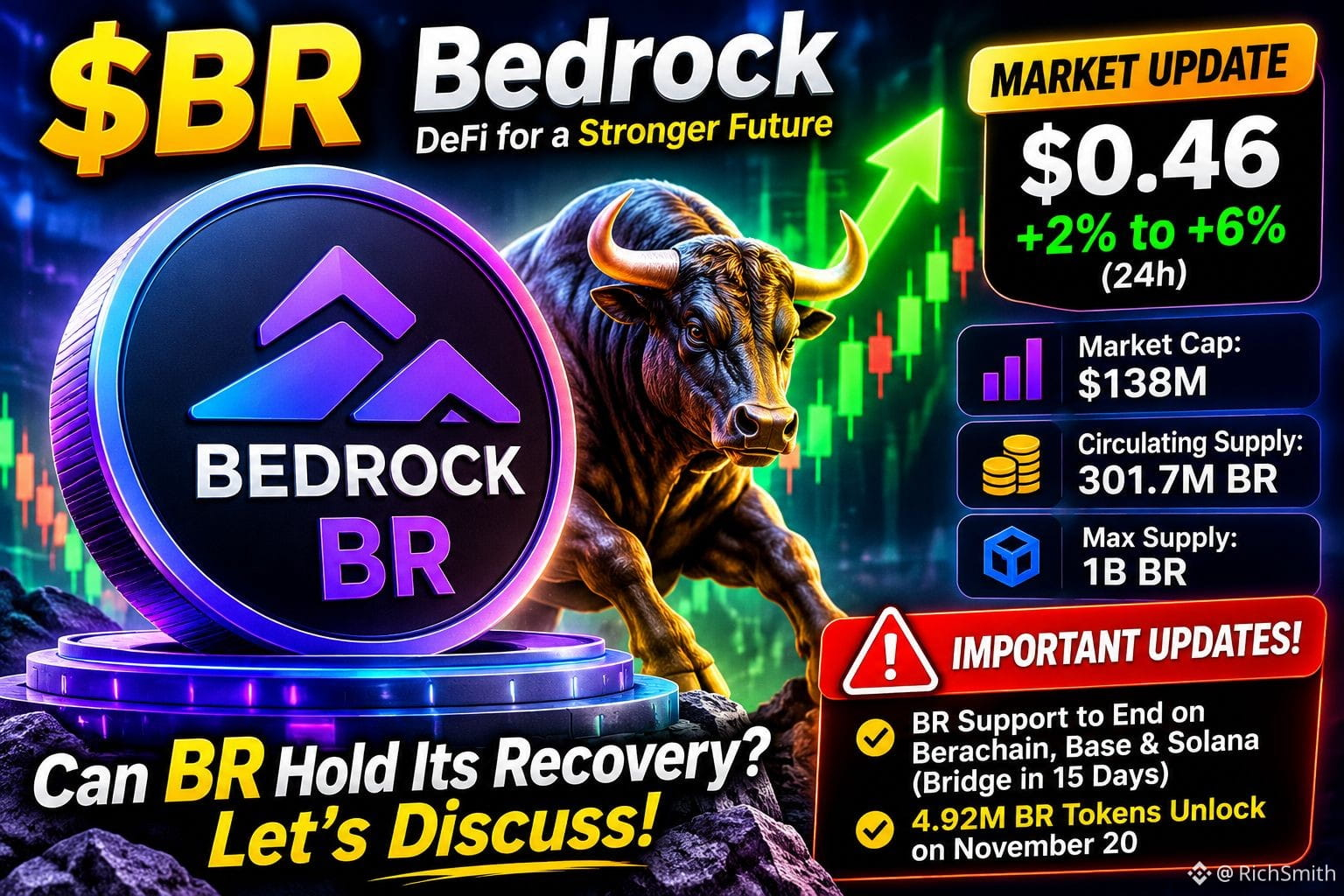
Can Bedrock($BR) maintain its recovery despite these developments, or could the upcoming supply increase and network changes create more selling pressure?
$BR IS MOVING! BUT THERE'S A BIG DEVELOPMENT INVESTORS SHOULD NOT IGNORE!
Bedrock ($BR) is attracting attention as its price attempts a short-term recovery.
November 18 Market Update
24-hour performance: Positive
Price: Around $0.46
Market capitalization: Approximately $138 million.
But here's where things get interesting!
BR has announced that it will discontinue Bedrock support on Berachain, Base and Solana, with the bridge scheduled to go offline in 15 days.
Users holding BR on those networks have been advised to bridge their tokens back to BNB Chain.
Another important date to watch is November 20, when approximately 4.92 million BR tokens are scheduled to unlock.
#BR #Bedrock #defi #CryptoNewss #BinanceSquare
Not financial advice.
1
313


·
--
🚀 $BR US Showing Strong Bullish Momentum!
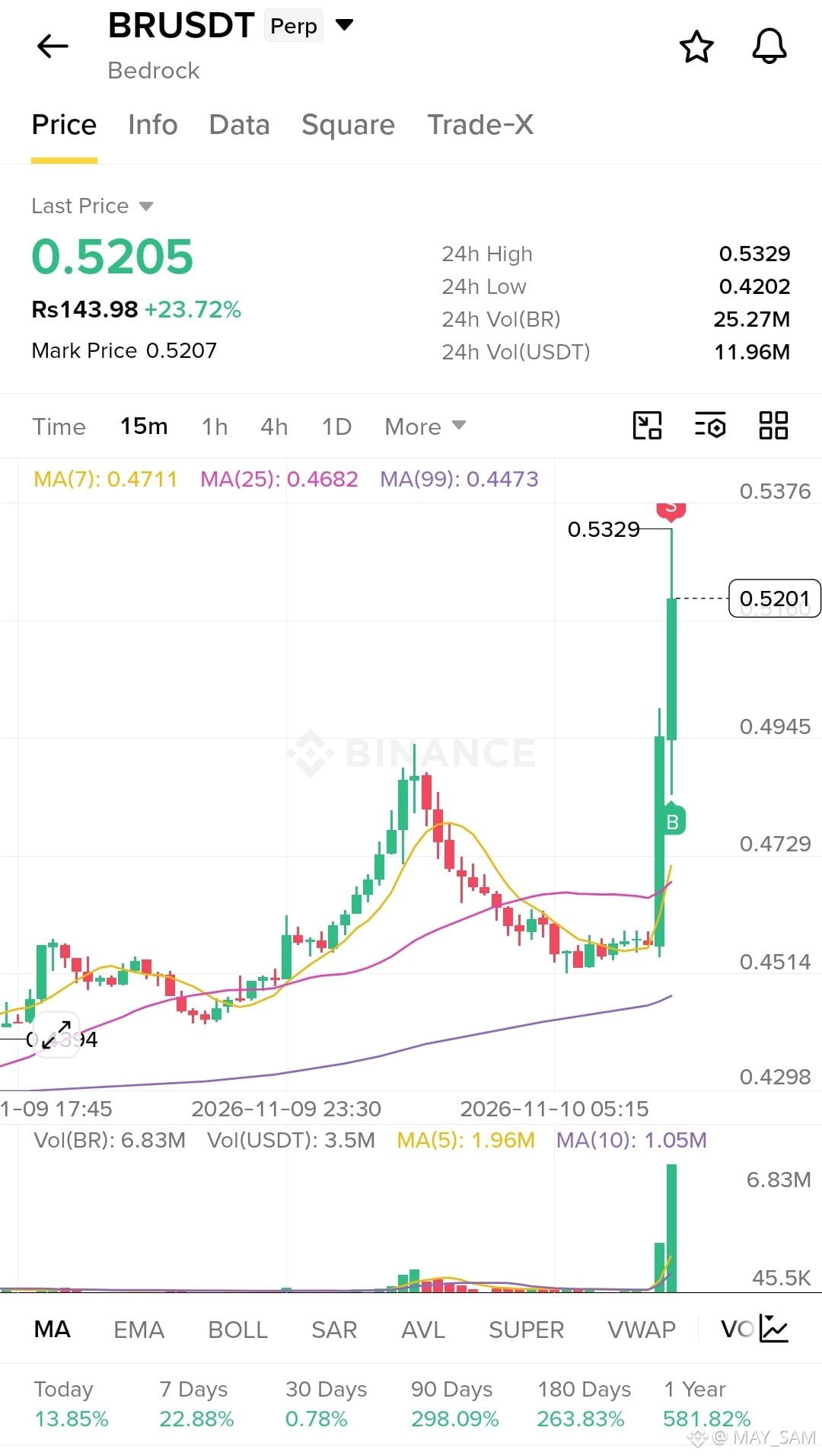
Bedrock ($BRUS) is trading around $0.5205, up 23.72% in 24 hours. The 15-minute chart shows a powerful breakout backed by a significant volume spike.
📊 Key Levels:
▫️ Resistance: $0.5329
▫️ Support: $0.4945
▫️ Next Support: $0.4729
If buying pressure continues and BRUS breaks above $0.5329, further upside may be possible. However, some profit-taking after this sharp rally cannot be ignored.
What's your view? Another breakout or a short-term correction?
Trade carefully and always manage your risk.
#BR #Bedrock #CryptoMarket #altcoins
1
3
379

·
--
Bullish
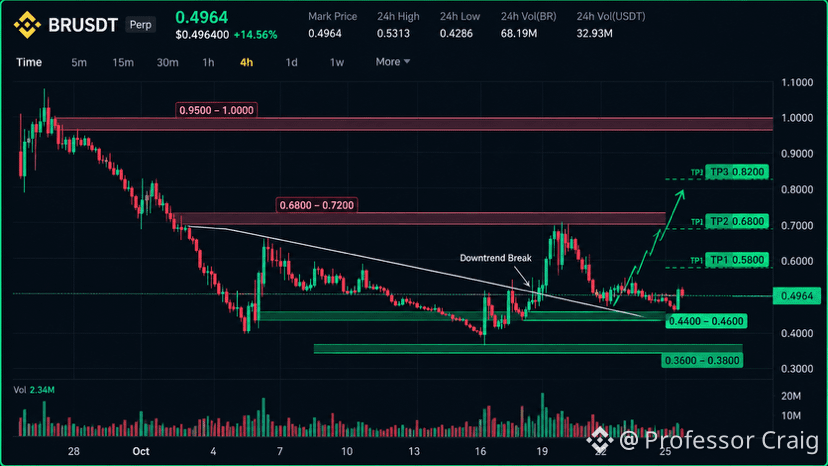
🚨$BR /USDT is preparing for its next major move. The downtrend has been challenged, and buyers are defending the $0.44–$0.46 support zone. I’m watching this chart closely because the next breakout could bring a strong recovery.
BRUSDT is trading around $0.4964 on the 4-hour chart after gaining 14.56% over the past 24 hours. After falling from above $1.00, the price has started showing signs of recovery, and the recent rally toward $0.70 suggests buyers are stepping back into the market. The key now is whether BR can build enough momentum to break above the nearby $0.53 resistance. The $0.44–$0.46 zone is the most important support to watch. As long as buyers defend this area, the bullish recovery setup remains in play. A breakout above $0.53 would strengthen the move toward $0.58, followed by $0.68–$0.72. If momentum continues and the upper resistance zone breaks, $0.82 becomes the next upside target.
My focus is on a sustained move above $0.53, which would give this setup a stronger bullish structure. Losing $0.44 would weaken the recovery and bring the $0.36–$0.38 support zone back into focus. BRUSDT is worth watching here, especially after the recent surge in momentum.
Key levels 🛑
* Current price: $0.4964
* Resistance: $0.53
* Target 1: $0.58
* Target 2: $0.68–$0.72
* Target 3: $0.82
* Support: $0.44–$0.46
* Major support: $0.36–$0.38
The next breakout could define BR’s direction for the coming sessions. Are you bullish on BRUSDT from here?
{future}(BRUSDT)
#bedrock #BRUSDT
🚨$BR /USDT is preparing for its next major move. The downtrend has been challenged, and buyers are defending the $0.44–$0.46 support zone. I’m watching this chart closely because the next breakout could bring a strong recovery.
BRUSDT is trading around $0.4964 on the 4-hour chart after gaining 14.56% over the past 24 hours. After falling from above $1.00, the price has started showing signs of recovery, and the recent rally toward $0.70 suggests buyers are stepping back into the market. The key now is whether BR can build enough momentum to break above the nearby $0.53 resistance. The $0.44–$0.46 zone is the most important support to watch. As long as buyers defend this area, the bullish recovery setup remains in play. A breakout above $0.53 would strengthen the move toward $0.58, followed by $0.68–$0.72. If momentum continues and the upper resistance zone breaks, $0.82 becomes the next upside target.
My focus is on a sustained move above $0.53, which would give this setup a stronger bullish structure. Losing $0.44 would weaken the recovery and bring the $0.36–$0.38 support zone back into focus. BRUSDT is worth watching here, especially after the recent surge in momentum.
Key levels 🛑
* Current price: $0.4964
* Resistance: $0.53
* Target 1: $0.58
* Target 2: $0.68–$0.72
* Target 3: $0.82
* Support: $0.44–$0.46
* Major support: $0.36–$0.38
The next breakout could define BR’s direction for the coming sessions. Are you bullish on BRUSDT from here?
#bedrock #BRUSDT
1
335

·
--
Bullish
#bedrock $BR One assumption that has followed crypto for years is that staking is fundamentally about locking assets and earning a return. It’s such a familiar idea that many people rarely stop to question it.
But after spending years watching staking infrastructure, DeFi markets, and liquidity mechanisms evolve, I think that view captures only part of the picture.
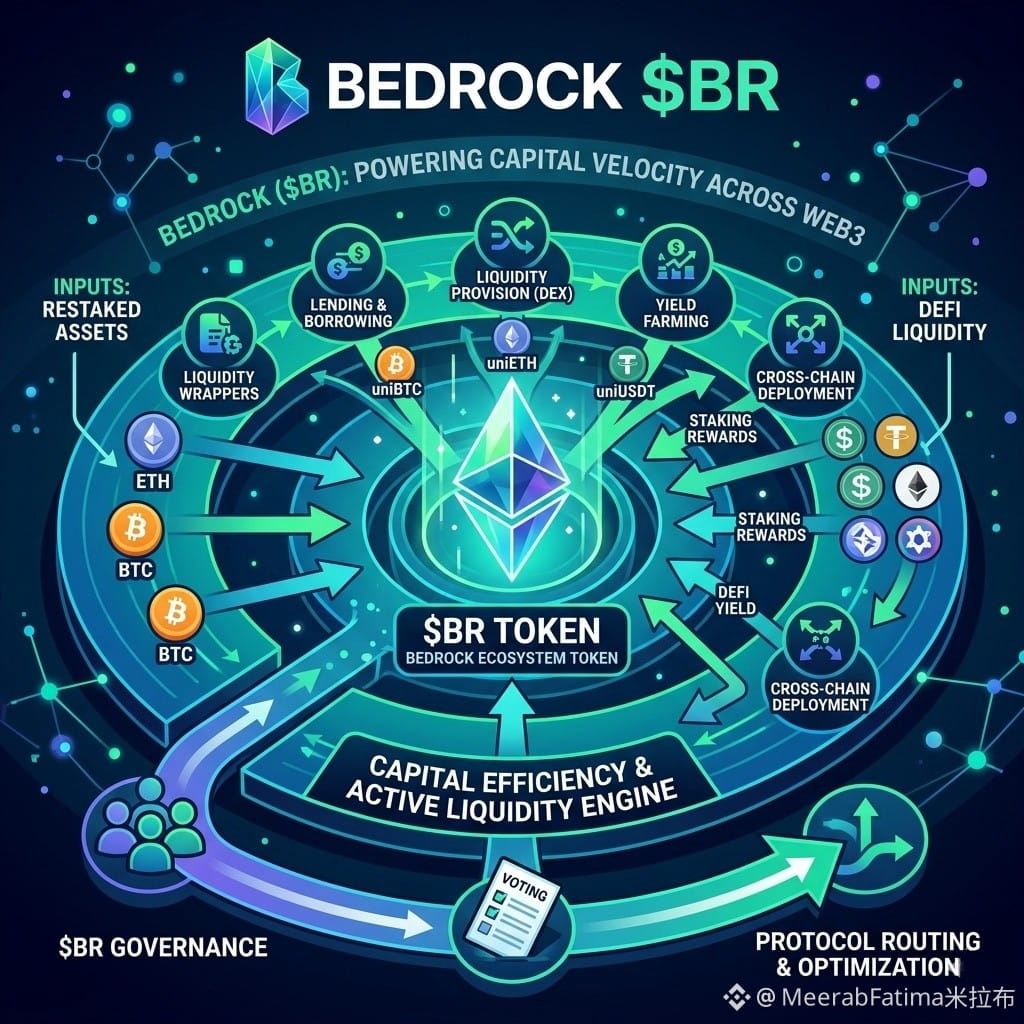
The more mature the industry becomes, the more the conversation shifts from yield to efficiency. Yield is relatively easy to understand. Capital efficiency is more subtle. It asks whether an asset can remain productive without becoming isolated from the rest of the ecosystem. Increasingly, that seems to be where innovation is happening.
One thing I’ve noticed over time is a change in how users think about idle assets. In earlier cycles, simply earning a return felt sufficient. Today, many participants view inactive liquidity as a hidden cost. There’s a growing awareness that every asset parked in one place represents a potential opportunity somewhere else.
That broader shift is part of what makes Bedrock ($BR) interesting to me. Not because of a particular feature or narrative, but because it reflects a larger effort to address a recurring challenge: how to keep capital active, useful, and adaptable across different environments without forcing unnecessary trade-offs.
The longer I observe crypto, the less I think value is created through passive ownership alone. More often, it emerges from the ability of capital to move, participate, and remain productive. That may be one of the most important changes taking place beneath the surface of modern crypto markets.
#BedrockBR @Bedrock $BR
{future}(BRUSDT)
#bedrock $BR One assumption that has followed crypto for years is that staking is fundamentally about locking assets and earning a return. It’s such a familiar idea that many people rarely stop to question it.
But after spending years watching staking infrastructure, DeFi markets, and liquidity mechanisms evolve, I think that view captures only part of the picture.
The more mature the industry becomes, the more the conversation shifts from yield to efficiency. Yield is relatively easy to understand. Capital efficiency is more subtle. It asks whether an asset can remain productive without becoming isolated from the rest of the ecosystem. Increasingly, that seems to be where innovation is happening.
One thing I’ve noticed over time is a change in how users think about idle assets. In earlier cycles, simply earning a return felt sufficient. Today, many participants view inactive liquidity as a hidden cost. There’s a growing awareness that every asset parked in one place represents a potential opportunity somewhere else.
That broader shift is part of what makes Bedrock ($BR ) interesting to me. Not because of a particular feature or narrative, but because it reflects a larger effort to address a recurring challenge: how to keep capital active, useful, and adaptable across different environments without forcing unnecessary trade-offs.
The longer I observe crypto, the less I think value is created through passive ownership alone. More often, it emerges from the ability of capital to move, participate, and remain productive. That may be one of the most important changes taking place beneath the surface of modern crypto markets.
#BedrockBR @Bedrock $BR
2
117

·
--
🚀 Bedrock Ecosystem Deep Dive: New Governance Paradigm in a Multi-Chain Setup
@Bedrock is a significant player in the liquid staking arena, and today I want to chat about its ecological positioning and competitive landscape. Many folks are just staring at the K-line fluctuations of $BR , overlooking the project's solid strides in cross-chain expansion and governance mechanisms.
First, let’s check some key data: $BR is currently priced at $0.1387, with a slight 24-hour pullback of -4.06%, but a 7-day increase of +5.27%, and a 30-day cumulative rise of +10.71%—the overall trend remains healthy. Its market cap is about $34.86 million, with a 24-hour trading volume of $6.14 million, ranking 587th on CoinGecko in terms of circulating market cap. Notably, the circulating supply of $BR is only 251 million tokens, accounting for 25.1% of the total supply of 1 billion—this means a large number of tokens have yet to hit the market, implying that as the protocol develops, the release pace of tokens will profoundly affect supply and demand.
📊 Multi-Chain Landscape: From BSC to Berachain
Bedrock has currently deployed on four chains—BNB Chain, Ethereum, Base, and Berachain. This multi-chain strategy is rare in the LSD space. Most liquid staking protocols tend to focus on a single chain (like Lido primarily targeting Ethereum), whereas Bedrock has chosen a path of "spreading its wings." The mainstream liquidity pool for $BR on BSC has around $760,000 in depth, making it the core trading venue in the ecosystem. The layouts on Base and Berachain show the team's forward-looking bets on emerging L2s and new public chain ecosystems.
🏛️ veBR Governance Model: Locking = Power
Bedrock's governance framework is based on the veBR (vote-escrowed) model, where users lock $BR on a 1:1 basis to receive veBR, allowing them to participate in decision-making on protocol parameters, incentive structures, and liquidity distribution. This is akin to Curve's veCRV model, but Bedrock applies it in the liquid staking governance domain, creating a closed loop of "staking → governance → rewards." This design not only enhances the long-term holding intention of the tokens but also provides a foundational guarantee for decentralized decision-making in the protocol's sustainable development.
🔍 Differentiation in the Competitive Landscape
In the LSD/LRT space, Lido dominates with over $20 billion in TVL, while Rocket Pool and Frax Ether have their own merits. Bedrock's differentiation lies in: first, it does not limit itself to liquid staking on a single chain but instead broadens its user base through multi-chain deployment; second, the veBR governance model grants token holders genuine voice in the protocol, rather than just passive holding; third, being listed in Binance Alpha Spotlight and Binance Wallet IDO indicates that the Binance ecosystem has given it a significant level of recognition.
💭 My Take
$BR currently has a pullback space of -46% compared to its ATH of $0.2571, but from its ATL of $0.0392 to now, it has seen a +253% rise, providing early participants with notable returns. The current valuation ($34.86 million market cap) for a four-chain deployed LSD protocol with a complete governance system isn't considered expensive—of course, this is contingent on the team continuing to drive TVL growth and cross-chain user conversion. I am more interested in whether the launch of Berachain can inject new liquidity into Bedrock and whether veBR governance is genuinely being actively utilized by the community.
In this fast-paced market, those willing to take the time to understand a project's underlying logic often go further than those who just watch the K-lines.
#Bedrock
161

·
--
#bedrock $BR
Innovation in DeFi depends on protocols that make assets work smarter, and @Bedrock is moving in that direction with Bedrock 2.0. I like the focus on improving capital efficiency, expanding multi-asset staking opportunities, and creating more utility for users across ecosystems. The long-term vision behind $BR is worth watching as the platform continues to evolve and attract more participants. Excited to follow the next milestones ahead. #bedrockoficial
Innovation in DeFi depends on protocols that make assets work smarter, and @Bedrock is moving in that direction with Bedrock 2.0. I like the focus on improving capital efficiency, expanding multi-asset staking opportunities, and creating more utility for users across ecosystems. The long-term vision behind $BR is worth watching as the platform continues to evolve and attract more participants. Excited to follow the next milestones ahead. #bedrockoficial
1
89

#bedrock $BR
Bitcoin restaking is exploding, and #bedrockoficial is leading the charge! Through uniBTC, they have unlocked massive liquidity for Bitcoin holders across multiple networks. By aggregating yield and securing decentralized networks, the protocol provides institutional-grade capital efficiency. Keep a close eye on $BR as the ecosystem scales up. Follow @Bedrock for the latest updates! 📈
#WorldShiftsToUtilityDrivenGrowth #USEquityFundingCostsSurge

87

·
--
I've noticed that @Bedrock is clearly trending in the multi-asset restaking space, and with Bedrock 2.0, they're starting to optimize better between maintaining liquidity and boosting yield, helping users avoid being 'capital locked' when staking like before; this aligns well with the current market where everyone wants cash flow flexibility, and if the rollout goes smoothly, $BR is still a name to watch in the upcoming DeFi narrative.
#Bedrock $BR
{future}(BRUSDT)
I've noticed that @Bedrock is clearly trending in the multi-asset restaking space, and with Bedrock 2.0, they're starting to optimize better between maintaining liquidity and boosting yield, helping users avoid being 'capital locked' when staking like before; this aligns well with the current market where everyone wants cash flow flexibility, and if the rollout goes smoothly, $BR is still a name to watch in the upcoming DeFi narrative.
#Bedrock $BR
#Bedrock $BR

4
2
220

·
--
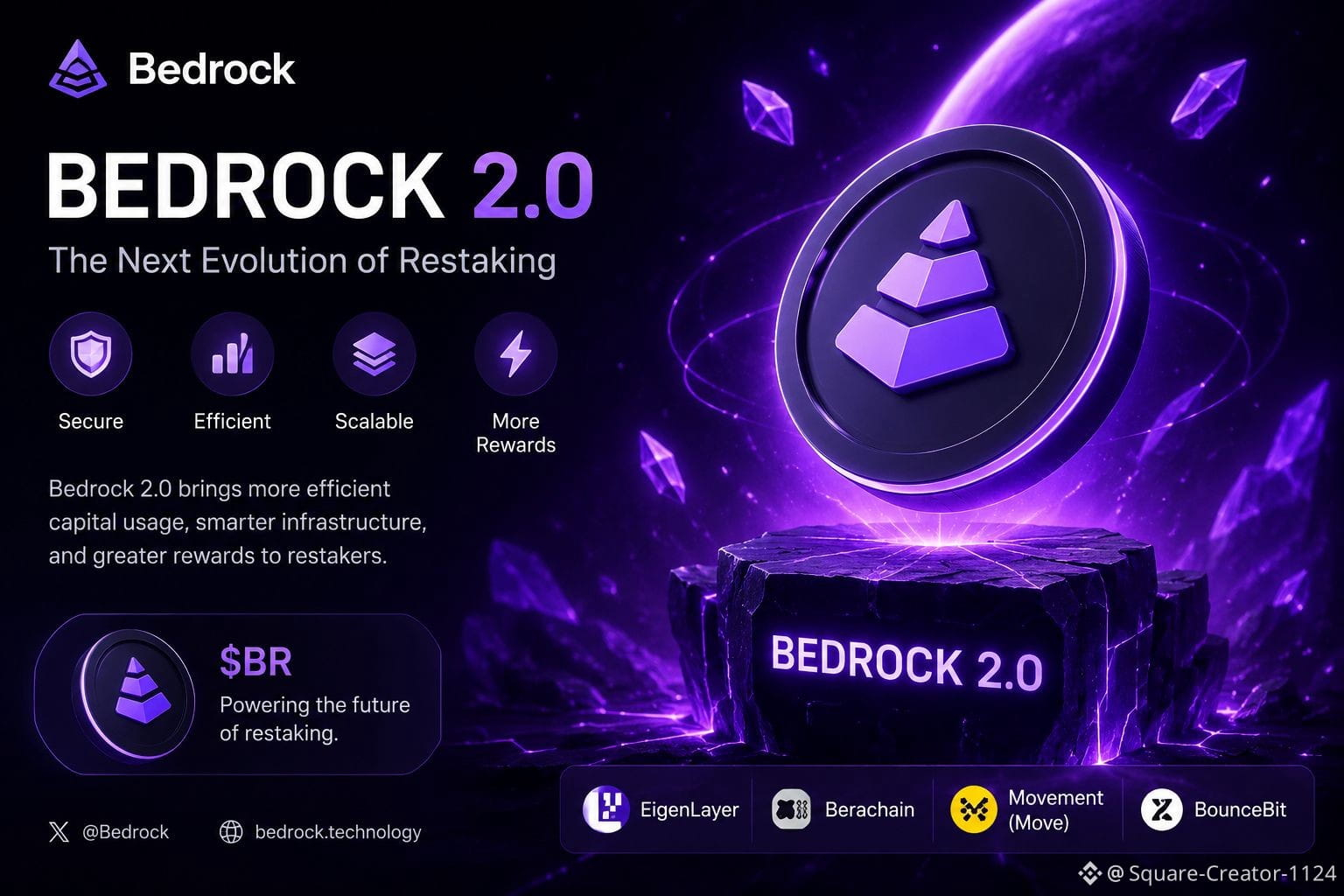
With the ramp-up in competition in the DeFi space, projects that can enhance asset efficiency are more crucial than ever. I see that Bedrock 2.0 is presenting an exciting vision by focusing on maximizing the use of collateralized assets and providing more flexible liquidity for users. I'm constantly tracking developments @Bedrock and looking forward to how $BR
{future}(BRUSDT)
will contribute to supporting the project's ecosystem growth in the upcoming phase. #Bedrock
With the ramp-up in competition in the DeFi space, projects that can enhance asset efficiency are more crucial than ever. I see that Bedrock 2.0 is presenting an exciting vision by focusing on maximizing the use of collateralized assets and providing more flexible liquidity for users. I'm constantly tracking developments @Bedrock and looking forward to how $BR
will contribute to supporting the project's ecosystem growth in the upcoming phase. #Bedrock
will contribute to supporting the project's ecosystem growth in the upcoming phase. #Bedrock
2
98

·
--
Bullish
$BR USDT has delivered a powerful +46.70% gain in the last 24 hours. The strong momentum indicates growing market attention and increased speculative activity. Traders should watch whether the price can hold above recent breakout levels. Sustained volume could support further upside, while a drop in momentum may lead to a pullback. Managing leverage carefully is important during highly volatile sessions. @Bedrock #Bedrock
{future}(BRUSDT)
$BR USDT has delivered a powerful +46.70% gain in the last 24 hours. The strong momentum indicates growing market attention and increased speculative activity. Traders should watch whether the price can hold above recent breakout levels. Sustained volume could support further upside, while a drop in momentum may lead to a pullback. Managing leverage carefully is important during highly volatile sessions. @Bedrock #Bedrock
128

·
--
$BR
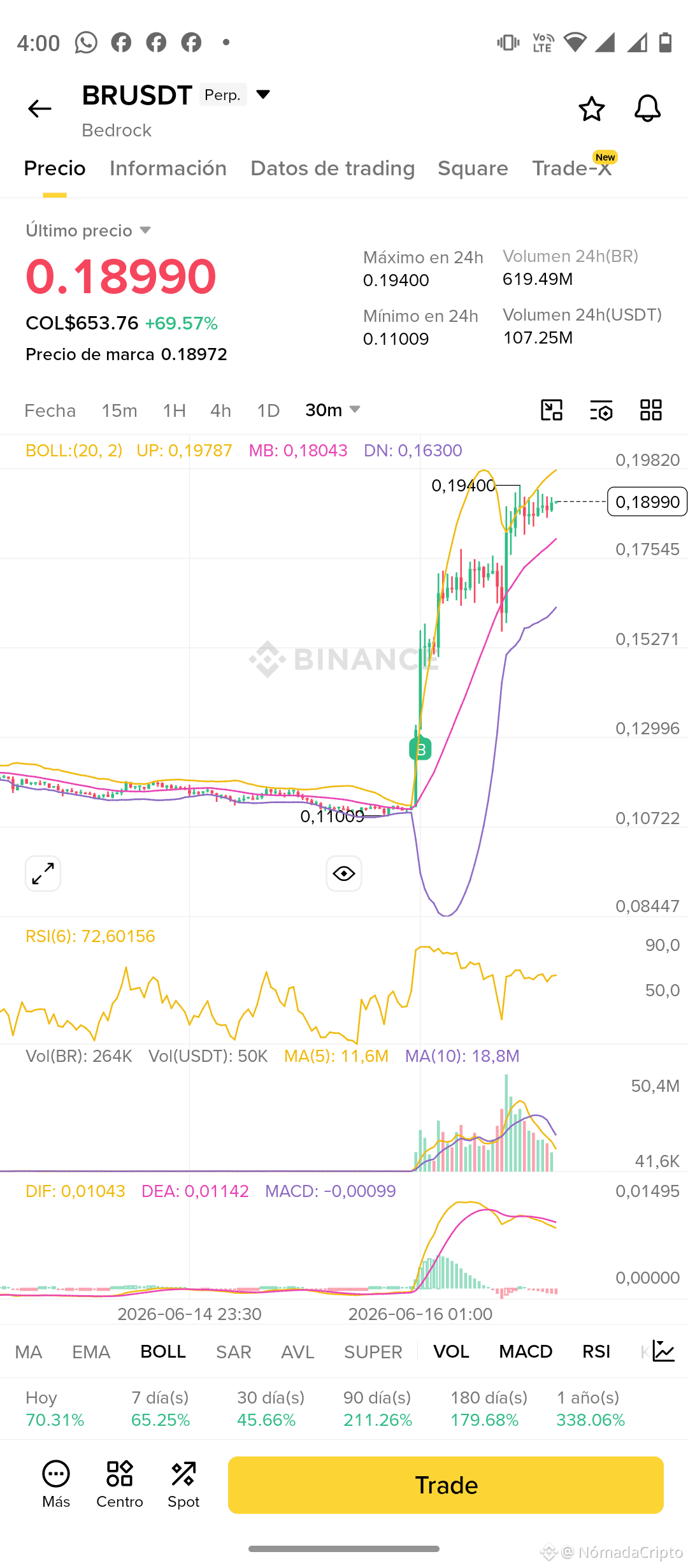
BR has turned into one of the hottest assets of the day after soaring nearly 70% in just 24 hours, breaking out of a long phase of stability.
What's really eye-catching is the speed of the move. After hovering around the 0.11 USDT mark for several days, buyers jumped in with force, pushing the price up to nearly 0.19 USDT, accompanied by a significant spike in traded volume.
When an asset stays quiet for such a long time and then experiences such an aggressive expansion, it tends to quickly attract the attention of traders looking to figure out if the momentum still has legs or if profit-taking is about to kick in.
For now, BR continues to trade close to its recent highs, a signal that keeps market interest alive while anticipation builds around its next move.
The question many are starting to ask is simple:
Are we witnessing the start of a new bullish phase for BR, or is the market nearing a zone where sellers will try to take back control?
$BR #Bedrock #Nomadacripto
{future}(BRUSDT)
$BR
BR has turned into one of the hottest assets of the day after soaring nearly 70% in just 24 hours, breaking out of a long phase of stability.
What's really eye-catching is the speed of the move. After hovering around the 0.11 USDT mark for several days, buyers jumped in with force, pushing the price up to nearly 0.19 USDT, accompanied by a significant spike in traded volume.
When an asset stays quiet for such a long time and then experiences such an aggressive expansion, it tends to quickly attract the attention of traders looking to figure out if the momentum still has legs or if profit-taking is about to kick in.
For now, BR continues to trade close to its recent highs, a signal that keeps market interest alive while anticipation builds around its next move.
The question many are starting to ask is simple:
Are we witnessing the start of a new bullish phase for BR, or is the market nearing a zone where sellers will try to take back control?
$BR #Bedrock #Nomadacripto
2
752

·
--
I've noticed that most people evaluate governance by looking at who gets voting power.
Lately, I've been thinking a different question might be more important: who is willing to wait for it?
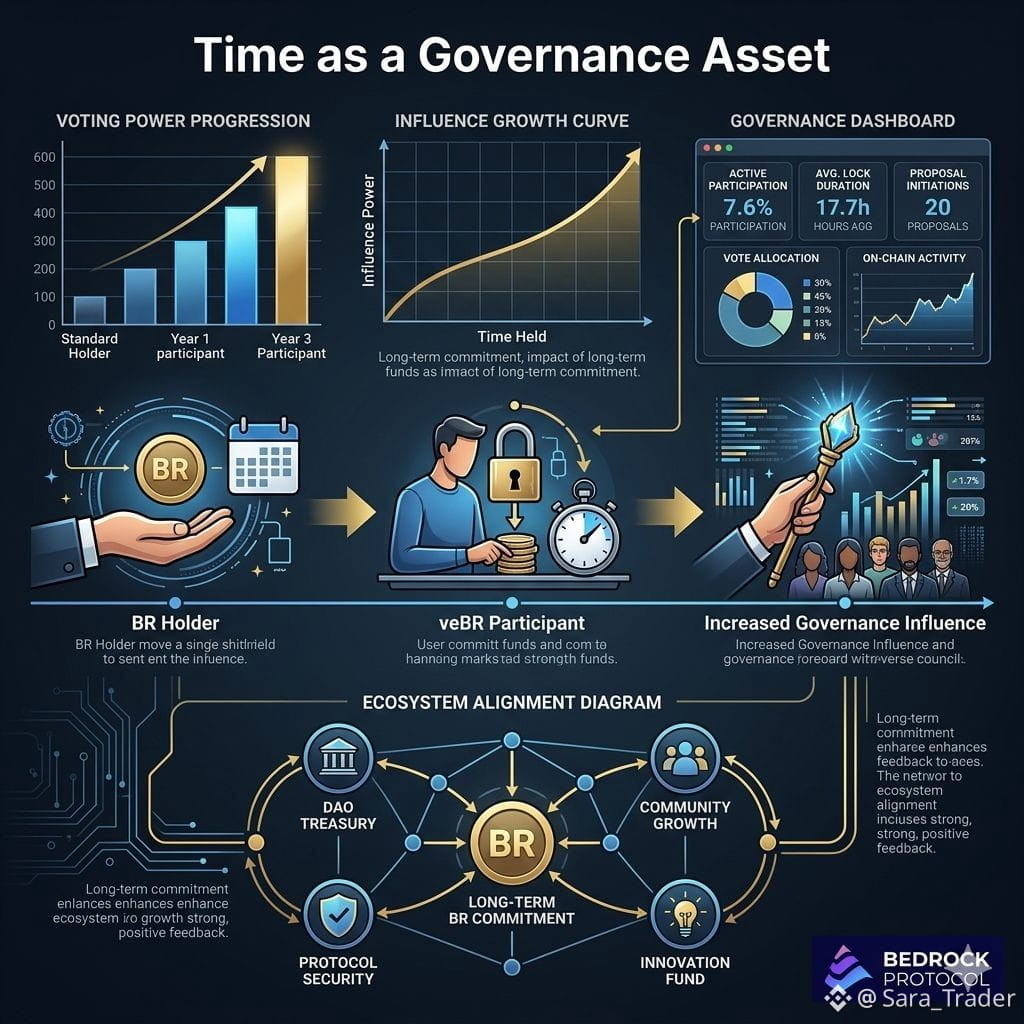
In Bedrock's model, influence isn't only tied to holding $BR. It becomes stronger through veBR and long-term participation. That creates an interesting dynamic because time itself becomes part of the governance process.
What catches my attention is that this changes the competition for influence. Instead of being purely about capital, it also becomes about commitment.
The market tends to reward speed. Governance often rewards patience.
Whether that leads to better decisions is something that can only be proven over time. But I do think it's an interesting experiment in aligning influence with participants who are willing to stay engaged beyond the next opportunity.
In a space where attention moves quickly, systems that value long-term commitment stand out to me.
@Bedrock $BR #Bedrock
I've noticed that most people evaluate governance by looking at who gets voting power.
Lately, I've been thinking a different question might be more important: who is willing to wait for it?
In Bedrock's model, influence isn't only tied to holding $BR . It becomes stronger through veBR and long-term participation. That creates an interesting dynamic because time itself becomes part of the governance process.
What catches my attention is that this changes the competition for influence. Instead of being purely about capital, it also becomes about commitment.
The market tends to reward speed. Governance often rewards patience.
Whether that leads to better decisions is something that can only be proven over time. But I do think it's an interesting experiment in aligning influence with participants who are willing to stay engaged beyond the next opportunity.
In a space where attention moves quickly, systems that value long-term commitment stand out to me.
@Bedrock $BR #Bedrock
1
1
160

·
--
Bearish
The tricky part isn’t creating a liquid restaking token. It’s making sure everything still adds up after people start using it.
While looking into Bedrock, I kept coming back to that point. The system can be live, but there’s still a lot happening behind the scenes—BTC and ETH rewards coming from different places, brBTC allocations being adjusted, and uniBTC/uniETH holders expecting the value they see to match what’s actually being generated underneath.
Bedrock is basically taking rewards from multiple layers like Babylon, Kernel, Pell, SatLayer and packaging that complexity into assets people can hold and use.
For me, the real test is simple: can users trust that one token still reflects the underlying strategy as more integrations get added?
That’s also where $BR starts to matter. Not because of bigger yield numbers, but because allocation decisions, incentives, and verification become harder as the stack grows.
My question is: how does Bedrock keep reward attribution transparent enough that users can verify where the value is actually coming from? @Bedrock $BR
{future}(BRUSDT)
#Bedrock
The tricky part isn’t creating a liquid restaking token. It’s making sure everything still adds up after people start using it.
While looking into Bedrock, I kept coming back to that point. The system can be live, but there’s still a lot happening behind the scenes—BTC and ETH rewards coming from different places, brBTC allocations being adjusted, and uniBTC/uniETH holders expecting the value they see to match what’s actually being generated underneath.
Bedrock is basically taking rewards from multiple layers like Babylon, Kernel, Pell, SatLayer and packaging that complexity into assets people can hold and use.
For me, the real test is simple: can users trust that one token still reflects the underlying strategy as more integrations get added?
That’s also where $BR starts to matter. Not because of bigger yield numbers, but because allocation decisions, incentives, and verification become harder as the stack grows.
My question is: how does Bedrock keep reward attribution transparent enough that users can verify where the value is actually coming from? @Bedrock $BR
#Bedrock
3
14
234

·
--
#bedrock $BR
The Bedrock project has always been a leader in its field, and with the announcement of Bedrock 2.0, I’m more convinced than ever that the project is heading toward significant milestones in its growth trajectory. The token $BR has promising potential given the robust infrastructure being built right now. I advise everyone to follow @Bedrock for the official and reliable updates as they come. #Bedrock
The Bedrock project has always been a leader in its field, and with the announcement of Bedrock 2.0, I’m more convinced than ever that the project is heading toward significant milestones in its growth trajectory. The token $BR has promising potential given the robust infrastructure being built right now. I advise everyone to follow @Bedrock for the official and reliable updates as they come. #Bedrock
5
138

·
--
I was having tea with Old Li over the weekend, and he was venting about getting wrecked by some DeFi project that was all hype and no substance. I just chuckled and waved it off; this kind of 'noob move' — only focusing on the buzz without checking the fundamentals — isn't new in the crypto space. Honestly, if you're looking for a solid long-term asset, I've recently been eyeing @Bedrock , and it actually has something going for it.
First off, its TVL (Total Value Locked) trend is looking super healthy, following a classic 'stair-step' pattern. Unlike those 'zigzag' protocols that rely on hefty subsidies to stay alive and have funds bouncing around, Bedrock has every rally accompanied by key developments like new chain integrations or collaborations with new ecosystems. Once the funds rise, they settle down nicely, and the longer the consolidation period, the stronger the real user engagement, which shows its solid foundation.
Secondly, its Delta-neutral strategy is a genuine 'compound interest ticket.' The logic here is to use BTC spot as collateral for safe returns and hedge directional risk through perpetual contracts, only making money off funding rates and staking interest differentials. An annualized return of 8 to 15 percent might not seem thrilling, but the drawdowns are kept firmly in single digits. In a market where high yields often come with high liquidation risks, this 'less lose' strategy can actually go the distance.
Lastly, its multi-routing and AI navigation design are quite clever. Bedrock 2.0 has integrated 15 chains and multiple AVS protocols, paired with BRClaw, the on-chain AI analyst, which helps regular users quickly assess vault opportunities. As long as the data sources are independent enough, this kind of tool can significantly lower the cognitive barriers for users.
Overall, in this market full of black swan events, Bedrock, which is driven by real business and focuses on risk control, is definitely more reliable than those projects that just play with 'future narratives.' If it were you, which core advantage would you prioritize in the DeFi space? @Bedrock #bedrock $BR
A. 稳健的“台阶型”TVL 底盘
80%
B. 主打“少输”的 Delta 中性策略
20%
C. 降维打击的“AI 导航 + 多路由”
0%
D. 成年人不做选择,我全都要!
0%
10 votes • Voting closed
1
4
2.1k

·
--
#bedrock $BR @Bedrock I didn't really pay much attention to Bedrock the first few times I saw people talking about it.
There are so many BTCFi projects now that after a while they all start sounding similar. Higher yield, better efficiency, more opportunities... you've heard it all before.
But when I spent some time reading about Bedrock, the uniBTC part actually made me stop for a minute.
One thing I've always found strange about Bitcoin is how much value just sits there doing nothing. People hold BTC for years, which makes sense, but at the same time that liquidity isn't really being used.
Bedrock seems to be built around that exact problem.
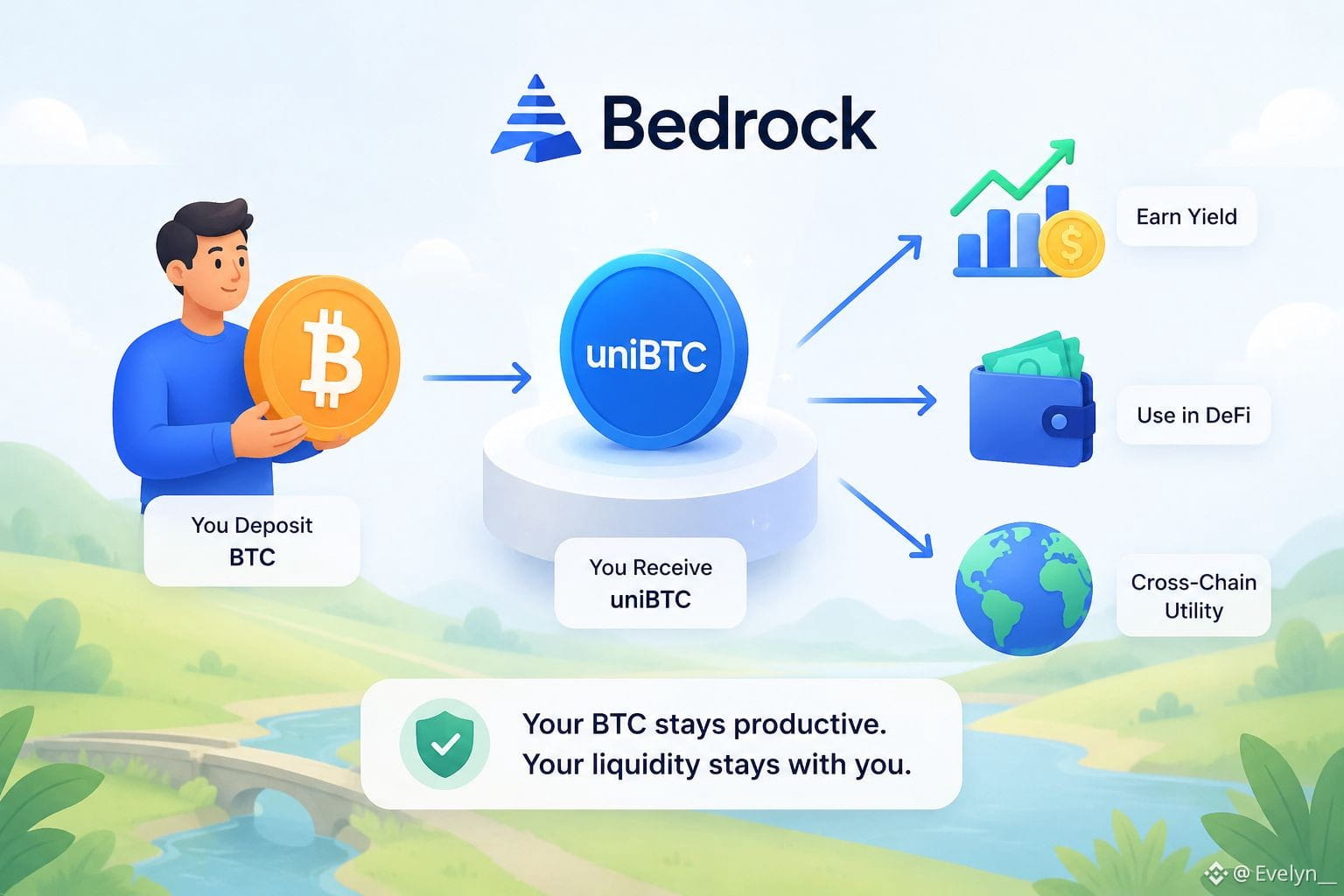
The idea behind uniBTC is pretty simple. You deposit Bitcoin-related assets and receive uniBTC in return. So instead of choosing between holding BTC or exploring DeFi opportunities, you can keep exposure while still having something liquid to use across the ecosystem.
I think that's the reason it has gained attention recently.
The growth numbers are hard to ignore too. Bedrock has expanded to more than 19 chains, integrated with 60+ DeFi protocols, and its TVL has already crossed $470M. For me, that says people are actually using the product rather than just talking about it on social media.
The more I look at it, the more it feels like Bedrock isn't trying to reinvent Bitcoin. It's trying to make existing Bitcoin liquidity more useful.
Maybe that's why I keep seeing its name come up whenever the BTCFi conversation starts.
4
3
252

·
--
Bullish
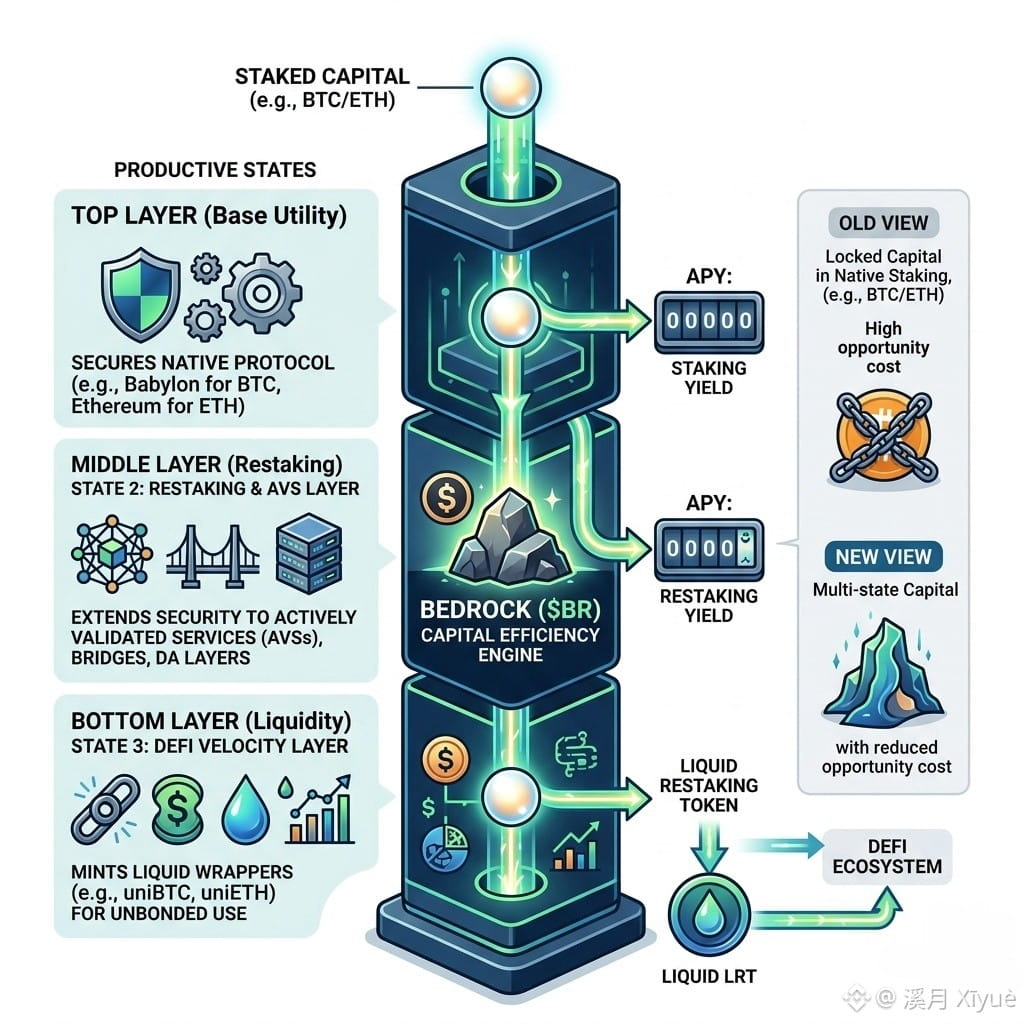
Most people who've been around crypto long enough treat staking yield as a destination. You commit your assets, the protocol rewards you, and that's the end of the thought process. I held that view for longer than I'd like to admit.
What gradually changed my thinking wasn't a single protocol or mechanism it was watching how sophisticated capital actually behaves over time. It doesn't rest. It moves through layers, finds compounding surfaces, and treats any static position as a temporary compromise rather than a strategy.
The uncomfortable realization I kept arriving at was this: most retail participants accept opportunity cost as a fixed condition of participating in staking, rather than a problem worth solving. That acceptance has become so normalized it barely registers as a limitation anymore.
But the infrastructure conversation has quietly moved on. The more interesting question being asked now isn't how much yield a position generates in isolation it's how many productive states a single unit of capital can occupy without fragmenting its underlying value or sacrificing access.
Bedrock exists somewhere inside that question. What draws my attention isn't the yield mechanics specifically, but the fact that it seems to be designed around a different assumption entirely that staked capital shouldn't have to choose between being productive and remaining useful elsewhere.
Whether that becomes a lasting framework or just another cycle narrative, I genuinely don't know. But I think the underlying premise deserves more serious consideration than most people are currently giving it.
$BR @Bedrock #bedrock
{alpha}(560xff7d6a96ae471bbcd7713af9cb1feeb16cf56b41)
Most people who've been around crypto long enough treat staking yield as a destination. You commit your assets, the protocol rewards you, and that's the end of the thought process. I held that view for longer than I'd like to admit.
What gradually changed my thinking wasn't a single protocol or mechanism it was watching how sophisticated capital actually behaves over time. It doesn't rest. It moves through layers, finds compounding surfaces, and treats any static position as a temporary compromise rather than a strategy.
The uncomfortable realization I kept arriving at was this: most retail participants accept opportunity cost as a fixed condition of participating in staking, rather than a problem worth solving. That acceptance has become so normalized it barely registers as a limitation anymore.
But the infrastructure conversation has quietly moved on. The more interesting question being asked now isn't how much yield a position generates in isolation it's how many productive states a single unit of capital can occupy without fragmenting its underlying value or sacrificing access.
Bedrock exists somewhere inside that question. What draws my attention isn't the yield mechanics specifically, but the fact that it seems to be designed around a different assumption entirely that staked capital shouldn't have to choose between being productive and remaining useful elsewhere.
Whether that becomes a lasting framework or just another cycle narrative, I genuinely don't know. But I think the underlying premise deserves more serious consideration than most people are currently giving it.
$BR @Bedrock #bedrock
150

·
--
#bedrock $BR After three years of re-staking on-chain, one thing is becoming increasingly clear: everyone is busy mining new tokens, yet no one wants to refine the mined ore into usable coins for the average Joe.
EigenLayer has built a massive mining operation, Babylon has opened a new pit on the Bitcoin main chain, and newcomers like Kernel are also snatching up land. But if you dig a little deeper, you’ll uncover an awkward truth: miners throw their ore in, yet end up with a mixed bag of yield certificates that need translating when crossing chains. The upstream of this race has turned into a red ocean, while the mid and downstream refining and circulation layers are nearly empty.
Bedrock aims to fill this gap. It doesn’t touch mining rigs or compete for mining rights; it focuses solely on one thing—melting down outputs from different mines into standardized liquid gold bars. uniBTC is a cross-chain furnace specifically designed for BTC, the heaviest mining vein, while brBTC is a standardized alloy mixed according to the PoSL formula from multiple sources like Babylon and Kernel. veBR acts as the governance valve that redistributes furnace control every quarter.
This choice appears to sidestep the heavy lifting, but the conditions are stringent. Operating solely at the refining layer means you don’t hold any mining veins, block production rights, or even influence the slash rules. What you offer is just the furnace and the recipe, and these two components are the easiest to replicate on-chain. The Hyperliquid-style full-stack integration is the paradigm worshipped in this circle, while Bedrock’s "middleman only" route inherently carries political incorrectness.
But it must be politically incorrect. The re-staking track has reached a critical point: there are enough mines built; the next challenge is who can turn the ore into circulating currency. The main focus for EigenLayer and Babylon is scaling production; they lack the bandwidth or motivation to translate every mine's output into a single financial language. This translation task is where Bedrock comes in.
So the real question isn’t whether Bedrock can outdo EigenLayer or Babylon—that question is fundamentally misplaced. The real question should be: when there are enough mining operations on-chain, who will be responsible for turning the ore into coins? Bedrock hasn't submitted its paper yet, but at least it's one of the few in the exam room who's put pen to paper. For this reason alone, it’s worth keeping an eye on.
210

·
--
This afternoon, I flipped through a cross-chain yield platform, and the page was filled with a bunch of BTC wrapped assets. My first reaction wasn’t to FOMO in, but rather to check what assets it actually supports and which chains it's running on. The biggest fear for BTCFi isn’t having too few entry points, but rather having too many chaotic ones.
I looked at @Bedrock 's Bedrock 2.0, and the key lies in this 'compatibility layer'. BTC-related assets have become a multi-faceted beast, with wBTC, uniBTC, various wrapped BTCs, and liquidity versions on different chains, each having their own use cases. The problem is, users can’t always figure out which asset can enter which protocol, which chain is more suitable, and which yield sources can connect. What Bedrock 2.0 aims to do is consolidate these scattered BTC asset entry points into a more unified participation framework.
brBTC's design is worth dissecting. It’s not just creating another BTC name; it’s more like an adapter within BTCFi, connecting uniBTC and various wrapped BTCs into the same yield acceptance layer. For users, the focus isn’t on remembering a bunch of complex paths, but knowing their BTC-related assets can enter broader DeFi scenarios through Bedrock. For the protocols, the value lies in connecting the dots between different asset formats, chain environments, and yield protocols.
The technical philosophy of Bedrock 2.0 is actually about reducing the fragmentation cost within BTCFi. In the past, $BTC BTC holders wanting to participate in on-chain yields often faced barriers like cross-chain issues, wrapping, protocol choices, and asset conversions; Bedrock serves as an intermediary asset adaptation infrastructure, allowing BTC capital to flow more smoothly into Ethereum, BNB Chain, and more restaking and yield sources.
When observing $BR long-term, we need to consider it within this compatibility network. If Bedrock can continuously expand its asset access range, enhance protocol adaptability, and improve user experience when entering BTCFi, then the value BR captures won’t just be about the hype of single products, but the coordinated value of the entire Bedrock 2.0 multi-asset yield network.
What BTCFi is competing on isn’t who has more concepts, but who can make complex entry points more unified. #bedrock #BTC #ETH
{future}(BTCUSDT)
{future}(BRUSDT)
{future}(ETHUSDT)
This afternoon, I flipped through a cross-chain yield platform, and the page was filled with a bunch of BTC wrapped assets. My first reaction wasn’t to FOMO in, but rather to check what assets it actually supports and which chains it's running on. The biggest fear for BTCFi isn’t having too few entry points, but rather having too many chaotic ones.
I looked at @Bedrock 's Bedrock 2.0, and the key lies in this 'compatibility layer'. BTC-related assets have become a multi-faceted beast, with wBTC, uniBTC, various wrapped BTCs, and liquidity versions on different chains, each having their own use cases. The problem is, users can’t always figure out which asset can enter which protocol, which chain is more suitable, and which yield sources can connect. What Bedrock 2.0 aims to do is consolidate these scattered BTC asset entry points into a more unified participation framework.
brBTC's design is worth dissecting. It’s not just creating another BTC name; it’s more like an adapter within BTCFi, connecting uniBTC and various wrapped BTCs into the same yield acceptance layer. For users, the focus isn’t on remembering a bunch of complex paths, but knowing their BTC-related assets can enter broader DeFi scenarios through Bedrock. For the protocols, the value lies in connecting the dots between different asset formats, chain environments, and yield protocols.
The technical philosophy of Bedrock 2.0 is actually about reducing the fragmentation cost within BTCFi. In the past, $BTC BTC holders wanting to participate in on-chain yields often faced barriers like cross-chain issues, wrapping, protocol choices, and asset conversions; Bedrock serves as an intermediary asset adaptation infrastructure, allowing BTC capital to flow more smoothly into Ethereum, BNB Chain, and more restaking and yield sources.
When observing $BR long-term, we need to consider it within this compatibility network. If Bedrock can continuously expand its asset access range, enhance protocol adaptability, and improve user experience when entering BTCFi, then the value BR captures won’t just be about the hype of single products, but the coordinated value of the entire Bedrock 2.0 multi-asset yield network.
What BTCFi is competing on isn’t who has more concepts, but who can make complex entry points more unified. #bedrock #BTC #ETH
世界杯西班牙对战佛得角在踢假球
76%
世界杯西班牙对战佛得角没有踢假球
24%
21 votes • Voting closed
2
2k
Log in to explore more content
Join global crypto users on Binance Square
⚡️ Get latest and useful information about crypto.
💬 Trusted by the world’s largest crypto exchange.
👍 Discover real insights from verified creators.
Email / Phone number
Trending Topics
1
#BTCReboundsAbove$60KAmidWhaleDipBuying
25,160 views
152 Discussing
2
#SolanaSets2027RoadmapToDoubleComputeCapacity
9,612 views
284 Discussing
3
#CaliforniaNvidiaProbeExaminesPotentialCriminalViolations
3,667 views
45 Discussing
4
#BlackRockLaunchesHKDollarDigitalLiquidityFund
8,048 views
257 Discussing
5
#NvidiaLoses$2.7TrillionInMonthAndAHalf
56,058 views
253 Discussing
6
#GlobalStocksFaceLongestLosingStreakSince2023
463,997 views
2,977 Discussing
7
#BlackRockIBITPostsRecord$541MSingleDayOutflow
72,829 views
158 Discussing
8
#AnthropicPlungesTowardIPOPriceonDay2
253,677 views
1,970 Discussing
9
#TwentyOneCapitalAdds172.25BTC
125,880 views
1,317 Discussing
10
#HKBillWouldExcludeTokenizedDepositsFromVirtualAssets
15,863 views
90 Discussing