
币圈导航0xnav
497 Posts

币圈导航0xnav
Report
Block User
🎈币安手续费邀请码:FANXIAN,频繁交易的手续费,甚至可能超过你的本金,这是一大笔费用!
36 Following
82 Followers
104 Liked
Posts
All
Videos
·
--
In the future, when you send money to a contact through a payment app commonly used in Korea, it might not be Korean won—it could be Ethereum or a dollar stablecoin. But don’t mistake this for “another kind of deposit in a bank account.”
On November 16, Viva Republica, the company behind Toss, announced that it would launch a non-custodial digital asset wallet called “Toss Coin Wallet” (토스 코인지갑) in the app this week. According to the company, Toss users won’t need to apply separately or meet any eligibility requirements; they can create a wallet in the “Assets” section on the home screen.
A few things that matter to everyday users 👇
🔹 What you can do: Receive assets transferred from an external exchange or another wallet, and send them to external wallets. You can view your holdings, balances, and transaction history in the Toss app. Toss users can also send money to each other through their contacts, without entering a long wallet address.
🔹 Only three assets are supported at first, and all are on Ethereum: ETH, USDT, and USDC. The company says these were selected based on global trading volume and usefulness, and that it will gradually add more assets and networks once the service is stable. For now, don’t assume you can transfer just any coin through the app.
🔹 Fees and protections are separate issues: Toss won’t charge an additional transfer fee, but transfers on the Ethereum network require Gas fees. USDT and USDC transfers also require ETH to pay those fees. According to the in-app FAQ, these digital assets are not covered by deposit insurance. The FAQ also says Toss securely protects users’ private keys; even if you lose your phone, you can use your existing wallet and assets after reinstalling the Toss app on a new phone. This isn’t quite the same as the familiar model where “the recovery phrase is only in your hands, and if you lose it, it’s gone,” so don’t assume that users have complete control of their keys themselves.
🔹 There are restrictions on transfers from Korean exchanges, too: According to reports, Bithumb users must pre-register their Toss wallet address and get it approved. For now, they can only transfer digital assets worth less than 1 million won; transfers of 1 million won or more aren’t supported through this route. Coinone users must also pre-register their address and get approval before transferring.
This isn’t an exchange, and it doesn’t mean Toss has already obtained a Virtual Asset Service Provider (VASP) license. Reports say Toss is preparing to apply for one so it can support stablecoin payments at its own payment terminals in the future. That’s a planned next step—not a license that has already been granted, and certainly not a sign that you can already pay with stablecoins in stores.
So, more accurately, this is a wallet launching in a commonly used financial app this week, with a limited range of send-and-receive functions. It’s not a new bank deposit, and it’s not yet a tool for accepting stablecoin payments.
Which matters more to you: “being able to send money to a contact in an app you already use,” or “no deposit insurance, and having to pay the Gas fees yourself”?
#韩国Toss本周推出非托管钱包 #ETH #BTC

17
·
--
A license being approved does not mean the trading platform is already live. The U.S. Commodity Futures Trading Commission has just granted Backpack the two credentials it needs to offer derivatives trading and clearing in the United States.
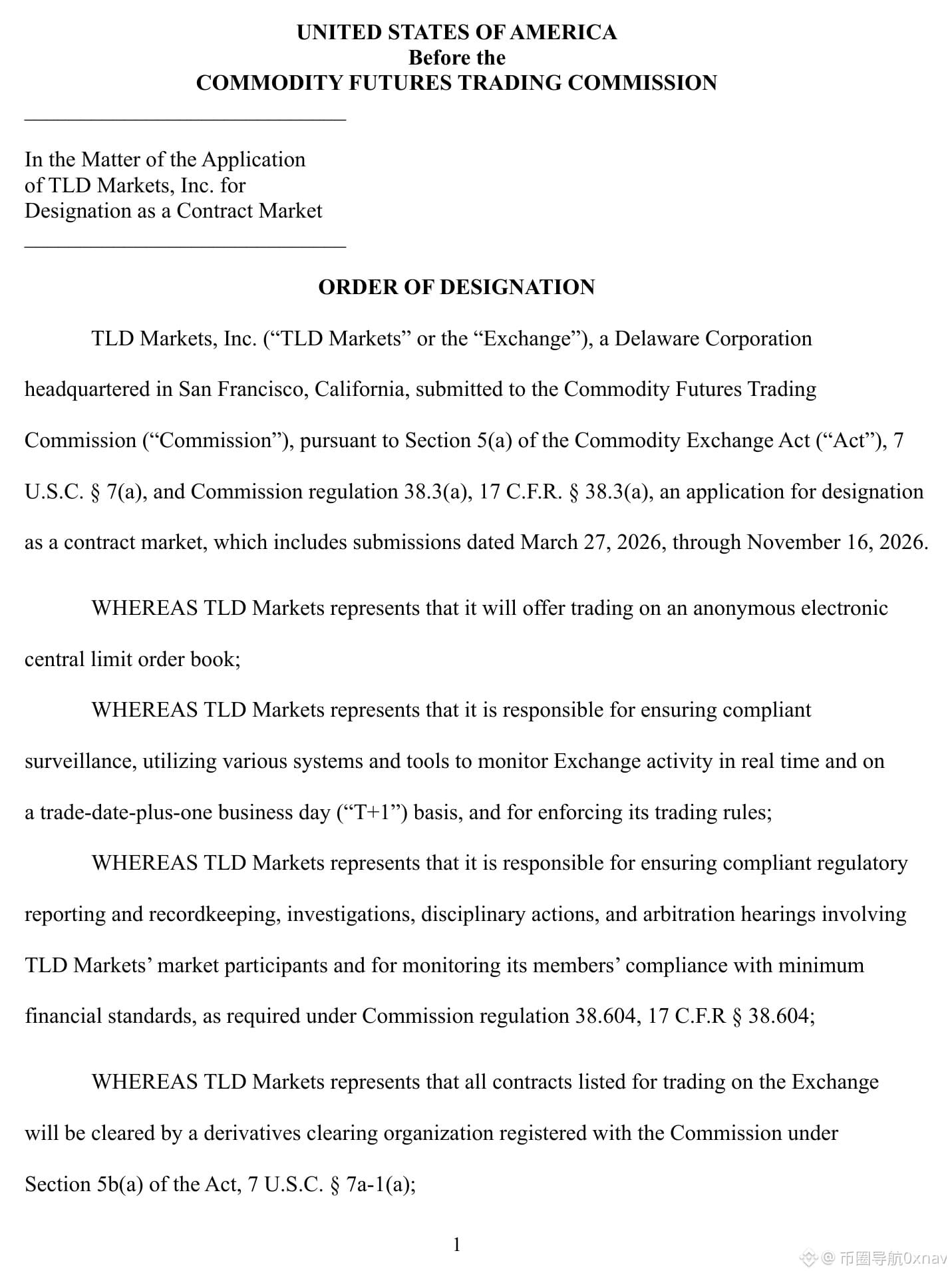
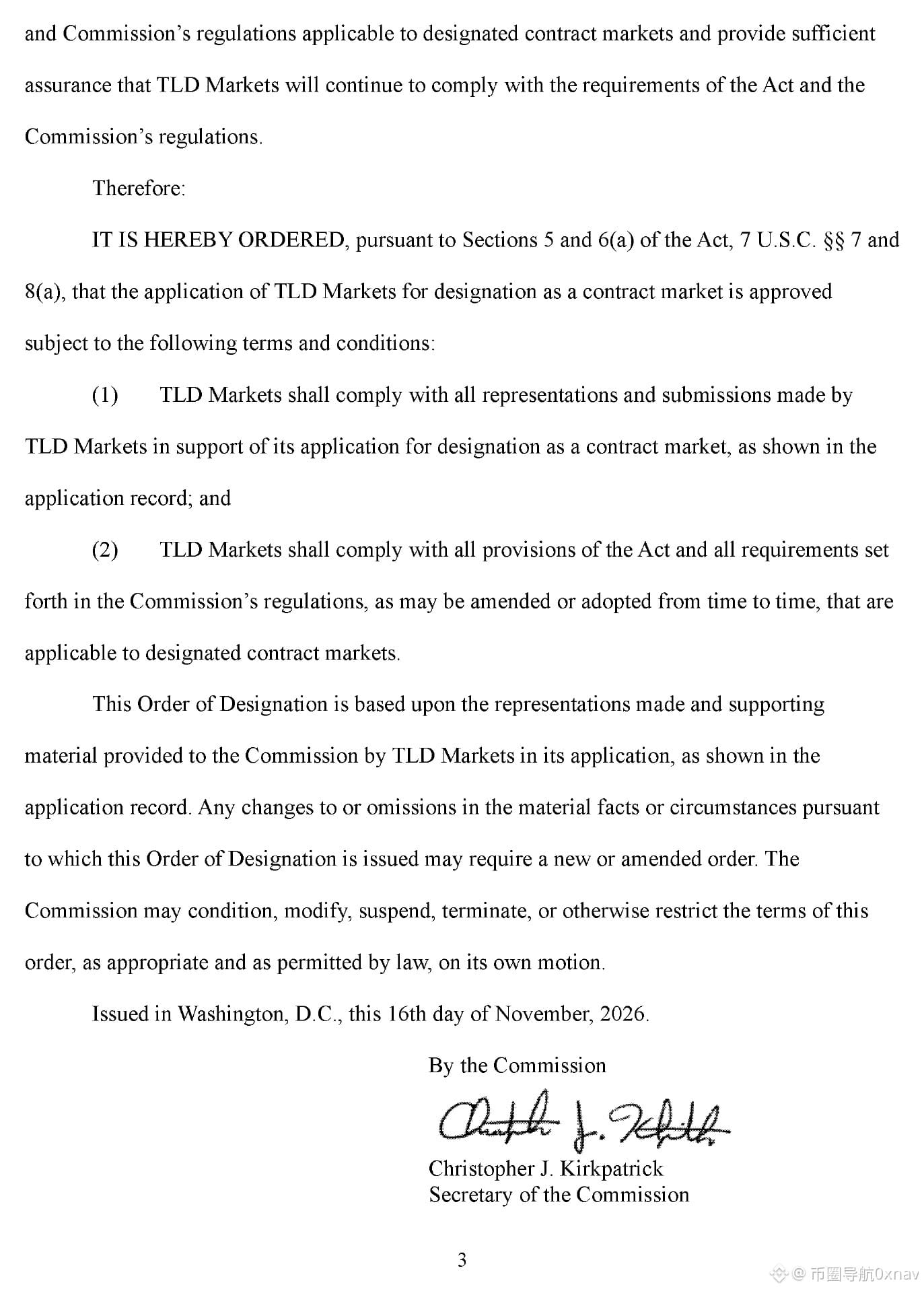
On November 16, U.S. time, the CFTC issued an order in Washington designating TLD Markets, Inc. as a designated contract market (DCM). The order was signed by Commission Secretary Christopher J. Kirkpatrick. The public filing page (Docket No. 60617) lists its status as Designated and the date as 2026-11-16. The application materials were submitted between March 27 and November 16, 2026.
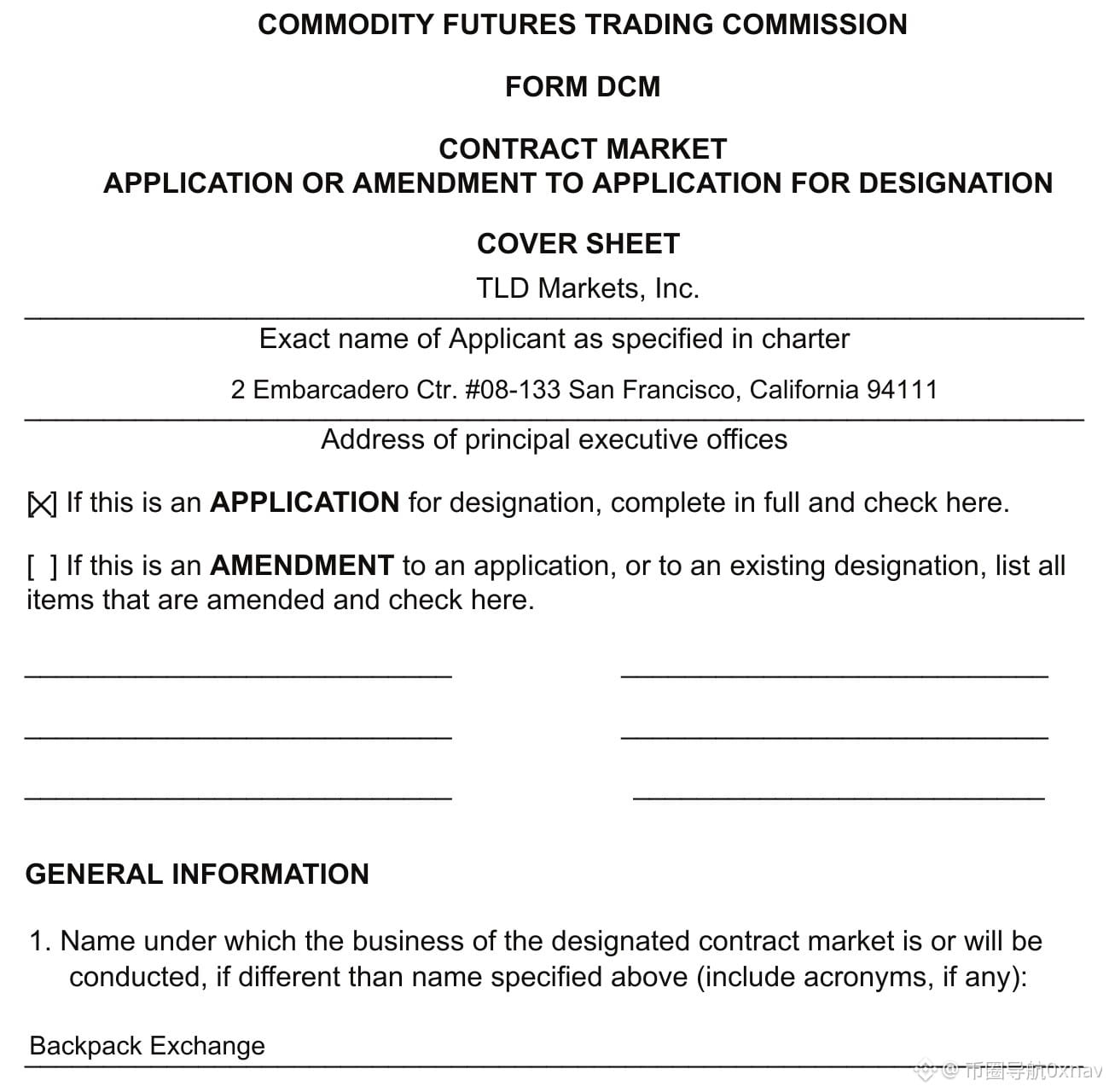
The designation order names TLD Markets, not Backpack. But the Form DCM cover page in the same public filing states that the designated contract market operates under the name Backpack Exchange and is located at 2 Embarcadero Ctr. in San Francisco.
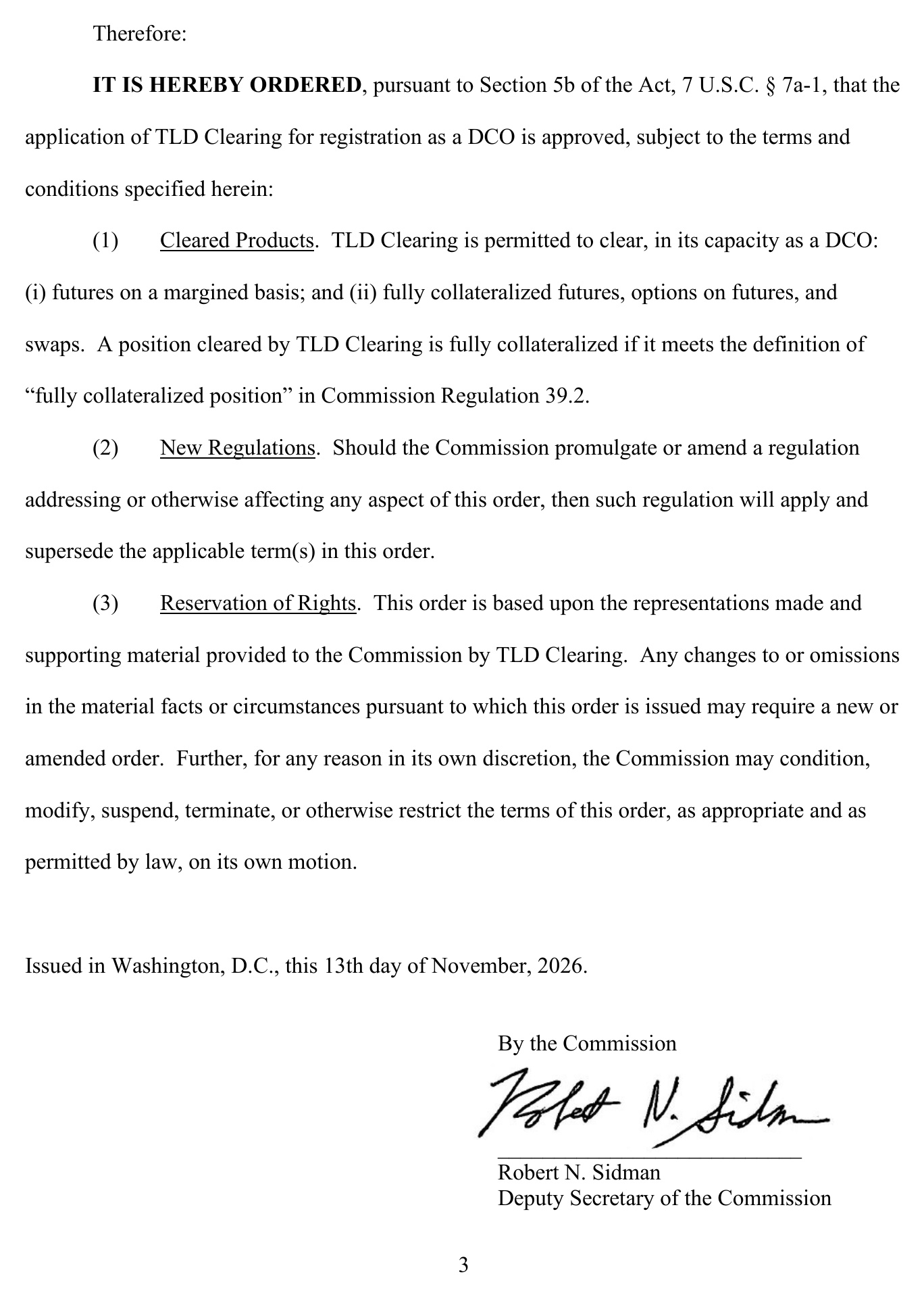
Three days earlier, on November 13, the CFTC issued a separate registration order approving TLD Clearing, Inc. (doing business as Backpack Clearing) as a derivatives clearing organization (DCO). It was signed by Deputy Secretary Robert N. Sidman. The designation order requires contracts listed by the exchange to be cleared by a registered clearing organization. The trading venue and clearing operation are two affiliated companies with separate licenses.
A few points that matter directly to ordinary users👇
🔹 What exists now is a license, not a live trading platform. The designation order approves the company to “become a designated contract market”; it does not list any contracts or give a launch date.
🔹 The registration order specifies the scope of clearing: (i) margined futures and (ii) fully collateralized futures, options on futures, and swaps. The company’s press release says U.S. users will be able to trade leveraged crypto perpetuals, use fiat or crypto assets as collateral, cross-margin, and trade around the clock. That is the company’s own description; the designation order itself does not spell out these products individually. The company’s official account was also recruiting people for a waitlist that same day, so this should not be taken to mean orders can already be placed.
🔹 That same day, CFTC Chair Michael S. Selig issued a statement saying the Commission had approved a DCM designation and DCO registration for an entity that uses blockchain architecture to execute and settle derivatives contracts. The statement did not name the company; based on the public filings released that day, the entity designated on November 16 was TLD Markets. He emphasized that entities using new technology must still meet the same standards as traditional markets, including requirements for anti-money laundering, customer protection and asset segregation, market surveillance, financial resources, and risk management.
🔹 Don’t confuse this with another company: the designation date for the exchange entity under tZERO was November 10, earlier than this one. It should not be treated as the same approval.
🔹 What this could mean for users: people in the United States who want to trade crypto perpetuals in the future may have another onshore option regulated by the CFTC, rather than having to use only offshore platforms. But these are still leveraged products, which magnify both gains and losses. A license does not mean low risk, and it certainly does not mean you can open a position in your usual app today.
Practical advice: first check that the entity is TLD Markets / Backpack Exchange, then wait for an official listing announcement and review the contract list, margin requirements, and liquidation rules. Don’t treat “approved” as a signal to deposit funds and copy trades.
Would you wait until a U.S.-licensed exchange actually lists crypto perpetuals before trying them, or stick with the platforms you already know? Share your thoughts in the comments👇
#CFTC批准Backpack衍生品交易所 #BTC #ETH
106
·
--
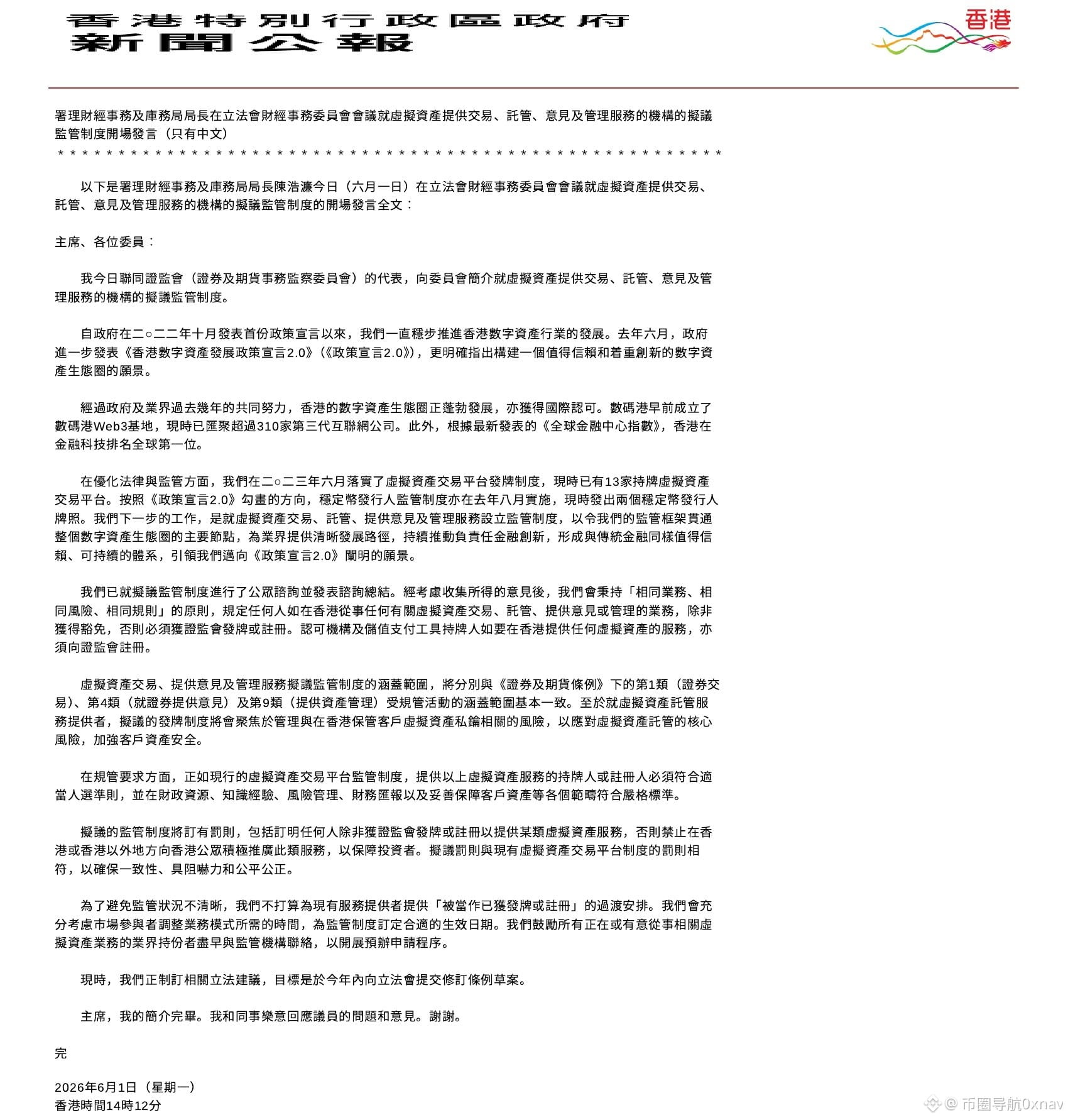
The trending headline says “intends to submit by year-end.” First, be clear about those two words: “intends” and “submit”—not that it has already been introduced to the Legislative Council, much less passed and become law.
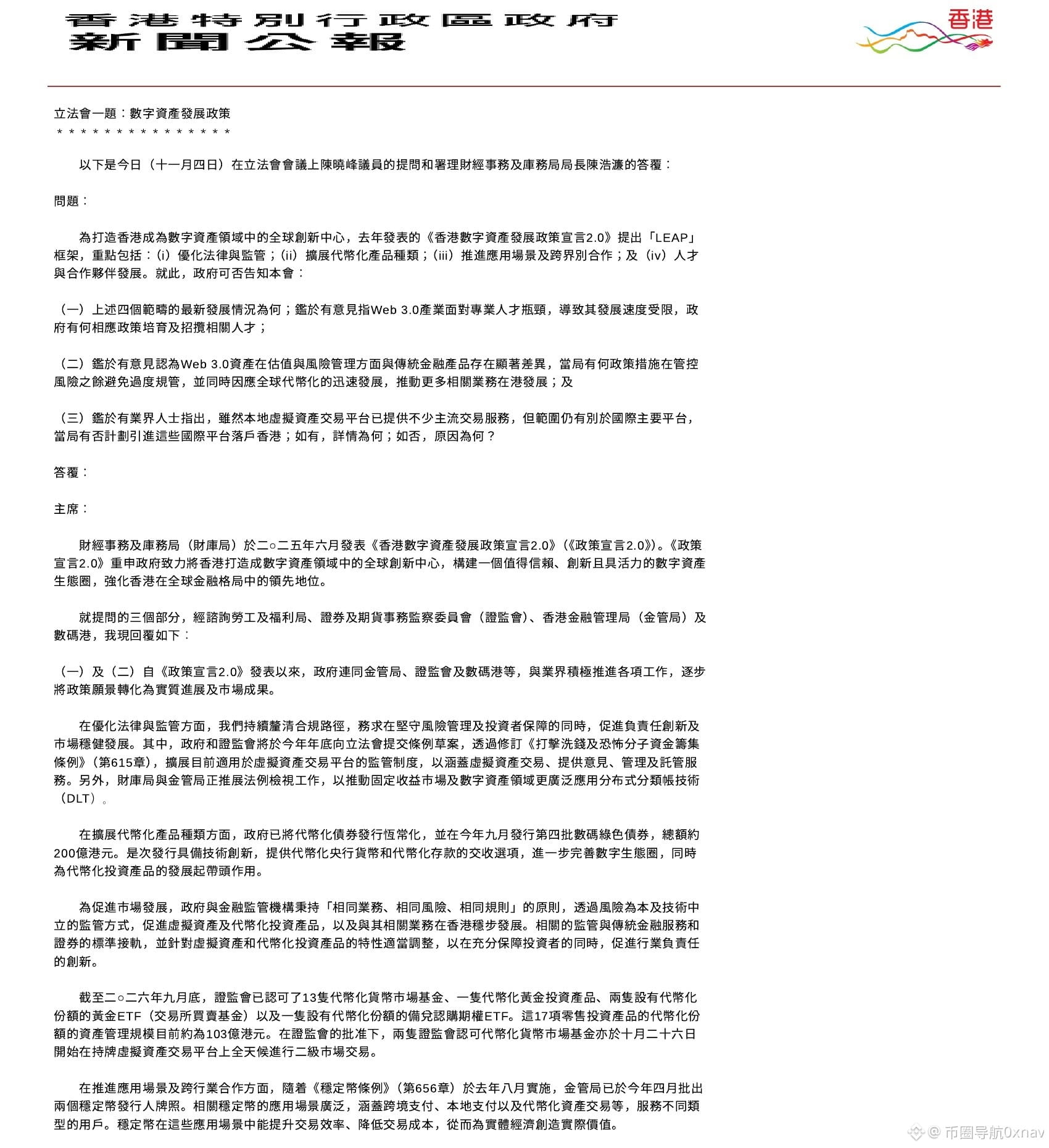
On November 16, Hong Kong Financial Secretary Paul Chan said at the Bloomberg Global Regulatory Forum held in Hong Kong that a bill would be submitted before the end of this year to complete the regulatory framework and extend licensing to institutions engaged in virtual asset dealing, advising, management and custody. The government’s press release published the full speech at 15:25 that day. The same point had already been made in the Legislative Council on November 4 by Joseph Chan, Acting Secretary for Financial Services and the Treasury: the government and the Securities and Futures Commission would submit a bill to the Legislative Council before the end of this year to amend the Anti-Money Laundering and Counter-Terrorist Financing Ordinance (Cap. 615), extending the regulatory regime currently applicable to virtual asset trading platforms to virtual asset dealing, advising, management and custody services. Today, the Financial Secretary reaffirmed that timetable.
For people in Hong Kong using related services, the key for now is to distinguish between what is already in operation and what is still going through the legislative process:
🔹 Already in place: The licensing regime for virtual asset trading platforms took effect in June 2023. The Stablecoins Ordinance (Cap. 656) took effect on August 1, 2025, and the HKMA issued two issuer licences in April this year. Paul Chan said today that both issuers have launched Hong Kong dollar stablecoins, and that 36 applications were received in the first round. He said the value of tokenized funds available to the public had grown about sevenfold over the past year. An official response on November 4 stated that two SFC-authorized tokenized money market funds had begun round-the-clock secondary-market trading on licensed platforms from October 26.
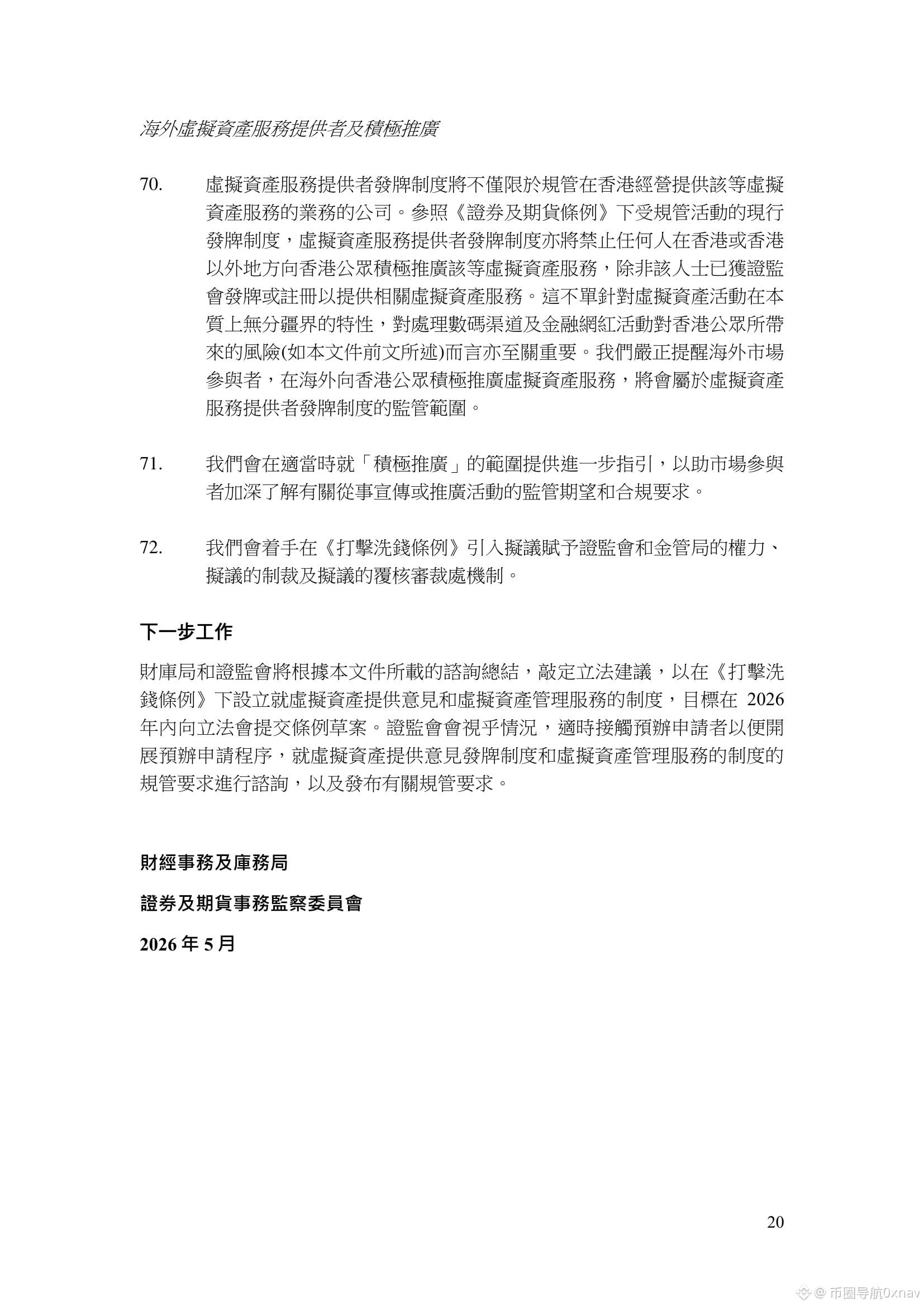
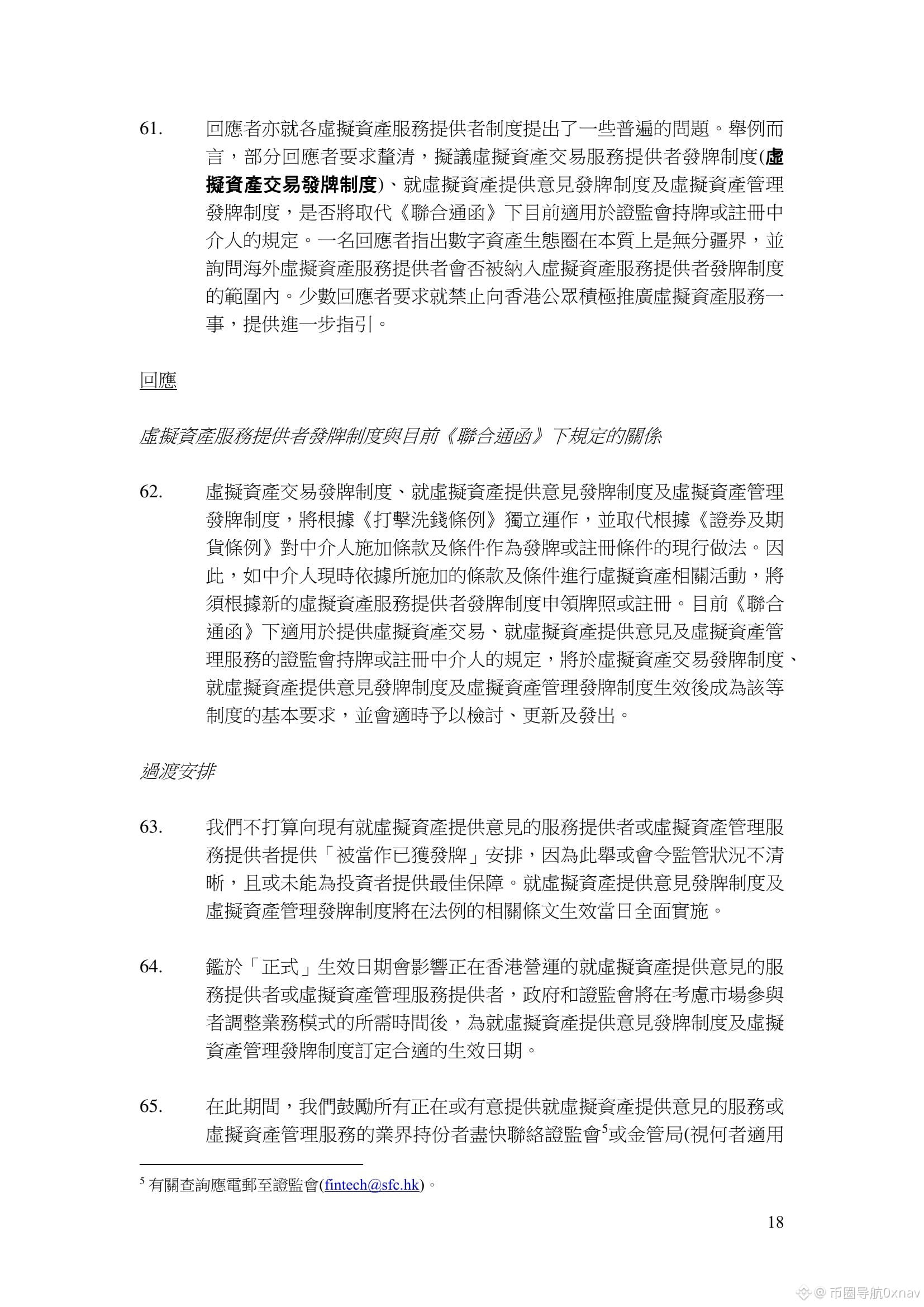
🔹 Not yet law: Under the proposals, dealing, advising, management and custody would require a licence from or registration with the SFC. Dealing would correspond to Type 1 regulated activity under the Securities and Futures Ordinance (dealing in securities), advising to Type 4, and management to Type 9. Custody would focus on the risks associated with safeguarding clients’ virtual asset private keys in Hong Kong. Unless exempt, anyone carrying on these four types of business in Hong Kong would have to be licensed by or registered with the SFC. Authorized institutions and licensees of stored value facilities would also have to register with the SFC if they wish to provide virtual asset services in Hong Kong. Anyone not licensed or registered would be prohibited from actively marketing these services to the Hong Kong public, whether in or outside Hong Kong.
🔹 No automatic transition to a licence: The authorities have stated that they do not intend to provide existing service providers with a transitional arrangement under which they would be “deemed to be licensed or registered.” They will take the time market participants need to adjust their businesses into account before setting an appropriate commencement date. That date has not yet been set. For now, existing services remain subject to the regimes already in effect for trading platforms and stablecoin issuers. Don’t mistake “a bill will be submitted before year-end” for “the new licences are already mandatory today.”
The principle is clear from the authorities: same business, same risks, same rules. After the bill is submitted to the Legislative Council, it will still need to go through scrutiny. The final text and commencement arrangements will be determined by the law as gazetted.
#香港拟年底提交数字资产监管法案 #BTC #ETH
1
3.5k
·
--
In the future, if you hold a large amount of crypto assets in Germany whose source you cannot explain, customs may be able to seize them first without opening criminal proceedings. But first, let’s be clear about where things stand: the Bundestag voted on November 12, but the law has not yet taken effect and still needs to pass the Bundesrat.
What was passed that day was the Customs Financial Justice Act (Zollfinanzgerechtigkeitsgesetz), whose full title is “A law to achieve greater justice by strengthening customs administration and combating financial crime.” The governing coalition parties, the Social Democratic Party and the Alternative for Germany voted in favor; the Left Party voted against, and the Greens abstained. The government said this is part of implementing the action plan to combat organized crime announced in February this year.
For most people, these are the key points 👇
🔹 Assets can be seized before criminal proceedings are opened: The key change is a new “administrative asset tracing and preservation” procedure for assets whose lawful origin is “reasonably suspected.” The federal government’s announcement says customs will also better monitor cross-border digital remittance channels and be able to seize crypto assets.
🔹 First, the value thresholds: Under the government’s draft, assets are generally considered “significant” if they exceed €100,000. For registrable property such as real estate and vehicles, the threshold is €50,000. Not every small holding will be dealt with under this new procedure.
🔹 Seizure is not the same as confiscation: The government’s draft says customs may initially seize assets for up to 30 days, and the fiscal court may extend this by a further 150 days, for a maximum total of 180 days. A panel of the fiscal court—not a single judge, and not customs acting alone—will decide whether the assets are ultimately confiscated.
🔹 Don’t make plans as if it has already taken effect: The bill still needs the Bundesrat’s approval and is not yet in force. The government’s draft estimates that it could generate around €308 million in additional revenue annually from 2028, covering assets such as real estate, luxury cars, works of art and crypto assets. This is an estimate, not money already collected.
Anyone in Germany holding a substantial amount of crypto assets can get their proof of source, transaction records and tax documents in order. But don’t interpret “passed by parliament” to mean “customs can already seize coins under the new law today.” We still need to see when the Bundesrat approves it and whether the final text changes.
#德国联邦议院通过海关扣押加密资产法案 #BTC #ETH




296
·
--
Verified
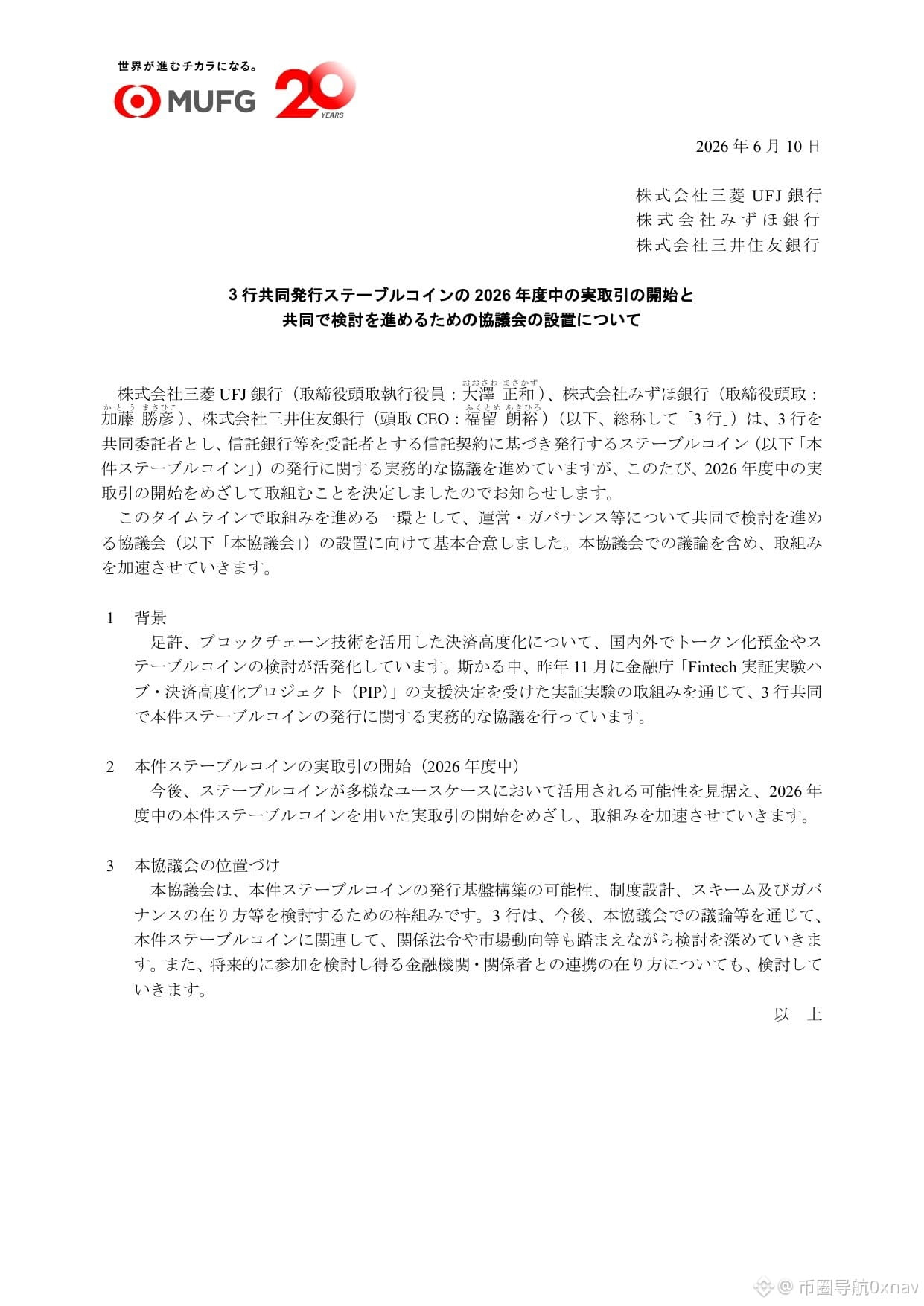
The trending topic says “planned issuance,” and those two words still apply: the yen stablecoin Japan’s three megabanks plan to launch has not entered live transactions as of today. Ordinary people still have nowhere to buy or redeem it.
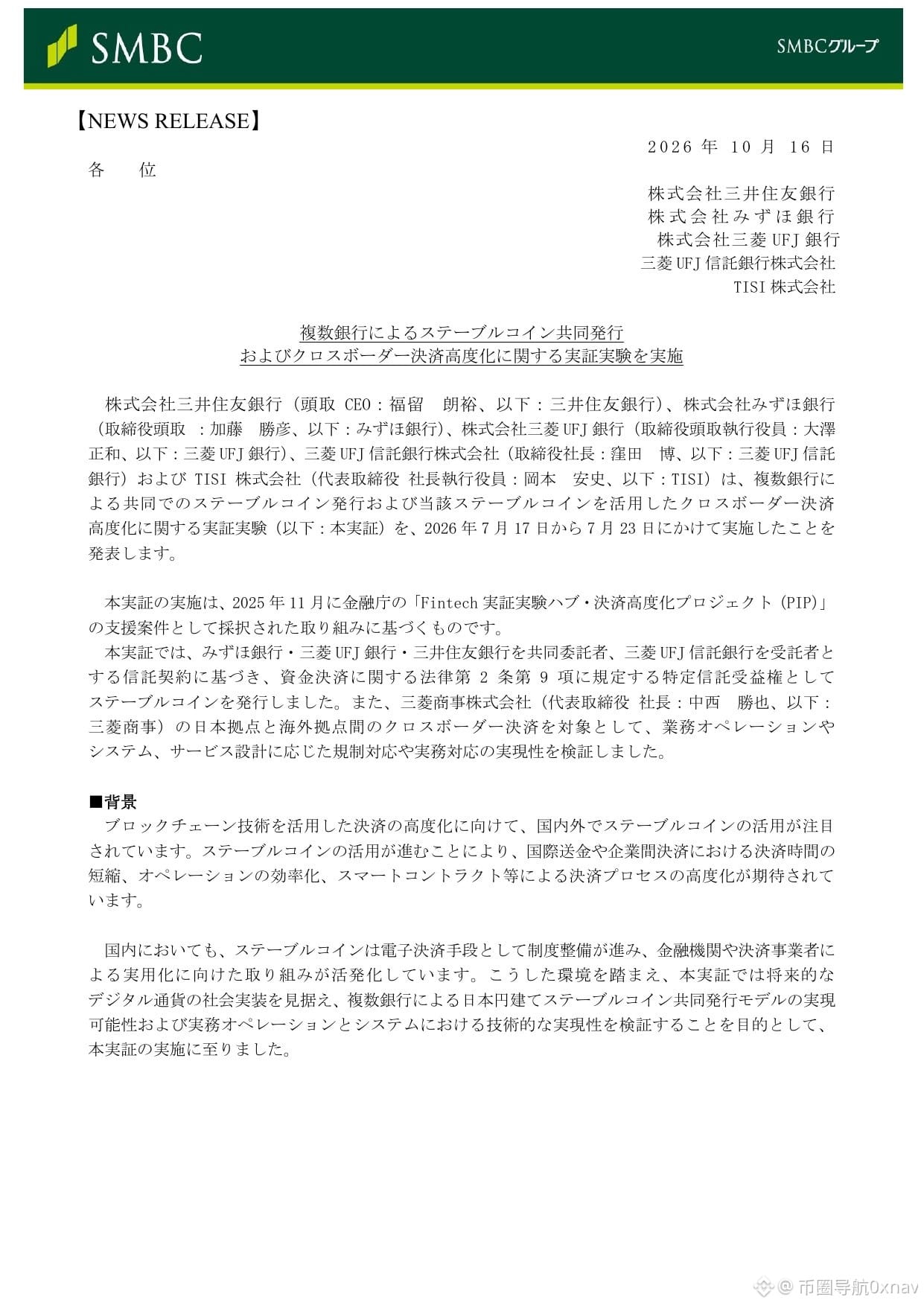
A joint press release dated June 10 from MUFG Bank, Mizuho Bank, and Sumitomo Mitsui Banking Corporation states that the three banks will act as joint settlors, with a trust bank and others serving as trustees, and that the stablecoin will be issued under a trust agreement. Their goal is to begin live transactions within Japan’s 2026 fiscal year. Japan’s 2026 fiscal year runs through the end of March next year. That is a timeline, not an announcement that the service is already live. The three banks also reached a basic agreement to establish a council to discuss its operations and governance. Tomoya Hasebe, head of global digital and innovation at Sumitomo Mitsui Banking Corporation, reiterated the timeline today at a roundtable in Singapore.
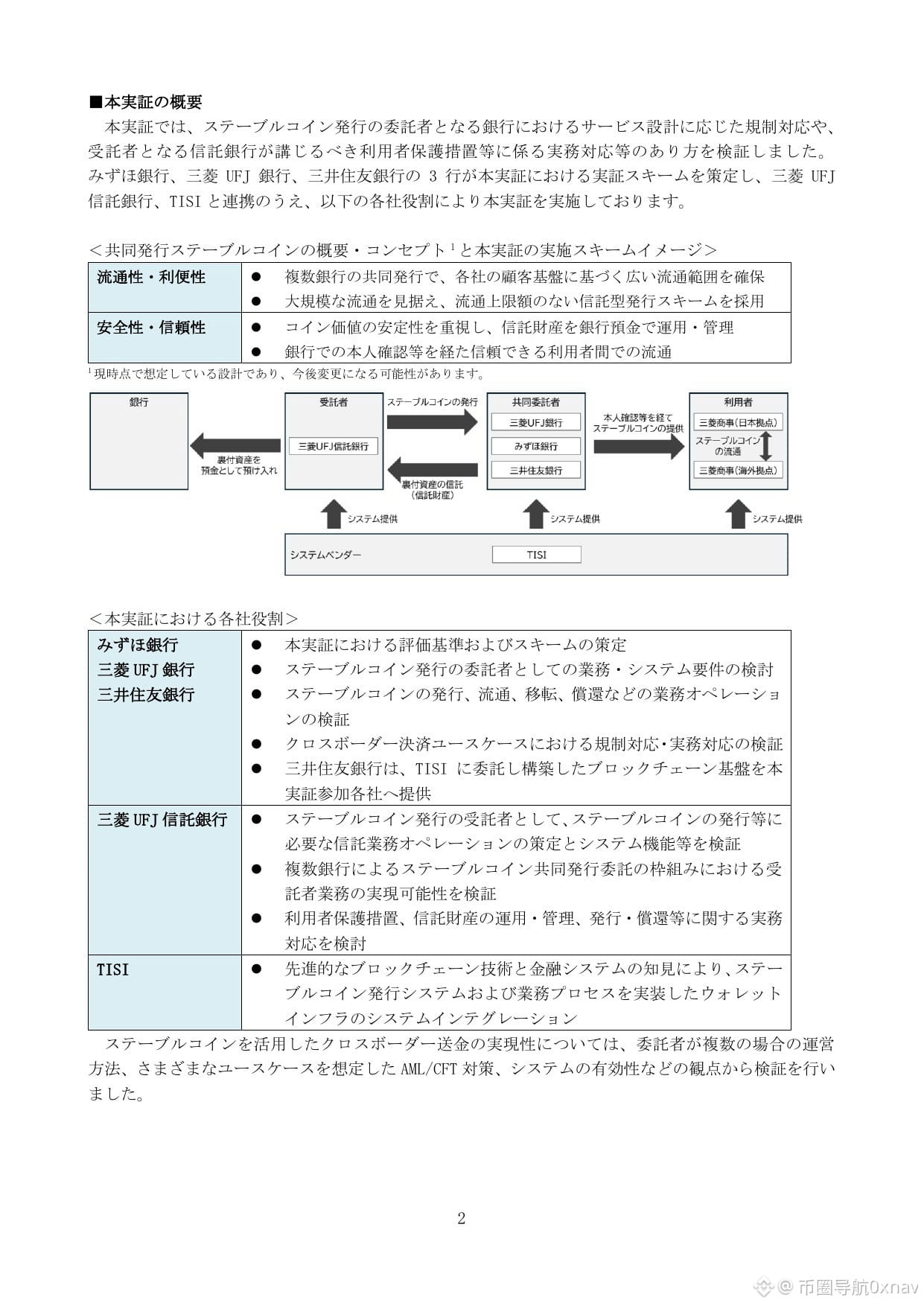
From July 17 to 23, the three banks, together with MUFG Trust and TISI, conducted a proof of concept. The coins were issued as “specified trust beneficial interests” under Article 2, Paragraph 9 of Japan’s Payment Services Act, with MUFG Trust serving as trustee. They tested the full process of issuance, circulation, and redemption, using cross-border settlement between Mitsubishi Corporation’s Japan and overseas offices as the scenario. This was not a redemption service open to the public.
Based on what has been officially disclosed so far, these are the points that matter most to ordinary people:
🔹 It cannot yet be treated as a usable coin: live transactions have not started, and the press release does not specify fees, whether individuals will be able to use it, or whether it can be bought and sold on trading platforms.
🔹 Where the money will be held and how redemption will work: The current plan is to manage the trust assets by holding them as bank deposits. The redemption process was tested in the pilot, but arrangements for public subscriptions and redemptions have not been announced. The official statement also says this is only the current plan and may change.
🔹 Where it can be used and who can use it: The plan is for circulation among users who have completed identity verification and other procedures with a bank. It is mainly intended for payments and remittances, especially cross-border business transactions—not for sending freely to any wallet on any blockchain. The banks also mentioned a trust-based issuance model with no circulation limit, but that too is only the current plan.
So don’t make financial plans on the assumption that “the yen stablecoin is already available to buy and redeem.” What matters is whether live transactions actually begin within the 2026 fiscal year, and what the terms for individuals and fees will be.
#日本三大银行拟发日元稳定币 #BTC #ETH
1
2.7k
·
--
In the future, transferring stablecoins to someone else’s wallet through a licensed platform in Thailand may no longer be possible. The proposal is still open for public consultation, but its provisions are already quite specific.
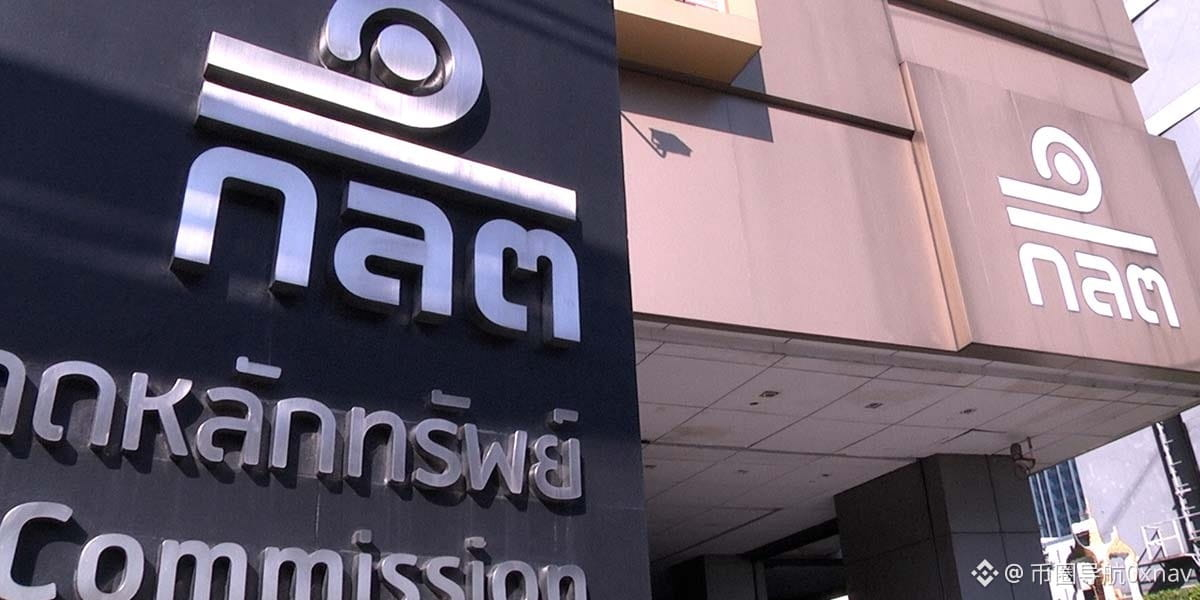
On November 12, Thailand’s Securities and Exchange Commission (SEC) issued Press Release No. 253, inviting public comment on a draft regulating stablecoin transactions through digital asset operators. The regulator aims to prevent stablecoins from being used as a channel for money laundering, technology-related crime, or evading cross-border remittance rules. The draft revises a version that was circulated for initial consultation in September this year. It has not yet taken effect, and comments are being accepted until November 26.
For ordinary users, these are the key points 👇
🔹 Transfers only to and from your own accounts: Stablecoins transferred into your platform account must come from an account or wallet verified as yours. The same applies to the destination of withdrawals. Transfers from another person’s account, or to another person’s account or wallet, are prohibited.
🔹 Separate daily limits for deposits and withdrawals: Deposits and withdrawals are each capped at 5 million baht per person, per operator, per day. They must also be consistent with your income sources and financial circumstances. Reaching the limit does not mean you can transfer freely.
🔹 Exceptions for transfers between licensed Thai platforms: If you transfer stablecoins between your own accounts with operators supervised by the SEC, and both parties comply with the Travel Rule, the 5-million-baht limit does not apply. There are also other exceptions, including for market makers, operators’ proprietary accounts, and certain arrangements approved by the Bank of Thailand.
🔹 Stricter rules for large over-the-counter trades: Brokers and dealers offering off-platform trading would face a proposed minimum trade size of 3 million baht and must disclose the execution price. Brokers may not directly arrange off-platform trades between two clients.
🔹 For now, don’t act as if the new rules are already in force. The press release does not state that the formal effective date or transition arrangements have already been finalized.
If you regularly withdraw stablecoins from Thai platforms, you can check in advance whether the withdrawal address is verified as yours and whether your daily deposits or withdrawals might approach the limit. If you have practical concerns to raise, the consultation is still open.
#泰国证监会拟设稳定币日转账上限 #BTC #ETH
208
·
--
The hack has not yet been confirmed, but South Korean exchanges may still shut down deposits and withdrawals first.
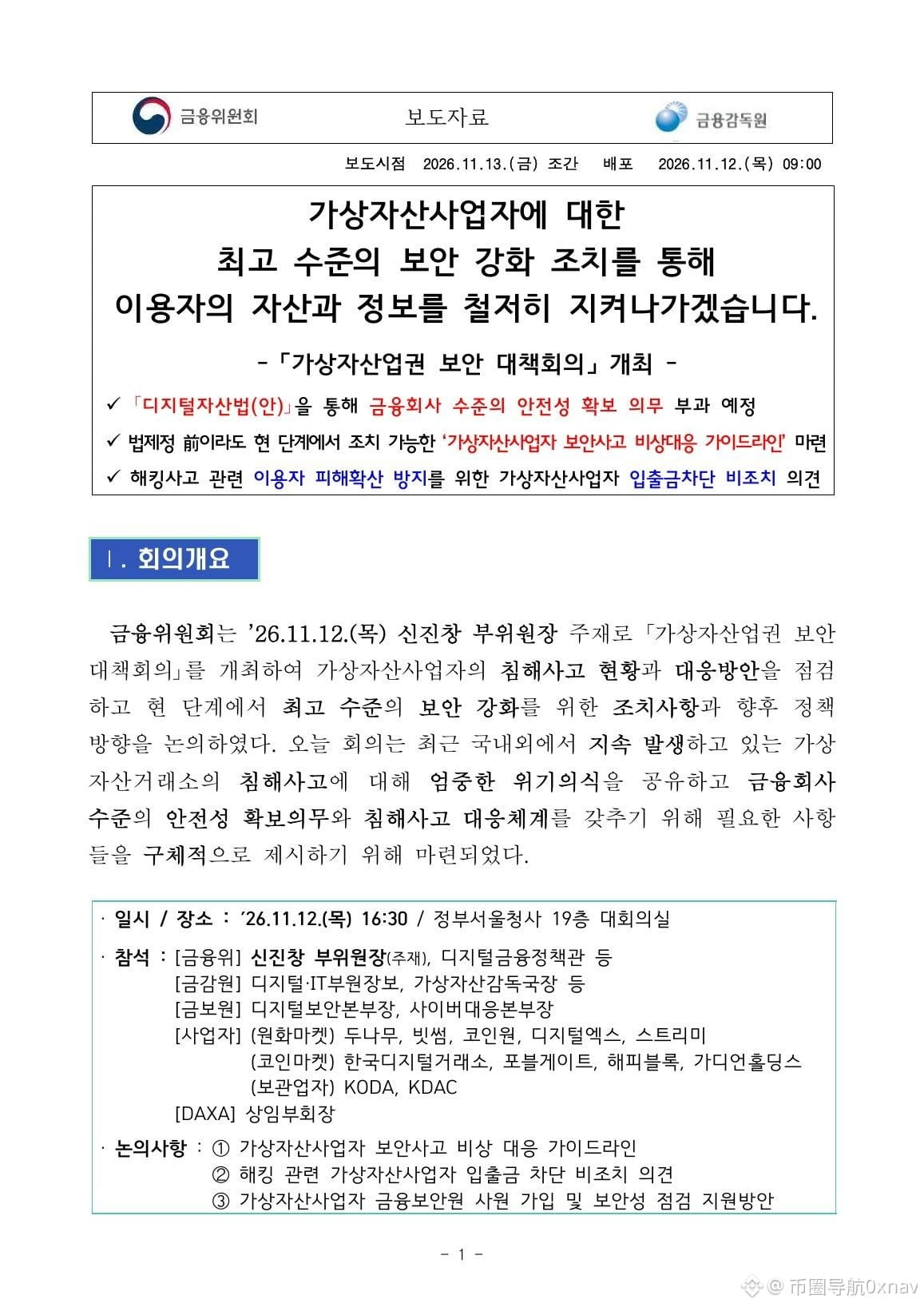
This is not a new law that has already taken effect. After the South Korean Financial Services Commission held a “Virtual Asset Industry Security Measures Meeting” at the Seoul Government Complex on November 12, it stated in a press release that it would issue a “no-action opinion letter,” allowing virtual asset service providers, under certain conditions, to temporarily block deposits and withdrawals when a hack or security breach is suspected. The press release was scheduled for publication in the morning papers on the 13th.
A few points that directly affect ordinary users 👇
🔹 The rules are actually stricter right now: The current Virtual Asset User Protection Act says operators cannot block deposits and withdrawals without a legitimate reason; suspension is allowed only when a hacking incident is clearly established. The industry told the Commission that it was unclear whether they could suspend transactions when abnormal activity appears but a hack is still only suspected. Citing cases including the Binance hack, the Commission stressed that being able to block transactions quickly in a security incident often determines whether user losses will be amplified, and therefore decided to issue the opinion letter.
🔹 It is not yet clear when it will take effect or how long a suspension can last: The press release says the letter “will be issued” and that temporary blocking will be allowed under “certain conditions.” It does not specify when the letter will be issued, the exact conditions for applying it, the maximum suspension period, or what conditions must be met before deposits and withdrawals can resume. So for now, it should not be interpreted as meaning that “exchanges can start suspending transactions at any time from today, with a uniform time limit already in place.”
🔹 What this means for you: Once the opinion letter is issued, deposits and withdrawals may be blocked earlier than before when suspicious, large-scale abnormal trading occurs, with the aim of preventing assets from being moved further. But during market volatility, you may also temporarily be unable to deposit or withdraw. The same press release also says that platforms unable to monitor and respond around the clock may process deposits and withdrawals only during periods when their systems are operating normally. They must notify users in advance, have sufficient staff, and process requests promptly.
🔹 Safekeeping and compensation were also addressed: Under the Virtual Asset Industry Supervision Regulations, operators must keep at least 80% of users’ assets in cold wallets isolated from the internet; the Commission said the industry as a whole is already above 95%. Even so, operators are still required to keep only the minimum amount needed for transactions in hot wallets and to consider spreading assets across multiple hot wallets. Insurance compensation limits and reserve funds must be sufficient to cover user losses caused by hacking or similar incidents. Any security breach, or discovery of attempted abnormal external access, must be reported promptly to the financial authorities. Work is still underway on the longer-term Digital Asset Act, which is intended to subject digital asset service providers (currently called virtual asset service providers) to IT security obligations and liability for damages similar to those of financial companies. But legislation takes time, so the Commission has asked the industry to implement these measures first.
If you care about deposits and withdrawals, you can first check whether the South Korean platform you usually use issues an announcement, then wait for the opinion letter to actually be released and its conditions to be clarified before drawing conclusions. Don’t interpret “a decision to issue an opinion letter” as meaning “deposits and withdrawals can already be suspended indefinitely from today.”
Which matters more to you: “being able to suspend transactions as soon as a hack is suspected, to prevent more assets from being moved,” or “having deposits and withdrawals blocked before an incident is confirmed”?
#韩国拟允许疑似黑客时暂停充提 #BTC #ETH


237
·
--
Starting November 26, private customers of Israel’s Discount Bank will be able to buy and sell Bitcoin and Ethereum in their bank’s app. The proceeds from sales will go into their bank account, but for now, the crypto can’t be transferred out.
On November 11, the bank announced on its website and in a press release that this is the first time in Israeli banking that customers can directly buy, sell, and hold Bitcoin and Ethereum in a banking app. Transactions will use customers’ existing securities accounts, so there’s no need to open an account with an overseas exchange or manage private keys themselves. The bank also stated that for now, this is a “closed system”: purchased crypto cannot be transferred to an external institution or to the customer’s own on-chain address, and crypto from outside cannot be transferred in. Whether transfers will be enabled in the future depends on regulatory and business developments.
Here are the key points that matter to everyday users 👇
🔹 Who can use it: The service is available only to private customers aged 18 or over who are in Israel and already have a securities account. They must first sign the relevant securities and complex-products terms, then complete a separate agreement in the app before placing an order. Corporate accounts are not eligible this time.
🔹 How trading works: In the app, go to “All actions → Capital markets → Digital currency trading.” For now, only immediate trades are available; future limit orders cannot be placed. Bitcoin and Ethereum can both be purchased in increments starting at 0.01 units. Trading hours are Sunday to Friday, 9:00–23:00 Israel time, in line with the bank’s trading room hours.
🔹 Fees and settlement: The trading fee is 2% of the transaction amount, with an additional foreign-exchange fee if currency conversion is required. Custody fees will be waived for six months from the launch on November 26, then charged quarterly at 0.25%. The crypto will appear in the securities portfolio immediately, while funds will be credited or debited on the next business day (T+1). Sale proceeds will be credited in U.S. dollars; customers must instruct the bank themselves if they want to convert them to shekels.
🔹 Tax: The bank says capital gains and losses on digital currencies can be offset against capital gains and losses on other securities in the same account. The tax rate on profits is 25%, and tax is handled at the bank before the funds are paid out. The bank emphasizes that this offset applies only to capital gains.
The bank also cautions that digital currencies are not legal tender and do not have the same protections as securities. They are highly volatile, and customers could lose their entire principal. Several Israeli media outlets report that the wallet infrastructure is provided by Fireblocks; the website describes the service and custody as being handled by an “authorized third party.”
This isn’t a button you can click just yet. You’ll have to wait until November 26 and sign the agreement before trading is actually enabled in the app.
#以色列Discount银行将上线比特币交易 #BTC #ETH

122
·
--
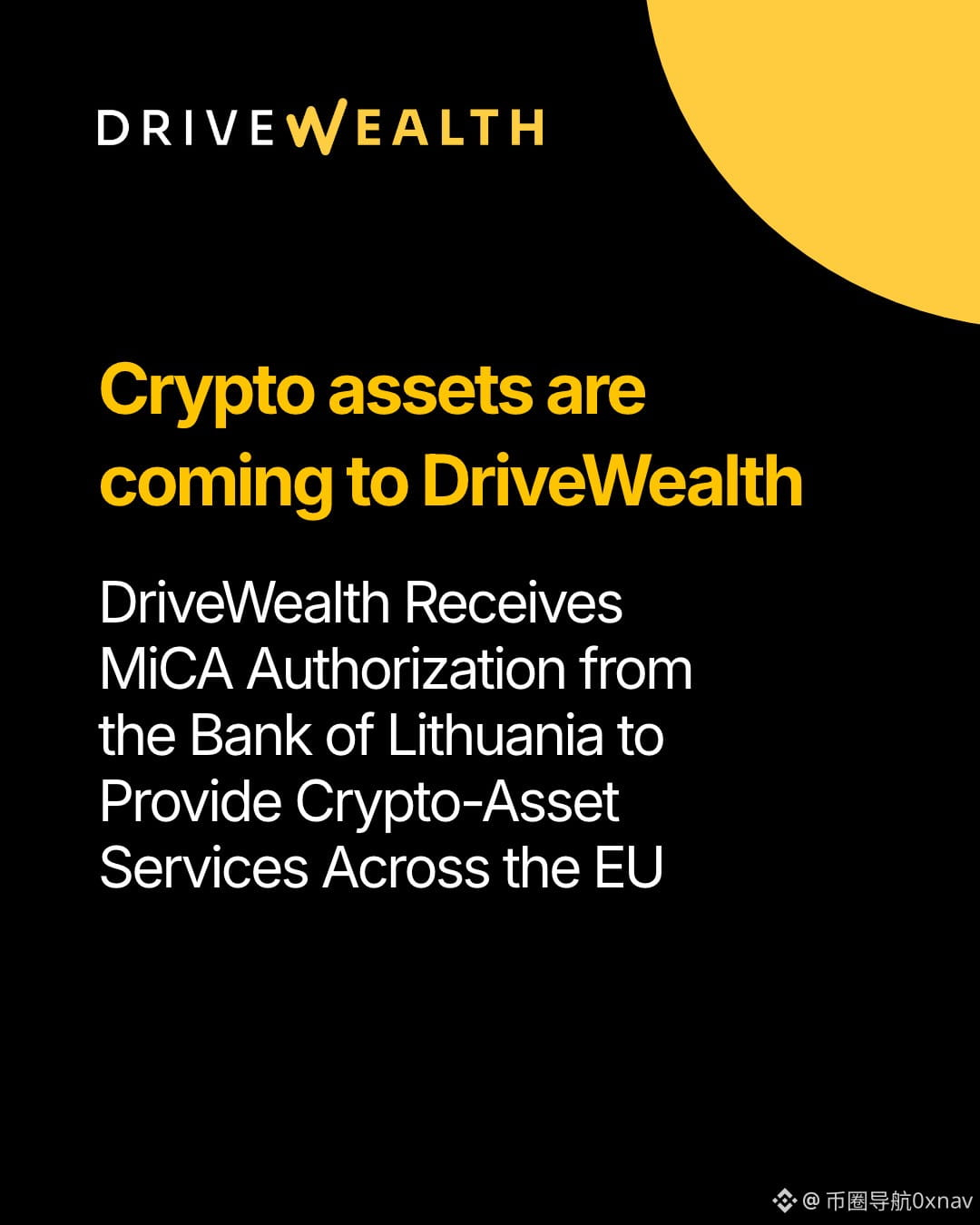
Want to use the same bank or e-wallet in Europe to buy and sell U.S. stocks and custody Bitcoin? What’s new today is just one more license—not a button that’s already gone live.
On November 11, the Bank of Lithuania (Lietuvos bankas) issued a press release confirming that it had authorized UAB DriveWealth Europe, the European subsidiary of U.S. brokerage infrastructure company DriveWealth, to provide crypto-asset services under the EU’s Markets in Crypto-Assets Regulation (MiCA). The company made its own announcement first, on November 10; the public register lists November 9 as the start date for the relevant crypto business.
A few points that matter directly to everyday users 👇
🔹 Scope of authorization: The central bank says the company can provide custody and administration of crypto-assets, as well as execute, receive, and transmit crypto-asset orders on behalf of clients. This builds on the financial intermediary (MiFID II) license it obtained in October 2024, meaning the same EU entity is subject to both securities and crypto regulations.
🔹 Not a new app for retail customers: DriveWealth provides “brokerage as a service” to banks, fintech companies, e-wallets, and brokerages. Everyday users won’t be able to open an account and buy crypto directly through its own interface just because of today’s authorization. If a bank or wallet you already use connects to this infrastructure in the future, you may be able to see stocks, tokenized assets, and crypto-assets in the same investment interface.
🔹 Not available yet: The company says crypto-asset services will be rolled out to partners in phases next year, with timing and coverage to be announced separately. It is still building the infrastructure. What the central bank announced today is a license—not a trading or custody feature that’s already live.
🔹 Don’t confuse “authorized to provide services in the EU” with “available to buy across Europe”: The company describes this authorization as a compliant route to providing crypto-asset services in the EU. But there is no timeline yet for when partners will launch or which countries’ users will get access first.
In short: Europe’s regulatory landscape now has another MiCA license, making it easier for banks and wallets to connect crypto-assets to their existing securities infrastructure in the future. It does not mean that everyday users can start depositing or withdrawing Bitcoin through their bank app today. What’s really worth watching is which institutions connect first when the phased rollout begins next year, which assets they will support for custody and trading, and how redemptions and transfers will work.
If you use a bank or e-wallet in Europe to trade U.S. stocks, would you be more interested if it added crypto-assets, or would you still stick with a separate exchange account?
#立陶宛央行授权DriveWealth加密服务 #BTC #ETH
17
·
--
Last week, the finance minister came forward and said he wanted to discuss with the National Assembly pushing crypto income tax back by another two years. Today, the ruling and opposition parties gave the proposal a tentative nod at the Assembly’s tax subcommittee—but the amendment itself has not yet been put to a vote.
After a meeting of the National Assembly’s Strategy and Finance Committee tax subcommittee on November 11, ruling party secretary and subcommittee chair Oh Ki-hyung (吴基炯) told reporters that the ruling and opposition parties had reached a consensus on further postponing virtual asset taxation. The government had previously said it wanted to delay it by two years, and there was no significant disagreement between the parties. Opposition party secretary Bae Jun-young (裴俊英) also said, “The decision today was to postpone it,” but added that the government must make thorough preparations for taxation during the grace period, and that the National Assembly would monitor its progress.
A few points that directly affect ordinary people 👇
🔹 How far back: If the proposal is ultimately adopted, the virtual asset income tax, originally scheduled to take effect on January 1, 2027, will be delayed by another two years, to 2029. This would be the fourth postponement since the law was enacted in 2020 (it was previously pushed back from 2022 to 2023, 2025, and 2027).
🔹 How much you pay has not changed: The current framework remains in place—the portion of annual gains above approximately 2.5 million won is taxed at about 22% (including local income tax). What is being postponed is the start date, not the tax being eliminated.
🔹 No vote today: The amendment to the Income Tax Act that would “delay it by another two years” was only tentatively agreed on at the tax subcommittee today; it was not formally approved. Oh Ki-hyung said the final vote would be held on the last day of the subcommittee’s work. He also noted, “Given the current situation, it would be fair to say it has already been delayed by two years”—that was an assessment made at the meeting, not a change to the law that has already taken effect.
🔹 Details still unresolved: The government opposes raising the basic deduction (on fairness grounds), and the two sides agreed to continue discussions. They also need to review and decide whether exchanges should submit transaction data in advance of the start date for a system trial. The government’s proposal on November 5 to allow losses to be carried forward for up to three years was on today’s agenda, but no conclusion was reached. Oh Ki-hyung said there was still room for both sides to discuss it constructively.
Put simply: compared with last week’s “government seeks postponement,” things moved a step forward today—the ruling and opposition parties reached a tentative consensus at the first legislative hurdle. But for people trading virtual assets in South Korea, the January 1, 2027 date still needs to be changed, and that will have to wait until the tax subcommittee formally approves the amendment and the remaining National Assembly procedures are completed. Don’t mistake “tentative” for “you won’t have to pay,” and don’t rush to sell everything on the assumption that tax will definitely apply in 2027. Keeping an eye on the amendment text is more reliable than following the headlines.
Will you take today’s “tentative” agreement as a reason to put tax planning aside for now, or wait until the tax subcommittee’s final-day vote before deciding what to do?
#韩国朝野暂定加密税推迟两年 #BTC

1
2
2.2k
·
--
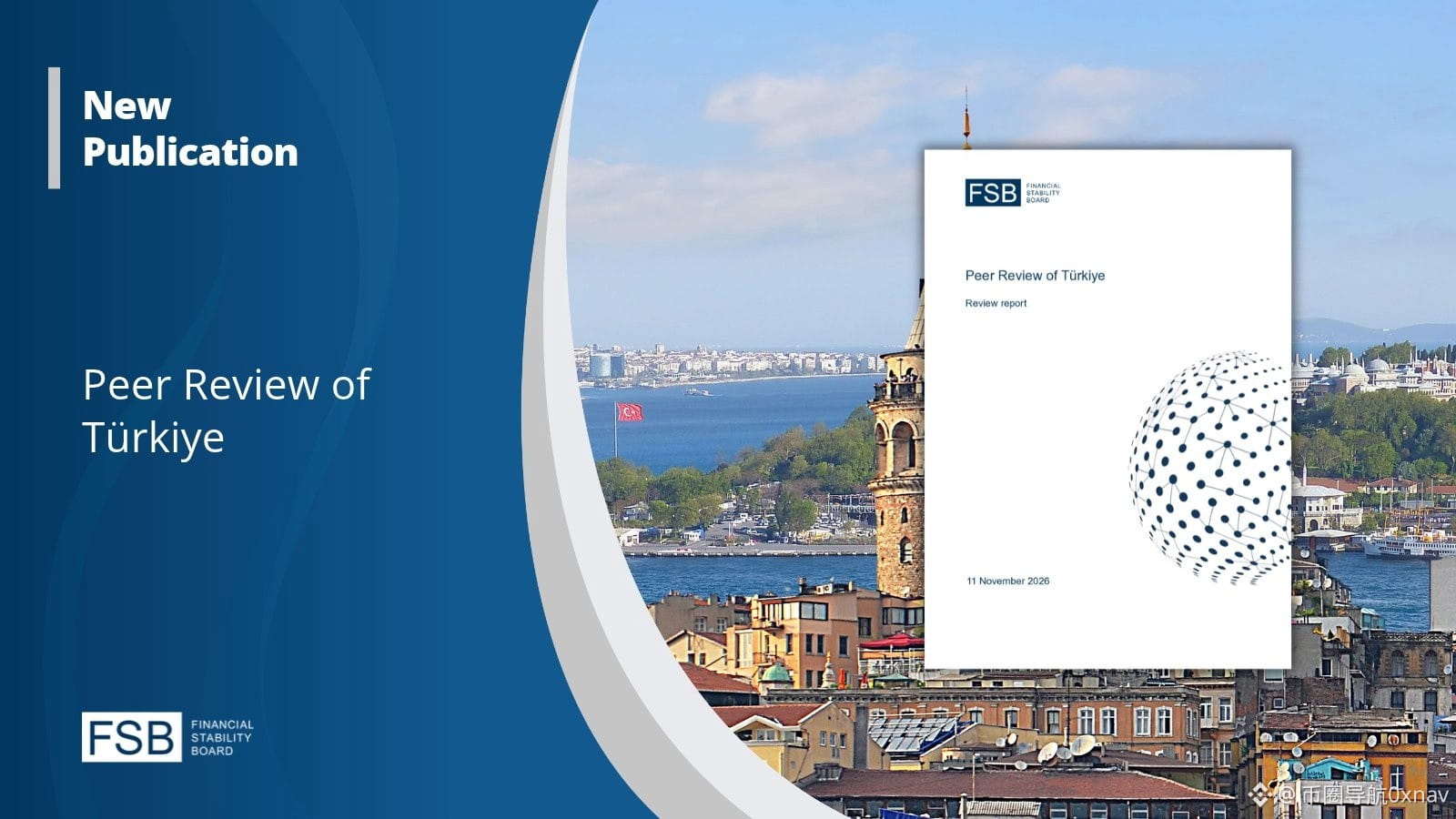
In Turkey, you still can’t use stablecoins to pay directly in shops, and redemption rules for issuers have not yet been legislated separately. This is the gap the Financial Stability Board highlighted today.
On November 11, the Financial Stability Board (FSB) published its second peer review report on Turkey, assessing the country’s progress in implementing recommendations on crypto-asset and stablecoin regulation. The report recognized that Turkey has brought most crypto-asset businesses within the regulatory perimeter: crypto-asset service providers must register and obtain licenses, customer assets must be segregated and held in custody, and a centralized data platform has been set up for monitoring. The country has also banned the use of crypto-assets for payments and blocked some risks from spilling over into the payments and banking systems. However, a dedicated regime for stablecoin issuers has yet to be established.
A few points that directly affect ordinary people 👇
🔹 Can you spend them in shops? Not yet. The Central Bank of the Republic of Türkiye’s (CBRT) 2021 rule prohibiting the use of crypto-assets for payments remains in force. Payment institutions cannot use crypto-assets for payment or e-money services, and licensed payment and e-money institutions cannot facilitate fund transfers for crypto trading, custody, or transfer platforms. Fiat on- and off-ramps are still handled mainly by banks.
🔹 Are there transfer limits? Yes. Authorities have set crypto-to-crypto transfer limits for stablecoins of $3,000 per day and $50,000 per month. Corporate clients may receive time-limited exemptions, subject to approval by the service provider’s board of directors and enhanced due diligence.
🔹 Can they be redeemed, and who oversees the reserves? There are currently no rules specifically for issuers. The management of reserves, how redemption rights are enforced, and how stabilization mechanisms should be designed have not yet been legislated separately. Stablecoin holders are also not covered by the Savings Deposit Insurance Fund (SDIF).
🔹 The e-money route is not yet open: The report says recent revisions to e-money rules allow some fiat-linked stablecoins to be treated as e-money, leaving open a possible path for their future use in payments. But the implementing rules still need to be issued separately by the CBRT, so this does not mean they can already be spent in shops. The FSB also recommends maintaining the firewall against using foreign-currency stablecoins for domestic payments, even if a dedicated regime is introduced.
Today’s report contains peer review recommendations; it is not a new authorization or ban passed by Turkey today. The FSB wants Turkey to establish a dedicated stablecoin regime (including redemption rights, reserve and prudential requirements), implement financial stability monitoring, strengthen regulatory enforcement, and prepare for cross-border cooperation. The progress data cited in the report is current through August 2026.
If you use fiat-backed stablecoins in Turkey, which matters more to you: how future redemption and reserve rules will be written, or whether the domestic payment ban will be eased through the e-money channel?
#FSB敦促土耳其建立稳定币框架 #BTC #ETH
197
·
--
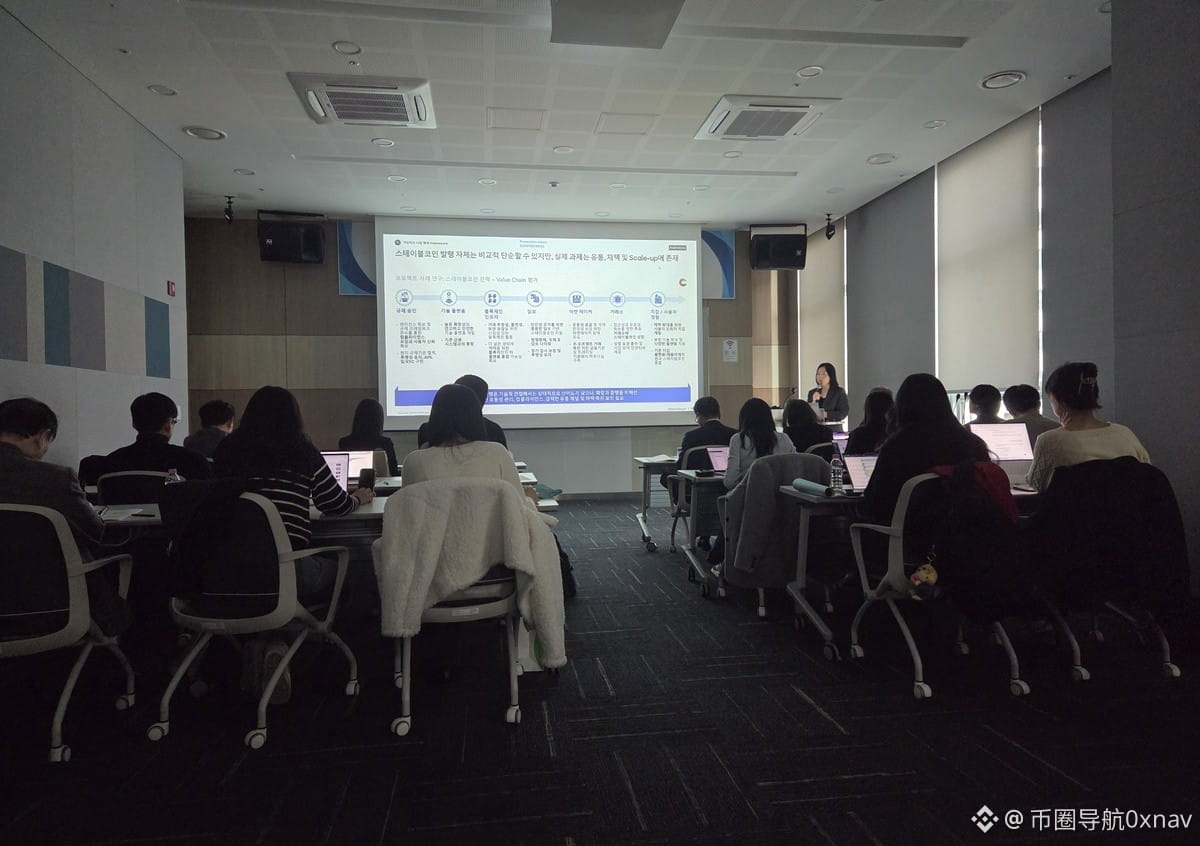
In South Korea, it’s still not possible to send money abroad using stablecoins through a bank or card network. Today, the head of the Foreign Exchange Analysis Division at the Ministry of Economy and Finance clarified how responsibilities will be divided: issuance will be governed by the Digital Asset Act, led by the Financial Services Commission, while cross-border payments and receipts will require a separate revision to the Foreign Exchange Transactions Act.
On the afternoon of November 11, a seminar titled “The Future of Cross-Border Payments in Korea in the Stablecoin Era” was held at Post Tower in Yeouido, Seoul. It was co-hosted by Democratic Party lawmakers Jeong Tae-ho and Ahn Do-geol, and organized by the Korea Fintech Industry Association. At the seminar, Son Seon-young, head of the Foreign Exchange Analysis Division at the Ministry of Economy and Finance, said that matters related to stablecoin issuance would be governed by the Digital Asset Act, which is being discussed under the leadership of the Financial Services Commission, while cross-border transactions using stablecoins are expected to be governed by the Foreign Exchange Transactions Act. She also said that, in conjunction with the enactment of the Digital Asset Act, the Foreign Exchange Transactions Act would clarify stablecoins’ legal status, cross-border transactions, and payment and receipt procedures.
A few points that directly affect ordinary people 👇
🔹 This isn’t a new opening approved today, nor is it a new ban: the division chief was describing the direction of the regulatory framework; no amendment text has been released yet. The government plans to first establish issuance rules in the Digital Asset Act, then revise the foreign exchange law accordingly.
🔹 Why can’t banks handle this now? She explained that when the Foreign Exchange Transactions Act was amended this June, it introduced a “virtual asset transfer business” category, mainly to track information on cross-border virtual asset transfers and the movement of funds in and out of the country. Under the current legal framework, small overseas remittance providers, banks, and card companies still cannot transfer stablecoins directly. To do so, they would first have to register as virtual asset transfer businesses.
🔹 Details that will be added to the foreign exchange law: whether stablecoins will be included in the existing category of “means of payment to and from foreign countries” or treated as a separate category; what will be permitted for current-account transactions (trade in goods and services) versus capital-account transactions (investment and movement of funds); and who will verify transactions across borders and what documents will be required. The principle is “same activity, same regulation.” While safeguarding the integrity of foreign exchange transactions, the government will also consider private-sector demand, transaction types, and whether the institutions handling transactions can fulfill their verification obligations.
🔹 This is not the same issue as “how domestic payments will be protected”: which consumer-protection law applies to domestic stablecoin payments is a separate discussion. What the Ministry of Economy and Finance clarified today is that cross-border transfers and remittances will be subject to the foreign exchange law. Neither issue has yet become a set of rules in force.
Put simply: South Korea did not announce today that banks will be able to send money abroad using stablecoins starting tomorrow. But the Ministry of Economy and Finance made clear at the seminar that “cross-border transactions fall under the foreign exchange law, and banks and card networks currently cannot transfer stablecoins directly.” The key question to watch is which institutions will be allowed to handle cross-border payments and receipts, and what procedures they will need to follow, once the Digital Asset Act is enacted—not to mistake the division of responsibilities discussed at the seminar for a new channel that is already available.
Are you more concerned about whether banks and card networks will be able to handle cross-border transactions in the future, or about first clarifying what will be permitted for current-account and capital-account transactions?
#韩国财政部称稳定币跨境支付将适用外汇交易法 #ETH #BTC



175
·
--
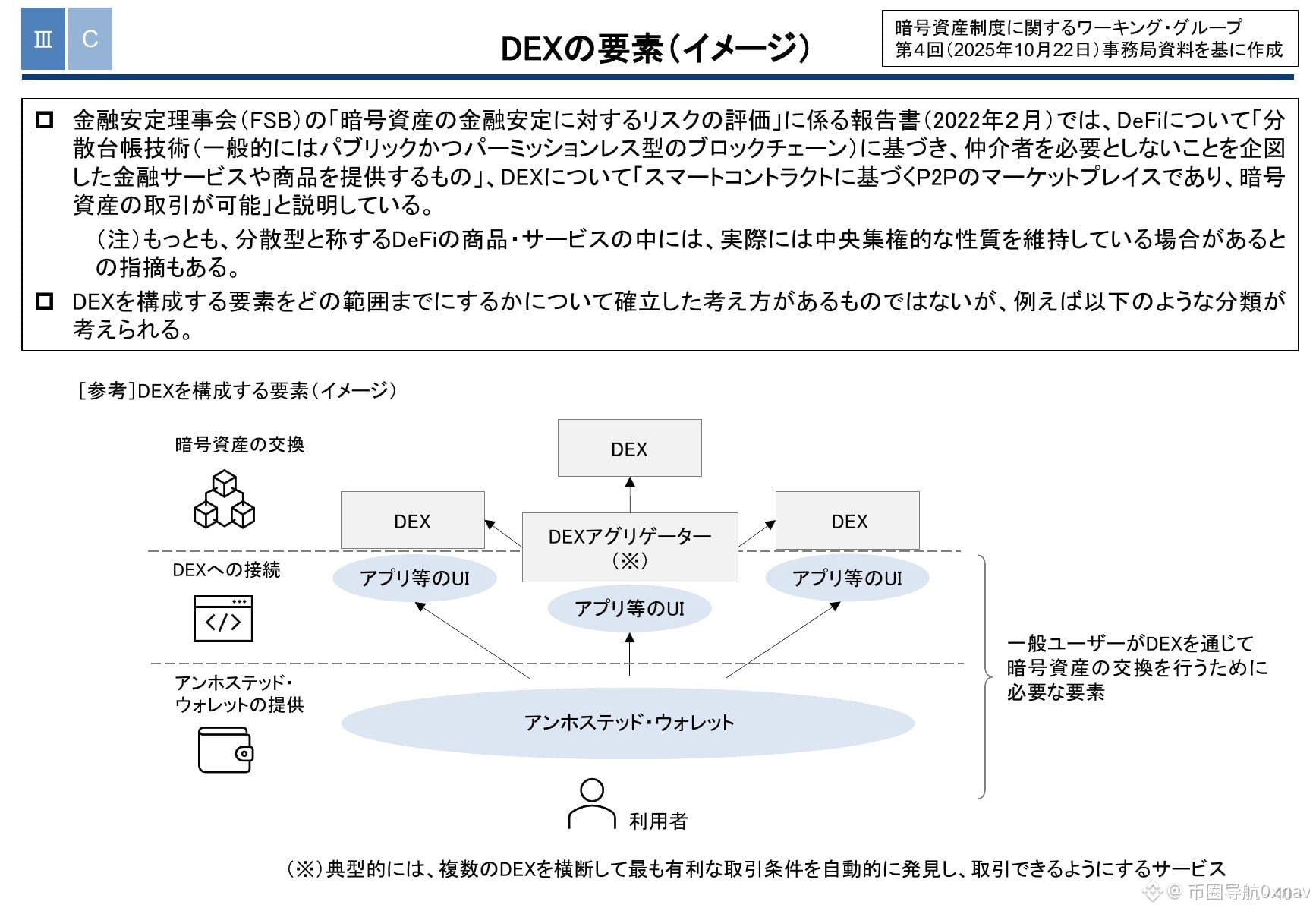
In Japan, swapping coins on decentralized exchanges did not result in a new ban today. What the Financial Services Agency made public was the minutes of the first meeting of the “Digital and Distributed Finance Response Study Group” held on October 20: the members wrote into their opinions how DeFi should be regulated, who should act as the gatekeeper, and whether large-scale redemptions of stablecoins could affect government bonds.
A few points directly relevant to ordinary people 👇
🔹 No law has changed yet; the discussion has only been laid out: the meeting lasted two hours on the afternoon of October 20, and Nomura Holdings and Securitize Japan gave hearings. The minutes omit the names of speakers and record the members’ opinions, not rules that are already in force. The same study group held a second meeting on November 2; what is newly added today is the written minutes of the first meeting.
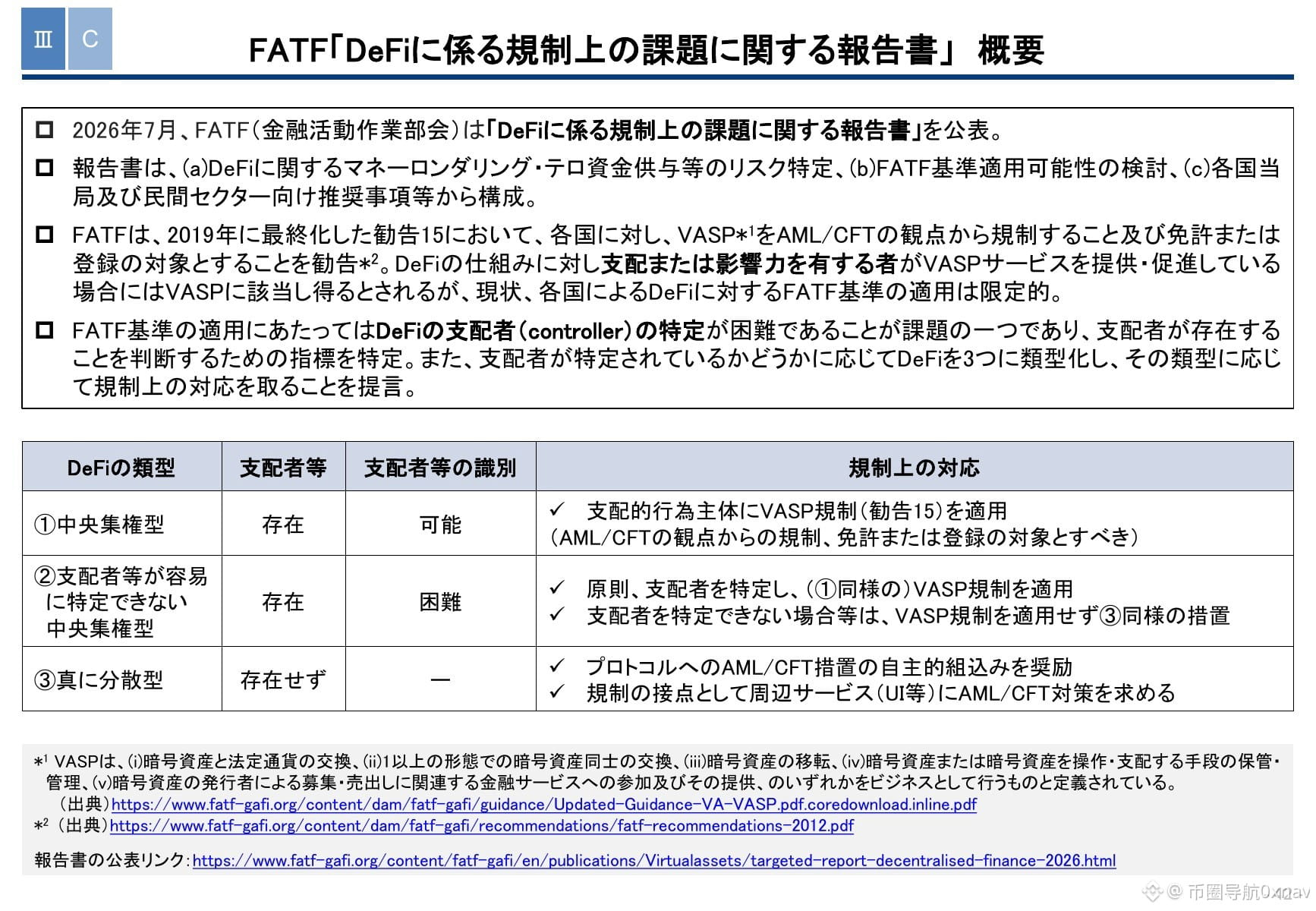
🔹 Who to regulate first for DeFi: members suggested first clarifying “how to deal with decentralized exchanges and DeFi,” while also comparing international discussions to sort out the regulatory targets and methods, so that Japan does not become “a place of regulatory vacuum or regulatory arbitrage,” and to respond appropriately in due course. Investor protection and market integrity were listed as points that should be discussed first. The “gatekeeper” role that traditional financial institutions have long performed was also written into the agenda as something to consider who should bear in the future. On anti-money laundering, members asked for serious discussion of how Japan should treat the FATF’s DeFi report released in July this year.
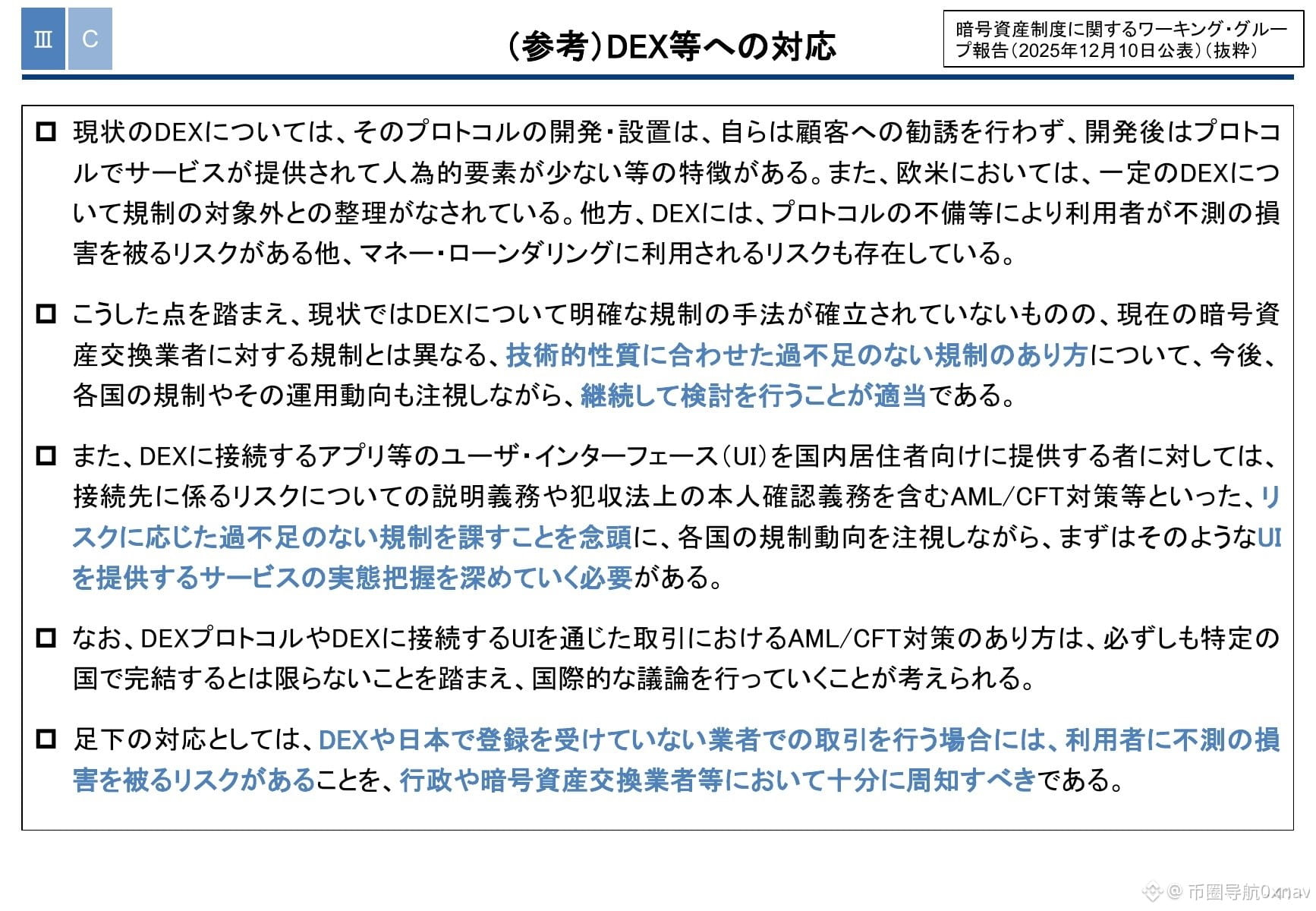
🔹 The most likely first point of contact for users later: the secretariat materials on the day still followed the organization in the 2025 December working group report—currently, there is no clear regulatory method for the decentralized exchange protocol itself; however, people who provide “application interfaces that connect to decentralized exchanges” to residents in Japan may be considered subject to obligations such as risk explanations and identity verification under the Act on Prevention of Transfer of Criminal Proceeds, and the actual situation of such interfaces needs to be examined first. The materials also state clearly: trading on decentralized exchanges or with operators not registered in Japan carries a risk of users suffering unexpected harm, and administrative bodies and licensed exchanges should provide sufficient notice. This is existing整理, not a new ban passed today.
🔹 Large-scale stablecoin redemptions: members pointed out that if major issuers of electronic payment instruments receive large redemption requests, government bonds held as reserve assets may also have to be sold in large quantities, so it is necessary to confirm whether the current regulations are sufficient. There was also an opinion that lending of electronic payment instruments, if bundled with issuance, may look like investment solicitation, and whether the current rules are adequate deserves another look.
In short: Japan did not announce a ban on using decentralized exchanges today, but questions like “who verifies identity on the front end” and “whether large redemptions will spill over into government bonds” have moved from internal discussion into public minutes. What to watch next is whether these opinions are written into a draft system, rather than treating the minutes as a newly effective rule.
Do you think they should regulate apps that connect to decentralized exchanges first, or should they first add rules to cover the government bond selling pressure during stablecoin redemptions?
#日本金融厅研究会讨论DeFi监管 #ETH #BTC
99
·
--
Thinking of handing your Bitcoin over to Germany’s biggest bank for safekeeping? Read the fine print first: ordinary people still can’t access it, and crypto assets don’t have the kind of insurance that bank deposits do.
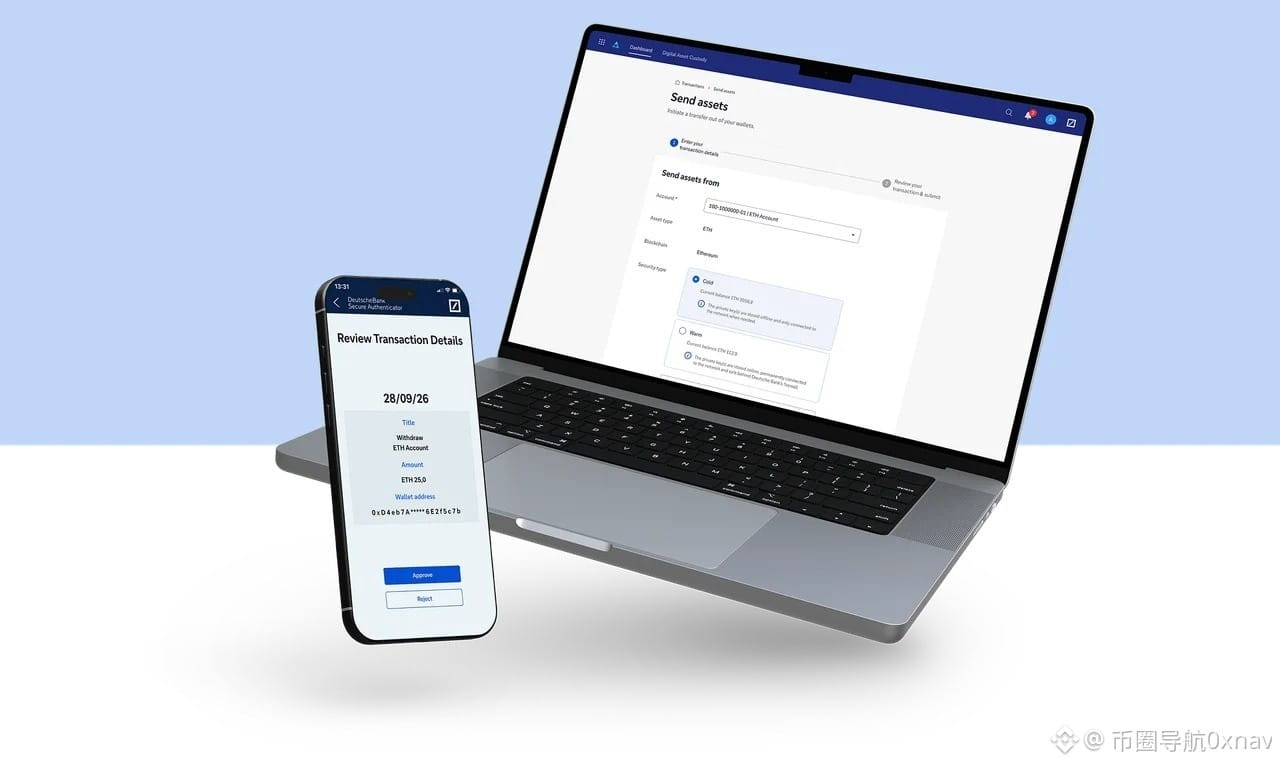
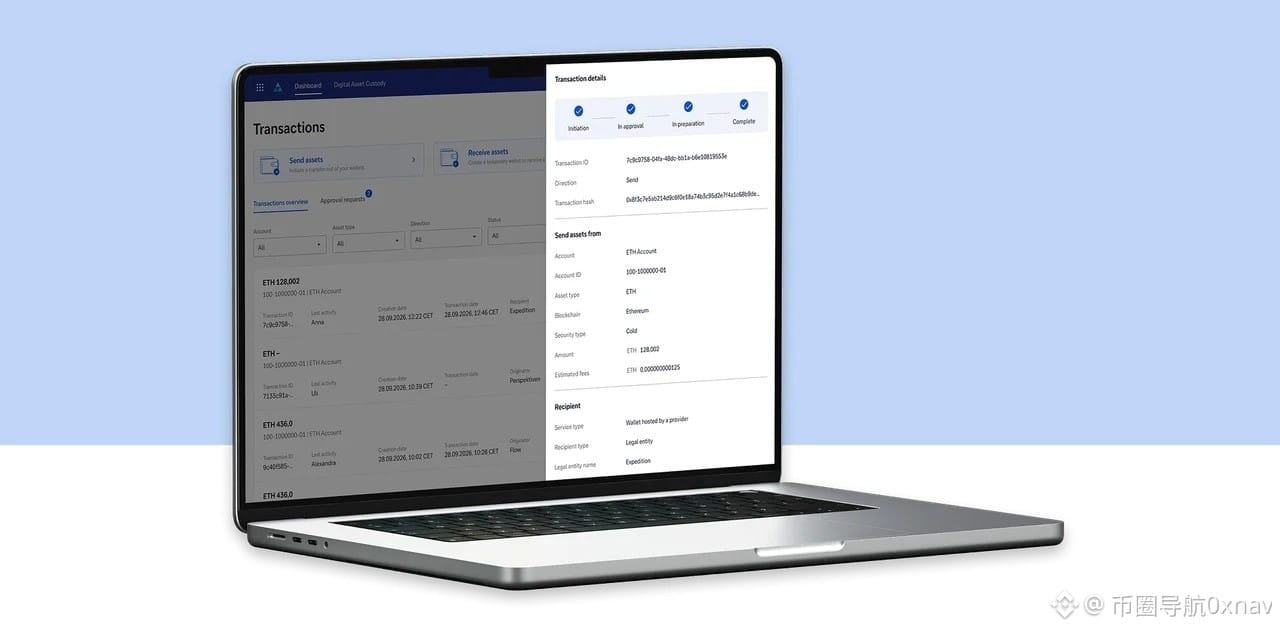
FRANKFURT, Nov. 11 (Reuters) — Deutsche Bank said today that its digital asset custody service has officially gone live for paying clients. On Sept. 16, Germany’s biggest bank announced plans to offer the service to institutional and corporate clients in Europe after completing the relevant regulatory processes. In mid-October, management said it was still “a few weeks” away. Today’s update changes “getting ready to launch” to “now open to paying clients.”
Here are a few points that matter directly to ordinary people 👇
🔹 Who can use it—and who can’t: According to the bank’s official statement in September, the service is initially aimed at corporate and institutional clients, including companies, asset managers, hedge funds, custodians, brokers, and sovereign institutions. They must pass the bank’s onboarding and due diligence checks. The official FAQ puts it plainly: the service is not available to retail clients. So this isn’t a German version of “buy crypto in your banking app”—ordinary individuals can’t open a custody account for it right now.
🔹 What it can custody and what you can do with it: At launch, the service supports Bitcoin, Ethereum, and some stablecoins or e-money tokens, including USDC, EURC, and EURAU. Clients can entrust selected digital assets to the bank for safekeeping and transfer them to third parties. The bank manages the wallets and private keys, so clients don’t have to build their own custody system. The official product page says the service is launching in Germany and will be offered across Europe on a cross-border basis, in accordance with applicable rules.
🔹 This is not the same as putting money in a bank: The bank specifically warns that crypto assets don’t have the applicable deposit guarantee mechanisms that eligible bank deposits do. Custody also doesn’t protect you from price fluctuations, fraud, or problems involving other market participants. The bank holding your private keys does not mean your assets are “protected like an overnight deposit.”
🔹 One more thing today: Reuters also reported that Deutsche Bank signed a memorandum of understanding that day with its majority-owned asset management company, Deutsche Asset Management (formerly DWS), to explore commercial and technological cooperation in digital assets. This is still just a memorandum—not a retail product that has already been integrated. The bank previously told Reuters that it hoped to expand the service to Asia, but today’s launch is still focused on European institutions.
Put simply: a major bank has launched a paid custody and transfer service for institutions to hold Bitcoin and stablecoins. It’s not a deposit-and-withdraw button for ordinary people, and don’t mistake it for a bank account with deposit insurance. The things to watch are who gets access, who assets can be transferred to, and whether there’s a timeline for expansion into Asia.
Would you feel more comfortable with institutions keeping their crypto at a bank now that a major German bank has officially launched custody—or do you still trust only yourself to hold the private keys?
#德意志银行推出数字资产托管 #BTC #ETH
56
·
--
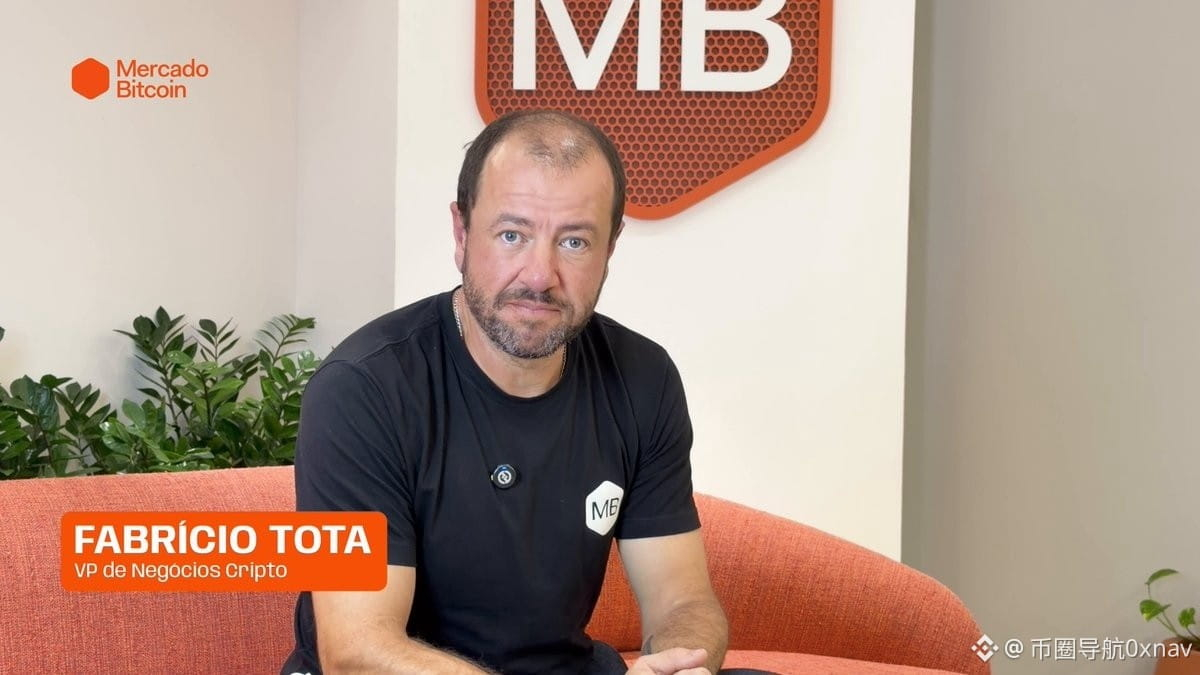
The reais in your account are now visible on the website—but when will you be able to transfer them to a bank account in your own name?
Brazilian crypto platform Mercado Bitcoin has scheduled this step for next week: it will first resume deposits and withdrawals in Brazilian reais via Pix, Brazil’s instant payment system. On November 10, the official account said in a reply to a user that the next phase was scheduled for the following week. Initially, withdrawals would only be allowed to accounts held in the customer’s own name and CPF, while deposits could come from accounts under different names. The exact date would be announced in advance through official channels. That same day, a company representative confirmed the plan to the media. By this timeline, just over ten days will have passed since the security incident on November 2. Estimates suggest that around $49 million was transferred from wallets linked to the platform at the time.
A few points that matter to everyday users 👇
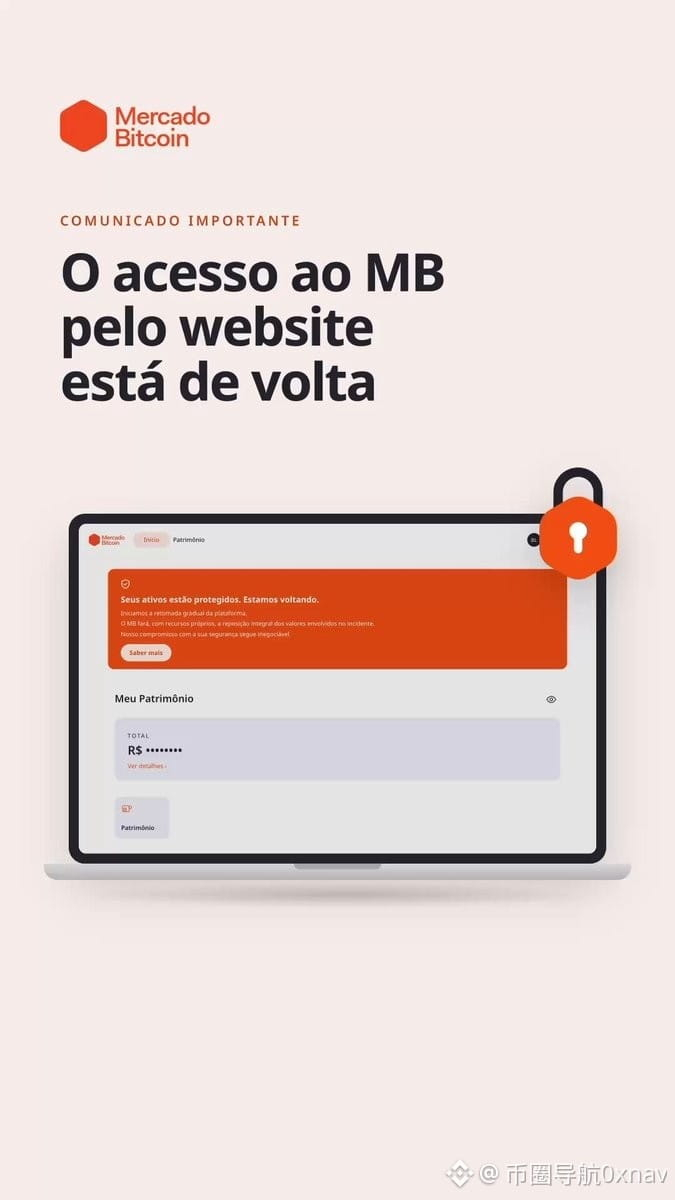
🔹 Being able to see your balance doesn’t mean you can move it yet. On November 9 (Monday local time), the platform began gradually restoring account access on its website. Customers could check their balances and assets, but Pix transfers, wire transfers, trading, and crypto transfers were still unavailable. The Help Center says the crypto balances currently shown reflect holdings from before the November 2 incident. Reais balances are also displayed at the rates from that day and will be updated once trading resumes.
🔹 To use your balance, you’ll first need to verify your details again in the official app. The Help Center says that when the next phase begins, all customers must confirm their registration details and set a new password in the official Mercado Bitcoin app before they can access their balances again. This step can only be completed through the official app. Meanwhile, payments for digital fixed-income products that were redeemed by their issuers during the incident will be credited to customers’ reais balances.
🔹 There’s no date yet for crypto deposits and withdrawals. Pix transfers in reais are part of the next phase; trading, crypto transfers, credit cards, and other services will come later. The company has not announced a schedule. A company representative also said that services would be restored in stages, with updates announced in advance through official channels. The Help Center also says the platform is using its own funds to replenish the assets involved in the incident.
🔹 Don’t fall for links claiming to “unlock your balance.” The official account warns that it will never ask for your password outside the platform or send you a link to unfreeze your balance. Only trust the official website, app, and Instagram and X accounts. The opening date will be announced through these channels, so don’t assume that “next week” means you can already withdraw.
In short: next week, the first step will be moving reais into and out of bank accounts, and withdrawals will only be allowed to accounts in your own name. If you mainly hold crypto and are eager to transfer it out, you’ll have to wait for the next official update.
Which matters more to you: “Can I withdraw reais to my own bank account first?” or “When will crypto deposits and withdrawals be available?”
#巴西MercadoBitcoin拟下周恢复Pix法币充提 #BTC #ETH

103
·
--
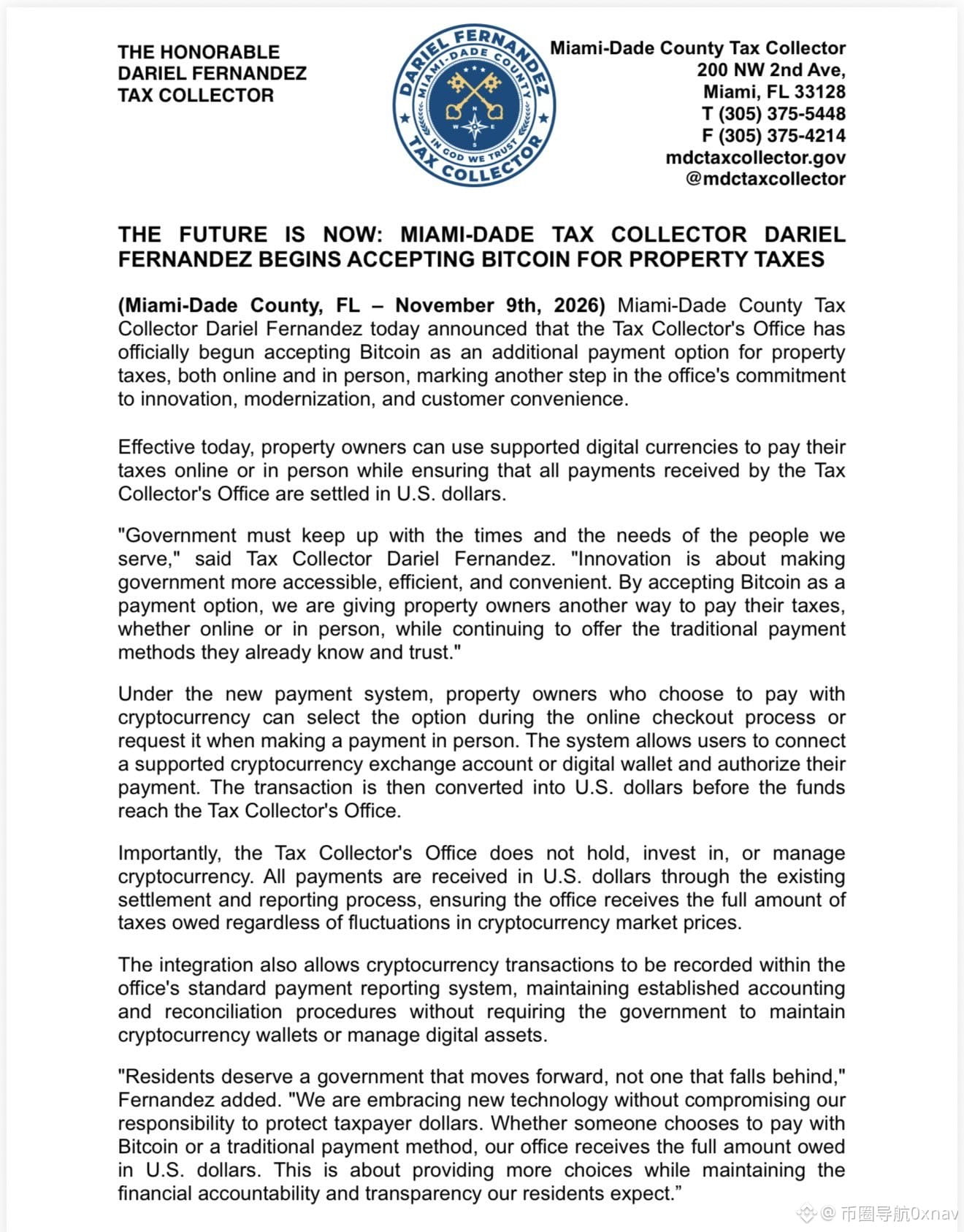
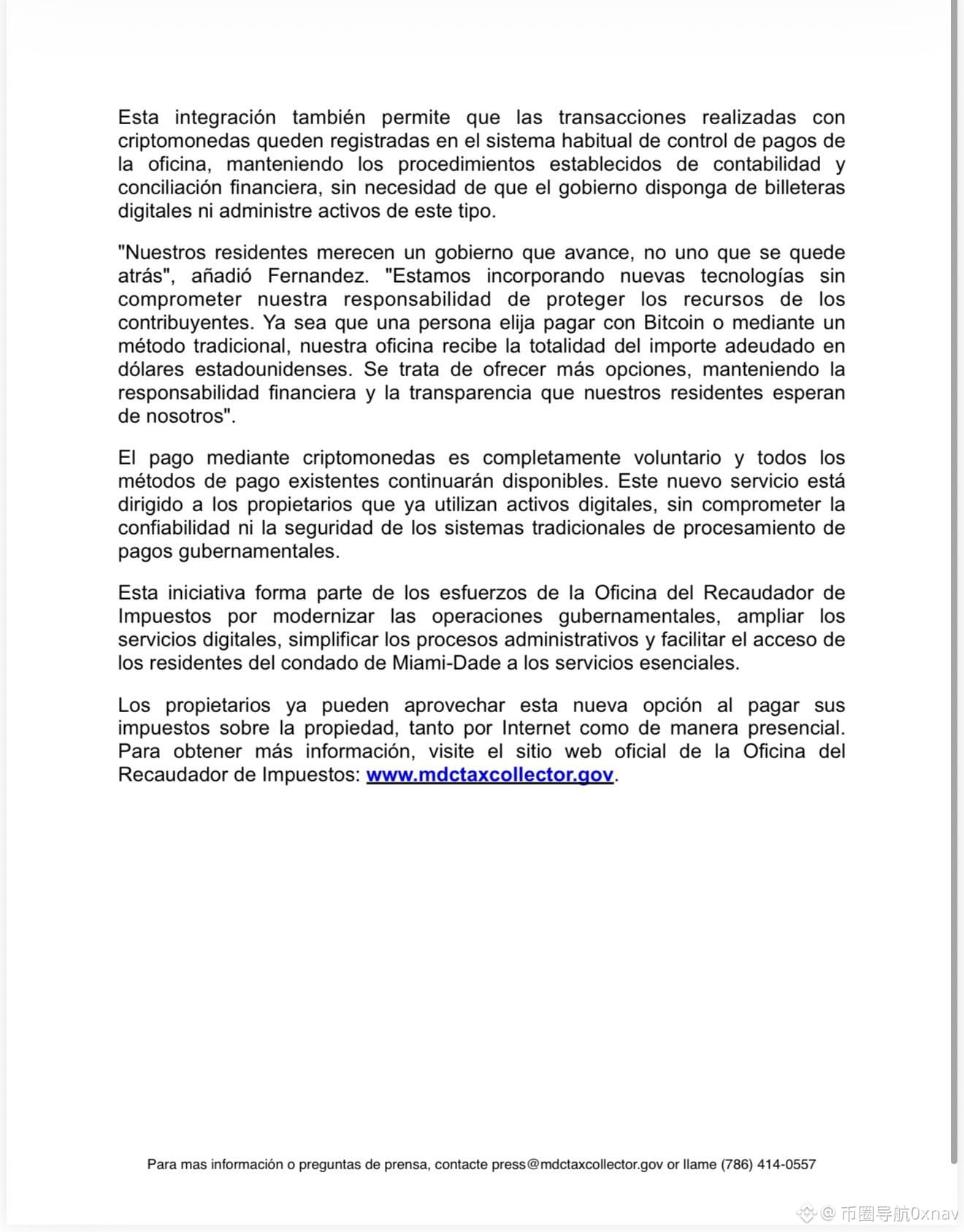
Paying Miami-Dade County property taxes with Bitcoin doesn’t mean the county is starting to hoard crypto. What goes into the county’s accounts is still U.S. dollars.
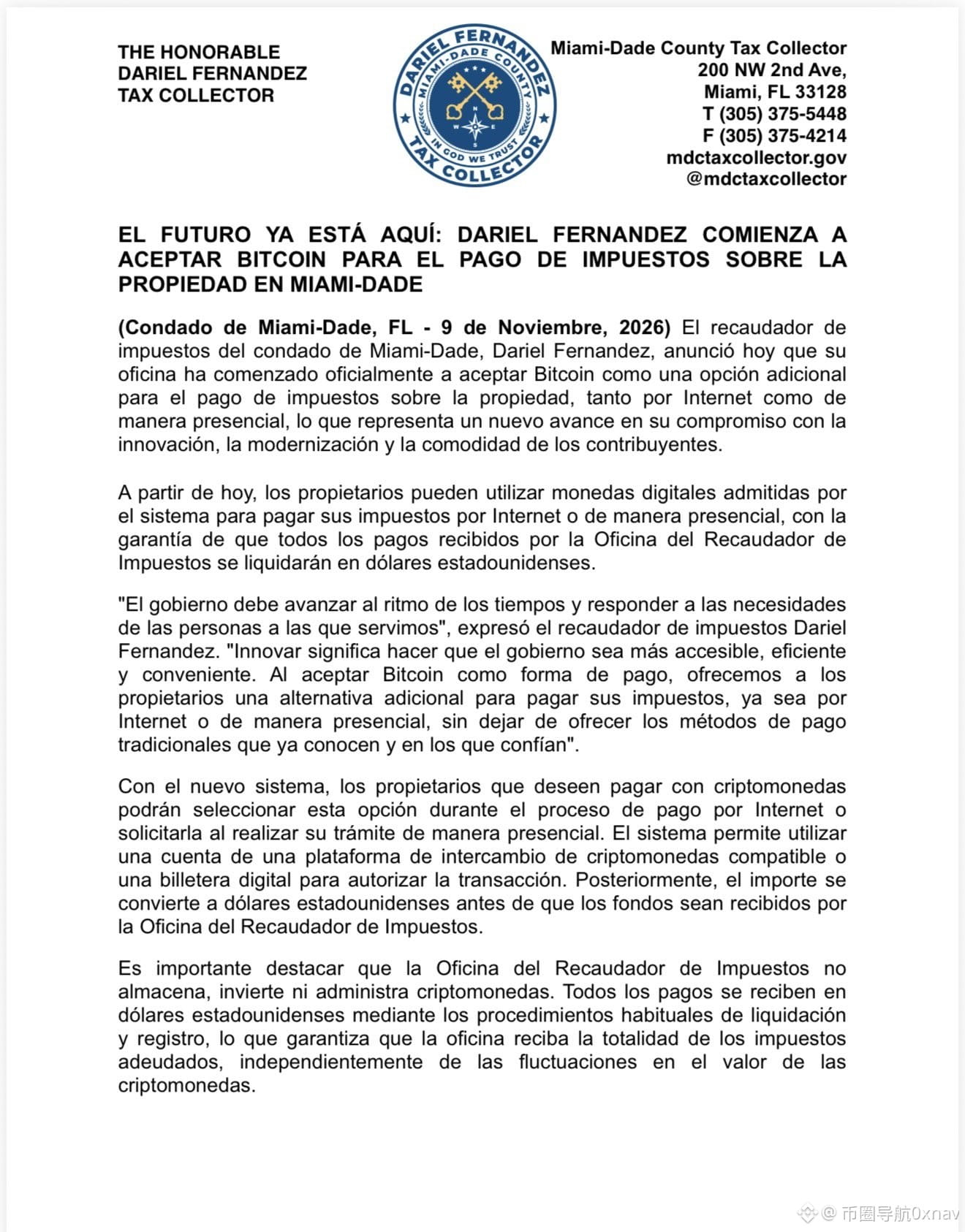
On Monday, November 9, Miami-Dade County Tax Collector Dariel Fernandez announced in an official statement that the Tax Collector’s Office had begun accepting Bitcoin as an additional payment option for property taxes, both online and in person. The statement said the option took effect immediately. He emphasized that this simply gives property owners another choice; traditional payment methods remain available.
A few points that directly affect taxpayers 👇
🔹 How the money gets to the county: When paying online, property owners select the cryptocurrency option, or ask to use it when paying in person. The system connects to a supported cryptocurrency exchange account or digital wallet and authorizes the payment. The transaction is converted into U.S. dollars before the funds reach the Tax Collector’s Office. The statement says the office does not hold, invest in, or manage cryptocurrency. It receives the full amount of taxes owed in U.S. dollars, with no more or less collected because of price fluctuations.
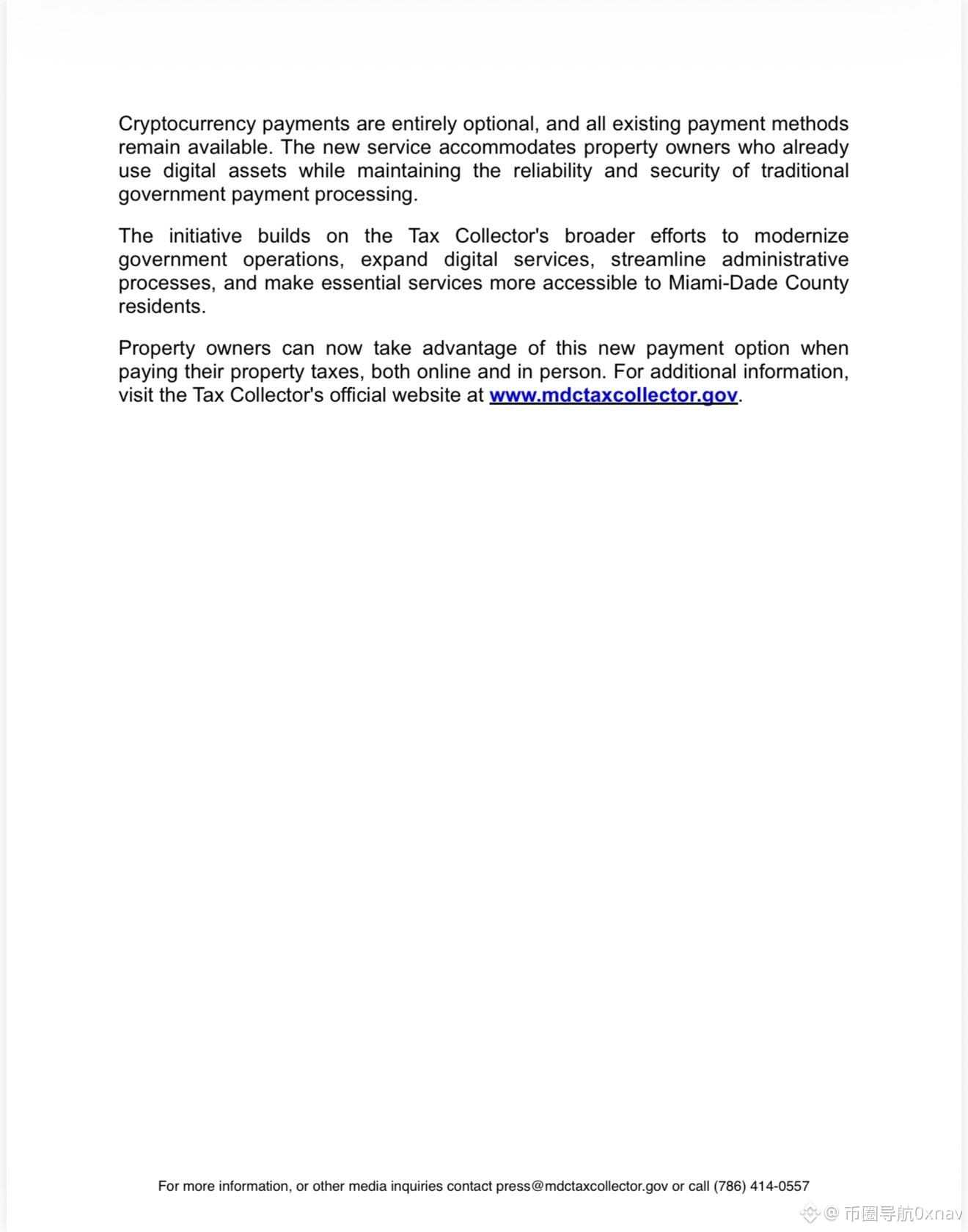
🔹 It’s not mandatory, and it doesn’t mean “you can pay with any coin”: This option is entirely voluntary. Existing methods, including checks, credit cards, debit cards, and cash, remain available as usual. The statement’s headline refers to Bitcoin, while also mentioning “supported digital currencies.” The same tax collector later clarified that the office accepts cryptocurrency—including Bitcoin and other digital currencies supported by the system—as an additional payment option for its services, including property taxes. The statement does not list exactly which coins or wallets are supported, so check the payment page.
🔹 Don’t mistake this for the county investing in crypto: A third-party conversion system exchanges the digital currency for U.S. dollars at the time of payment, after which the money enters the office’s existing settlement and accounting process. County staff don’t need to maintain crypto wallets themselves.
🔹 This is separate from the “pay early and get a discount” program: The county tax collector’s website is still advertising early-payment discounts on 2026 property taxes—pay by November 30 to get a 4% discount, with the discount decreasing month by month after that. Taxes must be paid in full by March 31, 2027. But the Bitcoin announcement itself does not say whether paying with Bitcoin qualifies for the same discount, or whether an additional conversion fee applies. Property owners in the area who want to pay with crypto should check the checkout page and official guidance for details on discounts, fees, and supported wallets before paying. Also, in the U.S., paying with crypto assets is generally treated as a disposal of those assets—separate from the county receiving U.S. dollars. Don’t conflate the two.
In short: this means “there’s now another way to pay your taxes using Bitcoin,” not “the county government is keeping tax payments on-chain.” The payment option is available as announced, but wallet eligibility, discounts, and fees depend on what the payment page says at the time.
Which matters more to you: being able to pay your taxes directly with Bitcoin, or knowing that the county doesn’t hold any cryptocurrency and only receives U.S. dollars?
#迈阿密戴德县接受比特币缴纳房产税 #BTC #ETH
155
·
--
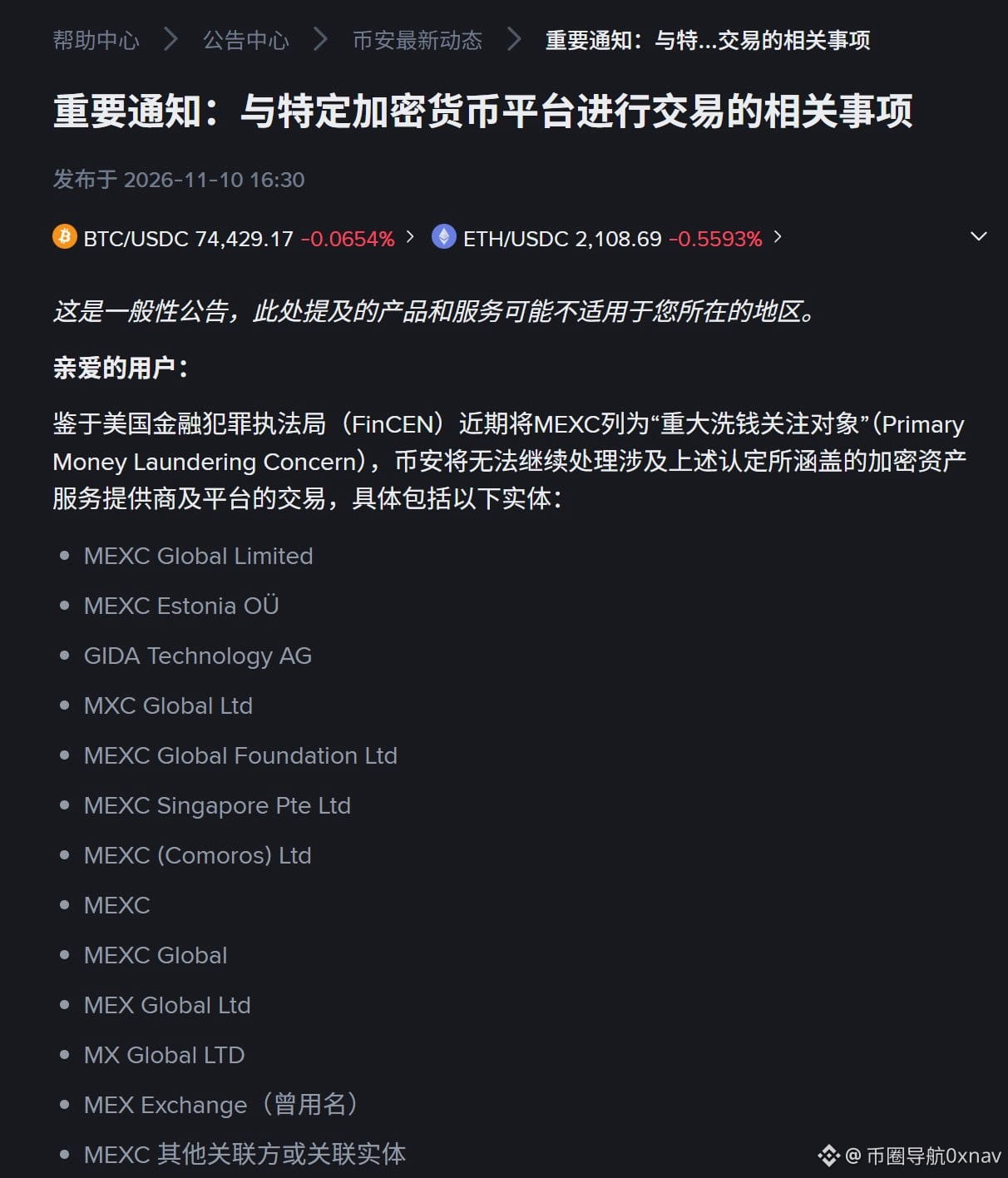
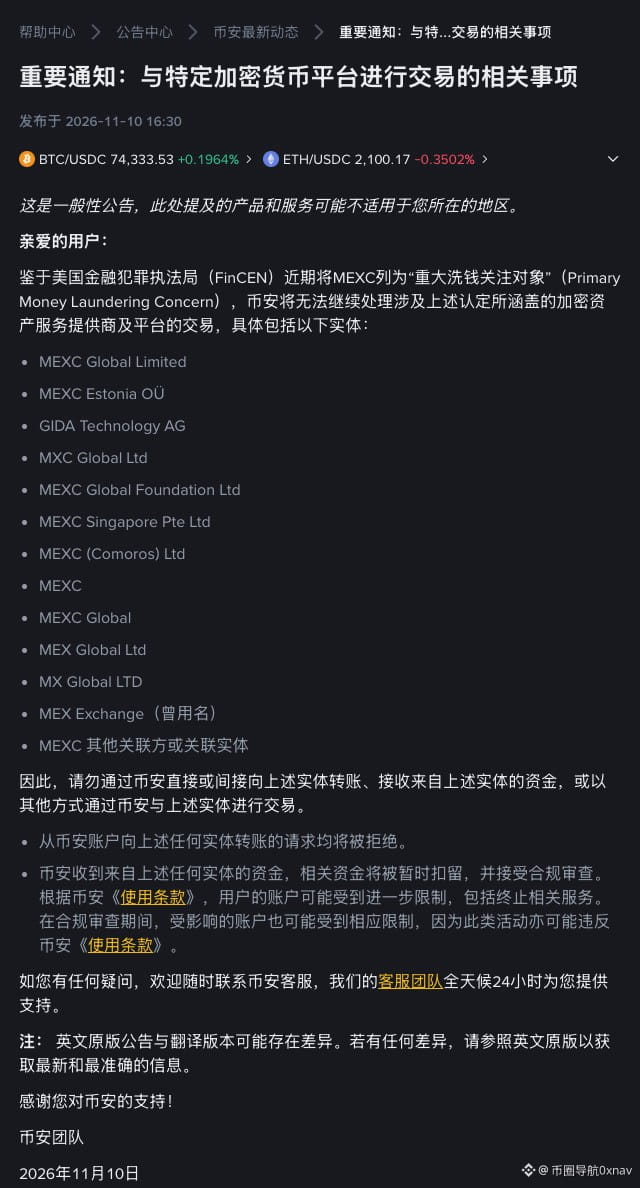
Transfers from Binance to MEXC will be rejected; deposits from MEXC to Binance may first be held for compliance review.
At 16:30 today (Beijing time, according to the publication time shown on the Chinese-language announcement page), Binance posted an “Important Notice: Matters Related to Transactions with Certain Cryptocurrency Platforms” on its official website. The background is that the U.S. Financial Crimes Enforcement Network (FinCEN) recently identified MEXC as a “primary money laundering concern.” The notice states that Binance will no longer be able to process transactions involving the crypto-asset service providers and platforms covered by that designation.
Here are a few points that are directly relevant to ordinary users 👇
🔹 The list includes more than just the commonly used name. The entities named in the notice include MEXC Global Limited, MEXC Estonia OÜ, GIDA Technology AG, MXC Global Ltd, MEXC Global Foundation Ltd, MEXC Singapore Pte Ltd, MEXC (Comoros) Ltd, as well as MEXC, MEXC Global, MEX Global Ltd, MX Global LTD, MEX Exchange (a former name), and other MEXC affiliates or related entities.
🔹 The notice says: Do not transfer funds to these entities directly or indirectly through Binance, receive funds from them, or otherwise transact with them through Binance. Requests to transfer funds from a Binance account to any of the entities listed above will be rejected.
🔹 If Binance receives funds from any of the entities listed above, those funds will be temporarily held for compliance review. Under the Terms of Use, a user’s account may be subject to further restrictions, including termination of the relevant services; affected accounts may also be restricted during the review. The notice does not say how long the review will take or when deposits that have been temporarily held may be released.
🔹 This is a general notice, and the products and services mentioned may not be available in some regions. In case of any discrepancy between the Chinese and English versions, the English original will prevail. For questions, you can contact Binance customer support; the notice states that the support team is available 24 hours a day, 7 days a week.
To be clear: the restrictions FinCEN previously imposed on U.S. financial institutions take effect 30 days after publication in the Federal Register. That is separate from Binance’s own rules for processing transfers announced today. This notice also does not say that “all assets on MEXC will be frozen”; it says that transfers between the two platforms will be handled according to the rules above. If you hold assets on both platforms and regularly transfer between them, pause any transfers in progress and check the list carefully.
Are you more concerned about “the transfer being rejected” or “a deposit being held for review”?
#币安将停止处理涉及MEXC及关联实体的资金转账 #BNB #BTC
55
·
--
In the future, if people in Korea pay with stablecoins, will the money they top up still be protected under the current electronic payment rules if a checkout dispute arises? At today’s discussion, the director of the Financial Supervisory Service’s Electronic Financial Inspection Bureau laid out the question—but first, an important caveat: this was his personal view, not a new law that has been enacted.
On November 10, the Korea Financial Investment Education Institute in Yeouido, Seoul, hosted a discussion titled “Stablecoin Innovation and Challenges After the Digital Asset Basic Act,” organized by the Democratic Party of Korea’s AI Finance and Economy Promotion Group. Speaking in a personal capacity, Shim Eun-seop, director of the Financial Supervisory Service’s Electronic Financial Inspection Bureau, said that if stablecoins are used as electronic payment tools, applying the Electronic Financial Transactions Act would be “unavoidable” in terms of fairness with existing electronic payment methods, user protection, and payment and settlement stability. He also said that stablecoins’ intended use as broadly accepted cash equivalents makes them similar to prepaid payment instruments; applying different laws to the same payment based on the settlement method could lead to regulatory arbitrage and confusion.
Here are a few points that matter directly to ordinary people 👇
🔹 This is not an announcement that “you’ll be able to scan and pay with stablecoins tomorrow.” The government is expected to submit a bill for the Digital Asset Basic Act, including provisions on stablecoins, to the National Assembly this month. The text has not yet been released, let alone passed into law.
🔹 Under his proposal, a “small-scale license” could be introduced under the Electronic Financial Transactions Act for stablecoin payment and settlement services. This would allow electronic financial businesses to receive, hold, and transfer stablecoins for payment purposes, while also requiring them to ensure stability, establish and report terms and conditions, protect topped-up and settlement funds, safeguard transaction information, and handle disputes.
🔹 Kim Bo-il, head of the Bank of Korea’s Virtual Assets Group, reiterated the Bank’s existing position: issuance of won-denominated stablecoins should initially be led by banks, with eligibility to issue them expanded only after the technology, existing systems, and regulatory framework are able to work together. He described this as a compromise in the absence of an ideal solution, intended to reduce the risk of stablecoins being used to evade regulation. Observers expect that the government’s bill this month will be more likely to favor bank-led consortia as issuers—but that is still an expectation, not an enacted legal provision.
🔹 Participants also argued that responsibilities at every stage, from issuance to redemption, should be clearly set out, and that the law should specify the conditions for freezing or blocking illicit transactions. This would help prevent private issuers from facing lawsuits after freezing funds on their own. These, too, are still discussion proposals.
Put simply, the near-term change isn’t “a new payment button appearing in your app tomorrow.” The question is whether, if stablecoin payments become possible in the future, topped-up funds will be protected and there will be a channel for complaints and compensation if something goes wrong. The details will depend on the government’s bill and any subsequent amendments.
Which matters more to you: “Will my money be protected when I pay?” or “Who will ultimately issue won-denominated stablecoins?”
#韩国金融监督院称稳定币支付应适用电子金融交易法 #BTC #ETH



507
·
--
This doesn’t mean that all USDT can no longer be used. Seeing a balance in your wallet doesn’t necessarily mean you can transfer it or redeem it for US dollars.
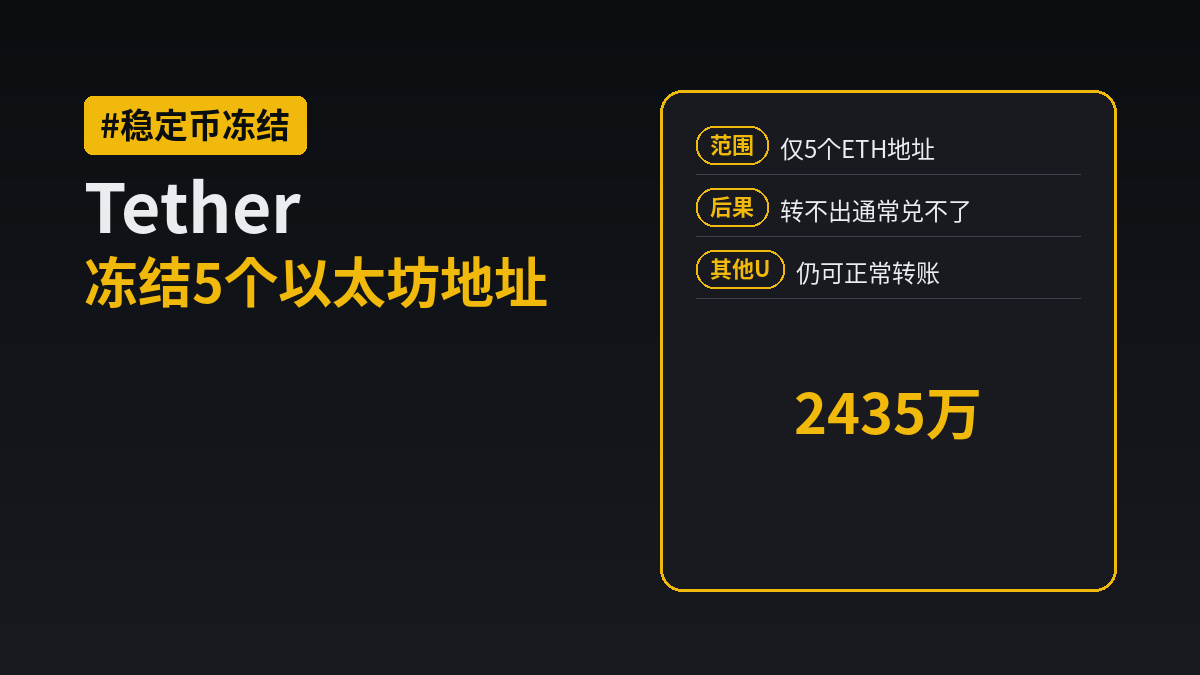
According to monitoring by MistTrack today around noon (approximately 12:07 Beijing time), Tether froze five Ethereum addresses about eight hours ago. These addresses had on-chain activity in 2021 and 2023, and held a combined total of approximately 24.35 million USDT. Wu Shuo also noted that Tether has yet to disclose the specific reason for this batch of freezes.
A few points that directly affect ordinary users 👇
🔹 What was frozen: Only the USDT on these five Ethereum addresses—not the entire network, and not U on other chains. According to MistTrack’s freeze alerts, the five balances were approximately 13.25 million, 3.18 million, 3.02 million, 2.85 million, and 2.05 million, adding up to the approximately 24.35 million figure circulating on trending lists.
🔹 Can it be transferred or redeemed? Once an address is blacklisted by the issuer, the coins remain recorded on-chain, but they can’t be transferred out of that address and usually can’t be redeemed for US dollars from Tether either. This is a built-in feature of stablecoin contracts, not a problem with the Ethereum network itself.
🔹 What about your own U? USDT in addresses that aren’t on this list can still be transferred and traded as usual. This also wasn’t a risk-control freeze by an exchange on a particular account, so don’t confuse it with other posts on social media about “accounts being frozen.”
🔹 The reason hasn’t been officially announced: MistTrack only confirmed that one of the addresses had previously had transactions with a wallet it had labeled as “phishing” and a “pig-butchering scam.” Having interacted doesn’t mean these five addresses have been confirmed as scam wallets; more information is needed.
Before accepting a payment, it may be worth checking the sender’s address. The amount is relatively small compared with the entire USDT market, but for the addresses named, these funds are currently unusable and can’t be redeemed.
#Tether冻结5个以太坊地址约2435万枚USDT #USDT #ETH
74
·
--
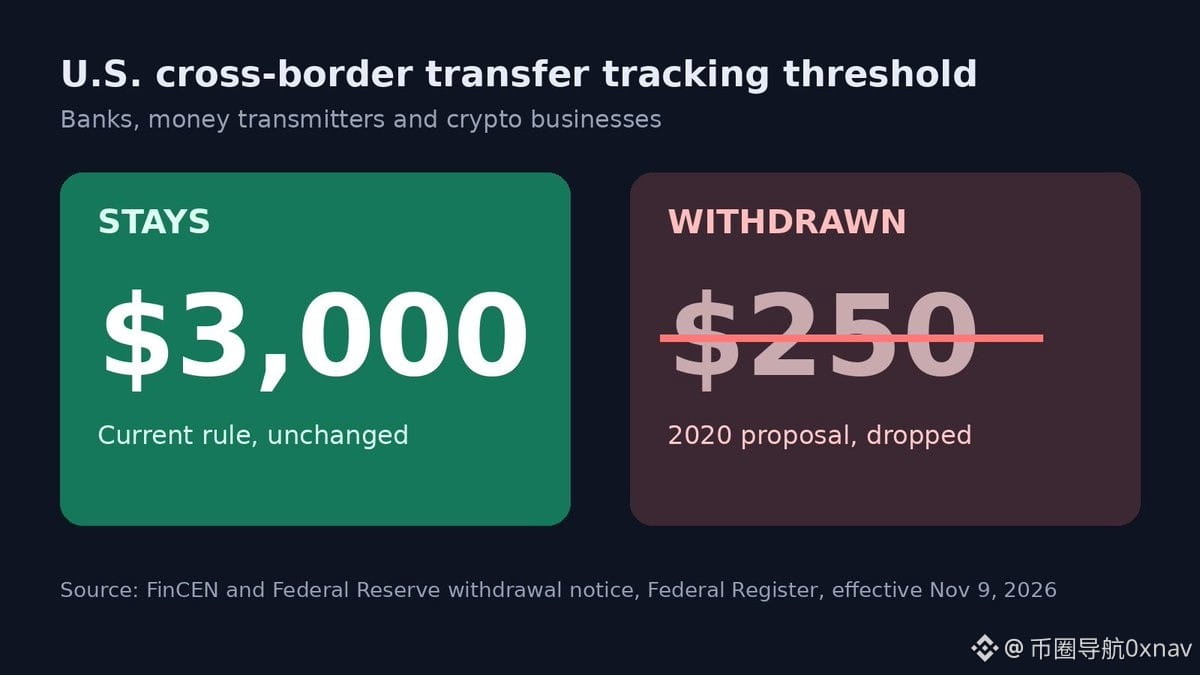
Don’t mistake “withdrawing the proposal” for “the Travel Rule is gone.” The threshold for whether U.S. cross-border transfers need to include a lot more personal information is still in the $3,000 range today.
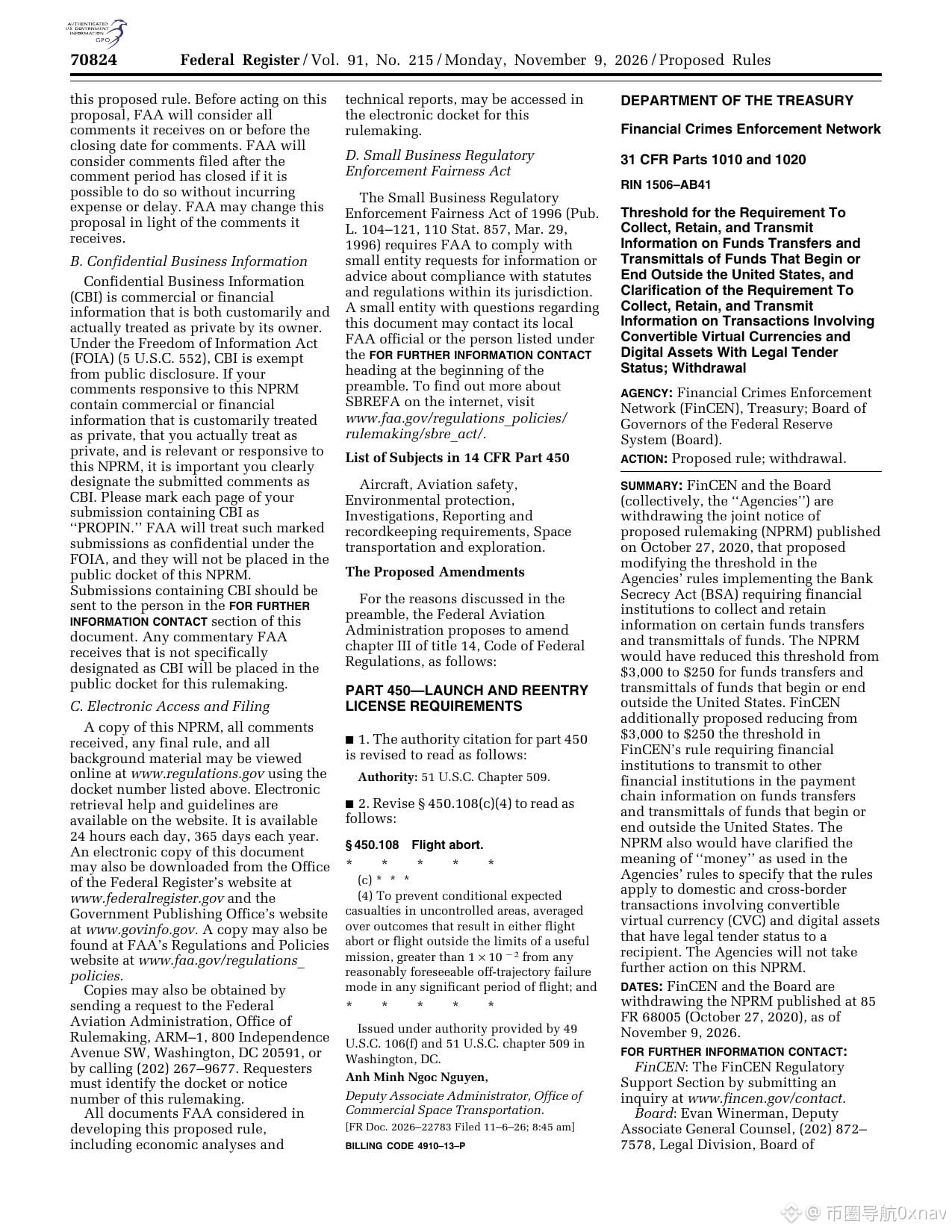
According to a joint notice from the U.S. Financial Crimes Enforcement Network (FinCEN) and the Federal Reserve, the Federal Register officially published the withdrawal on November 9, 2026, of the proposed rulemaking published on October 27, 2020. The original proposal sought to lower the threshold for the cross-border “recordkeeping rule / Travel Rule” from $3,000 to $250. It also sought to specify in the rule that the definition of “money” covers convertible virtual currency (CVC) and digital assets with legal-tender status. The entire proposal has now been withdrawn, and the two agencies have made clear that they will not issue a final rule based on it.
A few points that directly affect ordinary people 👇
🔹 How it works today: The current threshold remains $3,000. Banks and nonbank payment providers must still collect and retain information for transfers at or above the threshold, and pass it on to the next institution in the payment chain as required. Withdrawal does not mean existing obligations have been relaxed.
🔹 What would have happened: Had the proposal been adopted, small cross-border transfers involving the United States at either end would also have been covered by the same information-collection and transmission requirements. Many small remittances and transfers involving deposits to or withdrawals from exchanges would have faced significantly more compliance friction.
🔹 Why it was withdrawn: The agencies gave two reasons. First, the proposal had been on hold for more than five years, so any changes would require a new public comment period. Second, the convertible virtual currency industry and the legal framework for stablecoins have changed significantly in recent years (the notice refers to, among other things, the federal framework for payment stablecoins enacted in 2025), so the old proposal should not simply be carried forward.
🔹 Don’t take this to mean “crypto is no longer regulated”: Existing guidance, including the relevant 2019 guidance, remains in effect. It is only this round—“lower the threshold to $250 + explicitly include CVC in the definition”—that will not move forward. Any future changes would require a new public comment period.
In short: this “stops one round of tightening”; it does not “do away with the Travel Rule.” Remember three key points: the original threshold was $3,000; the proposed reduction to $250 has been withdrawn; and the withdrawal takes effect on 2026-11-09. For cross-border transfers involving stablecoins or fiat currency, continue to provide information as required by current rules and platform policies. Don’t read the headline as “small amounts can be transferred freely, and nobody keeps records.”
Which matters more to you: being asked fewer questions about small remittances, or worrying that a new proposal might bring another round of changes?
#FinCEN撤回跨境转账250美元门槛提案 #BTC #ETH
245
Log in to explore more content
Join global crypto users on Binance Square
⚡️ Get latest and useful information about crypto.
💬 Trusted by the world’s largest crypto exchange.
👍 Discover real insights from verified creators.
Email / Phone number
Trending Topics
NvidiaEarningsTonight:AIStocks’NextMove?
47,709 views
742 Discussing
Nvidia Earnings Day: Interim CEO's First Appearance — Can the AI Story Hold?
Binance News
·17 Likes
·7.8k views
A Packed Week of Earnings and Data Tests Markets
115,795 views
585 Discussing
AnthropicIPOTestsInvestorAppetiteForAI
252,113 views
2,469 Discussing