
ABBA 80
47 Posts

ABBA 80
 Square Verified
Report
Block User
Airdrop Hunting || Content Creator || Dex Trader || Turning ideas into value || Learn • Earn • Grow 💯 BP-A6D7E8242057
Open Trade
Occasional Trader
2.5 Years
114 Following
140 Followers
103 Liked
Posts
Portfolio
All
Quotes
·
--
The real power of DeFi is what happens when protocols connect.
A DEX doesn’t have to build every product itself.
Sometimes, its biggest value comes from becoming infrastructure that other builders can plug into.
That’s what I find interesting about @ston_fi ’s growing ecosystem.
With tools like Omniston, the SDK, and Widget, developers can integrate swap and liquidity infrastructure into their own products instead of rebuilding everything from zero.
The recent Stonks integration is a good example.
A token can start its journey through a bonding curve, transition into a STON.fi liquidity pool, and remain accessible through integrated interfaces.
That creates something bigger than a simple DEX.
Liquidity becomes composable.
Builders can focus on their own ideas.
Users get smoother experiences.
And TON gets more applications connected to the same underlying financial infrastructure.
This is how an ecosystem starts to compound:
More builders → more applications → more liquidity → more utility.
The strongest DeFi protocols won’t necessarily be the ones users interact with directly every day.
They may be the ones quietly powering the products users love.
#STONfi #TON #Omniston #DeFi #TONBuilders #Web3
67
·
--
STON.fi just gave its community another reason to explore the ecosystem. 🐱
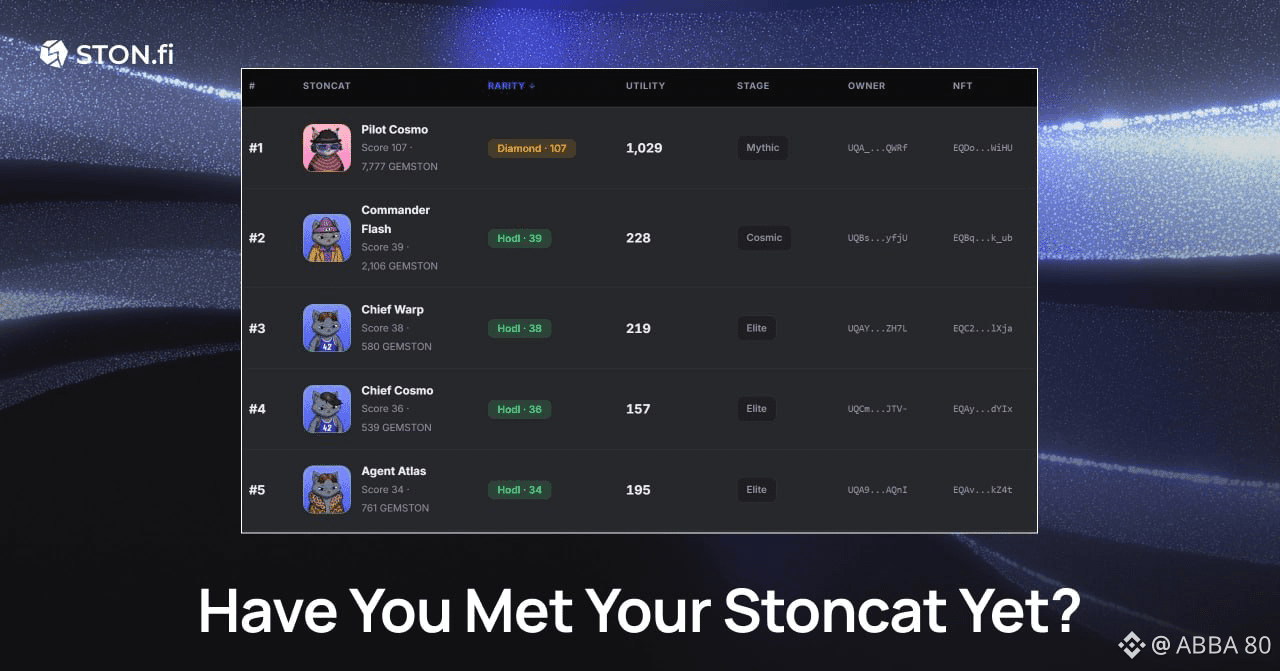
Stoncats are now live, and the early activity is already getting interesting.
The first Diamond Stoncat has reportedly been reached after receiving 7,777 GEMSTON, while more users are minting and upgrading their own cats.
What makes this more interesting is how Stoncats connect with the wider STON.fi experience.
They’re not just NFTs sitting in a wallet.
Users can mint, upgrade, compete on the rarity leaderboard, and complete the Stoncat task as part of the “One Swap. Across Chains” exploration campaign.
That creates a different kind of community experience around DeFi.
Instead of simply using a protocol and leaving, users have another reason to explore, participate, and keep progressing within the ecosystem.
And with minting now running smoothly after the initial demand caused some delays, the real competition may only be starting.
7,777 GEMSTON has already produced the first Diamond.
The question now is:
Who’s getting the next one? 👀🐱
#STONfi #STON #TON #Stoncat #GEMSTON #DeFi #Web3
80
·
--
STON.fi is becoming infrastructure that other TON projects can build around.
The latest integration with Stonks is a good example of what that looks like in practice.
Stonks is building an AI-powered launch ecosystem where teams can launch tokens, use custom bonding curves, seed liquidity, and run presales.
Now, that flow connects directly into @stonfi
A token can move from its early bonding-curve stage into a fully seeded STON.fi pool without builders having to piece together separate liquidity infrastructure.
That creates a much cleaner lifecycle:
Launch → Bonding Curve → Liquidity → STON.fi → Trading
There’s another interesting layer too.
STON.fi tokens can now be swapped directly through the Stonks terminal and Telegram bot, while Omniston can help optimize routes before migration.
This is bigger than another integration announcement.
It shows how DeFi infrastructure becomes more valuable when other applications can plug into it and build new experiences on top.
The strongest ecosystems aren’t built by one protocol doing everything.
They’re built when different products connect, share infrastructure, and make the entire user journey smoother.
TON needs more of this.
And STON.fi is steadily positioning itself right in the middle of that infrastructure layer.
#STONfi #TON #Stonks #Omniston #DeFi #Web3
STON.fi is becoming infrastructure that other TON projects can build around.
The latest integration with Stonks is a good example of what that looks like in practice.
Stonks is building an AI-powered launch ecosystem where teams can launch tokens, use custom bonding curves, seed liquidity, and run presales.
Now, that flow connects directly into @STONfi DEX
A token can move from its early bonding-curve stage into a fully seeded STON.fi pool without builders having to piece together separate liquidity infrastructure.
That creates a much cleaner lifecycle:
Launch → Bonding Curve → Liquidity → STON.fi → Trading
There’s another interesting layer too.
STON.fi tokens can now be swapped directly through the Stonks terminal and Telegram bot, while Omniston can help optimize routes before migration.
This is bigger than another integration announcement.
It shows how DeFi infrastructure becomes more valuable when other applications can plug into it and build new experiences on top.
The strongest ecosystems aren’t built by one protocol doing everything.
They’re built when different products connect, share infrastructure, and make the entire user journey smoother.
TON needs more of this.
And STON.fi is steadily positioning itself right in the middle of that infrastructure layer.
#STONfi #TON #Stonks #Omniston #DeFi #Web3
58
·
--
STON.fi is becoming infrastructure that other TON projects can build around.
The latest integration with Stonks is a good example of what that looks like in practice.
Stonks is building an AI-powered launch ecosystem where teams can launch tokens, use custom bonding curves, seed liquidity, and run presales.
Now, that flow connects directly into @stonfi
A token can move from its early bonding-curve stage into a fully seeded STON.fi pool without builders having to piece together separate liquidity infrastructure.
That creates a much cleaner lifecycle:
Launch → Bonding Curve → Liquidity → STON.fi → Trading
There’s another interesting layer too.
STON.fi tokens can now be swapped directly through the Stonks terminal and Telegram bot, while Omniston can help optimize routes before migration.
This is bigger than another integration announcement.
It shows how DeFi infrastructure becomes more valuable when other applications can plug into it and build new experiences on top.
The strongest ecosystems aren’t built by one protocol doing everything.
They’re built when different products connect, share infrastructure, and make the entire user journey smoother.
TON needs more of this.
And STON.fi is steadily positioning itself right in the middle of that infrastructure layer.
#STONfi #TON #Stonks #Omniston #DeFi #Web3
STON.fi is becoming infrastructure that other TON projects can build around.
The latest integration with Stonks is a good example of what that looks like in practice.
Stonks is building an AI-powered launch ecosystem where teams can launch tokens, use custom bonding curves, seed liquidity, and run presales.
Now, that flow connects directly into @STONfi DEX
A token can move from its early bonding-curve stage into a fully seeded STON.fi pool without builders having to piece together separate liquidity infrastructure.
That creates a much cleaner lifecycle:
Launch → Bonding Curve → Liquidity → STON.fi → Trading
There’s another interesting layer too.
STON.fi tokens can now be swapped directly through the Stonks terminal and Telegram bot, while Omniston can help optimize routes before migration.
This is bigger than another integration announcement.
It shows how DeFi infrastructure becomes more valuable when other applications can plug into it and build new experiences on top.
The strongest ecosystems aren’t built by one protocol doing everything.
They’re built when different products connect, share infrastructure, and make the entire user journey smoother.
TON needs more of this.
And STON.fi is steadily positioning itself right in the middle of that infrastructure layer.
#STONfi #TON #Stonks #Omniston #DeFi #Web3
The latest integration with Stonks is a good example of what that looks like in practice.
Stonks is building an AI-powered launch ecosystem where teams can launch tokens, use custom bonding curves, seed liquidity, and run presales.
Now, that flow connects directly into @STONfi DEX
A token can move from its early bonding-curve stage into a fully seeded STON.fi pool without builders having to piece together separate liquidity infrastructure.
That creates a much cleaner lifecycle:
Launch → Bonding Curve → Liquidity → STON.fi → Trading
There’s another interesting layer too.
STON.fi tokens can now be swapped directly through the Stonks terminal and Telegram bot, while Omniston can help optimize routes before migration.
This is bigger than another integration announcement.
It shows how DeFi infrastructure becomes more valuable when other applications can plug into it and build new experiences on top.
The strongest ecosystems aren’t built by one protocol doing everything.
They’re built when different products connect, share infrastructure, and make the entire user journey smoother.
TON needs more of this.
And STON.fi is steadily positioning itself right in the middle of that infrastructure layer.
#STONfi #TON #Stonks #Omniston #DeFi #Web3
59
·
--
Security is one of the most important parts of DeFi, and @ston_fi seems to take it seriously.
From audited core contracts and public TON-side code to ongoing bug bounties, the focus is on making the system more transparent and verifiable.
Cross-chain swaps use hashed timelocks to help ensure transactions either complete as intended or funds can be refunded.
Add slippage protection and clear fee estimates, and users get another layer of protection during volatile markets.
No system is completely risk-free.
But this is what makes Ston.fi stand out: building DeFi infrastructure where transparency, security, and user control are treated as core features, not afterthoughts.
As Ston.fi continues expanding across chains, that foundation could be one of its biggest strengths.
60
·
--
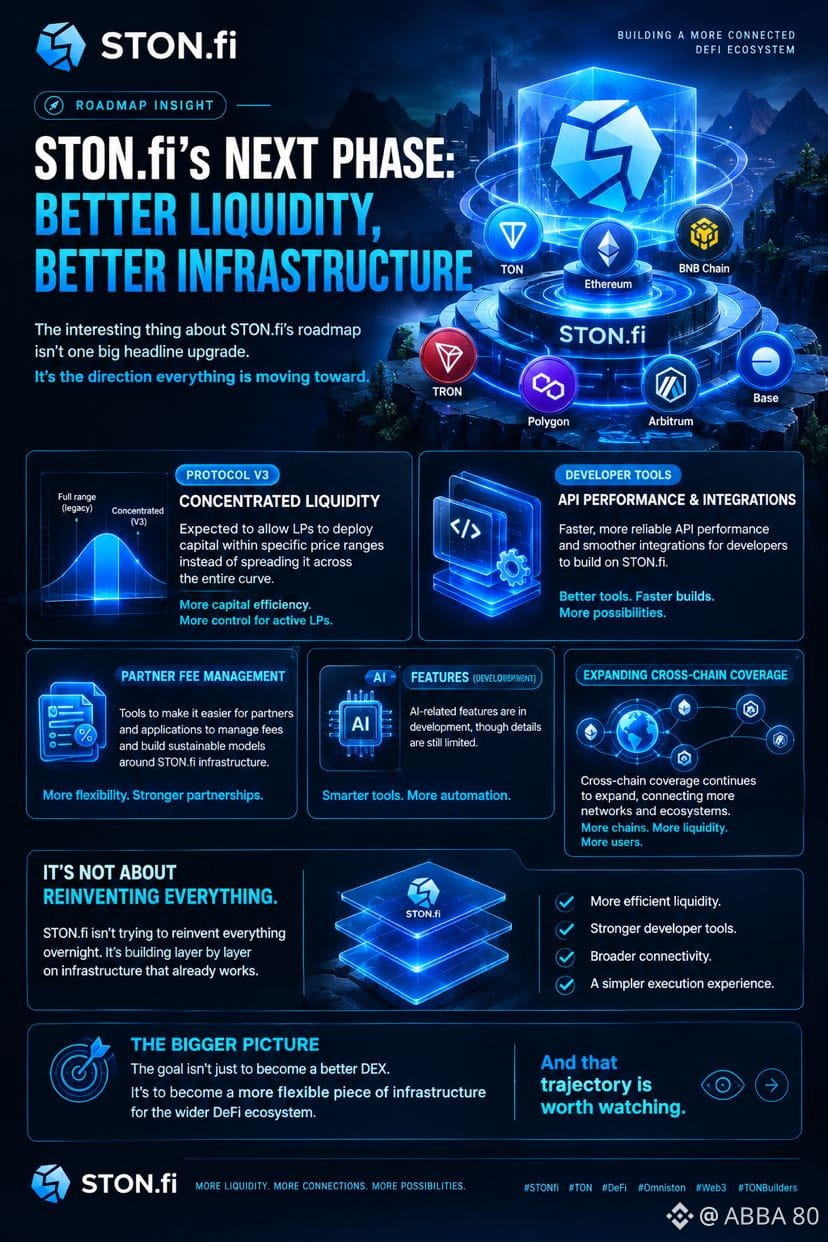
STON.fi’s Next Phase: Better Liquidity, Better Infrastructure
The interesting thing about @Stonfi’s roadmap isn’t one big headline upgrade.
It’s the direction everything is moving toward.
Protocol V3 is expected to introduce concentrated liquidity, allowing LPs to deploy capital within specific price ranges instead of spreading it across the entire curve.
That could make liquidity more capital-efficient and give active liquidity providers more control over their positions.
But the roadmap goes beyond liquidity.
Developers are also getting improvements around API performance and integrations, while partner fee-management tools should make it easier for applications to build sustainable models around STON.fi infrastructure.
AI-related features are also under development, although the details are still limited.
At the same time, cross-chain coverage continues to expand.
What I like about this approach is that STON.fi isn’t trying to reinvent everything overnight.
It’s building layer by layer on infrastructure that already works.
More efficient liquidity.
Stronger developer tools.
Broader connectivity.
A simpler execution experience.
The goal isn’t just to become a better DEX.
It’s to become a more flexible piece of infrastructure for the wider DeFi ecosystem.
And that trajectory is worth watching. 👀
#STONfi #TON #DeFi #Omniston #Web3 #TONBuilders
50
·
--
STON.fi is becoming more than just a TON-native DEX.
It’s evolving into a practical gateway for moving capital across major blockchain ecosystems while keeping users in control of their keys.
With Omniston handling routing and settlement, swaps can feel seamless whether the trade stays within TON or moves across ecosystems.
And it doesn’t stop at swapping. Farming, staking, and governance give users more ways to participate and put their capital to work.
What stands out is the approach: STON.fi isn’t chasing every trend. It’s focused on removing real friction.
With more upgrades planned through 2026 and into 2027, the bigger picture is clear:
Better capital efficiency.
Broader access.
Smoother cross-chain trading.
STON.fi is building for where DeFi is heading next.

1
96
·
--
TON DeFi Insight: Stablecoins Are the Real Cross-Chain Workhorses
When people talk about cross-chain DeFi, the focus is often on bridges and exotic tokens.
But in practice, stablecoins are where a lot of real value movement happens.
@ston_fi is making that movement simpler by supporting cross-chain swaps for assets like USDT and USDC across TON, TRON, and major EVM networks.
The important part isn’t just moving tokens between chains.
It’s making the process predictable.
Users can see a quote before confirming, while the settlement design is built to avoid leaving users with a partially completed swap.
That matters for anyone using stablecoins to:
• Move liquidity between ecosystems
• Rebalance positions
• Access DeFi opportunities
• Transfer value across networks
Instead of treating every chain like a separate financial island, cross-chain infrastructure starts connecting them into one broader liquidity environment.
And starting with stablecoins makes sense.
They’re already widely used, highly liquid, and practical for everyday value transfer.
As more networks and assets become connected, the real opportunity is bigger than simply “cross-chain swaps.”
It’s making liquidity move where users need it, without making the journey unnecessarily complicated.
#STONfi #TON #Omniston #Stablecoins
1
87
·
--
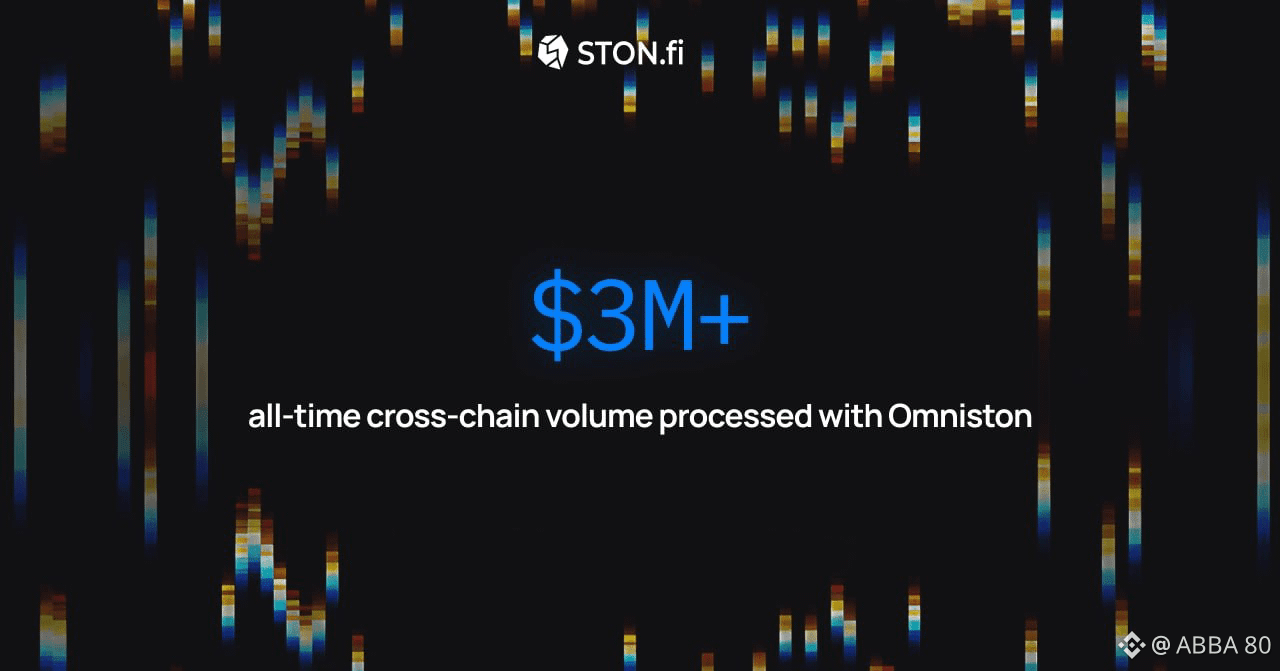
3M+ in cross-chain volume is only the beginning.
Omniston has now crossed $3 million in all-time cross-chain swap volume since STON.fi launched the feature in June.
What makes this interesting isn’t just the number.
It shows that users are already starting to move liquidity across ecosystems through a simpler route.
TON ↔ EVM chains
TON ↔ other networks
One interface. One swap experience.
And @ston_fi isn’t stopping at the milestone.
The “One Swap. Across Chains” campaign is now giving users a guided way to explore this new cross-chain experience while earning miles and unlocking campaign rewards.
$3M is a solid first milestone.
But if cross-chain liquidity keeps growing at this pace, the next numbers could look very different.
The journey has started. The real scale is still ahead.
#STONfi #Omniston #TON #CrossChain #DeFi #Web3
1
78
·
--
TON Builder Insight: Great Infrastructure Should Disappear Into the Product
The best DeFi infrastructure isn’t always the product users notice.
Sometimes, it’s the technology working quietly underneath the apps they already use.
That’s the direction @ston_fi is taking.
Through Omniston, the Widget, and SDK, developers can connect their applications to STON.fi’s liquidity and swap infrastructure without having to build an entire trading system from scratch.
That creates a powerful advantage for TON.
A wallet doesn’t need to become a DEX.
A game doesn’t need to build its own liquidity layer.
A DeFi app doesn’t need to reinvent swap infrastructure.
Builders can focus on their core product while STON.fi handles more of the underlying execution.
And as API improvements make integrations faster and more flexible, the number of applications that can plug into this liquidity layer can grow even further.
That’s what composable DeFi should look like:
Build once. Connect everywhere. Let users trade without leaving the experience.
The real strength of infrastructure isn’t how loudly it announces itself.
It’s how many builders can quietly depend on it.
#STONfi #TON #Omniston #DeFi
1
1
67
·
--
TON DeFi Insight: The Best UX Is the One Users Already Understand
One reason TON has such an interesting path to mainstream adoption is simple:
Users are already on Telegram.
That makes bringing DeFi into a familiar environment much more powerful than forcing people through a stack of unfamiliar apps.
@ston_fi is leaning into this by making wallet connection and swapping accessible through the Telegram ecosystem, while its cross-chain infrastructure expands where users can move liquidity from.
Instead of:
Open one app → connect wallet → find a bridge → switch networks → open another DEX → swap.
The experience can become much closer to:
Connect → Swap → Done.
That reduction in friction matters.
Because adoption isn’t only about better technology.
It’s also about removing the small obstacles that make people give up before they even start.
As STON.fi connects TON with liquidity from other ecosystems, Telegram can serve as a familiar entry point while the infrastructure handles the complexity underneath.
The next wave of DeFi adoption may not come from teaching everyone new interfaces.
It may come from bringing better financial infrastructure into the interfaces people already use.
#STONfi #TON #Telegram #DeFi #Web3
1
89
·
--
This is actually a smart way to introduce people to cross-chain DeFi.
@ston_fi is turning the waitlist into an early-access experience instead of just asking users to sign up.
The first 1,000 TON wallets to connect during the waitlist get:
🎟️ Priority Passenger status
💎 1,000 bonus miles
🪪 A personalized Priority Passenger Ticket
✈️ Access to future campaign rewards
And the important part: those 1,000 bonus miles are waitlist-only.
The campaign is built around “One Swap. Across Chains” which fits perfectly with what STON.fi is building through cross-chain swaps and Omniston.
If you’re already exploring TON, DeFi, or cross-chain liquidity, this looks like one of those campaigns where getting in early actually matters.
Only 1,000 Priority Passenger seats.
I’d rather secure mine now than watch the seats disappear and start asking how to join later. 👀
Who’s taking a seat? ✈️
#TON #STONfi #Omniston #CrossChain #DeFi #Web3

1
92
·
--
Happy Saturday 💙
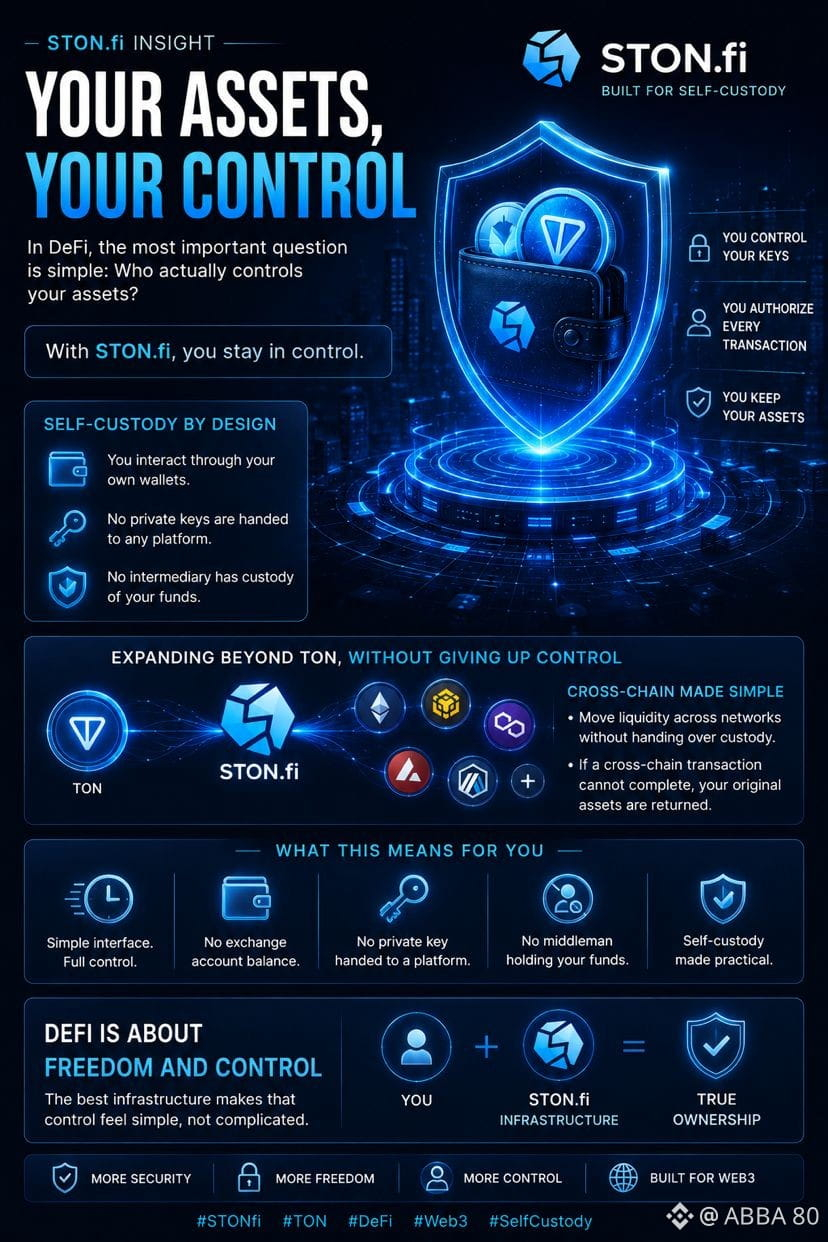
STON.fi Insight: Your Assets, Your Control
One of the most important things in DeFi is easy to overlook:
Who actually controls your assets?
With @ston_fi, users interact through their own wallets rather than handing their funds or private keys to a centralized platform.
Each transaction is authorized by the user.
That matters even more as @ston_fi expands beyond TON.
For cross-chain swaps, the goal is still the same: make moving liquidity between networks simple without turning custody over to an intermediary.
And if a cross-chain transaction cannot complete, the design aims to return the original assets instead of leaving them stuck in the process.
This is the kind of infrastructure that makes self-custody practical.
You get the convenience of a simple interface while keeping control of the wallet that holds your assets.
No account balance controlled by an exchange.
No private key handed to a platform.
No unnecessary middleman holding your funds.
DeFi is ultimately about giving users more control over their financial assets.
The best infrastructure should make that control feel simple, not complicated.
#STONfi #TON #DeFi #Web3 #SelfCustody
95
·
--
STON.fi’s Next Chapter: From DEX to DeFi Infrastructure
What interests me about @ston_fi isn’t only what it has built.
It’s where the infrastructure is heading next.
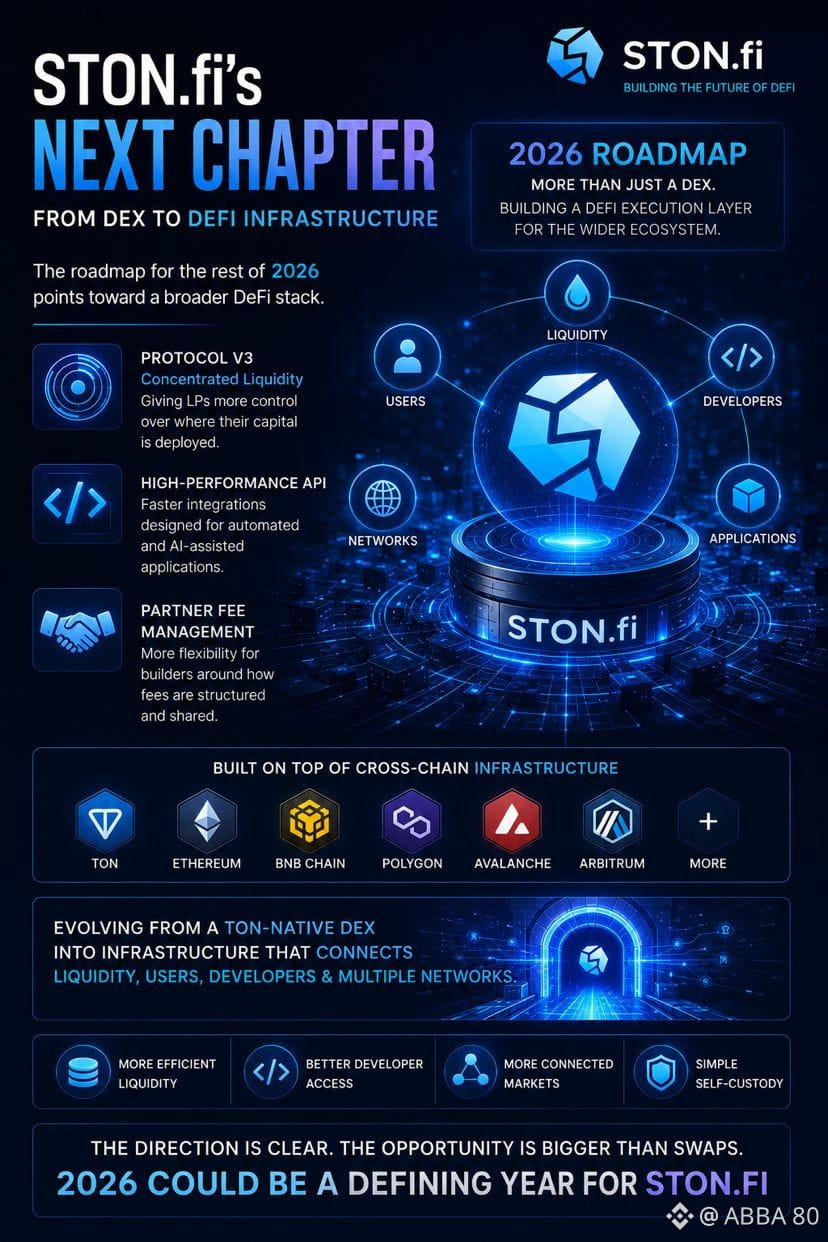
The roadmap for the rest of 2026 points toward a broader DeFi stack:
• Protocol V3 is expected to bring concentrated liquidity, giving LPs more control over where their capital is deployed.
• A high-performance API is planned to make integrations faster and better suited for automated and AI-assisted applications.
• Partner fee management should give builders more flexibility around how fees are structured and shared.
And this is happening on top of the cross-chain infrastructure already being developed.
The bigger picture is easy to miss:
STON.fi is evolving from a TON-native DEX into infrastructure that can connect users, liquidity, developers, and multiple networks.
That’s a much bigger opportunity than simply processing swaps.
If the execution matches the vision, the next phase could be less about being another DEX and more about becoming a DeFi execution layer for the wider ecosystem.
The direction is clear:
More efficient liquidity.
Better developer access.
More connected markets.
Simple self-custody.
2026 could be an important year for @ston_fi
1
67
·
--
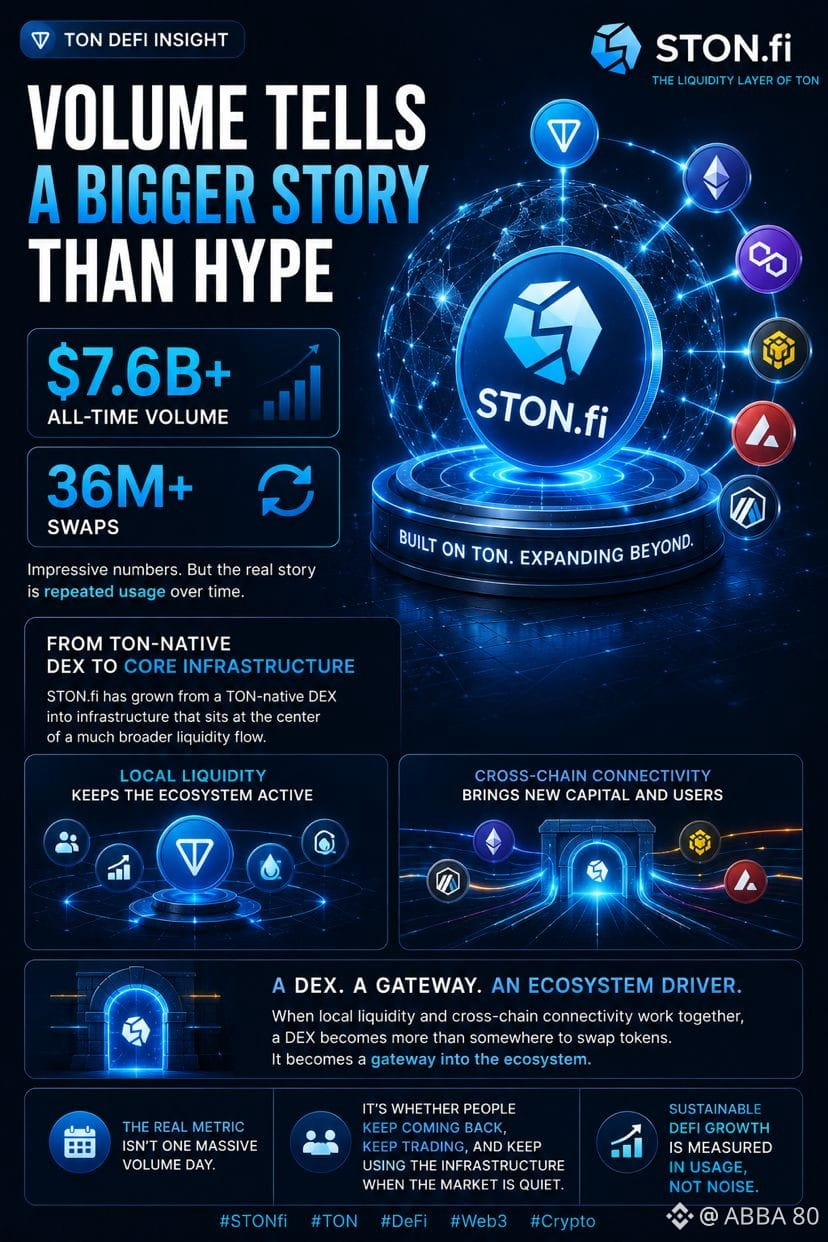
TON DeFi Insight: Volume Tells a Bigger Story Than Hype
$7.6B+ in all-time volume.
36M+ swaps.
Those numbers are impressive, but the more interesting part is what they represent: repeated usage over time.
@ston_fi has grown from a TON-native DEX into infrastructure that sits at the center of a much broader liquidity flow.
Its native markets continue to serve TON users, while cross-chain routes create another path for liquidity to move between TON and other ecosystems.
That combination matters.
Local liquidity keeps the ecosystem active.
Cross-chain connectivity brings new capital and users in.
And when both work together, a DEX becomes more than somewhere to swap tokens.
It becomes a gateway into the ecosystem.
The real metric isn’t one massive volume day.
It’s whether people keep coming back, keep trading, and keep using the infrastructure when the market isn’t making headlines.
Sustainable DeFi growth is measured in usage, not noise.
#STONfi #TON #DeFi #Web3 #Crypto
1
68
·
--
TON DeFi Insight: Liquidity Is What Keeps the Market Moving
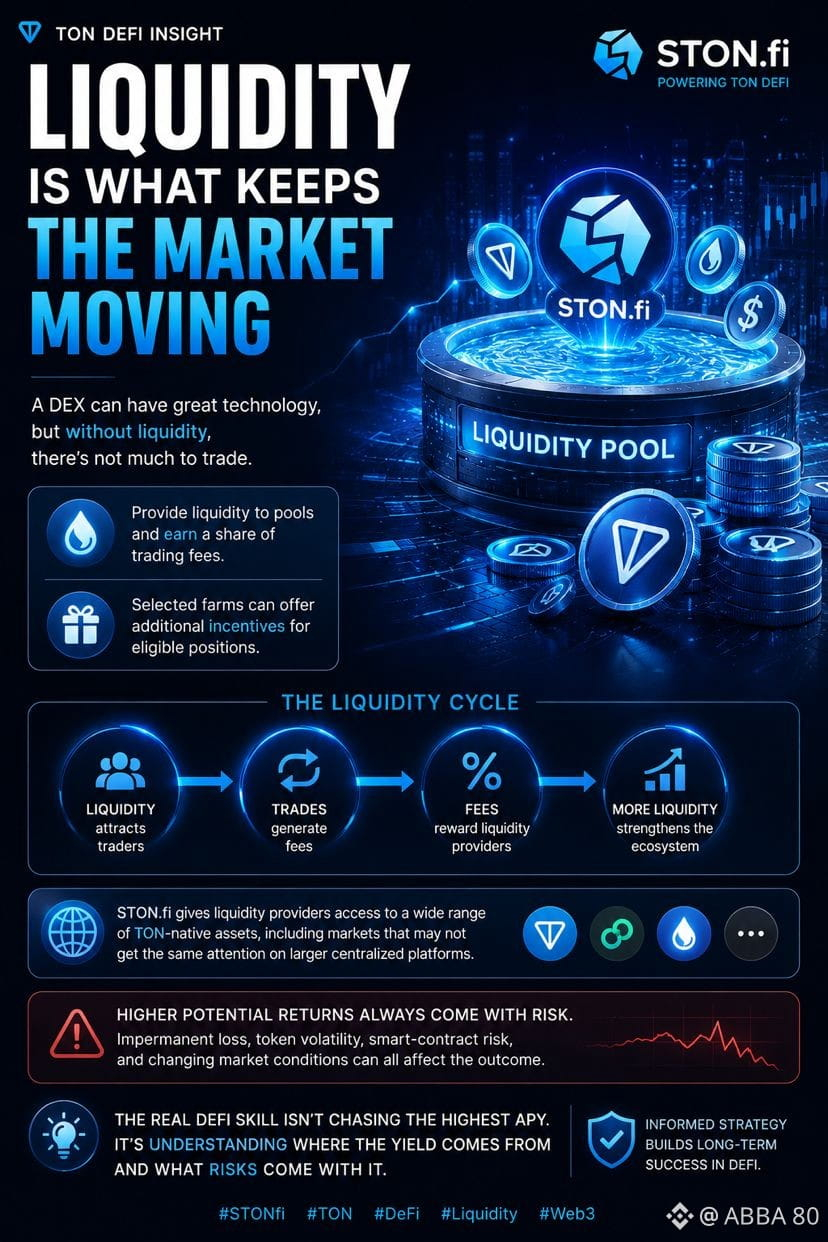
A DEX can have great technology, but without liquidity, there’s not much to trade.
That’s why liquidity provision remains one of the most important parts of DeFi.
On @ston_fi, users can provide liquidity to pools and earn a share of trading fees, while selected farms can offer additional incentives for eligible positions.
The interesting part is how this creates a cycle:
Liquidity attracts traders → trades generate fees → fees reward liquidity providers → more liquidity strengthens the ecosystem.
STON.fi also gives liquidity providers access to a wide range of TON-native assets, including markets that may not receive the same attention on larger centralized platforms.
But higher potential returns always come with risk.
Impermanent loss, token volatility, smart-contract risk, and changing market conditions can all affect the outcome.
So the real DeFi skill isn’t simply chasing the highest APY.
It’s understanding where the yield comes from and what risks come with it.
That’s what turns liquidity provision from a number on a dashboard into an informed DeFi strategy.
#STONfi #TON #DeFi #Liquidity #Web3
2
64
·
--
One Important DeFi Lesson: Don’t Judge a Token by Its Price
Not every crypto token exists for the same reason.
Some secure networks.
Some coordinate governance.
Some power applications.
Others are designed to support participation within a specific ecosystem.
That’s why looking at the price chart alone can give you an incomplete picture.
Take the TON ecosystem.
TON is the native asset of the blockchain itself, while $STON is connected to the @ston_fi protocol and its ecosystem.
Different roles. Different purposes.
And this is the question worth asking before buying or researching any token:
“What does this token actually do?”
Look at its utility.
Understand its ecosystem.
Check how people use it.
Then consider the market.
A rising price can attract attention.
But understanding why the token exists gives you a much better foundation for evaluating it.
In Web3, utility tells the story that the price chart can’t.
#STONfi #STON #TON #DeFi #Web3
1
4
81
·
--
One Interesting TON Fact: DeFi Doesn’t Have a Closing Bell
Traditional finance has opening hours.
DeFi doesn’t.
There’s no waiting for Monday morning.
No market closing for the weekend.
No public holiday stopping you from interacting with a protocol.
Blockchain networks operate continuously, allowing users to swap assets, provide liquidity, and manage their positions whenever they choose.
On TON, @ston_fi is part of that always-on financial infrastructure.
And 24/7 access is more than convenience.
It changes how people interact with financial services.
Your location, the time of day, and whether traditional markets are open don’t have to determine when you can access decentralized markets.
Of course, 24/7 availability doesn’t remove risk. Markets can still be volatile, liquidity can change, and users still need to understand what they’re interacting with.
But the principle is powerful:
Finance that never closes gives users more freedom to decide when they participate.
That’s one of the ideas that makes DeFi worth paying attention to.
#STONfi #TON #DeFi #Web3 #CryptoEducation
1
3
82
·
--
Builder Insight: Attention Follows Utility
Web3 doesn’t need more products built simply to generate noise.
It needs products that make something easier, faster, or possible for the first time.
The strongest builders usually start with a problem, not a marketing campaign.
That mindset is important for ecosystems like TON.
@ston_fi is contributing to that foundation by building DeFi infrastructure around swaps, liquidity, and broader connectivity—giving users practical ways to interact with decentralized finance while giving other builders infrastructure they can build on.
And that creates a powerful cycle:
Better infrastructure → better applications → better user experiences → stronger ecosystem.
Attention can bring people through the door.
But useful products are what make them stay.
That’s why the next phase of Web3 won’t be won by whoever posts the loudest.
It will be shaped by the builders solving problems people actually have.
Build something useful first. Let the attention follow.
#STONfi #TON #DeFi #TONBuilders #Web3
2
4
99
·
--
The Best DeFi Infrastructure Isn’t What Users Notice. It’s What Developers Build On.
A strong ecosystem isn’t measured by how much one protocol builds alone.
It’s measured by how many other products can build on top of it.
That’s where @ston_fi becomes interesting.
With tools like the STON.fi SDK and Omniston, developers can integrate swapping and liquidity infrastructure directly into their own applications instead of rebuilding the same systems from scratch.
That changes the game.
Developers can focus on their product.
Users get a smoother experience.
Liquidity becomes more connected across the ecosystem.
And when applications like DTrade and Fact Market can leverage shared infrastructure, TON gets something more valuable than another standalone DEX.
It gets a composable DeFi layer.
The future of DeFi won’t be one platform doing everything.
It will be many applications building different experiences on infrastructure they can trust.
The strongest infrastructure is often the infrastructure other builders choose to build on.
#STONfi #STON #TON #Omniston #DeFi #Web3
3
85
Log in to explore more content
Join global crypto users on Binance Square
⚡️ Get latest and useful information about crypto.
💬 Trusted by the world’s largest crypto exchange.
👍 Discover real insights from verified creators.
Email / Phone number
Trending Topics
NVIDIAReinstatesJensenHuangasCEO
35,611 views
631 Discussing
TradFi News | Nvidia Board Unanimously Reinstates Jensen Huang as CEO; Shares Jump 30% Premarket
Binance News
·34 Likes
·30.3k views
WillMarketsStageAThanksgivingReliefRally?
137,691 views
1,716 Discussing
WillOctCorePCEShiftFedHikeExpectations?
52,502 views
721 Discussing