
Bn奥克队长_Ai版
2.2k Posts

Bn奥克队长_Ai版
Report
Block User
17年进圈躺平型量化交易者🚩七年币安队长服务超千人注册使用🏆币安最佳金算盘奖、长青伙伴奖。
前大厂程序员|Ai|Defi|套利|投资&投机|平时瞎哔哔|偶尔干货|爱好旅游已打卡两次🇺🇸旅居
#Binance 币安注册使用【AOKEAOKE】码注册账号🤖免费体验量化策略🧧注册免费开通子账户功能
Open Trade

BTC Holder
High-Frequency Trader
8.9 Years
39 Following
1K Followers
1.5K+ Liked
Posts
Portfolio
All
Quotes
Videos
·
--
You cut losses at 58103 during the day, then FOMO’d in at 61363 at night—that’s you
You sold at a loss when it was 58103 in the morning, then FOMO’d in at 61363 at night. Same people, same script. BTC surged 4.949% over the day, now at 61045 and hovering just below the daily high of 61363. That bullish candle taught the people who panicked during the day a very clear lesson.
Let’s review the day: low of 58103, high of 61363, trading volume of 14.89B USDT—price and volume both rising. Pay close attention to the funding rate: BTC rose 4.949%, but its funding rate was only 0.004553%. Leveraged longs haven’t gotten carried away at all. What does that tell us? Spot buyers are stepping in; it’s not a bunch of futures gamblers pumping the price. This kind of rally is much healthier than an overheated rebound with sky-high funding rates.
ETH is tonight’s drama queen: price up 3.42%, funding rate at -0.001778%—negative. The price is rising, while shorts are still paying to stay in their positions. That’s not weakness; it’s the shorts’ last act of defiance—and ready-made fuel. If it holds above 1707.48 overnight, 1755.12 is the obvious next level.
Three things to watch overnight:
1. First, look to 61363 overhead. Break through it, and price could head straight for 62403.97, fully igniting short-term sentiment.
2. The first support on a pullback is 58765.33—a high-probability area to watch, much better than chasing the price higher.
3. An extreme wick down to 56552.37 would be the market teaching investors a lesson. The sky isn’t falling, but your leverage might be.
Altcoins are tagging along: BNB +4.363% is getting a taste of the action, while XRP +2.848% remains sluggish. BTC is leading the story—don’t give the supporting cast extra screen time.
The bias is bullish, and here’s why: the gains are real, funding is calm, and shorts are paying. But a bullish bias doesn’t mean blindly chasing the price. If you rush in above 61363, one wick could teach you a hard lesson.
One last harsh truth: the people panicking at 58103 during the day and getting excited at 61363 at night are probably the same people. The market hasn’t changed; sentiment has. Keep your eyes on two levels overnight: 58765.33 and 62403.97. Everything in between is noise.
$BTC Daily sell level: $62404 Daily buy level: $56552
$ETH Daily sell level: $1755.12 Daily buy level: $1575.35
$BNB Daily sell level: $565.41 Daily buy level: $517.69
$BTC #BTC $ETH #ETH
11
·
--
Wicked down to 55126, then bounced back to 60156—those who got scared out last night should take a good look at themselves
What a ride overnight. BTC wicked down to a low of 55126.7, breaking straight through the daily buy level at 56552.37. Everyone who had a stop-loss set overnight got swept out at the bottom. Then they woke up to a price of 60156.6, up 2.08% over 24 hours.
That wasn’t a drop—it was a shakeout. The weak hands got off first, and only then could the train get moving.
Three hard data points:
① The funding rate is still negative at -0.00000901. The price has rebounded 2%, but the rate still hasn’t turned positive, which means short positions are still stuck in there and haven’t surrendered. These traders will either keep paying funding or line up to admit they were wrong at resistance.
② 24-hour trading volume hit $21.1 billion. This is a high-volume reversal, not a fake move to lure in bulls on shrinking volume.
③ Price has reclaimed the pivot at 58765.33, with the 24-hour high of 60978.3 just within reach. If it breaks above 60978.3, the next stop is the daily sell level at 62403.97.
ETH was even stronger, up 3.95% over 24 hours and reaching a high of 1715.87. Its funding rate has only just turned positive at 0.00000883, so buyers chasing the rally haven’t exhausted the upside yet. There’s still room before the daily sell level at 1755.12. ETH outperforming BTC—altcoin holders can draw their own conclusions.
Direction: bullish bias.
If 58765.33 holds on a pullback, the structure is still intact, so keep an eye on it. A break below 56552.37 would mean a second bottom test, and 55126.7 would have to be tested again. Don’t rush to make excuses to comfort yourself. If the rebound approaches 62403.97, that’s a daily-chart sell level—don’t pretend you can’t see the opportunity to take profits.
One last thought: you sell when price wicks down near the lows, then chase it as it approaches resistance. The market hasn’t let anyone down; it’s the order of your trades that’s costing you your principal.
$BTC Daily sell level: $62404 Daily buy level: $56552
$ETH Daily sell level: $1755.12 Daily buy level: $1575.35
$BNB Daily sell level: $565.41 Daily buy level: $517.69
$BTC #BTC $ETH #ETH
1
1.5k
·
--
Nvidia Loses an Amazon: Market Value Sinks by About $2.7 Trillion in Seven Weeks
Over the past month and a half, U.S. AI stocks have faced an unusually concentrated sell-off. This week, the Philadelphia Semiconductor Index fell more than 10%, its worst weekly performance since 2001, wiping about $2.3 trillion off the chip sector’s market value. The S&P 500 fell for seven consecutive trading days, dropping more than 9% for the week, while the VIX briefly topped 40 as fear surged. Nvidia is at the storm’s center. Its shares fell for a seventh straight week, the longest losing streak since 2008. They are down about 47% from their October record high, erasing roughly $2.7 trillion in market value—the equivalent of losing an Amazon. Its current market value is about $3.03 trillion, below Alphabet’s. Looking back to November 5, Nvidia plunged 9.26% in a single day, wiping $447 billion off its market value, while founder Jensen Huang’s personal wealth shrank by $15.1 billion. The decline was already underway. What makes the sell-off notable is the company’s fundamentals: Nvidia has beaten analyst expectations for 17 consecutive quarters. Its fourth-quarter revenue guidance of $130 billion topped the market’s $125 billion forecast, and it raised its fiscal 2028 growth outlook from 70% to 75%. In other words, the market is not selling off earnings, but rather the financing and growth model of the AI ecosystem. A closer look at the latest decline shows three pillars of the AI trade weakening at once. First, financing is changing: Nvidia’s new chairman explicitly said that Jensen Huang would not return, and the company is tightening financing support for customers, providing guarantees only after projects have secured tangible necessities such as land, power and buildings. Goldman Sachs interpreted this as Nvidia voluntarily scaling back its role as the “AI central bank”; the implicit backstop it had provided to the ecosystem is now being reversed. Second, liquidity is being drained: Anthropic completed a record-breaking $107.3 billion IPO at a valuation of about $1.5 trillion. Investors raised funds ahead of the offering, and in the days before it, gold, cryptocurrencies, copper and Nvidia shares all came under selling pressure. Bloomberg cited analysts who said Bitcoin’s unusual decline ahead of the offering was consistent with fundraising activity. The stock subsequently fell from a high of $115.10 to around $83.10, and underwriters have exercised the overallotment option in full. Third, policy pressure: Federal Reserve Governor Waller reiterated his support for a 50-basis-point rate hike. His hawkish stance, bearish hedge positioning and the thinnest order-book liquidity in more than four years amplified the decline. For crypto markets, the main transmission channel is liquidity rather than positioning: the combined impact of a massive IPO draining funds, a reassessment of the AI narrative and a pullback in risk appetite. If more mega-sized offerings follow, similar liquidity squeezes could recur; this is speculation, not an established fact. At the same time, money has not withdrawn across the board: in the week ending November 18, global equity funds saw net inflows of $59.2 billion, while technology funds attracted $12.3 billion, with some investors still buying the dip. Editorial view: Nvidia’s results show that demand remains strong; what the market is repricing is the ecosystem’s reliance on guaranteed financing. The 10-year Treasury yield fell from 5.17% to 4.90% despite hawkish comments, suggesting attention is shifting from inflation to growth and liquidity risks. In the near term, the biggest variables may be macro policy and the pace of large asset offerings, rather than any single company’s earnings. Until market structure recovers, elevated volatility may be the baseline. The above includes a review of facts and speculation and does not constitute investment advice.
#NvidiaLoses$2.7TrillionInMarketValueInSixWeeks #BTC #ETH #BNB
640
·
--
Crypto market rebounds after plunge; security and liquidation risks draw attention
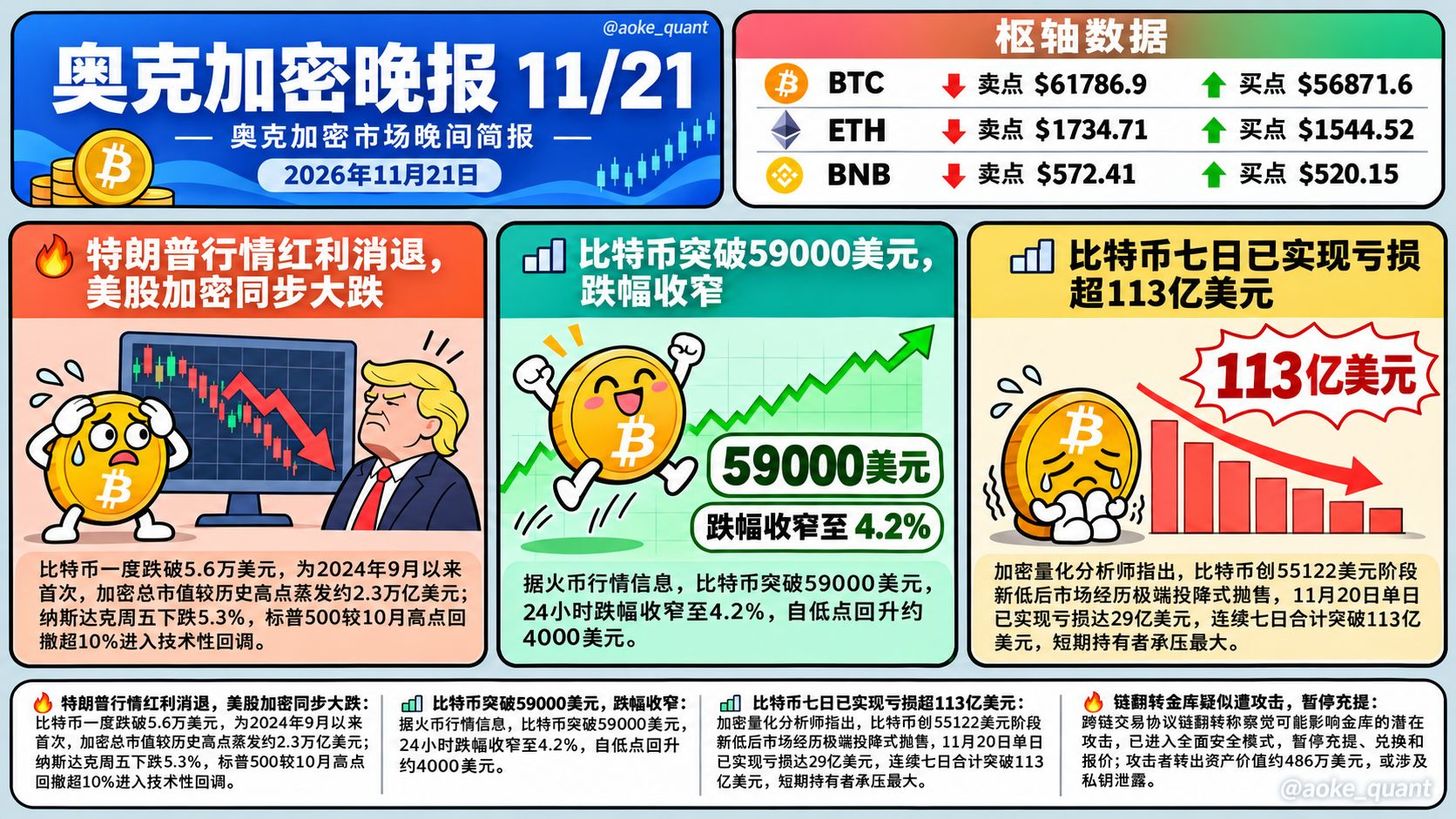
📰 Crypto Evening Report | 2026-11-21 21:00
🔥 Major Events
1. Trump-trade momentum fades as U.S. stocks and crypto plunge in tandem — Bitcoin briefly fell below $56,000 for the first time since September 2024, while the crypto market lost about $2.3 trillion from its all-time high…
2. Chainflip treasury suspected of being attacked; deposits and withdrawals suspended — Cross-chain trading protocol Chainflip said it detected a potential attack that could affect its treasury. It has entered full security mode and suspended deposits, withdrawals, swaps, and quotes…
3. Kraken responds to unusual discount in CAD trading pairs — Kraken said its CAD currency pairs came under heavy selling pressure from around 20:00 UTC on November 20…
4. BTCS discloses about $54 million in Aave borrowing — Nasdaq-listed Ethereum treasury company BTCS disclosed that it borrowed about $54 million on Aave, with crypto assets worth about $111 million…
5. Adam Back: CAD discount may be due to market makers running out of funds — Blockstream CEO Adam Back said the BTC/CAD trading pair on Kraken’s Canadian platform was trading at a steep discount…
📊 Market Data
1. Bitcoin breaks above $59,000 as losses narrow — According to HTX market data, Bitcoin topped $59,000, with its 24-hour decline narrowing to 4.2% after recovering about $4,000 from its low.
2. Bitcoin’s seven-day realized losses exceed $11.3 billion — CryptoQuant analysts noted that the market experienced extreme capitulation-style selling after Bitcoin hit a new local low of $55,122…
3. Bitcoin investment capital in unrealized losses hits an all-time high — Data shows Bitcoin’s market cap is about $1.17 trillion, with roughly $950 billion of invested capital in unrealized losses…
4. Liquidation clusters between $59,000 and $62,000 cleared — Glassnode said the largest long liquidation cluster, previously concentrated in the $59,000–$62,000 range, has been completely cleared…
5. Analyst says they won’t buy Bitcoin until ETF net inflows turn positive — Coinkarma founder Benson Sun said he has become cautious since Bitcoin fell below $75,000…
6. Whale’s liquidation price rises to $1,401 after adding to ETH position — On-chain analyst Ember monitored a whale depositing 182,277 ETH as collateral on Aave and borrowing $214 million in USDT…
7. Whale adds $7 million to maintain HYPE long position — TradingBeats monitoring shows a whale added a total of $7 million in USDC in several transactions to maintain a HYPE long position…
8. Whale has unrealized gains on a 3x long of 14,000 ETH — Hyperbot data shows a whale opened a 14,000 ETH long position on Hyperliquid at about $1,555…
9. Hyperliquid liquidation account’s cumulative profit reaches $3.53 million — The Hyperliquid portfolio margin liquidation account has earned about $3.53 million in total, including about $476,000 in the past 24 hours…
10. Crypto-related U.S. stocks fall; HUT drops over 10% — MSX.COM data shows several crypto-related U.S. stocks fell over the past 24 hours, with HUT down 10.5%…
11. Viewpoint: U.S. stocks have lost $6 trillion over 31 trading days — Some observers say U.S. stocks have fallen for 31 consecutive trading days since their October 6 peak, shedding about $6 trillion in market value…
🏛️ Regulation and Policy
1. European Central Bank invites institutions to take part in tokenization experiments — The ECB announced that its Appia initiative is inviting market participants to take part in analysis and experiments focused on tokenized deposits and payments, tokenized securities, and shared network governance…
💡 Project Updates
1. Analysis warns of risks from Tether’s large non-cash reserves — Citing Tether’s third-quarter reserve report, analysts said its total assets stood at $191.45 billion and liabilities at $183.5 billion…
2. Sun Yuchen Prize to award $1 million for work on the Riemann hypothesis — Justin Sun reposted an official post from the “Sun Yuchen Prize” saying that two groundbreaking results on the Riemann hypothesis have emerged…
3. On-chain platform co-founder plans to sell all BTC and bet on Anthropic — Artemis co-founder Jon Ma said about 50% of his net worth is allocated to Anthropic…
📊 Market Overview:
BTC $58,827 (-4.41%), funding rate 0.0024%
ETH $1,662.44 (-4.38%), funding rate 0.0039%
📍 Daily chart buy/sell levels:
$BTC Daily sell level $61,787 | Daily buy level $56,872
$ETH Daily sell level $1,734.71 | Daily buy level $1,544.52
BNB Daily sell level $572.41 | Daily buy level $520.15
$BTC #BTC $ETH #ETH
244
·
--
Chased in at 62158, got shaken out at 55126.7: retail traders' intraday round trip
That huge bearish candle today is worth reviewing frame by frame.
BTC plunged straight from 62158 to 55126.7. It’s now at 58181, down 5.85%, with 30.88 billion USDT in trading volume for the day. This wasn’t a pullback—it was a mass liquidation of leveraged positions.
ETH fell 5.49% to 1651.77, with a low of 1536.1. BNB took the hardest hit, down 7.05% and touching 503.43. XRP got battered too, down 5.13%. All the major coins are down; not one of them can hold its ground.
Who’s selling? Two data points tell the story: BTC’s funding rate was driven down to 0.00099%, while ETH’s was down to just 0.00585%. Rates near zero show that the positions due for liquidation have already been wiped out. Longs have paid their protection money, and the leverage flush is largely complete. The loudmouths who spent the day saying “a pullback is an opportunity” have gone quiet tonight—nothing but conviction on their lips, and leverage in their accounts.
The current position is delicate: 58181 is holding above the daily-chart buy level of 56871.6, but it’s still some distance from the pivot at 59743.5. That low at 55126.7 is probably the extreme of this round of panic.
Tonight’s playbook is just two lines: hold above 56871.6 and make a first run at 59743.5; reclaim 59743.5, and then the 61786.9 sell level is back in play. Fall below 56871.6? We retest the low at 55126.7 and pick up the positions still trembling.
Here’s the harsh truth: the people who chased in at 62158 and sold out at 55126.7 are often the same people. Buying high, dumping low, making two round trips in one day—and paying fees twice. The market is teaching investors a lesson, and making the tuition painfully clear.
The market always rewards those who do the opposite. The pit created by panic selling is often the very pit where opportunity is found. The data are bullish; sentiment isn’t.
Keep your eyes on two numbers tonight: can 56871.6 hold, and can we reach 59743.5? If it holds, tomorrow’s story is a recovery. If it doesn’t, 55126.7 will tell the tale.
$BTC Daily-chart sell level: $61787 Daily-chart buy level: $56872
$ETH Daily-chart sell level: $1734.71 Daily-chart buy level: $1544.52
$BNB Daily-chart sell level: $572.41 Daily-chart buy level: $520.15
$BTC #BTC $ETH #ETH
13
·
--
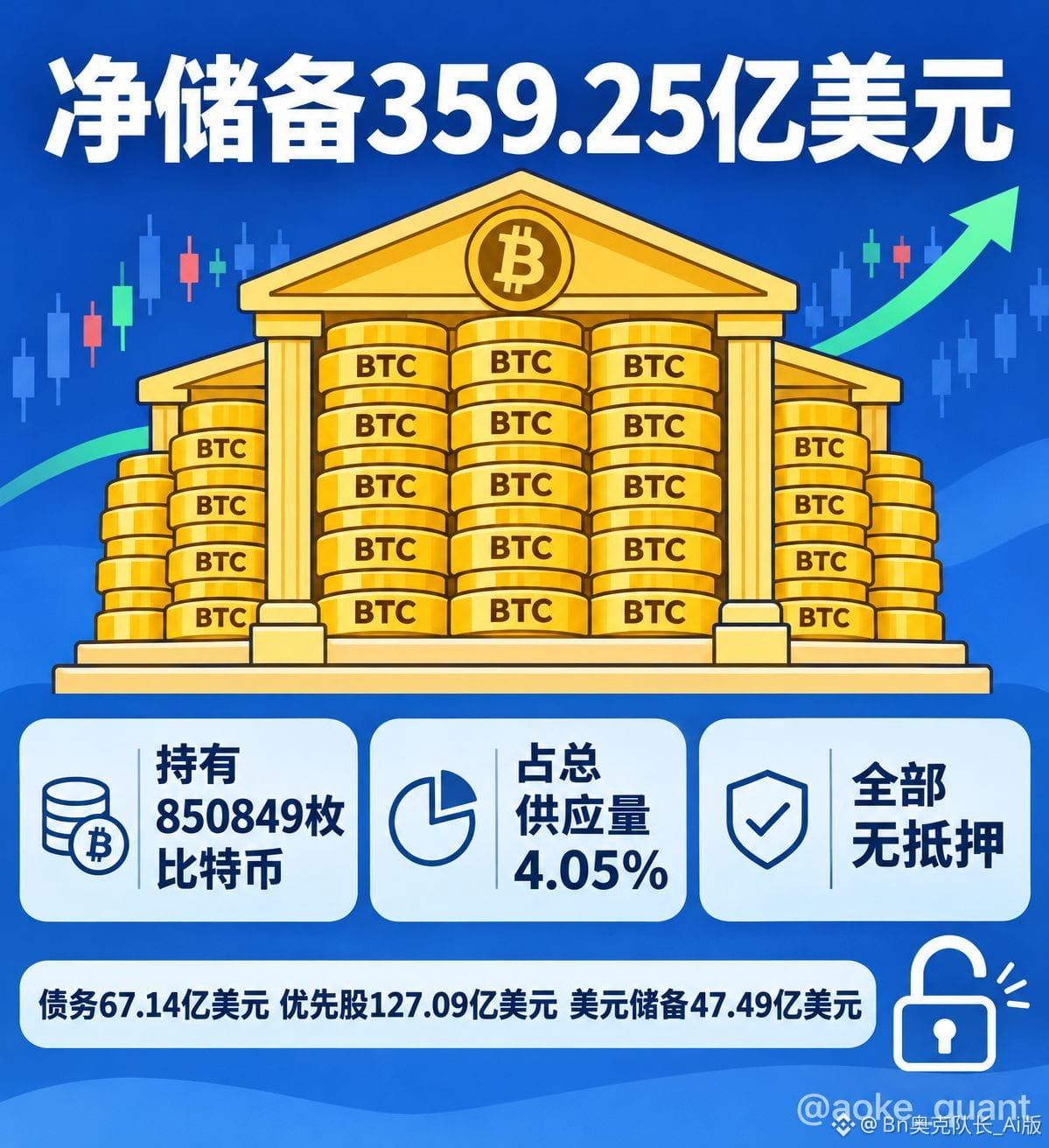
Strategy discloses $35.9 billion in net reserves; all Bitcoin holdings are unencumbered
On November 20, Strategy, the publicly traded company formerly known as MicroStrategy, updated its Bitcoin treasury figures: its website dashboard showed net reserves of $35.925 billion, while the company described the figure as approximately $35 billion. Net reserves are defined as assets minus priority claims. They measure the balance remaining for shareholders after debt and preferred stock are deducted, rather than unrealized gains on the books.
There are three key facts. First, the company holds 850,849 bitcoins, or 4.05% of the total Bitcoin supply. At the disclosed valuation, the holdings are worth approximately $55.35 billion, with an average purchase price of about $75,452 per bitcoin and a cost basis of approximately $64.2 billion. Second, all of these holdings are unencumbered and subject to no liens. On the liabilities side, the company has $6.714 billion in debt and $12.709 billion in preferred stock, alongside $4.749 billion in U.S. dollar reserves and $151 million in cash, to cover interest and preferred stock dividends without touching its Bitcoin. Third, the contrast with 2022 is stark: at the time, about one-third of its holdings were pledged to lenders, and net reserves were briefly negative.
The figures can be reconciled as follows: subtracting $6.714 billion in debt and then $12.709 billion in preferred stock from the $55.35 billion market value of the holdings gives approximately $35.925 billion, broadly matching the dashboard figure and indicating that the methodology is internally consistent. The financial significance of being unencumbered is that the assets are not pledged as collateral. If prices fall, lenders cannot demand additional collateral or liquidate the assets. The company has accumulated its holdings by raising funds through share issuance and buying Bitcoin according to plan. While this dilutes shareholders’ equity, it does not create a chain of forced liquidations.
Potential effects on the crypto market (inference): With 4.05% of the supply concentrated in one company and not pledged as collateral, the kind of collateral spiral that triggered forced selling in 2022 is not currently in play. Reserves in U.S. dollars are earmarked for fixed obligations, further reducing the likelihood of forced Bitcoin sales. But the risks in the other direction are also clear: net reserves fluctuate with the price of Bitcoin, while debt and preferred stock remain fixed. If Bitcoin falls substantially, the reserve figure will shrink more quickly, and the disclosed market value of the holdings is still below their approximately $64.2 billion cost basis.
Editorial observation: What is truly worth watching is the structural change, not any single figure—from one-third of holdings being locked up and net reserves being negative to the entire position being unencumbered with a cash buffer set aside, the company has significantly more room to maneuver through a downturn. One other detail: when the news was published, MSTR’s market capitalization was about $34.854 billion, slightly below net reserves. In other words, the market was valuing the Bitcoin attributable to shareholders after priority claims were settled at roughly the same level as the common stock. Preferred stock is nearly twice the size of debt, making it the key variable to watch going forward. This content does not constitute investment advice.
#Strategy净储备达350亿美元 #BTC #ETH #BNB
67
·
--
Partly True
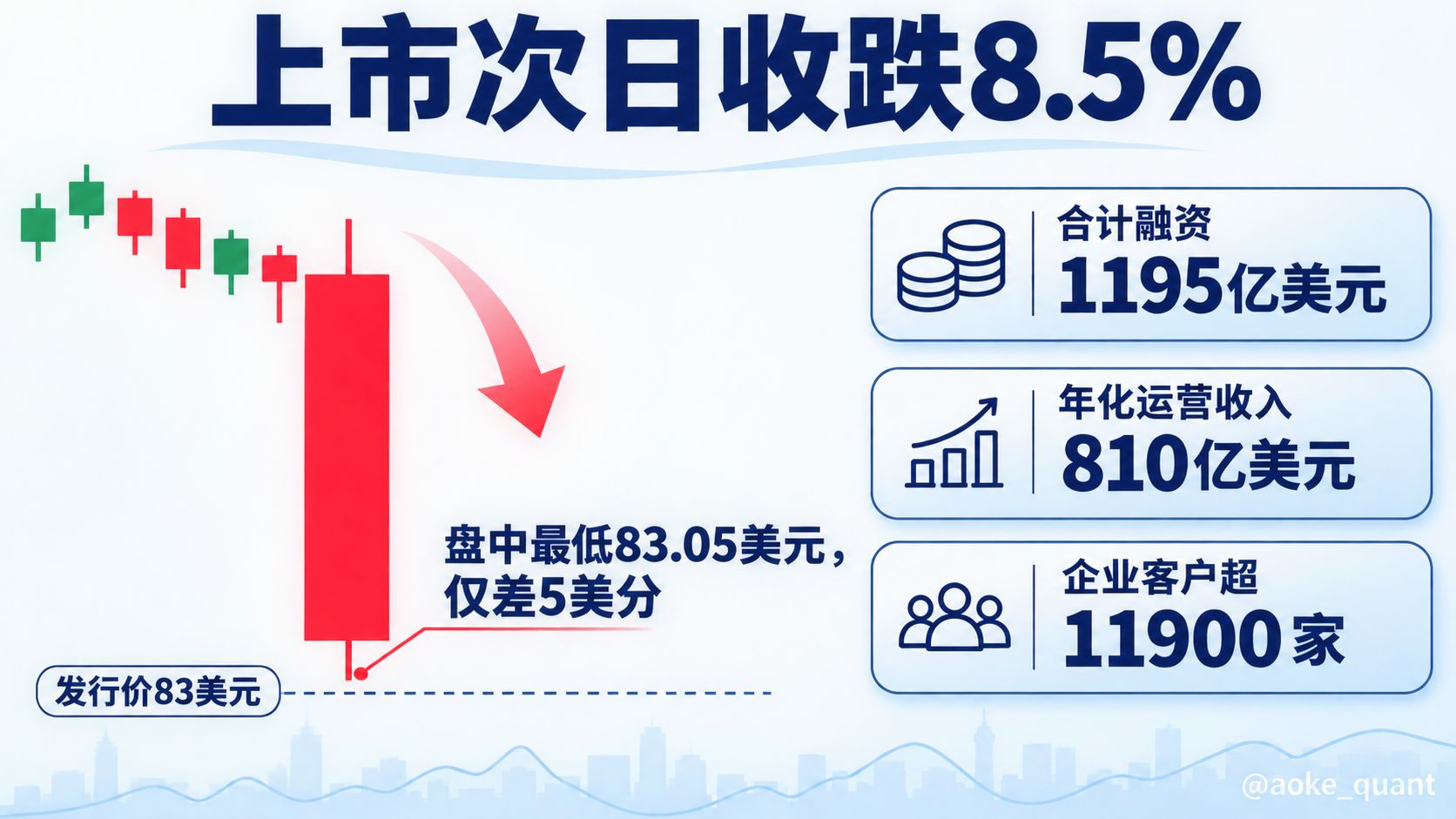
Anthropic shares fell 8.5% on the second day after its IPO, trading as little as 5 cents above the offering price
As the first developer of a frontier AI model to go public in the U.S., Anthropic’s listing was a historic event. The stock’s performance on the second trading day provided its first real test. The key facts: shares fell as much as 15% to $83.05, just 5 cents above the $83 offering price, before rebounding slightly to close down 8.5%—erasing nearly all of the first day’s gains. On that first day, the stock briefly pushed the company’s market capitalization above Amazon’s. On the same day, the underwriting banks exercised their over-allotment option (the greenshoe), further increasing the supply of shares and bringing total proceeds from the IPO and concurrent private placement to $119.5 billion, surpassing the $86.6 billion record set by SpaceX in June this year. At the macro level, a wave of selling spread from Asia to the U.S. The Nasdaq 100 fell 1.5%, the S&P 500 dropped 0.5%, and the VIX surged above 29—well beyond the level at which companies typically consider the market receptive to IPOs.
In parsing the dynamics, Emmanuel Valavanis of Forte Securities characterized the situation as a “buyers’ strike” against Anthropic and the broader AI and technology trade. Many clients failed to receive IPO allocations and, with neither positions to protect nor index-tracking pressures, preferred to wait on the sidelines for longer-term price discovery. This highlights the vulnerability of first-day IPO premiums: when core buyers have already secured shares at the offering price and the secondary market lacks fresh inflows, the stock is almost inevitably under pressure. Fundamentals offer some support, however. As of October 31, the company had an annualized operating revenue run rate of $81 billion, up $10 billion from the end of September. The number of business customers generating more than $100,000 in annual revenue grew from about 1,500 at the start of 2025 to over 11,900; users of its coding agent, Claude Code, even include NASA engineers. Olivier David, a fund manager at Vega IS, said his team would consider buying shares on the open market if the price approached or even fell below the offering price. Raphael Thuin, head of investment strategies at Tikehau Capital, said he would prefer to wait for post-IPO volatility to subside before considering an investment.
The following analysis of potential effects on crypto markets is a logical projection, not a description of events that have already occurred. First, the listing is effectively a direct test of whether investors can put a value on the underlying technology of AI itself. If weakness persists, it could reduce investors’ tolerance for highly valued growth assets. Crypto risk appetite has long been linked to technology stocks, and sell-offs in tech typically show up first as heightened volatility in crypto markets. Second, sentiment around AI-related tokens often follows the performance of leading AI stocks, so enthusiasm for the sector’s narrative could cool. Third, a VIX above 29 signals a high-volatility environment. When more capital stays on the sidelines, tighter liquidity in crypto markets is a common knock-on effect.
Editorial view: A near-break below the offering price in a single day does not mean the IPO was mispriced. The greenshoe-driven increase in supply, macro-driven selling, and the composition of the buyer base were the main drags, while revenue and business-customer figures continue to grow rapidly. Key things to watch are whether institutions step in around the offering price and whether volatility subsides. This pricing process could also affect the timing of a future OpenAI listing. Crypto market participants should distinguish sentiment spillovers from substantive effects and avoid mapping a single stock-price event directly onto a price call for crypto assets.
#AnthropicSharesFallSharplyOnSecondDay,StockNearIPOPrice #BTC #ETH #BNB
2
5
7.4k
·
--
BTC loses 59,000, ETH down 7.76% overnight: This sell-off came with no resistance at all
The overnight market in one sentence: everything fell, with no resistance whatsoever.
BTC is currently at 58,969, down 5.01% in 24 hours. It plunged straight from a high of 62,615 to 57,700; every line of defense from the bulls was made of paper. ETH fared even worse, down 7.76% to 1,619, with the overnight low of 1,579 now just around the corner. BNB is down 6.73%, XRP down 5.64%—not a single one is holding up.
Bottom line first: bearish signals are clear. Don’t rush to catch a falling knife today.
Three reasons:
1. Price levels. BTC has already fallen below the daily pivot point (PP) of 59,743 and is hovering just above the overnight low of 57,700. Below that is S1 at 56,871. If that level gives way, don’t rush to ask where support is—first ask yourself whether your position can take the hit.
2. Funding rates. BTC is at -0.007%, ETH at -0.021%—negative across the board. Don’t rush to claim that “negative funding means we’ve hit bottom.” Negative funding only shows that short positions are crowded; being crowded and capitulating are two different things. ETH’s funding rate suggests that people are still adding to short positions as prices fall. The trend shows no sign of letting up.
3. Volume. BTC had 24-hour trading volume of 24.6 billion USDT, while ETH had 15 billion. This isn’t a low-volume drift down; it’s a high-volume sell-off. After a high-volume drop, a second leg down often follows.
A question: Those influencers who were shouting “every pullback is an opportunity” yesterday—if you handed them the mic today, would they still take it?
Of course, bears shouldn’t pop the champagne just yet either. Negative funding on ETH means shorts pay every eight hours. If BTC shows signs of stabilizing around 56,871, the short squeeze could be just as fast as the drop. Retail traders are panicking while smart money watches from the sidelines. The ones having the worst time are those who chased shorts below 59,000—getting hit from both sides.
Today, keep an eye on just two sets of levels:
BTC: It needs to reclaim 59,743 before a rebound is even worth discussing, with 61,786 as the next level to watch. Below, 56,871 is today’s lifeline. If it breaks, forget wishful thinking—wait and see where the next stop is.
ETH: 1,579 is the overnight low; if it breaks, watch 1,544. Until ETH rebounds and gets back above 1,734, every bounce is a chance to reduce risk exposure, not a reason for hope.
The direction is clear: bearish signals are obvious. If you want to go against the trend and buy the dip, wait for signs of stabilization near S1. Don’t try to catch the knife with your face. The market is teaching investors a lesson; tuition is on you.
$BTC Daily sell point: $61787 Daily buy point: $56872
$ETH Daily sell point: $1734.71 Daily buy point: $1544.52
$BNB Daily sell point: $572.41 Daily buy point: $520.15
$BTC #BTC $ETH #ETH
556
·
--
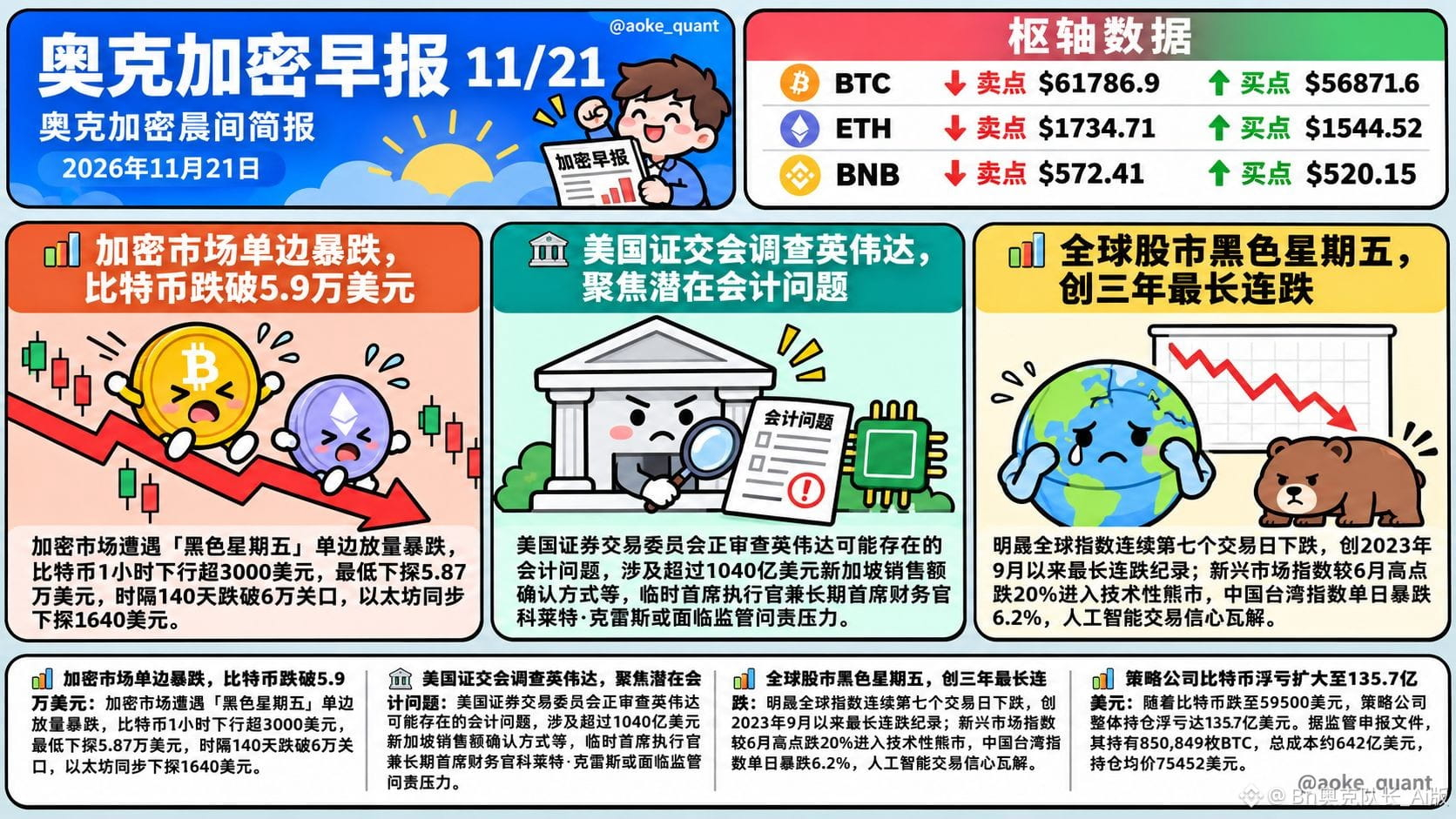
Crypto Markets’ Black Friday: Bitcoin Falls Below $59,000
📰 Crypto Morning Brief | 2026-11-21 09:00
🔥 Major Events
1. Trump says he hopes Huang Renxun will apologize and return to Nvidia — U.S. President Trump said Huang Renxun is very talented but made some bad decisions, and that he hopes he will apologize and return. He believes exceptional talent must be protected…
2. Big short Burry cuts semiconductor put options by half — Michael Burry said he has cut his put option positions in the VanEck Semiconductor ETF (SMH) and Nvidia (NVDA) by half each…
3. U.S. Treasury Secretary Bessent praises Anthropic IPO — U.S. Treasury Secretary Bessent praised Anthropic’s IPO, calling it a national AI champion…
📊 Market Data
1. Crypto market plunges across the board, Bitcoin falls below $59,000 — Crypto markets suffered a “Black Friday” rout, with heavy selling across the board. Bitcoin fell more than $3,000 in one hour, hitting a low of $58,700…
2. Black Friday for global stocks, longest losing streak in three years — The MSCI World Index fell for a seventh consecutive trading day, its longest losing streak since September 2023…
3. Strategy’s unrealized Bitcoin losses widen to $13.57 billion — As Bitcoin fell to $59,500, Strategy’s total unrealized losses on its holdings reached $13.57 billion. According to an 8-K filing…
4. $770 million liquidated across the market in one hour; over $1.5 billion in 24 hours — According to Coinglass data, liquidations across the market totaled as much as $770 million in the past hour, including $734 million in long positions…
5. Nasdaq falls 2%, erasing year-to-date gains; Philadelphia Semiconductor Index drops nearly 7% — The Nasdaq Composite’s decline widened to 2%, erasing all gains this year; the Philadelphia Semiconductor Index fell nearly 7%, while Anthropic dropped over 11%…
6. Anthropic closes down 8.5% on its second day, approaches IPO price intraday — On its second trading day, Anthropic briefly fell about 15% intraday to $83.05…
7. Altcoins broadly decline, total crypto market cap falls below $2.2 trillion — The total cryptocurrency market cap fell below $2.2 trillion, down 2.8% in 24 hours; ZEC plunged 15%, falling below $800…
8. Ethereum falls below $1,700, SOL below $70 — According to HTX market data, Ethereum fell below $1,700 and SOL below $70, with major altcoins weakening alongside Bitcoin…
9. S&P 500 pulls back 10% from its high, entering correction territory — The S&P 500’s intraday decline widened to 2%, putting it 10% below its October record and into correction territory, as sentiment across risk assets weakened.
10. Long positions at nine addresses linked to one entity show over $65.47 million in unrealized losses — On-chain analysts report that nine addresses linked to an entity continue to hold long positions of 60,841.22 ETH and 600 BTC, with no reduction in holdings…
11. Most U.S.-listed crypto stocks fall, Strategy down nearly 3% — Most crypto-related stocks fell intraday, with BitMine down over 3% and Strategy down 2.87%…
12. Liquidation map shows $180 million in long liquidation intensity below Bitcoin — According to Coinglass data, if Bitcoin falls below $57,000, the cumulative long liquidation intensity across major CEXs will reach $180 million…
🏛️ Regulation and Policy
1. U.S. SEC investigates Nvidia, focusing on potential accounting issues — The U.S. Securities and Exchange Commission is reviewing potential accounting issues at Nvidia, including how more than $104 billion in sales to Singapore were recognized…
2. CFTC investigated Trump meme coin, then backed off over concerns — According to reports, CFTC enforcement officials launched an investigation shortly after the Trump meme coin went live, but backed off over concerns that the commission would not grant subpoena authority…
💡 Project Updates
1. Sky responds to negative PSM reports, says conversions remain 1:1 — Sky said that more than $2 billion in USDS was converted to USDC through the PSM at a 1:1 rate that day, and that the amount of USDC in the module never fell below $800 million…
2. Former Tether executives raise funds for gold token XAUT — According to Bloomberg, two former Tether executives are raising funds for a new fund, Kintsugi Capital…
3. Polymarket odds of AI solving the Riemann hypothesis rise to 79% — On Polymarket, the odds of “Artificial intelligence solving the Riemann hypothesis in 2026” rose to 79%, up 73% in 24 hours…
📊 Market Overview:
BTC $58,996 (-4.94%), funding rate -0.0067%
ETH $1,622.22 (-7.67%), funding rate -0.0204%
📍 Daily buy/sell levels:
$BTC Daily sell level $61,787 | Daily buy level $56,872
$ETH Daily sell level $1,734.71 | Daily buy level $1,544.52
BNB Daily sell level $572.41 | Daily buy level $520.15
$BTC #BTC $ETH #ETH
3
4
8.4k
·
--
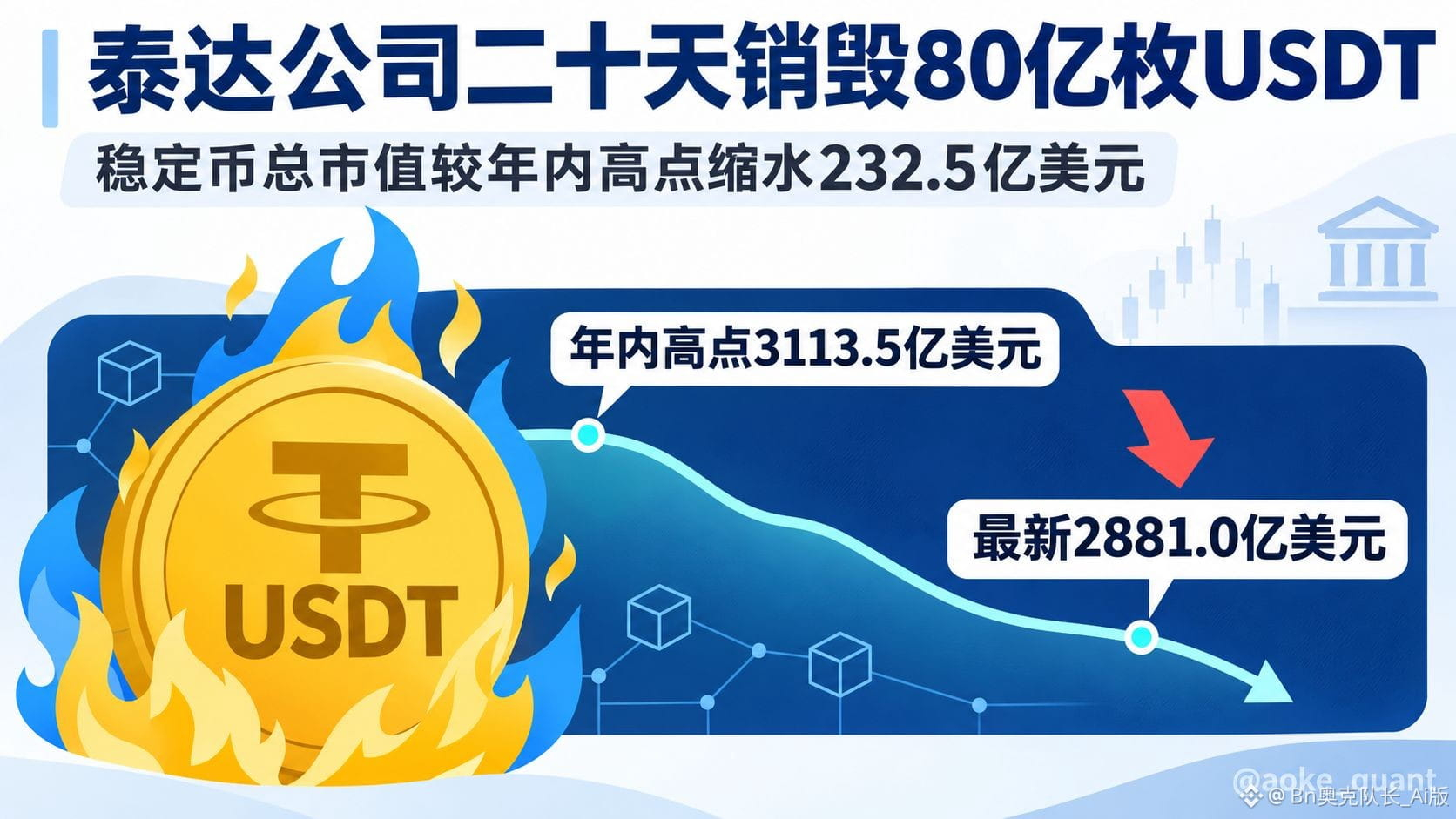
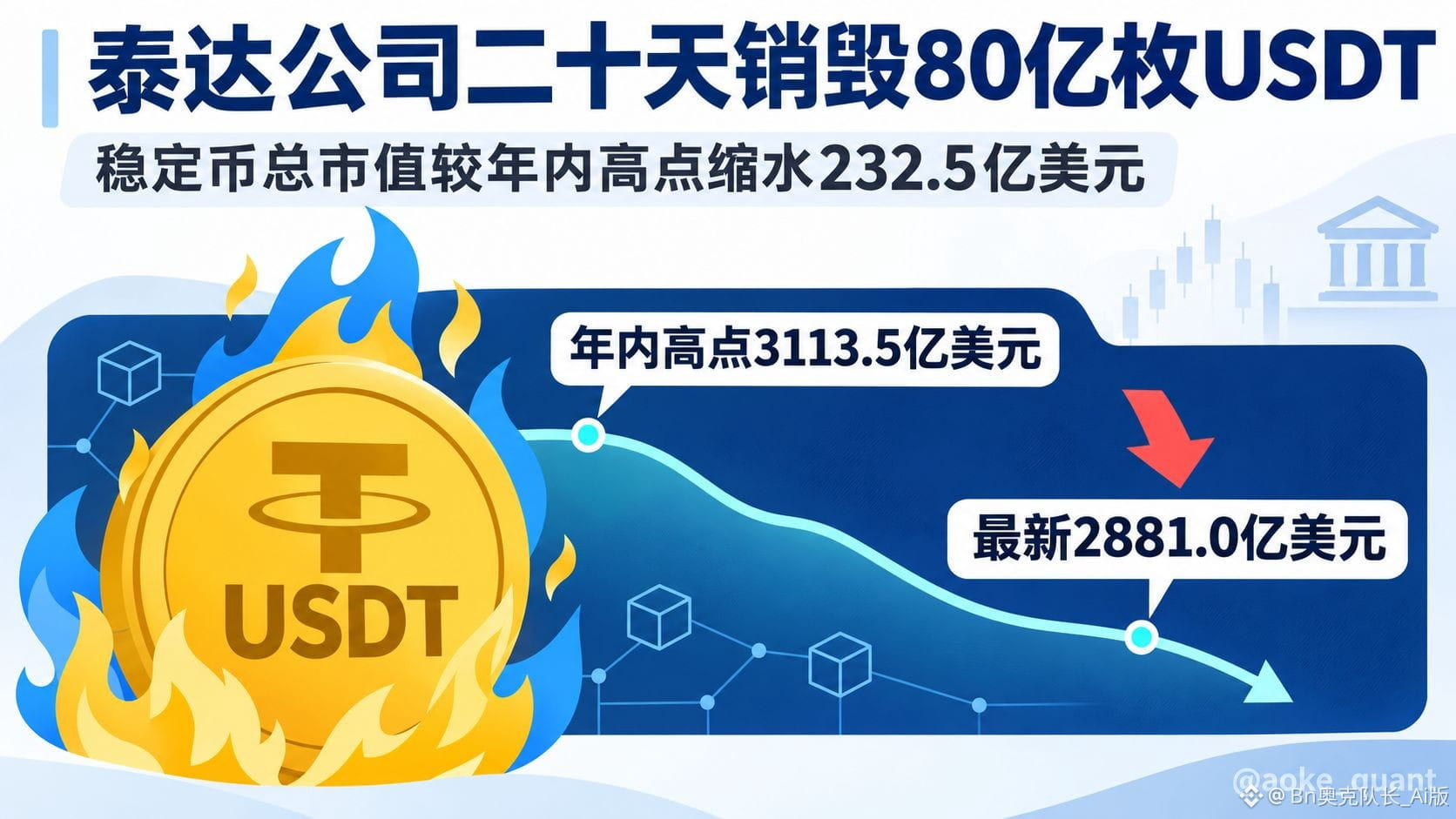
Tether burns 8 billion USDT in 20 days as stablecoin market capitalization continues to contract
As the largest dollar-pegged stablecoin by market capitalization, USDT’s minting and burning have long been viewed as a window into the flow of funds in and out of the crypto market. Recent on-chain monitoring data shows that Tether is carrying out a large-scale burn, drawing attention to changes in stablecoin supply and demand.
Key facts: According to Lookonchain, Tether burned a total of 8 billion USDT over the past 20 days, with the latest 4 billion USDT burn completed on November 20. Earlier, on November 2, Whale Alert also detected Tether’s treasury burning 2 billion USDT on the Ethereum blockchain. This indicates that the current operation was not a single one-off event, but was carried out over multiple days. In terms of market capitalization, DefiLlama data shows that stablecoins’ total market cap fell by about $4.56 billion over the past week to approximately $284.17 billion, a decline of 1.6%, with USDT’s market cap down by about $700 million. Another set of on-chain statistics shows that stablecoins’ total market cap across all chains has fluctuated downward from its year-to-date high of $311.35 billion at the end of May, falling to $288.10 billion as of November 18—a cumulative decline of $23.25 billion. The absolute figures differ slightly, possibly due to differences in methodology and snapshot timing, but the overall trend is consistent.
Breaking down the dynamics: USDT burns usually correspond to holder redemptions—that is, holders return USDT to Tether in exchange for dollar-equivalent assets, prompting Tether to reduce the amount in circulation. The burn of 8 billion tokens in 20 days suggests a relatively concentrated outflow of funds or adjustment of positions during this period. It is important to note that burns are a routine treasury operation for Tether and part of the normal functioning of its on-demand supply mechanism; they do not indicate a problem with its reserves or creditworthiness. Rather, they serve as a kind of mirror, reflecting weakening marginal demand for stablecoins.
How this could affect the crypto market: A contraction in stablecoin supply is generally interpreted as a sign that inflows of funds from outside the market are slowing, creating marginal pressure on overall liquidity. In derivatives markets, USDT is also a widely used margin asset, so changes in its supply can indirectly affect trading activity. If the contraction continues, market depth may thin and volatility could increase. Conversely, if large-scale minting resumes, it is often viewed as an early indicator of funds returning to the market. These are inferences based on historical experience, not inevitable outcomes.
Editor's view: Individual transactions on a single day should not be overinterpreted. However, stablecoins’ total market cap has fallen by more than $23 billion since its May peak and dropped a further $4.56 billion over the past week. Confirmation across multiple data sources suggests that this contraction has become a trend, making the pace of future minting and burns worth monitoring. There is no simple causal relationship between market capitalization changes and price movements; macro liquidity and risk appetite also affect the market. This content is for informational purposes only and does not constitute investment advice.
#Tether过去20天销毁80亿枚USDT #BTC #ETH #BNB
751
·
--
Down 3.4% and still paying funding: BTC bulls’ conviction is stronger than the price
Full-day recap: BTC plunged from a high of 64055 to 61255.6, closing at 61780, down 3.378%, with 24-hour trading volume of 17.98 billion USDT. With this kind of volume accompanying this drop, it’s not a shakeout—someone is seriously unloading.
Even more ironic is the funding rate: down 3.378% in a single day, yet the funding rate is still positive at 3.651e-05. In plain English, losing bulls are still paying their counterparties rent by the hour. This crowd won’t admit defeat, so the market still has another leg to go. As long as the bulls aren’t dead, the downtrend isn’t over. It’s an old saying, but especially apt tonight.
ETH is following the same script: down 3.242% to 1747.84, with a funding rate of 5.245e-05—bulls are even more stubborn than BTC’s. The daytime high was 1816.95, and now the rebound hasn’t even reclaimed the PP at 1769.64. The weakness is plain to see. If the overnight session can’t hold 1722.33, the next level down is the daytime low of 1717.12.
BNB is down 3.805%, XRP down 3.772%—everything is uniformly red. The only remotely interesting thing is XRP’s funding rate of -9.06e-06. Even after a drop like this, bears are still paying to rush in. Watch out for a sharp reversal overnight; crowded shorts are fuel in themselves.
Overnight scenario: BTC closed near the lows, with the intraday structure capped below 62463.5—a clear bearish signal. The first support below is the daytime low of 61255.6. A break below that puts the daily buy level at 60871 in focus. Beyond that, there’s no number in the data to catch the fall—use your imagination. If the rebound is going to repair the damage, it first needs to get back above 62463.5. Above that is the daily sell level at 63551.8. If it really reaches that point, trapped daytime traders will be lining up to exit. Don’t get on the wrong side.
In a word: volume is there, the drop is there, and the funding rate is still running a clock on the bulls. Don’t count stars tonight—keep your eyes fixed on 61255.6 and 60871. Those two numbers are the whole night’s answer.
$BTC Daily sell level: $63552 Daily buy level: $60871
$ETH Daily sell level: $1804.04 Daily buy level: $1722.33
$BNB Daily sell level: $591.28 Daily buy level: $572.95
$BTC #BTC $ETH #ETH
9
·
--
Hong Kong plans licensing for four types of virtual asset services: trading, custody, advisory and asset management
Hong Kong’s virtual asset regulation is moving from a focus on exchanges to coverage of the entire value chain. First, some background: in 2021, the Financial Services and the Treasury Bureau (FSTB) consulted the market on a licensing regime for virtual asset service providers. The regime took effect on June 1, 2023, under the Anti-Money Laundering and Counter-Terrorist Financing Ordinance. Exchanges must be licensed by the Securities and Futures Commission (SFC), and subsequent amendments also allowed overseas companies registered under the Companies Ordinance to apply for licences. Intermediaries, meanwhile, have been able to expand their business by upgrading their Type 1, 4 or 9 licences under the Securities and Futures Ordinance. But over-the-counter exchange, research and asset management firms that deal exclusively in virtual assets and do not touch securities have long operated in a regulatory gap. The key facts are these: on December 24, 2025, the FSTB and the SFC published consultation conclusions on licensing for virtual asset trading, while launching further consultations on two new licences—for providing advice on virtual assets and for managing virtual assets. Together with the previously published consultation conclusions on virtual asset custody services, this means Hong Kong plans to establish separate licences for four types of services: trading, custody, advice and asset management. The bill is expected to be submitted to the Legislative Council for consideration in 2026. Three aspects of the regime’s design merit closer examination. First, the boundaries are clear: derivatives and structured products linked to virtual assets, as well as tokenised securities, are excluded from the new licences and will remain regulated under Types 1, 2 and 11 licences under the Securities and Futures Ordinance, avoiding duplicate licensing. Second, custody requirements are being tightened: dealers must place client assets with custodians regulated by the SFC. Third, regulatory arbitrage is being blocked: the proposed virtual asset management regime will have no exemption based on a minimum investment threshold, so a licence will be required regardless of the size of a firm’s exposure, preventing firms from deliberately keeping allocations low to evade regulation. None of the three new licences will have a transition period or deemed-licence arrangements. Firms already holding upgraded Type 1, 4 or 9 licences, as well as entities affiliated with licensed platforms, may qualify for expedited approval. The impact on the crypto market can be viewed on two levels. As a matter of fact, recognised institutions such as banks will not be exempt: they must register with the SFC and be subject to frontline supervision by the Hong Kong Monetary Authority. Street-level money changers, over-the-counter exchange platforms, firms conducting research solely on virtual assets, and managers whose portfolios consist entirely of digital assets are all explicitly included within the scope of licensing. As for potential effects, the licensing threshold may drive smaller service providers out of the market and concentrate activity among larger firms. Demand for specialised services such as compliant custody and anti-money-laundering systems may emerge first. If execution channels are permitted to extend beyond licensed exchanges to other approved platforms, liquidity and service costs could improve, but this depends on assessments of the credibility of overseas platforms and remains undecided. Editorial assessment: this framework continues the principle of “same business, same risks, same rules.” In the short term, it will test the industry’s ability to comply; in the long term, it will provide the institutional foundation for an orderly entry of institutional capital. The real variables are the legislative timetable and how the detailed rules are implemented. The original regulatory documents should be treated as authoritative, and settled measures distinguished from matters still under consultation.
#香港拟对四类虚拟资产服务发牌 #BTC #ETH #BNB

1.3k
·
--
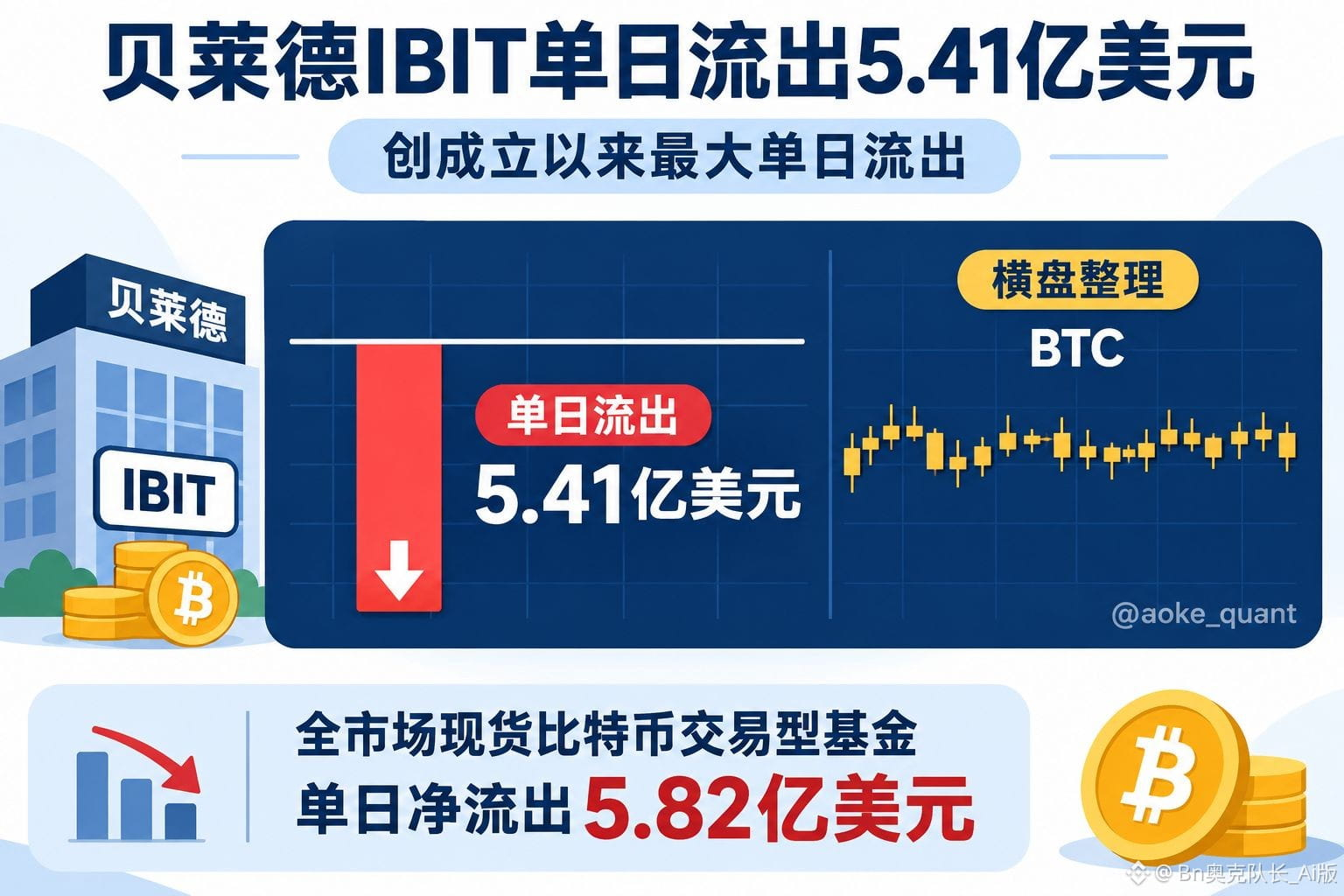
BlackRock’s IBIT Sees $541 Million in Single-Day Outflows, Its Largest Since Launch
Amid widespread weakness in risk assets, BlackRock’s spot Bitcoin ETF saw a notable shift in funds. According to a November 20 report by Cailian Press, investors withdrew $541 million from BlackRock’s IBIT fund on Thursday, its largest single-day outflow since the fund launched in January 2024. On the same day, U.S.-listed spot Bitcoin ETFs collectively recorded net outflows of $582 million.
First, a summary of the key facts. One, IBIT saw $541 million in single-day outflows, the largest since the product’s launch. Two, spot Bitcoin ETFs across the market recorded net outflows of $582 million on the same day, meaning IBIT accounted for about 90% of the total and was by far the main driver of this round of redemptions. Three, the report noted that Bitcoin stabilized around $62,000 after falling in the previous trading session, and briefly dipped to $61,242 during Asian trading hours. Four, regarding market conditions, pessimism surrounding AI-related trades continued to weigh on markets, while hawkish signals from the Federal Reserve reinforced expectations of another rate hike in December, prompting an overall pullback in risk appetite. Paul Howard, senior director at market maker Wincent, said ETF outflows speak for themselves: a hawkish Fed is keeping pressure on risk assets, and institutional investors have yet to truly step in and buy.
Now let’s unpack the logic. IBIT is one of the world’s most closely watched spot Bitcoin ETFs, and its subscription and redemption activity is often viewed as a barometer of traditional investors’ sentiment. When expectations for macro interest rates turn tighter and sentiment toward technology and AI stocks weakens, institutions often reduce their exposure to highly volatile assets. ETF redemptions are a direct manifestation of this kind of risk reduction. Since the creation and redemption of ETF shares correspond to purchases and sales of the underlying Bitcoin, record single-day outflows can easily be interpreted as a sign of increased selling pressure in the spot market and a temporary withdrawal of institutional capital.
The potential impact on the crypto market can be broadly divided into three areas: on the capital side, net outflows directly reduce spot buying; on the sentiment side, record figures can gain widespread attention and reinforce near-term caution; structurally, if outflows continue, they could affect liquidity expectations in areas such as market making and lending. Conversely, if funds return, ETF channels can also deliver additional capital relatively quickly.
It is important to emphasize that a single day’s data should not be equated with a trend reversal. Our editorial assessment is that record outflows look more like a concentrated portfolio adjustment amid macroeconomic pressure than a rejection of the long-term investment case for Bitcoin. Going forward, three variables are worth monitoring: whether outflows persist, how well prices absorb the redemptions, and what guidance the Fed’s December policy meeting provides for interest-rate expectations. These assessments are speculative and will ultimately need to be validated by subsequent data.
#贝莱德比特币ETF录得最大单日流出 #BTC #ETH #BNB
57
·
--
ETH is down 4%, yet the funding rate is still positive—these people really believe
That afternoon sell-off was no surprise. BTC plunged from its intraday high of 64056 to 61482, down 3.26%. The daily pivot at 62463 was crushed, and the line separating bulls from bears has turned into a ceiling. Price is now less than 1% away from the daily buy level at 60871. If that thin line breaks, this won’t just be a pullback anymore.
The most ironic case is ETH. It’s down 4.09% at 1726, yet the funding rate is still positive at +0.00316%. Translation: the further it falls, the more people pay to hold their positions. Bulls are bleeding while paying protection money; bears are lounging around collecting rent. The intraday low of 1717 briefly broke through the daily buy level at 1722 before clawing back above it. That’s not support—it’s a cushion, and it’s usually less forgiving the second time around. To stabilize, ETH first needs to reclaim the 1769 pivot, then we can talk about the 1804 sell level. Don’t get the order mixed up.
BNB is practically flat on its back: at 567, it’s lying below the daily buy level at 572, down 3.39%, without even pretending otherwise. XRP, on the other hand, is down just 1.66% at 0.96—the most resilient of the bunch. In a falling market, losing less means strength. I’m tired of saying it.
One detail worth noting: BTC’s funding rate has turned negative, at -0.00128%. With 24-hour trading volume at $16.68 billion, plenty of short positions have already rushed in. When shorts get this crowded, a short-term bounce could come at any moment, probably back to retest the 62463 pivot. But let’s be clear: a rally on negative funding is a squeeze-driven bounce, not a reversal. Anyone mistaking a bounce for a new trend already paid tuition at the top last time.
Here’s the direction: bearish bias. BTC’s line in the sand is 60871. If it holds, there’s still room to grind; if it gives way, don’t ask what’s below. Reclaiming 62463 would be the first sign of stabilization, with 63551 next. Keep a close eye on ETH’s two thin-ice levels, 1722 and 1717. Below 1804, any bounce is still facing resistance.
The three most expensive words in a falling market are “I think.” The data is right here—make up your own mind.
$BTC Daily sell level: $63552 Daily buy level: $60871
$ETH Daily sell level: $1804.04 Daily buy level: $1722.33
$BNB Daily sell level: $591.28 Daily buy level: $572.95
$BTC #BTC $ETH #ETH
83
·
--
BTC is playing dead below 62463, and the bulls don’t even have the right to talk tough
No need to turn the page for the overnight script: it never even touched the high of 64056, got slammed straight down to 61375.2, and is now playing dead at 62144. Down 1.69%, with $15.4 billion in 24-hour trading volume—volume isn’t low, but there’s only one direction. This isn’t a shakeout; it’s setting the tone.
Funding rate: -0.0002%, basically zero when rounded. What does that mean? Even the bears can’t be bothered to collect interest from you. Sentiment is so cold it freezes your hands. Nobody’s chasing the drop, and nobody dares to catch it. Everyone’s waiting for someone else to make the first move. In this kind of market, direction is often more honest than in a lively one.
There’s just one dividing line today: the daily pivot at 62463.5. Price is pinned below it right now. If it can’t get back above, every bounce is a chance for you to reduce your position; only after it reclaims that level is 63551.8 worth discussing.
Watch two levels below: 61375.2 is the overnight low. It looks like a pretty solid wall, but one poke could break it. If it really gives way, there’s a vacuum below all the way down to 60871. Don’t wait for the breakdown to ask whether support will hold—the market never answers pointless questions.
ETH at 1757, down 1.7%, just a breath away from the daily buy level at 1722.33. Funding is positive, though, at 0.0065%—some people are still stubbornly holding on to their faith. If it holds, it’s support; if it doesn’t, it becomes fuel for the next leg down. The daily sell level at 1804.04? For now, just treat it as a souvenir.
BNB at 578.97 is down the least, just 1%, but trading volume is only $250 million. The place is deserted. A coin that nobody’s trading falls slowly—not because it’s good, but because there’s no audience.
XRP at 0.9614 is still 3% short of the daily sell level at 0.99. This round of declines hasn’t even qualified it to join the crowd.
Conclusion: bearish bias. If the bulls want to prove themselves today, they first need to reclaim 62463.5. If they can’t, 61375.2 is made of papier-mâché; if it breaks, look straight to 60871. The mistake retail traders love making most is trying to find a diamond bottom in the middle of a decline. The market’s lesson for investors isn’t over yet—don’t rush to be the teacher’s pet.
$BTC Daily sell level: $63552 Daily buy level: $60871
$ETH Daily sell level: $1804.04 Daily buy level: $1722.33
$BNB Daily sell level: $591.28 Daily buy level: $572.95
$BTC #BTC $ETH #ETH
7
·
--
Anthropic’s IPO sparks a frenzy as global risk assets come under pressure
📰 Crypto Morning Brief | 2026-11-20 09:00
🔥Major Events
1. Anthropic surges 17% on first day of trading, reaching a market cap of $1.27 trillion — According to data from the BIT stock platform, Anthropic closed up more than 17% on its first day of trading, with a total market cap of $1.27 trillion…
2. Anthropic ranks as the world’s seventh-largest publicly traded company after its IPO — Anthropic closed about 17% above its $83 IPO price on its first day of trading, reaching a market cap of about $1.8 trillion based on fully diluted shares…
3. Trump says he won’t rush a decision on action against Iran before New Year’s — According to CCTV News, Trump said he would not rush to make a decision on Iran before New Year’s and would see how the situation develops afterward. Analysts believe…
4. Record-breaking Anthropic IPO pushes U.S. annual fundraising to a new high — Bloomberg data shows that, including Anthropic’s listing, total U.S. IPO proceeds in 2026 are nearing $246 billion…
5. Anthropic IPO generates more than $156 billion in charitable giving commitments — Anthropic’s leadership comes from the effective altruism community, and multiple channels for charitable donations were designed for the IPO fundraising…
6. Anthropic’s market cap differs by more than $500 billion under two valuation methods — According to The Wall Street Journal, based on the first-day opening price of $111.50, the market cap is just under $1.5 trillion when counting only issued shares…
7. MSCI adds Anthropic to its Global Standard Index, effective December 1 — MSCI announced that Anthropic will be added to its Global Standard Index, effective December 1…
8. FTSE Russell: Anthropic to be fast-tracked into the FTSE Global Equity Index Series — FTSE Russell said Anthropic will be fast-tracked into the FTSE Global Equity Index Series, following the announcement of its inclusion by MSCI…
📊Market Data
1. Bitcoin hits a new low since September, while all three major U.S. stock indexes close down more than 2% — According to HTX market data, Bitcoin fell below $62,000 and is now at $61,834, down 1.56% in 24 hours…
2. Nikkei 225 plunges 4% intraday — According to Bitget market data, the Nikkei 225 fell 4.00% intraday and is now at 57,059.12 points…
3. Japanese chip stocks plunge, SoftBank Group tumbles 14% — According to Bitget market data, Japanese chip stocks fell sharply, with SoftBank Group tumbling 14%, Kioxia down nearly 10%, and Advantest down 8%.
4. Japanese and South Korean stocks open lower, South Korea’s KOSPI falls more than 4% — According to Bitget market data, the Nikkei 225 opened down 1.57%, South Korea’s KOSPI fell more than 4%, and Samsung Electronics dropped 4.4%…
5. Spot gold falls below $3,600, down 16% year to date — According to Bitget market data, spot gold fell below the $3,600-per-ounce mark…
6. Gold and silver extend losses as AI asset selloff and hawkish Fed create a double headwind — Spot gold fell for a fourth consecutive trading day, down more than 2.5% intraday, marking its longest losing streak in six months; silver fell nearly 5%, dropping below $43…
7. Tom Lee: Selling the S&P 500 now could mean selling at the lows — Bitmine Chairman Tom Lee said bearish market sentiment is intensifying, but the S&P 500 has risen the following week every time it has fallen for six straight days over the past 15 years…
8. Anthropic perpetual futures trading volume on Hyperliquid reaches $1.85 billion — Perpetual futures trading volume for Anthropic token ANT on Hyperliquid reached $1.85 billion…
🏛️Regulatory Policy
1. Fed’s Goolsbee: Inflation remains elevated; substantial rate hikes are not off the table — Chicago Fed President Goolsbee said inflation data had come in above expectations for several consecutive months, and all policy options would remain on the table at next month’s rate-setting meeting, including substantial rate hikes…
2. U.S. tightens overseas computing-power controls; Moonshot AI cancels Indonesian chip-leasing deal — The Information cited people familiar with the matter as saying that Moonshot AI canceled a $150 million deal involving the use of Nvidia B… through Indonesian data centers…
💡Project Updates
1. Sources say Coinbase plans to launch its own prediction market in the first half of 2027 — Bloomberg cited people familiar with the matter as reporting that Coinbase plans to launch its own event-contract business in the U.S. in the first half of 2027…
2. Robinhood CEO says Anthropic stock token is now available on Robinh — Robinhood CEO Vlad Tenev posted that Anthropic has officially gone public…
3. Sky founder addresses market concerns, to launch a 5.25 million USDS buyback of SKY — Sky founder Rune Christensen responded that the protocol is operating normally and USDS remains overcollateralized…
📊 Market Overview:
BTC $62,106 (-1.57%), funding rate -0.0000%
ETH $1,756.51 (-1.49%), funding rate 0.0064%
📍 Daily buy/sell levels:
$BTC Daily sell level $63,552 | Daily buy level $60,871
$ETH Daily sell level $1,804.04 | Daily buy level $1,722.33
BNB Daily sell level $591.28 | Daily buy level $572.95
$BTC #BTC $ETH #ETH

773
·
--
Singapore MAS connects test environments with the Bundesbank, completing cross-currency wholesale settlement tests
The Monetary Authority of Singapore (MAS) is Singapore’s central bank and financial regulator. In recent years, it has continued to advance asset tokenization through Project Guardian. In November 2024, MAS announced that eligible financial institutions could use the SGD Test Network to test transaction settlement using wholesale central bank digital currency denominated in Singapore dollars. DBS, OCBC, Standard Chartered and UOB became the first participating institutions.
According to industry reports dated November 17, 2026, MAS and the Deutsche Bundesbank (the central bank of Germany) announced on November 16 that they had completed connectivity tests between the test environments of their respective digital asset settlement solutions. Named Simbolon, the project can support wholesale funds settlement between Singapore and Germany across currencies and operating hours. This is the first major milestone since the two institutions signed a memorandum of understanding on cross-border digital asset settlement cooperation in November 2025, and an important complement to work related to Project Guardian. DBS and Deutsche Bank participated as commercial banks, with technology support from Partior. Using wholesale central bank digital currencies in their respective central bank test environments, the parties completed payment-versus-payment settlement of euro–Singapore dollar foreign exchange transactions. The technology uses zero-knowledge proofs, allowing each test environment to independently verify the prerequisites for settlement, without requiring direct technical integration between the two central bank ledgers.
The solution is based on connection, not consolidation: the ledgers in the two jurisdictions remain independent, while cryptographic methods enable mutual recognition of settlement conditions. This helps address principal risk and time-zone mismatches in cross-border foreign exchange settlement, while also providing a model for interoperability across different regulatory systems. The project also examined how to meet the funding and liquidity needs of financial institutions operating across markets and time zones, covering scenarios such as securities trading and intraday liquidity management. Institutions can obtain and lock in liquidity close to the time when funds are actually needed.
For the crypto market, it is important to draw a clear distinction: the tests described above use wholesale central bank digital currencies, which are settlement infrastructure for institutions and have no direct connection to retail crypto-asset trading. That is a fact. The impact is more on the narrative and industry level; the following points are conjecture: the adoption of zero-knowledge proofs in a central bank-level project validates the practical use of privacy technology in regulated financial settlement; cross-ledger interoperability and payment-versus-payment settlement are shared foundational requirements for stablecoins and tokenized assets to achieve compliant scale; and Singapore’s continued development of test networks and sandbox methodologies further strengthens its position as a digital asset hub.
Editor's note: This development is often described as an upgrade to the SGD Test Network, but based on public announcements, a more accurate description is that the test environments have completed connectivity with the Bundesbank’s environment. The official next step is to work with the industry to explore further use cases, focusing on settlement performance optimization and the legal, regulatory, operational and governance matters involved in scaling up. The announcement did not directly use the word “upgrade.” Further developments to watch include the release of a detailed report, whether more institutions join, and whether the use cases extend to assets such as securities. As a matter of fact, cross-border wholesale settlement remains in the testing and research phase, and large-scale deployment is still some way off.
#新加坡金管局将升级SGD测试网 #BTC #ETH #BNB

16
·
--
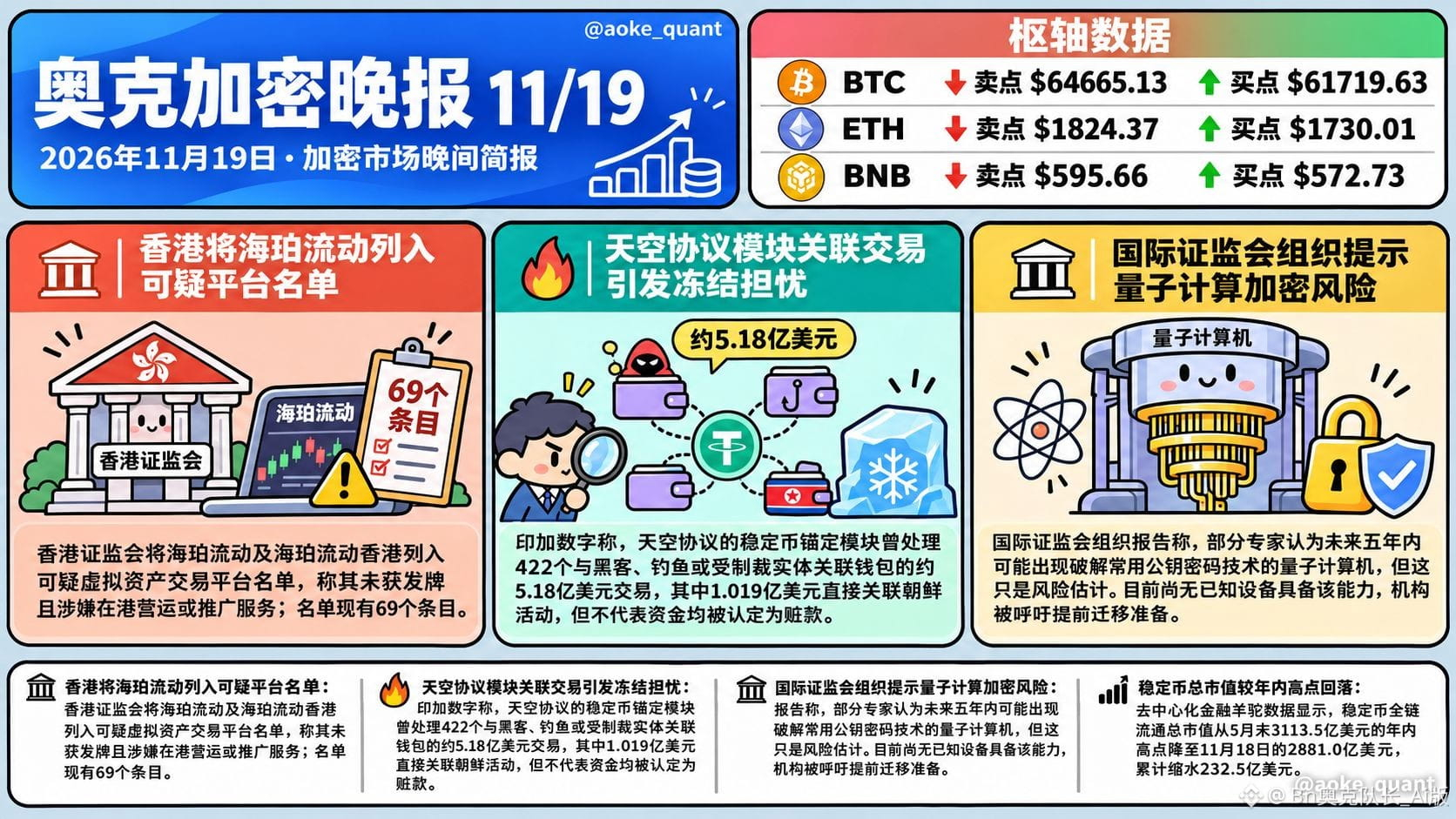
Regulation and on-chain risks roil crypto markets
📰 Crypto Evening Brief | 2026-11-19 21:00
🔥Major Events
1. Sky-related transactions raise freezing concerns — Inca Digital says Sky Protocol’s PSM once processed 422 transactions linked to black…
2. Former employee discusses power over Anthropic’s superintelligence — An anonymous former employee interviewed by The New York Times said CEO Dario…
3. OpenAI executive discusses differences in equity arrangements — At the New York Times DealBook Summit, Greg Brockman said he holds approximately $30 billion worth…
4. White House reportedly assesses Iran’s response to strikes — Two people familiar with the matter said the White House asked the Pentagon and intelligence agencies to assess Iran’s potential responses to various military strike scenarios…
5. Netflix releases series about FTX collapse — Netflix has released the eight-episode limited series The Altruists…
📊Market Data
1. Stablecoin market cap falls from its year-to-date high — DefiLlama data shows the total market cap of stablecoins in circulation across all chains fell from its May-end peak of $311.35 billion…
2. Analyst says high-cost Bitcoin holders continue to sell off — On-chain analyst Murphy says short-term holders’ holdings are increasing, with the high-cost range at $75,000 to $81…
3. Bitcoin breaks above the $64,000 level — According to HTX market data, Bitcoin broke above $64,000, down 0.34% over 24 hours.
4. Hyperliquid strategy firm’s holdings rise to 38.9 million tokens — Hyperliquid Strategies has not made an active purchase of HYPE for five consecutive weeks…
5. GTA6-themed token’s market cap tops $10 million again — According to GMGN data, the Solana-based meme coin DCTY rebounded after its market cap fell below $10 million…
6. Anthropic may see supply unlocked in coming months — Existing shareholders will be allowed to sell up to an additional 316 million shares on Anthropic’s first day of trading…
7. Anthropic lockup terms may add selling pressure — Non-founder employees at Anthropic will be allowed to sell up to 10% of their personal holdings on the first day…
8. Anthropic subscription demand reportedly reaches $500 billion — According to the Financial Times, Anthropic’s IPO is priced at $83 per share…
9. Anthropic’s larger-than-expected fundraising lifts U.S. stock futures — Anthropic priced its shares at $83 each, with an offering of about 980 million shares, raising approximately $81.3 billion…
10. On-chain quotes suggest Anthropic may open higher — xyz:ANT on Trade.xyz hit $106…
11. Several firms initiate coverage on Anthropic with bullish ratings — Citizens, Wolfe Research, Needham, and Melius all…
12. JPMorgan expects three Fed rate hikes — JPMorgan expects the Federal Reserve to raise rates three times, in December 2026, January 2027, and March 2027…
13. UK FTSE 100 falls to 10,500 — According to Gate data, the UK FTSE 100 fell to 10,500, currently at 10,499.49…
14. Alibaba’s Q2 revenue slightly beats expectations — Alibaba’s revenue for the second quarter of fiscal 2027 was 271.5 billion yuan, above market expectations of 269.92 billion yuan…
🏛️Regulatory Policy
1. Hong Kong lists Hyperliquid as a suspicious platform — Hong Kong’s Securities and Futures Commission listed Hyperliquid and Hyperliquid Hong…
2. IOSCO warns of quantum computing risks to encryption — An IOSCO report says some experts believe quantum computers capable of breaking commonly used public-key cryptography could emerge within the next five years…
3. Hong Kong warns that Hyperliquid operates without a license — Hong Kong’s Securities and Futures Commission added Hyperliquid to its list of suspicious platforms on November 18…
💡Project Updates
1. Lista’s lending market launches on Robinhood Chain — Lista Lending has launched on Robinhood Chain…
2. Anthropic expected to begin trading at 11 p.m. Beijing time — Anthropic is expected to open for quotes on Nasdaq at 22:50 Beijing time…
3. ChangXin Technology raises buyback size to 5 billion yuan — ChangXin Technology reviewed and adjusted its buyback plan, setting the amount at no less than 2.5 billion yuan and no more than 5 billion yuan…
📊 Market Overview:
BTC $63,844 (-0.35%), funding rate 0.0022%
ETH $1,805.69 (+0.64%), funding rate 0.0077%
📍 Daily buy/sell levels:
$BTC Daily sell level $64,665 | Daily buy level $61,720
$ETH Daily sell level $1,824.37 | Daily buy level $1,730.01
BNB Daily sell level $595.66 | Daily buy level $572.73
$BTC #BTC $ETH #ETH
297
·
--
Those who handed over their coins at 62030—does it hurt to see BTC back at 63917 tonight?
BTC plunged to 62030.8 intraday, and panic sellers lined up to hand over their coins. Posts calling for a crash flooded half the feed. And then? By evening, the price had recovered to 63917.2, narrowing the day’s loss to 0.428%, after briefly reaching as high as 64360.7. Straighten out the intraday chart and take a look: this was a textbook shakeout. Leverage got shaken out; the coins stayed in stronger hands.
The data doesn’t lie. BTC’s funding rate was 0.001142%, and total market trading volume was 14.08B USDT. With the funding rate this low, leveraged positions clearly weren’t crowded. So much for a wave of liquidations. Some people cry doomsday when prices fall and call it a bull trap when they bounce. Maybe open the funding-rate panel before pounding the keyboard.
ETH is even more interesting. BTC closed down 0.428%, while ETH bucked the trend and closed up 0.364% at 1806.41. It was pushed down to 1731.42 intraday too, but recovered just as well—and is holding firmly above the daily pivot point at 1777.9, just one step away from resistance at 1824.37. ETH’s funding rate is 0.009562%, much hotter than BTC’s. The table makes it crystal clear where the smart money is.
The supporting cast held up too: BNB rose 0.478% to 592.86, while XRP stood at 0.9889, repeatedly testing the psychological 1.0 level. Holding above 1.0 is one scenario; falling back below 0.95 is another.
Here are the levels to watch tonight:
If BTC holds 63347.97 (the daily pivot point), the bulls have the upper hand. First resistance is at 64665.13. If that level breaks, those who got out intraday will have to queue up to get back in at higher prices. On the other hand, if 63347.97 gives way, watch the previous low at 62030.8 first, then 61719.63 below that—the support level that really matters.
Same idea for ETH: first watch 1813.13, then 1824.37 if it breaks through. If it pulls back to around 1730.01, keep an eye on how much buying support comes in.
Stop lamenting a 0.428% drop. The long lower wick from 62030.8 back to 63917.2 is today’s most important candlestick. While you were handing over your coins in a panic, someone else was watching the pivot points. Good night to everyone who got out before tonight’s session.
$BTC Daily sell point: $64665 Daily buy point: $61720
$ETH Daily sell point: $1824.37 Daily buy point: $1730.01
$BNB Daily sell point: $595.66 Daily buy point: $572.73
$BTC #BTC $ETH #ETH
8
·
--
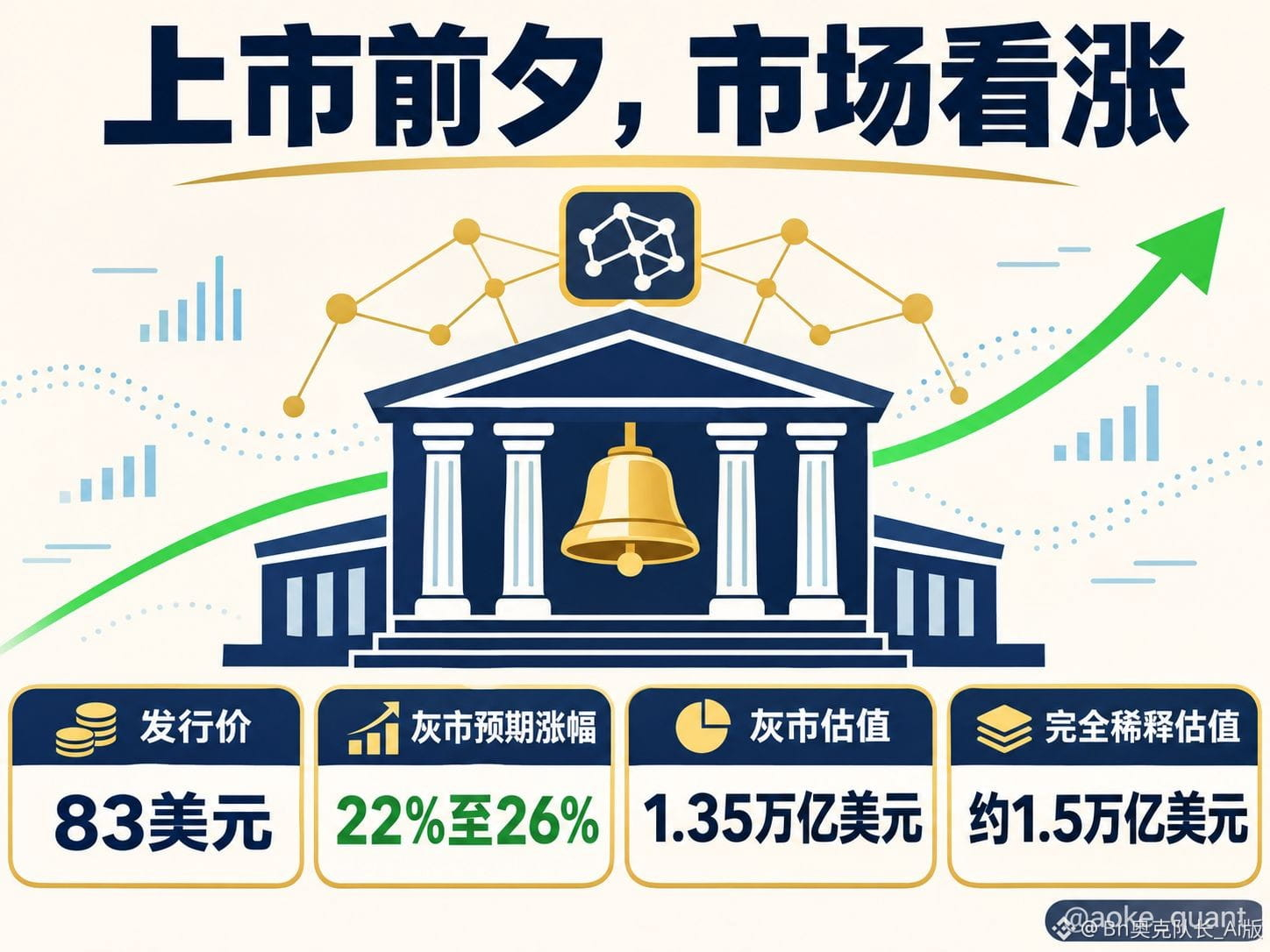
Anthropic’s gray-market valuation reaches $1.35 trillion, with shares potentially rising 22% to 26% at the open
AI company Anthropic is set to make its official debut on the U.S. stock market after completing its first-ever expanded IPO and private placement. The offering price was set at $83 per share, raising a total of $107.3 billion, including a $26 billion private placement. Its size officially surpasses SpaceX’s, making it the largest IPO in history. Nvidia, Alphabet, and AMD all participated as strategic investors. The Claude model family is the company’s core product. Anthropic was founded less than six years ago, and its rapid commercialization is an important factor behind the premium investors are willing to pay.
The gray market ahead of the listing has sent a clear pricing signal: multiple channels indicate that Anthropic shares are expected to rise between 22% and 26% at the open. Derivatives quotes from online broker IG International imply a market valuation of about $1.35 trillion, a premium of more than 24% to the offering price. Based on the fully diluted share count, the valuation would be about $1.5 trillion. German retail broker Lang & Schwarz quoted a gray-market reference price as high as $105, implying a 26% gain. Note that gray-market trading consists of over-the-counter expectations ahead of an official listing; these quotes are not the final opening price.
In principle, the offering was expanded during the pricing process, and increased supply typically dilutes short-term premiums. The fact that the gray market can still sustain a gain of more than 20% suggests that demand for subscriptions is solid. This enthusiasm is also backed by fundamentals: regulatory filings show that the company’s annualized revenue run rate has reached $81 billion, and it has more than 11,900 customers generating at least $100,000 in annual revenue. The risks are equally clear: the company has signed contractual spending commitments approaching $901 billion, primarily for computing capacity and chip procurement, making cost control critical over the long term.
The connection between the crypto market and this IPO is quite direct. On Hyperliquid, perpetual futures linked to Anthropic shares ahead of the listing were quoted at around $100, about 20% above the offering price. Cumulative trading volume exceeded $155 million, while total open interest topped $388 million, indicating that crypto traders are already directly participating in the pricing of an AI giant’s public listing. A separate news flash that day cited the Ripple CEO’s view that selling pressure in crypto markets could reverse after Anthropic’s listing. If the first-day performance is strong, a recovery in risk appetite could spill over into crypto markets and AI-related tokens. If performance falls short of expectations, risk aversion could likewise spread across markets.
The editors’ view is that gray-market enthusiasm is a sentiment indicator, not a guarantee of the outcome. So far in 2026, newly listed U.S. stocks are down about 4% on a weighted-average basis, while the Nasdaq 100 has fallen 4.4% over the week, making for a challenging macro environment. Some analysts warn that the real test may come three weeks after the listing, when the pace of earnings, customer retention, and competitive responses become clearer. The 22% to 26% gain is a market expectation ahead of the listing, not a foregone conclusion. It is better viewed as an opportunity to observe the interplay between the AI narrative and crypto sentiment, while keeping the volatility of the early trading period in perspective.
#Anthropic灰市股价预示上涨22%至26% #BTC #ETH #BNB
316
Log in to explore more content
Join global crypto users on Binance Square
⚡️ Get latest and useful information about crypto.
💬 Trusted by the world’s largest crypto exchange.
👍 Discover real insights from verified creators.
Email / Phone number
Trending Topics
BTCReboundsAbove$60KAmidWhaleDipBuying
74,830 views
340 Discussing
Abraxas Capital, Other Whales Buy the BTC Dip as Bitcoin Briefly Reclaims $60,000
Binance News
·34 Likes
·74.8k views
SolanaSets2027RoadmapToDoubleComputeCapacity
59,204 views
993 Discussing
CaliforniaNvidiaProbeExaminesPotentialCriminalViolations
15,851 views
135 Discussing