
Crypto Jrawan-前CEX研究员
1.2k Posts

Crypto Jrawan-前CEX研究员
Report
Block User
X(Twitter)同广场用户名|交易系统用AI来打造|前KOL、CEX研究员,目前为独立交易者,帮助你少走交易辛苦路与减少踩坑 | 定期直播|每日分享技术分析
Frequent Trader
5.8 Years
9 Following
835 Followers
544 Liked
Posts
All
Quotes
Live
PINNED
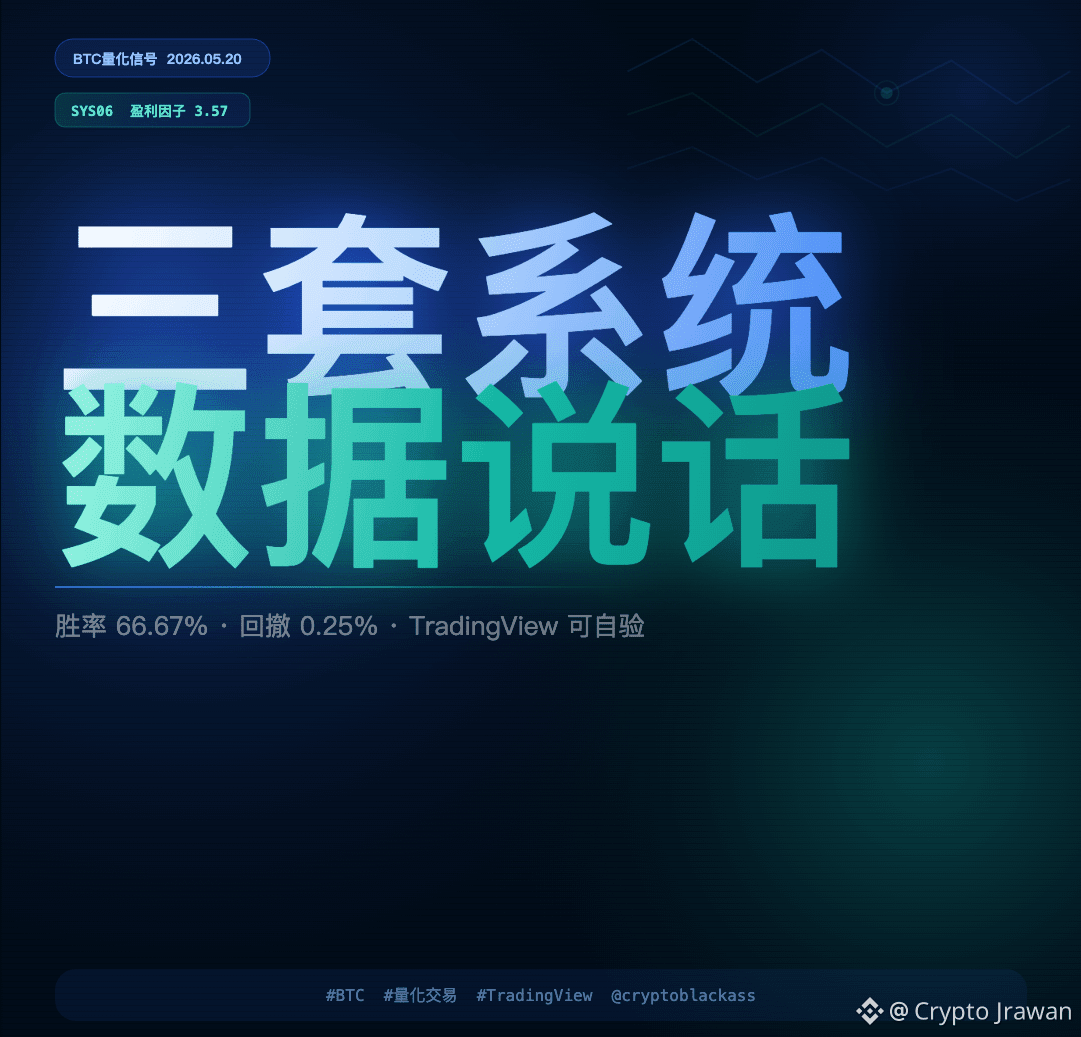
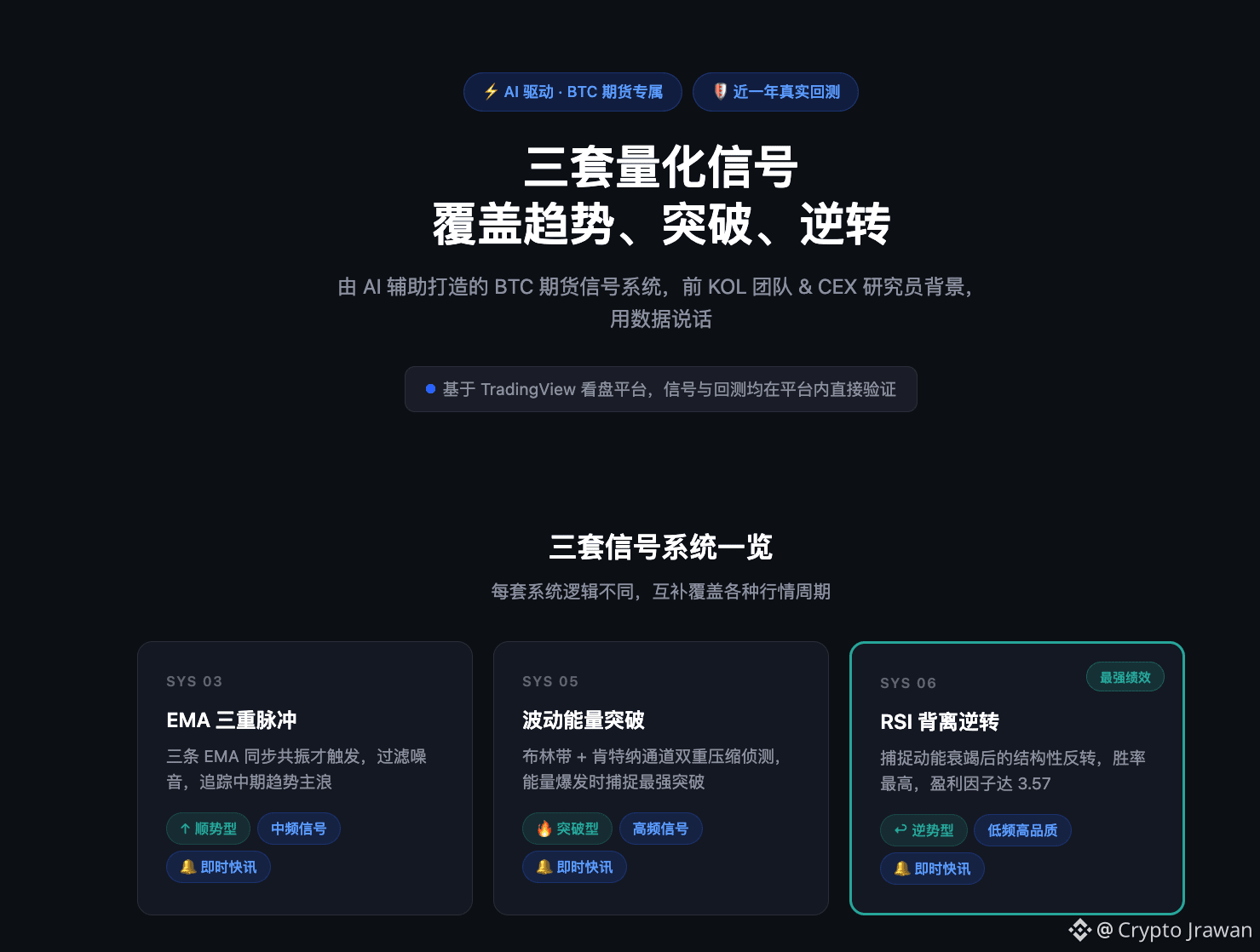
After months of work, I’ve leveraged AI to craft 3 BTC futures quant signals, and today they’re officially open for subscription.
Each strategy has its own role:
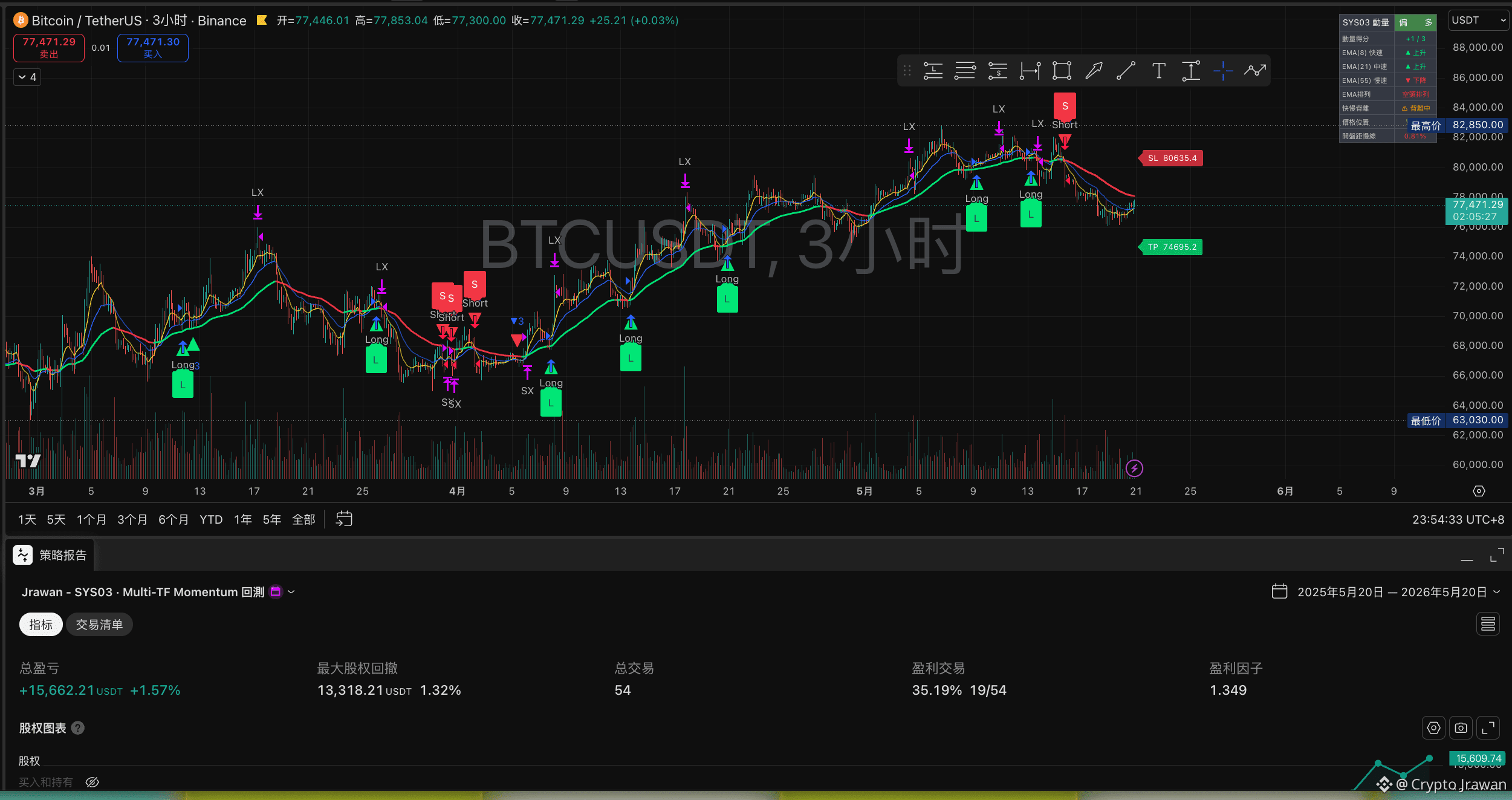
· SYS03 EMA Triple Pulse — Tracks mid-term trend waves, with 54 trades over the past year, profit factor of 1.46
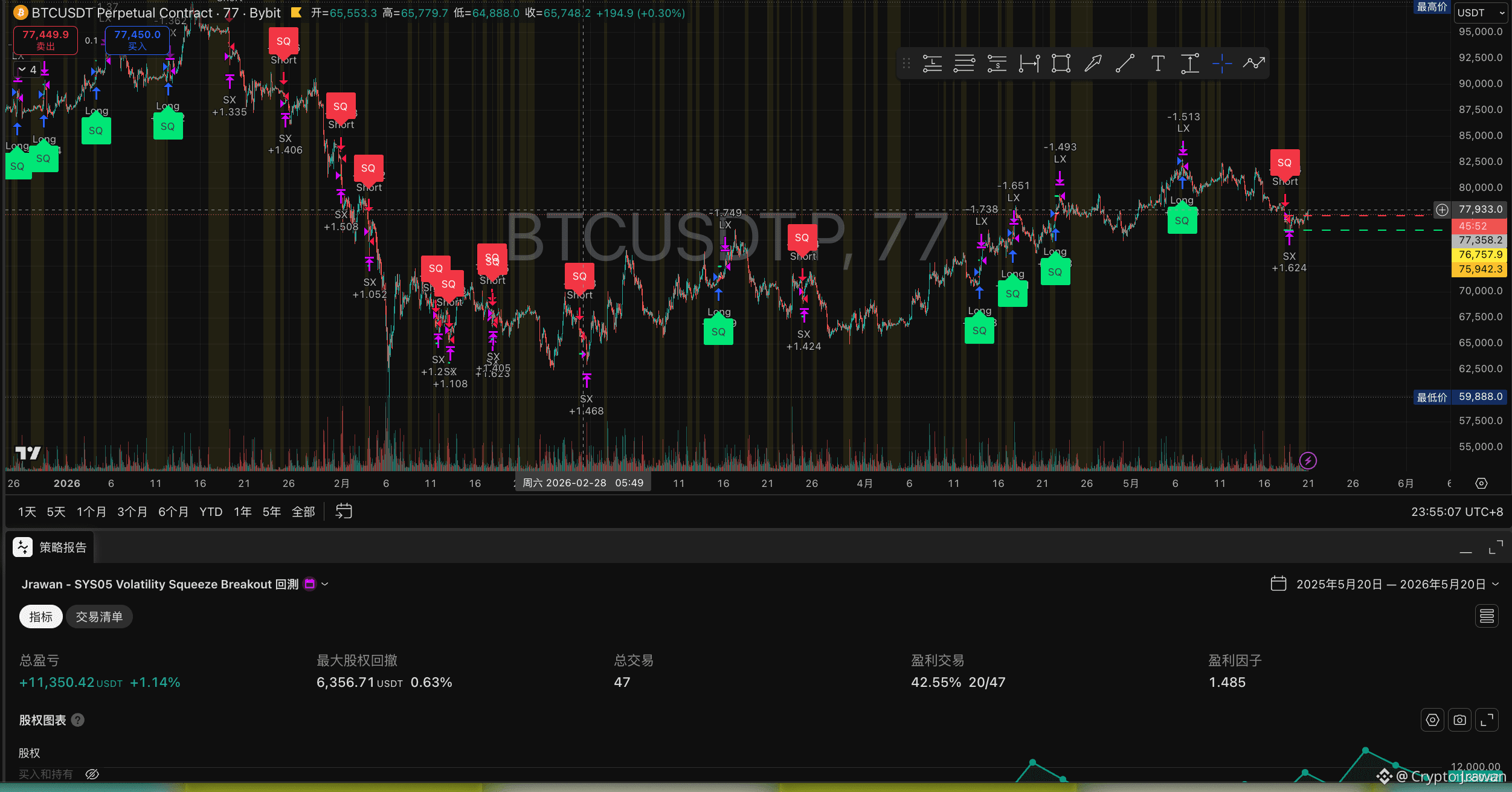
· SYS05 Volatility Energy Breakout — Bollinger Bands + Keltner Double Compression, capturing energy explosions, profit factor of 1.49
· SYS06 RSI Divergence Reversal — Only 15 trades in the past year, win rate of 66.67%, profit factor of 3.57, with a max drawdown of just 0.25%
All backtested on TradingView, so you can replicate the numbers yourself, no need to take my word for it.
Each signal includes:
✓ Real-time annotations for entry direction + SL / TP levels
✓ TradingView alerts pushed directly, getting notified of entry price / stop-loss / take-profit without having to watch the charts
✓ Backtest version for historical performance verification
Background: Former KOL team & CEX researcher, now independently developing trading systems.
If you're interested, DM me on X (Twitter) to learn about the subscription options, spots are limited, first come, first served.
#量化交易 #TradingView #量化信号
5
10
2.4k
PINNED
We'll be going live here from time to time to stream the charts + signal interpretations, no fluff.
Last time, folks said they gained a lot—but those who didn’t follow missed out.
I won’t give too much notice before going live, so make sure to follow to catch the action.
🔔 Follow → Don’t miss me!
We'll be going live here from time to time to stream the charts + signal interpretations, no fluff.
Last time, folks said they gained a lot—but those who didn’t follow missed out.
I won’t give too much notice before going live, so make sure to follow to catch the action.
🔔 Follow → Don’t miss me!
Last time, folks said they gained a lot—but those who didn’t follow missed out.
I won’t give too much notice before going live, so make sure to follow to catch the action.
🔔 Follow → Don’t miss me!

3
1.7k
One day of trading, one honest thought:
The best traders aren’t the ones who trade every day.
They’re the ones who know when not to trade.
Did you manage that today?
#交易心法 #CryptoTrading
$BTC $XAUT $HYPE
One day of trading, one honest thought:
The best traders aren’t the ones who trade every day.
They’re the ones who know when not to trade.
Did you manage that today?
#交易心法 #CryptoTrading
$BTC $XAUT $HYPE
The best traders aren’t the ones who trade every day.
They’re the ones who know when not to trade.
Did you manage that today?
#交易心法 #CryptoTrading
$BTC $XAUT $HYPE
1
352
If you could go back to your first day of trading, what would you most want to tell yourself?
My answer:
“Learn position sizing before technical analysis.”
Most people get the order backwards—they learn candlesticks, indicators, and chart patterns first,
then they can predict the direction correctly but still lose money.
The reason is simple: they haven’t managed risk properly.
Even with only a 60% win rate, a 2R risk-reward ratio
will give you positive expected value over the long run.
What’s your answer?
#交易心法 #交易心理 #Cryptocurrency
$BTC $XAUT $HYPE
35
Let me tell you about a friend.
He traded for three years and lost money the whole time.
It wasn't because he lacked skill—his analysis was always spot-on.
It was because whenever he got a trade right, he couldn't bring himself to take profits.
Whenever he got one wrong, he couldn't bring himself to cut his losses.
So how did it end?
He made a little when he was right, and lost a lot when he was wrong.
His expected value was negative.
Then he started using a fixed mechanism: take profit at 1.5R and stop loss at 0.5R—
regardless of how he felt, regardless of whether “this time might be different.”
By the third month, his account was in the black.
Not because his analysis had gotten more accurate, but because his expected value had finally turned positive.
Have you calculated your expected value?
#交易心理 #期望值 #Systematic Trading
$BTC $XAUT $HYPE
53
In early 2024, BTC surged on heavy volume around 58,000.
A friend of mine checked the charts every day and kept telling me, “Let’s wait a little longer, until the signal is clearer.”
At 62,000: “It feels too fast. Let’s wait for a pullback.”
At 68,000: “I’ll get in after the pullback. No rush.”
At 73,000: He finally couldn’t hold back and chased the price up.
Then BTC started pulling back, dropping to 60,000.
He said it wasn’t the money he lost—
It was this: he had spotted the opportunity at 58,000,
but by waiting for a “more certain signal,” he missed the best entry.
I asked him, “What are you waiting for?”
He said, “A signal that can’t be wrong.”
I said, “That kind of signal doesn’t exist.”
In trading, waiting for “more certainty” often means ending up with a “higher cost.”
#交易故事 #BTC #TradingPsychology
$BTC $XAUT $HYPE
151
I ran into three pitfalls when building my first quantitative system.
Pitfall 1: Overfitting
The backtest looked unbelievably good, but the system fell apart as soon as it went live.
Reason: The parameters were tuned too closely to historical data.
Pitfall 2: Ignoring fees
Each trade made $50 in the backtest, but after fees, only $15 was left in live trading.
Returns were cut by 70%.
Pitfall 3: No stop-loss logic
“Quantitative systems don’t make reckless trades.”
That is, until one market move wiped out 20%—then I learned that quantitative systems can get liquidated too.
The SYS series was gradually built after I learned these three lessons the hard way.
No pitfalls, no system.
#TradingView #量化交易 #CryptoTrading
$BTC $XAUT $HYPE
179
Good morning, a quick look at today's market, 11/23
BTC is consolidating around $61,100.
There's resistance at the previous high, with a support zone below.
Lately, the market has been full of people saying “it's about to go up” and “it's about to crash”—
but only the charts count; emotions don't.
My trading rules for today:
No signal → do nothing
Signal → follow the system, no scaling in or out
Simple, but hard.
$BTC
#BTC分析 #技术分析 #SystematicTrading
$BTC $XAUT $HYPE
123
Today's crypto market, summed up in one sentence:
Waiting.
BTC's current price action is like someone taking a deep breath—
Inhaling, holding it, ready to explode.
But the problem is, you don't know which direction it'll exhale.
So my strategy is simple:
Wait until it picks a direction, then get on board.
Don't guess, just follow. That's the core of systematic trading.
$BTC
#BTC #交易策略 #SystematicTrading
$BTC $XAUT $HYPE
108
The market closed today, so let’s do a brief summary.
Trading does not give signals every day, and not every day is suitable for placing trades.
If you didn’t make any trades today—
it may have been the right decision.
Protecting your capital is preparing for the next opportunity.
Continue tomorrow.
$BTC #系统交易 #Trading Discipline
$BTC $XAUT $HYPE
Trading does not give signals every day, and not every day is suitable for placing trades.
If you didn’t make any trades today—
it may have been the right decision.
Protecting your capital is preparing for the next opportunity.
Continue tomorrow.
$BTC #系统交易 #Trading Discipline
$BTC $XAUT $HYPE
69
After trading for so long, I want to ask you a question.
What’s the biggest obstacle you’re facing on your trading journey right now?
A. I don’t understand technical analysis
B. I understand it, but can’t control myself
C. My position management is inconsistent
D. I fall apart mentally as soon as I take a loss
Leave a comment and let me know. I’ll definitely reply when I see it.
I’m not trying to sell a course—I’m just genuinely curious and want to see where everyone is getting stuck.
#交易心理 #加密货币 #Engagement
$BTC $XAUT $HYPE
34
What’s the biggest difference between beginners and experienced traders?
It’s not analytical ability.
It’s not the size of their capital.
It’s how willing they are to accept “uncertainty.”
Beginner: “I need to find a method that’s 100% accurate.”
Experienced trader: “I just need positive expected value.”
There’s no 100% certainty in the market.
But with proper position sizing, you can make uncertainty work for you.
That’s the underlying logic of systematic trading.
Tell me in the comments: What’s your current attitude toward “uncertainty”?
#交易哲学 #期望值 #SystematicTrading
$BTC $XAUT $HYPE
70
In 2023, my account was wiped out once.
Not because I got the direction wrong, but because I used leverage and didn’t set a stop-loss.
At the time, my thinking was: “I’ve analyzed this clearly. It’s bound to bounce back.”
But it just didn’t.
That one time cost me two years’ worth of savings.
Someone asked me how I faced my family back then.
I said, “I didn’t tell them.”
I carried it all on my own for three months. I couldn’t sleep a single night during those months,
with only one thought on my mind: How do I make the money back?
Later, instead of rushing to earn it back, I spent six months rebuilding my system.
And things actually became more stable.
Getting liquidated isn’t the end. It’s a way of being forced to learn.
Have you ever been through something like this?
#真实分享 #交易故事 #CryptoTrading
$BTC $XAUT $HYPE
356
Spent several months building 3 sets of AI-assisted quantitative signals for BTC futures.
Each strategy has a different role:
· SYS03 Triple EMA Pulse — tracks the main wave of medium-term trends; 54 trades over the past year, profit factor 1.46
· SYS05 Volatility Energy Breakout — Bollinger Bands + Keltner dual squeeze, capturing energy bursts; profit factor 1.49
· SYS06 RSI Divergence Reversal — just 15 trades over the past year, 66.67% win rate, profit factor 3.57, maximum drawdown 0.25%
All backtested on TradingView, so you can reproduce the numbers yourself—you don't have to take my word for it.
Interested? DM me directly on X (Twitter). Spots are limited and available on a first-come, first-served basis.
#量化交易 #TradingView #QuantitativeSignals
$BTC $XAUT $HYPE
18
Today's crypto market, summed up in one sentence:
Waiting.
BTC's current movement is like someone taking a deep breath—
inhaling, holding it, ready to explode.
But the problem is, you don't know which direction it will exhale.
So my strategy is simple:
wait for it to choose a direction, then hop on.
Don't guess, just follow. That's the core of systematic trading.
$BTC
#BTC #交易策略 #SystematicTrading
$BTC $XAUT $HYPE
115
Today's crypto market, summed up in one sentence:
Waiting.
BTC's current movement is like someone taking a deep breath—
inhaling, holding it, getting ready to explode.
But the problem is, you don't know which direction it will breathe out.
So my strategy is simple:
wait until it picks a direction, then get on board.
Don't guess, just follow. That's the core of systematic trading.
$BTC
#BTC #交易策略 #SystematicTrading
$BTC $XAUT $HYPE
118
If you could go back to your first day of trading, what would you most want to tell yourself?
My answer:
“Learn position sizing before technical analysis.”
Most people get the order backwards—they learn candlesticks, indicators, and chart patterns first,
then they can predict the direction correctly but still lose money.
The reason is simple: they haven’t managed risk properly.
Even with a win rate of just 60%, a 2R risk-reward ratio
will give you positive expected value over the long run.
What’s your answer?
#交易心法 #交易心理 #Cryptocurrency
$BTC $XAUT $HYPE
31
Let me tell you about a friend.
He traded for three years and kept losing money.
It wasn't because he lacked skill—his analysis was always spot-on.
It was because whenever he got it right, he couldn't bring himself to take profits.
Whenever he got it wrong, he couldn't bring himself to cut his losses.
So what was the result?
He made a little when he was right, and lost a lot when he was wrong.
His expected value was negative.
Then he started using a fixed system: take profit at 1.5R and stop loss at 0.5R—
regardless of how he felt, regardless of whether “this time might be different.”
By the third month, his account was in the black.
Not because his analysis had become more accurate, but because his expected value was finally positive.
Have you calculated your expected value?
#交易心理 #期望值 #SystematicTrading
$BTC $XAUT $HYPE
225
The best trade I ever made wasn’t a single hugely profitable trade.
It was deciding to stop trading for three months during the 2022 bear market.
The market was in complete despair. Every day, people were shouting, “The bottom is in!”
And then it would drop another 30%.
Here’s what I did: I closed my charts and focused on learning.
I read six books about trading and rebuilt my trading framework.
When I came back three months later, the market was still falling,
but my mindset and system were much clearer.
Sometimes, the best trade is no trade at all.
#交易故事 #熊市策略 #CryptoTrading
$BTC $XAUT $HYPE
231
Log in to explore more content
Join global crypto users on Binance Square
⚡️ Get latest and useful information about crypto.
💬 Trusted by the world’s largest crypto exchange.
👍 Discover real insights from verified creators.
Email / Phone number
Trending Topics
NVIDIAReinstatesJensenHuangasCEO
98,698 views
899 Discussing
TradFi News | Nvidia Board Unanimously Reinstates Jensen Huang as CEO; Shares Jump 30% Premarket
Binance News
·39 Likes
·40.9k views
WillMarketsStageAThanksgivingReliefRally?
206,266 views
1,891 Discussing
WillOctCorePCEShiftFedHikeExpectations?
73,270 views
807 Discussing