Faheem Ur Rehman 12

7 Following
44 Followers
47 Liked
Posts
·
--
Verified
Article
Nvidia: Record Quarter, SEC Probe, and a $2.6 Trillion FallNvidia: Record Quarter, SEC Probe, and a $2.6 Trillion Fall Nvidia has just lived through the strangest month in its history. On 17 November it reported the biggest quarter ever posted by a chipmaker. Three days later its stock crashed 14% in a single session to a 52-week low. In seven weeks it has lost about $2.6 trillion of market value — more than the entire value of most companies on earth. This is what happened, in order, and what is still to come. 1. The numbers that didn't save it Nvidia's fiscal third quarter (August to October 2026) was, on paper, extraordinary. Revenue reached $115.8 billion, up 103% year over year, beating Wall Street's $109.33 billion estimate by about $6.5 billion. Adjusted earnings per share were $2.68 against $2.47 expected. Data centre revenue — the heart of the AI business — hit $107.6 billion, up 110% and about 93% of all sales. The company guided fourth-quarter revenue to about $130 billion, above the $125.2 billion consensus, and approved another $150 billion in share buybacks. Its next-generation Vera Rubin platform generated about $20 billion in its first quarter of production shipments, against $11 billion for Blackwell's first quarter. The market's answer: shares rose about 2% after hours, fell 3.3% the next day, then plunged 14.01% on Friday 20 November to close at $125.53. The numbers were never the problem. Trust was. 2. The probe The Wall Street Journal first reported on 17 November that the SEC was investigating Nvidia. On 20 November, Reuters reported — citing two people briefed on the matter — that enforcement staff are examining potential accounting issues, the first time the probe has been reported to focus on accounting. The New York Times reported on Saturday that the inquiry is in its early stages. The SEC has declined to comment, and Nvidia has not commented on the Reuters report. What is actually being examined is not yet public. One possibility raised in reporting is how Nvidia reports revenue by geography — in fiscal 2026 it recorded $19.7 billion in revenue from customers headquartered in China. That is a possibility, not an established fact. What is established: an investigation is not a finding. No charges have been announced, and many such inquiries close without penalties. 3. The leadership crisis The probe landed on a company already in crisis. Founder and CEO Jensen Huang resigned on 12 November, ending a 33-year run, after the board investigated his personal conduct. CFO Colette Kress is interim CEO, and the board has ruled out Huang's return, hiring executive search firm Heidrick & Struggles to find a permanent successor. The board has also retained law firm Wachtell as counsel. Huang has now agreed to testify in public before the US Senate on 3 December, at the request of Banking Committee chair Tim Scott, with Commerce Secretary Howard Lutnick testifying too. He has also agreed to a closed-door interview with three House committees on 1 December — his first testimony since resigning. The legal pressure does not stop there. California's attorney general served Nvidia with an investigative subpoena on 19 November, examining whether advanced chips reached China and whether investors were misled. The Justice Department is reviewing Nvidia's $12.9 billion acquisition of Hugging Face. Treasury Secretary Scott Bessent has given the board ten days to answer whether questionable sales inflated earnings. A proposed shareholder class action was filed on 9 November in federal court in San Jose. 4. The market Friday 20 November was Nvidia's seventh straight day of declines and its seventh consecutive weekly loss — a streak not seen since 2008, and its worst week since 2008. Its worst single day since January 2025. Over the seven weeks the stock has fallen 46%, and about $2.6 trillion of market value has gone. At the close on 11 November, the day before Huang's resignation was announced, Nvidia was worth $4.19 trillion; by Friday it had lost $1.04 trillion of that. It is now worth about $3 trillion, the fourth most valuable company in America after Apple, Microsoft and Alphabet. The sell-off spread. AMD fell 13% and Micron 14% on Friday. The Nasdaq fell 5.3%, the S&P 500 fell 3.7% into a correction, and the PHLX semiconductor index fell 10.7%. 5. What happens next Three dates now matter. Nvidia's GTC Washington conference runs 30 November to 3 December. Huang's House interview is 1 December and his public Senate testimony is 3 December. And the delayed quarterly 10-Q filing is due around 4 December — interim CEO Kress said it will be filed in the coming weeks, and UBS says management linked the delay to the investigation. Record revenue, record buybacks, and a 52-week low in the same week. The market is no longer pricing Nvidia's numbers. It is pricing whether those numbers can be trusted — and the next three weeks will decide that question ❓ $NVDA #NVIDIA #BinanceSquare

Nvidia: Record Quarter, SEC Probe, and a $2.6 Trillion Fall

Nvidia: Record Quarter, SEC Probe, and a $2.6 Trillion Fall
Nvidia has just lived through the strangest month in its history. On 17 November it reported the biggest quarter ever posted by a chipmaker. Three days later its stock crashed 14% in a single session to a 52-week low. In seven weeks it has lost about $2.6 trillion of market value — more than the entire value of most companies on earth.
This is what happened, in order, and what is still to come.
1. The numbers that didn't save it
Nvidia's fiscal third quarter (August to October 2026) was, on paper, extraordinary. Revenue reached $115.8 billion, up 103% year over year, beating Wall Street's $109.33 billion estimate by about $6.5 billion. Adjusted earnings per share were $2.68 against $2.47 expected. Data centre revenue — the heart of the AI business — hit $107.6 billion, up 110% and about 93% of all sales. The company guided fourth-quarter revenue to about $130 billion, above the $125.2 billion consensus, and approved another $150 billion in share buybacks. Its next-generation Vera Rubin platform generated about $20 billion in its first quarter of production shipments, against $11 billion for Blackwell's first quarter.
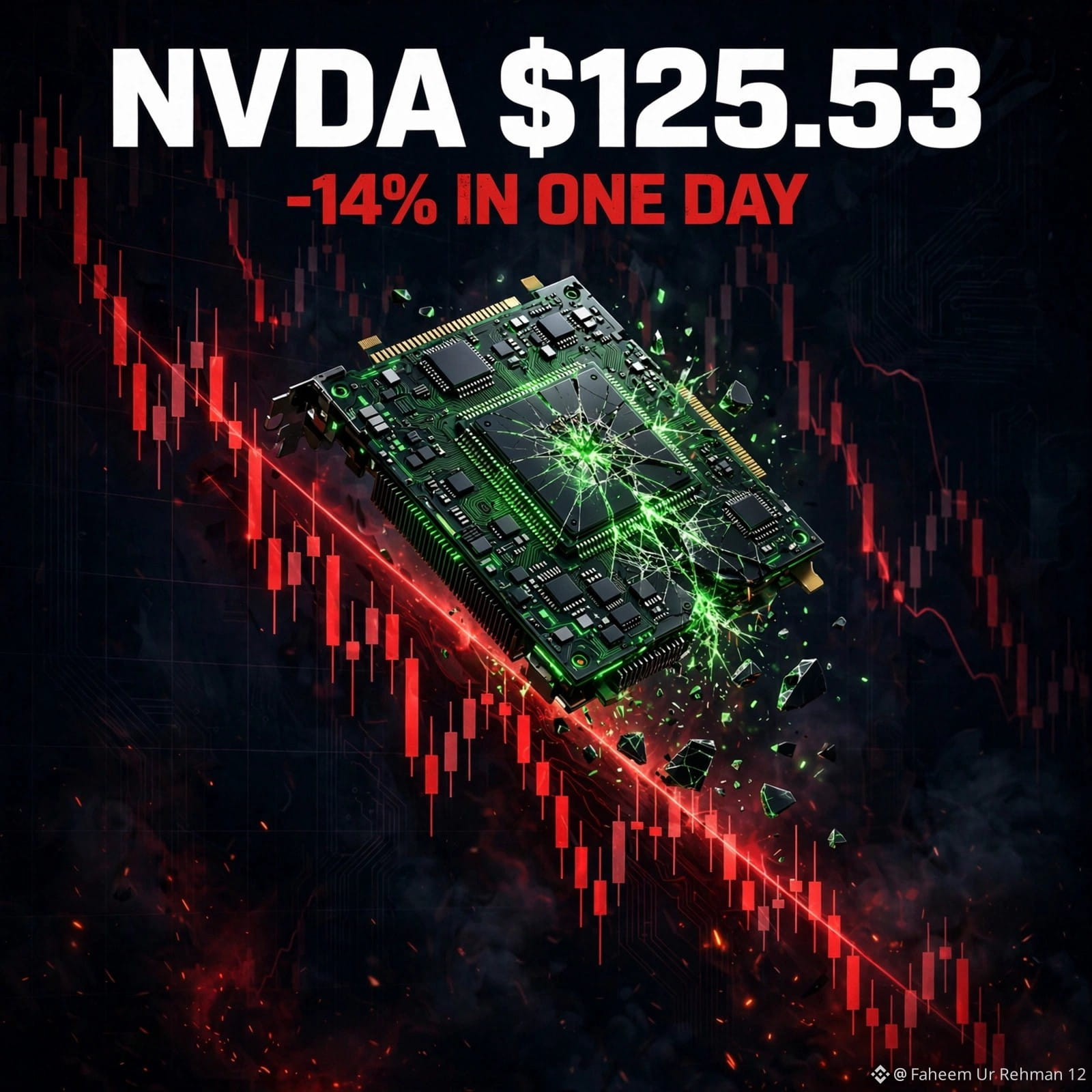
The market's answer: shares rose about 2% after hours, fell 3.3% the next day, then plunged 14.01% on Friday 20 November to close at $125.53. The numbers were never the problem. Trust was.
2. The probe
The Wall Street Journal first reported on 17 November that the SEC was investigating Nvidia. On 20 November, Reuters reported — citing two people briefed on the matter — that enforcement staff are examining potential accounting issues, the first time the probe has been reported to focus on accounting. The New York Times reported on Saturday that the inquiry is in its early stages. The SEC has declined to comment, and Nvidia has not commented on the Reuters report.
What is actually being examined is not yet public. One possibility raised in reporting is how Nvidia reports revenue by geography — in fiscal 2026 it recorded $19.7 billion in revenue from customers headquartered in China. That is a possibility, not an established fact. What is established: an investigation is not a finding. No charges have been announced, and many such inquiries close without penalties.
3. The leadership crisis
The probe landed on a company already in crisis. Founder and CEO Jensen Huang resigned on 12 November, ending a 33-year run, after the board investigated his personal conduct. CFO Colette Kress is interim CEO, and the board has ruled out Huang's return, hiring executive search firm Heidrick & Struggles to find a permanent successor. The board has also retained law firm Wachtell as counsel.
Huang has now agreed to testify in public before the US Senate on 3 December, at the request of Banking Committee chair Tim Scott, with Commerce Secretary Howard Lutnick testifying too. He has also agreed to a closed-door interview with three House committees on 1 December — his first testimony since resigning.
The legal pressure does not stop there. California's attorney general served Nvidia with an investigative subpoena on 19 November, examining whether advanced chips reached China and whether investors were misled. The Justice Department is reviewing Nvidia's $12.9 billion acquisition of Hugging Face. Treasury Secretary Scott Bessent has given the board ten days to answer whether questionable sales inflated earnings. A proposed shareholder class action was filed on 9 November in federal court in San Jose.
4. The market
Friday 20 November was Nvidia's seventh straight day of declines and its seventh consecutive weekly loss — a streak not seen since 2008, and its worst week since 2008. Its worst single day since January 2025. Over the seven weeks the stock has fallen 46%, and about $2.6 trillion of market value has gone. At the close on 11 November, the day before Huang's resignation was announced, Nvidia was worth $4.19 trillion; by Friday it had lost $1.04 trillion of that. It is now worth about $3 trillion, the fourth most valuable company in America after Apple, Microsoft and Alphabet.
The sell-off spread. AMD fell 13% and Micron 14% on Friday. The Nasdaq fell 5.3%, the S&P 500 fell 3.7% into a correction, and the PHLX semiconductor index fell 10.7%.
5. What happens next
Three dates now matter. Nvidia's GTC Washington conference runs 30 November to 3 December. Huang's House interview is 1 December and his public Senate testimony is 3 December. And the delayed quarterly 10-Q filing is due around 4 December — interim CEO Kress said it will be filed in the coming weeks, and UBS says management linked the delay to the investigation.
Record revenue, record buybacks, and a 52-week low in the same week. The market is no longer pricing Nvidia's numbers. It is pricing whether those numbers can be trusted — and the next three weeks will decide that question ❓
$NVDA
#NVIDIA #BinanceSquare
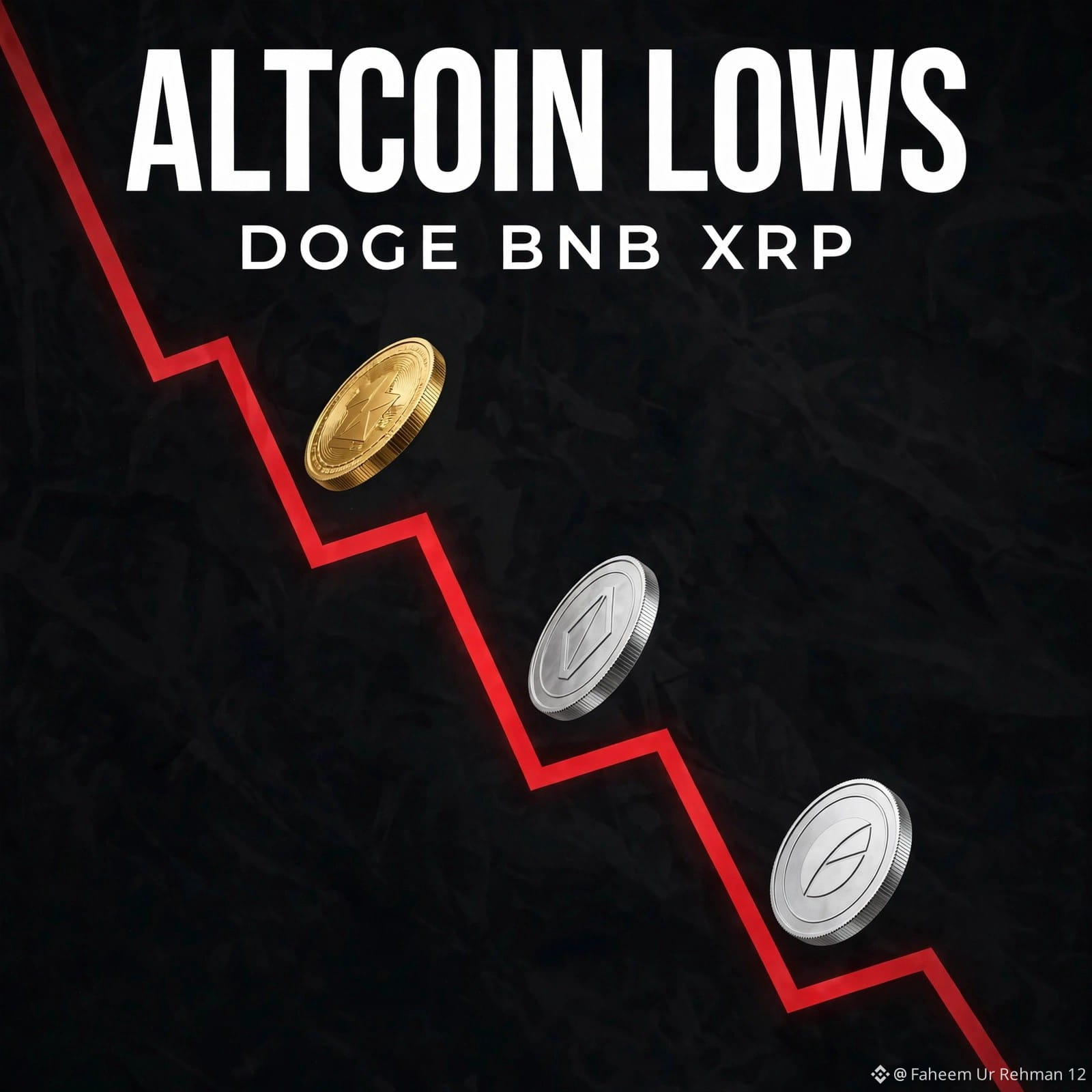
While Bitcoin Bounced, Altcoins Printed Lows Not Seen in Years Bitcoin recovered to $60,000 — but the big altcoins did not bounce with it. On 21 Nov they printed lows not seen in years. The facts (21 Nov, Binance data): • Dogecoin fell to $0.05077 — its lowest since June 2022 — before climbing back to about $0.0554 by 22 Nov. • BNB fell to $503.75, just $3.75 short of $500 — its lowest since 3 Feb 2025. It had opened the day at $540.84. • XRP fell to $0.86 — its lowest since 15 Nov 2024 — before bouncing back toward $0.93. • Ether slipped below $1,600 on 20 Nov. • Bitcoin dominance is now near 59% — money is crowding into BTC while altcoins bleed. Bitcoin bounced. The altcoins did not. Is this the bottom for alts — or is the pain still ahead? 👇 $DOGE {spot}(DOGEUSDT) $BNB {spot}(BNBUSDT) $XRP {spot}(XRPUSDT) #Altcoins #BinanceSquare
While Bitcoin Bounced, Altcoins Printed Lows Not Seen in Years

Bitcoin recovered to $60,000 — but the big altcoins did not bounce with it. On 21 Nov they printed lows not seen in years.

The facts (21 Nov, Binance data):
• Dogecoin fell to $0.05077 — its lowest since June 2022 — before climbing back to about $0.0554 by 22 Nov.
• BNB fell to $503.75, just $3.75 short of $500 — its lowest since 3 Feb 2025. It had opened the day at $540.84.
• XRP fell to $0.86 — its lowest since 15 Nov 2024 — before bouncing back toward $0.93.
• Ether slipped below $1,600 on 20 Nov.
• Bitcoin dominance is now near 59% — money is crowding into BTC while altcoins bleed.

Bitcoin bounced. The altcoins did not. Is this the bottom for alts — or is the pain still ahead? 👇

$DOGE
$BNB
$XRP

#Altcoins #BinanceSquare
·
--
Bullish
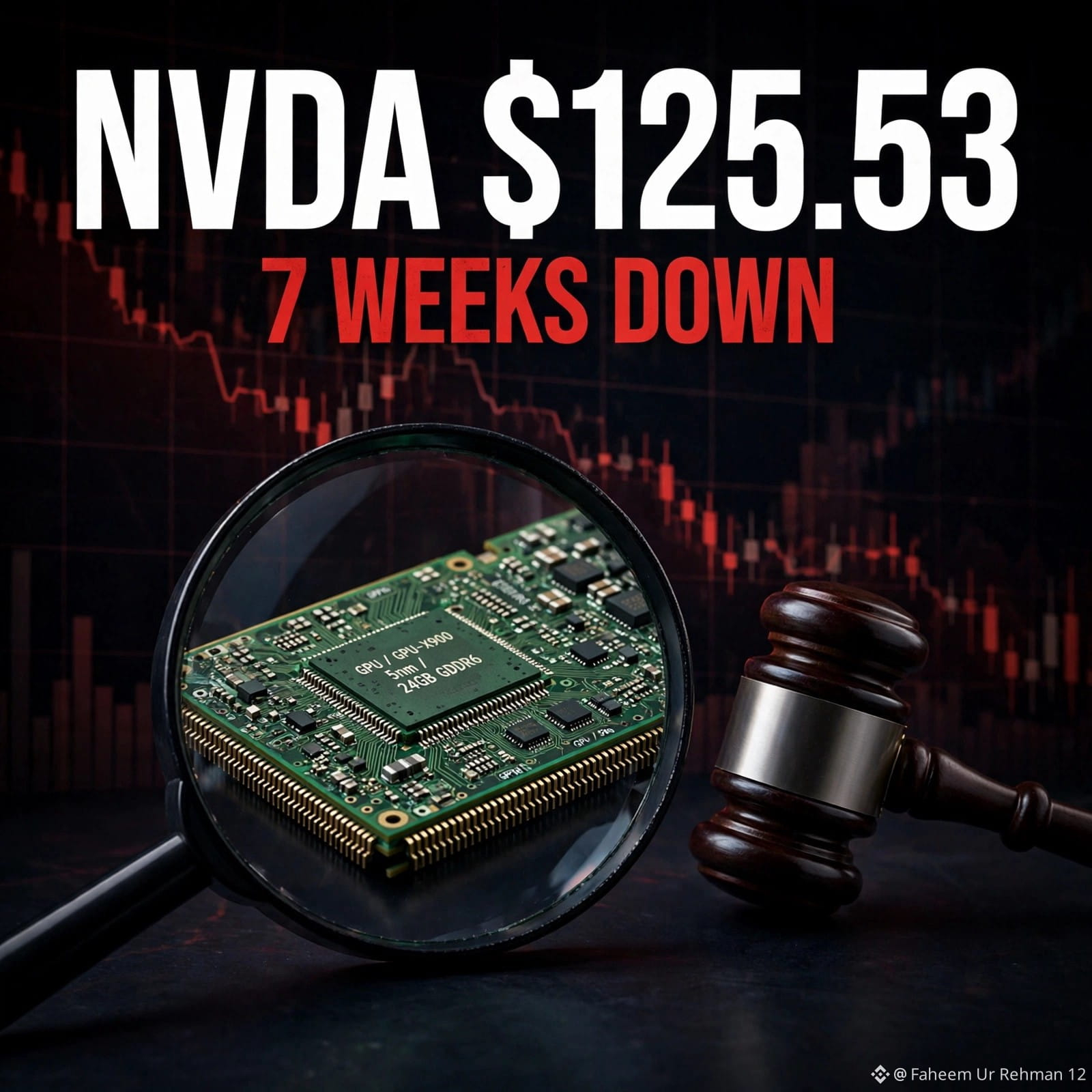
Nvidia: Three New Facts Landed Over the Weekend The Nvidia story moved again this weekend — and none of it is about earnings. What is new (22 Nov): • The New York Times reports the SEC inquiry into Nvidia's accounting is in its early stages, citing people briefed on the confidential investigation. The SEC declined to comment, and Nvidia has not commented. A probe is not a finding — no charges have been announced. • Jensen Huang has agreed to testify in public before the US Senate on 3 Dec, and to a closed-door interview with three House committees on 1 Dec — his first testimony since resigning on 12 Nov. • Nvidia has delayed its quarterly 10-Q filing. Interim CEO Colette Kress said on the earnings call it will be filed in the coming weeks; the deadline is around 4 Dec, and UBS says management linked the delay to the investigation. • The stock: $125.53 at Friday's close (20 Nov) — down 46% in seven weeks, about $2.6T of market value gone. At the close on 11 Nov, the day before Huang's resignation was announced, Nvidia was worth $4.19T. Seven weeks down, and the next hard dates are 1 Dec, 3 Dec and 4 Dec. What are YOU watching first — the testimony or the filing? 👇 $NVDA {future}(NVDAUSDT) #NVIDIA #BinanceSquare
Nvidia: Three New Facts Landed Over the Weekend

The Nvidia story moved again this weekend — and none of it is about earnings.

What is new (22 Nov):
• The New York Times reports the SEC inquiry into Nvidia's accounting is in its early stages, citing people briefed on the confidential investigation. The SEC declined to comment, and Nvidia has not commented. A probe is not a finding — no charges have been announced.
• Jensen Huang has agreed to testify in public before the US Senate on 3 Dec, and to a closed-door interview with three House committees on 1 Dec — his first testimony since resigning on 12 Nov.
• Nvidia has delayed its quarterly 10-Q filing. Interim CEO Colette Kress said on the earnings call it will be filed in the coming weeks; the deadline is around 4 Dec, and UBS says management linked the delay to the investigation.
• The stock: $125.53 at Friday's close (20 Nov) — down 46% in seven weeks, about $2.6T of market value gone. At the close on 11 Nov, the day before Huang's resignation was announced, Nvidia was worth $4.19T.

Seven weeks down, and the next hard dates are 1 Dec, 3 Dec and 4 Dec. What are YOU watching first — the testimony or the filing? 👇

$NVDA

#NVIDIA #BinanceSquare
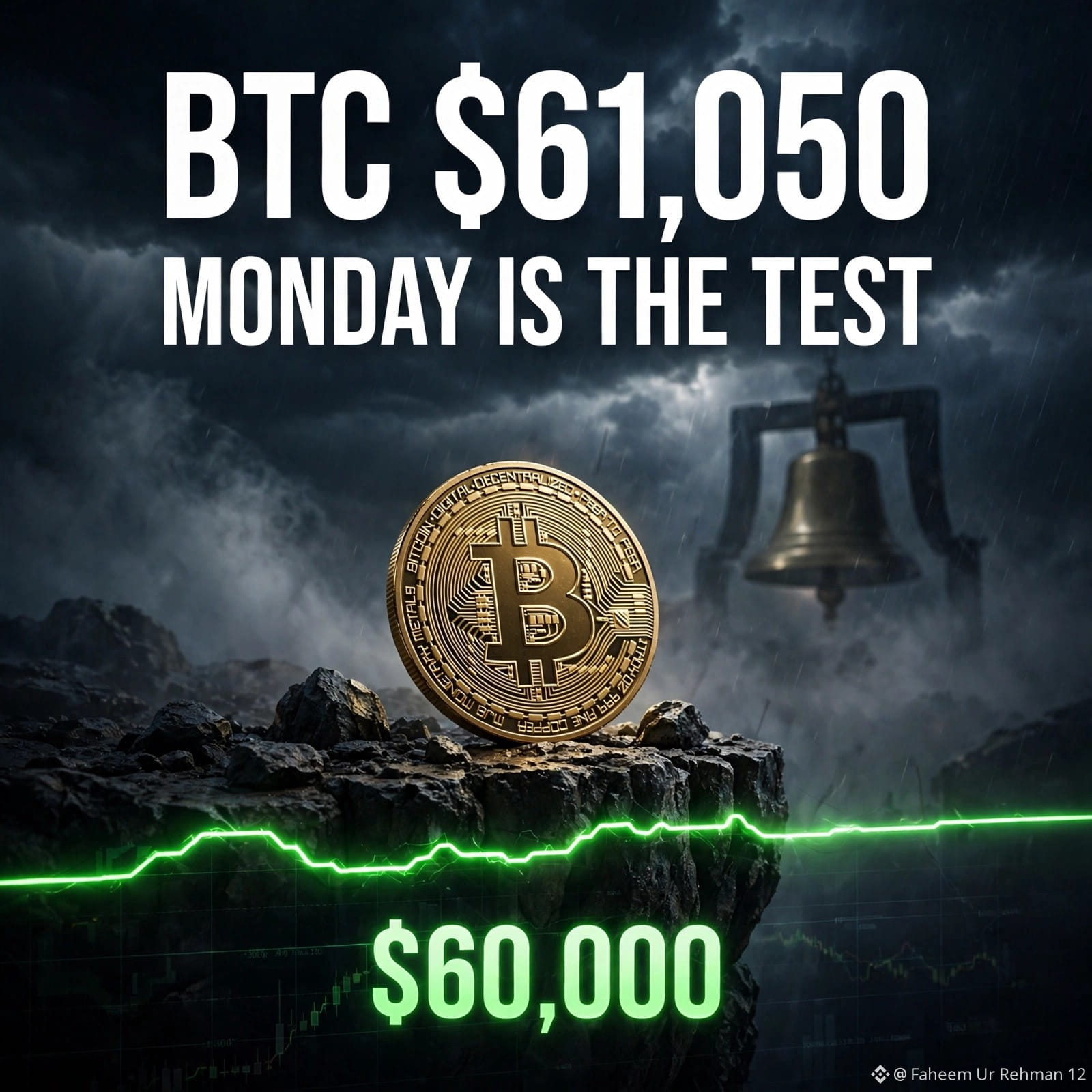
Bitcoin Held $60,000 All Weekend. Monday Is the Real Test. Bitcoin crashed to $55,130 on Saturday — its lowest in over two years — then bounced 9% to retake $60,000. It is trading near $61,050 (price as of 22 Nov, 21:28 UTC). The facts: • BTC closed Saturday (21 Nov) at $60,215.77, after touching the $55,130 low earlier that day. • Fear & Greed is at 8 — deep in Extreme Fear — even after the bounce. • US stocks had their worst week in years: the S&P 500 fell 3.7% on Friday and is now in a correction, and the Nasdaq fell 5.3%. • Crypto bounced while stocks were closed for the weekend. Monday's US open is the first real test of whether the bounce holds. Is this a decoupling — or just a weekend with the stock market closed? What do YOU think Monday brings? 👇 $BTC {future}(BTCUSDT) #bitcoin #BinanceSquare
Bitcoin Held $60,000 All Weekend. Monday Is the Real Test.

Bitcoin crashed to $55,130 on Saturday — its lowest in over two years — then bounced 9% to retake $60,000. It is trading near $61,050 (price as of 22 Nov, 21:28 UTC).

The facts:
• BTC closed Saturday (21 Nov) at $60,215.77, after touching the $55,130 low earlier that day.
• Fear & Greed is at 8 — deep in Extreme Fear — even after the bounce.
• US stocks had their worst week in years: the S&P 500 fell 3.7% on Friday and is now in a correction, and the Nasdaq fell 5.3%.
• Crypto bounced while stocks were closed for the weekend. Monday's US open is the first real test of whether the bounce holds.

Is this a decoupling — or just a weekend with the stock market closed? What do YOU think Monday brings? 👇

$BTC

#bitcoin #BinanceSquare
#NvidiaLoses$2.7TrillionInMonthAndAHalf Nvidia Beat Earnings by $6.5B — Then Crashed 14% to a 52-Week Low The strangest stock story of the year: Nvidia just posted its biggest quarter ever, and the market sold it like a fraud. What actually happened (20 Nov): • NVDA fell 14.01% on Friday to close at $125.53 — a 52-week low — wiping out nearly $500B in a single session, on about 626M shares traded. • The trigger: Reuters reported the SEC is now probing potential accounting issues at Nvidia — the first time the investigation has been reported to focus on accounting. • Just three days earlier, Nvidia reported Q3 revenue of $115.8B (+103% YoY), beating estimates by $6.5B, with EPS of $2.68 vs $2.47 expected — and guided Q4 to ~$130B, plus a $150B buyback. • The stock is down ~48% from its $243.37 high on 6 Oct — seven straight weekly falls, its longest slide since 2008. • It is not just Nvidia: AMD fell 13% and Micron 14% on Friday. The whole AI trade is unwinding. • The backdrop: CEO Jensen Huang resigned on 12 Nov, the board has ruled out his return, and he$NVDA.US {stock_us}(NVDA.US) testifies before Congress on 1 Dec. • After hours it recovered to $130.01 — up 3.6% from the close. Record revenue, record buyback — and a 52-week low anyway. The market is not pricing the numbers anymore. It is pricing trust. What do YOU think breaks first: the stock, or the story around it? 👇 $NVDA #NVIDIA #BinanceSquare
#NvidiaLoses$2.7TrillionInMonthAndAHalf

Nvidia Beat Earnings by $6.5B — Then Crashed 14% to a 52-Week Low

The strangest stock story of the year: Nvidia just posted its biggest quarter ever, and the market sold it like a fraud.

What actually happened (20 Nov):
• NVDA fell 14.01% on Friday to close at $125.53 — a 52-week low — wiping out nearly $500B in a single session, on about 626M shares traded.
• The trigger: Reuters reported the SEC is now probing potential accounting issues at Nvidia — the first time the investigation has been reported to focus on accounting.
• Just three days earlier, Nvidia reported Q3 revenue of $115.8B (+103% YoY), beating estimates by $6.5B, with EPS of $2.68 vs $2.47 expected — and guided Q4 to ~$130B, plus a $150B buyback.
• The stock is down ~48% from its $243.37 high on 6 Oct — seven straight weekly falls, its longest slide since 2008.
• It is not just Nvidia: AMD fell 13% and Micron 14% on Friday. The whole AI trade is unwinding.
• The backdrop: CEO Jensen Huang resigned on 12 Nov, the board has ruled out his return, and he$NVDA.US
testifies before Congress on 1 Dec.
• After hours it recovered to $130.01 — up 3.6% from the close.

Record revenue, record buyback — and a 52-week low anyway. The market is not pricing the numbers anymore. It is pricing trust.

What do YOU think breaks first: the stock, or the story around it? 👇

$NVDA

#NVIDIA #BinanceSquare
NVDAUS-7.95%
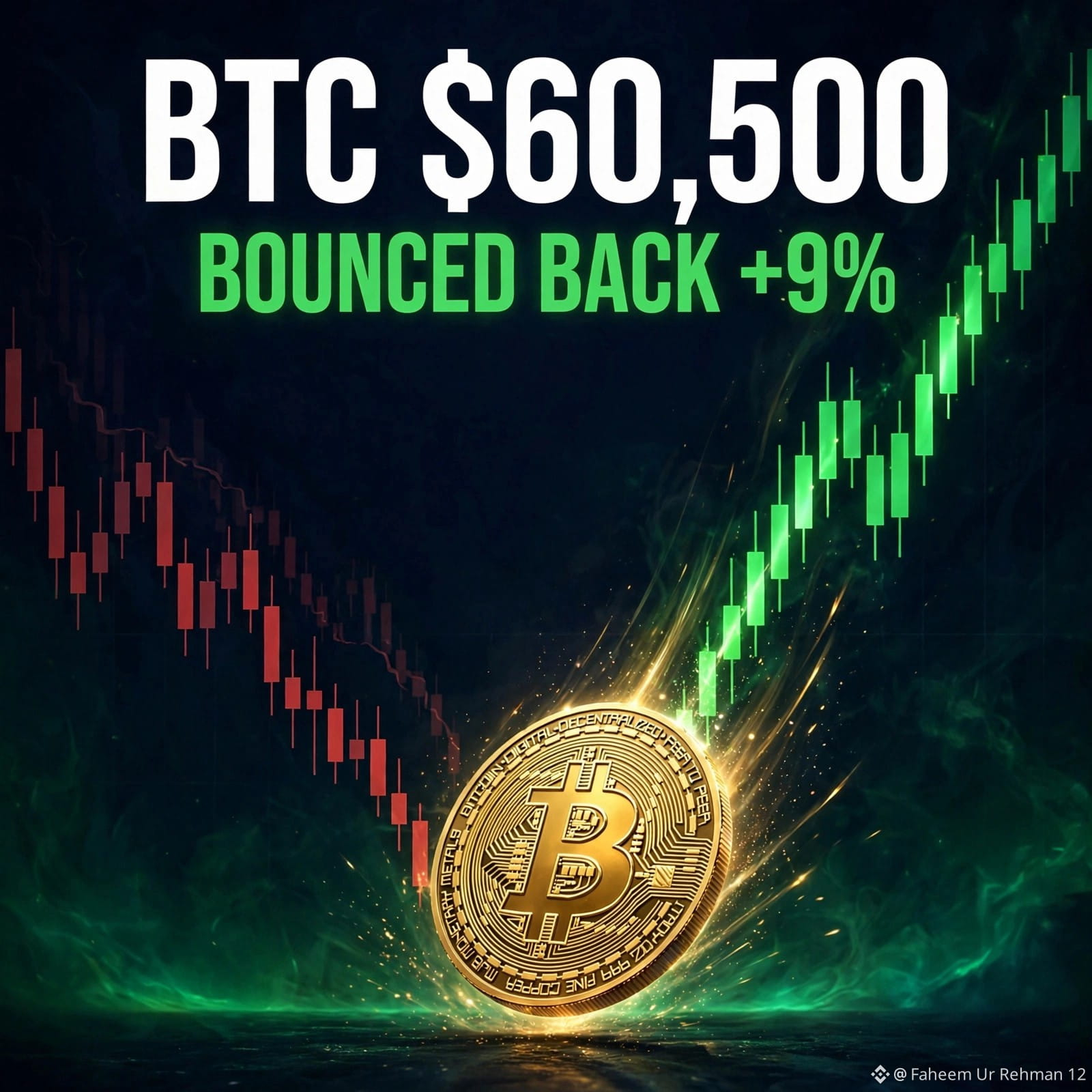
Bitcoin Bounced 9% From a Two-Year Low — Back Above $60,000 Saturday morning it was $55,130 — the lowest since September 2024. By the evening it was back above $60,000. What actually happened (21 Nov): • BTC crashed to ~$55,130, its lowest in over two years, then rebounded 9% to retake $60,000. It is trading near $60,500. • $2.4B in liquidations in 24 hours (CoinGlass) — mostly bullish bets wiped out. Holders realised $11.3B in losses over seven days. • Market cap is back near $1.21T — about 58% of the whole crypto market, worth about $2.06T in total. • US spot Bitcoin ETFs saw about $1.1B in net withdrawals this week. • ETH is near $1,680, up about 4.5%. Fear & Greed is still in Extreme Fear. What the market is watching next: • Holding $60,000 — then $62,000, the level BTC lost on Thursday. • Below $56,000, analysts point to the $50,000-53,000 zone (WazirX). • Monday's US stock open — the Nasdaq fell more than 4% on Friday. And ETF flows: Wintermute says a lasting recovery needs fresh inflows. • 8-9 Dec: the Fed decision, with a hike ~90% priced in. Dead-cat bounce or real recovery — nobody can say yet. What do YOU think: does $60K hold into Monday, or was this just a weekend bounce? 👇 $BTC {spot}(BTCUSDT) $ETH $MA.US #bitcoin #BinanceSquare
Bitcoin Bounced 9% From a Two-Year Low — Back Above $60,000

Saturday morning it was $55,130 — the lowest since September 2024. By the evening it was back above $60,000.

What actually happened (21 Nov):
• BTC crashed to ~$55,130, its lowest in over two years, then rebounded 9% to retake $60,000. It is trading near $60,500.
• $2.4B in liquidations in 24 hours (CoinGlass) — mostly bullish bets wiped out. Holders realised $11.3B in losses over seven days.
• Market cap is back near $1.21T — about 58% of the whole crypto market, worth about $2.06T in total.
• US spot Bitcoin ETFs saw about $1.1B in net withdrawals this week.
• ETH is near $1,680, up about 4.5%. Fear & Greed is still in Extreme Fear.

What the market is watching next:
• Holding $60,000 — then $62,000, the level BTC lost on Thursday.
• Below $56,000, analysts point to the $50,000-53,000 zone (WazirX).
• Monday's US stock open — the Nasdaq fell more than 4% on Friday. And ETF flows: Wintermute says a lasting recovery needs fresh inflows.
• 8-9 Dec: the Fed decision, with a hike ~90% priced in.

Dead-cat bounce or real recovery — nobody can say yet. What do YOU think: does $60K hold into Monday, or was this just a weekend bounce? 👇

$BTC
$ETH $MA.US

#bitcoin #BinanceSquare
Real Madrid CF vs. RC Celta de Vigo

Real Madrid CF vs. RC Celta de Vigo

REA99%Draw1%CEL1%
Volume $1,008,237.83
·
--
DOGE Green While BTC Bleeds — The Meme King Holds $0.055 Bitcoin broke $60,000 today. Most of the meme market went red with it. Dogecoin didn't. The facts (21 Nov): • DOGE is trading at $0.0550, up about 2.1% in 24 hours — still the biggest meme coin, with a market cap around $8.6B. • SHIB is also slightly green (+1.9%), PEPE is flat (+0.5%) — but MemeCore is down 8.3% and FLOKI is down 1%. • BTC is under $59,000 for the first time since July, and Fear & Greed is at 12 — Extreme Fear. The old dog is the steadiest meme on the worst day in months. Is DOGE the safest meme in a red market, or just the slowest to fall? Tell us below. 👇 $DOGE #DOGECOİN {spot}(DOGEUSDT) #MEMECOİNS #BinanceSquare
DOGE Green While BTC Bleeds — The Meme King Holds $0.055

Bitcoin broke $60,000 today. Most of the meme market went red with it. Dogecoin didn't.

The facts (21 Nov):
• DOGE is trading at $0.0550, up about 2.1% in 24 hours — still the biggest meme coin, with a market cap around $8.6B.
• SHIB is also slightly green (+1.9%), PEPE is flat (+0.5%) — but MemeCore is down 8.3% and FLOKI is down 1%.
• BTC is under $59,000 for the first time since July, and Fear & Greed is at 12 — Extreme Fear.

The old dog is the steadiest meme on the worst day in months.

Is DOGE the safest meme in a red market, or just the slowest to fall? Tell us below. 👇

$DOGE

#DOGECOİN

#MEMECOİNS #BinanceSquare
Bitcoin Up or Down on November 21?

Bitcoin Up or Down on November 21?

99%Up1%Down
Volume $168,476.02
Buttcoin Up 35% in 24h — The Joke Coin That Won't Stay Down While Bitcoin sits under $59,000 and most memes bleed, Buttcoin is up about 35% in the last 24 hours. The facts (21 Nov): • BUTTCOIN is trading near $0.0065, with a market cap around $6.5M. • It is one of the top meme gainers today on Solana — up roughly 35% while 169 of the top 250 meme coins are down. • I found no major news behind the move — it is running on meme momentum while the market is red. Funny name, serious green candle. How long do you give this one — one more day, or does it fade with the market? 👇 $SOL #buttcoin #MemeCoins #BinanceSquare
Buttcoin Up 35% in 24h — The Joke Coin That Won't Stay Down

While Bitcoin sits under $59,000 and most memes bleed, Buttcoin is up about 35% in the last 24 hours.

The facts (21 Nov):
• BUTTCOIN is trading near $0.0065, with a market cap around $6.5M.
• It is one of the top meme gainers today on Solana — up roughly 35% while 169 of the top 250 meme coins are down.
• I found no major news behind the move — it is running on meme momentum while the market is red.

Funny name, serious green candle. How long do you give this one — one more day, or does it fade with the market? 👇

$SOL

#buttcoin #MemeCoins #BinanceSquare
$SOL Super Inu Up 33% in 24h — While BTC Broke $60K Bitcoin is under $59,000 today and most meme coins are red — 169 of the top 250 are down. Super Inu is going the other way. The facts (21 Nov): • SI is trading near $0.0033, up about 33% in 24 hours. • Market cap around $3.3M, 24h volume $391K, over 8,000 trades today — trading activity up 124%. • Almost 48,000 holders. It is a Solana memecoin, launched 21 Sep 2026 as a joke on a Trump speech about renaming AI. • Honest context: its all-time high is $0.0407, so it is still about 90% below its peak — and there are 17+ copycat tokens with the same name. One-day spike or the start of something? What do you think — does SI hold this move? 👇 #SuperInu #MemeCoinSeason #BinanceSquare
$SOL Super Inu Up 33% in 24h — While BTC Broke $60K

Bitcoin is under $59,000 today and most meme coins are red — 169 of the top 250 are down. Super Inu is going the other way.

The facts (21 Nov):
• SI is trading near $0.0033, up about 33% in 24 hours.
• Market cap around $3.3M, 24h volume $391K, over 8,000 trades today — trading activity up 124%.
• Almost 48,000 holders. It is a Solana memecoin, launched 21 Sep 2026 as a joke on a Trump speech about renaming AI.
• Honest context: its all-time high is $0.0407, so it is still about 90% below its peak — and there are 17+ copycat tokens with the same name.

One-day spike or the start of something? What do you think — does SI hold this move? 👇

#SuperInu #MemeCoinSeason #BinanceSquare
Chelsea FC vs. Leeds United FC

Chelsea FC vs. Leeds United FC

LEE99%CHE1%Draw1%
Volume $372,583.64
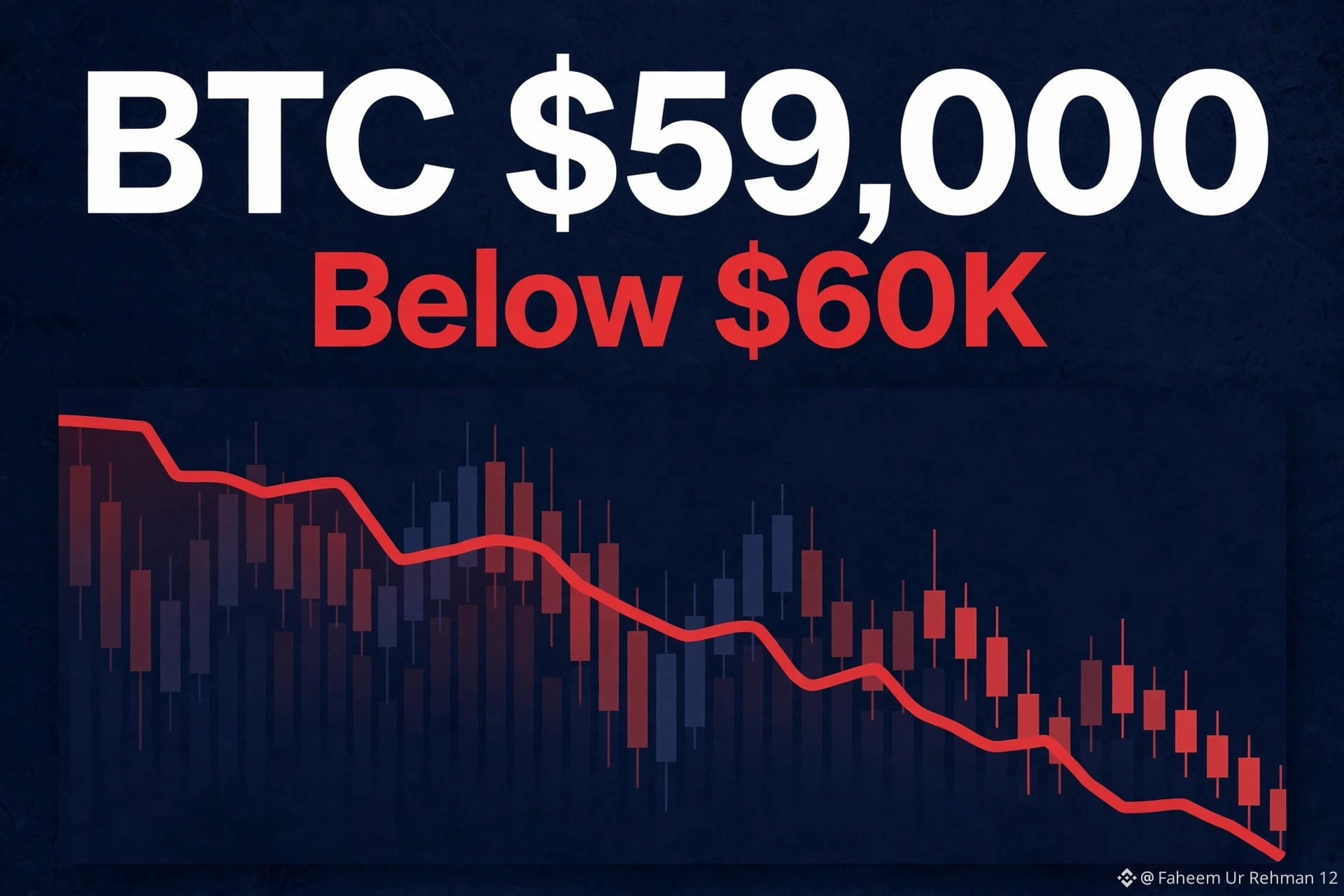
Bitcoin Broke $60,000 — First Time Since July. $1.91B Wiped Out in a Day. Yesterday it was $61,500. Today it is under $59,000 — and the selling is not slowing down. What actually happened: • BTC fell below $60,000 for the first time since early July, hitting a 24h low near $58,678. • $1.91B in liquidations in 24 hours — over 292,000 traders wiped out, mostly longs. • BlackRock's IBIT saw a record $541.1M outflow on 19 Nov. US spot Bitcoin ETFs lost $582.3M that day, about $3.47B so far in November. • ETH is near $1,640, down almost 8%. Fear & Greed: 12. Pure Extreme Fear. • Global stocks are on their longest losing streak since 2023 — risk is being sold everywhere, not just crypto. The next level everyone is watching: $57,717, the 1 July low. What do YOU think happens first: does $60K get taken back, or does BTC test $57,700 next? Drop your take below. 👇 $BTC $ETH #CanBTCReboundAfterFallingBelow60K? #Bitcoin #BinanceSquare
Bitcoin Broke $60,000 — First Time Since July. $1.91B Wiped Out in a Day.

Yesterday it was $61,500. Today it is under $59,000 — and the selling is not slowing down.

What actually happened:
• BTC fell below $60,000 for the first time since early July, hitting a 24h low near $58,678.
• $1.91B in liquidations in 24 hours — over 292,000 traders wiped out, mostly longs.
• BlackRock's IBIT saw a record $541.1M outflow on 19 Nov. US spot Bitcoin ETFs lost $582.3M that day, about $3.47B so far in November.
• ETH is near $1,640, down almost 8%. Fear & Greed: 12. Pure Extreme Fear.
• Global stocks are on their longest losing streak since 2023 — risk is being sold everywhere, not just crypto.

The next level everyone is watching: $57,717, the 1 July low.

What do YOU think happens first: does $60K get taken back, or does BTC test $57,700 next? Drop your take below. 👇

$BTC $ETH
#CanBTCReboundAfterFallingBelow60K?
#Bitcoin #BinanceSquare
BTC+3.33%
ETH+4.34%
IBITETF-1.19%
Article
South Korea Is About to Let 3,500 Companies Buy Bitcoin — After Nine Years of "No"South Korea Is About to Let 3,500 Companies Buy Bitcoin — After Nine Years of "No" For nine years, South Korean companies were locked out of crypto. Next week, that door finally starts to open. South Korea's Financial Services Commission (FSC) plans to publish guidelines that would let around 3,500 listed companies and registered professional-investor firms buy Bitcoin and other cryptocurrencies for investment, local news agency News1 reported on 18 November. The guidelines will arrive alongside the government's draft Digital Asset Basic Act, the country's planned rulebook for the crypto industry. This is not a rumour from a random blog. It is the second phase of a roadmap the regulator itself laid out in February 2025 — and it is arriving about 21 months late. What Exactly Is Changing Until now, South Korea's crypto market has been driven almost entirely by retail traders. Companies could not buy crypto for investment at all — a de facto ban in place since 2017. Under the plan, roughly 3,500 listed companies and firms registered as professional investors would become eligible to invest in Bitcoin and other crypto assets once the guidelines take effect. The FSC also plans to convene its Virtual Asset Committee to coincide with the release. The Digital Asset Basic Act is the legal backbone of the move. It would split crypto service providers into separate business types and set entry and conduct rules for OTC trading desks, brokers and other operators — the infrastructure needed so that large corporate orders do not distort prices on retail exchanges like Upbit. Why It Took So Long The FSC's February 2025 roadmap came in two stages. Phase 1 let nonprofits and exchanges sell off crypto holdings. Phase 2 — corporate buying — was scheduled for the second half of 2025. It never arrived. The delay was not about changing minds. It was about plumbing: real-name corporate bank accounts, custody, OTC execution and market safeguards all had to be built first. The guidelines landing next week would complete a process that started nearly two years ago. What It Does NOT Mean Yet Here is the part most headlines skip: publishing the guidelines does not open trading on its own. The FSC still has to say when listed companies can place their first orders. Firms will need real-name corporate bank accounts before they can trade, and no date for that has been announced. The FSC itself has not publicly confirmed a date for the guidelines either — the timeline comes from the News1 report. The draft law also has to pass. The government's draft is expected to reach the National Assembly next week, and the Political Affairs Committee aims to finish its review by January — timed with the implementation of the US GENIUS Act on stablecoins. Representative Min Byung-duk has said he intends to wrap the bill up by 9 January. The Fine Print An earlier draft reported in January 2026 would have capped a company's annual crypto investment at 5% of its equity capital and limited purchases to the top 20 coins by market value. The FSC responded the next day that key terms — including investment limits and eligible assets — had not been finalised. Treat the 5% figure as a draft proposal, not a final rule. Why It Matters South Korea is one of the world's most active crypto markets, but it has been a retail-only story until now. If even a fraction of 3,500 companies allocate to Bitcoin, it becomes one of Asia's most closely watched demand stories heading into 2027 — at a moment when Bitcoin is trading near $61,500, down roughly 50% from its October 2025 peak, and institutional flows elsewhere have been going the other way, with US spot Bitcoin ETFs posting hundreds of millions in outflows this week. The structure matters as much as the size. By routing large orders through regulated OTC desks instead of retail exchanges, Korea is trying to bring corporate money in without repeating the volatility its retail market is famous for. What to Watch Next 1. The guidelines themselves, expected next week — and what caps and coin lists they actually contain. 2. The first-trade date — the FSC still has to name it. 3. The National Assembly's January review of the Digital Asset Basic Act. Nine years of "no" is ending. The question now is how fast "yes" turns into real buying. Do you think Korean corporate demand can change Bitcoin's direction in 2027 — or will the rules stay too tight to matter? Share your view below. 👇 $BTC #southkoreaPlansToLet3500ListedFirmsBuyBitcoin #BinanceSquare #SouthKorea #bitcoin #BinanceSquare

South Korea Is About to Let 3,500 Companies Buy Bitcoin — After Nine Years of "No"

South Korea Is About to Let 3,500 Companies Buy Bitcoin — After Nine Years of "No"
For nine years, South Korean companies were locked out of crypto. Next week, that door finally starts to open.
South Korea's Financial Services Commission (FSC) plans to publish guidelines that would let around 3,500 listed companies and registered professional-investor firms buy Bitcoin and other cryptocurrencies for investment, local news agency News1 reported on 18 November. The guidelines will arrive alongside the government's draft Digital Asset Basic Act, the country's planned rulebook for the crypto industry.
This is not a rumour from a random blog. It is the second phase of a roadmap the regulator itself laid out in February 2025 — and it is arriving about 21 months late.
What Exactly Is Changing
Until now, South Korea's crypto market has been driven almost entirely by retail traders. Companies could not buy crypto for investment at all — a de facto ban in place since 2017.
Under the plan, roughly 3,500 listed companies and firms registered as professional investors would become eligible to invest in Bitcoin and other crypto assets once the guidelines take effect. The FSC also plans to convene its Virtual Asset Committee to coincide with the release.
The Digital Asset Basic Act is the legal backbone of the move. It would split crypto service providers into separate business types and set entry and conduct rules for OTC trading desks, brokers and other operators — the infrastructure needed so that large corporate orders do not distort prices on retail exchanges like Upbit.
Why It Took So Long
The FSC's February 2025 roadmap came in two stages. Phase 1 let nonprofits and exchanges sell off crypto holdings. Phase 2 — corporate buying — was scheduled for the second half of 2025. It never arrived.
The delay was not about changing minds. It was about plumbing: real-name corporate bank accounts, custody, OTC execution and market safeguards all had to be built first. The guidelines landing next week would complete a process that started nearly two years ago.
What It Does NOT Mean Yet
Here is the part most headlines skip: publishing the guidelines does not open trading on its own.
The FSC still has to say when listed companies can place their first orders. Firms will need real-name corporate bank accounts before they can trade, and no date for that has been announced. The FSC itself has not publicly confirmed a date for the guidelines either — the timeline comes from the News1 report.
The draft law also has to pass. The government's draft is expected to reach the National Assembly next week, and the Political Affairs Committee aims to finish its review by January — timed with the implementation of the US GENIUS Act on stablecoins. Representative Min Byung-duk has said he intends to wrap the bill up by 9 January.
The Fine Print
An earlier draft reported in January 2026 would have capped a company's annual crypto investment at 5% of its equity capital and limited purchases to the top 20 coins by market value. The FSC responded the next day that key terms — including investment limits and eligible assets — had not been finalised. Treat the 5% figure as a draft proposal, not a final rule.
Why It Matters
South Korea is one of the world's most active crypto markets, but it has been a retail-only story until now. If even a fraction of 3,500 companies allocate to Bitcoin, it becomes one of Asia's most closely watched demand stories heading into 2027 — at a moment when Bitcoin is trading near $61,500, down roughly 50% from its October 2025 peak, and institutional flows elsewhere have been going the other way, with US spot Bitcoin ETFs posting hundreds of millions in outflows this week.
The structure matters as much as the size. By routing large orders through regulated OTC desks instead of retail exchanges, Korea is trying to bring corporate money in without repeating the volatility its retail market is famous for.
What to Watch Next
1. The guidelines themselves, expected next week — and what caps and coin lists they actually contain.
2. The first-trade date — the FSC still has to name it.
3. The National Assembly's January review of the Digital Asset Basic Act.
Nine years of "no" is ending. The question now is how fast "yes" turns into real buying.
Do you think Korean corporate demand can change Bitcoin's direction in 2027 — or will the rules stay too tight to matter? Share your view below. 👇
$BTC
#southkoreaPlansToLet3500ListedFirmsBuyBitcoin #BinanceSquare #SouthKorea #bitcoin #BinanceSquare
Anthropic's IPO Popped 34% — Then Binance Had to Refund Everyone The biggest IPO in history just lived up to the hype — and then embarrassed crypto's tokenized-stock dream in the same week. What happened: • Anthropic (the company behind Claude) priced its Nasdaq debut at $83 a share — a record $81B raise, $107B with the private placement, valuing the company at $1.5 trillion. • On Thursday 19 Nov, ticker ANT opened at $111.50 — up 34% — hit $115.10, then closed at $97.17, still 17% above the IPO price. • On Friday it gave back another 7%+ in early trading. • The crypto twist: Binance Wallet's xStocks campaign for tokenized ANT shares hit its $500M USDC cap almost instantly on 18 Nov — but Binance could only secure 2,957 tokenized shares. All USDC was refunded in full, the 2,957 tokens are being airdropped free pro-rata, plus $1M in bStocks ANTB tokens as compensation. • Same story as the SpaceX IPO in June — demand was ~7x the shares on offer, supply was the bottleneck. AI's biggest listing ever, and even Binance couldn't get enough shares for everyone who wanted in. Did you try to get ANT through Binance Wallet? What happened with your subscription — refund, airdrop, or still waiting? Tell us below. 👇 $ANTB #IsAnthropic's$1.5TMarketCapJustified? #BinanceSquare #IsAnthropic15TMarketCapJustified
Anthropic's IPO Popped 34% — Then Binance Had to Refund Everyone

The biggest IPO in history just lived up to the hype — and then embarrassed crypto's tokenized-stock dream in the same week.

What happened:
• Anthropic (the company behind Claude) priced its Nasdaq debut at $83 a share — a record $81B raise, $107B with the private placement, valuing the company at $1.5 trillion.
• On Thursday 19 Nov, ticker ANT opened at $111.50 — up 34% — hit $115.10, then closed at $97.17, still 17% above the IPO price.
• On Friday it gave back another 7%+ in early trading.
• The crypto twist: Binance Wallet's xStocks campaign for tokenized ANT shares hit its $500M USDC cap almost instantly on 18 Nov — but Binance could only secure 2,957 tokenized shares. All USDC was refunded in full, the 2,957 tokens are being airdropped free pro-rata, plus $1M in bStocks ANTB tokens as compensation.
• Same story as the SpaceX IPO in June — demand was ~7x the shares on offer, supply was the bottleneck.

AI's biggest listing ever, and even Binance couldn't get enough shares for everyone who wanted in.

Did you try to get ANT through Binance Wallet? What happened with your subscription — refund, airdrop, or still waiting? Tell us below. 👇

$ANTB

#IsAnthropic's$1.5TMarketCapJustified? #BinanceSquare #IsAnthropic15TMarketCapJustified
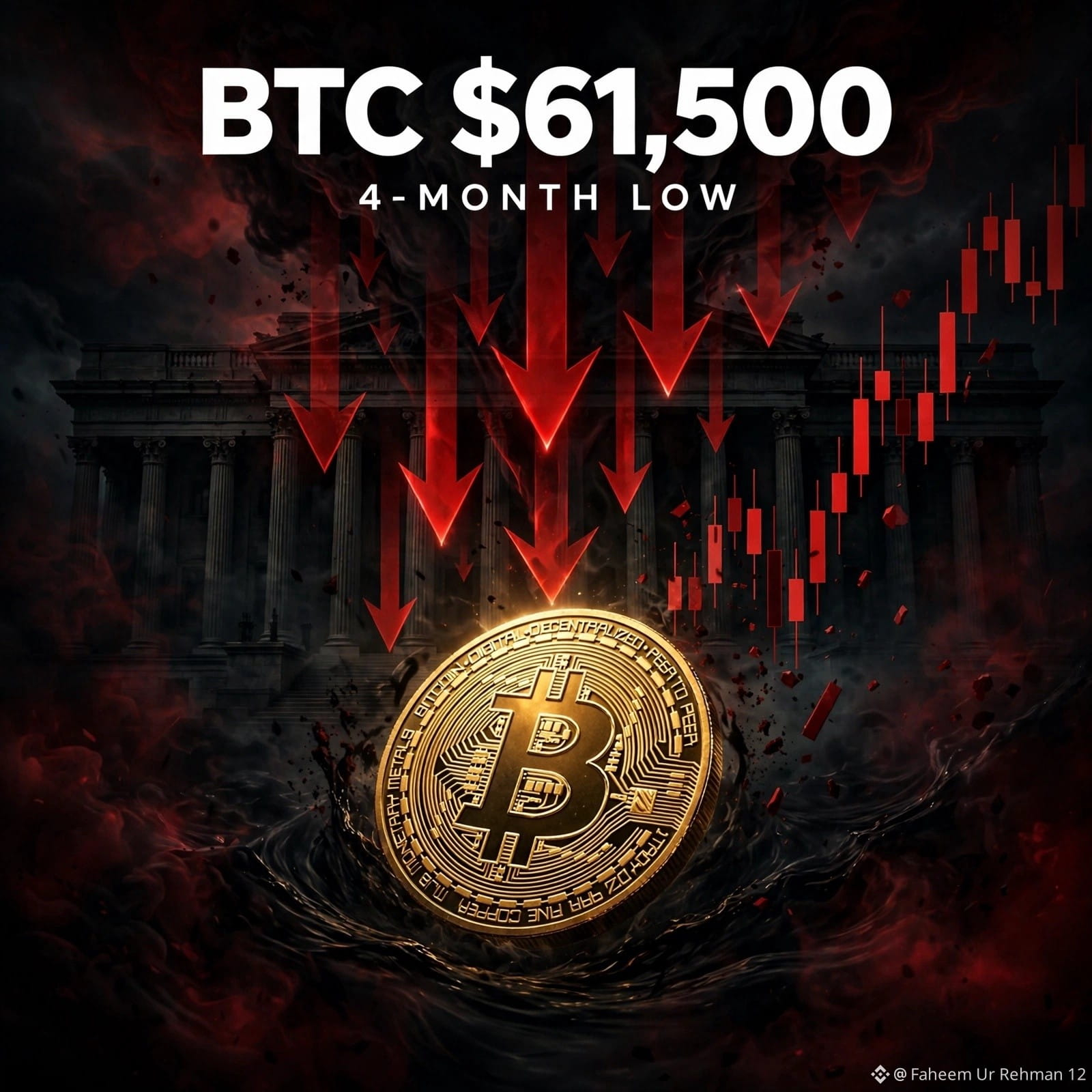
Bitcoin at $61,500 — Lowest Since July. The Fed Minutes Started This Slide. Three days of red. $61,500. Roughly half of the October 2025 peak gone. Here is what actually happened: • The Fed's October meeting minutes (out 18 Nov) said almost all officials expect MORE rate hikes — and two even raised the idea of a hike bigger than 25bp in December. • A December hike is now ~90% priced in. The decision lands 8–9 Dec. • US spot Bitcoin ETFs bled $306M on 18 Nov — day two of outflows. • ETH is near $1,750. Fear & Greed: 10–12. Pure Extreme Fear. Everyone is asking the same question — and nobody has the answer yet. What do YOU think happens first: does $60K hold, or does the Fed keep pushing it down? Drop your take in the comments. 👇 $BTC $ETH #BTCRemainsUnderPressureAfterHawkishFOMCMinutes #BinanceSquare #CanBTCReboundAfterFallingBelow60K?
Bitcoin at $61,500 — Lowest Since July. The Fed Minutes Started This Slide.

Three days of red. $61,500. Roughly half of the October 2025 peak gone.

Here is what actually happened:
• The Fed's October meeting minutes (out 18 Nov) said almost all officials expect MORE rate hikes — and two even raised the idea of a hike bigger than 25bp in December.
• A December hike is now ~90% priced in. The decision lands 8–9 Dec.
• US spot Bitcoin ETFs bled $306M on 18 Nov — day two of outflows.
• ETH is near $1,750. Fear & Greed: 10–12. Pure Extreme Fear.

Everyone is asking the same question — and nobody has the answer yet.

What do YOU think happens first: does $60K hold, or does the Fed keep pushing it down? Drop your take in the comments. 👇

$BTC $ETH

#BTCRemainsUnderPressureAfterHawkishFOMCMinutes #BinanceSquare #CanBTCReboundAfterFallingBelow60K?
#BTC Under Pressure After Hawkish FOMC Minutes Bitcoin is trading near $61,500 today — its lowest level since July, down for a third straight day and roughly 50% below its October 2025 all-time high of $126,080. What moved it: • The Fed's October meeting minutes, released 18 Nov, showed almost all officials see further rate hikes as appropriate — and two said a hike of more than 25bp could be on the table in December if inflation stays hot. • Traders now price a December hike at ~90% (25bp), with a ~10% chance of 50bp. • US spot Bitcoin ETFs saw $306M in outflows on 18 Nov — a second straight day of outflows. • ETH is near $1,750, and the Fear & Greed Index sits at 10–12: Extreme Fear. The December FOMC decision is on 8–9 Dec. Until then, the market is trading the hike, not the hope. $BTC C $ETH #CanBTCReboundAfterFallingBelow60K? BTCRemainsUnderPressureAfterHawkishFOMCMinutes #BinanceSquare
#BTC Under Pressure After Hawkish FOMC Minutes

Bitcoin is trading near $61,500 today — its lowest level since July, down for a third straight day and roughly 50% below its October 2025 all-time high of $126,080.

What moved it:
• The Fed's October meeting minutes, released 18 Nov, showed almost all officials see further rate hikes as appropriate — and two said a hike of more than 25bp could be on the table in December if inflation stays hot.
• Traders now price a December hike at ~90% (25bp), with a ~10% chance of 50bp.
• US spot Bitcoin ETFs saw $306M in outflows on 18 Nov — a second straight day of outflows.
• ETH is near $1,750, and the Fear & Greed Index sits at 10–12: Extreme Fear.

The December FOMC decision is on 8–9 Dec. Until then, the market is trading the hike, not the hope.

$BTC C $ETH

#CanBTCReboundAfterFallingBelow60K? BTCRemainsUnderPressureAfterHawkishFOMCMinutes #BinanceSquare
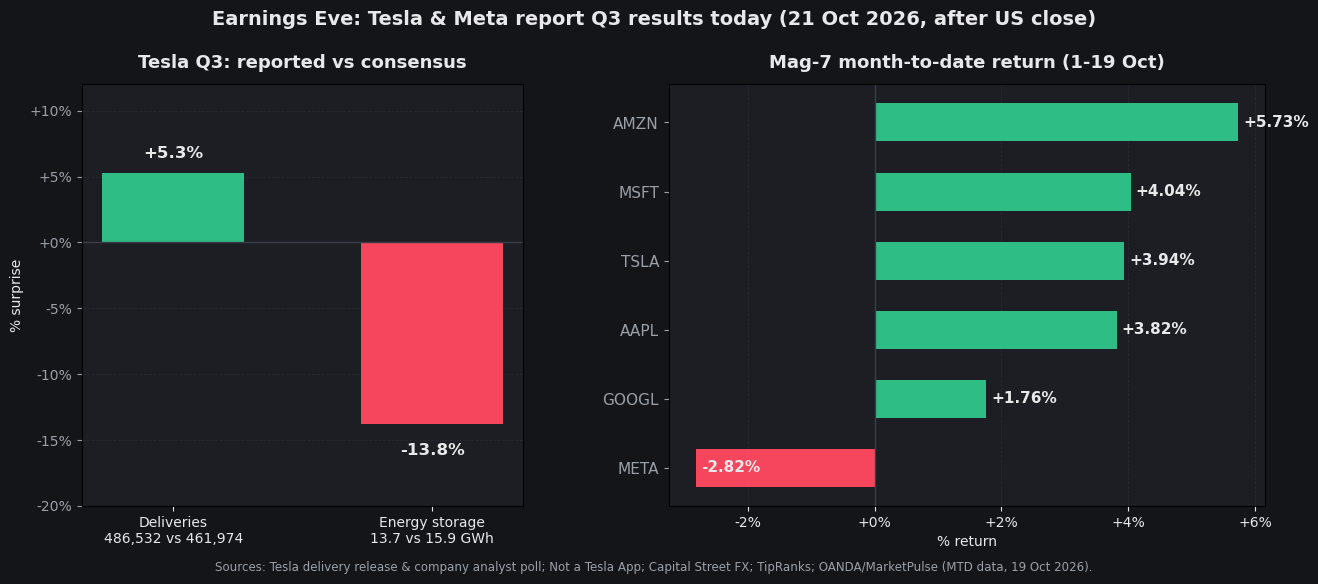
#EarningsSeason Earnings Eve: Tesla & Meta Report Today — What Actually Matters Two Magnificent 7 names report Q3 after today's US close. Here's the setup, not the hype. Tesla: • Deliveries beat: 486,532 vehicles (+5.3% vs 461,974 consensus), though down 2.1% YoY. Model 3/Y: 457,387 produced, 478,237 delivered. • Energy storage missed: 13.7 GWh vs 15.9 expected (-13.8%) — the growth story's soft spot. • Consensus: EPS $0.45 (-10% YoY), revenue $27.78B (-1.1% YoY). Call at 21:30 UTC. Meta: • Revenue consensus ~$63.34B (+20%+ YoY); EPS ~$6.6 — but BofA models just $3.79 on a $10B legal charge. Bernstein sees revenue $64.06B. • Watch the 2026 capex guide ($140–145B): AI spend is the whole debate. • Options imply a ~12% move — the market expects fireworks. Call at 4:30 PM ET. The divergence (chart): MTD through Oct 19, META is the only Mag-7 loser (-2.82%) while AMZN leads (+5.73%). One good print flips the whole board. Not financial advice — earnings nights reward preparation, not predictions. #EarningsSeason #BinanceSquare $TSLA $META
#EarningsSeason Earnings Eve: Tesla & Meta Report Today — What Actually Matters
Two Magnificent 7 names report Q3 after today's US close. Here's the setup, not the hype.
Tesla:
• Deliveries beat: 486,532 vehicles (+5.3% vs 461,974 consensus), though down 2.1% YoY. Model 3/Y: 457,387 produced, 478,237 delivered.
• Energy storage missed: 13.7 GWh vs 15.9 expected (-13.8%) — the growth story's soft spot.
• Consensus: EPS $0.45 (-10% YoY), revenue $27.78B (-1.1% YoY). Call at 21:30 UTC.
Meta:
• Revenue consensus ~$63.34B (+20%+ YoY); EPS ~$6.6 — but BofA models just $3.79 on a $10B legal charge. Bernstein sees revenue $64.06B.
• Watch the 2026 capex guide ($140–145B): AI spend is the whole debate.
• Options imply a ~12% move — the market expects fireworks. Call at 4:30 PM ET.
The divergence (chart): MTD through Oct 19, META is the only Mag-7 loser (-2.82%) while AMZN leads (+5.73%). One good print flips the whole board.

Not financial advice — earnings nights reward preparation, not predictions.

#EarningsSeason #BinanceSquare $TSLA $META
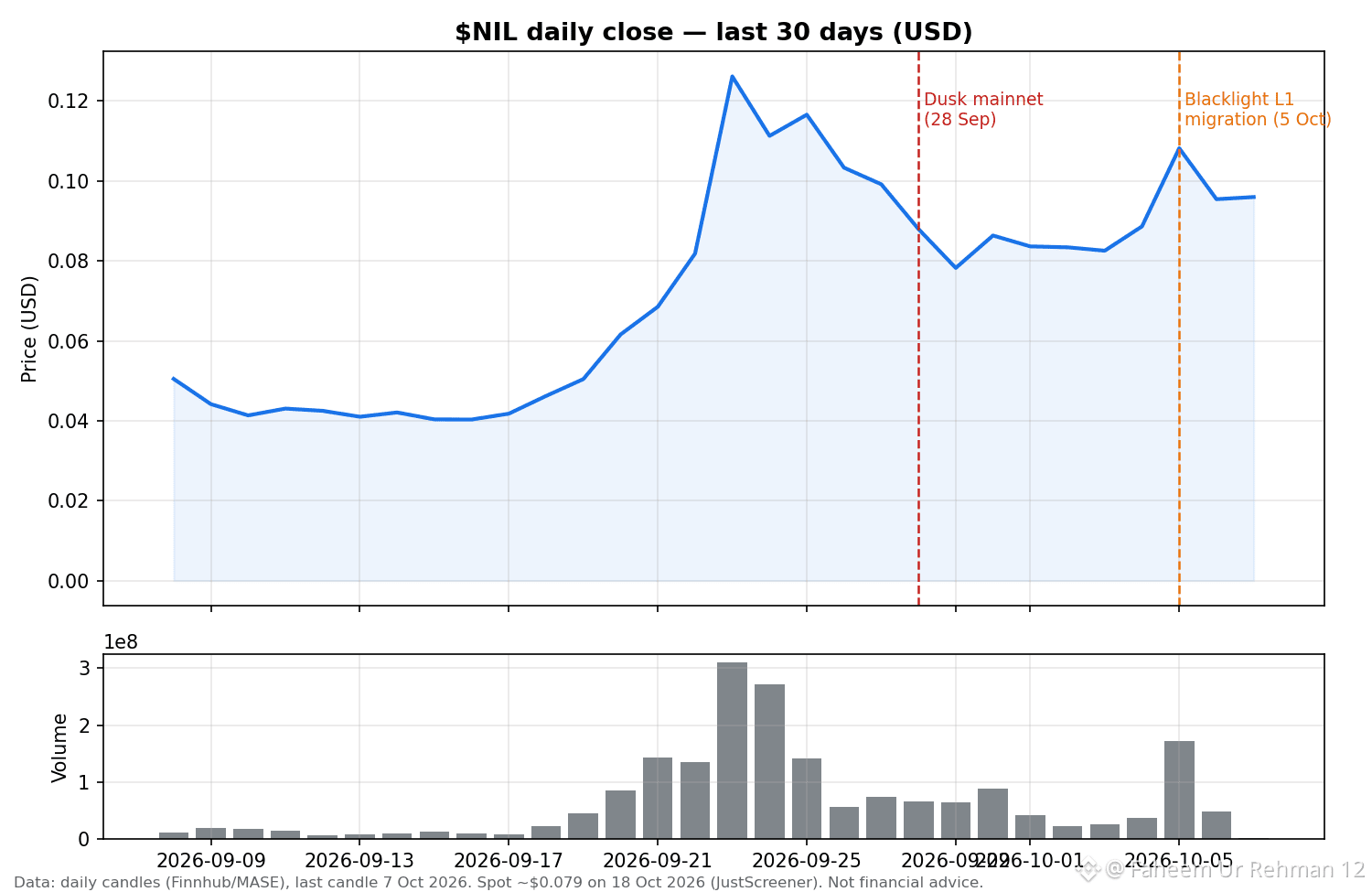
Nillion's Covenants: Programmable Money Just Shipped on Mainnet Nillion is running a creator campaign on Binance Square (16–26 Oct), and the topic worth covering is real: Covenants went live on the Dusk mainnet, and there's a 7-phase roadmap stretching to early 2028. What's actually shipped: • Covenants are programmable rules attached to tokens — spend conditions, time locks, and multi-party logic enforced on-chain. Nillion's first live experiment is TriggerMarket: 8 Covenants, 3 authors, 512 NIL in fees. • The network is evolving in phases: Dusk launched on Ethereum on 28 Sep, and the Blacklight L1 migration followed on 5 Oct — the foundation for Nillion's own chain. The numbers (as of 18 Oct): • $NIL trades at ~$0.0788 with a ~$40M market cap and $35.15M in 24h volume (JustScreener). Circulating supply: ~508M NIL. • 30-day high was $0.1487 on 24 Sep — so price is down ~47% from the local peak while the protocol shipped its biggest releases. Validators stake a minimum 70,000 NIL; inflation is 0.5%. The honest read: mainnet launches during a price drawdown are the real stress test. If Covenants see actual developer usage over the coming phases, the infrastructure story gets stronger; if not, it's another launch candle. Watch on-chain covenant activity, not just the chart. Not financial advice. $NIL @nillionnetwork #nillion $NIL {spot}(NILUSDT)
Nillion's Covenants: Programmable Money Just Shipped on Mainnet
Nillion is running a creator campaign on Binance Square (16–26 Oct), and the topic worth covering is real: Covenants went live on the Dusk mainnet, and there's a 7-phase roadmap stretching to early 2028.
What's actually shipped:
• Covenants are programmable rules attached to tokens — spend conditions, time locks, and multi-party logic enforced on-chain. Nillion's first live experiment is TriggerMarket: 8 Covenants, 3 authors, 512 NIL in fees.
• The network is evolving in phases: Dusk launched on Ethereum on 28 Sep, and the Blacklight L1 migration followed on 5 Oct — the foundation for Nillion's own chain.
The numbers (as of 18 Oct):
• $NIL trades at ~$0.0788 with a ~$40M market cap and $35.15M in 24h volume (JustScreener). Circulating supply: ~508M NIL.
• 30-day high was $0.1487 on 24 Sep — so price is down ~47% from the local peak while the protocol shipped its biggest releases. Validators stake a minimum 70,000 NIL; inflation is 0.5%.
The honest read: mainnet launches during a price drawdown are the real stress test. If Covenants see actual developer usage over the coming phases, the infrastructure story gets stronger; if not, it's another launch candle. Watch on-chain covenant activity, not just the chart.

Not financial advice.

$NIL @Nillion #nillion $NIL
The Agent Economy Needs an Identity Layer — Kite Is Building One Everyone talks about AI agents trading on-chain. Fewer people talk about the hard part: how do you give an agent a verifiable identity, spending limits, and a way to settle payments — without handing it your private keys? That's the problem Kite is built for. Here's the core design (diagram below): Identity first. The Kite Passport gives every agent a three-layer identity: the user as root wallet owner, a delegated agent carrying identity + reputation, and session keys with hard constraints — spending limits, allowed recipients, time windows. Delegated authority, but the user keeps root control. Settlement in stablecoins. Fees run in USDC, PYUSD or USDT, so agent costs are predictable. Payment channels handle micropayments, escrow, streaming and refunds — the plumbing commerce actually needs. A chain built for it. Kite is an EVM-compatible PoS L1 on Avalanche (chain ID 2366) with sub-second finality, backed by $33M in funding (Oct 2026). Why this matters: agentic commerce only scales if trust is programmable, not assumed. Kite's bet is that identity + stablecoin settlement is the missing rail between "cool demo" and real machine-to-machine economies. My honest read: the design is genuinely differentiated — most agent chains focus on execution speed, Kite focuses on identity and settlement. The open question is developer adoption: will builders pick Kite's rails, or fork the pattern elsewhere? Not financial advice. #KiteBBW $KITE @GoKiteAI $KITE {spot}(KITEUSDT)
The Agent Economy Needs an Identity Layer — Kite Is Building One

Everyone talks about AI agents trading on-chain. Fewer people talk about the hard part: how do you give an agent a verifiable identity, spending limits, and a way to settle payments — without handing it your private keys? That's the problem Kite is built for.

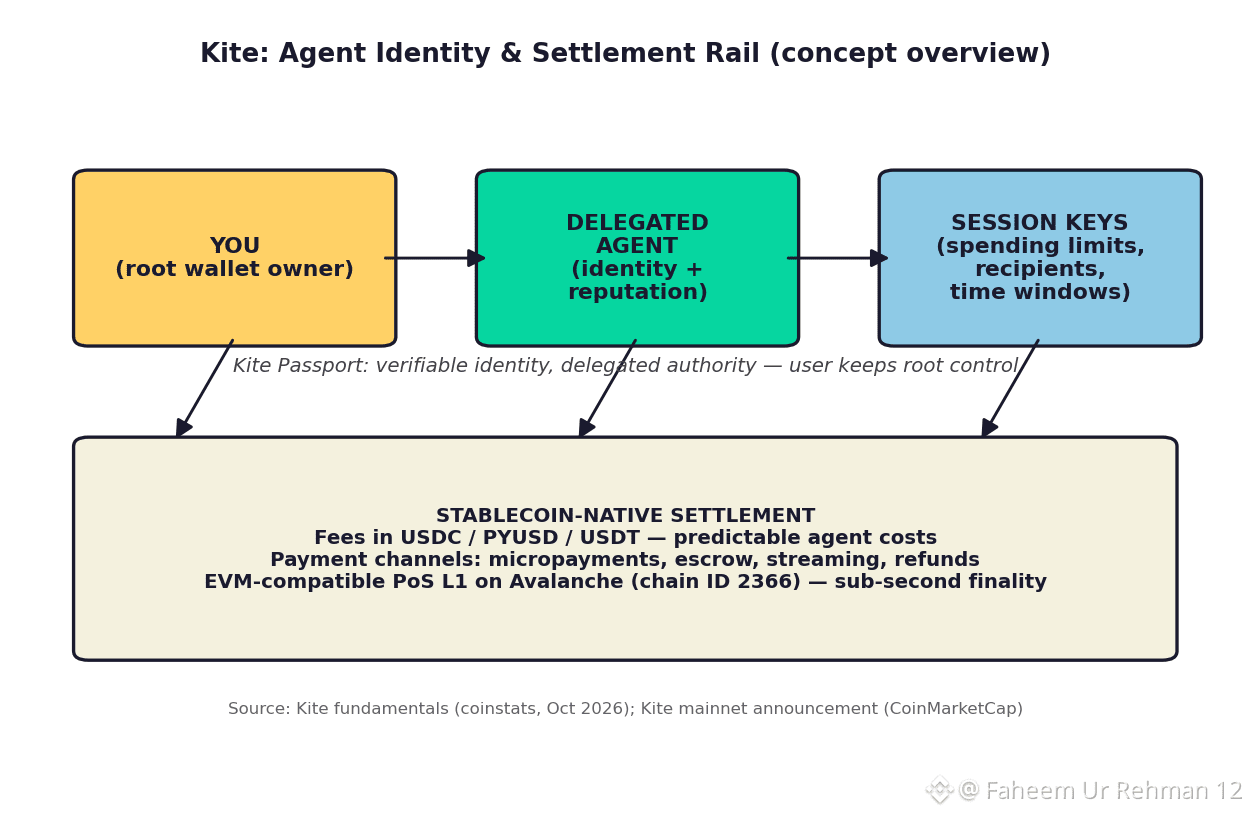
Here's the core design (diagram below):

Identity first. The Kite Passport gives every agent a three-layer identity: the user as root wallet owner, a delegated agent carrying identity + reputation, and session keys with hard constraints — spending limits, allowed recipients, time windows. Delegated authority, but the user keeps root control.

Settlement in stablecoins. Fees run in USDC, PYUSD or USDT, so agent costs are predictable. Payment channels handle micropayments, escrow, streaming and refunds — the plumbing commerce actually needs.

A chain built for it. Kite is an EVM-compatible PoS L1 on Avalanche (chain ID 2366) with sub-second finality, backed by $33M in funding (Oct 2026).

Why this matters: agentic commerce only scales if trust is programmable, not assumed. Kite's bet is that identity + stablecoin settlement is the missing rail between "cool demo" and real machine-to-machine economies.

My honest read: the design is genuinely differentiated — most agent chains focus on execution speed, Kite focuses on identity and settlement. The open question is developer adoption: will builders pick Kite's rails, or fork the pattern elsewhere?

Not financial advice.

#KiteBBW $KITE @KITE AI 中文 $KITE
$50K bStocks Trading Competition Is Live — Here's How It Works Binance Wallet is running a bStocks Tokenized Securities Trading Competition with a 50,000 USDC prize pool. Campaign runs Oct 13, 10:00 UTC – Oct 20, 10:00 UTC.$ The rules: • Trade designated bStocks (tokenized US stocks like $BBB, $MDBB, $PENGB, $UVXYB) via Binance Wallet (Keyless) on BNB Smart Chain • Only BUY volume counts — minimum $5,000 cumulative to qualify • Early Bird Multiplier: Day 1 trades got 3.0x, earlier is better • You must click [Join] on the promotion page FIRST — only trades after registration count • Binance Alpha and third-party DApps are excluded Honest take: this is a volume game, not a lottery. $5K+ in buys just to qualify means it's built for active traders, not casual entries. And remember — bStocks are tokenized equities, so the underlying stocks' earnings and market hours drive the price, not crypto sentiment. Not financial advice. Are you joining, or sitting this one out? #BinanceSquareTalks #bStocks #TokenizedStocks
$50K bStocks Trading Competition Is Live — Here's How It Works
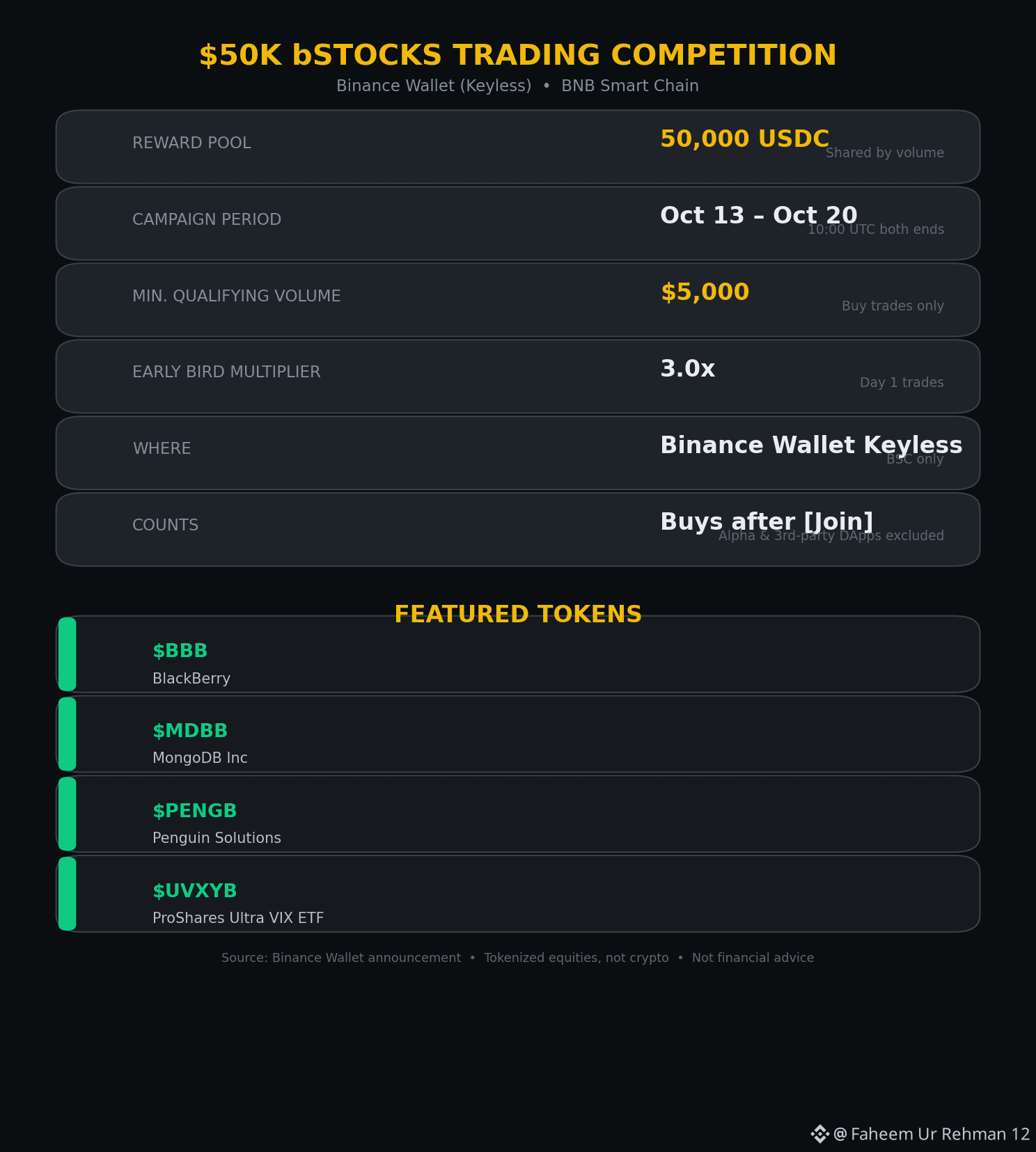
Binance Wallet is running a bStocks Tokenized Securities Trading Competition with a 50,000 USDC prize pool. Campaign runs Oct 13, 10:00 UTC – Oct 20, 10:00 UTC.$
The rules:
• Trade designated bStocks (tokenized US stocks like $BBB, $MDBB, $PENGB, $UVXYB) via Binance Wallet (Keyless) on BNB Smart Chain
• Only BUY volume counts — minimum $5,000 cumulative to qualify
• Early Bird Multiplier: Day 1 trades got 3.0x, earlier is better
• You must click [Join] on the promotion page FIRST — only trades after registration count
• Binance Alpha and third-party DApps are excluded
Honest take: this is a volume game, not a lottery. $5K+ in buys just to qualify means it's built for active traders, not casual entries. And remember — bStocks are tokenized equities, so the underlying stocks' earnings and market hours drive the price, not crypto sentiment.

Not financial advice. Are you joining, or sitting this one out?

#BinanceSquareTalks #bStocks #TokenizedStocks
LoL: MVK Esports vs Karmine Corp (BO5) - Worlds Play-In

LoL: MVK Esports vs Karmine Corp (BO5) - Worlds Play-In

Game Handicap: KC ...99%Game Handicap: KC ...99%Total Kills Over/U...99%
Volume $1,425,284.51
$NVDAB $NVDAB #AIAndSemiconductorStocksLoseOver$1TThisWeek $1 Trillion Gone: The AI Chip Selloff Nobody Saw Coming The Philadelphia Semiconductor Index just lost 12% in six sessions — erasing roughly $1 trillion in market value, the sharpest AI-led selloff of 2026. Here's what happened and why it matters for crypto. The damage: • Nvidia -1.8%, AMD -3.5%, Micron -4.4% on Thursday alone — AMD's -5.7% Wednesday was its worst day since August • Asia got hit harder: SK Hynix -10%, Samsung -8.7%, Advantest -14%, SoftBank -7.9% • The iShares Semiconductor ETF is heading for 8 straight daily losses — its longest streak in ~11 years Why it's happening: • The AI spending math is breaking: US tech giants are expected to spend $700B+ on AI infra this year, Gartner now warns ~$3.5 trillion of planned AI spending could face impairment, and Broadcom + Intel CEOs flagged financing as a major headwind • 10-year Treasury yields above 5% make borrowing for data centers brutally expensive • A Chinese memory maker claimed a technical breakthrough, adding competition fears The twist nobody talks about: while chips bled, ETF investors poured in RECORD money — $430M into the $72B VanEck Semiconductor ETF and $3.8B into the triple-leveraged SOXL, its best week EVER, even as it fell 21%. Retail is buying this dip with leverage. For crypto: $BTC and $ETH track Nasdaq risk appetite closely — when chips sneeze, crypto catches the flu. But notice: the AI crypto sector actually gained 3.63% this week. Decentralized AI tokens are decoupling from Big Tech AI. My take: the selloff is about financing costs, not AI demand. If yields roll over, chips snap back hardest. If not, the dip-buyers learn what leverage really costs. Not financial advice — what's your call: dead-cat bounce or the start of the AI unwind? #AIAndSemiconductorStocksLoseOver $1TThisWeek
$NVDAB $NVDAB #AIAndSemiconductorStocksLoseOver$1TThisWeek

$1 Trillion Gone: The AI Chip Selloff Nobody Saw Coming
The Philadelphia Semiconductor Index just lost 12% in six sessions — erasing roughly $1 trillion in market value, the sharpest AI-led selloff of 2026. Here's what happened and why it matters for crypto.
The damage:
• Nvidia -1.8%, AMD -3.5%, Micron -4.4% on Thursday alone — AMD's -5.7% Wednesday was its worst day since August
• Asia got hit harder: SK Hynix -10%, Samsung -8.7%, Advantest -14%, SoftBank -7.9%
• The iShares Semiconductor ETF is heading for 8 straight daily losses — its longest streak in ~11 years
Why it's happening:
• The AI spending math is breaking: US tech giants are expected to spend $700B+ on AI infra this year, Gartner now warns ~$3.5 trillion of planned AI spending could face impairment, and Broadcom + Intel CEOs flagged financing as a major headwind
• 10-year Treasury yields above 5% make borrowing for data centers brutally expensive
• A Chinese memory maker claimed a technical breakthrough, adding competition fears
The twist nobody talks about: while chips bled, ETF investors poured in RECORD money — $430M into the $72B VanEck Semiconductor ETF and $3.8B into the triple-leveraged SOXL, its best week EVER, even as it fell 21%. Retail is buying this dip with leverage.
For crypto: $BTC and $ETH track Nasdaq risk appetite closely — when chips sneeze, crypto catches the flu. But notice: the AI crypto sector actually gained 3.63% this week. Decentralized AI tokens are decoupling from Big Tech AI.
My take: the selloff is about financing costs, not AI demand. If yields roll over, chips snap back hardest. If not, the dip-buyers learn what leverage really costs.

Not financial advice — what's your call: dead-cat bounce or the start of the AI unwind?

#AIAndSemiconductorStocksLoseOver $1TThisWeek
Log in to explore more content
Join global crypto users on Binance Square
⚡️ Get latest and useful information about crypto.
💬 Trusted by the world’s largest crypto exchange.
👍 Discover real insights from verified creators.
Email / Phone number
Sitemap
Cookie Preferences
Platform T&Cs