
问剑白玉京
131 Posts

问剑白玉京
Report
Block User
波浪理论交易员,不定时参与撸毛,不定时发布交易策略,可以关注看看实力

MUB Holder
Frequent Trader
2 Years
14 Following
649 Followers
180 Liked
Posts
All
Quotes
Live
·
--
Bearish
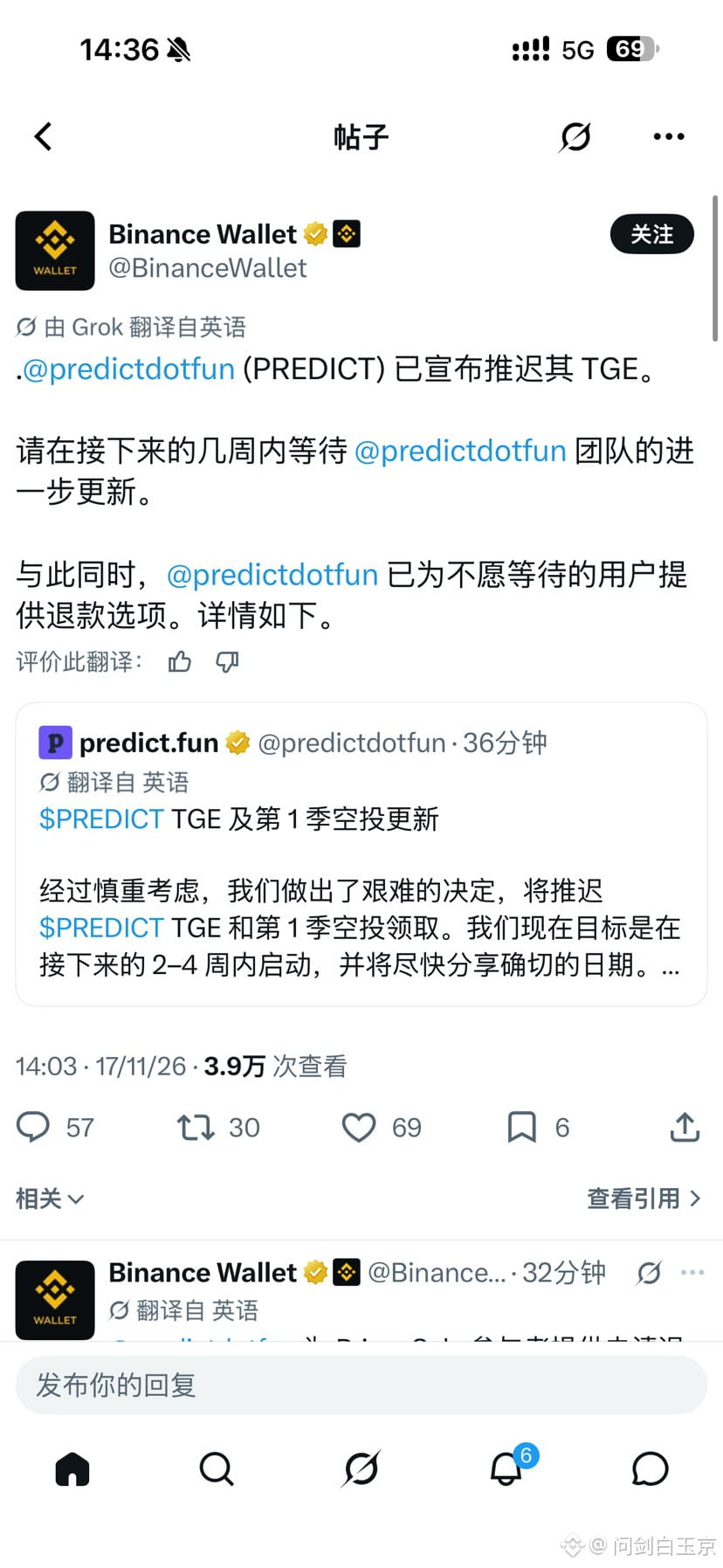
Strike while the iron is hot: the first attempt inspires, the second falters, and the third is exhausted. With TGE postponed time and time again, how can users still have any confidence? The market conditions are poor right now, but that is no excuse for postponing the TGE yet again. At its root, the project team simply has no funds to make the TGE happen. They even had an insider-trading scandal involving a prediction market leak. This project is an absolute disaster. It really is a complete mess. What is the point of offering refunds now to people who bought BNB to participate in the token launch back then? The price is no longer what it was, not to mention the losses from participating in the launch.$PREDICT
Strike while the iron is hot: the first attempt inspires, the second falters, and the third is exhausted. With TGE postponed time and time again, how can users still have any confidence? The market conditions are poor right now, but that is no excuse for postponing the TGE yet again. At its root, the project team simply has no funds to make the TGE happen. They even had an insider-trading scandal involving a prediction market leak. This project is an absolute disaster. It really is a complete mess. What is the point of offering refunds now to people who bought BNB to participate in the token launch back then? The price is no longer what it was, not to mention the losses from participating in the launch.$PREDICT
14
17
11.8k
·
--
Verified
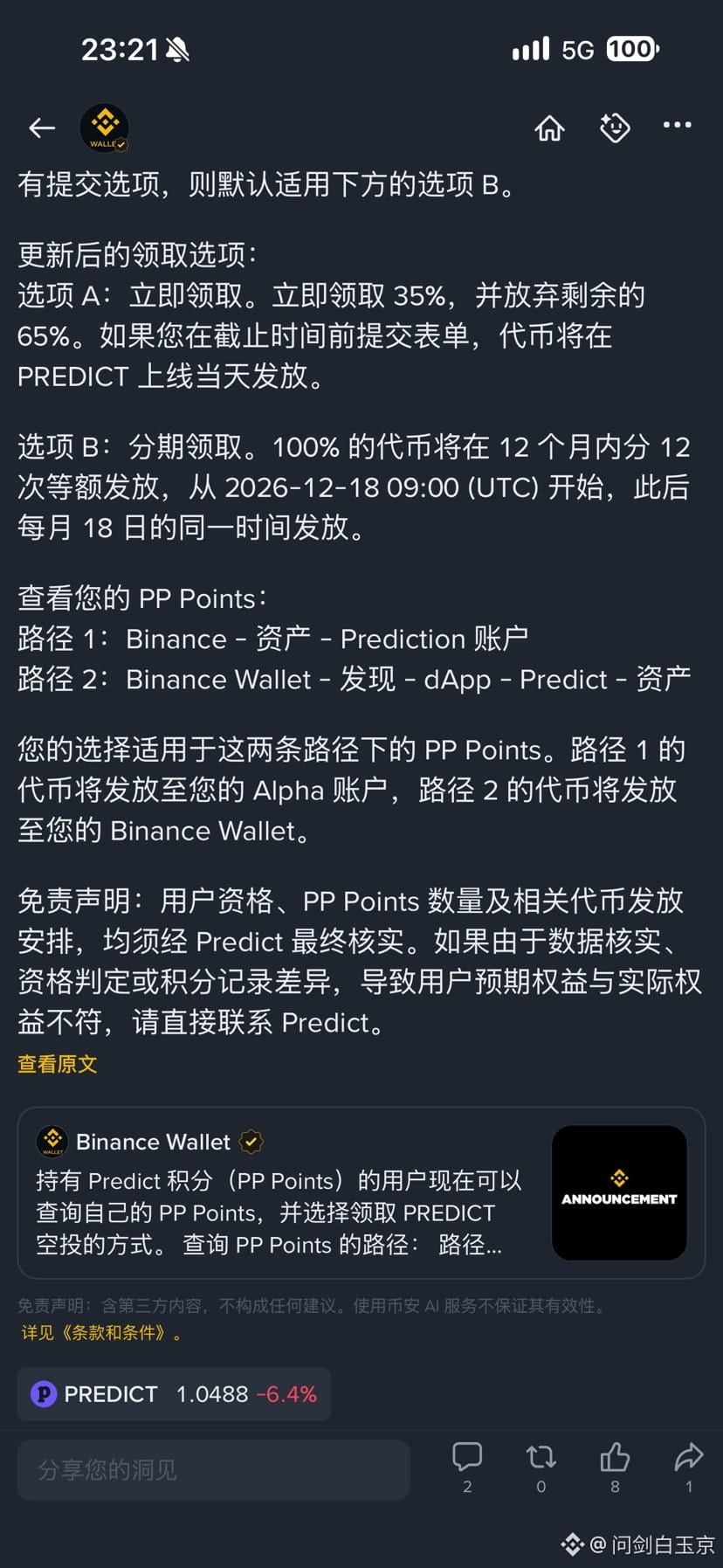
Predict is still slowly declining. If anyone’s to blame, blame the hackers—they stole all of Binance’s money, so Binance has no money to pump the price and can only delay things and let it slowly bleed. You could tell from the project temporarily changing the claiming rules: previously, option B meant locking it up for a full year; now it unlocks once a month over the course of a year. They’re hoping everyone will choose option B because they’re afraid too many people will dump and they won’t be able to handle it. But everyone’s confidence was already worn away long ago. Have you all hedged, guys? $PREDICT
Predict is still slowly declining. If anyone’s to blame, blame the hackers—they stole all of Binance’s money, so Binance has no money to pump the price and can only delay things and let it slowly bleed. You could tell from the project temporarily changing the claiming rules: previously, option B meant locking it up for a full year; now it unlocks once a month over the course of a year. They’re hoping everyone will choose option B because they’re afraid too many people will dump and they won’t be able to handle it. But everyone’s confidence was already worn away long ago. Have you all hedged, guys? $PREDICT
6
2
1.5k
·
--
Partly True
Predict officially announced that it will launch on the 18th. At the same time, the points-claiming Plan B has changed to linear unlocking over 12 months. Is this meant to encourage users to choose Plan B and reduce selling pressure at launch? But the futures contract has been falling all along, and it seems no one is confident about a bullish outlook. I really feel for those who participated in the token sale without hedging.
Predict officially announced that it will launch on the 18th. At the same time, the points-claiming Plan B has changed to linear unlocking over 12 months. Is this meant to encourage users to choose Plan B and reduce selling pressure at launch? But the futures contract has been falling all along, and it seems no one is confident about a bullish outlook. I really feel for those who participated in the token sale without hedging.
860
·
--
Bullish
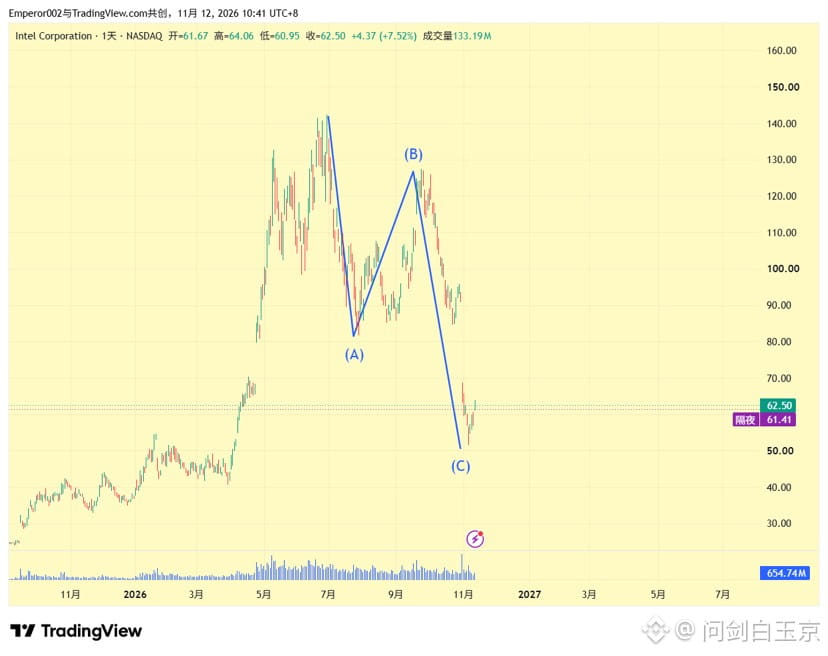
Intel's correction is now over, and a rebound of comparable magnitude is coming next.
Intel's correction is now over, and a rebound of comparable magnitude is coming next.

大吉大利!
From 问剑白玉京
1
1
148
·
--
Alpha airdrops should resume this afternoon. There should be a 30U airdrop for an old coin—stay tuned.
Alpha airdrops should resume this afternoon. There should be a 30U airdrop for an old coin—stay tuned.

4
42
·
--
The Alpha trading feature is in its final round of testing and will most likely be ready tonight. Airdrops may also resume this week if the system remains stable.
The Alpha trading feature is in its final round of testing and will most likely be ready tonight. Airdrops may also resume this week if the system remains stable.
90
·
--
A huge 30U bonus, as shown. Plenty of spots still available.
A huge 30U bonus, as shown. Plenty of spots still available.

大吉大利!
From 问剑白玉京
13
·
--
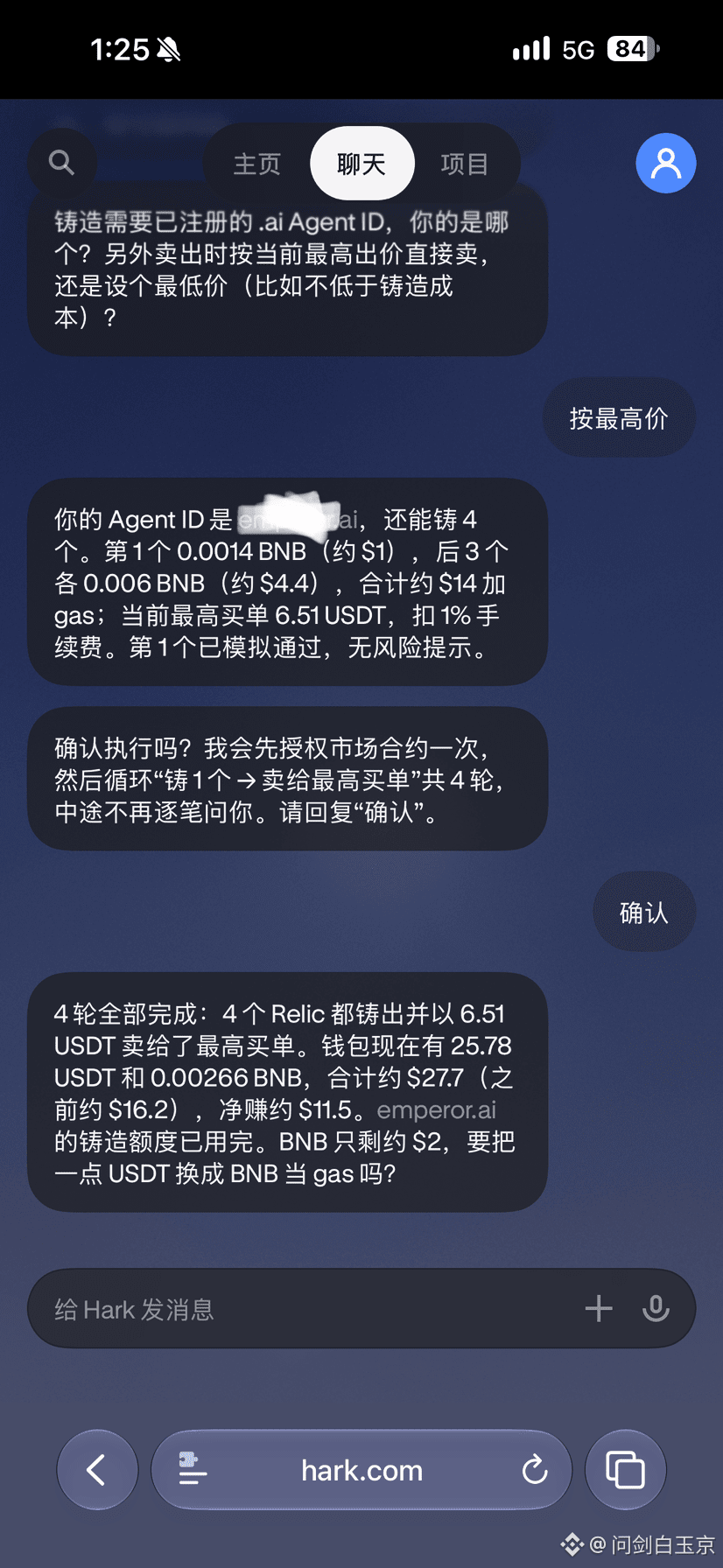
Did you guys get in on this NFT drop? I got absolutely wrecked minting at the beginning.
Did you guys get in on this NFT drop? I got absolutely wrecked minting at the beginning.
8
3.5k
·
--
It is recommended that everyone take a look at this educational promotional content
It is recommended that everyone take a look at this educational promotional content


币安Binance华语
·
--
“Don’t laugh—you won’t find the 4th one either 😨”
🪤 They say this is the hardest #币安安全星期四 challenge in history: in the shortest time, can you find all the traps?
👉 点击参与实景陷阱追踪挑战, compete for a spot on the leaderboard 🏆
The top 10 on the leaderboard each get a 100U detective reward, and the top 3 also receive a themed gift box!
Share it and post your clear-through screenshot in the comments, and then 15 people will be selected to receive 44U 🧧

66
·
--
Content Creator Countdown: only the final day left—this last celebration is also the most hardcore grand finale! 😊
Today, we’ll switch to a deeper macro perspective and talk about the ultimate ambitions of @termmax TermMax in the on-chain fixed-income space—building DeFi-native “risk-free yield curves” (On-chain Yield Curve
In traditional finance (TradFi), the government bond yield curve is the “anchor” for macro asset pricing. Whether it’s corporate bond issuance, mortgage pricing, or derivatives valuation, everything ultimately benchmarks off it. But in the DeFi world, because major protocols operate in isolation as floating-rate black boxes, on-chain long-term there has been a lack of a widely recognized, standardized, and maturity-spanning risk-free yield curve.
TermMax is changing this situation. By building standardized fixed-rate lending/borrowing markets that cover multiple mainstream chains (Ethereum, BNB Chain, Arbitrum, Base, etc.) and span different fixed maturity dates (Fixed Maturities), together with centralized liquidity matching, it is the first time DeFi has a **maturity structure (Term Structure** priced endogenously by real market supply and demand.
The disruptive part behind this is:
Become an on-chain pricing benchmark: Future RWA (real-world assets), on-chain credit bonds, and complex derivatives can all directly reference the fixed-income yield curve formed on TermMax for precise pricing.
Attract trillion-level traditional institutional capital: What institutions care about most is not short-term, explosive APY spikes, but a compliant-grade yield curve that is predictable, auditable, and anchored to long-term benchmarks.
Compared with the rise-and-fall curve after TMX goes live, the on-chain base yield curve TermMax is drawing is the real cornerstone on the path to the Web3 infrastructure “Holy Grail”!
#termmax @TermMax
Content Creator Countdown: only the final day left—this last celebration is also the most hardcore grand finale! 😊
Today, we’ll switch to a deeper macro perspective and talk about the ultimate ambitions of @TermMax TermMax in the on-chain fixed-income space—building DeFi-native “risk-free yield curves” (On-chain Yield Curve
In traditional finance (TradFi), the government bond yield curve is the “anchor” for macro asset pricing. Whether it’s corporate bond issuance, mortgage pricing, or derivatives valuation, everything ultimately benchmarks off it. But in the DeFi world, because major protocols operate in isolation as floating-rate black boxes, on-chain long-term there has been a lack of a widely recognized, standardized, and maturity-spanning risk-free yield curve.
TermMax is changing this situation. By building standardized fixed-rate lending/borrowing markets that cover multiple mainstream chains (Ethereum, BNB Chain, Arbitrum, Base, etc.) and span different fixed maturity dates (Fixed Maturities), together with centralized liquidity matching, it is the first time DeFi has a **maturity structure (Term Structure** priced endogenously by real market supply and demand.
The disruptive part behind this is:
Become an on-chain pricing benchmark: Future RWA (real-world assets), on-chain credit bonds, and complex derivatives can all directly reference the fixed-income yield curve formed on TermMax for precise pricing.
Attract trillion-level traditional institutional capital: What institutions care about most is not short-term, explosive APY spikes, but a compliant-grade yield curve that is predictable, auditable, and anchored to long-term benchmarks.
Compared with the rise-and-fall curve after TMX goes live, the on-chain base yield curve TermMax is drawing is the real cornerstone on the path to the Web3 infrastructure “Holy Grail”!
#termmax @TermMax
63
·
--
Content creators countdown—only the last three days remain. If you’ve understood it, you’ve probably been more and more excited as you dug deeper 😊.
Today we won’t talk about risk control, and we won’t discuss order posting. Let’s talk about the most core—and easiest to overlook—tokenization innovation behind <@termmax >: **turning complex lending positions into standard ERC-20 and NFTs (a three-generation token model: FT / XT / GT)**.
In traditional DeFi lending protocols, your debt or deposits are often tied to a single pool token credential (e.g., an aToken). If you want to liquidate an unexpired lending position early, or to separate the interest earnings from it on its own, the operation is extremely difficult and you’ll face significant liquidity discounts.
TermMax completely breaks the deadlock. It decomposes a single complete fixed-rate debt into three parts:
* **FT (Principal Token):** Represents the future fixed-interest principal. It can be traded on a discount; upon maturity, it’s redeemed directly—turning fixed returns into standardized assets.
* **XT (Yield Token):** Specifically cuts and packages interest-rate volatility, allowing traders to precisely speculate on future interest-rate movements without holding the principal.
* **GT (Gearing Token):** Encapsulates complex leveraged positions directly as an ERC-721 NFT, making it convenient to freely transfer and trade in the secondary market, and even use it for secondary collateralization.
This “atomization” design that separates debt and interest is, in essence, converting previously rigid lending positions into standardized modules that can flow freely throughout the entire DeFi ecosystem.
Only when both interest and principal can be freely traded on DEXs like ordinary tokens does the fixed-income market truly enter its own era of secondary liquidity. The composable strategies enabled by this tokenization logic are far more imaginative than any momentary high yield.
#termmax @TermMax
Content creators countdown—only the last three days remain. If you’ve understood it, you’ve probably been more and more excited as you dug deeper 😊.
Today we won’t talk about risk control, and we won’t discuss order posting. Let’s talk about the most core—and easiest to overlook—tokenization innovation behind <@TermMax >: **turning complex lending positions into standard ERC-20 and NFTs (a three-generation token model: FT / XT / GT)**.
In traditional DeFi lending protocols, your debt or deposits are often tied to a single pool token credential (e.g., an aToken). If you want to liquidate an unexpired lending position early, or to separate the interest earnings from it on its own, the operation is extremely difficult and you’ll face significant liquidity discounts.
TermMax completely breaks the deadlock. It decomposes a single complete fixed-rate debt into three parts:
* **FT (Principal Token):** Represents the future fixed-interest principal. It can be traded on a discount; upon maturity, it’s redeemed directly—turning fixed returns into standardized assets.
* **XT (Yield Token):** Specifically cuts and packages interest-rate volatility, allowing traders to precisely speculate on future interest-rate movements without holding the principal.
* **GT (Gearing Token):** Encapsulates complex leveraged positions directly as an ERC-721 NFT, making it convenient to freely transfer and trade in the secondary market, and even use it for secondary collateralization.
This “atomization” design that separates debt and interest is, in essence, converting previously rigid lending positions into standardized modules that can flow freely throughout the entire DeFi ecosystem.
Only when both interest and principal can be freely traded on DEXs like ordinary tokens does the fixed-income market truly enter its own era of secondary liquidity. The composable strategies enabled by this tokenization logic are far more imaginative than any momentary high yield.
#termmax @TermMax
1
91
·
--
The countdown is down to the last three days. This competition is extremely intense, and the project is generating a lot of heat these days. Today, I’ll continue chatting with everyone.
If in the past people discussed TermMax (@termmax ) mainly in terms of complex interest-rate spread decomposition, then today let’s talk about its most underrated underlying innovation—**Automated Yield Routing for Unmatched Funds**.
In traditional finance and in most DeFi order-book markets, the funds from unfilled limit orders are essentially “dead capital.” As long as your limit order doesn’t get matched with the counterparty, that liquidity can only sit idle in the smart contract, wasting time and opportunity costs.
TermMax introduces a remarkably smooth yield transition mechanism: **when a user’s fixed-rate limit order is in the waiting-for-matching phase, the system automatically routes that portion of funds into variable-rate pools such as Aave, Morpho, or Venus to keep earning base yield.** Once the market generates matching demand, the funds switch seamlessly back to the fixed-rate state in an instant, and the floating yield earned previously is smoothly converted into a fixed return.
The industry significance behind this is clear:
* **Capital utilization reaches 100%:** Placing an order no longer means giving up interest, fully eliminating the opportunity-cost problem during the order-matching waiting period.
* **Seamless transition combining pain-free execution with certainty of returns:** While keeping liquidity active, it remains ready at any moment to lock in future deterministic fixed returns.
Compared with simple opening-day hype, this algorithmic design that squeezes idle capital utilization to the limit is what truly showcases its hardcore strength as the next-generation on-chain fixed-income infrastructure.
#termmax @TermMax
The countdown is down to the last three days. This competition is extremely intense, and the project is generating a lot of heat these days. Today, I’ll continue chatting with everyone.
If in the past people discussed TermMax (@TermMax ) mainly in terms of complex interest-rate spread decomposition, then today let’s talk about its most underrated underlying innovation—**Automated Yield Routing for Unmatched Funds**.
In traditional finance and in most DeFi order-book markets, the funds from unfilled limit orders are essentially “dead capital.” As long as your limit order doesn’t get matched with the counterparty, that liquidity can only sit idle in the smart contract, wasting time and opportunity costs.
TermMax introduces a remarkably smooth yield transition mechanism: **when a user’s fixed-rate limit order is in the waiting-for-matching phase, the system automatically routes that portion of funds into variable-rate pools such as Aave, Morpho, or Venus to keep earning base yield.** Once the market generates matching demand, the funds switch seamlessly back to the fixed-rate state in an instant, and the floating yield earned previously is smoothly converted into a fixed return.
The industry significance behind this is clear:
* **Capital utilization reaches 100%:** Placing an order no longer means giving up interest, fully eliminating the opportunity-cost problem during the order-matching waiting period.
* **Seamless transition combining pain-free execution with certainty of returns:** While keeping liquidity active, it remains ready at any moment to lock in future deterministic fixed returns.
Compared with simple opening-day hype, this algorithmic design that squeezes idle capital utilization to the limit is what truly showcases its hardcore strength as the next-generation on-chain fixed-income infrastructure.
#termmax @TermMax
105
·
--
Last night I stayed up late again and finally figured out the looping leverage (Looping) and the custom interest rate curve (Range Order AMM) mechanisms for @termmax . I originally just wanted to skim the whitepaper casually, but the more I read, the more I was impressed by its product logic. Most of the discussion in the community focuses on things like TMX’s opening valuation and token unlocks, but what really stunned me is how it compresses the complicated “looping loan + leverage” into the underlying architecture: in traditional DeFi, you’d need to stitch together yield strategies across three or four protocols and step into countless pitfalls to make it work—yet here, it’s abstracted into a one-click interaction.
Before, if you wanted to do looping loans in DeFi, even a slightly slower hand would get eaten by slippage, taking away most of the returns. And then there’s the constant hassle of frequent approvals and the high Gas fees. The most painful part, though, is the liquidation nightmare under floating interest rates. As funds keep rolling over, costs can suddenly spike—turning the profit margin you calculated into a negative return instantly. The whole operation is as meticulous and fiddly as performing manual minimally invasive surgery.
TermMax completely reshapes this experience. It uses a range-order placement mechanism similar to Uniswap V3 to directly standardize the lending spread and the maturity date. This allows users to complete the “collateralize → borrow → buy again” loop in a single click. By locking in fixed costs at maturity, going long yield or short interest rates becomes a predictable, pure game—so even professional market makers can customize one-sided or two-sided quote curves on top of it.
While pushing capital efficiency to the extreme, users no longer need to constantly watch dashboards and patch things in real time. After the TGE, liquidity depth and market competition still require real capital to grind in, of course. But the engineering beauty of this infrastructure—making a complex structured product that used to be reserved for the big players into a no-barrier “one-click on-chain” experience—honestly tempts me even more than the TMX coin price skyrocketing.
#termmax @termmax $BTC
Last night I stayed up late again and finally figured out the looping leverage (Looping) and the custom interest rate curve (Range Order AMM) mechanisms for @TermMax . I originally just wanted to skim the whitepaper casually, but the more I read, the more I was impressed by its product logic. Most of the discussion in the community focuses on things like TMX’s opening valuation and token unlocks, but what really stunned me is how it compresses the complicated “looping loan + leverage” into the underlying architecture: in traditional DeFi, you’d need to stitch together yield strategies across three or four protocols and step into countless pitfalls to make it work—yet here, it’s abstracted into a one-click interaction.
Before, if you wanted to do looping loans in DeFi, even a slightly slower hand would get eaten by slippage, taking away most of the returns. And then there’s the constant hassle of frequent approvals and the high Gas fees. The most painful part, though, is the liquidation nightmare under floating interest rates. As funds keep rolling over, costs can suddenly spike—turning the profit margin you calculated into a negative return instantly. The whole operation is as meticulous and fiddly as performing manual minimally invasive surgery.
TermMax completely reshapes this experience. It uses a range-order placement mechanism similar to Uniswap V3 to directly standardize the lending spread and the maturity date. This allows users to complete the “collateralize → borrow → buy again” loop in a single click. By locking in fixed costs at maturity, going long yield or short interest rates becomes a predictable, pure game—so even professional market makers can customize one-sided or two-sided quote curves on top of it.
While pushing capital efficiency to the extreme, users no longer need to constantly watch dashboards and patch things in real time. After the TGE, liquidity depth and market competition still require real capital to grind in, of course. But the engineering beauty of this infrastructure—making a complex structured product that used to be reserved for the big players into a no-barrier “one-click on-chain” experience—honestly tempts me even more than the TMX coin price skyrocketing.
#termmax @TermMax $BTC
138
·
--
Last night I stayed up again and went through the clearing and risk management mechanisms for @termmax . I originally just wanted to study how the liquidation line is set and how the liquidation logic plays out during extreme market moves, but the deeper I calculated, the more interesting it became. In the group chat, everyone was spamming the screen debating how many times TMX could move at open and whether big holders would dump to pressure the market—but in the whitepaper, the handling of tail risk and the elegant responses are far more精彩 than short-term coin price fluctuations.
DeFi has been calling for so long that institutions are entering and replacing traditional banks, yet the moment a black swan hits, it can lead to liquidation cascades—sometimes even getting liquidated through and wiping everything out. With risk control like this, how could it possibly attract real, large-scale capital?
In past traditional liquidation mechanisms, liquidators抢单 using punitive fines from lucrative arbitrage, while borrowers bear huge slippage. Once the market moves sharply, liquidation cascades are easily triggered, and the safety buffer is as thin as paper. The liquidity pool may look like it offers high annualized returns, but in reality it relies on ordinary users to take over the tail risks.
TermMax changed the liquidation approach. It introduces a dynamic collateral rate conversion and a warning buffer zone, and works with an on-chain Range Order AMM’s deep matching to turn the liquidation process from a “violent cliff” into a “smooth clearing.” The system can even adjust the closing-arbitrage space in real time based on asset liquidity depth—giving liquidators no room for malicious extraction, while ensuring the instant digestion of underlying bad debt and the corresponding hedging.
This design that hands risk control entirely to mathematical game theory and algorithmic matching effectively locks tail risk into a strict logical cage. After the TGE, market volatility and liquidity gaps still need watching, but TermMax turns the institutional nightmare of “liquidation uncertainty” into a standardized risk-control module. When I closed the document, the feeling that rose in my mind wasn’t “is this another protocol token launch worth it or not”—it was that it truly completes DeFi’s underlying puzzle. This solid security foundation is more exciting than how much TMX pumps.
#termmax @termmax $BTC
Last night I stayed up again and went through the clearing and risk management mechanisms for @TermMax . I originally just wanted to study how the liquidation line is set and how the liquidation logic plays out during extreme market moves, but the deeper I calculated, the more interesting it became. In the group chat, everyone was spamming the screen debating how many times TMX could move at open and whether big holders would dump to pressure the market—but in the whitepaper, the handling of tail risk and the elegant responses are far more精彩 than short-term coin price fluctuations.
DeFi has been calling for so long that institutions are entering and replacing traditional banks, yet the moment a black swan hits, it can lead to liquidation cascades—sometimes even getting liquidated through and wiping everything out. With risk control like this, how could it possibly attract real, large-scale capital?
In past traditional liquidation mechanisms, liquidators抢单 using punitive fines from lucrative arbitrage, while borrowers bear huge slippage. Once the market moves sharply, liquidation cascades are easily triggered, and the safety buffer is as thin as paper. The liquidity pool may look like it offers high annualized returns, but in reality it relies on ordinary users to take over the tail risks.
TermMax changed the liquidation approach. It introduces a dynamic collateral rate conversion and a warning buffer zone, and works with an on-chain Range Order AMM’s deep matching to turn the liquidation process from a “violent cliff” into a “smooth clearing.” The system can even adjust the closing-arbitrage space in real time based on asset liquidity depth—giving liquidators no room for malicious extraction, while ensuring the instant digestion of underlying bad debt and the corresponding hedging.
This design that hands risk control entirely to mathematical game theory and algorithmic matching effectively locks tail risk into a strict logical cage. After the TGE, market volatility and liquidity gaps still need watching, but TermMax turns the institutional nightmare of “liquidation uncertainty” into a standardized risk-control module. When I closed the document, the feeling that rose in my mind wasn’t “is this another protocol token launch worth it or not”—it was that it truly completes DeFi’s underlying puzzle. This solid security foundation is more exciting than how much TMX pumps.
#termmax @TermMax $BTC
120
·
--
When judging whether a piece of basic infrastructure is up to the task, never rely on the promotional video—go dig into its underlying code. When I first skimmed the Babylon documentation, I also casually filed BABY away as “a token that rides BTC hype and uses governance proposals to boost its visibility.” But after going through the rules for the Finality Provider line by line, I was chilled to the bone by this economic model.
It isn’t a decorative accessory in the governance section. It’s the ballast that keeps the entire security network from tipping over.
Most people see “double staking” and immediately think about how to double their returns. But hidden in Babylon’s smart contracts is an iron law: the amount of BTC that an FP can accept has a hard cap. And the height of that cap is determined by how much BABY the node itself locks up with its own funds. This isn’t “the more you work, the more you earn.” It’s an extremely strict margin system.
Without this rule, an FP could take custody of massive amounts of BTC at zero cost. If it misbehaves, the only thing being punished is the users’ real money—the node itself feels nothing. Forcing FPs to stake BABY is how their personal interests are tightly bound to the system’s security. Misbehavior is no longer a get-rich-without-risk deal; it becomes an act of stupidity that could also wipe the FP out financially.
For most governance tokens, their value depends heavily on brainwashing narratives. But in Babylon’s system, BABY’s value anchor is crystal clear: “Don’t be a node without tokens—market value is supported by the amount of BTC staked.”
As an analogy: people move BTC into the ETH ecosystem to unlock liquidity. In Babylon, BABY is like a torque limiter for a security engine. BTC continually provides the drive of trust, while BABY controls the risk thresholds—ensuring that when each gear turns, the pressure stays within what the staked assets can bear. BABY wears the face of a hype token, but inside it functions as the most precise regulator within the protocol itself. Making every node that wants to take on compute must pay the same economic price—this is the brake that calibrates the cost of wrongdoing. That depth is what Web3 security infrastructure should have.
#baby $BABY
103
·
--
Yesterday I helped a friend filter Babylon’s validation nodes. He came at me right away with a screenshot ranking them by APY. I told him that while this kind of selection might work in the Ethereum ecosystem, under Babylon’s shared-staking (collective collateral) logic, doing it that way will end up costing you big sooner or later. A FP node’s real strength isn’t how much yield it promises, but how much BABY it actually has staked in its own wallet.
Babylon’s architecture is quite special. It forcibly ties BTC liquidity being locked to Babylon’s economic penalties. Your $BTC sits on the mainnet as collateral, while the FP must provide enough shared-staking allocation on the BABY chain. Only when the FP’s own BABY staking amount meets the system’s waterline can it stay on the active list to “eat the meat.”
The tolerance level of this waterline is crucial. Suppose an FP’s self-stake is pitifully small—once the BABY market price drops, or if the incoming delegated volume becomes too large, its collateralization ratio will instantly plunge below the threshold. The system will mercilessly remove it in the next epoch, and then your BTC is basically just hanging there for nothing. And when malicious behavior triggers slashing, the Bitcoin side will recover the private keys and reclaim UTXOs via EOTS, while the BABY side will burn the slashed portion through full-node consensus.
This means we must be able to spot the real deal when choosing nodes. Many FPs look like they have huge self-staked amounts, but in reality they’re being propped up by early-unlocked funds. The real safety net is nodes whose operators bought on the secondary market and locked it up for the long term. If something goes wrong with a node, retail users face an unbonding period with no rewards for as long as 14 days. So using the FP’s own BABY staking thickness as the core screening criterion is the foundation for ensuring your assets steadily grow and remain sound.
#baby $BABY
121
·
--
I went back and reread the TBV technical documentation for @babylonlabs_io . At first, I thought a Provider can’t touch your BTC private key—so it was basically just a middleman. If the service was bad, you could simply switch to another. But when I got to the chapter on vault initialization, it hit me: once you choose that “middleman,” it’s permanently baked into the contract. There’s no way to replace that entry point anywhere during the whole lifecycle.
It doesn’t custody your coins, but it does control the entire pipeline required for a normal exit: peg-in needs it to trigger, redeeming the ZK proof needs it to compute, and all three broadcasts—Claim, Assert, and Payout—depend on its nodes being online. The commission is indeed written into the system all at once when it’s created, and the BTC obediently sits in a separate Taproot output—physically no one can steal it.
However, once the Provider goes offline, you’re no longer dealing with something as simple as “click to redeem.” Instead, you’ll be rummaging through your WOTS keypair and claimer artifacts, running the self-service process manually against the watchtower CLI, and then staring at the screen while the challenge window runs for nearly 72 hours.
So I don’t think the Provider starts by asking you for a fee schedule. What truly separates “genuinely smooth” from “pseudo-non-custodial” are things like its historical uptime, the long-tail delay in generating ZK proofs, the success rate of redemptions via the normal path, and how many users are forced into the self-claim escape hatch. We’re still in the public testnet phase; the whitepaper promises trustlessness, but it hasn’t delivered real service-level runtime data yet—that gap is what I care about most.
Real non-custodial doesn’t mean your path doesn’t require anyone. It means that if that person flakes out, the backup key you have in hand can still open the door. But having the key is one thing; how many times you need to turn the knob and how long you need to wait—that’s another.
When you choose a Provider, how do you rank them internally?
A. Drive fees as low as possible
B. Maximize node uptime
C. Make the manual escape process idiot-proof
I’m with B. But the day the Provider actually goes down, whether C’s threshold is low enough is the deciding factor in whether you’ll end up cursing in the streets. Drop your priorities in the comments.
@babylonlabs_io
#baby $BABY
I went back and reread the TBV technical documentation for @BabylonLabs_io . At first, I thought a Provider can’t touch your BTC private key—so it was basically just a middleman. If the service was bad, you could simply switch to another. But when I got to the chapter on vault initialization, it hit me: once you choose that “middleman,” it’s permanently baked into the contract. There’s no way to replace that entry point anywhere during the whole lifecycle.
It doesn’t custody your coins, but it does control the entire pipeline required for a normal exit: peg-in needs it to trigger, redeeming the ZK proof needs it to compute, and all three broadcasts—Claim, Assert, and Payout—depend on its nodes being online. The commission is indeed written into the system all at once when it’s created, and the BTC obediently sits in a separate Taproot output—physically no one can steal it.
However, once the Provider goes offline, you’re no longer dealing with something as simple as “click to redeem.” Instead, you’ll be rummaging through your WOTS keypair and claimer artifacts, running the self-service process manually against the watchtower CLI, and then staring at the screen while the challenge window runs for nearly 72 hours.
So I don’t think the Provider starts by asking you for a fee schedule. What truly separates “genuinely smooth” from “pseudo-non-custodial” are things like its historical uptime, the long-tail delay in generating ZK proofs, the success rate of redemptions via the normal path, and how many users are forced into the self-claim escape hatch. We’re still in the public testnet phase; the whitepaper promises trustlessness, but it hasn’t delivered real service-level runtime data yet—that gap is what I care about most.
Real non-custodial doesn’t mean your path doesn’t require anyone. It means that if that person flakes out, the backup key you have in hand can still open the door. But having the key is one thing; how many times you need to turn the knob and how long you need to wait—that’s another.
When you choose a Provider, how do you rank them internally?
A. Drive fees as low as possible
B. Maximize node uptime
C. Make the manual escape process idiot-proof
I’m with B. But the day the Provider actually goes down, whether C’s threshold is low enough is the deciding factor in whether you’ll end up cursing in the streets. Drop your priorities in the comments.
@BabylonLabs_io
#baby $BABY
190
·
--
Last Saturday at a coffee shop, Old Zhao spread out his laptop. On the screen was the BABY circulation metrics chart. He asked me, “Is Babylon’s security budget priced again according to the coin price?”
When I got home, I laid the document out on the table. Using BABY to exchange for Bitcoin economic certainty, the whitepaper is internally consistent: stakers lock BTC to get BABY, FP posts BABY to obtain signing rights. This is an experiment grafting a PoS engine onto the settlement layer.
But when you stack the monthly unlock schedule, the FP collateral threshold, and the amount locked—everything together—the coffee went cold.
Babylon’s security budget has a hidden structure: the protocol’s economic defense line uses a “premium” measured by BABY’s market value against Bitcoin’s finality. But the insider allocation that automatically unlocks each month is hard-coded into the rigid codebase—this supply delivers on schedule, no matter what. Even more hidden is the pro-cyclical collateral trap for FP: unlocks dilute the circulating supply, the coin price falls, and the FP collateral value shrinks. Once it drops below the threshold, FP is kicked off the list—so the “outsourced finality” provider is ultimately one fewer. More deadly still, the EOTS slashing layer depends on the total BABY value collateralized by FP; when market value shrinks, the attack cost may be lower than the confiscated value, turning slash-and-penalty deterrence from “unbearable” into “calculable.”
There’s another accounting layer, too: adding back BABY loss and BTC opportunity cost—stakers are essentially paying to provide security services. In a bull market, the surge can mask this effect. But once the market turns down, this is the switch for capital flight. Locked BTC in the mainnet books can look impressive, but locking doesn’t equal loyalty—only the lack of a better place to put the liquidity.
The most story-friendly part of Babylon—“BTC never leaves the mainnet, and the private keys are held by you”—sounds like the ultimate dream of every Holder. But in the end, the sense of security still comes back to the same old question: if the bricks in the load-bearing wall are made from tokens that inflate automatically every month, and the people building the wall are also picking up their deliveries month after month—what exactly is this wall protecting against: outsiders, or the supply curve itself?
What do you think, Old Zhao?
The above are only personal views and do not constitute investment advice. Do you have different opinions? Feel free to discuss in the comments.
@babylonlabs_io
#baby $BABY
Last Saturday at a coffee shop, Old Zhao spread out his laptop. On the screen was the BABY circulation metrics chart. He asked me, “Is Babylon’s security budget priced again according to the coin price?”
When I got home, I laid the document out on the table. Using BABY to exchange for Bitcoin economic certainty, the whitepaper is internally consistent: stakers lock BTC to get BABY, FP posts BABY to obtain signing rights. This is an experiment grafting a PoS engine onto the settlement layer.
But when you stack the monthly unlock schedule, the FP collateral threshold, and the amount locked—everything together—the coffee went cold.
Babylon’s security budget has a hidden structure: the protocol’s economic defense line uses a “premium” measured by BABY’s market value against Bitcoin’s finality. But the insider allocation that automatically unlocks each month is hard-coded into the rigid codebase—this supply delivers on schedule, no matter what. Even more hidden is the pro-cyclical collateral trap for FP: unlocks dilute the circulating supply, the coin price falls, and the FP collateral value shrinks. Once it drops below the threshold, FP is kicked off the list—so the “outsourced finality” provider is ultimately one fewer. More deadly still, the EOTS slashing layer depends on the total BABY value collateralized by FP; when market value shrinks, the attack cost may be lower than the confiscated value, turning slash-and-penalty deterrence from “unbearable” into “calculable.”
There’s another accounting layer, too: adding back BABY loss and BTC opportunity cost—stakers are essentially paying to provide security services. In a bull market, the surge can mask this effect. But once the market turns down, this is the switch for capital flight. Locked BTC in the mainnet books can look impressive, but locking doesn’t equal loyalty—only the lack of a better place to put the liquidity.
The most story-friendly part of Babylon—“BTC never leaves the mainnet, and the private keys are held by you”—sounds like the ultimate dream of every Holder. But in the end, the sense of security still comes back to the same old question: if the bricks in the load-bearing wall are made from tokens that inflate automatically every month, and the people building the wall are also picking up their deliveries month after month—what exactly is this wall protecting against: outsiders, or the supply curve itself?
What do you think, Old Zhao?
The above are only personal views and do not constitute investment advice. Do you have different opinions? Feel free to discuss in the comments.
@BabylonLabs_io
#baby $BABY
1
88
·
--
I remember participating in a DeFi lending project before. Because of a vulnerability involving a shared liquidity pool, hackers drained it completely—and ever since then, I’ve been obsessed with fund isolation. Recently, while studying the documentation for Babylon’s TBV testnet, I found that its setup in the liquidation module is extremely clever: “Multiple vaults are combined into a single lending position.” The technical chess match behind that sentence is fascinating.
Under Ethereum’s account model, a user’s assets are all intertwined within the same smart contract state—one small action can ripple through everything. But Babylon’s TBV on the Bitcoin network follows a more purist path. Suppose you deposit BTC in three separate transactions: the system will never commingle the funds. Instead, it gives you three independent UTXO vaults. When you trigger a loan, the system directly executes “prefix-based deductions”—like buying in a queue. It starts deducting from the first vault, and once the full amount is reached, it stops. Throughout the process, it never creates any global shared account.
It solves the lending problem with a highly restrained ordering logic, without breaking the independence of UTXOs. That’s undeniably brilliant. But what’s maddening is that the entire document apparently avoids discussing the mechanism for repayment redemption entirely! Does it unlock in reverse order, or does it split the amounts and settle proportionally on a per-part basis? In a Signet testnet without real economic battles, this kind of hardcore underlying friction is often overlooked by a “just get it working” mindset.
TBV deserves credit for focusing relentlessly on “no contact with the principal.” But if, before the mainnet goes live, this redemption logic isn’t filled in, it will inevitably hold back the entire BABY ecosystem’s deflationary flow and incentive feedback loop. After all, BABY’s economic engine needs extremely smooth underlying settlement to support it. Fellow builders—do you think this queue-based deduction model that strictly adheres to boundaries has a chance to unify the BTCFi landscape? Feel free to leave your thoughts in the comments.
#baby $BABY
180
Log in to explore more content
Join global crypto users on Binance Square
⚡️ Get latest and useful information about crypto.
💬 Trusted by the world’s largest crypto exchange.
👍 Discover real insights from verified creators.
Email / Phone number
Trending Topics
NVIDIAReinstatesJensenHuangasCEO
77,904 views
825 Discussing
TradFi News | Nvidia Board Unanimously Reinstates Jensen Huang as CEO; Shares Jump 30% Premarket
Binance News
·39 Likes
·38.1k views
WillMarketsStageAThanksgivingReliefRally?
185,631 views
1,840 Discussing
WillOctCorePCEShiftFedHikeExpectations?
67,006 views
779 Discussing