
Mage进化论
66 Posts

Mage进化论
Report
Block User
2009年入金融 | 2013年做外汇贵金属 | 2019年入币圈现货及合约
专注裸K、指标与量化策略开发 | 实盘测试中
不喊单、不预测、不晒收益,只记录真实交易逻辑
非投资建议
Frequent Trader
1.1 Years
11 Following
77 Followers
15 Liked
Posts
All
Videos
·
--
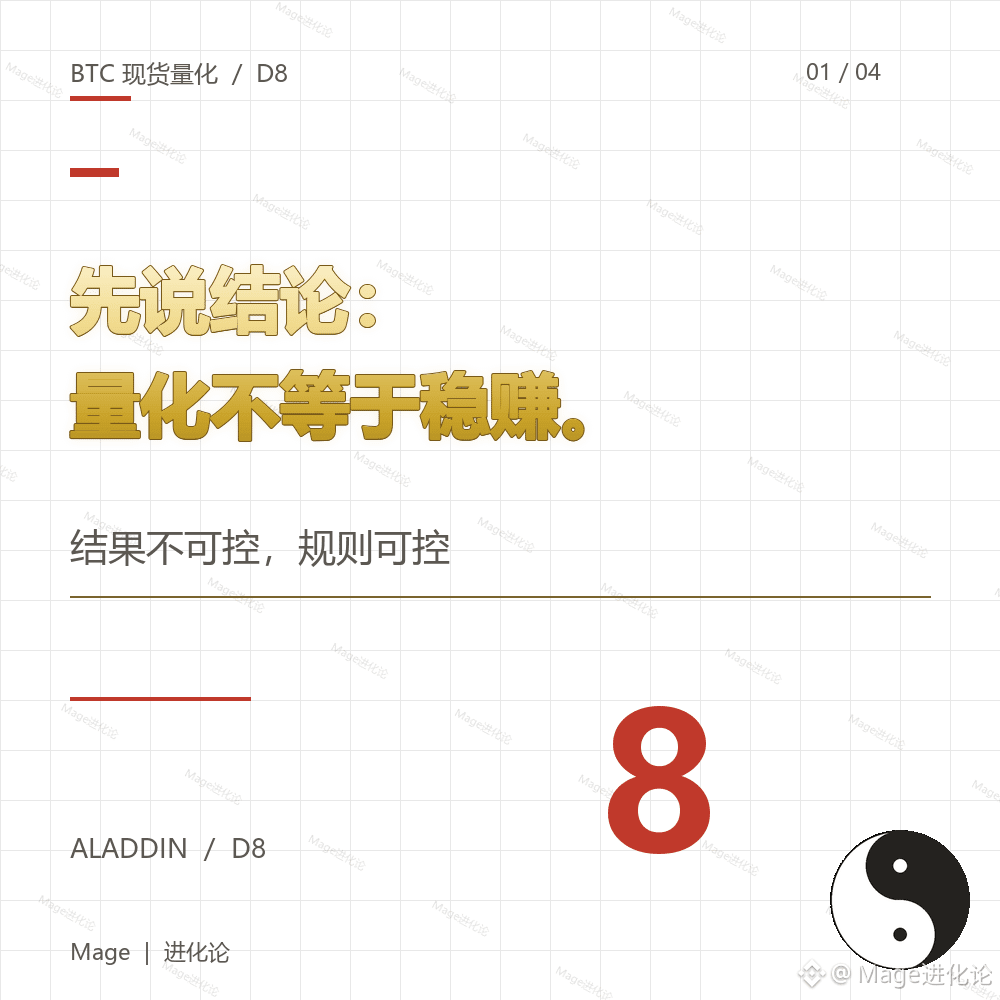
Let's start with the conclusion: quantitative trading doesn't guarantee profits.
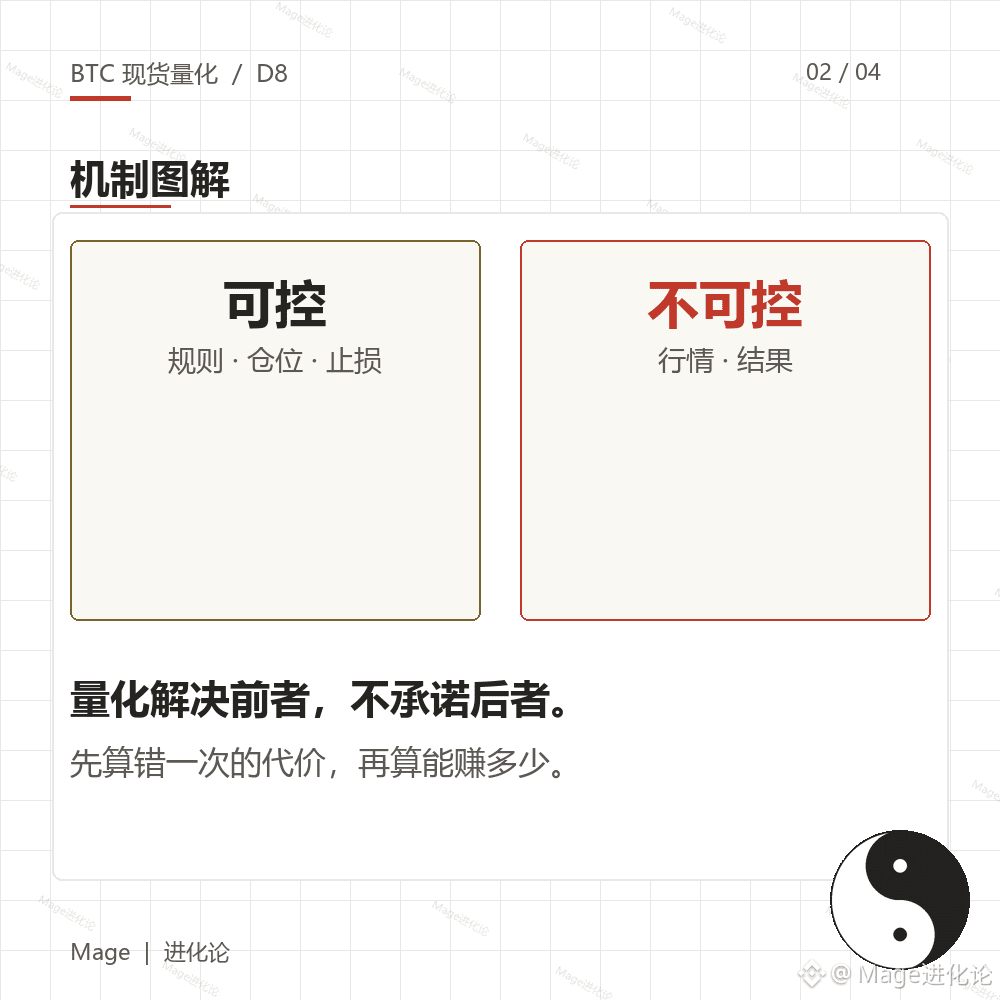
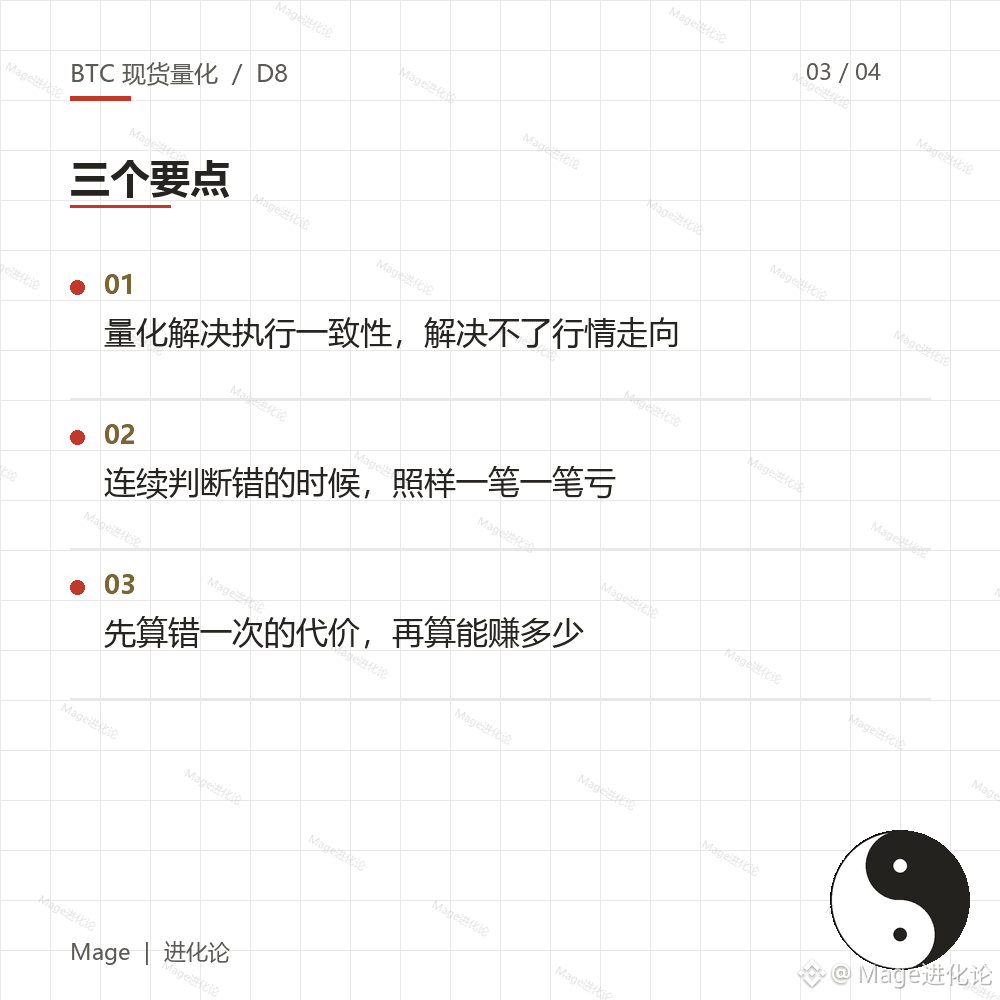
It ensures consistent execution, but it can't control whether the market moves as you expect. When a trend isn't confirmed, the rules help you trade less; if your judgments are wrong repeatedly, you'll still lose money one trade at a time. I'd rather talk about position sizing, stop-losses, and risk exposure—the outcome is beyond your control, but the rules are not.
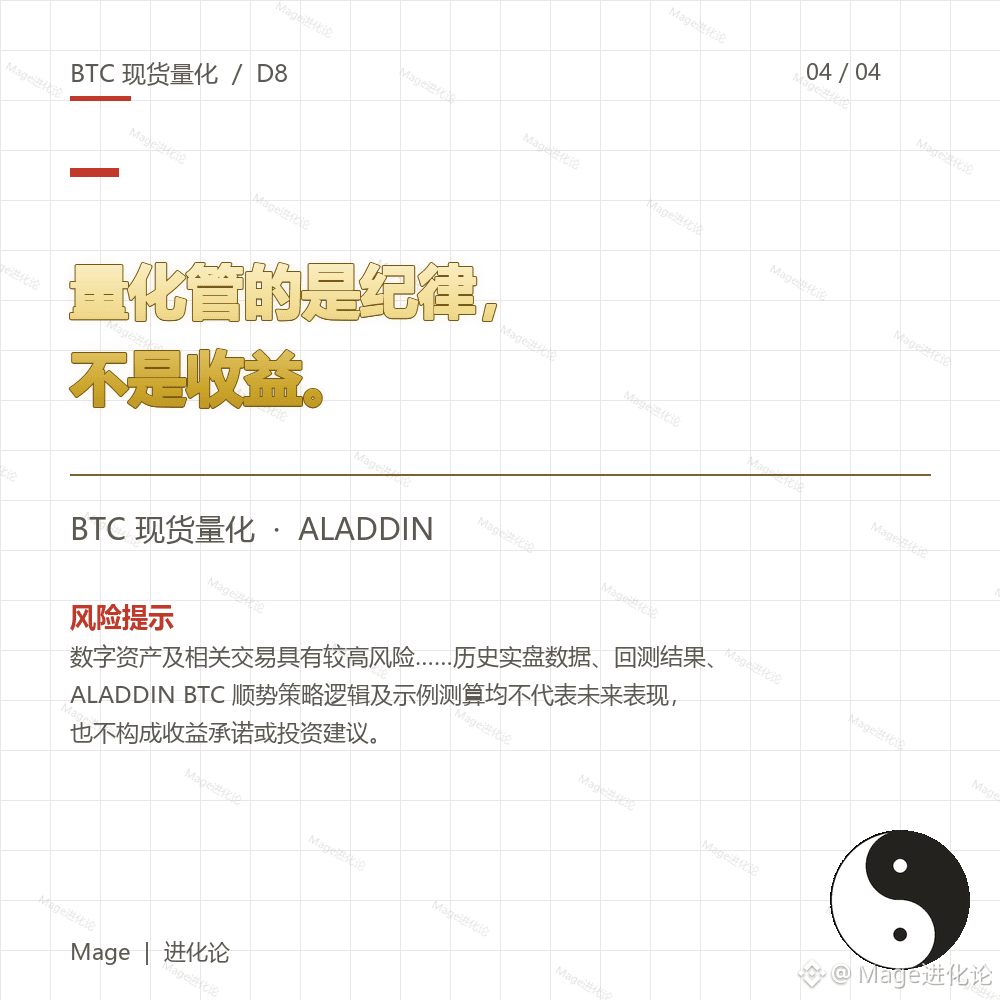
Quantitative trading manages discipline, not returns.$BTC
{spot}(BTCUSDT)
Let's start with the conclusion: quantitative trading doesn't guarantee profits.
It ensures consistent execution, but it can't control whether the market moves as you expect. When a trend isn't confirmed, the rules help you trade less; if your judgments are wrong repeatedly, you'll still lose money one trade at a time. I'd rather talk about position sizing, stop-losses, and risk exposure—the outcome is beyond your control, but the rules are not.
Quantitative trading manages discipline, not returns.$BTC
272
·
--
Spot vs. futures? You don’t necessarily need to use futures to do quantitative BTC trading.
Futures use leverage, so even a small position can amplify account volatility.
Spot has no leverage: you buy exactly what you pay for, and you can’t be liquidated.
I trade spot using only my own funds. I use three position sizes: 33%, 65%, and 100%, and I usually don’t go all in.
Based on a 33% position and a set risk budget per trade, one losing trade would affect about 2.64% of the entire account.
That number isn’t a return—it’s how much one losing trade would cost. Work that out first, then consider anything else.
Don’t use leverage. First, calculate the cost of one losing trade.
171
·
--
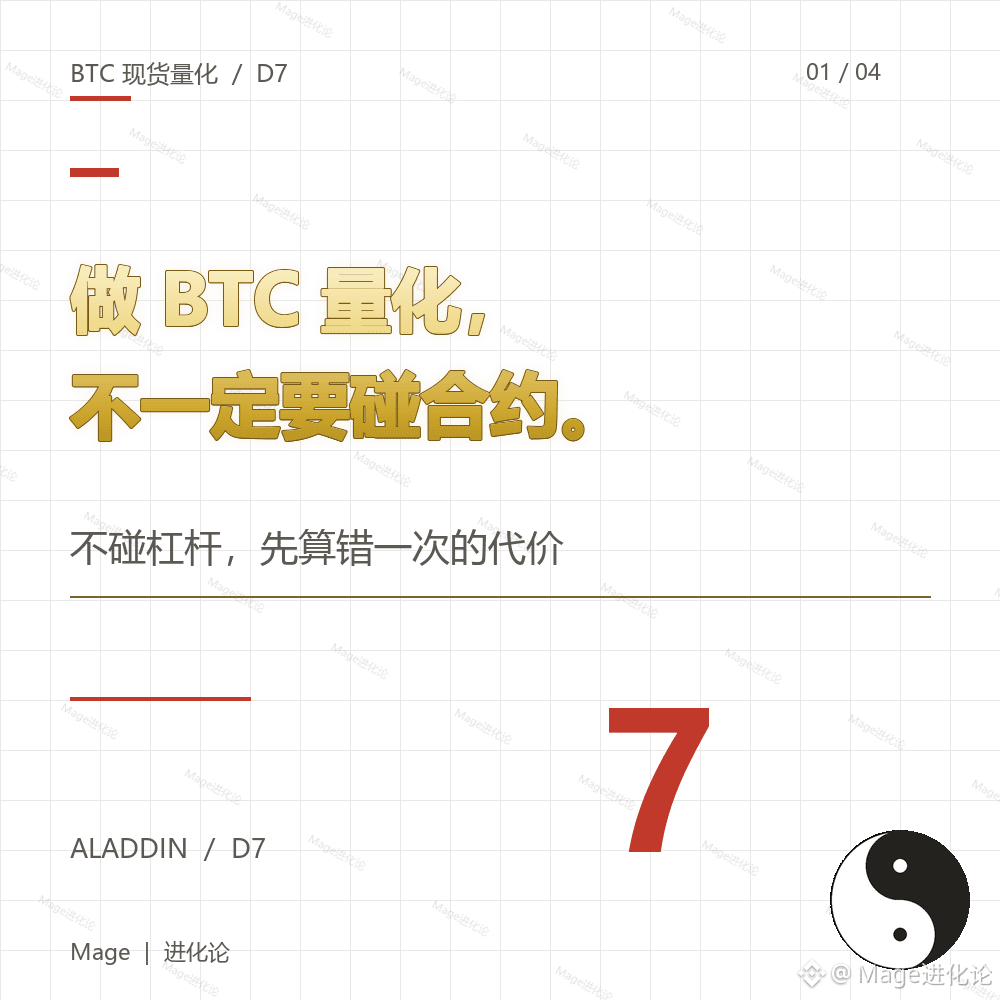
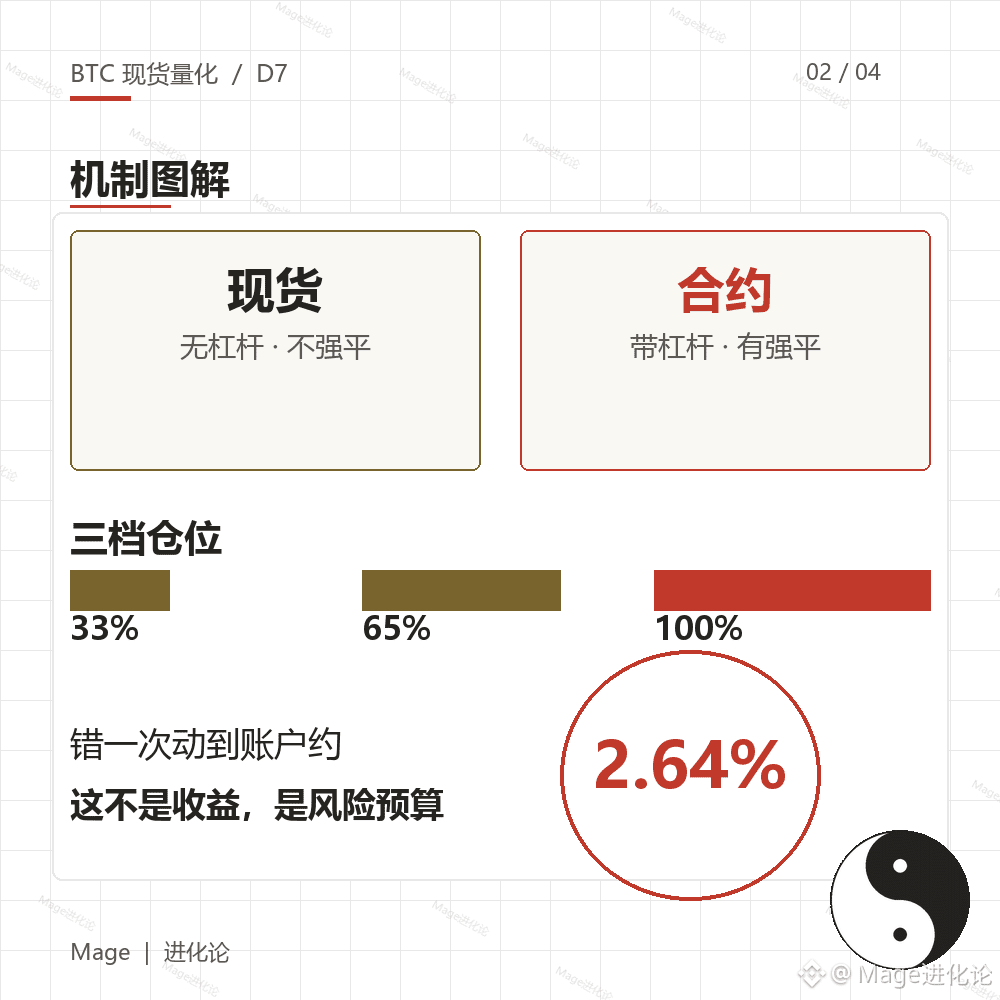
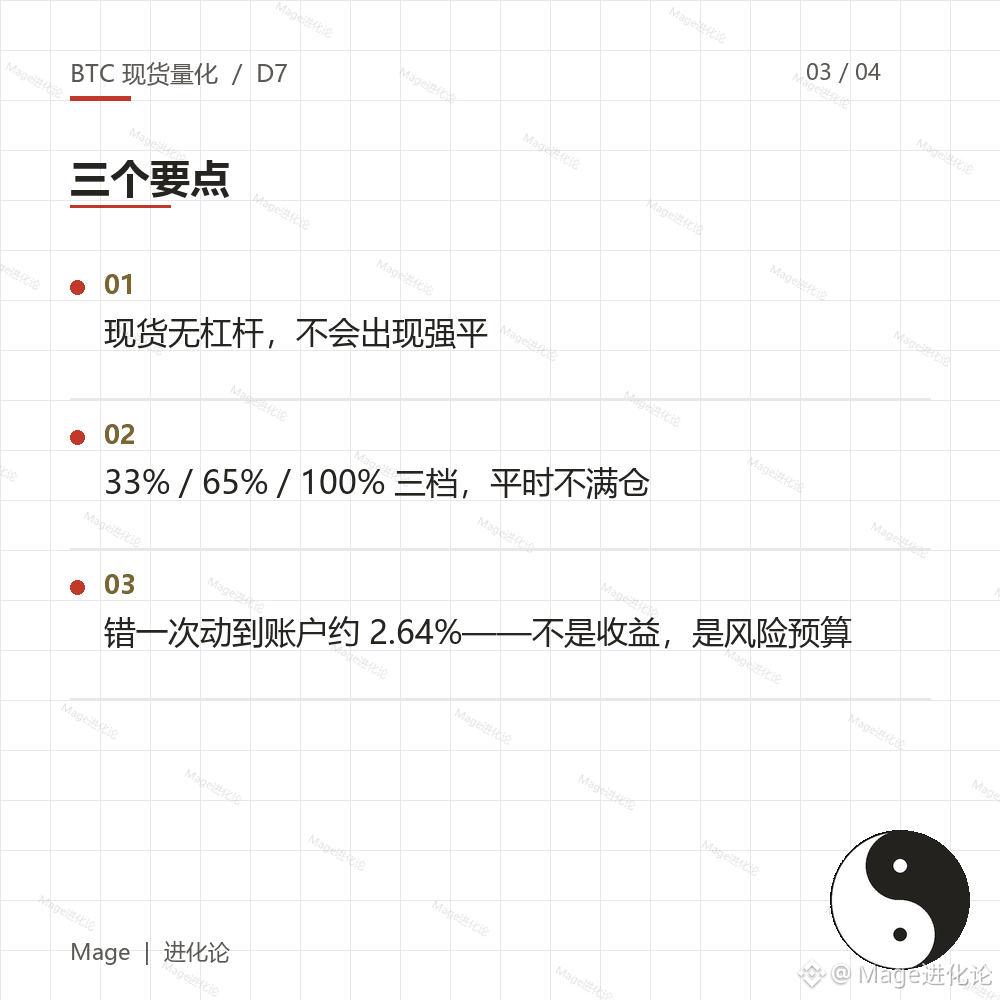
You don’t necessarily have to trade derivatives to quant trade BTC.
Derivatives use leverage, which amplifies account fluctuations; with spot, you only buy what you pay for, so there’s no liquidation. I trade spot: I only use my own funds, with position sizes of 33%, 65%, and 100%. One wrong move affects about 2.64% of the account—that’s not a return, it’s a risk budget.
No leverage. First, calculate the cost of getting it wrong once. $BTC
{spot}(BTCUSDT)
You don’t necessarily have to trade derivatives to quant trade BTC.
Derivatives use leverage, which amplifies account fluctuations; with spot, you only buy what you pay for, so there’s no liquidation. I trade spot: I only use my own funds, with position sizes of 33%, 65%, and 100%. One wrong move affects about 2.64% of the account—that’s not a return, it’s a risk budget.
No leverage. First, calculate the cost of getting it wrong once. $BTC
167
·
--
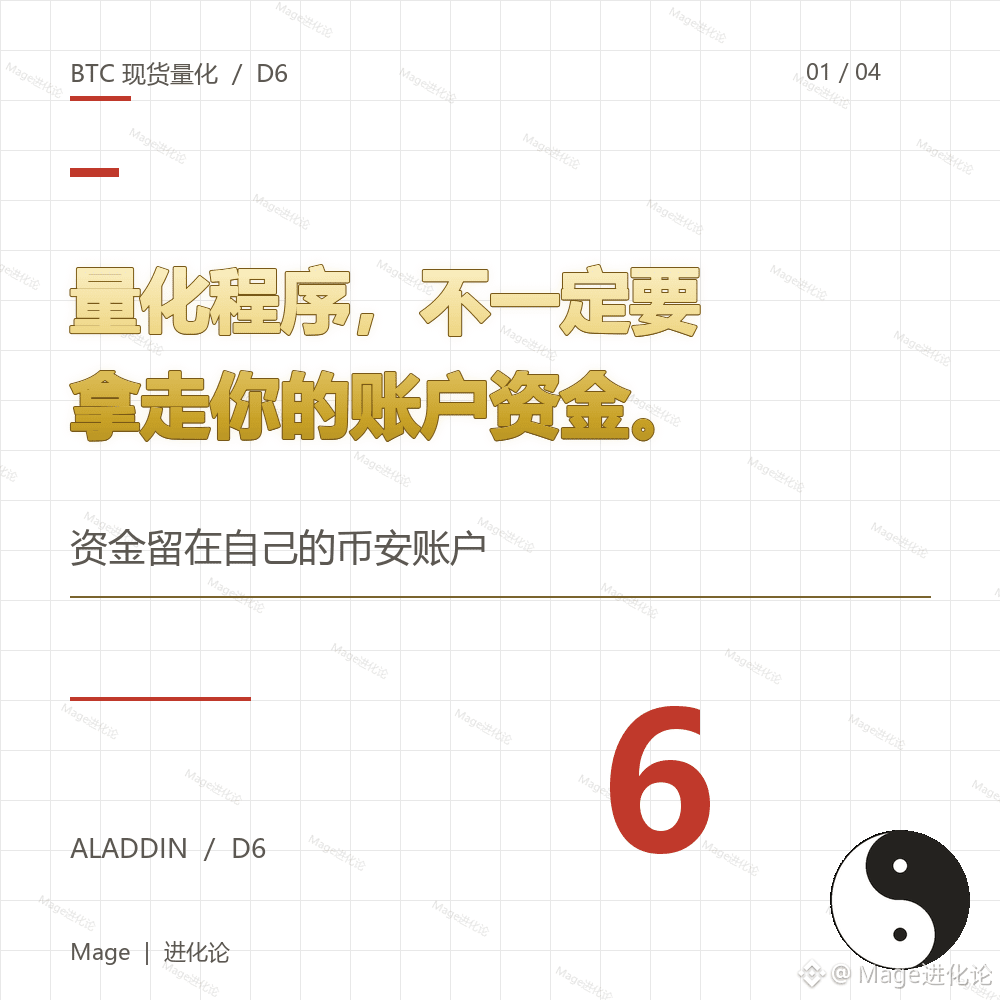
What is API-based algorithmic trading? An algorithmic trading program doesn't need to take custody of your funds.
When people hear “API,” many assume they have to transfer their money to someone. In reality, it’s the opposite.
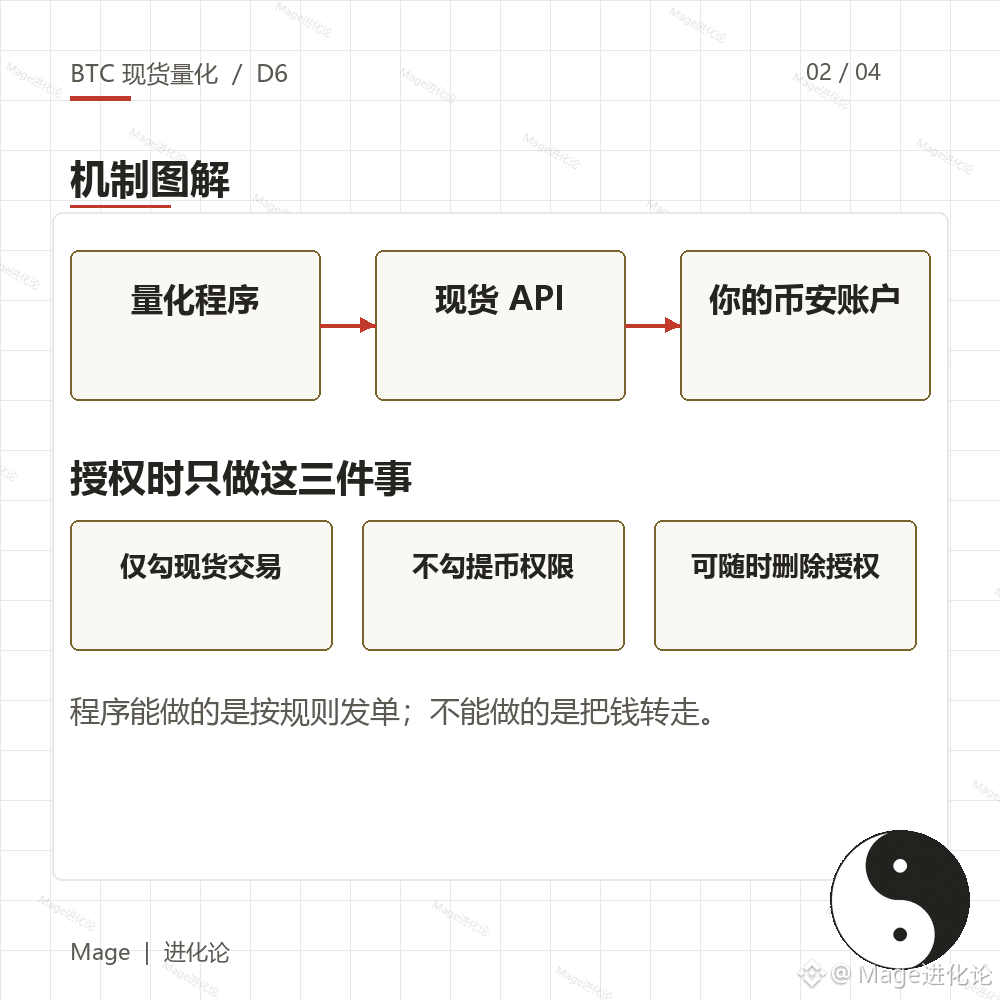
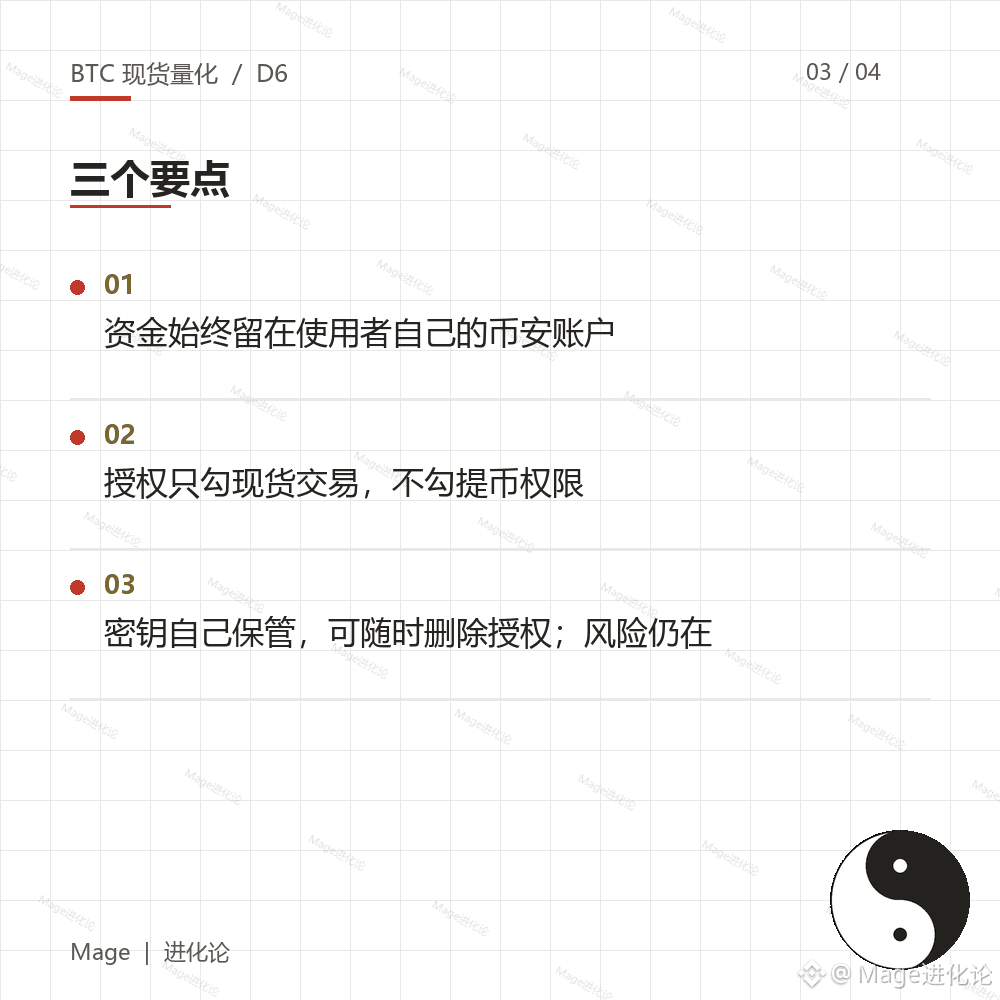
Your funds stay in your own Binance account; the program only gets permission to place orders.
When granting access, enable spot trading only—don't enable withdrawals. Keep the API key to yourself, and you can revoke access at any time.
The program can place orders according to rules, but it can't transfer your money. If you don't want to use it anymore, revoke access and that's it.
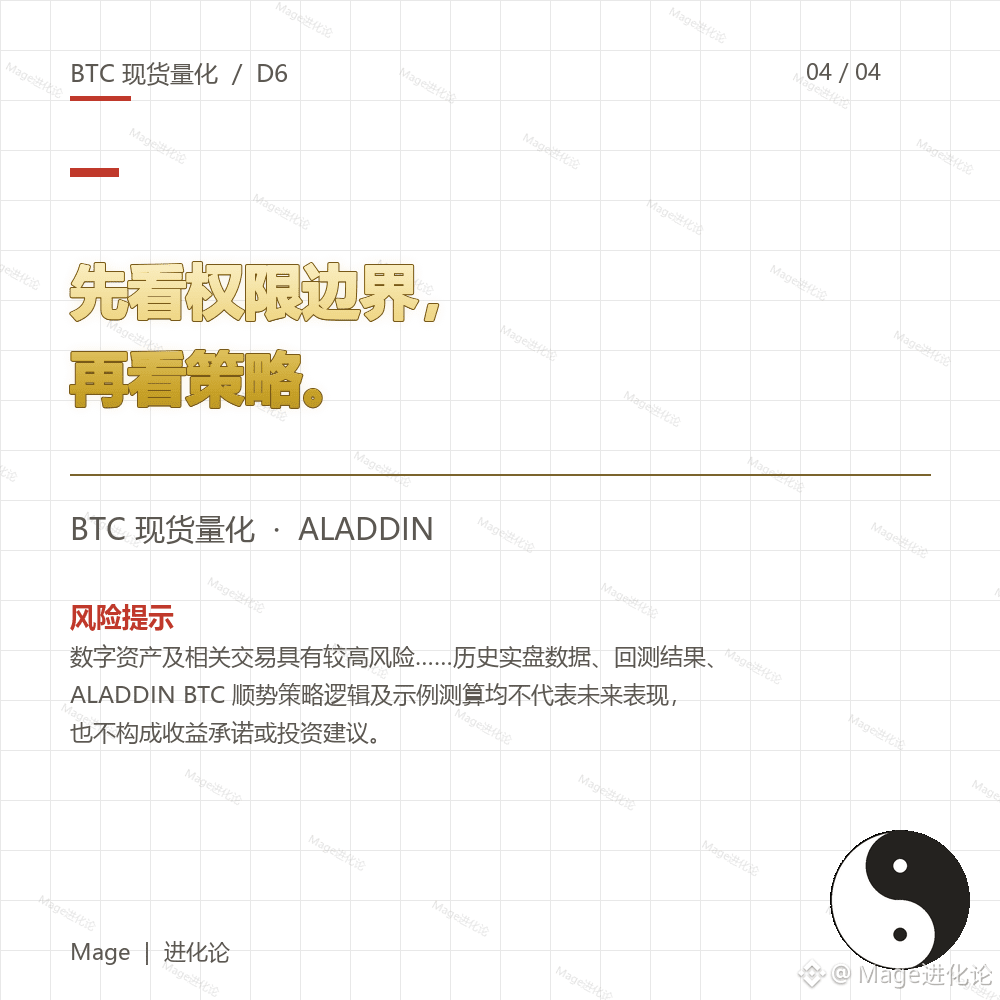
But that doesn't mean there are no risks. Market risks, system failures, and errors in the rules themselves are still possible.
Check the permission boundaries first, then look at the strategy.
90
·
--
A quantitative trading program doesn’t necessarily need to take custody of your funds.
Your funds remain in your own Binance account. The program only gets permission to place orders: when granting access, enable spot trading only—not withdrawals. Keep the API key secure, and you can revoke access at any time. But that doesn’t mean there’s no risk—market volatility, system failures, and errors in the rules themselves are still possible.
Check the permission boundaries first, then look at the strategy.
168
·
--
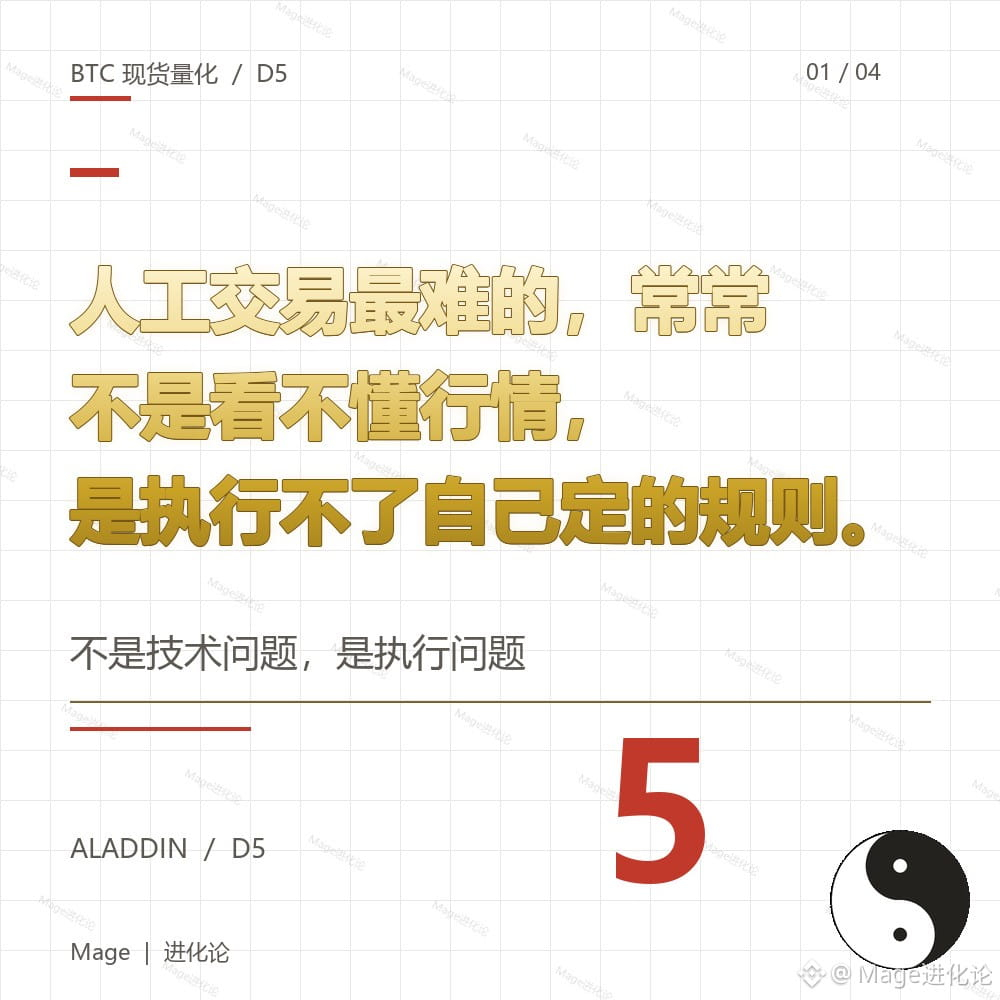
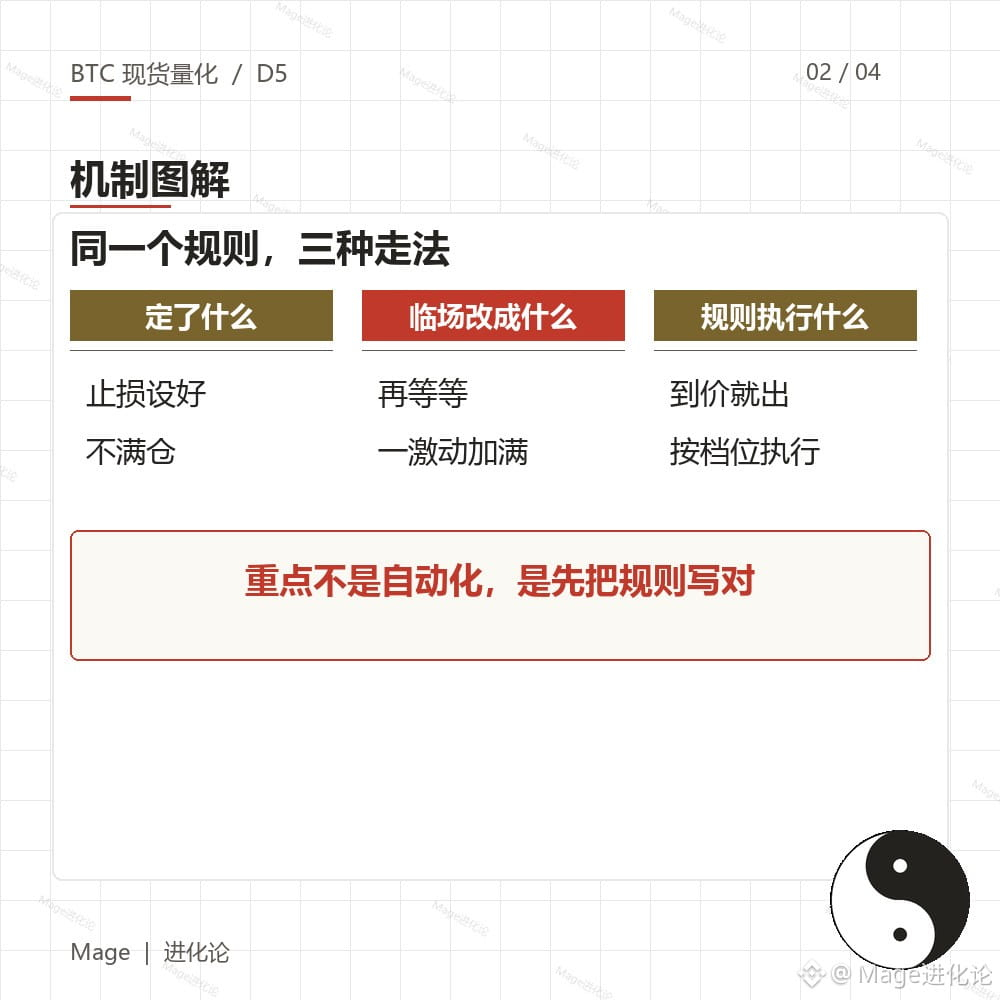
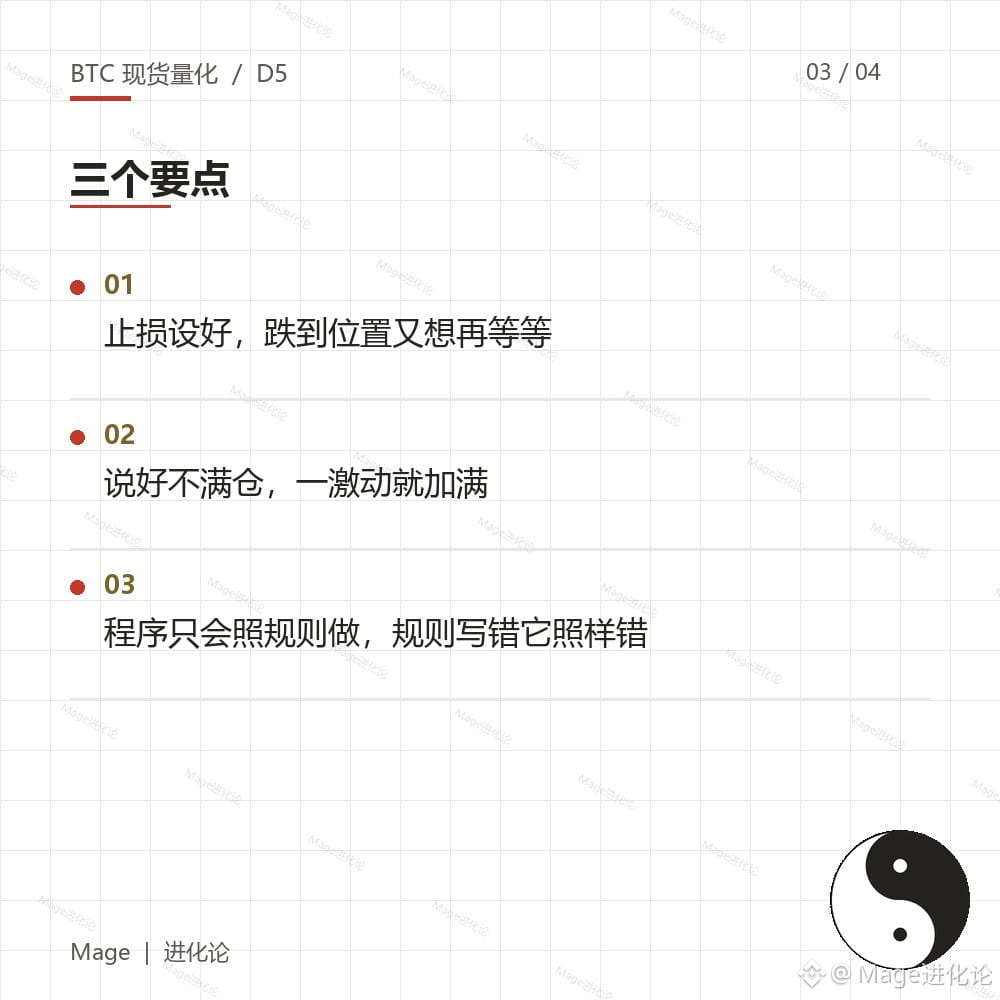
The hardest part of manual trading often isn’t understanding the market—it’s sticking to the rules you set for yourself.
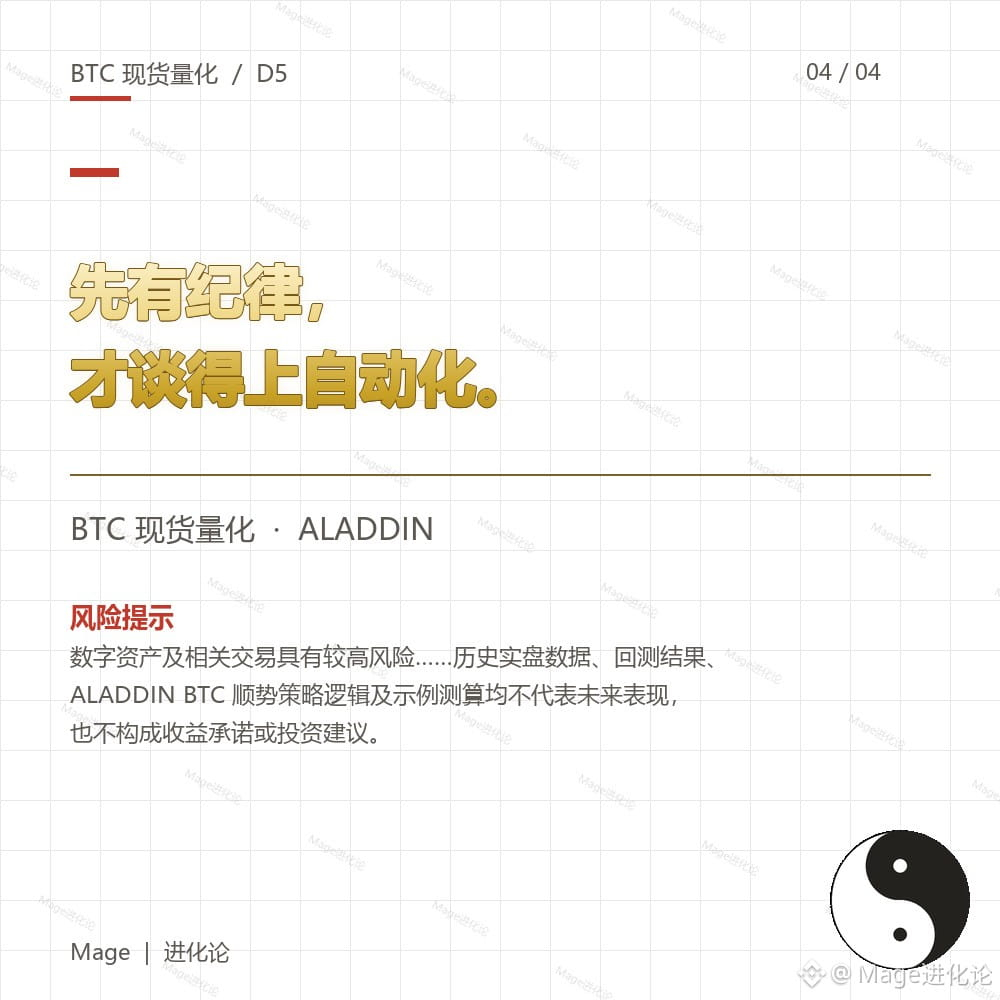
You set a stop-loss, then decide to wait a little longer. You promise not to go all in, then get excited and max out your position. Once you hand the rules over to a program, the biggest change is that you “stop negotiating with yourself.” But if you write the rules wrong, the program will faithfully get them wrong too.
Discipline comes first. Only then does automation make sense.
139
·
--
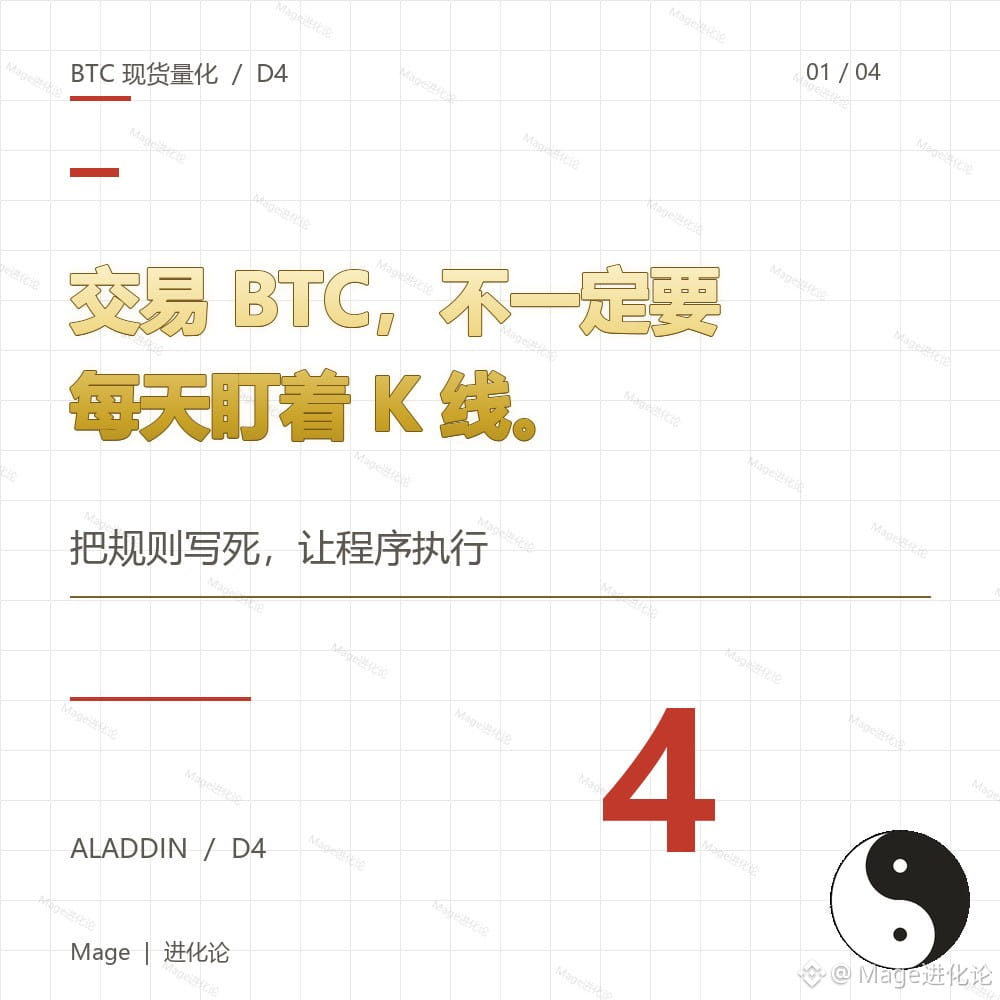
You don’t have to watch the charts every day to trade BTC.
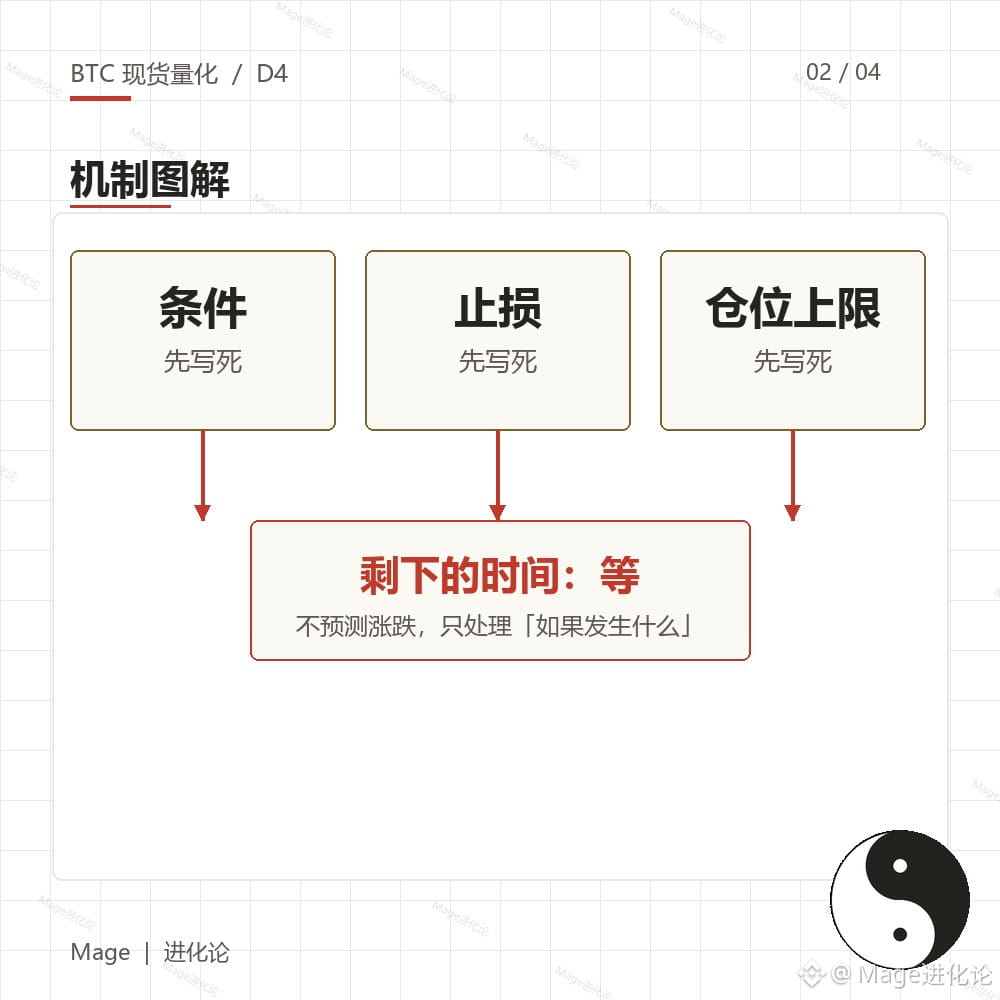
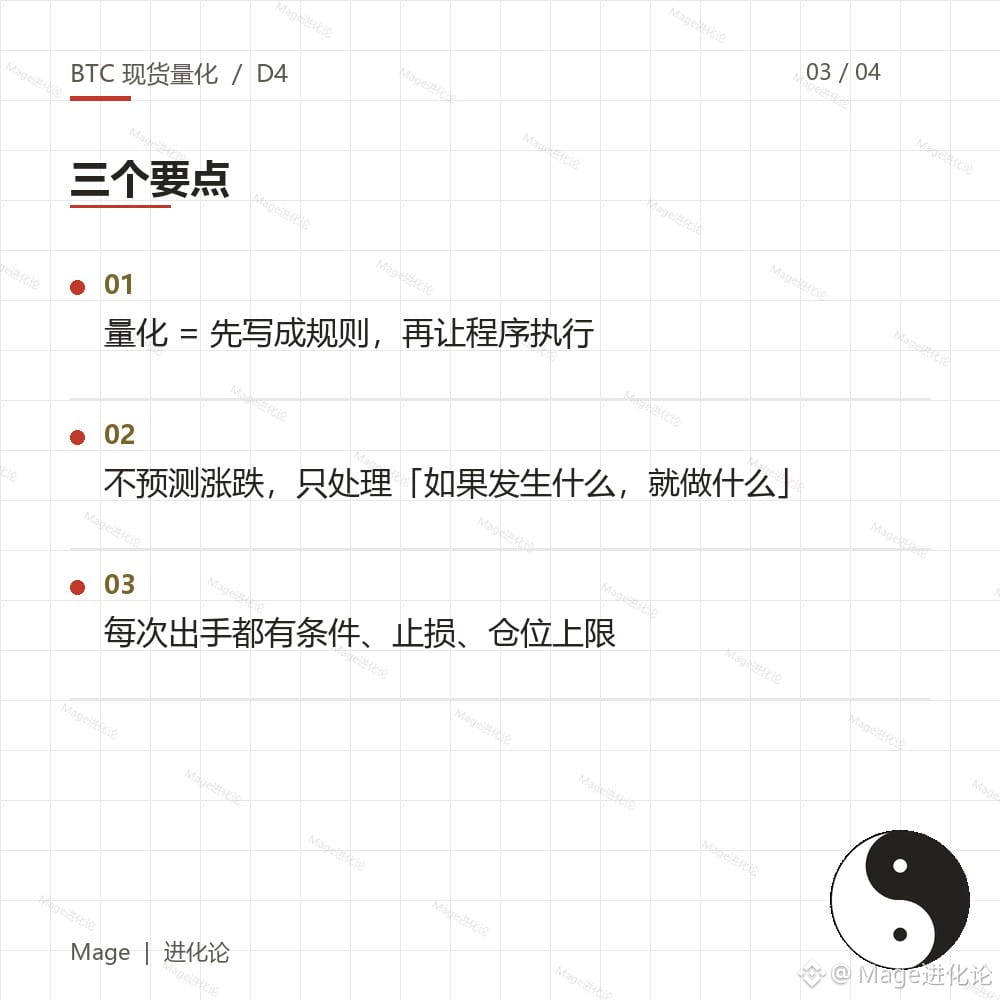
First, write down the rules: when to enter, when to exit, and how much to lose if you’re wrong. Then let a program execute them. It doesn’t predict whether prices will rise or fall; it simply does what you tell it to when certain things happen.
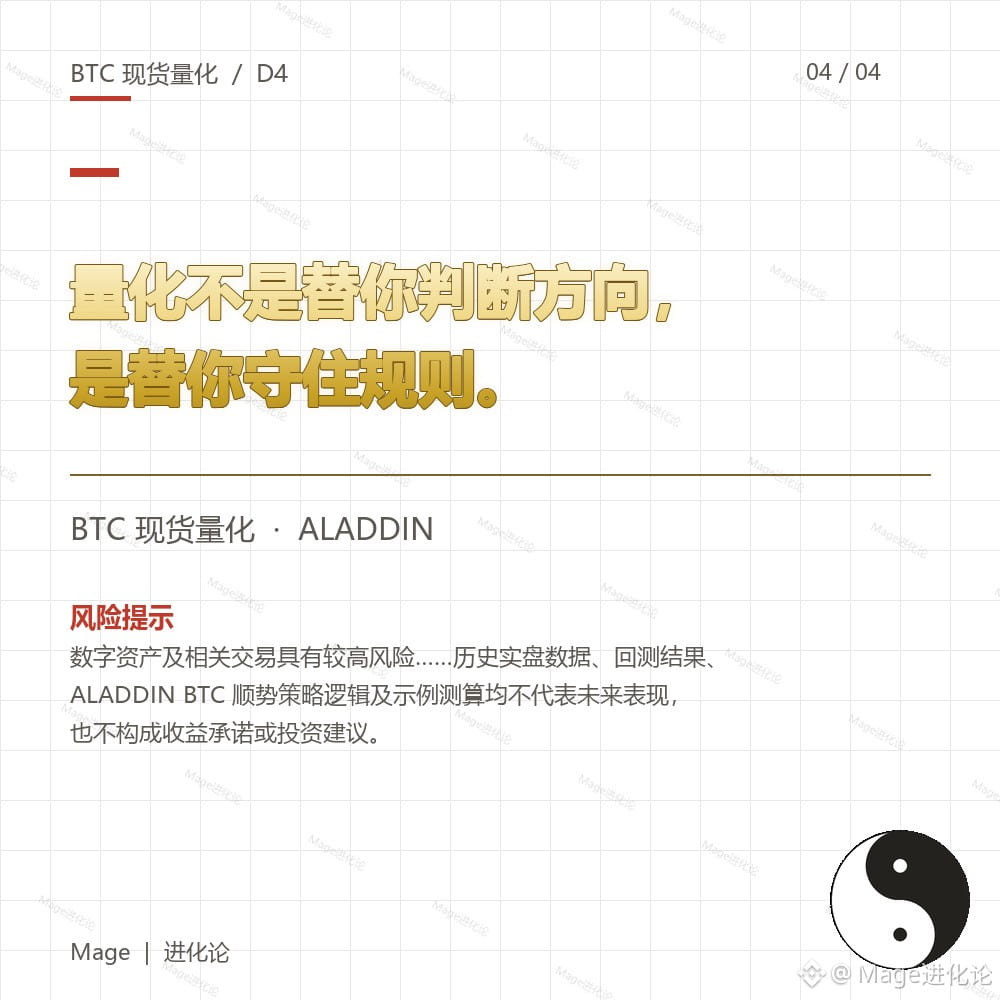
Quantitative trading doesn’t decide which way the market will go for you—it helps you stick to your rules.
59
·
--
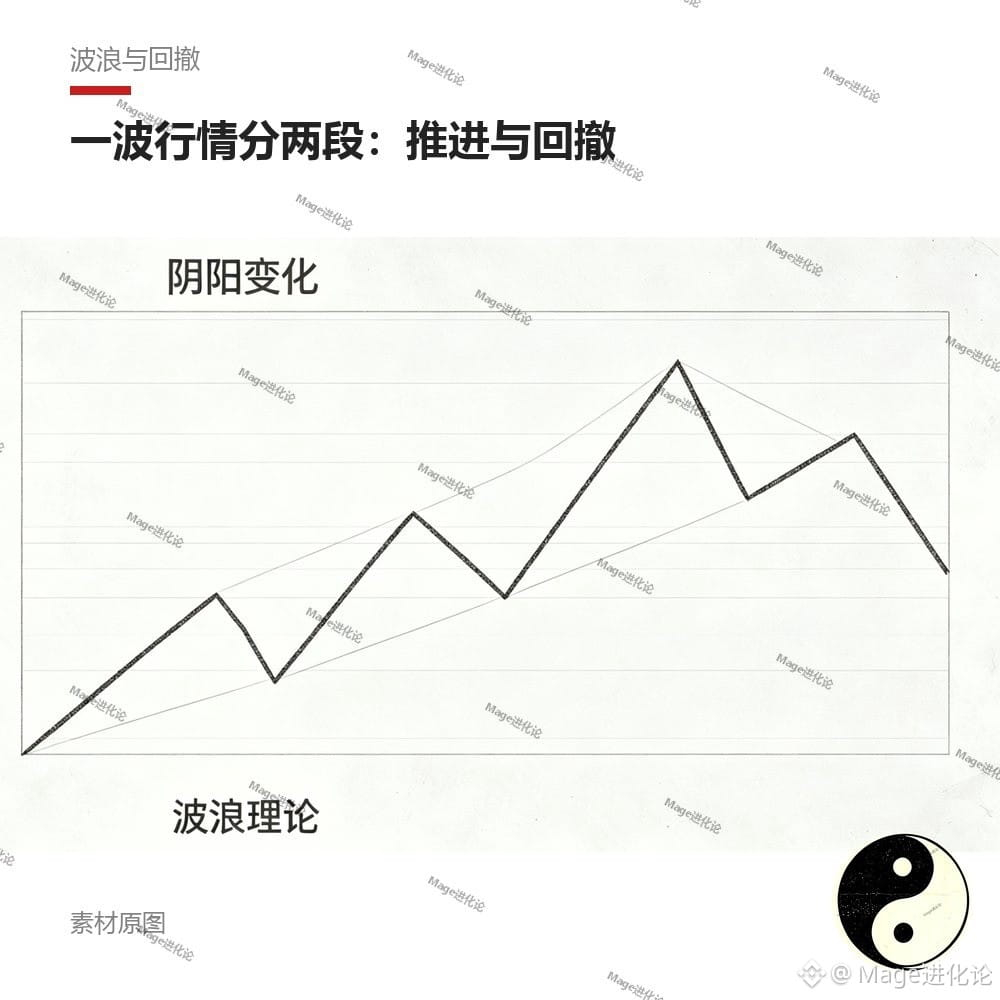
Tai chi and wave theory can describe cycles, but neither tells you when the turning point will come.
So I use them to answer just one question: what phase are we in now?
Wait while a base forms, hold through the main uptrend, trim near a top, and stay in cash during a pullback—not short.
If both highs and lows rise, it’s an uptrend; if both fall, it’s a pullback. If one rises and the other falls, sit it out.
A two-second question is more useful than reading ten analyses.
$BTC



277
·
--
Liquidation isn’t caused by the market—it’s caused by your actions.
Three actions: increasing leverage, adding to a losing position, and moving your stop-loss.
They all have one root cause: refusing to admit your judgment was wrong.
Many people analyze things in great detail. The problem is that emotion ultimately overrules their conclusions.
There’s only one solution: plan ahead. Write down three numbers before opening a position. If you can’t, don’t open one.$BTC $ETH




394
·
--
For a long time, I thought the most-quoted line in Article 21 was useless.
“There is only one side to the market—the right side.” It doesn’t teach you to predict the direction; it teaches you to keep quiet.
What you should really copy isn’t the quote, but the action behind it:
Before opening a position, write down the worst-case scenario.
People aren’t afraid of losing money; they’re afraid because they don’t know how much they could lose. $BTC



450
·
--
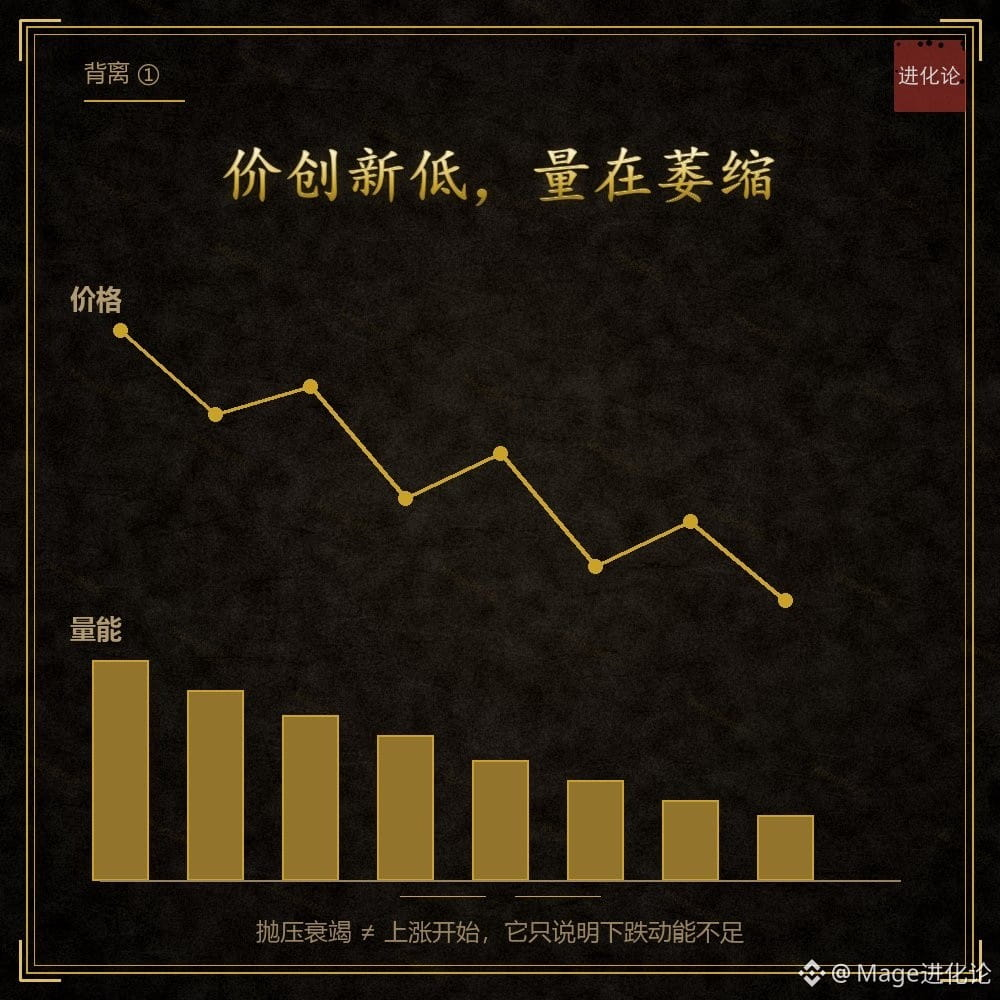
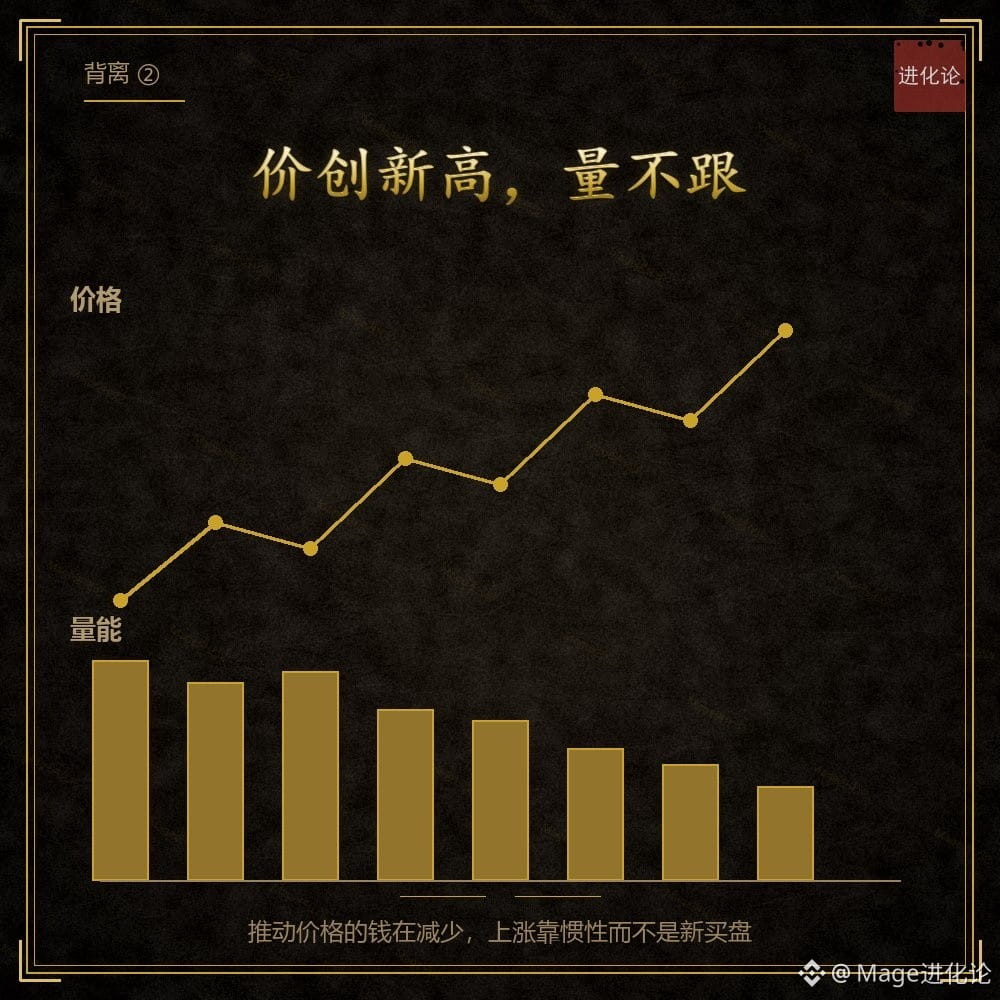
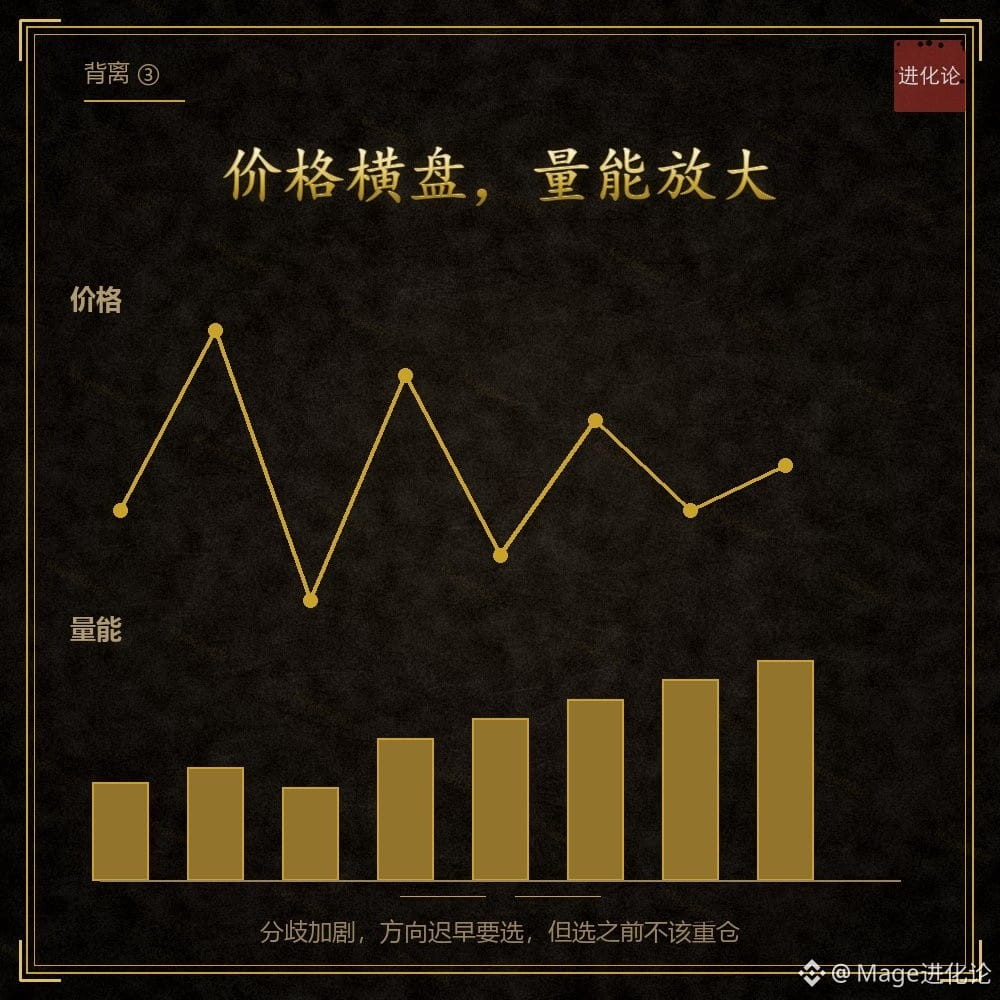
A new high in price without volume confirming it is the divergence I value most.
It has saved my account.
Its value isn't in predicting the top, but in keeping me cautious as prices rise.
I don't chase or go short when there's a new high on low volume; I just reduce my position and tighten my stop-loss.
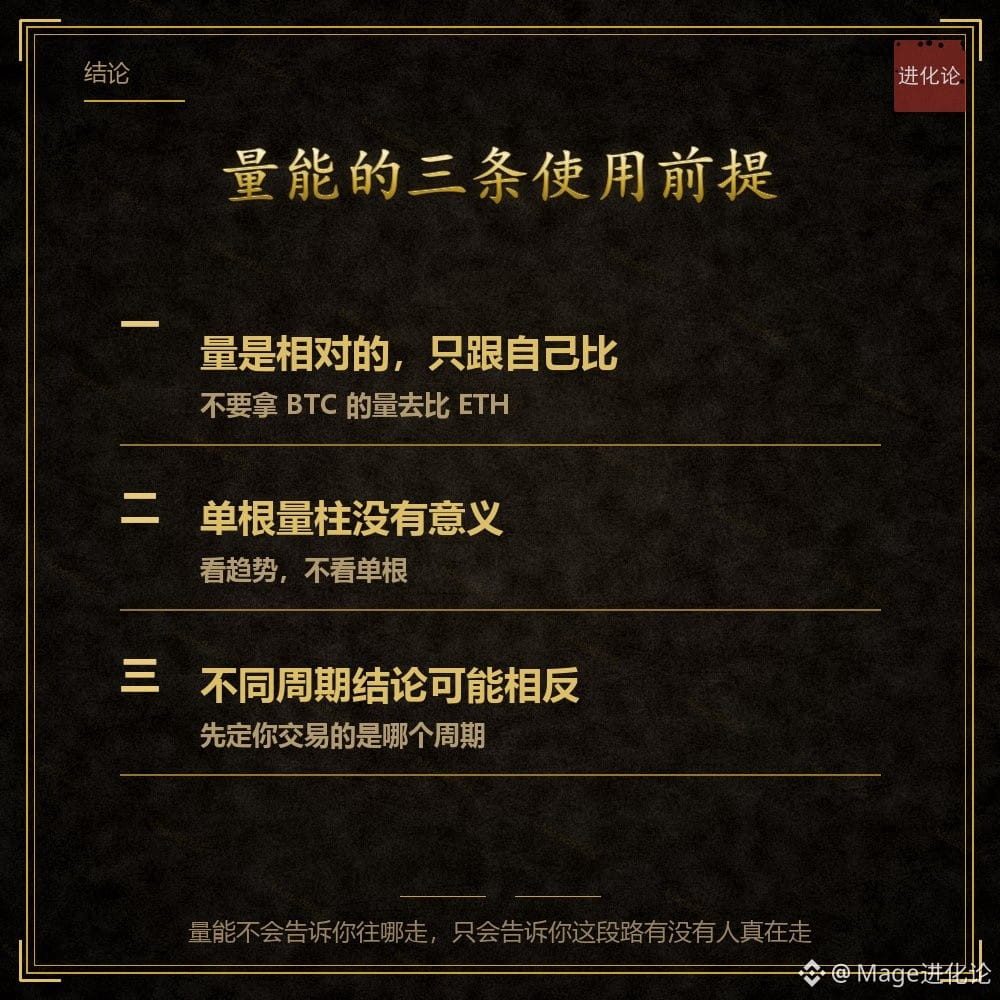
Volume doesn't tell you which way the market will go; it only tells you whether anyone is really moving.$BTC $ETH
178
·
--
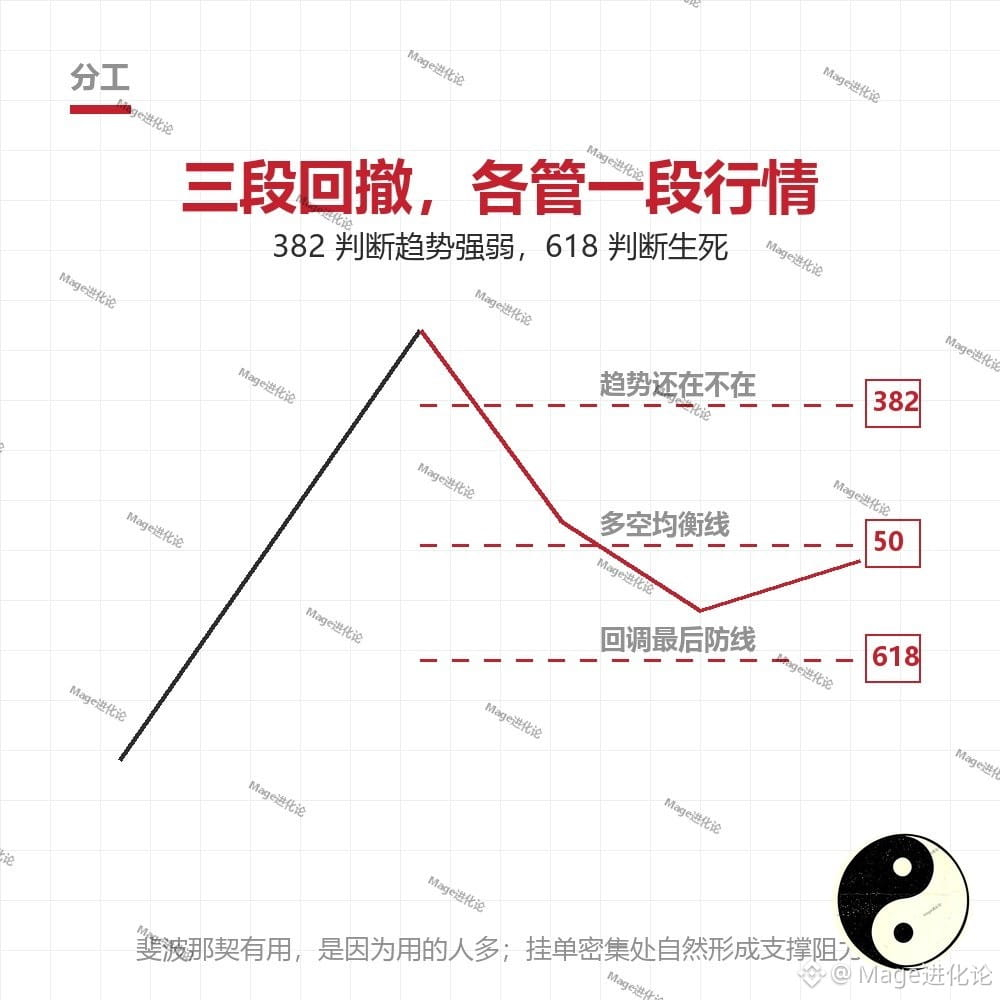
Fibonacci is useful only because so many people use it, creating dense clusters of orders.
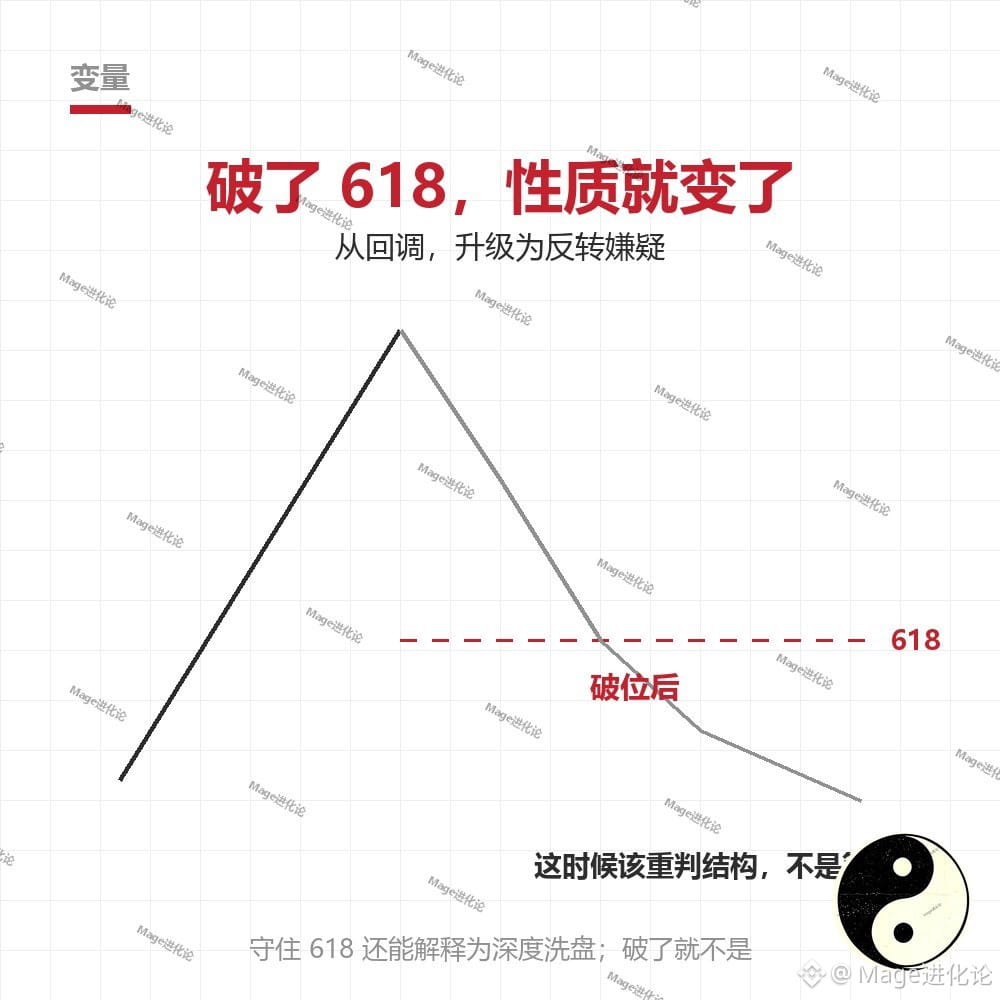
The 0.382 level tells you whether the trend is still intact; 0.5 marks the balance between bulls and bears; 0.618 is make-or-break.
Don’t use 0.382 for a stop-loss; use 0.618—it should be placed where your thesis is invalidated.
Don’t mix timeframes: a daily 0.618 level won’t work for a 15-minute trade. $BTC $ETH

1
309
·
--
After five consecutive weekly declines, BTC may have a chance to stabilize sometime between this week and next. Bitcoin has plunged to 73,500, with the Fibonacci 0.618 level at 69,000. Once it retests that level, you could consider adding to your position once. I’ve chosen to buy Ethereum in several batches.$BTC $ETH
After five consecutive weekly declines, BTC may have a chance to stabilize sometime between this week and next. Bitcoin has plunged to 73,500, with the Fibonacci 0.618 level at 69,000. Once it retests that level, you could consider adding to your position once. I’ve chosen to buy Ethereum in several batches.$BTC $ETH
104
·
--
What, no potato chips? 😂😂 This is why Elon Musk started making chips.
What, no potato chips? 😂😂 This is why Elon Musk started making chips.
43
·
--
Trading Lesson One: Calculate How Much You Could Lose Before You Calculate How Much You Could Make | Position Sizing Discipline | Trading Lesson One |
The first question beginners usually ask when entering a trade is how much they could make. The first lesson should be how much they could lose at most.
Because making money is a matter of probability; losing money is a matter of arithmetic. You can’t control probability, but you can control arithmetic.
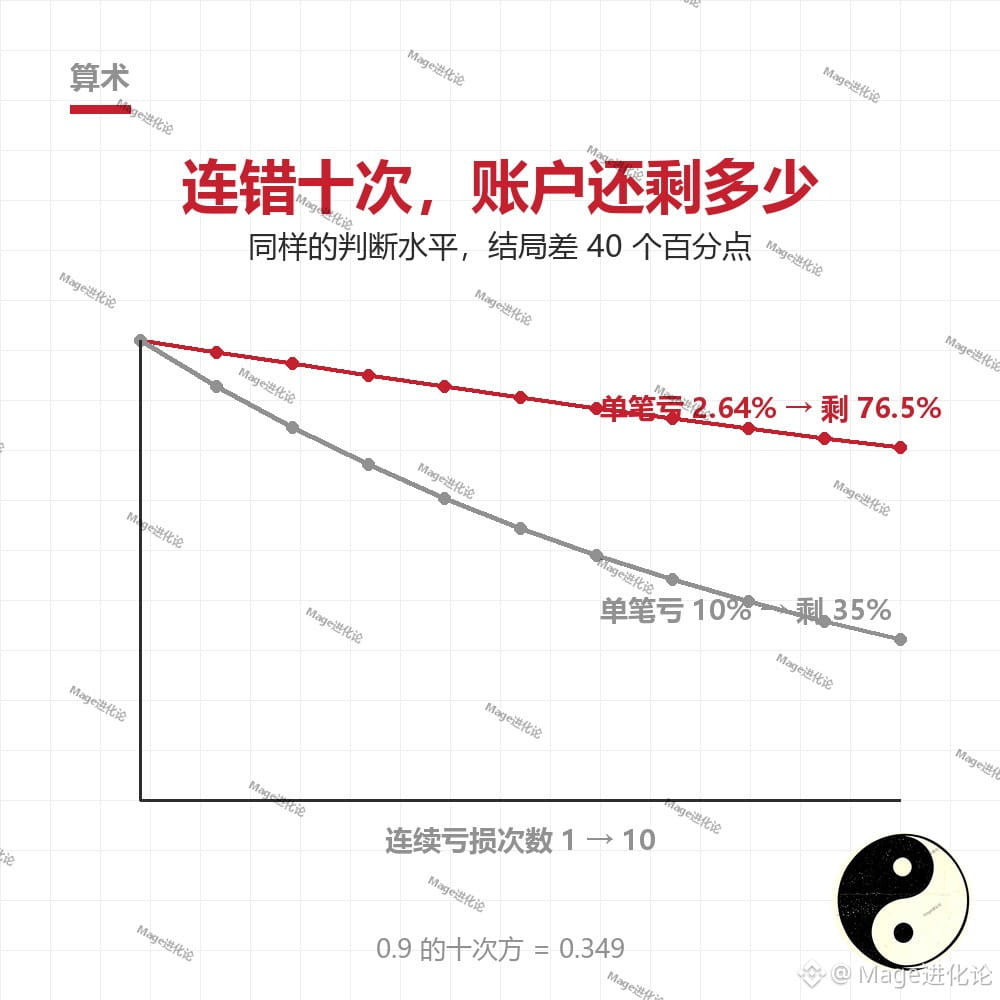
Here’s a simple comparison. Suppose each loss is 2.64% of your account. If you’re wrong ten times in a row (which is very common, especially when you’ve just switched strategies): 0.9736 to the power of ten is about 0.765, leaving you with 76.5% of your account—a 23.5% drawdown.
Now suppose you’re wrong ten times in a row, but each loss is 10% of your account: 0.9 to the power of ten is about 0.349, leaving you with just 35% of your account—a 65% drawdown.
The same level of judgment, the same number of consecutive losses. The only difference is position size and stop-loss—and the outcome differs by 40 percentage points.
That’s why I put position management ahead of every other technique. Technique determines how much you make when you’re right; position size determines whether you’ll survive long enough to make it.
Three iron rules I never break:
**1. Never add to a losing position.** This is the most common way to blow up your account—no contest. The moment you add to a losing position, you’re not averaging down; you’re turning a small mistake into one you can’t afford.
**2. Protect your capital first, then think about profits.** Once you have an unrealized profit, move your stop-loss to your entry price. This turns the trade from risky to risk-free, and only then are you in a position to consider its further potential.
**3. Never go all in.** People who go all in don’t get a second chance. The market will give you another opportunity, as long as you still have bullets left.
Honestly, I didn’t know these three rules instinctively. The first time I added to a position, I told myself it would be just this once. The second time, I wasn’t even looking at my stop-loss anymore.
What percentage of your account does your stop-loss risk on a single trade?



111
·
--
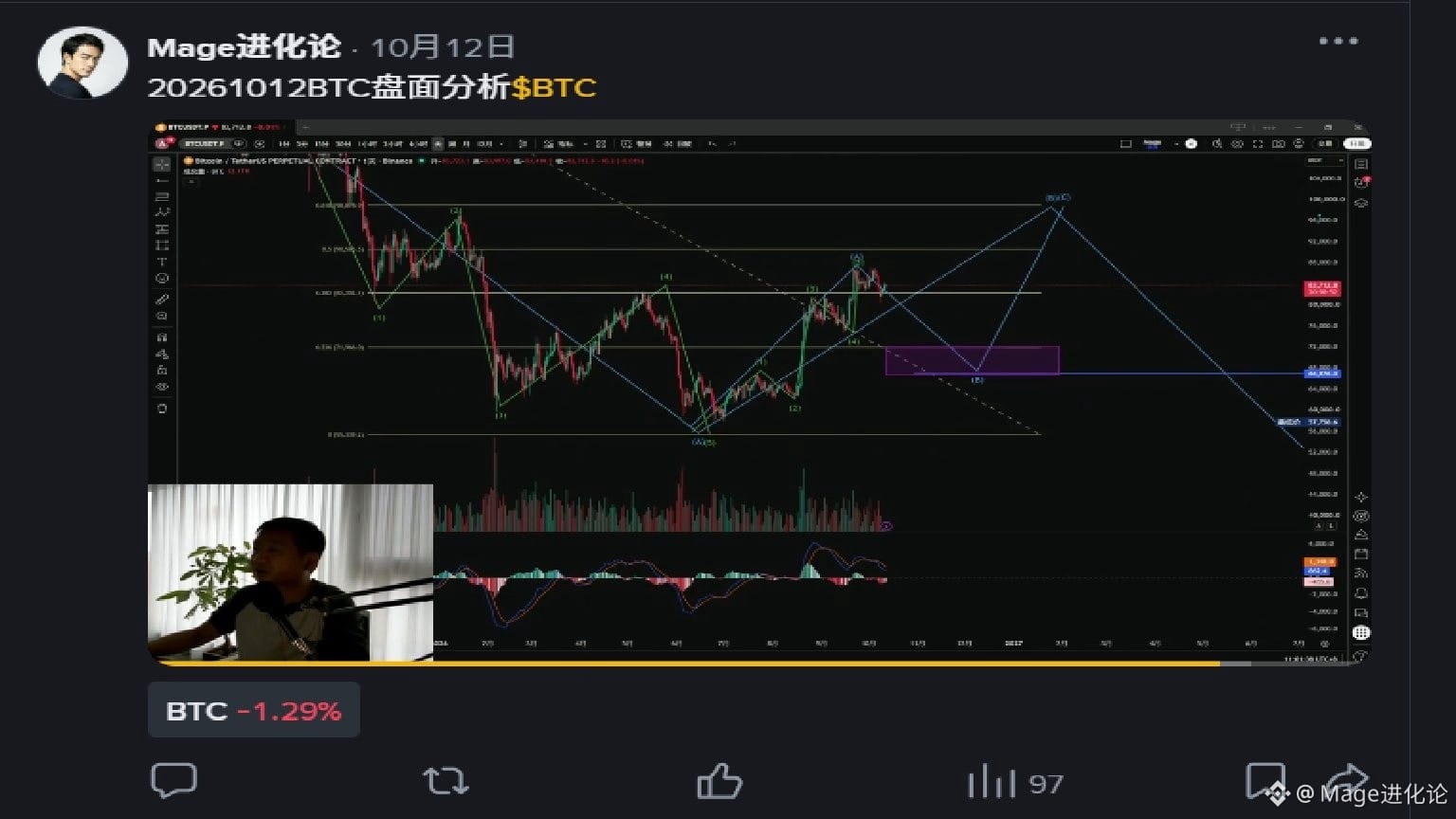
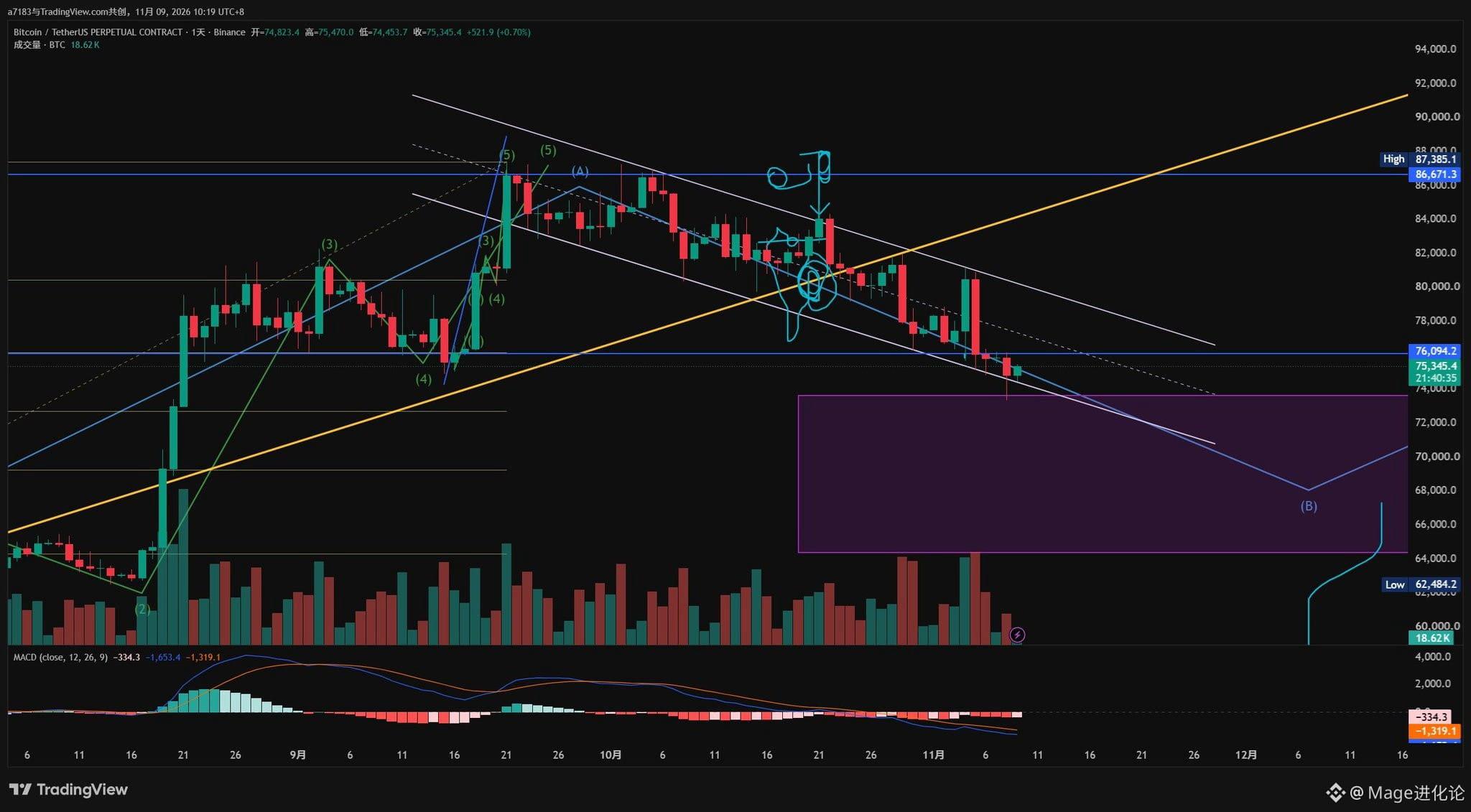
Guys, after a month of wobbling its way down, the market has finally reached the target zone from the first BTC market analysis I posted on this account in the Square. A month has flown by just like that. I just hope everyone can find an approach that works for them and survive in this market. There will always be opportunities. Keep going—we can encourage each other!
Guys, after a month of wobbling its way down, the market has finally reached the target zone from the first BTC market analysis I posted on this account in the Square. A month has flown by just like that. I just hope everyone can find an approach that works for them and survive in this market. There will always be opportunities. Keep going—we can encourage each other!
151
·
--
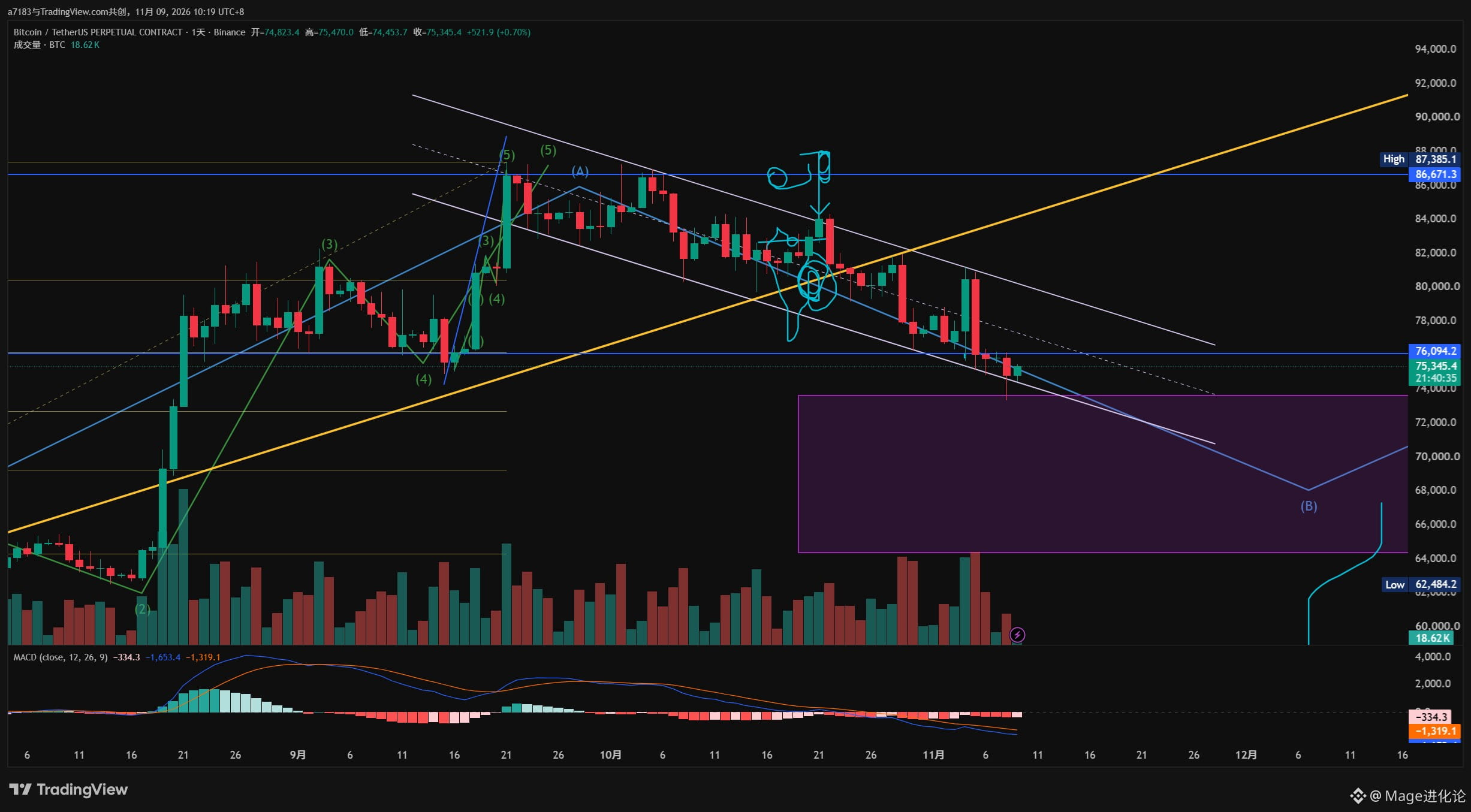
Guys, after a month of slowly drifting downward, the market has finally reached the target zone from the first BTC market analysis I posted on Plaza with this account. A month has flown by just like that. So really, after analyzing the market properly, there’s no need to trade frequently. You only need to trade 16 times in your life. If you can double your account each time, even if you start with just $100, after 16 trades that figure will have grown to an incredible $6.55 million. That’s the magic of compound interest. Making one solid trade a month is much better than placing dozens or even hundreds of trades a day. We all know what’s really going on behind the scenes, so I won’t spell it out. I just hope everyone can find an approach that works for them and survive in this market—there will always be opportunities. Let’s keep pushing and encourage one another.
$BTC
{spot}(BTCUSDT)
Guys, after a month of slowly drifting downward, the market has finally reached the target zone from the first BTC market analysis I posted on Plaza with this account. A month has flown by just like that. So really, after analyzing the market properly, there’s no need to trade frequently. You only need to trade 16 times in your life. If you can double your account each time, even if you start with just $100, after 16 trades that figure will have grown to an incredible $6.55 million. That’s the magic of compound interest. Making one solid trade a month is much better than placing dozens or even hundreds of trades a day. We all know what’s really going on behind the scenes, so I won’t spell it out. I just hope everyone can find an approach that works for them and survive in this market—there will always be opportunities. Let’s keep pushing and encourage one another.
$BTC
$BTC
180
Log in to explore more content
Join global crypto users on Binance Square
⚡️ Get latest and useful information about crypto.
💬 Trusted by the world’s largest crypto exchange.
👍 Discover real insights from verified creators.
Email / Phone number
Trending Topics
NvidiaLoses$2.7TrillionInMonthAndAHalf
2,132 views
51 Discussing
Nvidia’s $2.7 Trillion Wipeout: When Narrative Overrides Numbers 📉
Crypto With Faisal
·3 Likes
·1.5k views
CanBTCReboundAfterFallingBelow60K?
576,950 views
2,433 Discussing
GlobalStocksFaceLongestLosingStreakSince2023
197,351 views
1,679 Discussing