
Cruise橘子哥
1.4k Posts
Cruise橘子哥
Report
Block User
WEB3 Builder|努力提高认知、ing .🔸🔶 |热爱搞钱,又菜又爱玩|加密赚过超10万刀、合约「破产」后 2025 年重新开始
Open Trade
High-Frequency Trader
9.3 Years
323 Following
3.1K+ Followers
978 Liked
Posts
Portfolio
All
Quotes
Videos
Live
PINNED
·
--
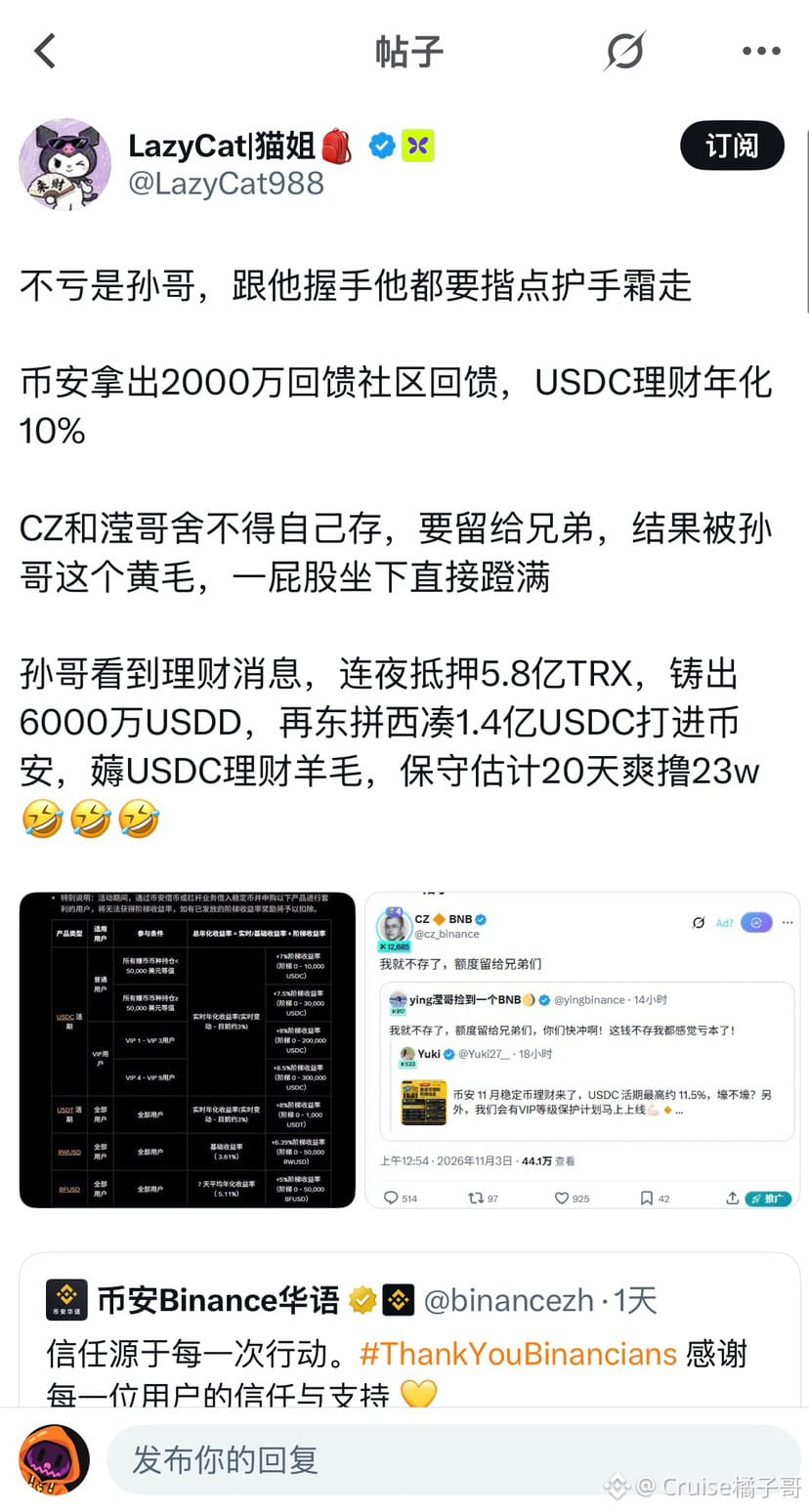
Hahaha, I'm dying—Sun's the man, as always. Sun has milked Binance dry.
Big Cousin says: I'm not depositing after all; I'll leave the quota for the brothers.
Sun: 140 million USDC rushing into Binance Earn—bro, I'm here!
Hahaha, I'm dying—Sun's the man, as always. Sun has milked Binance dry.
Big Cousin says: I'm not depositing after all; I'll leave the quota for the brothers.
Sun: 140 million USDC rushing into Binance Earn—bro, I'm here!
Big Cousin says: I'm not depositing after all; I'll leave the quota for the brothers.
Sun: 140 million USDC rushing into Binance Earn—bro, I'm here!
41
1
43
126k
·
--
$SOL SOL performed pretty well—know when to take your profits. I’m going to get a good night’s sleep tonight, hehe.
$SOL SOL performed pretty well—know when to take your profits. I’m going to get a good night’s sleep tonight, hehe.
155
·
--
The biggest deal in cybersecurity history was sealed tonight: CrowdStrike is acquiring Zscaler in an all-stock deal at an enterprise value of $43.9 billion, with each Zscaler share exchanged for 1.135 CrowdStrike shares. The announcement touted a 34% premium, but the buyer took a hit in the first ten minutes after the market opened. Recalculate the deal, and that premium is down to just 22%, haha.
Zscaler’s stock is up, but what shareholders will get is CrowdStrike stock. When the buyer’s shares fall, the value of the offer shrinks with them—those gains look borrowed. The deal isn’t scheduled to close until the second half of next year, and that remaining premium of just over 20% could get eaten away even further with a little movement in either stock.
Zscaler’s stock is up, but what shareholders will get is CrowdStrike stock. When the buyer’s shares fall, the value of the offer shrinks with them—those gains look borrowed. The deal isn’t scheduled to close until the second half of next year, and that remaining premium of just over 20% could get eaten away even further with a little movement in either stock.
15
·
--
Bearish
Let's make a prediction: how will U.S. stocks move tonight?
Will they rally or tank?#感恩节交易周开启,市场能否迎来修复性反弹?
Let's make a prediction: how will U.S. stocks move tonight?
Will they rally or tank?#感恩节交易周开启,市场能否迎来修复性反弹?
Will they rally or tank?#感恩节交易周开启,市场能否迎来修复性反弹?

15
·
--
Storage stocks were all down 12% to 16% at Friday’s close, but they’re the strongest premarket rebounders today: Micron, SanDisk, Seagate, and Western Digital are all up 7% to 8%, putting them among the biggest bounce-back names.
There’s a good reason for such a strong rebound. Storage is now a bottleneck in the AI supply chain, and several major U.S. companies are already discussing contracts much longer than the current three-to-five-year deals, with talks stretching as far as 20 years. They’re also bringing equity investments and joint ventures to build factories into the mix. Samsung and SK Hynix’s investment plans run through 2040, and there’s so much money involved they could buy out upstream equipment and materials suppliers outright. After Friday’s selloff, the first instinct was probably to scoop up storage stocks.
Whether the rally holds depends on whether trading volume picks up at tonight’s open, haha.
442
·
--
Anthropic raised $100 billion and secured the biggest IPO in U.S. stock market history, but the bond market quickly poured cold water on the news: the three major rating agencies will most likely give it a BB rating, two notches below investment grade. If it actually issues bonds, it would be the largest junk-rated issuer in U.S. history, taking that title from Hilton Hotels.
And not without reason: the company was founded less than six years ago, is not yet profitable, and has nevertheless committed to spending $900 billion on computing power over the next few years. Why would the bond market price its debt as investment grade? Before a rating is finalized, this kind of debt will probably have to take a circuitous route through chip-specific financing and structured instruments, which will only make it more expensive. It’s a little odd to see stocks and bonds assign two different valuations to the same company, haha.
And not without reason: the company was founded less than six years ago, is not yet profitable, and has nevertheless committed to spending $900 billion on computing power over the next few years. Why would the bond market price its debt as investment grade? Before a rating is finalized, this kind of debt will probably have to take a circuitous route through chip-specific financing and structured instruments, which will only make it more expensive. It’s a little odd to see stocks and bonds assign two different valuations to the same company, haha.
101
·
--
On Sunday, Trump posted on Truth Social urging Nvidia’s board to bring Jensen Huang back, saying it would be the best choice for both Nvidia and the United States. Nvidia jumped 7% in overnight trading, the Philadelphia Semiconductor Index bounced back, and TSMC also surged after hours.
That was quite a quick reversal. The board had only approved Huang’s resignation as CEO on November 12, and then on Friday came the SEC accounting investigation, sending the stock down 14% in a day. The market had basically written off any chance of his return. But Treasury Secretary Bessent also softened his tone on Sunday: a week ago he was calling for a complete overhaul and an outside CEO; now he says he wouldn’t oppose Huang coming back. Nvidia’s board, though, only said last week that it had no intention of reinstating him. Betting markets put the odds of his return at less than 20%, so this overnight move looks more like people trying to get in early. There hasn’t been any official statement, has there?
That was quite a quick reversal. The board had only approved Huang’s resignation as CEO on November 12, and then on Friday came the SEC accounting investigation, sending the stock down 14% in a day. The market had basically written off any chance of his return. But Treasury Secretary Bessent also softened his tone on Sunday: a week ago he was calling for a complete overhaul and an outside CEO; now he says he wouldn’t oppose Huang coming back. Nvidia’s board, though, only said last week that it had no intention of reinstating him. Betting markets put the odds of his return at less than 20%, so this overnight move looks more like people trying to get in early. There hasn’t been any official statement, has there?
213
·
--
South Korea held an emergency meeting on Sunday afternoon, and the market stabilization fund said it was ready to step in at any time. But the KOSPI still fell at Monday’s open, dropping more than 4% at one point during the session, with Samsung Electronics and SK Hynix leading the losses. The index had just fallen 5% last Friday.
The rescue measures are no small matter: starting tomorrow, the daily limit on share buybacks by listed companies will be eased, illegal short selling will be scrutinized, and the procedures to activate the stabilization fund will be completed. But no money has actually come in yet. The 10 trillion won fund set up in 2020 was never used in the end, either. Jefferies took the opportunity to downgrade Korean stocks to underweight, while Yuanta went further and cut its lower-end forecast for next year’s KOSPI to 4,000.
The rescue measures are no small matter: starting tomorrow, the daily limit on share buybacks by listed companies will be eased, illegal short selling will be scrutinized, and the procedures to activate the stabilization fund will be completed. But no money has actually come in yet. The 10 trillion won fund set up in 2020 was never used in the end, either. Jefferies took the opportunity to downgrade Korean stocks to underweight, while Yuanta went further and cut its lower-end forecast for next year’s KOSPI to 4,000.
182
·
--
Dell, HPE, Lenovo, and Supermicro have started going back and revising their prices. Even AI server orders signed months ago are being hit with extra charges, with increases of up to 45%. These companies assemble complete systems for data centers, and have to pay upfront for GPUs, memory, and networking equipment. When prices go up upstream, they’re the ones left holding the bill.
Memory prices have quadrupled since early 2024, and the cost of a complete system has become impossible to absorb, so they can only pass it on to customers. The worst case is Dell: a quantitative trading firm has taken it to court in Ireland over a server order worth more than $500 million. It’s pretty unusual for a company to re-quote a contract after it’s been signed.
Dell fell 11% on Friday, dragging HPE and Supermicro down with it. HPE reports earnings after the market closes Monday. No matter how many orders it lands, it won’t count for much if it can’t protect its gross margins.
206
·
--
South Korea held an emergency financial meeting on Sunday afternoon, putting its stock market stabilization fund on standby, ready to be deployed at any time. The KOSPI plunged more than 5% on Friday, and is now down 45% from its June peak. The urgency of the meeting gives you an idea of how worried they are.
Starting on the 24th, the daily buyback reporting limit for listed companies will be raised for three months, while illegal short selling will also be subject to a special three-month monitoring program. Taiwan is going a step further, banning short selling below the previous close starting tomorrow. Jefferies downgraded Korean stocks to underweight and upgraded India to overweight. The question they’re watching is whether that AI capex spending will pay off. When markets open tomorrow, the first thing to watch is whether South Korea can hold steady.
Starting on the 24th, the daily buyback reporting limit for listed companies will be raised for three months, while illegal short selling will also be subject to a special three-month monitoring program. Taiwan is going a step further, banning short selling below the previous close starting tomorrow. Jefferies downgraded Korean stocks to underweight and upgraded India to overweight. The question they’re watching is whether that AI capex spending will pay off. When markets open tomorrow, the first thing to watch is whether South Korea can hold steady.
76
·
--
$MEGA Mega is something else—it drops without hesitation, but climbs so slowly. So boring. Can't it just steadily go up? Let's go for it!
$MEGA Mega is something else—it drops without hesitation, but climbs so slowly. So boring. Can't it just steadily go up? Let's go for it!
457
·
--
Nvidia closed at $125 last Friday, down 23% for the week. It lost nearly $900 billion in market value in its worst week since October 2008, and fell for seven straight trading days. The trigger was a Reuters report that the SEC was investigating its accounting practices—but it didn’t say what the investigation was about or when it began.
What the market is really worried about is that whole “circular financing” arrangement. Chips get sold, then the money circles back to help customers pay for them; the customers’ data center projects are even used as collateral. When regulators start asking questions about which period the revenue belongs in and how it’s recorded on the books, things get hard to explain. After-hours trading over the weekend did turn green, though, and AI hardware stocks rose together—it looked like someone was trying to jump on this rebound.
What the market is really worried about is that whole “circular financing” arrangement. Chips get sold, then the money circles back to help customers pay for them; the customers’ data center projects are even used as collateral. When regulators start asking questions about which period the revenue belongs in and how it’s recorded on the books, things get hard to explain. After-hours trading over the weekend did turn green, though, and AI hardware stocks rose together—it looked like someone was trying to jump on this rebound.
206
·
--
Holding $SOL 1.1K USDT
$SOL
Honestly! Do you still believe in Sol? It was once the king of MEME chains.
$SOL
Honestly! Do you still believe in Sol? It was once the king of MEME chains.
Honestly! Do you still believe in Sol? It was once the king of MEME chains.
154
·
--
Over the weekend on X, Musk threw cold water on AI, saying the industry could face a serious funding crunch next year. His reasoning is pretty practical: powering, cooling, and keeping such a massive amount of computing capacity running smoothly is hard in itself. If it takes the whole industry even a few months to go from paying for compute to actually making money from the equipment, it could need to spend hundreds of billions more just on working capital.
The debate was sparked by Keras creator Chollet, who insisted that spot prices for GPUs are still rising, HBM and DRAM capacity is booked through 2029, and demand hasn’t peaked. Both sides have a point. But the market has already cast its vote: AI hardware stocks fell 10% in a week, and the Nasdaq gave back all of its gains for the year. Finding the money is now even harder than finding the compute.
The debate was sparked by Keras creator Chollet, who insisted that spot prices for GPUs are still rising, HBM and DRAM capacity is booked through 2029, and demand hasn’t peaked. Both sides have a point. But the market has already cast its vote: AI hardware stocks fell 10% in a week, and the Nasdaq gave back all of its gains for the year. Finding the money is now even harder than finding the compute.
73
·
--
On the evening of the 21st, missiles from Iran’s Revolutionary Guard hit a radar at a U.S. military base in Bahrain. Iran said it had struck the radar of a Patriot system, claiming that a U.S. drone had entered Iranian airspace. That same day, Trump said on Fox that he wanted to sign a permanent agreement with Iran and wasn’t even considering regime change. Firing while negotiating—it all seems pretty contradictory, doesn’t it?
But the after-hours market reaction didn’t quite follow the script: Brent crude rose by less than 0.2%, barely holding above $90, while Bitcoin bounced back above $60,000. Over 24 hours, 170,000 traders were liquidated. The base was hit, yet oil prices barely budged—the market clearly isn’t taking the threat of a Strait blockade seriously. Iran’s foreign minister has also said that the strait will reopen if the terms are agreed on. Now it’s a matter of whether that permanent agreement gets signed. The missiles, oddly enough, aren’t the main story this time. Haha.
But the after-hours market reaction didn’t quite follow the script: Brent crude rose by less than 0.2%, barely holding above $90, while Bitcoin bounced back above $60,000. Over 24 hours, 170,000 traders were liquidated. The base was hit, yet oil prices barely budged—the market clearly isn’t taking the threat of a Strait blockade seriously. Iran’s foreign minister has also said that the strait will reopen if the terms are agreed on. Now it’s a matter of whether that permanent agreement gets signed. The missiles, oddly enough, aren’t the main story this time. Haha.
14
·
--
Bearish
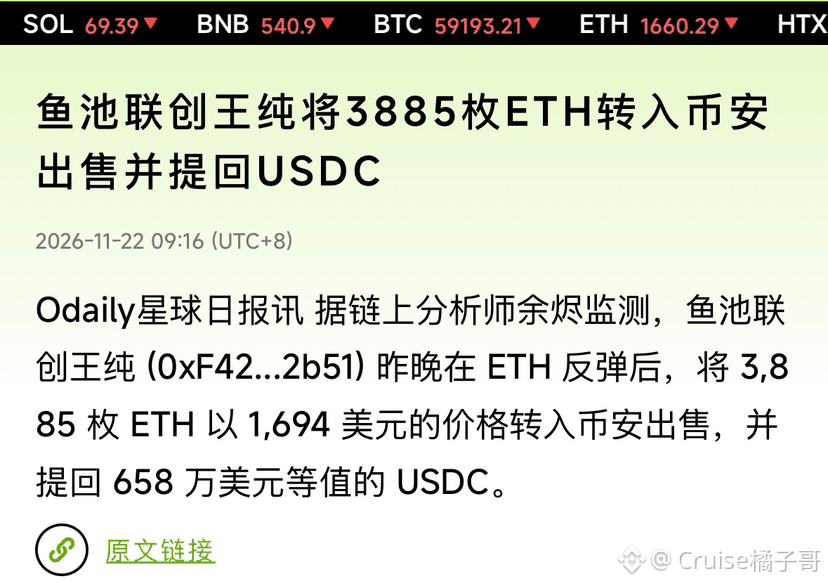
Even the big players are trading in and out—why do I feel like prices are still going to fall?
Looks like another drop could start next Monday 🙃 There are already signs of it. Chun just bought the dip, saw a little gain, and then ran for the exit. What the heck!
I really hope not. The global financial markets all need a breather. Taking a breather could mean moving sideways—it doesn't have to be only up or down.
If even one market can hold steady, I'll be happy.
Hang in there, market.
Hang in there, Bitcoin, Nasdaq, Nikkei, gold, silver, futures, my beloved A-shares~ all you financial daddies.
277
·
--
U.S. stocks had just been hammered by AI concerns, and Amazon fell 4% last Friday. Then reports emerged that it was close to acquiring Decart for nearly $7.5 billion. The Israeli company was founded by three engineers and was valued at just $4 billion when it raised funding in May—less than six months later, its valuation has nearly doubled.
Decart sells software that helps AI models run with less computing power, and it was also an early user of Amazon’s Trainium3 chips. Nvidia has invested in the company too, so now its buyer is one of Nvidia’s biggest rivals—that’s a pretty delicate situation. The Financial Times says a deal could be finalized as early as early next week, though talks could still fall apart. The market is slashing AI valuations while Amazon is snapping up a bargain; the two sides seem completely out of sync.
Decart sells software that helps AI models run with less computing power, and it was also an early user of Amazon’s Trainium3 chips. Nvidia has invested in the company too, so now its buyer is one of Nvidia’s biggest rivals—that’s a pretty delicate situation. The Financial Times says a deal could be finalized as early as early next week, though talks could still fall apart. The market is slashing AI valuations while Amazon is snapping up a bargain; the two sides seem completely out of sync.
1
1
434
·
--
Verified
Gold prices broke through four major round-number thresholds in a single week, with spot gold falling to just over $3,500 an ounce. It dropped nearly 9% in a week, wiping out all the gains made since the start of the year and hitting its lowest level since September last year. Gold shops have been adjusting prices even faster than the market: 24-karat gold jewelry now costs just over 1,050 yuan per gram.
You’d think nobody would be buying after a drop like that, right? But gold shops are packed. One counter at Yuyuan sold more than 60 gold bangles in a single morning. Laomiao is offering discounts by the gram, and staff say they expect another rush of customers this weekend. People scramble to buy when prices fall, and they scramble when prices rise too. After all these years, that really hasn’t changed, huh?
Anyone who bought in near the peak is feeling the pain now, with the value of their holdings down sharply from the high at the start of the year. But much of this wave of buying in China is driven by wedding-related demand—those buyers aren’t in the same camp as investors. Whether gold can hold above 3,500 yuan on Monday will tell us whether jumping in now means grabbing a bargain or trying to catch a falling knife.
1k
·
--
Spot gold broke through four consecutive round-number levels in a single week, closing Friday above $3,530—more than $2,000 below its peak at the start of the year. This doesn’t look like a pullback so much as a mad scramble for the exits.
Jewelry shops, meanwhile, were bustling. Prices for 24-karat gold jewelry came down, and one counter in Shanghai sold more than 60 bracelets in a single morning. Banks were busy issuing risk warnings—ICBC and China Merchants Bank both put out notices—but the queues of people buying gold were no shorter. Maybe fear and greed were jostling at the same counter.
Jewelry shops, meanwhile, were bustling. Prices for 24-karat gold jewelry came down, and one counter in Shanghai sold more than 60 bracelets in a single morning. Banks were busy issuing risk warnings—ICBC and China Merchants Bank both put out notices—but the queues of people buying gold were no shorter. Maybe fear and greed were jostling at the same counter.
214
·
--
Bearish
My account is now fully invested in spot Bitcoin, Ethereum, SOL, and BNB. Then last night I wanted to buy a little more, so I threw in $500 to try to catch the dip. But when I checked today, the $500 I put in yesterday had vanished, and I was down another $500 on top of that. Damn! This is exhausting.
My account is now fully invested in spot Bitcoin, Ethereum, SOL, and BNB. Then last night I wanted to buy a little more, so I threw in $500 to try to catch the dip. But when I checked today, the $500 I put in yesterday had vanished, and I was down another $500 on top of that. Damn! This is exhausting.

767
Log in to explore more content
Join global crypto users on Binance Square
⚡️ Get latest and useful information about crypto.
💬 Trusted by the world’s largest crypto exchange.
👍 Discover real insights from verified creators.
Email / Phone number
Trending Topics
NVIDIAReinstatesJensenHuangasCEO
77,904 views
825 Discussing
TradFi News | Nvidia Board Unanimously Reinstates Jensen Huang as CEO; Shares Jump 30% Premarket
Binance News
·39 Likes
·38.1k views
WillMarketsStageAThanksgivingReliefRally?
185,631 views
1,840 Discussing
WillOctCorePCEShiftFedHikeExpectations?
67,006 views
779 Discussing