
怪兽8号888-资讯收集箱
1.4k Posts

怪兽8号888-资讯收集箱
Report
Block User
每天更新热点,异动,盘面分析,每日总结,问就是网上扒的数据再加工给各位,哈哈!!
30 Following
120 Followers
116 Liked
Posts
All
Quotes
Just to mention it in passing, the thing on my mind most right now is this:
FN Express丨Did Trump’s third Meme coin dinner get gate-crashed on the cheap by the “short-selling army”?
I don’t think it’ll have much impact; just treat it as background information.
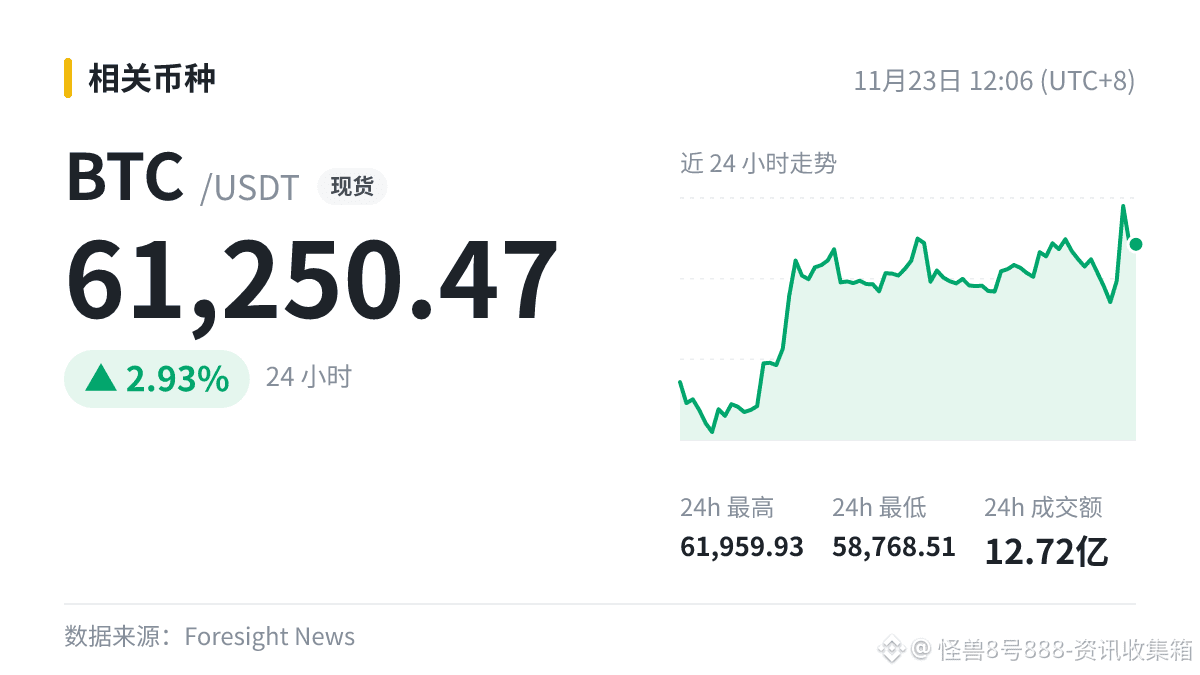
What do you think of the price trend for $BTC ?
The market moves fast, so don’t rush to conclusions.
FN Express丨Did Trump’s third Meme coin dinner get gate-crashed on the cheap by the “short-selling army”?
I don’t think it’ll have much impact; just treat it as background information.
What do you think of the price trend for $BTC ?
The market moves fast, so don’t rush to conclusions.
1
The latest news: here are a few key stories to help you get up to speed.
Market moves
$Unitree Robotics rose more than 10% intraday, with half-day trading volume reaching 3.141 billion yuan—30% more than its full-day volume last Friday. The humanoid robotics sector bucked the trend and strengthened even as the STAR 50 fell 2.65%, showing that investors are still paying close attention to robotics.
In a nutshell: It rose while the index fell, suggesting investors are picking their favorite stories. But a sharp one-day gain doesn’t make a trend, so think carefully before chasing it.
U.S. stock futures rose across the board: Nasdaq 100 futures gained 3.15%, S&P 500 futures rose 2.38% to top 7,100, and Dow futures climbed 1.71%. Sentiment overseas is upbeat, providing a tailwind for risk assets.
In a nutshell: Futures reflect expectations; they’re not a done deal. Don’t mistake premarket sentiment for the closing result.
AI watch
Donald Trump called on Truth Social for Nvidia’s board to rehire Jensen Huang, while Treasury Secretary Scott Bessent also switched to publicly backing him. Prediction markets put the odds of Huang becoming Nvidia’s “new CEO” at 18%, up from 10%—a pretty dramatic 180-degree shift in political and business attitudes in just one week.
In a nutshell: Prediction markets are just a barometer of sentiment. An 18% chance doesn’t mean it will happen. It’s fine to watch the drama, but don’t bet as if it’s a sure thing.
Meta Chief AI Officer Alexandr Wang declared that “superintelligence is coming,” citing Claude’s involvement in proving the Riemann hypothesis as a signal and saying the problem is harder than building an atomic bomb. The AI industry’s claims are getting ever grander.
In a nutshell: The Riemann hypothesis has been a tough nut for mathematicians to crack for 167 years. Take its use as a marketing hook with a grain of salt.
On-chain activity
F2pool co-founder Wang Chun withdrew 7,186 $ETH from Binance at an average price of $1,634 while ETH was falling, then deposited 5,685 $ETH back at an average price of $1,696 after the rebound—a pretty decisive buy-low, sell-high move.
In a nutshell: Big players’ swing trades are backed by discipline and deep pockets. Ordinary traders who copy them can easily end up holding the bag. Position management matters more than picking a direction.
A whale deposited 3.2 million $USDC into Hyperliquid and opened a 20x leveraged long position of 138,893 SILVER, worth about $5.86 million, with a liquidation price of $19.28. Once leverage is involved, the margin for error gets very thin.
In a nutshell: With 20x leverage, even a small move in the wrong direction could trigger liquidation. This kind of position is essentially a race against time.
Project updates
The Pomelo mainnet upgrade for Bitcoin layer-2 network Citrea will begin in 12 hours. The upgrade moves the proving system to SP1 and includes protocol fixes. Infrastructure may be briefly offline for a few minutes during the process.
In a nutshell: Upgrades are routine for layer-2 projects, but since this one involves migrating the proving system, it’s best to confirm the upgrade is complete before interacting.
Do you think this robotics rally is a sentiment-driven rebound or backed by fundamentals? Let’s talk in the comments.
1
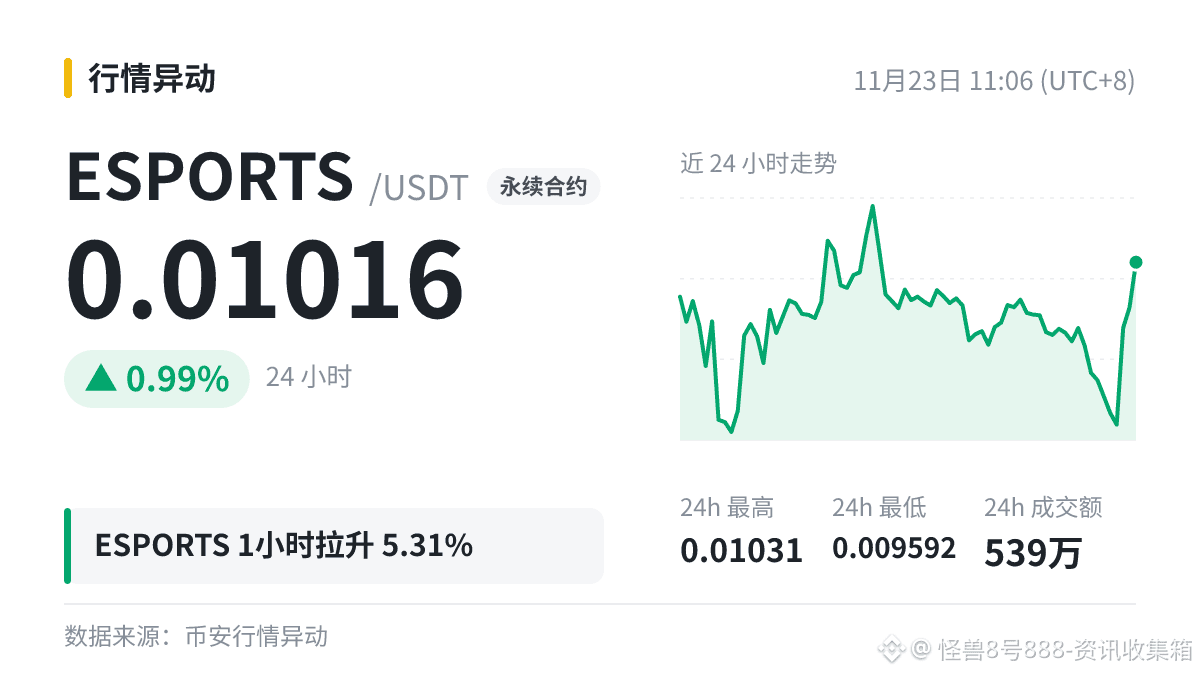
$ESPORTS 1 hours surged 5.31%—who's buying? 👀
Current price: 0.01016, 24h +0.99%.
I looked over the market, and there's only one thing I can say for sure: the pace is fairly restrained; it wasn't a sudden spike.
Do you think this is money flowing in or a short-term spark?
Markets carry risk, so trade with caution.
Current price: 0.01016, 24h +0.99%.
I looked over the market, and there's only one thing I can say for sure: the pace is fairly restrained; it wasn't a sudden spike.
Do you think this is money flowing in or a short-term spark?
Markets carry risk, so trade with caution.
7
The latest news, organized by topic to help you make sense of the headlines from the past hour.
I. AI and Chips
Headline: BofA says chip stocks won’t truly bottom until interest rates peak.
Take: When financing costs rise, cloud providers may scale back AI spending, and capital expenditures could be cut by 20% in 2027. It’s a reminder that the AI narrative can’t escape the constraints of interest rates—don’t focus only on the story and ignore the costs.
Headline: The “proof” of the Riemann hypothesis is stirring up controversy again, with mathematicians questioning whether a key definition is going in circles.
Take: 17 million lines of Lean code sounds daunting, but researchers say there are problems with the definitions. Even machine verification may not make it meaningful. A quick explainer: formal verification checks whether the logic is correct, not whether the question itself is well-posed.
II. Markets and Trading
Headline: Taiwan’s weighted index reversed its losses, rising 1.6% most recently.
Take: It was weak in early trading, then turned positive. That suggests money is shifting back and forth in regional markets as investors search for direction, and short-term sentiment remains quite volatile.
Headline: South Korea announced market-support measures, but the KOSPI still fell more than 4% at one point on Monday.
Take: A stabilization fund and relaxed buyback rules are a “bandage,” not a “shot in the arm.” The market’s reaction shows that confidence will take time to recover. Don’t treat policy announcements as a guarantee of a rebound.
Headline: Hong Kong-listed AI stocks opened lower and climbed; MINIMAX and Zhipu were up more than 6% at one point intraday.
Take: MINIMAX is now up 2.73% and Zhipu 3.11%. AI stocks are still drawing interest in Hong Kong, but the recovery from a weak open also shows there’s plenty of disagreement. Think through the volatility before chasing a move.
III. Crypto
Headline: A new wallet that built a $7.15 million $PEPE position over two days has added to it again, with cumulative unrealized losses of about $777,000.
Take: It withdrew about 667.3 billion more $PEPE over the past 12 hours. Buying more as the price falls is a classic averaging-down strategy, but the unrealized losses are right there. Meme coins are volatile, so consider whether you can stomach the risk before following the crowd.
IV. Companies and People
Headline: Trump urged Jensen Huang to return to $NVDA, Bessent has also softened his stance, and petition signatures have topped 200,000.
Take: Political pressure is building, but a CEO’s tenure is ultimately a matter of corporate governance. The number of petition signatures isn’t the same as a board vote. It’s fine to watch the drama, but don’t treat it as a signal about the company’s fundamentals.
One question for you: Which of these topics concerns you more—the interest-rate implications for AI chips, or the risks of buying more $PEPE against the trend?
The latest news, organized by topic to help you make sense of the headlines from the past hour.
I. AI and Chips
Headline: BofA says chip stocks won’t truly bottom until interest rates peak.
Take: When financing costs rise, cloud providers may scale back AI spending, and capital expenditures could be cut by 20% in 2027. It’s a reminder that the AI narrative can’t escape the constraints of interest rates—don’t focus only on the story and ignore the costs.
Headline: The “proof” of the Riemann hypothesis is stirring up controversy again, with mathematicians questioning whether a key definition is going in circles.
Take: 17 million lines of Lean code sounds daunting, but researchers say there are problems with the definitions. Even machine verification may not make it meaningful. A quick explainer: formal verification checks whether the logic is correct, not whether the question itself is well-posed.
II. Markets and Trading
Headline: Taiwan’s weighted index reversed its losses, rising 1.6% most recently.
Take: It was weak in early trading, then turned positive. That suggests money is shifting back and forth in regional markets as investors search for direction, and short-term sentiment remains quite volatile.
Headline: South Korea announced market-support measures, but the KOSPI still fell more than 4% at one point on Monday.
Take: A stabilization fund and relaxed buyback rules are a “bandage,” not a “shot in the arm.” The market’s reaction shows that confidence will take time to recover. Don’t treat policy announcements as a guarantee of a rebound.
Headline: Hong Kong-listed AI stocks opened lower and climbed; MINIMAX and Zhipu were up more than 6% at one point intraday.
Take: MINIMAX is now up 2.73% and Zhipu 3.11%. AI stocks are still drawing interest in Hong Kong, but the recovery from a weak open also shows there’s plenty of disagreement. Think through the volatility before chasing a move.
III. Crypto
Headline: A new wallet that built a $7.15 million $PEPE position over two days has added to it again, with cumulative unrealized losses of about $777,000.
Take: It withdrew about 667.3 billion more $PEPE over the past 12 hours. Buying more as the price falls is a classic averaging-down strategy, but the unrealized losses are right there. Meme coins are volatile, so consider whether you can stomach the risk before following the crowd.
IV. Companies and People
Headline: Trump urged Jensen Huang to return to $NVDA , Bessent has also softened his stance, and petition signatures have topped 200,000.
Take: Political pressure is building, but a CEO’s tenure is ultimately a matter of corporate governance. The number of petition signatures isn’t the same as a board vote. It’s fine to watch the drama, but don’t treat it as a signal about the company’s fundamentals.
One question for you: Which of these topics concerns you more—the interest-rate implications for AI chips, or the risks of buying more $PEPE against the trend?
29
Rhythm 11.23: Key Focus
$BTC 60852.52, 24h +1.19%. Whether this affects expectations going forward depends on whether the market agrees. It doesn't make for comfortable reading, but market movements have never been determined by a single piece of news.
The above is for informational purposes only and does not constitute investment advice.
28
Honestly, when I first got into this, I’d get excited as soon as I saw a move like this. These days, I’d take a look first.
$IDOL 5-minute rally of 2.25%, now at 0.01557.
Don’t mistake a temporary fluctuation for a trend, and don’t mistake a trend for an overnight market move.
Stay rational; don’t get carried away.
$IDOL 5-minute rally of 2.25%, now at 0.01557.
Don’t mistake a temporary fluctuation for a trend, and don’t mistake a trend for an overnight market move.
Stay rational; don’t get carried away.
45
The latest news, a few stories bundled together—the flavor is pretty intense.
On the AI infrastructure front, server makers are raising prices just months after signing contracts, by as much as 45%. The cost of machines built with $NVDA chips is being passed straight downstream. Take: Contracts are just paper; the price hikes are real. Data center bosses may have to redo their budgets overnight.
In the capital markets, Anthropic rose 17% on its first day of trading, setting a record for the biggest IPO. Then the underwriters fully exercised the greenshoe option in a single trading session, raising an additional $12.2 billion. Later, the stock briefly fell to within five cents of its $83 offering price, prompting accusations that the company was “in a hurry to take the money.” Take: The drums haven’t even cooled down, and they’re already reaching for the cash bag. That really does look a bit hasty.
On the macro front, Bill Ackman is urging the Fed to stop clinging to its 2% inflation target, arguing that 3% is more realistic. Goldman Sachs, meanwhile, warns that the Nasdaq 100 has fallen 19.8% from its peak, nearing bear-market territory—but the true bottom may still be ahead. Take: One side is urging the central bank to ease up, while the other says not to rush into buying the dip. The finance world’s professional mouthpieces live up to their reputation.
There’s been a crypto security incident: around 545.6 Blur Pool tokens, $ETH , are permanently locked. They can’t be withdrawn from the contract, affecting projects including Moonbirds and Milady. Take: This is really locked—so locked even your own mother couldn’t open it.
And one last bit of dark humor: TRUMP is planning a second holders’ dinner, and the entry threshold is now just $518 worth of $TRUMP, even though the token is down 98.8% from its all-time high. Take: Same old dinner, but the coin has already been on a roller coaster.
One final question: With AI price hikes, a greenshoe sprint, and a market bottom that may still be ahead all at the same table, would you rather watch the show or make a move?
The latest news, a few stories bundled together—the flavor is pretty intense.
On the AI infrastructure front, server makers are raising prices just months after signing contracts, by as much as 45%. The cost of machines built with $NVDA chips is being passed straight downstream. Take: Contracts are just paper; the price hikes are real. Data center bosses may have to redo their budgets overnight.
In the capital markets, Anthropic rose 17% on its first day of trading, setting a record for the biggest IPO. Then the underwriters fully exercised the greenshoe option in a single trading session, raising an additional $12.2 billion. Later, the stock briefly fell to within five cents of its $83 offering price, prompting accusations that the company was “in a hurry to take the money.” Take: The drums haven’t even cooled down, and they’re already reaching for the cash bag. That really does look a bit hasty.
On the macro front, Bill Ackman is urging the Fed to stop clinging to its 2% inflation target, arguing that 3% is more realistic. Goldman Sachs, meanwhile, warns that the Nasdaq 100 has fallen 19.8% from its peak, nearing bear-market territory—but the true bottom may still be ahead. Take: One side is urging the central bank to ease up, while the other says not to rush into buying the dip. The finance world’s professional mouthpieces live up to their reputation.
There’s been a crypto security incident: around 545.6 Blur Pool tokens, $ETH , are permanently locked. They can’t be withdrawn from the contract, affecting projects including Moonbirds and Milady. Take: This is really locked—so locked even your own mother couldn’t open it.
And one last bit of dark humor: TRUMP is planning a second holders’ dinner, and the entry threshold is now just $518 worth of $TRUMP , even though the token is down 98.8% from its all-time high. Take: Same old dinner, but the coin has already been on a roller coaster.
One final question: With AI price hikes, a greenshoe sprint, and a market bottom that may still be ahead all at the same table, would you rather watch the show or make a move?
70
The crypto market mini-drama has a new update: everyone on the plaza is talking about #香港代币化存款拟不列虚拟资产 , and I'm quietly watching from the sidelines.
$BTC 24h +1.54%. Do you think it will go up or down next? Leave a comment and vote.
#BTC
This isn't financial advice; make your own decisions.
The crypto market mini-drama has a new update: everyone on the plaza is talking about #香港代币化存款拟不列虚拟资产 , and I'm quietly watching from the sidelines.
$BTC 24h +1.54%. Do you think it will go up or down next? Leave a comment and vote.
#BTC
This isn't financial advice; make your own decisions.
$BTC 24h +1.54%. Do you think it will go up or down next? Leave a comment and vote.
#BTC
This isn't financial advice; make your own decisions.
86
$IDOL 5 minutes -2.62%, current price 0.0147. If you're itching to buy the dip, ask yourself these three questions first:
① The 24h low is 0.01342 and is holding below—has a stabilization signal appeared?
② It's already down -59.67% over 24h. Is the decline still continuing?
③ Have you planned your stop-loss? If your dip-buying call is wrong, how will you exit?
If you haven't thought it through, it's better to wait and see.
A big drop doesn't mean the bottom is in. Be patient and wait for a signal.
Just my personal opinion; not a basis for buying or selling.
3
The latest news: your seasoned market veteran is here to break down these headlines and sort them by topic.
On unusual market moves, $HXSCL (SK Hynix) is expected to open down about 5.2%, while most U.S. stocks are gaining in premarket trading. Take: Korean stocks took the first hit, while U.S. stocks are holding on. This kind of divergence is nothing new to a seasoned market veteran. Don’t rush to buy the dip—first see whether sentiment settles down.
Meanwhile, the “on-chain Nasdaq,” Trade.xyz, used perpetual contracts to price assets ahead of time over the weekend. Popular U.S. stock names were mostly stronger than at Friday’s close after hours, and are expected to open slightly higher in Monday’s premarket. Take: You can trade even when the broader market is closed for the weekend, so price discovery is faster—but you’ll need to judge the liquidity for yourself. Don’t treat premarket prices as gospel.
On macro policy, U.S. Treasury Secretary Bessent said the market selloff was driven by factors including Fed comments and the midterm elections. He also said there’s currently no answer on the matter of Nvidia selling chips, and that he’s staying in contact with interim management and lawyers to look into the compliance officer. Take: When officials speak up, they’re often explaining things after the fact. What really matters is how the compliance issue is resolved. A seasoned market veteran’s advice: don’t rush to take sides before the news is confirmed.
On individual stock ratings, Jefferies upgraded $SPCX (SpaceX) to Buy, with a price target of $210. Take: A single comment from a sell-side analyst can sway sentiment, but a rating is an opinion, not a guarantee. Before chasing the price higher, ask yourself whether you can stomach a pullback.
Bottom line, these headlines add up to this: while traditional markets are closed, on-chain markets are racing to price things in; macro figures are offering explanations, while stock ratings are adding fuel to the fire. A seasoned market veteran’s advice: understand the logic before you act, and think through your position size and risk first.
Which story are you more interested in? Want to dig into the rating on $SPCX , or watch whether weekend on-chain pricing and the opening price end up clashing?
7
$PROM 15 minutes -8.96%! The market is buzzing again—those watching the market, stay sharp!
Always think about how much you could lose before thinking about how much you could gain. Do you think this is a real breakout or just a temporary fluctuation?
The market changes in an instant, so don't rush to conclusions.
Always think about how much you could lose before thinking about how much you could gain. Do you think this is a real breakout or just a temporary fluctuation?
The market changes in an instant, so don't rush to conclusions.
5
The latest updates—here are a few quick headlines for you.
First, market moves: the on-chain Nasdaq, Trade.xyz, is using perpetual futures to price in Monday’s U.S. and Korean stock markets ahead of time. $HXSCL is expected to open down around 5.2%, while most popular U.S. stocks are strengthening premarket and the broader market is set to open slightly higher. A seasoned crypto trader’s take: price discovery can keep going even when markets are closed for the weekend. It’s novel, sure, but prices can get distorted when liquidity is thin, so don’t treat these pre-market prices as gospel. Elsewhere, over the past 24 hours, $BTC saw $232 million in liquidations across the crypto market—$161 million in shorts and $71.36 million in longs, with shorts taking the biggest hit. Put simply, those chasing the downside got another lesson in market sentiment. Liquidation data is always the best risk-management class.
On macro policy, U.S. Treasury Secretary Bessent attributed the market sell-off to factors including Federal Reserve remarks and the midterm elections. He also said there’s no answer yet on Nvidia chip sales, and that he’s in contact with the interim management team and lawyers. A seasoned trader’s take: officials can offer their explanations, but the market is watching their reactions. Take statements like these with a grain of salt—don’t treat them as trading signals. On ratings, Jefferies upgraded $SPCX to Buy, with a $210 price target. Institutional calls can be entertaining to watch, but how many times have ratings been proven wrong after the fact?
Crypto security is worth keeping an eye on. Cysic CEO Leo Fan pointed out that the public keys for addresses holding over 6 million BTC (31.2% of the circulating supply) have already been exposed on-chain. The key to addressing quantum threats is moving funds; upgrading cryptography alone isn’t enough. Frankly, a seasoned trader would say the quantum threat is more of a long-term concern for now, not a reason to think everything will collapse tomorrow. But the exposure of those address public keys is a real issue worth taking seriously—if you need to move your funds, start planning early.
In short, don’t get carried away by the market, don’t believe every headline, and leave yourself some room with your position sizes. After this wave of short liquidations, do you think sentiment will recover in the short term, or keep grinding lower?
9
Today's quote: The money you use to trade should ideally be money you can afford to lose without it affecting your life.
After saying that, I glanced at $XRP , quoted at 0.9247 (24h +0.21%).
DYOR, trade within your means.
Today's quote: The money you use to trade should ideally be money you can afford to lose without it affecting your life.
After saying that, I glanced at $XRP , quoted at 0.9247 (24h +0.21%).
DYOR, trade within your means.
After saying that, I glanced at $XRP , quoted at 0.9247 (24h +0.21%).
DYOR, trade within your means.
3
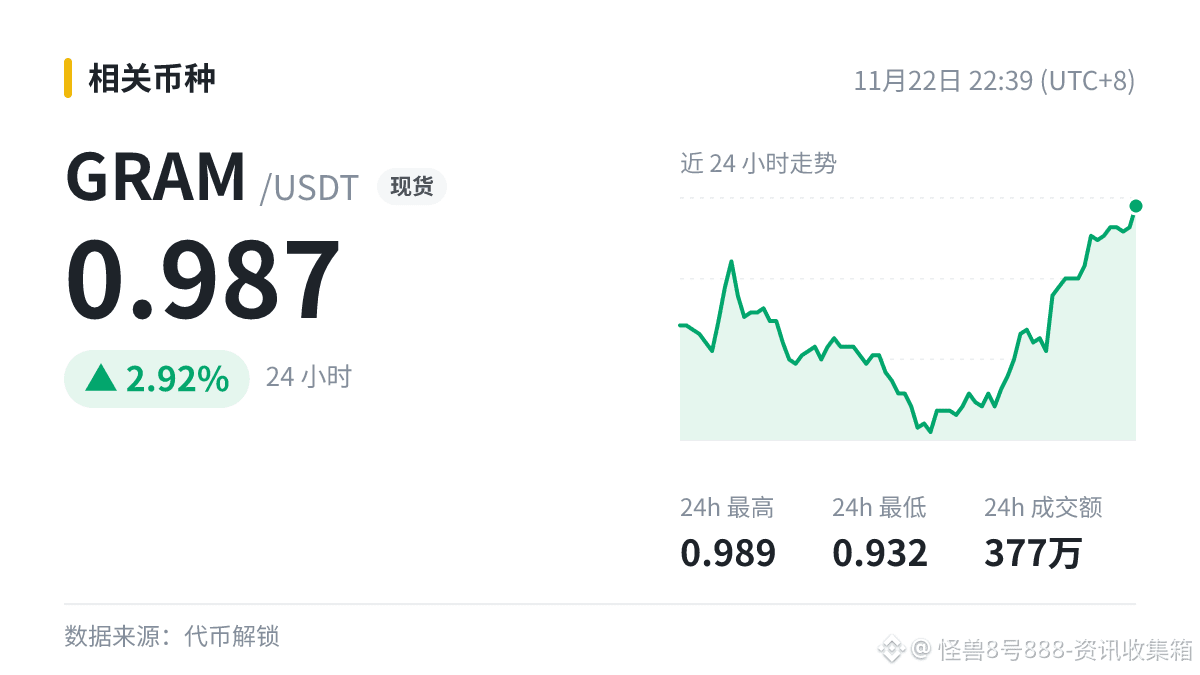
‼️ $GRAM will unlock approximately $35.05 million (1.27% of the circulating supply) on November 23, which is tomorrow.
The unlock is not a large share, but it’s still worth keeping an eye on the activity of related addresses. Are you buying this news?
NFA, do your own research.
‼️ $GRAM will unlock approximately $35.05 million (1.27% of the circulating supply) on November 23, which is tomorrow.
The unlock is not a large share, but it’s still worth keeping an eye on the activity of related addresses. Are you buying this news?
NFA, do your own research.
The unlock is not a large share, but it’s still worth keeping an eye on the activity of related addresses. Are you buying this news?
NFA, do your own research.
5
The latest updates—here are a few things to catch you up on.
On the public-chain front, Base lead Jesse Pollak said the $BASE ecosystem is still weighing whether to launch a token, but there’s no rush. They don’t want market noise to throw them off course. It’s a steady approach: grow the platform first, and take their time with a token launch. Meanwhile, trader Ansem believes $ZEC, $HYPE, and PUMP are all at key price levels and could bottom early next week, establishing November lows, before potentially bouncing. Take this kind of prediction with a grain of salt—the market will decide whether those key levels hold.
There’s a noteworthy signal from the mining sector: at an electricity rate of $0.06 per kWh, older mining machines from 2021 to 2023, such as the WhatsMiner M66, Antminer S19 XP, and Avalon A1466, have fallen below their shutdown prices and into loss-making territory. A shutdown price is the point at which the electricity cost of mining one coin exceeds the coin’s value, meaning it costs money to keep the machines running. This shows how high BTC mining difficulty is and how much pressure older machines are under—times are tough for miners.
In AI hardware, Dell, Hewlett Packard Enterprise, and Super Micro Computer are raising AI server prices by as much as 45%. Even agreements signed just a few months ago are being repriced. Demand for AI computing power is so strong that rising costs are being passed downstream, and customers doing business in the sector will have to pay more too.
On the macro and policy front, U.S. Director of National Intelligence Tulsi Gabbard said she would let the Nvidia investigation proceed naturally. Trump, meanwhile, said it would be difficult to work with Senate Democratic leader Schumer if he became majority leader. Both are political statements, with limited direct impact on the market in the short term, but their developments are worth watching.
Overall, public chains are taking a wait-and-see approach, miners are under pressure, and AI hardware prices are rising. Market sentiment is cautious. When making judgments about key price levels, remember to manage risk and don’t treat predictions as guarantees.
Do you think widespread losses among older mining machines could trigger a wave of mining capacity exiting the market?
The latest updates—here are a few things to catch you up on.
On the public-chain front, Base lead Jesse Pollak said the $BASE ecosystem is still weighing whether to launch a token, but there’s no rush. They don’t want market noise to throw them off course. It’s a steady approach: grow the platform first, and take their time with a token launch. Meanwhile, trader Ansem believes $ZEC , $HYPE , and PUMP are all at key price levels and could bottom early next week, establishing November lows, before potentially bouncing. Take this kind of prediction with a grain of salt—the market will decide whether those key levels hold.
There’s a noteworthy signal from the mining sector: at an electricity rate of $0.06 per kWh, older mining machines from 2021 to 2023, such as the WhatsMiner M66, Antminer S19 XP, and Avalon A1466, have fallen below their shutdown prices and into loss-making territory. A shutdown price is the point at which the electricity cost of mining one coin exceeds the coin’s value, meaning it costs money to keep the machines running. This shows how high BTC mining difficulty is and how much pressure older machines are under—times are tough for miners.
In AI hardware, Dell, Hewlett Packard Enterprise, and Super Micro Computer are raising AI server prices by as much as 45%. Even agreements signed just a few months ago are being repriced. Demand for AI computing power is so strong that rising costs are being passed downstream, and customers doing business in the sector will have to pay more too.
On the macro and policy front, U.S. Director of National Intelligence Tulsi Gabbard said she would let the Nvidia investigation proceed naturally. Trump, meanwhile, said it would be difficult to work with Senate Democratic leader Schumer if he became majority leader. Both are political statements, with limited direct impact on the market in the short term, but their developments are worth watching.
Overall, public chains are taking a wait-and-see approach, miners are under pressure, and AI hardware prices are rising. Market sentiment is cautious. When making judgments about key price levels, remember to manage risk and don’t treat predictions as guarantees.
Do you think widespread losses among older mining machines could trigger a wave of mining capacity exiting the market?
15
The circulating value of tokenized stocks on the Solana blockchain has surpassed $1.22 billion.
$SOL 69.83 (24h -1.12%)
Please refer to official sources for details.
For market information only. Please make your own trading decisions.
The circulating value of tokenized stocks on the Solana blockchain has surpassed $1.22 billion.
$SOL 69.83 (24h -1.12%)
Please refer to official sources for details.
For market information only. Please make your own trading decisions.
$SOL 69.83 (24h -1.12%)
Please refer to official sources for details.
For market information only. Please make your own trading decisions.
4
Latest Updates
I. Market Outlook: What’s next for $BTC in the short term?
Killa: Bitcoin will most likely trade sideways through year-end; don’t count on a V-shaped rebound
This trader’s reasoning is pretty straightforward: after a sharp rally or sell-off, markets usually need a few weeks to work through the move. They spend about 75% of the time chopping around in a range, so expecting a quick V-shaped recovery isn’t realistic. It’s more sensible to prepare for continued volatility.
Darkfost: $BTC found support near the cost basis of Binance’s SAFU Fund reserves
The realized price of the Bitcoin held in Binance’s SAFU Fund reserves is around $55,274. $BTC bounced after dipping as low as $55,122, suggesting there’s buying support at this level. Whether it can hold remains to be seen—don’t mistake a single bounce for a trend reversal.
II. Capital Flows: Altcoins are losing steam as money flows back into BTC
glassnode: Speculative interest in altcoins has clearly faded, with capital flowing back into BTC amid risk aversion
In late September, spot trading volume for altcoins was still four times that of BTC. Now that ratio has fallen below its summer low. When investors turn risk-averse, money flows into BTC; it only shifts back into higher-risk assets when risk appetite returns—and clearly, we’re seeing the former right now.
III. Overall View
Taken together, these three updates point in a fairly consistent direction: BTC is finding support near a key cost basis, but the short-term outlook favors choppy trading. Speculative capital is retreating from altcoins, and market sentiment is cautious. In this kind of market, chasing rallies or selling into dips can easily backfire. Managing position sizes and leaving room to maneuver matter more than trying to predict the direction.
Do you think this sideways grind will last through year-end, or will the market pick a direction sooner?
5
📰 Institutional update: Wells Fargo updates its agreement; users who use third-party AI agents do so at their own risk
The situation is neutral. Keep an eye on $BTC for now.
Make your own decisions about entering and exiting; don't follow blindly.
📰 Institutional update: Wells Fargo updates its agreement; users who use third-party AI agents do so at their own risk
The situation is neutral. Keep an eye on $BTC for now.
Make your own decisions about entering and exiting; don't follow blindly.
The situation is neutral. Keep an eye on $BTC for now.
Make your own decisions about entering and exiting; don't follow blindly.
2
🗒️ Crypto Basics | How to Read Candlestick Charts
· Definition: A candle with a closing price higher than its opening price is called a bullish candle; one with a closing price lower than its opening price is called a bearish candle. When the opening and closing prices are nearly the same, it is generally called a doji.
· Why: The length of the body reflects the price movement from open to close during that period, while the length of the wicks shows how much the price pulled back after spiking during the period.
· Reminder: When setting a stop-loss, be mindful of sudden moves such as long wicks. If your stop-loss price is set too close, it may be triggered accidentally.
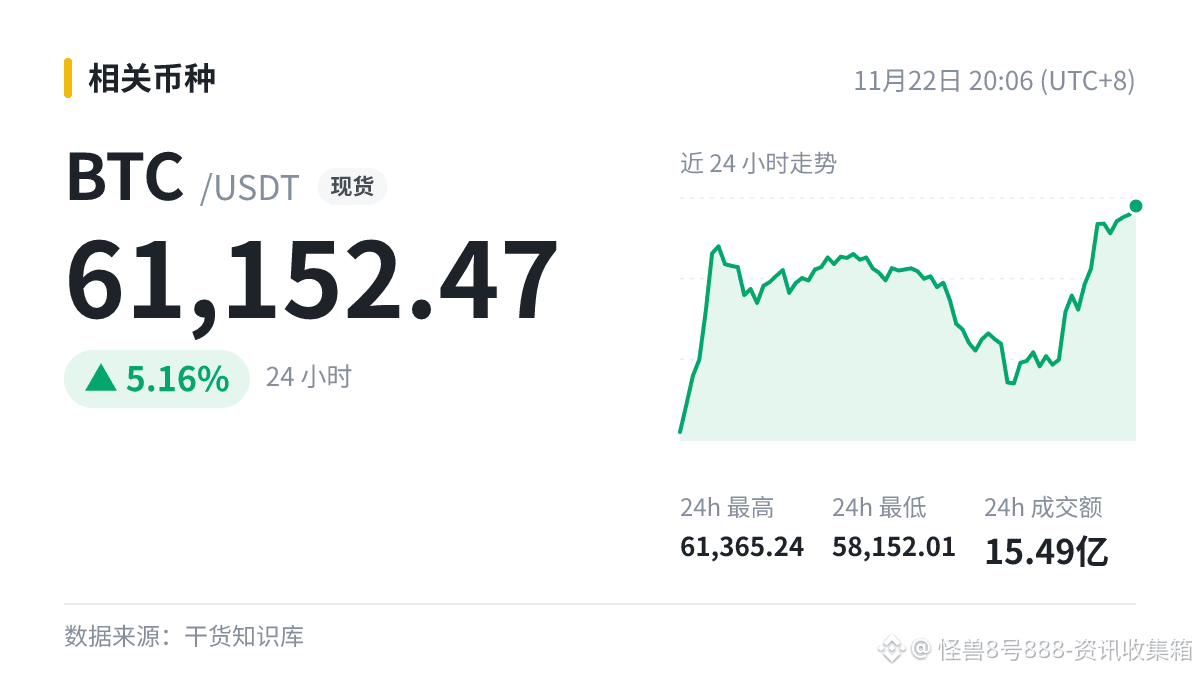
$BTC 61152.47(+5.16%)
This is not a recommendation; make your own decisions.
12
Latest News Briefing
I. AI and Tech IPO Updates
Controversy over the underwriting process for record-breaking Anthropic and SpaceX IPOs: According to Reuters, SpaceX and Anthropic each completed record-breaking IPOs this year, with underwriters earning fees of more than $500 million in both cases. However, some bankers have privately complained that the processes were complicated and highly restrictive, unlike previous IPOs. The entire listing process for SpaceX was led by Musk’s team. Commentary: Investment banks are making a fortune and still complaining—a sign that the bargaining power in these deals has shifted entirely to the issuers, and that leading tech companies are redefining the traditional underwriting model.
II. On-chain Whale Activity
A whale deposits 2,279 $BTC into Binance: According to monitoring by Lookonchain, a whale deposited 2,279 $BTC into Binance two hours ago, worth approximately $134.7 million. Commentary: Large $BTC inflows to exchanges have historically been a signal worth watching. Whether this is preparation for a sale or simply a transfer to a custodian will depend on subsequent on-chain activity; it’s best not to draw conclusions from a single deposit.
Trader sells 3,700 ETH, with unrealized losses of $5.36 million: According to monitoring by Lookonchain, a trader bought 9,677 ETH two weeks ago at an average price of $2,239, worth $21.66 million. The position is now down $5.36 million, and the trader sold 3,700 ETH five hours ago, worth $6.11 million. Commentary: Cutting losses after building a position near the highs is a real example of what many latecomers have experienced in this ETH market. Stop-loss decisions are rational in themselves, but this is also a reminder to decide where you’ll exit before chasing a rally.
That’s the latest news roundup. Here’s a question: when a whale deposits BTC into an exchange, are you more inclined to see it as a precursor to selling or as routine asset management? Share your take in the comments, and remember to interpret on-chain data rationally and manage your risk.
3
Log in to explore more content
Join global crypto users on Binance Square
⚡️ Get latest and useful information about crypto.
💬 Trusted by the world’s largest crypto exchange.
👍 Discover real insights from verified creators.
Email / Phone number
Trending Topics
WillMarketsStageAThanksgivingReliefRally?
10,298 views
238 Discussing
Markets enter Thanksgiving week after a sharp sell-off, with investors looking for a catalyst to stabilize risk assets.
The key event this week is Wednesday's October PCE inflation report and Q3 GDP revision, both scheduled for November 25 at 8:30 AM ET, according to the official US Bureau of Economic Analysis calendar.
The inflation data could influence expectations for the Federal Reserve's next policy decision. A softer-than-expected reading could support a relief rally across stocks and crypto, while hotter inflation may keep pressure on risk assets.
US markets will also be closed on Thanksgiving Day, creating a shortened trading week with potentially thinner liquidity.
My view: a relief rally is possible, but confirmation is still needed. Watch inflation data, market breadth, Bitcoin's recovery, and whether buyers can reclaim key resistance levels.
A bounce is not necessarily a reversal.
HOLD $BTC
#WillMarketsStageAThanksgivingReliefRally?
Waseem Ahmad mir
·0 Likes
·458 views
BessentSoftensStanceOnHuang’sNvidiaReturn
7,674 views
166 Discussing
EvolveAtBinanceBlockchainWeek
19 views
24 Discussing