
#717
717
967 views
21 Discussing
Hot
Latest

Injective's Veyra Mainnet Upgrade proposal, v1.21.0, has passed. Proposal #717 received 67.48% Yes, 0.33% No, and 42.69% participation, above the 33.40% quorum. The chain is expected to halt at block 193,145,000 on November 24 before restarting with the upgrade.
Veyra adds IBC support for EVM assets, RFQ infrastructure, and atomic swaps. If execution proceeds as planned, these features could broaden the network's trading and interoperability toolkit. Which feature has the clearest adoption path?
$inj
Not financial advice.
Follow for more crypto news and market updates.
105

Injective's official upgrades tracker lists Veyra v1.21.0 as Proposal #717 in voting, with a planned halt at block 193,145,000. That is a proposal, not a live upgrade. The practical milestone is the final vote and subsequent rollout; until then, feature descriptions are planned changes rather than current mainnet behavior. $INJ
Injective's official upgrades tracker lists Veyra v1.21.0 as Proposal #717 in voting, with a planned halt at block 193,145,000. That is a proposal, not a live upgrade. The practical milestone is the final vote and subsequent rollout; until then, feature descriptions are planned changes rather than current mainnet behavior. $INJ
178
Injective’s #717 upgrade vote has reached quorum: the live tracker shows 38.4% turnout against a 33.4% threshold. But the vote is still open until Nov 16, and 34.0% of cast votes are abstentions, so quorum is not the same as final approval. If passed, the chain upgrade targets block 193,145,000, around Nov 24. I’d keep those milestones separate. $INJ
Injective’s #717 upgrade vote has reached quorum: the live tracker shows 38.4% turnout against a 33.4% threshold. But the vote is still open until Nov 16, and 34.0% of cast votes are abstentions, so quorum is not the same as final approval. If passed, the chain upgrade targets block 193,145,000, around Nov 24. I’d keep those milestones separate. $INJ
111
Injective’s tracker still shows Proposal #717 for v1.21.0 in the voting stage, with a proposed halt at block 193,145,000. That’s a governance milestone, not a live upgrade. Separately, $INJ rose 7.52% in 24 hours on Binance Spot, with $23.28M quote volume. I’d watch the vote and rollout status directly; a sharp daily move can’t tell us how the proposal will resolve.
Injective’s tracker still shows Proposal #717 for v1.21.0 in the voting stage, with a proposed halt at block 193,145,000. That’s a governance milestone, not a live upgrade. Separately, $INJ rose 7.52% in 24 hours on Binance Spot, with $23.28M quote volume. I’d watch the vote and rollout status directly; a sharp daily move can’t tell us how the proposal will resolve.
46

Injective's Veyra upgrade is 10 days away — and the vote is not over yetTITLE: Injective's Veyra upgrade is 10 days away — and the vote is not over yet
Injective is green on a red day, and this time there is a real reason behind it.
INJ is up 11.0% at $8.01, with $22.9M in volume. It touched $8.38 today after dipping to $7.14. Meanwhile Bitcoin slipped under $67,000 to a fresh low of $66,456, and the Fear and Greed Index sits at 13 — extreme fear. INJ is moving against the whole market. But the price is only half the story. The other half is a vote that is happening right now.
On November 12, Injective opened a governance vote on proposal #717. It is asking token holders to approve software version v1.21.0 — the Veyra mainnet upgrade — with activation targeted for November 24.
What Veyra is supposed to do
Veyra is built for institutional trading. It adds RFQ trading — request-for-quote, the way big traders get prices for large orders — and new cross-chain tools, plus the groundwork for CypherOS, Injective's upcoming privacy platform. The idea is to make Injective a better place for tokenized assets and large trades, not just small retail orders.
That matters because Injective has always pitched itself as the chain for finance. Veyra is the next step in that plan, and the team calls it the final major upgrade of 2026. If it works, it gives institutions a reason to actually use the chain instead of just watching it.
The vote is the interesting part
Here is what caught my eye: participation has climbed to about 24.9%, up from 21.25% this morning — but the quorum is 33.4%, so it is still short. Around 62% of votes are in favour, roughly 38% are abstaining, and nobody has voted against it yet. Voting closes on November 16.
That is normal for governance votes — most holders do not vote. But it means the November 24 date is a target, not a promise. If the vote does not reach quorum, the timeline slips. Abstentions count toward participation, so that large abstaining bloc is actually helping the vote get over the line without adding to the yes tally.
The price action
INJ traded around $7.55 on November 13, up 1.3% that day after falling to $7.14. Today it pushed to $8.38 before settling near $8.01. The move is real, but it has not cleared the levels above it yet. Resistance sits at $8.38 to $8.44, then $8.58. Support is $7.14, the low of the last two days.
One honest note: the upgrade does not guarantee demand. Veyra adds the tools, but whether traders actually come and use them is unproven. An upgrade is a door opening. It is not people walking through it.
What I am watching next
First, does the vote reach quorum before November 16? Second, does INJ hold above $8.00 into the weekend while Bitcoin keeps sliding? Third, what happens on November 24 if the upgrade goes live — a quiet technical event, or the start of real activity?
Upgrades are easy to get excited about. The vote count is the part I am watching, because that is the part that decides whether any of this happens on time.
What do you look at first with an upgrade — the features, or the vote?
#Injective $INJ
Not financial advice.
Injective's Veyra upgrade is 10 days away — and the vote is not over yet
TITLE: Injective's Veyra upgrade is 10 days away — and the vote is not over yet
Injective is green on a red day, and this time there is a real reason behind it.
INJ is up 11.0% at $8.01, with $22.9M in volume. It touched $8.38 today after dipping to $7.14. Meanwhile Bitcoin slipped under $67,000 to a fresh low of $66,456, and the Fear and Greed Index sits at 13 — extreme fear. INJ is moving against the whole market. But the price is only half the story. The other half is a vote that is happening right now.
On November 12, Injective opened a governance vote on proposal #717. It is asking token holders to approve software version v1.21.0 — the Veyra mainnet upgrade — with activation targeted for November 24.
What Veyra is supposed to do
Veyra is built for institutional trading. It adds RFQ trading — request-for-quote, the way big traders get prices for large orders — and new cross-chain tools, plus the groundwork for CypherOS, Injective's upcoming privacy platform. The idea is to make Injective a better place for tokenized assets and large trades, not just small retail orders.
That matters because Injective has always pitched itself as the chain for finance. Veyra is the next step in that plan, and the team calls it the final major upgrade of 2026. If it works, it gives institutions a reason to actually use the chain instead of just watching it.
The vote is the interesting part
Here is what caught my eye: participation has climbed to about 24.9%, up from 21.25% this morning — but the quorum is 33.4%, so it is still short. Around 62% of votes are in favour, roughly 38% are abstaining, and nobody has voted against it yet. Voting closes on November 16.
That is normal for governance votes — most holders do not vote. But it means the November 24 date is a target, not a promise. If the vote does not reach quorum, the timeline slips. Abstentions count toward participation, so that large abstaining bloc is actually helping the vote get over the line without adding to the yes tally.
The price action
INJ traded around $7.55 on November 13, up 1.3% that day after falling to $7.14. Today it pushed to $8.38 before settling near $8.01. The move is real, but it has not cleared the levels above it yet. Resistance sits at $8.38 to $8.44, then $8.58. Support is $7.14, the low of the last two days.
One honest note: the upgrade does not guarantee demand. Veyra adds the tools, but whether traders actually come and use them is unproven. An upgrade is a door opening. It is not people walking through it.
What I am watching next
First, does the vote reach quorum before November 16? Second, does INJ hold above $8.00 into the weekend while Bitcoin keeps sliding? Third, what happens on November 24 if the upgrade goes live — a quiet technical event, or the start of real activity?
Upgrades are easy to get excited about. The vote count is the part I am watching, because that is the part that decides whether any of this happens on time.
What do you look at first with an upgrade — the features, or the vote?
#Injective $INJ
Not financial advice.
7

·
--
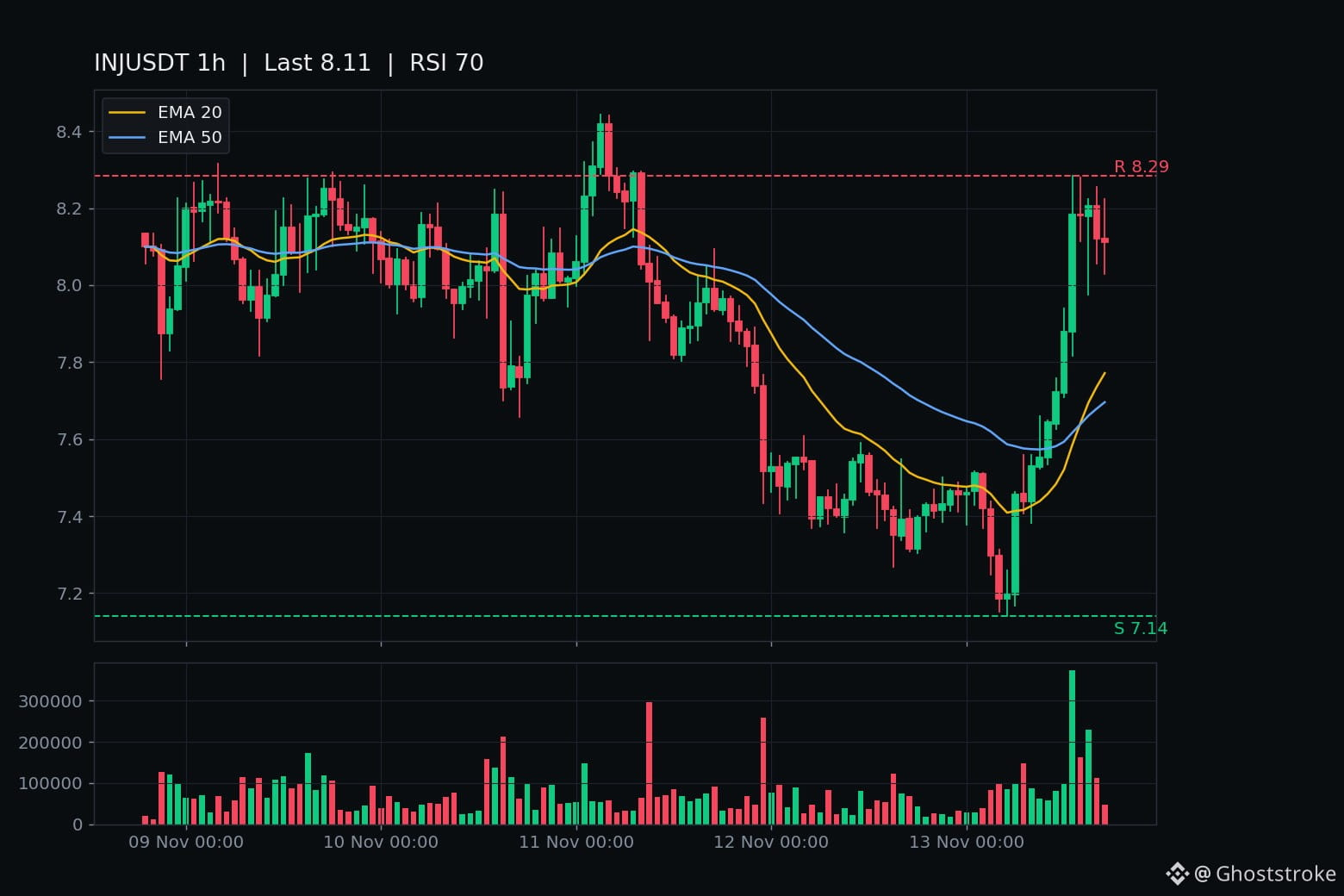
$INJ ran +10% today — and the ceiling ate it anyway.
The 13:00 hour blasted $7.88 to $8.285 on 374,917 tokens, the day's biggest INJ bar by far. Then the door: $8.205, the Oct 29 high. The 15:00 hour closed $8.207 — $0.002 above it. One hairline close, and that was all the recovery had.
16:00 closed $8.121. 17:00 closed $8.112. Two straight closes back below the door, and the forming hour is printing $8.06. The ceiling held on its first test.
Live $8.06, still +9.7% on the day — but that's window math: the 24h low was $7.141 this morning. From the $8.285 high it's already -2.7% back. Binance volume $16.3M, 290k trades. Rank #79, $807M mcap, 100M/100M circulating, -84.6% off the $52.62 ATH.
The chart agrees it's cooling, not breaking: RSI 70 (was 76 when the reclaim posted), still above EMA20 $7.77 and EMA50 $7.70. The $7.58 floor reclaimed this afternoon is still intact — this is a ceiling rejection, not a breakdown.
The backdrop hasn't changed either. The Veyra upgrade vote (Proposal #717, Nov 24 target) is 62% in favour but turnout is still short of the 33.4% quorum, voting closes Nov 16. No fresh timed headline today — tape, not news.
And the board isn't helping: BTC $68,866, -4.3% on the day. INJ rose into a bleeding board and is now fading with it.
Levels: $8.205 is the door — an hourly close back above it reopens the recovery. Above that, $8.285. Below, $7.58 is the floor that has to hold; under it, $7.289, then $7.141.
Does the door fall on the next test, or is $8.205 the ceiling for this leg?
108
Injective has opened voting on Proposal #717 for the Veyra Mainnet Upgrade (v1.21.0), described as its final major upgrade of 2026.
If approved, the chain will halt at block 193,145,000 to upgrade to the new binary. Veyra adds institutional RWA infrastructure, expands enterprise gateways, and lays groundwork for CypherOS-native privacy.
The proposal could matter for Injective's institutional adoption narrative, but execution through the upgrade and follow-on integrations will be worth watching. Will governance back the proposed upgrade?
$inj
Not financial advice.
Follow for more crypto news and market updates.
123

·
--
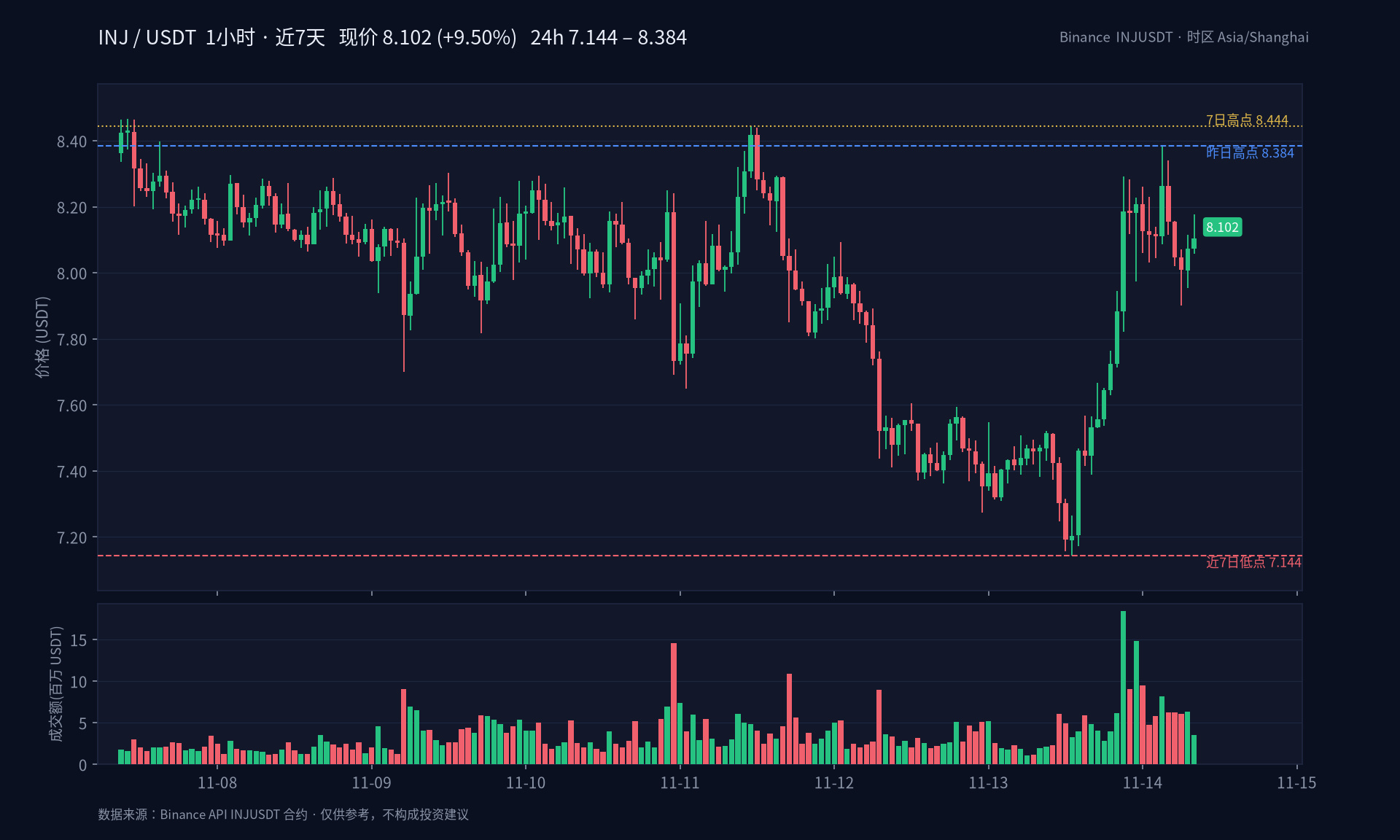
The broader market is still falling, but $INJ is up nearly 10%. An upgrade vote has just passed quorum on-chain.
Spot price: 8.103, up 9.62% over 24 hours; high: 8.376, low: 7.141. Futures trading volume is about $150 million. Injective’s Veyra upgrade proposal (#717) has an on-chain voter turnout of 34.8%, exceeding the 33.4% quorum, with 72.3% of votes cast in favor. However, voting doesn’t close until November 17 at 00:53 Beijing time, and the upgrade won’t be ready for implementation until November 24 at the earliest.
Relative strength remains, but don’t chase 8.38. The outlook is cautiously bullish on this rebound, with resistance at 8.384/8.444 and the previous day’s low of 7.144 as support. A high-volume break below 7.144 would invalidate this view.
Trading involves risk. Manage your own position size. These views do not constitute investment advice.
207

·
--
Injective has opened a governance vote on the Veyra mainnet upgrade to v1.21.0. Proposal #717 sets a halt point at block 193,145,000 if approved; voting is still ongoing according to the official upgrade tracker. Do you think this update is important? 🗳️⚙️🌐
$INJ #Injective #Crypto
Injective has opened a governance vote on the Veyra mainnet upgrade to v1.21.0. Proposal #717 sets a halt point at block 193,145,000 if approved; voting is still ongoing according to the official upgrade tracker. Do you think this update is important? 🗳️⚙️🌐
$INJ #Injective #Crypto
$INJ #Injective #Crypto

153

·
--
Injective has put the Veyra mainnet upgrade (v1.21.0) up for an on-chain vote, with a planned chain halt and version change on November 24. The title is all about “institutions,” “RWA,” and “trillions of dollars on-chain.” After translating the original proposal, the intern’s biggest question is: what exactly changes about $INJ itself (.
What happened:
Injective governance proposal #717 was submitted at 00:53 Beijing time on November 13, and voting began at the same time. Voting ends at 00:53 on November 17. It’s a software upgrade: if approved, the chain will halt at block height 193,145,000 (the proposal’s target date is November 24), switch to v1.21.0, and then resume producing blocks. The proposer notes that they are a member of the Injective Labs team.
The proposal says the upgrade will add roughly three things:
· New IBC interoperability capabilities, allowing assets to move between Injective’s EVM and the wider IBC cross-chain ecosystem
· RFQ (request for quote) trading infrastructure, along with expanded atomic swaps
· Foundations for the upcoming privacy platform, CypherOS
Why it might matter for INJ:
If RFQ and cross-chain capabilities really bring more institutional trading and tokenized assets onto the chain, on-chain activity and transaction fees could increase. INJ is used for gas and staking, so usage and staking demand could rise as a result.
But the intern has to point out: the original proposal doesn’t mention changing INJ fee distribution, burning, or issuance parameters at all. This upgrade changes the “road,” not “how the toll booth divides the money.” Whether traffic actually uses the new road depends on whether real RWA issuers and market makers come on board later; the proposal doesn’t name any specific ones.
Voting progress (Injective on-chain LCD interface, around 15:22 Beijing time):
About 9.21 million INJ in favor, about 5.32 million abstaining, about 80,000 against, and 0 vetoes. Based on the roughly 56.19 million INJ staked at the time, turnout was about 26%, still short of the 33.4% quorum required by the on-chain parameters. There are more than three days until the deadline, and the outcome is not yet decided, so it can’t be described as “passed” right now.
One more detail: Injective’s GitHub releases page says it will stop making source code public starting September 9, 2026. When the v1.21.0 testnet version was released on November 6, only binary files were provided. It will be a bit harder than before for external developers to independently review what changed in this upgrade.
On the market side: Binance INJUSDT perpetual futures were quoted at 7.558 around 15:22, up 1.819% over 24 hours. There’s no clear connection to the proposal, so the intern won’t force one.
A few things to watch next:
1. Whether turnout exceeds 33.4% and votes in favor exceed half before 00:53 on November 17
2. Whether the chain halt and version change around November 24 go smoothly, and whether exchanges suspend INJ deposits and withdrawals
3. Whether RFQ and cross-chain capabilities attract real institutional users after the upgrade, and whether on-chain trading volume changes
Sources: Injective on-chain governance proposal #717 and voting tally interface, Injective GitHub releases page, and Binance’s public market data API for USDⓈ-M futures. For learning purposes only; this is not investment advice~
$INJ
1
475

·
--
BREV surged 11% within 15 minutes! What happened? Key levels here16:55 (5 minutes ago) BREV surged 11% within 15 minutes (15-minute window 16:40→16:55); as of 17:00:53, the price is 0.08861, 24h +5.1%. Other movers in the same batch include LUMIA and OGN.
📅 Data as of 17:00:53 (event trigger times are shown in each note, prices are real-time snapshots at the time of writing)
📌 One-sentence highlight: 15-minute trends are being amplified; before following the trend, decide where to place your stop-loss
Market overview: BTC 82,804.20 (+0.18%) · ETH 2,495.02 (-0.36%); across the market, 357 up / 133 down in 24h; 24h top gainer MAGIC +41.44%, top loser SENT -17.07%.
BREV surged 11% within 15 minutes! What happened? Key levels here
16:55 (5 minutes ago) BREV surged 11% within 15 minutes (15-minute window 16:40→16:55); as of 17:00:53, the price is 0.08861, 24h +5.1%. Other movers in the same batch include LUMIA and OGN.
📅 Data as of 17:00:53 (event trigger times are shown in each note, prices are real-time snapshots at the time of writing)
📌 One-sentence highlight: 15-minute trends are being amplified; before following the trend, decide where to place your stop-loss
Market overview: BTC 82,804.20 (+0.18%) · ETH 2,495.02 (-0.36%); across the market, 357 up / 133 down in 24h; 24h top gainer MAGIC +41.44%, top loser SENT -17.07%.
1
·
--
Q surges 2.4% at a key time point! What happened? Key levels hereAt 08:04 (6 minutes ago), Q surged 2.4% at a key time point (5-minute window: 07:59→08:04). As of 08:10:52, its current price is 0.04242, up 41.3% over 24h. Other assets showing unusual moves around the same time include US and MOVR.
📅 Data as of 08:10:52 (event trigger times are noted in each item; prices are real-time snapshots taken when this was written)
📌 In a nutshell: Unusual moves during key periods (candlestick closes / U.S. market opens and closes) often involve institutional participation, making these signals more credible.
Market overview: BTC 83,287.30 (+2.20%) · ETH 2,503.34 (+3.12%); across the market, 365 assets rose and 125 fell over 24h; top 24h gainer: Q +41.28%; top loser: ARC -49.85%.
Q surges 2.4% at a key time point! What happened? Key levels here
At 08:04 (6 minutes ago), Q surged 2.4% at a key time point (5-minute window: 07:59→08:04). As of 08:10:52, its current price is 0.04242, up 41.3% over 24h. Other assets showing unusual moves around the same time include US and MOVR.
📅 Data as of 08:10:52 (event trigger times are noted in each item; prices are real-time snapshots taken when this was written)
📌 In a nutshell: Unusual moves during key periods (candlestick closes / U.S. market opens and closes) often involve institutional participation, making these signals more credible.
Market overview: BTC 83,287.30 (+2.20%) · ETH 2,503.34 (+3.12%); across the market, 365 assets rose and 125 fell over 24h; top 24h gainer: Q +41.28%; top loser: ARC -49.85%.
45


·
--
I've been watching the CoinGecko trending board and the numbers are eye‑catching. Bitcoin (BTC) still leads the pack, up +1.8% today 🚀. Close behind, Solana (SOL) jumped +3.4%, while Hyperliquid (HYPE) surged a hefty +7.2%.
I'm also keeping an eye on the mid‑rankers. Lighter (LIT) climbed +2.9% to rank #89, Pudgy Penguins (PENGU) rebounded with +4.1% at #119, and Dacity Coin (DACITY) nudged +1.5% despite its #717 spot today.
Quantus (QTC) slipped -0.8% but remains in the top 700, and I'm ready to adjust my strategy as the market shifts today 📈. My takeaway? Diversify early and ride the momentum.
$TIA, $AMP, $AGT
I've been watching the CoinGecko trending board and the numbers are eye‑catching. Bitcoin (BTC) still leads the pack, up +1.8% today 🚀. Close behind, Solana (SOL) jumped +3.4%, while Hyperliquid (HYPE) surged a hefty +7.2%.
I'm also keeping an eye on the mid‑rankers. Lighter (LIT) climbed +2.9% to rank #89, Pudgy Penguins (PENGU) rebounded with +4.1% at #119, and Dacity Coin (DACITY) nudged +1.5% despite its #717 spot today.
Quantus (QTC) slipped -0.8% but remains in the top 700, and I'm ready to adjust my strategy as the market shifts today 📈. My takeaway? Diversify early and ride the momentum.
$TIA , $AMP , $AGT
490
·
--
CAP Surges 13% in 15 Minutes! What Happened? Key Levels Here20:13 (4 minutes ago) CAP surged 13% within 15 minutes (15-minute window: 19:58→20:13). As of 20:17:51, the current price is 0.1017, up 8.8% over 24h. CTK and RSR also saw unusual moves during the same period.
📅 Data as of 20:17:51 (event trigger times are indicated in each item; prices are real-time snapshots taken at the time of writing)
📌 Key takeaway: The 15-minute trend has intensified—before following it, decide where to place your stop-loss.
Market overview: BTC 83,285.80(+0.14%) · ETH 2,543.12(+1.45%); across the market, 263 assets rose and 226 fell in 24h; top gainer over 24h: RSR +55.83%, top loser: LUMIA -26.03%.
CAP Surges 13% in 15 Minutes! What Happened? Key Levels Here
20:13 (4 minutes ago) CAP surged 13% within 15 minutes (15-minute window: 19:58→20:13). As of 20:17:51, the current price is 0.1017, up 8.8% over 24h. CTK and RSR also saw unusual moves during the same period.
📅 Data as of 20:17:51 (event trigger times are indicated in each item; prices are real-time snapshots taken at the time of writing)
📌 Key takeaway: The 15-minute trend has intensified—before following it, decide where to place your stop-loss.
Market overview: BTC 83,285.80(+0.14%) · ETH 2,543.12(+1.45%); across the market, 263 assets rose and 226 fell in 24h; top gainer over 24h: RSR +55.83%, top loser: LUMIA -26.03%.
8
Log in to explore more content
Join global crypto users on Binance Square
⚡️ Get latest and useful information about crypto.
💬 Trusted by the world’s largest crypto exchange.
👍 Discover real insights from verified creators.
Email / Phone number
Trending Topics
1
#NvidiaLoses$2.7TrillionInMonthAndAHalf
25,489 views
150 Discussing
2
#CanBTCReboundAfterFallingBelow60K?
819,593 views
3,075 Discussing
3
#GlobalStocksFaceLongestLosingStreakSince2023
303,900 views
2,057 Discussing
4
#BlackRockIBITPostsRecord$541MSingleDayOutflow
37,706 views
109 Discussing
5
#AnthropicPlungesTowardIPOPriceonDay2
156,550 views
1,242 Discussing
6
#TwentyOneCapitalAdds172.25BTC
72,348 views
690 Discussing
7
#HKBillWouldExcludeTokenizedDepositsFromVirtualAssets
9,978 views
51 Discussing
8
#BNBDropsBelow540USDTWith8.46%DailyDecline
83,945 views
668 Discussing
9
#HKBillProposesHK$100KFineForUnauthorizedCryptoTitles
2,813 views
22 Discussing
10
#BitMineFaces$10.1BUnrealizedETHLoss
5,878 views
28 Discussing