
#cryptotransparency
cryptotransparency
156,856 views
323 Discussing
Hot
Latest

SHELL's supply data remains an important source of uncertainty when comparing market capitalization figures.
Some trackers reported circulating supply around 270 million tokens, while others used figures closer to 474 million.
Since market capitalization is calculated by multiplying token price by circulating supply, different supply estimates can produce significantly different valuation figures.
This is why the reported market capitalization on November 14–15 ranged approximately from $7.5 million to $13.5 million.
The difference does not necessarily mean one price feed is incorrect. It may reflect different supply definitions, data updates or methodologies.
Until supply figures are reconciled through reliable confirmation, reporting a range is more responsible than presenting one estimate as definitive.
#TokenSupply #MarketCap #CryptoTransparency
69
·
--
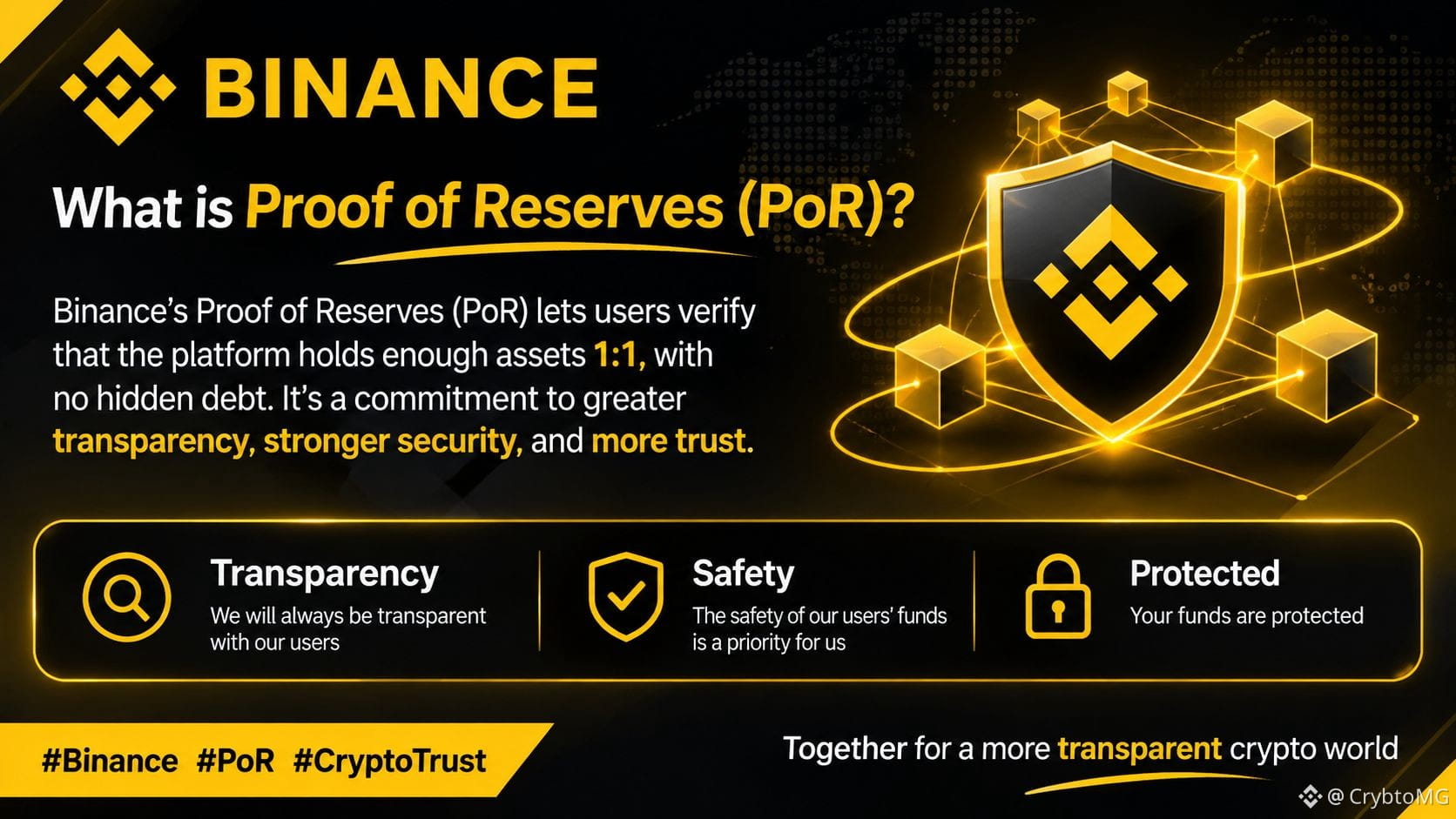
Binance Updates Its Proof of Reserves Wallet Addresses
Binance has added newly generated wallet addresses to its Proof of Reserves (PoR) list.
The exchange says all future withdrawals will be processed through these new addresses.
This is an important operational update because it gives the community new wallet information to monitor on-chain.
However, transparency is about more than publishing wallet addresses. Users should also be able to review reserve data and independently verify the information provided.
You can check the updated information through Binance's official Proof of Reserves page.
Do you think regular, verifiable reserve updates are becoming essential for crypto exchanges?
#Binance #ProofOfReserves #CryptoTransparency $LYN $IDOL $ESPORTS
1
12

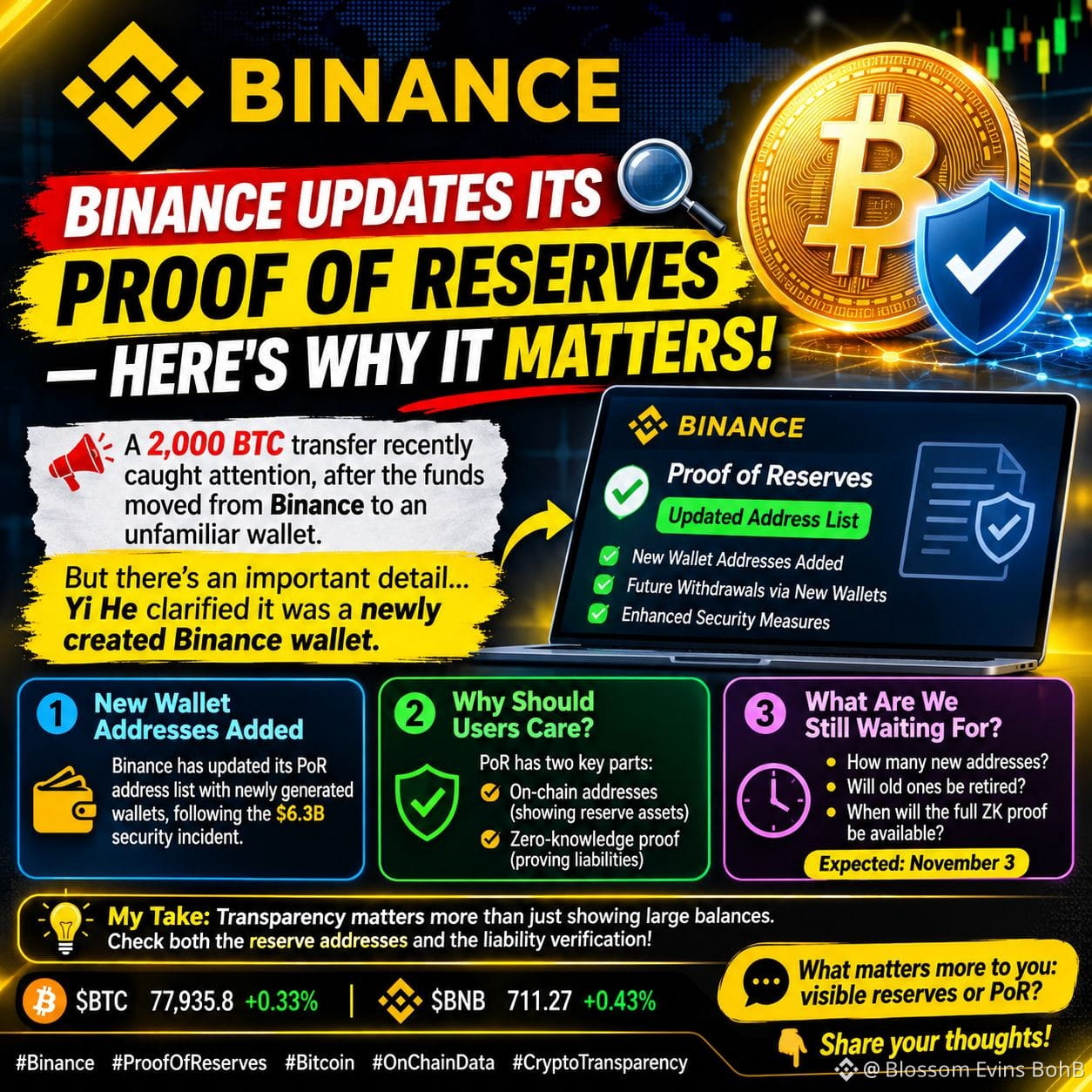
🚨 BINANCE UPDATES ITS PROOF OF RESERVES — HERE'S WHY IT MATTERS! 🔍
A 2,000 BTC transfer recently caught the attention of on-chain trackers after the funds moved from Binance to an unfamiliar wallet.
But there’s an important detail behind this transaction.
Yi He clarified that the destination was actually a newly created Binance wallet.
So, what’s happening?
🔹 1. New Wallet Addresses Added
Binance has updated its Proof of Reserves (PoR) address list with newly generated wallets. According to the exchange, future withdrawals will be processed through these new addresses as part of its ongoing security improvements following the reported $6.3 billion security incident.
🔹 2. Why Should Users Care?
Proof of Reserves isn't just about showing how much crypto an exchange holds.
It also involves proving that customer liabilities are properly accounted for.
There are two important parts:
On-chain wallet addresses showing reserve assets.
Zero-knowledge proof demonstrating that user liabilities are covered.
When wallet addresses change, independent trackers need to update their records to avoid misinterpreting legitimate transfers.
🔹 3. What Are We Still Waiting For?
A few important questions remain unanswered:
• How many new wallet addresses have been introduced? • Will the previous reserve addresses be phased out? • When will the complete zero-knowledge proof become available?
The full proof is expected around November 3.
My Take: Transparency matters more than just showing large wallet balances. Investors should look at both the reserve addresses and the liability verification before judging an exchange's financial transparency.
What matters more to you: visible on-chain reserves or independently verifiable Proof of Reserves?
👇 Share your thoughts!
$BTC $BNB
#Binance #ProofOfReserves #Bitcoin #OnChainData #CryptoTransparency
104
Fresh Proof of Reserves Addresses Strengthen Transparency. 🔐
Binance has updated its Proof of Reserves list with newly generated wallet addresses as part of its ongoing security response. All future withdrawals will now be processed exclusively through these refreshed addresses.
This proactive step enhances platform security and allows users to verify reserves with greater confidence. Combined with the latest snapshot and upcoming full zero knowledge proof it reinforces commitment to transparency and user protection.
{spot}(BNBUSDT)
$BNB #CoinVahini #ProofOfReserves #CryptoTransparency #binanceupdatesproofofreservesaddresses
Fresh Proof of Reserves Addresses Strengthen Transparency. 🔐
Binance has updated its Proof of Reserves list with newly generated wallet addresses as part of its ongoing security response. All future withdrawals will now be processed exclusively through these refreshed addresses.
This proactive step enhances platform security and allows users to verify reserves with greater confidence. Combined with the latest snapshot and upcoming full zero knowledge proof it reinforces commitment to transparency and user protection.
$BNB #CoinVahini #ProofOfReserves #CryptoTransparency #binanceupdatesproofofreservesaddresses
21
·
--
Article
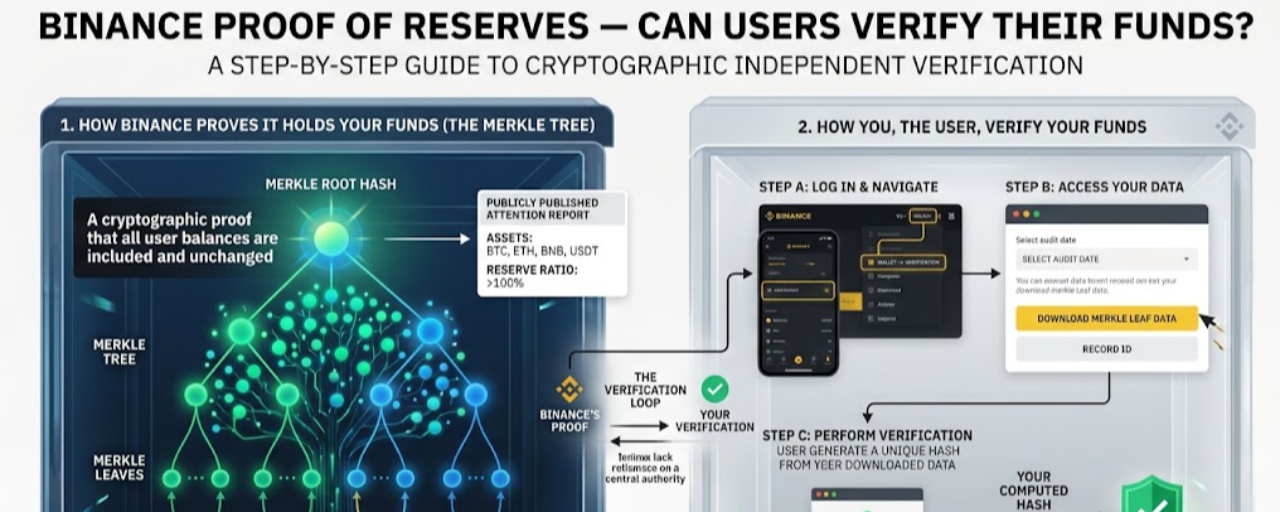
BINANCE PROOF OF RESERVES — CAN USERS VERIFY THEIR FUNDS?🔍 BINANCE'S NEXT BIG TEST: PROOF OF RESERVES!
Following its security crisis, Binance has published a new reserve snapshot.
A full zero-knowledge proof is expected November 3.
This could give users another way to independently verify asset backing.
💬 Is Proof of Reserves enough to build trust?
#Binance #ProofOfReserves #CryptoTransparency #BTC走势分析
BINANCE PROOF OF RESERVES — CAN USERS VERIFY THEIR FUNDS?
🔍 BINANCE'S NEXT BIG TEST: PROOF OF RESERVES!
Following its security crisis, Binance has published a new reserve snapshot.
A full zero-knowledge proof is expected November 3.
This could give users another way to independently verify asset backing.
💬 Is Proof of Reserves enough to build trust?
#Binance #ProofOfReserves #CryptoTransparency #BTC走势分析
1
13

🔥 Transparency isn't just a buzzword in crypto — it's the backbone of trust, and Block just raised the bar by opening its Bitcoin treasury to public verification with proof of reserves, a move that could reshape the market's #CryptoTransparency narrative.
📊 As the market navigates Extreme Fear sentiment with a Market Sentiment score of 23/100, and Bitcoin hovering at $62,866 with a bullish RSI of 61.7, this development couldn't come at a more critical time, especially with #BitcoinFallsOver50%FromOctoberHigh still a fresh wound for many investors, and the broader #CryptoMarket trending towards more robust regulatory frameworks.
💡 The bigger picture here is that as institutions like Block push for transparency, the entire ecosystem benefits, potentially attracting more institutional investors who are awaiting clearer regulatory guidelines, such as those discussed under #UKFCAPublishesCryptoRegFramework, which could further legitimize crypto as a viable asset class, impacting the market cycle and long-term thesis of cryptocurrencies like Bitcoin and Ethereum.
📈 The practical lesson is that investors should demand transparency from custodians and exchanges, using tools like on-chain analysis to verify reserves, especially in a market where Open Interest levels like $6.58B for Bitcoin and $4.17B for Ethereum signify a high level of institutional conviction, with funding rates of +0.0055% for Bitcoin and +0.0040% for Ethereum indicating bullish sentiment among longs.
❓ What strategies will you employ to ensure your assets are safeguarded in this evolving landscape, and how will you use data from futures markets and on-chain intelligence to inform your decisions?
1
34
·
--
Article
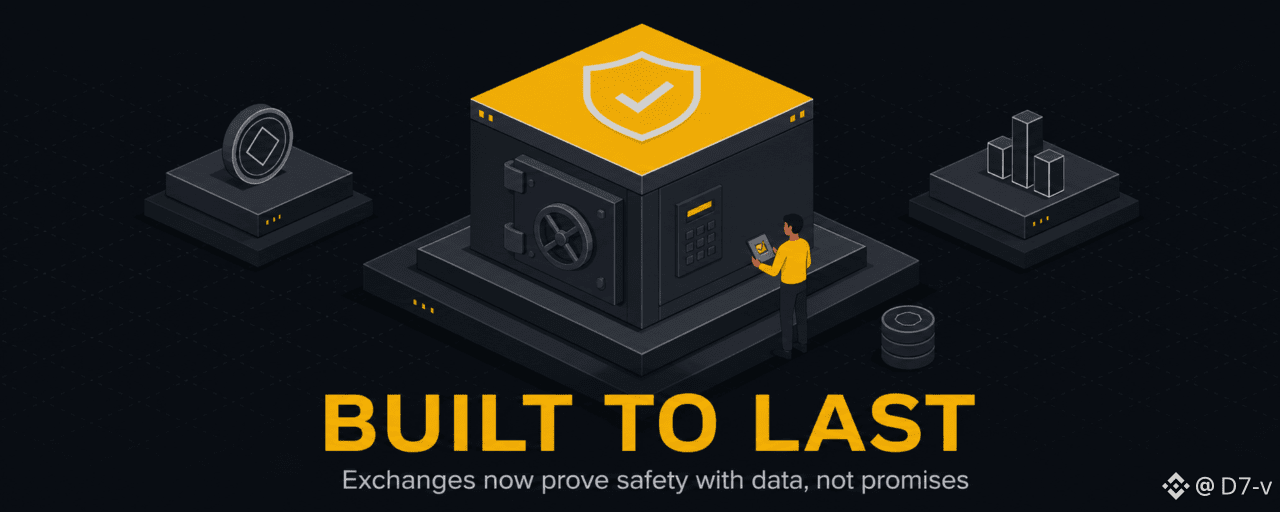
Built to Last: What Crypto Exchange Trust and Transparency Data Reveal About Where Users Are MovingCrypto Exchange Trust: Why "Who's Next?" Is the Wrong Question
Every time a crypto exchange wobbles, the same rumor mill starts turning: who's next? Which platform is quietly insolvent? Which one will freeze withdrawals this quarter?
It's an understandable instinct after years of blowups. But it's also the wrong question to ask in 2026. A market cooldown and tighter regulation have already done the sorting for us — and the independent data shows exactly which crypto exchanges are winning trust and which ones are losing users. No rumors needed. Just numbers.
This article breaks down what third-party research firms — not the exchanges themselves — are reporting about crypto exchange transparency, proof of reserves, and shifting user behavior. If you're deciding where to keep your funds, or just trying to understand why the market looks the way it does, this is the data-backed version of that story.
Why Trust and Transparency Now Decide Exchange Survival
For most of crypto's history, "trust" was a vibe. Big name, slick marketing, aggressive listings — that was often enough to pull in users. FTX changed that permanently.
Since then, independent research firms have built actual scoring frameworks around things that can be checked: custody structure, proof-of-reserves cadence, licensing, incident history, and withdrawal protections. Crypto Almanac Daily's 2026 trust index, for example, weights "counterparty and custody risk" as the single largest factor in its scoring model, ahead of fees or trading volume. Coin Bureau's 2026 Exchange Safety Score follows a similar logic, scoring platforms on a 100-point scale across custody, reserve transparency, regulation, and security track record rather than brand reputation alone.
That shift matters because it changes exchange behavior. When transparency is measurable and public, exchanges compete on proof, not just promises. That's a meaningfully healthier dynamic for the whole industry — and it's the backdrop for everything else in this article.
The Regulatory Squeeze Accelerated the Sort
Regulatory pressure through 2025 and into 2026 hasn't just meant more paperwork. It's actively pushed weaker or opaque exchanges out of key markets, while better-regulated, more transparent platforms absorbed the users left behind. Independent market-share data backs this up directly: total centralized exchange spot volume fell nearly 39% quarter-over-quarter in Q1 2026, yet the platforms with the strongest compliance and disclosure track records held or grew their share even as the overall pie shrank.
In plain terms: the market got smaller, but it also got more selective about who it trusts with that smaller pool of capital.
What the Market Share Data Actually Shows
If trust were only a talking point, you wouldn't see it reflected in trading volume. But it is.
CoinGlass data for Q1 2026 put total crypto trading volume (spot plus derivatives) at roughly $20.57 trillion. Within that, one exchange held a consistent lead across nearly every core metric — spot share around 34%, derivatives share around 35%, and user asset retention north of 70% among major centralized exchanges. That exchange was Binance, and it wasn't close: its Q1 derivatives volume alone exceeded the combined totals of the second and third-largest platforms.
By Q2 2026, TokenInsight's exchange report showed that lead widening further, with total market share rising from roughly 32.8% to 35.3% — the largest quarterly gain of any tracked exchange, achieved while already holding the industry's biggest share. CoinDesk Research's independent analysis, using order-book depth data across 427 listed assets, found Binance was the deepest liquidity venue for about 275 of them, or roughly 64% of the comparison set, and recorded the lowest average BTC slippage among major exchanges for order sizes ranging from $10,000 to $1 million.
None of this happens by accident. It happens because, in a contracting market, capital doesn't spread out evenly — it concentrates around venues that can prove they're solvent, liquid, and stable under stress.
Spot Fragmented. Derivatives Didn't.
One nuance worth understanding: spot trading has actually become more fragmented over the past few years, dropping from a peak concentration around 67% for the top venue back in 2023 to closer to 26% by mid-2026, as competing exchanges, regional platforms, and decentralized liquidity absorbed more spot flow. Derivatives told a different story — concentration there has stayed high, with the leading exchange holding roughly 37% share, about double its nearest competitor.
That split matters for anyone trading actively: spot markets give you more venue choice, but derivatives liquidity is still concentrated in a handful of platforms, which is exactly where execution quality (tighter spreads, lower slippage) tends to matter most.
Proof of Reserves: The Metric That Separates Talk From Proof
If market share tells you where users are going, proof of reserves (PoR) tells you why they trust getting there.
PoR is a public, verifiable snapshot of whether an exchange actually holds the assets it says it holds on behalf of users — typically shown through Merkle-tree cryptographic proofs, zero-knowledge attestations, or third-party audits. Independent rankings increasingly score exchanges specifically on this, using five core factors: reporting frequency, self-verification tools, independent audit involvement, per-asset coverage, and on-chain checkability.
Here's how that plays out across major platforms, according to independent transparency reviews:
Bitget has published monthly PoR reports without interruption since December 2022, using an open-source self-verification tool — the longest unbroken monthly record in the industry.OKX publishes monthly using zero-knowledge (zk-STARK) proofs, considered the most cryptographically advanced method currently in use.Kraken uses periodic independent third-party audits, giving it one of the cleanest long-term track records.Binance reports quarterly, combining zk-SNARK proofs with its SAFU insurance fund, and holds the largest absolute reserve base of any exchange tracked — reportedly around $150 billion in disclosed reserves in some 2026 snapshots, roughly 68% of combined reserves across eight major exchanges.Coinbase takes a different approach entirely, relying on audited public-company financial statements rather than cryptographic PoR, since it's a publicly listed company subject to SEC reporting requirements.
No single model is objectively "best" — frequency, cryptographic sophistication, and audit independence each solve a slightly different trust problem. But the broader trend is unmistakable: exchanges that publish something checkable, on a predictable schedule, are the ones independent researchers — and by extension, users — rank highest.
What to Actually Check as a User
If you're evaluating where to keep funds, don't just look for the words "proof of reserves" on a homepage. Check:
How often is it updated — monthly is stronger than quarterly, which is stronger than "occasionally."Can you verify it yourself, or does it rely entirely on the exchange's own reporting?Does a third party — an audit firm or independent verifier — sign off on it?Does it cover liabilities, not just assets? A reserve snapshot that ignores what the exchange owes users is only half the picture.
Liquidity Depth and Execution Quality as Hidden Trust Signals
Trust isn't only about solvency — it's also about whether the platform behaves reliably when you actually try to trade. This is where liquidity depth and slippage data become a quieter, but equally important, trust signal.
An exchange with thin order books can look fine on a calm day and then move violently against you during volatility — effectively an invisible cost that never shows up in a headline trust score. Independent execution-quality studies matter here precisely because they measure real trading conditions rather than marketing claims. Binance's 2026 data on 1% order-book depth and BTC slippage across large order sizes is a useful example of the kind of transparency that's becoming a competitive differentiator, not just a nice-to-have. Most retail coverage focuses on fees, but execution depth often matters more than fees for anyone trading meaningful size.
The On-Chain Shift: Tokenized Assets and RWAs as a Trust Barometer
Trust dynamics aren't confined to centralized exchanges. On-chain data from the first half of 2026 tells a parallel story about where users are willing to commit capital.
DeFi overall had a rough six months: total value locked across chains fell around 38%, and the industry recorded roughly $972 million in losses across 207 security incidents — the worst six-month stretch for exploits on record. That eroded confidence in supplying liquidity to unaudited or newer protocols.
But not everything on-chain contracted. Tokenized real-world assets (RWAs) — think tokenized stocks, treasuries, and other traditional instruments represented on-chain — kept growing even as speculative DeFi shrank. BNB Chain, in particular, became the leading venue for tokenized equities, with its RWA market cap growing roughly 107% in the first half of 2026 and its share of on-chain RWA value rising from about 9.8% to 13.5%.
Binance's own tokenized-stock product, bStocks, is a concrete example of this trend in action: it grew from a standing start in early June 2026 to over $500 million in market capitalization by the end of July — about a quarter of the entire tokenized-stock market and roughly 68% of the sector's total growth in that window. Retail users made up the vast majority of participants (nearly 4,800 users), while a smaller group of about 500 systematic traders captured most of the arbitrage profit, a pattern that's fairly typical when a new but genuinely useful product launches: retail shows up first for utility, professional capital shows up second for efficiency.
The takeaway here isn't "RWAs are hot." It's that users are willing to put capital into on-chain products specifically when there's a credible off-chain asset and a trustworthy issuer behind it — which is really just the same trust logic as proof of reserves, applied to tokenization instead of custody.
What This Means for Where Users Park Their Capital
Pulling all of this together, three practical filters emerge for anyone deciding where to hold or trade crypto in the current environment:
Check independent trust scores, not marketing pages. Sources like Coin Bureau's Exchange Safety Score or Crypto Almanac Daily's trust rankings evaluate custody, regulation, and incident history using consistent criteria across platforms.Verify reserve transparency and its cadence. Monthly, cryptographically checkable proof-of-reserves reports are a stronger signal than annual claims or vague "we're audited" statements.Look at liquidity depth for your actual trade size. A platform with the biggest volume headline isn't automatically the best execution venue for a $500 trade versus a $500,000 one — depth and slippage data matter more than total volume for active traders.
None of this means bigger is automatically safer, or that one exchange is right for everyone. Kraken's audit-based model, Bitget's monthly self-verification streak, OKX's zero-knowledge proofs, and Binance's scale-plus-SAFU approach each solve the trust problem differently. The point is that users now have real data to compare them on — and the platforms gaining share in 2026 are, overwhelmingly, the ones that make that comparison easy to do.
Key Takeaways
Crypto exchange trust is now measurable through proof of reserves, regulatory licensing, incident history, and liquidity depth — not just reputation.Independent 2026 data shows trading activity consolidating around exchanges with the strongest transparency practices, even as total market volume contracts.Spot trading has fragmented across more venues since 2023, while derivatives liquidity remains highly concentrated in a handful of platforms.Proof-of-reserves models differ by exchange (monthly self-verification, zero-knowledge proofs, independent audits, or public-company financials) — frequency and verifiability matter more than any single method being "correct."On-chain trust dynamics mirror exchange trust dynamics: tokenized real-world assets and equities kept growing in H1 2026 even as speculative DeFi contracted sharply.Users evaluating where to hold funds should check PoR cadence, independent trust scores, and execution quality for their specific trade size — not just headline volume or brand recognition.
FAQ
What does "proof of reserves" actually prove?
It shows, at a specific point in time, that an exchange holds enough assets to cover what it owes users — typically verified through cryptographic methods like Merkle trees or zero-knowledge proofs, or through independent third-party audits. It's a snapshot, not a real-time guarantee, which is why reporting frequency matters.
Is a bigger exchange automatically safer?
Not necessarily. Scale can support deeper liquidity and larger insurance funds, but independent safety scores weigh custody practices, audit frequency, and incident history alongside size. Some smaller or mid-sized exchanges score competitively on transparency despite lower volume.
Why did DeFi shrink while tokenized real-world assets grew in 2026?
DeFi's contraction was driven largely by a record number of exploits and losses, which understandably made users cautious about supplying liquidity to newer or unaudited protocols. Tokenized RWAs and equities grew because they're backed by a recognizable off-chain asset and issuer, giving users a more familiar trust anchor even in a risk-off environment.
How often should a trustworthy exchange publish proof of reserves?
Monthly is currently the strongest standard among major exchanges, especially when it's self-verifiable and covers both assets and liabilities. Quarterly or periodic reporting isn't automatically untrustworthy, but it gives users less visibility between reports.
What's the difference between spot and derivatives market concentration?
Spot trading has become more distributed across exchanges and decentralized venues since 2023. Derivatives, by contrast, remain concentrated in a small number of platforms with deep enough liquidity to support leveraged trading without excessive slippage.
Suggested Hashtags
#CryptoExchange #ProofOfReserves #CryptoTransparency #CryptoTrust #TokenizedAssets
Built to Last: What Crypto Exchange Trust and Transparency Data Reveal About Where Users Are Moving
Crypto Exchange Trust: Why "Who's Next?" Is the Wrong Question
Every time a crypto exchange wobbles, the same rumor mill starts turning: who's next? Which platform is quietly insolvent? Which one will freeze withdrawals this quarter?
It's an understandable instinct after years of blowups. But it's also the wrong question to ask in 2026. A market cooldown and tighter regulation have already done the sorting for us — and the independent data shows exactly which crypto exchanges are winning trust and which ones are losing users. No rumors needed. Just numbers.
This article breaks down what third-party research firms — not the exchanges themselves — are reporting about crypto exchange transparency, proof of reserves, and shifting user behavior. If you're deciding where to keep your funds, or just trying to understand why the market looks the way it does, this is the data-backed version of that story.
Why Trust and Transparency Now Decide Exchange Survival
For most of crypto's history, "trust" was a vibe. Big name, slick marketing, aggressive listings — that was often enough to pull in users. FTX changed that permanently.
Since then, independent research firms have built actual scoring frameworks around things that can be checked: custody structure, proof-of-reserves cadence, licensing, incident history, and withdrawal protections. Crypto Almanac Daily's 2026 trust index, for example, weights "counterparty and custody risk" as the single largest factor in its scoring model, ahead of fees or trading volume. Coin Bureau's 2026 Exchange Safety Score follows a similar logic, scoring platforms on a 100-point scale across custody, reserve transparency, regulation, and security track record rather than brand reputation alone.
That shift matters because it changes exchange behavior. When transparency is measurable and public, exchanges compete on proof, not just promises. That's a meaningfully healthier dynamic for the whole industry — and it's the backdrop for everything else in this article.
The Regulatory Squeeze Accelerated the Sort
Regulatory pressure through 2025 and into 2026 hasn't just meant more paperwork. It's actively pushed weaker or opaque exchanges out of key markets, while better-regulated, more transparent platforms absorbed the users left behind. Independent market-share data backs this up directly: total centralized exchange spot volume fell nearly 39% quarter-over-quarter in Q1 2026, yet the platforms with the strongest compliance and disclosure track records held or grew their share even as the overall pie shrank.
In plain terms: the market got smaller, but it also got more selective about who it trusts with that smaller pool of capital.
What the Market Share Data Actually Shows
If trust were only a talking point, you wouldn't see it reflected in trading volume. But it is.
CoinGlass data for Q1 2026 put total crypto trading volume (spot plus derivatives) at roughly $20.57 trillion. Within that, one exchange held a consistent lead across nearly every core metric — spot share around 34%, derivatives share around 35%, and user asset retention north of 70% among major centralized exchanges. That exchange was Binance, and it wasn't close: its Q1 derivatives volume alone exceeded the combined totals of the second and third-largest platforms.
By Q2 2026, TokenInsight's exchange report showed that lead widening further, with total market share rising from roughly 32.8% to 35.3% — the largest quarterly gain of any tracked exchange, achieved while already holding the industry's biggest share. CoinDesk Research's independent analysis, using order-book depth data across 427 listed assets, found Binance was the deepest liquidity venue for about 275 of them, or roughly 64% of the comparison set, and recorded the lowest average BTC slippage among major exchanges for order sizes ranging from $10,000 to $1 million.
None of this happens by accident. It happens because, in a contracting market, capital doesn't spread out evenly — it concentrates around venues that can prove they're solvent, liquid, and stable under stress.
Spot Fragmented. Derivatives Didn't.
One nuance worth understanding: spot trading has actually become more fragmented over the past few years, dropping from a peak concentration around 67% for the top venue back in 2023 to closer to 26% by mid-2026, as competing exchanges, regional platforms, and decentralized liquidity absorbed more spot flow. Derivatives told a different story — concentration there has stayed high, with the leading exchange holding roughly 37% share, about double its nearest competitor.
That split matters for anyone trading actively: spot markets give you more venue choice, but derivatives liquidity is still concentrated in a handful of platforms, which is exactly where execution quality (tighter spreads, lower slippage) tends to matter most.
Proof of Reserves: The Metric That Separates Talk From Proof
If market share tells you where users are going, proof of reserves (PoR) tells you why they trust getting there.
PoR is a public, verifiable snapshot of whether an exchange actually holds the assets it says it holds on behalf of users — typically shown through Merkle-tree cryptographic proofs, zero-knowledge attestations, or third-party audits. Independent rankings increasingly score exchanges specifically on this, using five core factors: reporting frequency, self-verification tools, independent audit involvement, per-asset coverage, and on-chain checkability.
Here's how that plays out across major platforms, according to independent transparency reviews:
Bitget has published monthly PoR reports without interruption since December 2022, using an open-source self-verification tool — the longest unbroken monthly record in the industry.OKX publishes monthly using zero-knowledge (zk-STARK) proofs, considered the most cryptographically advanced method currently in use.Kraken uses periodic independent third-party audits, giving it one of the cleanest long-term track records.Binance reports quarterly, combining zk-SNARK proofs with its SAFU insurance fund, and holds the largest absolute reserve base of any exchange tracked — reportedly around $150 billion in disclosed reserves in some 2026 snapshots, roughly 68% of combined reserves across eight major exchanges.Coinbase takes a different approach entirely, relying on audited public-company financial statements rather than cryptographic PoR, since it's a publicly listed company subject to SEC reporting requirements.
No single model is objectively "best" — frequency, cryptographic sophistication, and audit independence each solve a slightly different trust problem. But the broader trend is unmistakable: exchanges that publish something checkable, on a predictable schedule, are the ones independent researchers — and by extension, users — rank highest.
What to Actually Check as a User
If you're evaluating where to keep funds, don't just look for the words "proof of reserves" on a homepage. Check:
How often is it updated — monthly is stronger than quarterly, which is stronger than "occasionally."Can you verify it yourself, or does it rely entirely on the exchange's own reporting?Does a third party — an audit firm or independent verifier — sign off on it?Does it cover liabilities, not just assets? A reserve snapshot that ignores what the exchange owes users is only half the picture.
Liquidity Depth and Execution Quality as Hidden Trust Signals
Trust isn't only about solvency — it's also about whether the platform behaves reliably when you actually try to trade. This is where liquidity depth and slippage data become a quieter, but equally important, trust signal.
An exchange with thin order books can look fine on a calm day and then move violently against you during volatility — effectively an invisible cost that never shows up in a headline trust score. Independent execution-quality studies matter here precisely because they measure real trading conditions rather than marketing claims. Binance's 2026 data on 1% order-book depth and BTC slippage across large order sizes is a useful example of the kind of transparency that's becoming a competitive differentiator, not just a nice-to-have. Most retail coverage focuses on fees, but execution depth often matters more than fees for anyone trading meaningful size.
The On-Chain Shift: Tokenized Assets and RWAs as a Trust Barometer
Trust dynamics aren't confined to centralized exchanges. On-chain data from the first half of 2026 tells a parallel story about where users are willing to commit capital.
DeFi overall had a rough six months: total value locked across chains fell around 38%, and the industry recorded roughly $972 million in losses across 207 security incidents — the worst six-month stretch for exploits on record. That eroded confidence in supplying liquidity to unaudited or newer protocols.
But not everything on-chain contracted. Tokenized real-world assets (RWAs) — think tokenized stocks, treasuries, and other traditional instruments represented on-chain — kept growing even as speculative DeFi shrank. BNB Chain, in particular, became the leading venue for tokenized equities, with its RWA market cap growing roughly 107% in the first half of 2026 and its share of on-chain RWA value rising from about 9.8% to 13.5%.
Binance's own tokenized-stock product, bStocks, is a concrete example of this trend in action: it grew from a standing start in early June 2026 to over $500 million in market capitalization by the end of July — about a quarter of the entire tokenized-stock market and roughly 68% of the sector's total growth in that window. Retail users made up the vast majority of participants (nearly 4,800 users), while a smaller group of about 500 systematic traders captured most of the arbitrage profit, a pattern that's fairly typical when a new but genuinely useful product launches: retail shows up first for utility, professional capital shows up second for efficiency.
The takeaway here isn't "RWAs are hot." It's that users are willing to put capital into on-chain products specifically when there's a credible off-chain asset and a trustworthy issuer behind it — which is really just the same trust logic as proof of reserves, applied to tokenization instead of custody.
What This Means for Where Users Park Their Capital
Pulling all of this together, three practical filters emerge for anyone deciding where to hold or trade crypto in the current environment:
Check independent trust scores, not marketing pages. Sources like Coin Bureau's Exchange Safety Score or Crypto Almanac Daily's trust rankings evaluate custody, regulation, and incident history using consistent criteria across platforms.Verify reserve transparency and its cadence. Monthly, cryptographically checkable proof-of-reserves reports are a stronger signal than annual claims or vague "we're audited" statements.Look at liquidity depth for your actual trade size. A platform with the biggest volume headline isn't automatically the best execution venue for a $500 trade versus a $500,000 one — depth and slippage data matter more than total volume for active traders.
None of this means bigger is automatically safer, or that one exchange is right for everyone. Kraken's audit-based model, Bitget's monthly self-verification streak, OKX's zero-knowledge proofs, and Binance's scale-plus-SAFU approach each solve the trust problem differently. The point is that users now have real data to compare them on — and the platforms gaining share in 2026 are, overwhelmingly, the ones that make that comparison easy to do.
Key Takeaways
Crypto exchange trust is now measurable through proof of reserves, regulatory licensing, incident history, and liquidity depth — not just reputation.Independent 2026 data shows trading activity consolidating around exchanges with the strongest transparency practices, even as total market volume contracts.Spot trading has fragmented across more venues since 2023, while derivatives liquidity remains highly concentrated in a handful of platforms.Proof-of-reserves models differ by exchange (monthly self-verification, zero-knowledge proofs, independent audits, or public-company financials) — frequency and verifiability matter more than any single method being "correct."On-chain trust dynamics mirror exchange trust dynamics: tokenized real-world assets and equities kept growing in H1 2026 even as speculative DeFi contracted sharply.Users evaluating where to hold funds should check PoR cadence, independent trust scores, and execution quality for their specific trade size — not just headline volume or brand recognition.
FAQ
What does "proof of reserves" actually prove?
It shows, at a specific point in time, that an exchange holds enough assets to cover what it owes users — typically verified through cryptographic methods like Merkle trees or zero-knowledge proofs, or through independent third-party audits. It's a snapshot, not a real-time guarantee, which is why reporting frequency matters.
Is a bigger exchange automatically safer?
Not necessarily. Scale can support deeper liquidity and larger insurance funds, but independent safety scores weigh custody practices, audit frequency, and incident history alongside size. Some smaller or mid-sized exchanges score competitively on transparency despite lower volume.
Why did DeFi shrink while tokenized real-world assets grew in 2026?
DeFi's contraction was driven largely by a record number of exploits and losses, which understandably made users cautious about supplying liquidity to newer or unaudited protocols. Tokenized RWAs and equities grew because they're backed by a recognizable off-chain asset and issuer, giving users a more familiar trust anchor even in a risk-off environment.
How often should a trustworthy exchange publish proof of reserves?
Monthly is currently the strongest standard among major exchanges, especially when it's self-verifiable and covers both assets and liabilities. Quarterly or periodic reporting isn't automatically untrustworthy, but it gives users less visibility between reports.
What's the difference between spot and derivatives market concentration?
Spot trading has become more distributed across exchanges and decentralized venues since 2023. Derivatives, by contrast, remain concentrated in a small number of platforms with deep enough liquidity to support leveraged trading without excessive slippage.
Suggested Hashtags
#CryptoExchange #ProofOfReserves #CryptoTransparency #CryptoTrust #TokenizedAssets
1
114

·
--
7 days. 520 AI signals tracked. 38% hit a meaningful move (≥1%). The rest didn’t. We publish the misses too—that’s the point. No cherry-picking, just data. #CryptoTransparency
Educational, not financial advice. Crypto is risky.
Not financial advice. Every call is tracked openly — wins and losses.
7 days. 520 AI signals tracked. 38% hit a meaningful move (≥1%). The rest didn’t. We publish the misses too—that’s the point. No cherry-picking, just data. #CryptoTransparency
Educational, not financial advice. Crypto is risky.
Not financial advice. Every call is tracked openly — wins and losses.
Educational, not financial advice. Crypto is risky.
Not financial advice. Every call is tracked openly — wins and losses.
67

·
--
FBI Director's Bitcoin Bet Slump
The FBI Director's undisclosed investment in Strategy's Bitcoin treasury has lost 44% of its value, raising questions about transparency and corporate crypto strategies. This follows a pattern of high-profile executives making large bets on Bitcoin via publicly-traded vehicles.
MicroStrategy holds over 600,000 BTC as of mid-2026, making it one of the largest corporate Bitcoin holders worldwide. The stock's volatility directly impacts treasury valuations, with shares swinging alongside Bitcoin's price movements. Corporate treasuries increasingly view Bitcoin as a hedge against inflation and currency debasement.
Industry observers note that undisclosed personal trades by government officials in crypto assets create potential conflicts of interest. The SEC has proposed stricter disclosure rules for political figures trading in digital assets. Regulatory pressure mounts on both public companies and political figures regarding crypto transparency.
Will corporate Bitcoin strategies survive further volatility, or will this trend reverse? How do you view government officials' personal crypto holdings? Drop your take below. 👇
#CorporateBitcoin #CryptoTransparency #RegulatoryDebate
70

·
--
Article
GTA VI Leaker Cashes Out $350K in Crypto – What It Means for Your WalletIn the world of gaming leaks, you’d think the money would stay in a bank account, but a recent move shows that the digital cash trail can be traced in the blockchain. An analyst has linked the wallet behind the notorious GTA VI leak to a $350,000 outflow in liquidity fees, proving that even high‑profile leaks leave a crypto footprint.
What’s Happening?
When Take‑Two Interactive launched a legal hunt for the GTA VI leak, the culprit’s wallet—identified as CYBERLEEK—was seen moving a hefty sum of crypto. The move wasn’t a simple transfer; it was a series of liquidity‑fee‑driven transactions that moved $350,000 worth of tokens across exchanges. Think of it like a digital cash register that records every swipe, making the money trail impossible to hide.
Why It Matters for You
This isn’t just a headline; it’s a lesson in how blockchain transparency can expose even the most clandestine actors. Every time you send or receive crypto, the transaction is etched into a public ledger. If you’re a trader or a casual holder, knowing that a wallet can be traced and that large sums can be moved through liquidity pools is a reminder to stay vigilant about where your funds go.
Real‑World Example
Imagine you’re buying a rare in‑game item with $ETH. The seller’s wallet is public, and you can see every step of the transfer. Now, if that seller is actually a leak operation, the same transparency lets regulators and other users spot suspicious patterns—like sudden large liquidity fees or rapid movement across multiple exchanges. In the GTA VI case, the analyst’s ability to link the wallet to a $350k outflow shows how quickly a leak can be traced and potentially stopped.
Takeaway: Keep Your Crypto Clean
- Use reputable exchanges and wallets that offer clear transaction histories.
- Monitor large movements in your own wallet; sudden spikes can signal risk.
- Stay informed about how liquidity pools work—fees can be a red flag for illicit activity.
#CryptoTransparency #BinanceSquare #BlockchainWatch
What do you think—will more high‑profile leaks be caught on the blockchain, or will criminals find new ways to hide their tracks?
GTA VI Leaker Cashes Out $350K in Crypto – What It Means for Your Wallet
In the world of gaming leaks, you’d think the money would stay in a bank account, but a recent move shows that the digital cash trail can be traced in the blockchain. An analyst has linked the wallet behind the notorious GTA VI leak to a $350,000 outflow in liquidity fees, proving that even high‑profile leaks leave a crypto footprint.
What’s Happening?
When Take‑Two Interactive launched a legal hunt for the GTA VI leak, the culprit’s wallet—identified as CYBERLEEK—was seen moving a hefty sum of crypto. The move wasn’t a simple transfer; it was a series of liquidity‑fee‑driven transactions that moved $350,000 worth of tokens across exchanges. Think of it like a digital cash register that records every swipe, making the money trail impossible to hide.
Why It Matters for You
This isn’t just a headline; it’s a lesson in how blockchain transparency can expose even the most clandestine actors. Every time you send or receive crypto, the transaction is etched into a public ledger. If you’re a trader or a casual holder, knowing that a wallet can be traced and that large sums can be moved through liquidity pools is a reminder to stay vigilant about where your funds go.
Real‑World Example
Imagine you’re buying a rare in‑game item with $ETH . The seller’s wallet is public, and you can see every step of the transfer. Now, if that seller is actually a leak operation, the same transparency lets regulators and other users spot suspicious patterns—like sudden large liquidity fees or rapid movement across multiple exchanges. In the GTA VI case, the analyst’s ability to link the wallet to a $350k outflow shows how quickly a leak can be traced and potentially stopped.
Takeaway: Keep Your Crypto Clean
- Use reputable exchanges and wallets that offer clear transaction histories.
- Monitor large movements in your own wallet; sudden spikes can signal risk.
- Stay informed about how liquidity pools work—fees can be a red flag for illicit activity.
#CryptoTransparency #BinanceSquare #BlockchainWatch
What do you think—will more high‑profile leaks be caught on the blockchain, or will criminals find new ways to hide their tracks?
30
Why Exchange-Specific Data Matters
A trading volume figure from Binance Spot should not be combined with an aggregated volume figure from multiple exchanges without clear labeling.
Different providers may use different exchange coverage, calculation methods and reporting windows.
For SHELL, separating these sources helps avoid misleading comparisons.
#SHELL #CryptoTransparency #MyShell
28
·
--
We tracked 666 AI signals this week. 20% hit a meaningful move (≥1%). The rest didn’t. We track openly—wins and misses—so you can see the real hit rate, not just the highlights. #CryptoTransparency
Educational, not financial advice. Crypto is risky.
Not financial advice. Every call is tracked openly — wins and losses.
Educational, not financial advice. Crypto is risky.
Not financial advice. Every call is tracked openly — wins and losses.
78

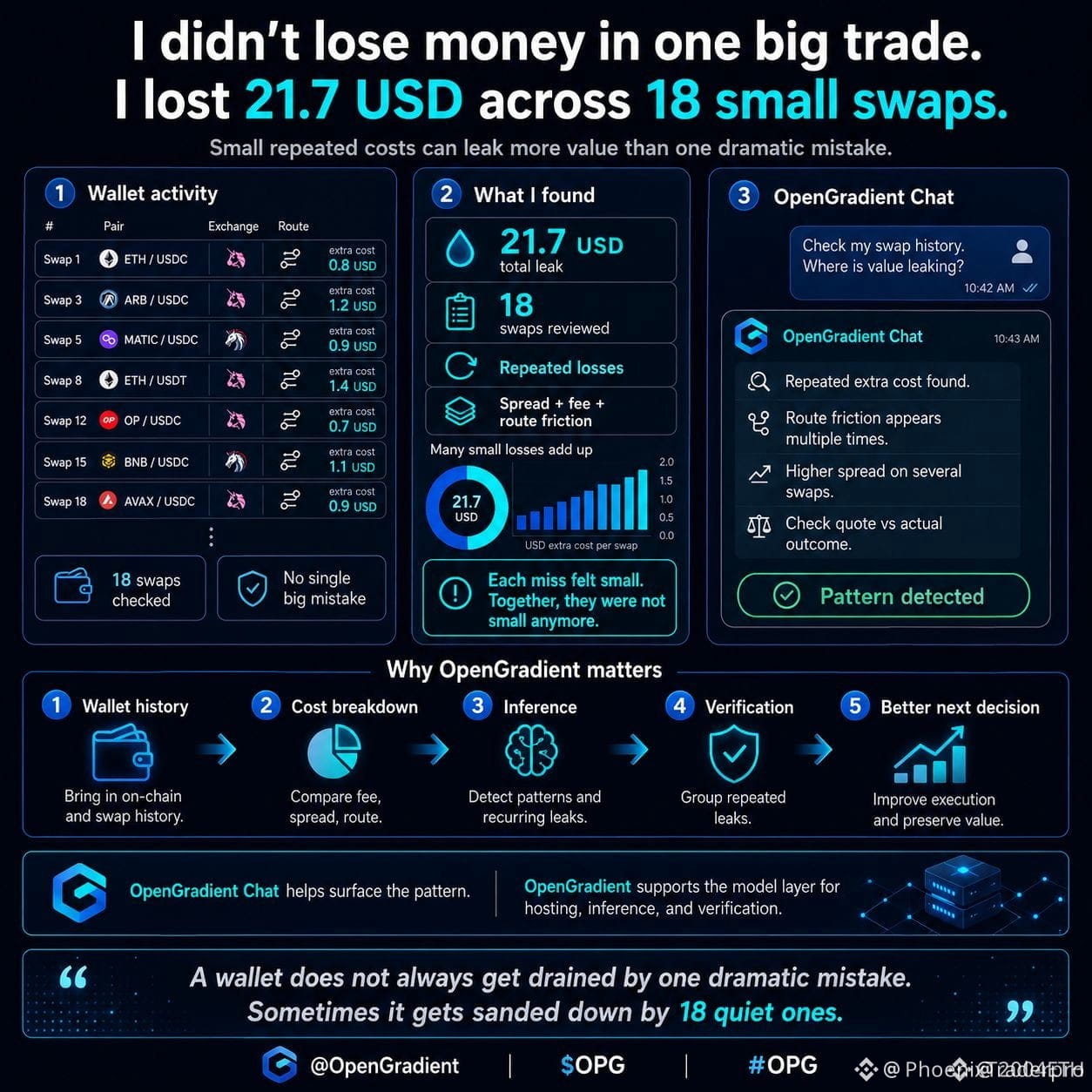
$OPG IS EXPOSED TO A NEW LEVEL OF TRANSPARENCY 🔥
Entry: 0.50
The OpenGradient network is helping traders like me connect the dots between small losses that add up over time, and this level of insight is a game changer, volume is surging right now as more traders realize the potential of $OPG , are you taking this entry or waiting for a pullback?
Not financial advice, manage your risk
#OPG #LongSetup #CryptoTransparency
💸
85
Article
How Can I Check Whether My Balance Is Included in Binance Proof of Reserves?A published [Proof of Reserves report](https://www.binance.com/en/proof-of-reserves) can show the assets an exchange reports holding against customer balances. But as a user, you might have a more personal question:
Was my own account actually included in that report?
Binance provides an individual verification process that allows users to examine their account information within a specific Proof of Reserves snapshot. You can view your personal verification record, identify the assets and balances included, and download the data needed to perform additional cryptographic checks.
This is an important distinction. You are not simply checking a general reserve figure. You are checking whether your own account's balance information is represented in the dataset used for that reporting period. Let's go through the process, including the technical details that are easy to overlook.
1. Select the Exact Proof of Reserves Reporting Period
Before looking for your account information, identify the snapshot you want to verify. Binance's published monthly schedule states that user balance snapshots are taken on the first day of each month at 00:00 UTC, with results expected to be released by the seventh day. However, special snapshots and changes to publication timelines may be announced separately. Always rely on the actual reporting date shown on Binance's Proof of Reserves page.
Why does the date matter? Because the snapshot represents account information at one specific moment. It does not continuously follow your deposits, withdrawals, or trading activity.
Imagine you held:
0.5 BTC on the snapshot date.You purchased another 0.2 BTC the following day.Your current holding is now 0.7 BTC.
Your historical verification record may still show 0.5 BTC. That is not necessarily a discrepancy. The additional purchase occurred after the snapshot. The same principle applies if you withdraw, sell, convert, or transfer assets after the reporting date.
Always compare your verification record with your holdings at the exact snapshot time, not your current wallet balance.
2. Where Can I Find My Individual Proof of Reserves Record?
You can access your [personal verification information directly through Binance](https://www.binance.com/en/support/faq/detail/815b25f0cb054bdd9d35eccc408fe981). Follow these steps:
Log in to your Binance account on the official website.Open Profile.Navigate to Wallet → Verification.Find the available Proof of Reserves verification records.Select the reporting date you want to examine.Expand the corresponding verification information.
Binance's verification page allows you to inspect the record associated with your account and the selected reporting period. Look for the following information:
Verification date.Verification type.Record ID.Merkle Leaf information.Assets covered by the selected report.Your recorded asset balances.The option to download the Merkle Tree data.
For the verification method described in Binance's technical guide, look for the self-verifying entry marked Merkle Tree + zk-SNARKs.
The key is to select the correct record. A verification entry from one reporting period should not be confused with another.
3. How Do I Know That My Own Account Is Included?
The individual verification record is the starting point. Binance provides a Record ID and Merkle Leaf information associated with your account and the selected snapshot. These are not generic identifiers shared by all users. They connect your individual account information to its position within the verification dataset. You can inspect your account's recorded assets and balances directly on the verification page. But there is an important difference between viewing the record and independently validating it. Viewing the record lets you examine the information Binance provides for your account. Downloading the Merkle Tree data and using the official verifier allows you to perform the cryptographic checks described in Binance's verification guide. That is the next level of the process.
4. What Exactly Are Record ID, AccountIndex, and Merkle Leaf?
These terms can sound interchangeable, but each has a different function.
Record ID The Record ID is the account-specific identifier displayed on the Binance Verification page for the selected snapshot. In the downloaded user configuration, it corresponds to the AccountIdHash field.
AccountIndex This field identifies the position of your account's Merkle leaf within the tree. Think of the Merkle Tree as a structure containing many account records. AccountIndex tells the verifier where your individual leaf is located.
Merkle Leaf The Merkle leaf represents your individual account information in the tree. Binance's PoR methodology uses hashed account identifiers and balance data to construct these leaves.
Merkle Root The Merkle Root is the final hash that summarizes the entire tree. If the underlying account information changes, the corresponding cryptographic hashes change, resulting in a different root. Your individual Merkle proof provides the path connecting your account's leaf to that root. This is what makes individual inclusion verification possible without exposing the account information of every other Binance user.
5. How to Download Your Individual Verification Data
Once you have selected the correct reporting period, you can download the data required for independent verification.
On the Binance Verification page:
Locate the self-verifying Merkle Tree entry.Confirm that the verification type is Merkle Tree + zk-SNARKs.Select Download Merkle Tree.Save the downloaded package to your computer.Extract the files.
The package contains the information required for the verification process, including your account-specific user_config.json file. This file is particularly important because it is generated using your account data from the selected snapshot. Keep all files together and make sure you do not mix information from different reporting periods.
6. How to Independently Verify Your Account With the Binance Verifier
Binance provides a verifier tool through its official GitHub repository. The tool allows users to perform cryptographic checks on the downloaded Proof of Reserves information.
Step 1: Download the correct verifier version
Visit Binance's official GitHub repository and download the version corresponding to the reporting period you want to verify.
According to Binance's published version mapping:
Always check the official repository for the appropriate release and any updated instructions before running the tool.
Step 2: Prepare the root verification files
Extract the verifier package and locate its config directory. Binance's instructions identify three important files required for root-level verification:
config.jsonproof.csvzkpor864.vk.save
Place the required files in the verifier's configuration directory. You should also check that the configuration references the correct proof data and verifying key. Three configuration elements are especially important:
ProofTable: Identifies the zk-SNARK proof data file.
ZkKeyName: Points to the verifying key included in the package.
CexAssetInfo: Represents total customer balance information for the listed Binance tokens, including verifiable and non-verifiable assets.
Binance explains that this information can be checked using the zk-SNARK proof and cross-checked against the verifiable assets shown on its Proof of Reserves portal.
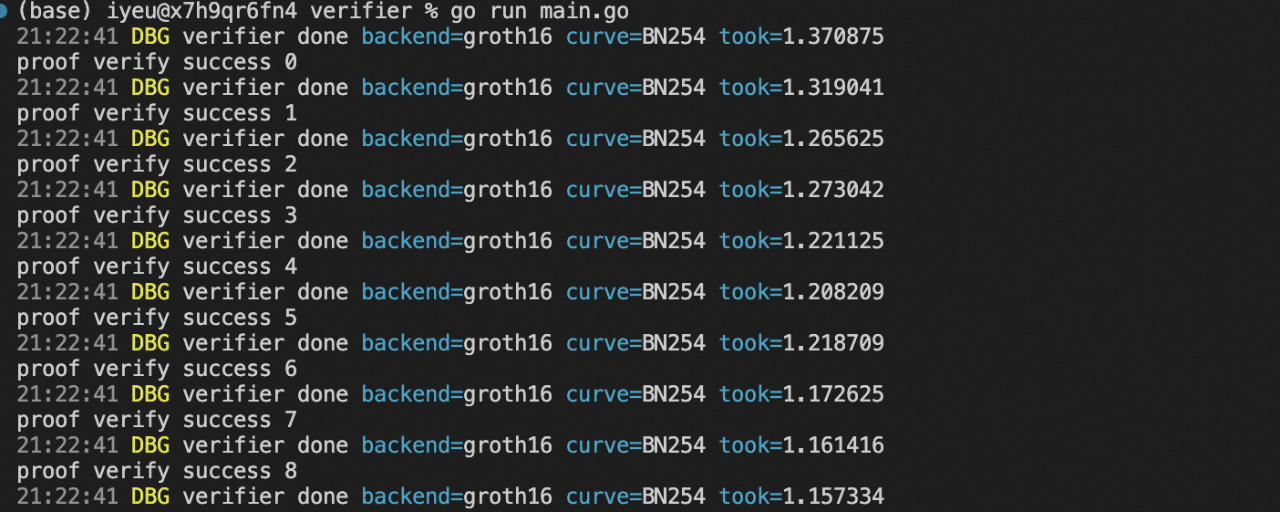
Step 3: Run the root-level verification
Open a terminal in the verifier directory and use the command corresponding to your operating system.
macOS ./verifier_darwin
Linux ./verifier_linux
Windows ./verifier_windows
This performs the root-level verification using the supplied proof and configuration data. Follow the setup instructions for the specific verifier release you downloaded.
Step 4: Run your individual account verification
Now you can move from checking the overall verification data to checking your own account.
Locate user_config.json in the downloaded verification package.
This file is generated using your account information at the snapshot time. Place it in the verifier's config directory, following Binance's instructions. Then run the individual verification command.
macOS ./verifier_darwin -user
Linux ./verifier_linux -user
Windows ./verifier_windows -user
The -user option tells the verifier to check your individual account information using the personal configuration file and its associated Merkle proof. This is the step that connects your own account data to the cryptographic verification process.
7. How to Read Your user_config.json File
The user_config.json file is where the individual verification data becomes more interesting. Instead of showing a simple wallet overview, it contains structured fields that allow the verifier to check your account's position and balance information. Here is what each field means:
TotalEquity, TotalDebt, and TotalCollateral
These fields provide information about the value and financial position of your account within the verification dataset.
TotalEquity represents the total USD value of your holdings.TotalDebt represents the total USD value of your borrowing.TotalCollateral represents the value of assets placed as collateral.
Binance's documentation specifies that these values use a scale of 10¹⁶. This means that the raw values in the configuration file are not necessarily displayed as ordinary USD figures. The scaling factor must be considered when interpreting them.
How to identify the assets in the Assets field
The Assets field contains the individual cryptocurrency balances included in your snapshot. However, the information may be represented through indexes rather than familiar token symbols. To identify the corresponding cryptocurrencies, use the Asset_List.csv file included in the downloaded package. Each index corresponds to an asset in that list. There is another detail worth remembering: asset balances generally use a scaling factor of 10⁸, while the following tokens use 10² according to Binance's documentation: BTTC, SHIB, LUNC, XEC, WIN, BIDR, SPELL, HOT, DOGE, PEPE, FLOKI, IDRT, BONK, DOGS, 1000SATS, and NEIRO. Do not compare the raw numbers directly with your normal wallet display without applying the appropriate scaling factor.
Why Root and Proof matter
-The Root and Proof fields are central to the individual verification.
-The Root is the Merkle Root hash associated with the selected dataset.
-The Proof is your account's Merkle path, which provides the information required to connect your leaf to that root.
The verifier uses these values to check whether your individual account information is cryptographically consistent with the published verification data.
8. What Do Merkle Trees and zk-SNARKs Actually Verify?
You do not need to understand every mathematical detail to follow the process, but knowing the role of each technology makes the result easier to interpret.
Merkle Trees verify individual inclusion.
A Merkle Tree organizes account data into a hierarchy of cryptographic hashes. Each account is represented by a leaf, and the hashes are combined until a single Merkle Root is produced. Your Merkle proof allows you to check whether your account's leaf belongs to that tree.
zk-SNARKs verify conditions across the larger dataset.
zk-SNARKs stands for Zero-Knowledge Succinct Non-Interactive Argument of Knowledge. In Binance's PoR system, the zk-SNARK proof is designed to check conditions such as:
User account balance sets are included in the calculation of total net account balances.Individual account net balances are non-negative.The Merkle Root is updated correctly when account information is incorporated into the leaf.
The important distinction is that Merkle Trees provide a way to verify your individual inclusion, while zk-SNARKs provide additional cryptographic checks on the broader balance dataset. Together, they provide a way to examine individual account inclusion and the integrity conditions applied to the larger dataset.
9. What Does Successful Verification Actually Mean?
A successful individual verification means that your account information is cryptographically consistent with the selected Merkle Tree and its associated proof. It provides evidence that your account was included in the dataset represented by that particular Merkle Root. The broader zk-SNARK verification provides additional evidence that the specified conditions applied to the dataset have been satisfied. However, there are some important limitations. A successful verification does not mean:
Your displayed balance is a live balance.Every cryptocurrency available on Binance is necessarily included in that snapshot.Every possible off-chain liability or financial obligation has been independently examined.The exchange is guaranteed to be free from all financial, operational, or security risks.A Proof of Reserves report is equivalent to a complete independent financial audit.
The snapshot date, asset coverage, and scope of the verification all matter.
10. What If Your Account Record Is Missing or Verification Fails?
If something does not look right, identify the issue before drawing conclusions.
You cannot find a verification record: Check whether you selected the correct reporting period and whether the results for that snapshot have been published.
Your asset does not appear in the record: Check the asset coverage for that particular reporting cycle. Not every report necessarily covers the same list of cryptocurrencies.
Your balance differs from your current wallet: Compare the record with your holdings at the snapshot date, not your current balance.
The verifier cannot find the required files: Check that you extracted the downloaded package correctly and placed the files in the expected configuration directory.
The verifier produces an error: Confirm that you downloaded the correct verifier version and that the configuration files belong to the same snapshot.
Your Record ID or asset information appears inconsistent: Compare the Verification page with your downloaded user_config.json and asset list. If the discrepancy remains, contact Binance Support through the official website.
⚠️Never use third-party downloads claiming to fix your verification files, and never share your account password, 2FA codes, or API credentials.
My Take: Transparency Is More Valuable When Users Can Verify It
I have been using Binance since 2019, and one thing I appreciate about the development of crypto platforms is the growing importance of giving users access to information rather than asking them to rely on statements alone. For me, Proof of Reserves becomes more meaningful when users can move beyond looking at a published number and examine the information associated with their own accounts. The technical side might seem intimidating at first. Record IDs, Merkle leaves, hashes, configuration files, and zero-knowledge proofs are not exactly everyday terms for most crypto users. But the idea is relatively simple: you should be able to check whether your account was included in a specific reporting snapshot and use the available tools to validate that information. You do not have to become a cryptography expert. You just need to understand what you are checking, use the official tools, and know the limitations of the result.
FAQ
1. How can I check whether my Binance account is included in Proof of Reserves? Log in to Binance, open Wallet → Verification, select the reporting date, and inspect your individual verification record.
2. Where can I find my Record ID? Your Record ID is displayed in the verification information associated with your account and the selected snapshot.
3. Is the Record ID the same as AccountIndex? No. The Record ID is associated with your account identifier, while AccountIndex indicates the position of your account's leaf in the Merkle Tree.
4. Can I check my balance without downloading the verifier? Yes. You can view your personal verification record, covered assets, and snapshot balances directly through Binance. The verifier is for additional independent cryptographic checks.
5. Why does the balance in my verification record differ from my current balance? Because the record represents a historical snapshot. Transactions made after that date are not reflected in the same snapshot.
6. Does Binance Proof of Reserves include every cryptocurrency? You should check the asset list for the reporting period you selected. Asset coverage can differ between snapshots.
7. What does a successful Merkle Tree verification prove? It provides cryptographic evidence that your individual account information is included in the dataset represented by the corresponding Merkle Root.
8. Does successful verification guarantee that all my funds are completely risk-free? No. It provides evidence within the scope of the selected Proof of Reserves system and snapshot. It does not eliminate all exchange-related risks or replace a comprehensive financial audit.
Final takeaway: You should not have to rely only on a general reserve figure to understand whether your own account was included in a Proof of Reserves report. Binance provides individual verification records and cryptographic tools that allow you to inspect your snapshot data and independently check your account's inclusion. The most important part is understanding the reporting date, the assets covered, and what the verification actually establishes.
#Binance #ProofOfReserves #CryptoTransparency #MerkleTrees #CryptoSecurity
How Can I Check Whether My Balance Is Included in Binance Proof of Reserves?
A published Proof of Reserves report can show the assets an exchange reports holding against customer balances. But as a user, you might have a more personal question:
Was my own account actually included in that report?
Binance provides an individual verification process that allows users to examine their account information within a specific Proof of Reserves snapshot. You can view your personal verification record, identify the assets and balances included, and download the data needed to perform additional cryptographic checks.
This is an important distinction. You are not simply checking a general reserve figure. You are checking whether your own account's balance information is represented in the dataset used for that reporting period. Let's go through the process, including the technical details that are easy to overlook.
1. Select the Exact Proof of Reserves Reporting Period
Before looking for your account information, identify the snapshot you want to verify. Binance's published monthly schedule states that user balance snapshots are taken on the first day of each month at 00:00 UTC, with results expected to be released by the seventh day. However, special snapshots and changes to publication timelines may be announced separately. Always rely on the actual reporting date shown on Binance's Proof of Reserves page.
Why does the date matter? Because the snapshot represents account information at one specific moment. It does not continuously follow your deposits, withdrawals, or trading activity.
Imagine you held:
0.5 BTC on the snapshot date.You purchased another 0.2 BTC the following day.Your current holding is now 0.7 BTC.
Your historical verification record may still show 0.5 BTC. That is not necessarily a discrepancy. The additional purchase occurred after the snapshot. The same principle applies if you withdraw, sell, convert, or transfer assets after the reporting date.
Always compare your verification record with your holdings at the exact snapshot time, not your current wallet balance.
2. Where Can I Find My Individual Proof of Reserves Record?
You can access your personal verification information directly through Binance. Follow these steps:
Log in to your Binance account on the official website.Open Profile.Navigate to Wallet → Verification.Find the available Proof of Reserves verification records.Select the reporting date you want to examine.Expand the corresponding verification information.
Binance's verification page allows you to inspect the record associated with your account and the selected reporting period. Look for the following information:
Verification date.Verification type.Record ID.Merkle Leaf information.Assets covered by the selected report.Your recorded asset balances.The option to download the Merkle Tree data.
For the verification method described in Binance's technical guide, look for the self-verifying entry marked Merkle Tree + zk-SNARKs.
The key is to select the correct record. A verification entry from one reporting period should not be confused with another.
3. How Do I Know That My Own Account Is Included?
The individual verification record is the starting point. Binance provides a Record ID and Merkle Leaf information associated with your account and the selected snapshot. These are not generic identifiers shared by all users. They connect your individual account information to its position within the verification dataset. You can inspect your account's recorded assets and balances directly on the verification page. But there is an important difference between viewing the record and independently validating it. Viewing the record lets you examine the information Binance provides for your account. Downloading the Merkle Tree data and using the official verifier allows you to perform the cryptographic checks described in Binance's verification guide. That is the next level of the process.
4. What Exactly Are Record ID, AccountIndex, and Merkle Leaf?
These terms can sound interchangeable, but each has a different function.
Record ID The Record ID is the account-specific identifier displayed on the Binance Verification page for the selected snapshot. In the downloaded user configuration, it corresponds to the AccountIdHash field.
AccountIndex This field identifies the position of your account's Merkle leaf within the tree. Think of the Merkle Tree as a structure containing many account records. AccountIndex tells the verifier where your individual leaf is located.
Merkle Leaf The Merkle leaf represents your individual account information in the tree. Binance's PoR methodology uses hashed account identifiers and balance data to construct these leaves.
Merkle Root The Merkle Root is the final hash that summarizes the entire tree. If the underlying account information changes, the corresponding cryptographic hashes change, resulting in a different root. Your individual Merkle proof provides the path connecting your account's leaf to that root. This is what makes individual inclusion verification possible without exposing the account information of every other Binance user.
5. How to Download Your Individual Verification Data
Once you have selected the correct reporting period, you can download the data required for independent verification.
On the Binance Verification page:
Locate the self-verifying Merkle Tree entry.Confirm that the verification type is Merkle Tree + zk-SNARKs.Select Download Merkle Tree.Save the downloaded package to your computer.Extract the files.
The package contains the information required for the verification process, including your account-specific user_config.json file. This file is particularly important because it is generated using your account data from the selected snapshot. Keep all files together and make sure you do not mix information from different reporting periods.
6. How to Independently Verify Your Account With the Binance Verifier
Binance provides a verifier tool through its official GitHub repository. The tool allows users to perform cryptographic checks on the downloaded Proof of Reserves information.
Step 1: Download the correct verifier version
Visit Binance's official GitHub repository and download the version corresponding to the reporting period you want to verify.
According to Binance's published version mapping:
Always check the official repository for the appropriate release and any updated instructions before running the tool.
Step 2: Prepare the root verification files
Extract the verifier package and locate its config directory. Binance's instructions identify three important files required for root-level verification:
config.jsonproof.csvzkpor864.vk.save
Place the required files in the verifier's configuration directory. You should also check that the configuration references the correct proof data and verifying key. Three configuration elements are especially important:
ProofTable: Identifies the zk-SNARK proof data file.
ZkKeyName: Points to the verifying key included in the package.
CexAssetInfo: Represents total customer balance information for the listed Binance tokens, including verifiable and non-verifiable assets.
Binance explains that this information can be checked using the zk-SNARK proof and cross-checked against the verifiable assets shown on its Proof of Reserves portal.
Step 3: Run the root-level verification
Open a terminal in the verifier directory and use the command corresponding to your operating system.
macOS ./verifier_darwin
Linux ./verifier_linux
Windows ./verifier_windows
This performs the root-level verification using the supplied proof and configuration data. Follow the setup instructions for the specific verifier release you downloaded.
Step 4: Run your individual account verification
Now you can move from checking the overall verification data to checking your own account.
Locate user_config.json in the downloaded verification package.
This file is generated using your account information at the snapshot time. Place it in the verifier's config directory, following Binance's instructions. Then run the individual verification command.
macOS ./verifier_darwin -user
Linux ./verifier_linux -user
Windows ./verifier_windows -user
The -user option tells the verifier to check your individual account information using the personal configuration file and its associated Merkle proof. This is the step that connects your own account data to the cryptographic verification process.
7. How to Read Your user_config.json File
The user_config.json file is where the individual verification data becomes more interesting. Instead of showing a simple wallet overview, it contains structured fields that allow the verifier to check your account's position and balance information. Here is what each field means:
TotalEquity, TotalDebt, and TotalCollateral
These fields provide information about the value and financial position of your account within the verification dataset.
TotalEquity represents the total USD value of your holdings.TotalDebt represents the total USD value of your borrowing.TotalCollateral represents the value of assets placed as collateral.
Binance's documentation specifies that these values use a scale of 10¹⁶. This means that the raw values in the configuration file are not necessarily displayed as ordinary USD figures. The scaling factor must be considered when interpreting them.
How to identify the assets in the Assets field
The Assets field contains the individual cryptocurrency balances included in your snapshot. However, the information may be represented through indexes rather than familiar token symbols. To identify the corresponding cryptocurrencies, use the Asset_List.csv file included in the downloaded package. Each index corresponds to an asset in that list. There is another detail worth remembering: asset balances generally use a scaling factor of 10⁸, while the following tokens use 10² according to Binance's documentation: BTTC, SHIB, LUNC, XEC, WIN, BIDR, SPELL, HOT, DOGE, PEPE, FLOKI, IDRT, BONK, DOGS, 1000SATS, and NEIRO. Do not compare the raw numbers directly with your normal wallet display without applying the appropriate scaling factor.
Why Root and Proof matter
-The Root and Proof fields are central to the individual verification.
-The Root is the Merkle Root hash associated with the selected dataset.
-The Proof is your account's Merkle path, which provides the information required to connect your leaf to that root.
The verifier uses these values to check whether your individual account information is cryptographically consistent with the published verification data.
8. What Do Merkle Trees and zk-SNARKs Actually Verify?
You do not need to understand every mathematical detail to follow the process, but knowing the role of each technology makes the result easier to interpret.
Merkle Trees verify individual inclusion.
A Merkle Tree organizes account data into a hierarchy of cryptographic hashes. Each account is represented by a leaf, and the hashes are combined until a single Merkle Root is produced. Your Merkle proof allows you to check whether your account's leaf belongs to that tree.
zk-SNARKs verify conditions across the larger dataset.
zk-SNARKs stands for Zero-Knowledge Succinct Non-Interactive Argument of Knowledge. In Binance's PoR system, the zk-SNARK proof is designed to check conditions such as:
User account balance sets are included in the calculation of total net account balances.Individual account net balances are non-negative.The Merkle Root is updated correctly when account information is incorporated into the leaf.
The important distinction is that Merkle Trees provide a way to verify your individual inclusion, while zk-SNARKs provide additional cryptographic checks on the broader balance dataset. Together, they provide a way to examine individual account inclusion and the integrity conditions applied to the larger dataset.
9. What Does Successful Verification Actually Mean?
A successful individual verification means that your account information is cryptographically consistent with the selected Merkle Tree and its associated proof. It provides evidence that your account was included in the dataset represented by that particular Merkle Root. The broader zk-SNARK verification provides additional evidence that the specified conditions applied to the dataset have been satisfied. However, there are some important limitations. A successful verification does not mean:
Your displayed balance is a live balance.Every cryptocurrency available on Binance is necessarily included in that snapshot.Every possible off-chain liability or financial obligation has been independently examined.The exchange is guaranteed to be free from all financial, operational, or security risks.A Proof of Reserves report is equivalent to a complete independent financial audit.
The snapshot date, asset coverage, and scope of the verification all matter.
10. What If Your Account Record Is Missing or Verification Fails?
If something does not look right, identify the issue before drawing conclusions.
You cannot find a verification record: Check whether you selected the correct reporting period and whether the results for that snapshot have been published.
Your asset does not appear in the record: Check the asset coverage for that particular reporting cycle. Not every report necessarily covers the same list of cryptocurrencies.
Your balance differs from your current wallet: Compare the record with your holdings at the snapshot date, not your current balance.
The verifier cannot find the required files: Check that you extracted the downloaded package correctly and placed the files in the expected configuration directory.
The verifier produces an error: Confirm that you downloaded the correct verifier version and that the configuration files belong to the same snapshot.
Your Record ID or asset information appears inconsistent: Compare the Verification page with your downloaded user_config.json and asset list. If the discrepancy remains, contact Binance Support through the official website.
⚠️Never use third-party downloads claiming to fix your verification files, and never share your account password, 2FA codes, or API credentials.
My Take: Transparency Is More Valuable When Users Can Verify It
I have been using Binance since 2019, and one thing I appreciate about the development of crypto platforms is the growing importance of giving users access to information rather than asking them to rely on statements alone. For me, Proof of Reserves becomes more meaningful when users can move beyond looking at a published number and examine the information associated with their own accounts. The technical side might seem intimidating at first. Record IDs, Merkle leaves, hashes, configuration files, and zero-knowledge proofs are not exactly everyday terms for most crypto users. But the idea is relatively simple: you should be able to check whether your account was included in a specific reporting snapshot and use the available tools to validate that information. You do not have to become a cryptography expert. You just need to understand what you are checking, use the official tools, and know the limitations of the result.
FAQ
1. How can I check whether my Binance account is included in Proof of Reserves? Log in to Binance, open Wallet → Verification, select the reporting date, and inspect your individual verification record.
2. Where can I find my Record ID? Your Record ID is displayed in the verification information associated with your account and the selected snapshot.
3. Is the Record ID the same as AccountIndex? No. The Record ID is associated with your account identifier, while AccountIndex indicates the position of your account's leaf in the Merkle Tree.
4. Can I check my balance without downloading the verifier? Yes. You can view your personal verification record, covered assets, and snapshot balances directly through Binance. The verifier is for additional independent cryptographic checks.
5. Why does the balance in my verification record differ from my current balance? Because the record represents a historical snapshot. Transactions made after that date are not reflected in the same snapshot.
6. Does Binance Proof of Reserves include every cryptocurrency? You should check the asset list for the reporting period you selected. Asset coverage can differ between snapshots.
7. What does a successful Merkle Tree verification prove? It provides cryptographic evidence that your individual account information is included in the dataset represented by the corresponding Merkle Root.
8. Does successful verification guarantee that all my funds are completely risk-free? No. It provides evidence within the scope of the selected Proof of Reserves system and snapshot. It does not eliminate all exchange-related risks or replace a comprehensive financial audit.
Final takeaway: You should not have to rely only on a general reserve figure to understand whether your own account was included in a Proof of Reserves report. Binance provides individual verification records and cryptographic tools that allow you to inspect your snapshot data and independently check your account's inclusion. The most important part is understanding the reporting date, the assets covered, and what the verification actually establishes.
#Binance #ProofOfReserves #CryptoTransparency #MerkleTrees #CryptoSecurity
1
2
622

🔶 Binance Enhances Transparency with Updated Proof of Reserves Wallet Addresses
Binance has introduced newly generated wallet addresses for processing withdrawals, and these addresses have also been incorporated into its Proof of Reserves (POR) framework.
This development aims to improve transparency and on-chain traceability, allowing users to monitor reserve-related wallet activity with greater clarity and verify that published reserve information reflects the latest wallet infrastructure.
The Proof of Reserves initiative plays an important role in building trust by providing verifiable reserve information while maintaining individual account privacy.
As Binance continues to upgrade its wallet infrastructure, keeping reserve records and disclosures updated is essential for maintaining accuracy and accountability.
Users are encouraged to check the latest Proof of Reserves data and verify their account inclusion through the available verification tools.
Transparency means more than showing assets — it means making information accurate, accessible, and independently verifiable. 🔍
#BinanceUpdatesProofofReservesAddresses ##BNB_Market_Update
#CryptoTransparency
#blockchain
#CryptoUpdates
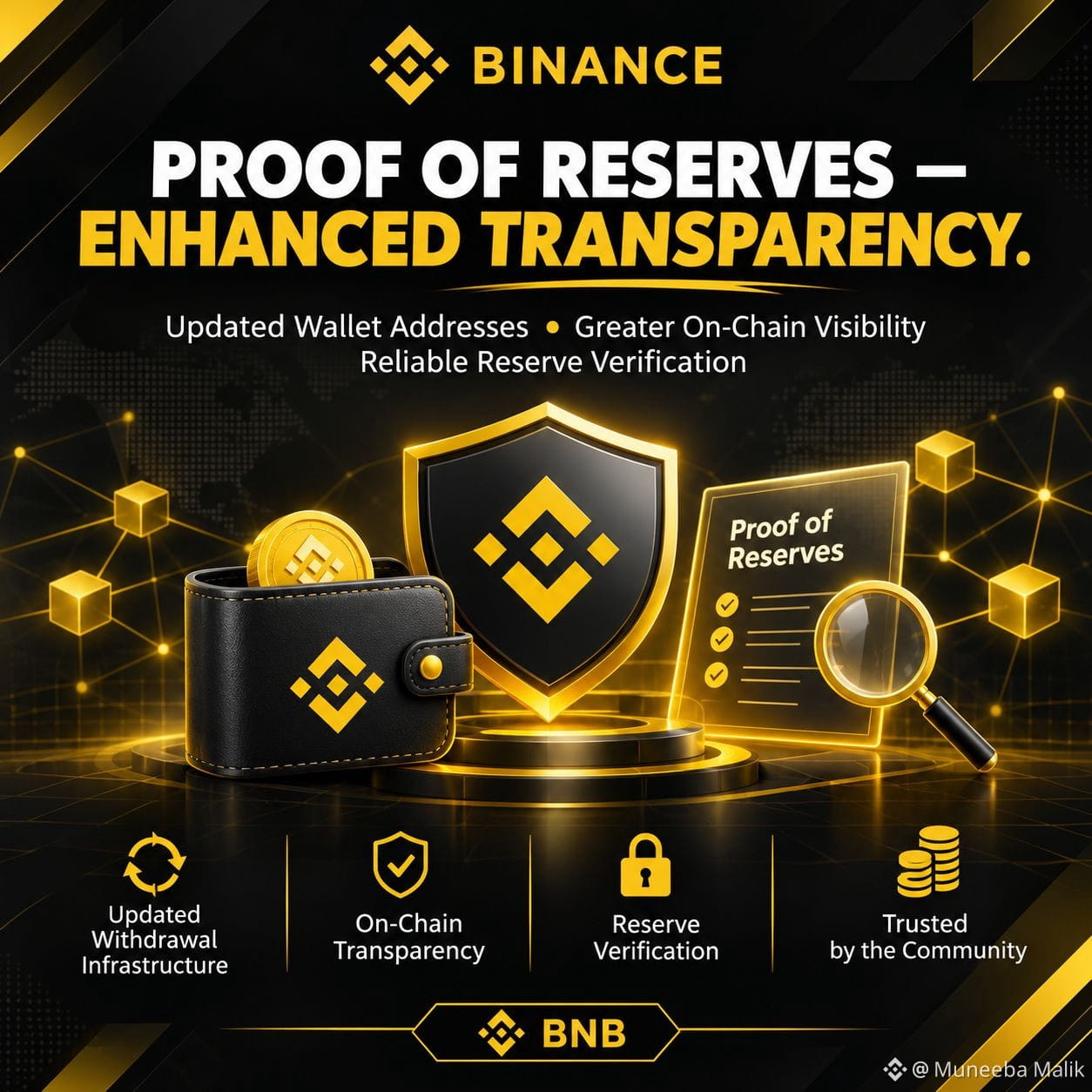
141


Article
Binance Proof of Reserves: Transparency Is the Real Test of Trust
Can you verify your crypto exchangBinance's Proof of Reserves (PoR) addresses an important question for every crypto investor: Are the assets held by an exchange sufficient to cover its users' balances?
Publishing wallet addresses gives users an opportunity to independently examine on-chain holdings. This is a meaningful step toward greater transparency, but it is important to understand what the data actually proves.
Proof of Reserves can help verify that an exchange holds certain assets at a particular point in time. However, it does not automatically prove that the exchange has no hidden liabilities or financial risks.
For investors, the real value lies in being able to verify the evidence rather than simply trusting a statement.
My perspective: Transparency should not be a one-time announcement. It should be an ongoing commitment that makes it easier for users to understand the financial health of the platforms they trust.
As crypto adoption grows, verifiable information will become increasingly important for building long-term confidence in the market.
Do you think Proof of Reserves is enough to build trust in a crypto exchange, or should exchanges also provide more detailed information about their liabilities?
#BinanceUpdates #ProofOfReserves #CryptoTransparency #Binance #CryptoInvesting
Binance Proof of Reserves: Transparency Is the Real Test of Trust Can you verify your crypto exchang
Binance's Proof of Reserves (PoR) addresses an important question for every crypto investor: Are the assets held by an exchange sufficient to cover its users' balances?
Publishing wallet addresses gives users an opportunity to independently examine on-chain holdings. This is a meaningful step toward greater transparency, but it is important to understand what the data actually proves.
Proof of Reserves can help verify that an exchange holds certain assets at a particular point in time. However, it does not automatically prove that the exchange has no hidden liabilities or financial risks.
For investors, the real value lies in being able to verify the evidence rather than simply trusting a statement.
My perspective: Transparency should not be a one-time announcement. It should be an ongoing commitment that makes it easier for users to understand the financial health of the platforms they trust.
As crypto adoption grows, verifiable information will become increasingly important for building long-term confidence in the market.
Do you think Proof of Reserves is enough to build trust in a crypto exchange, or should exchanges also provide more detailed information about their liabilities?
#BinanceUpdates #ProofOfReserves #CryptoTransparency #Binance #CryptoInvesting
4
3
76

·
--
Article
Binance Updates Proof of Reserves Addresses to Boost Transparency and Security#binanceupdatesproofofreservesaddresses
In a crucial step to reinforce user trust and system security, Binance has published an updated snapshot of its Proof of Reserves (PoR) system, including a refreshed directory of wallet addresses.
The updated Proof of Reserves mechanism utilizes Merkle Trees paired with zk-SNARKs (Zero-Knowledge Succinct Non-Interactive Arguments of Knowledge). This cryptographic framework allows traders to independently verify that their account balances are backed 1:1 on the exchange without compromising sensitive user privacy or transaction details.
By updating its verified address registry, Binance ensures full operational visibility across all major crypto assets. The latest reserves snapshot confirms 100% backing across core holdings, highlighting the exchange's commitment to solvency, customer protection, and platform stability.
Top 3 Tradeable Assets Covered in the Update
Bitcoin ($BTC )Role: Premier reserve asset and primary liquidity anchor.Verification: Confirmed 100% backed in the updated PoR snapshot, guaranteeing full operational coverage for spot and margin traders.Ethereum ($ETH )Role: Leading smart contract network token powering DeFi and Web3 assets.Verification: Fully audited across updated mainnet and Layer-2 hot/cold storage wallet clusters.BNB ($BNB )Role: Native utility and governance token of the BNB Chain ecosystem.Verification: Fully backed across all mainnet and cross-chain reserve addresses.{spot}(BTCUSDT){spot}(ETHUSDT){spot}(BNBUSDT)#CryptoTransparency #ProofOfReserves #Binancesecurity #Binance
Binance Updates Proof of Reserves Addresses to Boost Transparency and Security
#binanceupdatesproofofreservesaddresses
In a crucial step to reinforce user trust and system security, Binance has published an updated snapshot of its Proof of Reserves (PoR) system, including a refreshed directory of wallet addresses.
The updated Proof of Reserves mechanism utilizes Merkle Trees paired with zk-SNARKs (Zero-Knowledge Succinct Non-Interactive Arguments of Knowledge). This cryptographic framework allows traders to independently verify that their account balances are backed 1:1 on the exchange without compromising sensitive user privacy or transaction details.
By updating its verified address registry, Binance ensures full operational visibility across all major crypto assets. The latest reserves snapshot confirms 100% backing across core holdings, highlighting the exchange's commitment to solvency, customer protection, and platform stability.
Top 3 Tradeable Assets Covered in the Update
Bitcoin ($BTC )Role: Premier reserve asset and primary liquidity anchor.Verification: Confirmed 100% backed in the updated PoR snapshot, guaranteeing full operational coverage for spot and margin traders.Ethereum ($ETH )Role: Leading smart contract network token powering DeFi and Web3 assets.Verification: Fully audited across updated mainnet and Layer-2 hot/cold storage wallet clusters.BNB ($BNB )Role: Native utility and governance token of the BNB Chain ecosystem.Verification: Fully backed across all mainnet and cross-chain reserve addresses.#CryptoTransparency #ProofOfReserves #Binancesecurity #Binance
1
135

·
--
#BinanceUpdatesProofofReservesAddresses
As part of its ongoing security response, Binance has updated its Proof of Reserves wallet list with newly generated addresses. Going forward, all withdrawals will be processed exclusively from these new wallets.
Users can review the updated addresses and latest snapshot (taken 31 Oct 2026 00:00 UTC) on the official PoR page: binance.com/en/proof-of-reserves
Major assets continue to show ≥100% reserve ratios. Full zk-SNARKs proof is expected by 3 Nov.
This proactive refresh of PoR addresses after the recent incident strengthens transparency and operational security. Routing withdrawals through verified new wallets, combined with timely reserve snapshots and forthcoming cryptographic proofs, helps rebuild confidence. Consistent on-chain verifiability remains essential for user trust in centralized platforms. Stay SAFU and always verify independently.
#Binance #ProofOfReserves #SAFU #CryptoTransparency
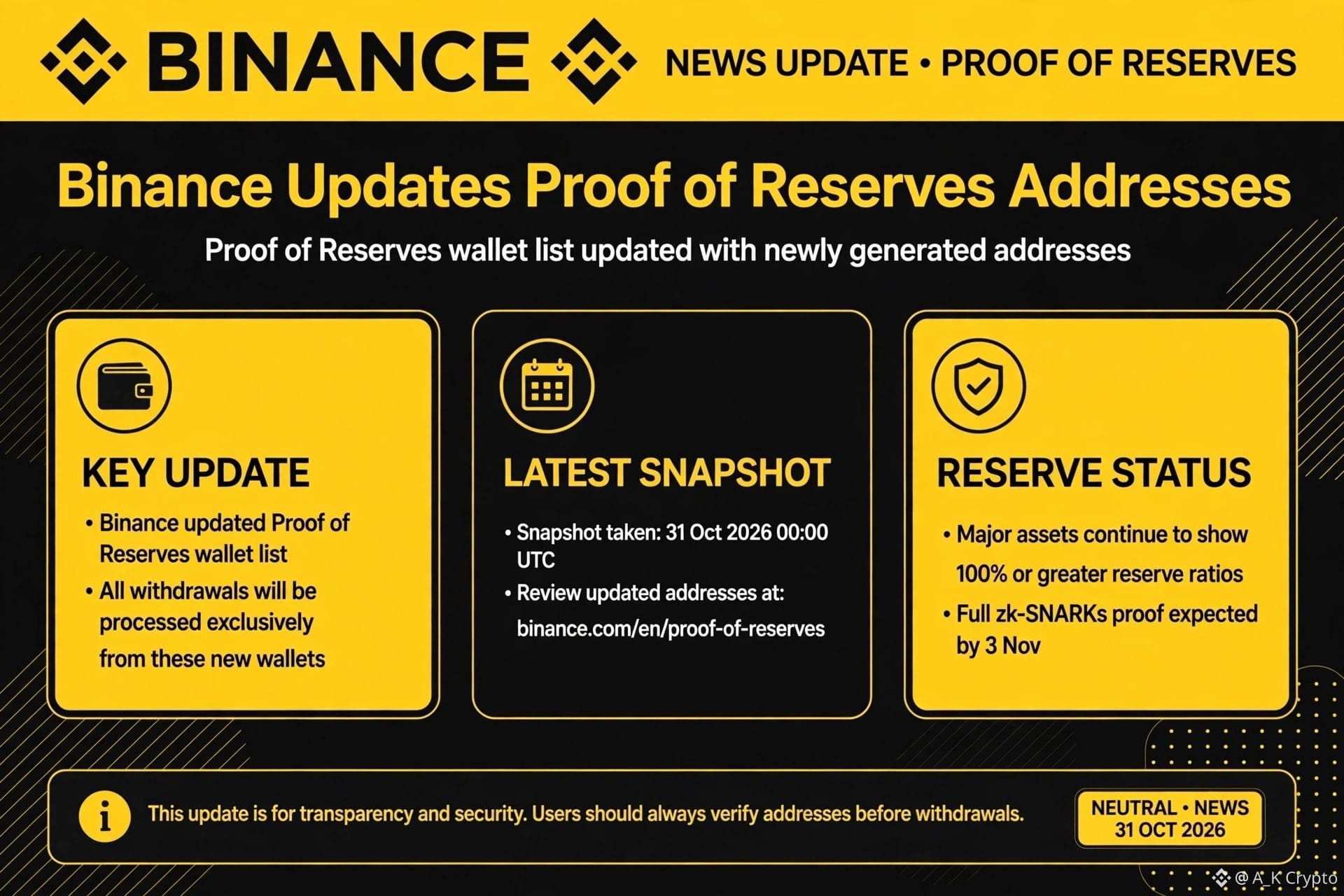
1
76

·
--
Bullish
🚨 **BINANCE HAS REPLENISHED 90% OF STOLEN ASSETS — USERS WON'T BEAR THE LOSS!**
A significant development in the latest Binance security incident.
According to Binance's October 31 update:
✅ 90% of the impacted stolen assets have been replenished.
✅ BTC, ETH, USDT, BNB, SOL, USDC, XRP, USD1, RLUSD and ZEC are reported as 100% backed.
✅ Binance is using a combination of its SAFU fund, Futures Insurance Fund and corporate treasury.
✅ Binance has committed to absorbing the financial impact rather than passing the loss to users.
There is still 10% outstanding, mainly involving less-liquid tokens that may take longer to acquire.
What happens next?
• Binance aims to complete the remaining replenishment.
• A new Proof of Reserves snapshot has been published.
• Full zero-knowledge proof generation is expected by November 3.
• Withdrawals are targeted to resume on November 1, subject to confirmation.
💡 **My perspective:**
The real test of an exchange is not whether it can avoid every security incident. It is how responsibly it responds when something goes wrong.
Binance is demonstrating financial accountability through measurable recovery efforts. The remaining challenge is to maintain transparency and independently verifiable user protection.
Crypto needs more accountability, not just promises.
**Do you think exchanges should be legally required to maintain emergency funds to protect users against security incidents?**
#BinanceSquareFamily #CryptoSecurity #SAFUnds #ProofOfReserves erves #Bitcoin❗ #CryptoTransparency rency
100

zachxbt calling out hayes for pumping $WLD then exiting is the exact thing most CT accounts won't say out loud.
the pattern isn't new. build a position, post the thesis, let retail follow, exit into the liquidity you created. hayes just got caught because he admitted the sale. most influencers never do. They just quietly rotate while their followers hold the bag.
i'd be checking how many other "conviction" posts from the last 6 months ended the same way. on-chain data doesn't lie. wallets do. and right now with fear at 11 and markets bleeding across the board, the last thing retail needs is more exit liquidity for people who already made their money.
this is why tracking wallet movements matters more than reading threads. conviction without transparency is just marketing.
#OnChain #Worldcoin #CryptoTransparency #DeFi #RetailTrading
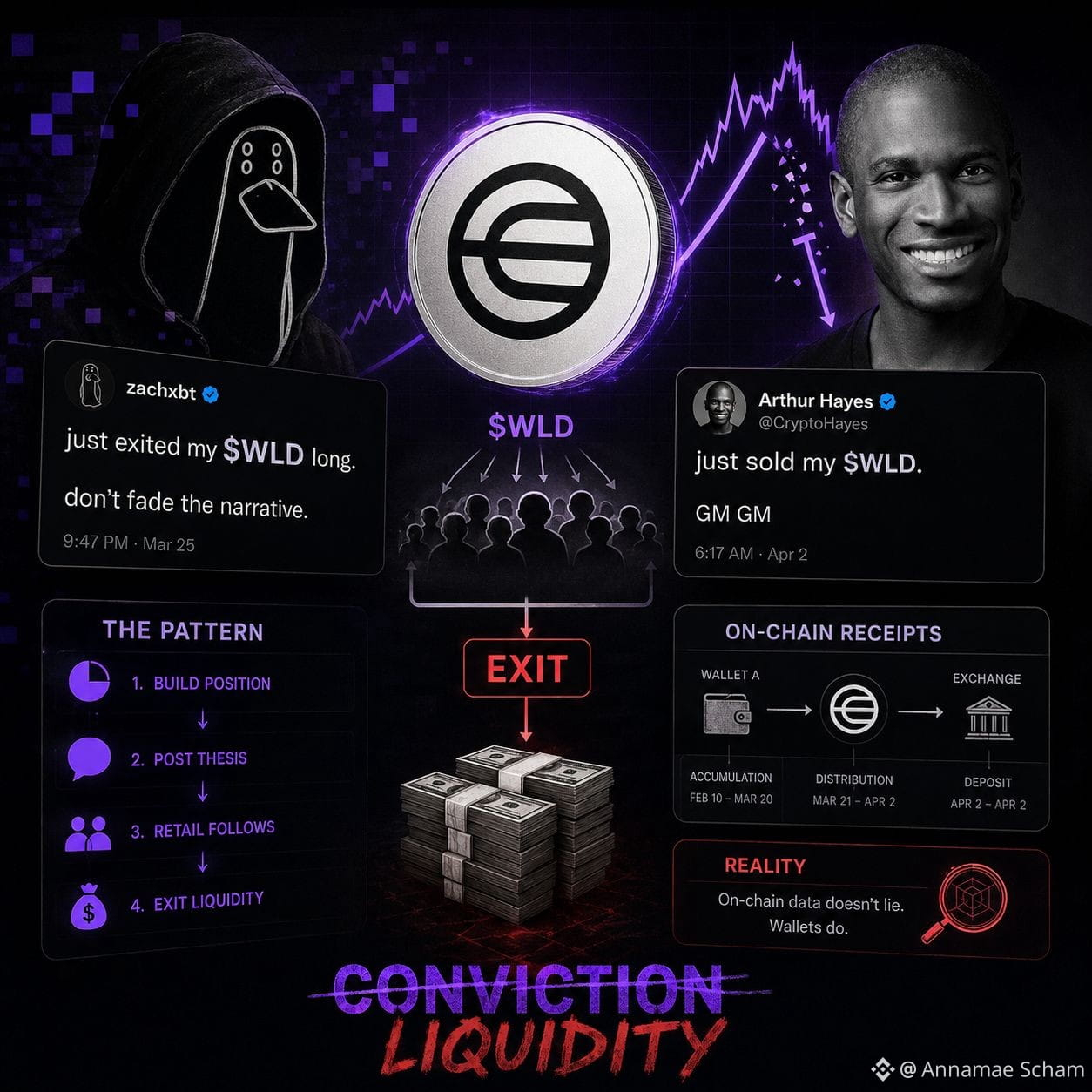
1
456
Log in to explore more content
Join global crypto users on Binance Square
⚡️ Get latest and useful information about crypto.
💬 Trusted by the world’s largest crypto exchange.
👍 Discover real insights from verified creators.
Email / Phone number
Trending Topics
1
#NvidiaLoses$2.7TrillionInMonthAndAHalf
16,477 views
111 Discussing
2
#CanBTCReboundAfterFallingBelow60K?
732,977 views
2,921 Discussing
3
#GlobalStocksFaceLongestLosingStreakSince2023
265,205 views
1,959 Discussing
4
#BlackRockIBITPostsRecord$541MSingleDayOutflow
30,570 views
88 Discussing
5
#AnthropicPlungesTowardIPOPriceonDay2
134,831 views
1,188 Discussing
6
#TwentyOneCapitalAdds172.25BTC
61,462 views
647 Discussing
7
#HKBillWouldExcludeTokenizedDepositsFromVirtualAssets
7,591 views
50 Discussing
8
#BNBDropsBelow540USDTWith8.46%DailyDecline
74,156 views
635 Discussing
9
#HKBillProposesHK$100KFineForUnauthorizedCryptoTitles
2,490 views
22 Discussing
10
#BitMineFaces$10.1BUnrealizedETHLoss
5,188 views
27 Discussing