
#economiccalendar
economiccalendar
60,152 views
108 Discussing
Hot
Latest

·
--
Article
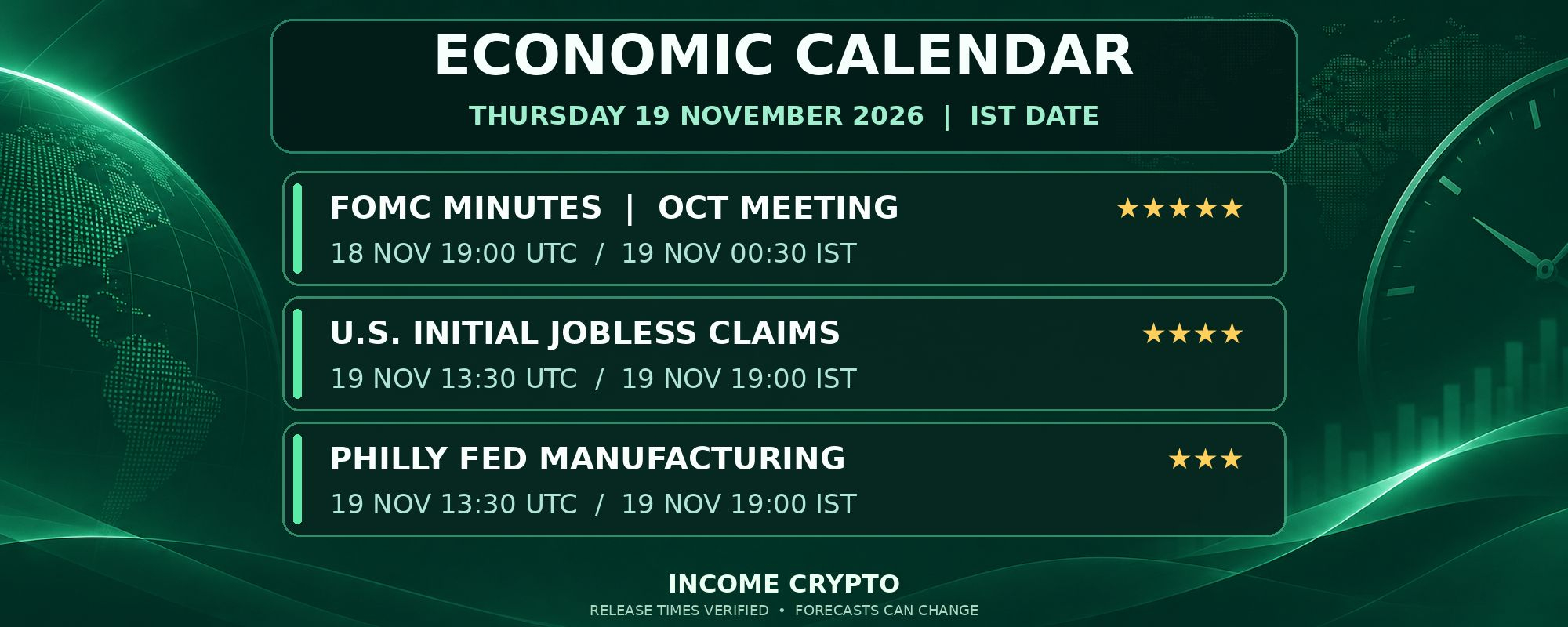
Can Thursday's Job Data Undo the Fed Minutes' First Bitcoin Move?Bitcoin could get one message from the Federal Reserve overnight and a different one from U.S. economic data before the following session is over. If $BTC changes direction twice, which move is actually telling us something about interest rates?
The first clock starts on Wednesday, November 18 at 19:00 UTC, which is Thursday, November 19 at 00:30 IST. That's when the minutes of the Fed's October 27-28 meeting are due. We already know the committee held its policy rate at 3.75%-4.00%, while Lisa Cook and Beth Hammack wanted a quarter-point increase. Those two dissents are not fresh news. The potential surprise is whether the discussion reveals a wider appetite to keep policy tighter than the 10-2 vote alone suggested. And remember, minutes describe an October conversation, not a new rate decision.
A hawkish reading could lift the U.S. two-year Treasury yield and the dollar, both potential headwinds for Bitcoin. But there's a catch. If BTC drops while those two indicators barely move, the Fed explanation is weaker than the headline makes it sound. Crypto-specific positioning or selling could be doing more of the work.
Then comes Thursday, November 19 at 13:30 UTC / 19:00 IST. U.S. initial jobless claims and the Philadelphia Fed manufacturing survey arrive together. PNC's November 16 calendar shows a 198,000 consensus for new claims, compared with 200,000 previously. For Philly Fed, the prior activity index was 20.9. PNC lists a 21.3 market consensus but its own forecast is just 18.5. Those are two different benchmarks, not two versions of the actual result.
Consider a hypothetical Philly Fed reading of 19.5. It would beat PNC's house forecast, miss the cited consensus, and fall below October's 20.9. Someone calling that simply 'strong' or 'weak' would be skipping the most important comparison. The survey is regional, too. Its new-orders and prices-paid details can matter more for the economic story than a single headline number.
Here's the bigger twist for $BTC. More jobless claims than expected might reduce fears of another rate hike, which could pull yields lower. But if the increase looks like the start of a serious growth problem, Bitcoin could fall anyway. Fewer claims might be healthy for workers but keep pressure on rates. There is no automatic 'bad jobs equals good Bitcoin' rule.
Two smaller calendar entries follow: the U.S. Leading Economic Index at 15:00 UTC / 20:30 IST and EIA natural-gas storage at 15:30 UTC / 21:00 IST. The first offers a broader growth check; the second primarily matters to natural-gas markets. Neither should be treated as equal in likely BTC relevance to the Fed minutes or the 13:30 UTC data pair.
The answer to the opening question isn't that the later report always wins. The more meaningful move is the one backed by a change in expected Fed policy, the two-year yield and the dollar, with Bitcoin's own reaction confirming or challenging that interpretation. Compare all three just before each release and again after the first volatility settles. If they disagree, the story is still incomplete.
#EconomicCalendar #FOMC #Bitcoin
Can Thursday's Job Data Undo the Fed Minutes' First Bitcoin Move?
Bitcoin could get one message from the Federal Reserve overnight and a different one from U.S. economic data before the following session is over. If $BTC changes direction twice, which move is actually telling us something about interest rates?
The first clock starts on Wednesday, November 18 at 19:00 UTC, which is Thursday, November 19 at 00:30 IST. That's when the minutes of the Fed's October 27-28 meeting are due. We already know the committee held its policy rate at 3.75%-4.00%, while Lisa Cook and Beth Hammack wanted a quarter-point increase. Those two dissents are not fresh news. The potential surprise is whether the discussion reveals a wider appetite to keep policy tighter than the 10-2 vote alone suggested. And remember, minutes describe an October conversation, not a new rate decision.
A hawkish reading could lift the U.S. two-year Treasury yield and the dollar, both potential headwinds for Bitcoin. But there's a catch. If BTC drops while those two indicators barely move, the Fed explanation is weaker than the headline makes it sound. Crypto-specific positioning or selling could be doing more of the work.
Then comes Thursday, November 19 at 13:30 UTC / 19:00 IST. U.S. initial jobless claims and the Philadelphia Fed manufacturing survey arrive together. PNC's November 16 calendar shows a 198,000 consensus for new claims, compared with 200,000 previously. For Philly Fed, the prior activity index was 20.9. PNC lists a 21.3 market consensus but its own forecast is just 18.5. Those are two different benchmarks, not two versions of the actual result.
Consider a hypothetical Philly Fed reading of 19.5. It would beat PNC's house forecast, miss the cited consensus, and fall below October's 20.9. Someone calling that simply 'strong' or 'weak' would be skipping the most important comparison. The survey is regional, too. Its new-orders and prices-paid details can matter more for the economic story than a single headline number.
Here's the bigger twist for $BTC . More jobless claims than expected might reduce fears of another rate hike, which could pull yields lower. But if the increase looks like the start of a serious growth problem, Bitcoin could fall anyway. Fewer claims might be healthy for workers but keep pressure on rates. There is no automatic 'bad jobs equals good Bitcoin' rule.
Two smaller calendar entries follow: the U.S. Leading Economic Index at 15:00 UTC / 20:30 IST and EIA natural-gas storage at 15:30 UTC / 21:00 IST. The first offers a broader growth check; the second primarily matters to natural-gas markets. Neither should be treated as equal in likely BTC relevance to the Fed minutes or the 13:30 UTC data pair.
The answer to the opening question isn't that the later report always wins. The more meaningful move is the one backed by a change in expected Fed policy, the two-year yield and the dollar, with Bitcoin's own reaction confirming or challenging that interpretation. Compare all three just before each release and again after the first volatility settles. If they disagree, the story is still incomplete.
#EconomicCalendar #FOMC #Bitcoin
1
183
·
--

Article
Economic Calendar | 17 November 2026November 17 Economic Calendar: Why Slower U.S. Retail Sales Could Still Hurt Bitcoin
Imagine checking Tuesday's U.S. retail sales report and seeing consumer spending slow sharply from September. You switch to the Bitcoin chart expecting some relief, only to find Treasury yields climbing and $BTC struggling.
Wouldn't weaker spending normally mean less pressure on interest rates?
Not necessarily. And this is where Tuesday's economic calendar gets interesting.
September's retail sales grew 0.8% month over month. OCBC's November 16 calendar puts October's forecast at just 0.2%.
Now suppose the actual number comes in at 0.4%.
That's slower than September, but twice the forecast. The bond market could see surprisingly resilient consumer demand rather than the slowdown suggested by the headline.
The 0.4% is only an example, not a prediction. The point is that markets react to the gap between expectations and reality, not simply whether a number went up or down.
Two clues before Wall Street opens
Australia's RBA meeting minutes arrive first. I'll be interested in whether policymakers still sound uncomfortable with persistent inflation. If the board sees less room to cut rates than traders expected, the Australian dollar could find support.
Then comes the UK's labour market report.
Unemployment is expected to hold at 4.7%, while annual average earnings growth is forecast to ease from 3.7% to 3.5%.
Here's the interesting part: even if unemployment doesn't change, stronger-than-expected wage growth could make the Bank of England's inflation problem harder to solve.
That's potentially important for GBP/USD, although the market's reaction will also depend on what was already priced in.
The number I'd read before trusting a Bitcoin move
At 13:30 UTC / 19:00 IST, U.S. retail sales and import/export prices arrive together.
Most headlines will focus on the retail sales figure. I'd spend another minute looking at the retail sales control group.
This narrower measure strips out volatile categories including autos and gasoline, giving a more useful view of underlying consumer spending.
The control group is forecast to rise 0.4%, compared with the previous 0.1%.
Suppose headline retail sales beat expectations but the control group disappoints. Suddenly that impressive headline doesn't look quite as convincing.
Maybe a handful of categories did the heavy lifting while broader consumer demand remained softer.
And there's another possibility.
If import prices surprise on the upside at the same time, Treasury yields could rise because of inflation concerns, even while parts of the spending report look weak.
That's a very different story from saying Americans are spending more, therefore the economy is stronger.
For Bitcoin, the distinction matters. Higher U.S. yields and a firmer dollar can make the environment tougher for risk assets, although neither guarantees a BTC sell-off.
Give the market another 45 minutes
At 14:15 UTC / 19:45 IST, U.S. industrial production adds another piece to the picture.
October output is forecast to grow just 0.1% month over month, versus 0.7% previously.
I'll look beyond the headline at manufacturing output. Electricity and utilities can move the overall figure without telling us much about how factories are performing.
By then, we'll have consumer spending, trade-price inflation and industrial activity on the table.
That's when I'd revisit Bitcoin rather than trust the first excited candle after retail sales.
If $BTC rebounds, the U.S. two-year Treasury yield and dollar are still worth checking against their levels before the data.
Are yields and the dollar easing while Bitcoin holds its first pullback? That would make a rates-driven recovery more plausible.
Or have both reversed higher while Bitcoin is already giving back its gains?
Neither outcome proves exactly who bought or sold BTC. But the second check can tell us whether the original market interpretation is holding up.
Tuesday's lesson is simple: a slowdown isn't automatically a downside surprise. Sometimes the number that looks weaker is still stronger than the market was prepared for.
#EconomicCalendar #RetailSales #bitcoin
{spot}(XAUTUSDT)
{future}(BTCUSDT)
Economic Calendar | 17 November 2026
November 17 Economic Calendar: Why Slower U.S. Retail Sales Could Still Hurt Bitcoin
Imagine checking Tuesday's U.S. retail sales report and seeing consumer spending slow sharply from September. You switch to the Bitcoin chart expecting some relief, only to find Treasury yields climbing and $BTC struggling.
Wouldn't weaker spending normally mean less pressure on interest rates?
Not necessarily. And this is where Tuesday's economic calendar gets interesting.
September's retail sales grew 0.8% month over month. OCBC's November 16 calendar puts October's forecast at just 0.2%.
Now suppose the actual number comes in at 0.4%.
That's slower than September, but twice the forecast. The bond market could see surprisingly resilient consumer demand rather than the slowdown suggested by the headline.
The 0.4% is only an example, not a prediction. The point is that markets react to the gap between expectations and reality, not simply whether a number went up or down.
Two clues before Wall Street opens
Australia's RBA meeting minutes arrive first. I'll be interested in whether policymakers still sound uncomfortable with persistent inflation. If the board sees less room to cut rates than traders expected, the Australian dollar could find support.
Then comes the UK's labour market report.
Unemployment is expected to hold at 4.7%, while annual average earnings growth is forecast to ease from 3.7% to 3.5%.
Here's the interesting part: even if unemployment doesn't change, stronger-than-expected wage growth could make the Bank of England's inflation problem harder to solve.
That's potentially important for GBP/USD, although the market's reaction will also depend on what was already priced in.
The number I'd read before trusting a Bitcoin move
At 13:30 UTC / 19:00 IST, U.S. retail sales and import/export prices arrive together.
Most headlines will focus on the retail sales figure. I'd spend another minute looking at the retail sales control group.
This narrower measure strips out volatile categories including autos and gasoline, giving a more useful view of underlying consumer spending.
The control group is forecast to rise 0.4%, compared with the previous 0.1%.
Suppose headline retail sales beat expectations but the control group disappoints. Suddenly that impressive headline doesn't look quite as convincing.
Maybe a handful of categories did the heavy lifting while broader consumer demand remained softer.
And there's another possibility.
If import prices surprise on the upside at the same time, Treasury yields could rise because of inflation concerns, even while parts of the spending report look weak.
That's a very different story from saying Americans are spending more, therefore the economy is stronger.
For Bitcoin, the distinction matters. Higher U.S. yields and a firmer dollar can make the environment tougher for risk assets, although neither guarantees a BTC sell-off.
Give the market another 45 minutes
At 14:15 UTC / 19:45 IST, U.S. industrial production adds another piece to the picture.
October output is forecast to grow just 0.1% month over month, versus 0.7% previously.
I'll look beyond the headline at manufacturing output. Electricity and utilities can move the overall figure without telling us much about how factories are performing.
By then, we'll have consumer spending, trade-price inflation and industrial activity on the table.
That's when I'd revisit Bitcoin rather than trust the first excited candle after retail sales.
If $BTC rebounds, the U.S. two-year Treasury yield and dollar are still worth checking against their levels before the data.
Are yields and the dollar easing while Bitcoin holds its first pullback? That would make a rates-driven recovery more plausible.
Or have both reversed higher while Bitcoin is already giving back its gains?
Neither outcome proves exactly who bought or sold BTC. But the second check can tell us whether the original market interpretation is holding up.
Tuesday's lesson is simple: a slowdown isn't automatically a downside surprise. Sometimes the number that looks weaker is still stronger than the market was prepared for.
#EconomicCalendar #RetailSales #bitcoin
Sihab vaiya 38:
sir please live karo
1
1
200

·
--
📅 KEY EVENTS THIS WEEK 📅
⚠️ SPECIAL ATTENTION: The FOMC meeting on Wednesday may cause high volatility across all markets!
🗓 MONDAY, OCTOBER 26
USA 17:30 GMT - Dallas Fed Manufacturing Index (Oct)
🗓 TUESDAY, OCTOBER 27
USA15:15 GMT - ADP Employment (weekly)
USA 15:30 GMT - Durable Goods Orders (Sep)
USA 16:00 GMT - SP-Case-Schiller Index (Aug)
USA 17:00 GMT - CB Consumer Confidence (Oct)
USA 17:00 GMT - New Home Sales (Sep)
USA17:00 GMT - Richmond Manufacturing Index (Oct)
🗓 WEDNESDAY, OCTOBER 28 🔥
USA15:30 GMT - Trade Balance (Sep preliminary)
USA 21:00 GMT - FOMC MEETING ⭐⭐⭐
USA 21:30 GMT - FOMC PRESS CONFERENCE ⭐⭐⭐
🗓 THURSDAY, OCTOBER 29
USA 15:30 GMT - GDP (Q3 2026 preliminary)
USA 15:30 GMT - Initial Jobless Claims
USA 15:30 GMT - PCE Price Index (Sep) - Inflation
🗓 FRIDAY, OCTOBER 30
USA 16:45 GMT - Chicago PMI (Oct)
Stay informed. Trade smart.
{future}(BTCUSDT)
{future}(ETHUSDT)
#EconomicCalendar #FOMC #Macro #BİNANCE
📅 KEY EVENTS THIS WEEK 📅
⚠️ SPECIAL ATTENTION: The FOMC meeting on Wednesday may cause high volatility across all markets!
🗓 MONDAY, OCTOBER 26
USA 17:30 GMT - Dallas Fed Manufacturing Index (Oct)
🗓 TUESDAY, OCTOBER 27
USA15:15 GMT - ADP Employment (weekly)
USA 15:30 GMT - Durable Goods Orders (Sep)
USA 16:00 GMT - SP-Case-Schiller Index (Aug)
USA 17:00 GMT - CB Consumer Confidence (Oct)
USA 17:00 GMT - New Home Sales (Sep)
USA17:00 GMT - Richmond Manufacturing Index (Oct)
🗓 WEDNESDAY, OCTOBER 28 🔥
USA15:30 GMT - Trade Balance (Sep preliminary)
USA 21:00 GMT - FOMC MEETING ⭐⭐⭐
USA 21:30 GMT - FOMC PRESS CONFERENCE ⭐⭐⭐
🗓 THURSDAY, OCTOBER 29
USA 15:30 GMT - GDP (Q3 2026 preliminary)
USA 15:30 GMT - Initial Jobless Claims
USA 15:30 GMT - PCE Price Index (Sep) - Inflation
🗓 FRIDAY, OCTOBER 30
USA 16:45 GMT - Chicago PMI (Oct)
Stay informed. Trade smart.
#EconomicCalendar #FOMC #Macro #BİNANCE
4

·
--
Verified
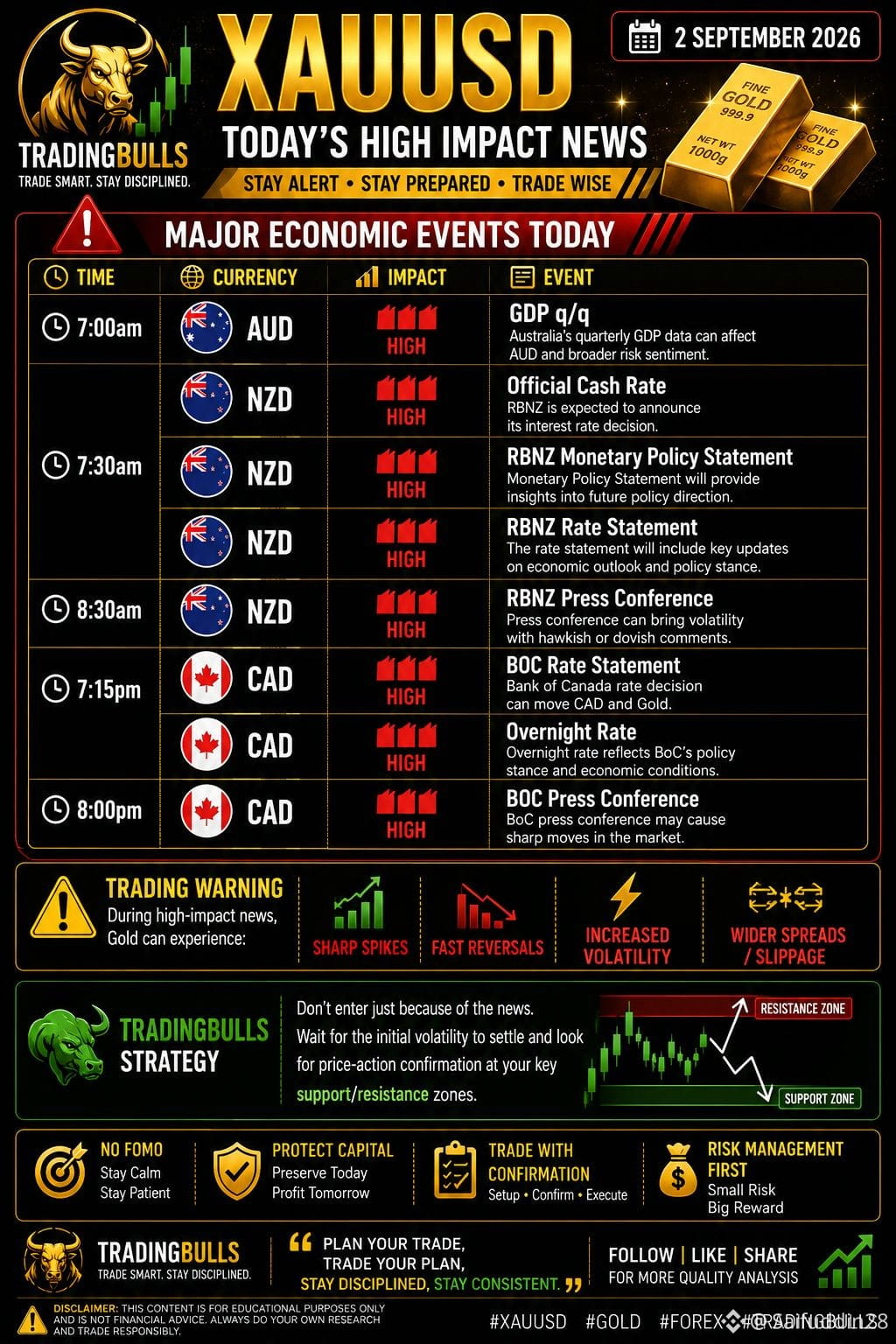
🐂 TRADINGBULLS | XAUUSD TODAY — HIGH IMPACT NEWS ⚡
📅 2 September 2026
Gold traders, today’s economic calendar is packed with high-impact events that can create strong volatility in XAUUSD.
🔴 AUD — GDP q/q
Australia’s quarterly GDP data can affect AUD and broader risk sentiment.
🔴 NZD — RBNZ Interest Rate Decision
The RBNZ has raised its Official Cash Rate to 2.75%, with the Monetary Policy Statement and press conference also in focus.
🔴 CAD — Bank of Canada
The BoC kept its policy rate at 2.25%, while highlighting increased inflation risks. Markets are watching the statement closely for clues about future policy.
⚠️ XAUUSD TRADING WARNING
During high-impact news, Gold can experience:
📈 Sharp spikes
📉 Fast reversals
⚡ Increased volatility
💥 Wider spreads/slippage
TradingBulls Strategy:
Don't enter just because of the news. Wait for the initial volatility to settle and look for price-action confirmation at your key support/resistance zones.
🐂 No FOMO • Protect Capital • Trade With Confirmation
⚠️ Educational content only. Not financial advice. Always manage your risk.
$XAU ❤️
#ForexNews #EconomicCalendar #TradingBulls #PriceAction
154
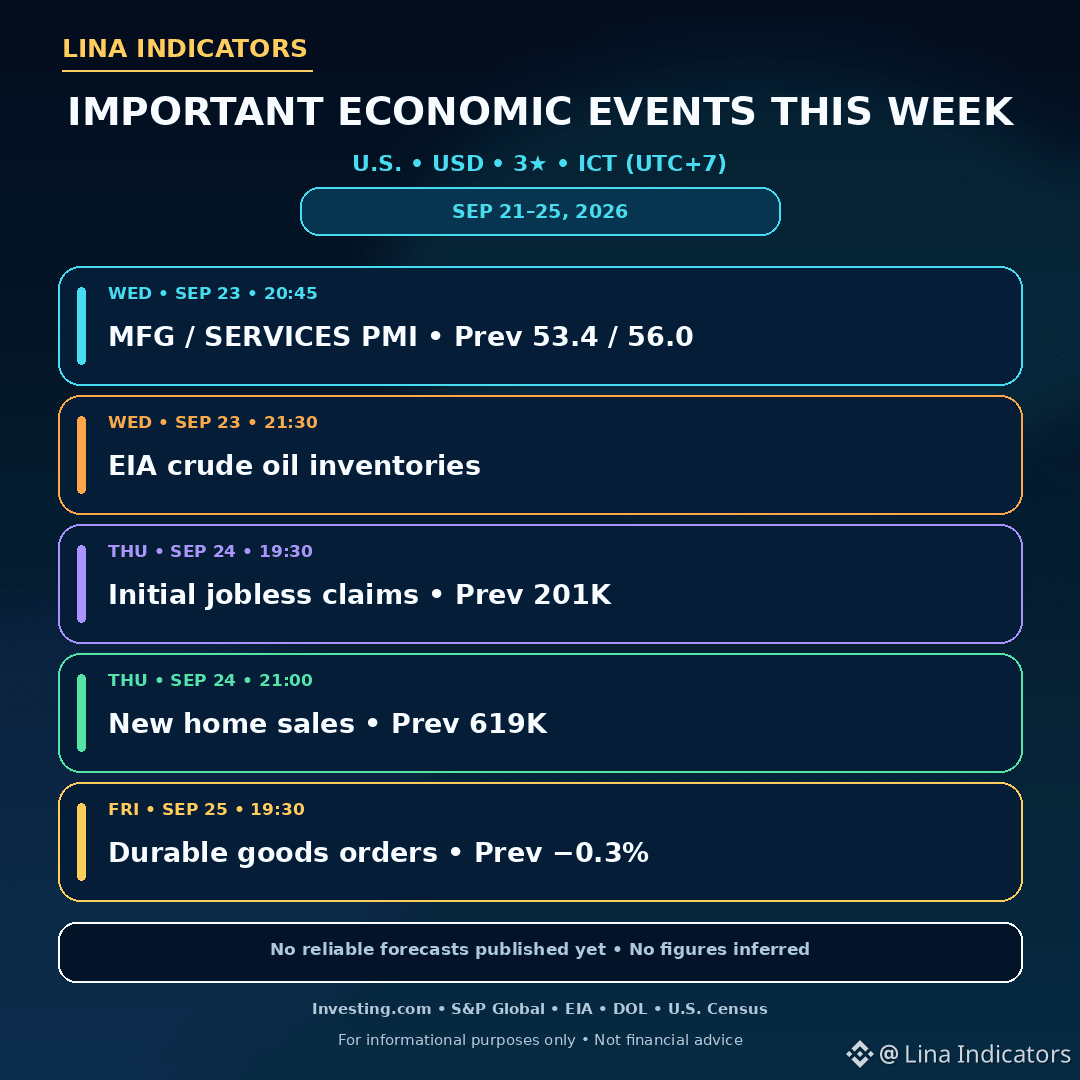
📅 LINA INDICATORS
IMPORTANT ECONOMIC EVENTS THIS WEEK
SEP 21–25, 2026 • ICT
No reliable forecasts were published at update time.
WED SEP 23 • 20:45 — U.S. Manufacturing PMI
WED SEP 23 • 20:45 — U.S. Services PMI
WED SEP 23 • 21:30 — EIA Crude Oil Inventories
THU SEP 24 • 19:30 — Initial Jobless Claims
THU SEP 24 • 21:00 — New Home Sales
FRI SEP 25 • 19:30 — Durable Goods Orders MoM
EXPECTED IMPACT
• USD/DXY: stronger data may lift yields and the dollar; weaker data may reverse that move.
• XAUUSD: mainly trades through USD and yields; EIA adds an oil-inflation channel.
• BTC: higher yields, a stronger USD and tighter liquidity are headwinds; weak data may help unless growth fears dominate.
#EconomicCalendar #DXY #XAUUSD #bitcoin #markets
For informational purposes only, not financial advice.
1
141

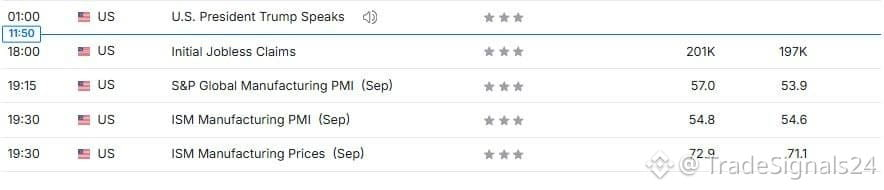
⚠️ IMPORTANT U.S. EVENTS TODAY — OCT 1
Keep an eye on 🇺🇸 Initial Jobless Claims
📊 Forecast: 201K | Previous: 197K
Also on watch:
🕘 19:15 — S&P Global Manufacturing PMI
🕤 19:30 — ISM Manufacturing PMI + Prices
These releases can bring volatility across USD, indices, gold & crypto, so keep an eye on the reaction after the numbers drop. 📈⚡
#EconomicCalendar #USData #Crypto #Bitcoin #Trading
72

·
--
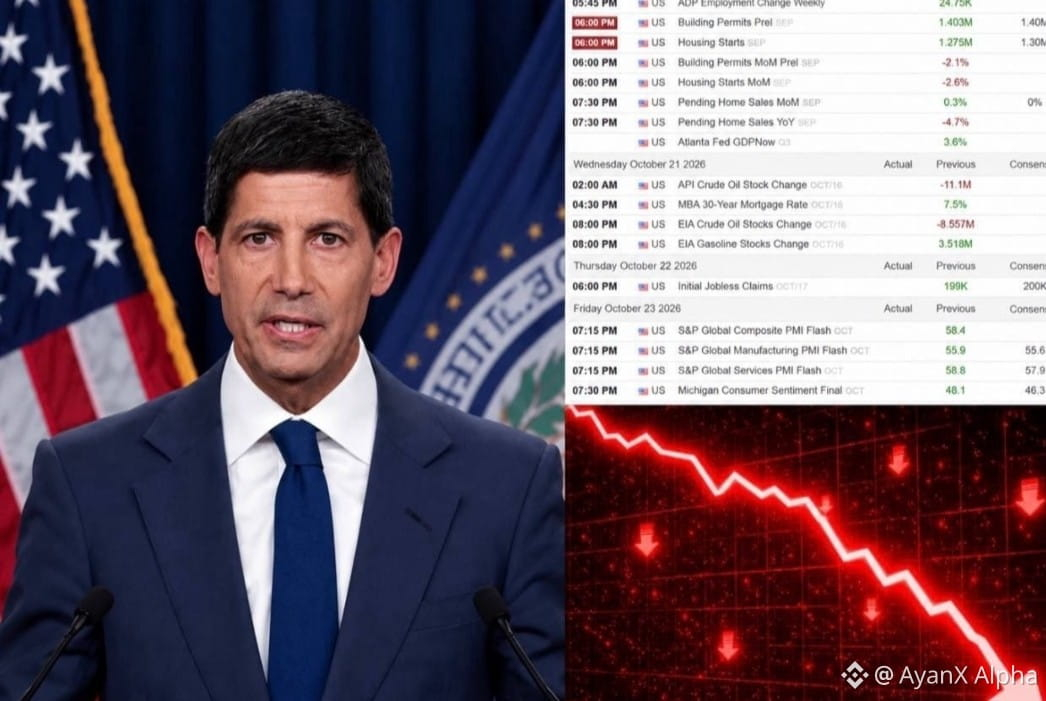
🚨 BIG WEEK AHEAD FOR CRYPTO! ⚠️📊
$BTC
{spot}(BTCUSDT)
Crypto traders, stay alert! 🔥 Major U.S. economic data could trigger sharp moves across the market this week.
📅 KEY EVENTS TO WATCH
🔹 Thursday, October 22
⏰ 8:30 AM ET — Jobless Claims
🔹 Friday, October 23
⏰ 9:45 AM ET — Manufacturing PMI
⏰ 9:45 AM ET — Services PMI
⏰ 10:00 AM ET — Consumer Sentiment
⏰ 10:00 AM ET — Inflation Expectations
📉 Inflation fears and interest-rate uncertainty could bring volatility to $BTC, $ETH, $SOL, and altcoins.
⚡ Strong data could shift rate expectations, while weaker data may change market sentiment.
👀 Watch the news, manage your risk, and avoid chasing sudden pumps or dumps!
Stay sharp, fam. Volatility creates opportunities—but risk management comes first! ❤️🤝
#bitcoin.” #Ethereum! #Solana #CryptoNews🔒📰🚫 #EconomicCalendar
🚨 BIG WEEK AHEAD FOR CRYPTO! ⚠️📊
$BTC
Crypto traders, stay alert! 🔥 Major U.S. economic data could trigger sharp moves across the market this week.
📅 KEY EVENTS TO WATCH
🔹 Thursday, October 22
⏰ 8:30 AM ET — Jobless Claims
🔹 Friday, October 23
⏰ 9:45 AM ET — Manufacturing PMI
⏰ 9:45 AM ET — Services PMI
⏰ 10:00 AM ET — Consumer Sentiment
⏰ 10:00 AM ET — Inflation Expectations
📉 Inflation fears and interest-rate uncertainty could bring volatility to $BTC , $ETH, $SOL, and altcoins.
⚡ Strong data could shift rate expectations, while weaker data may change market sentiment.
👀 Watch the news, manage your risk, and avoid chasing sudden pumps or dumps!
Stay sharp, fam. Volatility creates opportunities—but risk management comes first! ❤️🤝
#bitcoin.” #Ethereum! #Solana #CryptoNews🔒📰🚫 #EconomicCalendar
75

·
--
📅 Key Economic Events to Watch This Week
🇺🇸 22/10 12:30 (UTC+0) - Unemployment Claims (Forecast: 200K, Previous: 199K)
🇺🇸 23/10 13:45 (UTC+0) - Flash Manufacturing PMI (Forecast: 55.5, Previous: 57.0)
🇺🇸 23/10 13:45 (UTC+0) - Flash Services PMI (Forecast: 58.0, Previous: 58.7)
🇺🇸 23/10 14:00 (UTC+0) - Revised UoM Consumer Sentiment (Forecast: 46.3, Previous: 46.3)
🇺🇸 23/10 14:00 (UTC+0) - Revised UoM Inflation Expectations (Forecast: N/A, Previous: 4.7%)
Market outlook: Forecasts indicate a slight cooling in business activity across both manufacturing and services PMIs, while the labor market remains relatively stable. If PMI figures come in lower than expected, it could heighten expectations of monetary policy adjustments and drive fresh volatility across crypto and macro assets.
#MacroEconomy #EconomicCalendar
42

·
--
⚡️ Key Economic Events This Week
🗓 Tuesday: Weekly ADP Employment Change data
🗓 Wednesday: September S&P Manufacturing PMI & Services PMI data
🗓 Thursday: August New Home Sales data
🗓 Friday: August Durable Goods Orders data
🎙8 Fed speaker events are also scheduled throughout the week, with markets closely watching developments in oil prices.
#EconomicInsight
#EconomicCalendar
132

·
--
$BTC FACES A JULY CALENDAR THAT COULD SHIFT THE MARKET IN MINUTES 📅
The July 2 NFP miss hit the dollar and gold instantly. Crypto saw a mild bid, but the real test comes next week with CPI and the Fed decision. This month has ten high-impact events in sequence — one unexpected number could break current structure.
Volume is already thinning into these key windows. Manipulation often precedes the true move on macro releases. Which event are you watching most closely?
Not financial advice. Always manage your risk.
#BTC #EconomicCalendar #CryptoNews #MarketAnalysis
⚡
52

·
--
📅 Key economic calendar highlights this week
🇺🇸 22/10 19:30 (UTC+7) - Unemployment Claims (Forecast: 200K, Previous: 199K)
🇺🇸 23/10 20:45 (UTC+7) - Flash Manufacturing PMI (Forecast: 55.5, Previous: 57.0)
🇺🇸 23/10 20:45 (UTC+7) - Flash Services PMI (Forecast: 58.0, Previous: 58.7)
🇺🇸 23/10 21:00 (UTC+7) - Revised UoM Consumer Sentiment (Forecast: 46.3, Previous: 46.3)
🇺🇸 23/10 21:00 (UTC+7) - Revised UoM Inflation Expectations (Forecast: N/A, Previous: 4.7%)
Market outlook: The PMI indices are all forecast to edge down from the previous readings, suggesting that growth in manufacturing and services is showing signs of cooling. If the actual figures continue to weaken, market sentiment may anticipate that the Fed will be less hawkish in upcoming interest rate decisions.
#MacroEconomics #EconomicCalendar
46


Article
🚨 **CRITICAL 48 HOURS FOR CRYPTO & MACROECONOMICS! (FEAT. XRP & TRADING SETUPS)** 🚨
We are right i{future}(BTCUSDT)
{future}(USDCUSDT)
We are right in the middle of an incredibly high-stakes week for both the crypto markets and global finance. The critical data dropping over the next 48 hours will play a direct role in determining the short-term direction of Bitcoin ($BTC), Ethereum ($ETH), and Ripple ($XRP).
Here is your ultimate roadmap for July 15–16, 2026, along with crucial entry and exit strategies to stay ahead of the market:
📅 Wednesday, July 15: Inflation & Manufacturing Under the Microscope
Tomorrow is packed with heavy macroeconomic data points that will set the volatility in motion:
🇺🇸 *US Producer Price Index (PPI) (12:30 PM UTC June’s PPI data is a leading indicator for consumer inflation. A cooler-than-expected print could trigger a massive relief rally.
🇺🇸 *Empire State Manufacturing Index (12:30 PM UTC): First real look at industrial health and economic expansion.
🇨🇦 *Bank of Canada (BoC) Interest Rate Decision (1:45 PM UTC): Crucial for gauging global monetary easing trends.
🇺🇸 Fed Beige Book Report (6:00 PM UTC Direct economic insights from the 12 Fed districts, serving as the roadmap before the July 29 FOMC meeting.
📅 Thursday, July 16: Consumer Strength & Fed Commentary
The second half of the week shifts the spotlight directly onto the resilience of the US consumer:
🇺🇸 US Retail Sales (12:30 PM UTC): Consumer spending data will either quiet down recession fears or stoke fresh inflation worries.
🇺🇸 *Fed Governor Lisa D. Cook Speech (5:00 PM UTC) Any hints on the timeline of upcoming interest rate cuts will heavily swing crypto prices.
⚡ Crypto Market Pulse: The XRP Factor
XRP Ledger Momentum: $XRP is showing intense strength as institutional adoption of the XRPL spikes and global cross-border payment clarity reaches new heights. Keep a close eye on the key support levels; a breakout is cooking.
BTC & ETH Outlook: While Bitcoin ($BTC) navigates macro uncertainties, Ethereum ($ETH) holders are accumulating heavily in anticipation of the upcoming Glamsterdam upgrade.
🎯 KEY TRADING SETUPS: ENTRY & EXIT ZONES (BTC, ETH, XRP)
Note: Due to high volatility during the US economic data releases (especially around 12:30 PM UTC), use strict stop-losses and manage your risk.# 🟠 Bitcoin ($BTC)
* Strategy: Patience is key. We are looking for either a sweep of the range lows or a confirmed breakout.
* Optimal Buy Entry:
* Conservative: Limit orders in the $59,500 – $60,200 demand zone (on a liquidity sweep).
* Aggressive (Breakout): Buy on a confirmed 4-hour candle close above $63,800. Target Exit (Take Profit):** $65,500 (Short-term) / $68,200 (Mid-term).
🔵 Ethereum ($ETH)
* Strategy: ETH is consolidating. Accumulating near key support before the next network upgrade is the play.
* Optimal Buy Entry:
* Conservative: Limit orders at $3,150 – $3,220.
* Aggressive (Breakout): Buy on a daily close above $3,450.
* **Target Exit (Take Profit):** $3,600 (Short-term) / $3,850 (Mid-term).
#### 🟢 Ripple ($XRP)
* Strategy: XRP is coiled tight. Volatility is coming, making it a prime target for a sharp breakout trade.
* Optimal Buy Entry:
* Conservative: Limit orders in the $0.51 – $0.53 support block.
* Aggressive (Breakout): Buy immediately if we clear and hold above $0.59 on the daily chart.
* **Target Exit (Take Profit):** $0.64 (First major resistance) / $0.72 (Macro target).
💡 Pro Trader Note: Do not FOMO (Fear Of Missing Out) into positions right at the 12:30 PM UTC data release times. Let the initial market wick settle, wait for the direction to be confirmed, and then execute your plan. Guard your capital!
Which coin are you loading up on before the volatility kicks in? Let’s hear your strategy in the comments below! 👇
#Bitcoin #Ethereum #XRP #CryptoNews #TradingSignals #Binance #EconomicCalendar #Binance #ETHETFsApproved $XRP
$ETH
{future}(ETHUSDT)
🚨 **CRITICAL 48 HOURS FOR CRYPTO & MACROECONOMICS! (FEAT. XRP & TRADING SETUPS)** 🚨 We are right i
We are right in the middle of an incredibly high-stakes week for both the crypto markets and global finance. The critical data dropping over the next 48 hours will play a direct role in determining the short-term direction of Bitcoin ($BTC), Ethereum ($ETH ), and Ripple ($XRP ).
Here is your ultimate roadmap for July 15–16, 2026, along with crucial entry and exit strategies to stay ahead of the market:
📅 Wednesday, July 15: Inflation & Manufacturing Under the Microscope
Tomorrow is packed with heavy macroeconomic data points that will set the volatility in motion:
🇺🇸 *US Producer Price Index (PPI) (12:30 PM UTC June’s PPI data is a leading indicator for consumer inflation. A cooler-than-expected print could trigger a massive relief rally.
🇺🇸 *Empire State Manufacturing Index (12:30 PM UTC): First real look at industrial health and economic expansion.
🇨🇦 *Bank of Canada (BoC) Interest Rate Decision (1:45 PM UTC): Crucial for gauging global monetary easing trends.
🇺🇸 Fed Beige Book Report (6:00 PM UTC Direct economic insights from the 12 Fed districts, serving as the roadmap before the July 29 FOMC meeting.
📅 Thursday, July 16: Consumer Strength & Fed Commentary
The second half of the week shifts the spotlight directly onto the resilience of the US consumer:
🇺🇸 US Retail Sales (12:30 PM UTC): Consumer spending data will either quiet down recession fears or stoke fresh inflation worries.
🇺🇸 *Fed Governor Lisa D. Cook Speech (5:00 PM UTC) Any hints on the timeline of upcoming interest rate cuts will heavily swing crypto prices.
⚡ Crypto Market Pulse: The XRP Factor
XRP Ledger Momentum: $XRP is showing intense strength as institutional adoption of the XRPL spikes and global cross-border payment clarity reaches new heights. Keep a close eye on the key support levels; a breakout is cooking.
BTC & ETH Outlook: While Bitcoin ($BTC) navigates macro uncertainties, Ethereum ($ETH ) holders are accumulating heavily in anticipation of the upcoming Glamsterdam upgrade.
🎯 KEY TRADING SETUPS: ENTRY & EXIT ZONES (BTC, ETH, XRP)
Note: Due to high volatility during the US economic data releases (especially around 12:30 PM UTC), use strict stop-losses and manage your risk.# 🟠 Bitcoin ($BTC)
* Strategy: Patience is key. We are looking for either a sweep of the range lows or a confirmed breakout.
* Optimal Buy Entry:
* Conservative: Limit orders in the $59,500 – $60,200 demand zone (on a liquidity sweep).
* Aggressive (Breakout): Buy on a confirmed 4-hour candle close above $63,800. Target Exit (Take Profit):** $65,500 (Short-term) / $68,200 (Mid-term).
🔵 Ethereum ($ETH )
* Strategy: ETH is consolidating. Accumulating near key support before the next network upgrade is the play.
* Optimal Buy Entry:
* Conservative: Limit orders at $3,150 – $3,220.
* Aggressive (Breakout): Buy on a daily close above $3,450.
* **Target Exit (Take Profit):** $3,600 (Short-term) / $3,850 (Mid-term).
#### 🟢 Ripple ($XRP )
* Strategy: XRP is coiled tight. Volatility is coming, making it a prime target for a sharp breakout trade.
* Optimal Buy Entry:
* Conservative: Limit orders in the $0.51 – $0.53 support block.
* Aggressive (Breakout): Buy immediately if we clear and hold above $0.59 on the daily chart.
* **Target Exit (Take Profit):** $0.64 (First major resistance) / $0.72 (Macro target).
💡 Pro Trader Note: Do not FOMO (Fear Of Missing Out) into positions right at the 12:30 PM UTC data release times. Let the initial market wick settle, wait for the direction to be confirmed, and then execute your plan. Guard your capital!
Which coin are you loading up on before the volatility kicks in? Let’s hear your strategy in the comments below! 👇
#Bitcoin #Ethereum #XRP #CryptoNews #TradingSignals #Binance #EconomicCalendar #Binance #ETHETFsApproved $XRP
$ETH
84
·
--
📅 Economic Calendar Highlights This Week
🇺🇸 09/01 21:00 (UTC+7) - ISM Manufacturing PMI (Forecast: 55.2, Previous: 55.6)
🇺🇸 09/01 21:00 (UTC+7) - ISM Manufacturing Prices (Forecast: 71.2, Previous: 71.1)
🇺🇸 09/01 21:00 (UTC+7) - JOLTS Job Openings (Forecast: 7.33M, Previous: 7.36M)
🇺🇸 09/02 19:15 (UTC+7) - ADP Non-Farm Employment Change (Forecast: 47K, Previous: 44K)
🇺🇸 09/03 19:30 (UTC+7) - Unemployment Claims (Forecast: 205K, Previous: 203K)
🇺🇸 09/03 21:00 (UTC+7) - ISM Services PMI (Forecast: 54.1, Previous: 54.1)
Outlook: The manufacturing PMI indicators and the JOLTS job openings opportunity are forecast to decline slightly versus the previous period, suggesting that the labor market and manufacturing activity are cooling somewhat. This may bring positive expectations for the Fed’s interest rate policy in the coming time.
#Fed #EconomicCalendar
93


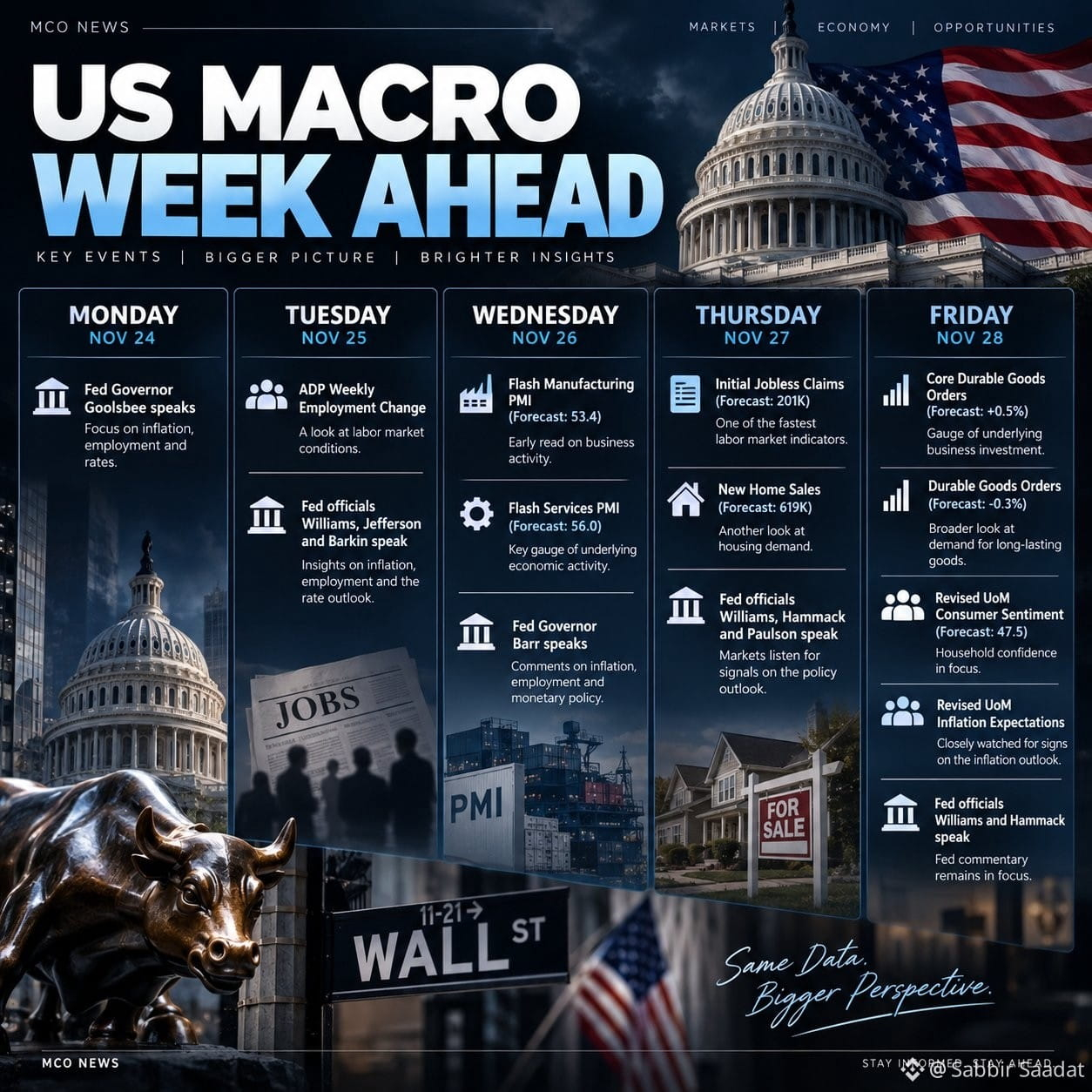
US Macro Week Ahead
Key events, big moves, and what to watch
The US macro calendar is heating up this week, and it could bring fresh volatility to the markets. From the Fed’s speeches to key data releases, traders will be watching every signal for clues on the next move.
On Monday, we’ll see the Fed Governor deliver a speech, which may hint at the central bank’s next steps. Tuesday brings the ADP employment report, a key indicator ahead of the official jobs data. Wednesday features the Flash Manufacturing PMI, and Thursday brings the initial jobless claims and more labor market data. Friday wraps up the week with core durable goods orders and consumer sentiment numbers, two important gauges for the economy’s strength.
These events can move the dollar, stocks, gold and, of course, crypto. So, keep an eye on the calendar, stay informed, and be ready for the upcoming moves.
Same data. Bigger perspective.
Stay informed. Stay ahead.
$BTC $XAUT $ZEC
#USMarkets #FedMeeting #EconomicCalendar #crypto #BinanceSquare
270
·
--
📅 Key Economic Events to Watch This Week (UTC+0):
🇺🇸 29/09 14:00 (UTC+0) - CB Consumer Confidence (Forecast: 90.1, Previous: 89.4)
🇺🇸 29/09 14:00 (UTC+0) - JOLTS Job Openings (Forecast: 7.23M, Previous: 7.27M)
🇺🇸 30/09 12:15 (UTC+0) - ADP Non-Farm Employment Change (Forecast: 70K, Previous: 38K)
🇺🇸 30/09 12:30 (UTC+0) - Core PCE Price Index m/m (Forecast: 0.3%, Previous: 0.2%)
🇺🇸 30/09 12:30 (UTC+0) - Final GDP q/q (Forecast: 1.5%, Previous: 1.5%)
🇺🇸 30/09 12:30 (UTC+0) - Final GDP Price Index q/q (Forecast: 6.4%, Previous: 6.4%)
Market expectations suggest labor conditions may show a slight uptick via ADP data while job openings continue to cool. However, with Core PCE projected to tick higher, persistent inflation concerns could keep market volatility elevated ahead of upcoming monetary policy decisions.
#MacroEconomy #Fed #EconomicCalendar
44

·
--
📅 This week’s key economic calendar at a glance:
🇺🇸 14/10 20:30 (UTC+8) - Core CPI m/m (Forecast: 0.2%, Previous: 0.3%)
🇺🇸 14/10 20:30 (UTC+8) - Core CPI y/y (Forecast: 2.5%, Previous: 2.4%)
🇺🇸 14/10 20:30 (UTC+8) - CPI m/m (Forecast: 0.6%, Previous: 0.4%)
🇺🇸 14/10 20:30 (UTC+8) - CPI y/y (Forecast: 3.6%, Previous: 3.4%)
🇺🇸 15/10 20:30 (UTC+8) - Core PPI m/m (Forecast: 0.3%, Previous: 0.2%)
🇺🇸 15/10 20:30 (UTC+8) - Core Retail Sales m/m (Forecast: 0.5%, Previous: 1.4%)
Based on expectations, both the headline CPI annual and monthly rates are slightly higher than their previous readings this week, while core retail sales are expected to slow. The push and pull between inflation and consumer spending data could bring volatility in either direction. Buckle up and assess the actual results objectively.
#CPIWatch #EconomicCalendar
72

📅 KEY MACRO EVENTS & FINANCIAL AUG 25, 2026 ⚠️
Traders, stay alert! Today's economic calendar brings important consumer sentiment and housing data that could impact USD liquidity and crypto volatility.
Here are the key releases to monitor today:
🇺🇸 United States (US Eastern Time / EST)
📊 10:00 AM EST — CB Consumer Confidence (Aug)
Why it matters: Reflects overall consumer sentiment and spending strength. A higher reading signals market resilience, while a drop signals potential recessionary pressure.
🏡 10:00 AM EST — New Home Sales (Jul)
Why it matters: Key measure of housing demand and underlying economic activity.
🏠 09:00 AM EST — S&P/Case-Shiller Home Price Index (Jun)
Why it matters: Measures home price inflation across key metropolitan areas.
🏬 10:00 AM EST — Richmond Fed Manufacturing Index (Aug)
Why it matters: Gauge of manufacturing conditions and business outlook.
🗣️ 08:00 AM EST / 12:00 PM EST — Fed Official Speeches (Barkin)
Why it matters: Comments on monetary policy path ahead of upcoming rate decisions.
💡 Crypto Market Impact
USD Strength: Stronger Consumer Confidence can boost the US Dollar DXY, potentially putting temporary downward pressure on $BTC and high-beta altcoins.
#CryptoNew s #EconomicCalendar #BTC #MacroEconomics
140
·
--

Article
Tomorrow's Economic Calendar | 18 November 2026Five events, five different market signals. Wednesday could give investors plenty to think about - but not every headline deserves the same reaction.
The interesting part is how these releases connect. Inflation in the UK, financial stability in Europe, housing activity in America, and crude oil inventories will tell us different things about economic conditions. And before those reports arrive, NVIDIA's earnings call could influence sentiment around AI-related stocks.
Here's what I would watch, and why.
NVIDIA Earnings Call - 17 Nov 22:00 UTC / 18 Nov 03:30 IST | High
NVIDIA is more than a chipmaker in the current AI investment story. Its results offer a window into how aggressively major technology companies are spending on AI infrastructure.
But strong revenue alone won't answer the most important question: Can growth keep up with the expectations already reflected in AI-related valuations?
Data-center revenue, profit margins and forward guidance deserve particular attention. Even an impressive quarter could disappoint investors if management's outlook falls short of market expectations.
For Binance traders, NVIDIA-linked derivatives may react to shifts in expectations around the underlying shares. But the derivative is not the stock itself, and trading conditions can differ.
UK CPI - October - 07:00 UTC / 12:30 IST | High
The Bank of England has to balance inflation against economic growth. Wednesday's consumer-price report could influence how investors assess that trade-off.
Headline inflation gets the attention, but I would look closely at core inflation and services prices. Why services? Because persistent price increases in labour-intensive sectors can make it harder for inflation to return sustainably to target.
A softer headline alongside stubborn services inflation would leave policymakers with a more complicated picture than the headline suggests. Watch GBP and UK government bond yields. Their reaction may tell us more about changing rate expectations than the CPI headline alone.
ECB Financial Stability Review - 09:00 UTC / 14:30 IST | Medium
This isn't a conventional inflation or interest-rate announcement. The ECB will assess vulnerabilities in the financial system, including risks around bank funding, financial markets and commercial property.
The important distinction is between identifying a vulnerability and observing an actual financial crisis. A warning about stretched valuations doesn't prove that prices are about to collapse. But a material deterioration in funding conditions could influence how investors price European financial risk.
I would watch whether the review identifies new vulnerabilities or reinforces existing concerns. For crypto, any link is indirect: broader financial stress could affect liquidity and risk appetite, but the report alone doesn't establish a Bitcoin price direction.
US Housing Starts & Building Permits - 13:30 UTC / 19:00 IST | Medium
Higher borrowing costs can discourage new housing projects. That's why construction data can offer useful clues about how interest rates are affecting the real economy.
But housing starts and building permits measure different stages. Permits indicate intended construction. Starts show projects where construction has actually begun.
Suppose permits improve while starts remain weak. That might suggest developers are preparing new projects without immediately increasing construction. If both weaken, concerns about housing activity could become more convincing.
The broader market connection runs through growth expectations, Treasury yields and the dollar. For $BTC and Gold, I would compare those reactions rather than assuming weaker housing data automatically means easier monetary policy.
EIA Weekly Crude Oil Inventories - 15:30 UTC / 21:00 IST | Medium
Oil inventories can produce a sharp headline: stocks increased or stocks decreased. But the number needs context.
A crude inventory draw can reflect stronger refinery demand, lower imports, higher exports or changes in domestic production. It doesn't necessarily mean consumers suddenly bought more fuel. That's why refinery runs and gasoline inventories matter alongside crude stocks.
A decline in crude inventories accompanied by strengthening fuel demand would tell a different story from a draw caused primarily by temporary supply disruptions. For WTI, I would also check whether the price reaction holds once traders examine the full report.
Also on the watchlist - Times to be confirmed
APEC Economic Leaders' Meeting: Watch for concrete developments involving trade restrictions, investment and market access. Broad statements of cooperation matter less than actionable policy changes.
Euro Area Final HICP - October: The key question is whether final inflation figures materially revise the earlier estimate, particularly for services inflation. A meaningful revision could influence ECB rate expectations.
What matters most for Bitcoin, Gold and the Dollar?
There isn't one simple answer. Stronger economic data can support growth expectations while pushing bond yields higher. Weaker data can encourage expectations of rate cuts while raising concerns about demand.
Those are very different outcomes for markets. For Wednesday, my approach would be to watch the initial reaction and then check whether Treasury yields, the dollar and relevant asset prices continue to support it.
The headline tells us what was released. The comparison with expectations tells us what surprised the market. The price reaction tells us how investors are interpreting it - for now.
#EconomicCalendar #Bitcoin #MacroEconomics
Tomorrow's Economic Calendar | 18 November 2026
Five events, five different market signals. Wednesday could give investors plenty to think about - but not every headline deserves the same reaction.
The interesting part is how these releases connect. Inflation in the UK, financial stability in Europe, housing activity in America, and crude oil inventories will tell us different things about economic conditions. And before those reports arrive, NVIDIA's earnings call could influence sentiment around AI-related stocks.
Here's what I would watch, and why.
NVIDIA Earnings Call - 17 Nov 22:00 UTC / 18 Nov 03:30 IST | High
NVIDIA is more than a chipmaker in the current AI investment story. Its results offer a window into how aggressively major technology companies are spending on AI infrastructure.
But strong revenue alone won't answer the most important question: Can growth keep up with the expectations already reflected in AI-related valuations?
Data-center revenue, profit margins and forward guidance deserve particular attention. Even an impressive quarter could disappoint investors if management's outlook falls short of market expectations.
For Binance traders, NVIDIA-linked derivatives may react to shifts in expectations around the underlying shares. But the derivative is not the stock itself, and trading conditions can differ.
UK CPI - October - 07:00 UTC / 12:30 IST | High
The Bank of England has to balance inflation against economic growth. Wednesday's consumer-price report could influence how investors assess that trade-off.
Headline inflation gets the attention, but I would look closely at core inflation and services prices. Why services? Because persistent price increases in labour-intensive sectors can make it harder for inflation to return sustainably to target.
A softer headline alongside stubborn services inflation would leave policymakers with a more complicated picture than the headline suggests. Watch GBP and UK government bond yields. Their reaction may tell us more about changing rate expectations than the CPI headline alone.
ECB Financial Stability Review - 09:00 UTC / 14:30 IST | Medium
This isn't a conventional inflation or interest-rate announcement. The ECB will assess vulnerabilities in the financial system, including risks around bank funding, financial markets and commercial property.
The important distinction is between identifying a vulnerability and observing an actual financial crisis. A warning about stretched valuations doesn't prove that prices are about to collapse. But a material deterioration in funding conditions could influence how investors price European financial risk.
I would watch whether the review identifies new vulnerabilities or reinforces existing concerns. For crypto, any link is indirect: broader financial stress could affect liquidity and risk appetite, but the report alone doesn't establish a Bitcoin price direction.
US Housing Starts & Building Permits - 13:30 UTC / 19:00 IST | Medium
Higher borrowing costs can discourage new housing projects. That's why construction data can offer useful clues about how interest rates are affecting the real economy.
But housing starts and building permits measure different stages. Permits indicate intended construction. Starts show projects where construction has actually begun.
Suppose permits improve while starts remain weak. That might suggest developers are preparing new projects without immediately increasing construction. If both weaken, concerns about housing activity could become more convincing.
The broader market connection runs through growth expectations, Treasury yields and the dollar. For $BTC and Gold, I would compare those reactions rather than assuming weaker housing data automatically means easier monetary policy.
EIA Weekly Crude Oil Inventories - 15:30 UTC / 21:00 IST | Medium
Oil inventories can produce a sharp headline: stocks increased or stocks decreased. But the number needs context.
A crude inventory draw can reflect stronger refinery demand, lower imports, higher exports or changes in domestic production. It doesn't necessarily mean consumers suddenly bought more fuel. That's why refinery runs and gasoline inventories matter alongside crude stocks.
A decline in crude inventories accompanied by strengthening fuel demand would tell a different story from a draw caused primarily by temporary supply disruptions. For WTI, I would also check whether the price reaction holds once traders examine the full report.
Also on the watchlist - Times to be confirmed
APEC Economic Leaders' Meeting: Watch for concrete developments involving trade restrictions, investment and market access. Broad statements of cooperation matter less than actionable policy changes.
Euro Area Final HICP - October: The key question is whether final inflation figures materially revise the earlier estimate, particularly for services inflation. A meaningful revision could influence ECB rate expectations.
What matters most for Bitcoin, Gold and the Dollar?
There isn't one simple answer. Stronger economic data can support growth expectations while pushing bond yields higher. Weaker data can encourage expectations of rate cuts while raising concerns about demand.
Those are very different outcomes for markets. For Wednesday, my approach would be to watch the initial reaction and then check whether Treasury yields, the dollar and relevant asset prices continue to support it.
The headline tells us what was released. The comparison with expectations tells us what surprised the market. The price reaction tells us how investors are interpreting it - for now.
#EconomicCalendar #Bitcoin #MacroEconomics
1
593

🚨 CRYPTO MARKET: CALM BEFORE THE STORM? 📊
The market may stay quiet until key economic events hit on Wednesday.
📅 Traders are watching upcoming data for clues on volatility and market direction.
₿ Keep an eye on $BTC $ETH and altcoins as the news unfolds.
📈 Track market moves, on-chain data, and economic events with Crypto Corner Terminal.
Stay prepared. Volatility can move fast.
#Crypto #Bitcoin #Trading #EconomicCalendar #CryptoNewss
24

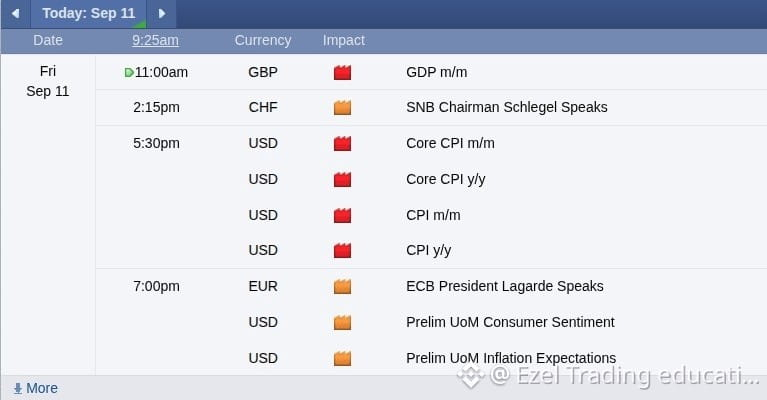
Today in the economic calendar there is high-impact news.
Avoid unnecessary trades and don’t chase the market around the time of the news. Wait for your setup and trade with discipline.
Protect your capital first.#EconomicCalendar #usd
Today in the economic calendar there is high-impact news.
Avoid unnecessary trades and don’t chase the market around the time of the news. Wait for your setup and trade with discipline.
Protect your capital first.#EconomicCalendar #usd
Avoid unnecessary trades and don’t chase the market around the time of the news. Wait for your setup and trade with discipline.
Protect your capital first.#EconomicCalendar #usd
42
Log in to explore more content
Join global crypto users on Binance Square
⚡️ Get latest and useful information about crypto.
💬 Trusted by the world’s largest crypto exchange.
👍 Discover real insights from verified creators.
Email / Phone number
Trending Topics
1
#CanBTCReboundAfterFallingBelow60K?
355,715 views
1,482 Discussing
2
#GlobalStocksFaceLongestLosingStreakSince2023
117,251 views
1,055 Discussing
3
#BlackRockIBITPostsRecord$541MSingleDayOutflow
588 views
15 Discussing
4
#AnthropicPlungesTowardIPOPriceonDay2
56,610 views
564 Discussing
5
#TwentyOneCapitalAdds172.25BTC
9,276 views
143 Discussing
6
#HKBillWouldExcludeTokenizedDepositsFromVirtualAssets
819 views
14 Discussing
7
#BNBDropsBelow540USDTWith8.46%DailyDecline
30,205 views
247 Discussing
8
#HKBillProposesHK$100KFineForUnauthorizedCryptoTitles
999 views
14 Discussing
9
#BitMineFaces$10.1BUnrealizedETHLoss
1,955 views
18 Discussing
10
#StrategyReports$35BNetReserves
1,814 views
17 Discussing