
#fundingrate
fundingrate
238,171 views
1,428 Discussing
Hot
Latest

Positive Funding Does Not Mean Unlimited Bullish Confidence
Recent SHELL perpetual-futures snapshots showed mildly positive funding, around 0.01% per 8 hours.
Under the usual funding mechanism, long positions pay short positions when funding is positive.
The rate is relatively modest and should not be interpreted as an extreme imbalance by itself.
Funding becomes more informative when examined alongside open interest, price direction and liquidation activity.
#FundingRate #SHELL #FuturesBasics

111

·
--
Holding a perpetual for days? Run this funding checklist first.
1. Check the interval. Many contracts settle every 8 hours, some every 4 hours or every hour. Same rate, very different daily cost.
2. Check the sign. Positive funding: longs pay shorts. Negative: shorts pay longs. You only pay or receive if you hold through a settlement time.
3. Multiply by your notional, not your collateral. A 0.01% payment on a $10,000 position is $1 per settlement, three times a day on an 8 hour contract.
4. Count the settlements. A week on an 8 hour contract passes about 21 of them.
5. Expect the rate to move. Today's number is not a fixed price for next week.
My take: funding is small per payment and easy to ignore, which is exactly why it hurts. On a long hold it can quietly become a real part of your result, in either direction. I check the sign and the interval before every swing entry, the same way I check the stop.
Do you check funding before you open, or only after you are in the trade?
$BTC $ETH #FundingRate #Futures
111
Mildly positive funding is not the same as an overcrowded long trade.
Recent SHELL funding snapshots were generally around 0.005–0.01% per typical interval. This means long holders paid short holders, but the reported rates were relatively modest.
Funding is a cost of holding perpetual positions, not a direct measurement of buying pressure in the spot market.
Its meaning also depends on the exchange and funding interval being measured.
#FundingRate #PerpetualFutures #CryptoData
70

⚡ Funding Rate & Open Interest Radar! 📡
Combining Funding Rates with OI shifts reveals where the crowd is positioned and where the next squeeze might trigger.
📊 Live USDⓈ-M Data (24h OI Change):
• BNB — $582.18 | Funding: 0.0000% | OI: -5.28% → Long positions closing out, funding neutral.
• AVAX — $6.964 | Funding: -0.0083% | OI: -4.47% → Shorts paying funding while OI contracts.
• SOL — $73.12 | Funding: +0.0060% | OI: -3.28% → Slight long bias, but open positions are declining.
• SUI — $0.7108 | Funding: +0.0025% | OI: +4.66% → Fastest-growing OI with fresh capital entering.
• BTC — $62,217.1 | Funding: +0.0100% | OI: +1.77% → Longs paying funding with steady, moderate OI growth.
⚖️ Note: Funding is paid to the opposing side; falling OI often signals deleveraging rather than a confirmed trend reversal.
⚠️ Not financial advice - DYOR
#BinanceSquare #BinanceFutures #OpenInterest #FundingRate #CoinVahini
130
·
--
⚠️ WHO PAYS THE FUNDING?
📊 19 NOV 2026 PK NIGHT ..
Many futures traders focus on price movements but forget about funding fees.
📚 WHAT IS FUNDING RATE?
Funding is a periodic payment between LONG and SHORT traders in perpetual futures.
Its purpose is to help keep futures prices close to the spot market price.
🔹 POSITIVE FUNDING RATE:
Long traders PAY short traders.
🔹 NEGATIVE FUNDING RATE:
Short traders PAY long traders.
💡 SIMPLE EXAMPLE:
Imagine your position value is 10,000 USDT and the funding rate is +0.01%.
Your funding payment as a long trader would be 1 USDT for that settlement.
Remember:
Funding is exchanged between traders, not an ordinary trading fee charged by the exchange.
✅ BEFORE HOLDING A FUTURES POSITION:
1️⃣ Check the current funding rate.
2️⃣ Check the next settlement time.
3️⃣ Understand your position size and potential funding cost.
⚠️ Important:
Funding intervals vary by contract and can change.
A high positive rate is not a guaranteed price reversal signal.
#CryptoEducation #FuturesTrading #FundingRate #TradingTips
🗳️ COMMUNITY POLL
When trading perpetual futures, what do you check most carefully?
Funding Rate
Liquidation Price
Trading Volume
All of Them
4 day(s) left
1
55

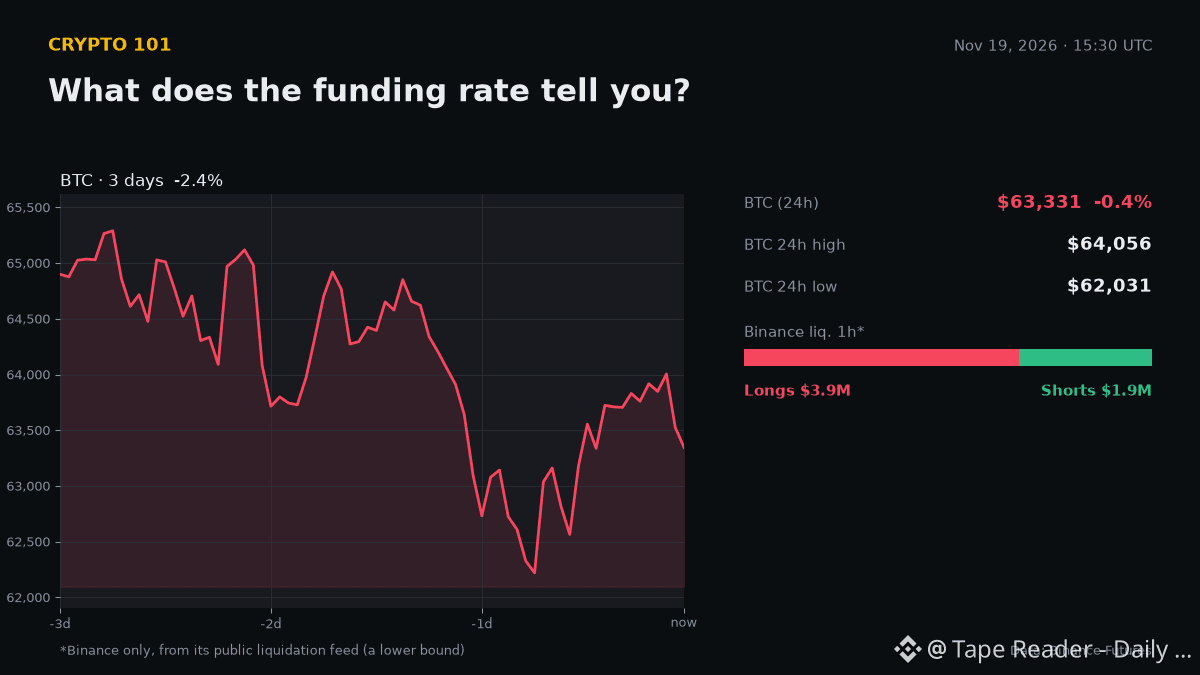
📚 Crypto 101: What does the funding rate tell you?
Funding is a small payment between longs and shorts on perpetual futures every 8 hours. Think of it like a tiny balancing fee that helps keep the futures price close to spot.
Today on Binance: $BTC funding is +0.0011%, so it is neutral. BTC trades at $63,359, with open interest at $6.06B and a 24h range of $64,056 to $62,031. $ETH is at $1,789.
The most common mistake is reading funding as a price signal by itself. It matters for risk because crowded trades can make moves feel sharper, and funding can tell you when one side is paying to stay in position.
What does positive funding mean?
#Crypto101 #FundingRate #BinanceSquareFamily
🔔 Follow for daily Binance liquidation, funding and market data.
📊 Data: Binance Futures, Nov 19 15:30 UTC. Liquidations = Binance only.
Not financial advice.
34

·
--
$IRYS funding at -0.76% is the weirdest number on the board right now. price is up 48% and shorts are still paying longs that much to stay in. OI is up 176% in a day on top of it.
meanwhile $NVDA perp is down 4.3% and OI grew 18%. retail long/short is 9.98, almost everyone on the long side, while top traders are only 3.09. that gap is big.
shorts paying up into a 48% candle usually ends one way, i think the $IRYS squeeze isn't done, but it gets ugly fast when it turns.
#Futures #FundingRate
477

·
--
What is a funding rate? A simple explanation in 1 minute 👇
Perpetual futures (perps) have no expiration date, so exchanges need an “anchor” to keep perp prices close to the real price. That anchor is the funding rate — payments that long and short traders make to each other periodically.
The rule is simple:
• Positive funding → longs pay shorts
• Negative funding → shorts pay longs
• The exchange doesn’t take this money; it goes directly from one trader to another.
Example: if you go long $BTC worth of 10,000 USDT and the funding rate is +0.01%, you pay 1 USDT each funding period. If funding is negative, you receive money.
Think of it like paying rent for space: whichever side is more crowded has to pay rent to the other side. The more crowded it is, the higher the rent.
Last week, after a major liquidation event, funding $BTC on major exchanges turned negative — shorts are paying longs to hold their positions. This signals that the crowd is leaning bearish, but it only measures the cost of leverage; it does not predict price direction.
On Binance, funding is calculated every 8 hours (00:00, 08:00, 16:00 UTC) — only those holding a position at that moment pay or receive it.
Understanding funding rates helps you read market sentiment instead of just looking at the price.
For informational purposes only, not investment advice.
#FundingRate #Bitcoin #CryptoVietnam
163
ENSO rises 8.9% and sellers pay funding… so who’s reading it wrong?Why are sellers paying this much per period on ENSO when 62.7% of accounts are on the buying side? $ENSO
The answer starts with what funding actually means: a periodic payment between the two sides of a perpetual contract that keeps its price close to the spot price. Here, the rate is -0.577% per period, meaning sellers pay buyers.
If the majority is buying, who actually pays? Funding is calculated based on position size, not the number of accounts. The distribution is 62.7% long versus 37.3% short, a ratio of 1.68, but large short positions determine who pays. That’s why the rate is so deeply negative.
ENSO rises 8.9% and sellers pay funding… so who’s reading it wrong?
Why are sellers paying this much per period on ENSO when 62.7% of accounts are on the buying side? $ENSO
The answer starts with what funding actually means: a periodic payment between the two sides of a perpetual contract that keeps its price close to the spot price. Here, the rate is -0.577% per period, meaning sellers pay buyers.
If the majority is buying, who actually pays? Funding is calculated based on position size, not the number of accounts. The distribution is 62.7% long versus 37.3% short, a ratio of 1.68, but large short positions determine who pays. That’s why the rate is so deeply negative.
59
How should a positive funding rate of 0.01% every 8 hours be interpreted?
Positive funding usually means that holders of Long positions pay fees to holders of Short positions.
At around 0.01% every 8 hours, according to reported trackers, SHELL’s funding rate is slightly positive, not yet at an extreme level.
If sustained, this cost could affect leveraged position holders. However, funding alone should not be used to predict price direction.
#SHELL #FundingRate #RiskManagement

8

·
--
📉 Major altcoins are pulling back alongside BTC, but derivatives positioning shows rising short crowding on $SOL and $XRP:
🔸 $SOL trades at $73.63 (-2.14% 24h) on $164.47M spot volume. Open interest sits around $4.15B to $4.25B while perpetual funding rates have flipped negative (-0.0029% to -0.0064%). Key support rests at $70.00 and the 7d low of $67.41, with resistance at $75.42 and $80.00.
🔸 $XRP holds $0.9672 (-1.65% 24h) with $99.44M volume, negative funding, and cooled OI near $1.95B to $1.97B. Watch support at $0.90 and heavy resistance at the $1.00 to $1.05 zone.
💡 Key Setup: Negative funding means shorts are paying longs to stay open. If spot buyers defend support, any relief bounce could trigger a sharp short squeeze.
#OpenInterest #FundingRate #Altcoins
Market observation only, NFA.
📉 Major altcoins are pulling back alongside BTC, but derivatives positioning shows rising short crowding on $SOL and $XRP :
🔸 $SOL trades at $73.63 (-2.14% 24h) on $164.47M spot volume. Open interest sits around $4.15B to $4.25B while perpetual funding rates have flipped negative (-0.0029% to -0.0064%). Key support rests at $70.00 and the 7d low of $67.41, with resistance at $75.42 and $80.00.
🔸 $XRP holds $0.9672 (-1.65% 24h) with $99.44M volume, negative funding, and cooled OI near $1.95B to $1.97B. Watch support at $0.90 and heavy resistance at the $1.00 to $1.05 zone.
💡 Key Setup: Negative funding means shorts are paying longs to stay open. If spot buyers defend support, any relief bounce could trigger a sharp short squeeze.
#OpenInterest #FundingRate #Altcoins
Market observation only, NFA.
135

·
--
$BTC breaks below $60.000 — leverage worth $720 million was wiped out in 24 hours. This is no longer an ordinary red session.
• $BTC around $59.000, 24h low $57.778 — the lowest of 2026; down 24.7% over 30 days, and 53% from the ~$126.000 peak; seventh consecutive down week, the first time since May 2022.
• ~$719–760 million in liquidations over 24h, with longs accounting for 86–92%; the largest order was $51.7 million on Binance.
• BTC OI at ~$20.9 billion, down ~5% over 24h; Binance funding negative at -0.0044%/8h, 3-month basis down from 5.5% to 4.5% — leverage is genuinely being unwound, not just prices falling.
• Options: puts accounted for 61% of volume, DVOL ~49, short-term volatility ~56% — the market is paying a high price for protection.
What these figures tell us: this is a genuine deleveraging event — longs are being liquidated, funding is negative, and OI is contracting. Some forced selling pressure has been released, but the trend has not yet reversed.
Key levels to watch: $60.000 (whether it is reclaimed), the 2026 low of ~$57.700, whether funding turns positive again, and ETF flows on the 20/11 session.
This article is for market information and analysis only, not investment advice.
$BTC
#Bitcoin #Crypto #Liquidation #FundingRate
76
-1.598% on $BARD: Who’s paying the bill for short positions?-1.598% is the funding rate on $BARD, and the nearest competing contract didn’t exceed -0.653% 📊
Are sellers paying a hefty bill to stay in their short positions? Yes—the negative rate means short positions pay long positions. Funding is a periodic payment between the two sides that keeps the perpetual contract close to the spot price.
First, -1.598% per interval is a striking figure, indicating crowded selling pressure in the contracts, and those who remain short bear a recurring cost.
-1.598% on $BARD: Who’s paying the bill for short positions?
-1.598% is the funding rate on $BARD , and the nearest competing contract didn’t exceed -0.653% 📊
Are sellers paying a hefty bill to stay in their short positions? Yes—the negative rate means short positions pay long positions. Funding is a periodic payment between the two sides that keeps the perpetual contract close to the spot price.
First, -1.598% per interval is a striking figure, indicating crowded selling pressure in the contracts, and those who remain short bear a recurring cost.
37

·
--
🚨 $ZKC SHORTS ARE BLEEDING 1.4% HOURLY AS THE SPOT SPREAD WIDENS! 💥
Entry: 0.0294 ⚡
Target: 0.0333 🚀
The spot market is ripping near $0.0333 while the perp lags behind at $0.0294, creating a brutal 11% discount that is burning aggressive shorts by the hour. 📊 Funding has slammed into the negative floor with hourly settlements extracting heavy fees from traders betting the rally fades. ⚡
Open interest has tripled while retail longs pile in against top traders holding net short exposure. If spot holds near $0.029 or the perp surges to close the gap, those trapped shorts will face a violent liquidation cascade. 🌊 💬 Are you riding the squeeze upward or betting spot finally rolls over? 👇
⚠️ Not financial advice. Always manage your risk. 🛡️
🏷️ #ZKC #ShortSqueeze #FundingRate #Crypto
🔥 💎

14

·
--
Bullish
ZKC SHORTS ARE PAYING ABOUT 1.4% AN HOUR TO BET THE SPOT RALLY FADES
$ZKC is up about 39% in 24 hours on Binance spot, near $0.0333 as of 21:24 ICT, with no clear catalyst reported
The perp lags near $0.0294, about 11% below its index
{future}(ZKCUSDT)
📊 That gap is expensive for shorts
ZKCUSDT funding hit the -2% floor at 19:00 ICT, then settlements moved from every 4 hours to hourly
The next two came in near -1.12% and -1.37%, about 4.5% paid by shorts in three settlements, with the next estimate near -1.43%
🔍 The short side looks concentrated
About 69% of accounts are long, yet top traders hold only about 49% of positions long, down from 58% this morning
Open contracts more than tripled since 13:00 ICT, yet are worth only about $4.1M, versus a $9.5M market cap on CoinGecko
{spot}(ZKCUSDT)
⚠️ Deposits and withdrawals are open, so this gap can be traded
If spot slides back toward $0.029, the shorts were right
If the perp climbs to meet spot, they may be forced out fast
$ZKC #boundless #fundingrate
ZKC SHORTS ARE PAYING ABOUT 1.4% AN HOUR TO BET THE SPOT RALLY FADES
$ZKC is up about 39% in 24 hours on Binance spot, near $0.0333 as of 21:24 ICT, with no clear catalyst reported
The perp lags near $0.0294, about 11% below its index
📊 That gap is expensive for shorts
ZKCUSDT funding hit the -2% floor at 19:00 ICT, then settlements moved from every 4 hours to hourly
The next two came in near -1.12% and -1.37%, about 4.5% paid by shorts in three settlements, with the next estimate near -1.43%
🔍 The short side looks concentrated
About 69% of accounts are long, yet top traders hold only about 49% of positions long, down from 58% this morning
Open contracts more than tripled since 13:00 ICT, yet are worth only about $4.1M, versus a $9.5M market cap on CoinGecko
⚠️ Deposits and withdrawals are open, so this gap can be traded
If spot slides back toward $0.029, the shorts were right
If the perp climbs to meet spot, they may be forced out fast
$ZKC #boundless #fundingrate
56
A modestly positive funding rate means long positions pay short positions in the perpetual futures market.
Recent $SHELL snapshots reported funding around 0.007–0.009% per funding interval. This is positive, but it should not automatically be described as extreme or overcrowded long positioning.
Funding rates can vary between exchanges and change rapidly as the futures market adjusts.
A useful analysis considers the funding rate together with Open Interest, spot-futures price differences, and liquidity.
Funding is a recurring cost of holding a perpetual position. It is also a positioning indicator, but it cannot predict the next price movement by itself.
#FundingRate #PerpetualFutures #TradingEducation
A slightly positive funding rate may indicate that Longs are paying Shorts, but it should not be interpreted as a definitive bullish signal.
For $SHELL, snapshots around 20/11 show funding rates mostly hovering around 0.005–0.01% per period.
This rate should be considered alongside OI, volume, and price movements. Additionally, each exchange may use a different funding interval.
Reading the units and interval correctly is just as important as reading the number.
#SHELL #FundingRate #FuturesMarket
A slightly positive funding rate may indicate that Longs are paying Shorts, but it should not be interpreted as a definitive bullish signal.
For $SHELL , snapshots around 20/11 show funding rates mostly hovering around 0.005–0.01% per period.
This rate should be considered alongside OI, volume, and price movements. Additionally, each exchange may use a different funding interval.
Reading the units and interval correctly is just as important as reading the number.
#SHELL #FundingRate #FuturesMarket
8

·
--
Bullish
📊 Funding rates are the heartbeat of perpetual futures, and most traders glance at them too late.
$BNB
{future}(BNBUSDT)
Perpetual contracts have no expiry, so a funding payment passes between longs and shorts at set intervals to keep the contract price close to spot.
🔹 Positive funding: longs pay shorts, which often hints at crowded bullish positioning.
🔹 Negative funding: shorts pay longs, which can point to bearish crowding.
🔹 Position sizing: funding is a running cost or credit, so holding a large leveraged position for long periods can quietly add up.
⚠️ The catch: funding shows positioning, not direction. Extreme readings can persist, and they are not a timing signal on their own.
My opinion: I treat funding as one sentiment clue next to open interest and price action. Check live rates on Binance Futures before drawing conclusions. This is education, not financial advice.
Do you track funding before opening a position, or ignore it? 🤔
#BinanceFutures #fundingrate #cryptotrading
#LearnWithLedgerLumina
📊 Funding rates are the heartbeat of perpetual futures, and most traders glance at them too late.
$BNB
Perpetual contracts have no expiry, so a funding payment passes between longs and shorts at set intervals to keep the contract price close to spot.
🔹 Positive funding: longs pay shorts, which often hints at crowded bullish positioning.
🔹 Negative funding: shorts pay longs, which can point to bearish crowding.
🔹 Position sizing: funding is a running cost or credit, so holding a large leveraged position for long periods can quietly add up.
⚠️ The catch: funding shows positioning, not direction. Extreme readings can persist, and they are not a timing signal on their own.
My opinion: I treat funding as one sentiment clue next to open interest and price action. Check live rates on Binance Futures before drawing conclusions. This is education, not financial advice.
Do you track funding before opening a position, or ignore it? 🤔
#BinanceFutures #fundingrate #cryptotrading
#LearnWithLedgerLumina
2
88
·
--
Bullish
Partly True
KAVA SHORTS LOST THEIR EXCUSE A DAY AGO, AND THEY'RE STILL PAYING
After the Kava Lend exploit, Binance froze $KAVA transfers, and one easy explanation for the deeply negative funding was that traders simply could not move coins in to arbitrage it away
{future}(KAVAUSDT)
That door was open again by yesterday afternoon
As of 11:20 ICT, Binance showed deposits and withdrawals open on the KAVA and BSC networks
📊 Funding did not normalize
All six 4-hour settlements since then were negative, about 1.7% in total paid by shorts
The next estimate was even deeper, near -0.41%, and the perp still traded below its index
🔍 Meanwhile price moved against them
$KAVA was up about 9% over 24 hours, near $0.0286
Open contracts barely changed, and about 53% of accounts were short
{spot}(KAVAUSDT)
⚠️ So this looks like real short conviction, not just closed plumbing
If price keeps rising while shorts keep paying, a squeeze becomes more likely
If it rolls over, the shorts get paid for their patience
$KAVA #KAVA #fundingrate
KAVA SHORTS LOST THEIR EXCUSE A DAY AGO, AND THEY'RE STILL PAYING
After the Kava Lend exploit, Binance froze $KAVA transfers, and one easy explanation for the deeply negative funding was that traders simply could not move coins in to arbitrage it away
That door was open again by yesterday afternoon
As of 11:20 ICT, Binance showed deposits and withdrawals open on the KAVA and BSC networks
📊 Funding did not normalize
All six 4-hour settlements since then were negative, about 1.7% in total paid by shorts
The next estimate was even deeper, near -0.41%, and the perp still traded below its index
🔍 Meanwhile price moved against them
$KAVA was up about 9% over 24 hours, near $0.0286
Open contracts barely changed, and about 53% of accounts were short
⚠️ So this looks like real short conviction, not just closed plumbing
If price keeps rising while shorts keep paying, a squeeze becomes more likely
If it rolls over, the shorts get paid for their patience
$KAVA #KAVA #fundingrate

777


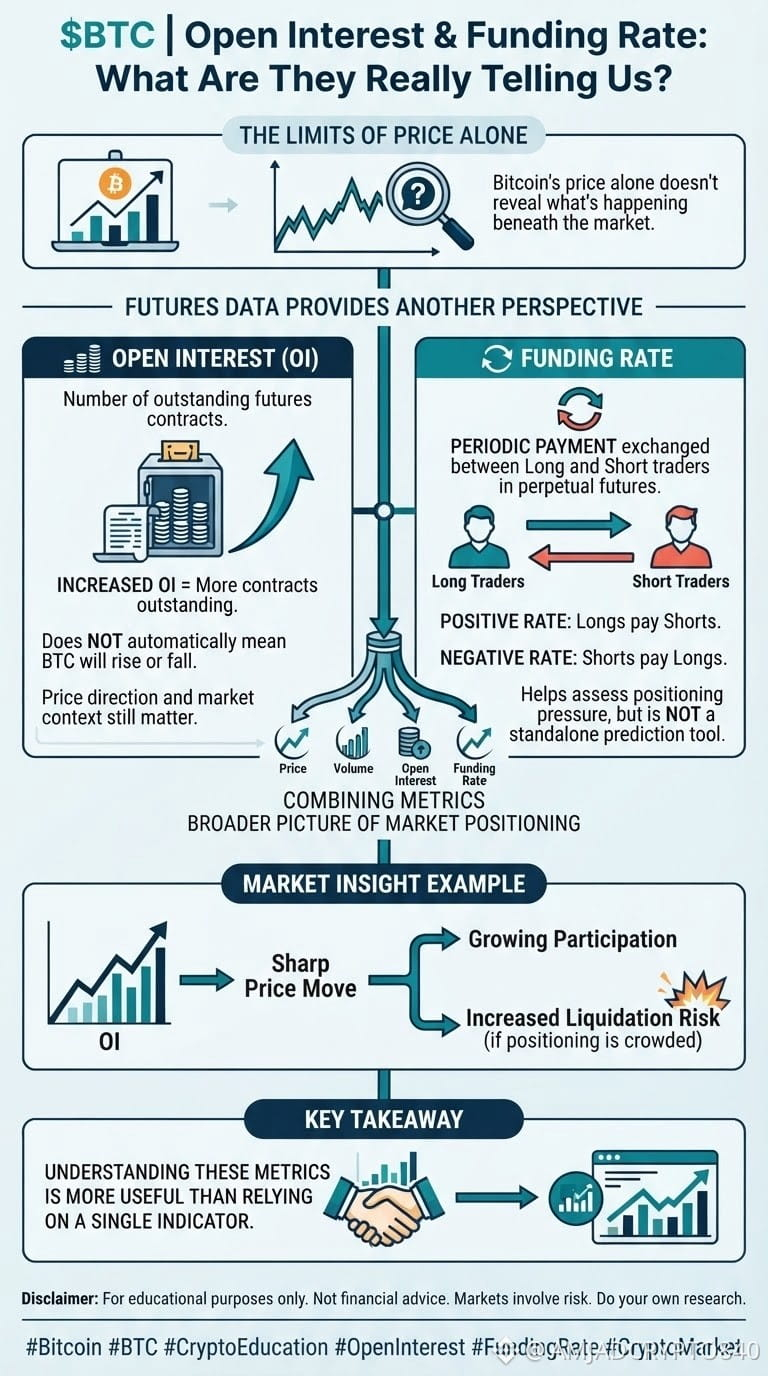
$BTC | Open Interest & Funding Rate: What Are They Really Telling Us?
Bitcoin's price alone doesn't always reveal what's happening beneath the market. Futures data can provide another perspective, especially Open Interest and Funding Rate.
Open Interest (OI) represents the number of futures contracts that remain open. When OI increases, it indicates that more contracts are outstanding, but it doesn't automatically mean Bitcoin will rise or fall. Price direction and market context still matter.
Funding Rate is a periodic payment exchanged between long and short traders in perpetual futures. A positive rate generally means longs pay shorts, while a negative rate generally means shorts pay longs. It can help assess positioning pressure, but it isn't a standalone prediction tool.
Combining price action, volume, Open Interest and Funding Rate may provide a broader picture of market positioning. For example, a rapid increase in OI during a sharp price move can indicate growing participation and may also increase liquidation risk if positioning becomes crowded.
Understanding these metrics is more useful than relying on a single indicator.
Disclaimer: This content is for educational purposes only and is not financial advice. Cryptocurrency markets involve risk. Always do your own research.
$BTC #bitcoin.” #CryptoEducation #OpenInterest #FundingRate #CryptoMarket
{spot}(BTCUSDT)
$BTC | Open Interest & Funding Rate: What Are They Really Telling Us?
Bitcoin's price alone doesn't always reveal what's happening beneath the market. Futures data can provide another perspective, especially Open Interest and Funding Rate.
Open Interest (OI) represents the number of futures contracts that remain open. When OI increases, it indicates that more contracts are outstanding, but it doesn't automatically mean Bitcoin will rise or fall. Price direction and market context still matter.
Funding Rate is a periodic payment exchanged between long and short traders in perpetual futures. A positive rate generally means longs pay shorts, while a negative rate generally means shorts pay longs. It can help assess positioning pressure, but it isn't a standalone prediction tool.
Combining price action, volume, Open Interest and Funding Rate may provide a broader picture of market positioning. For example, a rapid increase in OI during a sharp price move can indicate growing participation and may also increase liquidation risk if positioning becomes crowded.
Understanding these metrics is more useful than relying on a single indicator.
Disclaimer: This content is for educational purposes only and is not financial advice. Cryptocurrency markets involve risk. Always do your own research.
$BTC #bitcoin.” #CryptoEducation #OpenInterest #FundingRate #CryptoMarket
1
165
Log in to explore more content
Join global crypto users on Binance Square
⚡️ Get latest and useful information about crypto.
💬 Trusted by the world’s largest crypto exchange.
👍 Discover real insights from verified creators.
Email / Phone number
Trending Topics
1
#BTCReboundsAbove$60KAmidWhaleDipBuying
402 views
22 Discussing
2
#NvidiaLoses$2.7TrillionInMonthAndAHalf
35,675 views
181 Discussing
3
#GlobalStocksFaceLongestLosingStreakSince2023
356,720 views
2,310 Discussing
4
#BlackRockIBITPostsRecord$541MSingleDayOutflow
48,462 views
127 Discussing
5
#AnthropicPlungesTowardIPOPriceonDay2
184,817 views
1,421 Discussing
6
#TwentyOneCapitalAdds172.25BTC
86,894 views
849 Discussing
7
#HKBillWouldExcludeTokenizedDepositsFromVirtualAssets
13,089 views
59 Discussing
8
#HKBillProposesHK$100KFineForUnauthorizedCryptoTitles
3,298 views
29 Discussing
9
#BitMineFaces$10.1BUnrealizedETHLoss
6,597 views
32 Discussing
10
#StrategyReports$35BNetReserves
3,537 views
19 Discussing