
#itlg
itlg
274,465 views
4,828 Discussing
Hot
Latest

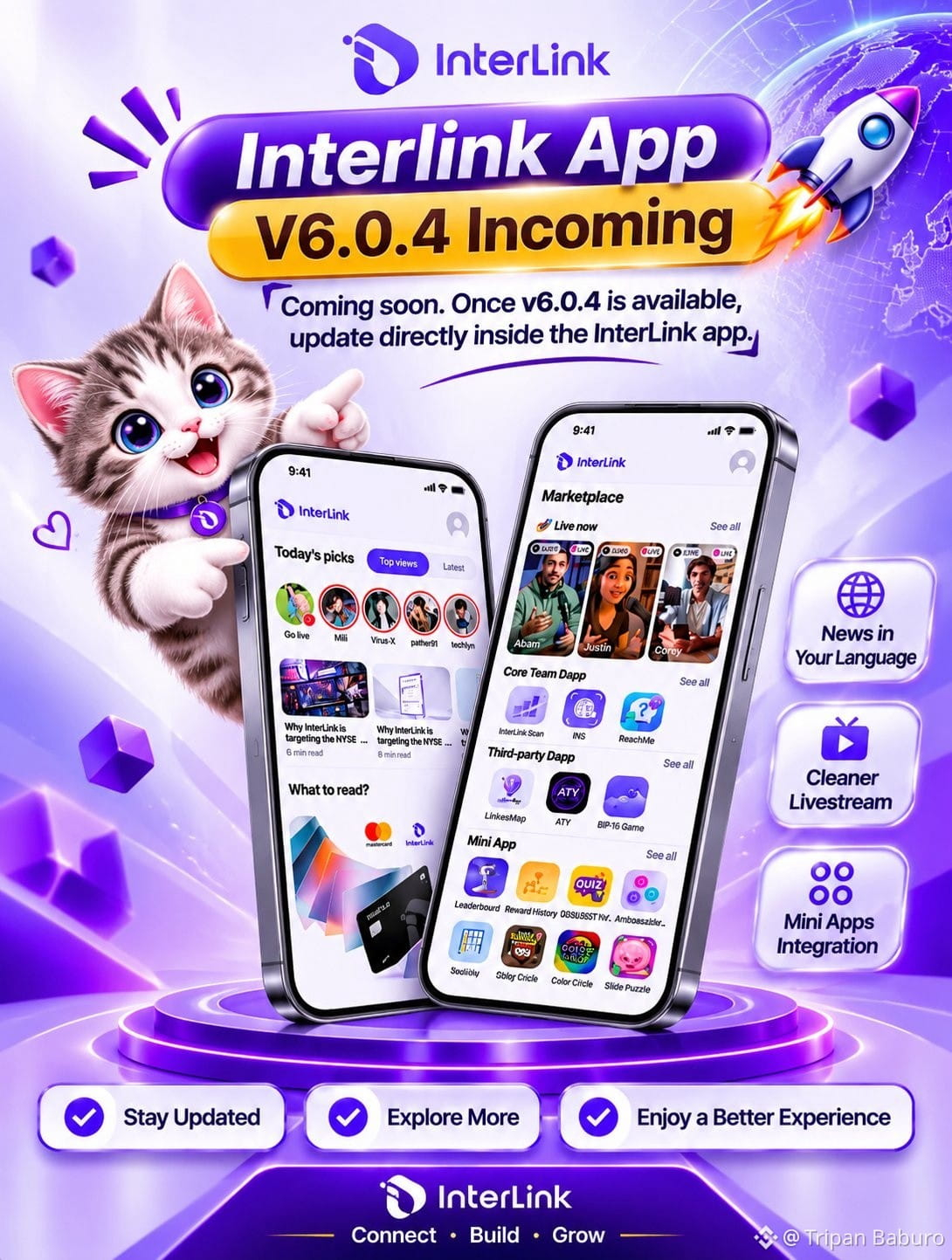
🚀🔥 INTERLINK APP V6.0.4 IS COMING SOON!
A smoother and smarter experience is on the way for all Linkers!
🌟 What's New?
📰 News section with your preferred app language.
🎥 Improved Livestream interface for easier browsing.
📱 Mini Apps redesigned to bring Livestreams and DApps together with better categories.
This update aims to make InterLink more organized, user-friendly, and convenient.
⏳ Coming soon! Update directly from inside the InterLink app when v6.0.4 becomes available.
💜 One Update. Better Experience. Stronger Ecosystem!
Which new feature are you most excited about?
#InterLink #ITLG #ITL
Market Now $SPCX $BTC $ETH
128

·
--
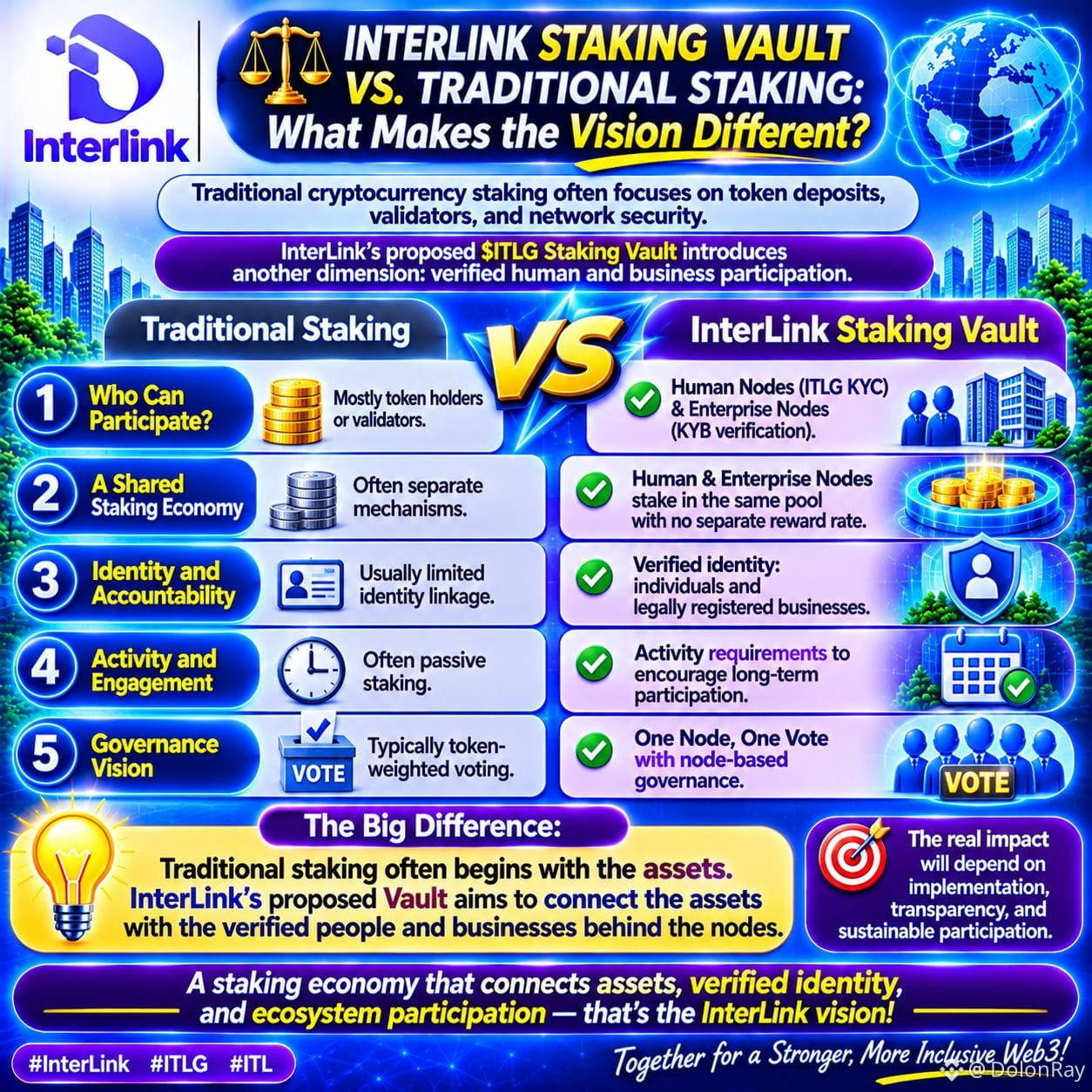
⚖️ 𝗜𝗡𝗧𝗘𝗥𝗟𝗜𝗡𝗞 𝗦𝗧𝗔𝗞𝗜𝗡𝗚 𝗩𝗔𝗨𝗟𝗧 𝗩𝗦. 𝗧𝗥𝗔𝗗𝗜𝗧𝗜𝗢𝗡𝗔𝗟 𝗦𝗧𝗔𝗞𝗜𝗡𝗚: 𝗪𝗛𝗔𝗧 𝗠𝗔𝗞𝗘𝗦 𝗧𝗛𝗘 𝗩𝗜𝗦𝗜𝗢𝗡 𝗗𝗜𝗙𝗙𝗘𝗥𝗘𝗡𝗧? 🌍
Traditional cryptocurrency staking often focuses on token deposits, validators, and network security.
InterLink's proposed $ITLG Staking Vault introduces another dimension: verified human and business participation.
Let's explore the key differences in the proposed vision.
🔹 1. Who Can Participate?
Traditional staking may allow participation based primarily on token ownership or validator requirements.
The proposed InterLink Vault introduces verified participant categories:
• Human Nodes completing ITLG KYC.
• Enterprise Nodes completing KYB verification.
🔹 2. A Shared Staking Economy
Human Nodes and Enterprise Nodes are expected to stake transferable $ITLG in the same shared pool.
The proposed model does not introduce a separate institutional reward rate.
🔹 3. Identity and Accountability
The InterLink vision connects node participation with verified individuals and legally registered businesses.
This adds an identity and accountability layer to the staking framework.
🔹 4. Activity and Engagement
The proposed Human Node mechanism includes activity requirements intended to encourage long-term participation.
This is different from viewing staking only as a passive token deposit.
🔹 5. Governance Vision
InterLink also proposes node-based governance, including the principle of One Node, One Vote.
The final rules will determine how this approach works and how governance safeguards are implemented.
The important distinction is that InterLink is not simply proposing another staking pool.
It is exploring a staking economy that connects transferable $ITLG, verified identity, ecosystem participation, and governance.
Traditional staking often begins with the assets. InterLink's proposed Vault aims to connect.
#InterLink #ITLG #ITL
64

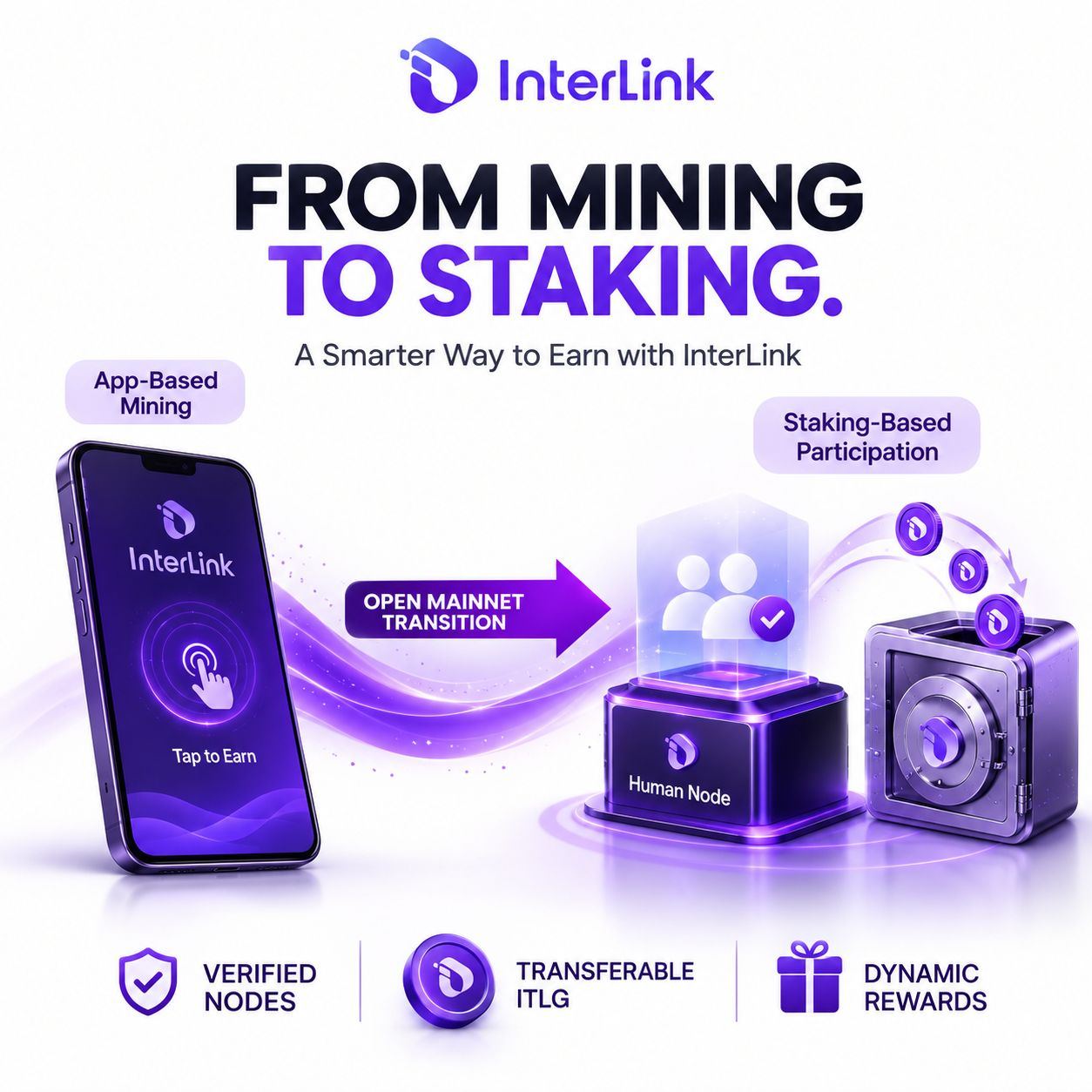
The next chapter of ITLG could be more than mining.
A proposed shift toward verified Human Nodes, staking, and dynamic rewards could redefine how Linkers participate.
The future is about contribution.
#InterLink #ITLG #ITL
The next chapter of ITLG could be more than mining.
A proposed shift toward verified Human Nodes, staking, and dynamic rewards could redefine how Linkers participate.
The future is about contribution.
#InterLink #ITLG #ITL
A proposed shift toward verified Human Nodes, staking, and dynamic rewards could redefine how Linkers participate.
The future is about contribution.
#InterLink #ITLG #ITL
65

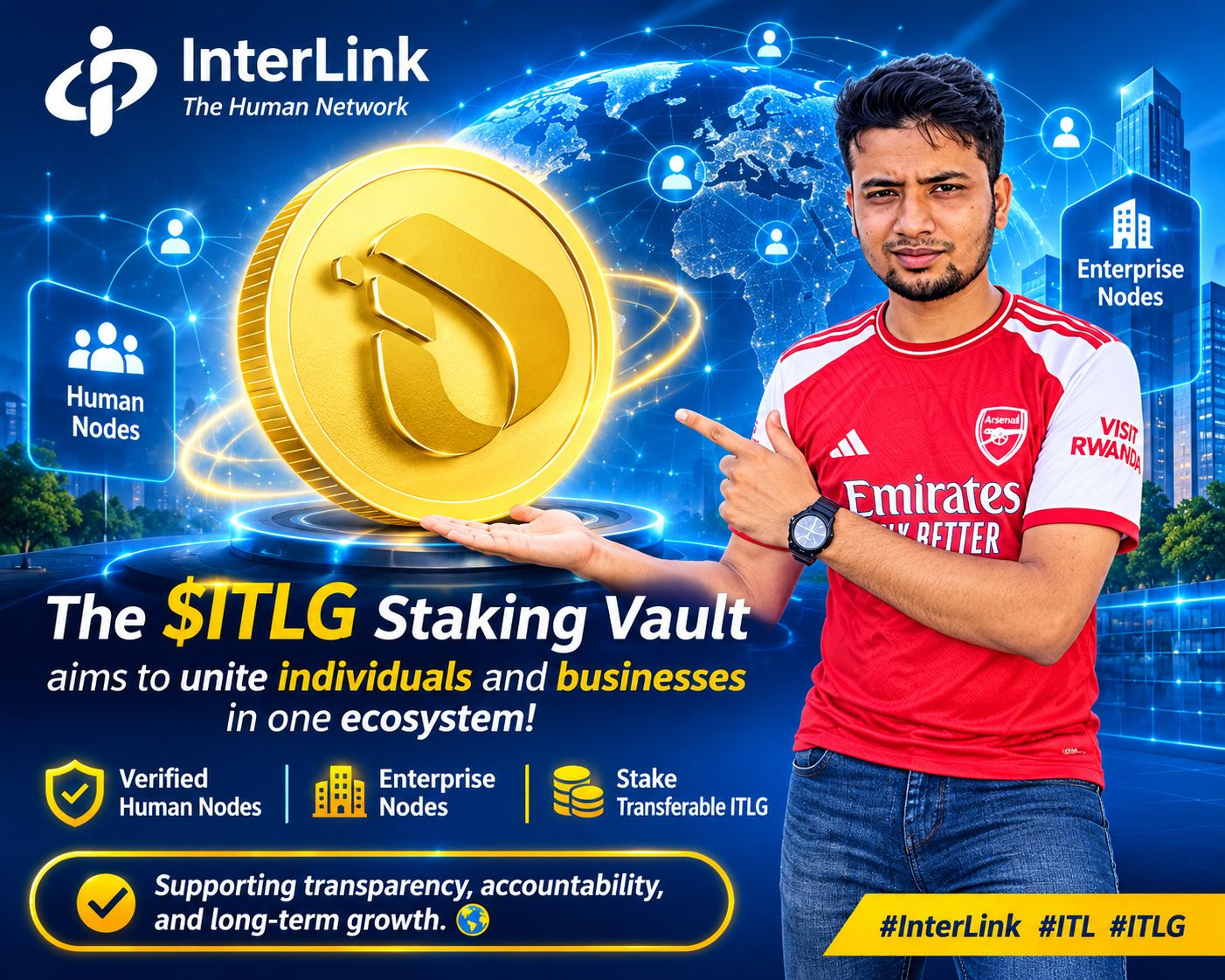
🚀 The $ITLG Staking Vault aims to unite individuals and businesses in one ecosystem! Verified Human Nodes and Enterprise Nodes can stake transferable ITLG, supporting transparency, accountability, and long-term growth. 🌍🤝
#InterLink #ITL #ITLG
🚀 The $ITLG Staking Vault aims to unite individuals and businesses in one ecosystem! Verified Human Nodes and Enterprise Nodes can stake transferable ITLG, supporting transparency, accountability, and long-term growth. 🌍🤝
#InterLink #ITL #ITLG
#InterLink #ITL #ITLG
1
60

·
--
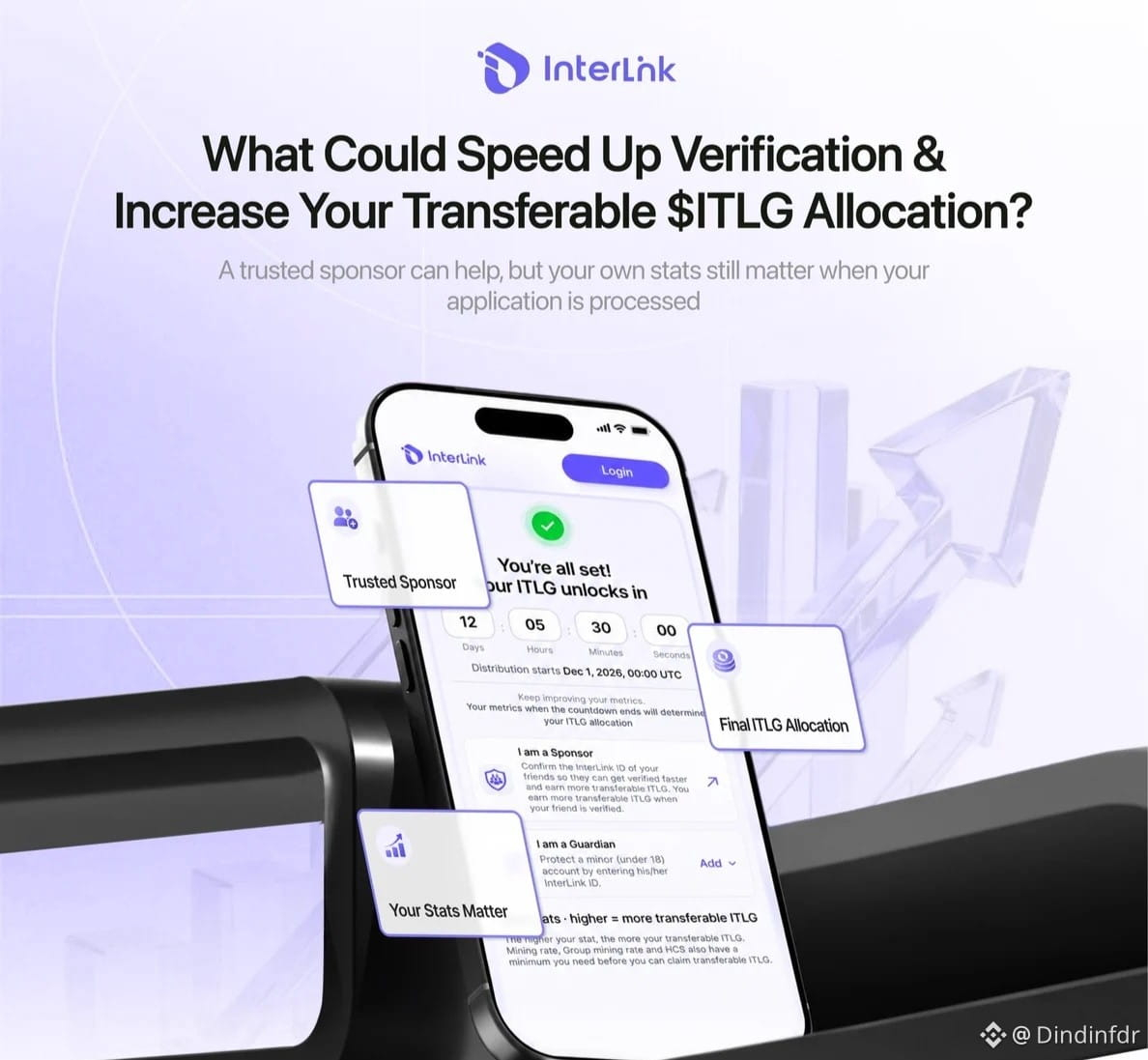
🔥 Want faster verification and more transferable $ITLG?
Ask a trusted Linker with good stats for their invitation code.
Enter the code → they confirm you → it may help speed things up and give you a bigger allocation (not guaranteed).
Keep mining and improving your own stats too. Your activity still matters most.
#InterLink #ITLG #ITL
Ask a trusted Linker with good stats for their invitation code.
Enter the code → they confirm you → it may help speed things up and give you a bigger allocation (not guaranteed).
Keep mining and improving your own stats too. Your activity still matters most.
#InterLink #ITLG #ITL
1
69
·
--
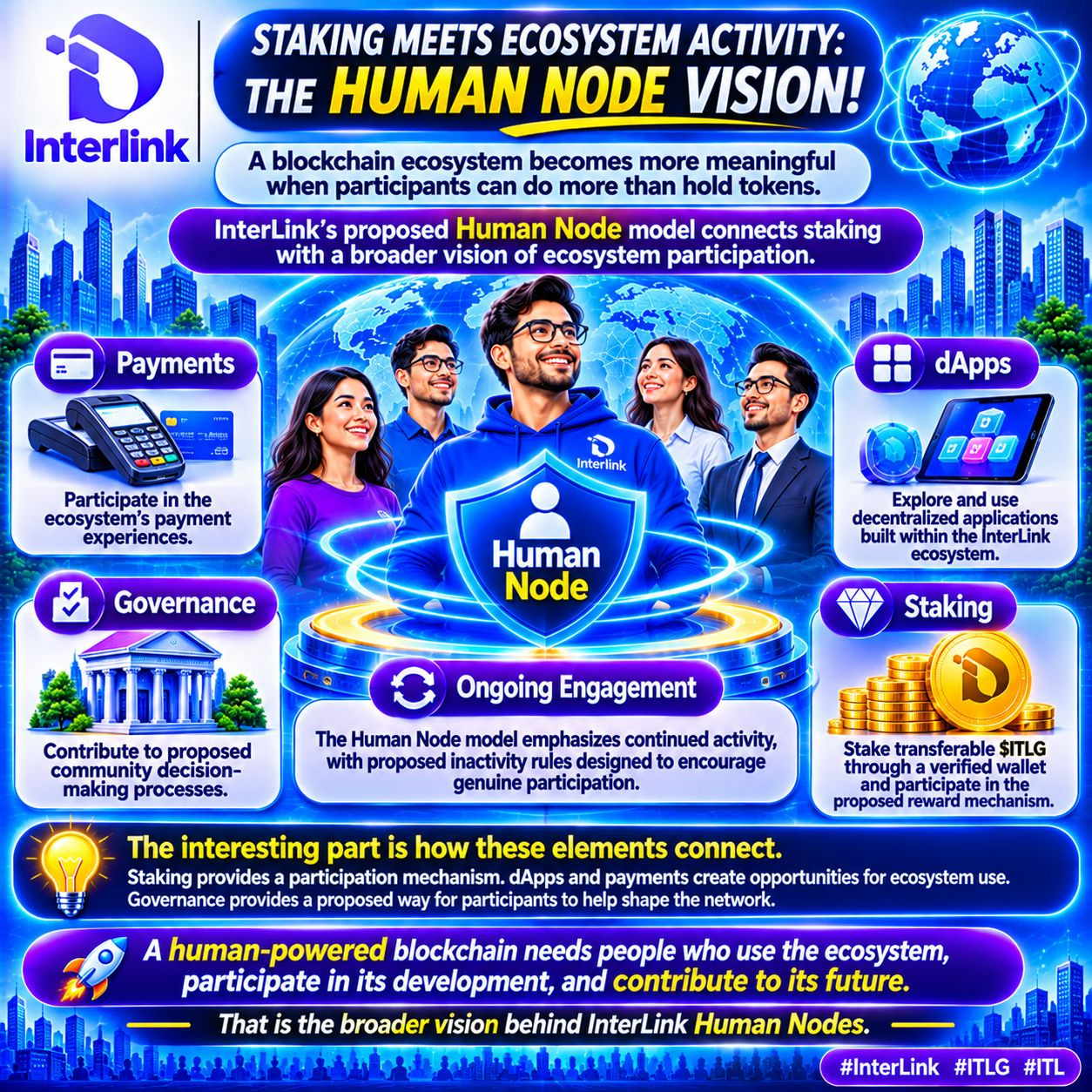
🌐 𝗦𝗧𝗔𝗞𝗜𝗡𝗚 𝗠𝗘𝗘𝗧𝗦 𝗘𝗖𝗢𝗦𝗬𝗦𝗧𝗘𝗠 𝗔𝗖𝗧𝗜𝗩𝗜𝗧𝗬: 𝗧𝗛𝗘 𝗛𝗨𝗠𝗔𝗡 𝗡𝗢𝗗𝗘 𝗩𝗜𝗦𝗜𝗢𝗡! 🚀
A blockchain ecosystem becomes more meaningful when participants can do more than hold tokens.
InterLink's proposed Human Node model connects staking with a broader vision of ecosystem participation.
Verified Human Nodes are envisioned to participate in different areas of the InterLink network.
💳 Payments: Participate in the ecosystem's payment experiences.
📱 dApps: Explore and use decentralized applications built within the InterLink ecosystem.
🗳️ Governance: Contribute to proposed community decision-making processes.
💎 Staking: Stake transferable $ITLG through a verified wallet and participate in the proposed reward mechanism.
🔄 Ongoing Engagement: The Human Node model emphasizes continued activity, with proposed inactivity rules designed to encourage genuine participation.
The interesting part is how these elements connect.
Staking provides a participation mechanism. dApps and payments create opportunities for ecosystem use. Governance provides a proposed way for participants to help shape the network.
This creates a vision where the value of a node is not defined only by its token balance.
However, actual participation opportunities, reward rules, and activity verification will depend on the final implementation.
A human-powered blockchain needs people who use the ecosystem, participate in its development, and contribute to its future.
That is the broader vision behind InterLink Human Nodes.
#InterLink #ITLG #ITL
75
·
--
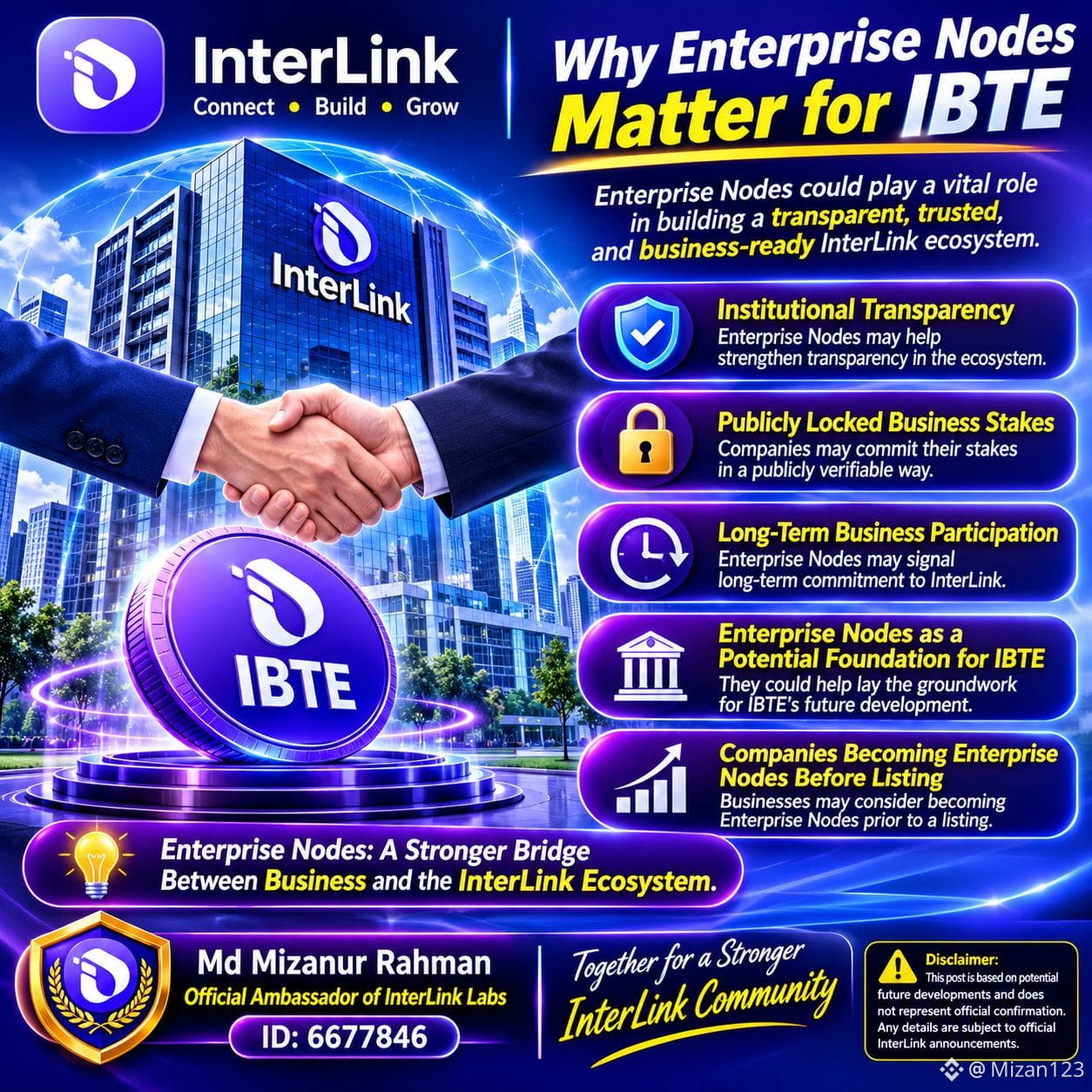
🏢 Why Enterprise Nodes Matter for IBTE! 💜
🔹 Verified business IDs build institutional trust
🔹 Publicly locked $ITLG shows long-term commitment
🔹 Foundation for a business-driven IBTE ecosystem
🔹 Early onboarding ahead of future listings
Connecting Real Businesses Onchain! 🌐
#InterLink #ITLG #ITL
🏢 Why Enterprise Nodes Matter for IBTE! 💜
🔹 Verified business IDs build institutional trust
🔹 Publicly locked $ITLG shows long-term commitment
🔹 Foundation for a business-driven IBTE ecosystem
🔹 Early onboarding ahead of future listings
Connecting Real Businesses Onchain! 🌐
#InterLink #ITLG #ITL
🔹 Verified business IDs build institutional trust
🔹 Publicly locked $ITLG shows long-term commitment
🔹 Foundation for a business-driven IBTE ecosystem
🔹 Early onboarding ahead of future listings
Connecting Real Businesses Onchain! 🌐
#InterLink #ITLG #ITL
74

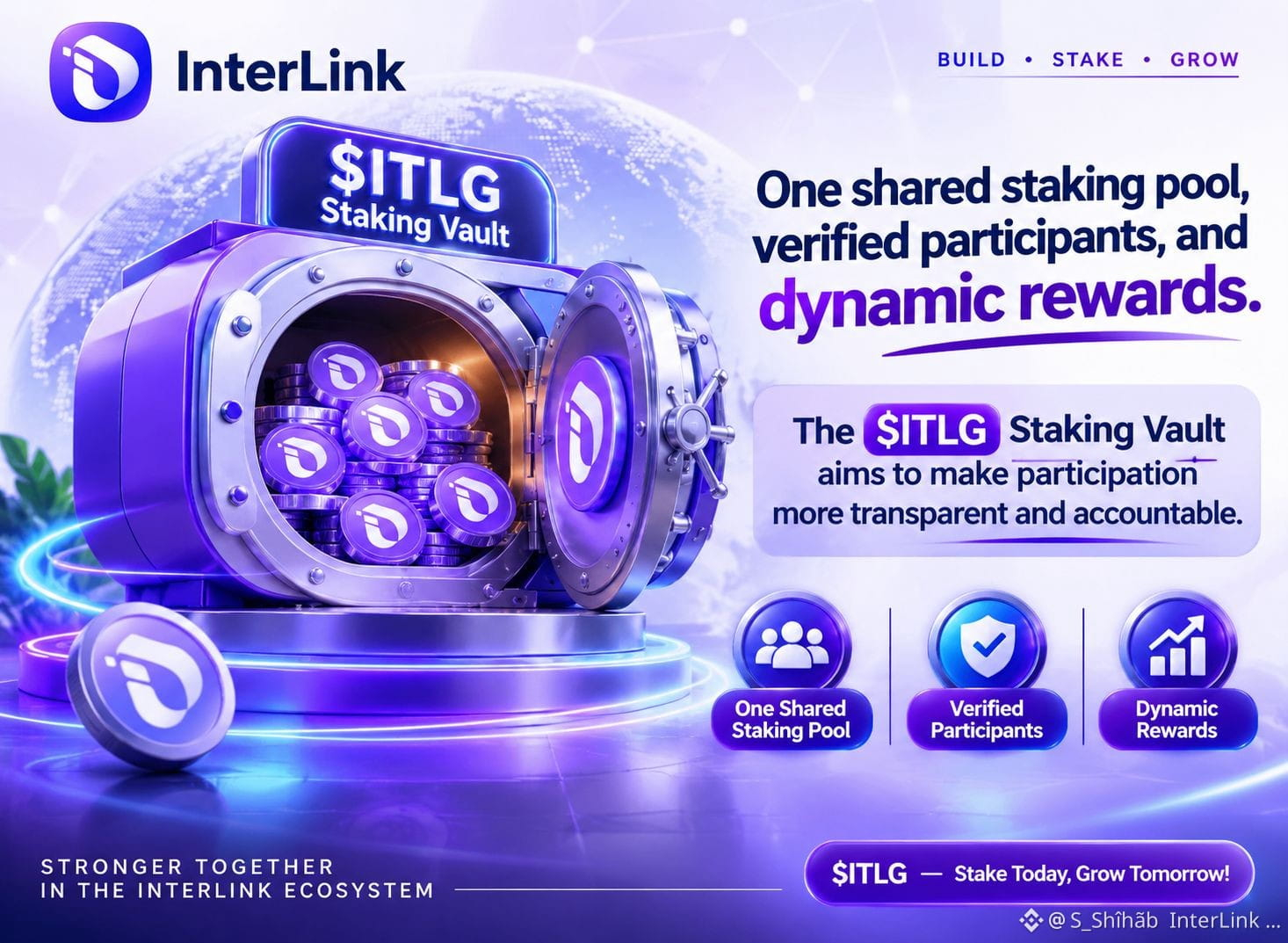
One shared staking pool, verified participants, and dynamic rewards. The $ITLG Staking Vault aims to make participation more transparent and accountable.
#InterLink #ITLG #ITL
One shared staking pool, verified participants, and dynamic rewards. The $ITLG Staking Vault aims to make participation more transparent and accountable.
#InterLink #ITLG #ITL
#InterLink #ITLG #ITL
76

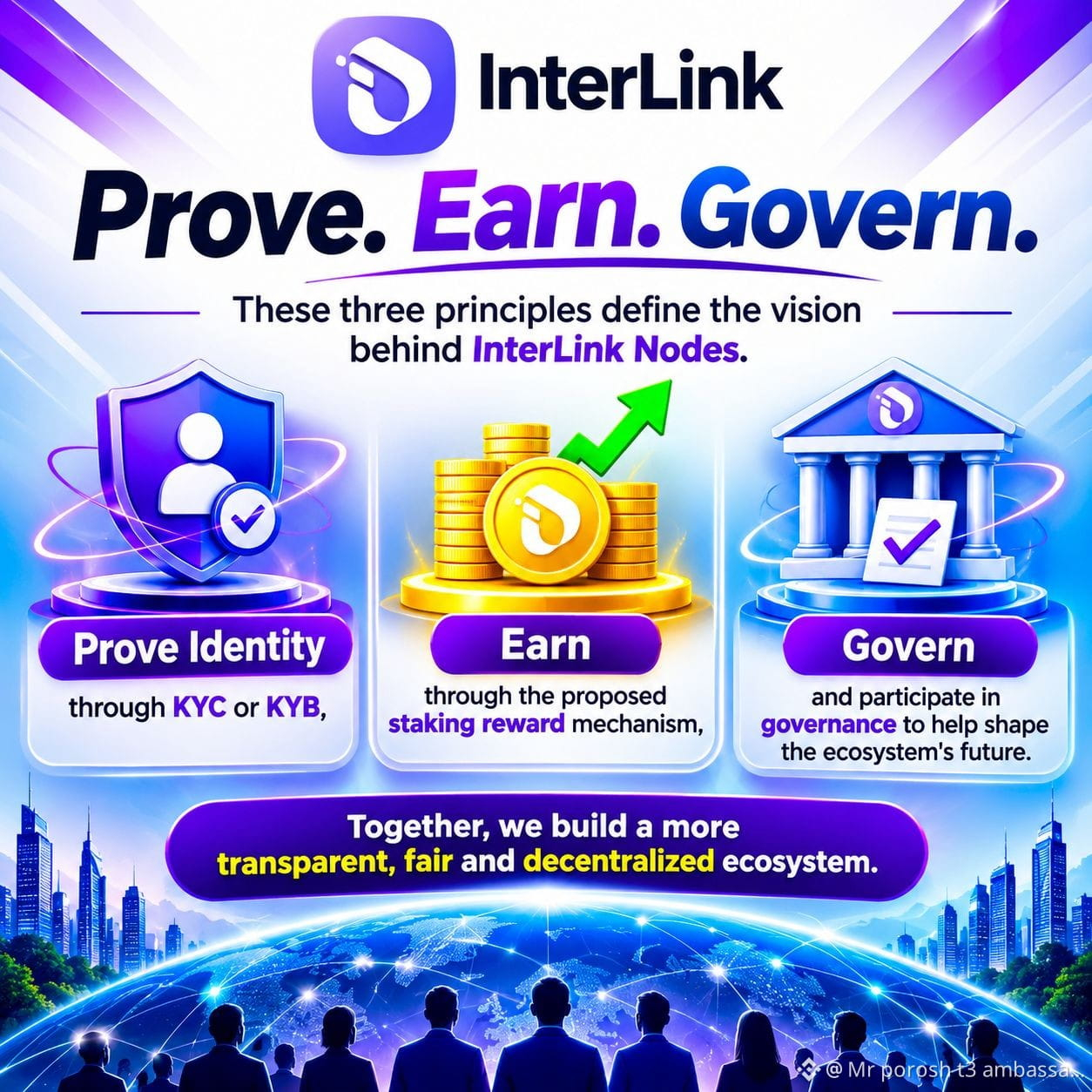
Prove. Earn. Govern.
These three principles define the vision behind InterLink Nodes.
Prove identity through KYC or KYB, earn through the proposed staking reward mechanism, and participate in governance to help shape the ecosystem's future.
#InterLink #ITLG #ITL
Prove. Earn. Govern.
These three principles define the vision behind InterLink Nodes.
Prove identity through KYC or KYB, earn through the proposed staking reward mechanism, and participate in governance to help shape the ecosystem's future.
#InterLink #ITLG #ITL
These three principles define the vision behind InterLink Nodes.
Prove identity through KYC or KYB, earn through the proposed staking reward mechanism, and participate in governance to help shape the ecosystem's future.
#InterLink #ITLG #ITL
72

·
--
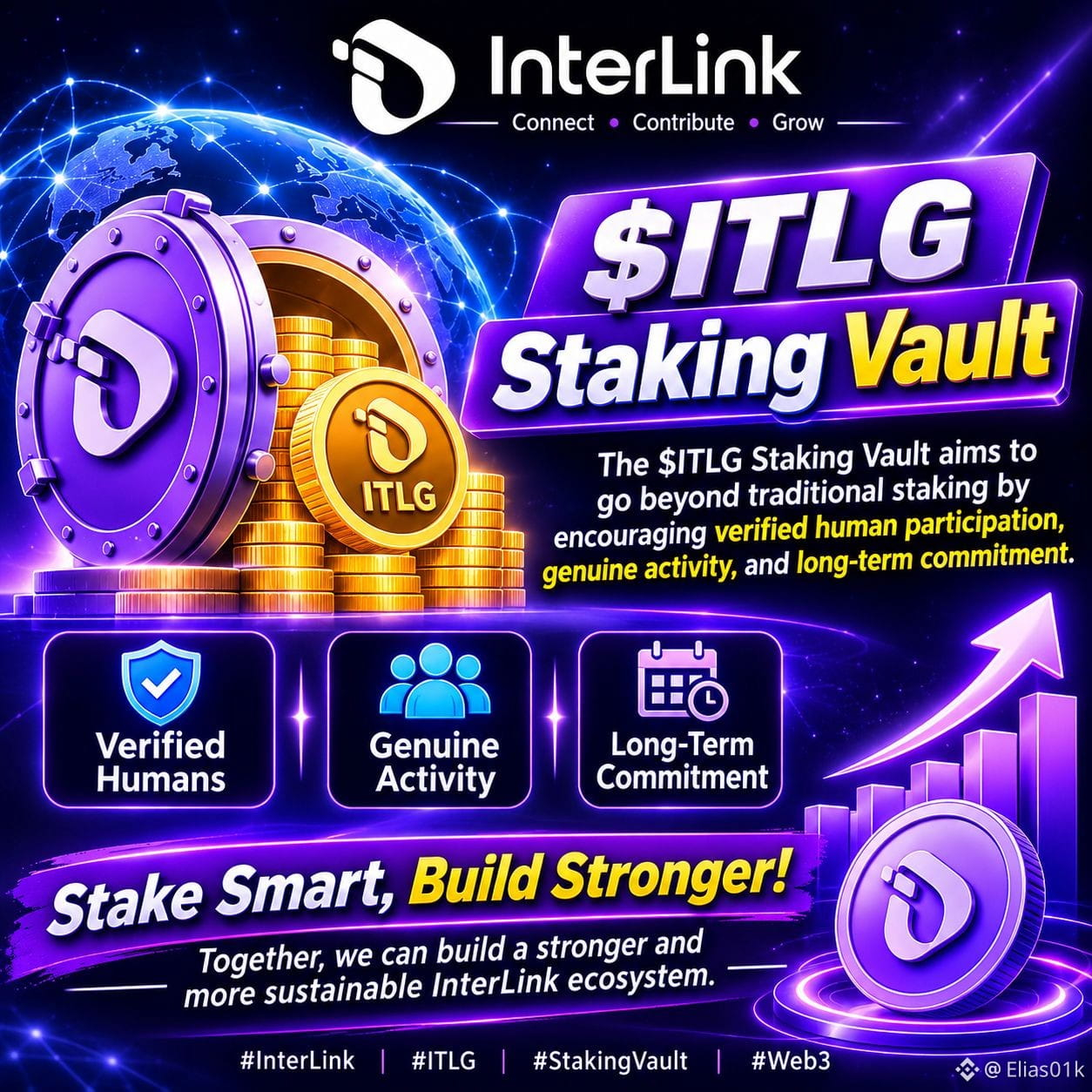
The $ITLG Staking Vault aims to go beyond traditional staking by encouraging verified human participation, genuine activity, and long-term commitment. It represents an important step toward building a stronger and more sustainable InterLink ecosystem.
#InterLink #ITLG #ITL
The $ITLG Staking Vault aims to go beyond traditional staking by encouraging verified human participation, genuine activity, and long-term commitment. It represents an important step toward building a stronger and more sustainable InterLink ecosystem.
#InterLink #ITLG #ITL
#InterLink #ITLG #ITL
70
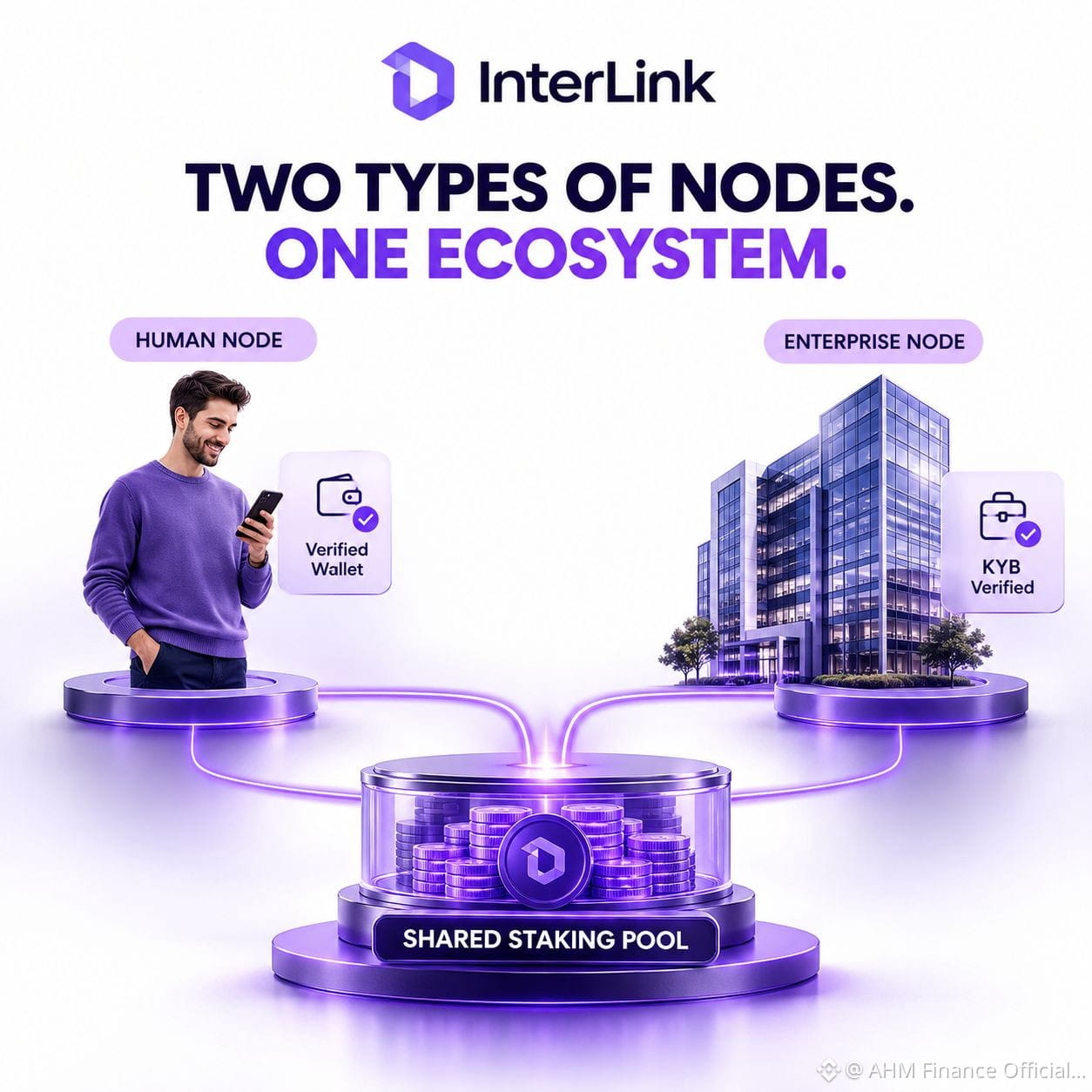
A person brings human trust. A company brings institutional commitment.
Human Nodes and Enterprise Nodes are designed to connect both under one ITLG staking ecosystem.
Different roles. One shared pool.
#InterLink #ITLG #ITL
A person brings human trust. A company brings institutional commitment.
Human Nodes and Enterprise Nodes are designed to connect both under one ITLG staking ecosystem.
Different roles. One shared pool.
#InterLink #ITLG #ITL
Human Nodes and Enterprise Nodes are designed to connect both under one ITLG staking ecosystem.
Different roles. One shared pool.
#InterLink #ITLG #ITL
74
·
--
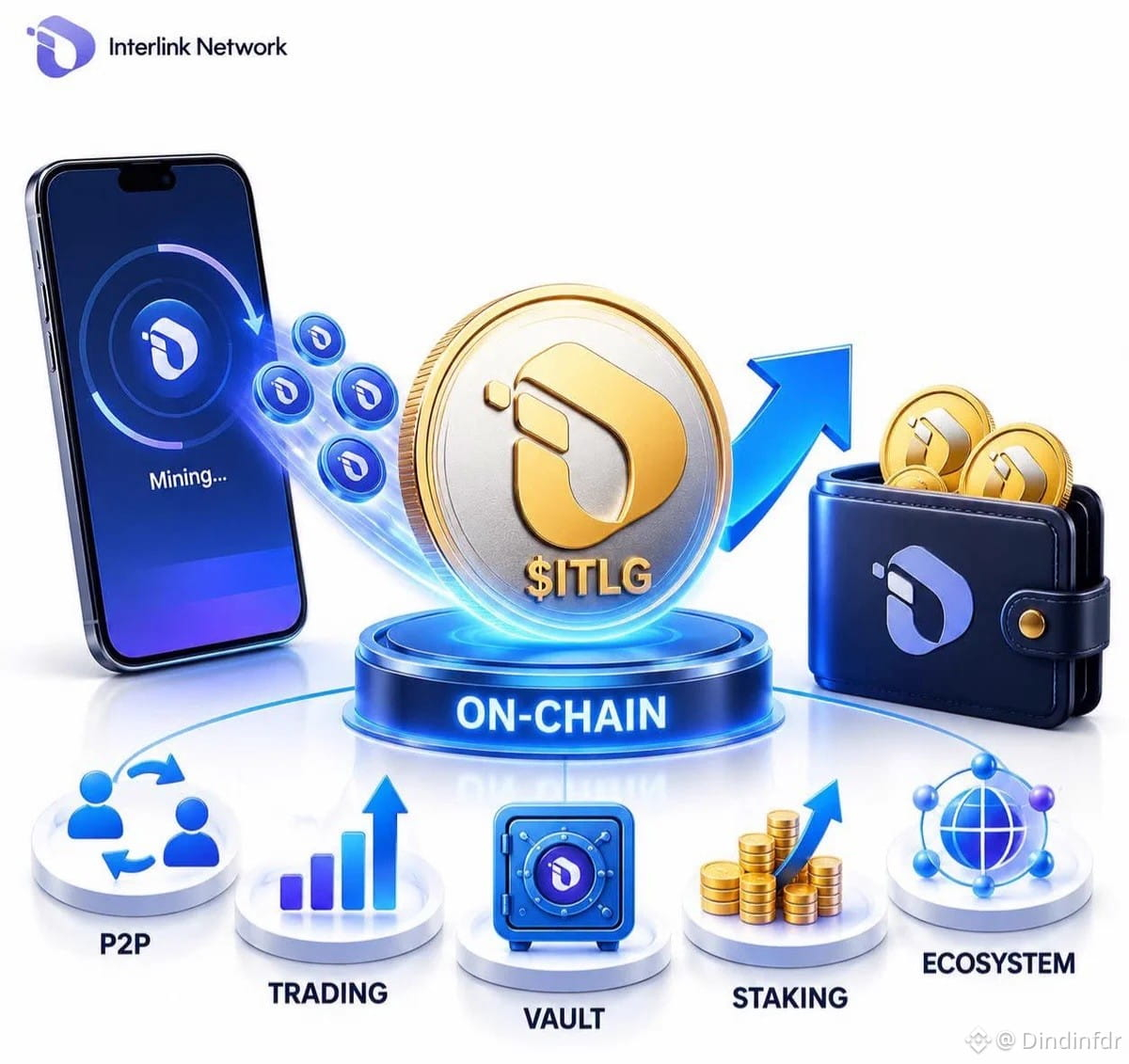
🚀 $ITLG staking will give rewards based on how much the ecosystem is used (from fees), not fixed rewards.
This could make people hold longer and help the network grow better.
What do you think?
#InterLink #ITLG #ITL
🚀 $ITLG staking will give rewards based on how much the ecosystem is used (from fees), not fixed rewards.
This could make people hold longer and help the network grow better.
What do you think?
#InterLink #ITLG #ITL
This could make people hold longer and help the network grow better.
What do you think?
#InterLink #ITLG #ITL
1
77
·
--
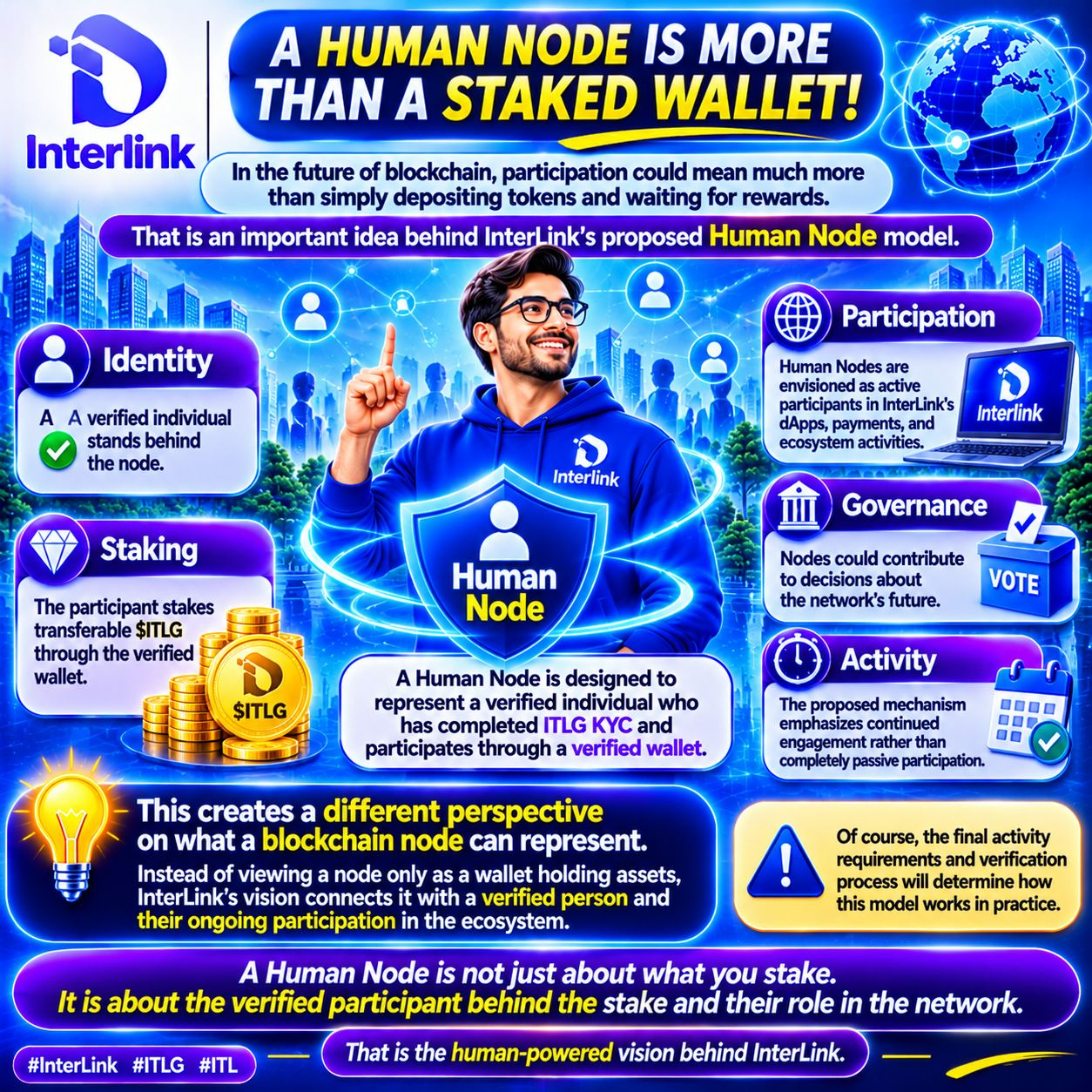
👤 𝗔 𝗛𝗨𝗠𝗔𝗡 𝗡𝗢𝗗𝗘 𝗜𝗦 𝗠𝗢𝗥𝗘 𝗧𝗛𝗔𝗡 𝗔 𝗦𝗧𝗔𝗞𝗘𝗗 𝗪𝗔𝗟𝗟𝗘𝗧! 🌐
In the future of blockchain, participation could mean much more than simply depositing tokens and waiting for rewards.
That is an important idea behind InterLink's proposed Human Node model.
A Human Node is designed to represent a verified individual who has completed ITLG KYC and participates through a verified wallet.
But the vision goes beyond staking.
👤 Identity: A verified individual stands behind the node.
💎 Staking: The participant stakes transferable $ITLG through the verified wallet.
🌍 Participation: Human Nodes are envisioned as active participants in InterLink's dApps, payments, and ecosystem activities.
🗳️ Governance: Nodes could contribute to decisions about the network's future.
⏳ Activity: The proposed mechanism emphasizes continued engagement rather than completely passive participation.
This creates a different perspective on what a blockchain node can represent.
Instead of viewing a node only as a wallet holding assets, InterLink's vision connects it with a verified person and their ongoing participation in the ecosystem.
Of course, the final activity requirements and verification process will determine how this model works in practice.
A Human Node is not just about what you stake. It is about the verified participant behind the stake and their role in the network.
That is the human-powered vision behind InterLink.
#InterLink #ITLG #ITL
31
·
--
Bullish
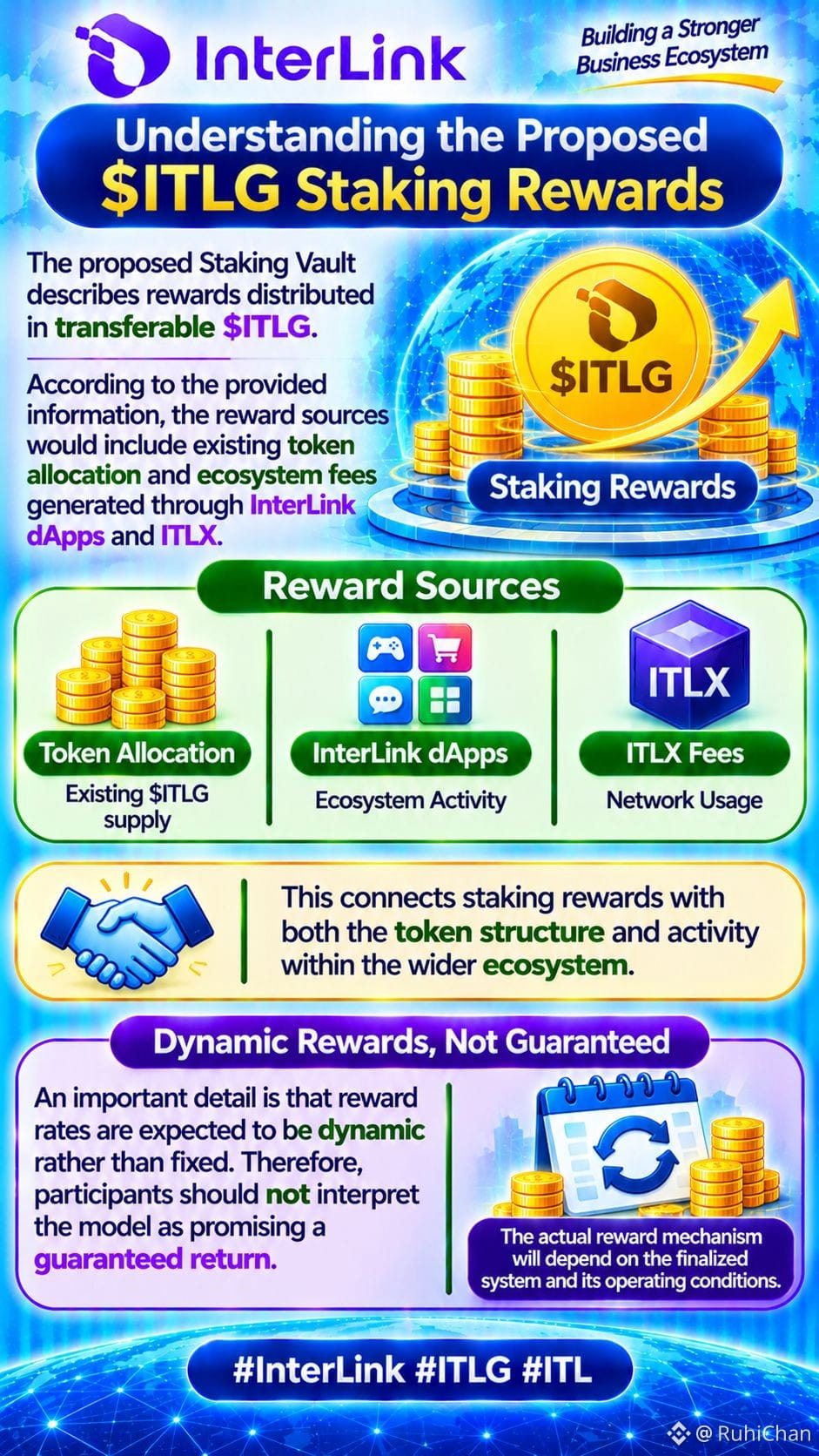
$ENSO $SKDD $BTC Understanding the Proposed $ITLG Staking Rewards
The proposed Staking Vault describes rewards distributed in transferable $ITLG. According to the provided information, the reward sources would include existing token allocation and ecosystem fees generated through InterLink dApps and ITLX.
This connects staking rewards with both the token structure and activity within the wider ecosystem.
An important detail is that reward rates are expected to be dynamic rather than fixed. Therefore, participants should not interpret the model as promising a guaranteed return. The actual reward mechanism will depend on the finalized system and its operating conditions.
#InterLink #ITLG #ITL
46
·
--
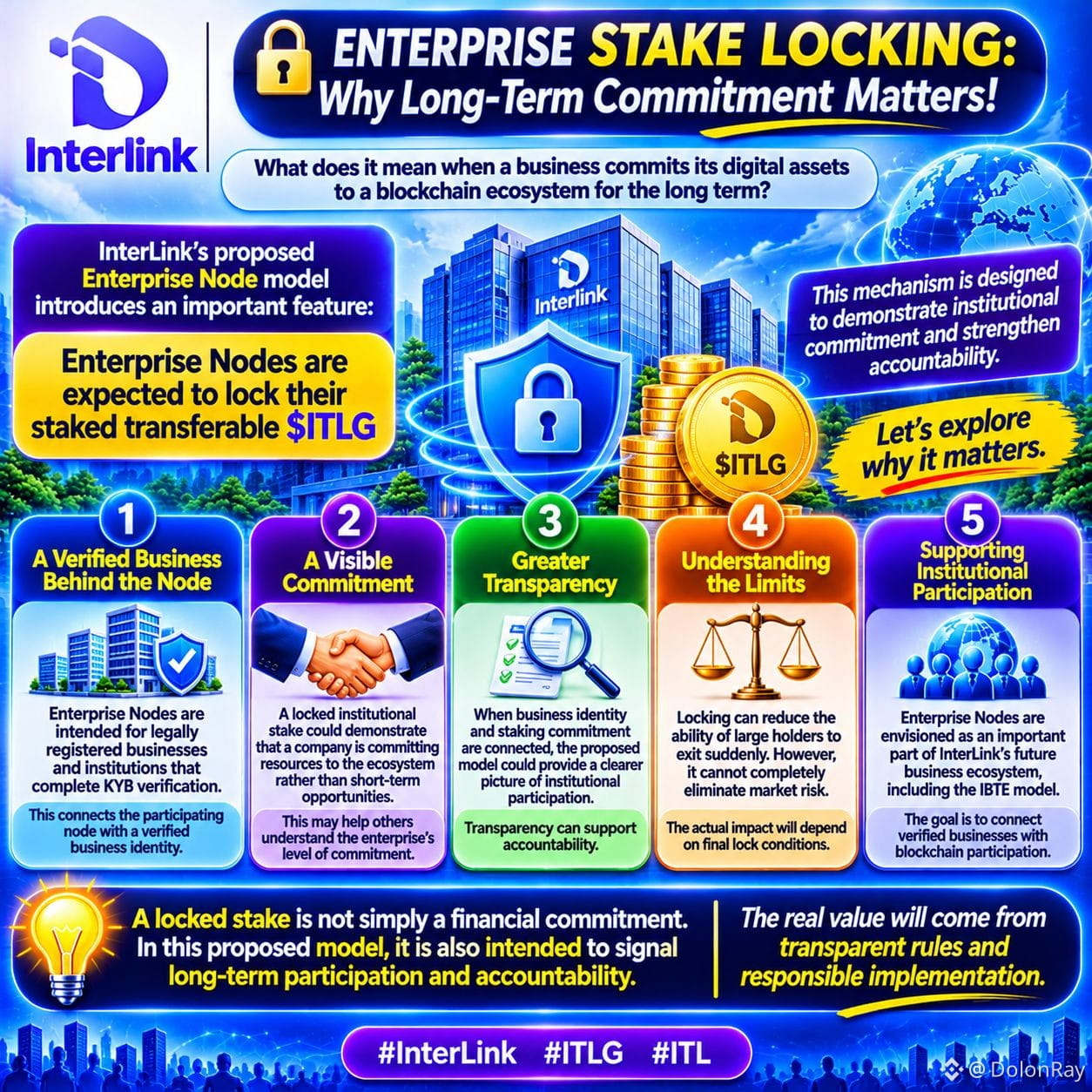
🔐 𝗘𝗡𝗧𝗘𝗥𝗣𝗥𝗜𝗦𝗘 𝗦𝗧𝗔𝗞𝗘 𝗟𝗢𝗖𝗞𝗜𝗡𝗚: 𝗪𝗛𝗬 𝗟𝗢𝗡𝗚-𝗧𝗘𝗥𝗠 𝗖𝗢𝗠𝗠𝗜𝗧𝗠𝗘𝗡𝗧 𝗠𝗔𝗧𝗧𝗘𝗥𝗦! 🏢
What does it mean when a business commits its digital assets to a blockchain ecosystem for the long term?
InterLink's proposed Enterprise Node model introduces an important feature:
Enterprise Nodes are expected to lock their staked transferable $ITLG.
This mechanism is designed to demonstrate institutional commitment and strengthen accountability.
Let's explore why it matters.
🏢 1. A Verified Business Behind the Node
Enterprise Nodes are intended for legally registered businesses and institutions that complete KYB verification.
This connects the participating node with a verified business identity.
🔒 2. A Visible Commitment
A locked institutional stake could demonstrate that a company is committing resources to the ecosystem rather than participating only for short-term opportunities.
This may help other participants understand the enterprise's level of commitment.
📊 3. Greater Transparency
When business identity and staking commitment are connected, the proposed model could provide a clearer picture of institutional participation.
Transparency can support accountability, especially when businesses become part of a wider blockchain economy.
⚖️ 4. Understanding the Limits
Locking mechanisms can reduce the ability of large holders to exit suddenly during the applicable lock period.
However, locking cannot completely eliminate market manipulation, price volatility, or financial risk.
The actual impact will depend on the final lock conditions, disclosure rules, and enforcement mechanisms.
🌍 5. Supporting Institutional Participation
Enterprise Nodes are envisioned as an important part of InterLink's future business ecosystem, including the proposed IBTE model.
The goal is to connect verified businesses with blockchain participation through a more structured framework.
#InterLink #ITLG #ITL
46

·
--
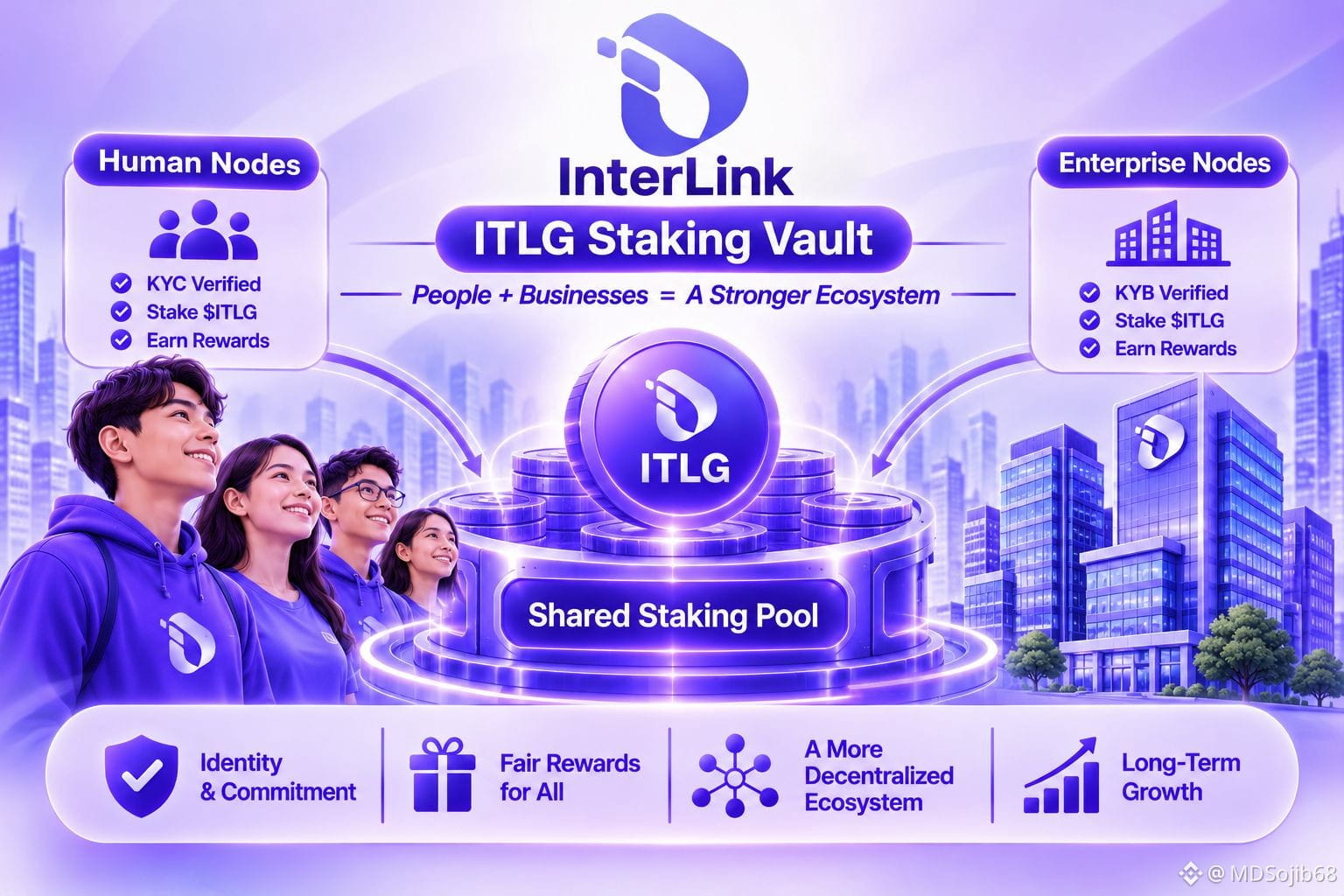
Traditional staking often gives more influence to those who hold more capital.
But @Square-Creator-2e9b96d5ccc2 is exploring a different direction with the $ITLG Staking Vault.
By bringing verified Human Nodes and Enterprise Nodes into one shared staking pool, the goal is to build an economy based on both identity and commitment.
Individuals verify through KYC, while businesses complete KYB. Both stake transferable $ITLG and participate under a shared reward mechanism.
It's a different approach to connecting real people, businesses, and blockchain participation.
#InterLink #ITLG #ITL
Traditional staking often gives more influence to those who hold more capital.
But @InterlinkLabs is exploring a different direction with the $ITLG Staking Vault.
By bringing verified Human Nodes and Enterprise Nodes into one shared staking pool, the goal is to build an economy based on both identity and commitment.
Individuals verify through KYC, while businesses complete KYB. Both stake transferable $ITLG and participate under a shared reward mechanism.
It's a different approach to connecting real people, businesses, and blockchain participation.
#InterLink #ITLG #ITL
73
·
--
Bullish
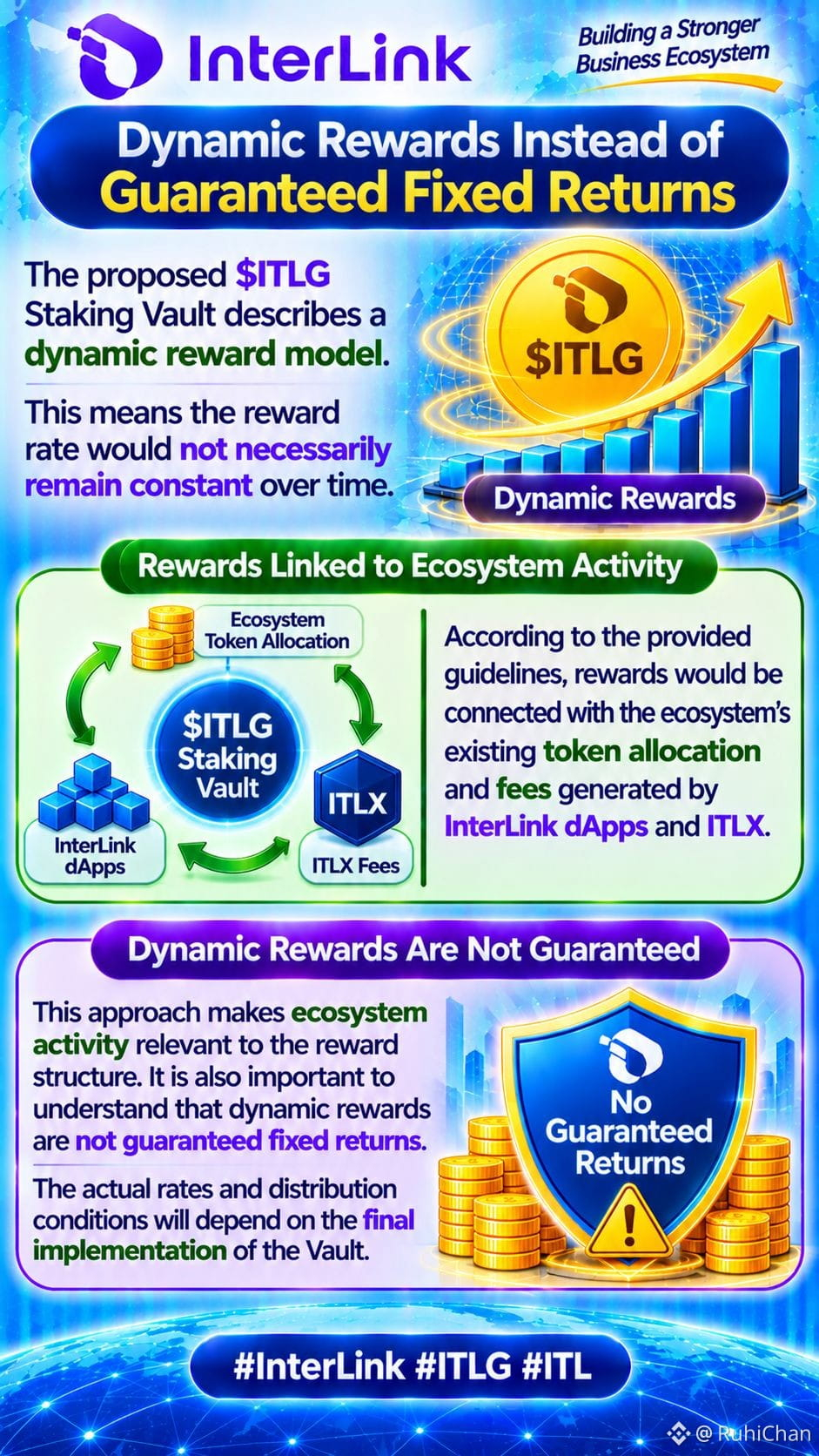
$BLESS $ENSO $SKDD Dynamic Rewards Instead of Guaranteed Fixed Returns
The proposed $ITLG Staking Vault describes a dynamic reward model. This means the reward rate would not necessarily remain constant over time.
According to the provided guidelines, rewards would be connected with the ecosystem's existing token allocation and fees generated by InterLink dApps and ITLX.
This approach makes ecosystem activity relevant to the reward structure. It is also important to understand that dynamic rewards are not guaranteed fixed returns. The actual rates and distribution conditions will depend on the final implementation of the Vault.
#InterLink #ITLG #ITL
312
·
--
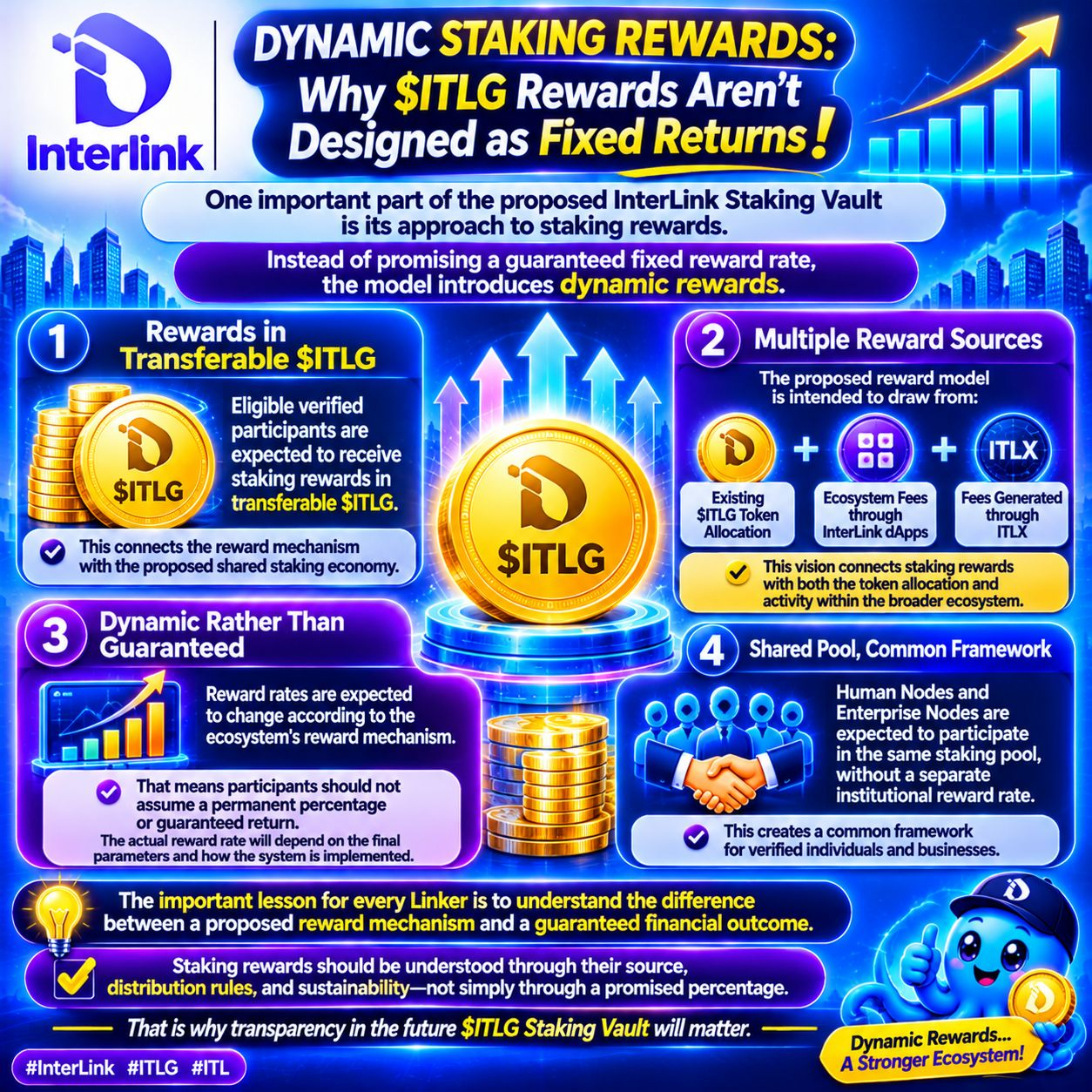
💎 𝗗𝗬𝗡𝗔𝗠𝗜𝗖 𝗦𝗧𝗔𝗞𝗜𝗡𝗚 𝗥𝗘𝗪𝗔𝗥𝗗𝗦: 𝗪𝗛𝗬 $𝗜𝗧𝗟𝗚 𝗥𝗘𝗪𝗔𝗥𝗗𝗦 𝗔𝗥𝗘𝗡'𝗧 𝗗𝗘𝗦𝗜𝗚𝗡𝗘𝗗 𝗔𝗦 𝗙𝗜𝗫𝗘𝗗 𝗥𝗘𝗧𝗨𝗥𝗡𝗦! 📊
One important part of the proposed InterLink Staking Vault is its approach to staking rewards.
Instead of promising a guaranteed fixed reward rate, the model introduces dynamic rewards.
But what does that actually mean?
🪙 1. Rewards in Transferable $ITLG
Eligible verified participants are expected to receive staking rewards in transferable $ITLG.
This connects the reward mechanism with the proposed shared staking economy.
🌐 2. Multiple Reward Sources
The proposed reward model is intended to draw from:
• Existing $ITLG token allocation.
• Ecosystem fees generated through InterLink dApps.
• Fees generated through ITLX.
This vision connects staking rewards with both the token allocation and activity within the broader ecosystem.
📈 3. Dynamic Rather Than Guaranteed
Reward rates are expected to change according to the ecosystem's reward mechanism.
That means participants should not assume a permanent percentage or guaranteed return.
The actual reward rate will depend on the final parameters and how the system is implemented.
🤝 4. Shared Pool, Common Framework
Human Nodes and Enterprise Nodes are expected to participate in the same staking pool, without a separate institutional reward rate.
This creates a common framework for verified individuals and businesses.
The important lesson for every Linker is to understand the difference between a proposed reward mechanism and a guaranteed financial outcome.
Staking rewards should be understood through their source, distribution rules, and sustainability—not simply through a promised percentage.
That is why transparency in the future $ITLG Staking Vault will matter.
#InterLink #ITLG #ITL
52
·
--
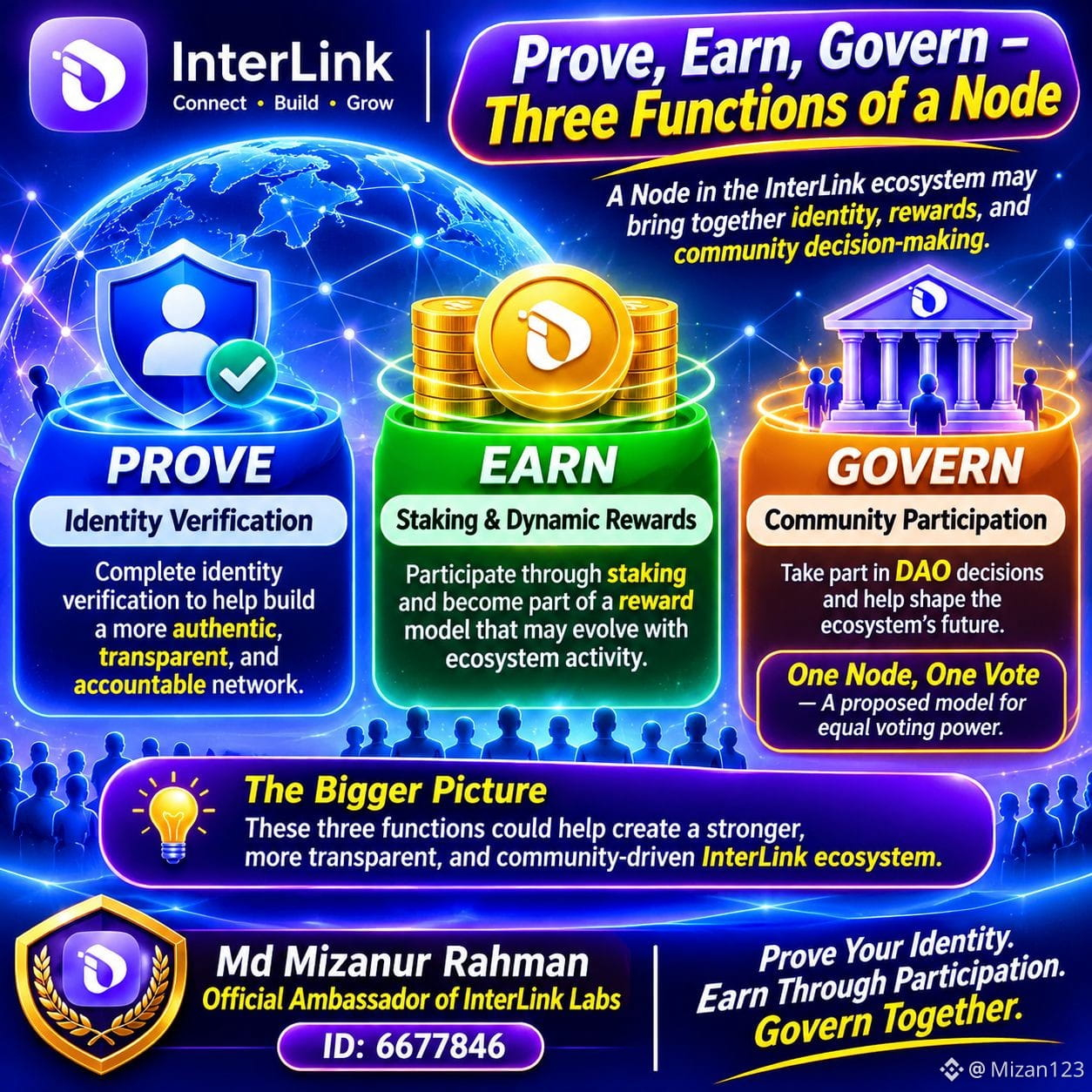
🚀 Prove, Earn, Govern – Core Functions of an InterLink Node! 💜
🛡️ PROVE: Identity verification for real trust
💎 EARN: Staking & dynamic ecosystem rewards
🗳️ GOVERN: DAO voting (One Node, One Vote)
Prove, Earn & Govern Together! 🌐
#InterLink #ITLG #ITL
🚀 Prove, Earn, Govern – Core Functions of an InterLink Node! 💜
🛡️ PROVE: Identity verification for real trust
💎 EARN: Staking & dynamic ecosystem rewards
🗳️ GOVERN: DAO voting (One Node, One Vote)
Prove, Earn & Govern Together! 🌐
#InterLink #ITLG #ITL
🛡️ PROVE: Identity verification for real trust
💎 EARN: Staking & dynamic ecosystem rewards
🗳️ GOVERN: DAO voting (One Node, One Vote)
Prove, Earn & Govern Together! 🌐
#InterLink #ITLG #ITL
61
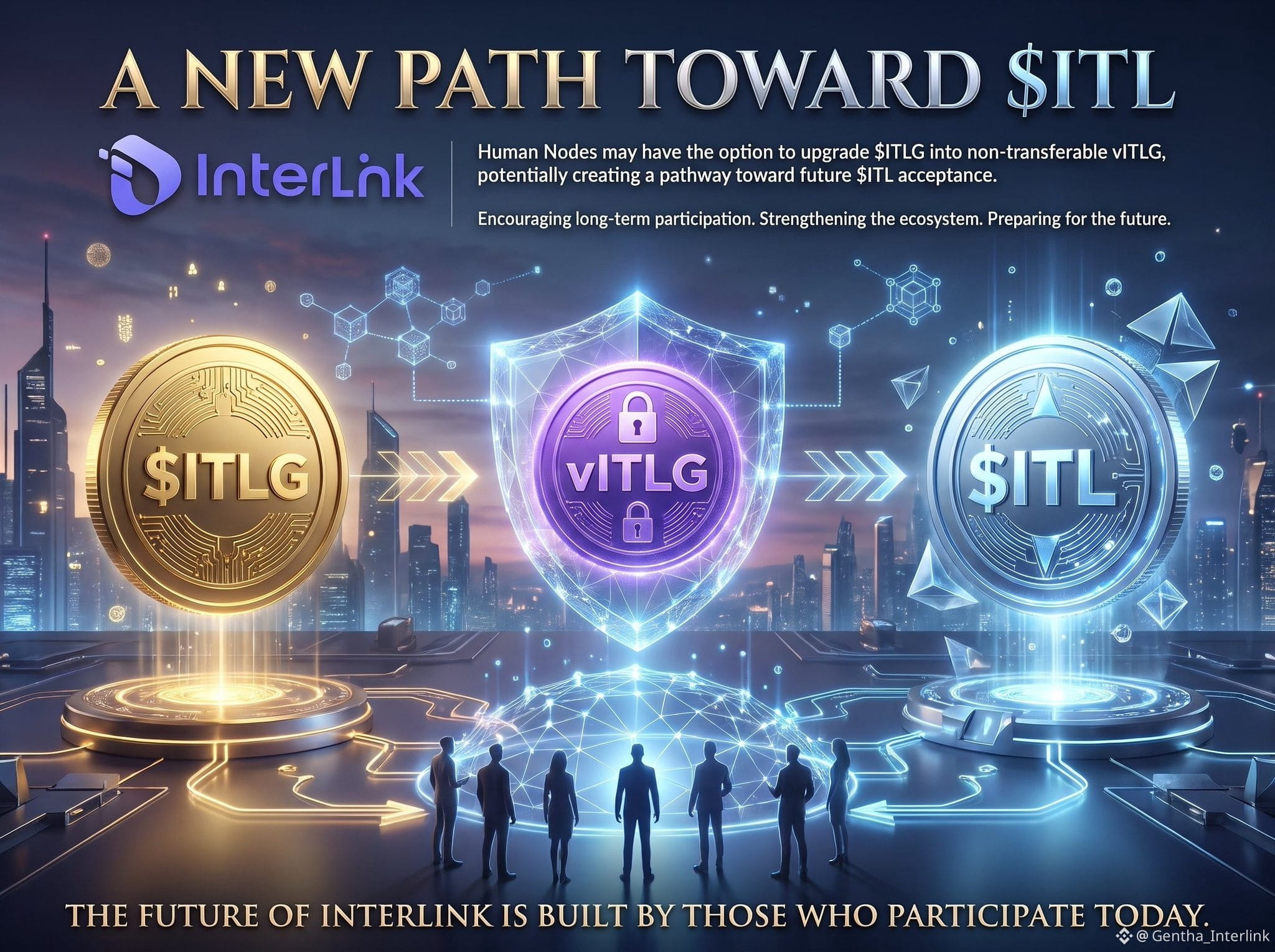
🚀 A NEW PATH TOWARD $ITL.
The InterLink ecosystem continues to evolve, introducing new possibilities for Human Nodes to participate in the future of the network.
One potential development is the option to upgrade $ITLG into vITLG, a non-transferable version of the token designed to reflect a deeper commitment to the ecosystem. This mechanism could potentially establish a pathway toward future $ITL acceptance, connecting participation today with opportunities in the next phase of InterLink.
🔹 $ITLG → vITLG — A potential upgrade mechanism for Human Nodes.
🔹 Non-transferable — Designed to emphasize commitment rather than short-term trading.
🔹 Future $ITL acceptance — Potentially opening new opportunities as the ecosystem evolves.
This concept represents more than a token transformation. It could be a step toward building a stronger foundation of trust, encouraging long-term participation, and aligning the interests of verified humans with the sustainable growth of the InterLink ecosystem.
As InterLink moves closer to its next stage, every mechanism designed to strengthen human participation could play an important role in shaping a more trusted and sustainable digital economy.
The future is not just about holding tokens, but about participating, building trust, and growing together. 🌐
#InterLink #ITLG #ITL
83
Log in to explore more content
Join global crypto users on Binance Square
⚡️ Get latest and useful information about crypto.
💬 Trusted by the world’s largest crypto exchange.
👍 Discover real insights from verified creators.
Email / Phone number
Trending Topics
1
#BTCReboundsAbove$60KAmidWhaleDipBuying
16,364 views
136 Discussing
2
#SolanaSets2027RoadmapToDoubleComputeCapacity
2,988 views
164 Discussing
3
#CaliforniaNvidiaProbeExaminesPotentialCriminalViolations
1,978 views
41 Discussing
4
#BlackRockLaunchesHKDollarDigitalLiquidityFund
4,508 views
159 Discussing
5
#NvidiaLoses$2.7TrillionInMonthAndAHalf
51,060 views
245 Discussing
6
#GlobalStocksFaceLongestLosingStreakSince2023
437,302 views
2,861 Discussing
7
#BlackRockIBITPostsRecord$541MSingleDayOutflow
67,293 views
157 Discussing
8
#AnthropicPlungesTowardIPOPriceonDay2
238,129 views
1,872 Discussing
9
#TwentyOneCapitalAdds172.25BTC
117,433 views
1,242 Discussing
10
#HKBillWouldExcludeTokenizedDepositsFromVirtualAssets
15,306 views
88 Discussing