
#kaiko
kaiko
139,998 views
95 Discussing
Hot
Latest

S&P + KAIKO JUST GAVE CRYPTO A BIGGER WALL STREET STAMP.
S&P Dow Jones Indices and Kaiko have just announced the S&P Kaiko Digital Asset Indices — a set of digital asset indices with a shared brand.
Notable points:
• Combines S&P DJI’s existing crypto indices with Kaiko’s benchmarks and multi-asset indices.
• Covers more than 4,000 reference levels and indices related to digital assets.
• Kaiko handles crypto data infrastructure + market expertise.
• S&P DJI handles licensing, global distribution, and benchmark administration.
• Financial products that currently use Kaiko benchmarks can switch to the S&P Kaiko brand.
But the most important thing isn’t the addition of yet another index set.
This is a sign that crypto is being pulled deeper into benchmarking and TradFi’s financial infrastructure.
From:
Crypto index → Institutional benchmark → Financial products → Wall Street rails.
I think the next step is what’s really worth watching: as these benchmarks see wider adoption, crypto will increasingly look less like a “off-system” market and more like a standardized asset class for institutional capital flows.
Wall Street didn’t ape into crypto.
They just gave it a spreadsheet and called it a benchmark. 💀
Do you think S&P Kaiko could become the standard benchmark for institutional crypto products in the next few years?
#crypto #bitcoin #Kaiko #SPDJI #DigitalAssets
131

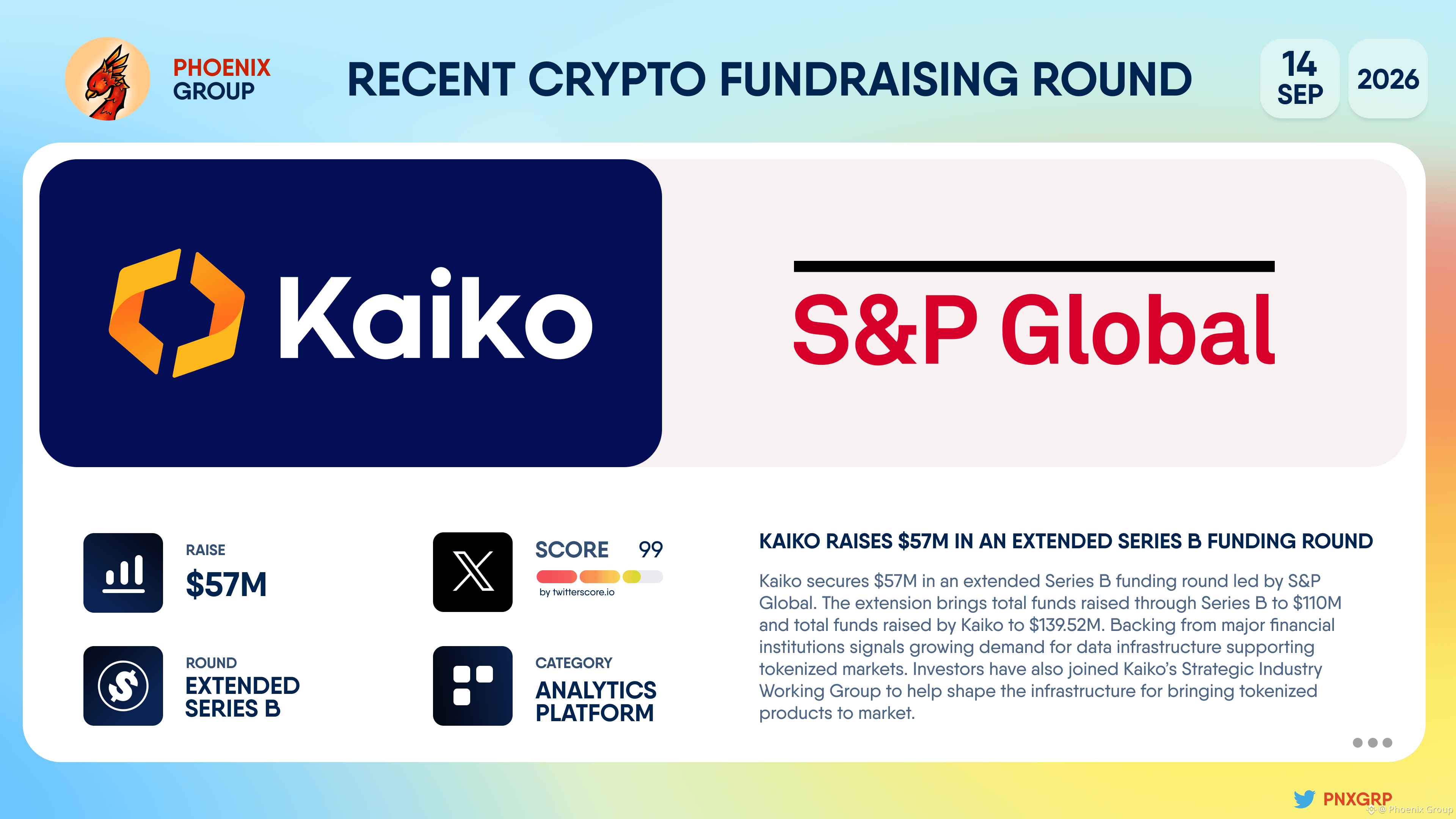
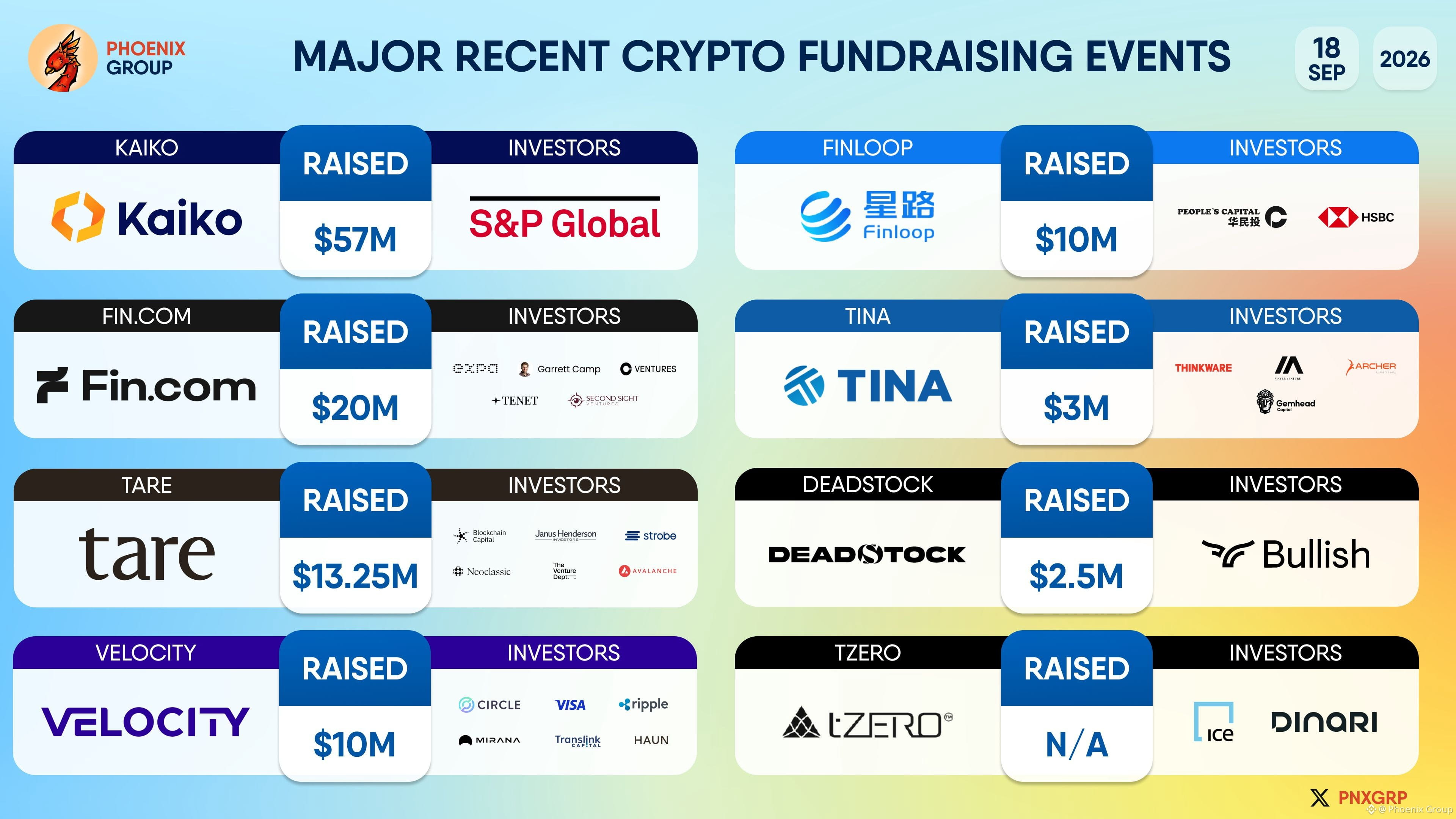
Kaiko raises $57M in an extended Series B funding round
#Kaiko secures $57M in an extended Series B funding round led by S&P Global. The extension brings total funds raised through Series B to $110M and total funds raised by Kaiko to $139.52M. Backing from major financial institutions signals growing demand for data infrastructure supporting tokenized markets. Investors have also joined Kaiko’s Strategic Industry Working Group to help shape the infrastructure for bringing tokenized products to market.
Kaiko is a crypto market data provider offering institutional-grade real-time and historical trading data, order book insights, and aggregated market metrics across more than 100 centralized and decentralized exchanges.
👉 kaiko.com/news/sp-global-leads-strategic-investment-in-kaiko-extending-series-b-to-110-million
118

The world of cryptocurrencies: Kaiko raises $110 million in the week’s biggest funding round according to crypto market data
Kaiko, a provider of cryptocurrency market data, led a week of funding totaling $180.25 million across nine cryptocurrency and blockchain deals, spanning September 12.
Kaiko’s $110 million round was backed by several major financial institutions, making it the most notable increase of the period. The remaining $70.25 million was distributed among eight other deals in the space.
Kaiko supplies institutional-grade market data to trading firms, asset managers, and exchanges. The funding boost indicates that institutional appetite for the infrastructure supporting cryptocurrency markets continues, even amid growing uncertainty in the sector.
Bitcoin’s weekly close above $80,000 is seen as a critical signal for the bullish market
Bitcoin is trading above $81,000 ahead of the weekly close, a level analysts are watching closely as a possible confirmation of the broader uptrend.
According to technical analysts, a sustained weekly close above $80,000 would indicate that the current market structure remains intact despite the significant volatility earlier in the week. If the level is not maintained, sentiment could shift toward a more cautious outlook.
The weekly close carries particular weight in technical analysis because it filters out intraday noise and reflects broader market conviction. In recent sessions, BTC has faced pressure due to macroeconomic uncertainty, making the current price defense especially notable.
#Kaiko #BTC #blockchain #TradingCommunity #TradingSignals $BTC
{web3_wallet_create}(CT_5012MuDS29b6rQb9MydKLMvggST5Yqez3B6gYWitvvjc6ir)
The world of cryptocurrencies: Kaiko raises $110 million in the week’s biggest funding round according to crypto market data
Kaiko, a provider of cryptocurrency market data, led a week of funding totaling $180.25 million across nine cryptocurrency and blockchain deals, spanning September 12.
Kaiko’s $110 million round was backed by several major financial institutions, making it the most notable increase of the period. The remaining $70.25 million was distributed among eight other deals in the space.
Kaiko supplies institutional-grade market data to trading firms, asset managers, and exchanges. The funding boost indicates that institutional appetite for the infrastructure supporting cryptocurrency markets continues, even amid growing uncertainty in the sector.
Bitcoin’s weekly close above $80,000 is seen as a critical signal for the bullish market
Bitcoin is trading above $81,000 ahead of the weekly close, a level analysts are watching closely as a possible confirmation of the broader uptrend.
According to technical analysts, a sustained weekly close above $80,000 would indicate that the current market structure remains intact despite the significant volatility earlier in the week. If the level is not maintained, sentiment could shift toward a more cautious outlook.
The weekly close carries particular weight in technical analysis because it filters out intraday noise and reflects broader market conviction. In recent sessions, BTC has faced pressure due to macroeconomic uncertainty, making the current price defense especially notable.
#Kaiko #BTC #blockchain #TradingCommunity #TradingSignals $BTC

48

·
--
🎯 Has S&P Global moved in to buy crypto data vendors?
📰 Veteran rating giant leads the investment in Kaiko, a crypto data provider, with a $110 million bet—staking on 24/7 market data infrastructure, aiming to plug on-chain data into traditional financial pipelines
💬 Buying data is buying pricing power; that’s more tangible than getting an ETF approval. Whoever controls the market data source gets to call the shots, and traditional giants have already quietly moved in
🏷️ #Kaiko #标普全球 #机构入场 #data infrastructure
22

S&P Global led a Series B funding round for Kaiko, bringing its total capital to 110 million dollars to build data infrastructure for tokenized markets.
#Kaiko #TokenizedMarkets
S&P Global led a Series B funding round for Kaiko, bringing its total capital to 110 million dollars to build data infrastructure for tokenized markets.
#Kaiko #TokenizedMarkets
#Kaiko #TokenizedMarkets
10

·
--
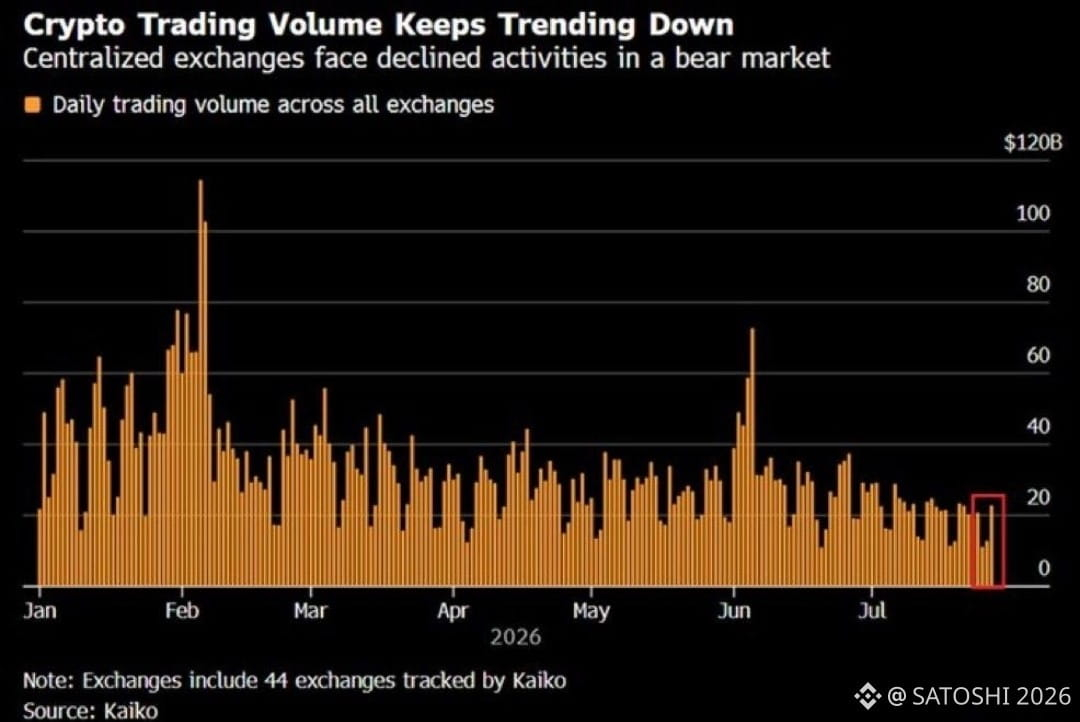
📉 FINAL ACCORD: Trading volumes have fallen, but why is that a plus for bulls? Apathetic sentiment is spreading across the crypto market, and activity on exchanges has dropped to critical levels.
Kaiko and Bloomberg analytics record a strong drying-up of liquidity.
📊 Report figures:
Daily volumes:
Only about $20 billion trades per day — three times less than in January.
Monopolization:
60% of all volumes are controlled by just six leading crypto exchanges.
🧠 What’s the hidden positive: A drop in indicators is a classic sign of the final stage of a bearish trend. The crowd has fully lost hope, and speculators have left the order books.
History proves:
during similar “drying-up,” the bear market heads straight to the finish line.
While the sideways range continues for another couple of months, major players are completing accumulation and preparing a launchpad for a bull run.
Watch the calm: $BTC
{future}(BTCUSDT)
👇 Will the market turn around in autumn, or will the range-bound phase drag on into winter?
👉 Subscribe! We analyze the hidden logic of market cycles online.
#Kaiko #MarketVolumes #BearMarket #CryptoNews #Trading
📉 FINAL ACCORD: Trading volumes have fallen, but why is that a plus for bulls? Apathetic sentiment is spreading across the crypto market, and activity on exchanges has dropped to critical levels.
Kaiko and Bloomberg analytics record a strong drying-up of liquidity.
📊 Report figures:
Daily volumes:
Only about $20 billion trades per day — three times less than in January.
Monopolization:
60% of all volumes are controlled by just six leading crypto exchanges.
🧠 What’s the hidden positive: A drop in indicators is a classic sign of the final stage of a bearish trend. The crowd has fully lost hope, and speculators have left the order books.
History proves:
during similar “drying-up,” the bear market heads straight to the finish line.
While the sideways range continues for another couple of months, major players are completing accumulation and preparing a launchpad for a bull run.
Watch the calm: $BTC
👇 Will the market turn around in autumn, or will the range-bound phase drag on into winter?
👉 Subscribe! We analyze the hidden logic of market cycles online.
#Kaiko #MarketVolumes #BearMarket #CryptoNews #Trading

1
227

·
--
Kaiko's latest round of fundraising expands total amount to $110 million, led by S&P Global with participation from Coinbase Ventures and others.
#Kaiko #SPGlobal #CoinbaseVentures #CryptoFunding
Kaiko's latest round of fundraising expands total amount to $110 million, led by S&P Global with participation from Coinbase Ventures and others.
#Kaiko #SPGlobal #CoinbaseVentures #CryptoFunding
#Kaiko #SPGlobal #CoinbaseVentures #CryptoFunding
46
Article
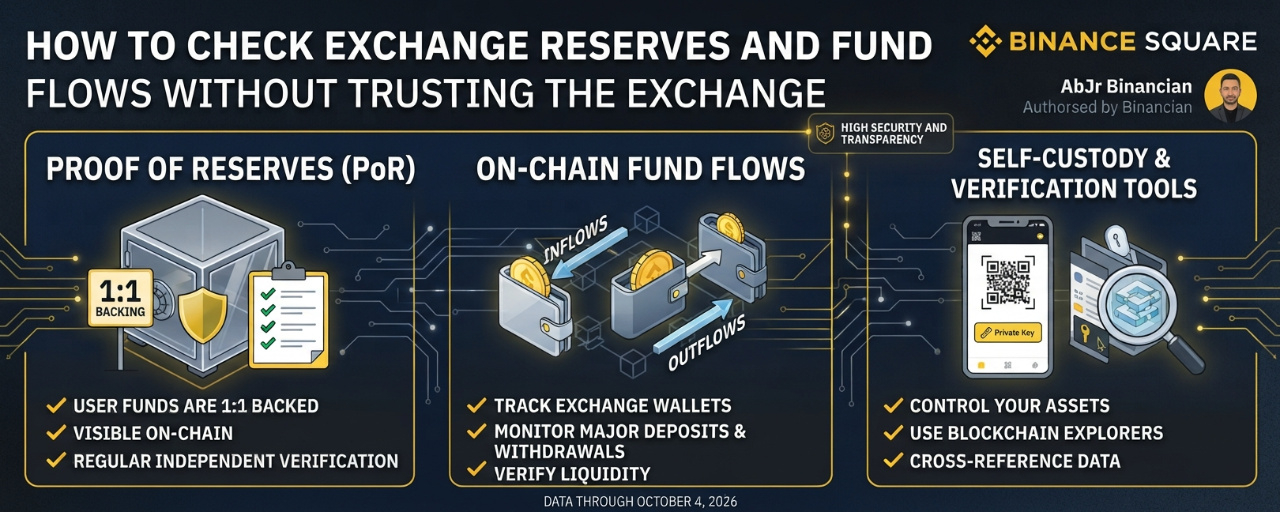
How to Check Exchange Reserves and Fund Flows Without Trusting the ExchangeIf you want to understand an exchange, don't rely on just one source of information.
Cryptocurrency exchanges publish information about their reserves, trading activity and platform performance.
But investors do not have to depend entirely on exchange announcements to understand what is happening.
Independent blockchain analytics providers, market-data platforms and research organizations offer tools that can help users examine exchange activity from different perspectives. The objective is not to find one perfect dashboard.
It is to combine independent sources and understand what each one actually measures.
Here are three useful platforms to start with.
1. CryptoQuant: Track Exchange Reserves and Netflows
<text color="secondary" size="xs">Platform: On-chain analytics</text>
CryptoQuant provides on-chain data and market indicators that help users examine cryptocurrency movements.
Two particularly useful metrics are:
Exchange Reserves
This indicator estimates the amount of cryptocurrency held in wallets attributed to exchanges.
Investors can monitor changes over time to identify whether estimated exchange-held balances are increasing or decreasing.
Exchange Netflows
Netflows help identify the difference between cryptocurrency entering and leaving exchange wallets.
This can provide useful context when evaluating market movements.
For example, a period of substantial outflows may indicate that assets are leaving exchange-associated wallets.
However, this does not automatically prove that investors are accumulating.
Transfers between exchanges, wallet reorganizations and changes in custody arrangements can also influence the figures.
How to use it:
Visit CryptoQuant.Select the cryptocurrency you want to analyze.Open the relevant exchange reserve or netflow chart.Select the exchange and time period where available.Compare the movement with price, trading volume and other market indicators.
2. Kaiko: Understand Liquidity Beyond Trading Volume
<text color="secondary" size="xs">Platform: Institutional market data</text>
Trading volume is one of the most commonly reported exchange metrics. But it does not tell the entire story.
Kaiko provides market-quality data that can help investors examine how efficiently assets can be traded.
Three indicators are particularly important.
Order-book depth
Shows how much buying and selling interest is available around the current market price.
Greater depth can help larger orders execute without significantly moving the market.
Bid-ask spread
Shows the difference between the best available buy and sell prices.
A smaller spread generally indicates better immediate trading conditions.
Slippage
Measures how much the execution price differs from the expected price.
This is especially important for larger trades and during periods of volatility.
How to use it:
Visit Kaiko's market-data resources.Select the asset and trading pair.Examine available market-depth and spread information.Compare equivalent trading pairs across exchanges.Review the same time periods to avoid misleading comparisons.
3. The Block: Monitor Derivatives and Market Structure
<text color="secondary" size="xs">Platform: Cryptocurrency research and data</text>
The Block provides cryptocurrency research, market statistics and derivatives-related data.
This can help investors understand market activity beyond spot trading.
Useful indicators include:
Futures trading volume
Shows the reported value of derivatives contracts traded during a given period.
Open interest
Measures the outstanding value of derivatives contracts that remain open.
Exchange market share
Provides context on how trading activity is distributed across different market participants and platforms, subject to the methodology and coverage of the data.
These metrics can help investors understand whether market activity is concentrated in spot markets or derivatives.
However, rising derivatives volume or open interest does not automatically indicate positive or negative market sentiment.
4. How to Combine These Three Sources
Each platform answers a different question.
The most useful approach is to examine the same asset, exchange and time period wherever possible.
For example, imagine an exchange reports a significant increase in trading activity.
Instead of immediately interpreting this as growing market confidence, examine:
Whether exchange reserves are increasing or decreasing.Whether the movement is accompanied by meaningful netflows.Whether order-book depth is improving.Whether bid-ask spreads remain competitive.Whether derivatives open interest is expanding.
This creates a more complete picture of market conditions.
5. Important Limitations to Remember
Independent data is valuable, but it is not automatically perfect.
Analytics providers use different methodologies, wallet-attribution systems and data coverage.
Some exchange wallets may not be identified correctly, while internal transfers can create movements that do not represent customer deposits or withdrawals.
Market-data coverage can also differ between providers.
Most importantly, on-chain reserves do not independently establish an exchange's complete financial position or prove that all customer liabilities are covered.
For that, users should also examine official Proof of Reserves reports, liability methodologies and available independent assurance.
Final Thoughts: Verify From More Than One Direction
Understanding an exchange requires more than reading its announcements or looking at a single reserve chart.
CryptoQuant helps examine on-chain reserves and fund movements.
Kaiko provides tools to evaluate market quality and liquidity.
The Block offers additional visibility into derivatives and market structure.
Together, these sources provide a broader analytical framework for understanding cryptocurrency exchanges.
The goal isn't to trust one dashboard more than another. It's to build your own conclusion from evidence that can be independently examined.
#Binance #CryptoQuant #Kaiko #TheBlock #ExchangeTransparency
How to Check Exchange Reserves and Fund Flows Without Trusting the Exchange
If you want to understand an exchange, don't rely on just one source of information.
Cryptocurrency exchanges publish information about their reserves, trading activity and platform performance.
But investors do not have to depend entirely on exchange announcements to understand what is happening.
Independent blockchain analytics providers, market-data platforms and research organizations offer tools that can help users examine exchange activity from different perspectives. The objective is not to find one perfect dashboard.
It is to combine independent sources and understand what each one actually measures.
Here are three useful platforms to start with.
1. CryptoQuant: Track Exchange Reserves and Netflows
<text color="secondary" size="xs">Platform: On-chain analytics</text>
CryptoQuant provides on-chain data and market indicators that help users examine cryptocurrency movements.
Two particularly useful metrics are:
Exchange Reserves
This indicator estimates the amount of cryptocurrency held in wallets attributed to exchanges.
Investors can monitor changes over time to identify whether estimated exchange-held balances are increasing or decreasing.
Exchange Netflows
Netflows help identify the difference between cryptocurrency entering and leaving exchange wallets.
This can provide useful context when evaluating market movements.
For example, a period of substantial outflows may indicate that assets are leaving exchange-associated wallets.
However, this does not automatically prove that investors are accumulating.
Transfers between exchanges, wallet reorganizations and changes in custody arrangements can also influence the figures.
How to use it:
Visit CryptoQuant.Select the cryptocurrency you want to analyze.Open the relevant exchange reserve or netflow chart.Select the exchange and time period where available.Compare the movement with price, trading volume and other market indicators.
2. Kaiko: Understand Liquidity Beyond Trading Volume
<text color="secondary" size="xs">Platform: Institutional market data</text>
Trading volume is one of the most commonly reported exchange metrics. But it does not tell the entire story.
Kaiko provides market-quality data that can help investors examine how efficiently assets can be traded.
Three indicators are particularly important.
Order-book depth
Shows how much buying and selling interest is available around the current market price.
Greater depth can help larger orders execute without significantly moving the market.
Bid-ask spread
Shows the difference between the best available buy and sell prices.
A smaller spread generally indicates better immediate trading conditions.
Slippage
Measures how much the execution price differs from the expected price.
This is especially important for larger trades and during periods of volatility.
How to use it:
Visit Kaiko's market-data resources.Select the asset and trading pair.Examine available market-depth and spread information.Compare equivalent trading pairs across exchanges.Review the same time periods to avoid misleading comparisons.
3. The Block: Monitor Derivatives and Market Structure
<text color="secondary" size="xs">Platform: Cryptocurrency research and data</text>
The Block provides cryptocurrency research, market statistics and derivatives-related data.
This can help investors understand market activity beyond spot trading.
Useful indicators include:
Futures trading volume
Shows the reported value of derivatives contracts traded during a given period.
Open interest
Measures the outstanding value of derivatives contracts that remain open.
Exchange market share
Provides context on how trading activity is distributed across different market participants and platforms, subject to the methodology and coverage of the data.
These metrics can help investors understand whether market activity is concentrated in spot markets or derivatives.
However, rising derivatives volume or open interest does not automatically indicate positive or negative market sentiment.
4. How to Combine These Three Sources
Each platform answers a different question.
The most useful approach is to examine the same asset, exchange and time period wherever possible.
For example, imagine an exchange reports a significant increase in trading activity.
Instead of immediately interpreting this as growing market confidence, examine:
Whether exchange reserves are increasing or decreasing.Whether the movement is accompanied by meaningful netflows.Whether order-book depth is improving.Whether bid-ask spreads remain competitive.Whether derivatives open interest is expanding.
This creates a more complete picture of market conditions.
5. Important Limitations to Remember
Independent data is valuable, but it is not automatically perfect.
Analytics providers use different methodologies, wallet-attribution systems and data coverage.
Some exchange wallets may not be identified correctly, while internal transfers can create movements that do not represent customer deposits or withdrawals.
Market-data coverage can also differ between providers.
Most importantly, on-chain reserves do not independently establish an exchange's complete financial position or prove that all customer liabilities are covered.
For that, users should also examine official Proof of Reserves reports, liability methodologies and available independent assurance.
Final Thoughts: Verify From More Than One Direction
Understanding an exchange requires more than reading its announcements or looking at a single reserve chart.
CryptoQuant helps examine on-chain reserves and fund movements.
Kaiko provides tools to evaluate market quality and liquidity.
The Block offers additional visibility into derivatives and market structure.
Together, these sources provide a broader analytical framework for understanding cryptocurrency exchanges.
The goal isn't to trust one dashboard more than another. It's to build your own conclusion from evidence that can be independently examined.
#Binance #CryptoQuant #Kaiko #TheBlock #ExchangeTransparency
63

·
--
In Europe, the euro is now traded more against $USDC than against $USDT.
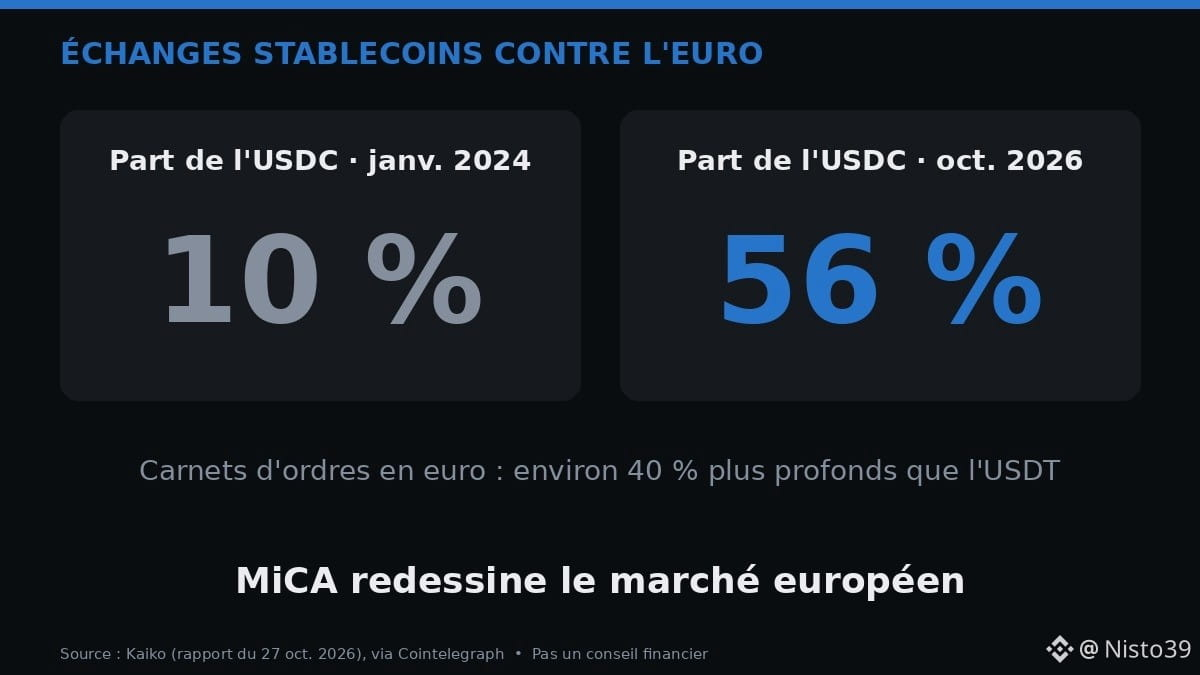
According to a Kaiko report published on October 27, USDC (Circle) accounts for 56% of euro-denominated stablecoin trading, up from just 10% in January 2024. Its euro order books are also around 40% deeper than those for USDT.
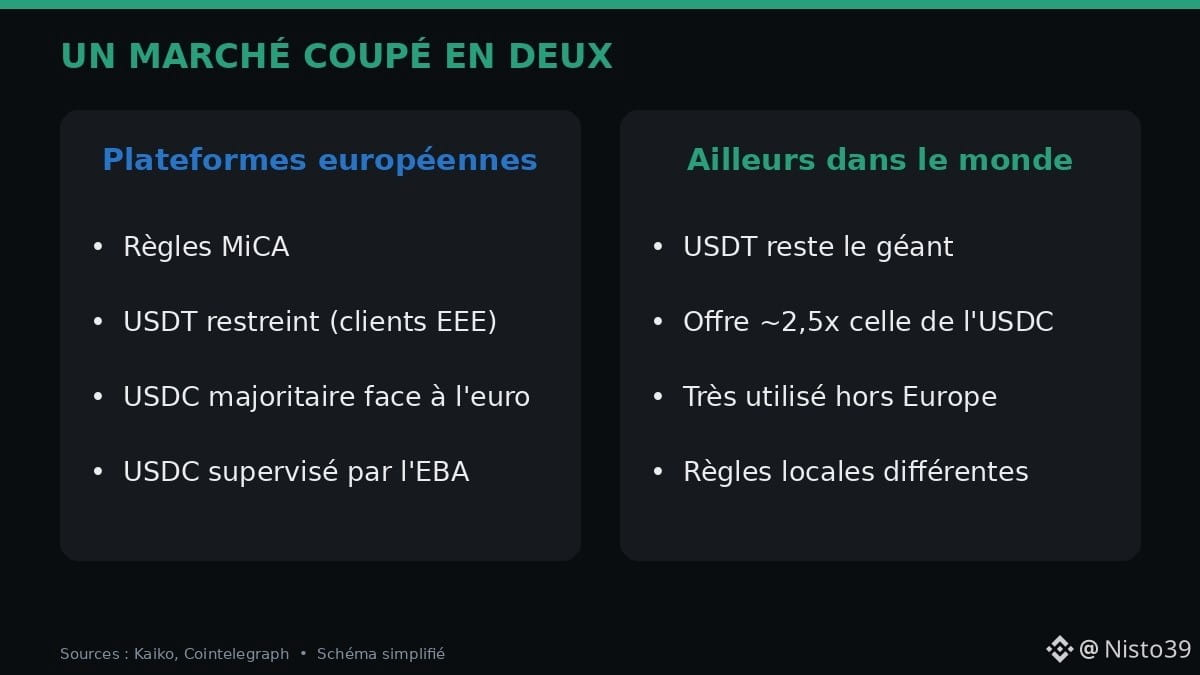
Why? MiCA, the European regulation on crypto assets. Major platforms have restricted USDT for their clients in the European Economic Area, and trading volume has shifted to the option considered compliant. In mid-October, the European Banking Authority also classified USDC as the first “significant” e-money token, placing it under its direct supervision.
An important caveat: globally, USDT remains the giant. Its circulating supply is around 2.5 times that of USDC. This isn’t the end of Tether; it’s a market splitting in two according to local rules.
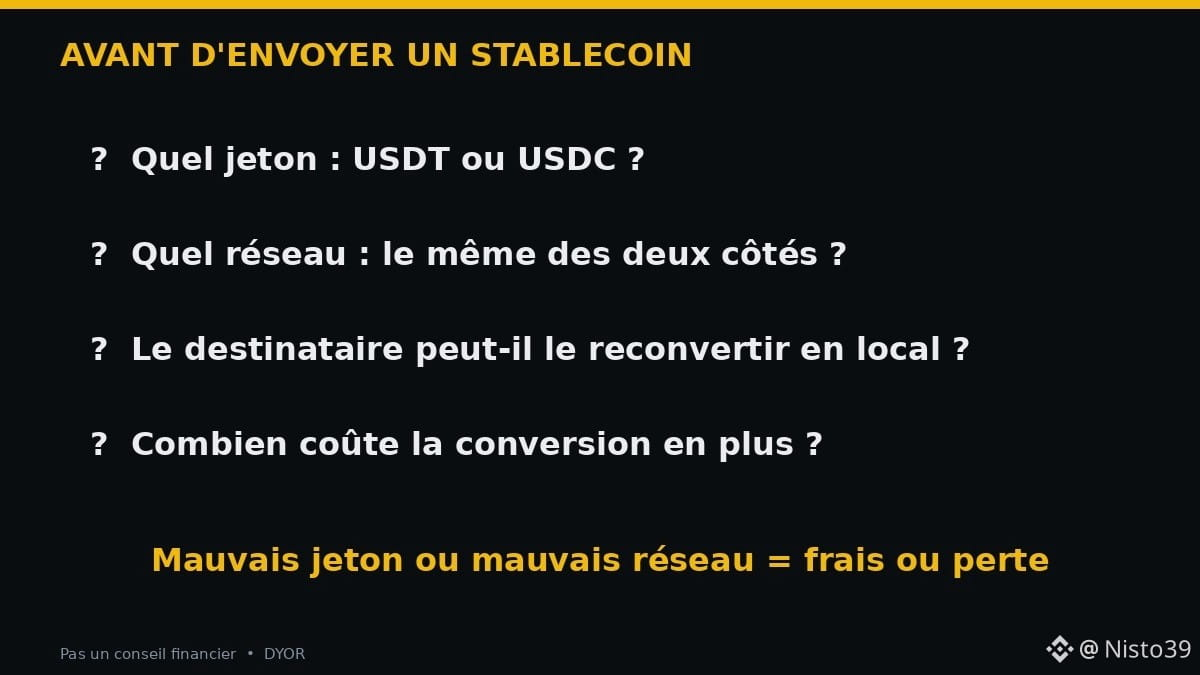
What this means for us: Oumar (a fictional character) sells car parts in Dakar. His cousin in Lyon sometimes sends him money by converting euros into a stablecoin. Yesterday, his cousin would buy USDT. Today, his European platform mostly offers him USDC. If Oumar only receives USDT on his end, an extra conversion is needed, which means extra fees.
Glossary:
• Stablecoin: a crypto token designed to be worth 1 dollar.
• Deep order book: lots of buy and sell offers, so the price moves less when you trade.
Caution: a stablecoin is not a bank account; it depends on its issuer and reserves. Always check the network and token before sending. Not financial advice.
And you, in your family, do you mostly use USDT or USDC for transfers?
#Stablecoins #MiCA #USDC #CryptoAfrique #Kaiko
81
205

·
--

Article
BREAKING: Kaiko Secures $110M Series B, S&P Global Joins the PartyKAIKO, the crypto market data powerhouse, just obliterated its funding ceiling, raising a staggering $110 million in a Series B round that now includes S&P Global, BNP Paribas, and other heavyweight banks. This move signals a historic shift: institutional giants are finally pouring capital into crypto data infrastructure, and nobody saw this coming.
The proof is crystal clear: S&P Global, a titan of financial ratings, joined the funding alongside top traditional banks and exchange operators. Kaiko’s expansion into continuous market data services is now backed by the same institutions that once viewed crypto as a fringe asset. #CryptoData #InstitutionalAdoption #Kaiko
The stakes? This infusion of capital will turbocharge Kaiko’s ability to deliver real‑time, high‑frequency market data to exchanges, hedge funds, and algorithmic traders. With institutional money on board, the entire crypto market is poised for a liquidity surge, tighter spreads, and a new era of transparency. #MarketImpact #DataRevolution
If you’re looking to ride the wave of institutional crypto adoption, now’s the time to get in. Don’t let this flood of capital pass you by—join the movement and stay ahead of the curve. What’s your next move?
BREAKING: Kaiko Secures $110M Series B, S&P Global Joins the Party
KAIKO, the crypto market data powerhouse, just obliterated its funding ceiling, raising a staggering $110 million in a Series B round that now includes S&P Global, BNP Paribas, and other heavyweight banks. This move signals a historic shift: institutional giants are finally pouring capital into crypto data infrastructure, and nobody saw this coming.
The proof is crystal clear: S&P Global, a titan of financial ratings, joined the funding alongside top traditional banks and exchange operators. Kaiko’s expansion into continuous market data services is now backed by the same institutions that once viewed crypto as a fringe asset. #CryptoData #InstitutionalAdoption #Kaiko
The stakes? This infusion of capital will turbocharge Kaiko’s ability to deliver real‑time, high‑frequency market data to exchanges, hedge funds, and algorithmic traders. With institutional money on board, the entire crypto market is poised for a liquidity surge, tighter spreads, and a new era of transparency. #MarketImpact #DataRevolution
If you’re looking to ride the wave of institutional crypto adoption, now’s the time to get in. Don’t let this flood of capital pass you by—join the movement and stay ahead of the curve. What’s your next move?
10

Article
90% of traders lose money when trading futures - And 8 ways to fix it to win.8 Deadly Mistakes When Trading Futures in Crypto – And How to Avoid Them Like a Pro Trader.
Trading futures in the cryptocurrency market can yield huge profits in a short time. But the high leverage and strong volatility also make this field a “death playground” for inexperienced traders, those lacking discipline, or simply those driven by emotions.
90% of traders lose money when trading futures - And 8 ways to fix it to win.
8 Deadly Mistakes When Trading Futures in Crypto – And How to Avoid Them Like a Pro Trader.
Trading futures in the cryptocurrency market can yield huge profits in a short time. But the high leverage and strong volatility also make this field a “death playground” for inexperienced traders, those lacking discipline, or simply those driven by emotions.
Trading futures in the cryptocurrency market can yield huge profits in a short time. But the high leverage and strong volatility also make this field a “death playground” for inexperienced traders, those lacking discipline, or simply those driven by emotions.
15
28.5k
Log in to explore more content
Join global crypto users on Binance Square
⚡️ Get latest and useful information about crypto.
💬 Trusted by the world’s largest crypto exchange.
👍 Discover real insights from verified creators.
Email / Phone number
Trending Topics
1
#WillMarketsStageAThanksgivingReliefRally?
17,098 views
358 Discussing
2
#BessentSoftensStanceOnHuang’sNvidiaReturn
12,153 views
228 Discussing
3
#EvolveAtBinanceBlockchainWeek
974 views
64 Discussing
4
#MuskWarnsOfAICashCrunch
11,826 views
188 Discussing
5
#KOSPITriggersSellSideSidecarForSecondStraightSession
0 views
0 Discussing
6
#SouthKoreaToTightenOversightOfCryptoTransfersAbroad
610 views
13 Discussing
7
#RussiaAllowsExchangesToOfferCryptoTrading
4,585 views
97 Discussing
8
#UKToBarCryptoExchangesFromMakingMarketsOnTheirOwnPlatforms
328 views
13 Discussing
9
#UKTreasurySignsCryptoMarketMakingExemptionRules
2,350 views
89 Discussing
10
#BTCReboundsAbove$60KAmidWhaleDipBuying
126,679 views
440 Discussing