
#mev
mev
180,385 views
519 Discussing
Hot
Latest

The recent acquittal in a high-stakes $25M Ethereum MEV case highlights a fascinating gray area at the intersection of blockchain mechanics and criminal law. Validators and institutional products like staked ETH yield streams face unprecedented legal scrutiny as regulators grapple with priority gas fees. While the verdict offers short-term relief, it fundamentally questions how decentralized sequencing models fit into traditional legal frameworks. The debate around blockchain revenue sharing is only just beginning. $ETH #Ethereum #MEV #CryptoRegulation
The recent acquittal in a high-stakes $25M Ethereum MEV case highlights a fascinating gray area at the intersection of blockchain mechanics and criminal law. Validators and institutional products like staked ETH yield streams face unprecedented legal scrutiny as regulators grapple with priority gas fees. While the verdict offers short-term relief, it fundamentally questions how decentralized sequencing models fit into traditional legal frameworks. The debate around blockchain revenue sharing is only just beginning. $ETH #Ethereum #MEV #CryptoRegulation
13

·
--
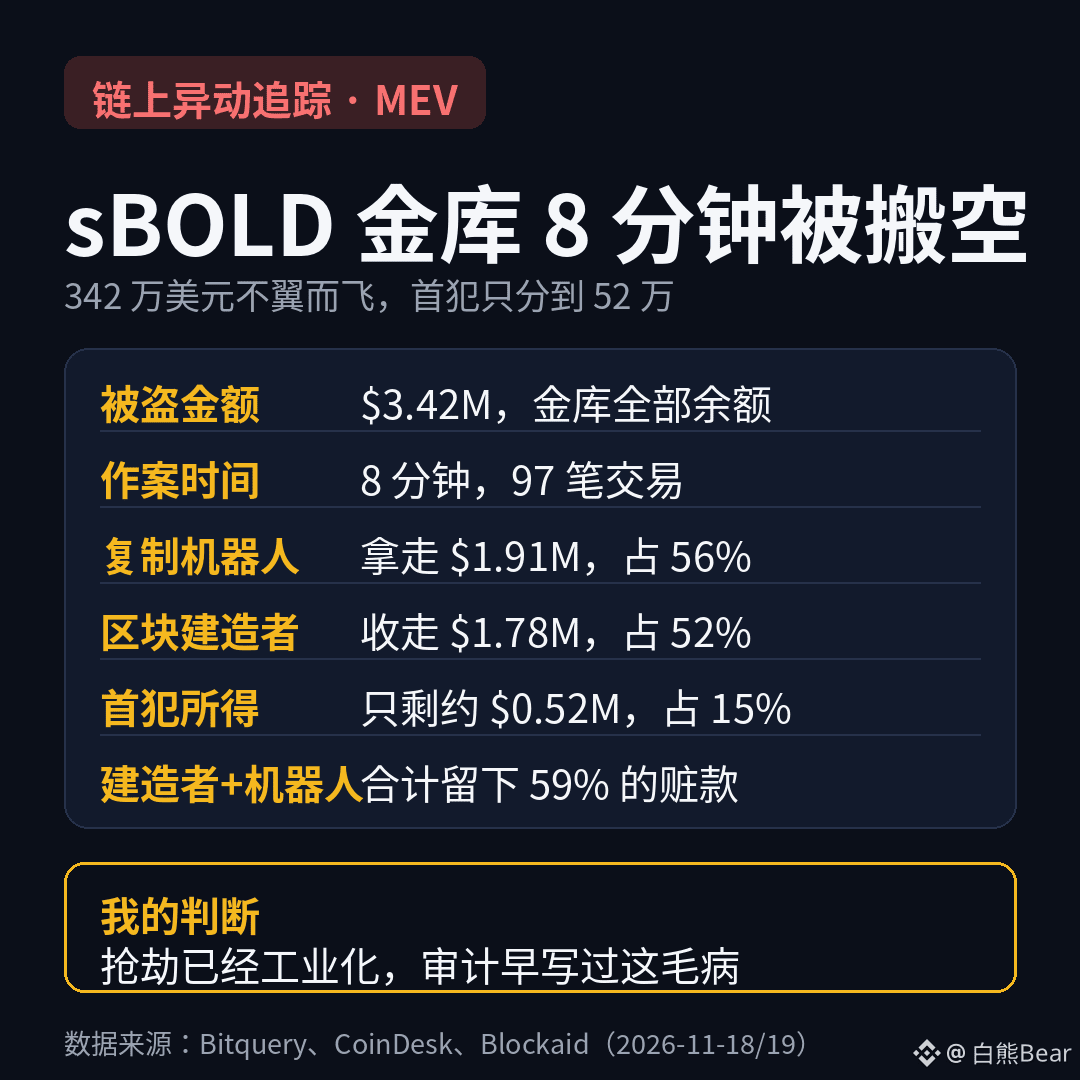
A vault was drained of $3.42 million in 8 minutes. The people who pulled it off only got $520,000—the rest went to frontrunning bots and block builders.
At midday on November 18, K3 Capital’s sBOLD vault was emptied between 12:25 and 12:33. In 97 transactions, all $3.42 million in the vault was gone. sBOLD is a product that earns interest on deposited BOLD stablecoins. The vulnerability was in the formula it used to calculate share prices: deposited wstETH wasn’t counted. The attacker flash-borrowed 10,000 wstETH from Morpho, minted about 9 million BOLD, then repeatedly deposited, swapped, and redeemed, cashing out other people’s BOLD. K3 didn’t announce that it was pausing the contract until 13:08. By then, the money was long gone.
The wildest part was how the proceeds were split. The wallet that first put the attack onchain got only about $520,000, then promptly routed it through THORChain and Maya and converted it to Bitcoin. An MEV bot that caught wind of the attack copied the whole exploit and swept up $1.91 million in 57 transactions—56% of the total. To get priority in transaction ordering, the bot paid Ethereum block builders $1.78 million in fees. The fee to jump the queue in a single block briefly reached 44 ETH. The builders and the bot’s receiving wallets kept 59% of the money between them.
To me, the most striking thing isn’t the $3.42 million figure. It’s that onchain robbery has become industrialized: within seconds of the attack code going onchain, six wallets, bots, and builders were all there to take their cut, while the original attacker got the least. Even more painful, ChainSecurity had already flagged a high-severity accounting issue in its May 2025 audit—the same kind of flaw, where collateral was omitted from share pricing. The audit report said it, but the vulnerability remained untouched until someone drained the vault. BOLD itself and Liquity were fine; the problem was in K3’s own wrapper. But users deposited into sBOLD, and those who can’t tell the difference between these layers are the ones who ultimately pay. Also, the builders collected $1.78 million in fees, but Bitquery says there’s no evidence they knew they were including attack transactions in their blocks. The MEV system doesn’t distinguish right from wrong: whoever pays more gets in first. That’s the hardest part to stomach.
Three things to watch next: K3 still hasn’t announced a compensation plan. For a small vault, $3.42 million is a total loss, so anyone who deposited into sBOLD should check how much of their position is left. Any yield-bearing vault that calculates its own share price should revisit the high-severity findings in its audit report. And on the same day, the Gonka bridge lost $1.05 million and Reental about $950,000. All three incidents add up to roughly $5.4 million, suggesting someone is sweeping through these kinds of vaults at scale.
Do you think block builders who collected $1.78 million in priority fees were accomplices to this robbery? Or is “pay us and we’ll do it” simply how things work onchain?
$BTC $ETH
#MEV #DeFi安全
5




·
--
🚨 BlackRock’s staked Ether ETF now captures a portion of Ethereum’s MEV fees, but the recent legal acquittal leaves the regulatory status of this income stream unresolved. This intersection of traditional finance and on-chain priority fees signals shifting dynamics for ETH utility.
Market Implication: Increased institutional exposure may bolster ETH’s long-term narrative, though regulatory clarity remains a key catalyst.
💡 Question: Will this ETF approval accelerate ETH adoption or invite stricter MEV regulations? #Ethereum #MEV
$ETH #TradingSignal #CryptoAnalysis
Market Implication: Increased institutional exposure may bolster ETH’s long-term narrative, though regulatory clarity remains a key catalyst.
💡 Question: Will this ETF approval accelerate ETH adoption or invite stricter MEV regulations? #Ethereum #MEV
$ETH #TradingSignal #CryptoAnalysis

23

·
--
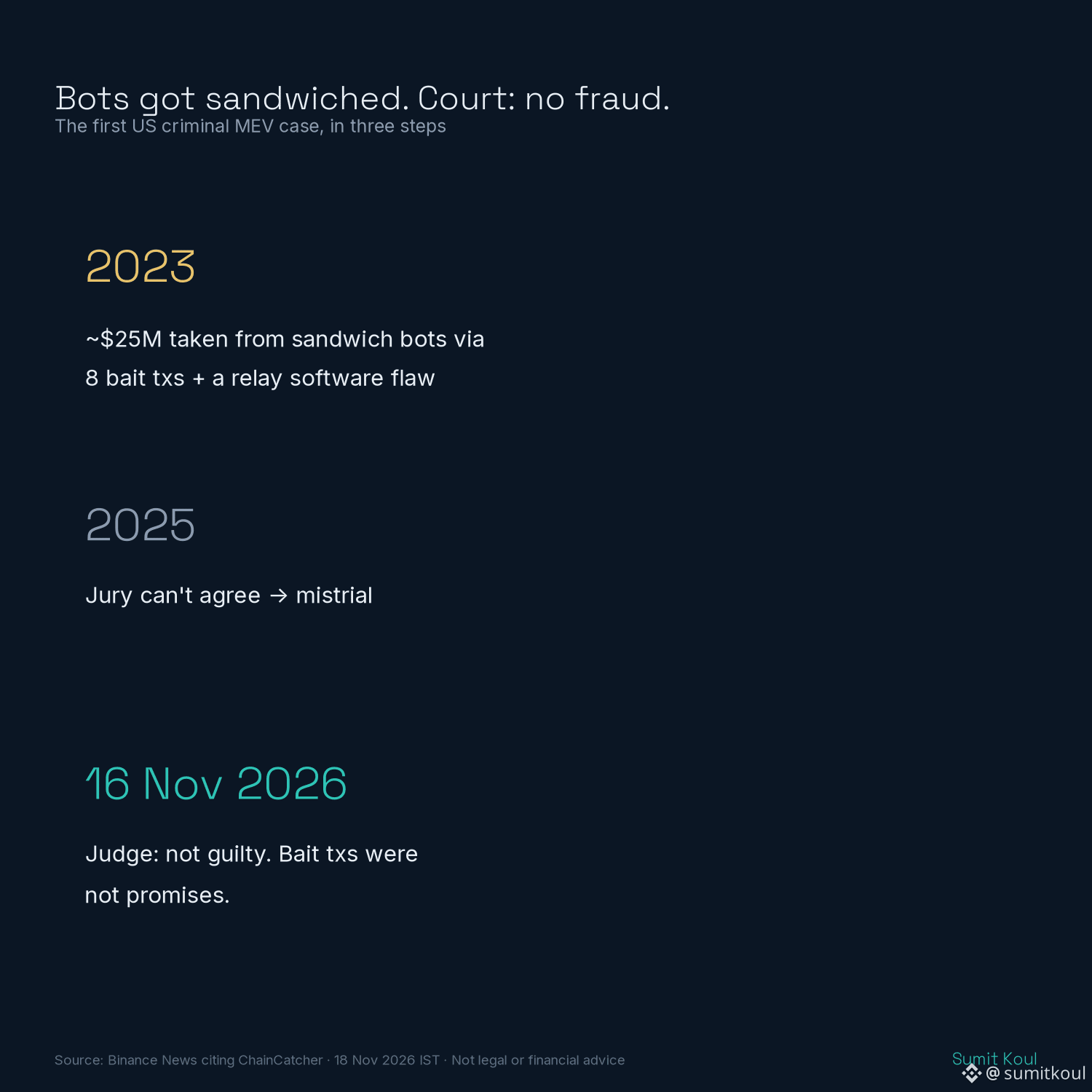
A US judge just ruled that tricking trading bots on Ethereum wasn't fraud.
The first criminal MEV case is over:
• ~$25M taken from sandwich bots in 2023, using 8 bait transactions and a relay software flaw
• 2025: jury couldn't agree, mistrial
• 16 Nov: not guilty. The judge said the bait transactions "were not promises"
Her description of Ethereum: "a trustless, highly adversarial environment with no terms of use."
If you swap on-chain, that line matters more than the verdict. I wrote up what it means for your slippage settings and trade routing:
https://www.binance.com/en/square/post/389501737587141
Not financial or legal advice.
#MEV #DeFi #Ethereum
1
36
The recent legal dismissal regarding Ethereum MEV trading bots highlights a fascinating gray area in blockchain architecture. Because protocols operate on transparent code rather than traditional terms of use, prosecuting decentralized arbitrage becomes legally complex. This ruling sets a major precedent for how courts view automated strategies on-chain, proving that decentralized networks operate under a vastly different rulebook than traditional finance. $ETH #Ethereum #CryptoLaw #MEV
The recent legal dismissal regarding Ethereum MEV trading bots highlights a fascinating gray area in blockchain architecture. Because protocols operate on transparent code rather than traditional terms of use, prosecuting decentralized arbitrage becomes legally complex. This ruling sets a major precedent for how courts view automated strategies on-chain, proving that decentralized networks operate under a vastly different rulebook than traditional finance. $ETH #Ethereum #CryptoLaw #MEV
2

·
--
🚨 $ETH TOTAL SHOCK: A VAULT DRAINED IN 8 MINUTES
The sBOLD vault at K3 Capital was hacked, and $3.4 million was taken in just 8 minutes, across 97 consecutive transactions. To me, the craziest part isn’t the theft—it’s who walked away with most of the loot.
Look at the detail nobody is noticing:
→ Ethereum block builders took $1.78 million — more than half the amount stolen — in MEV payments from bots competing to process the exploit; a single block collected 44 ETH.
→ One bot copied the attack and made off with $1.91 million, 56% of the total, while the original hacker got only about $520,000.
→ The attackers inflated the vault’s share value by depositing WETH that wasn’t recorded in the accounting and redeeming it for BOLD; a ChainSecurity audit in May 2025 had already warned about this risk.
Would you still put your savings in a DeFi vault after this, yes or no? 👇
$ETH $BOLD $WETH
#HackDeFi #MEV #VaultHack

2
1.4k

·
--
US judge: Making $25 million from Ethereum bots in 12 seconds was NOT fraud.
The facts: Judge Jessica Clarke (Manhattan) granted a motion for acquittal on Nov. 16 for Anton & James Peraire-Bueno — all charges of wire fraud, conspiracy, and money laundering were dismissed (CoinDesk, Nov. 18; Decrypt, Nov. 17). In a 46-page opinion, the judge found that prosecutors had failed to prove the “material misrepresentation” required under wire fraud law. The “Omakase” scheme in April 2023: bait transactions lured sandwich bots, then a MEV-Boost relay vulnerability was used to peek at block contents before commit and reorder transactions — the bots lost about $25 million in a single block, in about 12 seconds. The first trial in Nov. 2025 ended in a mistrial after the jury deadlocked. The judge’s most-quoted line: Ethereum is a “trustless, highly adversarial environment with no terms of use.” Flashbots patched the vulnerability within 24 hours; a wallet containing $3 million in proceeds was frozen.
My take: this is the first legal precedent on MEV — and the message to DeFi is blunt: code, not courts, is what protects your money. Improper conduct isn’t necessarily criminal if the elements of fraud aren’t proven. For users, audits and protocol design matter far more than hoping perpetrators will be punished afterward.
What I’m watching: whether prosecutors appeal, and whether this ruling becomes a reference point in future DeFi disputes. ETH is still around $1,779 tonight, BTC around $63,129 — the market has barely reacted.
What do you think: does this ruling make DeFi freer, or more dangerous for everyday users?
This is my analysis, not financial advice — always DYOR.
#Ethereum #MEV $ETH
22

·
--
The biggest thing to chew on these past couple of days isn’t the price of crypto—it’s that acquittal. The first criminal MEV case in the U.S. is over: two MIT brothers took nearly $25 million from sandwich bots in about 12 seconds. Last year, the jury deadlocked and the case ended in a mistrial; this time, the judge acquitted them outright. The reasoning stings: Ethereum has no user agreement, and wire fraud requires someone to be deceived by a false statement—yet on-chain, there’s no “I have read and agree” button. I wouldn’t read this as “MEV is legal now.” The judge only said criminal fraud wasn’t the way to pursue it; civil lawsuits and other regulatory tools are still on the table. The people who should really be sweating are those building staking yields into their products. BlackRock had already listed this case as a risk for its staked-ether ETF, and that bomb is still ticking. Until the rules are written into the code, the chain is the Wild West: you think you’re trading, but you’re actually running around naked. #MEV #以太坊 #加密监管 $ETH $EIGEN
The biggest thing to chew on these past couple of days isn’t the price of crypto—it’s that acquittal. The first criminal MEV case in the U.S. is over: two MIT brothers took nearly $25 million from sandwich bots in about 12 seconds. Last year, the jury deadlocked and the case ended in a mistrial; this time, the judge acquitted them outright. The reasoning stings: Ethereum has no user agreement, and wire fraud requires someone to be deceived by a false statement—yet on-chain, there’s no “I have read and agree” button. I wouldn’t read this as “MEV is legal now.” The judge only said criminal fraud wasn’t the way to pursue it; civil lawsuits and other regulatory tools are still on the table. The people who should really be sweating are those building staking yields into their products. BlackRock had already listed this case as a risk for its staked-ether ETF, and that bomb is still ticking. Until the rules are written into the code, the chain is the Wild West: you think you’re trading, but you’re actually running around naked. #MEV #以太坊 #加密监管 $ETH $EIGEN
17

·
--
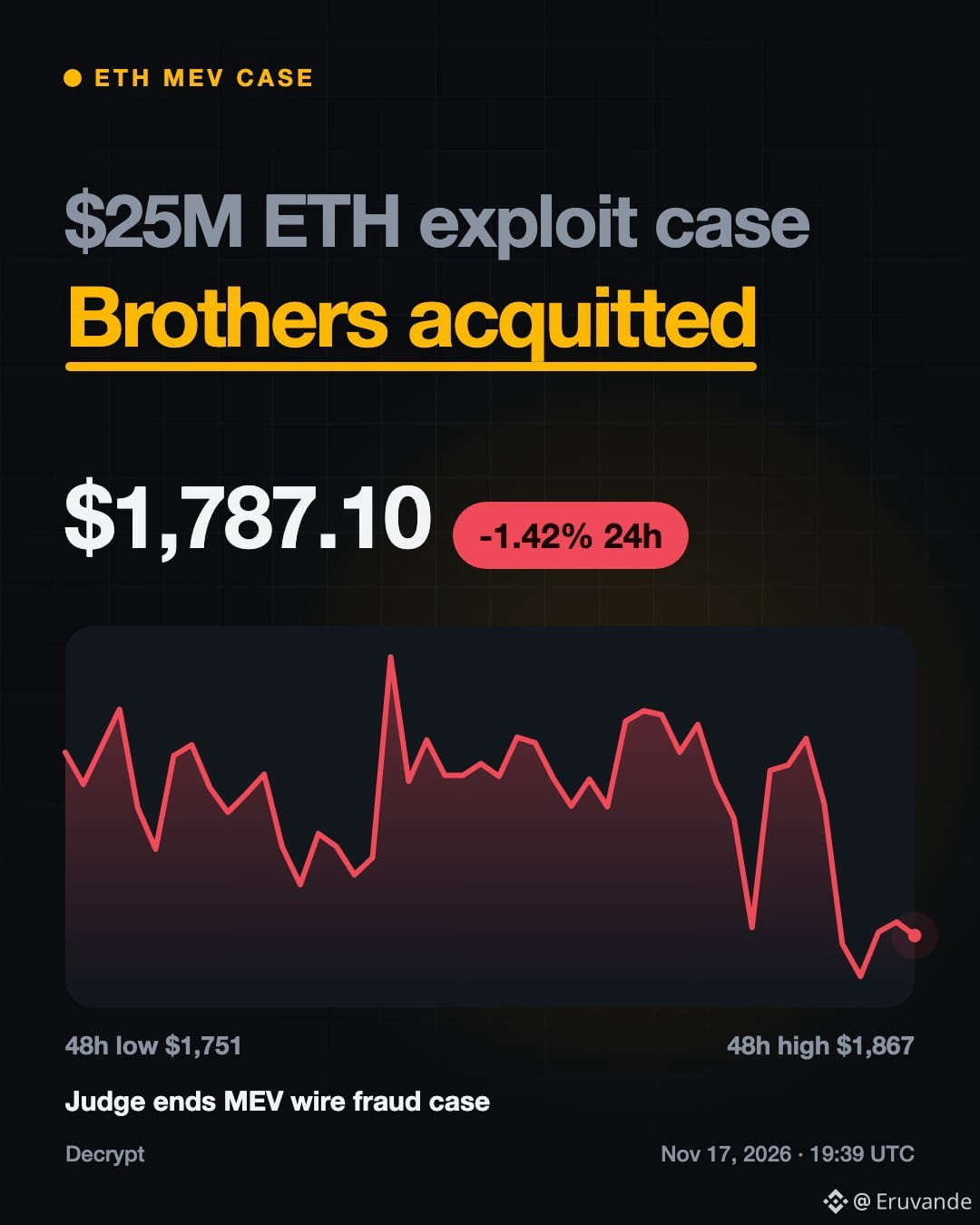
A US judge just acquitted the MIT-educated Peraire-Bueno brothers over a $25M $ETH MEV exploit.
The ruling: prosecutors failed to prove any material misrepresentation, a year after a jury deadlocked.
It does not settle whether the trades were ethical.
$ETH trades near $1,787.10 right now.
Does this open the door for more MEV plays on $ETH? 👀
#Ethereum #MEV
A US judge just acquitted the MIT-educated Peraire-Bueno brothers over a $25M $ETH MEV exploit.
The ruling: prosecutors failed to prove any material misrepresentation, a year after a jury deadlocked.
It does not settle whether the trades were ethical.
$ETH trades near $1,787.10 right now.
Does this open the door for more MEV plays on $ETH ? 👀
#Ethereum #MEV
The ruling: prosecutors failed to prove any material misrepresentation, a year after a jury deadlocked.
It does not settle whether the trades were ethical.
$ETH trades near $1,787.10 right now.
Does this open the door for more MEV plays on $ETH ? 👀
#Ethereum #MEV
BcryptexBTC:
This case just rewrote the rules for MEV on ETH if the court says it is not fraud then every searcher just got confidence to go harder I break down plays like this daily do you think this is bullish or dangerous for ETH
1
1
381

·
--
BlackRock’s Ethereum ETF Staking Revenue Split: Institutions Earn Priority Fees, Retail Investors Bear MEV Costs
The revenue-sharing mechanism for BlackRock’s staked Ethereum ETF is bringing a new form of capital redistribution into the spotlight: institutions earn priority fees through staking, while retail investors foot the bill for transaction front-running.
According to Cointelegraph, BlackRock’s staked Ethereum ETF will receive a share of the fees traders pay to secure transaction priority on Ethereum. A ruling in a related case has made the boundaries of the legal risks behind this mechanism even less clear. The report puts the associated MEV at 25M.
The significance of this perspective is that it is distinct from the ETF inflows and holdings changes that the market has been discussing repeatedly in recent weeks. Previously, the focus was on “whether money is flowing in.” Now the question is whether, after buying in, institutions can generate additional cash flow by staking the ETH they hold. For institutions like BlackRock, staking revenue-sharing adds another source of returns to holding ETH, theoretically strengthening their incentive to hold it for the long term.
Breaking down the capital flows, the mechanism centers on MEV (Maximal Extractable Value). Traders pay priority fees to have their transactions included first, and the value generated in the process is divided up. What institutions take is precisely the cost paid by retail investors. At 25M, this represents an additional source of income for institutions, while for retail investors it is the price of increased activity in the network economy. Both sides are part of the same mechanism, but their interests run in opposite directions.
The market reaction may differ depending on which side you look at. For institutions, if staking revenue-sharing proves to be a stable source of returns, it could reinforce the case for holding ETFs and provide bullish support for ETH through capital flows. For retail investors, controversy over MEV front-running and rising gas costs tell the opposite story and could dampen sentiment among some active traders.
The counterarguments are also clear: MEV front-running is controversial, regulatory scrutiny of institutional revenue-sharing remains a risk, and rising costs for retail investors could also prompt concerns about how user-friendly the network is. None of these outcomes is certain, but they are factors that need to be monitored continuously.
What should we watch next? It is worth looking at two dimensions. On the capital-flow side, whether staking revenue-sharing can be sustained and whether it grows alongside holdings are key to assessing institutions’ willingness to hold. At the trading level, if you are following $ETH, it is more important to watch the long-term impact of MEV mechanisms on network transaction costs than short-term sentiment swings. Waiting for the market to confirm the balance between costs and returns is more prudent than chasing a single narrative.
$ETH #Ethereum #ETF #MEV
The above is an informational summary and personal analysis, and does not constitute investment advice.
Follow me for ongoing updates on key market developments and data.
BlackRock’s Ethereum ETF Staking Revenue Split: Institutions Earn Priority Fees, Retail Investors Bear MEV Costs
The revenue-sharing mechanism for BlackRock’s staked Ethereum ETF is bringing a new form of capital redistribution into the spotlight: institutions earn priority fees through staking, while retail investors foot the bill for transaction front-running.
According to Cointelegraph, BlackRock’s staked Ethereum ETF will receive a share of the fees traders pay to secure transaction priority on Ethereum. A ruling in a related case has made the boundaries of the legal risks behind this mechanism even less clear. The report puts the associated MEV at 25M.
The significance of this perspective is that it is distinct from the ETF inflows and holdings changes that the market has been discussing repeatedly in recent weeks. Previously, the focus was on “whether money is flowing in.” Now the question is whether, after buying in, institutions can generate additional cash flow by staking the ETH they hold. For institutions like BlackRock, staking revenue-sharing adds another source of returns to holding ETH, theoretically strengthening their incentive to hold it for the long term.
Breaking down the capital flows, the mechanism centers on MEV (Maximal Extractable Value). Traders pay priority fees to have their transactions included first, and the value generated in the process is divided up. What institutions take is precisely the cost paid by retail investors. At 25M, this represents an additional source of income for institutions, while for retail investors it is the price of increased activity in the network economy. Both sides are part of the same mechanism, but their interests run in opposite directions.
The market reaction may differ depending on which side you look at. For institutions, if staking revenue-sharing proves to be a stable source of returns, it could reinforce the case for holding ETFs and provide bullish support for ETH through capital flows. For retail investors, controversy over MEV front-running and rising gas costs tell the opposite story and could dampen sentiment among some active traders.
The counterarguments are also clear: MEV front-running is controversial, regulatory scrutiny of institutional revenue-sharing remains a risk, and rising costs for retail investors could also prompt concerns about how user-friendly the network is. None of these outcomes is certain, but they are factors that need to be monitored continuously.
What should we watch next? It is worth looking at two dimensions. On the capital-flow side, whether staking revenue-sharing can be sustained and whether it grows alongside holdings are key to assessing institutions’ willingness to hold. At the trading level, if you are following $ETH , it is more important to watch the long-term impact of MEV mechanisms on network transaction costs than short-term sentiment swings. Waiting for the market to confirm the balance between costs and returns is more prudent than chasing a single narrative.
$ETH #Ethereum #ETF #MEV
The above is an informational summary and personal analysis, and does not constitute investment advice.
Follow me for ongoing updates on key market developments and data.
151

·
--
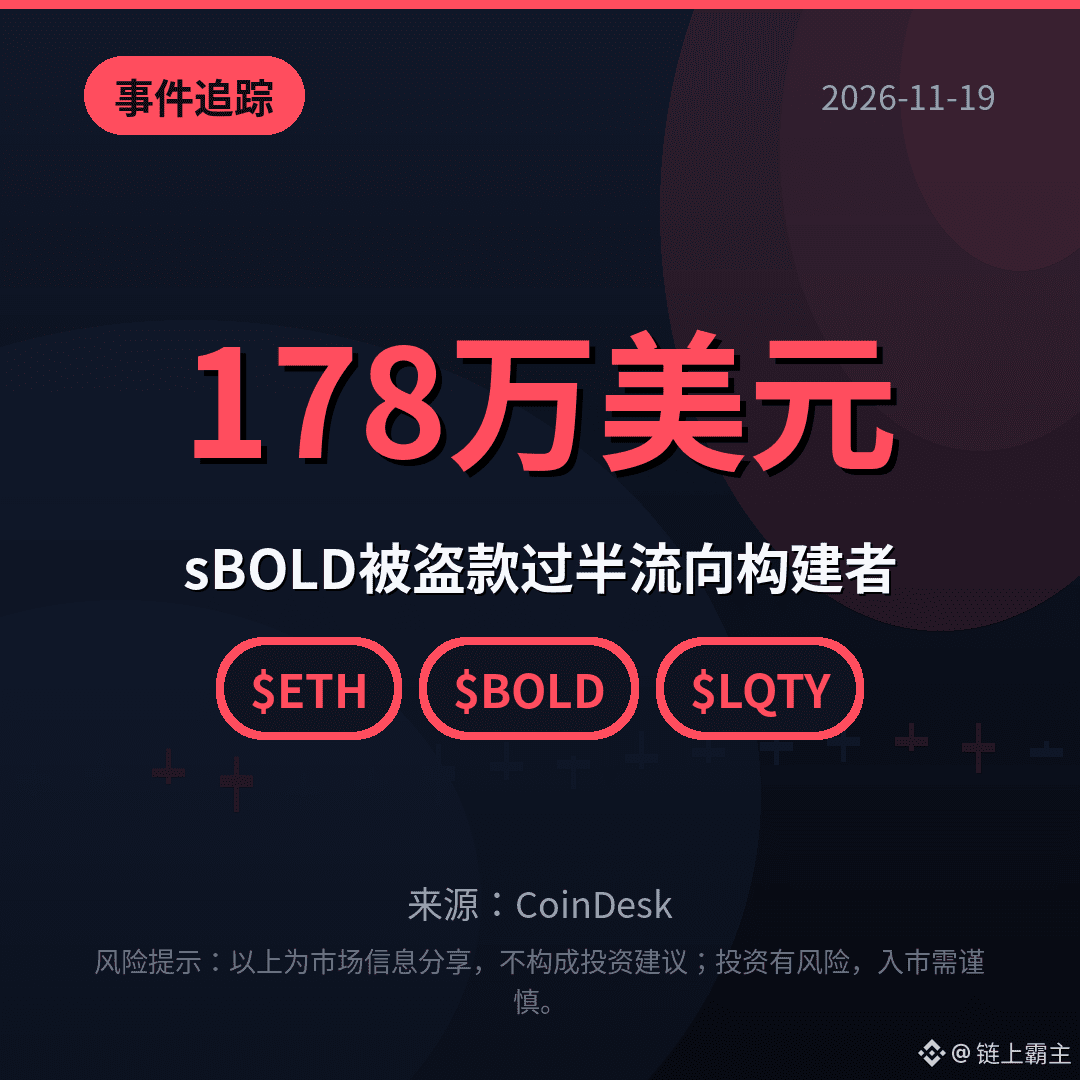
【Incident Tracker】More than half of the stolen sBOLD funds flowed to builders
New developments in the sBOLD theft: Bitquery tracking shows that 97 transactions drained the treasury in 8 minutes, with about $1.78 million flowing to block builders—more than half the total. Titan built most of the blocks involved. A copycat attack bot took $1.91 million, or 56%, while the original attacker kept only $520,000. The $1.78 million was payment, not confirmed profit.
$ETH $BOLD $LQTY
#币安广场 #MEV #Hackers
(Source: CoinDesk)
⚠️Risk warning: The above is shared for market information purposes only and does not constitute investment advice. Investing involves risks; please exercise caution.
Should builders return the money?
3
The recent dismissal of charges in the high-profile $25M Ethereum MEV case highlights a fascinating grey area in blockchain tech. While the court found no technical fraud in how the transactions were executed, the debate around the ethics of front-running and blockspace ordering is far from over. As validator strategies evolve, this legal outcome sets a unique precedent for how decentralized systems intersect with traditional law enforcement and market fairness. $ETH #Ethereum #MEV #CryptoRegulation
The recent dismissal of charges in the high-profile $25M Ethereum MEV case highlights a fascinating grey area in blockchain tech. While the court found no technical fraud in how the transactions were executed, the debate around the ethics of front-running and blockspace ordering is far from over. As validator strategies evolve, this legal outcome sets a unique precedent for how decentralized systems intersect with traditional law enforcement and market fairness. $ETH #Ethereum #MEV #CryptoRegulation
12
·
--
【Market Flash】$25 million swept up in 12 seconds, judge says it wasn’t fraud
In April 2023, two brothers set up eight bait trades to lure MEV bots. When their own validator proposed a block, they exploited a loophole in the Ultrasound relay, sweeping up $25 million in just 12 seconds and paying a fine of only about 1 ETH. On November 16, Judge Clarke acquitted them, ruling that prosecutors had not proven any “material misrepresentation” and that the relay had not been misled because it never validated the fields. What do you think of this legal gray area?
$ETH $BTC $SOL
#币安广场 #以太坊 #MEV
(Source: Bitcoinist)
⚠️Risk warning: The above is shared for informational purposes only and does not constitute investment advice. Investing involves risks; please exercise caution.

18
·
--
🚨 Judge Jessica Clarke acquitted the brothers in the $25M ETH MEV case, ruling transactions lacked false promises. The verdict clears legal hurdles but leaves ethical questions open.
Market implication: Reduced legal risk may ease sentiment around MEV strategies, though regulatory scrutiny remains high.
💡 What does this ruling mean for the future of MEV extraction? #Ethereum #MEV
$ETH #TradingSignal #CryptoAnalysis
Market implication: Reduced legal risk may ease sentiment around MEV strategies, though regulatory scrutiny remains high.
💡 What does this ruling mean for the future of MEV extraction? #Ethereum #MEV
$ETH #TradingSignal #CryptoAnalysis

12
·
--
🚨 Judge acquits MIT brothers in $25M Ethereum MEV case. The court ruled prosecutors failed to prove material misrepresentation needed for wire fraud, ending a year-long prosecution. This legal clarity removes a major uncertainty cloud over MEV activities, potentially boosting developer confidence in Ethereum infrastructure.
Implication: Legal certainty may stabilize MEV-related projects and infrastructure tokens.
💡 What does this verdict mean for the future of MEV on Ethereum? #Ethereum #MEV
$ETH #TradingSignal #CryptoAnalysis
Implication: Legal certainty may stabilize MEV-related projects and infrastructure tokens.
💡 What does this verdict mean for the future of MEV on Ethereum? #Ethereum #MEV
$ETH #TradingSignal #CryptoAnalysis

13

Judge clears MIT brothers in $25M MEV caseThe $25M Ethereum MEV prosecution is over, and the judge's reason was narrow: prosecutors never proved material misrepresentation. 📈 $ETH
So the charges are gone for good? For this case, yes. A federal judge acquitted the MIT brothers, about a year after a jury deadlocked on the same wire fraud counts.
Does this legalize MEV? No. The ruling turned on a failure of proof, not on a finding that transaction ordering tactics are lawful.
What changes for you in Doha, Riyadh or Dubai? Nothing about the dirham or riyal pegs, and no local exchange is named in the ruling. If you run MEV-style strategies, the legal picture may look less settled than before, but this is one court's decision and says nothing about how other cases could go.
Takeaway: the case died on evidence, not on a ruling that MEV is legal.
Do you expect another MEV prosecution this year? 👇
#Ethereum #MEV
For information only, not financial advice.
Tap $ETH to trade
$ETH
غيرك سبقك وتابع. ادخل بروفايلي وخلك مع اللي يقرأ قبل ما ينتشر الخبر.
Judge clears MIT brothers in $25M MEV case
The $25M Ethereum MEV prosecution is over, and the judge's reason was narrow: prosecutors never proved material misrepresentation. 📈 $ETH
So the charges are gone for good? For this case, yes. A federal judge acquitted the MIT brothers, about a year after a jury deadlocked on the same wire fraud counts.
Does this legalize MEV? No. The ruling turned on a failure of proof, not on a finding that transaction ordering tactics are lawful.
What changes for you in Doha, Riyadh or Dubai? Nothing about the dirham or riyal pegs, and no local exchange is named in the ruling. If you run MEV-style strategies, the legal picture may look less settled than before, but this is one court's decision and says nothing about how other cases could go.
Takeaway: the case died on evidence, not on a ruling that MEV is legal.
Do you expect another MEV prosecution this year? 👇
#Ethereum #MEV
For information only, not financial advice.
Tap $ETH to trade
$ETH
غيرك سبقك وتابع. ادخل بروفايلي وخلك مع اللي يقرأ قبل ما ينتشر الخبر.
16
Log in to explore more content
Join global crypto users on Binance Square
⚡️ Get latest and useful information about crypto.
💬 Trusted by the world’s largest crypto exchange.
👍 Discover real insights from verified creators.
Email / Phone number
Trending Topics
1
#NvidiaLoses$2.7TrillionInMonthAndAHalf
16,059 views
111 Discussing
2
#CanBTCReboundAfterFallingBelow60K?
728,345 views
2,915 Discussing
3
#GlobalStocksFaceLongestLosingStreakSince2023
263,476 views
1,958 Discussing
4
#BlackRockIBITPostsRecord$541MSingleDayOutflow
30,205 views
88 Discussing
5
#AnthropicPlungesTowardIPOPriceonDay2
133,724 views
1,186 Discussing
6
#TwentyOneCapitalAdds172.25BTC
60,943 views
646 Discussing
7
#HKBillWouldExcludeTokenizedDepositsFromVirtualAssets
7,450 views
50 Discussing
8
#BNBDropsBelow540USDTWith8.46%DailyDecline
73,600 views
634 Discussing
9
#HKBillProposesHK$100KFineForUnauthorizedCryptoTitles
2,468 views
22 Discussing
10
#BitMineFaces$10.1BUnrealizedETHLoss
5,116 views
27 Discussing