
#msci
msci
138,131 views
659 Discussing
Hot
Latest

·
--
Strategy is about to be kicked out of the MSCI indexes, and passive funds will have to sell. 📰
MSCI will remove Strategy from its USA and global indexes after the close on November 30, under rules for companies that mainly hold digital assets, according to the Calebandbrown weekly rollup. 📉 My reading is that this is a forced seller story, not a Bitcoin story, because index funds that track MSCI must sell the stock whether they like Bitcoin or not, and that selling lands right when the market is already at extreme fear. The stock is not Bitcoin, but the selling pressure around it is real. ⚠️
Does the MSCI removal push Strategy lower into November 30, or is the selling already priced in? 🤔
Follow for more trades.
#Crypto #Bitcoin #FuturesTrading #TradingSignals #MSCI

2

·
--
MSCI confirmed that after market close on November 30, it will remove Strategy from its global equity indexes. Japan's Metaplanet is also on the removal list.
This won't force the companies to sell Bitcoin. What may change next is that funds tracking these indexes may have to sell their shares.
Strategy itself has said that the relevant funds hold around 13 million shares, about 3.1% of its basic share capital.
An index constituent adjustment doesn't mean the coins held have already been sold.
$MSTR $BTC #MSCI
129

·
--
**MSCI drops MSTR – forced selling could hit both the stock and Bitcoin.**
Passive funds tracking MSCI indexes must rebalance after the November 30 close, potentially triggering **$2 billion‑$3 billion** of MSTR share sell‑offs.
The sell‑off may compress MSTR’s premium to its Bitcoin holdings, making equity financing less attractive and potentially limiting future BTC purchases.
While the removal does not require Strategy to liquidate its Bitcoin reserves, reduced passive demand could reshape digital‑asset treasury models if other crypto‑heavy firms face similar index exclusions.
**What’s your view: will the MSCI exclusion accelerate a feedback loop between MSTR’s stock pressure and Bitcoin’s price?**
#MSCI #MSTR #Bitcoin #DigitalAssets #PassiveInvesting

1
94

MSCI has kicked Strategy out of its index, effective at the close on November 30.
This is not a delisting, nor is it forcing the company to sell its coins—Strategy won’t touch a single one of its 850,364 BTC, bought at an average price of about $75,456, for a total cost of $64.16 billion. But index funds holding about 13 million shares (3.1%) must sell them by December 1. JPMorgan estimates selling pressure of about $2.8 billion, potentially rising to $8.8 billion if Nasdaq follows suit.
The real damage comes from another direction: Strategy’s cycle of issuing shares and debt to buy coins is built on its stock trading at a premium to its net asset value. That premium peaked at 3.4 times in November 2024; now it’s down to about 1.08 times. Once it’s kicked out of the index, the premium could shrink further, leaving its coin-buying machine unable to keep running.
Japan’s Metaplanet has also been kicked out. MSCI’s new rule is straightforward: companies whose balance sheets make them look like funds don’t belong in stock indexes.
$BTC holders haven’t changed; what’s changed is the pipeline funding it.
#MSCI #Strategy

44

·
--
🎯 Bitcoin’s biggest buyer gets kicked out of the index
📰 Strategy fell more than 7% in premarket trading and will be removed from the MSCI index after the market closes on November 30. The company buying up crypto has vanished overnight from the list of holdings in passive funds.
💬 This is the hidden thread behind this round of declines. Index funds have to sell mechanically—not because they’re bearish, but because the rules won’t let them hold it. I was stunned for a couple of seconds after reading this. This kind of selling pressure leaves no room for negotiation; wait for it to finish before buying the dip.
🏷️ #Strategy #MSCI #被动资金 #ETF
49

Strategy's MSCI exit: what index selling means
MSCI's November review lists Strategy for removal from its USA Index at the close on November 30, 2026.
Index funds aim to follow a benchmark's holdings. Removing a company can therefore create selling pressure on its shares as funds adjust their portfolios. This does not automatically require Strategy to sell Bitcoin from its treasury.
Separately, JPMorgan's September 30 disclosure lists 848,932 Strategy common shares, up about 36% from June 30, alongside 11,408,930 IBIT shares.
These are quarter-end holdings. They do not reveal current positions, purchase costs or the full picture of hedging. The filing also lists Strategy put and call options, so the common shares alone cannot establish a simple bullish bet.
Index membership, corporate financing and $BTC holdings are connected, but they are different things. Selling pressure on MSTR could matter for future fundraising; its scale and duration should not be assumed.
#strategy #MSCI #bitcoin

364

·
--
Is Strategy's Bitcoin-buying machine about to lose its fuel? ⛽
📰 What happened
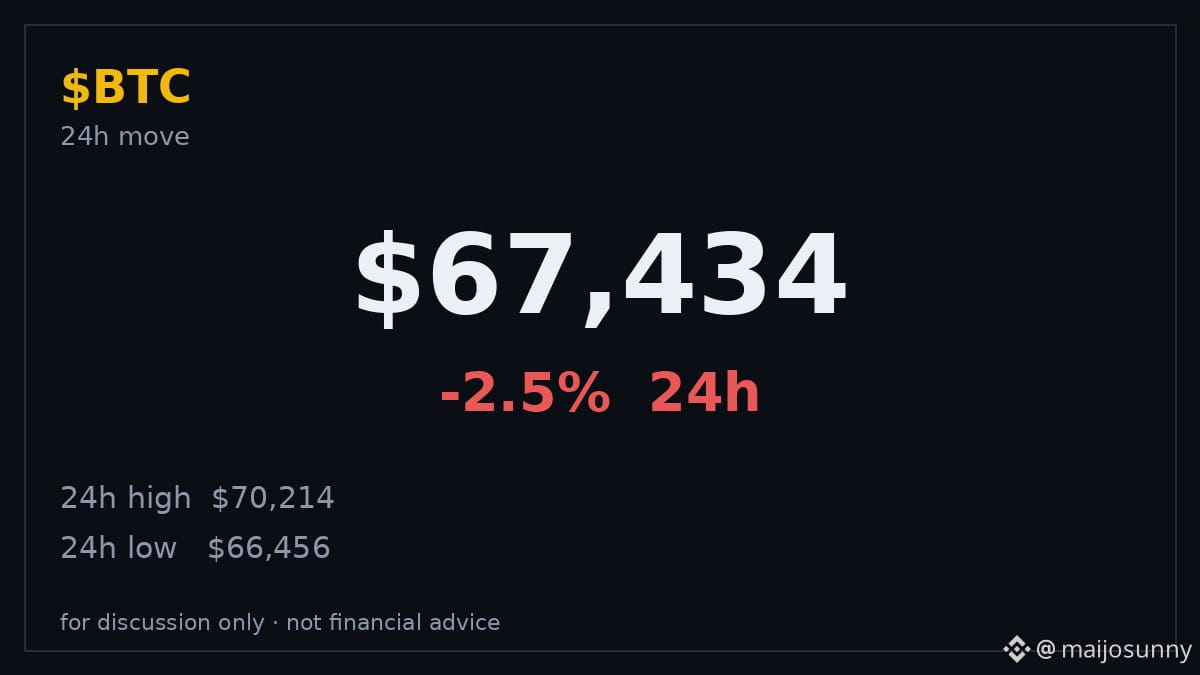
MSCI confirmed Nov 11 it will drop Strategy (MSTR) from its indexes at the Nov 30 close, calling it a "non-operating company" under a new rule. JPMorgan estimates ~$2.8B in forced selling from index funds. Meanwhile $BTC at $67,434 sits ~11% below Strategy's $75,456 average cost, putting its 850,364 BTC stack ~$6.85B underwater on paper (CryptoTimes calc, based on the Nov 9 SEC 8-K).
🤔 Why it matters
Strategy buys BTC by selling shares at a premium. That premium has compressed from 3.4x a year ago to about 1.08x (CoinDesk). Removal does NOT force Strategy to sell any BTC, but a thinner premium means thinner fuel for the next buy.
👀 What to watch
Monday's 8-K (Nov 16): did Strategy buy, sell, or pause? And Nov 30: how much of the $2.8B actually exits.
Is MSCI's call the end of the treasury-company trade, or a dip to buy before Monday's filing? 🐂🐻
Not financial advice. DYOR.
#Strategy #Bitcoin #MSCI #crypto
99

·
--
Verified
$2.8 billion, forced selling on November 30.
JPMorgan estimates that index funds will have to dump this much MSTR stock by then.
In the same rebalancing, MSCI added another Bitcoin-hoarding company, SWC, to the index.
SWC holds only 2,850 bitcoins.
I don't think the index is rejecting Bitcoin; it's rejecting the business model of making hoarding Bitcoin your main business.
Which side are you on: has the Bitcoin-hoarding model run its course, or has the index got it wrong?
@Binance_News $BTC #BTC #MSCI


404

·
--
MSCI kicked Strategy out of its index, but what really got knocked out wasn’t the 850,000 coins it holds—not a single one will be forced onto the market.
What got knocked out was the money-printing machine of “issuing stock to buy coins.”
On November 11, MSCI confirmed that after the market close on November 30, it would remove Strategy from the MSCI USA/World/ACWI indexes. Index funds will have to sell about 13 million shares (3.1% of the float), which JPMorgan estimates at around $2.8 billion. If Nasdaq follows suit, the total could reach $8.8 billion.
BTC is currently around $65,500, and has closed below Strategy’s average cost of $75,500 for several days in a row. Its 850,000-coin holdings are sitting on about $8.4 billion in unrealized losses.
MSTR closed Friday at $111.62, down 13.67% over five days and 26.22% over the past month. The company’s market cap is $51.68 billion, already below the roughly $55.7 billion value of the coins it holds—the stock is cheaper than the value of its coins on the books.
My take: when the stock trades below the value of its coins, issuing new shares to buy more coins just means losing more with every purchase. Strategy’s biggest strength in this bull market—issuing stock at a premium to acquire coins—has stalled. As recently as November 2–8, it bought 1,036 coins at an average price of $79,000. It hasn’t sold a single coin this week, but whether it can keep buying next week depends on whether the premium returns.
The real risk isn’t the $2.8 billion in forced selling on November 30 (Strategy itself says that’s less than a day’s trading volume). It’s that if the index world classifies “companies that hoard coins” as non-operating companies, this financing channel will systematically narrow.
Watch three variables next: forced selling at the November 30 close, whether Nasdaq launches a similar consultation, and whether MSTR’s discount to the value of its coins narrows. If the discount doesn’t narrow, Strategy will likely first slow its weekly coin purchases, or even stop them altogether.
Do you think Strategy will be completely “expelled” from the index world, or could a rebound in the coin price to its $75,000 cost basis restore its premium?
$BTC
#比特币 #MSCI #Strategy
The above is for market information only and does not constitute investment advice.
429

·
--
Is Bitcoin about to be dumped? Strategy is being removed from MSCI indexes—first, understand the difference between selling stock, selling coins, and delisting
Being removed from an index does not mean Bitcoin has to be sold.
MSCI announced the results of its November index review on November 11, with all changes taking effect at the close on November 30. According to the removal list cited by media reports, Strategy (MSTR) is being removed from the MSCI USA Index, and consequently from the MSCI World and ACWI indexes. In this round alone, ACWI is adding 13 stocks and removing 100.
Why is it being removed? Under the new “non-operating companies” rules MSCI set on October 15:
1. First, MSCI checks whether a company has enough operating assets.
2. If not, it is assessed using five financial ratios. A company fails if it meets four or more of the criteria.
3. Companies already in the index are removed only if they fail in two consecutive annual reporting periods, giving them a buffer.
On November 11, MSCI also confirmed that these rules apply to the MSCI USA Index Series. The temporary freeze, introduced on October 10, 2025, for companies with “digital assets accounting for more than 50% of total assets” is being discontinued as of this review. All companies will be assessed under the new rules.
Three common misconceptions:
- “It’s going to be delisted”: No. An index is a list that funds use to select stocks, not a stock exchange. The shares will continue trading as usual.
- “The company has to sell its coins”: The rules only determine whether a company can be included in the index; they do not require it to sell any assets.
- “This has nothing to do with the coins I hold”: There is an indirect connection. Passive funds tracking these indexes will have to remove MSTR when the changes take effect. Companies like this raise funds by issuing shares to buy coins; if the share price weakens, issuing the same number of shares brings in less money.
A quick self-check you can use: If you hold shares in a “crypto treasury company” or related funds, check two figures first—the share of total assets made up by digital assets, and how much revenue comes from the company’s main business. The higher the first figure and the smaller the main business, the more likely the company is to fall under the new screening rules. Go by MSCI’s official announcement, and don’t trust screenshots claiming “so-and-so is also getting removed.”
Follow me. I’ll explain the original rules behind institutional news first, then discuss whether it has anything to do with the coins you hold.
#比特币 #MSCI #Strategy #币股 $BTC

267

·
--
Verified
For the past couple of days, everyone’s been saying “Strategy will be forced to sell $2.8 billion worth,” which sounds pretty scary, so I looked into where that came from 🤡
The $2.8 billion figure was calculated by JPMorgan last November, based on the old version of MSCI’s proposal at the time. That version never went into effect. This year, MSCI switched to a new rule for “non-operating companies.” Strategy is indeed still being kicked out, effective after the close on November 30, but MSCI itself has never said exactly how much passive funds would have to sell.
Strategy says that funds tracking MSCI indexes hold around 13 million shares, or 3.1% of its total shares outstanding. Using Friday’s close of $MSTR at $111.62, that comes to just over $1.4 billion. 17.9 million shares traded on Friday alone.
So just looking at index-related selling pressure, one day’s trading volume could absorb it. It’s not as dramatic as people make it sound.
What I’m more concerned about is another calculation. BTC is around $67,700 right now, and Strategy’s average cost for its more than 850,000 coins is $75,456, so the price is about 10% below its cost. It buys coins by issuing common and preferred stock. When the share price falls and its premium shrinks, each share it sells buys fewer coins, so the accelerator on this coin-buying machine naturally lets up.
After the 30th, keep an eye on its weekly 8-K filings to see whether it’s still buying and how much. That’s more reliable than news headlines.
#MSTR #BTC #MSCI #USStocks
$MSTR $BTC
803

·
--
Bearish
$BTC 🤔
🚨 MSCI EXCLUDES STRATEGY (MSTR) — IS BITCOIN IN TROUBLE?
A major development has put Michael Saylor's Bitcoin strategy under the spotlight.
MSCI's decision to exclude Strategy from its indexes could trigger significant institutional selling pressure.
💰 Potential index-related outflows could reach billions of dollars.
📉 Could this affect Strategy's ability to raise capital and continue accumulating Bitcoin?
🐋 Institutional money plays a major role in today's crypto market.
THE BIG QUESTION:
Is this a warning sign for Bitcoin, or just another temporary market shake-up?
👇 What's your take?
@followers
#Bitcoin #BTC #MichaelSaylor #strategyinvest #CryptoNews #MSCI
#WhatWillDriveCryptoandStocks’NextRebound?

1
309
MSCI has officially taken action: After the market close on November 30, Strategy (MSTR) was removed from the MSCI USA, MSCI World, and ACWI indexes on the grounds that it is a “non-operating company” under new rules. It holds 850,364 BTC on its books, acquired for $64.16 billion at an average price of $75,456, while operating assets account for less than half of its total assets. JPMorgan estimates that passive funds will be forced to sell about $2.8 billion worth of shares; if other index providers follow suit, the total could reach $8.8 billion. Strategy argues that MSCI-tracking funds hold only 13 million shares, or 3.1% of the company—less than a day’s trading volume. To be clear: removal from an index does not mean delisting, and nobody is forcing the company to sell its coins. But for the first time, the “Bitcoin treasury company” model has been formally deemed ineligible by the mainstream financial system. MSTR closed Wednesday at $122.35, then fell 1.5% to $120.50 after hours. Also removed in the same batch were Japan’s Metaplanet and uranium miner Yellow Cake. #MSCI #Strategy
MSCI has officially taken action: After the market close on November 30, Strategy (MSTR) was removed from the MSCI USA, MSCI World, and ACWI indexes on the grounds that it is a “non-operating company” under new rules. It holds 850,364 BTC on its books, acquired for $64.16 billion at an average price of $75,456, while operating assets account for less than half of its total assets. JPMorgan estimates that passive funds will be forced to sell about $2.8 billion worth of shares; if other index providers follow suit, the total could reach $8.8 billion. Strategy argues that MSCI-tracking funds hold only 13 million shares, or 3.1% of the company—less than a day’s trading volume. To be clear: removal from an index does not mean delisting, and nobody is forcing the company to sell its coins. But for the first time, the “Bitcoin treasury company” model has been formally deemed ineligible by the mainstream financial system. MSTR closed Wednesday at $122.35, then fell 1.5% to $120.50 after hours. Also removed in the same batch were Japan’s Metaplanet and uranium miner Yellow Cake. #MSCI #Strategy

110

MSCI Removes MicroStrategy From Major Indexes
MSCI decision to exclude MicroStrategy from its benchmark indexes could trigger notable passive fund outflows and impact the primary Bitcoin proxy for institutional investors.
#MicroStrategy #MSCI
MSCI Removes MicroStrategy From Major Indexes
MSCI decision to exclude MicroStrategy from its benchmark indexes could trigger notable passive fund outflows and impact the primary Bitcoin proxy for institutional investors.
#MicroStrategy #MSCI
MSCI decision to exclude MicroStrategy from its benchmark indexes could trigger notable passive fund outflows and impact the primary Bitcoin proxy for institutional investors.
#MicroStrategy #MSCI
54

MSCI drops Strategy despite its $19.5 billion profitIf Strategy made $19.5 billion in profit, why is MSCI taking it out of major stock indexes? 📉 $BTC
Michael Saylor's Bitcoin giant is being removed from major investment benchmarks. The profit figure is the part most readers will skip, and it is also the part that explains nothing about the decision.
Index providers don't screen for profit. They screen for what kind of business a company is. Strategy's balance sheet is built around Bitcoin, so MSCI's move raises a classification question: operating company, or something closer to a fund?
The notes don't confirm which benchmarks are affected or how fast the removal happens. Whether the decision could slow Strategy's Bitcoin buying is also unconfirmed.
What it means for you: if index funds can no longer hold the stock passively, one source of demand could fade. And if Strategy's access to capital tightens, its BTC purchases may slow — both are possibilities, not outcomes.
Index inclusion is a judgment about business type, not a reward for profits.
Is Strategy a Bitcoin fund or an operating business — which label fits better? 👇
#Bitcoin #MSCI
For information only, not financial advice.
Tap $BTC to trade
$BTC
غيرك سبقك وتابع. ادخل بروفايلي وخلك مع اللي يقرأ قبل ما ينتشر الخبر.
MSCI drops Strategy despite its $19.5 billion profit
If Strategy made $19.5 billion in profit, why is MSCI taking it out of major stock indexes? 📉 $BTC
Michael Saylor's Bitcoin giant is being removed from major investment benchmarks. The profit figure is the part most readers will skip, and it is also the part that explains nothing about the decision.
Index providers don't screen for profit. They screen for what kind of business a company is. Strategy's balance sheet is built around Bitcoin, so MSCI's move raises a classification question: operating company, or something closer to a fund?
The notes don't confirm which benchmarks are affected or how fast the removal happens. Whether the decision could slow Strategy's Bitcoin buying is also unconfirmed.
What it means for you: if index funds can no longer hold the stock passively, one source of demand could fade. And if Strategy's access to capital tightens, its BTC purchases may slow — both are possibilities, not outcomes.
Index inclusion is a judgment about business type, not a reward for profits.
Is Strategy a Bitcoin fund or an operating business — which label fits better? 👇
#Bitcoin #MSCI
For information only, not financial advice.
Tap $BTC to trade
$BTC
غيرك سبقك وتابع. ادخل بروفايلي وخلك مع اللي يقرأ قبل ما ينتشر الخبر.
275


·
--
Verified
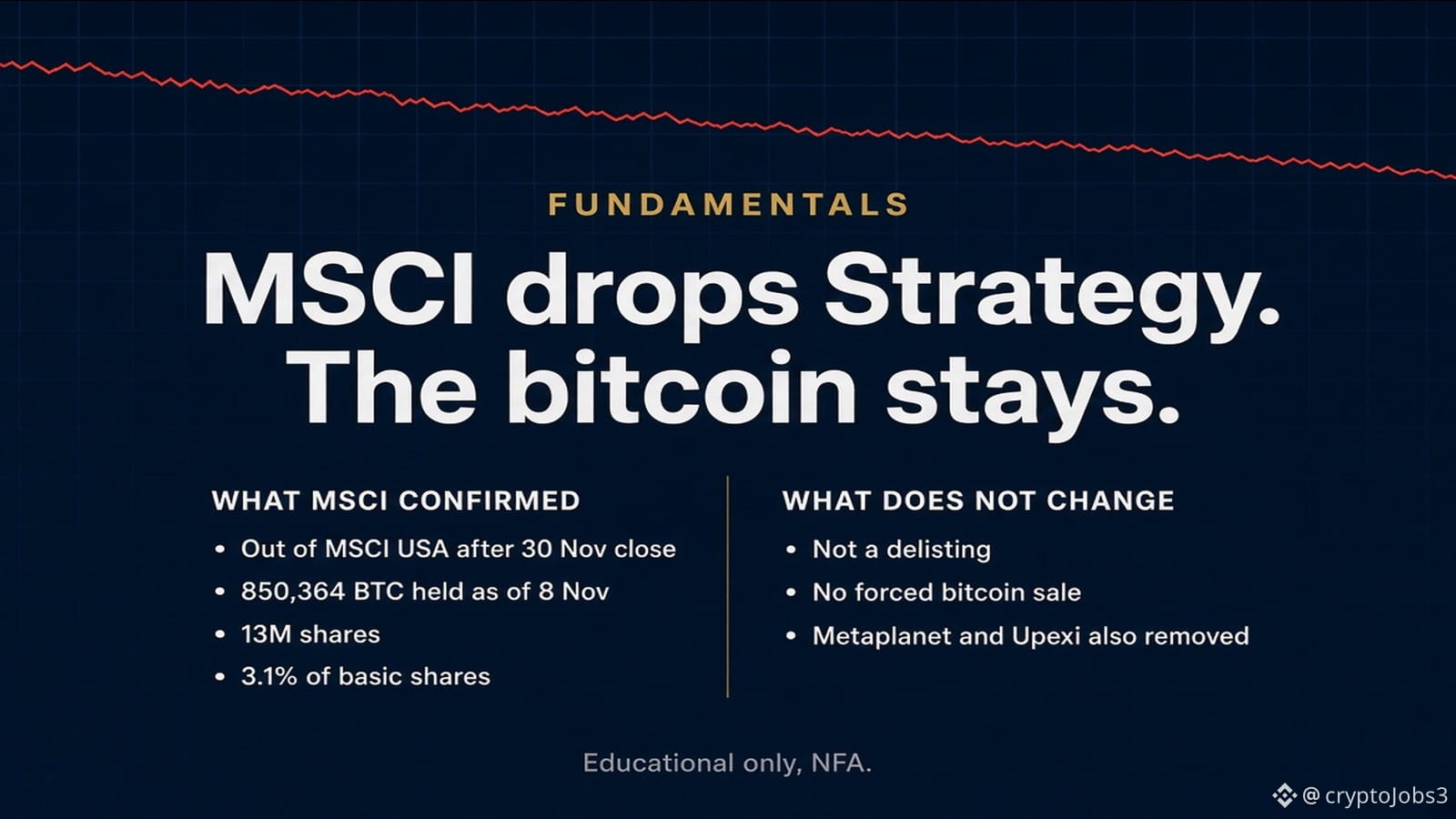
$MSTR · MSCI will remove Strategy from its global equity indexes, including the MSCI USA Index, after the close on 30 November 2026.
Strategy holds 850,364 $BTC as of 8 November, the largest stack among listed companies.
Index funds that track these benchmarks may have to sell the shares. That does not force a sale of the bitcoin, and it does not delist the stock.
A new screen for non operating companies, adopted on 15 October. Metaplanet and Upexi are also set to be removed.
Strategy has said MSCI linked funds held about 13 million shares, or 3.1% of basic shares.
NFA.
#MSTR #MSCI
1.4k

·
--

Article
Strategy & Metaplanet to Lose MSCI Index Membership in November ReshuffleDate: November 12, 2026
Global index provider MSCI has confirmed the removal of two major Bitcoin treasury companies, Strategy (MSTR) and Metaplanet (3350.T), from its respective stock indexes. The changes will take effect after the market closes on November 30, 2026.
Strategy will be removed from the MSCI USA Index, while Japan-based Metaplanet will leave the MSCI Japan Small Cap Index.
Why Is MSCI Removing These Companies?
The decision follows MSCI's new eligibility rules for companies with substantial non-operating assets. The revised framework evaluates operating assets and five financial measures to determine whether a company qualifies for index membership.
These changes could particularly affect companies whose business models focus heavily on holding digital assets such as Bitcoin.
Interestingly, Ethereum treasury company SharpLink was not included among the deletions.
Strategy Pushes Back Against MSCI
Strategy Executive Chairman Michael Saylor and CEO Phong Le previously criticized the proposed rules, describing the treatment of digital asset treasury companies as discriminatory.
The company has argued that its business model should not be unfairly penalized because of its Bitcoin treasury strategy.
Market Reaction
The announcement created additional pressure on both companies' shares.
Strategy (MSTR): Fell 2.6% in after-hours trading to $119.06.
Metaplanet (3350.T): Closed Wednesday down 2.53% at 231 yen.
What Does This Mean for Crypto Investors?
MSCI index removal could create selling pressure because investment funds tracking these indexes may need to sell their holdings in the affected companies.
However, index removal does not mean that either company will be delisted from its stock exchange, nor does it require them to sell their Bitcoin holdings.
Final Thoughts
MSCI's decision highlights the growing debate surrounding corporate cryptocurrency treasury companies and their place in traditional financial markets.
The coming weeks will be important for Strategy and Metaplanet as investors assess the potential impact of reduced index exposure and changing institutional demand.
Stay informed, watch market developments, and always do your own research before making investment decisions.
#Bitcoin #Strategy #Strategy #MSTR
#Metaplanet #MSCI
#CryptoNews
#BTC
{future}(MSTRUSDT)
{stock_us}(MSCI.US)
Strategy & Metaplanet to Lose MSCI Index Membership in November Reshuffle
Date: November 12, 2026
Global index provider MSCI has confirmed the removal of two major Bitcoin treasury companies, Strategy (MSTR) and Metaplanet (3350.T), from its respective stock indexes. The changes will take effect after the market closes on November 30, 2026.
Strategy will be removed from the MSCI USA Index, while Japan-based Metaplanet will leave the MSCI Japan Small Cap Index.
Why Is MSCI Removing These Companies?
The decision follows MSCI's new eligibility rules for companies with substantial non-operating assets. The revised framework evaluates operating assets and five financial measures to determine whether a company qualifies for index membership.
These changes could particularly affect companies whose business models focus heavily on holding digital assets such as Bitcoin.
Interestingly, Ethereum treasury company SharpLink was not included among the deletions.
Strategy Pushes Back Against MSCI
Strategy Executive Chairman Michael Saylor and CEO Phong Le previously criticized the proposed rules, describing the treatment of digital asset treasury companies as discriminatory.
The company has argued that its business model should not be unfairly penalized because of its Bitcoin treasury strategy.
Market Reaction
The announcement created additional pressure on both companies' shares.
Strategy (MSTR): Fell 2.6% in after-hours trading to $119.06.
Metaplanet (3350.T): Closed Wednesday down 2.53% at 231 yen.
What Does This Mean for Crypto Investors?
MSCI index removal could create selling pressure because investment funds tracking these indexes may need to sell their holdings in the affected companies.
However, index removal does not mean that either company will be delisted from its stock exchange, nor does it require them to sell their Bitcoin holdings.
Final Thoughts
MSCI's decision highlights the growing debate surrounding corporate cryptocurrency treasury companies and their place in traditional financial markets.
The coming weeks will be important for Strategy and Metaplanet as investors assess the potential impact of reduced index exposure and changing institutional demand.
Stay informed, watch market developments, and always do your own research before making investment decisions.
#Bitcoin #Strategy #Strategy #MSTR
#Metaplanet #MSCI
#CryptoNews
#BTC
11

Strategy has purchased hundreds of thousands of Bitcoin to make it the company’s primary asset. But it is precisely this business model that led MSCI to decide to remove Strategy shares from the MSCI USA Index effective at the close of trading on November 30, 2026.
MSCI believes that companies whose assets consist mostly of investments and that lack substantial operating assets no longer meet its index criteria.
This doesn’t mean Strategy has to sell its Bitcoin. Instead, passive investment funds that track the index will have to remove MSTR shares from their portfolios.
JPMorgan previously estimated that around $2.8 billion in funds could flow out as a result of this removal. The potential outflow could even reach $8.8 billion if other index providers take similar action.
Strategy’s business model, which puts Bitcoin at the center of the company’s balance sheet, is now at odds with Wall Street’s index rules.
#MSCI CI #WallStreetNews et #BitcoinTreasuryStrategy
$BARD

119

·
--
Verified
📰 Bitcoin Treasuries reposted on X Strategy CEO Phong Le’s response during a live CNBC interview: MSCI will remove MicroStrategy (MSTR), and Le estimates that only about 3% of the company’s shares are linked to MSCI indexes, so the impact will be limited and the matter is not material. 🚀 He noted that MSCI has been focused on digital assets for years, yet is still picking “winners” and “losers.”
🔍 This means that even with index adjustments, fluctuations in the overall market value of MSTR and related holdings may be limited. Still, the market is watching to see whether MSCI’s evaluation criteria for crypto-related companies will change. Whether MSCI will continue to tighten or loosen its coverage of digital assets remains unknown.
💬 What do you think? Could decisions like this by MSCI gradually affect the mainstream acceptance of crypto assets?
Not investment advice.
#BTC #CryptoNews #MSCI #MicroStrategy #Write2Earn
56

·
--
Strategy to Be Removed From MSCI Index—Will It Be Forced to Sell Bitcoin Too?Over the past two days, Strategy has once again found itself at the intersection of crypto and U.S. stock market discussions. The reason isn’t a new announcement about buying coins, but a change in index eligibility. When people see phrases like “index removal” and “passive selling,” the first thought is often: Is another huge batch of Bitcoin about to be dumped onto the market? In reality, there are several distinct layers of trading between the two.
First, let’s look at what’s confirmed. In its list of global standard index changes published on November 11, MSCI included STRATEGY A among the securities to be removed from the MSCI USA Index. The announcement states that this round of changes will take effect after the market closes on November 30. Deep Tide also covered the news on November 12. So this is an announced index change that has yet to take effect. It should not be described as “the company has been delisted from the exchange,” much less equated directly with the company beginning to liquidate its Bitcoin holdings.
Strategy to Be Removed From MSCI Index—Will It Be Forced to Sell Bitcoin Too?
Over the past two days, Strategy has once again found itself at the intersection of crypto and U.S. stock market discussions. The reason isn’t a new announcement about buying coins, but a change in index eligibility. When people see phrases like “index removal” and “passive selling,” the first thought is often: Is another huge batch of Bitcoin about to be dumped onto the market? In reality, there are several distinct layers of trading between the two.
First, let’s look at what’s confirmed. In its list of global standard index changes published on November 11, MSCI included STRATEGY A among the securities to be removed from the MSCI USA Index. The announcement states that this round of changes will take effect after the market closes on November 30. Deep Tide also covered the news on November 12. So this is an announced index change that has yet to take effect. It should not be described as “the company has been delisted from the exchange,” much less equated directly with the company beginning to liquidate its Bitcoin holdings.
First, let’s look at what’s confirmed. In its list of global standard index changes published on November 11, MSCI included STRATEGY A among the securities to be removed from the MSCI USA Index. The announcement states that this round of changes will take effect after the market closes on November 30. Deep Tide also covered the news on November 12. So this is an announced index change that has yet to take effect. It should not be described as “the company has been delisted from the exchange,” much less equated directly with the company beginning to liquidate its Bitcoin holdings.
1.2k
Log in to explore more content
Join global crypto users on Binance Square
⚡️ Get latest and useful information about crypto.
💬 Trusted by the world’s largest crypto exchange.
👍 Discover real insights from verified creators.
Email / Phone number
Trending Topics
1
#IsAnthropic’s$1.5TMarketCapJustified?
5,919 views
55 Discussing
2
#BTCRemainsUnderPressureAfterHawkishFOMCMinutes
190,673 views
1,927 Discussing
3
#NvidiaBoardReportedlySplitOverHuang’sReturn
93,420 views
1,031 Discussing
4
#StrategySTRCPreferredSlips3.65%Below$100Par
4,701 views
61 Discussing
5
#MASToUpgradeSGDTestnetToSGDigitalLedger
13,491 views
206 Discussing
6
#CanGTA6'sLaunchLiftTTWOShares?
65,594 views
764 Discussing
7
#Solana2027RoadmapTargetsDoubleComputeCapacity
4,291 views
105 Discussing
8
#InjectiveTokenizedRealEstateMortgagesTop$1.5B
915 views
27 Discussing
9
#TetherMakesStrategicInvestmentInSCRYPT
4,222 views
91 Discussing
10
#CapitalGroupAdds1264500StrategyShares
20,254 views
216 Discussing