
#mastercard
mastercard
756,488 views
1,483 Discussing
Hot
Latest

🚨 YOUR NEXT CUSTOMER COULD BE AN AI AGENT — PAYING ON THE XRP LEDGER. 🤖💸
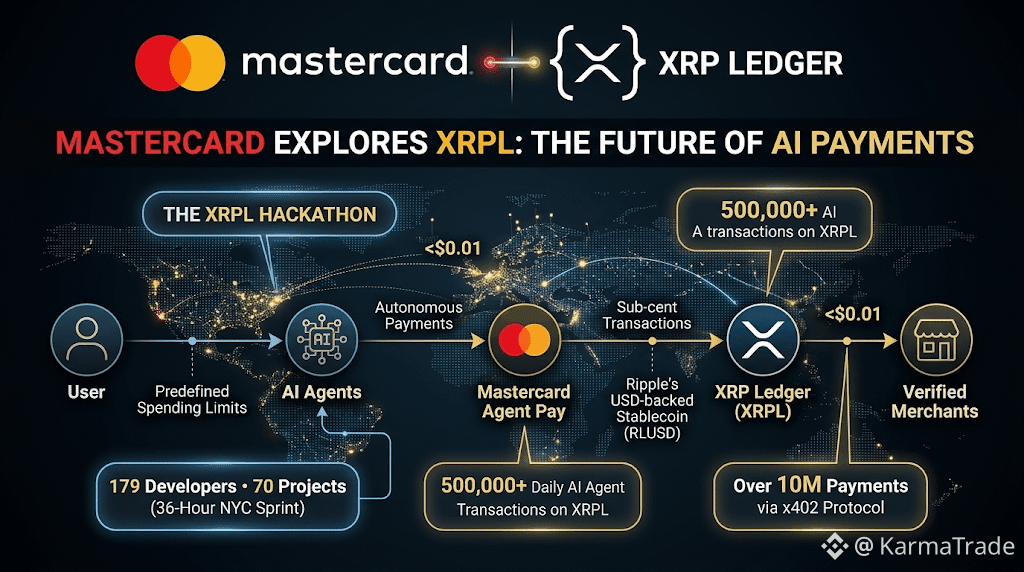
Mastercard spotlighted a hackathon where 179 developers submitted 70 projects in 36 hours, exploring AI agents that could:
✅ Pay verified merchants autonomously
✅ Respect predefined spending limits
✅ Settle in RLUSD on the XRP Ledger
✅ Make micropayments worth fractions of a cent.
📊 Mastercard’s article cites Ripple reporting 500,000+ daily AI-agent transactions and 10 million+ cumulative x402 payments on XRPL. These figures measure activity, not dollar volumes.
⚠️ THE RISK? AUTOMATING PAYMENTS CAN ALSO ACCELERATE LOSSES.
A manipulated AI agent could pay a fraudulent merchant, expose sensitive information or misuse wallet permissions. Spending limits help — but identity verification, restricted permissions, monitoring and emergency controls matter too.
🌍 WHAT COULD THIS MEAN FOR CRYPTO?
🔹 More practical utility: machines purchasing data, computing power and digital services.
🔹 Greater stablecoin relevance: autonomous commerce could increase demand for blockchain settlement.
🔹 More security pressure: faster payments require stronger controls and clear accountability.
📌 For XRP, network growth does not automatically mean price growth. These demonstrations used RLUSD for settlement; transaction counts alone cannot establish meaningful XRP demand or investment returns.
My take: the opportunity is enormous, but adoption will depend on making autonomous payments trustworthy.
Would you give an AI agent a $1000 crypto budget — and what safeguards would you demand? 👇
#XRPL #Mastercard #AgenticCommerce
$XRP
{spot}(XRPUSDT)
$NVDAB
{spot}(NVDABUSDT)
$MSFTB
{spot}(MSFTBUSDT)
🚨 YOUR NEXT CUSTOMER COULD BE AN AI AGENT — PAYING ON THE XRP LEDGER. 🤖💸
Mastercard spotlighted a hackathon where 179 developers submitted 70 projects in 36 hours, exploring AI agents that could:
✅ Pay verified merchants autonomously
✅ Respect predefined spending limits
✅ Settle in RLUSD on the XRP Ledger
✅ Make micropayments worth fractions of a cent.
📊 Mastercard’s article cites Ripple reporting 500,000+ daily AI-agent transactions and 10 million+ cumulative x402 payments on XRPL. These figures measure activity, not dollar volumes.
⚠️ THE RISK? AUTOMATING PAYMENTS CAN ALSO ACCELERATE LOSSES.
A manipulated AI agent could pay a fraudulent merchant, expose sensitive information or misuse wallet permissions. Spending limits help — but identity verification, restricted permissions, monitoring and emergency controls matter too.
🌍 WHAT COULD THIS MEAN FOR CRYPTO?
🔹 More practical utility: machines purchasing data, computing power and digital services.
🔹 Greater stablecoin relevance: autonomous commerce could increase demand for blockchain settlement.
🔹 More security pressure: faster payments require stronger controls and clear accountability.
📌 For XRP, network growth does not automatically mean price growth. These demonstrations used RLUSD for settlement; transaction counts alone cannot establish meaningful XRP demand or investment returns.
My take: the opportunity is enormous, but adoption will depend on making autonomous payments trustworthy.
Would you give an AI agent a $1000 crypto budget — and what safeguards would you demand? 👇
#XRPL #Mastercard #AgenticCommerce
$XRP
$NVDAB
$MSFTB
Mastercard spotlighted a hackathon where 179 developers submitted 70 projects in 36 hours, exploring AI agents that could:
✅ Pay verified merchants autonomously
✅ Respect predefined spending limits
✅ Settle in RLUSD on the XRP Ledger
✅ Make micropayments worth fractions of a cent.
📊 Mastercard’s article cites Ripple reporting 500,000+ daily AI-agent transactions and 10 million+ cumulative x402 payments on XRPL. These figures measure activity, not dollar volumes.
⚠️ THE RISK? AUTOMATING PAYMENTS CAN ALSO ACCELERATE LOSSES.
A manipulated AI agent could pay a fraudulent merchant, expose sensitive information or misuse wallet permissions. Spending limits help — but identity verification, restricted permissions, monitoring and emergency controls matter too.
🌍 WHAT COULD THIS MEAN FOR CRYPTO?
🔹 More practical utility: machines purchasing data, computing power and digital services.
🔹 Greater stablecoin relevance: autonomous commerce could increase demand for blockchain settlement.
🔹 More security pressure: faster payments require stronger controls and clear accountability.
📌 For XRP, network growth does not automatically mean price growth. These demonstrations used RLUSD for settlement; transaction counts alone cannot establish meaningful XRP demand or investment returns.
My take: the opportunity is enormous, but adoption will depend on making autonomous payments trustworthy.
Would you give an AI agent a $1000 crypto budget — and what safeguards would you demand? 👇
#XRPL #Mastercard #AgenticCommerce
$XRP
$NVDAB
$MSFTB

1
322

·
--
Bullish
Verified
Mastercard & $XRP Ledger: AI Agents Making Autonomous Payments! 🚨🌐
Mastercard just highlighted an XRPL hackathon where 179 developers built AI-powered payment tools using Mastercard Agent Pay and Ripple's stablecoin ($RLUSD ).
The Quick Breakdown:
• Autonomous AI Spending: AI agents pay verified merchants automatically within user-set spending limits—no manual sign-off needed.
• Why XRPL? AI workflows require tiny, sub-cent micropayments that traditional rails can't handle. XRPL’s speed and near-zero fees solve this.
• Real Traction: AI agents are already executing 500,000+ daily transactions on the XRP Ledger.
Massive real-world validation for XRPL in the AI economy! Are you bullish on $XRP's AI utility? 👇
#Mastercard #XRPL #xrp #AIpayments #BinanceSquare
Mastercard & $XRP Ledger: AI Agents Making Autonomous Payments! 🚨🌐
Mastercard just highlighted an XRPL hackathon where 179 developers built AI-powered payment tools using Mastercard Agent Pay and Ripple's stablecoin ($RLUSD ).
The Quick Breakdown:
• Autonomous AI Spending: AI agents pay verified merchants automatically within user-set spending limits—no manual sign-off needed.
• Why XRPL? AI workflows require tiny, sub-cent micropayments that traditional rails can't handle. XRPL’s speed and near-zero fees solve this.
• Real Traction: AI agents are already executing 500,000+ daily transactions on the XRP Ledger.
Massive real-world validation for XRPL in the AI economy! Are you bullish on $XRP 's AI utility? 👇
#Mastercard #XRPL #xrp #AIpayments #BinanceSquare
Mastercard just highlighted an XRPL hackathon where 179 developers built AI-powered payment tools using Mastercard Agent Pay and Ripple's stablecoin ($RLUSD ).
The Quick Breakdown:
• Autonomous AI Spending: AI agents pay verified merchants automatically within user-set spending limits—no manual sign-off needed.
• Why XRPL? AI workflows require tiny, sub-cent micropayments that traditional rails can't handle. XRPL’s speed and near-zero fees solve this.
• Real Traction: AI agents are already executing 500,000+ daily transactions on the XRP Ledger.
Massive real-world validation for XRPL in the AI economy! Are you bullish on $XRP 's AI utility? 👇
#Mastercard #XRPL #xrp #AIpayments #BinanceSquare
KARIMARTI:
Il ne faut pas confondre le succès de Ripple en tant qu'entreprise, le succès de XRPL en tant que réseau et la valeur croissante du XRP en tant que cryptomonnaie ; ce sont trois choses liées mais non identiques.
1
4
763

Verified
🚨Quiet institutional adoption: Mastercard launches its Global Money Platform
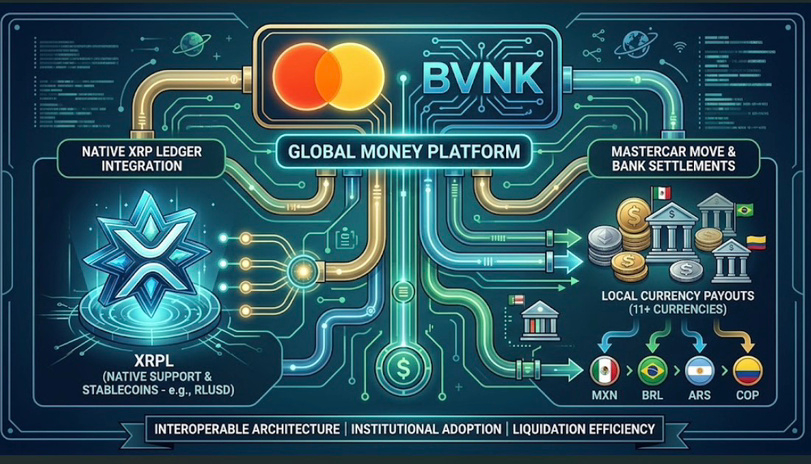
While much of the market watches only the daily candles, financial infrastructure has just taken a giant leap forward. After acquiring crypto payments firm BVNK (for $1.8B), Mastercard officially launched Global Money Platform, connecting stablecoins directly to traditional banking.
How it works:
• Multi-currency accounts: Businesses and fintechs manage fiat money and stablecoins from a single platform, with real-time conversion.
• Direct to local banks: Through Mastercard Move, stablecoin payments are settled directly into bank accounts in 11 initial currencies (including Argentine pesos 🇦🇷, Brazilian reals 🇧🇷, Chilean pesos 🇨🇱, and Colombian pesos 🇨🇴, with a goal of reaching 40+ currencies).
• Global reach: Enables digital balances to be spent across Mastercard's worldwide merchant network.
The platform supports more than 20 blockchains, depending on each transaction's requirements, while BVNK's infrastructure natively integrates $XRP on XRPL (for both deposits and payments), in addition to supporting stablecoins on that network such as $RLUSD (which Mastercard had already enabled as a settlement option). Stablecoins are becoming the quiet engine behind traditional banking, and networks like XRPL are already part of this interoperable infrastructure.
$XRP #Mastercard #Stablecoins
🚨Quiet institutional adoption: Mastercard launches its Global Money Platform
While much of the market watches only the daily candles, financial infrastructure has just taken a giant leap forward. After acquiring crypto payments firm BVNK (for $1.8B), Mastercard officially launched Global Money Platform, connecting stablecoins directly to traditional banking.
How it works:
• Multi-currency accounts: Businesses and fintechs manage fiat money and stablecoins from a single platform, with real-time conversion.
• Direct to local banks: Through Mastercard Move, stablecoin payments are settled directly into bank accounts in 11 initial currencies (including Argentine pesos 🇦🇷, Brazilian reals 🇧🇷, Chilean pesos 🇨🇱, and Colombian pesos 🇨🇴, with a goal of reaching 40+ currencies).
• Global reach: Enables digital balances to be spent across Mastercard's worldwide merchant network.
The platform supports more than 20 blockchains, depending on each transaction's requirements, while BVNK's infrastructure natively integrates $XRP on XRPL (for both deposits and payments), in addition to supporting stablecoins on that network such as $RLUSD (which Mastercard had already enabled as a settlement option). Stablecoins are becoming the quiet engine behind traditional banking, and networks like XRPL are already part of this interoperable infrastructure.
$XRP #Mastercard #Stablecoins
While much of the market watches only the daily candles, financial infrastructure has just taken a giant leap forward. After acquiring crypto payments firm BVNK (for $1.8B), Mastercard officially launched Global Money Platform, connecting stablecoins directly to traditional banking.
How it works:
• Multi-currency accounts: Businesses and fintechs manage fiat money and stablecoins from a single platform, with real-time conversion.
• Direct to local banks: Through Mastercard Move, stablecoin payments are settled directly into bank accounts in 11 initial currencies (including Argentine pesos 🇦🇷, Brazilian reals 🇧🇷, Chilean pesos 🇨🇱, and Colombian pesos 🇨🇴, with a goal of reaching 40+ currencies).
• Global reach: Enables digital balances to be spent across Mastercard's worldwide merchant network.
The platform supports more than 20 blockchains, depending on each transaction's requirements, while BVNK's infrastructure natively integrates $XRP on XRPL (for both deposits and payments), in addition to supporting stablecoins on that network such as $RLUSD (which Mastercard had already enabled as a settlement option). Stablecoins are becoming the quiet engine behind traditional banking, and networks like XRPL are already part of this interoperable infrastructure.
$XRP #Mastercard #Stablecoins
1
849

·
--
Verified
Mastercard beats Q3 estimates as payments and services expand
💳 Mastercard reported Q3 2026 revenue of $9.8 billion, up 14% year over year. Adjusted EPS reached $5.31, exceeding estimates of around $5.16–$5.17.
🛒 Purchase volume rose 9%, suggesting spending remained resilient despite economic uncertainty. However, growth in transaction value does not necessarily imply an equivalent increase in real purchasing power.
🌐 Cross-border volume increased 11%, supporting business performance and reflecting demand for international transactions.
🛡️ Value-added services revenue grew 19%, outpacing the payment network’s 11% growth. This provides another source of growth alongside transaction processing.
🔎 The results support the payments sector’s outlook, while spending resilience remains a key factor to monitor if price pressures and geopolitical uncertainty persist.
#Mastercard $MA.US
Mastercard beats Q3 estimates as payments and services expand
💳 Mastercard reported Q3 2026 revenue of $9.8 billion, up 14% year over year. Adjusted EPS reached $5.31, exceeding estimates of around $5.16–$5.17.
🛒 Purchase volume rose 9%, suggesting spending remained resilient despite economic uncertainty. However, growth in transaction value does not necessarily imply an equivalent increase in real purchasing power.
🌐 Cross-border volume increased 11%, supporting business performance and reflecting demand for international transactions.
🛡️ Value-added services revenue grew 19%, outpacing the payment network’s 11% growth. This provides another source of growth alongside transaction processing.
🔎 The results support the payments sector’s outlook, while spending resilience remains a key factor to monitor if price pressures and geopolitical uncertainty persist.
#Mastercard $MA.US
💳 Mastercard reported Q3 2026 revenue of $9.8 billion, up 14% year over year. Adjusted EPS reached $5.31, exceeding estimates of around $5.16–$5.17.
🛒 Purchase volume rose 9%, suggesting spending remained resilient despite economic uncertainty. However, growth in transaction value does not necessarily imply an equivalent increase in real purchasing power.
🌐 Cross-border volume increased 11%, supporting business performance and reflecting demand for international transactions.
🛡️ Value-added services revenue grew 19%, outpacing the payment network’s 11% growth. This provides another source of growth alongside transaction processing.
🔎 The results support the payments sector’s outlook, while spending resilience remains a key factor to monitor if price pressures and geopolitical uncertainty persist.
#Mastercard $MA.US

MAUS-0.04%
638

·
--
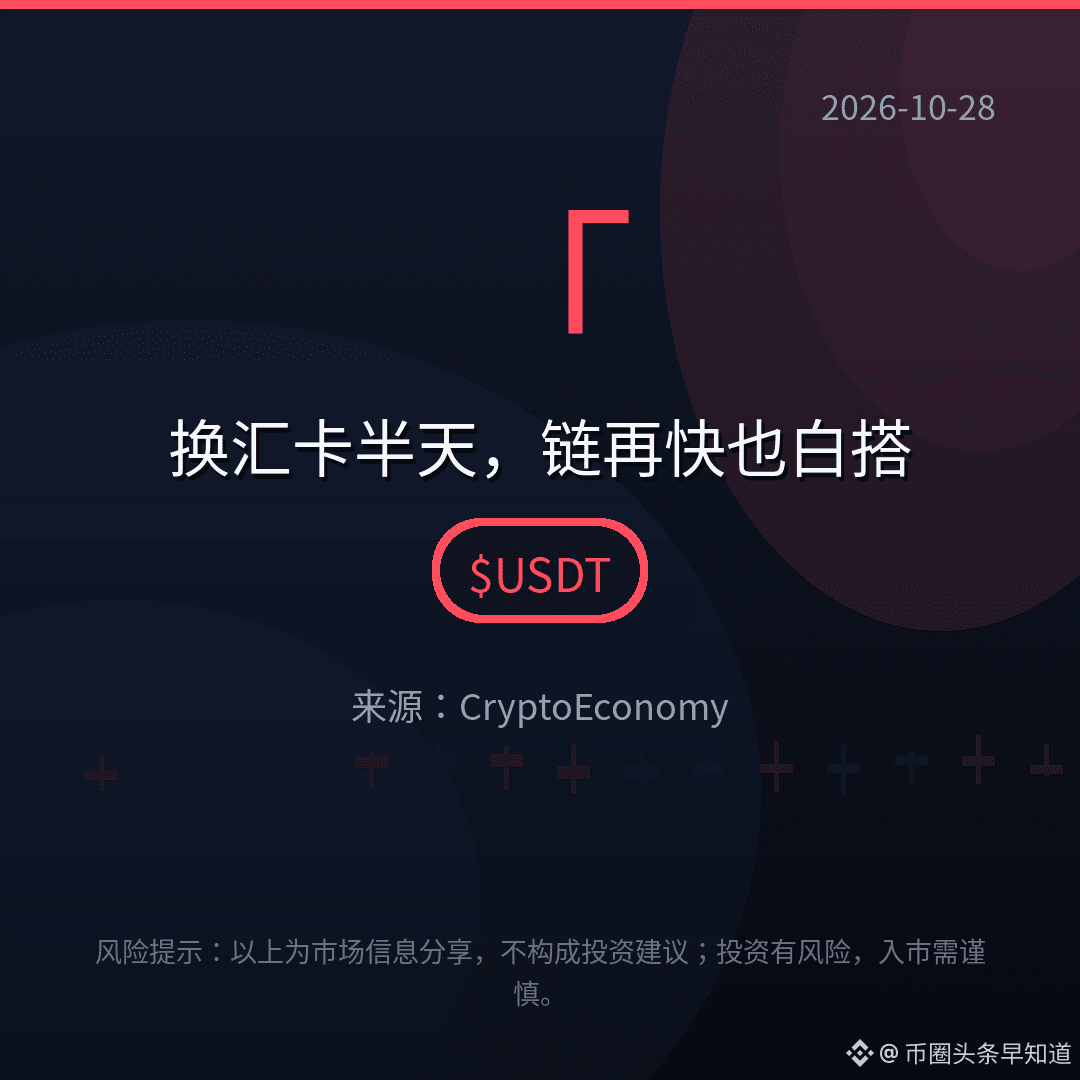
【Market Flash】On-chain transfers arrive in seconds, while currency conversion takes half a day—Mastercard says the quiet part out loud. On October 27, an Asia-Pacific executive told CNBC: “When FX is needed at both ends, a single card—no matter how fast—won’t cut it.” On October 15, Mastercard and BVNK launched the Global Money Platform, connecting FX and local payments through a single API. The missing piece is the last mile. Is this bullish or bearish for $USDT?
$USDT $USDC $XRP
#稳定币 #跨境 #Mastercard
(Source: CryptoEconomy)
⚠️Risk disclaimer: The above is shared for informational purposes only and does not constitute investment advice. Investing involves risks; please exercise caution.
【Market Flash】On-chain transfers arrive in seconds, while currency conversion takes half a day—Mastercard says the quiet part out loud. On October 27, an Asia-Pacific executive told CNBC: “When FX is needed at both ends, a single card—no matter how fast—won’t cut it.” On October 15, Mastercard and BVNK launched the Global Money Platform, connecting FX and local payments through a single API. The missing piece is the last mile. Is this bullish or bearish for $USDT?
$USDT $USDC $XRP
#稳定币 #跨境 #Mastercard
(Source: CryptoEconomy)
⚠️Risk disclaimer: The above is shared for informational purposes only and does not constitute investment advice. Investing involves risks; please exercise caution.
$USDT $USDC $XRP
#稳定币 #跨境 #Mastercard
(Source: CryptoEconomy)
⚠️Risk disclaimer: The above is shared for informational purposes only and does not constitute investment advice. Investing involves risks; please exercise caution.
70

·
--
Mastercard Calls Out the Stablecoin “Sandwich” Bottleneck: Payment Speed Gains Stalled at Conversion
Stablecoins are widely seen as key infrastructure for speeding up payments. But in its first public use of a “sandwich” metaphor, Mastercard pointed out that what often holds efficiency back is not the stablecoin itself, but the conversion processes behind it. This view adds an infrastructure perspective to the current liquidity narrative.
According to CNBC, Mastercard wrote that stablecoins could theoretically enable faster payments, but “slow conversions” in the supporting systems may limit their real-world benefits. The “sandwich” refers to stablecoins being caught between traditional financial infrastructure in the payment chain: if settlement at either end cannot keep pace, the speed gains in the middle are diluted.
This assessment is worth noting because it shifts the discussion away from the grand narrative of whether stablecoins will replace traditional payments and back toward the more practical issue of the real obstacles to adoption at scale. Investors focused on liquidity typically pay attention to where money comes from and where it flows; the efficiency of infrastructure conversions directly determines the friction costs of those flows.
Fundamentally, the value of stablecoins lies not only in the tokens themselves, but also in whether they can integrate seamlessly with bank clearing, merchant acquiring, and cross-border settlement. If conversions are slow, the improvements to the payment experience are diminished—which also helps explain why institutions remain cautious about adoption. It is important to note that this is Mastercard’s expressed view, not hard data. Its perspective leans toward traditional payments and may underestimate stablecoins’ long-term efficiency, so its immediate market impact is limited.
At the market level, views like this typically do not trigger direct asset-price reactions, but they can gradually shape institutional expectations for the stablecoin payments sector. It reminds observers focused on liquidity that the central tension in the stablecoin narrative is shifting from “issuance scale” to “implementation efficiency.”
One counterpoint is that, as a traditional payments giant, Mastercard may have an inclination to protect its existing interests. Meanwhile, several stablecoin payment solutions in the industry already perform well in terms of speed and cost. Whether the “sandwich” bottleneck is widespread remains to be demonstrated with more evidence.
What to watch next: Competition in stablecoin payments will center on continually improving conversion speed and cost. At the trading level, the more important thing is to wait for tangible evidence of infrastructure improvements rather than overinterpreting a single viewpoint.
#Stablecoins #Mastercard #CryptoPayments
The above is a compilation of information and personal analysis, and does not constitute investment advice.
Mastercard Calls Out the Stablecoin “Sandwich” Bottleneck: Payment Speed Gains Stalled at Conversion
Stablecoins are widely seen as key infrastructure for speeding up payments. But in its first public use of a “sandwich” metaphor, Mastercard pointed out that what often holds efficiency back is not the stablecoin itself, but the conversion processes behind it. This view adds an infrastructure perspective to the current liquidity narrative.
According to CNBC, Mastercard wrote that stablecoins could theoretically enable faster payments, but “slow conversions” in the supporting systems may limit their real-world benefits. The “sandwich” refers to stablecoins being caught between traditional financial infrastructure in the payment chain: if settlement at either end cannot keep pace, the speed gains in the middle are diluted.
This assessment is worth noting because it shifts the discussion away from the grand narrative of whether stablecoins will replace traditional payments and back toward the more practical issue of the real obstacles to adoption at scale. Investors focused on liquidity typically pay attention to where money comes from and where it flows; the efficiency of infrastructure conversions directly determines the friction costs of those flows.
Fundamentally, the value of stablecoins lies not only in the tokens themselves, but also in whether they can integrate seamlessly with bank clearing, merchant acquiring, and cross-border settlement. If conversions are slow, the improvements to the payment experience are diminished—which also helps explain why institutions remain cautious about adoption. It is important to note that this is Mastercard’s expressed view, not hard data. Its perspective leans toward traditional payments and may underestimate stablecoins’ long-term efficiency, so its immediate market impact is limited.
At the market level, views like this typically do not trigger direct asset-price reactions, but they can gradually shape institutional expectations for the stablecoin payments sector. It reminds observers focused on liquidity that the central tension in the stablecoin narrative is shifting from “issuance scale” to “implementation efficiency.”
One counterpoint is that, as a traditional payments giant, Mastercard may have an inclination to protect its existing interests. Meanwhile, several stablecoin payment solutions in the industry already perform well in terms of speed and cost. Whether the “sandwich” bottleneck is widespread remains to be demonstrated with more evidence.
What to watch next: Competition in stablecoin payments will center on continually improving conversion speed and cost. At the trading level, the more important thing is to wait for tangible evidence of infrastructure improvements rather than overinterpreting a single viewpoint.
#Stablecoins #Mastercard #CryptoPayments
The above is a compilation of information and personal analysis, and does not constitute investment advice.
Stablecoins are widely seen as key infrastructure for speeding up payments. But in its first public use of a “sandwich” metaphor, Mastercard pointed out that what often holds efficiency back is not the stablecoin itself, but the conversion processes behind it. This view adds an infrastructure perspective to the current liquidity narrative.
According to CNBC, Mastercard wrote that stablecoins could theoretically enable faster payments, but “slow conversions” in the supporting systems may limit their real-world benefits. The “sandwich” refers to stablecoins being caught between traditional financial infrastructure in the payment chain: if settlement at either end cannot keep pace, the speed gains in the middle are diluted.
This assessment is worth noting because it shifts the discussion away from the grand narrative of whether stablecoins will replace traditional payments and back toward the more practical issue of the real obstacles to adoption at scale. Investors focused on liquidity typically pay attention to where money comes from and where it flows; the efficiency of infrastructure conversions directly determines the friction costs of those flows.
Fundamentally, the value of stablecoins lies not only in the tokens themselves, but also in whether they can integrate seamlessly with bank clearing, merchant acquiring, and cross-border settlement. If conversions are slow, the improvements to the payment experience are diminished—which also helps explain why institutions remain cautious about adoption. It is important to note that this is Mastercard’s expressed view, not hard data. Its perspective leans toward traditional payments and may underestimate stablecoins’ long-term efficiency, so its immediate market impact is limited.
At the market level, views like this typically do not trigger direct asset-price reactions, but they can gradually shape institutional expectations for the stablecoin payments sector. It reminds observers focused on liquidity that the central tension in the stablecoin narrative is shifting from “issuance scale” to “implementation efficiency.”
One counterpoint is that, as a traditional payments giant, Mastercard may have an inclination to protect its existing interests. Meanwhile, several stablecoin payment solutions in the industry already perform well in terms of speed and cost. Whether the “sandwich” bottleneck is widespread remains to be demonstrated with more evidence.
What to watch next: Competition in stablecoin payments will center on continually improving conversion speed and cost. At the trading level, the more important thing is to wait for tangible evidence of infrastructure improvements rather than overinterpreting a single viewpoint.
#Stablecoins #Mastercard #CryptoPayments
The above is a compilation of information and personal analysis, and does not constitute investment advice.
46

·
--
Mastercard just opened Early Access so AI agents can pay for digital services — with x402 vouchers and Base settlement.
On October 20, 2026, Mastercard launched Agent Pay for Machines Early Access after end-to-end pilots with Cloudflare, Coinbase, Base, BVNK, Ant International, AIsa, and Hype. The stack builds on open x402: when an agent hits a paid API or model, the seller returns HTTP 402, the agent signs a budget-capped payment voucher, and the seller verifies it before delivering. Vouchers can be batched and redeemed later, so agents keep working without a new billing account for every service.
In the Cloudflare Connect demo, one marketing agent completed nine payments across two merchants inside a single approved budget. Coinbase Developer Platform funded the wallet, Base handled on-chain settlement, and BVNK settled fiat or stablecoins — Cloudflare’s gateway settles x402 in $USDC on Base. Early Access is for developers testing APIs and sandboxes; general commercial availability is not yet announced.
#Mastercard #x402 #USDC #Base #AI $USDC
DYOR. Not financial advice.
{spot}(USDCUSDT)
Mastercard just opened Early Access so AI agents can pay for digital services — with x402 vouchers and Base settlement.
On October 20, 2026, Mastercard launched Agent Pay for Machines Early Access after end-to-end pilots with Cloudflare, Coinbase, Base, BVNK, Ant International, AIsa, and Hype. The stack builds on open x402: when an agent hits a paid API or model, the seller returns HTTP 402, the agent signs a budget-capped payment voucher, and the seller verifies it before delivering. Vouchers can be batched and redeemed later, so agents keep working without a new billing account for every service.
In the Cloudflare Connect demo, one marketing agent completed nine payments across two merchants inside a single approved budget. Coinbase Developer Platform funded the wallet, Base handled on-chain settlement, and BVNK settled fiat or stablecoins — Cloudflare’s gateway settles x402 in $USDC on Base. Early Access is for developers testing APIs and sandboxes; general commercial availability is not yet announced.
#Mastercard #x402 #USDC #Base #AI $USDC
DYOR. Not financial advice.
On October 20, 2026, Mastercard launched Agent Pay for Machines Early Access after end-to-end pilots with Cloudflare, Coinbase, Base, BVNK, Ant International, AIsa, and Hype. The stack builds on open x402: when an agent hits a paid API or model, the seller returns HTTP 402, the agent signs a budget-capped payment voucher, and the seller verifies it before delivering. Vouchers can be batched and redeemed later, so agents keep working without a new billing account for every service.
In the Cloudflare Connect demo, one marketing agent completed nine payments across two merchants inside a single approved budget. Coinbase Developer Platform funded the wallet, Base handled on-chain settlement, and BVNK settled fiat or stablecoins — Cloudflare’s gateway settles x402 in $USDC on Base. Early Access is for developers testing APIs and sandboxes; general commercial availability is not yet announced.
#Mastercard #x402 #USDC #Base #AI $USDC
DYOR. Not financial advice.

1
50

🟠 USDT back on Bitcoin mainnet? Utexo joins Mastercard Crypto Partner Program
On October 21, Utexo announced that it had joined the Mastercard Crypto Partner Program.
Here’s what it’s doing in a nutshell: using the RGB protocol to issue USDT natively on Bitcoin, then using the Lightning Network for settlement. The official pitch is no wrapped tokens or cross-chain bridges—just instant, private USDT payments.
Longtime users may remember that USDT was first issued on Bitcoin via Omni Layer. Later, because of speed and fee issues, everyone moved to Tron and Ethereum. Now someone is giving that route another try.
🔹 The upside: Bitcoin’s security + Lightning’s speed + Mastercard’s payment network. If all three can really be connected, there’s plenty of potential.
🔹 Reasons to stay cautious: “Joining the partner program” is more like getting a ticket in the door. It doesn’t mean Utexo is already connected to Mastercard’s settlement system, and no specific product or timeline has been announced.
My take: The timeline is full of “huge move” posts, and the hype is real. But in payments, there’s only one thing that matters in the end: how many people are actually using it. If you’re used to sending USDT on Tron, what would make you switch to Bitcoin? Fees, transaction speed, and wallet support—all need to be there.
Don’t chase related tokens just because of one partnership announcement. Wait and see whether there’s real payment volume data.
Would you be willing to send and receive USDT on Bitcoin, or would you stick with Tron? Let’s talk in the comments 👇
#USDT #比特币 #稳定币 #Mastercard
🟠 USDT back on Bitcoin mainnet? Utexo joins Mastercard Crypto Partner Program
On October 21, Utexo announced that it had joined the Mastercard Crypto Partner Program.
Here’s what it’s doing in a nutshell: using the RGB protocol to issue USDT natively on Bitcoin, then using the Lightning Network for settlement. The official pitch is no wrapped tokens or cross-chain bridges—just instant, private USDT payments.
Longtime users may remember that USDT was first issued on Bitcoin via Omni Layer. Later, because of speed and fee issues, everyone moved to Tron and Ethereum. Now someone is giving that route another try.
🔹 The upside: Bitcoin’s security + Lightning’s speed + Mastercard’s payment network. If all three can really be connected, there’s plenty of potential.
🔹 Reasons to stay cautious: “Joining the partner program” is more like getting a ticket in the door. It doesn’t mean Utexo is already connected to Mastercard’s settlement system, and no specific product or timeline has been announced.
My take: The timeline is full of “huge move” posts, and the hype is real. But in payments, there’s only one thing that matters in the end: how many people are actually using it. If you’re used to sending USDT on Tron, what would make you switch to Bitcoin? Fees, transaction speed, and wallet support—all need to be there.
Don’t chase related tokens just because of one partnership announcement. Wait and see whether there’s real payment volume data.
Would you be willing to send and receive USDT on Bitcoin, or would you stick with Tron? Let’s talk in the comments 👇
#USDT #比特币 #稳定币 #Mastercard
On October 21, Utexo announced that it had joined the Mastercard Crypto Partner Program.
Here’s what it’s doing in a nutshell: using the RGB protocol to issue USDT natively on Bitcoin, then using the Lightning Network for settlement. The official pitch is no wrapped tokens or cross-chain bridges—just instant, private USDT payments.
Longtime users may remember that USDT was first issued on Bitcoin via Omni Layer. Later, because of speed and fee issues, everyone moved to Tron and Ethereum. Now someone is giving that route another try.
🔹 The upside: Bitcoin’s security + Lightning’s speed + Mastercard’s payment network. If all three can really be connected, there’s plenty of potential.
🔹 Reasons to stay cautious: “Joining the partner program” is more like getting a ticket in the door. It doesn’t mean Utexo is already connected to Mastercard’s settlement system, and no specific product or timeline has been announced.
My take: The timeline is full of “huge move” posts, and the hype is real. But in payments, there’s only one thing that matters in the end: how many people are actually using it. If you’re used to sending USDT on Tron, what would make you switch to Bitcoin? Fees, transaction speed, and wallet support—all need to be there.
Don’t chase related tokens just because of one partnership announcement. Wait and see whether there’s real payment volume data.
Would you be willing to send and receive USDT on Bitcoin, or would you stick with Tron? Let’s talk in the comments 👇
#USDT #比特币 #稳定币 #Mastercard
230

·
--
Mastercard gives AI “pocket money”: early access, not a free-for-allAt Cloudflare Connect, Mastercard launched Agent Pay for Machines in developer early access. In a nutshell: the boss sets the task and budget first, then AI buys services—not just handing a card to a bot.
In the demo, marketing agency Hype gives an agent a budget to plan a protein bar campaign. The agent buys social media research from AIsa and uses Cloudflare AI Gateway to create eight images: nine payments, two merchants, all within one approved budget. Under the hood: x402 (HTTP 402 Payment Required), incubated by Coinbase; wallet infrastructure from Coinbase Developer Platform; and Base for on-chain settlement. BVNK acts as the agent's wallet and uses Mastercard Global Money Platform. Payments can be made in fiat or stablecoins, including $USDC.
Mastercard gives AI “pocket money”: early access, not a free-for-all
At Cloudflare Connect, Mastercard launched Agent Pay for Machines in developer early access. In a nutshell: the boss sets the task and budget first, then AI buys services—not just handing a card to a bot.
In the demo, marketing agency Hype gives an agent a budget to plan a protein bar campaign. The agent buys social media research from AIsa and uses Cloudflare AI Gateway to create eight images: nine payments, two merchants, all within one approved budget. Under the hood: x402 (HTTP 402 Payment Required), incubated by Coinbase; wallet infrastructure from Coinbase Developer Platform; and Base for on-chain settlement. BVNK acts as the agent's wallet and uses Mastercard Global Money Platform. Payments can be made in fiat or stablecoins, including $USDC .
In the demo, marketing agency Hype gives an agent a budget to plan a protein bar campaign. The agent buys social media research from AIsa and uses Cloudflare AI Gateway to create eight images: nine payments, two merchants, all within one approved budget. Under the hood: x402 (HTTP 402 Payment Required), incubated by Coinbase; wallet infrastructure from Coinbase Developer Platform; and Base for on-chain settlement. BVNK acts as the agent's wallet and uses Mastercard Global Money Platform. Payments can be made in fiat or stablecoins, including $USDC .
38

Mastercard is making a massive leap into the future of commerce by enabling AI agents to execute autonomous payments. By demonstrating live ad campaigns managed by AI, they are proving that machine to machine transactions are no longer theoretical. This shift will fundamentally change how digital advertising and automated services operate as AI agents become active economic participants in the global economy.
#Mastercard #AIAgents ⠀
Mastercard is making a massive leap into the future of commerce by enabling AI agents to execute autonomous payments. By demonstrating live ad campaigns managed by AI, they are proving that machine to machine transactions are no longer theoretical. This shift will fundamentally change how digital advertising and automated services operate as AI agents become active economic participants in the global economy.
#Mastercard #AIAgents ⠀
#Mastercard #AIAgents ⠀
15


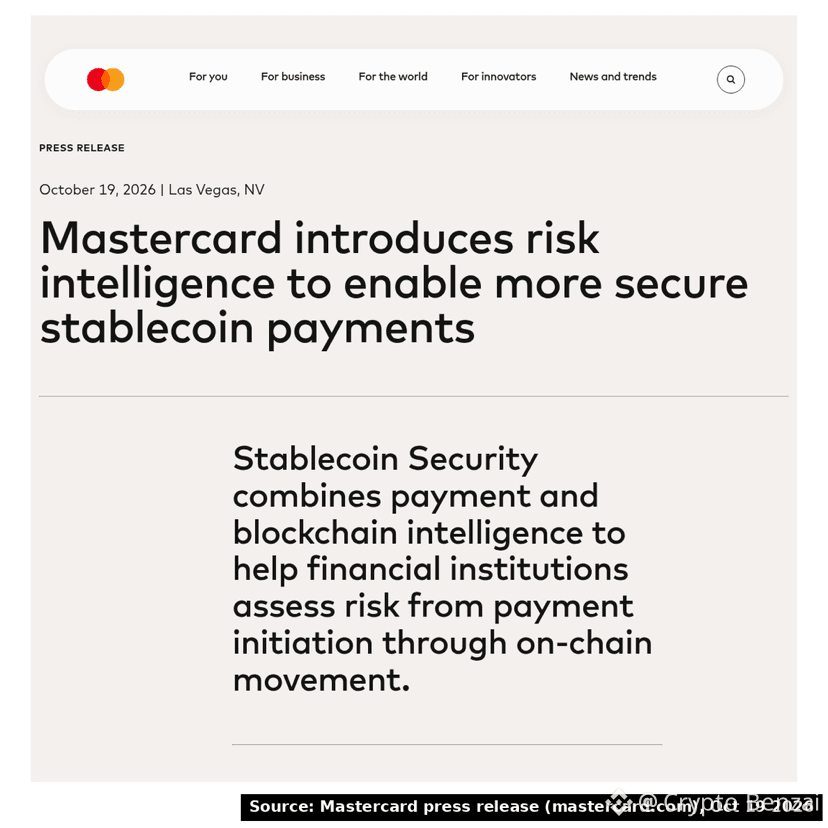
Mastercard unveiled Stablecoin Security at Money20/20 USA. The API mixes payment data with blockchain analytics to flag fraud, scam and sanctions risk and score a payment before it completes. Borderless.xyz and Keyrails are the first partners. North America gets it first, with worldwide availability expected in 2027. $USDC style rails keep getting bank-grade tools.
How long until your bank settles in stablecoins?
#Stablecoins #Payments #Mastercard
Source: Mastercard press release
{spot}(USDCUSDT)
Mastercard unveiled Stablecoin Security at Money20/20 USA. The API mixes payment data with blockchain analytics to flag fraud, scam and sanctions risk and score a payment before it completes. Borderless.xyz and Keyrails are the first partners. North America gets it first, with worldwide availability expected in 2027. $USDC style rails keep getting bank-grade tools.
How long until your bank settles in stablecoins?
#Stablecoins #Payments #Mastercard
Source: Mastercard press release
How long until your bank settles in stablecoins?
#Stablecoins #Payments #Mastercard
Source: Mastercard press release
1
153

#Mastercard
🤖 The era of autonomous economy: Mastercard launches payments for AI agents together with crypto giants!
The future, where artificial intelligence buys its own services and pays for subscriptions without human intervention, is already here. Mastercard announced the launch of the Agent Pay for Machines platform.
This is a payment tool that will allow autonomous AI agents and smart machines to make transactions between themselves using bank cards, accounts and stablecoins.
✨ Key features of the platform:
Microtransactions: AI will be able to carry out operations worth fractions of a cent, which occur automatically in the background.
Flexibility: Support for both traditional fiat and digital assets.
Speed and scale: The system is designed for huge volumes of lightning-fast transactions with ultra-low latency.
🤝 Who's in the game?
More than 30 leading technology and crypto companies have already joined the initiative, including Coinbase, RippleX, Stripe, Polygon, Cloudflare, OKX, Solana Foundation, and Aave Labs.
💼 Mastercard’s Big Crypto Focus in 2026
This launch is a logical step in the payment giant’s massive expansion into the digital asset market. This year alone, the company:
1️⃣ Launched a Crypto Partner Program with over 85 partners (including Binance and PayPal).
2️⃣ Acquired infrastructure firm BVNK for $1.8 billion to expand its stablecoin payments.
3️⃣ Integrated support for regulated stablecoins USDC from Circle and RLUSD from Ripple.
{future}(XRPUSDT)
{future}(BTCUSDT)
{future}(ETHUSDT)
#Mastercard
🤖 The era of autonomous economy: Mastercard launches payments for AI agents together with crypto giants!
The future, where artificial intelligence buys its own services and pays for subscriptions without human intervention, is already here. Mastercard announced the launch of the Agent Pay for Machines platform.
This is a payment tool that will allow autonomous AI agents and smart machines to make transactions between themselves using bank cards, accounts and stablecoins.
✨ Key features of the platform:
Microtransactions: AI will be able to carry out operations worth fractions of a cent, which occur automatically in the background.
Flexibility: Support for both traditional fiat and digital assets.
Speed and scale: The system is designed for huge volumes of lightning-fast transactions with ultra-low latency.
🤝 Who's in the game?
More than 30 leading technology and crypto companies have already joined the initiative, including Coinbase, RippleX, Stripe, Polygon, Cloudflare, OKX, Solana Foundation, and Aave Labs.
💼 Mastercard’s Big Crypto Focus in 2026
This launch is a logical step in the payment giant’s massive expansion into the digital asset market. This year alone, the company:
1️⃣ Launched a Crypto Partner Program with over 85 partners (including Binance and PayPal).
2️⃣ Acquired infrastructure firm BVNK for $1.8 billion to expand its stablecoin payments.
3️⃣ Integrated support for regulated stablecoins USDC from Circle and RLUSD from Ripple.
🤖 The era of autonomous economy: Mastercard launches payments for AI agents together with crypto giants!
The future, where artificial intelligence buys its own services and pays for subscriptions without human intervention, is already here. Mastercard announced the launch of the Agent Pay for Machines platform.
This is a payment tool that will allow autonomous AI agents and smart machines to make transactions between themselves using bank cards, accounts and stablecoins.
✨ Key features of the platform:
Microtransactions: AI will be able to carry out operations worth fractions of a cent, which occur automatically in the background.
Flexibility: Support for both traditional fiat and digital assets.
Speed and scale: The system is designed for huge volumes of lightning-fast transactions with ultra-low latency.
🤝 Who's in the game?
More than 30 leading technology and crypto companies have already joined the initiative, including Coinbase, RippleX, Stripe, Polygon, Cloudflare, OKX, Solana Foundation, and Aave Labs.
💼 Mastercard’s Big Crypto Focus in 2026
This launch is a logical step in the payment giant’s massive expansion into the digital asset market. This year alone, the company:
1️⃣ Launched a Crypto Partner Program with over 85 partners (including Binance and PayPal).
2️⃣ Acquired infrastructure firm BVNK for $1.8 billion to expand its stablecoin payments.
3️⃣ Integrated support for regulated stablecoins USDC from Circle and RLUSD from Ripple.

1
127

·
--
🚨 BIG MOVE FOR CRYPTO ADOPTION! 🚨
Mastercard is expanding its settlement network to support regulated stablecoins, including $USDC, $RLUSD, and $PYUSD.
The integration spans major blockchains like Ethereum, Solana, Base, Arbitrum, and XRPL, bringing stablecoins one step closer to mainstream global payments.
Institutional adoption is accelerating, and the bridge between traditional finance and crypto is getting stronger than ever. 🔥💳🌍$ETH $SOL $XRP $ARB
#ETH #Adoption #stablecoin #Mastercard
🚨 BIG MOVE FOR CRYPTO ADOPTION! 🚨
Mastercard is expanding its settlement network to support regulated stablecoins, including $USDC, $RLUSD, and $PYUSD.
The integration spans major blockchains like Ethereum, Solana, Base, Arbitrum, and XRPL, bringing stablecoins one step closer to mainstream global payments.
Institutional adoption is accelerating, and the bridge between traditional finance and crypto is getting stronger than ever. 🔥💳🌍$ETH $SOL $XRP $ARB
#ETH #Adoption #stablecoin #Mastercard
Mastercard is expanding its settlement network to support regulated stablecoins, including $USDC, $RLUSD, and $PYUSD.
The integration spans major blockchains like Ethereum, Solana, Base, Arbitrum, and XRPL, bringing stablecoins one step closer to mainstream global payments.
Institutional adoption is accelerating, and the bridge between traditional finance and crypto is getting stronger than ever. 🔥💳🌍$ETH $SOL $XRP $ARB
#ETH #Adoption #stablecoin #Mastercard

3
1
3
102

·
--
🚨 Mastercard Expands Stablecoin Support to Include USDC, PYUSD, and RLUSD:
💳 Payments giant Mastercard has announced new settlement capabilities utilizing major stablecoins like USDC, PYUSD, RLUSD, and other leading pegged assets.
🔗 This newly integrated support will cover a wide range of multi-chain settlement options across various blockchain networks.
💰 The move highlights a major shift by institutional giants toward adopting decentralized ledger technology to optimize global payment processing.
📊 Stablecoin-based settlements offer near-instant transaction finality and drastically reduced costs compared to legacy cross-border payment networks.
💡 The Bottom Line: Mastercard is opening the door to faster, cheaper global transactions by unlocking native stablecoin settlements across multiple blockchains, further accelerating the convergence of traditional finance and Web3.
$USDC #Mastercard #USDCstablecoin #PYUSD #RLUSD #StablecoinRevolution
🚨 Mastercard Expands Stablecoin Support to Include USDC, PYUSD, and RLUSD:
💳 Payments giant Mastercard has announced new settlement capabilities utilizing major stablecoins like USDC, PYUSD, RLUSD, and other leading pegged assets.
🔗 This newly integrated support will cover a wide range of multi-chain settlement options across various blockchain networks.
💰 The move highlights a major shift by institutional giants toward adopting decentralized ledger technology to optimize global payment processing.
📊 Stablecoin-based settlements offer near-instant transaction finality and drastically reduced costs compared to legacy cross-border payment networks.
💡 The Bottom Line: Mastercard is opening the door to faster, cheaper global transactions by unlocking native stablecoin settlements across multiple blockchains, further accelerating the convergence of traditional finance and Web3.
$USDC #Mastercard #USDCstablecoin #PYUSD #RLUSD #StablecoinRevolution
💳 Payments giant Mastercard has announced new settlement capabilities utilizing major stablecoins like USDC, PYUSD, RLUSD, and other leading pegged assets.
🔗 This newly integrated support will cover a wide range of multi-chain settlement options across various blockchain networks.
💰 The move highlights a major shift by institutional giants toward adopting decentralized ledger technology to optimize global payment processing.
📊 Stablecoin-based settlements offer near-instant transaction finality and drastically reduced costs compared to legacy cross-border payment networks.
💡 The Bottom Line: Mastercard is opening the door to faster, cheaper global transactions by unlocking native stablecoin settlements across multiple blockchains, further accelerating the convergence of traditional finance and Web3.
$USDC #Mastercard #USDCstablecoin #PYUSD #RLUSD #StablecoinRevolution
1
122

Mastercard is bringing stablecoins like PYUSD and RLUSD into its settlement system, and they're backing weekend settlements—this is a signal worth watching: traditional payment networks are pushing stablecoins from "on-chain assets" to tools that are more aligned with everyday business settlements.
The focus isn't just on adding a few more coins; it's about extending settlement times into the weekend, which could boost cross-border payments, merchant collections, and liquidity efficiency. In the stablecoin race, the next moves to watch aren’t about concepts anymore, but who can actually integrate into payment scenarios, compliance frameworks, and user networks.
#稳定币 #Mastercard #crypto payments
Mastercard is bringing stablecoins like PYUSD and RLUSD into its settlement system, and they're backing weekend settlements—this is a signal worth watching: traditional payment networks are pushing stablecoins from "on-chain assets" to tools that are more aligned with everyday business settlements.
The focus isn't just on adding a few more coins; it's about extending settlement times into the weekend, which could boost cross-border payments, merchant collections, and liquidity efficiency. In the stablecoin race, the next moves to watch aren’t about concepts anymore, but who can actually integrate into payment scenarios, compliance frameworks, and user networks.
#稳定币 #Mastercard #crypto payments
The focus isn't just on adding a few more coins; it's about extending settlement times into the weekend, which could boost cross-border payments, merchant collections, and liquidity efficiency. In the stablecoin race, the next moves to watch aren’t about concepts anymore, but who can actually integrate into payment scenarios, compliance frameworks, and user networks.
#稳定币 #Mastercard #crypto payments
39
Verified
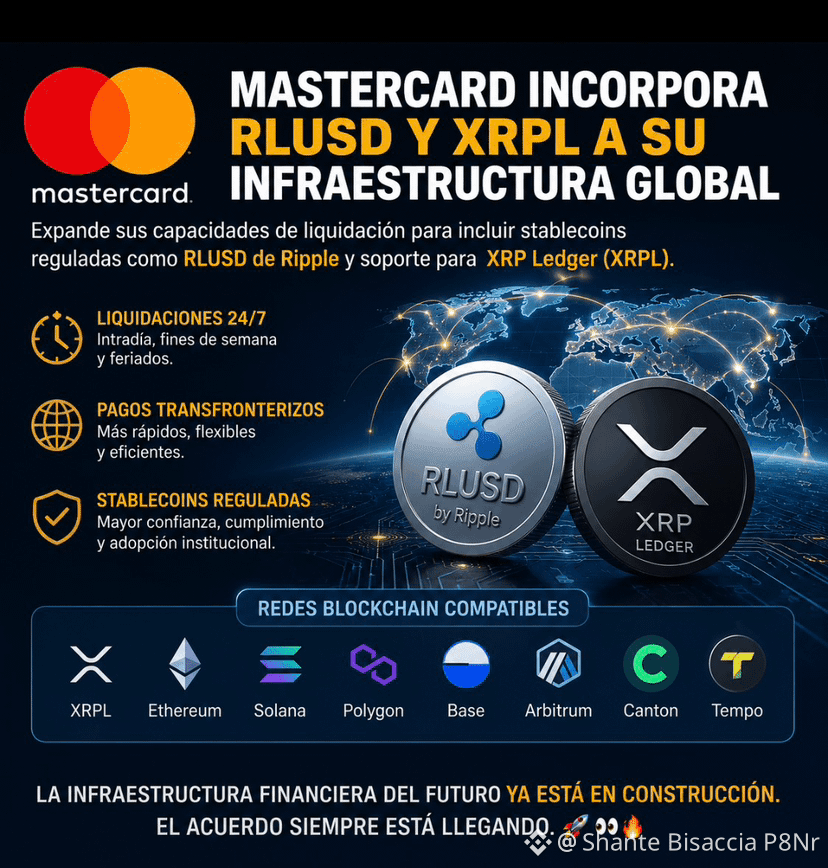
🚨 Mastercard adds RLUSD and XRPL, among others, to its global settlement infrastructure.
Mastercard announced the expansion of its settlement capabilities to include regulated stablecoins, including Ripple's RLUSD, and support for the XRP Ledger (XRPL).
The company aims to offer faster and more flexible settlements, including intraday operations, weekends, and holidays, moving towards a financial system available 24/7. According to Mastercard, this initiative is focused on cross-border payments, treasury, and money movements that require greater speed and efficiency.
In addition to XRPL, Mastercard will work with other blockchain networks like Ethereum, Solana, Polygon, Base, Arbitrum, Canton, and Tempo, showcasing a multi-network strategy for integrating digital assets into its global structure.
This shows that major companies are gradually incorporating blockchain into their current payment infrastructures.
$ETH $XRP $SOL #RLUSD #Mastercard #Blockchain #CryptoNews
🚨 Mastercard adds RLUSD and XRPL, among others, to its global settlement infrastructure.
Mastercard announced the expansion of its settlement capabilities to include regulated stablecoins, including Ripple's RLUSD, and support for the XRP Ledger (XRPL).
The company aims to offer faster and more flexible settlements, including intraday operations, weekends, and holidays, moving towards a financial system available 24/7. According to Mastercard, this initiative is focused on cross-border payments, treasury, and money movements that require greater speed and efficiency.
In addition to XRPL, Mastercard will work with other blockchain networks like Ethereum, Solana, Polygon, Base, Arbitrum, Canton, and Tempo, showcasing a multi-network strategy for integrating digital assets into its global structure.
This shows that major companies are gradually incorporating blockchain into their current payment infrastructures.
$ETH $XRP $SOL #RLUSD #Mastercard #Blockchain #CryptoNews
Mastercard announced the expansion of its settlement capabilities to include regulated stablecoins, including Ripple's RLUSD, and support for the XRP Ledger (XRPL).
The company aims to offer faster and more flexible settlements, including intraday operations, weekends, and holidays, moving towards a financial system available 24/7. According to Mastercard, this initiative is focused on cross-border payments, treasury, and money movements that require greater speed and efficiency.
In addition to XRPL, Mastercard will work with other blockchain networks like Ethereum, Solana, Polygon, Base, Arbitrum, Canton, and Tempo, showcasing a multi-network strategy for integrating digital assets into its global structure.
This shows that major companies are gradually incorporating blockchain into their current payment infrastructures.
$ETH $XRP $SOL #RLUSD #Mastercard #Blockchain #CryptoNews
4
1.4k

·
--

Article
Urgent: New data reveals Mastercard's entry into the DeFi world.. Settling transactions with stablecoins across 8 networksIn a surprising move that shook the foundations of the traditional financial system, Mastercard officially announced the expansion of its global card settlement network to support regulated stablecoins, enabling on-chain transaction settlements around the clock.
📊 Market signal breakdown and supported networks:
💳 Historic liquidity integration: The new feature allows for local and instant payment settlements using major currencies like $USDC and $PYUSD, along with the anticipated token $RLUSD .
Urgent: New data reveals Mastercard's entry into the DeFi world.. Settling transactions with stablecoins across 8 networks
In a surprising move that shook the foundations of the traditional financial system, Mastercard officially announced the expansion of its global card settlement network to support regulated stablecoins, enabling on-chain transaction settlements around the clock.
📊 Market signal breakdown and supported networks:
💳 Historic liquidity integration: The new feature allows for local and instant payment settlements using major currencies like $USDC and $PYUSD, along with the anticipated token $RLUSD .
📊 Market signal breakdown and supported networks:
💳 Historic liquidity integration: The new feature allows for local and instant payment settlements using major currencies like $USDC and $PYUSD, along with the anticipated token $RLUSD .
3
141

·
--
🚨 MASTERCARD LAUNCHES 24/7 SETTLEMENT WITH USDC, PYUSD AND RLUSD
Mastercard is expanding settlement to support regulated stablecoins on-chain, including on weekends and holidays.
Supported assets will include Circle's
$USDC, Paxos' $PYUSD, $USDG, $USDP, and Ripple's $RLUSD
& $SoFiUSD. Early users include Cross River, Lead Bank, CBW Bank, ARQ and Nuvei.
{spot}(RLUSDUSDT)
#Mastercard #RLUSD #stablecoin #USDC
🚨 MASTERCARD LAUNCHES 24/7 SETTLEMENT WITH USDC, PYUSD AND RLUSD
Mastercard is expanding settlement to support regulated stablecoins on-chain, including on weekends and holidays.
Supported assets will include Circle's
$USDC, Paxos' $PYUSD, $USDG, $USDP, and Ripple's $RLUSD
& $SoFiUSD. Early users include Cross River, Lead Bank, CBW Bank, ARQ and Nuvei.
#Mastercard #RLUSD #stablecoin #USDC
Mastercard is expanding settlement to support regulated stablecoins on-chain, including on weekends and holidays.
Supported assets will include Circle's
$USDC, Paxos' $PYUSD, $USDG, $USDP, and Ripple's $RLUSD
& $SoFiUSD. Early users include Cross River, Lead Bank, CBW Bank, ARQ and Nuvei.
#Mastercard #RLUSD #stablecoin #USDC


2
110

·
--
Bullish
Partly True
The PayFi Connection with Card Giants
The launch of Orbit Plus Consumer Gateway in Southeast Asia, integrated with #Visa and #Mastercard , takes VELO out of the "tech promise" category and places it directly into the realm of massive transactional infrastructure.
Southeast Asia (countries like Thailand, the Philippines, Indonesia) is the region with the highest adoption of digital payments and crypto on the planet, driven by a vast population that doesn’t use traditional banks but does own smartphones.
Orbit Plus isn’t here to compete in a saturated market; it’s here to capture the cash flow of millions of users who are already using digital wallets daily.
The native integration with Visa and Mastercard means that users pay with their crypto balance in the app, the card network processes the payment through its existing POS terminals, and the merchant receives local currency instantly. Zero friction, invisible adoption.
The role of $VELO : Every time someone buys a coffee, pays for a service, or transfers money using Orbit Plus, the system automatically buys and sells VELO in the background to settle the transaction.
Institutional money is eyeing the integration with existing financial rails (Visa/Mastercard) and the capture of real cash flow.
$VELO positions itself as one of the key plumbing systems for liquidity in Asia.
The PayFi Connection with Card Giants
The launch of Orbit Plus Consumer Gateway in Southeast Asia, integrated with #Visa and #Mastercard , takes VELO out of the "tech promise" category and places it directly into the realm of massive transactional infrastructure.
Southeast Asia (countries like Thailand, the Philippines, Indonesia) is the region with the highest adoption of digital payments and crypto on the planet, driven by a vast population that doesn’t use traditional banks but does own smartphones.
Orbit Plus isn’t here to compete in a saturated market; it’s here to capture the cash flow of millions of users who are already using digital wallets daily.
The native integration with Visa and Mastercard means that users pay with their crypto balance in the app, the card network processes the payment through its existing POS terminals, and the merchant receives local currency instantly. Zero friction, invisible adoption.
The role of $VELO : Every time someone buys a coffee, pays for a service, or transfers money using Orbit Plus, the system automatically buys and sells VELO in the background to settle the transaction.
Institutional money is eyeing the integration with existing financial rails (Visa/Mastercard) and the capture of real cash flow.
$VELO positions itself as one of the key plumbing systems for liquidity in Asia.
The launch of Orbit Plus Consumer Gateway in Southeast Asia, integrated with #Visa and #Mastercard , takes VELO out of the "tech promise" category and places it directly into the realm of massive transactional infrastructure.
Southeast Asia (countries like Thailand, the Philippines, Indonesia) is the region with the highest adoption of digital payments and crypto on the planet, driven by a vast population that doesn’t use traditional banks but does own smartphones.
Orbit Plus isn’t here to compete in a saturated market; it’s here to capture the cash flow of millions of users who are already using digital wallets daily.
The native integration with Visa and Mastercard means that users pay with their crypto balance in the app, the card network processes the payment through its existing POS terminals, and the merchant receives local currency instantly. Zero friction, invisible adoption.
The role of $VELO : Every time someone buys a coffee, pays for a service, or transfers money using Orbit Plus, the system automatically buys and sells VELO in the background to settle the transaction.
Institutional money is eyeing the integration with existing financial rails (Visa/Mastercard) and the capture of real cash flow.
$VELO positions itself as one of the key plumbing systems for liquidity in Asia.
11
1.7k
·
--
$LINK
💥MASTERCARD & CHAINLINK ARE BRINGING 3.5 BILLION CARDHOLDERS DIRECTLY ONCHAIN.
THIS LETS EVERYDAY USERS BUY DIGITAL ASSETS DIRECTLY ON DECENTRALIZED EXCHANGES USING TRADITIONAL PAYMENT CARDS.
POWERED BY CHAINLINK INFRASTRUCTURE, UNISWAP LIQUIDITY, AND ZERO HASH COMPLIANCE, THIS OFFICIALLY BRIDGES TRADFI AND DEFI FOR THE MASSES.
#Mastercard #LINK #TradFiToDeFi #crypto
$LINK
💥MASTERCARD & CHAINLINK ARE BRINGING 3.5 BILLION CARDHOLDERS DIRECTLY ONCHAIN.
THIS LETS EVERYDAY USERS BUY DIGITAL ASSETS DIRECTLY ON DECENTRALIZED EXCHANGES USING TRADITIONAL PAYMENT CARDS.
POWERED BY CHAINLINK INFRASTRUCTURE, UNISWAP LIQUIDITY, AND ZERO HASH COMPLIANCE, THIS OFFICIALLY BRIDGES TRADFI AND DEFI FOR THE MASSES.
#Mastercard #LINK #TradFiToDeFi #crypto
💥MASTERCARD & CHAINLINK ARE BRINGING 3.5 BILLION CARDHOLDERS DIRECTLY ONCHAIN.
THIS LETS EVERYDAY USERS BUY DIGITAL ASSETS DIRECTLY ON DECENTRALIZED EXCHANGES USING TRADITIONAL PAYMENT CARDS.
POWERED BY CHAINLINK INFRASTRUCTURE, UNISWAP LIQUIDITY, AND ZERO HASH COMPLIANCE, THIS OFFICIALLY BRIDGES TRADFI AND DEFI FOR THE MASSES.
#Mastercard #LINK #TradFiToDeFi #crypto

1
166
Log in to explore more content
Join global crypto users on Binance Square
⚡️ Get latest and useful information about crypto.
💬 Trusted by the world’s largest crypto exchange.
👍 Discover real insights from verified creators.
Email / Phone number
Trending Topics
1
#NvidiaLoses$2.7TrillionInMonthAndAHalf
19,130 views
120 Discussing
2
#CanBTCReboundAfterFallingBelow60K?
762,868 views
2,986 Discussing
3
#GlobalStocksFaceLongestLosingStreakSince2023
277,266 views
1,988 Discussing
4
#BlackRockIBITPostsRecord$541MSingleDayOutflow
32,865 views
91 Discussing
5
#AnthropicPlungesTowardIPOPriceonDay2
141,817 views
1,212 Discussing
6
#TwentyOneCapitalAdds172.25BTC
64,899 views
662 Discussing
7
#HKBillWouldExcludeTokenizedDepositsFromVirtualAssets
8,306 views
50 Discussing
8
#BNBDropsBelow540USDTWith8.46%DailyDecline
77,451 views
651 Discussing
9
#HKBillProposesHK$100KFineForUnauthorizedCryptoTitles
2,590 views
22 Discussing
10
#BitMineFaces$10.1BUnrealizedETHLoss
5,462 views
28 Discussing