
#moneyhabits
moneyhabits
5,857 views
13 Discussing
Hot
Latest

Money Habits That Build Wealth
Most people think wealth comes from one big win — one lucky trade, one perfect coin. In my experience, it almost never works that way. Wealth is built quietly, by small habits repeated every single day.
Here is what the habit looks like in real life:
✅ Pay yourself first — set aside a fixed amount from every income before you spend anything
✅ Risk only money you can afford to lose, and never trade with borrowed money
✅ Keep a simple record of every trade and every expense, so you can see where your money actually goes
❌ Never spend your profit the same day you make it — that is how traders stay broke
❌ Never keep your whole savings on one exchange or in one coin
One mistake I see again and again: treating trading profit like free money. You win a trade, feel rich, and buy something you do not need — then the next loss comes, and there is nothing left to trade with. The traders who last are not the ones who win the most. They are the ones who protect their capital and let it grow slowly, month after month.
Success does not come in one day. It comes from discipline, patience, risk management and learning every day.
Education Only — Not Financial Advice (NFA). Trading involves risk.
Follow Profit Direction for more signals, best signals and market updates. Like this post and share your opinion in the comments.
Which money habit do you find hardest — saving first, or not spending your profit right away? Tell me in the comments.
#TradingTips #CryptoTrading #MoneyHabits #WealthMindset #ProfitDirection

1
Money Habits That Build Wealth
I used to think building wealth was about one big winning trade. It is not. It is about small money habits, repeated every day, that most people skip because they look boring.
One habit changed everything for me: I pay myself first. Before I spend on anything else, I set aside a fixed part of whatever I earn — even a small amount — and I do not touch it for trading or for fun. That one rule stopped the cycle of earning, spending everything, and starting from zero again.
✅ Do: decide a fixed saving amount and move it aside the day money comes in.
✅ Do: keep trading money and living money in separate places, so a bad trade never eats your rent.
✅ Do: track where your money goes for one month — most people are surprised by the leaks.
❌ Don't: spend first and save "whatever is left" — there is never anything left.
❌ Don't: borrow money to trade or to buy crypto. Borrowed money turns a small loss into a real problem.
Success does not come in one day. It comes from discipline, patience, risk management, and learning every day.
Education Only — Not Financial Advice (NFA). Trading involves risk.
Follow Profit Direction for more signals, best signals and market updates. Like this post and share your opinion in the comments.
What is the one money habit you wish you had started a year ago? Tell us in the comments.
#TradingTips #CryptoTrading #SuccessMindset #MoneyHabits

5


The Diwali bonus is the easiest money of the year to waste, because it arrives with a reason to spend it attached.
The one rule that works: decide the split before the money lands. Once it is in the account, every shop has a plan for it. Before that, you do.
The split I use for any lump sum, bonus or not:
A third to the cushion. Emergency fund if it is below six months. If the fund is full, the most expensive loan, usually the credit card or a personal loan. Paying off 18% debt is an 18% return, guaranteed, tax free. No fund offers that.
A third to the long bucket. Index fund, PPF top up, a one time Bitcoin buy sized like a month of SIP, not like a lottery ticket. Money that you will not see again until it has doubled.
A third to Diwali. Gifts, the trip, the one thing you wanted all year. Spent without guilt, because the other two thirds already did their job.
The mistake I made for years: spending the whole bonus and telling myself the SIP covers the investing. The SIP covers the salary. The bonus was the only money that could have moved the needle, and it went into a phone I replaced eighteen months later.
Bonus coming this week? Write the three numbers now, before it arrives.
What is your bonus split this year? Thirds, or something else?
Education only, not financial advice.
$BTC #Diwali #PersonalFinance #MoneyHabits
2
467
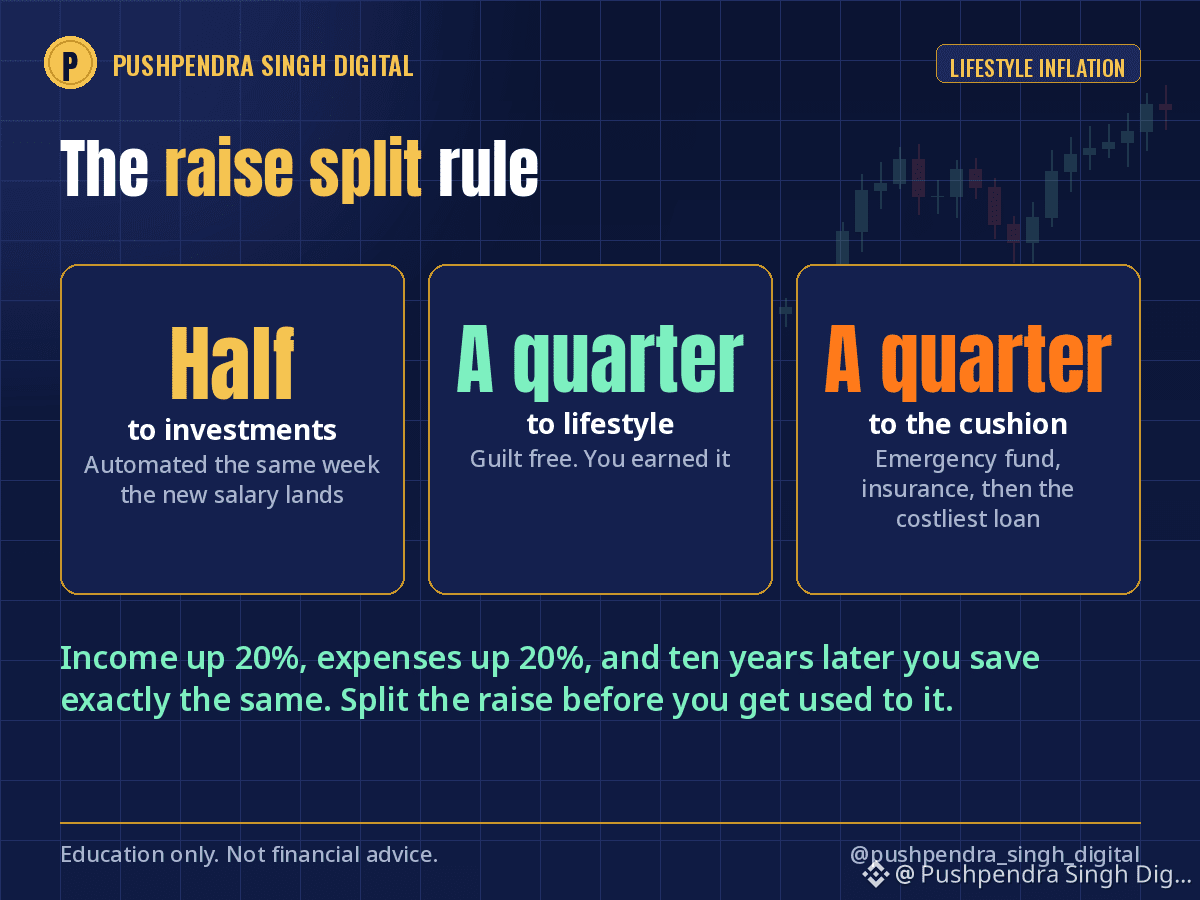
Bonus and increment letters land this season, and with them the most expensive sentence in personal finance: "I deserve it."
Lifestyle inflation is simple. Income goes up 20%, expenses go up 20%, and ten years later you earn three times more and save exactly the same. I did this between my first and third jobs. The bigger flat, the car EMI, the better phone every year. Savings rate: unchanged.
The rule that fixed it, the raise split rule:
Half of every raise goes to investments, automated the same week the new salary lands. SIP increase, EPF voluntary contribution, a monthly Bitcoin buy. It never reaches the spending account.
A quarter goes to lifestyle, guilt free. You did earn it.
A quarter goes to the cushion: emergency fund until it reaches six months, then insurance upgrades, then prepaying the most expensive loan.
The maths over a career: someone who saves half of every raise ends up with a savings rate of 40% or more by their mid thirties without ever feeling a cut, because they never had the money to begin with.
Your next raise is the easiest money you will ever invest. You are not used to it yet.
What did you do with your last raise?
Education only, not financial advice.
$BTC #PersonalFinance #LifestyleInflation #MoneyHabits
1
4
532
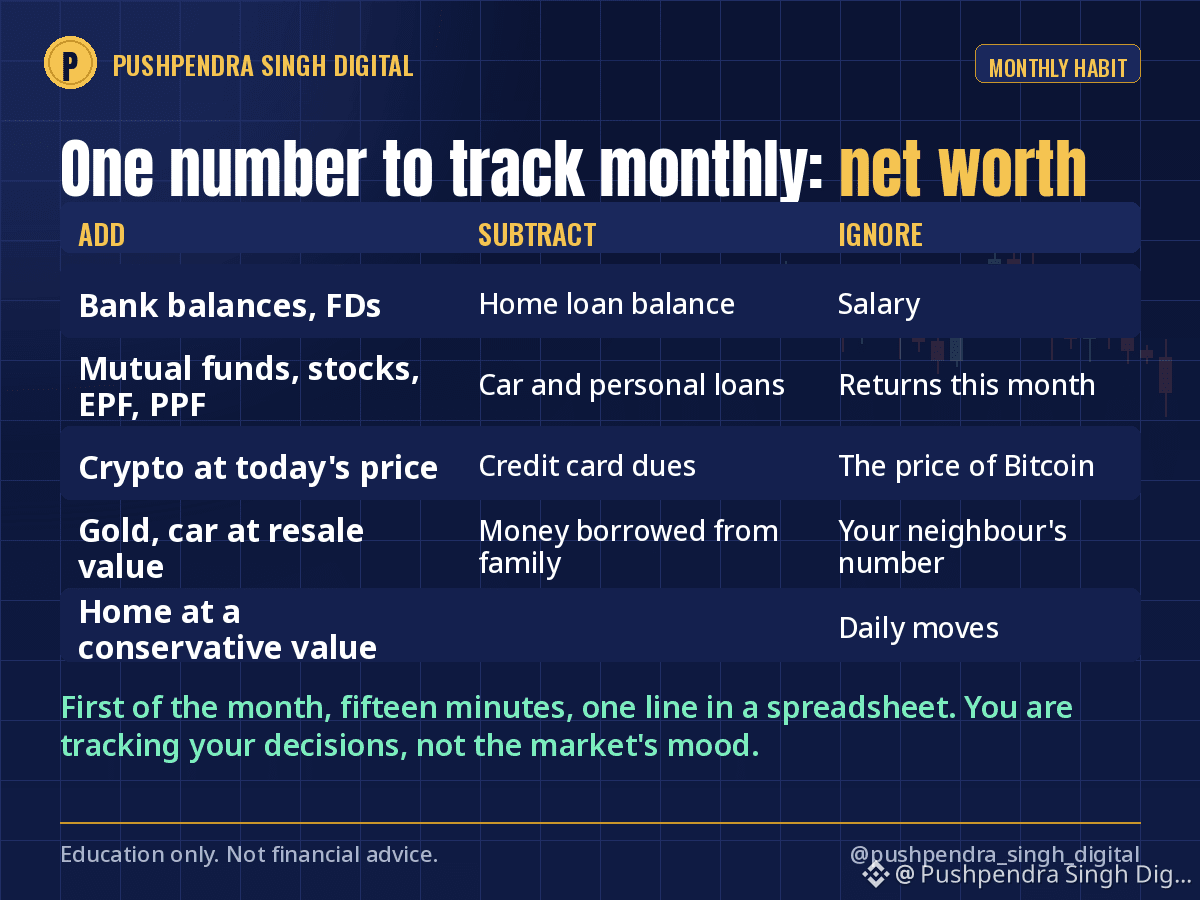
It is the first of the month. If you track one number about your money, make it net worth. Everything you own minus everything you owe. Once a month, same date, one line in a spreadsheet.
What goes in:
Assets: bank balances, fixed deposits, mutual funds, stocks, EPF and PPF, crypto at today's price, gold, the car at resale value, the home at a conservative value.
Liabilities: home loan balance, car loan, personal loans, credit card dues, money borrowed from family.
What stays out: salary, returns, and the price of Bitcoin. Income is not wealth. A 20% return on 5% of your money is a rounding error.
Why monthly and not daily: daily is noise. Monthly shows the direction, and after a year you will see what actually moved the number. In my case it was never a trade. It was the savings rate and one loan I finished early.
The honest part: including crypto at today's price means the number will swing. Mine fell for three months after last October's top and I kept recording it. That is the point. You are tracking your decisions, not the market's mood.
First of the month, fifteen minutes, one number. It is the quietest habit with the loudest result. Today is a good day to start.
Do you know your net worth today, within 10%?
Education only, not financial advice.
$BTC #NetWorth #PersonalFinance #MoneyHabits
3
581
Money Habits That Build Wealth
Wealth is rarely built by one big win. It is built by small money habits, repeated every day — in life, in business, and in trading. The people who keep their money are usually not the ones who earn the most, but the ones who manage it best.
Do this:
✅ Spend less than you earn, and save a little from every income, no matter how small.
✅ Keep a safety buffer, so one bad week or one losing trade does not force you into panic.
✅ Risk only a small amount on each trade, and never use money you cannot afford to lose.
✅ Track where your money goes, and review your week honestly — what worked and what did not.
Do NOT do this:
❌ Do not buy at a FOMO peak just because everyone else is rushing in.
❌ Do not panic sell a good plan just because the price moves against you for a few minutes.
❌ Do not borrow or use too much leverage to recover a loss — revenge trading usually makes it worse.
❌ Do not skip your stop-loss because you hope the price will come back.
One common mistake, explained simply: spending the profit before it is real. A trader makes a small profit, immediately increases the trade size and lifestyle spending, and then one normal loss wipes out weeks of gains. The better habit is simple: protect the profit first, keep the size small, and let steady habits add up over time.
Success does not come in one day. It comes from discipline, patience, risk management and learning every day.
Education Only — Not Financial Advice (NFA). Trading involves risk.
Follow Profit Direction for more signals, best signals and market updates. Like this post and share your opinion in the comments.
#TradingTips #CryptoTrading #SuccessMindset #MoneyHabits

39
Money Habits That Build Wealth
Wealth is rarely built by one big win. It is built by small money habits, repeated every day, in trading and in life. The people who stay wealthy are usually not the ones who earned the most in one day — they are the ones who protected what they earned and let it grow slowly.
✅ DO this:
• Pay yourself first — set aside a small part of every income before you spend the rest.
• Spend less than you earn, and keep a safety buffer for bad days.
• Write down where your money goes, so leaks like impulse buying become visible.
• Learn before you invest, and only risk money you can afford to lose.
❌ DON'T do this:
• Don't borrow money to trade, and don't use leverage you do not fully understand.
• Don't chase a coin, a deal, or a lifestyle just because others are showing it off.
• Don't spend a profit the same day you make it — a kept profit is real wealth.
One common mistake, explained simply: living on tomorrow's money. Many people buy on credit or trade with borrowed funds when the market looks exciting, then a normal fall wipes out both the profit and the original money. Wealth grows the other way round: earn, save a little, learn a little, and repeat. Small, boring habits beat big, risky bets over time.
Remember: success does not come in one day. It comes from discipline, patience, risk management and learning every day.
Education Only — Not Financial Advice (NFA). Trading involves risk.
Follow Profit Direction for more signals, best signals and market updates. Like this post and share your opinion in the comments.
#TradingTips #CryptoTrading #SuccessMindset #MoneyHabits

28
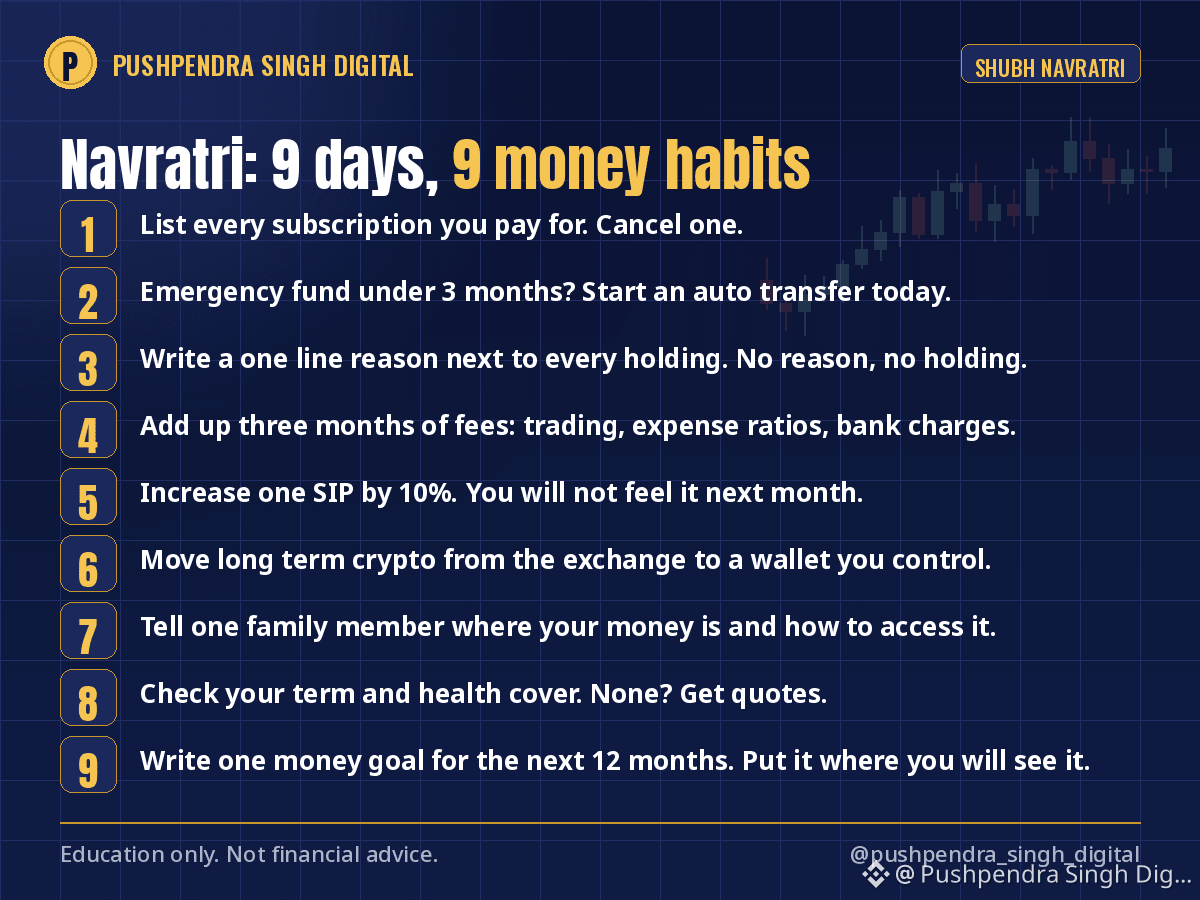
Navratri is in its last stretch and Dussehra is on Tuesday. Here are nine money habits, one for each day of the festival. Start on whichever day you are on and finish by Diwali. Each one takes less than ten minutes.
Day 1: Write down every subscription you pay for. Cancel one.
Day 2: Check your emergency fund. Under 3 months of expenses? Set up an auto transfer, even a small one.
Day 3: Open your demat or exchange account and write a one line reason next to each holding. No reason, no holding.
Day 4: Add up your fees for the last three months: trading, fund expense ratios, bank charges.
Day 5: Increase one SIP by 10%. You will not feel it next month.
Day 6: Move long term crypto that is sitting on an exchange to a wallet you control.
Day 7: Tell one family member where your investments are and how to access them.
Day 8: Check your term and health cover. If you have none, get quotes.
Day 9: Write your one money goal for the next 12 months on paper and put it where you will see it.
Nine days of this does more than nine months of watching charts.
Which day will be hardest for you? For me it is always Day 4.
Shubh Navratri. Education only, not financial advice.
$BTC #Navratri #PersonalFinance #MoneyHabits
1
180
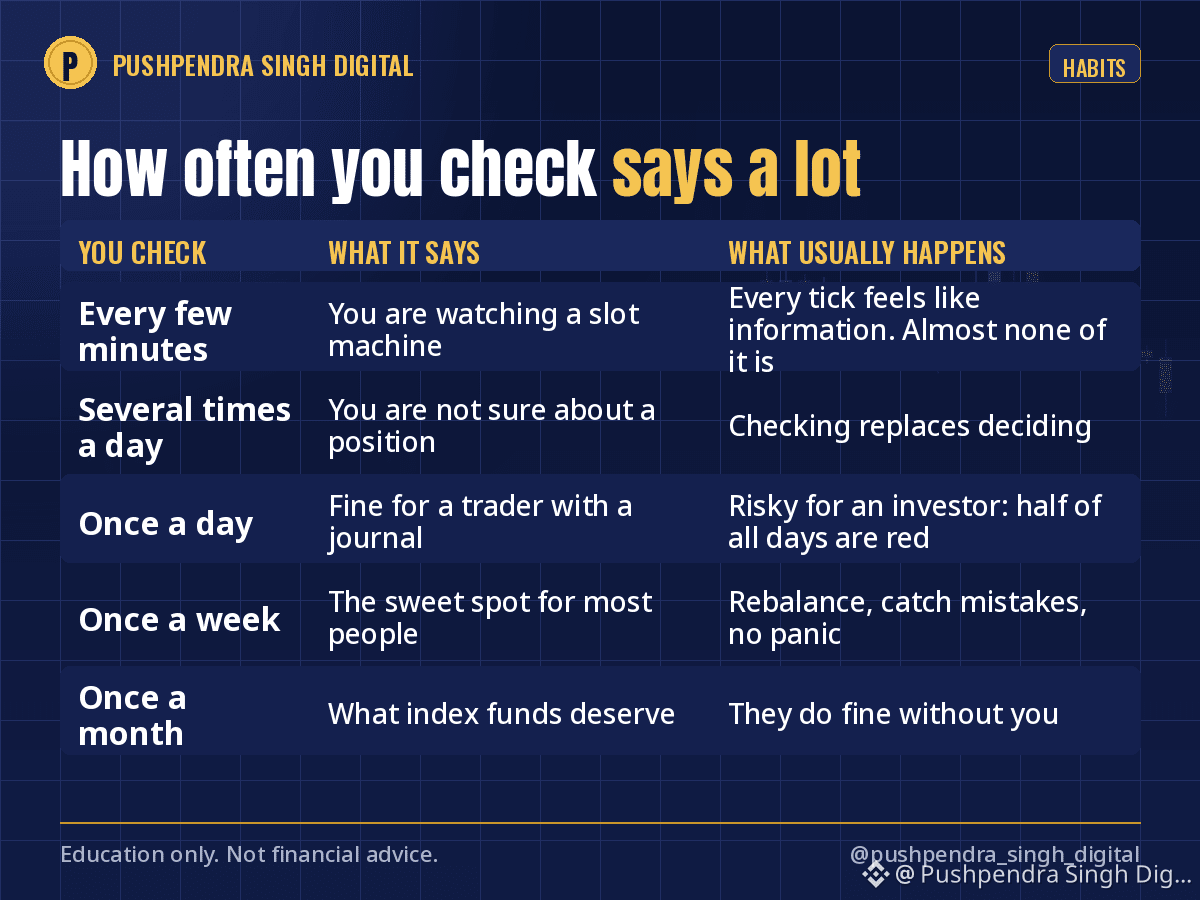
How often you open your portfolio app tells you more about your plan than your returns do.
Every few minutes: you are not investing, you are watching a slot machine with your own money inside. Every tick feels like information. Almost none of it is.
Several times a day: you have positions you are not sure about. If you were sure, you would not need to check.
Once a day: fine for an active trader with a journal and a plan. Dangerous for a long term investor, because roughly half of all days are red, and each one invites a bad decision.
Once a week: the sweet spot for most people. Enough to rebalance, catch a mistake, and notice news that matters. Not enough to panic.
Once a month: what my index funds get. They are doing fine without me.
When I built a tracker for my own portfolio, the feature I used most was not the chart. It was the one that showed how many times I had opened the app that day. The number was embarrassing. It went down after that.
How many times did you check today? Honest answers only.
Education only, not financial advice.
$BTC #TradingPsychology #Investing #MoneyHabits
145
Log in to explore more content
Join global crypto users on Binance Square
⚡️ Get latest and useful information about crypto.
💬 Trusted by the world’s largest crypto exchange.
👍 Discover real insights from verified creators.
Email / Phone number
Trending Topics
1
#NVIDIAReinstatesJensenHuangasCEO
1,935 views
218 Discussing
2
#WillMarketsStageAThanksgivingReliefRally?
98,005 views
1,445 Discussing
3
#WillOctCorePCEShiftFedHikeExpectations?
34,404 views
553 Discussing
4
#BitcoinEndsRecord17DayStreakOfLowerHighs
58 views
58 Discussing
5
#TradersPriceOut50bpDecemberFedHike
596 views
54 Discussing
6
#EvolveAtBinanceBlockchainWeek
85,626 views
838 Discussing
7
#BlackRockETHNetOutflowsReach$1.75BSinceOct1
292 views
10 Discussing
8
#TrumpBackedAmericanBitcoinRaisesHoldingsToOver8500BTC
537 views
25 Discussing
9
#MuskWarnsOfAICashCrunch
47,989 views
628 Discussing
10
#SkyPSMUSDCLiquidityReboundsTo$1.77B
368 views
9 Discussing