
#nvdia
nvdia
95,111 views
393 Discussing
Hot
Latest

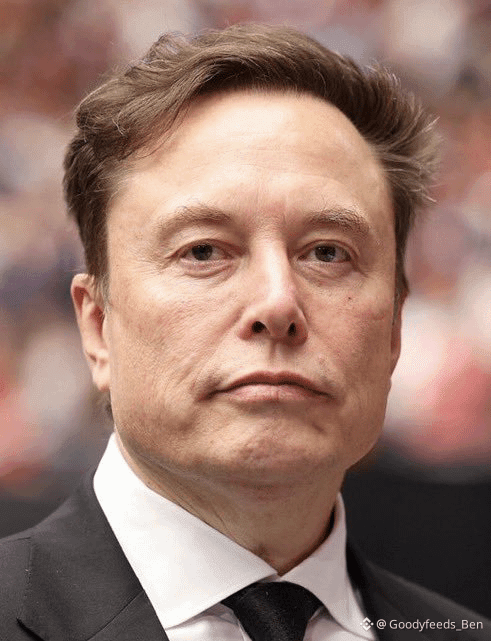
#ElonMusk. proposed acquisition of #NVDIA ?
Have u heard about this rumor? Whether it is rumor or real acquisition, lets see what happen:
NVIDIA's Board of Directors has unanimously rejected an unsolicited $20 billion acquisition proposal from Elon Musk, formally determining that the offer severely undervalues the company's proprietary AI architecture, global market dominance, and long-term growth trajectory. The decision followed a comprehensive review conducted with independent financial and legal advisors, who concluded that surrendering NVIDIA's independence at such a fraction of its intrinsic worth would be fundamentally contrary to the best interests of shareholders, customers, and partners worldwide.
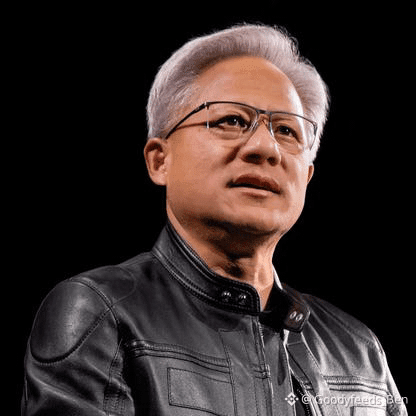
In parallel with the rejection, the board has initiated urgent discussions about potentially bringing back co-founder and former CEO Jensen Huang to guide the company through this pivotal era of heightened strategic interest and rapid AI expansion. Directors believe Huang's unmatched technical vision, deep institutional knowledge, and proven leadership remain critical assets as NVIDIA defends its autonomy and accelerates its next-generation semiconductor roadmap.
NVIDIA emphasized that it remains steadfast in its commitment to independent innovation and delivering industry-defining value without the distractions of opportunistic takeover attempts. The company confirmed that day-to-day operations, supply chain commitments, and research initiatives continue uninterrupted while leadership discussions proceed, with a focus on shaping the future of accelerated computing.
$NVDL #ElonMuskTalks
3
2.9k

·
--
Bullish
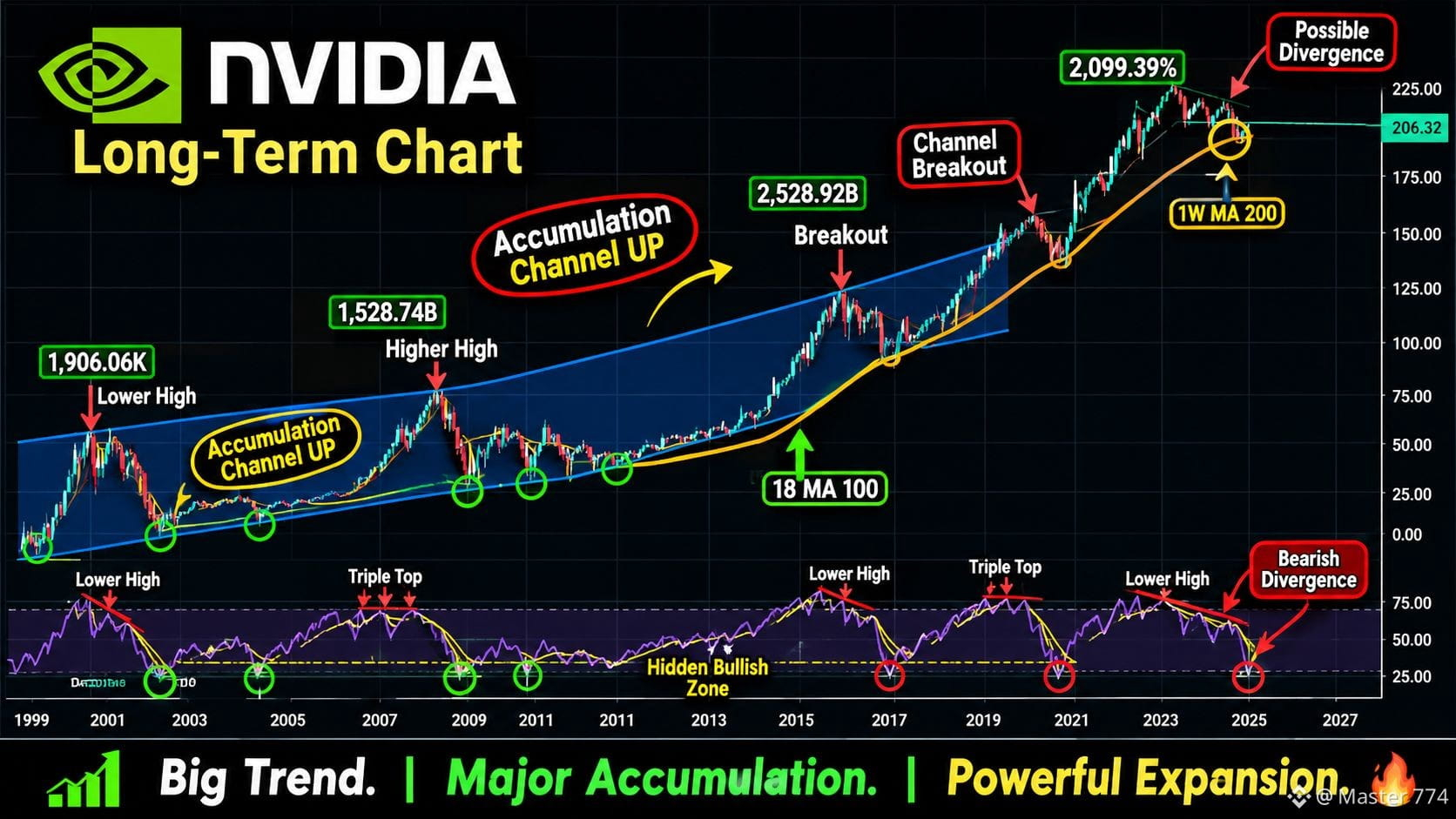
$NVDA is showing an interesting long-term setup as momentum approaches a historically important accumulation zone.
The 1W MA200 remains a key level to watch. If price holds above this support, the broader bullish structure could remain intact, potentially opening the door for another move toward previous highs.
Patience and confirmation matter here.
Trade on $NVDA
#NVDIA
{future}(NVDAUSDT)
$NVDA is showing an interesting long-term setup as momentum approaches a historically important accumulation zone.
The 1W MA200 remains a key level to watch. If price holds above this support, the broader bullish structure could remain intact, potentially opening the door for another move toward previous highs.
Patience and confirmation matter here.
Trade on $NVDA
#NVDIA
The 1W MA200 remains a key level to watch. If price holds above this support, the broader bullish structure could remain intact, potentially opening the door for another move toward previous highs.
Patience and confirmation matter here.
Trade on $NVDA
#NVDIA
Master 774
·
--
Bullish🇺🇸🇨🇳 A $3.2 BILLION NVIDIA-RELATED AI PIPELINE HAS BEEN UNCOVERED IN CHINA!!!
Despite U.S. export restrictions, Chinese companies, universities, and government-backed projects are still building AI infrastructure around restricted Nvidia chips.
More than 150 procurement notices, contracts, and corporate disclosures reveal projects worth over $3.2 BILLION.
Huang previously claimed Nvidia's market share in China had fallen from 95% to ZERO, yet Chinese projects are still planning around Nvidia's H100, H200, and H800 processors.
$NVDA
113

Build flags and calibration steps to enable FP8 and FP4 KV-cache alongside NVFP4 weights?Configuring FP8 or NVFP4 Key-Value (KV) cache quantization alongside NVFP4 model weights requires calibrating activation dynamic ranges during offline post-training quantization (PTQ) and enabling specific runtime plugins/flags during engine compilation or server execution.
Phase 1: Calibration & Checkpoint Export (NVIDIA ModelOpt)
Before building the engine, offline calibration using modelopt (NVIDIA Model Optimizer) is required to capture scaling parameters for weights and KV-cache layer matrices.
1. Quantization Config Script (quantize.py)
To export an NVFP4 weight model paired with either FP8 or NVFP4 KV cache, calibrate the attention key/value tensors against a calibration dataset (e.g., CNN-DailyMail or WikiText).
Phase 2: Engine Compilation via trtllm-build CLI
To compile the calibrated checkpoint into a runtime .engine, pass explicit build flags that register the FP4 weight matrix plugins and allocate the target KV cache data type.
CLI Command Execution
Mandatory Build Flags Reference
Phase 3: High-Level Python API Execution (LLM class)
When launching serving pipelines via the high-level TensorRT-LLM API, configure the KvCacheConfig programmatically:
#NVDIA #BTC #Binance
Build flags and calibration steps to enable FP8 and FP4 KV-cache alongside NVFP4 weights?
Configuring FP8 or NVFP4 Key-Value (KV) cache quantization alongside NVFP4 model weights requires calibrating activation dynamic ranges during offline post-training quantization (PTQ) and enabling specific runtime plugins/flags during engine compilation or server execution.
Phase 1: Calibration & Checkpoint Export (NVIDIA ModelOpt)
Before building the engine, offline calibration using modelopt (NVIDIA Model Optimizer) is required to capture scaling parameters for weights and KV-cache layer matrices.
1. Quantization Config Script (quantize.py)
To export an NVFP4 weight model paired with either FP8 or NVFP4 KV cache, calibrate the attention key/value tensors against a calibration dataset (e.g., CNN-DailyMail or WikiText).
Phase 2: Engine Compilation via trtllm-build CLI
To compile the calibrated checkpoint into a runtime .engine, pass explicit build flags that register the FP4 weight matrix plugins and allocate the target KV cache data type.
CLI Command Execution
Mandatory Build Flags Reference
Phase 3: High-Level Python API Execution (LLM class)
When launching serving pipelines via the high-level TensorRT-LLM API, configure the KvCacheConfig programmatically:
#NVDIA #BTC #Binance
101
Nvidia's NVFP4 precision units compare to AMD's OCP MXFP4 implementation for AI inference?
While Nvidia NVFP4 and AMD OCP MXFP4 both utilize 4-bit floating-point representation ($E2M1$: 1 sign bit, 2 exponent bits, 1 mantissa bit) to achieve up to double the compute throughput of FP8 during AI LLM inference, they differ fundamentally in microscaling block size, scaling precision, hardware lock-in, and accuracy retention.
Architectural & Specification Comparison
Technical Differences & Performance Trade-offs
1. Microblock Size & Outlier Sensitivity
Nvidia NVFP4 (16-Element Block): By grouping weights and activations into smaller 16-element blocks, NVFP4 isolates large activation outliers in LLMs (such as in attention projections). An outlier only impacts 15 neighboring weights within its block.AMD OCP MXFP4 (32-Element Block): Microscaling FP4 doubles the block size to 32 elements. While this halves the memory storage footprint of scale factors (saving 0.25 bits/weight), a single outlier in a transformer matrix dilutes the scaling resolution across 31 neighboring values, leading to heavier quantization rounding errors.
2. Scale Factor Precision (E4M3 vs. E8M0)
NVFP4's Dual-Layer Scaling: NVFP4 uses an FP8 (E4M3) scale factor per 16-element block combined with a global FP32 matrix-level scale factor. E4M3 provides mantissa precision in the scale factor itself, preserving fine-grained sub-distributions in large model weight weights without sacrificing accuracy.MXFP4's Exponent-Only Scaling: MXFP4 employs an E8M0 scale, meaning the scale factor can only shift the decimal point by powers of two ($2^n$). While E8M0 offers massive dynamic range, it lacks mantissa precision within the scale itself. To offset this gap, AMD relies on calibration methods like MR-GPTQ (applying block-wise Hadamard rotations to flatten outliers prior to quantization).
3. Cross-Platform Portability vs. Hardware Lock-In
NVFP4 (Nvidia Single-Vendor Optimization): Built exclusively for Nvidia's 5th and 6th Generation Tensor Cores. Models quantized to NVFP4 are optimized for TensorRT engines running on Blackwell and Vera Rubin platforms, but cannot run natively on AMD GPUs or open accelerators.OCP MXFP4 (The Portable Ecosystem): MXFP4 is an industry open standard supported across multi-vendor AI hardware ecosystems. AMD's Instinct MI350/MI400 series GPUs execute MXFP4 natively in hardware via Matrix Fused Multiply-Add (MFMA) instructions. Crucially, Nvidia Blackwell GPUs also support MXFP4 execution, making OCP MXFP4 the standard choice for multi-cloud, cross-vendor AI serving fleets seeking to avoid lock-in.
Key Takeaway for Deployment
Choose NVFP4 if you operate an all-Nvidia fleet (Blackwell / Rubin) and require the highest task accuracy retention without complex rotation re-calibration tricks during W4A4/W4A8 inference.Choose OCP MXFP4 if you require cross-hardware model portability across AMD Instinct and Nvidia accelerators, or want to reduce scale-storage overhead in multi-tenant cloud serving setups.
#Xrp🔥🔥 #NVDIA
Nvidia's NVFP4 precision units compare to AMD's OCP MXFP4 implementation for AI inference?
While Nvidia NVFP4 and AMD OCP MXFP4 both utilize 4-bit floating-point representation ($E2M1$: 1 sign bit, 2 exponent bits, 1 mantissa bit) to achieve up to double the compute throughput of FP8 during AI LLM inference, they differ fundamentally in microscaling block size, scaling precision, hardware lock-in, and accuracy retention.
Architectural & Specification Comparison
Technical Differences & Performance Trade-offs
1. Microblock Size & Outlier Sensitivity
Nvidia NVFP4 (16-Element Block): By grouping weights and activations into smaller 16-element blocks, NVFP4 isolates large activation outliers in LLMs (such as in attention projections). An outlier only impacts 15 neighboring weights within its block.AMD OCP MXFP4 (32-Element Block): Microscaling FP4 doubles the block size to 32 elements. While this halves the memory storage footprint of scale factors (saving 0.25 bits/weight), a single outlier in a transformer matrix dilutes the scaling resolution across 31 neighboring values, leading to heavier quantization rounding errors.
2. Scale Factor Precision (E4M3 vs. E8M0)
NVFP4's Dual-Layer Scaling: NVFP4 uses an FP8 (E4M3) scale factor per 16-element block combined with a global FP32 matrix-level scale factor. E4M3 provides mantissa precision in the scale factor itself, preserving fine-grained sub-distributions in large model weight weights without sacrificing accuracy.MXFP4's Exponent-Only Scaling: MXFP4 employs an E8M0 scale, meaning the scale factor can only shift the decimal point by powers of two ($2^n$). While E8M0 offers massive dynamic range, it lacks mantissa precision within the scale itself. To offset this gap, AMD relies on calibration methods like MR-GPTQ (applying block-wise Hadamard rotations to flatten outliers prior to quantization).
3. Cross-Platform Portability vs. Hardware Lock-In
NVFP4 (Nvidia Single-Vendor Optimization): Built exclusively for Nvidia's 5th and 6th Generation Tensor Cores. Models quantized to NVFP4 are optimized for TensorRT engines running on Blackwell and Vera Rubin platforms, but cannot run natively on AMD GPUs or open accelerators.OCP MXFP4 (The Portable Ecosystem): MXFP4 is an industry open standard supported across multi-vendor AI hardware ecosystems. AMD's Instinct MI350/MI400 series GPUs execute MXFP4 natively in hardware via Matrix Fused Multiply-Add (MFMA) instructions. Crucially, Nvidia Blackwell GPUs also support MXFP4 execution, making OCP MXFP4 the standard choice for multi-cloud, cross-vendor AI serving fleets seeking to avoid lock-in.
Key Takeaway for Deployment
Choose NVFP4 if you operate an all-Nvidia fleet (Blackwell / Rubin) and require the highest task accuracy retention without complex rotation re-calibration tricks during W4A4/W4A8 inference.Choose OCP MXFP4 if you require cross-hardware model portability across AMD Instinct and Nvidia accelerators, or want to reduce scale-storage overhead in multi-tenant cloud serving setups.
#Xrp🔥🔥 #NVDIA
77
Nvidia's Rubin platform versus AMD's Instinct series.Nvidia’s Vera Rubin platform (R200/VR200) and AMD’s Instinct MI400 series (MI455X/MI450X) represent fundamentally different architectural philosophies in ultra-high-density AI compute.
While Nvidia prioritizes a mixed-node approach paired with 3D vertical die-stacking to maximize raw matrix throughput per reticle area, AMD relies heavily on modular chiplet disaggregation and dense 3D hybrid bonding to maximize total HBM capacity and scale-up memory bandwidth.
Silicon Node & Packaging Comparison
Architectural & Packaging Differences
1. Silicon Node Selection: Mixed-Node vs. Pure Chiplet Disaggregation
Nvidia Rubin: Employs a split-node architecture. The compute dies leverage TSMC’s high-performance N3P node to maximize transistor density for NVFP4 Tensor Cores. To optimize overall cost and thermal constraints, less latency-critical I/O operations are offloaded to TSMC N5B.AMD Instinct (MI455X): Takes disaggregation a step further by breaking the GPU into smaller, highly yields-optimized 3N compute tiles sitting atop base I/O dies. This allows AMD to achieve high wafer yields even on larger silicon footprints.
2. Advanced 3D Packaging: SoIC vs. Direct Hybrid Bonding
TSMC SoIC (System-on-Integrated-Chips): Rubin integrates TSMC’s SoIC 3D vertical stacking. By stacking logic directly above memory controller and interface layers, Nvidia cuts inter-die wiring lengths. This dramatically lowers parasitic capacitance and reduces energy consumption during high-frequency data movement across the NV-HBI (High-Bandwidth Interface).AMD 3D Hybrid Bonding: AMD utilizes high-density copper-to-copper (Cu-Cu) direct hybrid bonding. This allows vertically stacked compute tiles to exchange data with underlying base dies at near-monolithic latency and massive inter-die bandwidth.
3. HBM4 Implementation & Substrate Reticle Sizes
2,048-Bit Memory Interfaces: Both architectures transition to HBM4, which doubles the memory interface width per stack from 1,024 bits to 2,048 bits compared to HBM3e.Interposer Footprint (CoWoS-L): Integrating massive HBM4 stacks around large logic dies pushes packaging requirements beyond 4x reticle size interposers.Capacity Edge: AMD allocates space for 12 HBM4 stacks (432 GB) compared to Nvidia’s 8 stacks (288 GB), giving the MI455X a 50% advantage in local GPU memory capacity for holding extra-large LLM KV-caches locally.
4. Interconnect Protocols: NVLink 6 vs. Infinity Fabric
Nvidia NVLink 6: Connects Rubin GPUs across a passive backplane with NVLink 6 switches delivering up to 3.6 TB/s per GPU of bi-directional scale-up bandwidth.AMD Infinity Fabric: Operates via high-speed physical links on the CoWoS package, delivering up to 3.6 TB/s per GPU of scale-up bandwidth directly connecting MI455X accelerators within the Helios rack architecture.
#NVDIA #cryptouniverseofficial #Binance
Nvidia's Rubin platform versus AMD's Instinct series.
Nvidia’s Vera Rubin platform (R200/VR200) and AMD’s Instinct MI400 series (MI455X/MI450X) represent fundamentally different architectural philosophies in ultra-high-density AI compute.
While Nvidia prioritizes a mixed-node approach paired with 3D vertical die-stacking to maximize raw matrix throughput per reticle area, AMD relies heavily on modular chiplet disaggregation and dense 3D hybrid bonding to maximize total HBM capacity and scale-up memory bandwidth.
Silicon Node & Packaging Comparison
Architectural & Packaging Differences
1. Silicon Node Selection: Mixed-Node vs. Pure Chiplet Disaggregation
Nvidia Rubin: Employs a split-node architecture. The compute dies leverage TSMC’s high-performance N3P node to maximize transistor density for NVFP4 Tensor Cores. To optimize overall cost and thermal constraints, less latency-critical I/O operations are offloaded to TSMC N5B.AMD Instinct (MI455X): Takes disaggregation a step further by breaking the GPU into smaller, highly yields-optimized 3N compute tiles sitting atop base I/O dies. This allows AMD to achieve high wafer yields even on larger silicon footprints.
2. Advanced 3D Packaging: SoIC vs. Direct Hybrid Bonding
TSMC SoIC (System-on-Integrated-Chips): Rubin integrates TSMC’s SoIC 3D vertical stacking. By stacking logic directly above memory controller and interface layers, Nvidia cuts inter-die wiring lengths. This dramatically lowers parasitic capacitance and reduces energy consumption during high-frequency data movement across the NV-HBI (High-Bandwidth Interface).AMD 3D Hybrid Bonding: AMD utilizes high-density copper-to-copper (Cu-Cu) direct hybrid bonding. This allows vertically stacked compute tiles to exchange data with underlying base dies at near-monolithic latency and massive inter-die bandwidth.
3. HBM4 Implementation & Substrate Reticle Sizes
2,048-Bit Memory Interfaces: Both architectures transition to HBM4, which doubles the memory interface width per stack from 1,024 bits to 2,048 bits compared to HBM3e.Interposer Footprint (CoWoS-L): Integrating massive HBM4 stacks around large logic dies pushes packaging requirements beyond 4x reticle size interposers.Capacity Edge: AMD allocates space for 12 HBM4 stacks (432 GB) compared to Nvidia’s 8 stacks (288 GB), giving the MI455X a 50% advantage in local GPU memory capacity for holding extra-large LLM KV-caches locally.
4. Interconnect Protocols: NVLink 6 vs. Infinity Fabric
Nvidia NVLink 6: Connects Rubin GPUs across a passive backplane with NVLink 6 switches delivering up to 3.6 TB/s per GPU of bi-directional scale-up bandwidth.AMD Infinity Fabric: Operates via high-speed physical links on the CoWoS package, delivering up to 3.6 TB/s per GPU of scale-up bandwidth directly connecting MI455X accelerators within the Helios rack architecture.
#NVDIA #cryptouniverseofficial #Binance
52

#NVDIA 🚨 NVIDIA BOARD REPORTEDLY DIVIDED OVER JENSEN HUANG’S POTENTIAL RETURN
NVIDIA is facing a fresh wave of leadership uncertainty as reports suggest that the company’s board may be divided over the possibility of Jensen Huang returning to a leadership role.
Huang’s name remains deeply connected with NVIDIA’s incredible AI-driven growth. Under his leadership, NVIDIA transformed from a major chipmaker into one of the world’s most important players in the AI revolution.
But now, the reported internal debate is raising a bigger question:
👉 Could Jensen Huang actually make a comeback — or is NVIDIA preparing for a new leadership era?
🔥 Why This Matters for Investors
🔹 Leadership stability: Markets generally dislike uncertainty at the top.
🔹 AI dominance: NVIDIA’s future depends heavily on maintaining its advantage in AI chips, data centers and next-generation computing.
🔹 Investor sentiment: Any major leadership development involving Huang could create significant volatility around NVIDIA shares.
🔹 Boardroom decisions: If the board is genuinely divided, the situation could become an important story for investors and the broader tech market.
For now, investors should treat these reports as unconfirmed speculation, not a finalized leadership decision.
One thing is certain: Jensen Huang’s role at NVIDIA is far bigger than just a CEO title — his leadership has become closely associated with the company’s AI success story.
📌 Could Jensen Huang return, or is NVIDIA ready to move forward without him?
What do you think? 👇
Bullish on NVIDIA 🚀 or concerned about the leadership uncertainty?
⚠️ Do your own research (DYOR). This post is for informational purposes only and is not financial advice.
#NVIDIA #NVDA #JensenHuang #AI #ArtificialIntelligence #StockMarket #TechStocks #Investing #Nasdaq #BinanceSquare
63
BREAKING NEWS💥💥💥
#NVDIA might fall and encounter the strongest competitor they can ever imagine👽👽👽
#JensenHuang is reportedly considering starting a new semiconductor company—seen here as a serious threat.
Given his deep insider knowledge of Nvidia, CUDA, and its engineering teams, any venture he launches could quickly become Nvidia's biggest competitor. The piece compares this to #Anthropic : former #OpenAI core members left to found a rival that became OpenAI's fiercest competitor and successfully went public. Since Huang knows Nvidia even better, the threat is portrayed as even greater.
$NVDAB
5
317
Great new!!☕️☕️☕️
$NVDA might pump back to where it is again!!!
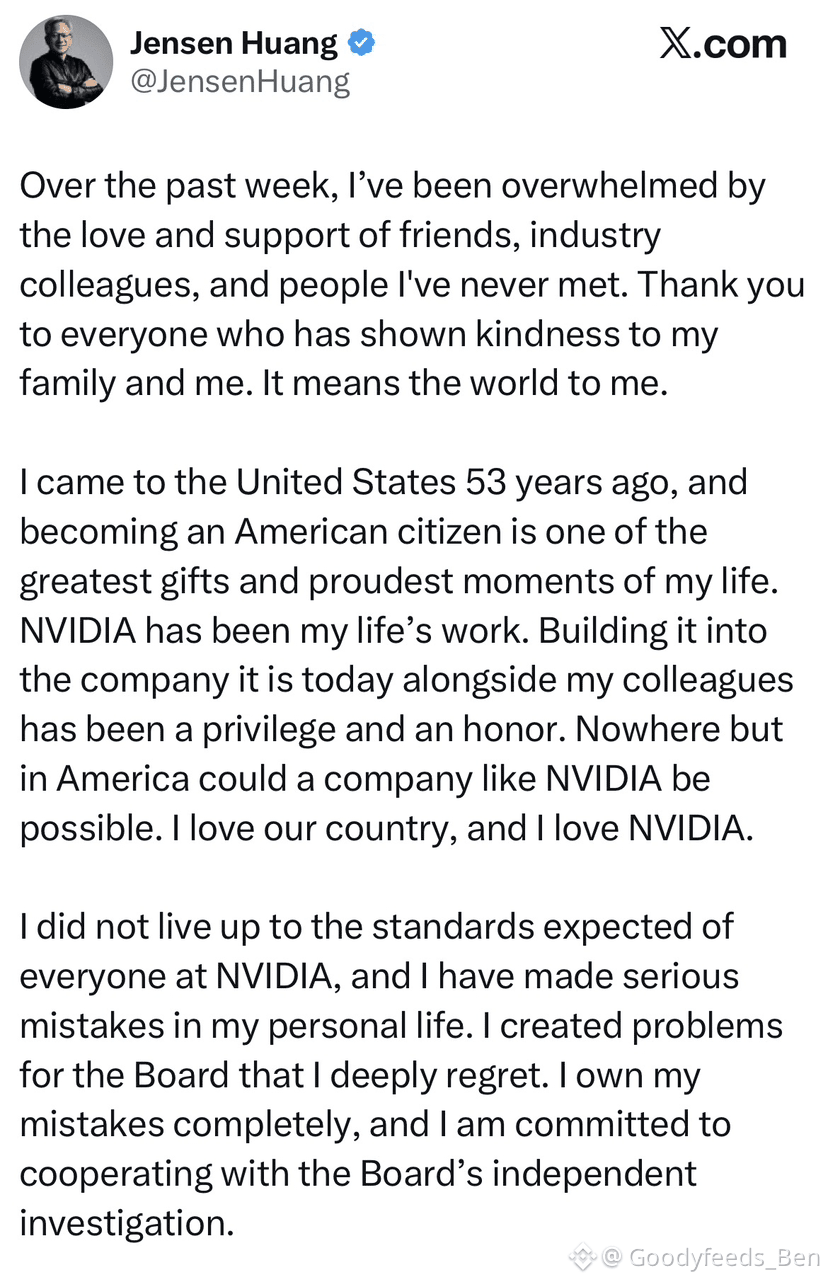
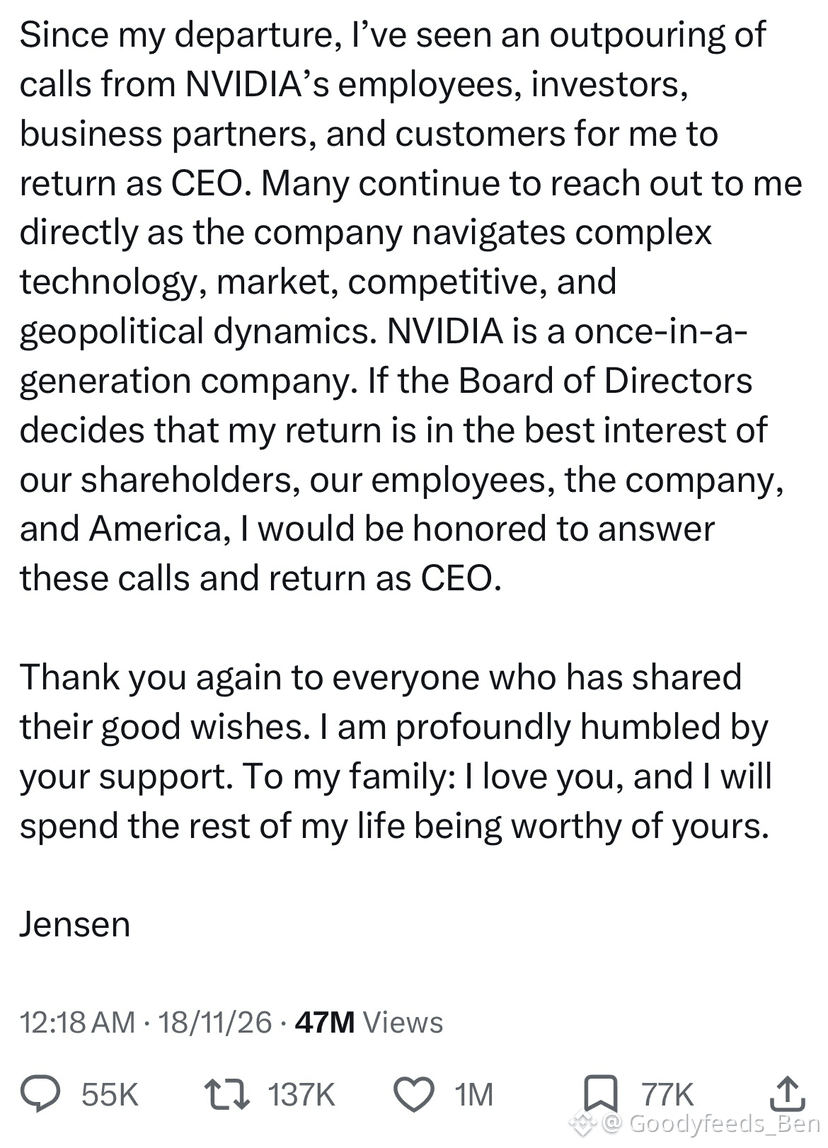
#JensenHuang might be coming back as CEO of #NVDIA
Reading from his tweets, I can sense that there is a possibility that board of directors of nvdia had discussion with him regarding his return.
I guess that the purpose of his tweet is to see how the public react to when he says he wants to return.
There are a lot of supports from some investors and tech figures for his return, even #TRUMP said that Jensen is a great leader.
However, the decision-making authority still lies with the board, we need to see if they will change their decision based on the pressure from the supporters of Jensen.
So do u think that Jensen’s post is a hint that he will return? Or it is just Jensen’s own personal willingness?
5
419

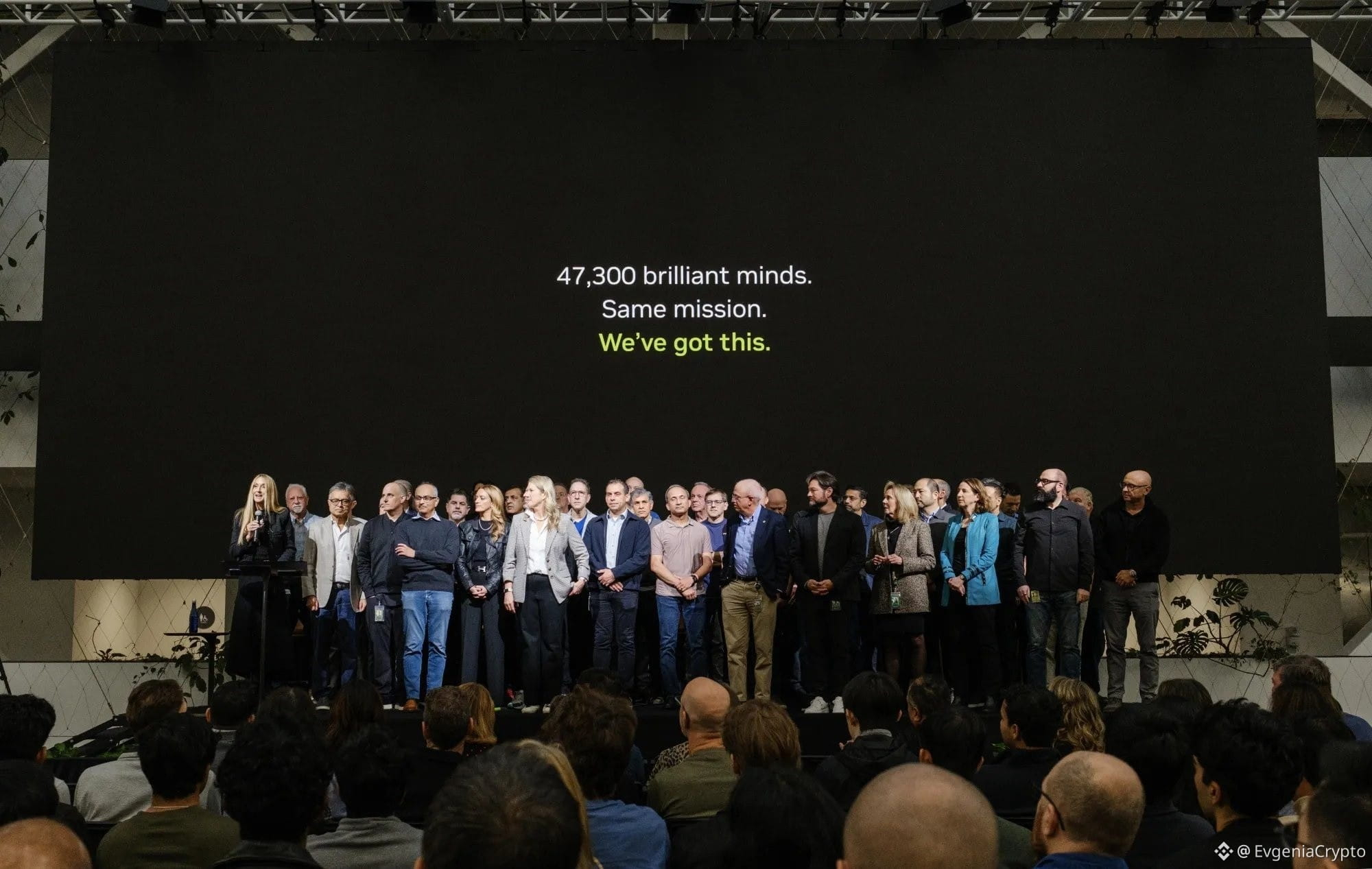
So, come on, admit it: what hopes did you have that Huang would come back? 🤔 Honestly, I’m saying it like it is: I don’t care, and I think 99 percent of people here don’t care either. 1% don’t even know who he is 😁😁‼️‼️
But if you’re an investor or a holder and you’re following the news in the hope that he’ll return, it’s not going to happen. In short, there was a meeting of minds $NVDA . Colette, the acting CEO, said, “We’ll manage. We don’t need a washed-up has-been; the corporation’s employees are brilliant minds.”
So here’s the conclusion: Huang screwed up his own creation. They don’t need him; everything’s already been developed, and they need new minds. Alain Delon can go rest 🤷♀️
$NVDAon
#NVDIA #NVDAUSDT
2
363

·
--
Bullish
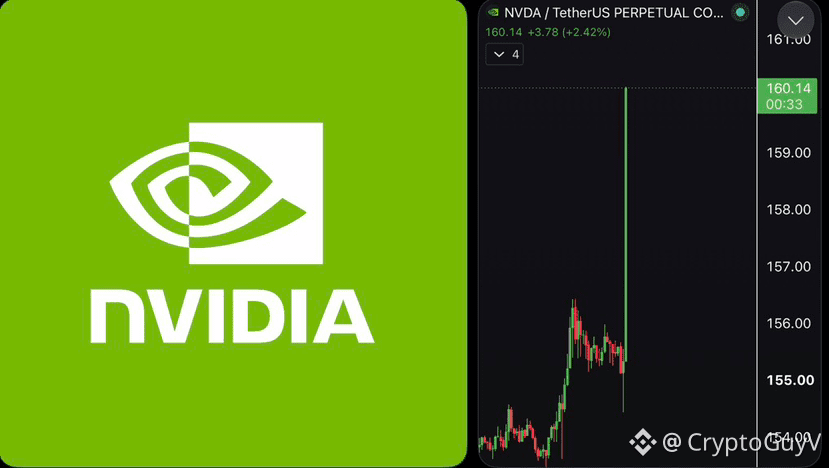
NVIDIA $NVDA Q3 EARNINGS CAME IN AT $155.84 BILLION BEATING EXPECTATIONS
THE STOCK JUST PUMPED OVER 4%
#NVDIA
NVIDIA $NVDA Q3 EARNINGS CAME IN AT $155.84 BILLION BEATING EXPECTATIONS
THE STOCK JUST PUMPED OVER 4%
#NVDIA
THE STOCK JUST PUMPED OVER 4%
#NVDIA
1
534

$NVDA
{future}(NVDAUSDT)
Reports earnings tonight, and I actually think people who are bullish on Nvidia should be more cautious.
Not because I'm bearish on $NVDA .
It's because a good company, good earnings, and a good stock price are completely different things.
Nvidia's earnings may continue to grow, but if the market has already priced in several years of future growth, the stock may not rise even if earnings beat expectations.
I think there's a question worth discussing.
Being equally bullish on Nvidia, buying the stock and opening a 10x perpetual contract are actually two completely different trades.
When you buy the stock, you own a beneficial interest in the company. As long as the company is still around and you don't actively sell, you can keep waiting for the fundamentals to play out—though of course, you also bear the risk of the stock price falling.
When you buy a stock perpetual contract, you don't own the stock or have any right to shareholder dividends.
What you're buying is exposure to its price.
10x leverage means that if the stock moves 5% against you, you theoretically lose half your margin.
At close to 10%, you may be liquidated before the price even falls that far.
On top of that, there are a few easily overlooked things about stock perpetual contracts:
① They trade 24/7, so prices can keep moving even when the U.S. stock market is closed.
② Funding fees are usually settled every 8 hours, so with a long-term position, it's not just about whether the stock price rises or falls.
③ Gaps after earnings, liquidity, and changes in mark price may make your actual liquidation risk greater than you expect.
I'm increasingly convinced that many people don't lose because they picked the wrong stock, but because they turned a long-term view into a short-term leveraged trade.
You believe $NVDA AI business will do well over the next three years, yet you use 10x leverage to bet on its share price at 1 a.m. tomorrow.
#NVDIA
$NVDA
Reports earnings tonight, and I actually think people who are bullish on Nvidia should be more cautious.
Not because I'm bearish on $NVDA .
It's because a good company, good earnings, and a good stock price are completely different things.
Nvidia's earnings may continue to grow, but if the market has already priced in several years of future growth, the stock may not rise even if earnings beat expectations.
I think there's a question worth discussing.
Being equally bullish on Nvidia, buying the stock and opening a 10x perpetual contract are actually two completely different trades.
When you buy the stock, you own a beneficial interest in the company. As long as the company is still around and you don't actively sell, you can keep waiting for the fundamentals to play out—though of course, you also bear the risk of the stock price falling.
When you buy a stock perpetual contract, you don't own the stock or have any right to shareholder dividends.
What you're buying is exposure to its price.
10x leverage means that if the stock moves 5% against you, you theoretically lose half your margin.
At close to 10%, you may be liquidated before the price even falls that far.
On top of that, there are a few easily overlooked things about stock perpetual contracts:
① They trade 24/7, so prices can keep moving even when the U.S. stock market is closed.
② Funding fees are usually settled every 8 hours, so with a long-term position, it's not just about whether the stock price rises or falls.
③ Gaps after earnings, liquidity, and changes in mark price may make your actual liquidation risk greater than you expect.
I'm increasingly convinced that many people don't lose because they picked the wrong stock, but because they turned a long-term view into a short-term leveraged trade.
You believe $NVDA AI business will do well over the next three years, yet you use 10x leverage to bet on its share price at 1 a.m. tomorrow.
#NVDIA
5

·
--
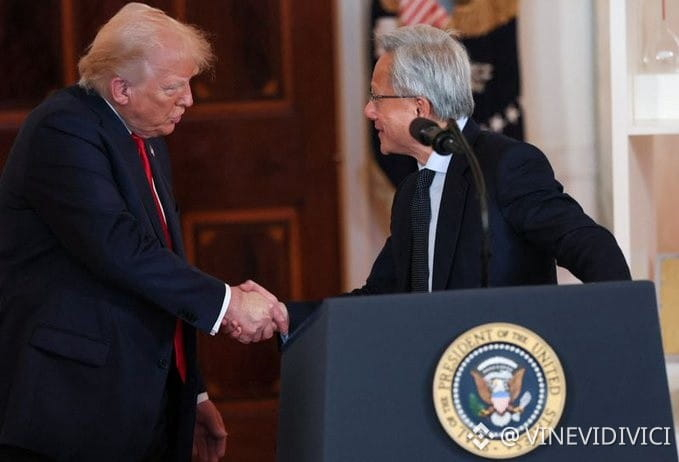
President Donald Trump said he would welcome Jensen Huang’s return as Nvidia’s
$NVDA
{future}(NVDAUSDT)
CEO, defending the former executive against national security concerns following his recent resignation over alleged personal relationships. Trump stated that Huang "didn't put national security at risk," though he criticized Huang's personal conduct regarding a reported relationship with a former Megaspeed International executive accused of having ties to Chinese intelligence.#JensenHuang #Trump #NVdia
President Donald Trump said he would welcome Jensen Huang’s return as Nvidia’s
$NVDA
CEO, defending the former executive against national security concerns following his recent resignation over alleged personal relationships. Trump stated that Huang "didn't put national security at risk," though he criticized Huang's personal conduct regarding a reported relationship with a former Megaspeed International executive accused of having ties to Chinese intelligence.#JensenHuang #Trump #NVdia
202
·
--
Bullish
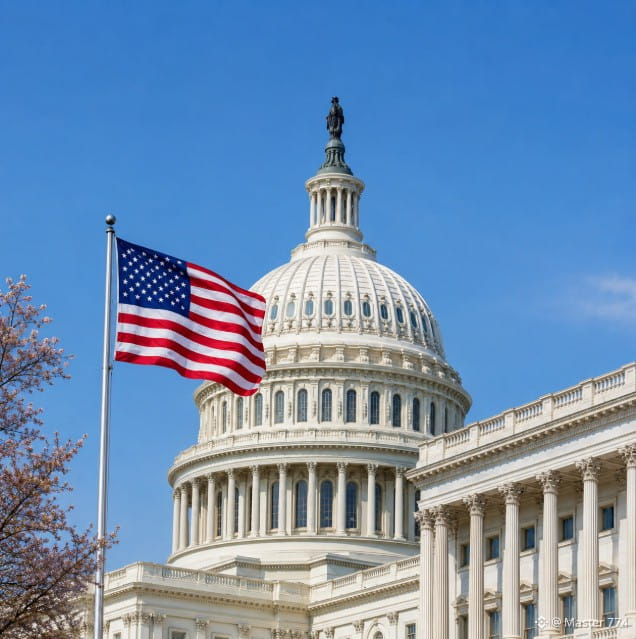
BREAKING: After the Nvidia scandal, Congress moves to pass 4 bills, one letting it BLOCK chip sales to China that Trump approved.
That means lawmakers could stop chip deals with China even after the White House signs off.
Both parties back the bills, which could ride on a must-pass defense bill Trump is unlikely to veto.
"Washington is not ready to move on," Beacon Research analyst Owen Tedford told the FT.
Separately, the WSJ says Alice Huang's former firm, Megaspeed, arranged nearly $12 BILLION of Nvidia chips for companies in China.
Lawmakers now want Commerce Secretary Howard Lutnick to explain how Nvidia was allowed to sell chips to Megaspeed.
$NVDA
#NVDIA
{future}(NVDAUSDT)
BREAKING: After the Nvidia scandal, Congress moves to pass 4 bills, one letting it BLOCK chip sales to China that Trump approved.
That means lawmakers could stop chip deals with China even after the White House signs off.
Both parties back the bills, which could ride on a must-pass defense bill Trump is unlikely to veto.
"Washington is not ready to move on," Beacon Research analyst Owen Tedford told the FT.
Separately, the WSJ says Alice Huang's former firm, Megaspeed, arranged nearly $12 BILLION of Nvidia chips for companies in China.
Lawmakers now want Commerce Secretary Howard Lutnick to explain how Nvidia was allowed to sell chips to Megaspeed.
$NVDA
#NVDIA
Master 774
·
--
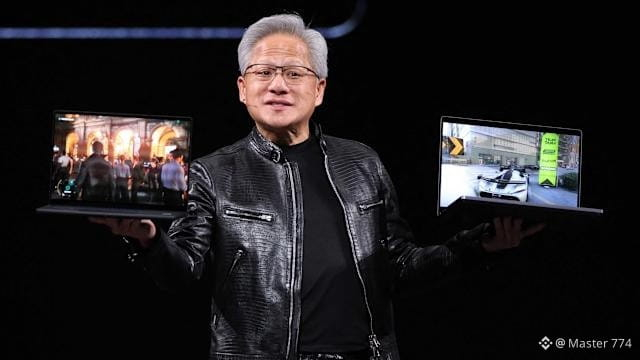
Bullish🇺🇸🇨🇳 A $3.2 BILLION NVIDIA-RELATED AI PIPELINE HAS BEEN UNCOVERED IN CHINA!!!
Despite U.S. export restrictions, Chinese companies, universities, and government-backed projects are still building AI infrastructure around restricted Nvidia chips.
More than 150 procurement notices, contracts, and corporate disclosures reveal projects worth over $3.2 BILLION.
Huang previously claimed Nvidia's market share in China had fallen from 95% to ZERO, yet Chinese projects are still planning around Nvidia's H100, H200, and H800 processors.
$NVDA
Despite U.S. export restrictions, Chinese companies, universities, and government-backed projects are still building AI infrastructure around restricted Nvidia chips.
More than 150 procurement notices, contracts, and corporate disclosures reveal projects worth over $3.2 BILLION.
Huang previously claimed Nvidia's market share in China had fallen from 95% to ZERO, yet Chinese projects are still planning around Nvidia's H100, H200, and H800 processors.
$NVDA
91

Article
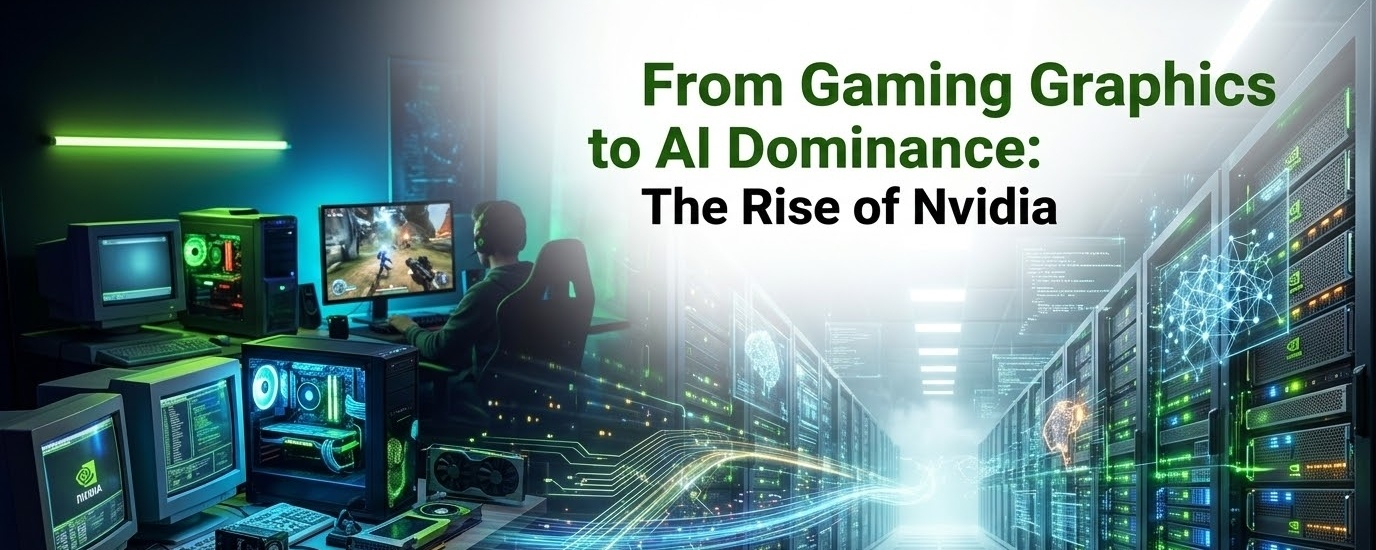
From Gaming Graphics to AI Dominance: The Rise of NvidiaNvidia Corporation is an American multinational technology company headquartered in Santa Clara, California. Founded on April 5, 1993, by Jensen Huang, Chris Malachowsky, and Curtis Priem, the company is a global leader in accelerated computing, graphics processing units (GPUs), and artificial intelligence (AI) infrastructure.
Company Overview & Key Facts
Nvidia employs over 42,000 people across 38 countries. It achieved record full-year revenue of $215.9 billion in fiscal year 2026 and became one of the world's most valuable public companies.
• Core Business. Nvidia designs high-end computer chips, systems-on-chips (SoCs), and software platforms that power video gaming, data centers, and AI workloads.
• Market Dominance. According to Britannica Money, Nvidia holds a 92% market share in the discrete graphics segment as of 2025.
• Recent Leadership Change. Co-founder Jensen Huang resigned as president and CEO in November 2026 amid a public scandal. CFO Colette Kress stepped in as interim CEO alongside chairman Harvey Jones.
Major Products & Technologies
The NVIDIA Official Website categorizes its hardware and software offerings across several major computing sectors:
• AI & Data Center Hardware. Nvidia builds specialized AI chips and supercomputers, including the Blackwell and Hopper architectures, as well as DGX and HGX systems that form the backbone of modern AI factories.
• Gaming & Graphics. The GeForce line of GPUs and RTX graphics cards power PC gaming and creative rendering for over 200 million users worldwide.
• CUDA Software Platform. Launched in 2006, CUDA is Nvidia's proprietary parallel computing platform and programming model. It allows over 7.5 million developers to use GPUs for general-purpose computing and deep learning.
• Autonomous Vehicles & Robotics. The NVIDIA DRIVE platform provides end-to-end software and hardware for autonomous vehicles, while Jetson and Omniverse power edge AI, robotics, and industrial digital twins.
$NVDAB
Key Historical Milestones
Nvidia evolved from a PC graphics chipmaker into the central hardware supplier for the global AI industry.
• 1993 Founding. Three computer scientists started the company in California to bring 3D graphics to gaming and multimedia.
• 1999 GPU Invention. Nvidia released the GeForce 256, marketing it as the world's first true GPU.
• 2012 AI Breakthrough. Researchers used Nvidia GPUs to train AlexNet, sparking the modern deep learning revolution.
• 2022–2026 AI Boom. Widespread adoption of generative AI models like ChatGPT drove massive demand for Nvidia data center chips, pushing the company's market valuation past $4 trillion in 2025.
Let me know 🤔
Would you like 😃 to dive deeper into a specific area of Nvidia, such as:
Gaming GPUs (like the GeForce RTX series)
AI & Data Center hardware (like Blackwell and CUDA)
Recent stock performance and financial news
Let me know ☺️ which area interests you most so I can share more tailored details.😉
#NVDIA #company_news
From Gaming Graphics to AI Dominance: The Rise of Nvidia
Nvidia Corporation is an American multinational technology company headquartered in Santa Clara, California. Founded on April 5, 1993, by Jensen Huang, Chris Malachowsky, and Curtis Priem, the company is a global leader in accelerated computing, graphics processing units (GPUs), and artificial intelligence (AI) infrastructure.
Company Overview & Key Facts
Nvidia employs over 42,000 people across 38 countries. It achieved record full-year revenue of $215.9 billion in fiscal year 2026 and became one of the world's most valuable public companies.
• Core Business. Nvidia designs high-end computer chips, systems-on-chips (SoCs), and software platforms that power video gaming, data centers, and AI workloads.
• Market Dominance. According to Britannica Money, Nvidia holds a 92% market share in the discrete graphics segment as of 2025.
• Recent Leadership Change. Co-founder Jensen Huang resigned as president and CEO in November 2026 amid a public scandal. CFO Colette Kress stepped in as interim CEO alongside chairman Harvey Jones.
Major Products & Technologies
The NVIDIA Official Website categorizes its hardware and software offerings across several major computing sectors:
• AI & Data Center Hardware. Nvidia builds specialized AI chips and supercomputers, including the Blackwell and Hopper architectures, as well as DGX and HGX systems that form the backbone of modern AI factories.
• Gaming & Graphics. The GeForce line of GPUs and RTX graphics cards power PC gaming and creative rendering for over 200 million users worldwide.
• CUDA Software Platform. Launched in 2006, CUDA is Nvidia's proprietary parallel computing platform and programming model. It allows over 7.5 million developers to use GPUs for general-purpose computing and deep learning.
• Autonomous Vehicles & Robotics. The NVIDIA DRIVE platform provides end-to-end software and hardware for autonomous vehicles, while Jetson and Omniverse power edge AI, robotics, and industrial digital twins.
$NVDAB
Key Historical Milestones
Nvidia evolved from a PC graphics chipmaker into the central hardware supplier for the global AI industry.
• 1993 Founding. Three computer scientists started the company in California to bring 3D graphics to gaming and multimedia.
• 1999 GPU Invention. Nvidia released the GeForce 256, marketing it as the world's first true GPU.
• 2012 AI Breakthrough. Researchers used Nvidia GPUs to train AlexNet, sparking the modern deep learning revolution.
• 2022–2026 AI Boom. Widespread adoption of generative AI models like ChatGPT drove massive demand for Nvidia data center chips, pushing the company's market valuation past $4 trillion in 2025.
Let me know 🤔
Would you like 😃 to dive deeper into a specific area of Nvidia, such as:
Gaming GPUs (like the GeForce RTX series)
AI & Data Center hardware (like Blackwell and CUDA)
Recent stock performance and financial news
Let me know ☺️ which area interests you most so I can share more tailored details.😉
#NVDIA #company_news
Fouzia Munawar:
recent rock performance financial 😃 news
1
1
1
111
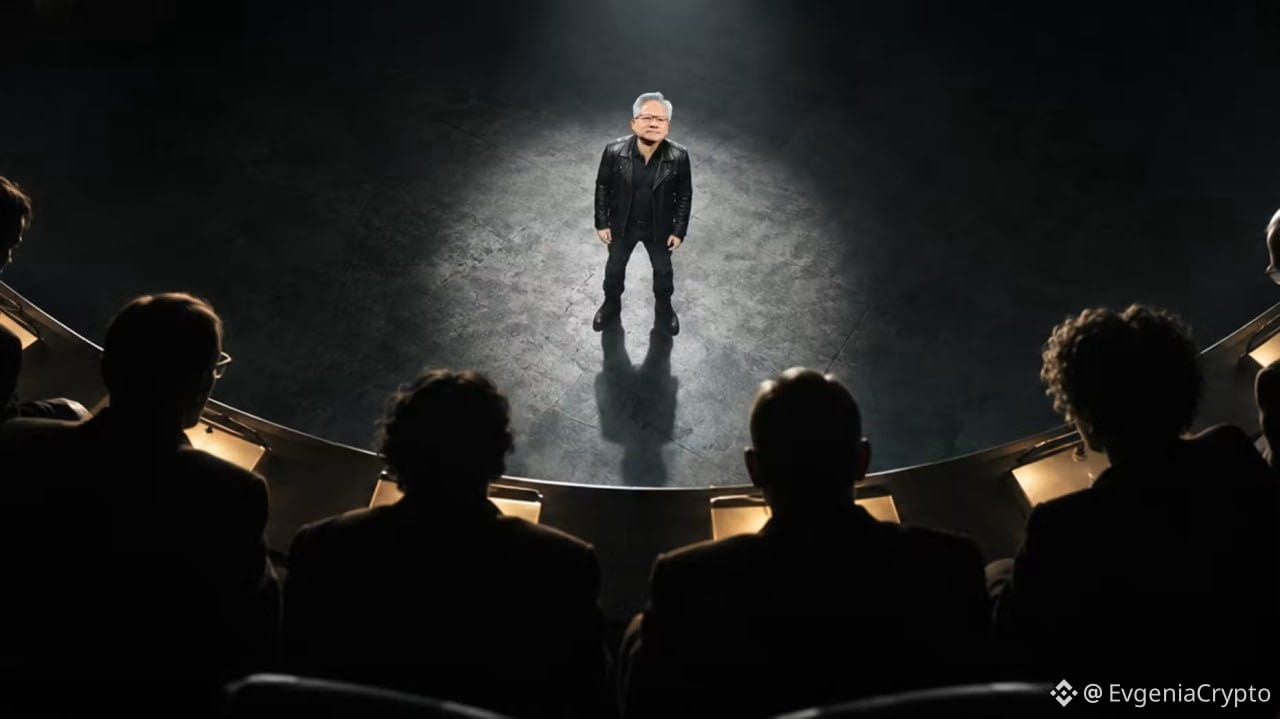
Do you feel sorry for him? They can't do without a strong leader; they can't be themselves and be #NVDIA whole, can they?)
The board of directors hinted at Jensen Huang's return and is asking investors to help bring him back to the position. Do you think they'll bring him back?🤔
$NVDA $NVDAon
Do you feel sorry for him? They can't do without a strong leader; they can't be themselves and be #NVDIA whole, can they?)
The board of directors hinted at Jensen Huang's return and is asking investors to help bring him back to the position. Do you think they'll bring him back?🤔
$NVDA $NVDAon
The board of directors hinted at Jensen Huang's return and is asking investors to help bring him back to the position. Do you think they'll bring him back?🤔
$NVDA $NVDAon
1
678
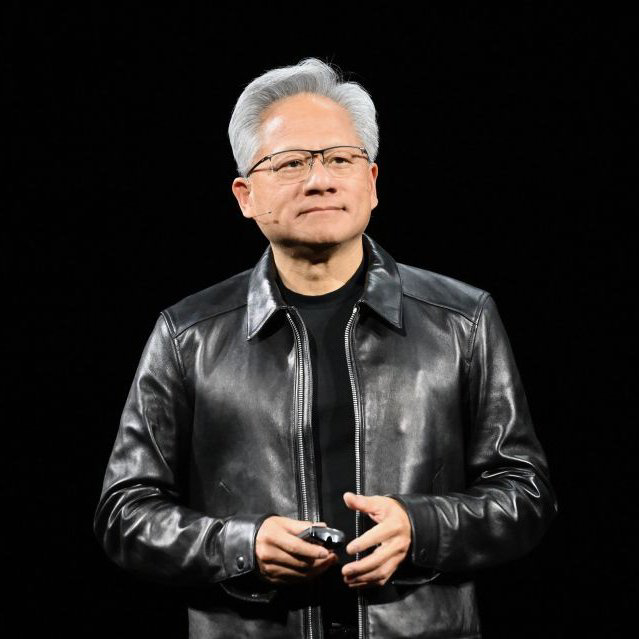
#JensenHuang laughs at himself: I'm a scum
According to Bloomberg, China News Agency quoted by Bloomberg, Huang Renxun resigned as CEO of#NVDIA before the mental and physical exhaustion, the past style is no longer vigorous. People who have spoken to him in recent days have revealed that Huang has repented and ridiculed himself as a "scum," saying he does not care about his fate at the moment and cares most about his wife. On the 11th local time, a remote meeting of the Nvidia board continued late into the night, and Huang could only finally resign. He co-founded NVIDIA in 1993 and served as CEO for many years, leading the company to become a global leader in AI chips. Nvdia announced on the 12th that CFO Kress was appointed as interim CEO, and Huang resigned as president, CEO and director, effective immediately. The cost was already on the table when the turmoil reached the point of resigning. Publicly admitting wrongdoing, self-deprecating and taking responsibility, at least not continuing to push hard; The company also quickly appointed a temporary CEO, and the business did not stop. The consequences of private life are to be borne by yourself, and whether the enterprise can stabilize depends on how the team takes over.
According to Bloomberg, China News Agency quoted by Bloomberg, Huang Renxun resigned as CEO of#NVDIA before the mental and physical exhaustion, the past style is no longer vigorous. People who have spoken to him in recent days have revealed that Huang has repented and ridiculed himself as a "scum," saying he does not care about his fate at the moment and cares most about his wife. On the 11th local time, a remote meeting of the Nvidia board continued late into the night, and Huang could only finally resign. He co-founded NVIDIA in 1993 and served as CEO for many years, leading the company to become a global leader in AI chips. Nvdia announced on the 12th that CFO Kress was appointed as interim CEO, and Huang resigned as president, CEO and director, effective immediately. The cost was already on the table when the turmoil reached the point of resigning. Publicly admitting wrongdoing, self-deprecating and taking responsibility, at least not continuing to push hard; The company also quickly appointed a temporary CEO, and the business did not stop. The consequences of private life are to be borne by yourself, and whether the enterprise can stabilize depends on how the team takes over.
5
365

·
--
Verified
🚨 JENSEN HUANG STEPS DOWN: WHAT'S NEXT FOR $NVDA? ⚠️
After 33 years, NVIDIA co-founder Jensen Huang has resigned as President, CEO, and board member, effective immediately.
🔹 Leadership Changes:
• Colette Kress, NVIDIA’s CFO, has been appointed interim CEO.
• Harvey C. Jones has become the company’s first-ever board chair.
• The board will search for a permanent CEO, considering internal and external candidates.
📉 The leadership change has raised questions about NVIDIA’s future direction and investor confidence.
📅 November 17: NVIDIA is still scheduled to report its Q3 FY2027 results. Investors will be watching revenue, guidance, AI-chip demand, and the company’s long-term strategy.
The board has also announced an independent investigation following reports that Huang was targeted by a foreign intelligence effort. The board said it has no reason to believe NVIDIA secrets or national security were compromised.
Jensen played a major role in building NVIDIA into an AI leader. Now the question is whether the company can maintain its momentum under new leadership.
Is NVIDIA bigger than Jensen Huang, or was he its biggest competitive advantage? 👀
$NVDAB - $BARD - $AKE
{spot}(NVDABUSDT)
{future}(BARDUSDT)
{future}(AKEUSDT)
#NVDIA #huangexitnvidiastrategyinfocus
"Can NVIDIA maintain its momentum"!?
🚨 JENSEN HUANG STEPS DOWN: WHAT'S NEXT FOR $NVDA? ⚠️
After 33 years, NVIDIA co-founder Jensen Huang has resigned as President, CEO, and board member, effective immediately.
🔹 Leadership Changes:
• Colette Kress, NVIDIA’s CFO, has been appointed interim CEO.
• Harvey C. Jones has become the company’s first-ever board chair.
• The board will search for a permanent CEO, considering internal and external candidates.
📉 The leadership change has raised questions about NVIDIA’s future direction and investor confidence.
📅 November 17: NVIDIA is still scheduled to report its Q3 FY2027 results. Investors will be watching revenue, guidance, AI-chip demand, and the company’s long-term strategy.
The board has also announced an independent investigation following reports that Huang was targeted by a foreign intelligence effort. The board said it has no reason to believe NVIDIA secrets or national security were compromised.
Jensen played a major role in building NVIDIA into an AI leader. Now the question is whether the company can maintain its momentum under new leadership.
Is NVIDIA bigger than Jensen Huang, or was he its biggest competitive advantage? 👀
$NVDAB - $BARD - $AKE
#NVDIA #huangexitnvidiastrategyinfocus
"Can NVIDIA maintain its momentum"!?
🟢 Yes — Strong team! 🚀
60%
🔴 No — Jensen mattered! 👀
40%
513 votes • Voting closed
20
1
60
95.7k
·
--
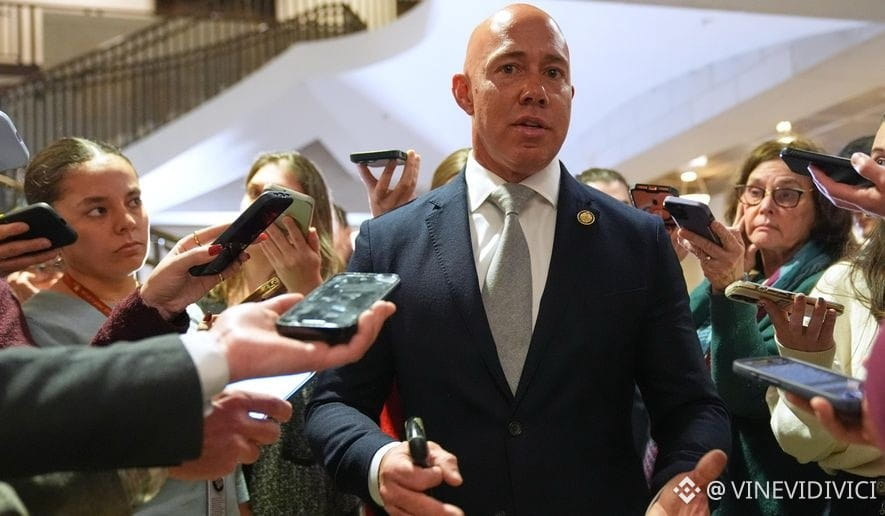
Capitol Hill committee chairs are lining up to grill Nvidia founder Jensen Huang about his love affair with an alleged Chinese spy.
Mr. Huang resigned from the technology company on Tuesday after admitting to extramarital affairs. Now, Congress wants its shot at the fallen tech titan.
Senate Majority Leader John Thune, South Dakota Republican, said he expected Senate probes into the matter.
“It would make sense because of the nature of the association,” he said.
Democrats, who ran on a midterm platform adversarial toward Big Tech, are likely to take up the issue with hearings and briefings in the next Congress.
Rep. Gregory Meeks of New York, the top Democrat on the Foreign Affairs Committee, said the Huang situation could warrant the creation of a subcommittee.
Advertisement Advertisement
“That’s how important and significant it is,” he said. “Come Jan. 4, there will be some hearings.”
Sen. Elizabeth Warren, a Massachusetts Democrat who leads her party on the Senate Banking Committee, said on social media, “Jensen Huang’s decision to resign from NVIDIA does not absolve him, other executives, or the company as a whole of responsibility for putting our national security at risk or for any potential violations of our laws.” #JensenHuang #capitol #NVdia
277
·
--
Bearish
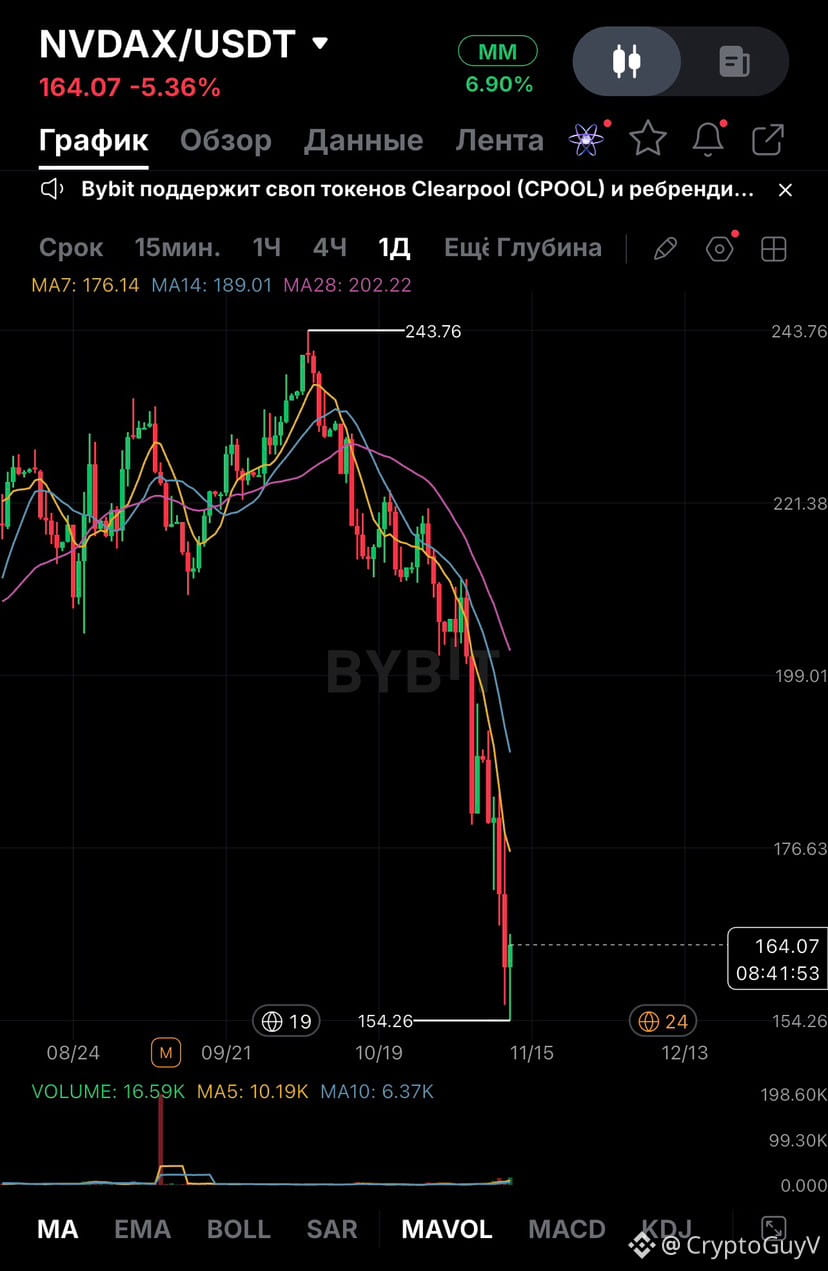
NVIDIA at $150? Give me two.
I think this is a decent entry point. The FUD will pass, and in two weeks everyone will have forgotten about it, and the company will still be the main AI narrative in the US.
#NVDIA
NVIDIA at $150? Give me two.
I think this is a decent entry point. The FUD will pass, and in two weeks everyone will have forgotten about it, and the company will still be the main AI narrative in the US.
#NVDIA
I think this is a decent entry point. The FUD will pass, and in two weeks everyone will have forgotten about it, and the company will still be the main AI narrative in the US.
#NVDIA
211

·
--
Verified
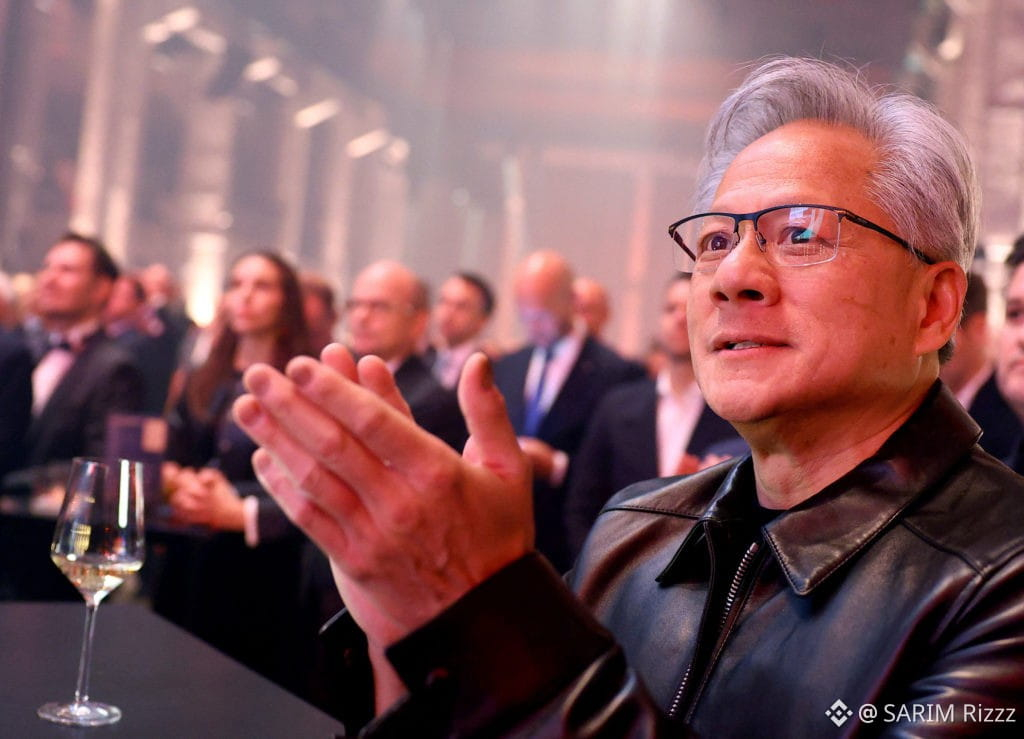
🚨 $NVDA — BIG EARNINGS SURPRISE OR MAJOR CRASH? 👀
Nvidia (NVDA) reports earnings on November 17, but an earnings beat may not be enough to push the stock higher.
Here's what I'm watching:
🟢 BULLISH: Strong AI demand and positive forward guidance could trigger a major rally for NVDA, AMD and the semiconductor sector.
🔴 BEARISH: Weak guidance or slowing AI spending could trigger another sell-off, even if earnings beat expectations.
The real question isn't whether Nvidia can beat earnings, but whether AI growth can meet Wall Street's expectations.
Fam, would you buy before earnings or wait for the reaction? 👇
#NVDIA #AnthropicRejectsIPODelayValuationinQuestion
{future}(NVDAUSDT)
#CoreWeaveJumps10%On168%RevenueGrowth
🚨 $NVDA — BIG EARNINGS SURPRISE OR MAJOR CRASH? 👀
Nvidia (NVDA) reports earnings on November 17, but an earnings beat may not be enough to push the stock higher.
Here's what I'm watching:
🟢 BULLISH: Strong AI demand and positive forward guidance could trigger a major rally for NVDA, AMD and the semiconductor sector.
🔴 BEARISH: Weak guidance or slowing AI spending could trigger another sell-off, even if earnings beat expectations.
The real question isn't whether Nvidia can beat earnings, but whether AI growth can meet Wall Street's expectations.
Fam, would you buy before earnings or wait for the reaction? 👇
#NVDIA #AnthropicRejectsIPODelayValuationinQuestion
#CoreWeaveJumps10%On168%RevenueGrowth
1
646
Log in to explore more content
Join global crypto users on Binance Square
⚡️ Get latest and useful information about crypto.
💬 Trusted by the world’s largest crypto exchange.
👍 Discover real insights from verified creators.
Email / Phone number
Trending Topics
1
#BTCReboundsAbove$60KAmidWhaleDipBuying
87,462 views
399 Discussing
2
#SolanaSets2027RoadmapToDoubleComputeCapacity
72,115 views
1,134 Discussing
3
#CaliforniaNvidiaProbeExaminesPotentialCriminalViolations
19,625 views
165 Discussing
4
#BlackRockLaunchesHKDollarDigitalLiquidityFund
60,494 views
849 Discussing
5
#NvidiaLoses$2.7TrillionInMonthAndAHalf
82,199 views
337 Discussing
6
#GlobalStocksFaceLongestLosingStreakSince2023
590,969 views
3,572 Discussing
7
#BlackRockIBITPostsRecord$541MSingleDayOutflow
100,178 views
186 Discussing
8
#AnthropicPlungesTowardIPOPriceonDay2
329,451 views
2,399 Discussing
9
#TwentyOneCapitalAdds172.25BTC
178,604 views
1,708 Discussing
10
#HKBillWouldExcludeTokenizedDepositsFromVirtualAssets
19,138 views
109 Discussing