
#occissuesfirstfinalruleundergeniusact
occissuesfirstfinalruleundergeniusact
125,794 views
1,217 Discussing
Hot
Latest

📰 American Bankers Association to OCC: What Is the Stablecoin Rule Really Afraid Of?
The American Bankers Association (ABA) recently publicly criticized the Office of the Comptroller of the Currency (OCC), accusing it of undermining congressional legislation with its final rule on stablecoin rewards. Put simply, banks and regulators are at odds again—this time over rewards for crypto stablecoins. The ABA argues that the OCC’s new rule moves too fast and fails to fully reflect the intent of last year’s Stablecoin Regulatory Act passed by Congress. The regulatory battle is heating up again, casting a shadow over the future development of crypto stablecoins.
Why does this news matter?
The OCC’s stablecoin rewards rule essentially gives stablecoin issuers the green light to offer rewards to third-party platforms (such as exchanges and wallet providers), provided they purchase highly secure assets like U.S. Treasury securities. The ABA objects, arguing that this conflicts with the spirit of last year’s congressional legislation, which holds that “only banks can offer rewards.” It fears this could weaken banks’ advantage in the stablecoin sector. At the heart of the issue is the long-standing tension between banks and tech companies competing in this emerging field. Now that the OCC has suddenly extended an olive branch to their rivals, banks are naturally pushing back. In the broader regulatory cycle, this comes as countries around the world are reassessing their crypto regulatory frameworks. Major powers like the U.S., which want to encourage innovation while also preventing things from getting out of control, are proceeding with exceptional caution. To connect this with other recent events, consider the SEC’s recent lawsuit against Binance—both reflect regulators’ efforts to bring the crypto industry under stricter rules.
Impact on the market
For BTC and ETH, this news is likely to have more of a sentiment-driven impact. In the short term, it could push risk-averse money toward traditional finance, but over the longer term, clearer regulation could make the market more stable. The potential chain of effects is as follows: the dispute between the ABA and OCC could divert regulatory resources, possibly putting other more urgent crypto issues on hold; stablecoin issuers may be caught between the two sides, having to comply with OCC rules while also facing pressure from banks; capital may initially flow out of the crypto sector, but once the regulatory uncertainty is resolved, new investment opportunities could emerge. Similar events have occurred in the past. For example, the EU’s 2019 draft stablecoin regulations sparked significant industry controversy, but ultimately helped standardize the market.
Trading outlook
💡 Sentiment looks bearish in the short term, but in the long run, regulatory uncertainty could create room for projects that can adapt to survive. Key price levels to watch are BTC at $80K and ETH at $2.3K. This outlook is invalidated if the OCC revises its rules next to accommodate banks.
【Conditions that would invalidate this outlook】If the OCC revokes the stablecoin rewards rule within one month, this outlook is invalidated.
【Disclosure of position】This article is not sponsored by any project, and the author does not hold any of the assets mentioned.
⚠️ This is not investment advice. Forecasts are for reference only.
#OCCIssuesFirstFinalRuleUnderGENIUSAct
$BTC $ETH



50

🚨 **U.S. STABLECOIN REGULATION JUST TOOK A MAJOR STEP FORWARD!** 🏦🌐
🔥 **#OCCIssuesFirstFinalRuleUnderGENIUSAct
The U.S. Office of the Comptroller of the Currency (OCC) has issued its **final rule implementing the GENIUS Act**, creating a clearer regulatory framework for payment stablecoins.
📌 **What's changing?**
✅ Rules covering stablecoin reserves and redemption
✅ Stronger risk management, audits & supervision
✅ Requirements for permitted stablecoin issuers
✅ Certain crypto custody activities addressed
📅 **Effective date:** January 18, 2027.
👀 **Why it matters:** Clearer rules could shape stablecoin adoption, competition and institutional participation—but implementation and consumer protection will be key.
⚠️ **Important:** Regulatory progress doesn't guarantee crypto prices will rise.
💬 **Your take:** Will clearer stablecoin rules accelerate adoption, or bring tougher challenges?
#Stablecoins #GENIUSAct #DigitalAssets #Blockchain
75
📰 OCC’s new rule is here—what exactly is the crypto market afraid of?
The Fed just said CPI came in as expected, and U.S. stocks hit another record high. Then the Office of the Comptroller of the Currency (OCC) suddenly dropped a bombshell: it finally published the final stablecoin rule under the Trump-era GENIUS Act. This hard-hitting rule takes away all the money stablecoin issuers might earn from third-party rewards, sending the industry’s profit expectations plummeting. This is a major issue for all the crypto heavyweights looking to issue U.S. dollar stablecoins.
Why does this news matter?
The underlying reason for this new rule is that regulators are aggressively testing the waters. Trump signed the GENIUS Act, but after Republicans left office, Democrats kept dragging their feet. Now Biden’s OCC has suddenly made its move, wanting to see just how tough Congress and financial heavyweights are on cryptocurrency. Put simply, this is a way to pave the road for a potentially comprehensive stablecoin bill in the coming years. Why act now? Because last year, Congress once again gave the OCC a firm order to establish stablecoin regulations. This move to eliminate third-party rewards suggests regulators may genuinely fear that dollar stablecoins could trigger a financial crisis. What does this mean? It means the boundary between crypto and traditional finance is about to be redrawn.
The impact on the market
In the short term, this is bullish for BTC. Since the new rule halves stablecoin issuers’ profit expectations, they may turn around and buy the dip in Bitcoin—after all, BTC is cheaper than stablecoins right now. In the long term, it will become increasingly difficult for crypto and traditional finance to operate across sectors. If Congress introduces even stricter regulations in the future, the entire stablecoin industry may have to undergo a shake-up. A historical parallel? Before the 2008 financial crisis, shadow banking was also expanding rapidly. And what happened? So the OCC’s new rule looks more like a brake on the entire industry. However, if crypto heavyweights find ways around it—for example, by changing third-party rewards into another form—market sentiment could shift again.
💡 I think this could give BTC a short-term boost, as stablecoin heavyweights may move into BTC. But that thesis falls apart if Congress takes even harsher action later.
This article is not sponsored by any project, and the author does not hold any of the assets mentioned.
⚠️ This is not investment advice. Forecasts are for reference only.
#OCCIssuesFirstFinalRuleUnderGENIUSAct
$ETH $BTC

23

·
--
ETH Stablecoin Compliance Window | Applying Does Not Mean an Exemption Is Approved | First Watch Whether Prices Can Stabilize Near $2,380
My stance is cautious: I would not translate the implementation of U.S. stablecoin rules directly into a buy signal for ETH. On October 21, the U.S. Office of the Comptroller of the Currency (OCC) issued the final rules for the GENIUS Act, along with separate application and exemption guidance. The latter contains a detail that can easily be left out of sensational headlines: by January 18, 2027, an issuer must have an application submitted to the OCC that is “substantially complete” and pending review to qualify to submit a written request for an exemption from relevant requirements. Being able to apply does not mean automatic approval; the OCC says it will assess requests case by case. A statutory exemption may last up to 12 months, but the actual duration will depend on the regulator’s decision. The OCC is still awaiting approval from the U.S. Office of Management and Budget for the information-collection procedures associated with the application form; only then will it announce when it will begin accepting applications. This is a compliance pathway, not an announcement that any issuer has already received a license or an exemption.
Why does this matter for ETH? Ethereum is an important settlement network for stablecoins, and issuers’ reserve, redemption, risk-management, and licensing arrangements may affect the continuity of on-chain dollar activity in the future. But stablecoins remaining on-chain does not necessarily mean that spot demand for ETH will rise in tandem: trading volumes, fees, the shift to layer-2 networks, and which chains institutions use all need to be assessed separately. What matters more to me is that the rules shift the question of whether issuers can continue issuing from verbal expectations to document review. In the short term, this may first curb excessive optimism in valuations; only over the longer term might it create the conditions to discuss growth in compliant capital. A policy date should not be treated as the date a rally begins.
The market reaction also cannot simply be called bullish. According to the Kraken ETH/USD order book just now, the current price is around $2,381, the 24-hour opening price was around $2,472, and the range was approximately $2,357 to $2,481. This price action at least suggests that the rules announcement has not yet generated a clear upward trend in buying. However, the price decline cannot be attributed to the OCC alone; macro risk appetite and broader market volatility are also at play. The levels I’m watching are support at $2,357, the $2,400 round-number level, and $2,472 as a recovery confirmation level. If ETH breaks below $2,357 and fails to reclaim it for some time, the short-term recovery thesis is invalidated. If it regains and holds above $2,472 with sustained volume, then it would be worth reassessing the upside potential.
If I were trading this myself, I would neither chase a long position now nor open a large short against support. I would consider a spot position using 2% of my total capital only if ETH first recovers $2,400 and then holds that level on the four-hour timeframe; if it cannot hold above that level, I would stay out of the market. After entering, my first target would be $2,472, where I would take half off the position; my second target would be the previous high near $2,480, where I would close the rest. I would set a stop-loss below $2,350, and would also exit early if a four-hour candle closes back below $2,357 and the rebound is weak. This is a conditional plan, not a claim that a trade has already been entered or made a profit; I would not use high leverage to bet on the speed of approval.
Sources: OCC Announcement of Final Rule No. 2026-50 and Application and Exemption Guidance No. 2026-51; price reference: live Kraken ETH/USD order book. #OCCIssuesFirstFinalRuleUnderGENIUSAct #ETH
This is only my personal market observation and does not constitute investment advice.

35

·
--
Bullish
is your stablecoin yield legal under the GENIUS Act? the OCC's answer, as of October 21: depends, we'll look
that's my read of the first final rule from a federal banking regulator under the act. it takes effect January 18, 2027, a date the law itself set, 18 months after the July 18, 2025 signing
the proposal presumed certain exchange and third-party stablecoin rewards dodge the yield ban
those presumptions are gone
the ban on payments solely for holding stays, applied to each arrangement's facts
so rewards on coins like $USDC
{future}(USDCUSDT)
aren't presumed illegal. they aren't presumed fine either
the ABA hates it. TD Cowen calls it ambiguity "until the courts rule"
Treasury, the Fed and the FDIC are still writing theirs. round one
for the record: Simple Earn Flexible is where I park stables, and news days don't move them
#OCCIssuesFirstFinalRuleUnderGENIUSAct #GENIUSActExpectedToTakeEffectJan18,2027
is your stablecoin yield legal under the GENIUS Act? the OCC's answer, as of October 21: depends, we'll look
that's my read of the first final rule from a federal banking regulator under the act. it takes effect January 18, 2027, a date the law itself set, 18 months after the July 18, 2025 signing
the proposal presumed certain exchange and third-party stablecoin rewards dodge the yield ban
those presumptions are gone
the ban on payments solely for holding stays, applied to each arrangement's facts
so rewards on coins like $USDC
aren't presumed illegal. they aren't presumed fine either
the ABA hates it. TD Cowen calls it ambiguity "until the courts rule"
Treasury, the Fed and the FDIC are still writing theirs. round one
for the record: Simple Earn Flexible is where I park stables, and news days don't move them
#OCCIssuesFirstFinalRuleUnderGENIUSAct #GENIUSActExpectedToTakeEffectJan18,2027

1
75

·
--
Bullish
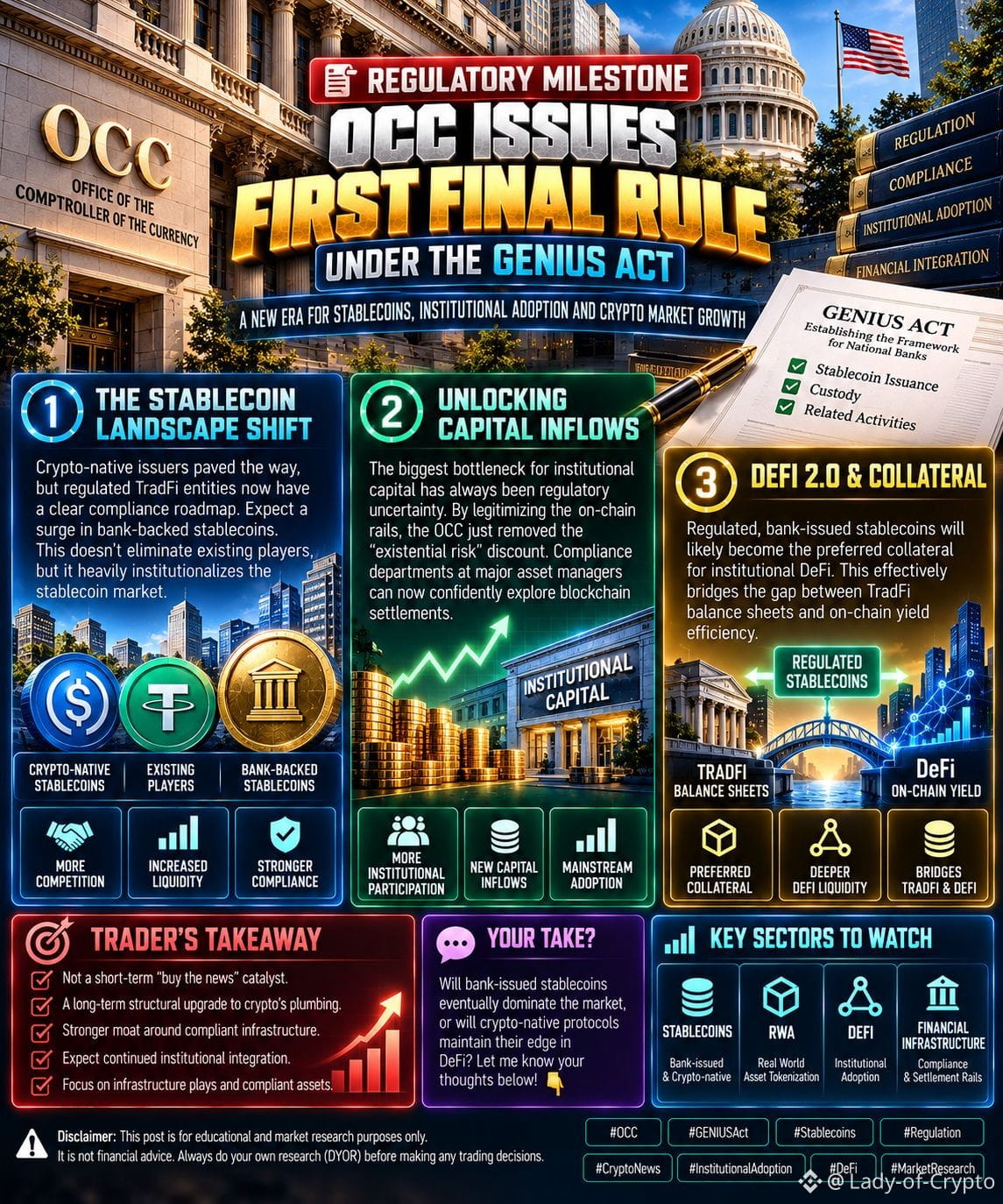
#occissuesfirstfinalruleundergeniusact Regulatory clarity is officially shifting from a macro headwind to a structural tailwind. 🏛️
The OCC just issued its first final rule under the GENIUS Act, formally establishing the framework for national banks to engage in stablecoin issuance, custody, and related activities.
Here is my market research breakdown on why this is a watershed moment for the broader crypto ecosystem:
1️⃣ **The Stablecoin Landscape Shift:** Crypto-native issuers paved the way, but regulated TradFi entities now have a clear compliance roadmap. Expect a surge in bank-backed stablecoins. This doesn't eliminate existing players, but it heavily institutionalizes the stablecoin market.
2️⃣ **Unlocking Capital Inflows:** The biggest bottleneck for institutional capital has always been regulatory uncertainty. By legitimizing the on-chain rails, the OCC just removed the "existential risk" discount. Compliance departments at major asset managers can now confidently explore blockchain settlements.
3️⃣ **DeFi 2.0 & Collateral:** Regulated, bank-issued stablecoins will likely become the preferred collateral for institutional DeFi. This effectively bridges the gap between TradFi balance sheets and on-chain yield efficiency.
**Trader’s Takeaway:**
I’m not viewing this as a short-term "buy the news" catalyst, but rather a long-term structural upgrade to crypto's plumbing. The moat around compliant infrastructure just got significantly wider.
What’s your take? Will bank-issued stablecoins eventually dominate the market, or will crypto-native protocols maintain their edge in decentralized finance? Let me know your thoughts below! 👇
This post is for educational and market research purposes only. It is not financial advice. Always do your own research (DYOR) before making any trading decisions.
$DGB $PHA $SC
{spot}(SCUSDT)
{future}(PHAUSDT)
{spot}(DGBUSDT)
#occissuesfirstfinalruleundergeniusact Regulatory clarity is officially shifting from a macro headwind to a structural tailwind. 🏛️
The OCC just issued its first final rule under the GENIUS Act, formally establishing the framework for national banks to engage in stablecoin issuance, custody, and related activities.
Here is my market research breakdown on why this is a watershed moment for the broader crypto ecosystem:
1️⃣ **The Stablecoin Landscape Shift:** Crypto-native issuers paved the way, but regulated TradFi entities now have a clear compliance roadmap. Expect a surge in bank-backed stablecoins. This doesn't eliminate existing players, but it heavily institutionalizes the stablecoin market.
2️⃣ **Unlocking Capital Inflows:** The biggest bottleneck for institutional capital has always been regulatory uncertainty. By legitimizing the on-chain rails, the OCC just removed the "existential risk" discount. Compliance departments at major asset managers can now confidently explore blockchain settlements.
3️⃣ **DeFi 2.0 & Collateral:** Regulated, bank-issued stablecoins will likely become the preferred collateral for institutional DeFi. This effectively bridges the gap between TradFi balance sheets and on-chain yield efficiency.
**Trader’s Takeaway:**
I’m not viewing this as a short-term "buy the news" catalyst, but rather a long-term structural upgrade to crypto's plumbing. The moat around compliant infrastructure just got significantly wider.
What’s your take? Will bank-issued stablecoins eventually dominate the market, or will crypto-native protocols maintain their edge in decentralized finance? Let me know your thoughts below! 👇
This post is for educational and market research purposes only. It is not financial advice. Always do your own research (DYOR) before making any trading decisions.
$DGB $PHA $SC
657

·
--
📰 The U.S. OCC Finally Issues the GENIUS Act Rule: What Do the New Stablecoin Regulations Mean?
The Office of the Comptroller of the Currency (OCC) has officially issued the final stablecoin rule under the GENIUS Act signed by Trump, set to take effect on January 18. The biggest change in the new rule is the removal of the presumption rule for third-party reward arrangements. This means stablecoin issuers will need to disclose and oversee token reward mechanisms more clearly, with far-reaching implications for the industry's compliance costs and operating models.
Why does this news matter?
The OCC's move is not an isolated event, but a continuation of U.S. regulators' increasingly tough stance toward the crypto sector over the past year. The implementation of the GENIUS Act means:
1. **Greater regulatory clarity**: The Act aims to address potential systemic risks posed by stablecoins, particularly complex derivative structures linked to third-party rewards. Removing the presumption rule reflects regulators' push for greater transparency in the way the industry operates.
2. **Higher industry costs**: Issuers will need to devote more resources to designing compliant reward mechanisms. This could drive some smaller stablecoin projects out of the market and concentrate market share among the largest players.
3. **Alignment with European regulations**: Europe is establishing a regulatory framework for crypto-asset markets through MiCA. The U.S. move signals that the two major economic blocs are strengthening cross-border regulatory coordination. Stablecoins could face dual compliance requirements for international circulation in the future.
Market impact
Although overall market sentiment is currently weak (BTC and ETH have fallen for two consecutive days), the new rule is likely to have a limited short-term impact on market sentiment, as its effects will be felt more in the evolution of the industry's long-term structure:
1. **Impact on BTC/ETH**: BTC, as a store-of-value asset, is likely to be less directly affected. ETH, however, is closely tied to the DeFi ecosystem, and some protocols may need to adjust how they use stablecoins. The extent of the impact will depend on how quickly DeFi projects respond to the OCC's new rule over the next six months.
2. **Shifts in capital flows**: Higher compliance costs could prompt some capital to move from unstablecoin derivatives into ETFs in traditional financial markets. However, these flows will take more time to assess; significant changes may not be visible for at least three months.
3. **Historical precedent**: The U.S. Senate's passage of the Stablecoin Act in 2019 also shook the industry, but the sector ultimately adapted to the new regulatory framework. The GENIUS Act may have a more far-reaching impact because it directly affects stablecoins' core business models.
Trading outlook
For now, the new rule looks more like a long-term optimization of the industry ecosystem than a short-term market catalyst. BTC and ETH may continue to be affected in the near term by macroeconomic capital flows and geopolitical risks, while the regulatory news itself is unlikely to become the dominant market driver. This assessment should be revisited if a major stablecoin project collapses due to compliance issues within the next three months.
This article is not sponsored by any project, and the author does not hold any of the assets mentioned.
$BTC $ETH #BTC #ETH
⚠️ This is not investment advice. Predictions are for reference only.
#OCCIssuesFirstFinalRuleUnderGENIUSAct


285

·
--
Bullish
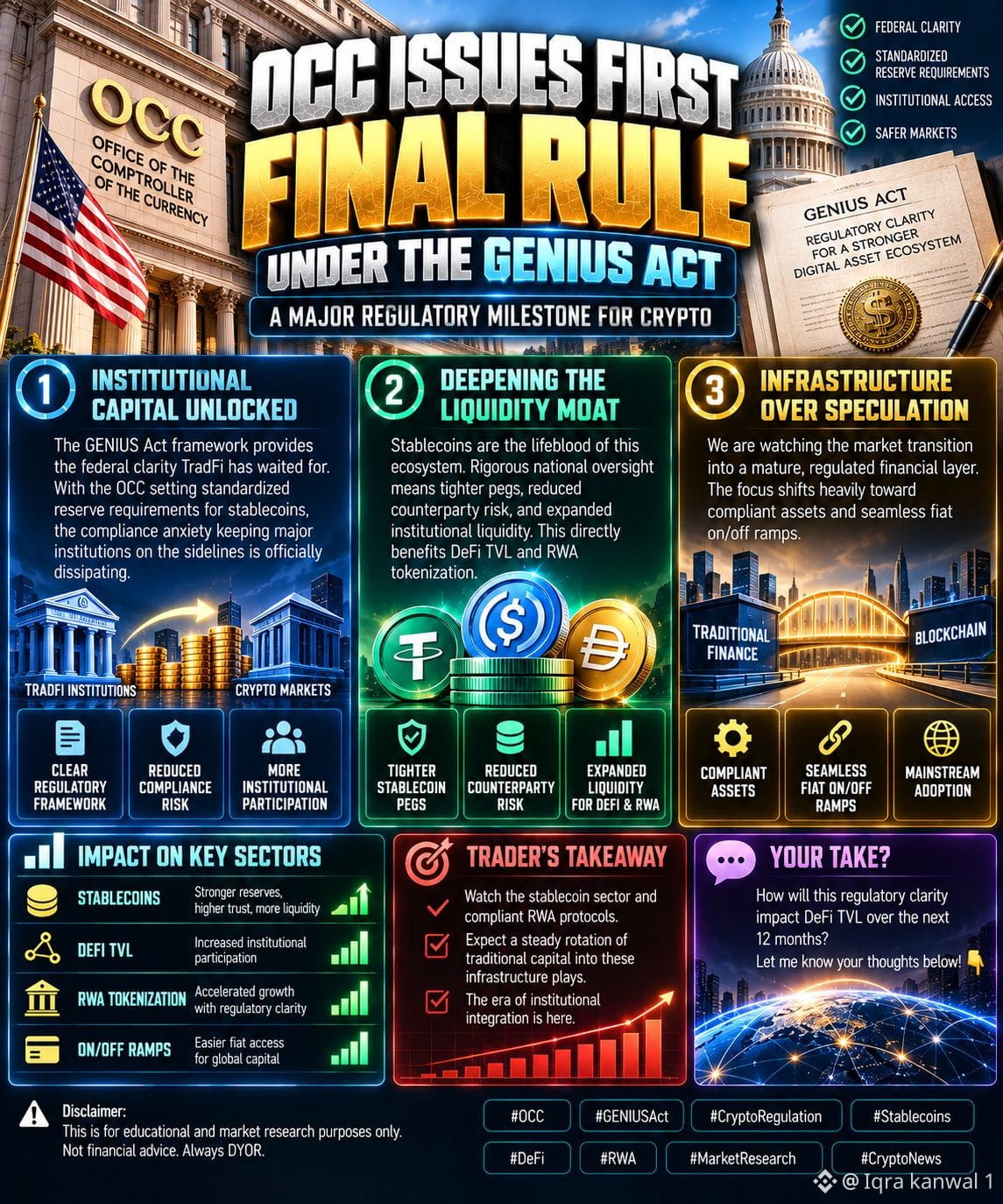
#occissuesfirstfinalruleundergeniusact 🚨 Regulatory Milestone: OCC Issues First Final Rule Under the GENIUS Act
Filtering regulatory noise from actual structural shifts is key in this market. Today, the OCC issued its first final rule under the GENIUS Act. This isn't just a compliance update; it’s a foundational upgrade for crypto’s macro liquidity rails.
Here is my market research breakdown of what this means:
1️⃣ Institutional Capital Unlocked
The GENIUS Act framework provides the federal clarity TradFi has waited for. With the OCC setting standardized reserve requirements for stablecoins, the compliance anxiety keeping major institutions on the sidelines is officially dissipating.
2️⃣ Deepening the Liquidity Moat
Stablecoins are the lifeblood of this ecosystem. Rigorous national oversight means tighter pegs, reduced counterparty risk, and expanded institutional liquidity. This directly benefits DeFi TVL and RWA tokenization.
3️⃣ Infrastructure Over Speculation
We are watching the market transition into a mature, regulated financial layer. The focus shifts heavily toward compliant assets and seamless fiat on/off ramps.
📊 Trader’s Takeaway:
Watch the stablecoin sector and compliant RWA protocols. As federal clarity solidifies, expect a steady rotation of traditional capital into these infrastructure plays. The era of institutional integration is here.
How will this regulatory clarity impact DeFi TVL over the next 12 months? Let me know your thoughts below! 👇
This is for educational and market research purposes only. Not financial advice. Always DYOR.
$DODO $ARK $BOTB
{spot}(BOTBUSDT)
{future}(ARKUSDT)
{spot}(DODOUSDT)
#occissuesfirstfinalruleundergeniusact 🚨 Regulatory Milestone: OCC Issues First Final Rule Under the GENIUS Act
Filtering regulatory noise from actual structural shifts is key in this market. Today, the OCC issued its first final rule under the GENIUS Act. This isn't just a compliance update; it’s a foundational upgrade for crypto’s macro liquidity rails.
Here is my market research breakdown of what this means:
1️⃣ Institutional Capital Unlocked
The GENIUS Act framework provides the federal clarity TradFi has waited for. With the OCC setting standardized reserve requirements for stablecoins, the compliance anxiety keeping major institutions on the sidelines is officially dissipating.
2️⃣ Deepening the Liquidity Moat
Stablecoins are the lifeblood of this ecosystem. Rigorous national oversight means tighter pegs, reduced counterparty risk, and expanded institutional liquidity. This directly benefits DeFi TVL and RWA tokenization.
3️⃣ Infrastructure Over Speculation
We are watching the market transition into a mature, regulated financial layer. The focus shifts heavily toward compliant assets and seamless fiat on/off ramps.
📊 Trader’s Takeaway:
Watch the stablecoin sector and compliant RWA protocols. As federal clarity solidifies, expect a steady rotation of traditional capital into these infrastructure plays. The era of institutional integration is here.
How will this regulatory clarity impact DeFi TVL over the next 12 months? Let me know your thoughts below! 👇
This is for educational and market research purposes only. Not financial advice. Always DYOR.
$DODO $ARK $BOTB
1
845

·
--
#occissuesfirstfinalruleundergeniusact
🏛️ BREAKING: OCC Drops First Final Rule Under the GENIUS Act! 🚀
The regulatory landscape for digital assets just hit a massive milestone. The Office of the Comptroller of the Currency (OCC) has officially issued its final rule implementing the GENIUS Act (Guiding and Establishing National Innovation for U.S. Stablecoins), establishing a historic federal standard for payment stablecoins.
With the compliance clock ticking toward the official rollout on January 18, 2027, here are the crucial takeaways every crypto trader and investor needs to know:
Unified Federal Standards: Say goodbye to fragmented state-by-state rules. The framework sets strict requirements for high-quality reserve backing (1:1), mandatory annual audits, redemption timelines, and risk management.
The Yield Debate: Direct interest/yield payments from stablecoin issuers to holders remain strictly banned by the statute. However, in a notable shift, the OCC dropped its strict presumption against third-party rewards, opting instead to evaluate affiliate and exchange reward programs on a case-by-case basis.
Institutional Adoption Highway: By introducing a clear national licensing framework for eligible bank and non-bank entities, this rule clears the regulatory fog for heavy institutional capital entering dollar-pegged assets like $USDC and $USDT.
Note: AML, BSA, and sanctions requirements are still coming separately down the pipeline via the Treasury.
🌐 The big question: Does this federal rulebook accelerate mainstream crypto payments, or will the yield restrictions slow down retail adoption? Drop your thoughts below! 👇💬
$USDT $BTC #GENIUSAct #CryptoRegulation #Stablecoins #CryptoNews

202

·
--
Bullish
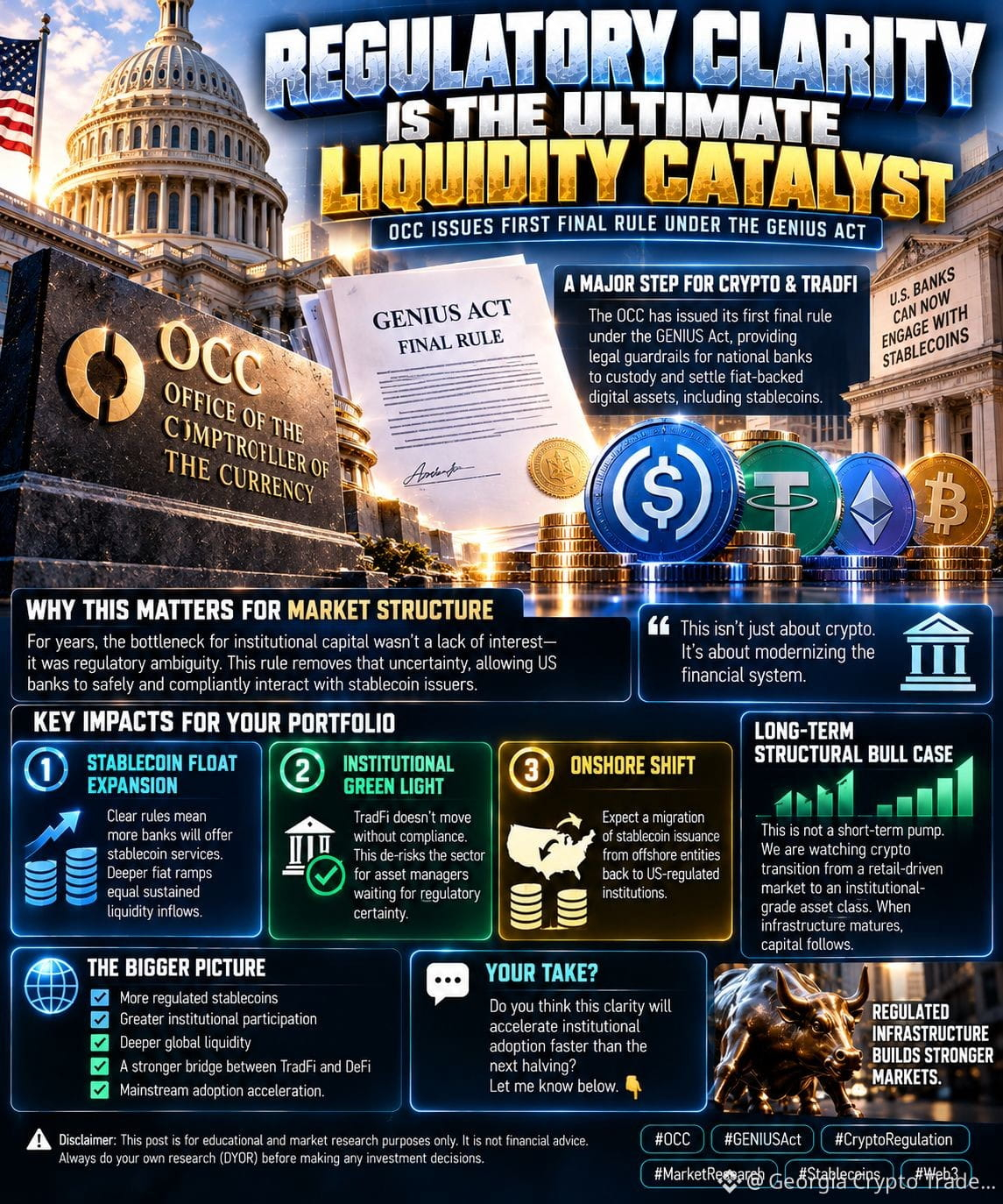
#occissuesfirstfinalruleundergeniusact Regulatory clarity is the ultimate liquidity catalyst. 🏛️📊
The OCC just issued its first final rule under the GENIUS Act. If you’re only watching daily price action, you might miss the macro shift happening. As a market researcher, I don't trade hype; I trade infrastructure. Here is what this means for market structure.
For years, the bottleneck for institutional capital wasn’t a lack of interest—it was regulatory ambiguity. US banks sat on the sidelines, fearing enforcement actions just for interacting with stablecoin issuers. This OCC rule changes the game, providing legal guardrails for national banks to custody and settle fiat-backed digital assets.
Why does this matter for your portfolio?
1️⃣ Stablecoin Float Expansion: Clear rules mean more banks will offer stablecoin services. Deeper fiat ramps equal sustained liquidity inflows.
2️⃣ Institutional Green Light: TradFi doesn't move without compliance. This de-risks the sector for asset managers waiting for regulatory certainty.
3️⃣ Onshore Shift: Expect a migration of stablecoin issuance from offshore entities back to US-regulated institutions.
This isn't a short-term pump; it’s a long-term structural bull case. We are watching crypto transition from a retail-driven market to an institutional-grade asset class. The rails are being built in real-time. When infrastructure matures, capital follows.
Do you think this clarity will accelerate institutional adoption faster than the next halving? Let me know below. 👇
#OCC #GENIUSAct #CryptoRegulation #MarketResearch #Stablecoins
$LUMIA $SOXSB $BOTB
{spot}(BOTBUSDT)
{spot}(SOXSBUSDT)
{future}(LUMIAUSDT)
#occissuesfirstfinalruleundergeniusact Regulatory clarity is the ultimate liquidity catalyst. 🏛️📊
The OCC just issued its first final rule under the GENIUS Act. If you’re only watching daily price action, you might miss the macro shift happening. As a market researcher, I don't trade hype; I trade infrastructure. Here is what this means for market structure.
For years, the bottleneck for institutional capital wasn’t a lack of interest—it was regulatory ambiguity. US banks sat on the sidelines, fearing enforcement actions just for interacting with stablecoin issuers. This OCC rule changes the game, providing legal guardrails for national banks to custody and settle fiat-backed digital assets.
Why does this matter for your portfolio?
1️⃣ Stablecoin Float Expansion: Clear rules mean more banks will offer stablecoin services. Deeper fiat ramps equal sustained liquidity inflows.
2️⃣ Institutional Green Light: TradFi doesn't move without compliance. This de-risks the sector for asset managers waiting for regulatory certainty.
3️⃣ Onshore Shift: Expect a migration of stablecoin issuance from offshore entities back to US-regulated institutions.
This isn't a short-term pump; it’s a long-term structural bull case. We are watching crypto transition from a retail-driven market to an institutional-grade asset class. The rails are being built in real-time. When infrastructure matures, capital follows.
Do you think this clarity will accelerate institutional adoption faster than the next halving? Let me know below. 👇
#OCC #GENIUSAct #CryptoRegulation #MarketResearch #Stablecoins
$LUMIA $SOXSB $BOTB
1
1
1.3k

🌐 Traditional Banking Meets Digital Assets
Stablecoin regulation is becoming an important issue for the relationship between banks and crypto markets.
The OCC's final rule under the GENIUS Act highlights the shift from legislation toward operational supervision.
The real impact will depend on the rule's specific requirements and how institutions respond.
#DigitalFinance $ETH $BNB
#occissuesfirstfinalruleundergeniusact
22
🔍 What Comes After a Final Rule?
Issuing a final rule is a regulatory milestone, but implementation is where the details become important.
Financial institutions will need to understand applicable requirements, compliance processes, and supervisory expectations under the GENIUS Act framework.
For crypto observers, following the actual rule is more useful than reacting to the headline alone.
#GENIUSAct $BTC $USDC
#occissuesfirstfinalruleundergeniusact
42
💵 Why Stablecoin Rules Matter
Stablecoins connect digital assets with dollar-based payments and trading.
As the OCC issues a final rule under the GENIUS Act, institutions and market participants will be watching how the regulatory framework affects issuance, oversight, and confidence in the sector.
Clear rules and effective implementation both matter.
#Stablecoins $USDC $XRP
#occissuesfirstfinalruleundergeniusact
30
📜 Stablecoin Regulation Moves Forward
The OCC's final rule under the GENIUS Act brings attention to the practical side of stablecoin oversight.
For the crypto industry, implementation details matter: compliance obligations, permitted activities, and supervisory expectations can influence how institutions participate.
Watch the official guidance for the full picture.
#CryptoRegulation $BTC $ETH
#occissuesfirstfinalruleundergeniusact
49

#OCCIssuesFirstFinalRuleUnderGENIUSAct
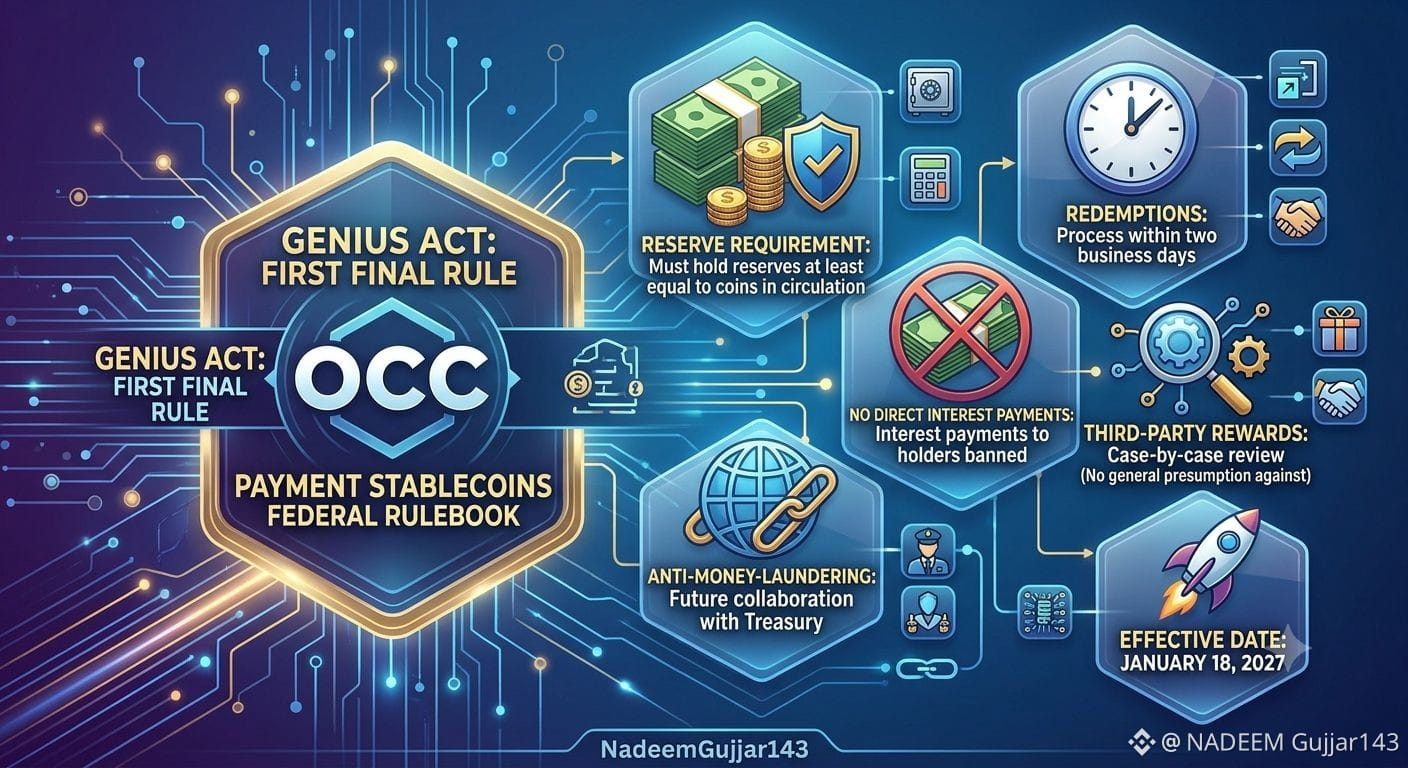
🏦 Big news for stablecoins! The OCC just issued its first final rule under the GENIUS Act, giving payment stablecoin issuers a clear federal rulebook. 📜
Issuers must hold reserves worth at least as much as their coins in circulation 💵 and generally honor redemptions within two business days ⏱️. Direct interest payments to holders stay banned 🚫.
The rule drops the proposed presumption against third-party rewards, so those arrangements will be reviewed case by case 🔍. Anti-money-laundering rules will come later with Treasury.
📅 Everything takes effect January 18, 2027. 🚀
#GENIUSAct #OCC #Stablecoins
#Nadeemgujjar143
@Square-Creator-f3ffb6967ae3 @CryptoPattern @Square-Creator-4f9167370
$BNB
{spot}(BNBUSDT)
$FOLKS
{future}(FOLKSUSDT)
$SHIB
{spot}(SHIBUSDT)
#OCCIssuesFirstFinalRuleUnderGENIUSAct
🏦 Big news for stablecoins! The OCC just issued its first final rule under the GENIUS Act, giving payment stablecoin issuers a clear federal rulebook. 📜
Issuers must hold reserves worth at least as much as their coins in circulation 💵 and generally honor redemptions within two business days ⏱️. Direct interest payments to holders stay banned 🚫.
The rule drops the proposed presumption against third-party rewards, so those arrangements will be reviewed case by case 🔍. Anti-money-laundering rules will come later with Treasury.
📅 Everything takes effect January 18, 2027. 🚀
#GENIUSAct #OCC #Stablecoins
#Nadeemgujjar143
@aasho @CryptoPattern @Ayesha
$BNB
$FOLKS
$SHIB
1
3
1.8k

·
--
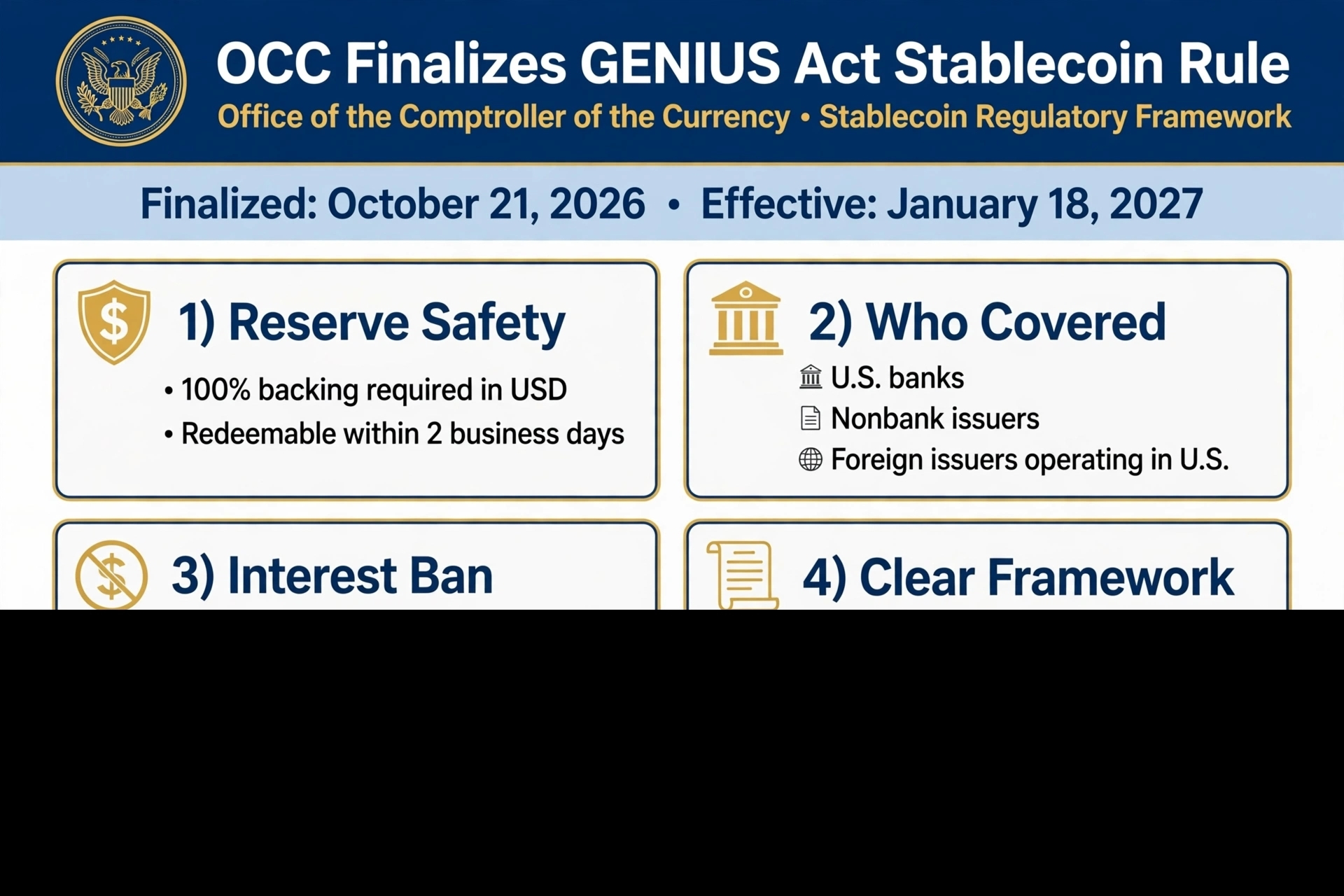
🏛️ *OCC Final Rule for Stablecoins - GENIUS Act!*
📅 *Finalized: Oct 21, 2026*
🚀 Starts: *18 January 2027*
✅ First agency to finish the rule!
⚡ *What's new?*
1️⃣ *Money Safety* 💵🔒
- For every $1 stablecoin, must have $1 real dollars in bank
- If you want your money back, they must return in 2 days ⏰$OCC.US
{stock_us}(OCC.US)
#c
2️⃣ *Who needs to follow?* 👮♂️
- Big US banks 🏦
- New crypto companies wanting license 📜$BTC
- Foreign companies issuing stablecoins in US 🌍
3️⃣ *Interest / Rewards* 💸⚠️
- Can't pay interest just for holding coin ❌
- BUT if exchange gives rewards for other reasons, OCC will check case-by-case 👀
- Old rewards like:
- PayPal 4% on PYUSD
- Coinbase 3.75% on USDC
- Kraken 4.5% on USDG
- All must pass new test again!
4️⃣ *What OCC said?* 🗣️
_"Clear framework for innovation with strong safety"_
💡 Simple: Stablecoins now have proper US rules - safe backing, quick redemption, and rewards will be watched closely!
#OCCIssuesFirstFinalRuleUnderGENIUSAct #GENIUSAct #CryptoRegulation #cryptotrading #BTC
🏛️ *OCC Final Rule for Stablecoins - GENIUS Act!*
📅 *Finalized: Oct 21, 2026*
🚀 Starts: *18 January 2027*
✅ First agency to finish the rule!
⚡ *What's new?*
1️⃣ *Money Safety* 💵🔒
- For every $1 stablecoin, must have $1 real dollars in bank
- If you want your money back, they must return in 2 days ⏰$OCC.US
#c
2️⃣ *Who needs to follow?* 👮♂️
- Big US banks 🏦
- New crypto companies wanting license 📜$BTC
- Foreign companies issuing stablecoins in US 🌍
3️⃣ *Interest / Rewards* 💸⚠️
- Can't pay interest just for holding coin ❌
- BUT if exchange gives rewards for other reasons, OCC will check case-by-case 👀
- Old rewards like:
- PayPal 4% on PYUSD
- Coinbase 3.75% on USDC
- Kraken 4.5% on USDG
- All must pass new test again!
4️⃣ *What OCC said?* 🗣️
_"Clear framework for innovation with strong safety"_
💡 Simple: Stablecoins now have proper US rules - safe backing, quick redemption, and rewards will be watched closely!
#OCCIssuesFirstFinalRuleUnderGENIUSAct #GENIUSAct #CryptoRegulation #cryptotrading #BTC
BTC+3.91%
OCCUS+14.14%
67

·
--
#occissuesfirstfinalruleundergeniusact
The OCC’s GENIUS Act rule is final. “Stablecoin yield is dead” is the wrong takeaway. 🏛️
What’s confirmed ✅ (Oct. 21)
• 1:1 reserves; redemption within 2 business days
• Minimum capital threshold of $5M, now maintained beyond an issuer’s first 3 years of operation
• Takes effect Jan. 18, 2027, the same day as the Act
The yield question ⚠️
• The prohibition applies to issuers that pay yield solely in exchange for holding, using, or retaining a stablecoin
• The OCC dropped its proposed presumption against rewards paid by third parties or affiliates; these will therefore be reviewed on a case-by-case basis
• But there is no grandfathering for existing programs and no compliance transition period
What’s still missing
Rules on anti-money laundering, the BSA, and sanctions will be established separately, and the OCC only covers issuers it supervises.
In my view, things are less certain than headlines about “pro-innovation regulation” suggest. Exchanges offering USDC rewards must now prove that each program is compliant.
Will rewards evolve into activity-based incentives? 👇
This is not financial advice. Do your own research.
$BTC
{future}(BTCUSDT)
$MAGMA
{future}(MAGMAUSDT)
$IRYS
{future}(IRYSUSDT)
#occissuesfirstfinalruleundergeniusact
The OCC’s GENIUS Act rule is final. “Stablecoin yield is dead” is the wrong takeaway. 🏛️
What’s confirmed ✅ (Oct. 21)
• 1:1 reserves; redemption within 2 business days
• Minimum capital threshold of $5M, now maintained beyond an issuer’s first 3 years of operation
• Takes effect Jan. 18, 2027, the same day as the Act
The yield question ⚠️
• The prohibition applies to issuers that pay yield solely in exchange for holding, using, or retaining a stablecoin
• The OCC dropped its proposed presumption against rewards paid by third parties or affiliates; these will therefore be reviewed on a case-by-case basis
• But there is no grandfathering for existing programs and no compliance transition period
What’s still missing
Rules on anti-money laundering, the BSA, and sanctions will be established separately, and the OCC only covers issuers it supervises.
In my view, things are less certain than headlines about “pro-innovation regulation” suggest. Exchanges offering USDC rewards must now prove that each program is compliant.
Will rewards evolve into activity-based incentives? 👇
This is not financial advice. Do your own research.
$BTC
$MAGMA
$IRYS
1
2.7k

OCC finalizes GENIUS Act rule. What changed?
Confirmed:
1:1 reserves.
Redemption within 2 business days.
Minimum capital of US$5 million, required even after the first 3 years.
Effective January 18, 2027.
On yield:
The prohibition applies to issuers that pay yield solely for holding the stablecoin.
OCC dropped the presumption against third-party rewards.
Assessment will be case by case.
No protection for existing programs and no deadline to comply.
What’s still missing:
AML, BSA, and sanctions rules.
Coverage only for issuers supervised by the OCC.
My opinion:
The situation is less certain than the headlines suggest.
Exchanges offering USDC rewards need to prove compliance program by program.
Will rewards evolve into activity-based incentives?
This is not financial advice. Do your own research.
$LUMIA $PHA $IRYS
#OCCIssuesFirstFinalRuleUnderGENIUSAct
{spot}(LUMIAUSDT)
{spot}(PHAUSDT)
{future}(IRYSUSDT)
OCC finalizes GENIUS Act rule. What changed?
Confirmed:
1:1 reserves.
Redemption within 2 business days.
Minimum capital of US$5 million, required even after the first 3 years.
Effective January 18, 2027.
On yield:
The prohibition applies to issuers that pay yield solely for holding the stablecoin.
OCC dropped the presumption against third-party rewards.
Assessment will be case by case.
No protection for existing programs and no deadline to comply.
What’s still missing:
AML, BSA, and sanctions rules.
Coverage only for issuers supervised by the OCC.
My opinion:
The situation is less certain than the headlines suggest.
Exchanges offering USDC rewards need to prove compliance program by program.
Will rewards evolve into activity-based incentives?
This is not financial advice. Do your own research.
$LUMIA $PHA $IRYS
#OCCIssuesFirstFinalRuleUnderGENIUSAct

1
644


Article
OCC Issues Final Rule for the GENIUS Act: A New Era or Just Window Dressing for Stablecoins#occissuesfirstfinalruleundergeniusact
On October 21, 2026, the U.S. Office of the Comptroller of the Currency (OCC) officially published the Final Rule (Bulletin 2026-50) implementing the GENIUS Act. This is a historic step that lays the groundwork for the first federal regulatory framework governing issuers of payment stablecoins in the United States.
With its effective date set for January 18, 2027, this legal framework will directly affect the structure of digital asset circulation, the business models of exchanges, and institutional money flows in the coming cycle.
OCC Issues Final Rule for the GENIUS Act: A New Era or Just Window Dressing for Stablecoins
#occissuesfirstfinalruleundergeniusact
On October 21, 2026, the U.S. Office of the Comptroller of the Currency (OCC) officially published the Final Rule (Bulletin 2026-50) implementing the GENIUS Act. This is a historic step that lays the groundwork for the first federal regulatory framework governing issuers of payment stablecoins in the United States.
With its effective date set for January 18, 2027, this legal framework will directly affect the structure of digital asset circulation, the business models of exchanges, and institutional money flows in the coming cycle.
708

·
--
#occissuesfirstfinalruleundergeniusact
🏛️ BREAKING: OCC Issues First Final Rule Under the Landmark GENIUS Act!
The Office of the Comptroller of the Currency (OCC) has officially issued its final rule implementing the GENIUS Act (Guiding and Establishing National Innovation for U.S. Stablecoins), setting a historic federal standard for digital asset regulation!
📊 Key Regulatory Takeaways:
Federal Standards for Stablecoins: Establishes unified federal requirements for payment stablecoin issuers covering high-quality reserve backing, seamless 1:1 redemptions, strict capital buffers, and third-party custody audits.
National Licensing Framework: Creates a clear pathway for bank and non-bank entities to operate legally across all U.S. jurisdictions starting January 18, 2027.
Yield & Rewards Restrictions: Directly bans stablecoin issuers from paying interest/yield on idle balances, while establishing case-by-case evaluation for third-party exchange reward programs.
Institutional Clarity: Replacing fragmented state-by-state laws with a single federal rulebook reduces long-term regulatory friction and opens the door for broader institutional capital adoption.
Top 3 Tradeable Coins & Trade Setups
Bitcoin $BTC
Trade Plan:
Entry (Long): $82,000 – $82,800 (On support retest or bullish confirmation)
Target 1: $85,500
Target 2: $88,200
Stop Loss (SL): $80,500
Ethereum $ETH
Trade Plan:
Entry (Long): $2,420 – $2,460 (Looking for 4H bullish reversal triggers)
Target 1: $2,600
Target 2: $2,750
Stop Loss (SL): $2,350
Solana $SOL
Trade Plan:
Entry (Long): $107 – $110 (Buy zone near local structural support)
Target 1: $118
Target 2: $126
Stop Loss (SL): $102
{spot}(BTCUSDT)
{spot}(ETHUSDT)
{spot}(SOLUSDT)
#GENIUSAct #CryptoRegulatio #bitcoin #cryptotrading
#occissuesfirstfinalruleundergeniusact
🏛️ BREAKING: OCC Issues First Final Rule Under the Landmark GENIUS Act!
The Office of the Comptroller of the Currency (OCC) has officially issued its final rule implementing the GENIUS Act (Guiding and Establishing National Innovation for U.S. Stablecoins), setting a historic federal standard for digital asset regulation!
📊 Key Regulatory Takeaways:
Federal Standards for Stablecoins: Establishes unified federal requirements for payment stablecoin issuers covering high-quality reserve backing, seamless 1:1 redemptions, strict capital buffers, and third-party custody audits.
National Licensing Framework: Creates a clear pathway for bank and non-bank entities to operate legally across all U.S. jurisdictions starting January 18, 2027.
Yield & Rewards Restrictions: Directly bans stablecoin issuers from paying interest/yield on idle balances, while establishing case-by-case evaluation for third-party exchange reward programs.
Institutional Clarity: Replacing fragmented state-by-state laws with a single federal rulebook reduces long-term regulatory friction and opens the door for broader institutional capital adoption.
Top 3 Tradeable Coins & Trade Setups
Bitcoin $BTC
Trade Plan:
Entry (Long): $82,000 – $82,800 (On support retest or bullish confirmation)
Target 1: $85,500
Target 2: $88,200
Stop Loss (SL): $80,500
Ethereum $ETH
Trade Plan:
Entry (Long): $2,420 – $2,460 (Looking for 4H bullish reversal triggers)
Target 1: $2,600
Target 2: $2,750
Stop Loss (SL): $2,350
Solana $SOL
Trade Plan:
Entry (Long): $107 – $110 (Buy zone near local structural support)
Target 1: $118
Target 2: $126
Stop Loss (SL): $102
#GENIUSAct #CryptoRegulatio #bitcoin #cryptotrading
1
5.6k
Log in to explore more content
Join global crypto users on Binance Square
⚡️ Get latest and useful information about crypto.
💬 Trusted by the world’s largest crypto exchange.
👍 Discover real insights from verified creators.
Email / Phone number
Trending Topics
1
#WillMarketsStageAThanksgivingReliefRally?
25,629 views
528 Discussing
2
#BessentSoftensStanceOnHuang’sNvidiaReturn
17,636 views
366 Discussing
3
#EvolveAtBinanceBlockchainWeek
11,012 views
211 Discussing
4
#MuskWarnsOfAICashCrunch
16,506 views
277 Discussing
5
#SouthKoreaToTightenOversightOfCryptoTransfersAbroad
1,295 views
30 Discussing
6
#RussiaAllowsExchangesToOfferCryptoTrading
7,947 views
150 Discussing
7
#UKToBarCryptoExchangesFromMakingMarketsOnTheirOwnPlatforms
476 views
20 Discussing
8
#UKTreasurySignsCryptoMarketMakingExemptionRules
3,112 views
117 Discussing
9
#BTCReboundsAbove$60KAmidWhaleDipBuying
135,072 views
445 Discussing
10
#SolanaSets2027RoadmapToDoubleComputeCapacity
118,179 views
1,448 Discussing