
#rayls
rayls
44,838 views
141 Discussing
Hot
Latest

·
--
Article
Performance ≠ Payouts: What I Found Inside Rayls Validator Reward MechanicsDoes a validator with significantly higher consensus performance automatically receive a larger share of staking rewards?
I wanted to understand how these two things are connected in Rayls, so I examined the Solidity implementations of "ConsensusRegistry" and "RewardDistributor", along with their integration tests.
What I found was an important distinction between recording validator performance and calculating staking rewards.
1. Two contracts, two different responsibilities
"ConsensusRegistry" calculates and stores validator performance weights using three components in the inspected hybrid implementation:
• Participation Share: 80%
• Anchor Commit Share: 10%
• Stake Tier Share: 10%
These components use different normalization denominators and have their own eligibility conditions.
However, storing a performance weight does not automatically mean another contract uses it.
2. What actually goes into reward calculations?
The inspected "RewardDistributor" implementation follows a different calculation path.
It considers:
• Validator's own stake
• Track A delegated stake
• Track B delegated stake
• Applicable target APYs
• Epoch duration
Track A and Track B reward targets are calculated separately. The contract then compares the combined target with the available reward balance and distributes rewards according to the calculated targets.
The important detail is that the inspected "distributeRewards()" function does not retrieve the stored performance weights from "ConsensusRegistry".
3. The integration test makes the difference clearer
The repository includes a deterministic integration test with four validators having different consensus activity:
• Validator 1: 1,000 leader rounds
• Validator 2: 1,200 leader rounds
• Validator 3: 900 leader rounds
• Validator 4: 50 leader rounds
Their stake composition, delegation amounts and reward conditions are kept identical.
The test deliberately funds the RewardDistributor with the combined calculated target, making the funding ratio equal to one.
Despite the different consensus activity and recorded performance weights, the validators receive approximately equal rewards under these controlled conditions.
4. Beyond one fixed scenario
The same test file also contains a fuzz test.
It explores different delegation amounts, validator commissions and leader-round distributions. This adds another layer of evidence that the observed reward fairness is not limited to one manually selected configuration.
However, it remains a bounded test property, not proof of every possible network configuration or live mainnet behaviour.
5. One important implementation distinction
The repository also contains a newer hybrid performance-weight integration.
But its presence in the codebase does not establish that it is activated on mainnet. In the repository snapshot examined, the relevant integration was still documented as pending, and the mainnet hardfork schedule listed "HybridRewards" as "Never".
My takeaway
Consensus performance and staking reward calculations are related concepts, but they are not necessarily the same mechanism.
In the inspected implementation, ConsensusRegistry records performance weights, while RewardDistributor calculates rewards using stake composition, delegation and target APYs.
That is why looking at a validator's performance weight alone may not tell the complete story about its staking rewards.
I based this investigation on a pinned snapshot of the official Rayls Axyl repository, examining the Solidity implementations, deterministic integration test, fuzz-test logic and hardfork configuration.
The Foundry suite was not independently executed, and live mainnet contract state was not independently verified.
Sometimes the most interesting discovery isn't what a contract calculates, but what the next contract actually reads.
@Rayls
Performance ≠ Payouts: What I Found Inside Rayls Validator Reward Mechanics
Does a validator with significantly higher consensus performance automatically receive a larger share of staking rewards?
I wanted to understand how these two things are connected in Rayls, so I examined the Solidity implementations of "ConsensusRegistry" and "RewardDistributor", along with their integration tests.
What I found was an important distinction between recording validator performance and calculating staking rewards.
1. Two contracts, two different responsibilities
"ConsensusRegistry" calculates and stores validator performance weights using three components in the inspected hybrid implementation:
• Participation Share: 80%
• Anchor Commit Share: 10%
• Stake Tier Share: 10%
These components use different normalization denominators and have their own eligibility conditions.
However, storing a performance weight does not automatically mean another contract uses it.
2. What actually goes into reward calculations?
The inspected "RewardDistributor" implementation follows a different calculation path.
It considers:
• Validator's own stake
• Track A delegated stake
• Track B delegated stake
• Applicable target APYs
• Epoch duration
Track A and Track B reward targets are calculated separately. The contract then compares the combined target with the available reward balance and distributes rewards according to the calculated targets.
The important detail is that the inspected "distributeRewards()" function does not retrieve the stored performance weights from "ConsensusRegistry".
3. The integration test makes the difference clearer
The repository includes a deterministic integration test with four validators having different consensus activity:
• Validator 1: 1,000 leader rounds
• Validator 2: 1,200 leader rounds
• Validator 3: 900 leader rounds
• Validator 4: 50 leader rounds
Their stake composition, delegation amounts and reward conditions are kept identical.
The test deliberately funds the RewardDistributor with the combined calculated target, making the funding ratio equal to one.
Despite the different consensus activity and recorded performance weights, the validators receive approximately equal rewards under these controlled conditions.
4. Beyond one fixed scenario
The same test file also contains a fuzz test.
It explores different delegation amounts, validator commissions and leader-round distributions. This adds another layer of evidence that the observed reward fairness is not limited to one manually selected configuration.
However, it remains a bounded test property, not proof of every possible network configuration or live mainnet behaviour.
5. One important implementation distinction
The repository also contains a newer hybrid performance-weight integration.
But its presence in the codebase does not establish that it is activated on mainnet. In the repository snapshot examined, the relevant integration was still documented as pending, and the mainnet hardfork schedule listed "HybridRewards" as "Never".
My takeaway
Consensus performance and staking reward calculations are related concepts, but they are not necessarily the same mechanism.
In the inspected implementation, ConsensusRegistry records performance weights, while RewardDistributor calculates rewards using stake composition, delegation and target APYs.
That is why looking at a validator's performance weight alone may not tell the complete story about its staking rewards.
I based this investigation on a pinned snapshot of the official Rayls Axyl repository, examining the Solidity implementations, deterministic integration test, fuzz-test logic and hardfork configuration.
The Foundry suite was not independently executed, and live mainnet contract state was not independently verified.
Sometimes the most interesting discovery isn't what a contract calculates, but what the next contract actually reads.
@Rayls
I wanted to understand how these two things are connected in Rayls, so I examined the Solidity implementations of "ConsensusRegistry" and "RewardDistributor", along with their integration tests.
What I found was an important distinction between recording validator performance and calculating staking rewards.
1. Two contracts, two different responsibilities
"ConsensusRegistry" calculates and stores validator performance weights using three components in the inspected hybrid implementation:
• Participation Share: 80%
• Anchor Commit Share: 10%
• Stake Tier Share: 10%
These components use different normalization denominators and have their own eligibility conditions.
However, storing a performance weight does not automatically mean another contract uses it.
2. What actually goes into reward calculations?
The inspected "RewardDistributor" implementation follows a different calculation path.
It considers:
• Validator's own stake
• Track A delegated stake
• Track B delegated stake
• Applicable target APYs
• Epoch duration
Track A and Track B reward targets are calculated separately. The contract then compares the combined target with the available reward balance and distributes rewards according to the calculated targets.
The important detail is that the inspected "distributeRewards()" function does not retrieve the stored performance weights from "ConsensusRegistry".
3. The integration test makes the difference clearer
The repository includes a deterministic integration test with four validators having different consensus activity:
• Validator 1: 1,000 leader rounds
• Validator 2: 1,200 leader rounds
• Validator 3: 900 leader rounds
• Validator 4: 50 leader rounds
Their stake composition, delegation amounts and reward conditions are kept identical.
The test deliberately funds the RewardDistributor with the combined calculated target, making the funding ratio equal to one.
Despite the different consensus activity and recorded performance weights, the validators receive approximately equal rewards under these controlled conditions.
4. Beyond one fixed scenario
The same test file also contains a fuzz test.
It explores different delegation amounts, validator commissions and leader-round distributions. This adds another layer of evidence that the observed reward fairness is not limited to one manually selected configuration.
However, it remains a bounded test property, not proof of every possible network configuration or live mainnet behaviour.
5. One important implementation distinction
The repository also contains a newer hybrid performance-weight integration.
But its presence in the codebase does not establish that it is activated on mainnet. In the repository snapshot examined, the relevant integration was still documented as pending, and the mainnet hardfork schedule listed "HybridRewards" as "Never".
My takeaway
Consensus performance and staking reward calculations are related concepts, but they are not necessarily the same mechanism.
In the inspected implementation, ConsensusRegistry records performance weights, while RewardDistributor calculates rewards using stake composition, delegation and target APYs.
That is why looking at a validator's performance weight alone may not tell the complete story about its staking rewards.
I based this investigation on a pinned snapshot of the official Rayls Axyl repository, examining the Solidity implementations, deterministic integration test, fuzz-test logic and hardfork configuration.
The Foundry suite was not independently executed, and live mainnet contract state was not independently verified.
Sometimes the most interesting discovery isn't what a contract calculates, but what the next contract actually reads.
@Rayls
71

Article
Why does deterministic finality matter for settlement? I scanned Rayls mainnet history.I read every block from launch on 30 Apr to 9 Nov using only the public RPC. No wallet nothing signed
What I found
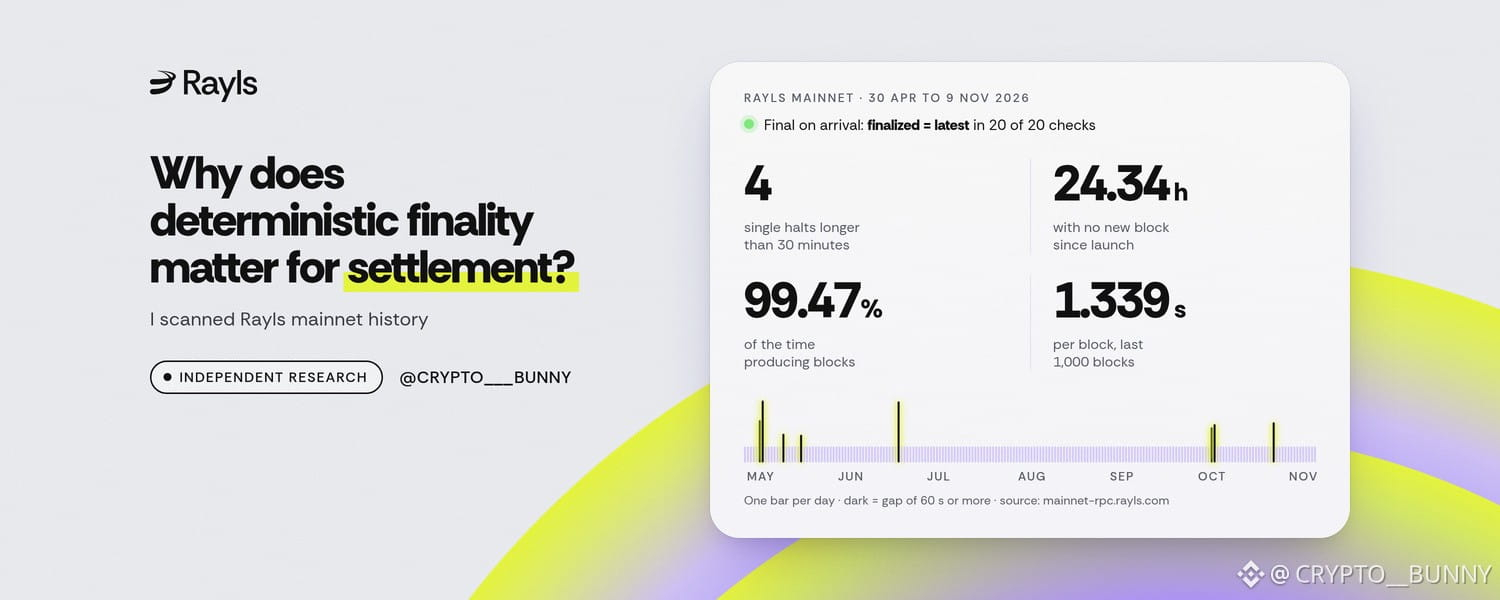
Finality is real. In 20 out of 20 checks the finalized block and the latest block were the same block with the same hash. So once a block shows up its already final. no waiting for confirmations
Speed is about 1.34s per block not under 1s. Rayls site says under 1s but its own docs table says over 1s so they need one clear number
Since launch the chain had 44 gaps of 60s or more. 24.34h in total so its producing blocks 99.47% of the time. 4 of those were real halts over 30 min and the longest was 11h43m on 5 to 6 May
The weird part is timestamps. I found 203 blocks with old timestamps. On 27 Jul blocks kept coming normally but 32 of them were stamped up to 12h behind. Any explorer that trusts block time would show an 8h outage that never happened. My own first scan fell for it too
Good sign is @Rayls Rayls published a public root cause writeup for the 21 Jun halt and the onchain data lines up with it
My take. Finality is solid and thats what matters most for settlement. What I would fix first is the timestamps. If you build on Rayls order by block number not by time
Full article on my X and all scripts are public: https://github.com/marwan786797/rayls-finality-check
Sources
https://www.rayls.com/
https://docs.rayls.com/docs/axyl-performance-benchmarks
https://explorer.rayls.com/
https://github.com/raylsnetwork/axyl/blob/main/doc/incidents/2026-06-21-mainnet-halt.md
#Rayls $RLS
Why does deterministic finality matter for settlement? I scanned Rayls mainnet history.
I read every block from launch on 30 Apr to 9 Nov using only the public RPC. No wallet nothing signed
What I found
Finality is real. In 20 out of 20 checks the finalized block and the latest block were the same block with the same hash. So once a block shows up its already final. no waiting for confirmations
Speed is about 1.34s per block not under 1s. Rayls site says under 1s but its own docs table says over 1s so they need one clear number
Since launch the chain had 44 gaps of 60s or more. 24.34h in total so its producing blocks 99.47% of the time. 4 of those were real halts over 30 min and the longest was 11h43m on 5 to 6 May
The weird part is timestamps. I found 203 blocks with old timestamps. On 27 Jul blocks kept coming normally but 32 of them were stamped up to 12h behind. Any explorer that trusts block time would show an 8h outage that never happened. My own first scan fell for it too
Good sign is @Rayls Rayls published a public root cause writeup for the 21 Jun halt and the onchain data lines up with it
My take. Finality is solid and thats what matters most for settlement. What I would fix first is the timestamps. If you build on Rayls order by block number not by time
Full article on my X and all scripts are public: https://github.com/marwan786797/rayls-finality-check
Sources
https://www.rayls.com/
https://docs.rayls.com/docs/axyl-performance-benchmarks
https://explorer.rayls.com/
https://github.com/raylsnetwork/axyl/blob/main/doc/incidents/2026-06-21-mainnet-halt.md
#Rayls $RLS
What I found
Finality is real. In 20 out of 20 checks the finalized block and the latest block were the same block with the same hash. So once a block shows up its already final. no waiting for confirmations
Speed is about 1.34s per block not under 1s. Rayls site says under 1s but its own docs table says over 1s so they need one clear number
Since launch the chain had 44 gaps of 60s or more. 24.34h in total so its producing blocks 99.47% of the time. 4 of those were real halts over 30 min and the longest was 11h43m on 5 to 6 May
The weird part is timestamps. I found 203 blocks with old timestamps. On 27 Jul blocks kept coming normally but 32 of them were stamped up to 12h behind. Any explorer that trusts block time would show an 8h outage that never happened. My own first scan fell for it too
Good sign is @Rayls Rayls published a public root cause writeup for the 21 Jun halt and the onchain data lines up with it
My take. Finality is solid and thats what matters most for settlement. What I would fix first is the timestamps. If you build on Rayls order by block number not by time
Full article on my X and all scripts are public: https://github.com/marwan786797/rayls-finality-check
Sources
https://www.rayls.com/
https://docs.rayls.com/docs/axyl-performance-benchmarks
https://explorer.rayls.com/
https://github.com/raylsnetwork/axyl/blob/main/doc/incidents/2026-06-21-mainnet-halt.md
#Rayls $RLS
1
149

·
--
Article
What’s the Difference Between Tokenized Deposits and USDT/USDC?I’m Agung Rayls Ambassador.
Lately, many people have been asking me about the difference between tokenized deposits and stablecoins like USDT or USDC. This question often comes from people who are still new to blockchain, and I believe it’s important to answer it clearly and honestly.
I wrote this article based on
@raylslabs
official documentation and blog, combined with my own observations while studying the ecosystem. I’ve tried to keep the language as simple as possible so that even those who are new to Rayls can follow along.
Who Issues the Money?
USDT and USDC are issued by third-party companies (Tether and Circle). They hold reserves and then issue tokens that can circulate freely across many blockchains. Banks can usually hold or sell these tokens, but they do not issue them and have limited direct control.
Tokenized deposits,on the other hand, are issued directly by the bank. According to Rayls’ official documentation, a tokenized deposit is a digital representation of value issued by an institution, often designed for consumer use in retail payments, settlements, or incentive schemes. Within a Rayls Sovereign ledger, these tokens can be securely minted, programmed, and transacted.[](<
https://docs.rayls.com/docs/rayls-node-use-cases-tokenised-deposit
>)
From what I’ve seen in Rayls’ architecture, this is one of the biggest differences: the bank remains the issuer, not just a user.
Control: Who Can Set the Rules?
With USDT/USDC, banks have little direct control. If there’s an issue (fraud, compliance, or a regulator’s request), the bank usually cannot freeze the customer’s tokens on its own.
On Rayls Sovereign, the bank retains control. Official documentation states that institutions can run smart contracts that enforce governance rules such as freezing, seizing, or locking tokens. There’s also a clear mechanism where a deposit can be locked on Sovereign, while a stablecoin representing its value is minted on the Public Chain. The original deposit stays on the institution’s balance sheet and never leaves its perimeter.[](<
https://docs.rayls.com/docs/a-warm-introduction-rayls-sovereign
>)
The flow works like this:
1. The tokenized deposit is registered and activated.
2. The deposit is locked in the institution’s own Rayls Sovereign ledger (not burned).
3. A stablecoin is minted on the Rayls Public Chain against that locked collateral.[](<
https://docs.rayls.com/docs/rayls-node-use-cases-tokenised-deposit
>)
In my view, this is why many institutions are interested. They don’t have to release customer funds just to give them access to the on-chain world.
From the Customer’s Perspective
I often tell friends who are new to this concept:
“If you want your money to still feel like money in the bank, a tokenized deposit is closer. If you want the freedom to move it anywhere in the crypto world, USDT/USDC is a better fit.”
Real Examples Already in Production
Several institutions have already used this approach in production environments, for example:
- XP Inc. issued USDXP (a USD stablecoin) on Rayls infrastructure.
- Several banks in Brazil participated in the Drex pilot with the Central Bank of Brazil, which involves tokenized deposits.
- Nuclea (a major financial market infrastructure in Brazil) has already run tokenization in production.
This is no longer just a concept on paper. Some of it is already live.
Simple Illustration: How the Flow Works
Here’s a simple flow of how a tokenized deposit works on Rayls:
This diagram shows the core mechanism: the deposit stays locked at the bank on Sovereign, while a usable stablecoin is minted on the public chain.
Important Note (For Accuracy)
From the official Rayls documentation and blog that I’ve read:
- A tokenized deposit is a product issued by an institution and remains under their control.
- The lock-and-mint mechanism is supported.
- However, the legal status and whether a tokenized deposit is automatically covered by deposit insurance schemes is not explicitly stated. This still depends on regulations in each country. I don’t want to overclaim on this point.
Quick Conclusion
USDT/USDC and tokenized deposits are both “digital money,” but their purpose and control differ.
- Want maximum freedom in the crypto world → USDT/USDC is more suitable.
- Want on-chain innovation while staying under the bank’s control → Tokenized deposits are more relevant.
In my opinion, both will likely coexist rather than replace each other. Banks need control and compliance, while crypto users need flexibility. Rayls is trying to bridge the two.
If you have questions or want me to explain any part in more detail (for example, the lock-and-mint mechanism or the examples in Brazil), feel free to ask in the comments or DM. I’m happy to discuss this.
---
Sources
1. Tokenised deposits and stablecoins on Rayls Sovereign
https://docs.rayls.com/docs/rayls-node-use-cases-tokenised-deposit
(Main source for definition and lock-and-mint flow)
2. Rayls Sovereign – Introduction
https://docs.rayls.com/docs/a-warm-introduction-rayls-sovereign
(Governance features: freeze, seize, lock)
3. The private-public settlement flow: tokenised deposits and stablecoins on Rayls
https://www.rayls.com/blog/the-private-public-settlement-flow-tokenised-deposits-and-stablecoins-on-rayls
4. Introducing Rayls Sovereign: the onchain gateway for institutions
https://www.rayls.com/blog/introducing-rayls-sovereign-the-onchain-gateway-for-institutions
5. Rayls product pages (Public Chain & Sovereign) for production examples (Drex, Nuclea, etc.)
#Rayls #RWA $RLS
What’s the Difference Between Tokenized Deposits and USDT/USDC?
I’m Agung Rayls Ambassador.
Lately, many people have been asking me about the difference between tokenized deposits and stablecoins like USDT or USDC. This question often comes from people who are still new to blockchain, and I believe it’s important to answer it clearly and honestly.
I wrote this article based on
@raylslabs
official documentation and blog, combined with my own observations while studying the ecosystem. I’ve tried to keep the language as simple as possible so that even those who are new to Rayls can follow along.
Who Issues the Money?
USDT and USDC are issued by third-party companies (Tether and Circle). They hold reserves and then issue tokens that can circulate freely across many blockchains. Banks can usually hold or sell these tokens, but they do not issue them and have limited direct control.
Tokenized deposits,on the other hand, are issued directly by the bank. According to Rayls’ official documentation, a tokenized deposit is a digital representation of value issued by an institution, often designed for consumer use in retail payments, settlements, or incentive schemes. Within a Rayls Sovereign ledger, these tokens can be securely minted, programmed, and transacted.[](<
https://docs.rayls.com/docs/rayls-node-use-cases-tokenised-deposit
>)
From what I’ve seen in Rayls’ architecture, this is one of the biggest differences: the bank remains the issuer, not just a user.
Control: Who Can Set the Rules?
With USDT/USDC, banks have little direct control. If there’s an issue (fraud, compliance, or a regulator’s request), the bank usually cannot freeze the customer’s tokens on its own.
On Rayls Sovereign, the bank retains control. Official documentation states that institutions can run smart contracts that enforce governance rules such as freezing, seizing, or locking tokens. There’s also a clear mechanism where a deposit can be locked on Sovereign, while a stablecoin representing its value is minted on the Public Chain. The original deposit stays on the institution’s balance sheet and never leaves its perimeter.[](<
https://docs.rayls.com/docs/a-warm-introduction-rayls-sovereign
>)
The flow works like this:
1. The tokenized deposit is registered and activated.
2. The deposit is locked in the institution’s own Rayls Sovereign ledger (not burned).
3. A stablecoin is minted on the Rayls Public Chain against that locked collateral.[](<
https://docs.rayls.com/docs/rayls-node-use-cases-tokenised-deposit
>)
In my view, this is why many institutions are interested. They don’t have to release customer funds just to give them access to the on-chain world.
From the Customer’s Perspective
I often tell friends who are new to this concept:
“If you want your money to still feel like money in the bank, a tokenized deposit is closer. If you want the freedom to move it anywhere in the crypto world, USDT/USDC is a better fit.”
Real Examples Already in Production
Several institutions have already used this approach in production environments, for example:
- XP Inc. issued USDXP (a USD stablecoin) on Rayls infrastructure.
- Several banks in Brazil participated in the Drex pilot with the Central Bank of Brazil, which involves tokenized deposits.
- Nuclea (a major financial market infrastructure in Brazil) has already run tokenization in production.
This is no longer just a concept on paper. Some of it is already live.
Simple Illustration: How the Flow Works
Here’s a simple flow of how a tokenized deposit works on Rayls:
This diagram shows the core mechanism: the deposit stays locked at the bank on Sovereign, while a usable stablecoin is minted on the public chain.
Important Note (For Accuracy)
From the official Rayls documentation and blog that I’ve read:
- A tokenized deposit is a product issued by an institution and remains under their control.
- The lock-and-mint mechanism is supported.
- However, the legal status and whether a tokenized deposit is automatically covered by deposit insurance schemes is not explicitly stated. This still depends on regulations in each country. I don’t want to overclaim on this point.
Quick Conclusion
USDT/USDC and tokenized deposits are both “digital money,” but their purpose and control differ.
- Want maximum freedom in the crypto world → USDT/USDC is more suitable.
- Want on-chain innovation while staying under the bank’s control → Tokenized deposits are more relevant.
In my opinion, both will likely coexist rather than replace each other. Banks need control and compliance, while crypto users need flexibility. Rayls is trying to bridge the two.
If you have questions or want me to explain any part in more detail (for example, the lock-and-mint mechanism or the examples in Brazil), feel free to ask in the comments or DM. I’m happy to discuss this.
---
Sources
1. Tokenised deposits and stablecoins on Rayls Sovereign
https://docs.rayls.com/docs/rayls-node-use-cases-tokenised-deposit
(Main source for definition and lock-and-mint flow)
2. Rayls Sovereign – Introduction
https://docs.rayls.com/docs/a-warm-introduction-rayls-sovereign
(Governance features: freeze, seize, lock)
3. The private-public settlement flow: tokenised deposits and stablecoins on Rayls
https://www.rayls.com/blog/the-private-public-settlement-flow-tokenised-deposits-and-stablecoins-on-rayls
4. Introducing Rayls Sovereign: the onchain gateway for institutions
https://www.rayls.com/blog/introducing-rayls-sovereign-the-onchain-gateway-for-institutions
5. Rayls product pages (Public Chain & Sovereign) for production examples (Drex, Nuclea, etc.)
#Rayls #RWA $RLS
Lately, many people have been asking me about the difference between tokenized deposits and stablecoins like USDT or USDC. This question often comes from people who are still new to blockchain, and I believe it’s important to answer it clearly and honestly.
I wrote this article based on
@raylslabs
official documentation and blog, combined with my own observations while studying the ecosystem. I’ve tried to keep the language as simple as possible so that even those who are new to Rayls can follow along.
Who Issues the Money?
USDT and USDC are issued by third-party companies (Tether and Circle). They hold reserves and then issue tokens that can circulate freely across many blockchains. Banks can usually hold or sell these tokens, but they do not issue them and have limited direct control.
Tokenized deposits,on the other hand, are issued directly by the bank. According to Rayls’ official documentation, a tokenized deposit is a digital representation of value issued by an institution, often designed for consumer use in retail payments, settlements, or incentive schemes. Within a Rayls Sovereign ledger, these tokens can be securely minted, programmed, and transacted.[](<
https://docs.rayls.com/docs/rayls-node-use-cases-tokenised-deposit
>)
From what I’ve seen in Rayls’ architecture, this is one of the biggest differences: the bank remains the issuer, not just a user.
Control: Who Can Set the Rules?
With USDT/USDC, banks have little direct control. If there’s an issue (fraud, compliance, or a regulator’s request), the bank usually cannot freeze the customer’s tokens on its own.
On Rayls Sovereign, the bank retains control. Official documentation states that institutions can run smart contracts that enforce governance rules such as freezing, seizing, or locking tokens. There’s also a clear mechanism where a deposit can be locked on Sovereign, while a stablecoin representing its value is minted on the Public Chain. The original deposit stays on the institution’s balance sheet and never leaves its perimeter.[](<
https://docs.rayls.com/docs/a-warm-introduction-rayls-sovereign
>)
The flow works like this:
1. The tokenized deposit is registered and activated.
2. The deposit is locked in the institution’s own Rayls Sovereign ledger (not burned).
3. A stablecoin is minted on the Rayls Public Chain against that locked collateral.[](<
https://docs.rayls.com/docs/rayls-node-use-cases-tokenised-deposit
>)
In my view, this is why many institutions are interested. They don’t have to release customer funds just to give them access to the on-chain world.
From the Customer’s Perspective
I often tell friends who are new to this concept:
“If you want your money to still feel like money in the bank, a tokenized deposit is closer. If you want the freedom to move it anywhere in the crypto world, USDT/USDC is a better fit.”
Real Examples Already in Production
Several institutions have already used this approach in production environments, for example:
- XP Inc. issued USDXP (a USD stablecoin) on Rayls infrastructure.
- Several banks in Brazil participated in the Drex pilot with the Central Bank of Brazil, which involves tokenized deposits.
- Nuclea (a major financial market infrastructure in Brazil) has already run tokenization in production.
This is no longer just a concept on paper. Some of it is already live.
Simple Illustration: How the Flow Works
Here’s a simple flow of how a tokenized deposit works on Rayls:
This diagram shows the core mechanism: the deposit stays locked at the bank on Sovereign, while a usable stablecoin is minted on the public chain.
Important Note (For Accuracy)
From the official Rayls documentation and blog that I’ve read:
- A tokenized deposit is a product issued by an institution and remains under their control.
- The lock-and-mint mechanism is supported.
- However, the legal status and whether a tokenized deposit is automatically covered by deposit insurance schemes is not explicitly stated. This still depends on regulations in each country. I don’t want to overclaim on this point.
Quick Conclusion
USDT/USDC and tokenized deposits are both “digital money,” but their purpose and control differ.
- Want maximum freedom in the crypto world → USDT/USDC is more suitable.
- Want on-chain innovation while staying under the bank’s control → Tokenized deposits are more relevant.
In my opinion, both will likely coexist rather than replace each other. Banks need control and compliance, while crypto users need flexibility. Rayls is trying to bridge the two.
If you have questions or want me to explain any part in more detail (for example, the lock-and-mint mechanism or the examples in Brazil), feel free to ask in the comments or DM. I’m happy to discuss this.
---
Sources
1. Tokenised deposits and stablecoins on Rayls Sovereign
https://docs.rayls.com/docs/rayls-node-use-cases-tokenised-deposit
(Main source for definition and lock-and-mint flow)
2. Rayls Sovereign – Introduction
https://docs.rayls.com/docs/a-warm-introduction-rayls-sovereign
(Governance features: freeze, seize, lock)
3. The private-public settlement flow: tokenised deposits and stablecoins on Rayls
https://www.rayls.com/blog/the-private-public-settlement-flow-tokenised-deposits-and-stablecoins-on-rayls
4. Introducing Rayls Sovereign: the onchain gateway for institutions
https://www.rayls.com/blog/introducing-rayls-sovereign-the-onchain-gateway-for-institutions
5. Rayls product pages (Public Chain & Sovereign) for production examples (Drex, Nuclea, etc.)
#Rayls #RWA $RLS
163
·
--
Article
Inside Rayls’ First Vault Launch: Deposits, Rewards & Contract Controls@Rayls opened deposits for its first vault on October 15, 2026. Instead of looking only at the launch announcement, I examined the bridge activity, reserve report, reward schedule changes, actual deposit transactions, and vault contract architecture to understand what the available evidence really shows.
Here are the key findings 👇
🔹 1. Bridge Activity and Token Supply
The Polygon bridge-vault records examined showed 264,868.416247 BRL1 in incoming transfers and 9,576.454346 BRL1 in outgoing transfers, leaving a net balance of 255,291.961901 BRL1.
The Rayls explorer displayed a BRL1.p total supply of 255,291.962. These figures closely reconcile to the displayed precision.
This is useful onchain evidence, but it does not independently prove continuous 1:1 backing at every block or timestamp.
🔹 2. What the Proof of Reserves Report Shows
The October 1, 2026, BRL1 Proof of Reserves report listed total reserves of R$19,354,372, distributed across bank deposits, Brazilian Treasury bills (LFTs), and repos.
The report stated collateralisation of 111.35% against the circulating supply at its specified reference point.
There is an important limitation: the report explicitly stated that it had not yet been audited by an independent entity. Its figures should therefore be understood in that context.
🔹 3. Changes to the Reward Schedule
The original weekly reward rates were:
• Week 1: 10,000 RLS per 1,000 BRL1.p
• Week 2: 8,000 RLS
• Week 3: 6,000 RLS
• Week 4: 4,000 RLS
The rates were later reduced by 50% for new deposits, becoming 5,000, 4,000, 3,000, and 2,000 RLS respectively.
Deposits within the first R$250,000 retained the original rates. This distinction matters when assessing individual deposit transactions and their expected reward allocations.
🔹 4. What Actual Deposit Transactions Reveal
I examined two onchain deposits.
The October 16 transaction recorded a deposit of 100,000 BRL1.p with a reward allocation of 1,000,000 RLS, consistent with the original Week 1 rate.
The October 28 transaction recorded a deposit of 5,271.47899 BRL1.p with a reward allocation of 21,085.91596 RLS, consistent with the revised Week 2 rate.
These transactions provide concrete evidence of recorded deposits and calculated reward allocations. They should not be confused with proof that the rewards have already been paid.
🔹 5. Lock-Up Conditions and Reward Delivery
The launch terms included a deposit lock-up, scheduled reward credits into staking, and a 14-day unbonding period for staked rewards.
The reward credit dates specified in the schedule were still in the future as of November 2, 2026. Actual delivery therefore needs to be assessed when those dates arrive, rather than assumed from the deposit records alone.
🔹 6. Vault Contract Architecture
The vault uses an ERC1967 proxy linked to a separate implementation contract. This architecture allows the proxy to route interactions to the implementation.
However, identifying the proxy and implementation does not establish who controls upgrades. The administrator, multisig or timelock arrangements, and complete upgrade history were not independently verified in this analysis.
Final Takeaway
The available evidence shows real onchain deposit activity, reward calculations consistent with the applicable rates, and a close numerical reconciliation between the examined Polygon bridge-vault transfers and the displayed Rayls token supply.
At the same time, several questions must remain separate: independent reserve assurance, actual reward delivery, and the people or mechanisms controlling contract upgrades.
A strong analysis should not treat every claim as proven simply because a transaction or contract exists. It should clearly distinguish verified records, published terms, and details that still require confirmation.
#Rayls $RLS
Inside Rayls’ First Vault Launch: Deposits, Rewards & Contract Controls
@Rayls opened deposits for its first vault on October 15, 2026. Instead of looking only at the launch announcement, I examined the bridge activity, reserve report, reward schedule changes, actual deposit transactions, and vault contract architecture to understand what the available evidence really shows.
Here are the key findings 👇
🔹 1. Bridge Activity and Token Supply
The Polygon bridge-vault records examined showed 264,868.416247 BRL1 in incoming transfers and 9,576.454346 BRL1 in outgoing transfers, leaving a net balance of 255,291.961901 BRL1.
The Rayls explorer displayed a BRL1.p total supply of 255,291.962. These figures closely reconcile to the displayed precision.
This is useful onchain evidence, but it does not independently prove continuous 1:1 backing at every block or timestamp.
🔹 2. What the Proof of Reserves Report Shows
The October 1, 2026, BRL1 Proof of Reserves report listed total reserves of R$19,354,372, distributed across bank deposits, Brazilian Treasury bills (LFTs), and repos.
The report stated collateralisation of 111.35% against the circulating supply at its specified reference point.
There is an important limitation: the report explicitly stated that it had not yet been audited by an independent entity. Its figures should therefore be understood in that context.
🔹 3. Changes to the Reward Schedule
The original weekly reward rates were:
• Week 1: 10,000 RLS per 1,000 BRL1.p
• Week 2: 8,000 RLS
• Week 3: 6,000 RLS
• Week 4: 4,000 RLS
The rates were later reduced by 50% for new deposits, becoming 5,000, 4,000, 3,000, and 2,000 RLS respectively.
Deposits within the first R$250,000 retained the original rates. This distinction matters when assessing individual deposit transactions and their expected reward allocations.
🔹 4. What Actual Deposit Transactions Reveal
I examined two onchain deposits.
The October 16 transaction recorded a deposit of 100,000 BRL1.p with a reward allocation of 1,000,000 RLS, consistent with the original Week 1 rate.
The October 28 transaction recorded a deposit of 5,271.47899 BRL1.p with a reward allocation of 21,085.91596 RLS, consistent with the revised Week 2 rate.
These transactions provide concrete evidence of recorded deposits and calculated reward allocations. They should not be confused with proof that the rewards have already been paid.
🔹 5. Lock-Up Conditions and Reward Delivery
The launch terms included a deposit lock-up, scheduled reward credits into staking, and a 14-day unbonding period for staked rewards.
The reward credit dates specified in the schedule were still in the future as of November 2, 2026. Actual delivery therefore needs to be assessed when those dates arrive, rather than assumed from the deposit records alone.
🔹 6. Vault Contract Architecture
The vault uses an ERC1967 proxy linked to a separate implementation contract. This architecture allows the proxy to route interactions to the implementation.
However, identifying the proxy and implementation does not establish who controls upgrades. The administrator, multisig or timelock arrangements, and complete upgrade history were not independently verified in this analysis.
Final Takeaway
The available evidence shows real onchain deposit activity, reward calculations consistent with the applicable rates, and a close numerical reconciliation between the examined Polygon bridge-vault transfers and the displayed Rayls token supply.
At the same time, several questions must remain separate: independent reserve assurance, actual reward delivery, and the people or mechanisms controlling contract upgrades.
A strong analysis should not treat every claim as proven simply because a transaction or contract exists. It should clearly distinguish verified records, published terms, and details that still require confirmation.
#Rayls $RLS
Here are the key findings 👇
🔹 1. Bridge Activity and Token Supply
The Polygon bridge-vault records examined showed 264,868.416247 BRL1 in incoming transfers and 9,576.454346 BRL1 in outgoing transfers, leaving a net balance of 255,291.961901 BRL1.
The Rayls explorer displayed a BRL1.p total supply of 255,291.962. These figures closely reconcile to the displayed precision.
This is useful onchain evidence, but it does not independently prove continuous 1:1 backing at every block or timestamp.
🔹 2. What the Proof of Reserves Report Shows
The October 1, 2026, BRL1 Proof of Reserves report listed total reserves of R$19,354,372, distributed across bank deposits, Brazilian Treasury bills (LFTs), and repos.
The report stated collateralisation of 111.35% against the circulating supply at its specified reference point.
There is an important limitation: the report explicitly stated that it had not yet been audited by an independent entity. Its figures should therefore be understood in that context.
🔹 3. Changes to the Reward Schedule
The original weekly reward rates were:
• Week 1: 10,000 RLS per 1,000 BRL1.p
• Week 2: 8,000 RLS
• Week 3: 6,000 RLS
• Week 4: 4,000 RLS
The rates were later reduced by 50% for new deposits, becoming 5,000, 4,000, 3,000, and 2,000 RLS respectively.
Deposits within the first R$250,000 retained the original rates. This distinction matters when assessing individual deposit transactions and their expected reward allocations.
🔹 4. What Actual Deposit Transactions Reveal
I examined two onchain deposits.
The October 16 transaction recorded a deposit of 100,000 BRL1.p with a reward allocation of 1,000,000 RLS, consistent with the original Week 1 rate.
The October 28 transaction recorded a deposit of 5,271.47899 BRL1.p with a reward allocation of 21,085.91596 RLS, consistent with the revised Week 2 rate.
These transactions provide concrete evidence of recorded deposits and calculated reward allocations. They should not be confused with proof that the rewards have already been paid.
🔹 5. Lock-Up Conditions and Reward Delivery
The launch terms included a deposit lock-up, scheduled reward credits into staking, and a 14-day unbonding period for staked rewards.
The reward credit dates specified in the schedule were still in the future as of November 2, 2026. Actual delivery therefore needs to be assessed when those dates arrive, rather than assumed from the deposit records alone.
🔹 6. Vault Contract Architecture
The vault uses an ERC1967 proxy linked to a separate implementation contract. This architecture allows the proxy to route interactions to the implementation.
However, identifying the proxy and implementation does not establish who controls upgrades. The administrator, multisig or timelock arrangements, and complete upgrade history were not independently verified in this analysis.
Final Takeaway
The available evidence shows real onchain deposit activity, reward calculations consistent with the applicable rates, and a close numerical reconciliation between the examined Polygon bridge-vault transfers and the displayed Rayls token supply.
At the same time, several questions must remain separate: independent reserve assurance, actual reward delivery, and the people or mechanisms controlling contract upgrades.
A strong analysis should not treat every claim as proven simply because a transaction or contract exists. It should clearly distinguish verified records, published terms, and details that still require confirmation.
#Rayls $RLS
3
464


Article
How is Rayls staking APY calculated, and how are actual rewards paid out?When looking at the staking APY for @Rayls , is it enough to just check the displayed yield?
To understand the actual yield, there’s one more thing to look at.
How are earnings recorded, calculated as APY, and ultimately paid out as actual rewards?
This time, I directly compared the "RewardCurve" and "RewardDistributor" code in the official Rayls repository.
1. Is network revenue automatically reflected in staking APY?
"RewardCurve" is designed to calculate annual APY by combining the base monthly emission with variable emissions.
How is Rayls staking APY calculated, and how are actual rewards paid out?
When looking at the staking APY for @Rayls , is it enough to just check the displayed yield?
To understand the actual yield, there’s one more thing to look at.
How are earnings recorded, calculated as APY, and ultimately paid out as actual rewards?
This time, I directly compared the "RewardCurve" and "RewardDistributor" code in the official Rayls repository.
1. Is network revenue automatically reflected in staking APY?
"RewardCurve" is designed to calculate annual APY by combining the base monthly emission with variable emissions.
To understand the actual yield, there’s one more thing to look at.
How are earnings recorded, calculated as APY, and ultimately paid out as actual rewards?
This time, I directly compared the "RewardCurve" and "RewardDistributor" code in the official Rayls repository.
1. Is network revenue automatically reflected in staking APY?
"RewardCurve" is designed to calculate annual APY by combining the base monthly emission with variable emissions.
1
103


Article
When Has a Blockchain Transfer Truly Arrived? A Real-World Test of "Finality" on Ethereum and RaylsIn my last few posts, I’ve been measuring how long Rayls proofs take to compute. But for banks, there’s a more fundamental question: when has money truly arrived—and can no longer be taken back? This week, I changed direction and had GitHub’s servers monitor both Ethereum and the Rayls public chain for two hours, to see how they answer that question for themselves.
Here’s the short answer first. When banks say a payment has "arrived," they mean two things: it’s legally irrevocable, and it can’t be rolled back technically. On the technical side, Ethereum nodes mark a block as "finalized" 12.6 to 19.2 minutes after the latest block, with a median of 16 minutes. The Rayls public chain, by contrast, marks each block as finalized the moment it is produced, with a new block appearing roughly every 1.35 seconds. This kind of "deterministic finality" comes at a cost: if consensus can’t progress, the chain stops instead of forking. The Rayls public chain has stopped at least twice since launch—once for 11.72 hours and once for 9.15 hours. After both outages, it resumed directly from the block where it had stopped.
When Has a Blockchain Transfer Truly Arrived? A Real-World Test of "Finality" on Ethereum and Rayls
In my last few posts, I’ve been measuring how long Rayls proofs take to compute. But for banks, there’s a more fundamental question: when has money truly arrived—and can no longer be taken back? This week, I changed direction and had GitHub’s servers monitor both Ethereum and the Rayls public chain for two hours, to see how they answer that question for themselves.
Here’s the short answer first. When banks say a payment has "arrived," they mean two things: it’s legally irrevocable, and it can’t be rolled back technically. On the technical side, Ethereum nodes mark a block as "finalized" 12.6 to 19.2 minutes after the latest block, with a median of 16 minutes. The Rayls public chain, by contrast, marks each block as finalized the moment it is produced, with a new block appearing roughly every 1.35 seconds. This kind of "deterministic finality" comes at a cost: if consensus can’t progress, the chain stops instead of forking. The Rayls public chain has stopped at least twice since launch—once for 11.72 hours and once for 9.15 hours. After both outages, it resumed directly from the block where it had stopped.
Here’s the short answer first. When banks say a payment has "arrived," they mean two things: it’s legally irrevocable, and it can’t be rolled back technically. On the technical side, Ethereum nodes mark a block as "finalized" 12.6 to 19.2 minutes after the latest block, with a median of 16 minutes. The Rayls public chain, by contrast, marks each block as finalized the moment it is produced, with a new block appearing roughly every 1.35 seconds. This kind of "deterministic finality" comes at a cost: if consensus can’t progress, the chain stops instead of forking. The Rayls public chain has stopped at least twice since launch—once for 11.72 hours and once for 9.15 hours. After both outages, it resumed directly from the block where it had stopped.
2
371
Verified
Article
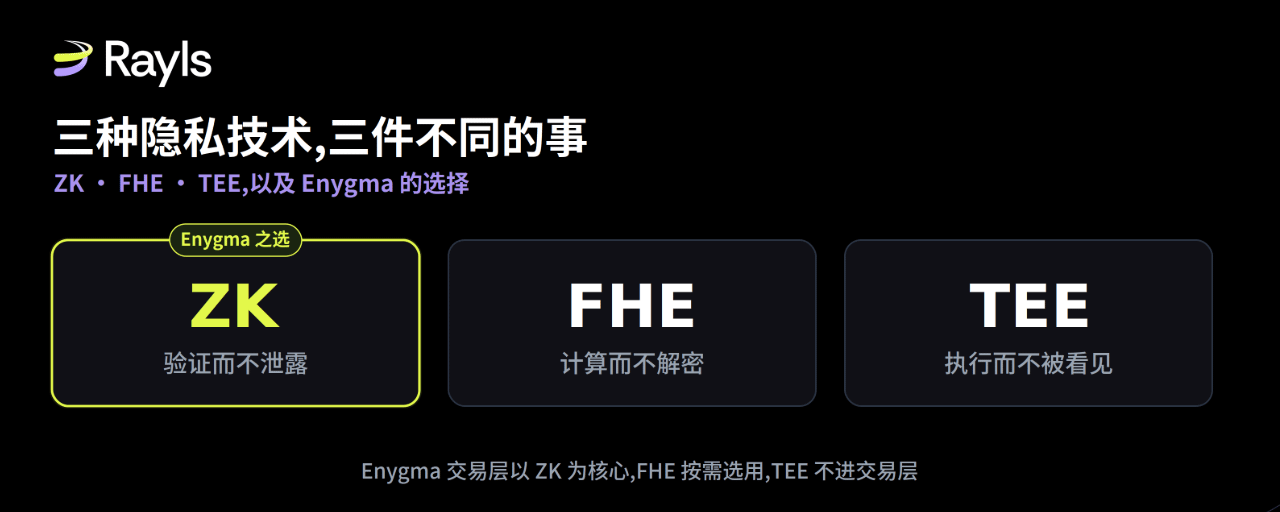
Someone asked me which is strongest: ZK, FHE, or TEE—and I think they asked the wrong question!To be honest, the first time I saw these three abbreviations put together, I thought they were three different answers to the same question: faster, safer—pick one and you’re done. Later I realized that ranking them side by side is like asking, “Which is best—a hammer, a screwdriver, or a wrench?” The answer depends on whether you have a nail, a screw, or a bolt.
The issues they each solve are actually three problems that have been conflated.
The first problem is: I want to prove that something is true, but the data needed for the proof is sensitive, and I don't want to show it to you. A bank wants to tell regulators that a transaction is legal, authorization is correct, and there are no duplicates—yet it doesn't want to put the amounts and the payer/payee details on the ledgers. This kind of proof that is true but doesn't reveal the underlying data is ZK’s home turf. Its charm lies in guaranteeing the conclusion comes from mathematics, not from “I promise you, I won’t let you see.” Regulators or auditors who receive the verification key can check the result, but they can’t touch the underlying data. The cost is also real: it’s good at proving properties of data, but not good at letting multiple parties compute together when no one has complete data, and it’s far more compute-intensive than plaintext.
Someone asked me which is strongest: ZK, FHE, or TEE—and I think they asked the wrong question!
To be honest, the first time I saw these three abbreviations put together, I thought they were three different answers to the same question: faster, safer—pick one and you’re done. Later I realized that ranking them side by side is like asking, “Which is best—a hammer, a screwdriver, or a wrench?” The answer depends on whether you have a nail, a screw, or a bolt.
The issues they each solve are actually three problems that have been conflated.
The first problem is: I want to prove that something is true, but the data needed for the proof is sensitive, and I don't want to show it to you. A bank wants to tell regulators that a transaction is legal, authorization is correct, and there are no duplicates—yet it doesn't want to put the amounts and the payer/payee details on the ledgers. This kind of proof that is true but doesn't reveal the underlying data is ZK’s home turf. Its charm lies in guaranteeing the conclusion comes from mathematics, not from “I promise you, I won’t let you see.” Regulators or auditors who receive the verification key can check the result, but they can’t touch the underlying data. The cost is also real: it’s good at proving properties of data, but not good at letting multiple parties compute together when no one has complete data, and it’s far more compute-intensive than plaintext.
The issues they each solve are actually three problems that have been conflated.
The first problem is: I want to prove that something is true, but the data needed for the proof is sensitive, and I don't want to show it to you. A bank wants to tell regulators that a transaction is legal, authorization is correct, and there are no duplicates—yet it doesn't want to put the amounts and the payer/payee details on the ledgers. This kind of proof that is true but doesn't reveal the underlying data is ZK’s home turf. Its charm lies in guaranteeing the conclusion comes from mathematics, not from “I promise you, I won’t let you see.” Regulators or auditors who receive the verification key can check the result, but they can’t touch the underlying data. The cost is also real: it’s good at proving properties of data, but not good at letting multiple parties compute together when no one has complete data, and it’s far more compute-intensive than plaintext.
1
385
Article
What truly changed with this lockup isn’t the time—it’s who you need to trustWhen I look at lockup announcements, they usually only care about one thing: whether this commitment can be verified. Most projects’ “team lockup” ultimately comes down to a single sentence—you either choose to believe it or you don’t. This time is a bit different, so I checked on-chain.
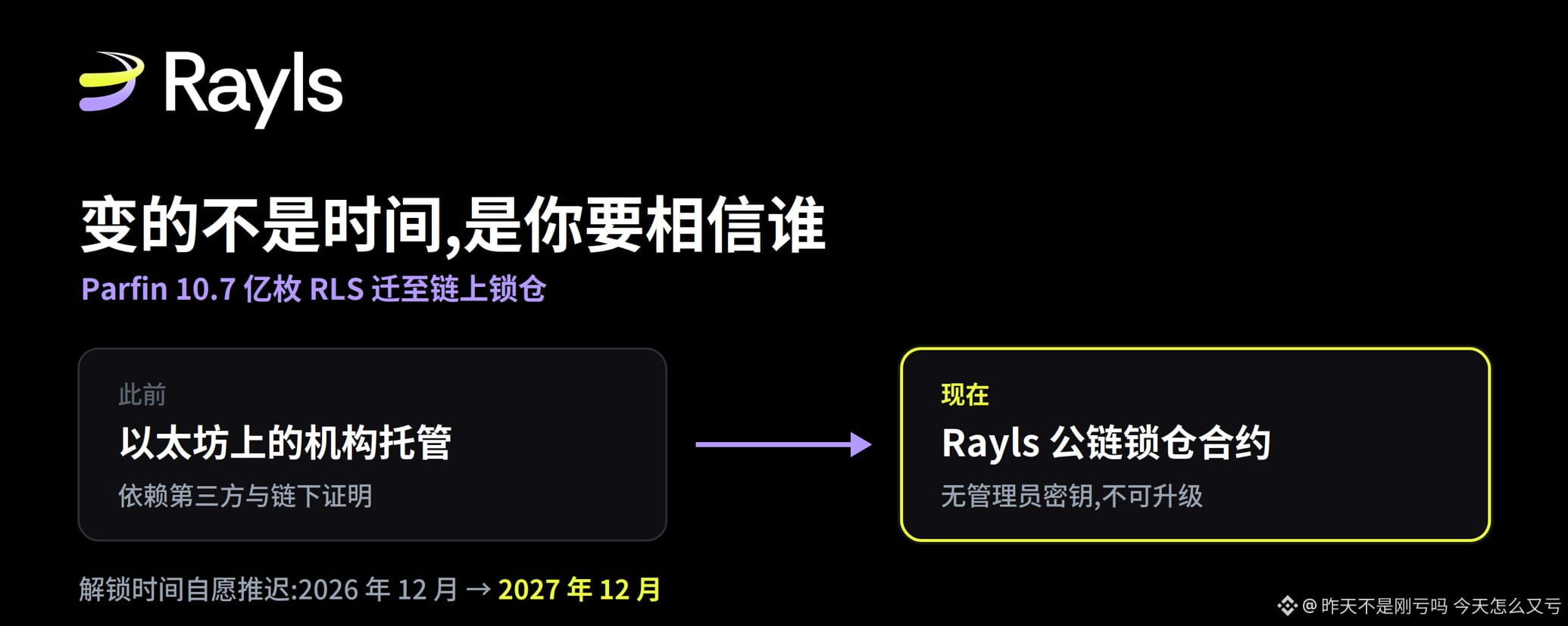
First, let’s state the facts clearly. Parfin is the core technology provider behind Rayls. It is responsible for developing privacy nodes, the private network, the Enygma privacy framework, and the Rayls mainnet. As compensation for its work prior to the TGE, it received 1,070,493,535 RLS tokens—about 11% of the initial total supply of 10 billion.
This batch of tokens was previously held by an institutional custodian on Ethereum. The reason is straightforward: at the time of the TGE, the Rayls chain hadn’t gone live yet, so the tokens could only be held in custody. Now that the mainnet is available, this batch has been migrated to the Rayls chain and locked in a smart contract that can be publicly verified. At the same time, the unlock date has been pushed back from December 2026 to December 2027.
What truly changed with this lockup isn’t the time—it’s who you need to trust
When I look at lockup announcements, they usually only care about one thing: whether this commitment can be verified. Most projects’ “team lockup” ultimately comes down to a single sentence—you either choose to believe it or you don’t. This time is a bit different, so I checked on-chain.
First, let’s state the facts clearly. Parfin is the core technology provider behind Rayls. It is responsible for developing privacy nodes, the private network, the Enygma privacy framework, and the Rayls mainnet. As compensation for its work prior to the TGE, it received 1,070,493,535 RLS tokens—about 11% of the initial total supply of 10 billion.
This batch of tokens was previously held by an institutional custodian on Ethereum. The reason is straightforward: at the time of the TGE, the Rayls chain hadn’t gone live yet, so the tokens could only be held in custody. Now that the mainnet is available, this batch has been migrated to the Rayls chain and locked in a smart contract that can be publicly verified. At the same time, the unlock date has been pushed back from December 2026 to December 2027.
First, let’s state the facts clearly. Parfin is the core technology provider behind Rayls. It is responsible for developing privacy nodes, the private network, the Enygma privacy framework, and the Rayls mainnet. As compensation for its work prior to the TGE, it received 1,070,493,535 RLS tokens—about 11% of the initial total supply of 10 billion.
This batch of tokens was previously held by an institutional custodian on Ethereum. The reason is straightforward: at the time of the TGE, the Rayls chain hadn’t gone live yet, so the tokens could only be held in custody. Now that the mainnet is available, this batch has been migrated to the Rayls chain and locked in a smart contract that can be publicly verified. At the same time, the unlock date has been pushed back from December 2026 to December 2027.
170
Article
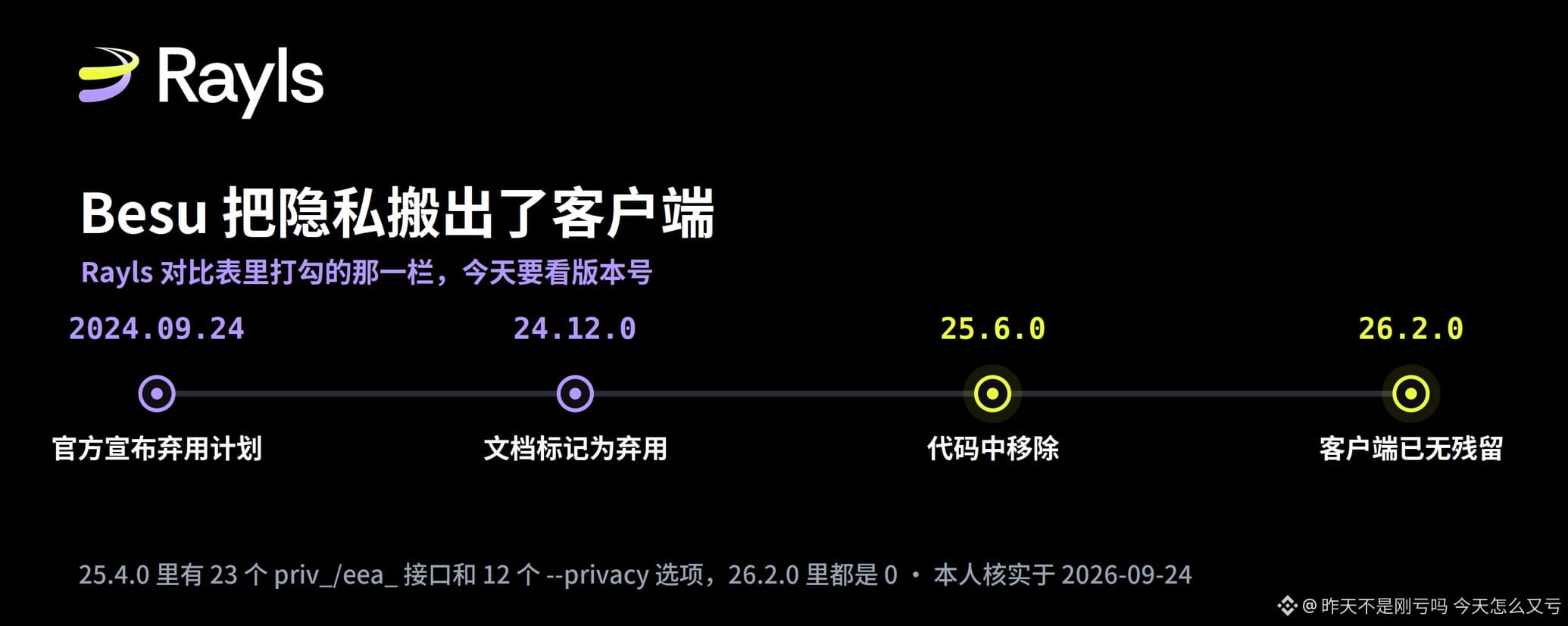
Rayls’ comparison table says Besu supports privacy, so I counted it in its codeIn the Rayls official website supplier comparison table, there are nine rows, and I chose the one labeled “Privacy.” The reason is simple: privacy is important, and Besu is open source—its documentation and code are both available for me to look up.
In the comparison table, Rayls checks both rows—“Isolated Privacy” and “Cryptographic Privacy”—while Besu only checks the first row. I planned to verify using the other party’s own documentation, so I looked up Besu’s documentation, then pulled down its code and counted it line by line.
The conclusion isn’t “Besu doesn’t work.” The real difference is this: these two companies place privacy at different layers, and Besu moved it away earlier than many people think.
Rayls’ comparison table says Besu supports privacy, so I counted it in its code
In the Rayls official website supplier comparison table, there are nine rows, and I chose the one labeled “Privacy.” The reason is simple: privacy is important, and Besu is open source—its documentation and code are both available for me to look up.
In the comparison table, Rayls checks both rows—“Isolated Privacy” and “Cryptographic Privacy”—while Besu only checks the first row. I planned to verify using the other party’s own documentation, so I looked up Besu’s documentation, then pulled down its code and counted it line by line.
The conclusion isn’t “Besu doesn’t work.” The real difference is this: these two companies place privacy at different layers, and Besu moved it away earlier than many people think.
In the comparison table, Rayls checks both rows—“Isolated Privacy” and “Cryptographic Privacy”—while Besu only checks the first row. I planned to verify using the other party’s own documentation, so I looked up Besu’s documentation, then pulled down its code and counted it line by line.
The conclusion isn’t “Besu doesn’t work.” The real difference is this: these two companies place privacy at different layers, and Besu moved it away earlier than many people think.
281
Article
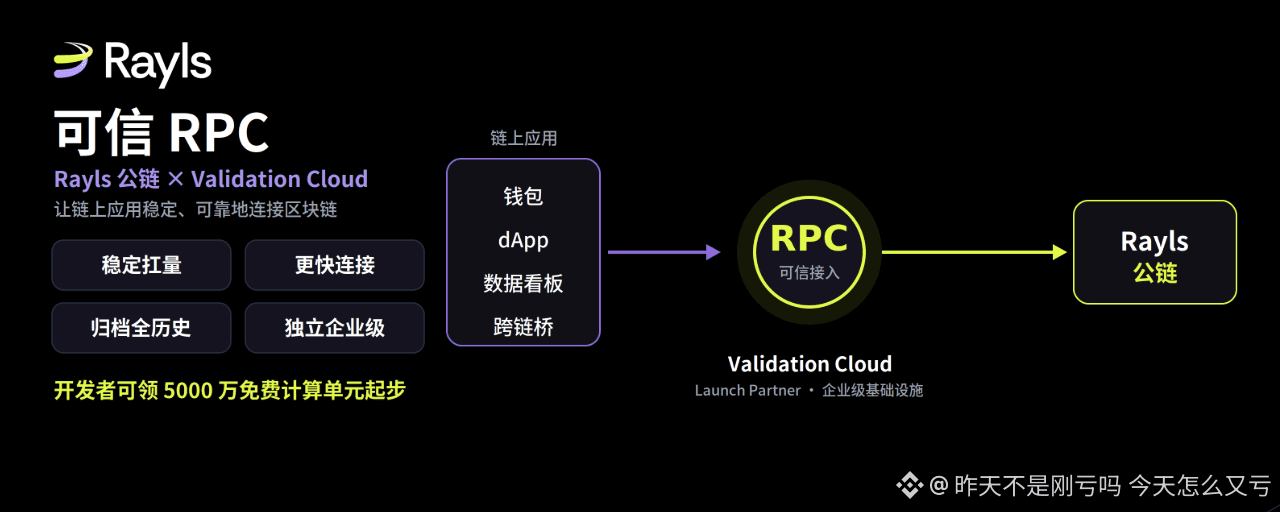
Good news, good news, good news!!!! Rayls public chain has integrated a trusted RPC!!!Brothers, I’ve been lurking in the Rayls community for a long time. I know everyone is very dissatisfied with the team—so am I. But the team is really doing work and has been putting in effort. It’s just that the Rayls team is taking a compliance-first route. Brothers, don’t give up—leave it to time. I believe the Rayls team will ultimately deliver the exam papers that satisfy us. Let me share some good news with you brothers—it's about the recent Rayls team integrating with an RPC. This is a very important thing!!
A quick overview at a glance
What is RPC
You can think of RPC as a dedicated hotline between an application and the blockchain.
Good news, good news, good news!!!! Rayls public chain has integrated a trusted RPC!!!
Brothers, I’ve been lurking in the Rayls community for a long time. I know everyone is very dissatisfied with the team—so am I. But the team is really doing work and has been putting in effort. It’s just that the Rayls team is taking a compliance-first route. Brothers, don’t give up—leave it to time. I believe the Rayls team will ultimately deliver the exam papers that satisfy us. Let me share some good news with you brothers—it's about the recent Rayls team integrating with an RPC. This is a very important thing!!
A quick overview at a glance
What is RPC
You can think of RPC as a dedicated hotline between an application and the blockchain.
A quick overview at a glance
What is RPC
You can think of RPC as a dedicated hotline between an application and the blockchain.
1
458
Partly True
Article
To judge whether an institution is truly on-chain, look at one thing: can ordinary customers use it directly?In the crypto circle, you can see “some traditional finance giant is moving into blockchain” every week. I mostly swipe past headlines like this, because in most cases they end up in an innovation lab, issue a press release, and then there’s no follow-up. There’s a very simple way to judge whether something is true: for an ordinary customer, in their own app, can they directly click in and use it?
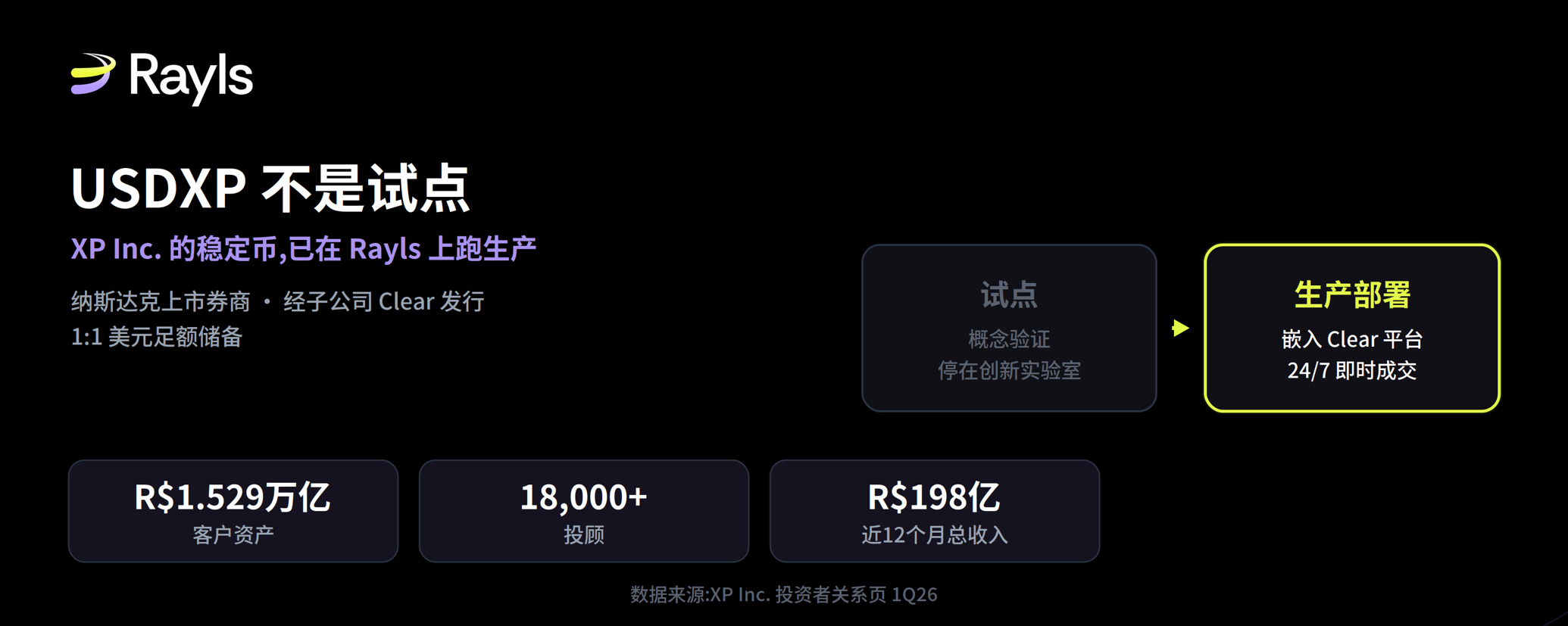
XP Inc. This time it met the standard.
First, get a clear picture of the company, because its scale determines how much weight this carries. XP is a Brazil-based investment platform listed on Nasdaq, ticker symbol XP. I checked its investor relations page for Q1 2026 data: customer assets are on the order of R$152.9 billion reais—more precisely, R$1.529 trillion; there are more than 18,000 financial advisors; and over the past twelve months, total revenue is R$19.8 billion reais, with pre-tax profit of R$5.8 billion reais.
To judge whether an institution is truly on-chain, look at one thing: can ordinary customers use it directly?
In the crypto circle, you can see “some traditional finance giant is moving into blockchain” every week. I mostly swipe past headlines like this, because in most cases they end up in an innovation lab, issue a press release, and then there’s no follow-up. There’s a very simple way to judge whether something is true: for an ordinary customer, in their own app, can they directly click in and use it?
XP Inc. This time it met the standard.
First, get a clear picture of the company, because its scale determines how much weight this carries. XP is a Brazil-based investment platform listed on Nasdaq, ticker symbol XP. I checked its investor relations page for Q1 2026 data: customer assets are on the order of R$152.9 billion reais—more precisely, R$1.529 trillion; there are more than 18,000 financial advisors; and over the past twelve months, total revenue is R$19.8 billion reais, with pre-tax profit of R$5.8 billion reais.
XP Inc. This time it met the standard.
First, get a clear picture of the company, because its scale determines how much weight this carries. XP is a Brazil-based investment platform listed on Nasdaq, ticker symbol XP. I checked its investor relations page for Q1 2026 data: customer assets are on the order of R$152.9 billion reais—more precisely, R$1.529 trillion; there are more than 18,000 financial advisors; and over the past twelve months, total revenue is R$19.8 billion reais, with pre-tax profit of R$5.8 billion reais.
1
274
Article
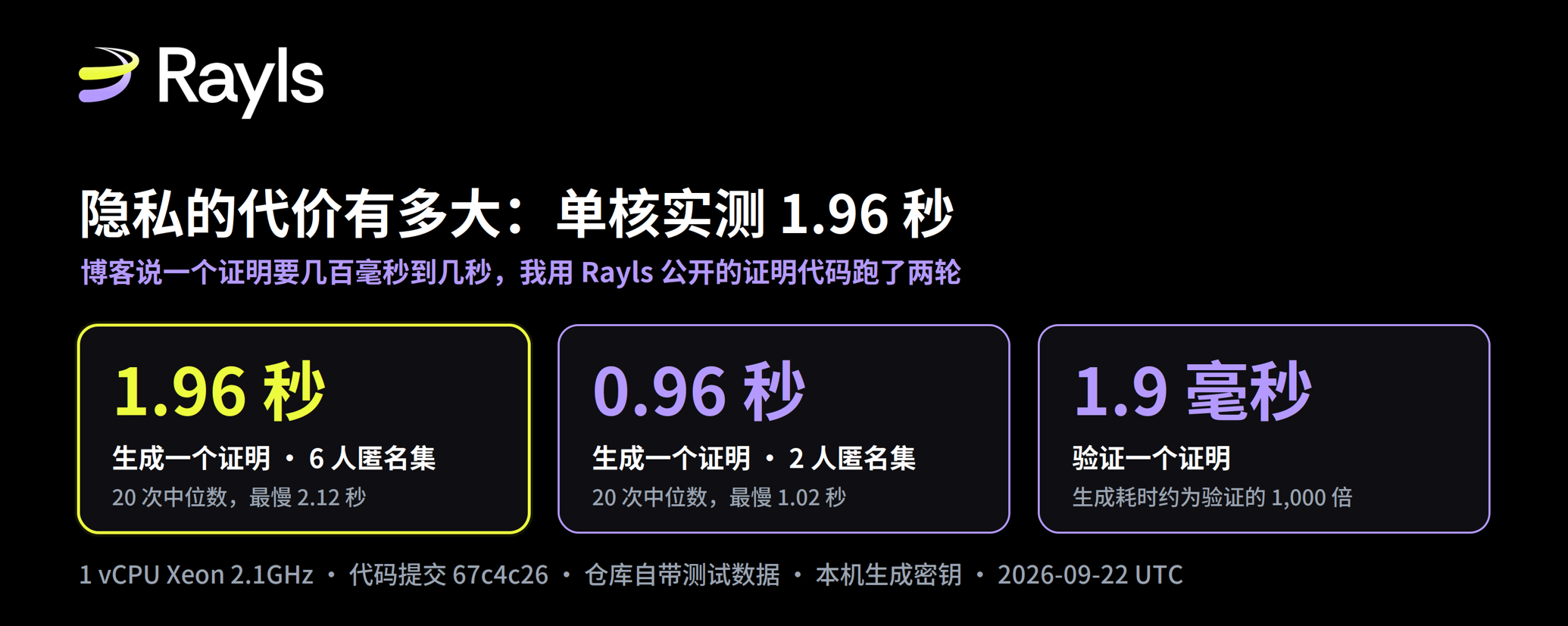
Rayls says privacy has a cost—I've run its proof code onceOn September 19, Rayls published a post (“Privacy has a price”). The title said “honest math,” but the entire piece only provided a single range of numbers: a proof takes anywhere from a few hundred milliseconds to a few seconds. For weeks I kept writing about Rayls’ privacy architecture; this time I’m sharing the new stuff with everyone. I pulled down the publicly released proof code, ran it dozens of times in practice, and I’m sharing this interesting conclusion!
Let’s first talk about what the blog covers. Its core argument can be summarized in two sentences. The first sentence is where the cost comes from: confidential transactions are more expensive than transparent ones—mainly because generating zero-knowledge proofs is costly, while verification is relatively cheap. Even a basic confidential transfer proof takes several hundred milliseconds to a few seconds on ordinary commercial hardware. The second sentence is what you should ask: institutions shouldn’t only ask about TPS; they should ask what the throughput is under the level of privacy and auditability they actually need when facing real business workloads. The blog argues that the volume in interbank settlement isn’t large, and it falls well within what confidential settlement systems can handle.
Rayls says privacy has a cost—I've run its proof code once
On September 19, Rayls published a post (“Privacy has a price”). The title said “honest math,” but the entire piece only provided a single range of numbers: a proof takes anywhere from a few hundred milliseconds to a few seconds. For weeks I kept writing about Rayls’ privacy architecture; this time I’m sharing the new stuff with everyone. I pulled down the publicly released proof code, ran it dozens of times in practice, and I’m sharing this interesting conclusion!
Let’s first talk about what the blog covers. Its core argument can be summarized in two sentences. The first sentence is where the cost comes from: confidential transactions are more expensive than transparent ones—mainly because generating zero-knowledge proofs is costly, while verification is relatively cheap. Even a basic confidential transfer proof takes several hundred milliseconds to a few seconds on ordinary commercial hardware. The second sentence is what you should ask: institutions shouldn’t only ask about TPS; they should ask what the throughput is under the level of privacy and auditability they actually need when facing real business workloads. The blog argues that the volume in interbank settlement isn’t large, and it falls well within what confidential settlement systems can handle.
Let’s first talk about what the blog covers. Its core argument can be summarized in two sentences. The first sentence is where the cost comes from: confidential transactions are more expensive than transparent ones—mainly because generating zero-knowledge proofs is costly, while verification is relatively cheap. Even a basic confidential transfer proof takes several hundred milliseconds to a few seconds on ordinary commercial hardware. The second sentence is what you should ask: institutions shouldn’t only ask about TPS; they should ask what the throughput is under the level of privacy and auditability they actually need when facing real business workloads. The blog argues that the volume in interbank settlement isn’t large, and it falls well within what confidential settlement systems can handle.
1
290
Article
Does the Relayer in Rayls Really Execute Messages?$RLS
While reviewing the Rayls Relayer code again, I noticed something odd.
If the Relayer is the one delivering messages, shouldn’t it also have RELAYER permission for "executeMessage()"?
But when I traced the actual code, that wasn’t the case.
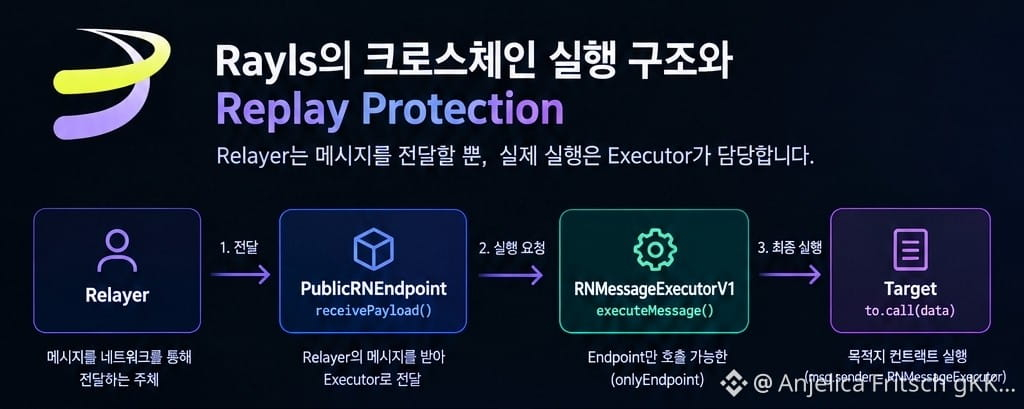
Instead, Rayls separates the authority to deliver messages from the authority to actually execute them.
On the Public Chain, the first place the Relayer enters is "PublicRNEndpoint.receivePayload()".
Rather than executing the message directly here,
Does the Relayer in Rayls Really Execute Messages?
$RLS
While reviewing the Rayls Relayer code again, I noticed something odd.
If the Relayer is the one delivering messages, shouldn’t it also have RELAYER permission for "executeMessage()"?
But when I traced the actual code, that wasn’t the case.
Instead, Rayls separates the authority to deliver messages from the authority to actually execute them.
On the Public Chain, the first place the Relayer enters is "PublicRNEndpoint.receivePayload()".
Rather than executing the message directly here,
While reviewing the Rayls Relayer code again, I noticed something odd.
If the Relayer is the one delivering messages, shouldn’t it also have RELAYER permission for "executeMessage()"?
But when I traced the actual code, that wasn’t the case.
Instead, Rayls separates the authority to deliver messages from the authority to actually execute them.
On the Public Chain, the first place the Relayer enters is "PublicRNEndpoint.receivePayload()".
Rather than executing the message directly here,
1
122
Article
Staking is now open to everyone, but there are a few things you should know firstI started staking from the batch of pre-commitments in June, so I’ve gone through this whole process already. This time it’s open to everyone. A lot of people around me have been asking how to operate it and what to watch out for, so I’m just going to lay everything out clearly in one go.
First, let’s talk about the change itself.
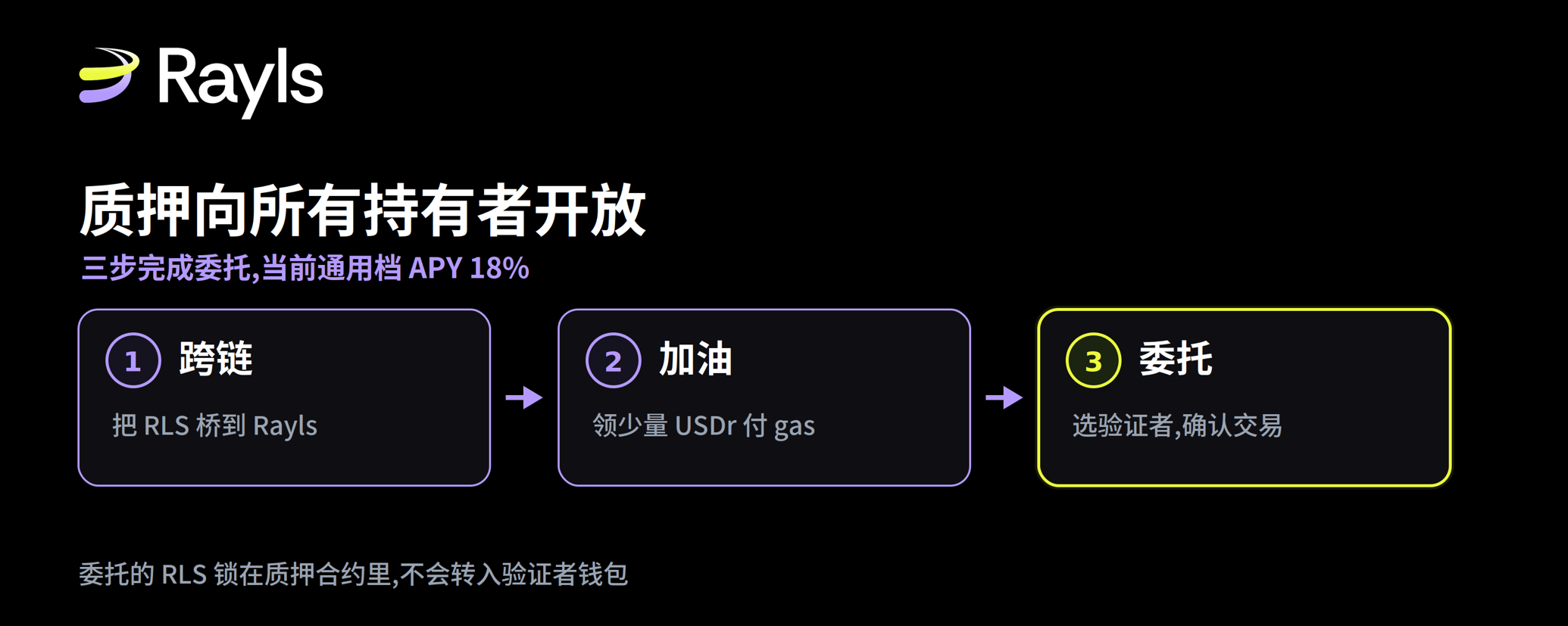
Rayls uses delegated proof-of-stake: validators run nodes, produce blocks, and help secure the public chain. Regular holders don’t need to run nodes themselves—they can delegate their RLS to a validator and share part of the staking rewards.
This mechanism went live in June, but at the time it was only available to wallets that participated in the pre-commitment plan and the liquidity seed activities. Those participants locked their tokens before the mainnet launch, and the official team offered a three-month 55% boosted annualized return. They even sent 1 USDr to each qualifying wallet so they wouldn’t even have to worry about having gas.
Staking is now open to everyone, but there are a few things you should know first
I started staking from the batch of pre-commitments in June, so I’ve gone through this whole process already. This time it’s open to everyone. A lot of people around me have been asking how to operate it and what to watch out for, so I’m just going to lay everything out clearly in one go.
First, let’s talk about the change itself.
Rayls uses delegated proof-of-stake: validators run nodes, produce blocks, and help secure the public chain. Regular holders don’t need to run nodes themselves—they can delegate their RLS to a validator and share part of the staking rewards.
This mechanism went live in June, but at the time it was only available to wallets that participated in the pre-commitment plan and the liquidity seed activities. Those participants locked their tokens before the mainnet launch, and the official team offered a three-month 55% boosted annualized return. They even sent 1 USDr to each qualifying wallet so they wouldn’t even have to worry about having gas.
First, let’s talk about the change itself.
Rayls uses delegated proof-of-stake: validators run nodes, produce blocks, and help secure the public chain. Regular holders don’t need to run nodes themselves—they can delegate their RLS to a validator and share part of the staking rewards.
This mechanism went live in June, but at the time it was only available to wallets that participated in the pre-commitment plan and the liquidity seed activities. Those participants locked their tokens before the mainnet launch, and the official team offered a three-month 55% boosted annualized return. They even sent 1 USDr to each qualifying wallet so they wouldn’t even have to worry about having gas.
282
Partly True
Article
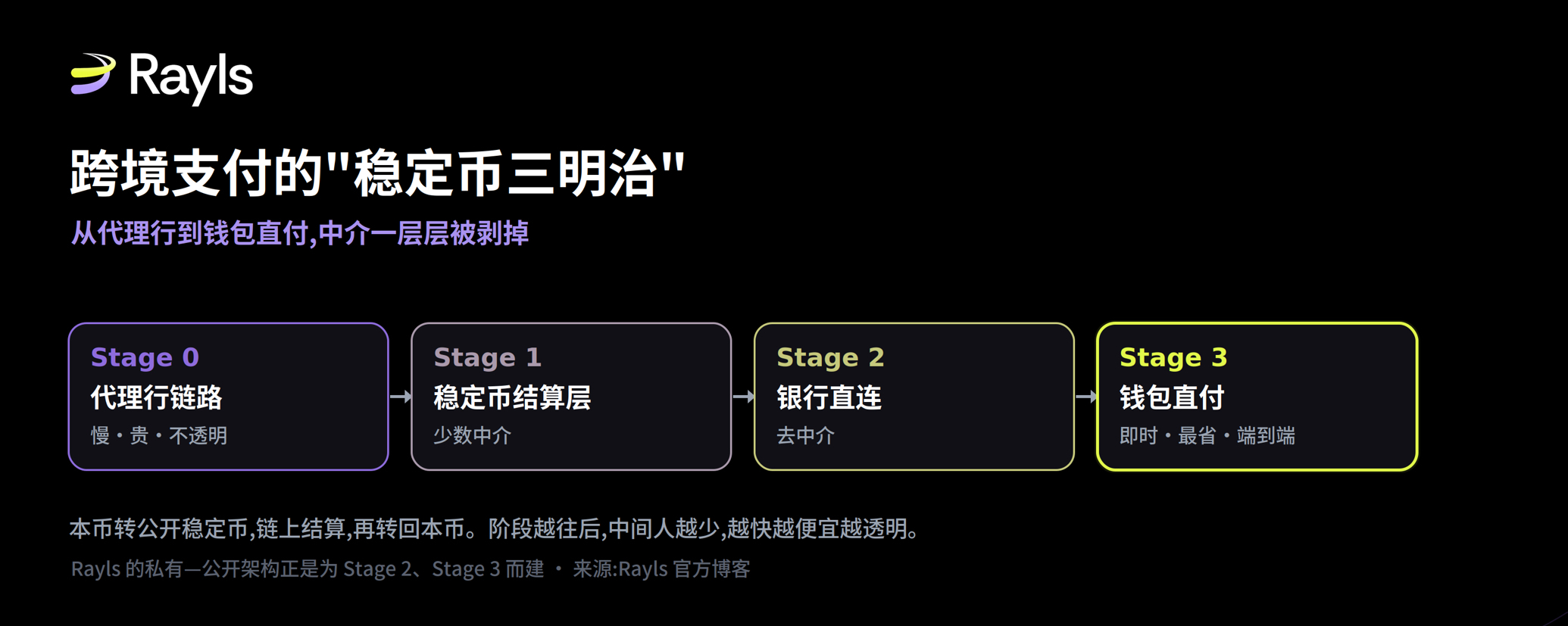
A cross-border remittance being broken down into a “sandwich”In my previous article about XP, I kept wondering about one thing: once an institutional stablecoin like USDXP is issued, how exactly does it participate in real cross-border settlement? This piece is my attempt to fill in that gap, and it also helped me finally understand a term for the first time: “stablecoin sandwich.”
First, let’s explain this term. It’s actually very visual. A single cross-border payment: the two ends are your local currency, with a layer of public stablecoin in the middle. The payer converts their local currency into a USD stablecoin; the stablecoin completes the cross-border settlement on-chain; then the payee converts it back into their own local currency. Doesn’t it look like two slices of bread with that middle layer in between? That’s the phrase the industry started using to describe stablecoin-based cross-border settlement.
A cross-border remittance being broken down into a “sandwich”
In my previous article about XP, I kept wondering about one thing: once an institutional stablecoin like USDXP is issued, how exactly does it participate in real cross-border settlement? This piece is my attempt to fill in that gap, and it also helped me finally understand a term for the first time: “stablecoin sandwich.”
First, let’s explain this term. It’s actually very visual. A single cross-border payment: the two ends are your local currency, with a layer of public stablecoin in the middle. The payer converts their local currency into a USD stablecoin; the stablecoin completes the cross-border settlement on-chain; then the payee converts it back into their own local currency. Doesn’t it look like two slices of bread with that middle layer in between? That’s the phrase the industry started using to describe stablecoin-based cross-border settlement.
First, let’s explain this term. It’s actually very visual. A single cross-border payment: the two ends are your local currency, with a layer of public stablecoin in the middle. The payer converts their local currency into a USD stablecoin; the stablecoin completes the cross-border settlement on-chain; then the payee converts it back into their own local currency. Doesn’t it look like two slices of bread with that middle layer in between? That’s the phrase the industry started using to describe stablecoin-based cross-border settlement.
418
Article
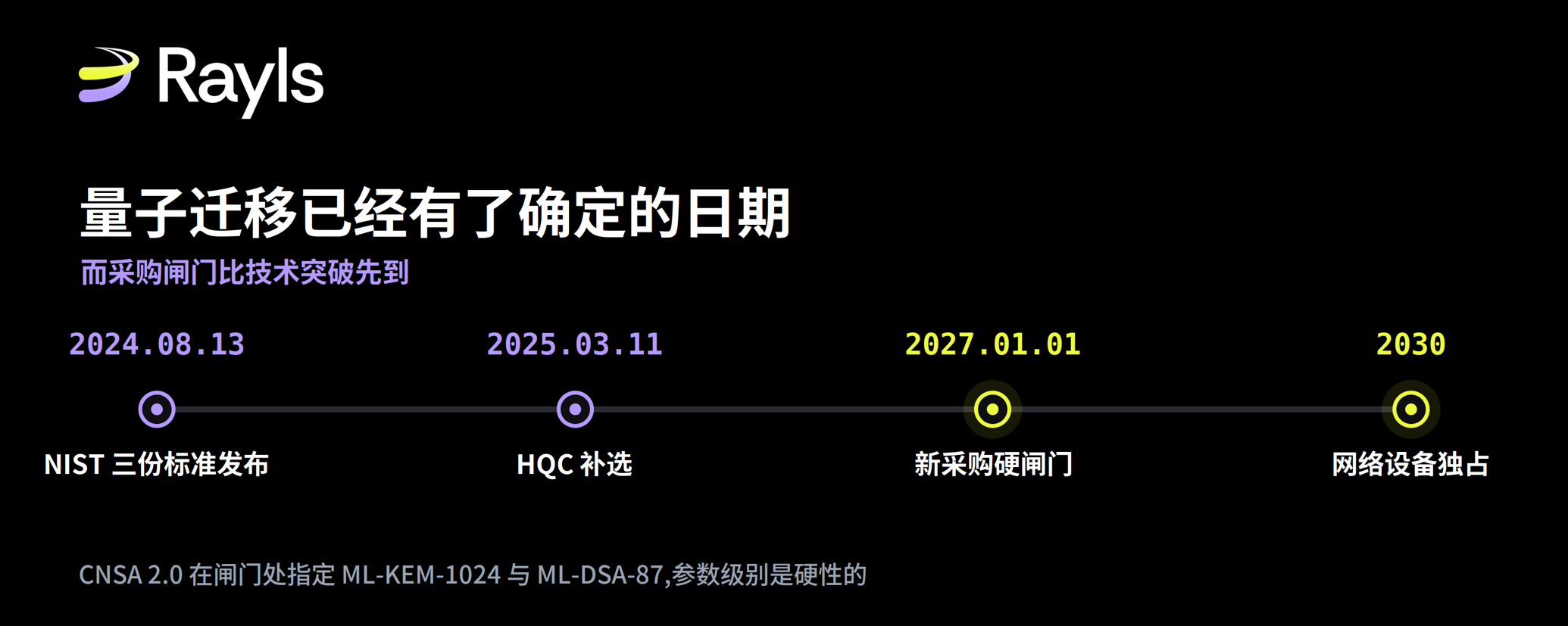
The words "post-quantum" only count if they are specified down to the parameter levelI started staking RLS back in the pre-commitment phase, and when I read the official blog, it was usually to see whether my position would be affected. This August 30 article about quantum stuff was different: the whole piece was teaching institutions how to do procurement, with little direct relevance to someone like me, a retail investor. But I still read it to the end, because it opened with a pretty strict rule, and that rule eventually brought me back to the article itself.
The rule is like this: if a claim says something is "quantum-safe" but doesn’t clearly state which standardized algorithm it uses and at what parameter level, then it isn’t a claim at all, just a label.
The words "post-quantum" only count if they are specified down to the parameter level
I started staking RLS back in the pre-commitment phase, and when I read the official blog, it was usually to see whether my position would be affected. This August 30 article about quantum stuff was different: the whole piece was teaching institutions how to do procurement, with little direct relevance to someone like me, a retail investor. But I still read it to the end, because it opened with a pretty strict rule, and that rule eventually brought me back to the article itself.
The rule is like this: if a claim says something is "quantum-safe" but doesn’t clearly state which standardized algorithm it uses and at what parameter level, then it isn’t a claim at all, just a label.
The rule is like this: if a claim says something is "quantum-safe" but doesn’t clearly state which standardized algorithm it uses and at what parameter level, then it isn’t a claim at all, just a label.
260
Article
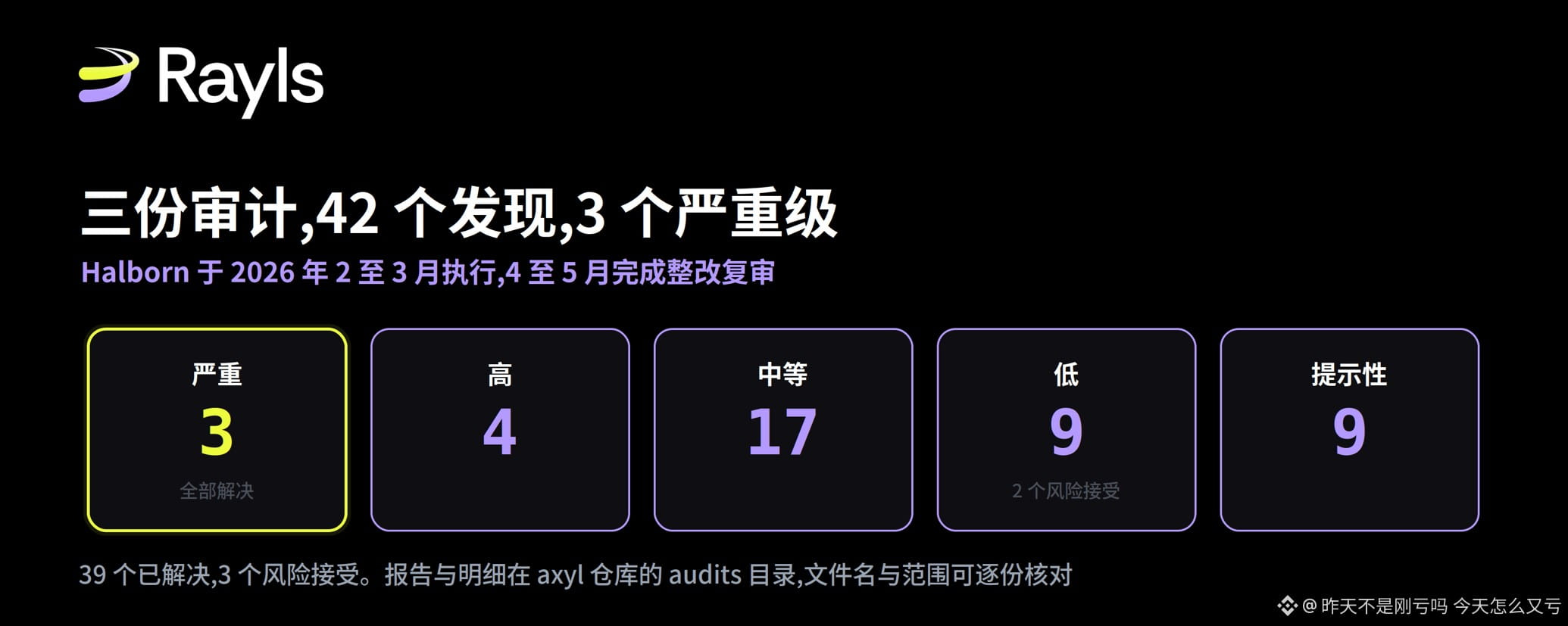
42 questions across three audit reports, including 3 critical onesI started staking RLS back in the pre-commitment phase—it was just something I got into by reading the official materials. After the name “Sovereign” was introduced, most of the discussion ended up lingering on “is it just a name change?” I think that question is backwards. The name doesn’t matter; what matters is what was changed underneath, and how much a firm can get that it can independently verify during due diligence. For every number in this piece, I’ve provided the exact source; you can reproduce it by following along.
First, let me clarify something. Because last week I wrote an article about auditability, some readers may have seen it.
Most of the content here is new. It comes from Axyl’s code repositories, the audit directories within those repos, and Axyl’s performance benchmarks documentation page. I hadn’t touched any of those before. Only the small section about key custody continues the conclusion from the previous article—I’ll mark it there. I separate what’s new from what’s old because what I “looked up this week” versus what I “looked up before” should be something readers can distinguish for themselves.
42 questions across three audit reports, including 3 critical ones
I started staking RLS back in the pre-commitment phase—it was just something I got into by reading the official materials. After the name “Sovereign” was introduced, most of the discussion ended up lingering on “is it just a name change?” I think that question is backwards. The name doesn’t matter; what matters is what was changed underneath, and how much a firm can get that it can independently verify during due diligence. For every number in this piece, I’ve provided the exact source; you can reproduce it by following along.
First, let me clarify something. Because last week I wrote an article about auditability, some readers may have seen it.
Most of the content here is new. It comes from Axyl’s code repositories, the audit directories within those repos, and Axyl’s performance benchmarks documentation page. I hadn’t touched any of those before. Only the small section about key custody continues the conclusion from the previous article—I’ll mark it there. I separate what’s new from what’s old because what I “looked up this week” versus what I “looked up before” should be something readers can distinguish for themselves.
First, let me clarify something. Because last week I wrote an article about auditability, some readers may have seen it.
Most of the content here is new. It comes from Axyl’s code repositories, the audit directories within those repos, and Axyl’s performance benchmarks documentation page. I hadn’t touched any of those before. Only the small section about key custody continues the conclusion from the previous article—I’ll mark it there. I separate what’s new from what’s old because what I “looked up this week” versus what I “looked up before” should be something readers can distinguish for themselves.
347
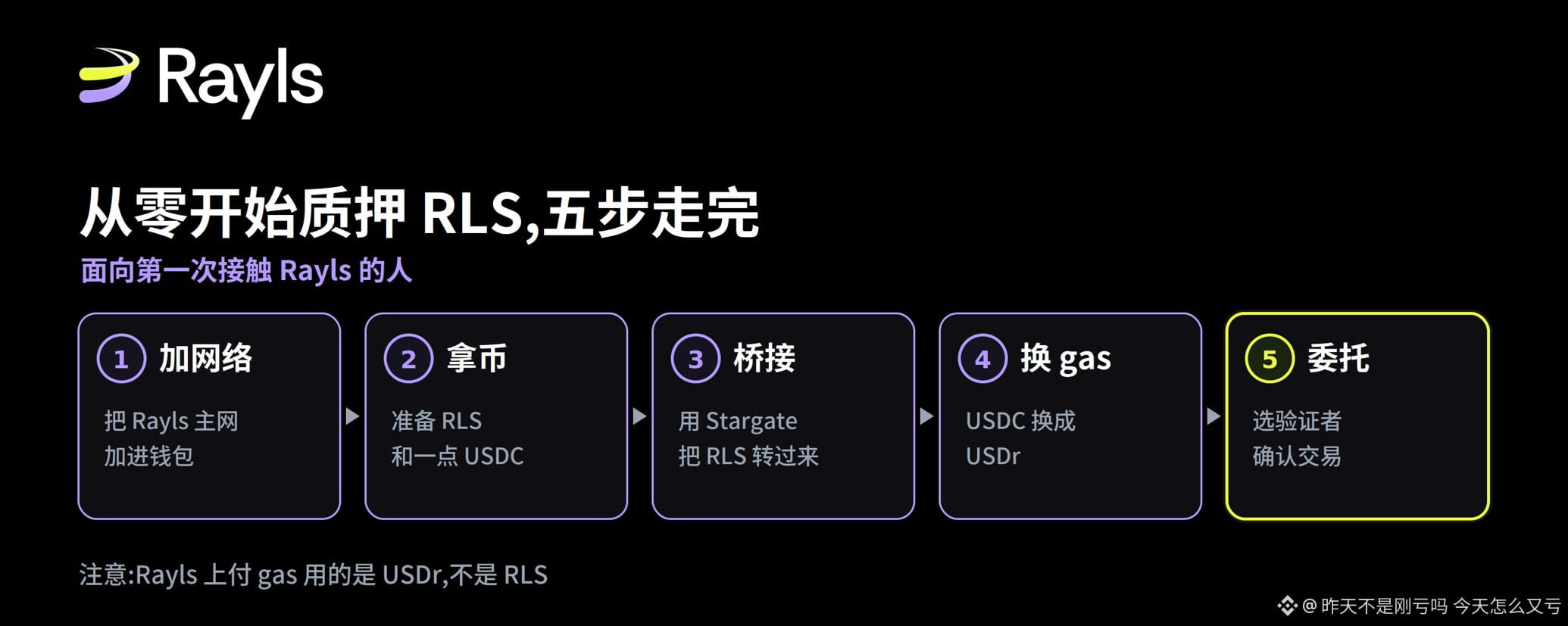
Article
Stake RLS from Scratch: A Complete Step-by-Step Guide Written for BeginnersIn the previous post, I talked about the staking being opened up itself. But in the backend, the most frequently asked question from many brothers was actually the same sentence: exactly how do you do it? So this time, I went through the whole process again from start to finish, and wrote down every step and every spot that’s easy to get stuck. Just follow it.
Here’s the link to the previous post: [质押开放给所有人了,但有几件事最好先知道](https://www.binance.com/zh-cn/square/post/355871701721682)
First, let’s make it clear who this article is for. If you’ve never come across Rayls at all— and even aren’t very familiar with terms like wallets or bridging— then this is written for you. For every piece of technical terminology, I’ll briefly explain it along the way.
Stake RLS from Scratch: A Complete Step-by-Step Guide Written for Beginners
In the previous post, I talked about the staking being opened up itself. But in the backend, the most frequently asked question from many brothers was actually the same sentence: exactly how do you do it? So this time, I went through the whole process again from start to finish, and wrote down every step and every spot that’s easy to get stuck. Just follow it.
Here’s the link to the previous post: 质押开放给所有人了,但有几件事最好先知道
First, let’s make it clear who this article is for. If you’ve never come across Rayls at all— and even aren’t very familiar with terms like wallets or bridging— then this is written for you. For every piece of technical terminology, I’ll briefly explain it along the way.
Here’s the link to the previous post: 质押开放给所有人了,但有几件事最好先知道
First, let’s make it clear who this article is for. If you’ve never come across Rayls at all— and even aren’t very familiar with terms like wallets or bridging— then this is written for you. For every piece of technical terminology, I’ll briefly explain it along the way.
2
1
515
·
--
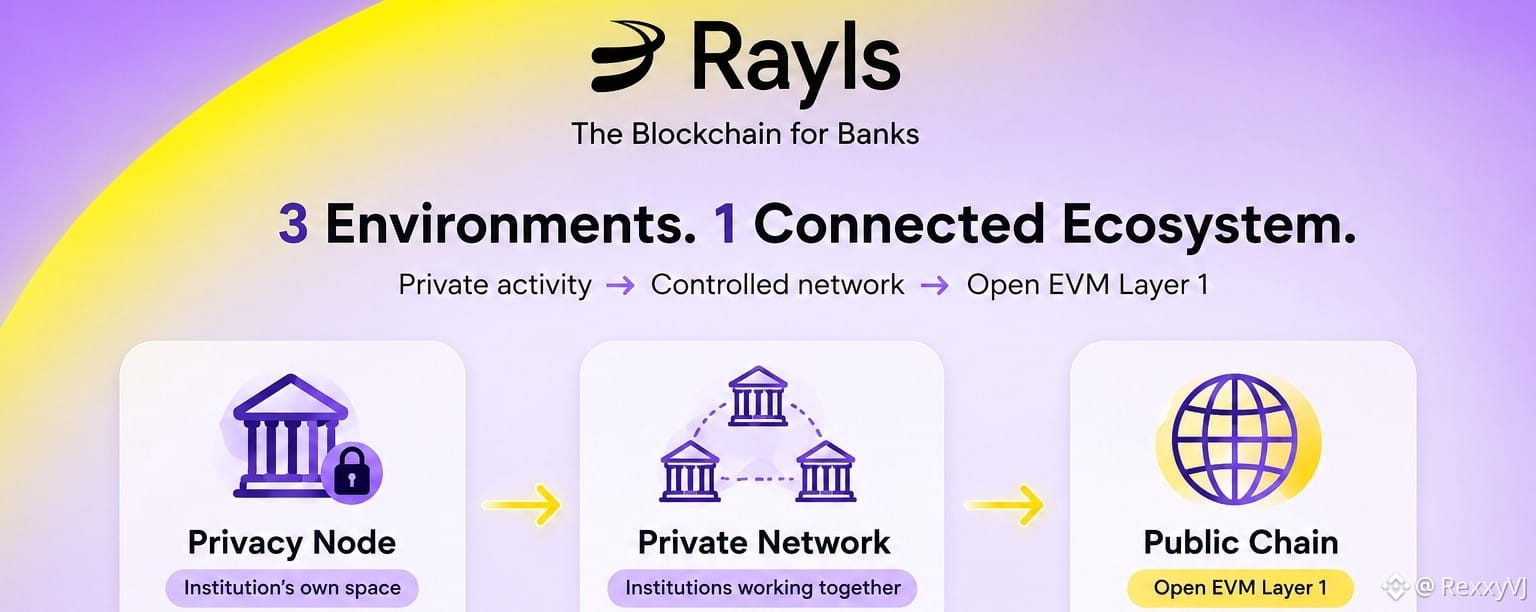
Article
The part of Rayls that finally made sense to meI’ve been going through the Rayls docs, and one thing I initially found confusing was the difference between a Privacy Node, Private Network, and Public Chain.
After looking at how they connect, it became much easier to understand.
They each have a different role.
1. Privacy Node: the institution’s own blockchain
A Rayls Privacy Node is an EVM-compatible chain operated by a single institution.
What happens inside the institution stays inside its own environment.
It can issue tokens, manage balances, run smart contracts and handle its internal activity there.
One detail I found important: a Privacy Node is not a validator.
The docs describe it more like the institution’s own onchain environment, where its data, keys and workflows are controlled by the institution itself.
That makes sense for banks because they need control over sensitive financial information.
2. Private Network: where institutions interact
The next part is the Rayls Private Network.
This is a permissioned blockchain network where multiple institutions can connect through their Privacy Nodes.
So instead of every institution keeping its own isolated blockchain, they can interact with other approved participants while keeping transactions private.
Rayls uses a Private Network Hub to coordinate these interactions.
This is where Enygma becomes interesting.
Enygma is Rayls’ privacy protocol for confidential transactions. The docs show how it can be used for private token transfers and Delivery-versus-Payment, where two assets can be exchanged while keeping sensitive transaction information protected.
There is also an auditor role, so privacy doesn't simply mean that nobody can ever inspect anything.
That balance between confidentiality and authorised visibility is one of the things I found interesting while going through the docs.
3. Public Chain: the open side
Then there is the Rayls Public Chain.
This is an EVM-compatible Layer 1 designed to connect the institutional side with the open blockchain ecosystem.
This is where public applications, assets and DeFi can operate.
The current docs also mention over 10,000 TPS and sub-second deterministic finality through Rayls' Axyl consensus.
So the Public Chain isn't simply another place to store assets.
It is the open side of the architecture.
The simple way I understand it now
Think about an institution issuing a tokenised asset.
Privacy Node
The institution creates and manages the asset in its own environment.
↓
Private Network
The institution can interact with other approved institutions privately.
↓
Public Chain
The asset can reach the open blockchain ecosystem and public liquidity when appropriate.
Of course, the actual flow depends on the use case. The important part is that Rayls doesn't force every activity into the same environment.
Each environment has a specific job.
And this is where Rayls Enygma fits
This was probably the most interesting part for me.
Blockchain usually gives you transparency by default, but financial institutions often need the opposite for sensitive transactions.
Enygma is designed to provide confidential transactions while keeping them verifiable and auditable.
For example, Rayls documents describe confidential transfers where the sender, recipient and amount can be hidden from public view, while authorised auditors can still access the necessary information.
It also supports private DvP flows for tokenised assets.
So the goal isn't simply:
"make everything private."
It is more about giving different participants different levels of visibility depending on what they are authorised to see.
What I took away from exploring Rayls
Before going through the docs, I mostly thought of Rayls as another blockchain project focused on institutions.
After looking at the architecture, I see the idea differently.
The Privacy Node gives an institution its own controlled onchain environment.
The Private Network lets approved institutions interact.
The Public Chain connects that institutional infrastructure to the open blockchain world.
And Enygma provides the privacy layer for sensitive activity.
That separation is probably the part of Rayls I found most interesting.
Instead of asking institutions to choose between private infrastructure and public blockchain access, Rayls is building a way for the two sides to work together.
That was the part that clicked for me after actually going through the docs.
@Rayls #Rayls
The part of Rayls that finally made sense to me
I’ve been going through the Rayls docs, and one thing I initially found confusing was the difference between a Privacy Node, Private Network, and Public Chain.
After looking at how they connect, it became much easier to understand.
They each have a different role.
1. Privacy Node: the institution’s own blockchain
A Rayls Privacy Node is an EVM-compatible chain operated by a single institution.
What happens inside the institution stays inside its own environment.
It can issue tokens, manage balances, run smart contracts and handle its internal activity there.
One detail I found important: a Privacy Node is not a validator.
The docs describe it more like the institution’s own onchain environment, where its data, keys and workflows are controlled by the institution itself.
That makes sense for banks because they need control over sensitive financial information.
2. Private Network: where institutions interact
The next part is the Rayls Private Network.
This is a permissioned blockchain network where multiple institutions can connect through their Privacy Nodes.
So instead of every institution keeping its own isolated blockchain, they can interact with other approved participants while keeping transactions private.
Rayls uses a Private Network Hub to coordinate these interactions.
This is where Enygma becomes interesting.
Enygma is Rayls’ privacy protocol for confidential transactions. The docs show how it can be used for private token transfers and Delivery-versus-Payment, where two assets can be exchanged while keeping sensitive transaction information protected.
There is also an auditor role, so privacy doesn't simply mean that nobody can ever inspect anything.
That balance between confidentiality and authorised visibility is one of the things I found interesting while going through the docs.
3. Public Chain: the open side
Then there is the Rayls Public Chain.
This is an EVM-compatible Layer 1 designed to connect the institutional side with the open blockchain ecosystem.
This is where public applications, assets and DeFi can operate.
The current docs also mention over 10,000 TPS and sub-second deterministic finality through Rayls' Axyl consensus.
So the Public Chain isn't simply another place to store assets.
It is the open side of the architecture.
The simple way I understand it now
Think about an institution issuing a tokenised asset.
Privacy Node
The institution creates and manages the asset in its own environment.
↓
Private Network
The institution can interact with other approved institutions privately.
↓
Public Chain
The asset can reach the open blockchain ecosystem and public liquidity when appropriate.
Of course, the actual flow depends on the use case. The important part is that Rayls doesn't force every activity into the same environment.
Each environment has a specific job.
And this is where Rayls Enygma fits
This was probably the most interesting part for me.
Blockchain usually gives you transparency by default, but financial institutions often need the opposite for sensitive transactions.
Enygma is designed to provide confidential transactions while keeping them verifiable and auditable.
For example, Rayls documents describe confidential transfers where the sender, recipient and amount can be hidden from public view, while authorised auditors can still access the necessary information.
It also supports private DvP flows for tokenised assets.
So the goal isn't simply:
"make everything private."
It is more about giving different participants different levels of visibility depending on what they are authorised to see.
What I took away from exploring Rayls
Before going through the docs, I mostly thought of Rayls as another blockchain project focused on institutions.
After looking at the architecture, I see the idea differently.
The Privacy Node gives an institution its own controlled onchain environment.
The Private Network lets approved institutions interact.
The Public Chain connects that institutional infrastructure to the open blockchain world.
And Enygma provides the privacy layer for sensitive activity.
That separation is probably the part of Rayls I found most interesting.
Instead of asking institutions to choose between private infrastructure and public blockchain access, Rayls is building a way for the two sides to work together.
That was the part that clicked for me after actually going through the docs.
@Rayls #Rayls
After looking at how they connect, it became much easier to understand.
They each have a different role.
1. Privacy Node: the institution’s own blockchain
A Rayls Privacy Node is an EVM-compatible chain operated by a single institution.
What happens inside the institution stays inside its own environment.
It can issue tokens, manage balances, run smart contracts and handle its internal activity there.
One detail I found important: a Privacy Node is not a validator.
The docs describe it more like the institution’s own onchain environment, where its data, keys and workflows are controlled by the institution itself.
That makes sense for banks because they need control over sensitive financial information.
2. Private Network: where institutions interact
The next part is the Rayls Private Network.
This is a permissioned blockchain network where multiple institutions can connect through their Privacy Nodes.
So instead of every institution keeping its own isolated blockchain, they can interact with other approved participants while keeping transactions private.
Rayls uses a Private Network Hub to coordinate these interactions.
This is where Enygma becomes interesting.
Enygma is Rayls’ privacy protocol for confidential transactions. The docs show how it can be used for private token transfers and Delivery-versus-Payment, where two assets can be exchanged while keeping sensitive transaction information protected.
There is also an auditor role, so privacy doesn't simply mean that nobody can ever inspect anything.
That balance between confidentiality and authorised visibility is one of the things I found interesting while going through the docs.
3. Public Chain: the open side
Then there is the Rayls Public Chain.
This is an EVM-compatible Layer 1 designed to connect the institutional side with the open blockchain ecosystem.
This is where public applications, assets and DeFi can operate.
The current docs also mention over 10,000 TPS and sub-second deterministic finality through Rayls' Axyl consensus.
So the Public Chain isn't simply another place to store assets.
It is the open side of the architecture.
The simple way I understand it now
Think about an institution issuing a tokenised asset.
Privacy Node
The institution creates and manages the asset in its own environment.
↓
Private Network
The institution can interact with other approved institutions privately.
↓
Public Chain
The asset can reach the open blockchain ecosystem and public liquidity when appropriate.
Of course, the actual flow depends on the use case. The important part is that Rayls doesn't force every activity into the same environment.
Each environment has a specific job.
And this is where Rayls Enygma fits
This was probably the most interesting part for me.
Blockchain usually gives you transparency by default, but financial institutions often need the opposite for sensitive transactions.
Enygma is designed to provide confidential transactions while keeping them verifiable and auditable.
For example, Rayls documents describe confidential transfers where the sender, recipient and amount can be hidden from public view, while authorised auditors can still access the necessary information.
It also supports private DvP flows for tokenised assets.
So the goal isn't simply:
"make everything private."
It is more about giving different participants different levels of visibility depending on what they are authorised to see.
What I took away from exploring Rayls
Before going through the docs, I mostly thought of Rayls as another blockchain project focused on institutions.
After looking at the architecture, I see the idea differently.
The Privacy Node gives an institution its own controlled onchain environment.
The Private Network lets approved institutions interact.
The Public Chain connects that institutional infrastructure to the open blockchain world.
And Enygma provides the privacy layer for sensitive activity.
That separation is probably the part of Rayls I found most interesting.
Instead of asking institutions to choose between private infrastructure and public blockchain access, Rayls is building a way for the two sides to work together.
That was the part that clicked for me after actually going through the docs.
@Rayls #Rayls
3
98

·
--
Bearish
#RLS — Rayls getting REAL or Rekt? 😏⚡
LIVE TODAY Oct 6: $0.002205 — $0.0035 range! 😂
Kraken shows $0.0027 (MCap $5.27M, 2B circ, Vol $974K) 📊 TradingView screaming $0.003591 (+8.20% 24h) — this coin can't decide if it's up or down, mood swings like my ex! 🤣
Bitget $0.00255, Gate $0.00255, MEXC $0.00255 — all exchanges synced like boy band!
Trading at $0.00224 — just 7% above ATL $0.002097 from July 1! Basically bottom fishing territory! 🎣 -2.5% today but staking live with 55% APY!
ATL bounce or another leg down? Any chance? 👇
#RLS #Rayls $RLS
{alpha}(560x17ea10b6ae4fde59fdbf471bd28ab9710f508816)
#RLS — Rayls getting REAL or Rekt? 😏⚡
LIVE TODAY Oct 6: $0.002205 — $0.0035 range! 😂
Kraken shows $0.0027 (MCap $5.27M, 2B circ, Vol $974K) 📊 TradingView screaming $0.003591 (+8.20% 24h) — this coin can't decide if it's up or down, mood swings like my ex! 🤣
Bitget $0.00255, Gate $0.00255, MEXC $0.00255 — all exchanges synced like boy band!
Trading at $0.00224 — just 7% above ATL $0.002097 from July 1! Basically bottom fishing territory! 🎣 -2.5% today but staking live with 55% APY!
ATL bounce or another leg down? Any chance? 👇
#RLS #Rayls $RLS
LIVE TODAY Oct 6: $0.002205 — $0.0035 range! 😂
Kraken shows $0.0027 (MCap $5.27M, 2B circ, Vol $974K) 📊 TradingView screaming $0.003591 (+8.20% 24h) — this coin can't decide if it's up or down, mood swings like my ex! 🤣
Bitget $0.00255, Gate $0.00255, MEXC $0.00255 — all exchanges synced like boy band!
Trading at $0.00224 — just 7% above ATL $0.002097 from July 1! Basically bottom fishing territory! 🎣 -2.5% today but staking live with 55% APY!
ATL bounce or another leg down? Any chance? 👇
#RLS #Rayls $RLS
150
Log in to explore more content
Join global crypto users on Binance Square
⚡️ Get latest and useful information about crypto.
💬 Trusted by the world’s largest crypto exchange.
👍 Discover real insights from verified creators.
Email / Phone number
Trending Topics
1
#XRPDropsToTwoYearLowNear87Cents
0 views
0 Discussing
2
#BitcoinFallsBelow$57KToTwoYearLow
0 views
0 Discussing
3
#NvidiaLoses$2.7TrillionInMonthAndAHalf
82 views
17 Discussing
4
#CanBTCReboundAfterFallingBelow60K?
477,933 views
2,104 Discussing
5
#GlobalStocksFaceLongestLosingStreakSince2023
164,781 views
1,471 Discussing
6
#BlackRockIBITPostsRecord$541MSingleDayOutflow
7,371 views
47 Discussing
7
#AnthropicPlungesTowardIPOPriceonDay2
78,782 views
841 Discussing
8
#TwentyOneCapitalAdds172.25BTC
30,258 views
374 Discussing
9
#HKBillWouldExcludeTokenizedDepositsFromVirtualAssets
2,974 views
39 Discussing
10
#BNBDropsBelow540USDTWith8.46%DailyDecline
46,202 views
427 Discussing