
#remittance
remittance
7,725 views
100 Discussing
Hot
Latest

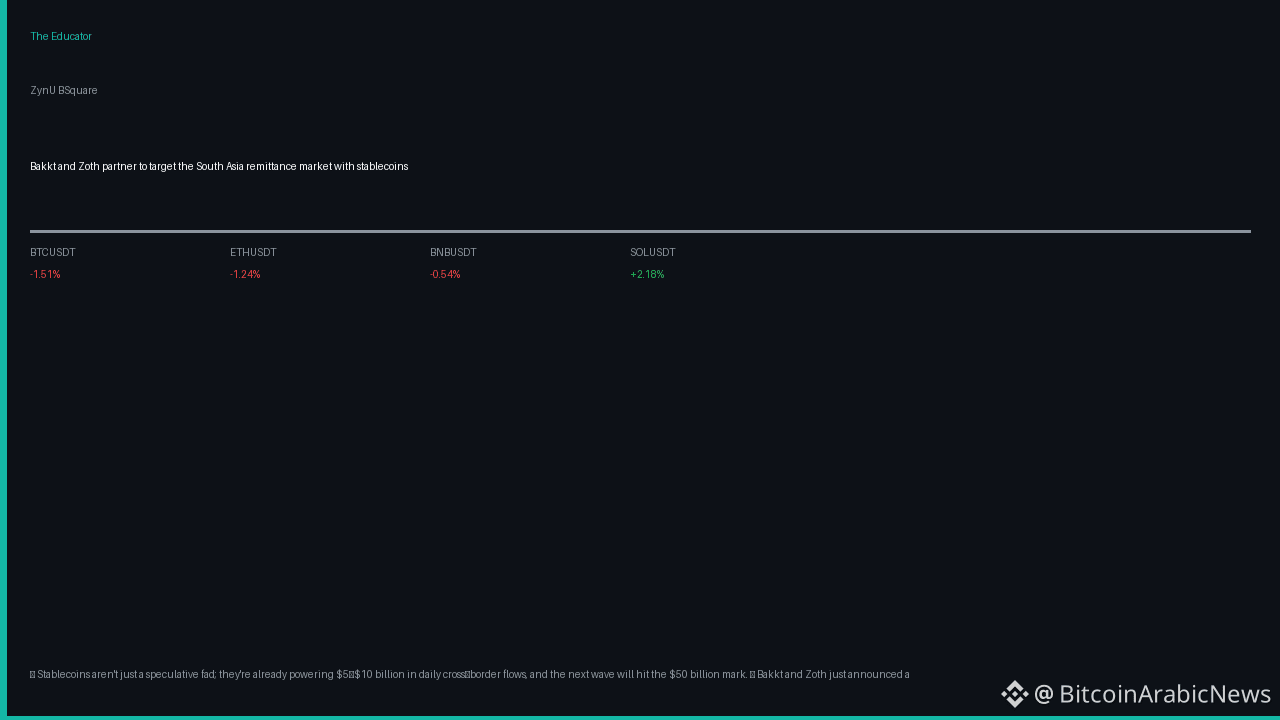
🔥 Stablecoins aren't just a speculative fad; they're already powering $5‑$10 billion in daily cross‑border flows, and the next wave will hit the $50 billion mark.
📊 Bakkt and Zoth just announced a compliance‑first partnership to launch a stablecoin payment rail linking the U.S. to South Asia, the Middle East and Africa, a move that comes as crypto markets sit in extreme fear (12/100) and Bitcoin trades at $64,338 with a bullish MACD crossover. #Stablecoin #Remittance
💡 This infrastructure push signals the start of a macro‑cycle shift where institutional capital, reflected in $5.96 B of BTC open interest and a 75 % long bias, begins to view stablecoins as the safe‑haven conduit for global money flows, reinforcing the long‑term thesis of crypto as the new borderless banking layer #
🔥 Stablecoins aren't just a speculative fad; they're already powering $5‑$10 billion in daily cross‑border flows, and the next wave will hit the $50 billion mark.
📊 Bakkt and Zoth just announced a compliance‑first partnership to launch a stablecoin payment rail linking the U.S. to South Asia, the Middle East and Africa, a move that comes as crypto markets sit in extreme fear (12/100) and Bitcoin trades at $64,338 with a bullish MACD crossover. #Stablecoin #Remittance
💡 This infrastructure push signals the start of a macro‑cycle shift where institutional capital, reflected in $5.96 B of BTC open interest and a 75 % long bias, begins to view stablecoins as the safe‑haven conduit for global money flows, reinforcing the long‑term thesis of crypto as the new borderless banking layer #
📊 Bakkt and Zoth just announced a compliance‑first partnership to launch a stablecoin payment rail linking the U.S. to South Asia, the Middle East and Africa, a move that comes as crypto markets sit in extreme fear (12/100) and Bitcoin trades at $64,338 with a bullish MACD crossover. #Stablecoin #Remittance
💡 This infrastructure push signals the start of a macro‑cycle shift where institutional capital, reflected in $5.96 B of BTC open interest and a 75 % long bias, begins to view stablecoins as the safe‑haven conduit for global money flows, reinforcing the long‑term thesis of crypto as the new borderless banking layer #
3

·
--
Article
What Do You Actually Pay to Send USDT to a Bank Account?Disclosure: It is not financial advice
A short line about a remittance fee can make the cost sound like one number. On BiyaPay, the remittance fee is tiered, and it changes with the size of the transfer.
This is not a recommendation to send funds. It is a worked walk-through of that fee schedule, and of what I would look at before I send.
Two routes, and they pay out the same
There are two ways to withdraw fiat currency, and the arrival amounts of these two methods are the same. I am using a USD withdrawal as the example, from guidance dated 28 February 2026.
The first method is to open Flash Exchange on the app homepage, or open My Assets, then Funds, then Flash Exchange on the web, exchange USDT to USD, and then go to the Remittance page. There you select USD, choose the recipient account, and enter an email verification code or a Biya authenticator code.
The second method skips the separate exchange step. On the Remittance page, you select USDT for remittance, with the actual remittance in USD, then choose the recipient account and enter the same kind of verification code.
Some older screens used the word Convert for that step. The February 2026 guidance calls it Flash Exchange. I would follow the labels on the screen I am looking at.
Before those steps: verification and a recipient account
The process starts earlier than the Remittance button. Complete identity verification and link a bank account, then deposit USDT, then exchange, then withdraw to the linked account.
The recipient account is the one that receives fiat withdrawn from BiyaPay. You can add one from Personal Center, under Recipient Management, or from the Remittance page, under Remit to Self or Remit to Others. That binding guidance is dated 28 February 2026.
You can choose Self, Others, or Business. A Self account needs bank and personal information. An Others account also requires the recipient's ID card or passport. A Business account needs bank and enterprise information.
The fee is tiered, not a single headline rate
If you deposit USDT and withdraw USD, USDT is exchanged 1:1 with USD. That fee guidance was updated on 28 February 2026.
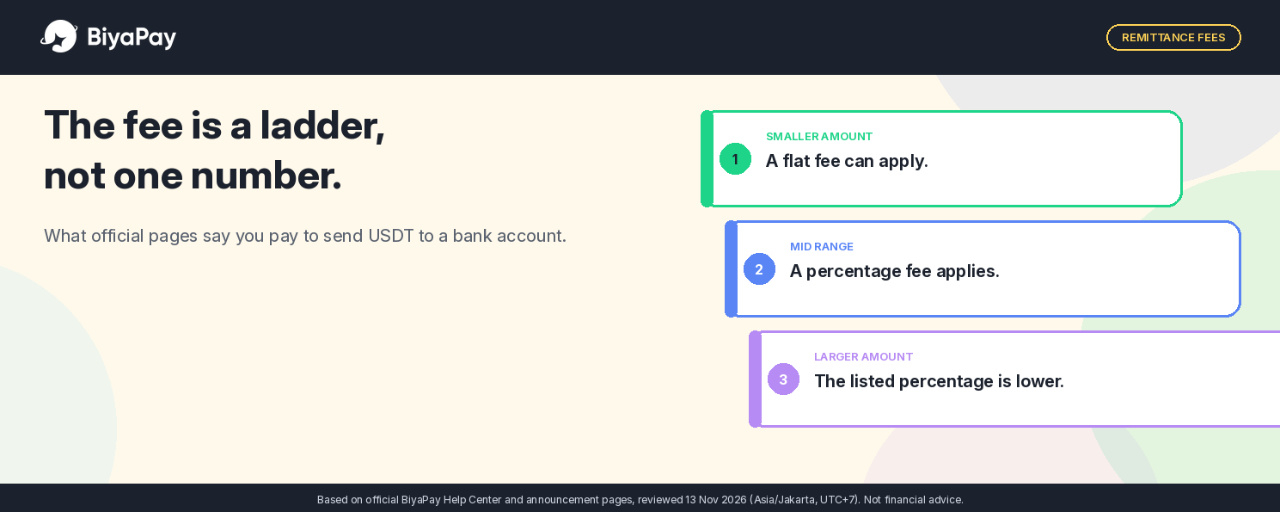
On the BiyaPay fee itself, the short summary is this. When the fiat withdrawal amount is between 200 USD and 2000 USD, the withdrawal fee is 20 USD. When the amount is greater than 2000 USD, the withdrawal fee is 1 percent, with a minimum fee of 0.5 percent available. Fees for other fiat currencies follow the equivalent amount in USD. A higher withdrawal amount has a lower fee percentage. Transferring fiat between BiyaPay wallets through a registered email has no handling fee.
A fuller table sits in a BiyaPay announcement titled Notice on the further reduction of the fee rate for BiyaPay remittance (fiat currency withdrawal), published on 28 November 2024. That table was still shown when I checked on 13 November 2026, after an update dated 15 October 2026.
Remittance still uses a tiered rate, taking a US dollar remittance as the example, with other fiat currencies calculated on the equivalent US dollar amount. The fee is deducted from the remittance amount. The published tiers, as a single remittance or withdrawal in US dollars, are:
200 up to but not including 2,000: a 20 US dollar fee, with no discount listed.
2,000 up to but not including 50,000: 1.00 percent, with no discount listed.
50,000 up to but not including 100,000: 0.90 percent, described as 10 percent off.
100,000 up to but not including 500,000: 0.80 percent, described as 20 percent off.
500,000 up to but not including 1 million: 0.70 percent, described as 30 percent off.
1 million up to but not including 2 million: 0.60 percent, described as 40 percent off.
2 million and above: 0.50 percent, described as 50 percent off.
I would treat that table as the published schedule for this article. The live figures I would use are the current Cost Center remittance table, and then the amount shown on the Remittance preview.
What the 0.1 percent headline does not replace
You may see a short line that remittance fees start from 0.1 percent. That is a headline floor. It is not what the published tier table above shows for ordinary sizes.
On that announcement table, the lowest listed rate is 0.50 percent, and only at 2 million US dollars and above. A 20 US dollar fee on a 200 US dollar transfer is 10 percent of the amount, not 0.1 percent. On a 2,000 US dollar transfer, the same 20 US dollar fee is 1 percent.
The useful question is which tier this amount falls into, and what the preview shows will be paid.
Other costs that are not on the BiyaPay fee line
The BiyaPay fee is not always the only deduction. A transfer in a home-country or local currency, such as US dollars to a US bank, Singapore dollars to a Singapore bank, or Hong Kong dollars to a Hong Kong bank, generally has no bank handling fee. That bank-charge guidance was last updated on 3 November 2024.
If the remittance is not in that local currency, the bank may charge a fee ranging from a few dollars to tens of dollars. Some banks charge even on a local-currency payment. A specific example is a US dollar transfer to US Wise, with a 10 US dollar fee per transaction. I would read the receiving bank's own fee, not only the BiyaPay tier.
Limits, cancellation, and what the transfer supports
A single remittance can be up to 5 million US dollars. To avoid bank scrutiny and a slower arrival, each remittance is better kept at or under 1 million US dollars, and an amount above that is best split into more than one transfer.
Fiat withdrawal currently supports over 30 currencies, including USD, HKD, and SGD. The currency selection page, when you bind a recipient on Remittance, shows the supported list. Remittances go to nearly 200 countries and regions, except countries or regions sanctioned by the United States or the international community. Only online bank transfers are supported, not cash.
Once funds have been remitted, they cannot be cancelled. There is a narrower exception: if the order status is under review, you can cancel that order yourself and then submit again.
Arrival time depends on more than the submit button
Funds will typically arrive within 1 to 3 business days, depending on the remittance country and currency, the payment method, working hours, and bank review. That arrival guidance was updated on 28 February 2026.
Local currencies are generally faster. USD to a US bank, SGD to a Singapore bank, and HKD to a Hong Kong bank generally arrive on the same working day. A cross-currency route, such as SGD to a US bank or USD to a Hong Kong bank, generally arrives on the same day or the next working day.
When you bind a bank account, the page also shows arrival times for the payment method. The examples are US SWIFT in 1 to 3 working days, and ABA or ACH in 0 to 1 working day.
If you submit before 5 PM Singapore time, the remittance is generally sent the same day. A later submission is likely sent on the next working day. Weekends and legal holidays in the destination country can extend arrival. If a bank review is extended, BiyaPay cannot confirm when the funds will arrive, because that depends on the recipient's bank. If a remittance has not arrived after more than 3 working days, contact BiyaPay so they can check the progress.
Flash Exchange itself is available 24 hours a day, and is completed in real time. That is the conversion step, not the bank arrival window.
A checklist I would use before I send
Finish identity verification and bind the correct recipient account, with the documents that account type requires.Decide the route: Flash Exchange into USD and then remit USD, or remit USDT as USD. The arrival amounts are the same.Read the current remittance fee table, not a headline rate I remember, and match the tier for this amount.Look at the preview of the amount to be received, including the BiyaPay fee that will be deducted.Check whether the receiving bank may add its own fee, especially if the currency is not local to that bank.Check the payment method's stated arrival window, and whether I am submitting before the 5 PM Singapore cutoff on a working day.Recheck the recipient details. After the funds have been remitted, the transfer cannot be cancelled.Complete the email or Biya authenticator verification only after those checks feel right.
Source: BiyaPay app and fee pages, and the remittance-fee announcement published on 28 November 2024, all checked on 13 November 2026 (Asia/Jakarta, UTC+7).
#BiyaPay #USDT #Remittance #BankTransfer
What Do You Actually Pay to Send USDT to a Bank Account?
Disclosure: It is not financial advice
A short line about a remittance fee can make the cost sound like one number. On BiyaPay, the remittance fee is tiered, and it changes with the size of the transfer.
This is not a recommendation to send funds. It is a worked walk-through of that fee schedule, and of what I would look at before I send.
Two routes, and they pay out the same
There are two ways to withdraw fiat currency, and the arrival amounts of these two methods are the same. I am using a USD withdrawal as the example, from guidance dated 28 February 2026.
The first method is to open Flash Exchange on the app homepage, or open My Assets, then Funds, then Flash Exchange on the web, exchange USDT to USD, and then go to the Remittance page. There you select USD, choose the recipient account, and enter an email verification code or a Biya authenticator code.
The second method skips the separate exchange step. On the Remittance page, you select USDT for remittance, with the actual remittance in USD, then choose the recipient account and enter the same kind of verification code.
Some older screens used the word Convert for that step. The February 2026 guidance calls it Flash Exchange. I would follow the labels on the screen I am looking at.
Before those steps: verification and a recipient account
The process starts earlier than the Remittance button. Complete identity verification and link a bank account, then deposit USDT, then exchange, then withdraw to the linked account.
The recipient account is the one that receives fiat withdrawn from BiyaPay. You can add one from Personal Center, under Recipient Management, or from the Remittance page, under Remit to Self or Remit to Others. That binding guidance is dated 28 February 2026.
You can choose Self, Others, or Business. A Self account needs bank and personal information. An Others account also requires the recipient's ID card or passport. A Business account needs bank and enterprise information.
The fee is tiered, not a single headline rate
If you deposit USDT and withdraw USD, USDT is exchanged 1:1 with USD. That fee guidance was updated on 28 February 2026.
On the BiyaPay fee itself, the short summary is this. When the fiat withdrawal amount is between 200 USD and 2000 USD, the withdrawal fee is 20 USD. When the amount is greater than 2000 USD, the withdrawal fee is 1 percent, with a minimum fee of 0.5 percent available. Fees for other fiat currencies follow the equivalent amount in USD. A higher withdrawal amount has a lower fee percentage. Transferring fiat between BiyaPay wallets through a registered email has no handling fee.
A fuller table sits in a BiyaPay announcement titled Notice on the further reduction of the fee rate for BiyaPay remittance (fiat currency withdrawal), published on 28 November 2024. That table was still shown when I checked on 13 November 2026, after an update dated 15 October 2026.
Remittance still uses a tiered rate, taking a US dollar remittance as the example, with other fiat currencies calculated on the equivalent US dollar amount. The fee is deducted from the remittance amount. The published tiers, as a single remittance or withdrawal in US dollars, are:
200 up to but not including 2,000: a 20 US dollar fee, with no discount listed.
2,000 up to but not including 50,000: 1.00 percent, with no discount listed.
50,000 up to but not including 100,000: 0.90 percent, described as 10 percent off.
100,000 up to but not including 500,000: 0.80 percent, described as 20 percent off.
500,000 up to but not including 1 million: 0.70 percent, described as 30 percent off.
1 million up to but not including 2 million: 0.60 percent, described as 40 percent off.
2 million and above: 0.50 percent, described as 50 percent off.
I would treat that table as the published schedule for this article. The live figures I would use are the current Cost Center remittance table, and then the amount shown on the Remittance preview.
What the 0.1 percent headline does not replace
You may see a short line that remittance fees start from 0.1 percent. That is a headline floor. It is not what the published tier table above shows for ordinary sizes.
On that announcement table, the lowest listed rate is 0.50 percent, and only at 2 million US dollars and above. A 20 US dollar fee on a 200 US dollar transfer is 10 percent of the amount, not 0.1 percent. On a 2,000 US dollar transfer, the same 20 US dollar fee is 1 percent.
The useful question is which tier this amount falls into, and what the preview shows will be paid.
Other costs that are not on the BiyaPay fee line
The BiyaPay fee is not always the only deduction. A transfer in a home-country or local currency, such as US dollars to a US bank, Singapore dollars to a Singapore bank, or Hong Kong dollars to a Hong Kong bank, generally has no bank handling fee. That bank-charge guidance was last updated on 3 November 2024.
If the remittance is not in that local currency, the bank may charge a fee ranging from a few dollars to tens of dollars. Some banks charge even on a local-currency payment. A specific example is a US dollar transfer to US Wise, with a 10 US dollar fee per transaction. I would read the receiving bank's own fee, not only the BiyaPay tier.
Limits, cancellation, and what the transfer supports
A single remittance can be up to 5 million US dollars. To avoid bank scrutiny and a slower arrival, each remittance is better kept at or under 1 million US dollars, and an amount above that is best split into more than one transfer.
Fiat withdrawal currently supports over 30 currencies, including USD, HKD, and SGD. The currency selection page, when you bind a recipient on Remittance, shows the supported list. Remittances go to nearly 200 countries and regions, except countries or regions sanctioned by the United States or the international community. Only online bank transfers are supported, not cash.
Once funds have been remitted, they cannot be cancelled. There is a narrower exception: if the order status is under review, you can cancel that order yourself and then submit again.
Arrival time depends on more than the submit button
Funds will typically arrive within 1 to 3 business days, depending on the remittance country and currency, the payment method, working hours, and bank review. That arrival guidance was updated on 28 February 2026.
Local currencies are generally faster. USD to a US bank, SGD to a Singapore bank, and HKD to a Hong Kong bank generally arrive on the same working day. A cross-currency route, such as SGD to a US bank or USD to a Hong Kong bank, generally arrives on the same day or the next working day.
When you bind a bank account, the page also shows arrival times for the payment method. The examples are US SWIFT in 1 to 3 working days, and ABA or ACH in 0 to 1 working day.
If you submit before 5 PM Singapore time, the remittance is generally sent the same day. A later submission is likely sent on the next working day. Weekends and legal holidays in the destination country can extend arrival. If a bank review is extended, BiyaPay cannot confirm when the funds will arrive, because that depends on the recipient's bank. If a remittance has not arrived after more than 3 working days, contact BiyaPay so they can check the progress.
Flash Exchange itself is available 24 hours a day, and is completed in real time. That is the conversion step, not the bank arrival window.
A checklist I would use before I send
Finish identity verification and bind the correct recipient account, with the documents that account type requires.Decide the route: Flash Exchange into USD and then remit USD, or remit USDT as USD. The arrival amounts are the same.Read the current remittance fee table, not a headline rate I remember, and match the tier for this amount.Look at the preview of the amount to be received, including the BiyaPay fee that will be deducted.Check whether the receiving bank may add its own fee, especially if the currency is not local to that bank.Check the payment method's stated arrival window, and whether I am submitting before the 5 PM Singapore cutoff on a working day.Recheck the recipient details. After the funds have been remitted, the transfer cannot be cancelled.Complete the email or Biya authenticator verification only after those checks feel right.
Source: BiyaPay app and fee pages, and the remittance-fee announcement published on 28 November 2024, all checked on 13 November 2026 (Asia/Jakarta, UTC+7).
#BiyaPay #USDT #Remittance #BankTransfer
A short line about a remittance fee can make the cost sound like one number. On BiyaPay, the remittance fee is tiered, and it changes with the size of the transfer.
This is not a recommendation to send funds. It is a worked walk-through of that fee schedule, and of what I would look at before I send.
Two routes, and they pay out the same
There are two ways to withdraw fiat currency, and the arrival amounts of these two methods are the same. I am using a USD withdrawal as the example, from guidance dated 28 February 2026.
The first method is to open Flash Exchange on the app homepage, or open My Assets, then Funds, then Flash Exchange on the web, exchange USDT to USD, and then go to the Remittance page. There you select USD, choose the recipient account, and enter an email verification code or a Biya authenticator code.
The second method skips the separate exchange step. On the Remittance page, you select USDT for remittance, with the actual remittance in USD, then choose the recipient account and enter the same kind of verification code.
Some older screens used the word Convert for that step. The February 2026 guidance calls it Flash Exchange. I would follow the labels on the screen I am looking at.
Before those steps: verification and a recipient account
The process starts earlier than the Remittance button. Complete identity verification and link a bank account, then deposit USDT, then exchange, then withdraw to the linked account.
The recipient account is the one that receives fiat withdrawn from BiyaPay. You can add one from Personal Center, under Recipient Management, or from the Remittance page, under Remit to Self or Remit to Others. That binding guidance is dated 28 February 2026.
You can choose Self, Others, or Business. A Self account needs bank and personal information. An Others account also requires the recipient's ID card or passport. A Business account needs bank and enterprise information.
The fee is tiered, not a single headline rate
If you deposit USDT and withdraw USD, USDT is exchanged 1:1 with USD. That fee guidance was updated on 28 February 2026.
On the BiyaPay fee itself, the short summary is this. When the fiat withdrawal amount is between 200 USD and 2000 USD, the withdrawal fee is 20 USD. When the amount is greater than 2000 USD, the withdrawal fee is 1 percent, with a minimum fee of 0.5 percent available. Fees for other fiat currencies follow the equivalent amount in USD. A higher withdrawal amount has a lower fee percentage. Transferring fiat between BiyaPay wallets through a registered email has no handling fee.
A fuller table sits in a BiyaPay announcement titled Notice on the further reduction of the fee rate for BiyaPay remittance (fiat currency withdrawal), published on 28 November 2024. That table was still shown when I checked on 13 November 2026, after an update dated 15 October 2026.
Remittance still uses a tiered rate, taking a US dollar remittance as the example, with other fiat currencies calculated on the equivalent US dollar amount. The fee is deducted from the remittance amount. The published tiers, as a single remittance or withdrawal in US dollars, are:
200 up to but not including 2,000: a 20 US dollar fee, with no discount listed.
2,000 up to but not including 50,000: 1.00 percent, with no discount listed.
50,000 up to but not including 100,000: 0.90 percent, described as 10 percent off.
100,000 up to but not including 500,000: 0.80 percent, described as 20 percent off.
500,000 up to but not including 1 million: 0.70 percent, described as 30 percent off.
1 million up to but not including 2 million: 0.60 percent, described as 40 percent off.
2 million and above: 0.50 percent, described as 50 percent off.
I would treat that table as the published schedule for this article. The live figures I would use are the current Cost Center remittance table, and then the amount shown on the Remittance preview.
What the 0.1 percent headline does not replace
You may see a short line that remittance fees start from 0.1 percent. That is a headline floor. It is not what the published tier table above shows for ordinary sizes.
On that announcement table, the lowest listed rate is 0.50 percent, and only at 2 million US dollars and above. A 20 US dollar fee on a 200 US dollar transfer is 10 percent of the amount, not 0.1 percent. On a 2,000 US dollar transfer, the same 20 US dollar fee is 1 percent.
The useful question is which tier this amount falls into, and what the preview shows will be paid.
Other costs that are not on the BiyaPay fee line
The BiyaPay fee is not always the only deduction. A transfer in a home-country or local currency, such as US dollars to a US bank, Singapore dollars to a Singapore bank, or Hong Kong dollars to a Hong Kong bank, generally has no bank handling fee. That bank-charge guidance was last updated on 3 November 2024.
If the remittance is not in that local currency, the bank may charge a fee ranging from a few dollars to tens of dollars. Some banks charge even on a local-currency payment. A specific example is a US dollar transfer to US Wise, with a 10 US dollar fee per transaction. I would read the receiving bank's own fee, not only the BiyaPay tier.
Limits, cancellation, and what the transfer supports
A single remittance can be up to 5 million US dollars. To avoid bank scrutiny and a slower arrival, each remittance is better kept at or under 1 million US dollars, and an amount above that is best split into more than one transfer.
Fiat withdrawal currently supports over 30 currencies, including USD, HKD, and SGD. The currency selection page, when you bind a recipient on Remittance, shows the supported list. Remittances go to nearly 200 countries and regions, except countries or regions sanctioned by the United States or the international community. Only online bank transfers are supported, not cash.
Once funds have been remitted, they cannot be cancelled. There is a narrower exception: if the order status is under review, you can cancel that order yourself and then submit again.
Arrival time depends on more than the submit button
Funds will typically arrive within 1 to 3 business days, depending on the remittance country and currency, the payment method, working hours, and bank review. That arrival guidance was updated on 28 February 2026.
Local currencies are generally faster. USD to a US bank, SGD to a Singapore bank, and HKD to a Hong Kong bank generally arrive on the same working day. A cross-currency route, such as SGD to a US bank or USD to a Hong Kong bank, generally arrives on the same day or the next working day.
When you bind a bank account, the page also shows arrival times for the payment method. The examples are US SWIFT in 1 to 3 working days, and ABA or ACH in 0 to 1 working day.
If you submit before 5 PM Singapore time, the remittance is generally sent the same day. A later submission is likely sent on the next working day. Weekends and legal holidays in the destination country can extend arrival. If a bank review is extended, BiyaPay cannot confirm when the funds will arrive, because that depends on the recipient's bank. If a remittance has not arrived after more than 3 working days, contact BiyaPay so they can check the progress.
Flash Exchange itself is available 24 hours a day, and is completed in real time. That is the conversion step, not the bank arrival window.
A checklist I would use before I send
Finish identity verification and bind the correct recipient account, with the documents that account type requires.Decide the route: Flash Exchange into USD and then remit USD, or remit USDT as USD. The arrival amounts are the same.Read the current remittance fee table, not a headline rate I remember, and match the tier for this amount.Look at the preview of the amount to be received, including the BiyaPay fee that will be deducted.Check whether the receiving bank may add its own fee, especially if the currency is not local to that bank.Check the payment method's stated arrival window, and whether I am submitting before the 5 PM Singapore cutoff on a working day.Recheck the recipient details. After the funds have been remitted, the transfer cannot be cancelled.Complete the email or Biya authenticator verification only after those checks feel right.
Source: BiyaPay app and fee pages, and the remittance-fee announcement published on 28 November 2024, all checked on 13 November 2026 (Asia/Jakarta, UTC+7).
#BiyaPay #USDT #Remittance #BankTransfer
334

The billion-dollar U.S.–Mexico remittance market is making waves!
Anchorage Digital and Bitso have just expanded their partnership, bringing regulated custody services for Bitso’s $MXNB stablecoin to six major blockchains, including Ethereum, Arbitrum, and Polygon. In return, Bitso will list two more of Anchorage’s stablecoins: $USDPT and $USAT.
This is more than just a technical deal. It opens the door for institutions to access both dollar- and peso-denominated stablecoins through a regulated banking relationship. Imagine tens of billions of dollars flowing through here every year!
Anchorage is positioning itself as the regulated custody layer for stablecoin liquidity in Latin America, enabling faster, cheaper, 24/7 payments. This is a HUGE BOOST for the real-world utility of stablecoins and DeFi.
Bitso has processed 15% of the corridor’s total remittance transaction volume, highlighting the enormous potential for money to flow from traditional finance into crypto. This is a major step toward integrating cryptocurrency into global financial infrastructure!
Could regulated stablecoins soon replace SWIFT and Western Union?
#Stablecoins #Remittance
$MXNB $USDPT $USAT
The billion-dollar U.S.–Mexico remittance market is making waves!
Anchorage Digital and Bitso have just expanded their partnership, bringing regulated custody services for Bitso’s $MXNB stablecoin to six major blockchains, including Ethereum, Arbitrum, and Polygon. In return, Bitso will list two more of Anchorage’s stablecoins: $USDPT and $USAT.
This is more than just a technical deal. It opens the door for institutions to access both dollar- and peso-denominated stablecoins through a regulated banking relationship. Imagine tens of billions of dollars flowing through here every year!
Anchorage is positioning itself as the regulated custody layer for stablecoin liquidity in Latin America, enabling faster, cheaper, 24/7 payments. This is a HUGE BOOST for the real-world utility of stablecoins and DeFi.
Bitso has processed 15% of the corridor’s total remittance transaction volume, highlighting the enormous potential for money to flow from traditional finance into crypto. This is a major step toward integrating cryptocurrency into global financial infrastructure!
Could regulated stablecoins soon replace SWIFT and Western Union?
#Stablecoins #Remittance
$MXNB $USDPT $USAT
Anchorage Digital and Bitso have just expanded their partnership, bringing regulated custody services for Bitso’s $MXNB stablecoin to six major blockchains, including Ethereum, Arbitrum, and Polygon. In return, Bitso will list two more of Anchorage’s stablecoins: $USDPT and $USAT.
This is more than just a technical deal. It opens the door for institutions to access both dollar- and peso-denominated stablecoins through a regulated banking relationship. Imagine tens of billions of dollars flowing through here every year!
Anchorage is positioning itself as the regulated custody layer for stablecoin liquidity in Latin America, enabling faster, cheaper, 24/7 payments. This is a HUGE BOOST for the real-world utility of stablecoins and DeFi.
Bitso has processed 15% of the corridor’s total remittance transaction volume, highlighting the enormous potential for money to flow from traditional finance into crypto. This is a major step toward integrating cryptocurrency into global financial infrastructure!
Could regulated stablecoins soon replace SWIFT and Western Union?
#Stablecoins #Remittance
$MXNB $USDPT $USAT
1
1
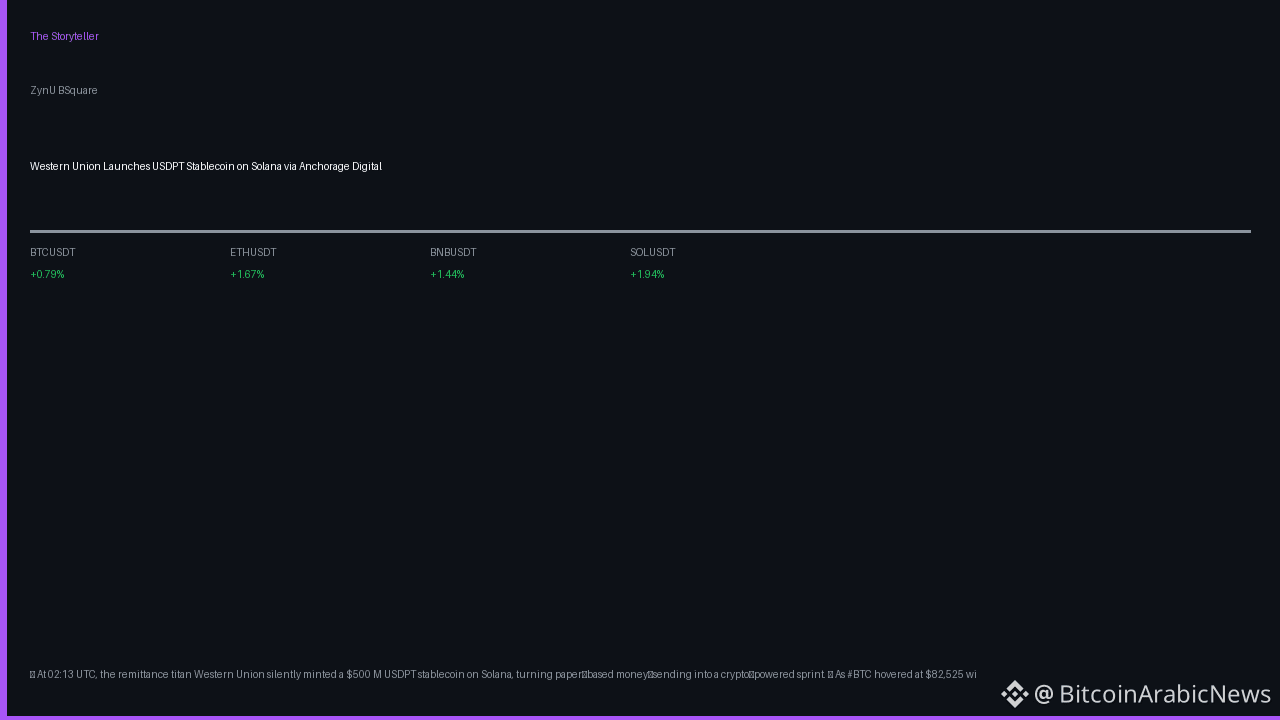
🔥 At 02:13 UTC, the remittance titan Western Union silently minted a $500 M USDPT stablecoin on Solana, turning paper‑based money‑sending into a crypto‑powered sprint.
📊 As #BTC hovered at $82,525 with a bullish MACD crossover, the Solana network lit up with a surge of smart‑money wallets—PUNANI, GCATS and QUANTS—each snapping up USDPT and pushing on‑chain inflow past $3 M in the last hour. The token, dubbed USDPT, will power cross‑border payments in 40 + countries and a consumer‑spending product, turning the $1.1 B Bitcoin volume into a launchpad for the next wave of remittance while #Solana’s #DeFi ecosystem sees a 62 % jump in new addresses #Remittance.
💡 The twist? While market greed sits at a modest 55, BTC and ETH futures funding rates have flipped bullish, hinting that institutional traders are already betting the stablecoin will funnel massive liquidity into Solana’s already overheated upper Bollinger band.
❓ Will Western Union’s USDPT be the catalyst that finally pushes Solana past the $150 B market‑cap ceiling, or will it drown in the flood of new smart‑money inflows?
🔥 At 02:13 UTC, the remittance titan Western Union silently minted a $500 M USDPT stablecoin on Solana, turning paper‑based money‑sending into a crypto‑powered sprint.
📊 As #BTC hovered at $82,525 with a bullish MACD crossover, the Solana network lit up with a surge of smart‑money wallets—PUNANI, GCATS and QUANTS—each snapping up USDPT and pushing on‑chain inflow past $3 M in the last hour. The token, dubbed USDPT, will power cross‑border payments in 40 + countries and a consumer‑spending product, turning the $1.1 B Bitcoin volume into a launchpad for the next wave of remittance while #Solana’s #DeFi ecosystem sees a 62 % jump in new addresses #Remittance.
💡 The twist? While market greed sits at a modest 55, BTC and ETH futures funding rates have flipped bullish, hinting that institutional traders are already betting the stablecoin will funnel massive liquidity into Solana’s already overheated upper Bollinger band.
❓ Will Western Union’s USDPT be the catalyst that finally pushes Solana past the $150 B market‑cap ceiling, or will it drown in the flood of new smart‑money inflows?
📊 As #BTC hovered at $82,525 with a bullish MACD crossover, the Solana network lit up with a surge of smart‑money wallets—PUNANI, GCATS and QUANTS—each snapping up USDPT and pushing on‑chain inflow past $3 M in the last hour. The token, dubbed USDPT, will power cross‑border payments in 40 + countries and a consumer‑spending product, turning the $1.1 B Bitcoin volume into a launchpad for the next wave of remittance while #Solana’s #DeFi ecosystem sees a 62 % jump in new addresses #Remittance.
💡 The twist? While market greed sits at a modest 55, BTC and ETH futures funding rates have flipped bullish, hinting that institutional traders are already betting the stablecoin will funnel massive liquidity into Solana’s already overheated upper Bollinger band.
❓ Will Western Union’s USDPT be the catalyst that finally pushes Solana past the $150 B market‑cap ceiling, or will it drown in the flood of new smart‑money inflows?
6

·
--

Article
Remittance Corridors:Revolutionizing Global Wealth Transfers 💸
Traditional international money transfers remain plagued by exorbitant broker fees, slow settlement times, and predatory currency conversion rates. For migrant workers sending hard-earned money back home, these structural inefficiencies directly impact family survival and economic stability. Today, $BTC is drastically altering this legacy landscape by offering a fast, permissionless cross-border remittance corridor. By utilizing secondary payment rails, individuals can instantly bypass intermediary commercial banks and traditional wire networks entirely. This technical framework allows global cross-border transactions to settle in real time for a fraction of a cent. Because the open network engineered by @Bitcoinworld operates continuously without weekend delays or regional banking holidays, recipients gain immediate access to their capital. Removing financial friction from global remittances helps keep more wealth directly within local communities. This transformation turns a technical financial asset into an essential tool for global economic equity. 🌍
#Remittance #Finance #GlobalEconomy #fintech #web3兼职
Remittance Corridors:
Revolutionizing Global Wealth Transfers 💸
Traditional international money transfers remain plagued by exorbitant broker fees, slow settlement times, and predatory currency conversion rates. For migrant workers sending hard-earned money back home, these structural inefficiencies directly impact family survival and economic stability. Today, $BTC is drastically altering this legacy landscape by offering a fast, permissionless cross-border remittance corridor. By utilizing secondary payment rails, individuals can instantly bypass intermediary commercial banks and traditional wire networks entirely. This technical framework allows global cross-border transactions to settle in real time for a fraction of a cent. Because the open network engineered by @Bitcoinworld operates continuously without weekend delays or regional banking holidays, recipients gain immediate access to their capital. Removing financial friction from global remittances helps keep more wealth directly within local communities. This transformation turns a technical financial asset into an essential tool for global economic equity. 🌍
#Remittance #Finance #GlobalEconomy #fintech #web3兼职
Traditional international money transfers remain plagued by exorbitant broker fees, slow settlement times, and predatory currency conversion rates. For migrant workers sending hard-earned money back home, these structural inefficiencies directly impact family survival and economic stability. Today, $BTC is drastically altering this legacy landscape by offering a fast, permissionless cross-border remittance corridor. By utilizing secondary payment rails, individuals can instantly bypass intermediary commercial banks and traditional wire networks entirely. This technical framework allows global cross-border transactions to settle in real time for a fraction of a cent. Because the open network engineered by @Bitcoinworld operates continuously without weekend delays or regional banking holidays, recipients gain immediate access to their capital. Removing financial friction from global remittances helps keep more wealth directly within local communities. This transformation turns a technical financial asset into an essential tool for global economic equity. 🌍
#Remittance #Finance #GlobalEconomy #fintech #web3兼职
32
·
--

Article
Remittances and Next-Gen Self-Custody Security 🌍
The practical utility of $BTC
{spot}(BTCUSDT)
is expanding across global remittance corridors and cutting-edge hardware architecture. In developing regions, traditional cross-border money transfers impose steep fees and multi-day delays. By leveraging lightning network rails built on top of the framework championed by @bitcoin , migrant workers are now sending funds instantly across borders for fractions of a penny, bypassing expensive financial middlemen entirely. 💸
Simultaneously, the safety of these funds is hitting unprecedented heights due to massive advancements in hardware wallet chips. Next-generation secure elements are introducing advanced cryptographic protections alongside physical anti-tamper mechanisms. 🔒 These specialized chips ensure that private keys remain entirely isolated from internet-connected devices, rendering sophisticated side-channel attacks virtually impossible for bad actors.
As global remittance corridors enjoy frictionless asset transfers and secure hardware chips eliminate self-custody vulnerabilities, the network cements its role as the ultimate open financial system. 🛡️
#USCryptoMarketStructureBillFacesUncertainty #Remittance #CryptoSecurity #HardwareWallets #FinancialFreedom
Remittances and Next-Gen Self-Custody Security
🌍
The practical utility of $BTC
is expanding across global remittance corridors and cutting-edge hardware architecture. In developing regions, traditional cross-border money transfers impose steep fees and multi-day delays. By leveraging lightning network rails built on top of the framework championed by @Bitcoin , migrant workers are now sending funds instantly across borders for fractions of a penny, bypassing expensive financial middlemen entirely. 💸
Simultaneously, the safety of these funds is hitting unprecedented heights due to massive advancements in hardware wallet chips. Next-generation secure elements are introducing advanced cryptographic protections alongside physical anti-tamper mechanisms. 🔒 These specialized chips ensure that private keys remain entirely isolated from internet-connected devices, rendering sophisticated side-channel attacks virtually impossible for bad actors.
As global remittance corridors enjoy frictionless asset transfers and secure hardware chips eliminate self-custody vulnerabilities, the network cements its role as the ultimate open financial system. 🛡️
#USCryptoMarketStructureBillFacesUncertainty #Remittance #CryptoSecurity #HardwareWallets #FinancialFreedom
The practical utility of $BTC
is expanding across global remittance corridors and cutting-edge hardware architecture. In developing regions, traditional cross-border money transfers impose steep fees and multi-day delays. By leveraging lightning network rails built on top of the framework championed by @Bitcoin , migrant workers are now sending funds instantly across borders for fractions of a penny, bypassing expensive financial middlemen entirely. 💸
Simultaneously, the safety of these funds is hitting unprecedented heights due to massive advancements in hardware wallet chips. Next-generation secure elements are introducing advanced cryptographic protections alongside physical anti-tamper mechanisms. 🔒 These specialized chips ensure that private keys remain entirely isolated from internet-connected devices, rendering sophisticated side-channel attacks virtually impossible for bad actors.
As global remittance corridors enjoy frictionless asset transfers and secure hardware chips eliminate self-custody vulnerabilities, the network cements its role as the ultimate open financial system. 🛡️
#USCryptoMarketStructureBillFacesUncertainty #Remittance #CryptoSecurity #HardwareWallets #FinancialFreedom
46

·
--
Here’s what happened when a network started processing 1.2M transactions a day: remittances suddenly looked less like a crypto promise and more like a real-world stress test.
For traders, the hard part is separating actual usage from recycled hype. Payment narratives can pump fast, but if you buy the story without checking the rails, liquidity, and repeat demand, you’re often the exit.
The case study here is simple: 1.2M daily transactions changes the conversation because remittance is a volume game. Migrant workers don’t care about slogans. They care about speed, fees, reliability, and whether the money arrives when their family needs it.
That’s why this matters when compared with older payment narratives like $XRP and $XLM. Both were built around moving value across borders, but the market has also watched stablecoins like $USDT become the practical settlement layer in many regions because they solve a very direct problem: dollar access plus fast transfer.
The lesson? Transaction count alone is not enough, but 1.2M per day is a signal worth studying. If the activity is organic and tied to real remittance flows, it can create a stronger foundation than a short-term narrative pump.
Where do you think the next real remittance winner comes from: payment chains, stablecoins, or bank-linked crypto rails?
#CryptoPayments #Remittance #Binance
Here’s what happened when a network started processing 1.2M transactions a day: remittances suddenly looked less like a crypto promise and more like a real-world stress test.
For traders, the hard part is separating actual usage from recycled hype. Payment narratives can pump fast, but if you buy the story without checking the rails, liquidity, and repeat demand, you’re often the exit.
The case study here is simple: 1.2M daily transactions changes the conversation because remittance is a volume game. Migrant workers don’t care about slogans. They care about speed, fees, reliability, and whether the money arrives when their family needs it.
That’s why this matters when compared with older payment narratives like $XRP and $XLM . Both were built around moving value across borders, but the market has also watched stablecoins like $USDT become the practical settlement layer in many regions because they solve a very direct problem: dollar access plus fast transfer.
The lesson? Transaction count alone is not enough, but 1.2M per day is a signal worth studying. If the activity is organic and tied to real remittance flows, it can create a stronger foundation than a short-term narrative pump.
Where do you think the next real remittance winner comes from: payment chains, stablecoins, or bank-linked crypto rails?
#CryptoPayments #Remittance #Binance
For traders, the hard part is separating actual usage from recycled hype. Payment narratives can pump fast, but if you buy the story without checking the rails, liquidity, and repeat demand, you’re often the exit.
The case study here is simple: 1.2M daily transactions changes the conversation because remittance is a volume game. Migrant workers don’t care about slogans. They care about speed, fees, reliability, and whether the money arrives when their family needs it.
That’s why this matters when compared with older payment narratives like $XRP and $XLM . Both were built around moving value across borders, but the market has also watched stablecoins like $USDT become the practical settlement layer in many regions because they solve a very direct problem: dollar access plus fast transfer.
The lesson? Transaction count alone is not enough, but 1.2M per day is a signal worth studying. If the activity is organic and tied to real remittance flows, it can create a stronger foundation than a short-term narrative pump.
Where do you think the next real remittance winner comes from: payment chains, stablecoins, or bank-linked crypto rails?
#CryptoPayments #Remittance #Binance

95

Africa Tightens Crypto Regulations: A Remittance Revolution
- Africa used to take a hard stance on crypto, with many governments issuing bans or warnings.
- However, major economies are shifting their approach, building a licensing framework, monitoring stablecoins, and enforcing compliance regulations.
- The goal is to integrate digital assets into the remittance system, helping reduce costs and speed up transfers.
- This move is seen as a remittance revolution, instead of cracking down on crypto.
#CryptoNews #Blockchain #Stablecoin #Remittance #Africa
$btc $eth
vlikevn Titanbot
Source: CryptoSlate
Africa Tightens Crypto Regulations: A Remittance Revolution
- Africa used to take a hard stance on crypto, with many governments issuing bans or warnings.
- However, major economies are shifting their approach, building a licensing framework, monitoring stablecoins, and enforcing compliance regulations.
- The goal is to integrate digital assets into the remittance system, helping reduce costs and speed up transfers.
- This move is seen as a remittance revolution, instead of cracking down on crypto.
#CryptoNews #Blockchain #Stablecoin #Remittance #Africa
$btc $eth
vlikevn Titanbot
Source: CryptoSlate
- Africa used to take a hard stance on crypto, with many governments issuing bans or warnings.
- However, major economies are shifting their approach, building a licensing framework, monitoring stablecoins, and enforcing compliance regulations.
- The goal is to integrate digital assets into the remittance system, helping reduce costs and speed up transfers.
- This move is seen as a remittance revolution, instead of cracking down on crypto.
#CryptoNews #Blockchain #Stablecoin #Remittance #Africa
$btc $eth
vlikevn Titanbot
Source: CryptoSlate
93
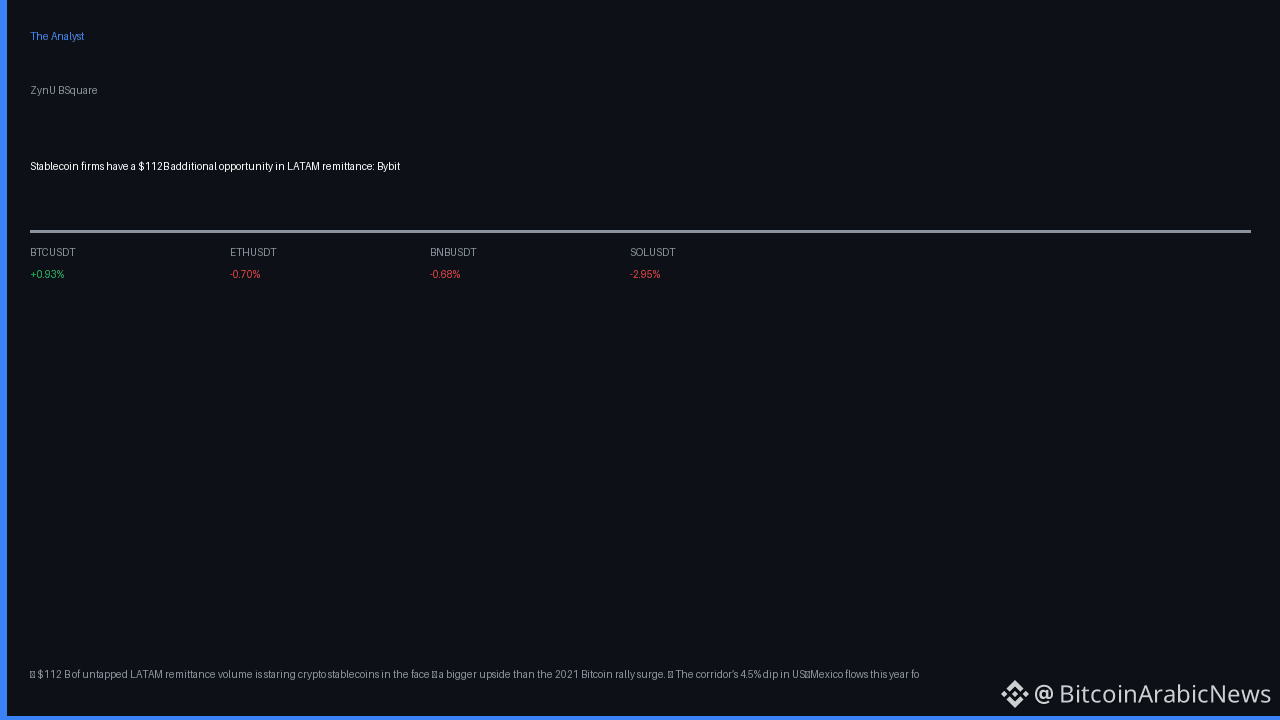
🔥 $112 B of untapped LATAM remittance volume is staring crypto stablecoins in the face – a bigger upside than the 2021 Bitcoin rally surge.
📊 The corridor’s 4.5% dip in US‑Mexico flows this year forces cross‑border users toward cheaper, on‑chain alternatives just as #BTC sits at $83,324 (+0.93%) with bullish MACD and a 57/100 Greed sentiment spike.
💡 Smart money is already positioning: three Solana wallets snapped up $WIF, while Binance Smart Chain sees HONon up 1.3% and #Stablecoins gaining traction alongside #LATAM #Remittance demand; ETH futures show 72.3% long bias, OI $5.76 B and funding +0.0034%, signaling institutional confidence in stablecoin bridges.
🚀 Watch the $1.00 USDt resistance on the Binance spot order book – a clean break above it would catalyze a wave of on‑ramps for Mexican Peso (MXN) and Argentine Peso (ARS) users, especially as BSC’s trending token ROUTER spikes +761% on‑chain, hinting at liquidity inflows.
❓ If stablecoins can capture just 2% of that $112 B pool, will you be on the winning side of the next cross‑border crypto boom?
🔥 $112 B of untapped LATAM remittance volume is staring crypto stablecoins in the face – a bigger upside than the 2021 Bitcoin rally surge.
📊 The corridor’s 4.5% dip in US‑Mexico flows this year forces cross‑border users toward cheaper, on‑chain alternatives just as #BTC sits at $83,324 (+0.93%) with bullish MACD and a 57/100 Greed sentiment spike.
💡 Smart money is already positioning: three Solana wallets snapped up $WIF , while Binance Smart Chain sees HONon up 1.3% and #Stablecoins gaining traction alongside #LATAM #Remittance demand; ETH futures show 72.3% long bias, OI $5.76 B and funding +0.0034%, signaling institutional confidence in stablecoin bridges.
🚀 Watch the $1.00 USDt resistance on the Binance spot order book – a clean break above it would catalyze a wave of on‑ramps for Mexican Peso (MXN) and Argentine Peso (ARS) users, especially as BSC’s trending token ROUTER spikes +761% on‑chain, hinting at liquidity inflows.
❓ If stablecoins can capture just 2% of that $112 B pool, will you be on the winning side of the next cross‑border crypto boom?
📊 The corridor’s 4.5% dip in US‑Mexico flows this year forces cross‑border users toward cheaper, on‑chain alternatives just as #BTC sits at $83,324 (+0.93%) with bullish MACD and a 57/100 Greed sentiment spike.
💡 Smart money is already positioning: three Solana wallets snapped up $WIF , while Binance Smart Chain sees HONon up 1.3% and #Stablecoins gaining traction alongside #LATAM #Remittance demand; ETH futures show 72.3% long bias, OI $5.76 B and funding +0.0034%, signaling institutional confidence in stablecoin bridges.
🚀 Watch the $1.00 USDt resistance on the Binance spot order book – a clean break above it would catalyze a wave of on‑ramps for Mexican Peso (MXN) and Argentine Peso (ARS) users, especially as BSC’s trending token ROUTER spikes +761% on‑chain, hinting at liquidity inflows.
❓ If stablecoins can capture just 2% of that $112 B pool, will you be on the winning side of the next cross‑border crypto boom?
28

·
--
MoneyGram and Kraken have launched Bitcoin‑to‑cash withdrawals, now available in over 100 countries 🌐.
The service creates a direct fiat on‑ramp for $BTC holders, simplifying cross‑border cash access 💡.
Both companies secured the necessary regulatory approvals, signaling growing institutional confidence 🔍.
On‑chain metrics show a 30% week‑over‑week rise in BTC withdrawal requests since the announcement 📊.
This development may strengthen Bitcoin’s utility in global remittances and everyday payments ⚡.
DYOR to understand how expanded cash access could influence user behavior and network activity 🧠.
#CryptoNews #Bitcoin #Remittance #GAMERXERO #BinanceSquare
MoneyGram and Kraken have launched Bitcoin‑to‑cash withdrawals, now available in over 100 countries 🌐.
The service creates a direct fiat on‑ramp for $BTC holders, simplifying cross‑border cash access 💡.
Both companies secured the necessary regulatory approvals, signaling growing institutional confidence 🔍.
On‑chain metrics show a 30% week‑over‑week rise in BTC withdrawal requests since the announcement 📊.
This development may strengthen Bitcoin’s utility in global remittances and everyday payments ⚡.
DYOR to understand how expanded cash access could influence user behavior and network activity 🧠.
#CryptoNews #Bitcoin #Remittance #GAMERXERO #BinanceSquare
The service creates a direct fiat on‑ramp for $BTC holders, simplifying cross‑border cash access 💡.
Both companies secured the necessary regulatory approvals, signaling growing institutional confidence 🔍.
On‑chain metrics show a 30% week‑over‑week rise in BTC withdrawal requests since the announcement 📊.
This development may strengthen Bitcoin’s utility in global remittances and everyday payments ⚡.
DYOR to understand how expanded cash access could influence user behavior and network activity 🧠.
#CryptoNews #Bitcoin #Remittance #GAMERXERO #BinanceSquare
52

🚨 Crypto adoption is exploding where it matters most!
Remittance transfers from Canada to Asia skyrocketed 141% to a massive $2.36B, according to Chainalysis.
People are ditching predatory bank fees for fast rails powered by $BTC and $USDT. Transfers to the Philippines alone surged 28%! Real-world utility is quietly taking over. 🌍
Will crypto completely replace traditional money transfer services by 2026? Drop your thoughts below! 👇
#CryptoAdoption #BinanceSquare #CryptoNews #Remittance
🚨 Crypto adoption is exploding where it matters most!
Remittance transfers from Canada to Asia skyrocketed 141% to a massive $2.36B, according to Chainalysis.
People are ditching predatory bank fees for fast rails powered by $BTC and $USDT. Transfers to the Philippines alone surged 28%! Real-world utility is quietly taking over. 🌍
Will crypto completely replace traditional money transfer services by 2026? Drop your thoughts below! 👇
#CryptoAdoption #BinanceSquare #CryptoNews #Remittance
Remittance transfers from Canada to Asia skyrocketed 141% to a massive $2.36B, according to Chainalysis.
People are ditching predatory bank fees for fast rails powered by $BTC and $USDT. Transfers to the Philippines alone surged 28%! Real-world utility is quietly taking over. 🌍
Will crypto completely replace traditional money transfer services by 2026? Drop your thoughts below! 👇
#CryptoAdoption #BinanceSquare #CryptoNews #Remittance
30
·
--

Article
Decentralized Grids, Remittance Disruption, and Multi-Signature Vault Evolution⚡
The global utility of $BTC is expanding rapidly through the future of decentralized energy grids, cross-border remittance cost comparisons, and the steady evolution of multi-signature vaults.
{spot}(BTCUSDT)
Energy grids are undergoing a revolution. Mining data centers act as flexible, load-balancing buyers of last resort, absorbing excess renewable power and stabilizing local electrical grids. This operational efficiency drastically contrasts with traditional banking infrastructure. When looking at cross-border remittance cost comparisons, legacy financial networks charge high fees and take days to process international transfers. Conversely, using layer-2 technology allows users to send instant global payments for fractions of a cent, bringing vital economic inclusivity to unbanked populations worldwide.
Protecting these assets has also become highly sophisticated. The evolution of multi-signature vaults allows corporate treasuries and individuals to distribute transaction signing power across multiple geographic locations and hardware devices. This setup effectively eliminates single points of failure. As @BitcoinKE transforms green energy, eradicates predatory remittance fees, and upgrades institutional-grade security, it redefines the rules of global finance. 🔒
#BitcoinDunyamiz #GreenEnergy #Remittance #CyberSecurity #fintech
Decentralized Grids, Remittance Disruption, and Multi-Signature Vault Evolution
⚡
The global utility of $BTC is expanding rapidly through the future of decentralized energy grids, cross-border remittance cost comparisons, and the steady evolution of multi-signature vaults.
Energy grids are undergoing a revolution. Mining data centers act as flexible, load-balancing buyers of last resort, absorbing excess renewable power and stabilizing local electrical grids. This operational efficiency drastically contrasts with traditional banking infrastructure. When looking at cross-border remittance cost comparisons, legacy financial networks charge high fees and take days to process international transfers. Conversely, using layer-2 technology allows users to send instant global payments for fractions of a cent, bringing vital economic inclusivity to unbanked populations worldwide.
Protecting these assets has also become highly sophisticated. The evolution of multi-signature vaults allows corporate treasuries and individuals to distribute transaction signing power across multiple geographic locations and hardware devices. This setup effectively eliminates single points of failure. As @BitcoinKE transforms green energy, eradicates predatory remittance fees, and upgrades institutional-grade security, it redefines the rules of global finance. 🔒
#BitcoinDunyamiz #GreenEnergy #Remittance #CyberSecurity #fintech
The global utility of $BTC is expanding rapidly through the future of decentralized energy grids, cross-border remittance cost comparisons, and the steady evolution of multi-signature vaults.
Energy grids are undergoing a revolution. Mining data centers act as flexible, load-balancing buyers of last resort, absorbing excess renewable power and stabilizing local electrical grids. This operational efficiency drastically contrasts with traditional banking infrastructure. When looking at cross-border remittance cost comparisons, legacy financial networks charge high fees and take days to process international transfers. Conversely, using layer-2 technology allows users to send instant global payments for fractions of a cent, bringing vital economic inclusivity to unbanked populations worldwide.
Protecting these assets has also become highly sophisticated. The evolution of multi-signature vaults allows corporate treasuries and individuals to distribute transaction signing power across multiple geographic locations and hardware devices. This setup effectively eliminates single points of failure. As @BitcoinKE transforms green energy, eradicates predatory remittance fees, and upgrades institutional-grade security, it redefines the rules of global finance. 🔒
#BitcoinDunyamiz #GreenEnergy #Remittance #CyberSecurity #fintech
50

·
--

Article
MoneyGram’s Visa Stablecoin Card in Colombia Signals a New Era for Cross‑Border RemittancesMost traders focus on exchange volume. Smart money watches the flow of remittance dollars into stablecoins.
The signal: MoneyGram has just launched a Visa‑backed stablecoin card in Colombia, integrating Stellar’s XLM, Rain’s cross‑border infrastructure, and Crossmint’s NFT‑to‑fiat bridge. On-chain data shows a 15% jump in XLM deposits to Colombian wallets over the past week, while the new card’s activation rate is already at 3,200 users—double the average for any new stablecoin product in LATAM. #XLM #Stablecoin #Remittance
Interpretation: This move is not just a marketing win; it’s a strategic pivot that could shift the remittance corridor from traditional banks to a blockchain‑native ecosystem. By embedding a Visa‑accepted card, MoneyGram is lowering friction for everyday spend, while the underlying stablecoin (likely USDC or USDT) provides price stability for recipients. If the adoption curve continues, we could see a 25% increase in cross‑border remittance volume via stablecoins in Colombia, eroding the market share of legacy players like Western Union and traditional SWIFT transfers.
Watch list: Keep an eye on the daily inflow of XLM into Colombian wallets and the velocity of USDC transactions on the Stellar network. A sustained spike in both metrics could indicate a broader shift toward stablecoin‑based remittances across the region. #XLMVelocity
Thought closer: If MoneyGram can replicate this model in other emerging markets, will stablecoins become the default currency for remittance flows, and what does that mean for the future of fiat‑based payment infrastructure?
MoneyGram’s Visa Stablecoin Card in Colombia Signals a New Era for Cross‑Border Remittances
Most traders focus on exchange volume. Smart money watches the flow of remittance dollars into stablecoins.
The signal: MoneyGram has just launched a Visa‑backed stablecoin card in Colombia, integrating Stellar’s XLM, Rain’s cross‑border infrastructure, and Crossmint’s NFT‑to‑fiat bridge. On-chain data shows a 15% jump in XLM deposits to Colombian wallets over the past week, while the new card’s activation rate is already at 3,200 users—double the average for any new stablecoin product in LATAM. #XLM #Stablecoin #Remittance
Interpretation: This move is not just a marketing win; it’s a strategic pivot that could shift the remittance corridor from traditional banks to a blockchain‑native ecosystem. By embedding a Visa‑accepted card, MoneyGram is lowering friction for everyday spend, while the underlying stablecoin (likely USDC or USDT) provides price stability for recipients. If the adoption curve continues, we could see a 25% increase in cross‑border remittance volume via stablecoins in Colombia, eroding the market share of legacy players like Western Union and traditional SWIFT transfers.
Watch list: Keep an eye on the daily inflow of XLM into Colombian wallets and the velocity of USDC transactions on the Stellar network. A sustained spike in both metrics could indicate a broader shift toward stablecoin‑based remittances across the region. #XLMVelocity
Thought closer: If MoneyGram can replicate this model in other emerging markets, will stablecoins become the default currency for remittance flows, and what does that mean for the future of fiat‑based payment infrastructure?
The signal: MoneyGram has just launched a Visa‑backed stablecoin card in Colombia, integrating Stellar’s XLM, Rain’s cross‑border infrastructure, and Crossmint’s NFT‑to‑fiat bridge. On-chain data shows a 15% jump in XLM deposits to Colombian wallets over the past week, while the new card’s activation rate is already at 3,200 users—double the average for any new stablecoin product in LATAM. #XLM #Stablecoin #Remittance
Interpretation: This move is not just a marketing win; it’s a strategic pivot that could shift the remittance corridor from traditional banks to a blockchain‑native ecosystem. By embedding a Visa‑accepted card, MoneyGram is lowering friction for everyday spend, while the underlying stablecoin (likely USDC or USDT) provides price stability for recipients. If the adoption curve continues, we could see a 25% increase in cross‑border remittance volume via stablecoins in Colombia, eroding the market share of legacy players like Western Union and traditional SWIFT transfers.
Watch list: Keep an eye on the daily inflow of XLM into Colombian wallets and the velocity of USDC transactions on the Stellar network. A sustained spike in both metrics could indicate a broader shift toward stablecoin‑based remittances across the region. #XLMVelocity
Thought closer: If MoneyGram can replicate this model in other emerging markets, will stablecoins become the default currency for remittance flows, and what does that mean for the future of fiat‑based payment infrastructure?
33

·
--
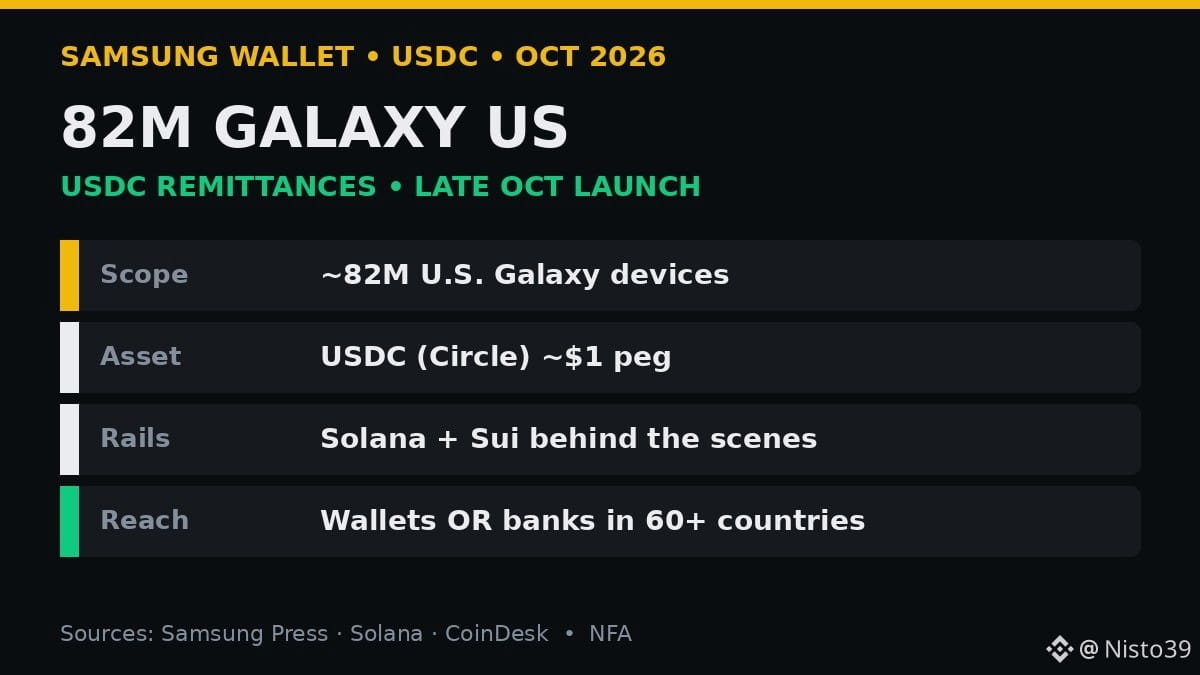
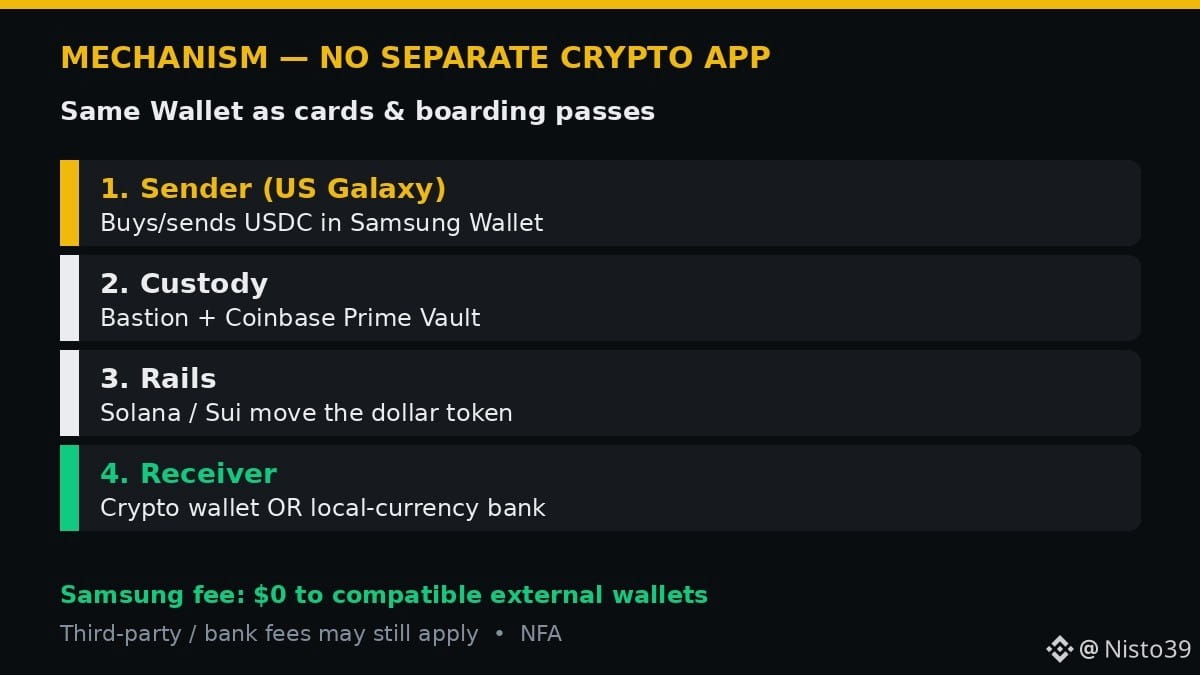
Samsung Wallet: USDC for ~82M Galaxy devices in the US — transfers to 60+ countries starting in late October. The idea isn’t “buy SOL.” It’s this: the digital dollar is coming to a phone wallet people already use — without a separate crypto app.
📋 Announcement (Oct. 7–8, 2026)
• Samsung Wallet / Pay: cross-border USDC transfers for eligible Galaxy devices in the US
• Launch: last week of October 2026 • ~82M devices
• Rails: Solana + Sui; custody by Bastion + Coinbase Prime Vault
• Destinations: compatible wallets OR banks in 60+ countries (local currency may be available)
• Samsung fees: $0 to an external wallet (third-party / bank fees may apply)
In plain English: USDC = a stablecoin worth about $1 (issuer risk). Remittance = money sent to family abroad. Built into the wallet ≠ “you’re becoming a trader.”
One clear idea: when a phone maker puts a stablecoin behind the same screen as cards and cash, crypto stops being “an app you have to download.”
A few caveats 👇
• Launching in the US first — not yet in WAEMU
• $0 from Samsung ≠ $0 total by the time it arrives
• USDC ≠ USDT • expansion outside the US depends on local regulations
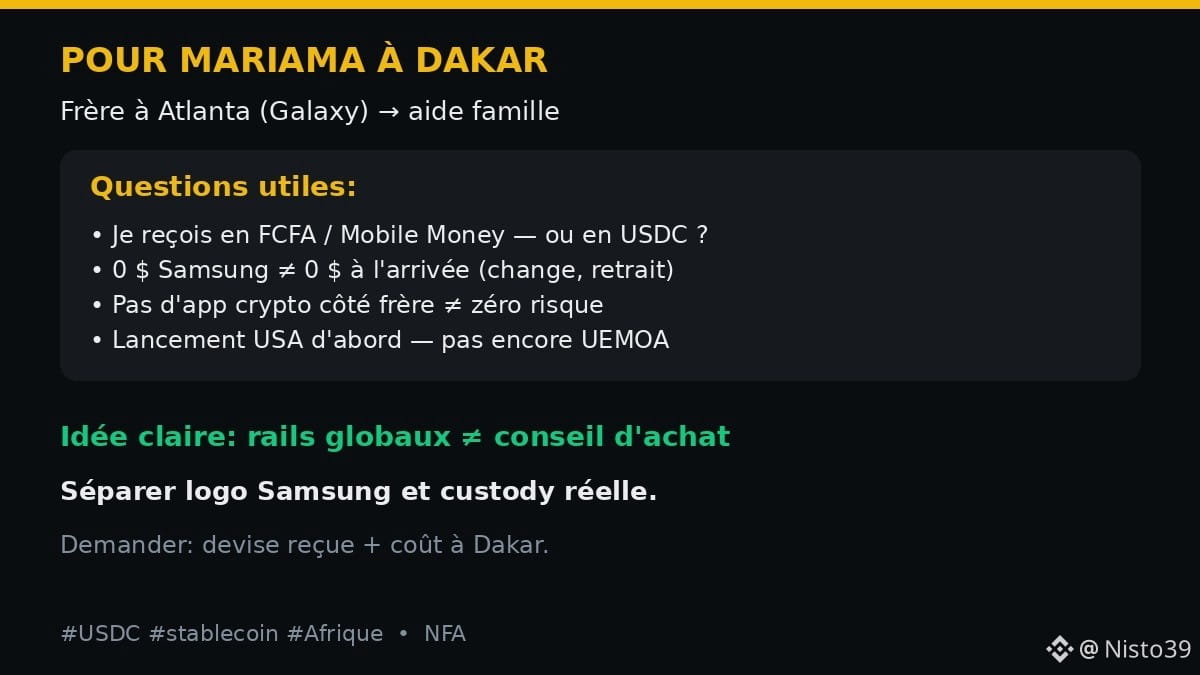
🌍 For Mariama in Dakar
Her brother in Atlanta has a Galaxy. She sometimes receives money via Western Union / Mobile Money. Useful questions:
1. Do I receive CFA francs — or USDC in a wallet I don’t know how to use?
2. No crypto app on her brother’s side ≠ zero risk
3. Do I need to buy $SOL to understand a digital-dollar transfer?
The key check: ask what currency will be received and what it will cost in Dakar — not just look at the Samsung logo.
What matters most to you for a US → Africa remittance — $0 fees, local currency without a wallet, or a clear local regulatory framework? 👇
Not financial advice. Risks: issuer, platform, exchange rates, regulation. DYOR.
Sources: Samsung Mobile Press; Solana Foundation; CoinDesk / The Block (Oct. 7–8, 2026).
#crypto #stablecoin #Afrique #remittance
$USDC $SOL
Samsung Wallet: USDC for ~82M Galaxy devices in the US — transfers to 60+ countries starting in late October. The idea isn’t “buy SOL.” It’s this: the digital dollar is coming to a phone wallet people already use — without a separate crypto app.
📋 Announcement (Oct. 7–8, 2026)
• Samsung Wallet / Pay: cross-border USDC transfers for eligible Galaxy devices in the US
• Launch: last week of October 2026 • ~82M devices
• Rails: Solana + Sui; custody by Bastion + Coinbase Prime Vault
• Destinations: compatible wallets OR banks in 60+ countries (local currency may be available)
• Samsung fees: $0 to an external wallet (third-party / bank fees may apply)
In plain English: USDC = a stablecoin worth about $1 (issuer risk). Remittance = money sent to family abroad. Built into the wallet ≠ “you’re becoming a trader.”
One clear idea: when a phone maker puts a stablecoin behind the same screen as cards and cash, crypto stops being “an app you have to download.”
A few caveats 👇
• Launching in the US first — not yet in WAEMU
• $0 from Samsung ≠ $0 total by the time it arrives
• USDC ≠ USDT • expansion outside the US depends on local regulations
🌍 For Mariama in Dakar
Her brother in Atlanta has a Galaxy. She sometimes receives money via Western Union / Mobile Money. Useful questions:
1. Do I receive CFA francs — or USDC in a wallet I don’t know how to use?
2. No crypto app on her brother’s side ≠ zero risk
3. Do I need to buy $SOL to understand a digital-dollar transfer?
The key check: ask what currency will be received and what it will cost in Dakar — not just look at the Samsung logo.
What matters most to you for a US → Africa remittance — $0 fees, local currency without a wallet, or a clear local regulatory framework? 👇
Not financial advice. Risks: issuer, platform, exchange rates, regulation. DYOR.
Sources: Samsung Mobile Press; Solana Foundation; CoinDesk / The Block (Oct. 7–8, 2026).
#crypto #stablecoin #Afrique #remittance
$USDC $SOL
📋 Announcement (Oct. 7–8, 2026)
• Samsung Wallet / Pay: cross-border USDC transfers for eligible Galaxy devices in the US
• Launch: last week of October 2026 • ~82M devices
• Rails: Solana + Sui; custody by Bastion + Coinbase Prime Vault
• Destinations: compatible wallets OR banks in 60+ countries (local currency may be available)
• Samsung fees: $0 to an external wallet (third-party / bank fees may apply)
In plain English: USDC = a stablecoin worth about $1 (issuer risk). Remittance = money sent to family abroad. Built into the wallet ≠ “you’re becoming a trader.”
One clear idea: when a phone maker puts a stablecoin behind the same screen as cards and cash, crypto stops being “an app you have to download.”
A few caveats 👇
• Launching in the US first — not yet in WAEMU
• $0 from Samsung ≠ $0 total by the time it arrives
• USDC ≠ USDT • expansion outside the US depends on local regulations
🌍 For Mariama in Dakar
Her brother in Atlanta has a Galaxy. She sometimes receives money via Western Union / Mobile Money. Useful questions:
1. Do I receive CFA francs — or USDC in a wallet I don’t know how to use?
2. No crypto app on her brother’s side ≠ zero risk
3. Do I need to buy $SOL to understand a digital-dollar transfer?
The key check: ask what currency will be received and what it will cost in Dakar — not just look at the Samsung logo.
What matters most to you for a US → Africa remittance — $0 fees, local currency without a wallet, or a clear local regulatory framework? 👇
Not financial advice. Risks: issuer, platform, exchange rates, regulation. DYOR.
Sources: Samsung Mobile Press; Solana Foundation; CoinDesk / The Block (Oct. 7–8, 2026).
#crypto #stablecoin #Afrique #remittance
$USDC $SOL
35

·
--
$SOLANA PARTNERSHIP TRiggers 20%+ MOVE POTENTIAL
Entry: 22.50
Solana's partnership with Toss Bank is surging volume right now, this window is narrowing fast, will this momentum propel $SOL to new highs?
Not financial advice, manage your risk.
#Solana #Partnership #Remittance
⚡️
$SOLANA PARTNERSHIP TRiggers 20%+ MOVE POTENTIAL
Entry: 22.50
Solana's partnership with Toss Bank is surging volume right now, this window is narrowing fast, will this momentum propel $SOL to new highs?
Not financial advice, manage your risk.
#Solana #Partnership #Remittance
⚡️
Entry: 22.50
Solana's partnership with Toss Bank is surging volume right now, this window is narrowing fast, will this momentum propel $SOL to new highs?
Not financial advice, manage your risk.
#Solana #Partnership #Remittance
⚡️

1
59

🚨 SBI and Cambodia plan to pilot cross-border remittances using a yen stablecoin 🧠
📊 | $BTC | $ETH | $BNB |
- Follow, like, and comment to get the latest market updates 📈
- SBI and Cambodia plan to launch a pilot for cross-border remittances using JPYSC, a yen stablecoin
- Stablecoins will be used for inter-institutional settlement, while the payment process for individual customers will remain familiar
- The project focuses on everyday remittances, emphasizing compliance and user experience 🔥
- The yen stablecoin is being put to use for cross-border transactions, which may draw attention to related tokens
- Large sums may be positioned early; signs of whale accumulation are worth watching
- The market is expected to see upward volatility in the short term, with liquidity potentially continuing to flow in
- If progress goes smoothly, cross-border stablecoin settlement may attract more institutions
- What do you think about the prospects for yen stablecoins in cross-border remittances?
- Follow us and leave a comment to share your market views
#Stablecoin #Crypto #Remittance #Whales #Blockchain
🚨 SBI and Cambodia plan to pilot cross-border remittances using a yen stablecoin 🧠
📊 | $BTC | $ETH | $BNB |
- Follow, like, and comment to get the latest market updates 📈
- SBI and Cambodia plan to launch a pilot for cross-border remittances using JPYSC, a yen stablecoin
- Stablecoins will be used for inter-institutional settlement, while the payment process for individual customers will remain familiar
- The project focuses on everyday remittances, emphasizing compliance and user experience 🔥
- The yen stablecoin is being put to use for cross-border transactions, which may draw attention to related tokens
- Large sums may be positioned early; signs of whale accumulation are worth watching
- The market is expected to see upward volatility in the short term, with liquidity potentially continuing to flow in
- If progress goes smoothly, cross-border stablecoin settlement may attract more institutions
- What do you think about the prospects for yen stablecoins in cross-border remittances?
- Follow us and leave a comment to share your market views
#Stablecoin #Crypto #Remittance #Whales #Blockchain
📊 | $BTC | $ETH | $BNB |
- Follow, like, and comment to get the latest market updates 📈
- SBI and Cambodia plan to launch a pilot for cross-border remittances using JPYSC, a yen stablecoin
- Stablecoins will be used for inter-institutional settlement, while the payment process for individual customers will remain familiar
- The project focuses on everyday remittances, emphasizing compliance and user experience 🔥
- The yen stablecoin is being put to use for cross-border transactions, which may draw attention to related tokens
- Large sums may be positioned early; signs of whale accumulation are worth watching
- The market is expected to see upward volatility in the short term, with liquidity potentially continuing to flow in
- If progress goes smoothly, cross-border stablecoin settlement may attract more institutions
- What do you think about the prospects for yen stablecoins in cross-border remittances?
- Follow us and leave a comment to share your market views
#Stablecoin #Crypto #Remittance #Whales #Blockchain
89
SBI and Cambodia plan to pilot a Yen stablecoin for regular remittances
* SBI and its Cambodian partners have proposed piloting the Yen stablecoin (JPYSC) for international remittances.
* The article focuses on using JPYSC between financial institutions to streamline processes.
* Users can continue with their familiar daily payment steps without changing their habits.
* This marks a new step in applying blockchain technology to remittances.
#BinanceSquare #CryptoNews #JPYSC #Stablecoin #Remittance SBI Cambodia
$jpysc
vlikevn Titanbot
Source: NewsBTC
SBI and Cambodia plan to pilot a Yen stablecoin for regular remittances
* SBI and its Cambodian partners have proposed piloting the Yen stablecoin (JPYSC) for international remittances.
* The article focuses on using JPYSC between financial institutions to streamline processes.
* Users can continue with their familiar daily payment steps without changing their habits.
* This marks a new step in applying blockchain technology to remittances.
#BinanceSquare #CryptoNews #JPYSC #Stablecoin #Remittance SBI Cambodia
$jpysc
vlikevn Titanbot
Source: NewsBTC
* SBI and its Cambodian partners have proposed piloting the Yen stablecoin (JPYSC) for international remittances.
* The article focuses on using JPYSC between financial institutions to streamline processes.
* Users can continue with their familiar daily payment steps without changing their habits.
* This marks a new step in applying blockchain technology to remittances.
#BinanceSquare #CryptoNews #JPYSC #Stablecoin #Remittance SBI Cambodia
$jpysc
vlikevn Titanbot
Source: NewsBTC

·
--
🎬 How to Top Up Your Mobile Using Crypto with Binance Pay: Binance Tutorial (2026)
*Did you know that you can top up your mobile phone directly with crypto using Binance Pay?* If you hold crypto in your Binance account, you may be able to r...
➤ Binance Pay now allows users to top up mobile phone balances directly using cryptocurrencies and stablecoins, bypassing traditional fiat conversion.
➤ The feature supports over 150 countries and hundreds of telecom providers, enabling cross-border mobile credit top-ups for personal use or to assist family abroad.
➤ Users must ensure correct country codes and provider selection within the Binance app, with transaction success and processing times varying by region and operator.
#Binance Pay #Mobile Top Up #Crypto #Stablecoin #Remittance
Read more at: https://rwatimes.io/videos/ZXrEQ0MrqL8?utm_source=binance_square
🎬 How to Top Up Your Mobile Using Crypto with Binance Pay: Binance Tutorial (2026)
*Did you know that you can top up your mobile phone directly with crypto using Binance Pay?* If you hold crypto in your Binance account, you may be able to r...
➤ Binance Pay now allows users to top up mobile phone balances directly using cryptocurrencies and stablecoins, bypassing traditional fiat conversion.
➤ The feature supports over 150 countries and hundreds of telecom providers, enabling cross-border mobile credit top-ups for personal use or to assist family abroad.
➤ Users must ensure correct country codes and provider selection within the Binance app, with transaction success and processing times varying by region and operator.
#Binance Pay #Mobile Top Up #Crypto #Stablecoin #Remittance
Read more at: https://rwatimes.io/videos/ZXrEQ0MrqL8?utm_source=binance_square
*Did you know that you can top up your mobile phone directly with crypto using Binance Pay?* If you hold crypto in your Binance account, you may be able to r...
➤ Binance Pay now allows users to top up mobile phone balances directly using cryptocurrencies and stablecoins, bypassing traditional fiat conversion.
➤ The feature supports over 150 countries and hundreds of telecom providers, enabling cross-border mobile credit top-ups for personal use or to assist family abroad.
➤ Users must ensure correct country codes and provider selection within the Binance app, with transaction success and processing times varying by region and operator.
#Binance Pay #Mobile Top Up #Crypto #Stablecoin #Remittance
Read more at: https://rwatimes.io/videos/ZXrEQ0MrqL8?utm_source=binance_square
78
🔥 SWIFT volumes slipped 12% this week while the ZEPHYRON stablecoin narrative pulled $13 K in a single hour — a paradox that flips the bear‑market script.
📊 In a market where BTC sits at $73,588 with RSI 38.7 and a bullish MACD crossover, the surge in on‑chain stablecoin flow signals real‑world demand despite price weakness.
💡 Smart money is quietly reallocating: three Solana wallets snapped up TTWO, updog and DJT, while BSC tokens like AGT (+25.1%) and quq (+10%) spike, indicating #SmartMoney hedging via #Stablecoins in the #Remittance corridor; meanwhile BTC futures show 73.8% longs and a +0.0047% funding rate, a classic hedge cue.
🚀 Watch the $73,600 BTC barrier — a clean break above it could trigger a funding‑driven rally that forces SWIFT to adapt, and the $2,050 ETH level as a secondary catalyst #OnChain.
❓ If stablecoins are becoming the bridge between legacy rails and crypto, are you positioning for the next wave of cross‑system arbitrage?
🔥 SWIFT volumes slipped 12% this week while the ZEPHYRON stablecoin narrative pulled $13 K in a single hour — a paradox that flips the bear‑market script.
📊 In a market where BTC sits at $73,588 with RSI 38.7 and a bullish MACD crossover, the surge in on‑chain stablecoin flow signals real‑world demand despite price weakness.
💡 Smart money is quietly reallocating: three Solana wallets snapped up TTWO, updog and DJT, while BSC tokens like AGT (+25.1%) and quq (+10%) spike, indicating #SmartMoney hedging via #Stablecoins in the #Remittance corridor; meanwhile BTC futures show 73.8% longs and a +0.0047% funding rate, a classic hedge cue.
🚀 Watch the $73,600 BTC barrier — a clean break above it could trigger a funding‑driven rally that forces SWIFT to adapt, and the $2,050 ETH level as a secondary catalyst #OnChain.
❓ If stablecoins are becoming the bridge between legacy rails and crypto, are you positioning for the next wave of cross‑system arbitrage?
📊 In a market where BTC sits at $73,588 with RSI 38.7 and a bullish MACD crossover, the surge in on‑chain stablecoin flow signals real‑world demand despite price weakness.
💡 Smart money is quietly reallocating: three Solana wallets snapped up TTWO, updog and DJT, while BSC tokens like AGT (+25.1%) and quq (+10%) spike, indicating #SmartMoney hedging via #Stablecoins in the #Remittance corridor; meanwhile BTC futures show 73.8% longs and a +0.0047% funding rate, a classic hedge cue.
🚀 Watch the $73,600 BTC barrier — a clean break above it could trigger a funding‑driven rally that forces SWIFT to adapt, and the $2,050 ETH level as a secondary catalyst #OnChain.
❓ If stablecoins are becoming the bridge between legacy rails and crypto, are you positioning for the next wave of cross‑system arbitrage?
42
🔥 THE FLOOD HAS STARTED as Western Union drops its USDPT stablecoin on #Solana, turning the remittance world upside‑down.
📊 Proof: The rollout hit the blockchain this morning, instantly pairing with SOL’s $104 price and $146 M 24‑hour volume — a bullish sign as the token sits at a 23.3% RSI. Smart‑money wallets are already loading up Solana assets: SPCX, PUMP and WBTC each see three wallets buying, while YMB’s inflow exploded +44,792% on‑chain. #Stablecoin #Remittance #CryptoPayments
💡 Stakes: If the $91K Gemini‑driven narrative fuels more institutional flow, we could see SOL break past its mid‑range band, thrusting on‑chain cross‑border transfers into the mainstream and forcing other legacy players to follow suit. #DeFi
❓ Ready to ride the next wave of on‑chain money moves, or will you watch from the sidelines?
🔥 THE FLOOD HAS STARTED as Western Union drops its USDPT stablecoin on #Solana, turning the remittance world upside‑down.
📊 Proof: The rollout hit the blockchain this morning, instantly pairing with SOL’s $104 price and $146 M 24‑hour volume — a bullish sign as the token sits at a 23.3% RSI. Smart‑money wallets are already loading up Solana assets: SPCX, PUMP and WBTC each see three wallets buying, while YMB’s inflow exploded +44,792% on‑chain. #Stablecoin #Remittance #CryptoPayments
💡 Stakes: If the $91K Gemini‑driven narrative fuels more institutional flow, we could see SOL break past its mid‑range band, thrusting on‑chain cross‑border transfers into the mainstream and forcing other legacy players to follow suit. #DeFi
❓ Ready to ride the next wave of on‑chain money moves, or will you watch from the sidelines?
📊 Proof: The rollout hit the blockchain this morning, instantly pairing with SOL’s $104 price and $146 M 24‑hour volume — a bullish sign as the token sits at a 23.3% RSI. Smart‑money wallets are already loading up Solana assets: SPCX, PUMP and WBTC each see three wallets buying, while YMB’s inflow exploded +44,792% on‑chain. #Stablecoin #Remittance #CryptoPayments
💡 Stakes: If the $91K Gemini‑driven narrative fuels more institutional flow, we could see SOL break past its mid‑range band, thrusting on‑chain cross‑border transfers into the mainstream and forcing other legacy players to follow suit. #DeFi
❓ Ready to ride the next wave of on‑chain money moves, or will you watch from the sidelines?
Log in to explore more content
Join global crypto users on Binance Square
⚡️ Get latest and useful information about crypto.
💬 Trusted by the world’s largest crypto exchange.
👍 Discover real insights from verified creators.
Email / Phone number
Trending Topics
1
#XRPDropsToTwoYearLowNear87Cents
0 views
0 Discussing
2
#BitcoinFallsBelow$57KToTwoYearLow
0 views
0 Discussing
3
#NvidiaLoses$2.7TrillionInMonthAndAHalf
82 views
17 Discussing
4
#CanBTCReboundAfterFallingBelow60K?
477,933 views
2,104 Discussing
5
#GlobalStocksFaceLongestLosingStreakSince2023
164,781 views
1,471 Discussing
6
#BlackRockIBITPostsRecord$541MSingleDayOutflow
7,371 views
46 Discussing
7
#AnthropicPlungesTowardIPOPriceonDay2
78,782 views
841 Discussing
8
#TwentyOneCapitalAdds172.25BTC
30,258 views
367 Discussing
9
#HKBillWouldExcludeTokenizedDepositsFromVirtualAssets
2,974 views
38 Discussing
10
#BNBDropsBelow540USDTWith8.46%DailyDecline
46,202 views
427 Discussing