
#spacex
spacex
6.7M views
10,855 Discussing
Hot
Latest

·
--
Bearish
$SPCX Market Update Today 🚀
SpaceX is gaining attention after its Starship successfully returned from orbit and was caught by the launch tower. The company is also expanding its AI data center plans, attracting investor interest. However, market weakness is affecting shares. Yahoo Finance +1
📉 Price Direction: Drifting down today as selling pressure increases.
{future}(SPCXUSDT)
#SPCX #SpaceX #Aİ #crypto #BinanceSquare
$SPCX Market Update Today 🚀
SpaceX is gaining attention after its Starship successfully returned from orbit and was caught by the launch tower. The company is also expanding its AI data center plans, attracting investor interest. However, market weakness is affecting shares. Yahoo Finance +1
📉 Price Direction: Drifting down today as selling pressure increases.
#SPCX #SpaceX #Aİ #crypto #BinanceSquare
SpaceX is gaining attention after its Starship successfully returned from orbit and was caught by the launch tower. The company is also expanding its AI data center plans, attracting investor interest. However, market weakness is affecting shares. Yahoo Finance +1
📉 Price Direction: Drifting down today as selling pressure increases.
#SPCX #SpaceX #Aİ #crypto #BinanceSquare
200

·
--
Bearish
🚨 SPCX PULLING BACK NEAR $140! WILL $139 SUPPORT HOLD OR BREAK?
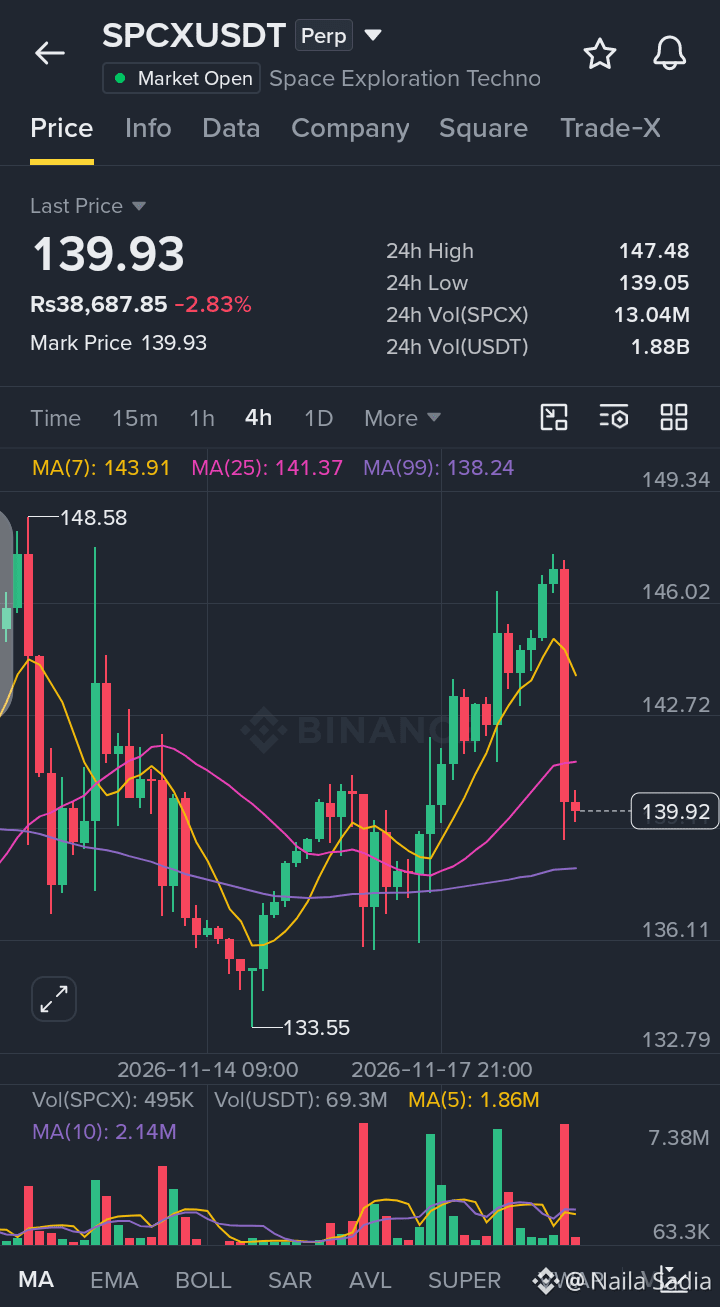
$SPCX is trading near $139.93, down 2.83%. The 4H chart shows a sharp pullback below MA(7) ($143.91) and MA(25) ($141.37), while still holding just above the MA(99) ($138.24).
📉 Market Outlook: Short-term pullback pressure is active after rejecting near recent highs, though the MA(99) and $139.05 intraday low remain nearby support. A break below $138.20–$139.05 could extend downside toward $133.55, while reclaiming $141.40–$143.90 and breaking above $147.48 resistance may revive upside momentum.
🎯 TRADE PLAN – SHORT
Entry: $141.00–$143.50
TP1: $138.30
TP2: $134.00
SL: $145.50
💬 Will $SPCX hold above the MA(99) support or slide deeper toward $134?
👇 CLICK HERE FOR TRADE
$SPCX
{future}(SPCXUSDT)
#SPCX #SpaceX #CryptoAnalysis #BinanceSquare
🚨 SPCX PULLING BACK NEAR $140! WILL $139 SUPPORT HOLD OR BREAK?
$SPCX is trading near $139.93, down 2.83%. The 4H chart shows a sharp pullback below MA(7) ($143.91) and MA(25) ($141.37), while still holding just above the MA(99) ($138.24).
📉 Market Outlook: Short-term pullback pressure is active after rejecting near recent highs, though the MA(99) and $139.05 intraday low remain nearby support. A break below $138.20–$139.05 could extend downside toward $133.55, while reclaiming $141.40–$143.90 and breaking above $147.48 resistance may revive upside momentum.
🎯 TRADE PLAN – SHORT
Entry: $141.00–$143.50
TP1: $138.30
TP2: $134.00
SL: $145.50
💬 Will $SPCX hold above the MA(99) support or slide deeper toward $134?
👇 CLICK HERE FOR TRADE
$SPCX
#SPCX #SpaceX #CryptoAnalysis #BinanceSquare
$SPCX is trading near $139.93, down 2.83%. The 4H chart shows a sharp pullback below MA(7) ($143.91) and MA(25) ($141.37), while still holding just above the MA(99) ($138.24).
📉 Market Outlook: Short-term pullback pressure is active after rejecting near recent highs, though the MA(99) and $139.05 intraday low remain nearby support. A break below $138.20–$139.05 could extend downside toward $133.55, while reclaiming $141.40–$143.90 and breaking above $147.48 resistance may revive upside momentum.
🎯 TRADE PLAN – SHORT
Entry: $141.00–$143.50
TP1: $138.30
TP2: $134.00
SL: $145.50
💬 Will $SPCX hold above the MA(99) support or slide deeper toward $134?
👇 CLICK HERE FOR TRADE
$SPCX
#SPCX #SpaceX #CryptoAnalysis #BinanceSquare
204
·
--
Bullish
$SPCX Market Update Today 🚀
SpaceX has received an important permit for its $24 billion Texas AI data center project. This could support its growing AI business and attract more investor interest. However, local tax concerns remain. Investor's Business Daily +1
📈 Price Direction: Moving upward as buying interest strengthens, with some market risks remaining.
{future}(SPCXUSDT)
#SPCX #SpaceX #AI #crypto #BinanceSquare
$SPCX Market Update Today 🚀
SpaceX has received an important permit for its $24 billion Texas AI data center project. This could support its growing AI business and attract more investor interest. However, local tax concerns remain. Investor's Business Daily +1
📈 Price Direction: Moving upward as buying interest strengthens, with some market risks remaining.
#SPCX #SpaceX #AI #crypto #BinanceSquare
SpaceX has received an important permit for its $24 billion Texas AI data center project. This could support its growing AI business and attract more investor interest. However, local tax concerns remain. Investor's Business Daily +1
📈 Price Direction: Moving upward as buying interest strengthens, with some market risks remaining.
#SPCX #SpaceX #AI #crypto #BinanceSquare
198

🚨 ELON MUSK TRIES TO EXPLAIN WHAT’S GOING ON WITH UKRAINE AND STARLINK
📰 ¿QUÉ PASÓ?
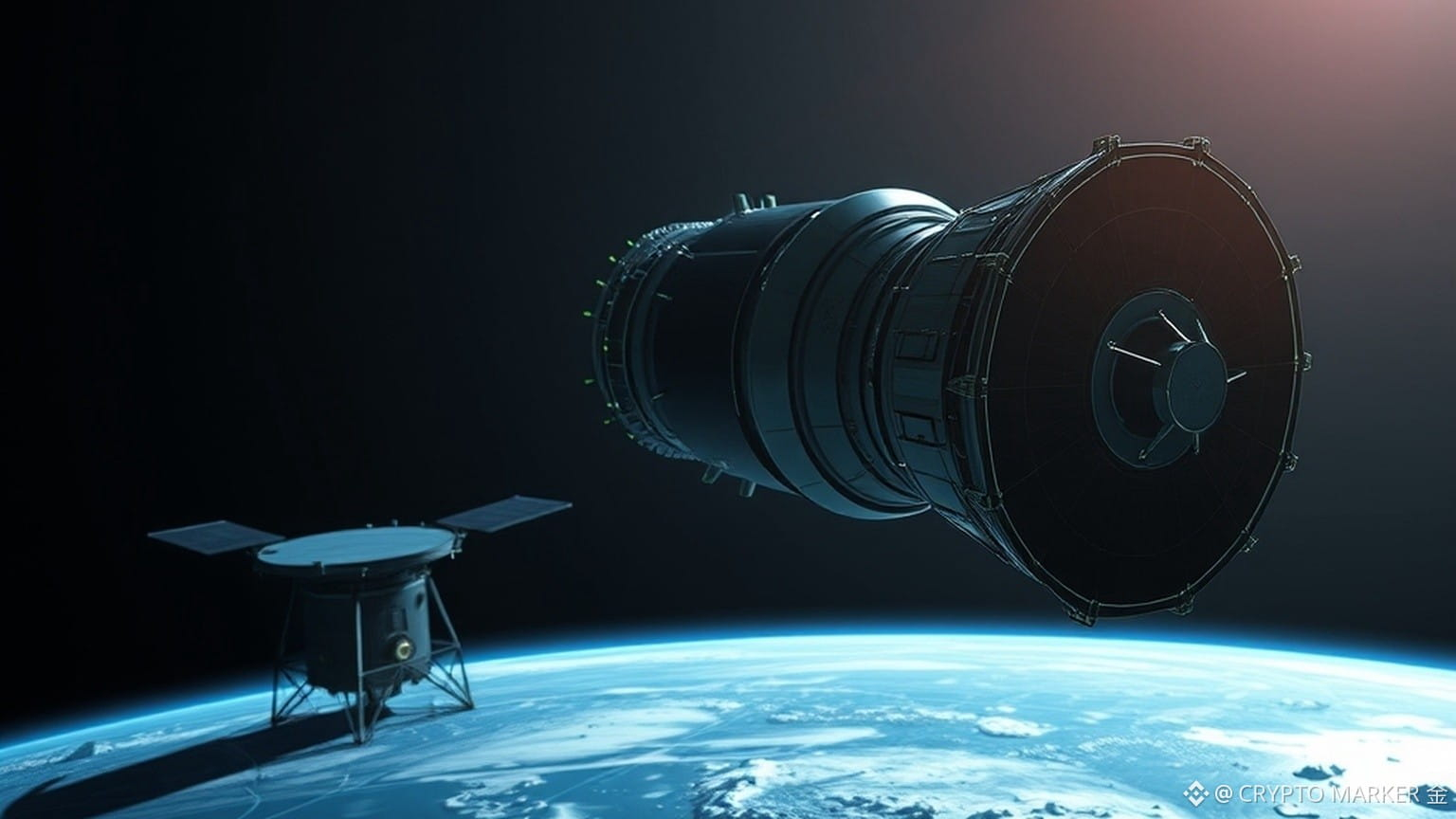
Elon Musk said Ukrainian president Volodymyr Zelenskyy is lying about disruptions to Starshield in Ukraine and that he's trying to misuse SpaceX's consumer service, Starlink, for military purposes. Musk made the comments at The New York Times' DealBook Summit on Wednesday as he tried to explain the conflict following weeks of back and forth between […]
📊 IMPACTO EN TECNOLOGÍA
El avance muestra cómo la conectividad satelital está ampliando sus aplicaciones y compitiendo cada vez más con la infraestructura tradicional de telecomunicaciones.
🔎 Fuente: The Verge
🤔 💬 ¿Podría la conectividad satelital convertirse en una alternativa cada vez más importante a las redes tradicionales?
#SpaceX #Satellite #Crypto_Marker #News
🚨 ELON MUSK TRIES TO EXPLAIN WHAT’S GOING ON WITH UKRAINE AND STARLINK
📰 ¿QUÉ PASÓ?
Elon Musk said Ukrainian president Volodymyr Zelenskyy is lying about disruptions to Starshield in Ukraine and that he's trying to misuse SpaceX's consumer service, Starlink, for military purposes. Musk made the comments at The New York Times' DealBook Summit on Wednesday as he tried to explain the conflict following weeks of back and forth between […]
📊 IMPACTO EN TECNOLOGÍA
El avance muestra cómo la conectividad satelital está ampliando sus aplicaciones y compitiendo cada vez más con la infraestructura tradicional de telecomunicaciones.
🔎 Fuente: The Verge
🤔 💬 ¿Podría la conectividad satelital convertirse en una alternativa cada vez más importante a las redes tradicionales?
#SpaceX #Satellite #Crypto_Marker #News
📰 ¿QUÉ PASÓ?
Elon Musk said Ukrainian president Volodymyr Zelenskyy is lying about disruptions to Starshield in Ukraine and that he's trying to misuse SpaceX's consumer service, Starlink, for military purposes. Musk made the comments at The New York Times' DealBook Summit on Wednesday as he tried to explain the conflict following weeks of back and forth between […]
📊 IMPACTO EN TECNOLOGÍA
El avance muestra cómo la conectividad satelital está ampliando sus aplicaciones y compitiendo cada vez más con la infraestructura tradicional de telecomunicaciones.
🔎 Fuente: The Verge
🤔 💬 ¿Podría la conectividad satelital convertirse en una alternativa cada vez más importante a las redes tradicionales?
#SpaceX #Satellite #Crypto_Marker #News
30

🚨 JUST IN: 🇺🇸🇺🇦 ELON MUSK CLAIMS UKRAINE'S ENTIRE MILITARY FRONT COULD COLLAPSE WITHOUT STARLINK.
One private technology company has become a critical part of modern warfare.
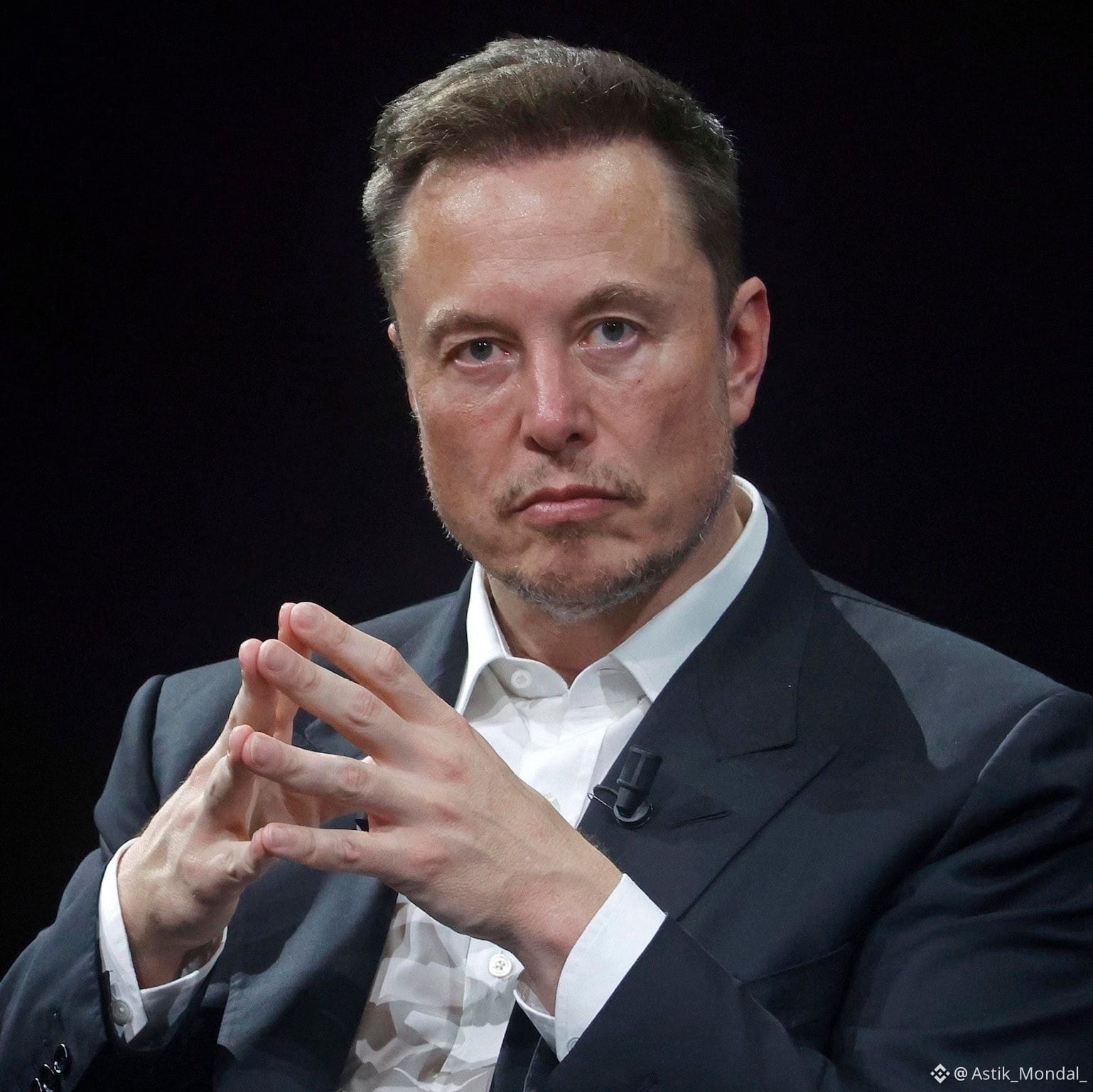
Elon Musk says Ukraine's military front would collapse immediately without Starlink.
Think about the implications.
🛰️ Starlink provides critical satellite internet connectivity in areas where traditional communication infrastructure is damaged or unavailable.
⚔️ Military units rely on battlefield communications to coordinate operations and maintain connectivity.
🌍 This highlights how satellite technology is becoming a strategic asset in modern geopolitical conflicts.
But there's a much bigger issue here.
Can one private company have this much influence over the outcome of a war?
Starlink isn't just another internet service anymore.
It's a reminder that control over critical technology infrastructure can translate into enormous geopolitical power.
The future of warfare may depend as much on technology companies as traditional military strength.
#ElonMusk #Starlink #Ukraine #Geopolitics #SpaceX $SPCX $TSLA
🚨 JUST IN: 🇺🇸🇺🇦 ELON MUSK CLAIMS UKRAINE'S ENTIRE MILITARY FRONT COULD COLLAPSE WITHOUT STARLINK.
One private technology company has become a critical part of modern warfare.
Elon Musk says Ukraine's military front would collapse immediately without Starlink.
Think about the implications.
🛰️ Starlink provides critical satellite internet connectivity in areas where traditional communication infrastructure is damaged or unavailable.
⚔️ Military units rely on battlefield communications to coordinate operations and maintain connectivity.
🌍 This highlights how satellite technology is becoming a strategic asset in modern geopolitical conflicts.
But there's a much bigger issue here.
Can one private company have this much influence over the outcome of a war?
Starlink isn't just another internet service anymore.
It's a reminder that control over critical technology infrastructure can translate into enormous geopolitical power.
The future of warfare may depend as much on technology companies as traditional military strength.
#ElonMusk #Starlink #Ukraine #Geopolitics #SpaceX $SPCX $TSLA
One private technology company has become a critical part of modern warfare.
Elon Musk says Ukraine's military front would collapse immediately without Starlink.
Think about the implications.
🛰️ Starlink provides critical satellite internet connectivity in areas where traditional communication infrastructure is damaged or unavailable.
⚔️ Military units rely on battlefield communications to coordinate operations and maintain connectivity.
🌍 This highlights how satellite technology is becoming a strategic asset in modern geopolitical conflicts.
But there's a much bigger issue here.
Can one private company have this much influence over the outcome of a war?
Starlink isn't just another internet service anymore.
It's a reminder that control over critical technology infrastructure can translate into enormous geopolitical power.
The future of warfare may depend as much on technology companies as traditional military strength.
#ElonMusk #Starlink #Ukraine #Geopolitics #SpaceX $SPCX $TSLA

1
165

Break down SpaceX's S-1 metrics across Starlink, launch services, and xAI operational spending.SpaceX’s S-1 registration statement details a multi-segment consolidated corporate structure following its early-2026 common-control acquisitions of xAI and X Corp. The filing breaks the company into three distinct reporting segments: Connectivity (Starlink), Space (Launch Services), and AI (xAI & X Corp).
Consolidated Financial Overview (FY 2025)
Total Revenue: $18.67 Billion (+33% YoY)Net Income / (Loss): -$4.93 Billion (swung from positive net income in 2024 due to heavy AI expansion and infrastructure costs)Total Capital Expenditures: $20.70 Billion (heavily weighted toward AI compute cluster buildouts)
Segment-by-Segment Metrics Breakdown
Key Operational Drivers per Segment
1. Connectivity (Starlink): The Profit Engine
Subscriber Growth: Starlink scaled past 10.3 million subscribers globally, with enterprise and government contracts representing a high-margin, zero-churn baseline.ARPU Compression: Average Revenue Per User (ARPU) trended downward from $99/month (2023) to $81/month (2025) and ~$69/month (2026) as coverage expanded into high-volume, lower-income global consumer markets.Cash Generation Role: Starlink’s cash flows serve as the internal financial pillar subsidizing both rocket development and AI infrastructure.
2. Space (Launch Services): The Infrastructure Platform
Launch Velocity: Increased from 98 annual launches (2023) to 170 launches (2025), with over 65% of missions dedicated internally to deploying Starlink satellite constellations rather than external paying customers.Starship R&D Burden: Operating losses in this segment stem directly from expensing billions in uncapitalized Starship research and development costs through the P&L.
3. AI Segment (xAI & X Corp): The High-Burn Growth Bet
Massive CapEx Scale: Capital expenditures for the AI segment accounted for over 76% of total company CapEx, driving the construction of massive GPU training clusters (such as the Colossus supercomputer facilities in Memphis).Monetization vs. Burn: While X advertising revenue contracted, external compute leasing—exemplified by large enterprise contracts—provides a rising revenue offset against heavy physical hardware depreciation.
Strategic Financial Dynamic
SpaceX operates as an internal cross-subsidization ecosystem. The high-margin cash flows generated by Starlink cover operational adjustments in launch services, while feeding multi-billion-dollar capital outlays into xAI's data center expansions.
#Anthropic #SpaceX #Binance
Break down SpaceX's S-1 metrics across Starlink, launch services, and xAI operational spending.
SpaceX’s S-1 registration statement details a multi-segment consolidated corporate structure following its early-2026 common-control acquisitions of xAI and X Corp. The filing breaks the company into three distinct reporting segments: Connectivity (Starlink), Space (Launch Services), and AI (xAI & X Corp).
Consolidated Financial Overview (FY 2025)
Total Revenue: $18.67 Billion (+33% YoY)Net Income / (Loss): -$4.93 Billion (swung from positive net income in 2024 due to heavy AI expansion and infrastructure costs)Total Capital Expenditures: $20.70 Billion (heavily weighted toward AI compute cluster buildouts)
Segment-by-Segment Metrics Breakdown
Key Operational Drivers per Segment
1. Connectivity (Starlink): The Profit Engine
Subscriber Growth: Starlink scaled past 10.3 million subscribers globally, with enterprise and government contracts representing a high-margin, zero-churn baseline.ARPU Compression: Average Revenue Per User (ARPU) trended downward from $99/month (2023) to $81/month (2025) and ~$69/month (2026) as coverage expanded into high-volume, lower-income global consumer markets.Cash Generation Role: Starlink’s cash flows serve as the internal financial pillar subsidizing both rocket development and AI infrastructure.
2. Space (Launch Services): The Infrastructure Platform
Launch Velocity: Increased from 98 annual launches (2023) to 170 launches (2025), with over 65% of missions dedicated internally to deploying Starlink satellite constellations rather than external paying customers.Starship R&D Burden: Operating losses in this segment stem directly from expensing billions in uncapitalized Starship research and development costs through the P&L.
3. AI Segment (xAI & X Corp): The High-Burn Growth Bet
Massive CapEx Scale: Capital expenditures for the AI segment accounted for over 76% of total company CapEx, driving the construction of massive GPU training clusters (such as the Colossus supercomputer facilities in Memphis).Monetization vs. Burn: While X advertising revenue contracted, external compute leasing—exemplified by large enterprise contracts—provides a rising revenue offset against heavy physical hardware depreciation.
Strategic Financial Dynamic
SpaceX operates as an internal cross-subsidization ecosystem. The high-margin cash flows generated by Starlink cover operational adjustments in launch services, while feeding multi-billion-dollar capital outlays into xAI's data center expansions.
#Anthropic #SpaceX #Binance
Consolidated Financial Overview (FY 2025)
Total Revenue: $18.67 Billion (+33% YoY)Net Income / (Loss): -$4.93 Billion (swung from positive net income in 2024 due to heavy AI expansion and infrastructure costs)Total Capital Expenditures: $20.70 Billion (heavily weighted toward AI compute cluster buildouts)
Segment-by-Segment Metrics Breakdown
Key Operational Drivers per Segment
1. Connectivity (Starlink): The Profit Engine
Subscriber Growth: Starlink scaled past 10.3 million subscribers globally, with enterprise and government contracts representing a high-margin, zero-churn baseline.ARPU Compression: Average Revenue Per User (ARPU) trended downward from $99/month (2023) to $81/month (2025) and ~$69/month (2026) as coverage expanded into high-volume, lower-income global consumer markets.Cash Generation Role: Starlink’s cash flows serve as the internal financial pillar subsidizing both rocket development and AI infrastructure.
2. Space (Launch Services): The Infrastructure Platform
Launch Velocity: Increased from 98 annual launches (2023) to 170 launches (2025), with over 65% of missions dedicated internally to deploying Starlink satellite constellations rather than external paying customers.Starship R&D Burden: Operating losses in this segment stem directly from expensing billions in uncapitalized Starship research and development costs through the P&L.
3. AI Segment (xAI & X Corp): The High-Burn Growth Bet
Massive CapEx Scale: Capital expenditures for the AI segment accounted for over 76% of total company CapEx, driving the construction of massive GPU training clusters (such as the Colossus supercomputer facilities in Memphis).Monetization vs. Burn: While X advertising revenue contracted, external compute leasing—exemplified by large enterprise contracts—provides a rising revenue offset against heavy physical hardware depreciation.
Strategic Financial Dynamic
SpaceX operates as an internal cross-subsidization ecosystem. The high-margin cash flows generated by Starlink cover operational adjustments in launch services, while feeding multi-billion-dollar capital outlays into xAI's data center expansions.
#Anthropic #SpaceX #Binance
8
Compare Anthropic infrastructure lease commitments against SpaceX's xAI segment capital expendituresComparing Anthropic’s infrastructure commitments against SpaceX’s xAI segment capital expenditures highlights two contrasting financial approaches to acquiring compute capacity: Off-Balance-Sheet Contractual Commitments (Anthropic) versus On-Balance-Sheet Direct Capital Deployment (SpaceX/xAI)
Strategic Differences in AI Infrastructure Execution
1. Anthropic: Hyperscaler Dependency & Lease Obligations
The Neocloud & Hyperscaler Model: Anthropic operates as a software and model developer without owning physical data centers. To secure computing scale, it relies on multi-billion-dollar minimum spend guarantees with cloud providers:Broadcom Lease: ~$161.2 Billion for custom AI/TPU hardware hosting.Google Cloud: At least $121.3 Billion (April 2026–July 2033).SpaceX/xAI Leasing: Up to $120.5 Billion through 2029.Amazon Web Services (AWS): At least $110.0 Billion (May 2026–April 2036).Financial Risk Profile: Because a vast majority of these contracts contain minimum payment clauses regardless of actual API consumption, Anthropic must maintain high enterprise revenue growth to absorb $70+ billion in annual near-term obligations.
2. SpaceX / xAI: Asset Ownership & Heavy Balance-Sheet CapEx
Direct Hardware Ownership: SpaceX finances, builds, and directly owns its physical data center assets and GPU clusters (such as the Colossus supercomputer).Capex Drag vs. Monetization: Instead of committing to future payments to third-party clouds, SpaceX’s xAI segment absorbs massive upfront capital costs—spending $12.7 billion in 2025 CapEx and scaling to over $16 billion in single-quarter CapEx by late 2026.Cross-Segment Integration: SpaceX offsets xAI's direct capital expenditures through high-margin cash generation from Starlink (~$7.2B EBITDA), while simultaneously monetizing xAI’s compute clusters by leasing excess capacity back to third-party developers—including Anthropic itself.
Primary Takeaway for Institutional Investors
Anthropic trades capital ownership for speed and flexibility, incurring massive fixed operational contract risks over the next decade.SpaceX uses its multi-segment balance sheet to fund direct physical ownership of AI compute, bearing severe upfront cash burn that is cushioned by Starlink's operational revenues.
#starlinksatelite #SpaceX #BTC
Compare Anthropic infrastructure lease commitments against SpaceX's xAI segment capital expenditures
Comparing Anthropic’s infrastructure commitments against SpaceX’s xAI segment capital expenditures highlights two contrasting financial approaches to acquiring compute capacity: Off-Balance-Sheet Contractual Commitments (Anthropic) versus On-Balance-Sheet Direct Capital Deployment (SpaceX/xAI)
Strategic Differences in AI Infrastructure Execution
1. Anthropic: Hyperscaler Dependency & Lease Obligations
The Neocloud & Hyperscaler Model: Anthropic operates as a software and model developer without owning physical data centers. To secure computing scale, it relies on multi-billion-dollar minimum spend guarantees with cloud providers:Broadcom Lease: ~$161.2 Billion for custom AI/TPU hardware hosting.Google Cloud: At least $121.3 Billion (April 2026–July 2033).SpaceX/xAI Leasing: Up to $120.5 Billion through 2029.Amazon Web Services (AWS): At least $110.0 Billion (May 2026–April 2036).Financial Risk Profile: Because a vast majority of these contracts contain minimum payment clauses regardless of actual API consumption, Anthropic must maintain high enterprise revenue growth to absorb $70+ billion in annual near-term obligations.
2. SpaceX / xAI: Asset Ownership & Heavy Balance-Sheet CapEx
Direct Hardware Ownership: SpaceX finances, builds, and directly owns its physical data center assets and GPU clusters (such as the Colossus supercomputer).Capex Drag vs. Monetization: Instead of committing to future payments to third-party clouds, SpaceX’s xAI segment absorbs massive upfront capital costs—spending $12.7 billion in 2025 CapEx and scaling to over $16 billion in single-quarter CapEx by late 2026.Cross-Segment Integration: SpaceX offsets xAI's direct capital expenditures through high-margin cash generation from Starlink (~$7.2B EBITDA), while simultaneously monetizing xAI’s compute clusters by leasing excess capacity back to third-party developers—including Anthropic itself.
Primary Takeaway for Institutional Investors
Anthropic trades capital ownership for speed and flexibility, incurring massive fixed operational contract risks over the next decade.SpaceX uses its multi-segment balance sheet to fund direct physical ownership of AI compute, bearing severe upfront cash burn that is cushioned by Starlink's operational revenues.
#starlinksatelite #SpaceX #BTC
Strategic Differences in AI Infrastructure Execution
1. Anthropic: Hyperscaler Dependency & Lease Obligations
The Neocloud & Hyperscaler Model: Anthropic operates as a software and model developer without owning physical data centers. To secure computing scale, it relies on multi-billion-dollar minimum spend guarantees with cloud providers:Broadcom Lease: ~$161.2 Billion for custom AI/TPU hardware hosting.Google Cloud: At least $121.3 Billion (April 2026–July 2033).SpaceX/xAI Leasing: Up to $120.5 Billion through 2029.Amazon Web Services (AWS): At least $110.0 Billion (May 2026–April 2036).Financial Risk Profile: Because a vast majority of these contracts contain minimum payment clauses regardless of actual API consumption, Anthropic must maintain high enterprise revenue growth to absorb $70+ billion in annual near-term obligations.
2. SpaceX / xAI: Asset Ownership & Heavy Balance-Sheet CapEx
Direct Hardware Ownership: SpaceX finances, builds, and directly owns its physical data center assets and GPU clusters (such as the Colossus supercomputer).Capex Drag vs. Monetization: Instead of committing to future payments to third-party clouds, SpaceX’s xAI segment absorbs massive upfront capital costs—spending $12.7 billion in 2025 CapEx and scaling to over $16 billion in single-quarter CapEx by late 2026.Cross-Segment Integration: SpaceX offsets xAI's direct capital expenditures through high-margin cash generation from Starlink (~$7.2B EBITDA), while simultaneously monetizing xAI’s compute clusters by leasing excess capacity back to third-party developers—including Anthropic itself.
Primary Takeaway for Institutional Investors
Anthropic trades capital ownership for speed and flexibility, incurring massive fixed operational contract risks over the next decade.SpaceX uses its multi-segment balance sheet to fund direct physical ownership of AI compute, bearing severe upfront cash burn that is cushioned by Starlink's operational revenues.
#starlinksatelite #SpaceX #BTC
146
Compare the dual-class voting structures and founder control rights of SpaceX and Anthropic.Both SpaceX and Anthropic use multi-class voting share structures to isolate public investors from corporate control. However, their governance mechanics reflect fundamentally different management philosophies: SpaceX relies on absolute single-person voting dominance, while Anthropic pairs founder voting control with external safety oversight through a public benefit trust structure.
Key Governance & Voting Metrics Comparison
Core Structural & Governance Differences
1. SpaceX: Autocratic Single-Leader Control
The 10:1 Vote Dynamic: SpaceX uses a classic Silicon Valley dual-class structure. Class A common stock carries 1 vote per share, while Class B shares carry 10 votes per share.MEXCMusk's Voting Dominance: By holding over 93% of the outstanding Class B shares, Elon Musk exerts ~79% to 82% of total shareholder voting power while holding ~40% to 42% of actual economic equity.Operational Implication: Hostile takeovers, board proxy fights, or activist shareholder resolutions are mathematically impossible without Musk's explicit consent.
2. Anthropic: Collective Founder & Public Benefit Trust Model
The Class F Golden Share: Rather than relying purely on accumulating high-vote equity, Anthropic issued a dedicated Class F share to a Founder LLC representing its seven co-founders (led by CEO Dario Amodei and President Daniela Amodei). This single share automatically guarantees 50.1% of the total voting power on all standard shareholder matters.KuCoinPublic Benefit Corporation (PBC) Obligation: As a registered Delaware PBC, Anthropic's board has a legal fiduciary duty to balance shareholder financial returns alongside its mission to develop safe, beneficial AI.Long-Term Benefit Trust: Independent from equity holders, Anthropic’s governance structure incorporates an external Long-Term Benefit Trust, which holds independent rights to elect select board members tasked specifically with monitoring safety protocols and ethical alignment.
Primary Takeaway for Public Shareholders
Buying Class A shares in either company provides economic exposure to core revenue growth—Starlink and launch infrastructure for SpaceX, or Claude enterprise revenue for Anthropic—without conferring operational control.
SpaceX investors bet directly on Elon Musk's strategic decision-making and execution authority.Anthropic investors enter a multi-tiered governance model where founder voting supremacy is bound by a legal Public Benefit mandate and external safety oversight.
#SpaceX #ellonmask #Binance
Compare the dual-class voting structures and founder control rights of SpaceX and Anthropic.
Both SpaceX and Anthropic use multi-class voting share structures to isolate public investors from corporate control. However, their governance mechanics reflect fundamentally different management philosophies: SpaceX relies on absolute single-person voting dominance, while Anthropic pairs founder voting control with external safety oversight through a public benefit trust structure.
Key Governance & Voting Metrics Comparison
Core Structural & Governance Differences
1. SpaceX: Autocratic Single-Leader Control
The 10:1 Vote Dynamic: SpaceX uses a classic Silicon Valley dual-class structure. Class A common stock carries 1 vote per share, while Class B shares carry 10 votes per share.MEXCMusk's Voting Dominance: By holding over 93% of the outstanding Class B shares, Elon Musk exerts ~79% to 82% of total shareholder voting power while holding ~40% to 42% of actual economic equity.Operational Implication: Hostile takeovers, board proxy fights, or activist shareholder resolutions are mathematically impossible without Musk's explicit consent.
2. Anthropic: Collective Founder & Public Benefit Trust Model
The Class F Golden Share: Rather than relying purely on accumulating high-vote equity, Anthropic issued a dedicated Class F share to a Founder LLC representing its seven co-founders (led by CEO Dario Amodei and President Daniela Amodei). This single share automatically guarantees 50.1% of the total voting power on all standard shareholder matters.KuCoinPublic Benefit Corporation (PBC) Obligation: As a registered Delaware PBC, Anthropic's board has a legal fiduciary duty to balance shareholder financial returns alongside its mission to develop safe, beneficial AI.Long-Term Benefit Trust: Independent from equity holders, Anthropic’s governance structure incorporates an external Long-Term Benefit Trust, which holds independent rights to elect select board members tasked specifically with monitoring safety protocols and ethical alignment.
Primary Takeaway for Public Shareholders
Buying Class A shares in either company provides economic exposure to core revenue growth—Starlink and launch infrastructure for SpaceX, or Claude enterprise revenue for Anthropic—without conferring operational control.
SpaceX investors bet directly on Elon Musk's strategic decision-making and execution authority.Anthropic investors enter a multi-tiered governance model where founder voting supremacy is bound by a legal Public Benefit mandate and external safety oversight.
#SpaceX #ellonmask #Binance
Key Governance & Voting Metrics Comparison
Core Structural & Governance Differences
1. SpaceX: Autocratic Single-Leader Control
The 10:1 Vote Dynamic: SpaceX uses a classic Silicon Valley dual-class structure. Class A common stock carries 1 vote per share, while Class B shares carry 10 votes per share.MEXCMusk's Voting Dominance: By holding over 93% of the outstanding Class B shares, Elon Musk exerts ~79% to 82% of total shareholder voting power while holding ~40% to 42% of actual economic equity.Operational Implication: Hostile takeovers, board proxy fights, or activist shareholder resolutions are mathematically impossible without Musk's explicit consent.
2. Anthropic: Collective Founder & Public Benefit Trust Model
The Class F Golden Share: Rather than relying purely on accumulating high-vote equity, Anthropic issued a dedicated Class F share to a Founder LLC representing its seven co-founders (led by CEO Dario Amodei and President Daniela Amodei). This single share automatically guarantees 50.1% of the total voting power on all standard shareholder matters.KuCoinPublic Benefit Corporation (PBC) Obligation: As a registered Delaware PBC, Anthropic's board has a legal fiduciary duty to balance shareholder financial returns alongside its mission to develop safe, beneficial AI.Long-Term Benefit Trust: Independent from equity holders, Anthropic’s governance structure incorporates an external Long-Term Benefit Trust, which holds independent rights to elect select board members tasked specifically with monitoring safety protocols and ethical alignment.
Primary Takeaway for Public Shareholders
Buying Class A shares in either company provides economic exposure to core revenue growth—Starlink and launch infrastructure for SpaceX, or Claude enterprise revenue for Anthropic—without conferring operational control.
SpaceX investors bet directly on Elon Musk's strategic decision-making and execution authority.Anthropic investors enter a multi-tiered governance model where founder voting supremacy is bound by a legal Public Benefit mandate and external safety oversight.
#SpaceX #ellonmask #Binance
257
Headline revenues and high-level operating lossesBeyond the headline revenues and high-level operating losses, SpaceX’s S-1 filing reveals a unique operational architecture where each of the three business segments plays a specific role in the broader corporate strategy.
Segment Operational Drivers & Deep Dive
1. Connectivity (Starlink): High-Margin Cash Generator
Customer Mix: The enterprise and government side ($4.18B revenue, +51% YoY) carries a zero-churn profile over the past two years among large enterprise clients paying >$750,000 annually.ARPU vs. Scale: Consumer broadband ARPU compressed from $99/month (2023) to $81/month (2025) and $69/month (2026) as coverage expanded globally across lower-income regions. To mitigate this, SpaceX introduced a $5–$10 price increase across core markets to stabilize average revenue per user.CapEx Efficiency: Satellite constellation buildouts cost $4.2 billion in 2025. High hardware margins (~63% EBITDA) allow Starlink to fund its own constellation replenishments while generating surplus cash for the parent entity.
2. Space (Launch Services): Internal Utility Platform
Internal Capacity Priority: Over 65% of Falcon 9 launches in 2025 and 2026 were deployed for internal Starlink V2/V3 satellites rather than external paying customers.Starship R&D Expense: The reported operating loss of -$657 million in 2025 stems from expensing ~$3.0 billion in uncapitalized Starship R&D directly through the Space segment P&L.Backlog Support: Commercial and government launch contracts maintain a solid revenue baseline ($2.58B commercial/NASA + $1.51B national security), anchored by high commercial launch market share.
3. xAI & X Corp: High-Burn Growth Infrastructure
Common-Control Accounting: Following the early-2026 consolidation under SpaceX, historical financial statements were recast to include both xAI and X Corp.Infrastructure Depreciation: The -$6.35 billion operating loss is heavily driven by accelerated depreciation on hardware (such as compute clusters built with tens of thousands of GPUs) alongside massive $12.7 billion CapEx spending.Revenue Anchor: While X advertising revenue contracted, external compute leasing (highlighted by a $1.25B/month multi-year compute deal with Anthropic) provides a key revenue floor to offset hardware depreciation costs.
Key Financial Takeaways
Internal Cross-Subsidization: Starlink’s $7.2B EBITDA at 63% margins absorbs the operational losses of both launch development and AI compute buildouts.Total Capital Outflow: Total 2025 CapEx reached $20.70 billion against $6.8 billion in operating cash flow. The resulting $14 billion cash deficit was funded through private placements and institutional debt before the June IPO.
#SpaceX #EBITDA #StarlinkInPakistan #BNB_Market_Update
Headline revenues and high-level operating losses
Beyond the headline revenues and high-level operating losses, SpaceX’s S-1 filing reveals a unique operational architecture where each of the three business segments plays a specific role in the broader corporate strategy.
Segment Operational Drivers & Deep Dive
1. Connectivity (Starlink): High-Margin Cash Generator
Customer Mix: The enterprise and government side ($4.18B revenue, +51% YoY) carries a zero-churn profile over the past two years among large enterprise clients paying >$750,000 annually.ARPU vs. Scale: Consumer broadband ARPU compressed from $99/month (2023) to $81/month (2025) and $69/month (2026) as coverage expanded globally across lower-income regions. To mitigate this, SpaceX introduced a $5–$10 price increase across core markets to stabilize average revenue per user.CapEx Efficiency: Satellite constellation buildouts cost $4.2 billion in 2025. High hardware margins (~63% EBITDA) allow Starlink to fund its own constellation replenishments while generating surplus cash for the parent entity.
2. Space (Launch Services): Internal Utility Platform
Internal Capacity Priority: Over 65% of Falcon 9 launches in 2025 and 2026 were deployed for internal Starlink V2/V3 satellites rather than external paying customers.Starship R&D Expense: The reported operating loss of -$657 million in 2025 stems from expensing ~$3.0 billion in uncapitalized Starship R&D directly through the Space segment P&L.Backlog Support: Commercial and government launch contracts maintain a solid revenue baseline ($2.58B commercial/NASA + $1.51B national security), anchored by high commercial launch market share.
3. xAI & X Corp: High-Burn Growth Infrastructure
Common-Control Accounting: Following the early-2026 consolidation under SpaceX, historical financial statements were recast to include both xAI and X Corp.Infrastructure Depreciation: The -$6.35 billion operating loss is heavily driven by accelerated depreciation on hardware (such as compute clusters built with tens of thousands of GPUs) alongside massive $12.7 billion CapEx spending.Revenue Anchor: While X advertising revenue contracted, external compute leasing (highlighted by a $1.25B/month multi-year compute deal with Anthropic) provides a key revenue floor to offset hardware depreciation costs.
Key Financial Takeaways
Internal Cross-Subsidization: Starlink’s $7.2B EBITDA at 63% margins absorbs the operational losses of both launch development and AI compute buildouts.Total Capital Outflow: Total 2025 CapEx reached $20.70 billion against $6.8 billion in operating cash flow. The resulting $14 billion cash deficit was funded through private placements and institutional debt before the June IPO.
#SpaceX #EBITDA #StarlinkInPakistan #BNB_Market_Update
Segment Operational Drivers & Deep Dive
1. Connectivity (Starlink): High-Margin Cash Generator
Customer Mix: The enterprise and government side ($4.18B revenue, +51% YoY) carries a zero-churn profile over the past two years among large enterprise clients paying >$750,000 annually.ARPU vs. Scale: Consumer broadband ARPU compressed from $99/month (2023) to $81/month (2025) and $69/month (2026) as coverage expanded globally across lower-income regions. To mitigate this, SpaceX introduced a $5–$10 price increase across core markets to stabilize average revenue per user.CapEx Efficiency: Satellite constellation buildouts cost $4.2 billion in 2025. High hardware margins (~63% EBITDA) allow Starlink to fund its own constellation replenishments while generating surplus cash for the parent entity.
2. Space (Launch Services): Internal Utility Platform
Internal Capacity Priority: Over 65% of Falcon 9 launches in 2025 and 2026 were deployed for internal Starlink V2/V3 satellites rather than external paying customers.Starship R&D Expense: The reported operating loss of -$657 million in 2025 stems from expensing ~$3.0 billion in uncapitalized Starship R&D directly through the Space segment P&L.Backlog Support: Commercial and government launch contracts maintain a solid revenue baseline ($2.58B commercial/NASA + $1.51B national security), anchored by high commercial launch market share.
3. xAI & X Corp: High-Burn Growth Infrastructure
Common-Control Accounting: Following the early-2026 consolidation under SpaceX, historical financial statements were recast to include both xAI and X Corp.Infrastructure Depreciation: The -$6.35 billion operating loss is heavily driven by accelerated depreciation on hardware (such as compute clusters built with tens of thousands of GPUs) alongside massive $12.7 billion CapEx spending.Revenue Anchor: While X advertising revenue contracted, external compute leasing (highlighted by a $1.25B/month multi-year compute deal with Anthropic) provides a key revenue floor to offset hardware depreciation costs.
Key Financial Takeaways
Internal Cross-Subsidization: Starlink’s $7.2B EBITDA at 63% margins absorbs the operational losses of both launch development and AI compute buildouts.Total Capital Outflow: Total 2025 CapEx reached $20.70 billion against $6.8 billion in operating cash flow. The resulting $14 billion cash deficit was funded through private placements and institutional debt before the June IPO.
#SpaceX #EBITDA #StarlinkInPakistan #BNB_Market_Update
33
Break down SpaceX's S-1 metrics across Starlink, launch services, and xAI operational spending.SpaceX’s S-1 registration statement reveals a unique corporate structure consolidating three distinct business segments under a single balance sheet (SPCX).
The filing highlights a company where Starlink acts as the primary cash and profit engine, Launch Services operates as the operational backbone, and the xAI segment serves as a massive capital-intensive growth bet.
Consolidated Financial Summary (FY2025)
Segment-by-Segment S-1 Breakdown
1. Connectivity (Starlink) — The Cash & Profit Engine
Starlink generated 61% of total revenue and essentially 100% of SpaceX's operating profits in 2025.
Stock Alarm Pro
Revenue: $11.39 Billion (+49.8% YoY).SEC-API.ioConsumer Broadband: $7.21 Billion (+49% YoY) across 8.9M subscribers.Mostly metricsEnterprise & Government: $4.18 Billion (+51% YoY).Mostly metricsProfitability: $7.20 Billion in Segment EBITDA with a 38.8% operating margin (and ~63% EBITDA margin).Mostly metricsCapEx Allocation: $4.20 Billion in 2025 for satellite manufacturing and constellation expansion (9,600+ deployed satellites).Key Unit Metric: ARPU (Average Revenue Per User) fell from $99/mo (2023) to $81/mo (2025) as expansion targeted global markets, offset by zero-churn high-margin enterprise adoption.
2. Space (Launch Services) — The Foundational Platform
The traditional launch business operates with modest reported revenue growth because internal capacity is primarily directed to launching Starlink satellites and AI compute infrastructure.
Mostly metrics
Revenue: $4.09 Billion (+7.6% YoY, ~22% of total company revenue).Mostly metricsCommercial & NASA Launch Services: $2.58 Billion.Development Contracts & National Security: $1.51 Billion.Profitability: $653 Million in Segment EBITDA with an operating margin of -16.1% due to uncapitalized Starship R&D costs.Mostly metricsCapEx & R&D: $3.80 Billion CapEx + ~$3 Billion in R&D dedicated strictly to Starship development.
3. xAI & X Corp — The High-Burn AI Expansion
Formally consolidated under common-control accounting following SpaceX’s acquisition of xAI (and X Corp) in February 2026.
Revenue: $3.20 Billion (+22.2% YoY, ~17% of total company revenue).Mostly metricsAdvertising (X): $1.84 Billion (Contracted -21% from 2023 levels).SEC-API.ioAI Solutions & Infrastructure (Grok / Compute sales): $1.36 Billion (+52.1% YoY).SEC-API.ioOperating Loss: -$6.35 Billion in 2025 operating losses (expanding to a ~$10B annualized burn rate in Q1 2026).CapEx: $12.70 Billion spent in 2025 (buildouts for the 200,000+ GPU Colossus clusters).Major Commercial Milestone: Disclosed a landmark compute contract with Anthropic to rent xAI's Colossus infrastructure for $1.25 billion per month ($15B/year) through May 2029.
Primary Takeaway for Investors
The S-1 demonstrates that SpaceX operates as a cross-subsidized ecosystem. High-margin cash flows generated by Starlink's satellite network (~$3 billion in positive free cash flow) are deployed directly into financing Starship launches and scaling xAI's multi-billion-dollar compute cluster expansion.
#SpaceX #starlinksatelite #ATH
Break down SpaceX's S-1 metrics across Starlink, launch services, and xAI operational spending.
SpaceX’s S-1 registration statement reveals a unique corporate structure consolidating three distinct business segments under a single balance sheet (SPCX).
The filing highlights a company where Starlink acts as the primary cash and profit engine, Launch Services operates as the operational backbone, and the xAI segment serves as a massive capital-intensive growth bet.
Consolidated Financial Summary (FY2025)
Segment-by-Segment S-1 Breakdown
1. Connectivity (Starlink) — The Cash & Profit Engine
Starlink generated 61% of total revenue and essentially 100% of SpaceX's operating profits in 2025.
Stock Alarm Pro
Revenue: $11.39 Billion (+49.8% YoY).SEC-API.ioConsumer Broadband: $7.21 Billion (+49% YoY) across 8.9M subscribers.Mostly metricsEnterprise & Government: $4.18 Billion (+51% YoY).Mostly metricsProfitability: $7.20 Billion in Segment EBITDA with a 38.8% operating margin (and ~63% EBITDA margin).Mostly metricsCapEx Allocation: $4.20 Billion in 2025 for satellite manufacturing and constellation expansion (9,600+ deployed satellites).Key Unit Metric: ARPU (Average Revenue Per User) fell from $99/mo (2023) to $81/mo (2025) as expansion targeted global markets, offset by zero-churn high-margin enterprise adoption.
2. Space (Launch Services) — The Foundational Platform
The traditional launch business operates with modest reported revenue growth because internal capacity is primarily directed to launching Starlink satellites and AI compute infrastructure.
Mostly metrics
Revenue: $4.09 Billion (+7.6% YoY, ~22% of total company revenue).Mostly metricsCommercial & NASA Launch Services: $2.58 Billion.Development Contracts & National Security: $1.51 Billion.Profitability: $653 Million in Segment EBITDA with an operating margin of -16.1% due to uncapitalized Starship R&D costs.Mostly metricsCapEx & R&D: $3.80 Billion CapEx + ~$3 Billion in R&D dedicated strictly to Starship development.
3. xAI & X Corp — The High-Burn AI Expansion
Formally consolidated under common-control accounting following SpaceX’s acquisition of xAI (and X Corp) in February 2026.
Revenue: $3.20 Billion (+22.2% YoY, ~17% of total company revenue).Mostly metricsAdvertising (X): $1.84 Billion (Contracted -21% from 2023 levels).SEC-API.ioAI Solutions & Infrastructure (Grok / Compute sales): $1.36 Billion (+52.1% YoY).SEC-API.ioOperating Loss: -$6.35 Billion in 2025 operating losses (expanding to a ~$10B annualized burn rate in Q1 2026).CapEx: $12.70 Billion spent in 2025 (buildouts for the 200,000+ GPU Colossus clusters).Major Commercial Milestone: Disclosed a landmark compute contract with Anthropic to rent xAI's Colossus infrastructure for $1.25 billion per month ($15B/year) through May 2029.
Primary Takeaway for Investors
The S-1 demonstrates that SpaceX operates as a cross-subsidized ecosystem. High-margin cash flows generated by Starlink's satellite network (~$3 billion in positive free cash flow) are deployed directly into financing Starship launches and scaling xAI's multi-billion-dollar compute cluster expansion.
#SpaceX #starlinksatelite #ATH
The filing highlights a company where Starlink acts as the primary cash and profit engine, Launch Services operates as the operational backbone, and the xAI segment serves as a massive capital-intensive growth bet.
Consolidated Financial Summary (FY2025)
Segment-by-Segment S-1 Breakdown
1. Connectivity (Starlink) — The Cash & Profit Engine
Starlink generated 61% of total revenue and essentially 100% of SpaceX's operating profits in 2025.
Stock Alarm Pro
Revenue: $11.39 Billion (+49.8% YoY).SEC-API.ioConsumer Broadband: $7.21 Billion (+49% YoY) across 8.9M subscribers.Mostly metricsEnterprise & Government: $4.18 Billion (+51% YoY).Mostly metricsProfitability: $7.20 Billion in Segment EBITDA with a 38.8% operating margin (and ~63% EBITDA margin).Mostly metricsCapEx Allocation: $4.20 Billion in 2025 for satellite manufacturing and constellation expansion (9,600+ deployed satellites).Key Unit Metric: ARPU (Average Revenue Per User) fell from $99/mo (2023) to $81/mo (2025) as expansion targeted global markets, offset by zero-churn high-margin enterprise adoption.
2. Space (Launch Services) — The Foundational Platform
The traditional launch business operates with modest reported revenue growth because internal capacity is primarily directed to launching Starlink satellites and AI compute infrastructure.
Mostly metrics
Revenue: $4.09 Billion (+7.6% YoY, ~22% of total company revenue).Mostly metricsCommercial & NASA Launch Services: $2.58 Billion.Development Contracts & National Security: $1.51 Billion.Profitability: $653 Million in Segment EBITDA with an operating margin of -16.1% due to uncapitalized Starship R&D costs.Mostly metricsCapEx & R&D: $3.80 Billion CapEx + ~$3 Billion in R&D dedicated strictly to Starship development.
3. xAI & X Corp — The High-Burn AI Expansion
Formally consolidated under common-control accounting following SpaceX’s acquisition of xAI (and X Corp) in February 2026.
Revenue: $3.20 Billion (+22.2% YoY, ~17% of total company revenue).Mostly metricsAdvertising (X): $1.84 Billion (Contracted -21% from 2023 levels).SEC-API.ioAI Solutions & Infrastructure (Grok / Compute sales): $1.36 Billion (+52.1% YoY).SEC-API.ioOperating Loss: -$6.35 Billion in 2025 operating losses (expanding to a ~$10B annualized burn rate in Q1 2026).CapEx: $12.70 Billion spent in 2025 (buildouts for the 200,000+ GPU Colossus clusters).Major Commercial Milestone: Disclosed a landmark compute contract with Anthropic to rent xAI's Colossus infrastructure for $1.25 billion per month ($15B/year) through May 2029.
Primary Takeaway for Investors
The S-1 demonstrates that SpaceX operates as a cross-subsidized ecosystem. High-margin cash flows generated by Starlink's satellite network (~$3 billion in positive free cash flow) are deployed directly into financing Starship launches and scaling xAI's multi-billion-dollar compute cluster expansion.
#SpaceX #starlinksatelite #ATH
35
Compare the trading performance of major mega-cap IPOs over their first 90 days.Looking across historical patterns and recent benchmark debuts like SpaceX (SPCX), mega-cap tech IPOs generally follow a distinct three-phase trajectory during their first 90 days of public trading.
The 3-Phase 90-Day Lifecycle of Mega-Cap IPOs
Phase 1: The Initial Pop & Index Inflow (Days 1–15)Strategic cornerstone buyers, institutional overallotment options, and mechanical demand from fast-track index inclusions (e.g., MSCI World, Nasdaq-100) create a structural bid floor.SpaceX Example: Debuted at $135 on June 12, popped 19% to close day one at $161 ($2.1T market cap), and ran to a high of $201.80 later in June.Phase 2: Valuation Digest & Profit Taking (Days 16–60)Once initial index allocations complete, early hedge fund buyers and momentum retail traders routinely harvest short-term profits. Multiples face pressure as markets reconcile launch-day hyper-growth pricing against broad macroeconomic conditions.SpaceX Example: Pullbacks dragged SPCX down to a low of $108 in August (a ~46% decline from its peak and ~20% below its offer price).Phase 3: Earnings Validation & Pre-Lockup Drift (Days 61–90+)The first quarterly earnings report serves as a reality test. High-performing companies recover above their offer price, while those missing metrics re-rate lower ahead of insider lock-up expirations.SpaceX Example: Rebound back to $147.79 (+9.5% above its $135 offer price) at day 90 following strong Q3 results ($14.58B in revenue, up 161%).
Historical 90-Day Performance Comparison
Critical Takeaways for Mega-Cap Listings
Outperforming Facebook's Famous Trap: While historical tech IPOs average strong day-one returns, long-term 90-day holds are split. SpaceX closing above its offer price at day 90 put it in a stronger tier than Meta/Facebook (which took 14 months to regain $38).Float Dynamics vs. Fundamental Risk: Ultra-tight free floats (e.g., ~4% for SpaceX) create significant upside volatility early on, but expose retail investors to sharp drawdowns when lock-up periods end (often 90 to 180 days post-listing).
#SpaceX #Anthropic #btc
Compare the trading performance of major mega-cap IPOs over their first 90 days.
Looking across historical patterns and recent benchmark debuts like SpaceX (SPCX), mega-cap tech IPOs generally follow a distinct three-phase trajectory during their first 90 days of public trading.
The 3-Phase 90-Day Lifecycle of Mega-Cap IPOs
Phase 1: The Initial Pop & Index Inflow (Days 1–15)Strategic cornerstone buyers, institutional overallotment options, and mechanical demand from fast-track index inclusions (e.g., MSCI World, Nasdaq-100) create a structural bid floor.SpaceX Example: Debuted at $135 on June 12, popped 19% to close day one at $161 ($2.1T market cap), and ran to a high of $201.80 later in June.Phase 2: Valuation Digest & Profit Taking (Days 16–60)Once initial index allocations complete, early hedge fund buyers and momentum retail traders routinely harvest short-term profits. Multiples face pressure as markets reconcile launch-day hyper-growth pricing against broad macroeconomic conditions.SpaceX Example: Pullbacks dragged SPCX down to a low of $108 in August (a ~46% decline from its peak and ~20% below its offer price).Phase 3: Earnings Validation & Pre-Lockup Drift (Days 61–90+)The first quarterly earnings report serves as a reality test. High-performing companies recover above their offer price, while those missing metrics re-rate lower ahead of insider lock-up expirations.SpaceX Example: Rebound back to $147.79 (+9.5% above its $135 offer price) at day 90 following strong Q3 results ($14.58B in revenue, up 161%).
Historical 90-Day Performance Comparison
Critical Takeaways for Mega-Cap Listings
Outperforming Facebook's Famous Trap: While historical tech IPOs average strong day-one returns, long-term 90-day holds are split. SpaceX closing above its offer price at day 90 put it in a stronger tier than Meta/Facebook (which took 14 months to regain $38).Float Dynamics vs. Fundamental Risk: Ultra-tight free floats (e.g., ~4% for SpaceX) create significant upside volatility early on, but expose retail investors to sharp drawdowns when lock-up periods end (often 90 to 180 days post-listing).
#SpaceX #Anthropic #btc
The 3-Phase 90-Day Lifecycle of Mega-Cap IPOs
Phase 1: The Initial Pop & Index Inflow (Days 1–15)Strategic cornerstone buyers, institutional overallotment options, and mechanical demand from fast-track index inclusions (e.g., MSCI World, Nasdaq-100) create a structural bid floor.SpaceX Example: Debuted at $135 on June 12, popped 19% to close day one at $161 ($2.1T market cap), and ran to a high of $201.80 later in June.Phase 2: Valuation Digest & Profit Taking (Days 16–60)Once initial index allocations complete, early hedge fund buyers and momentum retail traders routinely harvest short-term profits. Multiples face pressure as markets reconcile launch-day hyper-growth pricing against broad macroeconomic conditions.SpaceX Example: Pullbacks dragged SPCX down to a low of $108 in August (a ~46% decline from its peak and ~20% below its offer price).Phase 3: Earnings Validation & Pre-Lockup Drift (Days 61–90+)The first quarterly earnings report serves as a reality test. High-performing companies recover above their offer price, while those missing metrics re-rate lower ahead of insider lock-up expirations.SpaceX Example: Rebound back to $147.79 (+9.5% above its $135 offer price) at day 90 following strong Q3 results ($14.58B in revenue, up 161%).
Historical 90-Day Performance Comparison
Critical Takeaways for Mega-Cap Listings
Outperforming Facebook's Famous Trap: While historical tech IPOs average strong day-one returns, long-term 90-day holds are split. SpaceX closing above its offer price at day 90 put it in a stronger tier than Meta/Facebook (which took 14 months to regain $38).Float Dynamics vs. Fundamental Risk: Ultra-tight free floats (e.g., ~4% for SpaceX) create significant upside volatility early on, but expose retail investors to sharp drawdowns when lock-up periods end (often 90 to 180 days post-listing).
#SpaceX #Anthropic #btc
236
Anthropic's IPO valuation, subscription demand, and capital raised against SpaceX's June 2026 recordThe listings of SpaceX (June 2026) and Anthropic (November 2026) represent the two largest tech debuts on record, combined pulling over $150 billion in public capital into the market within a five-month span.
Key Metrics Comparison
Core Structural & Performance Differences
Public Record Holders: SpaceX retains the absolute record for the single largest IPO raise at $85.7 billion. For Anthropic to surpass SpaceX’s record on its public offering alone, it would require a final share price exceeding $90 to $104 per share.Parallel Strategic Capital: Anthropic’s public raise is supplemented by a $26 billion concurrent private placement with tech backers including Google, Nvidia, Microsoft, AMD, and TSMC. Combined, Anthropic's overall capital intake surrounding its debut exceeds $90 billion.Business Model & Diversification: SpaceX offered investors a multi-revenue asset—combining launch services, Starlink satellite network cash flows, and its merged xAI ecosystem. In contrast, Anthropic is a pure-play AI foundation model developer, relying directly on enterprise AI growth, API consumption, and tools like Claude Code.Post-Listing Performance Context: Following SpaceX's record June debut, shares fell ~10% over subsequent months as the tech-heavy Nasdaq underperformed. Institutional investors are closely monitoring whether Anthropic's more conservative initial valuation multiple (7x–8x 2027 revenue vs. peer medians) provides a larger cushion against post-debut drawdowns.
#SpaceX #Anthropic #FollowForMore #TipsForBeginners
Anthropic's IPO valuation, subscription demand, and capital raised against SpaceX's June 2026 record
The listings of SpaceX (June 2026) and Anthropic (November 2026) represent the two largest tech debuts on record, combined pulling over $150 billion in public capital into the market within a five-month span.
Key Metrics Comparison
Core Structural & Performance Differences
Public Record Holders: SpaceX retains the absolute record for the single largest IPO raise at $85.7 billion. For Anthropic to surpass SpaceX’s record on its public offering alone, it would require a final share price exceeding $90 to $104 per share.Parallel Strategic Capital: Anthropic’s public raise is supplemented by a $26 billion concurrent private placement with tech backers including Google, Nvidia, Microsoft, AMD, and TSMC. Combined, Anthropic's overall capital intake surrounding its debut exceeds $90 billion.Business Model & Diversification: SpaceX offered investors a multi-revenue asset—combining launch services, Starlink satellite network cash flows, and its merged xAI ecosystem. In contrast, Anthropic is a pure-play AI foundation model developer, relying directly on enterprise AI growth, API consumption, and tools like Claude Code.Post-Listing Performance Context: Following SpaceX's record June debut, shares fell ~10% over subsequent months as the tech-heavy Nasdaq underperformed. Institutional investors are closely monitoring whether Anthropic's more conservative initial valuation multiple (7x–8x 2027 revenue vs. peer medians) provides a larger cushion against post-debut drawdowns.
#SpaceX #Anthropic #FollowForMore #TipsForBeginners
Key Metrics Comparison
Core Structural & Performance Differences
Public Record Holders: SpaceX retains the absolute record for the single largest IPO raise at $85.7 billion. For Anthropic to surpass SpaceX’s record on its public offering alone, it would require a final share price exceeding $90 to $104 per share.Parallel Strategic Capital: Anthropic’s public raise is supplemented by a $26 billion concurrent private placement with tech backers including Google, Nvidia, Microsoft, AMD, and TSMC. Combined, Anthropic's overall capital intake surrounding its debut exceeds $90 billion.Business Model & Diversification: SpaceX offered investors a multi-revenue asset—combining launch services, Starlink satellite network cash flows, and its merged xAI ecosystem. In contrast, Anthropic is a pure-play AI foundation model developer, relying directly on enterprise AI growth, API consumption, and tools like Claude Code.Post-Listing Performance Context: Following SpaceX's record June debut, shares fell ~10% over subsequent months as the tech-heavy Nasdaq underperformed. Institutional investors are closely monitoring whether Anthropic's more conservative initial valuation multiple (7x–8x 2027 revenue vs. peer medians) provides a larger cushion against post-debut drawdowns.
#SpaceX #Anthropic #FollowForMore #TipsForBeginners
473
·
--
Bullish
$SPCX Market Update Today 🚀
SpaceX is gaining attention after reporting strong Q3 revenue growth. Its AI business is expanding, and plans for space-based data centers are attracting investors. Shares recently gained 3.16%, showing positive market momentum. Forex News by FX Leaders +1
📈 Price Direction: Moving up as buyers show stronger interest.
{future}(SPCXUSDT)
#SPCX #SpaceX #crypto #BinanceSquare
$SPCX Market Update Today 🚀
SpaceX is gaining attention after reporting strong Q3 revenue growth. Its AI business is expanding, and plans for space-based data centers are attracting investors. Shares recently gained 3.16%, showing positive market momentum. Forex News by FX Leaders +1
📈 Price Direction: Moving up as buyers show stronger interest.
#SPCX #SpaceX #crypto #BinanceSquare
SpaceX is gaining attention after reporting strong Q3 revenue growth. Its AI business is expanding, and plans for space-based data centers are attracting investors. Shares recently gained 3.16%, showing positive market momentum. Forex News by FX Leaders +1
📈 Price Direction: Moving up as buyers show stronger interest.
#SPCX #SpaceX #crypto #BinanceSquare
312

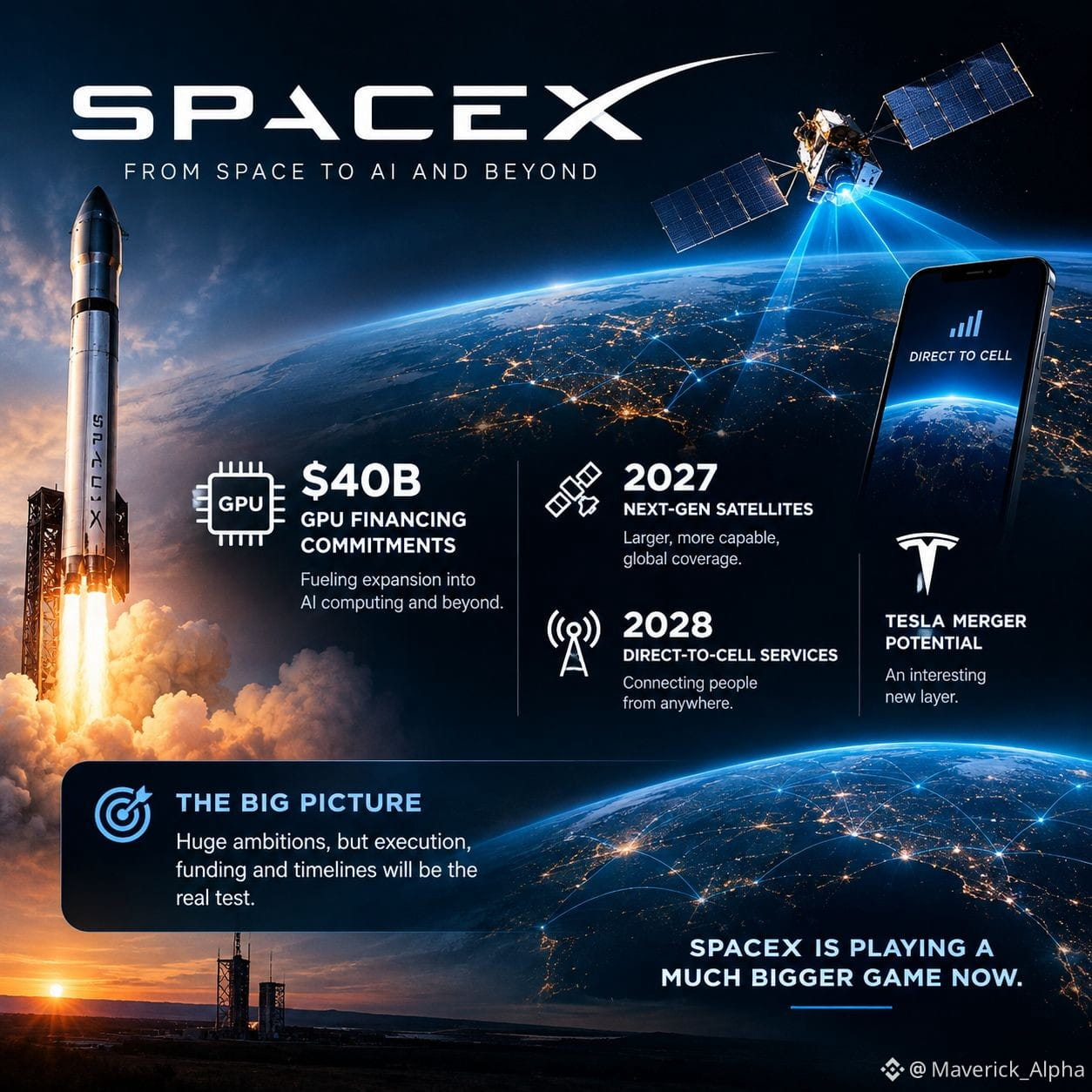
SpaceX is becoming much more than a space company.
Around $40B in GPU financing commitments could help fuel its expansion into AI computing and mobile connectivity.
Next-generation satellites are planned for 2027, with direct-to-cell services targeted for 2028.
The potential Tesla merger adds another interesting layer.
Big ambitions, but the real challenge will be execution, funding, and delivering on these timelines.
SpaceX is playing a much bigger game now.
#SpaceX #AI
$SPCX $TSLA
{future}(TSLAUSDT)
SpaceX is becoming much more than a space company.
Around $40B in GPU financing commitments could help fuel its expansion into AI computing and mobile connectivity.
Next-generation satellites are planned for 2027, with direct-to-cell services targeted for 2028.
The potential Tesla merger adds another interesting layer.
Big ambitions, but the real challenge will be execution, funding, and delivering on these timelines.
SpaceX is playing a much bigger game now.
#SpaceX #AI
$SPCX $TSLA
Around $40B in GPU financing commitments could help fuel its expansion into AI computing and mobile connectivity.
Next-generation satellites are planned for 2027, with direct-to-cell services targeted for 2028.
The potential Tesla merger adds another interesting layer.
Big ambitions, but the real challenge will be execution, funding, and delivering on these timelines.
SpaceX is playing a much bigger game now.
#SpaceX #AI
$SPCX $TSLA
279

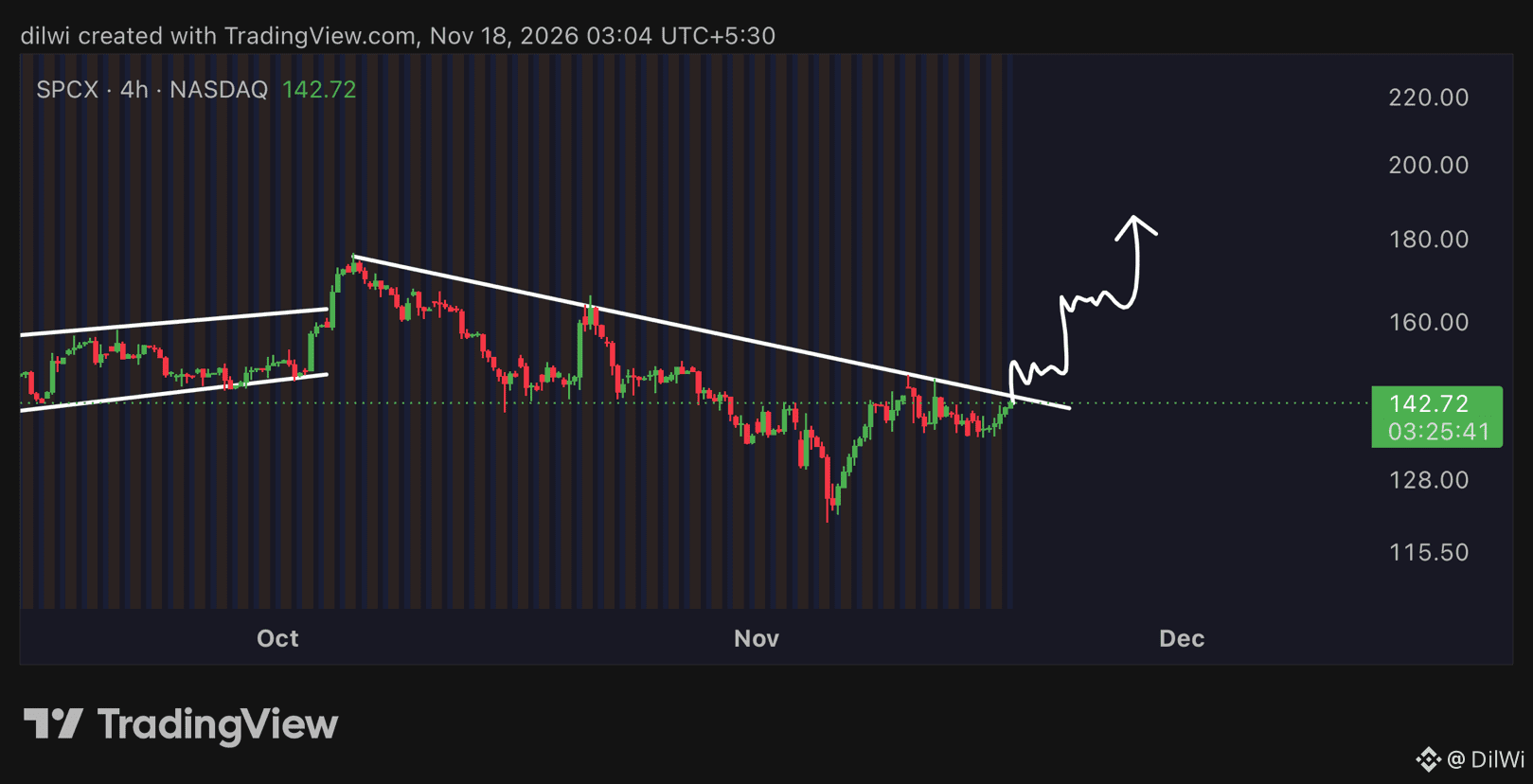

·
--
SpaceX’s AI computing capacity is now expanding at an infrastructure-scale pace.
👇
{web3_wallet_create}(10xcf91b70017eabde82c9671e30e5502d312ea6eb2)
At DealBook, Musk shared a set of figures worth unpacking: by the end of 2027, SpaceX plans to add more than 1 GW of ground-based AI computing capacity per month, bringing its total to around 15 GW.
For comparison, SpaceX had a nominal computing capacity of 1.7 GW in Q3 2025. In other words, by 2027, the computing capacity it adds in a single year will be several times its current scale—a pace of infrastructure expansion, not product iteration.
What does 15 GW mean? By Musk’s own account on an earnings call, it’s approaching the scale of “Amazon’s entire current computing capacity.” And the real bottleneck is no longer chips, but power delivery: “Perhaps a quarter of that 15 GW won’t be powered up on time.”
In the next phase of the AI computing race, pricing power won’t lie in process technology, but in watts.
$BTC $BNB #AI算力 #SpaceX #基础设施
SpaceX’s AI computing capacity is now expanding at an infrastructure-scale pace.
👇
At DealBook, Musk shared a set of figures worth unpacking: by the end of 2027, SpaceX plans to add more than 1 GW of ground-based AI computing capacity per month, bringing its total to around 15 GW.
For comparison, SpaceX had a nominal computing capacity of 1.7 GW in Q3 2025. In other words, by 2027, the computing capacity it adds in a single year will be several times its current scale—a pace of infrastructure expansion, not product iteration.
What does 15 GW mean? By Musk’s own account on an earnings call, it’s approaching the scale of “Amazon’s entire current computing capacity.” And the real bottleneck is no longer chips, but power delivery: “Perhaps a quarter of that 15 GW won’t be powered up on time.”
In the next phase of the AI computing race, pricing power won’t lie in process technology, but in watts.
$BTC $BNB #AI算力 #SpaceX #基础设施
👇
At DealBook, Musk shared a set of figures worth unpacking: by the end of 2027, SpaceX plans to add more than 1 GW of ground-based AI computing capacity per month, bringing its total to around 15 GW.
For comparison, SpaceX had a nominal computing capacity of 1.7 GW in Q3 2025. In other words, by 2027, the computing capacity it adds in a single year will be several times its current scale—a pace of infrastructure expansion, not product iteration.
What does 15 GW mean? By Musk’s own account on an earnings call, it’s approaching the scale of “Amazon’s entire current computing capacity.” And the real bottleneck is no longer chips, but power delivery: “Perhaps a quarter of that 15 GW won’t be powered up on time.”
In the next phase of the AI computing race, pricing power won’t lie in process technology, but in watts.
$BTC $BNB #AI算力 #SpaceX #基础设施

1
358

·
--
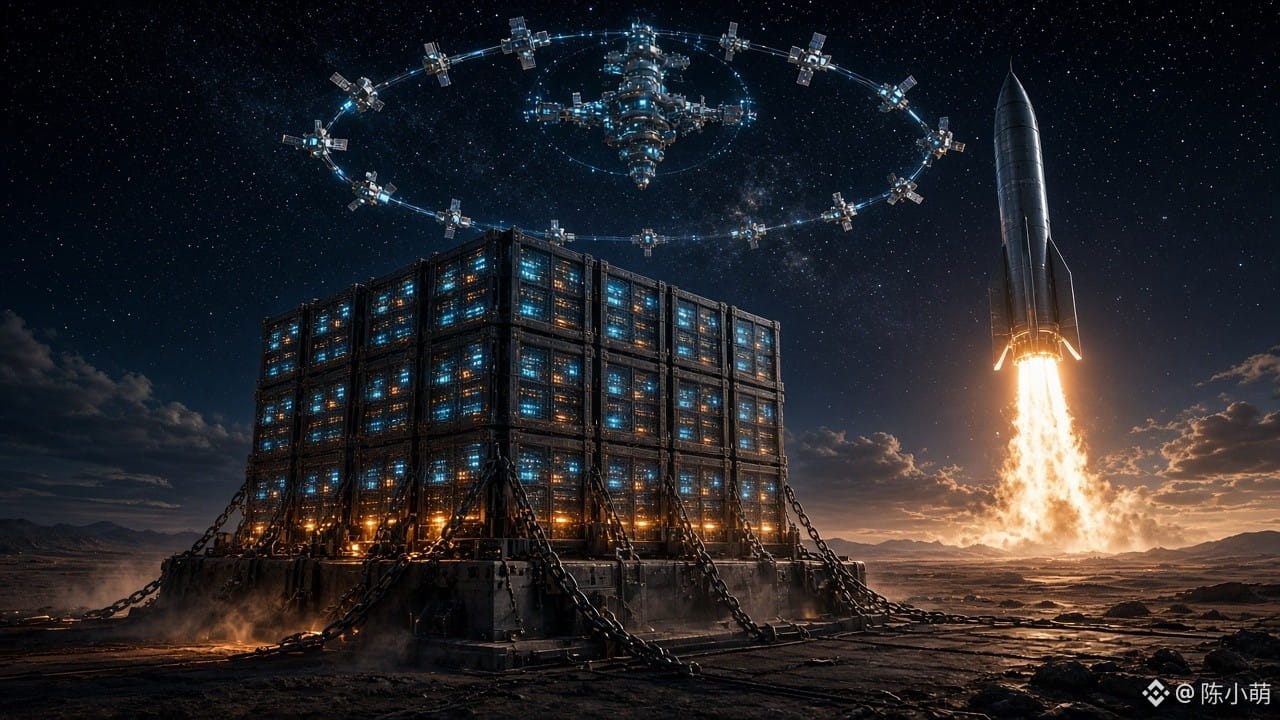
$43 billion in chip loans—and creditors are just afraid Musk will launch them into space 😂
▫️SpaceX’s latest $43 billion debt financing is backed by advanced Nvidia chips
▫️Creditors demanded an extra clause: the chips can’t be sent to orbital data centers, because if SpaceX defaults, they’d be impossible to recover and sell up there
▫️It’s still unclear whether this restriction made it into the final contract
▫️Of the total, $25 billion is investment-grade bonds, with an interest rate of about 8.3%; SpaceX says the chips will be kept in ground-based data centers
A rocket company uses chips as collateral for a loan, and the creditors’ first reaction is to prevent a launch? 👇 (Not investment advice)
#SpaceX #英伟达 #Musk
$43 billion in chip loans—and creditors are just afraid Musk will launch them into space 😂
▫️SpaceX’s latest $43 billion debt financing is backed by advanced Nvidia chips
▫️Creditors demanded an extra clause: the chips can’t be sent to orbital data centers, because if SpaceX defaults, they’d be impossible to recover and sell up there
▫️It’s still unclear whether this restriction made it into the final contract
▫️Of the total, $25 billion is investment-grade bonds, with an interest rate of about 8.3%; SpaceX says the chips will be kept in ground-based data centers
A rocket company uses chips as collateral for a loan, and the creditors’ first reaction is to prevent a launch? 👇 (Not investment advice)
#SpaceX #英伟达 #Musk
▫️SpaceX’s latest $43 billion debt financing is backed by advanced Nvidia chips
▫️Creditors demanded an extra clause: the chips can’t be sent to orbital data centers, because if SpaceX defaults, they’d be impossible to recover and sell up there
▫️It’s still unclear whether this restriction made it into the final contract
▫️Of the total, $25 billion is investment-grade bonds, with an interest rate of about 8.3%; SpaceX says the chips will be kept in ground-based data centers
A rocket company uses chips as collateral for a loan, and the creditors’ first reaction is to prevent a launch? 👇 (Not investment advice)
#SpaceX #英伟达 #Musk
725

·
--
Tesla closed at $374.41 on November 19, down 2.4% on the day and about 17% for the year. On the same day, the hottest topic in the market was not the drop, but a merger: Tesla and SpaceX have both formed independent board committees to study a merger of the two companies, potentially creating a behemoth worth about $3.4 trillion.
Well-known investor Gary Black poured cold water on the idea: even if SpaceX offered a 24% premium in a stock-swap deal, Tesla could still fall another 25% within a month, back to $280. On paper, it looks attractive—at $374, a 24% premium would mean $464—but to buy Tesla, SpaceX would need to issue about 50% more new shares, instantly diluting existing shareholders by half. Once the news breaks, people who receive the stock first sell to lock in profits, and the more shares are exchanged, the less valuable they become.
A cautionary example is right in front of us: when news broke on October 28 that Marvell was acquiring Lumentum, a 24% premium still failed to support the stock. By November 4, Lumentum had fallen 27% from before the news, and Marvell had fallen 31%; since then, Lumentum has dropped more than 40% in total.
A stock-swap acquisition simply means buying a company without cash, using your own stock as currency. Dilution means printing more and more shares, making the value per share thinner and thinner. The merger story is about Starship plus autonomous driving plus robots packaged for a public listing; the math is about something else entirely: the premium is on paper, while dilution is real. A pop and then pullback after the news is the more likely outcome, and chasing the rally would mean giving exit liquidity to the early sellers. The merger is still only at the committee-research stage, and the rumor alone can whipsaw the stock several times.#特斯拉 #SpaceX $TSLA $SPCX $QQQ
Tesla closed at $374.41 on November 19, down 2.4% on the day and about 17% for the year. On the same day, the hottest topic in the market was not the drop, but a merger: Tesla and SpaceX have both formed independent board committees to study a merger of the two companies, potentially creating a behemoth worth about $3.4 trillion.
Well-known investor Gary Black poured cold water on the idea: even if SpaceX offered a 24% premium in a stock-swap deal, Tesla could still fall another 25% within a month, back to $280. On paper, it looks attractive—at $374, a 24% premium would mean $464—but to buy Tesla, SpaceX would need to issue about 50% more new shares, instantly diluting existing shareholders by half. Once the news breaks, people who receive the stock first sell to lock in profits, and the more shares are exchanged, the less valuable they become.
A cautionary example is right in front of us: when news broke on October 28 that Marvell was acquiring Lumentum, a 24% premium still failed to support the stock. By November 4, Lumentum had fallen 27% from before the news, and Marvell had fallen 31%; since then, Lumentum has dropped more than 40% in total.
A stock-swap acquisition simply means buying a company without cash, using your own stock as currency. Dilution means printing more and more shares, making the value per share thinner and thinner. The merger story is about Starship plus autonomous driving plus robots packaged for a public listing; the math is about something else entirely: the premium is on paper, while dilution is real. A pop and then pullback after the news is the more likely outcome, and chasing the rally would mean giving exit liquidity to the early sellers. The merger is still only at the committee-research stage, and the rumor alone can whipsaw the stock several times.#特斯拉 #SpaceX $TSLA $SPCX $QQQ
Well-known investor Gary Black poured cold water on the idea: even if SpaceX offered a 24% premium in a stock-swap deal, Tesla could still fall another 25% within a month, back to $280. On paper, it looks attractive—at $374, a 24% premium would mean $464—but to buy Tesla, SpaceX would need to issue about 50% more new shares, instantly diluting existing shareholders by half. Once the news breaks, people who receive the stock first sell to lock in profits, and the more shares are exchanged, the less valuable they become.
A cautionary example is right in front of us: when news broke on October 28 that Marvell was acquiring Lumentum, a 24% premium still failed to support the stock. By November 4, Lumentum had fallen 27% from before the news, and Marvell had fallen 31%; since then, Lumentum has dropped more than 40% in total.
A stock-swap acquisition simply means buying a company without cash, using your own stock as currency. Dilution means printing more and more shares, making the value per share thinner and thinner. The merger story is about Starship plus autonomous driving plus robots packaged for a public listing; the math is about something else entirely: the premium is on paper, while dilution is real. A pop and then pullback after the news is the more likely outcome, and chasing the rally would mean giving exit liquidity to the early sellers. The merger is still only at the committee-research stage, and the rumor alone can whipsaw the stock several times.#特斯拉 #SpaceX $TSLA $SPCX $QQQ
197
·
--
Bearish
$SPCX Market Update Today 🚀
SpaceX is gaining investor attention as ARK Invest bought around $52.7 million worth of its shares. Starship's successful upper-stage recovery is also boosting confidence. However, broader market weakness is affecting the stock. TipRanks +1
📉 Price Direction: Slipping slightly today as market selling pressure continues.
{future}(SPCXUSDT)
#SPCX #SpaceX #crypto #BinanceSquare
$SPCX Market Update Today 🚀
SpaceX is gaining investor attention as ARK Invest bought around $52.7 million worth of its shares. Starship's successful upper-stage recovery is also boosting confidence. However, broader market weakness is affecting the stock. TipRanks +1
📉 Price Direction: Slipping slightly today as market selling pressure continues.
#SPCX #SpaceX #crypto #BinanceSquare
SpaceX is gaining investor attention as ARK Invest bought around $52.7 million worth of its shares. Starship's successful upper-stage recovery is also boosting confidence. However, broader market weakness is affecting the stock. TipRanks +1
📉 Price Direction: Slipping slightly today as market selling pressure continues.
#SPCX #SpaceX #crypto #BinanceSquare
218

·
--
Bullish
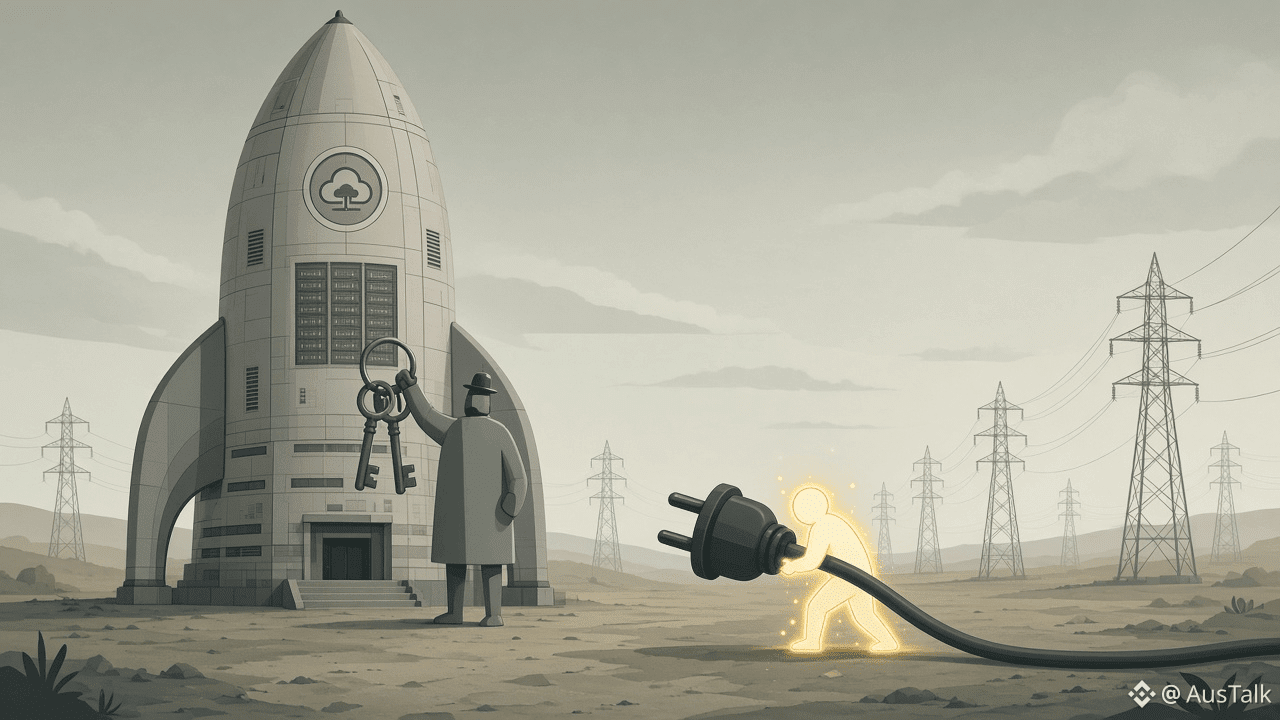
Musk said at DealBook that Anthropic is “highly likely” to keep renting computing capacity from SpaceX, most likely asking for another 10 gigawatts
The current deal covers all of Colossus 1: more than 300 megawatts and over 220,000 Nvidia GPUs. SpaceX’s prospectus says Anthropic pays about $1.25 billion a month
10 gigawatts is more than 30 times the current scale. Anthropic itself hasn’t confirmed it, and it’s a short-term contract that can be terminated with three to six months’ notice
The landlord is reporting what the tenant needs—and it just happens to be the day before the tenant goes public. Think about the logic there, and then think about what’s really going on
$ANTHROPIC
$SPCX
{future}(SPCXUSDT)
#Anthropic #SpaceX
Musk said at DealBook that Anthropic is “highly likely” to keep renting computing capacity from SpaceX, most likely asking for another 10 gigawatts
The current deal covers all of Colossus 1: more than 300 megawatts and over 220,000 Nvidia GPUs. SpaceX’s prospectus says Anthropic pays about $1.25 billion a month
10 gigawatts is more than 30 times the current scale. Anthropic itself hasn’t confirmed it, and it’s a short-term contract that can be terminated with three to six months’ notice
The landlord is reporting what the tenant needs—and it just happens to be the day before the tenant goes public. Think about the logic there, and then think about what’s really going on
$ANTHROPIC
$SPCX
#Anthropic #SpaceX
The current deal covers all of Colossus 1: more than 300 megawatts and over 220,000 Nvidia GPUs. SpaceX’s prospectus says Anthropic pays about $1.25 billion a month
10 gigawatts is more than 30 times the current scale. Anthropic itself hasn’t confirmed it, and it’s a short-term contract that can be terminated with three to six months’ notice
The landlord is reporting what the tenant needs—and it just happens to be the day before the tenant goes public. Think about the logic there, and then think about what’s really going on
$ANTHROPIC
$SPCX
#Anthropic #SpaceX
471
Log in to explore more content
Join global crypto users on Binance Square
⚡️ Get latest and useful information about crypto.
💬 Trusted by the world’s largest crypto exchange.
👍 Discover real insights from verified creators.
Email / Phone number
Trending Topics
1
#CanBTCReboundAfterFallingBelow60K?
0 views
115 Discussing
2
#GlobalStocksFaceLongestLosingStreakSince2023
0 views
272 Discussing
3
#AnthropicPlungesTowardIPOPriceonDay2
0 views
43 Discussing
4
#GaoTengBitcoinETFListsOnHKEX
0 views
264 Discussing
5
#TradFiForBeginners
946,825 views
5,525 Discussing
6
#NvidiaBoardReportedlySplitOverHuang’sReturn
258,674 views
2,409 Discussing
7
#TetherBurns8BillionUSDTInPast20Days
0 views
101 Discussing
8
#BitcoinWalletSignatureFlawExploitableWithinSeconds
0 views
44 Discussing
9
#CanGTA6'sLaunchLiftTTWOShares?
207,868 views
1,711 Discussing
10
#HongKongProposesSFCLicensingForFourVirtualAssetServices
404 views
32 Discussing