
#visa
visa
573,989 views
1,525 Discussing
Hot
Latest

·
--
#VisaPlansStablecoinPrefundingForAPAC
CrossBorderPayments
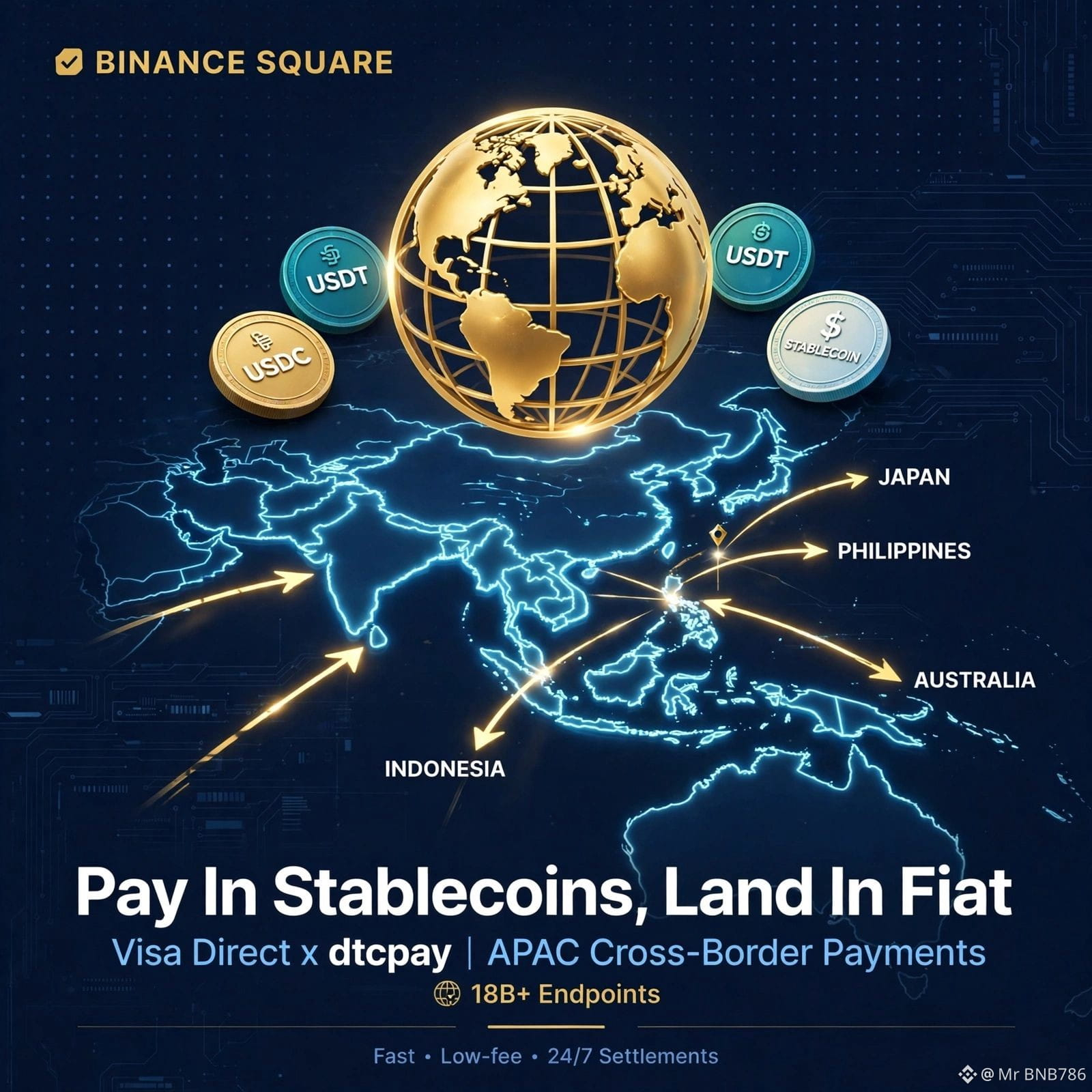
💸 Pay In Stablecoins, Land In Fiat: Visa Direct Hits APAC
Visa just made a big move at the Singapore FinTech Festival! Eligible Asia-Pacific clients can now fund cross-border payouts with stablecoins through Visa Direct, while recipients still receive local fiat.
The pilot is with Singapore-based licensed firm dtcpay, with Triple-A handling conversion, settlement, and compliance.
Why it matters:
- No need to lock huge fiat in advance for prefunding
- Funding outside banking hours / 24/7 flexibility
- Access to Visa Direct's 18B+ endpoints
- APAC already accounts for around 1/3 of global cross-border flows
This already went live in the US in Oct 2026 with Inyo Global using USDC. Now it's APAC's turn.
Do you think stablecoins are the future of cross-border payments, or will fiat rails still dominate?
#Visa #Stablecoin #USDC #USDT #VisaDirect #CryptoNews #APAC
99

·
--
#VisaPlansStablecoinPrefundingForAPACCrossBorderPayments
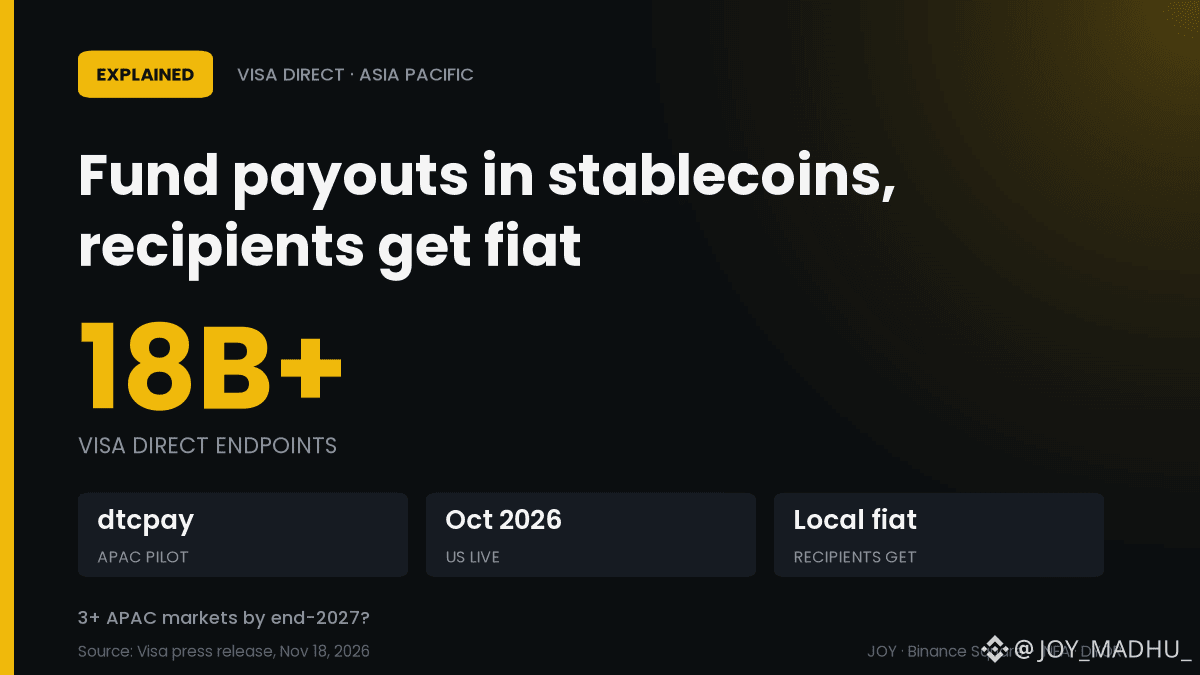
💸 Pay In Stablecoins, Land In Fiat: Visa Direct Hits APAC
Visa will let eligible Asia-Pacific clients prefund cross-border payouts with stablecoins, while recipients still get local fiat.
📊 Visa Direct reaches 18B+ endpoints worldwide
📅 US version went live in Oct with Inyo Global, using USDC
🏦 Singapore's dtcpay runs the APAC pilot
⚠️ Visa itself offers no digital asset services
My read: plumbing like this is how stablecoins scale quietly.
Live in 3+ APAC markets by end-2027, yes or no? 👇
$USDC
#VisaPlansStablecoinPrefundingForAPACCrossBorderPayments #Stablecoins #Visa
90

·
--
💳 VISA WANTS TO USE STABLECOINS FOR INTERNATIONAL TRANSFERS!
The major payments giant continues to integrate crypto technology into traditional finance.
Visa announced a new feature: its partners in the Asia-Pacific region will be able to fund international payouts using stablecoins.
How will it work? 👇
💵 Businesses use a supported stablecoin to top up their balance.
🌍 The recipient receives regular fiat currency.
⚡ Companies gain more flexibility in managing liquidity.
This is another example of how crypto is gradually moving beyond exchanges.
And the most interesting part — Visa is already moving these solutions from testing to real-world use.
🤔 Will USDT and USDC become part of everyday international payments in the future?
#Visa #Stablecoins #USDC
299

·
--
Visa wants businesses in Asia Pacific to fund cross-border payouts with stablecoins while recipients still receive regular cash.
On November 18, 2026, Visa announced plans to let eligible Asia Pacific clients use supported stablecoins to prefund cross-border payouts through Visa Direct, its real-time money movement platform. Recipients still get fiat, and the network reaches more than 18 billion endpoints. Visa is piloting the setup with dtcpay, a Singapore-based digital payments company, with independently provided digital asset infrastructure handling the stablecoin side.
The move extends a capability Visa first piloted in 2025 and took into commercial production in the United States with Inyo Global in October 2026. Visa says stablecoin prefunding gives businesses more flexibility in managing short-term liquidity and treasury across markets and time zones. The specific stablecoins, eligible markets and a wider launch date were not disclosed.
#Stablecoins #Visa #Payments
DYOR. Not financial advice.
{stock_us}(V.US)
Visa wants businesses in Asia Pacific to fund cross-border payouts with stablecoins while recipients still receive regular cash.
On November 18, 2026, Visa announced plans to let eligible Asia Pacific clients use supported stablecoins to prefund cross-border payouts through Visa Direct, its real-time money movement platform. Recipients still get fiat, and the network reaches more than 18 billion endpoints. Visa is piloting the setup with dtcpay, a Singapore-based digital payments company, with independently provided digital asset infrastructure handling the stablecoin side.
The move extends a capability Visa first piloted in 2025 and took into commercial production in the United States with Inyo Global in October 2026. Visa says stablecoin prefunding gives businesses more flexibility in managing short-term liquidity and treasury across markets and time zones. The specific stablecoins, eligible markets and a wider launch date were not disclosed.
#Stablecoins #Visa #Payments
DYOR. Not financial advice.

VUS+0.56%
43

Visa expands the use of stablecoins for international payments in Asia-Pacific
Visa has announced that it will expand its stablecoin prefunding program for eligible Visa Direct clients in the Asia-Pacific region. The initiative will enable cross-border payments to be funded using stable digital currencies, making international transfers faster and more efficient. With this move, Visa aims to strengthen its digital payment solutions in key markets across the region.
$ENA $SOL $BTC
#Visa #Stablecoin #InternationalPayments
1
71

·
--
Verified
Article
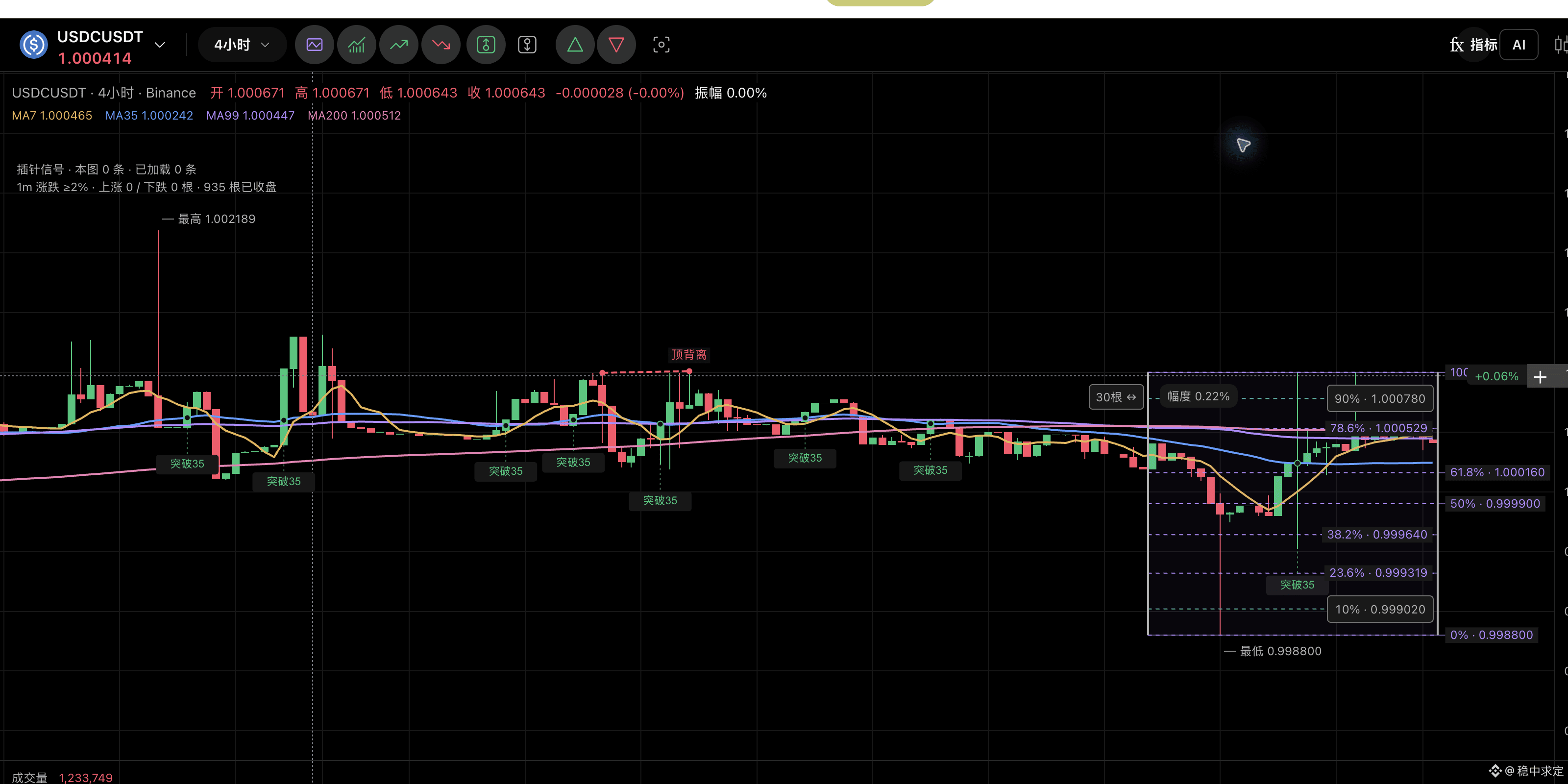
Visa brings stablecoin prefunding to Asia-Pacific: USDC gets an entry point, but this isn’t new buying demandVisa brings stablecoin prefunding to Asia-Pacific: USDC gets an entry point, but this isn’t new buying demand
The bottom line: The `#VisaPlansStablecoinPrefundingForAPACCrossBorderPayments` currently visible on Binance Square’s trending page corresponds to a new Asia-Pacific pilot announced by Visa on November 18. The real change is not that “Visa is starting to buy USDC for businesses,” but that eligible Visa Direct clients can use supported stablecoins to prefund cross-border fiat payouts, with recipients still receiving fiat currency.
1. What happened?
Official Visa announcement: https://www.visa.com.sg/about-visa/newsroom/press-releases/visa-direct-advances-stablecoin-powered-money-movement-in-asia-pacific.html. The announcement says that Singapore digital payments company dtcpay is participating in the pilot, with stablecoin funds entering Visa Direct’s prefunding process, while the final payout still reaches the recipient in fiat currency. Visa describes this as connecting on-chain funds with its existing cross-border payments network, and says its network covers more than 18 billion endpoints.
Visa brings stablecoin prefunding to Asia-Pacific: USDC gets an entry point, but this isn’t new buying demand
Visa brings stablecoin prefunding to Asia-Pacific: USDC gets an entry point, but this isn’t new buying demand
The bottom line: The `#VisaPlansStablecoinPrefundingForAPACCrossBorderPayments` currently visible on Binance Square’s trending page corresponds to a new Asia-Pacific pilot announced by Visa on November 18. The real change is not that “Visa is starting to buy USDC for businesses,” but that eligible Visa Direct clients can use supported stablecoins to prefund cross-border fiat payouts, with recipients still receiving fiat currency.
1. What happened?
Official Visa announcement: https://www.visa.com.sg/about-visa/newsroom/press-releases/visa-direct-advances-stablecoin-powered-money-movement-in-asia-pacific.html. The announcement says that Singapore digital payments company dtcpay is participating in the pilot, with stablecoin funds entering Visa Direct’s prefunding process, while the final payout still reaches the recipient in fiat currency. Visa describes this as connecting on-chain funds with its existing cross-border payments network, and says its network covers more than 18 billion endpoints.
546

Visa expands the use of stablecoins for international payments in Asia-Pacific
Visa has announced that it will expand its stablecoin prefunding program for eligible Visa Direct clients in the Asia-Pacific region. The initiative will enable cross-border payments to be funded using stable digital currencies, making international transfers faster and more efficient. With this move, Visa aims to strengthen its digital payment solutions in key markets across the region.
$ENA $SOL $BTC
#Visa #Stablecoin #InternationalPayments
59

·
--
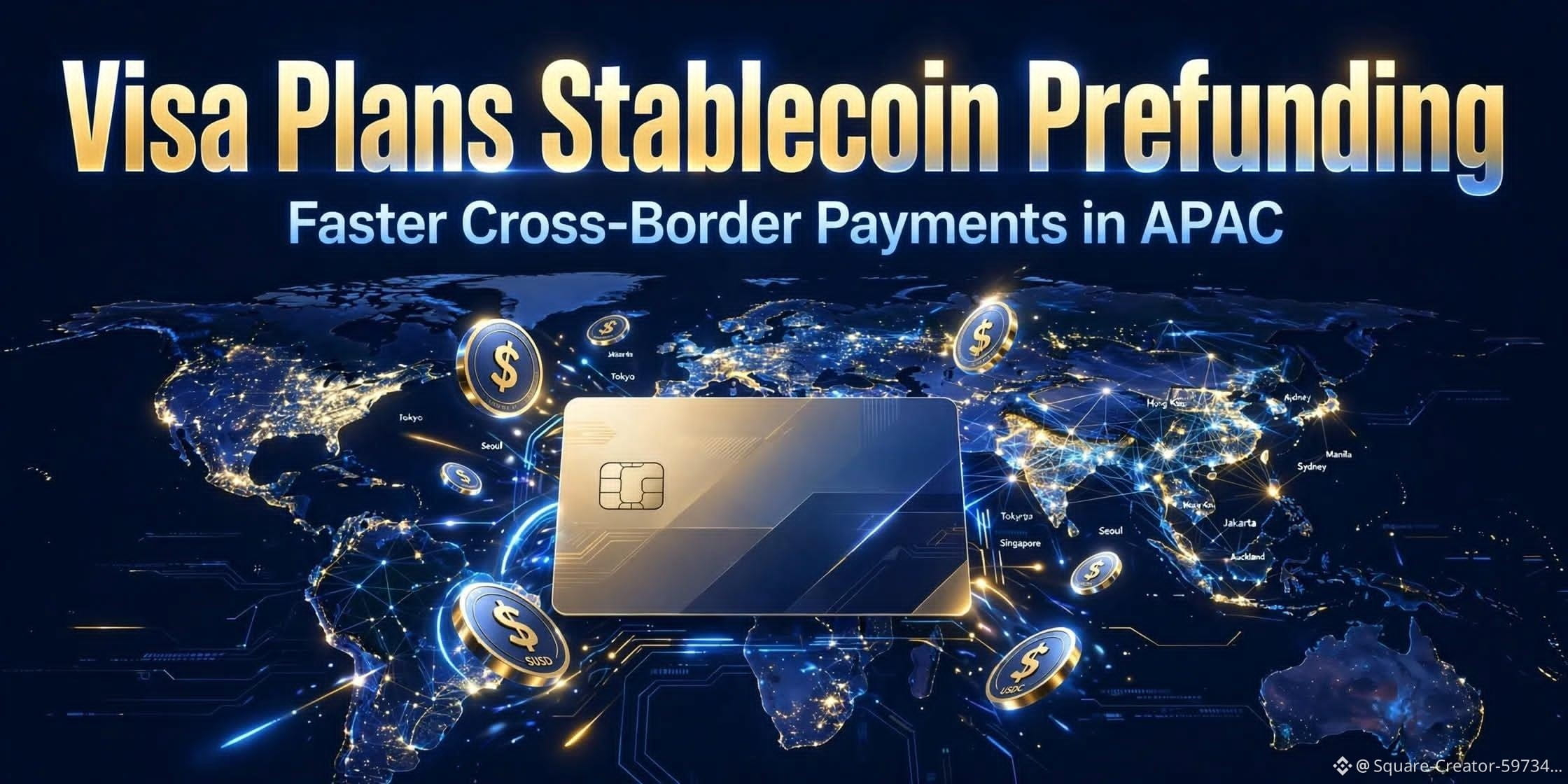
#VisaPlansStablecoinPrefundingForAPAC
> Visa is getting ready for something big in Asia 🔥
>
> Visa plans to use stablecoins to provide funding for cross-border payments in the Asia-Pacific region (APAC).
>
> What does this mean?
> It means transfers between countries will become much faster and cheaper, without having to wait days for banks.
>
> This shows that big companies are starting to believe in crypto—not just as talk, but as a real payment solution.
>
> Do you think stablecoins will become the future of global transfers, or will banks continue to dominate the market?
>
> #Visa #stablecoin #Crypto #BTC
خديجة-:
1
60
7
71

·
--
Visa is putting stablecoins into the back end of cross-border remittances, while recipients still receive fiat currency.
On November 18, Visa announced a pilot with dtcpay in Asia Pacific: pre-fund payments with supported stablecoins, then pay out in fiat currency through Visa Direct. Similar capabilities entered commercial operation in the U.S. with Inyo Global in October; in Asia Pacific, they are still at the pilot stage.
What I think is worth testing is whether payment institutions can tie up less money in pre-funding without having the savings offset by conversion fees. The announcement’s footnote also says that digital asset services are provided by an independent licensed partner. Next, we’ll need to look at the participating regions, foreign exchange and total fees, and actual settlement times. Only these data can show whether changing the back end really improves cross-border payments.
#Visa This is not investment advice.
VZUS+1.49%
46

·
--
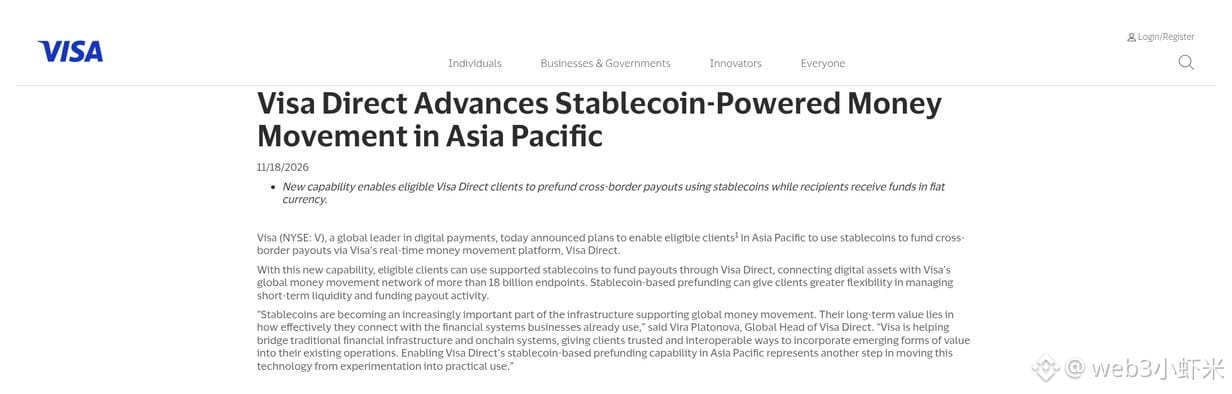
Visa announced on its official website today that Visa Direct plans to let eligible customers in Asia Pacific pre-fund cross-border payouts using supported stablecoins, while recipients continue to receive fiat currency.
The company said the capability entered commercial production in the U.S. with Inyo Global this October, while in Asia Pacific it will first be piloted with Singapore’s dtcpay. Visa Direct’s official network is said to cover more than 18 billion endpoints.
Using stablecoins to top up liquidity while keeping payouts in fiat is a more practical way to implement this.
#Visa #Stablecoins

25

·
--
VISA Adds Western Union's $WU.US Stablecoin to Its Settlement Network — Traditional Finance Moves Deeper Into Crypto!
Visa and Anchorage Digital are expanding institutional stablecoin adoption by enabling eligible partners to settle VisaNet obligations using Western Union's $WU.US . This development strengthens the connection between traditional payment networks and blockchain-based financial infrastructure.
#Visa #WesternUnion #USDPT #Stablecoins #CryptoNews
{spot}(SOLUSDT)
{stock_us}(WU.US)
VISA Adds Western Union's $WU.US Stablecoin to Its Settlement Network — Traditional Finance Moves Deeper Into Crypto!
Visa and Anchorage Digital are expanding institutional stablecoin adoption by enabling eligible partners to settle VisaNet obligations using Western Union's $WU.US . This development strengthens the connection between traditional payment networks and blockchain-based financial infrastructure.
#Visa #WesternUnion #USDPT #Stablecoins #CryptoNews

SOL+2.99%
WUUS-1.61%
149

·
--
🚨 VISA IS TAKING STABLECOINS TO THE NEXT LEVEL! 🌍
Traditional finance and blockchain are getting closer!
🔥 What's new?
Visa has added Western Union's USDPT stablecoin to its VisaNet settlement infrastructure.
Why is this important?
🔹 Blockchain-based settlement is gaining attention.
🔹 Financial institutions are exploring stablecoin payments.
🔹 Digital assets are becoming part of traditional financial infrastructure.
This isn't just about crypto trading — it's about how money moves around the world.
⚠️ Adoption is still developing, and stablecoins carry issuer, regulatory and operational risks.
💬 Your thoughts: Will stablecoins become a major part of global payments?
#Visa #Stablecoin #WesternUnion #Blockchain #Crypto #Web3 #BinanceSquare#CryptoSelloffTriggersMultipleWhaleLiquidations

V-0.83%
WUUS-1.61%
KYFKON:
SUBHAN ALLAH 🌟
JAZAK ALLAH 🌟
1
2
168
·
--
Visa and eligible partners can now settle VisaNet obligations using Western Union's USDPT stablecoin, Anchorage Digital said on November 12, 2026.
Anchorage Digital Bank, N.A. said it is collaborating with Visa to support select stablecoins issued by the federally chartered bank as native settlement assets on the Visa network, starting with USDPT. The Western Union token is the first Anchorage-issued stablecoin to be supported in that role. Anchorage said USDPT is fully backed by U.S. dollars and cash equivalents and is redeemable one-for-one.
Visa and eligible partners now have the option to use USDPT to settle VisaNet obligations. Dan Roesbery, Visa's vice president of global crypto partnerships, said the move gives partners another institution-grade settlement choice backed by a federally chartered bank. The firms also described a framework to explore support for additional Anchorage-issued stablecoins later; the announcement did not name other tokens or a settlement chain.
#Stablecoin #Visa #Payments
DYOR. Not financial advice.

WUUS-1.61%
8

·
--
VISA $V AND WESTERN UNION MERGE PAYMENTS AND BLOCKCHAIN: STABLECOINS REACH A NEW LEVEL!
The cryptocurrency industry has received another major signal from traditional finance. Visa $V has partnered with Anchorage Digital to integrate Western Union’s USDPT stablecoin into its VisaNet payment network.
This initiative centers on utilizing USDPT for settlement operations directly within Visa's payment infrastructure, combining the efficiency of stablecoins with the scale of a global payment network.
The crypto market is advancing not only through the price appreciation of $BTC and altcoins. An equally critical development is unfolding in the payments sector, as major corporations steadily integrate blockchain technology into everyday financial operations.
Solutions of this caliber are positioned to serve as the foundation for the next phase of mass cryptocurrency adoption.
#CryptoNews #Visa #Stablecoins
130

·
--
💰 Visa expands stablecoin settlements: Western Union’s USDPT added
On November 12, 2026, Anchorage Digital announced a partnership with Visa: Visa and eligible partners can now settle VisaNet obligations in USDPT, a stablecoin issued by Western Union. The token is issued by regulated U.S. institution Anchorage Digital Bank.
This concerns settlements between participants in the payment network, not a new feature for all Visa cardholders to pay for purchases. USDPT launched on Solana in May, but the companies did not specify which blockchain will be used for settlements under the new agreement.
The parties also provided for the possibility of considering other Anchorage stablecoins in the future. Their integration has not yet been announced.
Source: Anchorage Digital, The Block, November 12, 2026.
#Stablecoins #Visa
28

·
--
“Can now be used to settle Visa payments”: Western Union’s $USDPT joins the settlement network, according to an announcement from its issuerFirst, let's put the source on the table. On November 12, Anchorage Digital issued an official press release: certain stablecoins issued by Anchorage Digital Bank can be used as native settlement assets on the Visa network. The first is Western Union's $USDPT.
In plain English: Visa and eligible partners can now choose to use $USDPT to settle payables on VisaNet. The release says “can now choose,” not “will explore a partnership in the future” in yet another memo.
This is the first stablecoin issued by Anchorage itself to be included in this arrangement. The two sides left the door open to evaluating whether to add other stablecoins it issues later—evaluating, not putting them on the schedule already.
“Can now be used to settle Visa payments”: Western Union’s $USDPT joins the settlement network, according to an announcement from its issuer
First, let's put the source on the table. On November 12, Anchorage Digital issued an official press release: certain stablecoins issued by Anchorage Digital Bank can be used as native settlement assets on the Visa network. The first is Western Union's $USDPT.
In plain English: Visa and eligible partners can now choose to use $USDPT to settle payables on VisaNet. The release says “can now choose,” not “will explore a partnership in the future” in yet another memo.
This is the first stablecoin issued by Anchorage itself to be included in this arrangement. The two sides left the door open to evaluating whether to add other stablecoins it issues later—evaluating, not putting them on the schedule already.
164

·
--
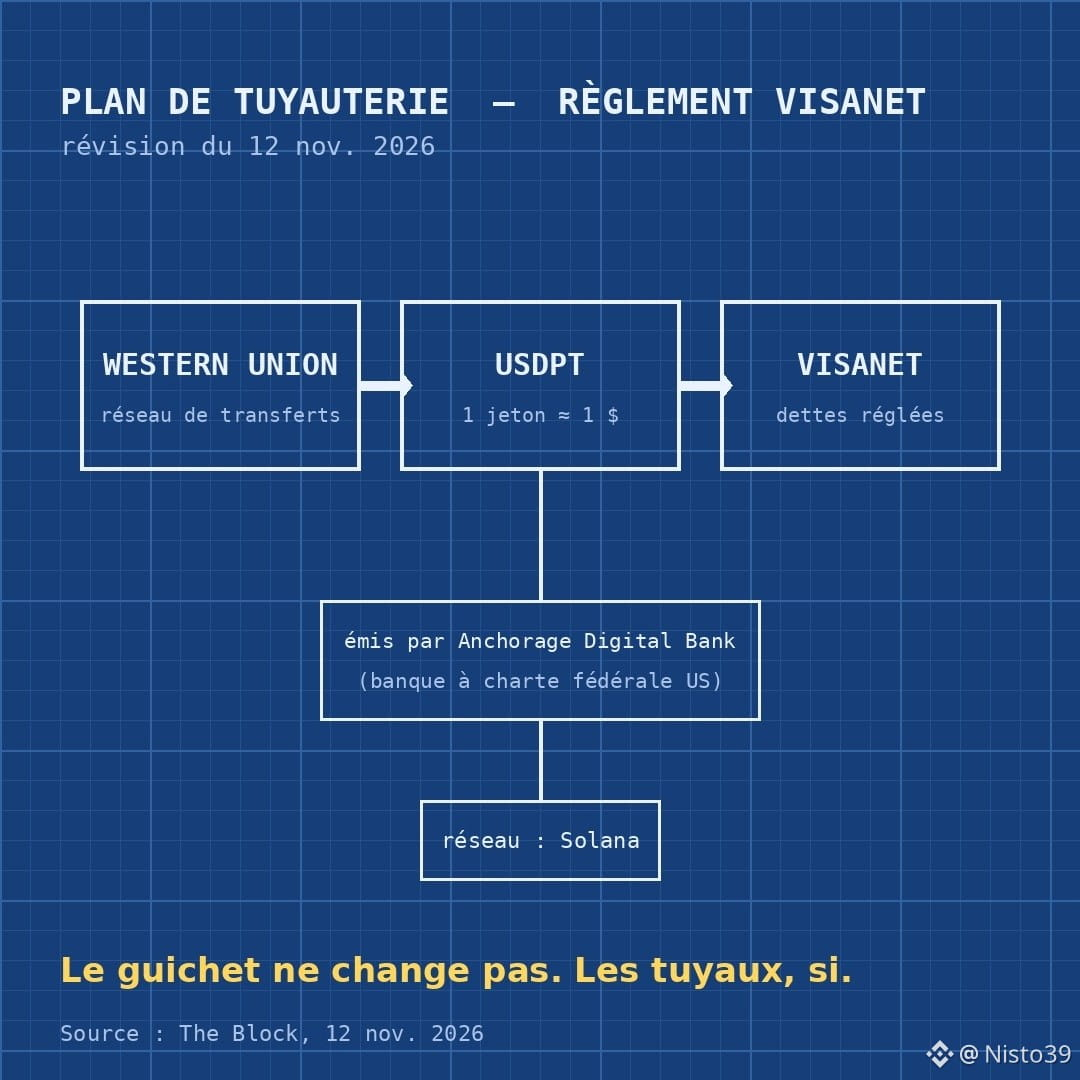
Simple question: when your family sends you money through Western Union, do you think the dollars actually travel?
No. Behind the counter, banks and card networks owe each other money and settle their accounts later, on business days. That’s the plumbing that has just changed a little.
Since November 12 (The Block), Visa and its eligible partners can settle their debts on VisaNet with USDPT, Western Union’s stablecoin. A stablecoin is a token that is supposed to always be worth $1, backed by reserves. This one is issued by Anchorage Digital Bank, a US federally chartered bank, and has been running on $SOL since its launch in May, first in the Philippines and Bolivia.
A few points of reference:
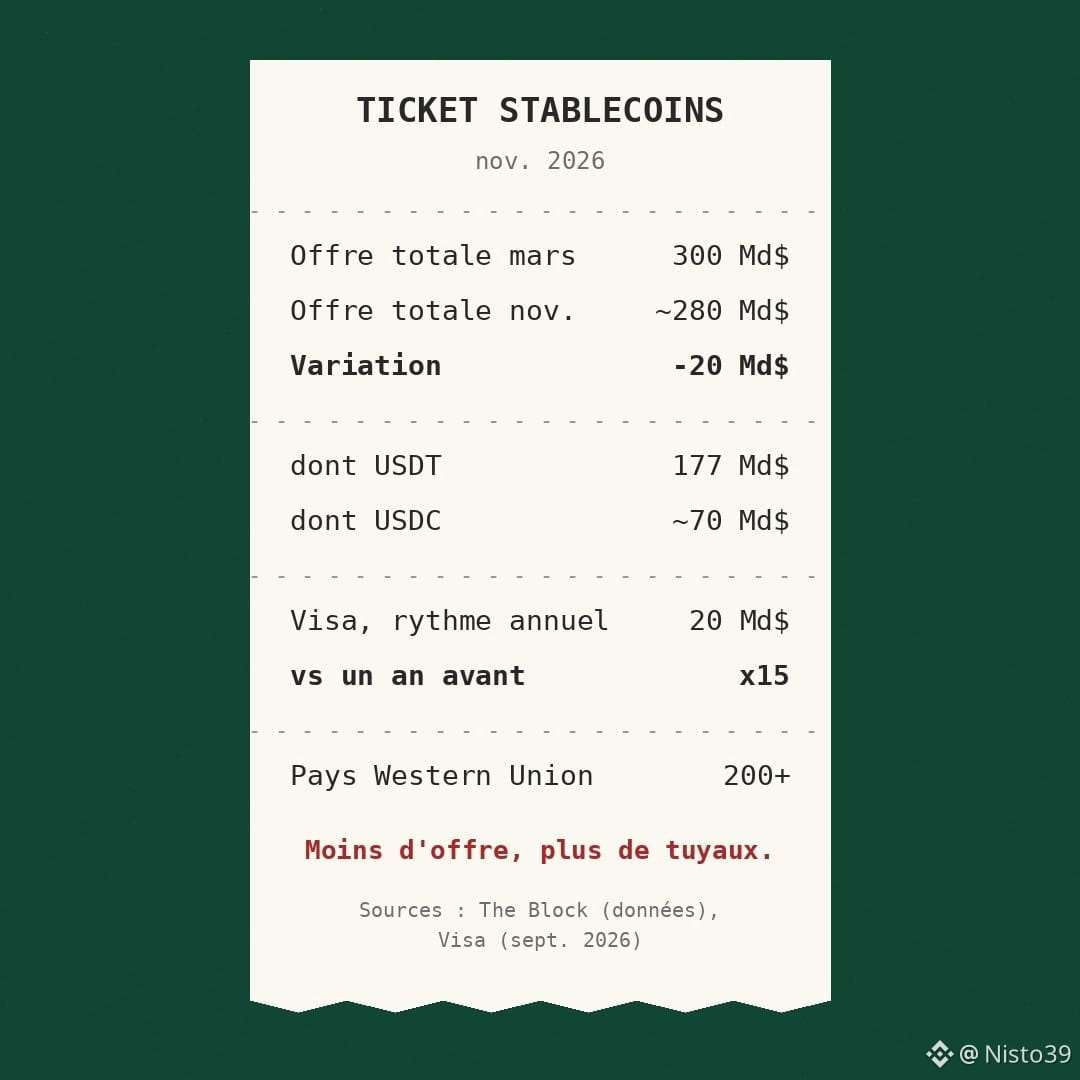
• Western Union is aiming for 24/7 settlements across a network of more than 200 countries
• In September, Visa announced an annualized rate of $20 billion settled in stablecoins, 15 times more than a year earlier
• At the same time, the total supply of stablecoins is shrinking: about $280 billion, down from $300 billion in March, including $177 billion in $USDT
What won’t change tomorrow morning: the person collecting money in Dakar or Douala probably won’t notice any difference at the counter. Fees, exchange rates, waiting times—all of that still depends on Western Union and its local agents.
My take: it’s less spectacular than a consumer launch, and therefore more important. Stablecoins are gaining ground where nobody’s looking—in the back office. The real question is whether the savings from these settlements will ever end up in the sender’s pocket, or only in profit margins.
How much less would you have to pay to send $100 before you’d say it had really made a difference?
#Stablecoins #WesternUnion #Visa #Transferts
342

·
--
🚨 VISA IS BRINGING STABLECOINS INTO ITS PAYMENT NETWORK!
A major step for crypto adoption!
Visa and Anchorage Digital have enabled stablecoin settlements on Visa's network, starting with Western Union's USDPT.
🔥 WHY IT MATTERS:
• Traditional payments are moving closer to blockchain.
• Stablecoins could make financial settlements faster.
• More institutions may explore crypto-based payment systems.
💡 MY TAKE:
This is the kind of real-world adoption that could shape the future of crypto.
👇 Do you think stablecoins will become a normal part of everyday payments?
#CryptoNews #Stablecoins #Visa #blockchain

142

·
--
Visa opens its settlement network to Western Union’s stablecoin — but not for paying at the checkout.
The facts: Anchorage Digital announced on Nov. 12, 2026, that Visa and eligible partners can now settle obligations on VisaNet using USDPT, a Western Union stablecoin issued by Anchorage Digital Bank. USDPT is the first Anchorage-issued stablecoin to be supported as a native settlement asset on VisaNet, with a framework in place to add other Anchorage stablecoins. USDPT is a Solana-based token, launched in May 2026 and backed 1:1 by the U.S. dollar. Visa’s stablecoin settlement volume is already above $25 billion a year — up 10x in a year — with more than 225 related card programs.
My take: what matters isn’t USDPT itself, but the pattern — the world’s largest payments network is now using stablecoins to settle obligations between institutions. The limits are clear: this is institutional settlement, not consumer payments, and Visa itself hasn’t issued an official statement; the announcement came from Anchorage.
What I’m watching: which Anchorage stablecoin is next to join VisaNet, and whether USDPT volume actually materializes — so far, no figures have been reported.
What do you think: will institutional settlement like this transform markets first, or is consumer adoption more important?
This is my analysis, not financial advice — always DYOR.
#Stablecoin #Visa $SOL
2

The market is getting crushed, but Visa is laying the groundwork: Western Union’s USDPT stablecoin is now officially connected to VisaNet for settlement. Visa’s stablecoin settlements are running at an annualized $25 billion—10 times higher than a year ago—with 225+ card programs already underway. USDPT is issued on Solana.
$BTC 68, 600 is grinding out a bottom, while $SOL 80 dollars swing around—is this the bear market moment when institutions move settlement rails on-chain? Are you following or waiting?
A Institutional groundwork is a bottom signal
B A bullish-news fakeout; first see whether 68,000 can hold
$SOL $BTC
#Visa #稳定币 #Solana

9
Log in to explore more content
Join global crypto users on Binance Square
⚡️ Get latest and useful information about crypto.
💬 Trusted by the world’s largest crypto exchange.
👍 Discover real insights from verified creators.
Email / Phone number
Trending Topics
1
#NvidiaLoses$2.7TrillionInMonthAndAHalf
8,403 views
86 Discussing
2
#CanBTCReboundAfterFallingBelow60K?
642,775 views
2,723 Discussing
3
#GlobalStocksFaceLongestLosingStreakSince2023
227,919 views
1,861 Discussing
4
#BlackRockIBITPostsRecord$541MSingleDayOutflow
23,353 views
69 Discussing
5
#AnthropicPlungesTowardIPOPriceonDay2
113,446 views
1,104 Discussing
6
#TwentyOneCapitalAdds172.25BTC
49,251 views
588 Discussing
7
#HKBillWouldExcludeTokenizedDepositsFromVirtualAssets
5,630 views
48 Discussing
8
#BNBDropsBelow540USDTWith8.46%DailyDecline
64,279 views
583 Discussing
9
#HKBillProposesHK$100KFineForUnauthorizedCryptoTitles
2,174 views
21 Discussing
10
#BitMineFaces$10.1BUnrealizedETHLoss
4,413 views
25 Discussing