
#cftc
cftc
2M views
5,011 Discussing
Hot
Latest

·
--
Bearish
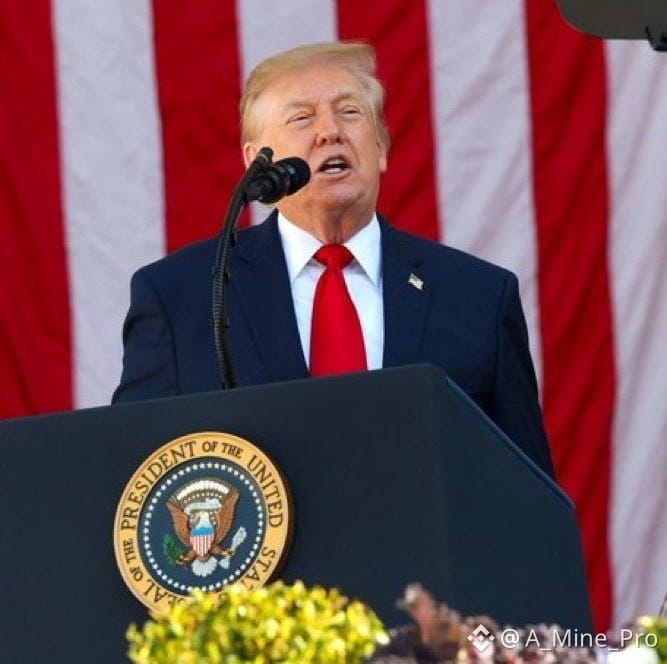
🚨BREAKING: #CFTC STAFF REPORTEDLY INVESTIGATED THE #TRUMP ’S #memecoin 🚨
The CFTC staff reportedly launched an insider trading probe shortly after the token’s launch.
The investigation was later dropped.
Staff reportedly feared CFTC leadership won’t approve subpoenas needed to move forward.
Another controversy surrounding Trump’s ventures.
#CanBTCReboundAfterFallingBelow60K? .
#GlobalStocksFaceLongestLosingStreakSince2023 .
$BTC
{future}(BTCUSDT)
.$ETH
{future}(ETHUSDT)
.$TRUMP
{future}(TRUMPUSDT)
🚨BREAKING: #CFTC STAFF REPORTEDLY INVESTIGATED THE #TRUMP ’S #memecoin 🚨
The CFTC staff reportedly launched an insider trading probe shortly after the token’s launch.
The investigation was later dropped.
Staff reportedly feared CFTC leadership won’t approve subpoenas needed to move forward.
Another controversy surrounding Trump’s ventures.
#CanBTCReboundAfterFallingBelow60K? .
#GlobalStocksFaceLongestLosingStreakSince2023 .
$BTC
.$ETH
.$TRUMP
403

·
--
Prediction markets face a state-level showdown. US District Judge Lorna Schofield denied the CFTC's emergency bid to stop New York Attorney General Letitia James from seeking a restraining order against Kalshi, finding the CFTC hadn't shown it was likely to win on federal preemption. A New York state court hearing is set for Monday, and Kalshi warns an order could shut its whole exchange. #Kalshi #PredictionMarkets #CFTC
Prediction markets face a state-level showdown. US District Judge Lorna Schofield denied the CFTC's emergency bid to stop New York Attorney General Letitia James from seeking a restraining order against Kalshi, finding the CFTC hadn't shown it was likely to win on federal preemption. A New York state court hearing is set for Monday, and Kalshi warns an order could shut its whole exchange. #Kalshi #PredictionMarkets #CFTC
·
--
CFTC Chairman Michael Selig says onchain exchanges like Hyperliquid get no special treatment in the US: they can offer perpetual futures to US retail traders only with regulatory approval or through a licensed exchange. "We're not going to treat you differently and say because it's onchain, you have a different set of requirements." He pointed to Backpack, which just won approval for a US derivatives exchange and clearinghouse. #Hyperliquid #CFTC #DeFi #Crypto
CFTC Chairman Michael Selig says onchain exchanges like Hyperliquid get no special treatment in the US: they can offer perpetual futures to US retail traders only with regulatory approval or through a licensed exchange. "We're not going to treat you differently and say because it's onchain, you have a different set of requirements." He pointed to Backpack, which just won approval for a US derivatives exchange and clearinghouse. #Hyperliquid #CFTC #DeFi #Crypto
315

·
--
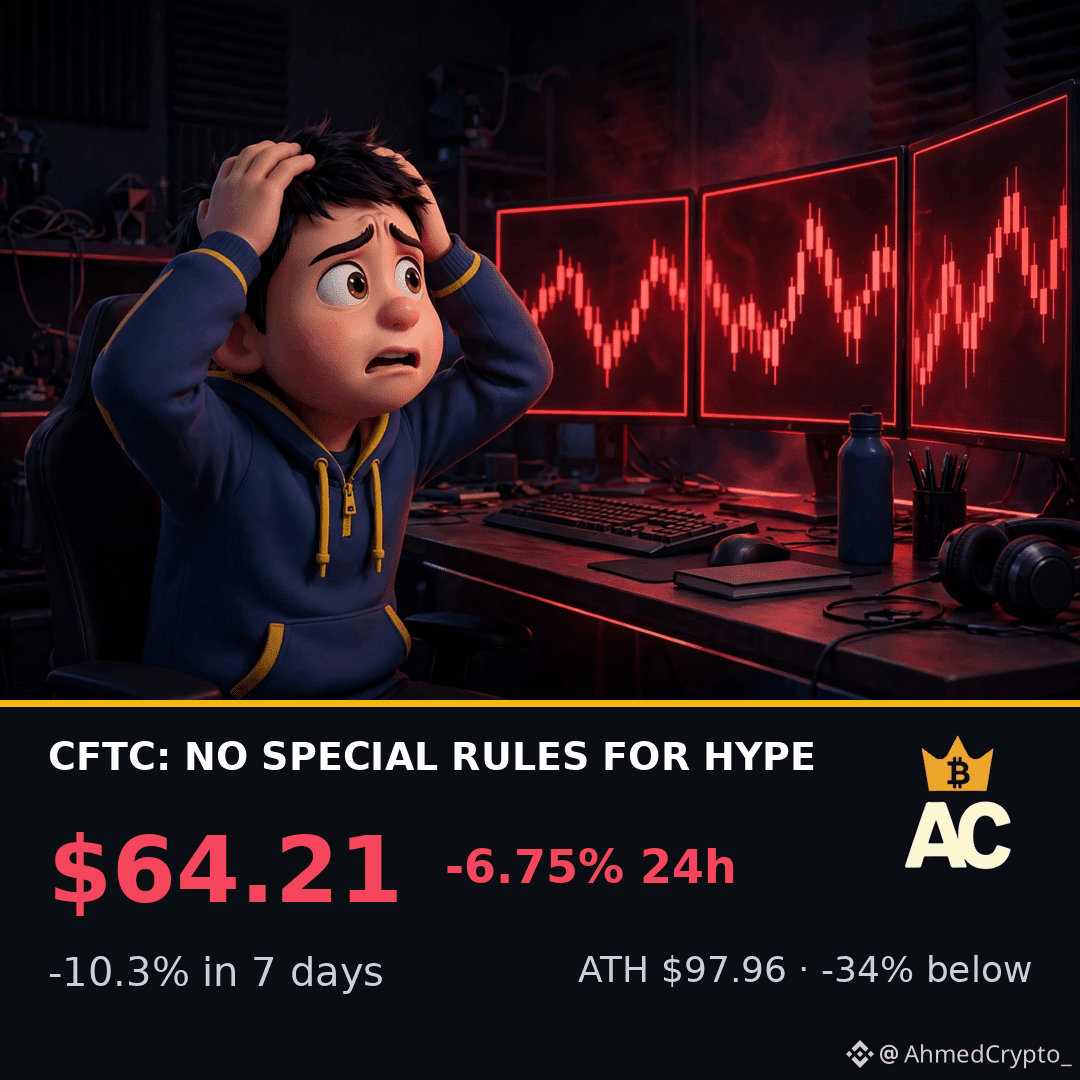
⚠️ CFTC TO HYPERLIQUID: NO SPECIAL RULES — REGISTER OR PARTNER
CFTC Chair Michael Selig just drew the line: onchain perps platforms get no exemption to serve US retail. Register as an exchange, or partner with one that is. Backpack already did it — winning 3 US licenses this week.
• $HYPE $64.21 (-6.75% in 24h)
• -10.3% in 7 days, ~34% below its $97.96 ATH
• Hong Kong's SFC flagged Hyperliquid as suspicious this week
• Kraken/Bitnomial plan + HypeStrat FCM filing still pending
Regulation is coming for perps — the end of the free-for-all, or the start of Hyperliquid going legit?
#Hyperliquid #CFTC #CryptoRegulation $HYPE
250
·
--
The US Senate passed the DEATH BETS Act by voice vote on Nov 19. It would bar CFTC-registered exchanges from listing prediction contracts tied to terrorism, assassination, war, US military operations or a person's death. The bill now goes to the House, where its companion version is still in committee. A clear line for prediction markets as they keep growing. #PredictionMarkets #CFTC #Crypto
The US Senate passed the DEATH BETS Act by voice vote on Nov 19. It would bar CFTC-registered exchanges from listing prediction contracts tied to terrorism, assassination, war, US military operations or a person's death. The bill now goes to the House, where its companion version is still in committee. A clear line for prediction markets as they keep growing. #PredictionMarkets #CFTC #Crypto

·
--
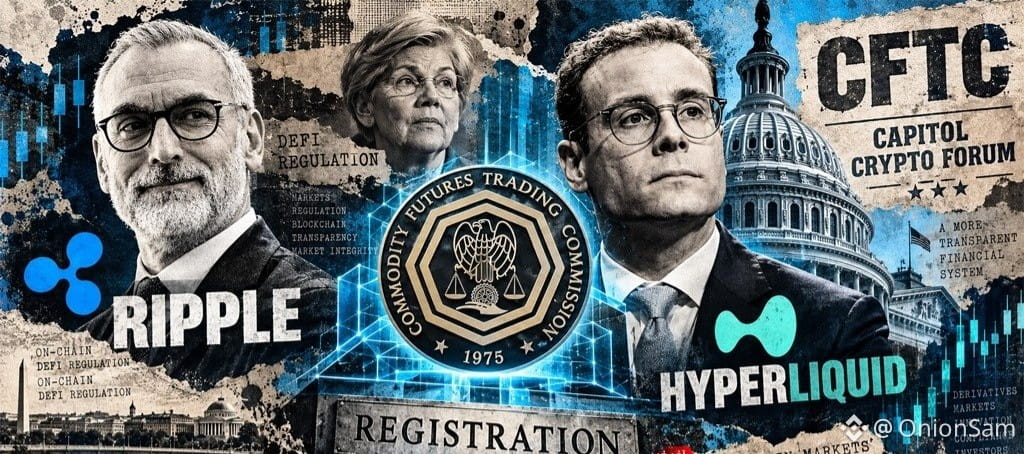
🏛️🇺🇸 U.S. REGULATION: CFTC Chair Opens Compliant Pathway for Hyperliquid & Onchain Derivatives! 📊⚡
🗣️ Speaking at the Capitol Crypto Forum in Washington, CFTC Chairman Michael Selig confirmed that onchain perpetual DEXs like @HyperliquidX can legally serve U.S. traders—provided they register as designated exchanges or partner with already-licensed intermediaries.
📊 Hard Data & Regulatory Context:
🔗 Compliant Access Models:
Selig cited Backpack's recent CFTC/NFA approval as proof that blockchain-native platforms can integrate into U.S. frameworks, aligning with ongoing U.S. access efforts via Bitnomial (with Kraken/Payward) and HypeStrat Markets.
⚖️ Ripple on Congress & Warren:
Ripple Chief Legal Officer Stuart Alderoty stated at the same event that Sen. Elizabeth Warren—expected to chair the Senate Banking Committee in Jan 2027—will not dictate U.S. crypto policy, though she will likely ramp up oversight hearings.
📜 Rulemaking Over Legislation:
Alderoty noted the stalled CLARITY Act is unlikely to pass in the next Congress, meaning actual crypto market rules will come directly from CFTC and SEC agency rulemaking rather than new laws.
💡 Trader Reality Check:
This is a major regulatory green light for compliant DeFi derivatives, not an overnight U.S. launch for Hyperliquid. Geofencing remains active until intermediary licenses are finalized—watch official CFTC filings rather than hype! 🧠🎯
#CFTC #Hyperliquid #CryptoRegulation #defi #Ripple #PerpDEX #CryptoNews
$HYPE
{spot}(HYPEUSDT)
$XRP
$DYDX
{spot}(DYDXUSDT)
$GMX
{spot}(GMXUSDT)
$SNX
🏛️🇺🇸 U.S. REGULATION: CFTC Chair Opens Compliant Pathway for Hyperliquid & Onchain Derivatives! 📊⚡
🗣️ Speaking at the Capitol Crypto Forum in Washington, CFTC Chairman Michael Selig confirmed that onchain perpetual DEXs like @HyperliquidX can legally serve U.S. traders—provided they register as designated exchanges or partner with already-licensed intermediaries.
📊 Hard Data & Regulatory Context:
🔗 Compliant Access Models:
Selig cited Backpack's recent CFTC/NFA approval as proof that blockchain-native platforms can integrate into U.S. frameworks, aligning with ongoing U.S. access efforts via Bitnomial (with Kraken/Payward) and HypeStrat Markets.
⚖️ Ripple on Congress & Warren:
Ripple Chief Legal Officer Stuart Alderoty stated at the same event that Sen. Elizabeth Warren—expected to chair the Senate Banking Committee in Jan 2027—will not dictate U.S. crypto policy, though she will likely ramp up oversight hearings.
📜 Rulemaking Over Legislation:
Alderoty noted the stalled CLARITY Act is unlikely to pass in the next Congress, meaning actual crypto market rules will come directly from CFTC and SEC agency rulemaking rather than new laws.
💡 Trader Reality Check:
This is a major regulatory green light for compliant DeFi derivatives, not an overnight U.S. launch for Hyperliquid. Geofencing remains active until intermediary licenses are finalized—watch official CFTC filings rather than hype! 🧠🎯
#CFTC #Hyperliquid #CryptoRegulation #defi #Ripple #PerpDEX #CryptoNews
$HYPE
$XRP
$DYDX
$GMX
$SNX

ETH 4U 🍀
From OnionSam
428

The CFTC indicated it won't impose specialized regulatory frameworks for onchain trading platforms like Hyperliquid providing significant clarity for the decentralized derivatives sector.
#CFTC #Hyperliquid
The CFTC indicated it won't impose specialized regulatory frameworks for onchain trading platforms like Hyperliquid providing significant clarity for the decentralized derivatives sector.
#CFTC #Hyperliquid
#CFTC #Hyperliquid
53

$HYPE just got a clearer US roadmap. CFTC Chairman Michael Selig said at The Block's Capitol Crypto Forum that onchain venues like Hyperliquid can reach US retail in two ways: register as an exchange themselves or partner with one that's already registered.
He pointed to Backpack, which The Block says just picked up three US licenses (FCM, DCM and DCO), as the first route. His line was basically: keep the onchain tech, but follow the same rules as every other exchange.
My take: no approval, no timeline, so I wouldn't trade $HYPE on this alone. But for a perp DEX, "here's the door" from the top US derivatives regulator beats years of "you're not welcome". The real question is whether Hyperliquid would accept KYC and the other things a registered partner would need.
Would a US-compliant version of Hyperliquid be bullish for $HYPE, or would it kill what makes it work?
NFA, just thinking out loud.
Source: The Block
#HYPE #Hyperliquid #CFTC #CryptoNews
$HYPE just got a clearer US roadmap. CFTC Chairman Michael Selig said at The Block's Capitol Crypto Forum that onchain venues like Hyperliquid can reach US retail in two ways: register as an exchange themselves or partner with one that's already registered.
He pointed to Backpack, which The Block says just picked up three US licenses (FCM, DCM and DCO), as the first route. His line was basically: keep the onchain tech, but follow the same rules as every other exchange.
My take: no approval, no timeline, so I wouldn't trade $HYPE on this alone. But for a perp DEX, "here's the door" from the top US derivatives regulator beats years of "you're not welcome". The real question is whether Hyperliquid would accept KYC and the other things a registered partner would need.
Would a US-compliant version of Hyperliquid be bullish for $HYPE , or would it kill what makes it work?
NFA, just thinking out loud.
Source: The Block
#HYPE #Hyperliquid #CFTC #CryptoNews
63

🔥 INSIGHT: The internet never had an authorizing statute, and neither did big data.
Former @CFTC chairman @giancarloMKTS told @itsciaranlyons that this freedom is what lets US innovators build for commercial needs first.
He called the idea that crypto needed regulatory clarity
#Crypto #CFTC
🔥 INSIGHT: The internet never had an authorizing statute, and neither did big data.
Former @CFTC chairman @giancarloMKTS told @itsciaranlyons that this freedom is what lets US innovators build for commercial needs first.
He called the idea that crypto needed regulatory clarity
#Crypto #CFTC
Former @CFTC chairman @giancarloMKTS told @itsciaranlyons that this freedom is what lets US innovators build for commercial needs first.
He called the idea that crypto needed regulatory clarity
#Crypto #CFTC
1

·
--
Binance.US’s US perpetual futures: don’t be fooled by the headline—they’re still a long way from launching ⚠️
📌 On 11/19, the CFTC deemed Binance.US’s DCM/DCO applications “complete,” but that only means they’ve entered substantive review—not that they’ve been approved.
📌 The clearinghouse, BAM Clearing, is still “pending registration.” Its own filings state that clearing won’t begin until March 2027 at the earliest.
📌 The DCM review window is 180 days, ending on 2027/5/18.
📌 Contracts in the rulebook: BTC perpetuals at 0.01 BTC per contract; ETH perpetuals at 0.1 ETH per contract. Margin rules are handled by the clearinghouse and haven’t been published yet, so the leverage is still unknown.
👉 For comparison: Backpack just qualified on 11/13 to offer margined futures eligible for clearing, becoming the first new entrant in more than 20 years. The race for US-regulated perpetuals is starting to line up.
My take: Don’t treat this as a short-term bullish catalyst; it looks more like a long-term regulatory narrative. BTC is currently around $59-60K, and the Fear & Greed Index is at 11 (extreme fear). The market is more focused on fund flows and liquidations.
How much market share do you think US-regulated perpetuals will take from offshore exchanges? Let’s discuss in the comments 👇
$BNB $BTC $ETH
#币安 #CFTC #PerpetualFutures
Personal opinion only; not investment advice

46

·
--
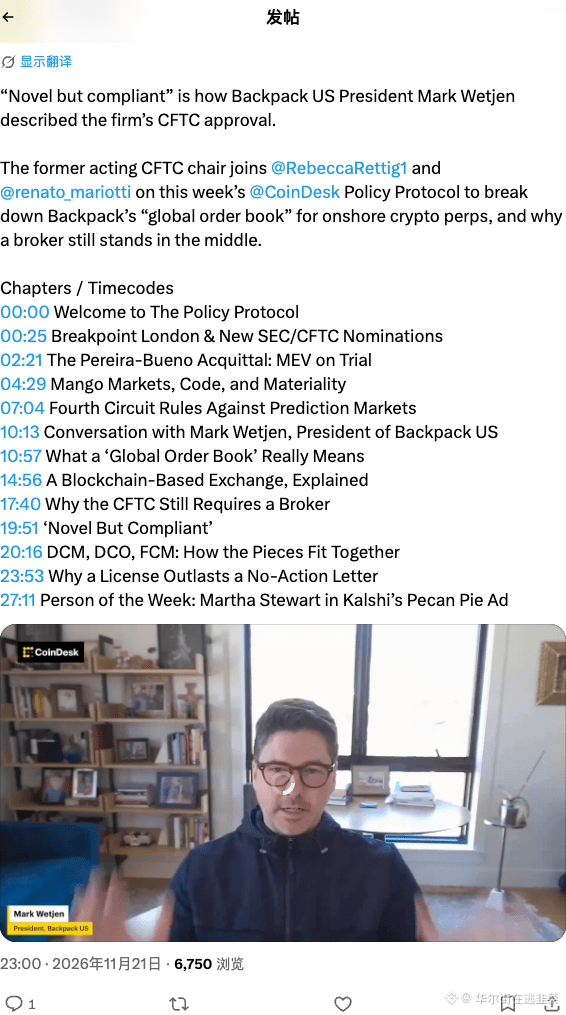
Backpack’s “global order book” has been approved by the CFTC. Wetjen described it as “novel but compliant.” Despite the talk of technology, it still relies on brokers to act as intermediaries.
Compliance is the ticket to entry, not a protective charm.
As institutions enter the market, the bar will only get higher.
#Crypto #CFTC #Backpack
Compliance is the ticket to entry, not a protective charm.
As institutions enter the market, the bar will only get higher.
#Crypto #CFTC #Backpack
12

·
--
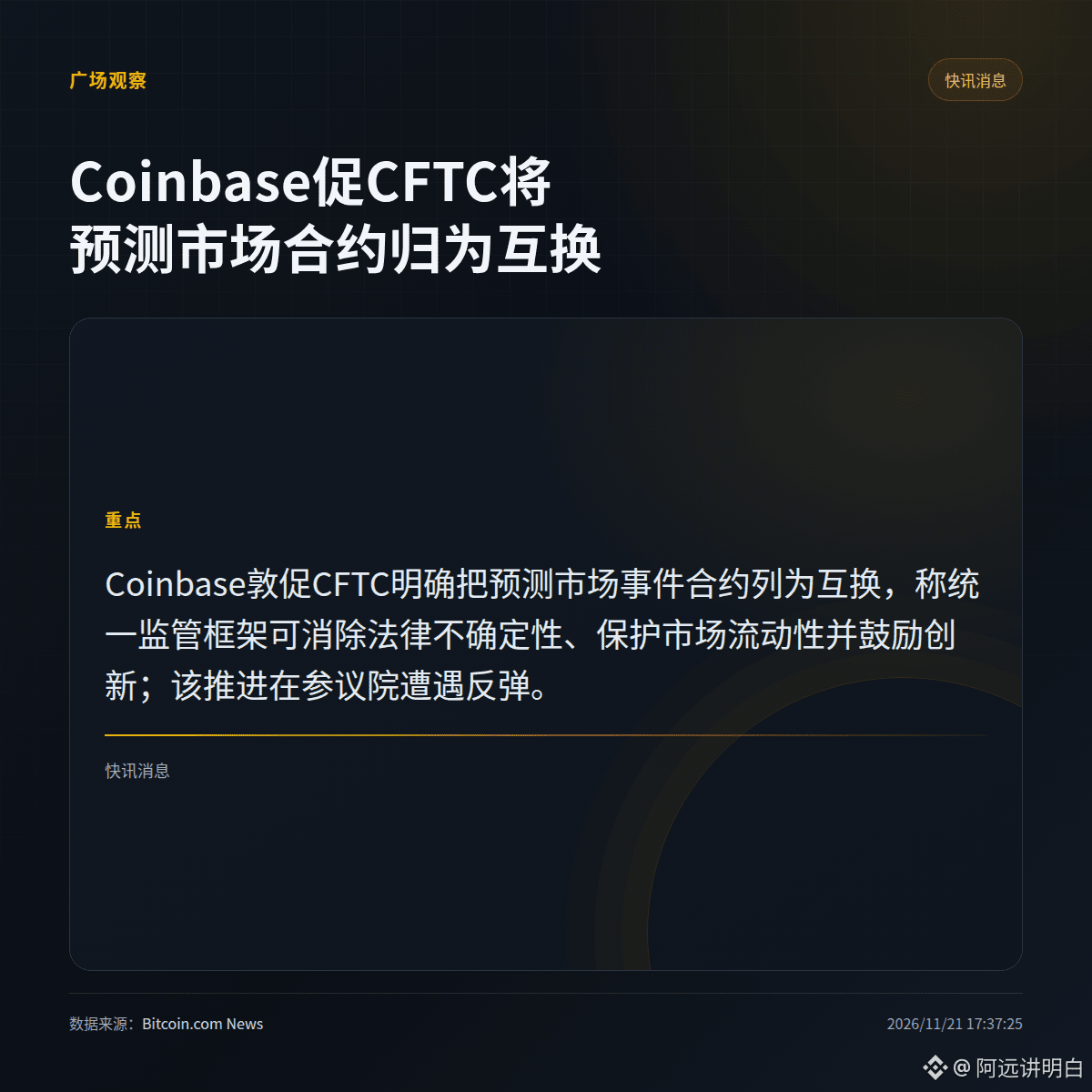
Coinbase submitted a comment to the Commodity Futures Trading Commission, urging it to classify event contracts in prediction markets as swaps under federal law through formal rulemaking. It argues that a unified framework would eliminate legal ambiguity, preserve market liquidity, and leave room for innovation. The proposal has met resistance in the Senate, putting the political obstacles squarely on the table. In my view, the issue is not prediction markets themselves, but which set of rules governs these contracts. A change in classification would also reshape trading platforms’ compliance paths and product design. $BNB #Coinbase #CFTC. For now, I’ll keep watching the trading range and volume, and won’t rush to a conclusion until there’s confirmation.
Coinbase submitted a comment to the Commodity Futures Trading Commission, urging it to classify event contracts in prediction markets as swaps under federal law through formal rulemaking. It argues that a unified framework would eliminate legal ambiguity, preserve market liquidity, and leave room for innovation. The proposal has met resistance in the Senate, putting the political obstacles squarely on the table. In my view, the issue is not prediction markets themselves, but which set of rules governs these contracts. A change in classification would also reshape trading platforms’ compliance paths and product design. $BNB #Coinbase #CFTC. For now, I’ll keep watching the trading range and volume, and won’t rush to a conclusion until there’s confirmation.

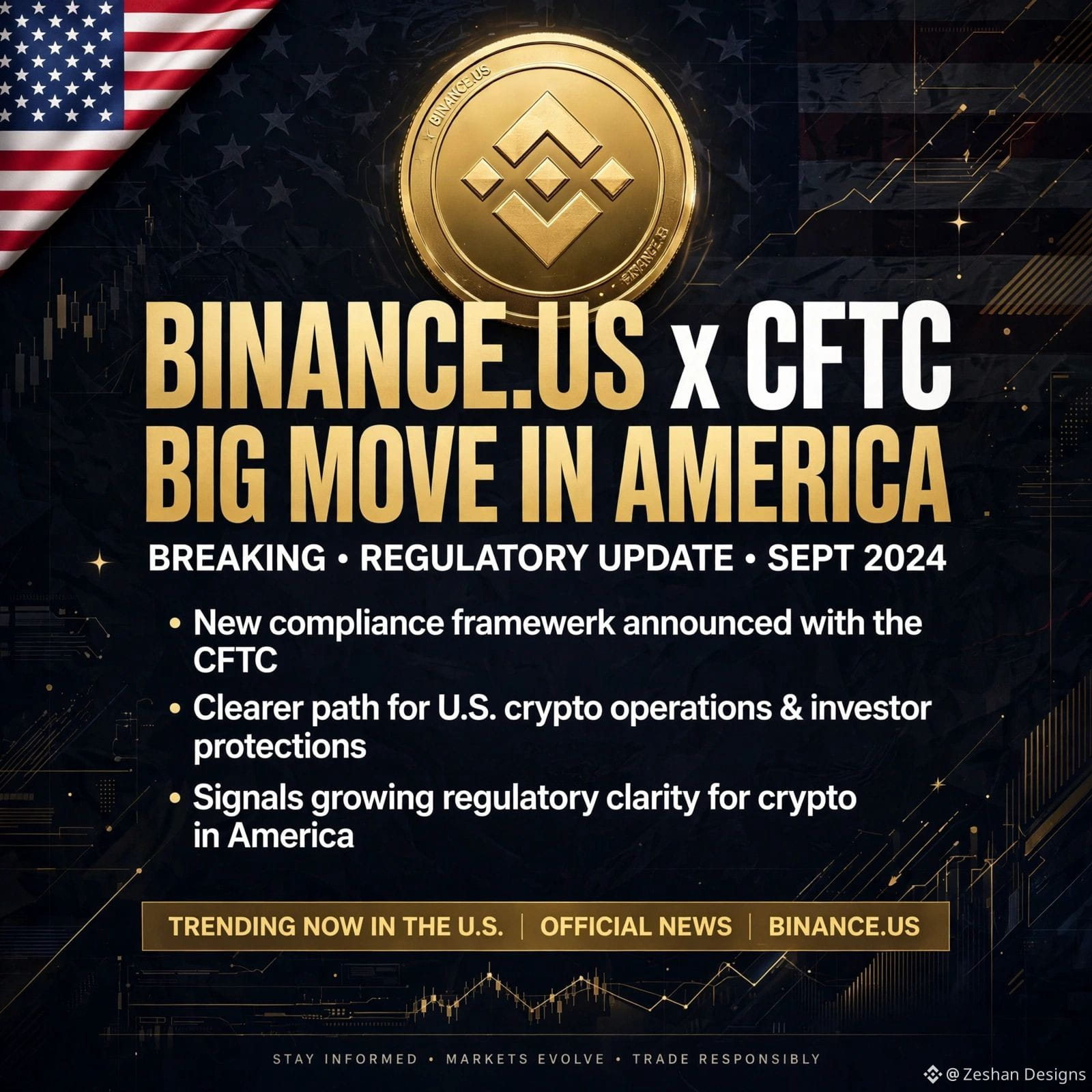
🇺🇸 BREAKING: http://Binance.US x CFTC - BIG MOVE IN AMERICA!
On 19 Nov, the CFTC declared http://Binance.US's DCM and DCO applications "materially complete." This means the case has now moved into substantive review.
What does this mean?
- http://Binance.US is getting closer to offering regulated Bitcoin and Ether perpetual futures in America
- The plan is for a BTC contract of 0.01 BTC and an ETH contract of 0.1 ETH
- BUT APPROVAL HAS NOT BEEN GRANTED YET, and trading has not started
This isn't approval; it's clearing the first major hurdle. Regulated perps for US customers will start only after final approval.
What do you think? Will this give BNB and BTC a pump, or will the market go down further? 👇 Tell us in the comments
#Binance #CFTC #Bitcoin #CryptoNews
97

·
--
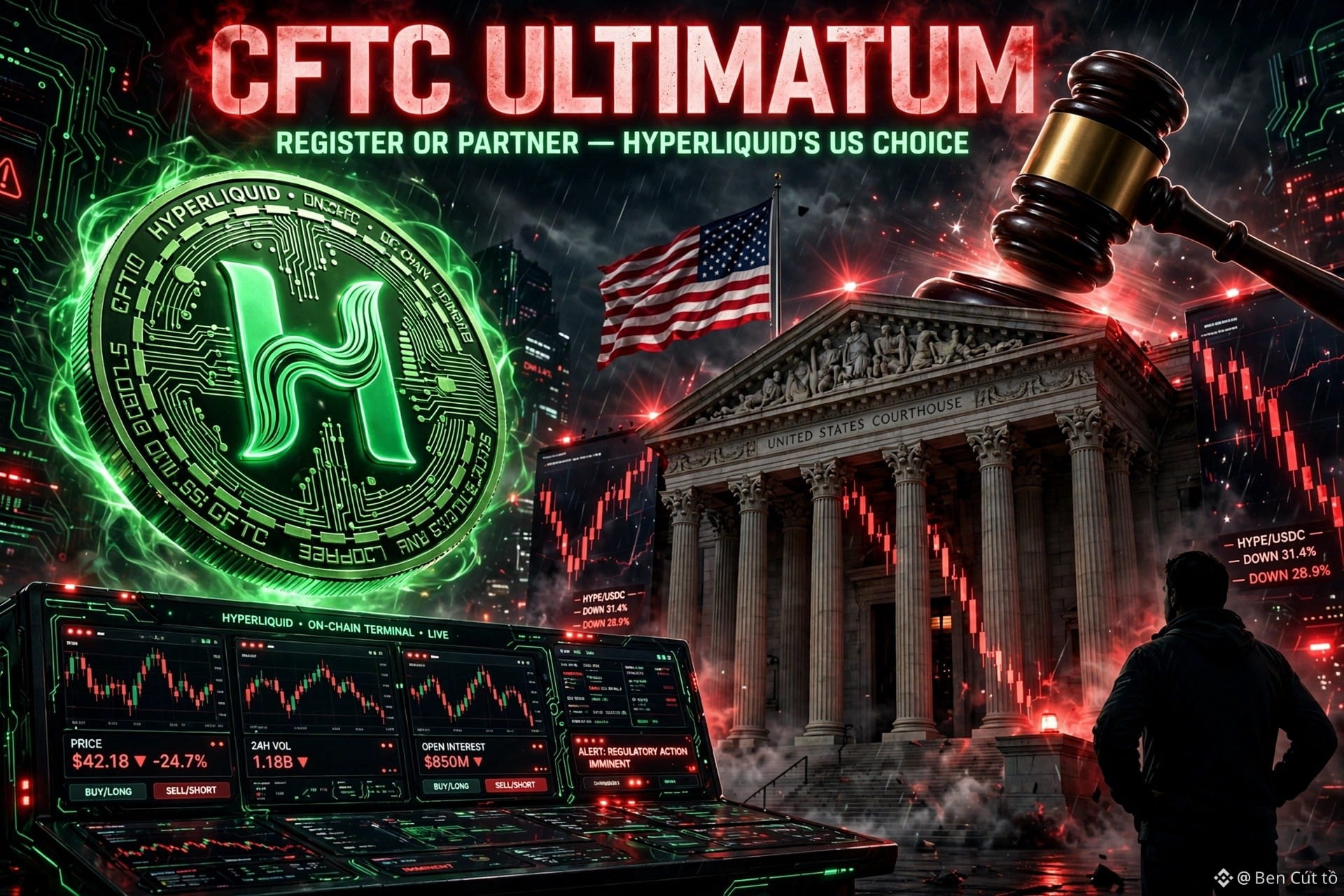
🚨 BREAKING: The U.S. gives Hyperliquid an ultimatum!
CFTC Chairman Michael Selig declared on Nov. 19 that on-chain exchanges wanting to serve U.S. traders have only two options: register as an exchange or partner with an already licensed exchange. The blockchain can stay as it is, but the rules must be exactly the same as for traditional exchanges.
The twist: Hyperliquid still blocks U.S. users, yet it’s the largest on-chain perpetuals exchange, with 7-day volume reaching $75.72 billion. Backpack just secured all three licenses in one week, setting an example for the entire industry. Hong Kong, meanwhile, is going the other way, listing Hyperliquid as a suspicious exchange.
$HYPE is currently hovering around $65.50, down 3.5% in 24 hours and still 33% below its $97.96 peak.
The door to the U.S. is opening, but the price is giving up some decentralization. Follow me—I post here first.
#Hyperliquid #CFTC
Euna Varnedore EF02:
Nóng mẹ j tầm này nữa, chán chả muốn nhìn luôn
2
5
14.8k

·
--
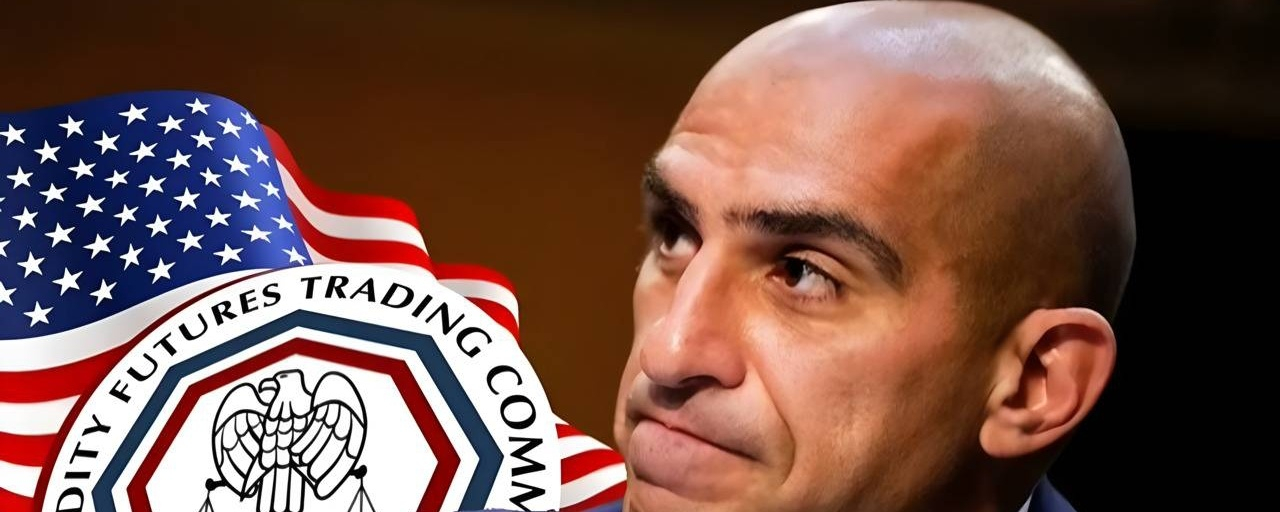
Article
CFTC Chair Reveals Requirements for Crypto Exchanges to Offer Derivatives Services in the U.S.U.S. Commodity Futures Trading Commission (CFTC) Chair Michael Selig has clarified the conditions under which cryptocurrency exchanges, including DeFi platforms like Hyperliquid, may offer derivatives services to customers in the United States.
According to Selig, platforms seeking to enter this market have two options: register for a license with the CFTC themselves or partner with an already licensed entity.
Two legal pathways
CFTC Chair Reveals Requirements for Crypto Exchanges to Offer Derivatives Services in the U.S.
U.S. Commodity Futures Trading Commission (CFTC) Chair Michael Selig has clarified the conditions under which cryptocurrency exchanges, including DeFi platforms like Hyperliquid, may offer derivatives services to customers in the United States.
According to Selig, platforms seeking to enter this market have two options: register for a license with the CFTC themselves or partner with an already licensed entity.
Two legal pathways
According to Selig, platforms seeking to enter this market have two options: register for a license with the CFTC themselves or partner with an already licensed entity.
Two legal pathways
1
10

“CFTC approves CRO perpetuals”—hold off on reposting that. That’s not what the original filing says.
The 11/19 filing was a self-certification by North American Derivatives Exchange (the Nadex acquired by Crypto.com in 2022, now operating under the OG.com Markets brand) under CFTC Rule 40.2(a) for a CRO-USD cash-settled perpetual, planned to launch on 11/23. Rule 40.2(a) means the exchange declares the contract compliant and files it; the CFTC does not grant prior approval. The exchange is the subject of “certified”—it’s not a CFTC seal of approval.
What’s really worth looking at is this chain:
The exchange belongs to Crypto.com; the underlying CRO is a Crypto.com ecosystem token; the CF Cronos-Dollar Spot Rate used as the settlement reference draws from just three order books—Coinbase, Kraken, and Crypto.com (per CF Benchmarks’ constituent list); and the index provider, CF Benchmarks, is a wholly owned subsidiary of Kraken’s parent company, Payward. The filing itself says so.
To be fair, there are safeguards: the index excludes order books that deviate from the median and limits the depth of any single trade. People at constituent exchanges who have access to nonpublic order flow are prohibited from trading this contract. But the restricted-person list doesn’t specifically name CRO’s issuer or the Cronos team; it relies on general insider-information rules as a backstop. With one of the three quote sources being an affiliated party for this smaller-token index, don’t compare its resistance to manipulation with a BTC index drawing on multiple deep order books.
Retail traders should pay more attention to funding. The formula follows the same structure as Binance’s USDT-margined contracts: an interest-rate component of 0.01% per 8 hours; if the premium is within ±0.05%, the rate is 0.01%, paid by longs to shorts. Even if the price stays perfectly aligned with the index, longs would pay about 11% a year (0.01% × 3 × 365 = 10.95%), with a cap of 2% every 8 hours.
So the claim that “U.S. crypto holders finally have a compliant channel” is a bit muddled. Holders want spot trading. What perpetuals actually add is a compliant shorting/hedging leg, benefiting people with large positions to hedge—not retail traders looking to buy the dip.
One more nitpick: the position accountability threshold is $5 million, which at CRO’s current price of about $0.0396 works out to roughly 126 million tokens. The reporting threshold is listed as 25 contracts, with 1 CRO per contract—about $1 in total. Looks like a template that wasn’t fully updated.
#CRO #CFTC
44

·
--
🚨 $HYPE ASTONISHING: THE CFTC OPENS THE DOOR TO THE U.S., BUT ON ITS TERMS
CFTC Chair Michael Selig made it clear this Thursday in Washington: Hyperliquid and onchain platforms that want to sell perpetual futures to U.S. retail customers must register as an exchange or partner with one that’s already registered. To me, this is the door truly opening, but with the regulator holding the key: there are no more shortcuts just because you’re “decentralized.”
Look at the detail no one is noticing:
→ Selig laid out the only 2 paths on Nov. 19 at the Capitol Crypto Forum: register independently or partner with a registered exchange; “we’re not going to treat you differently just because you’re onchain,” with no special exemptions for anyone.
→ Backpack completed the full stack in 5 days: clearinghouse on Nov. 13, exchange on Nov. 16, and FCM broker on Nov. 18; it’s the model Selig held up as an example, and the first crypto-native company with all 3 licenses to offer leveraged perps in the U.S.
→ Meanwhile, Hong Kong added Hyperliquid to its list of suspicious platforms on Nov. 18 for operating without a license, and the platform remains barred to U.S. customers; in May, CME and ICE had already called for an investigation into possible manipulation and sanctions violations.
Do you think Hyperliquid will make it into the U.S. in 2027, or will it stay out? 👇
$HYPE
#Hyperliquid #CFTC #Regulation

1.5k
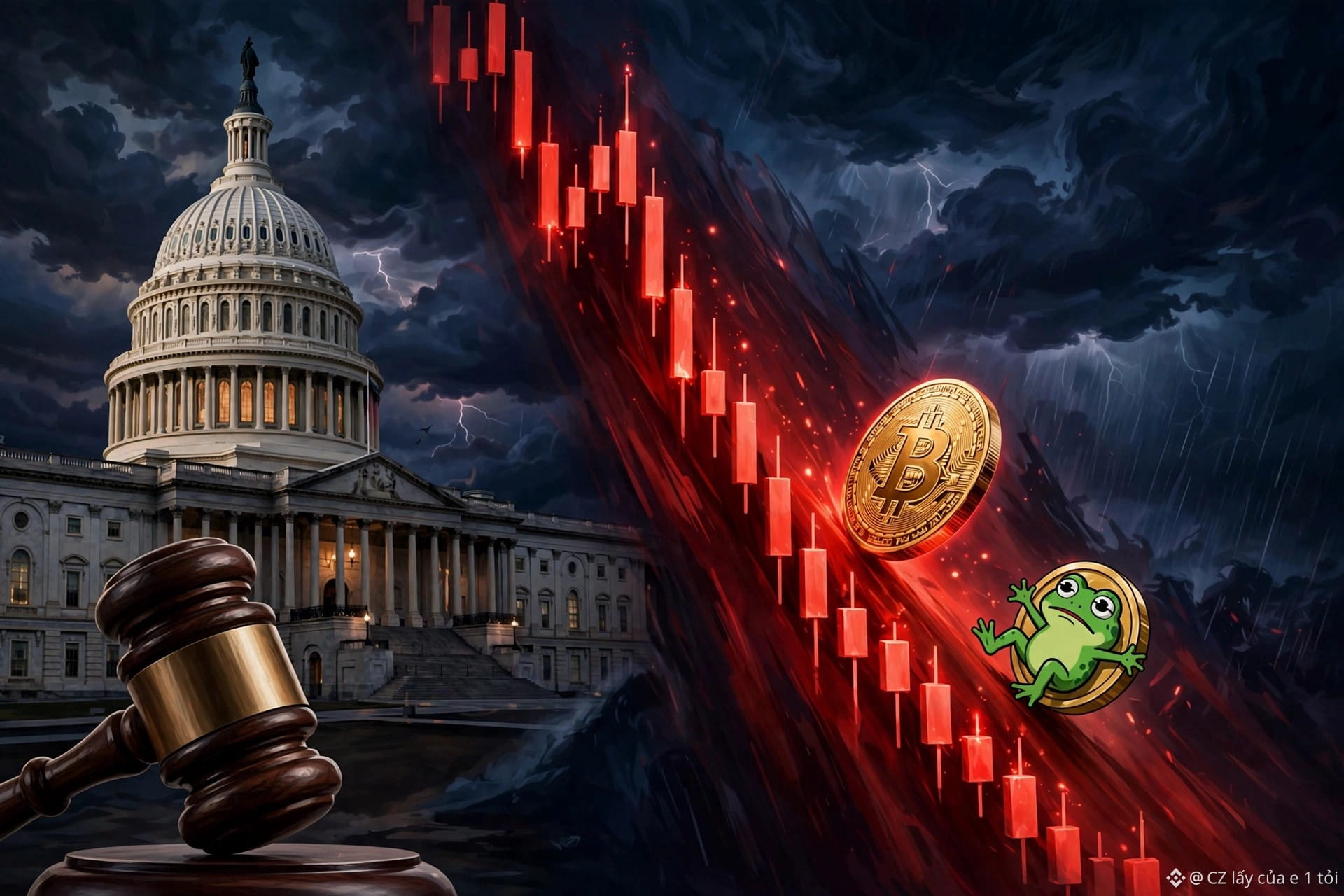
📉 Market update 20/11: Bitcoin is hovering around $61,700, down for the third consecutive day after briefly touching nearly $61,200. Sentiment remains in extreme fear, with the Fear & Greed Index at just 12/100, while total market capitalization has fallen to around $2.21 trillion.
Latest news: CFTC Chair Michael Selig said that on-chain exchanges like Hyperliquid seeking to serve retail investors in the U.S. must register as exchanges or partner with a licensed exchange—there are no exceptions just because trading takes place on the blockchain. He cited Backpack as an example; it received all three CFTC licenses this week. Meanwhile, Hong Kong has just added Hyperliquid to its list of suspicious platforms.
Outflows continue: U.S. spot Bitcoin ETFs saw net outflows of $582.3 million on November 19, with BlackRock’s IBIT setting a record at $541.1 million. Total market liquidations reached $718.6 million in 24 hours, 86% of them long positions.
The biggest loser today: $PEPE fell 11.26% to around $0.00000353, with a market cap of about $1.5 billion, as funds flowed heavily out of exchanges and the price retested the support zone.
Do you think clear U.S. regulations will bring on-chain trading back home, or push it overseas? Share your thoughts below!
#CryptoNews #Bitcoin #CFTC #PEPE
Market information, not investment advice.
413

·
--
One sentence from the CFTC chair has shattered the dream of on-chain exchanges operating as a “lawless haven.”
If you want access to the U.S. retail market, you either register or find a licensed exchange to back you—there’s no third option.
On Thursday, CFTC Chair Selig singled out Hyperliquid at a crypto forum on Capitol Hill: if on-chain perpetual contracts are to be offered to U.S. retail traders, they must follow the same rules as traditional derivatives exchanges. “You don’t get special treatment just because you’re on-chain.”
He also pointed to a ready-made example: Backpack secured three U.S. licenses—FCM, DCM, and DCO—all at once this Monday, showing that the registration route is a viable one.
Kraken’s parent company got moving back in September. CFTC-regulated Bitnomial is using Hyperliquid’s on-chain technology to offer perpetual contracts, and is still awaiting approval.
Meanwhile, on Wednesday, Hong Kong’s Securities and Futures Commission added Hyperliquid to its list of suspicious platforms, saying it is unlicensed and suspected of marketing to Hong Kong investors.
I think the most interesting part of this drama is that it’s getting squeezed from both sides: the U.S. says, “You can come in, but put on a uniform first,” while Hong Kong says, “You haven’t even come through the door, so don’t go shouting about it.”
On-chain exchanges have dodged the compliance hurdle for years, but sooner or later they have to face it head-on.
HYPE is currently at $63.90, down 6.87% over 24 hours (verified on CoinGecko; source: CoinDesk, 2026-11-20).
Is compliance paving the way for Hyperliquid, or putting it in chains?
$HYPE $BTC
#CFTC #Hyperliquid

239

CFTC allows Hyperliquid and onchain exchanges to offer derivatives to U.S. traders if licensed
- The CFTC allows Hyperliquid and onchain exchanges to offer derivatives to U.S. traders.
- Requirement: They must be licensed or partner with a registered exchange.
- The CFTC chairman announced this notice.
#BinanceSquare #CryptoNews #CFTC #Derivatives #Hyperliquid Onchain
$btc $eth
vlikevn Titanbot
Source: CoinDesk
66
Log in to explore more content
Join global crypto users on Binance Square
⚡️ Get latest and useful information about crypto.
💬 Trusted by the world’s largest crypto exchange.
👍 Discover real insights from verified creators.
Email / Phone number
Trending Topics
1
#NvidiaLoses$2.7TrillionInMonthAndAHalf
29,885 views
163 Discussing
2
#CanBTCReboundAfterFallingBelow60K?
864,416 views
3,213 Discussing
3
#GlobalStocksFaceLongestLosingStreakSince2023
327,445 views
2,149 Discussing
4
#BlackRockIBITPostsRecord$541MSingleDayOutflow
41,902 views
119 Discussing
5
#AnthropicPlungesTowardIPOPriceonDay2
169,149 views
1,316 Discussing
6
#TwentyOneCapitalAdds172.25BTC
78,495 views
746 Discussing
7
#HKBillWouldExcludeTokenizedDepositsFromVirtualAssets
11,292 views
56 Discussing
8
#BNBDropsBelow540USDTWith8.46%DailyDecline
88,952 views
710 Discussing
9
#HKBillProposesHK$100KFineForUnauthorizedCryptoTitles
3,115 views
29 Discussing
10
#BitMineFaces$10.1BUnrealizedETHLoss
6,260 views
32 Discussing