
#coinbase
coinbase
2.6M views
9,029 Discussing
Hot
Latest


·
--
🎯 Coinbase targets first half of 2027 for its own prediction market contracts
Coinbase plans to launch in-house event contracts in the US in the first half of 2027 for both retail and institutional clients, Bloomberg reported, citing a person familiar with the matter. The exchange currently offers prediction markets through Kalshi and intends to keep that partnership, after winning CFTC approval for its own clearinghouse in September. The business topped $200M in annualized revenue in Q3, with daily traders up more than 60% quarter over quarter. A spokesperson said Coinbase had “nothing new to announce today.”
⭐ Prediction markets are becoming a revenue stream less tied to crypto volatility, helping Coinbase offset slowing coin trading.
#Coinbase #PredictionMarkets #Kalshi #CFTC #COIN

100
·
--
🚨 Coinbase backs CFTC proposal to label prediction market contracts as swaps, not gambling. Finally, regulators might stop treating us like high-rollers at a casino.
Btw $BTC $61,638 (-3.48%) and $SOL $72.03 (-3.41%) as I type this.
Will this spark a wave of legit prediction markets?
Stay curious! 🎲
#CryptoRegulation #Coinbase
Btw $BTC $61,638 (-3.48%) and $SOL $72.03 (-3.41%) as I type this.
Will this spark a wave of legit prediction markets?
Stay curious! 🎲
#CryptoRegulation #Coinbase
64

·
--
🎯 COINBASE WANTS TO BE ITS OWN KALSHI
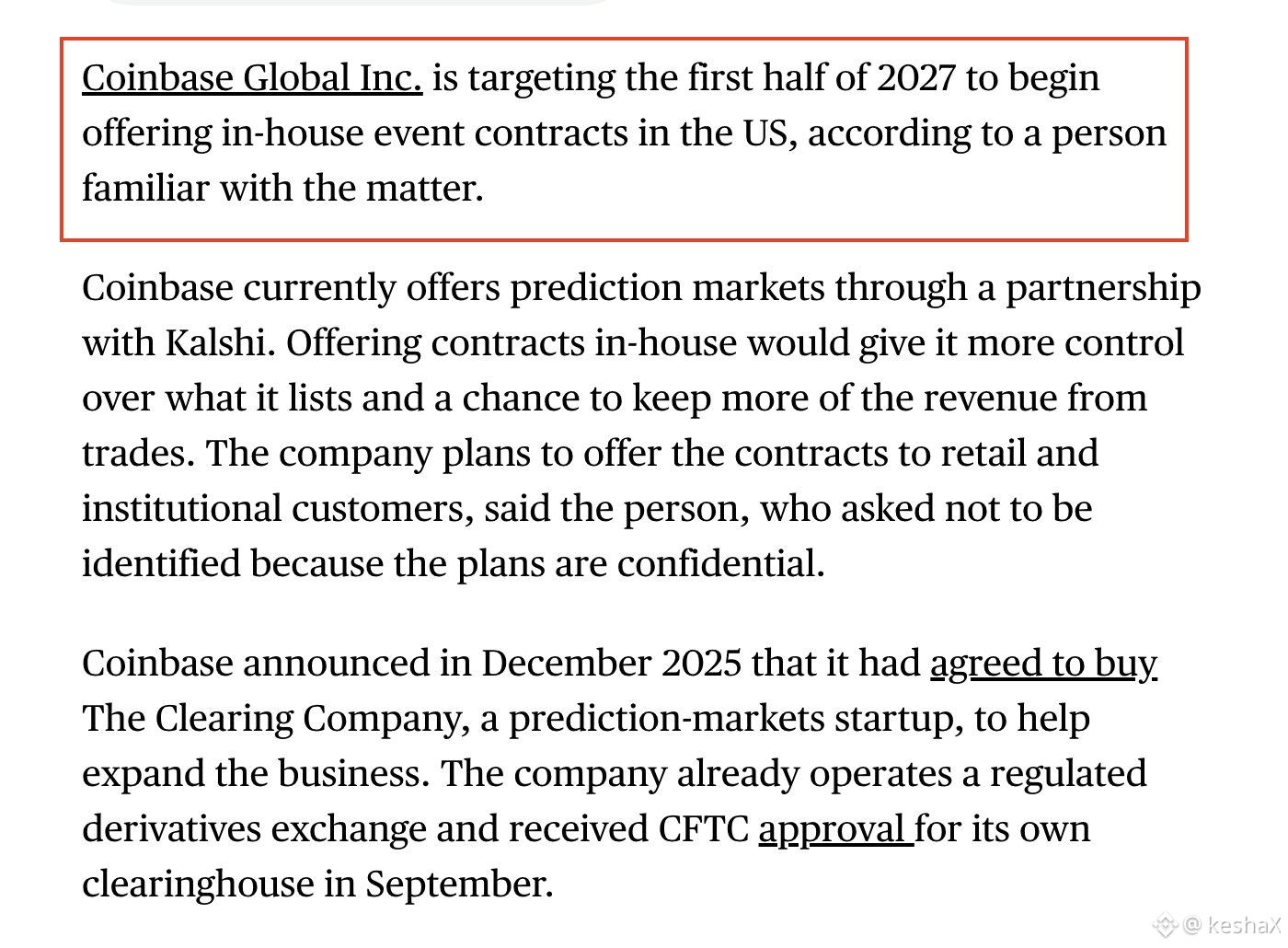
Bloomberg: Coinbase is targeting the first half of 2027 for its own US event contracts. Right now its prediction markets run through a partnership with Kalshi.
What it already has:
- A regulated derivatives exchange
- CFTC approval for its own clearinghouse (September)
- The Clearing Company deal, agreed in December 2025
Coinbase's official line: "We have nothing new to announce today."
Same day, Binance.US said the CFTC found its DCM and DCO applications materially complete. That is not approval. A review can take up to 180 days, and no derivatives launch before the green light. CEO Stephen Gregory has named event contracts as a goal.
Prediction markets are turning from a Polymarket vs Kalshi duel into an exchange war.
Who leads US prediction markets by 2028: Polymarket, Kalshi or Coinbase?
#PredictionMarkets #Coinbase #BinanceUS #CryptoNews


1
163

·
--
Coinbase launched crypto options for eligible non-US users in select markets, powered by Deribit liquidity and settled in USDC. Traders get single and multi-leg strategies, payoff charts and Greeks on BTC, ETH, SOL, AVAX, HYPE and XRP. US retail access is planned to come later. #Coinbase #Options #Crypto
Coinbase launched crypto options for eligible non-US users in select markets, powered by Deribit liquidity and settled in USDC. Traders get single and multi-leg strategies, payoff charts and Greeks on BTC, ETH, SOL, AVAX, HYPE and XRP. US retail access is planned to come later. #Coinbase #Options #Crypto
86


Article
Coinbase AI Stops $4.7 Million Crypto Scam: Can Artificial Intelligence Defeat Deepfake Fraud?Imagine watching what looks like an official Tesla livestream. Elon Musk appears on screen, a cryptocurrency giveaway is announced, and viewers are promised something that sounds almost too good to be true:
Send crypto now and receive double your money back.
Hundreds of people believed it.
But the person on screen wasn't actually Elon Musk. It was an AI-generated deepfake, and the giveaway was designed to steal cryptocurrency.
What happened next is particularly interesting: another AI system stepped in and helped stop millions of dollars from reaching the scammers.
Coinbase says its AI-powered security system blocked approximately $4.7 million in attempted transfers, preventing around 91% of the funds involved in the scam from leaving customers' accounts.
This isn't just another crypto fraud story. It raises a much bigger question:
Can artificial intelligence become one of the strongest weapons against the very scams that AI itself makes possible?
🎭 1. How the Fake Elon Musk Giveaway Worked
The scammers created a fake YouTube livestream resembling Tesla's official broadcast of its flying-car demonstration.
The video featured an AI-generated version of Elon Musk, along with cryptocurrency wallet addresses and QR codes displayed on screen.
The promise was familiar: send cryptocurrency to the displayed address and receive twice as much in return.
More than 500,000 people watched the livestream, according to Coinbase.
Within approximately two hours, hundreds of Coinbase customers attempted to transfer millions of dollars to the scammers.
The disturbing part?
These weren't necessarily people whose accounts had been hacked.
They were legitimate account holders who believed they were participating in a genuine giveaway and authorised the transactions themselves.
That makes this type of fraud particularly difficult to detect.
🤖 2. How Coinbase's AI Caught the Scam
Traditional fraud detection systems are often designed to identify suspicious logins, stolen credentials or transactions that customers didn't authorise.
But this situation was different.
The customers were logged in. They were using their own accounts. And they were willingly approving the payments.
Coinbase says its security system used machine-learning models to identify suspicious outgoing transfers, including patterns associated with:
Cryptocurrency giveaway scams.Impersonation of well-known individuals and brands.Newly created wallet addresses.Promises of unusually high or guaranteed returns.
Once a transaction was flagged, an AI-powered scam-prevention agent stepped in.
Rather than simply blocking a payment without explanation, it engaged the customer in a conversation, explained the warning signs and questioned the claims behind the giveaway.
According to Coinbase, the system recognised the underlying scam pattern even though it had never encountered this particular combination of a deepfake and a live product event.
The entire intervention reportedly operated without human involvement.
💰 3. The $4.7 Million Figure: What Actually Happened?
This is the number that makes the story stand out.
<text></text>
Coinbase reported that its AI-powered defences stopped approximately $4.7 million from leaving customers' accounts.
The company also said this represented around 91% of the attempted funds associated with the scam.
But there's an important distinction investors should understand.
The $4.7 million was money prevented from reaching scammers. It was not money recovered after a confirmed theft.
Coinbase has not publicly provided a complete breakdown of how much cryptocurrency ultimately reached the scammers or how much was lost outside its platform.
Still, the incident demonstrates something significant: AI-based security systems may be able to intervene even when customers themselves are being manipulated into approving fraudulent transactions.
⚠️ 4. The New Problem: AI Is Helping Both Sides
This is where the story becomes bigger than Coinbase.
Artificial intelligence is creating opportunities for the financial industry, but it is also making online fraud more convincing.
Scammers can now use AI tools to:
Create realistic deepfake videos of public figures.Clone voices and imitate familiar personalities.Produce convincing fake livestreams.Generate professional-looking websites and promotional material.Personalise messages designed to manipulate potential victims.
A convincing video is no longer proof that the person on screen is genuine.
And that creates a serious challenge for cryptocurrency investors, particularly because blockchain transactions are generally irreversible once confirmed.
The same technology that makes scams more sophisticated could also make automated fraud detection more powerful.
We are entering an increasingly important battle: AI versus AI.
📈 5. Could AI Become Crypto's Next Major Security Layer?
The Coinbase incident offers an interesting example of how AI could change cryptocurrency security.
Instead of relying entirely on customers to recognise suspicious activity, platforms can use automated systems to analyse transaction patterns and intervene before funds leave an account.
This could eventually help protect users against:
Deepfake investment promotions.Fake celebrity giveaways.Wallet-address impersonation.Social-engineering attacks.Suspicious transfers triggered by fraudulent instructions.
However, there are limitations.
AI systems can make mistakes. Legitimate transactions may be flagged, while determined scammers and manipulated customers may find ways around automated safeguards.
And protection on one exchange does not automatically protect funds held in self-custody wallets or transferred through other platforms.
The technology is promising, but it is not a guarantee of safety.
🔮 6. What Happens Next?
🟢 Bullish scenario for crypto security
More exchanges adopt AI-powered fraud detection.AI agents identify suspicious transactions before confirmation.Security systems become better at recognising new scam techniques.Greater protection improves confidence among everyday crypto users.
If this develops successfully, AI security could become an important competitive advantage for cryptocurrency platforms.
🔴 Bearish scenario
Scammers use increasingly realistic deepfakes and automated attacks.Fraudsters learn how to bypass AI-based detection.False positives frustrate legitimate customers.Investors become less confident as online impersonation becomes harder to recognise.
The biggest risk is that the technology used to protect investors may struggle to keep pace with the technology used to deceive them.
💡 Final Thoughts
The most interesting part of this story isn't simply that Coinbase stopped $4.7 million from reaching scammers.
It's that the fraud didn't require stolen passwords, compromised accounts or a traditional hacking attack.
People were convinced to send their own money.
That is a much harder problem to solve because technology must identify not just suspicious activity, but the possibility that a customer is being manipulated.
Coinbase's result is encouraging, but one incident doesn't prove that AI can eliminate crypto fraud.
What it does show is that the future of cryptocurrency security may depend heavily on how effectively platforms combine human awareness with intelligent automated protection.
AI has made financial scams more convincing. Could it also become the technology that finally makes them harder to execute?
👇 What do you think?
Will AI become crypto's strongest defense against fraud, or will scammers always find a way to stay one step ahead?
Disclaimer: This article is for informational and educational purposes only. It is not financial or investment advice. Always verify cryptocurrency promotions through official channels and never send crypto based on promises of doubled returns.
#BinanceSquare #Crypto #Aİ #Coinbase #Cybersecurity
{spot}(AIUSDT)
Coinbase AI Stops $4.7 Million Crypto Scam: Can Artificial Intelligence Defeat Deepfake Fraud?
Imagine watching what looks like an official Tesla livestream. Elon Musk appears on screen, a cryptocurrency giveaway is announced, and viewers are promised something that sounds almost too good to be true:
Send crypto now and receive double your money back.
Hundreds of people believed it.
But the person on screen wasn't actually Elon Musk. It was an AI-generated deepfake, and the giveaway was designed to steal cryptocurrency.
What happened next is particularly interesting: another AI system stepped in and helped stop millions of dollars from reaching the scammers.
Coinbase says its AI-powered security system blocked approximately $4.7 million in attempted transfers, preventing around 91% of the funds involved in the scam from leaving customers' accounts.
This isn't just another crypto fraud story. It raises a much bigger question:
Can artificial intelligence become one of the strongest weapons against the very scams that AI itself makes possible?
🎭 1. How the Fake Elon Musk Giveaway Worked
The scammers created a fake YouTube livestream resembling Tesla's official broadcast of its flying-car demonstration.
The video featured an AI-generated version of Elon Musk, along with cryptocurrency wallet addresses and QR codes displayed on screen.
The promise was familiar: send cryptocurrency to the displayed address and receive twice as much in return.
More than 500,000 people watched the livestream, according to Coinbase.
Within approximately two hours, hundreds of Coinbase customers attempted to transfer millions of dollars to the scammers.
The disturbing part?
These weren't necessarily people whose accounts had been hacked.
They were legitimate account holders who believed they were participating in a genuine giveaway and authorised the transactions themselves.
That makes this type of fraud particularly difficult to detect.
🤖 2. How Coinbase's AI Caught the Scam
Traditional fraud detection systems are often designed to identify suspicious logins, stolen credentials or transactions that customers didn't authorise.
But this situation was different.
The customers were logged in. They were using their own accounts. And they were willingly approving the payments.
Coinbase says its security system used machine-learning models to identify suspicious outgoing transfers, including patterns associated with:
Cryptocurrency giveaway scams.Impersonation of well-known individuals and brands.Newly created wallet addresses.Promises of unusually high or guaranteed returns.
Once a transaction was flagged, an AI-powered scam-prevention agent stepped in.
Rather than simply blocking a payment without explanation, it engaged the customer in a conversation, explained the warning signs and questioned the claims behind the giveaway.
According to Coinbase, the system recognised the underlying scam pattern even though it had never encountered this particular combination of a deepfake and a live product event.
The entire intervention reportedly operated without human involvement.
💰 3. The $4.7 Million Figure: What Actually Happened?
This is the number that makes the story stand out.
<text></text>
Coinbase reported that its AI-powered defences stopped approximately $4.7 million from leaving customers' accounts.
The company also said this represented around 91% of the attempted funds associated with the scam.
But there's an important distinction investors should understand.
The $4.7 million was money prevented from reaching scammers. It was not money recovered after a confirmed theft.
Coinbase has not publicly provided a complete breakdown of how much cryptocurrency ultimately reached the scammers or how much was lost outside its platform.
Still, the incident demonstrates something significant: AI-based security systems may be able to intervene even when customers themselves are being manipulated into approving fraudulent transactions.
⚠️ 4. The New Problem: AI Is Helping Both Sides
This is where the story becomes bigger than Coinbase.
Artificial intelligence is creating opportunities for the financial industry, but it is also making online fraud more convincing.
Scammers can now use AI tools to:
Create realistic deepfake videos of public figures.Clone voices and imitate familiar personalities.Produce convincing fake livestreams.Generate professional-looking websites and promotional material.Personalise messages designed to manipulate potential victims.
A convincing video is no longer proof that the person on screen is genuine.
And that creates a serious challenge for cryptocurrency investors, particularly because blockchain transactions are generally irreversible once confirmed.
The same technology that makes scams more sophisticated could also make automated fraud detection more powerful.
We are entering an increasingly important battle: AI versus AI.
📈 5. Could AI Become Crypto's Next Major Security Layer?
The Coinbase incident offers an interesting example of how AI could change cryptocurrency security.
Instead of relying entirely on customers to recognise suspicious activity, platforms can use automated systems to analyse transaction patterns and intervene before funds leave an account.
This could eventually help protect users against:
Deepfake investment promotions.Fake celebrity giveaways.Wallet-address impersonation.Social-engineering attacks.Suspicious transfers triggered by fraudulent instructions.
However, there are limitations.
AI systems can make mistakes. Legitimate transactions may be flagged, while determined scammers and manipulated customers may find ways around automated safeguards.
And protection on one exchange does not automatically protect funds held in self-custody wallets or transferred through other platforms.
The technology is promising, but it is not a guarantee of safety.
🔮 6. What Happens Next?
🟢 Bullish scenario for crypto security
More exchanges adopt AI-powered fraud detection.AI agents identify suspicious transactions before confirmation.Security systems become better at recognising new scam techniques.Greater protection improves confidence among everyday crypto users.
If this develops successfully, AI security could become an important competitive advantage for cryptocurrency platforms.
🔴 Bearish scenario
Scammers use increasingly realistic deepfakes and automated attacks.Fraudsters learn how to bypass AI-based detection.False positives frustrate legitimate customers.Investors become less confident as online impersonation becomes harder to recognise.
The biggest risk is that the technology used to protect investors may struggle to keep pace with the technology used to deceive them.
💡 Final Thoughts
The most interesting part of this story isn't simply that Coinbase stopped $4.7 million from reaching scammers.
It's that the fraud didn't require stolen passwords, compromised accounts or a traditional hacking attack.
People were convinced to send their own money.
That is a much harder problem to solve because technology must identify not just suspicious activity, but the possibility that a customer is being manipulated.
Coinbase's result is encouraging, but one incident doesn't prove that AI can eliminate crypto fraud.
What it does show is that the future of cryptocurrency security may depend heavily on how effectively platforms combine human awareness with intelligent automated protection.
AI has made financial scams more convincing. Could it also become the technology that finally makes them harder to execute?
👇 What do you think?
Will AI become crypto's strongest defense against fraud, or will scammers always find a way to stay one step ahead?
Disclaimer: This article is for informational and educational purposes only. It is not financial or investment advice. Always verify cryptocurrency promotions through official channels and never send crypto based on promises of doubled returns.
#BinanceSquare #Crypto #Aİ #Coinbase #Cybersecurity
2
1
363

·
--
Bearish
🔐 Coinbase's AI scam-prevention agent intercepted approximately $4.7 million — around 91% of funds customers attempted to send — during a deep-fake Elon Musk crypto giveaway scam.
Scheme used fabricated Musk livestream promising to double viewers cryptocurrency deposits.
Coinbase's AI agent identified and blocked fraudulent transfers before funds reached scammers, with only a fraction of targeted amount getting through.
Crypto giveaway scams using deepfake celebrity likenesses have become a persistent threat in the industry, with high-profile figures like Musk frequently impersonated to lend credibility to fraudulent schemes.
#cryptonews #BinanceSquare #Write2Earn #creatorpad #coinbase
$SPCXB
{spot}(SPCXBUSDT)
$TSLAB
{spot}(TSLABUSDT)
🔐 Coinbase's AI scam-prevention agent intercepted approximately $4.7 million — around 91% of funds customers attempted to send — during a deep-fake Elon Musk crypto giveaway scam.
Scheme used fabricated Musk livestream promising to double viewers cryptocurrency deposits.
Coinbase's AI agent identified and blocked fraudulent transfers before funds reached scammers, with only a fraction of targeted amount getting through.
Crypto giveaway scams using deepfake celebrity likenesses have become a persistent threat in the industry, with high-profile figures like Musk frequently impersonated to lend credibility to fraudulent schemes.
#cryptonews #BinanceSquare #Write2Earn #creatorpad #coinbase
$SPCXB
$TSLAB
156

$MORPHO quietly got a pretty big real-world win yesterday and I don't think the market noticed.
The Block reports Coinbase rolled its onchain crypto loans out to New York, which completes Coinbase Borrow across all 50 US states. It runs on Morpho's lending infrastructure on Base, and per The Block it has originated more than $3.4B in loans since January 2025, with over $1.7B still outstanding. NY users can borrow USDC against BTC, ETH and SOL.
For me this is the kind of boring usage story that matters more than another hype cycle: real borrowers, real fees, on rails a regulated exchange is willing to put its name on. Doesn't mean $MORPHO pumps tomorrow in a market this weak, but it's a fundamentals point I'm keeping on the list.
Would you ever borrow against your BTC onchain, or is that a hard no for you?
NFA, just sharing what I'm watching.
Source: The Block
#MORPHO #DeFi #Coinbase #CryptoNews
147

·
--
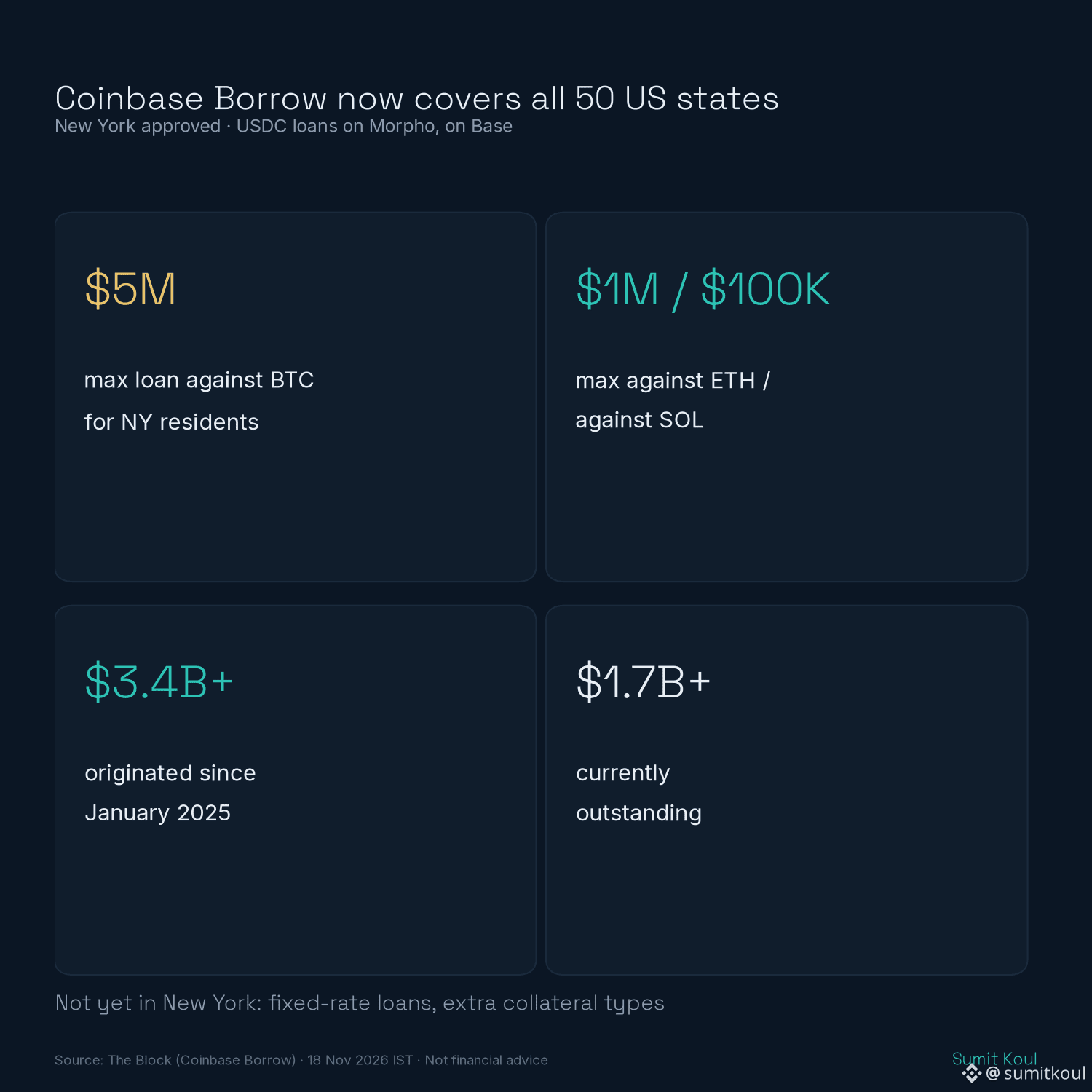
Coinbase Borrow now works in all 50 US states. New York was the last one. 🏦
How it works: you post crypto as collateral and borrow USDC. Under the hood it runs on Morpho's lending infrastructure on Base.
New York limits (per The Block):
• Up to $5M against $BTC
• Up to $1M against $ETH
• Up to $100K against $SOL
Since January 2025 it has originated more than $3.4B in loans, with over $1.7B outstanding. Fixed-rate loans and extra collateral types aren't available in New York yet.
One thing to remember in a market like this: a crypto-backed loan can be liquidated if your collateral falls far enough. Know your liquidation price before you borrow.
Would you borrow against your crypto, or never? 👇
Not financial advice.
#DeFi #Coinbase #Morpho
28
·
--
Coinbase Borrow is now live in New York after NYDFS approval, completing its rollout to all 50 US states. Users can borrow USDC against BTC, ETH or SOL via Morpho on Base, with limits up to 5 million dollars for BTC, 1 million for ETH and 100,000 for SOL. #Coinbase #DeFi
Coinbase Borrow is now live in New York after NYDFS approval, completing its rollout to all 50 US states. Users can borrow USDC against BTC, ETH or SOL via Morpho on Base, with limits up to 5 million dollars for BTC, 1 million for ETH and 100,000 for SOL. #Coinbase #DeFi
1

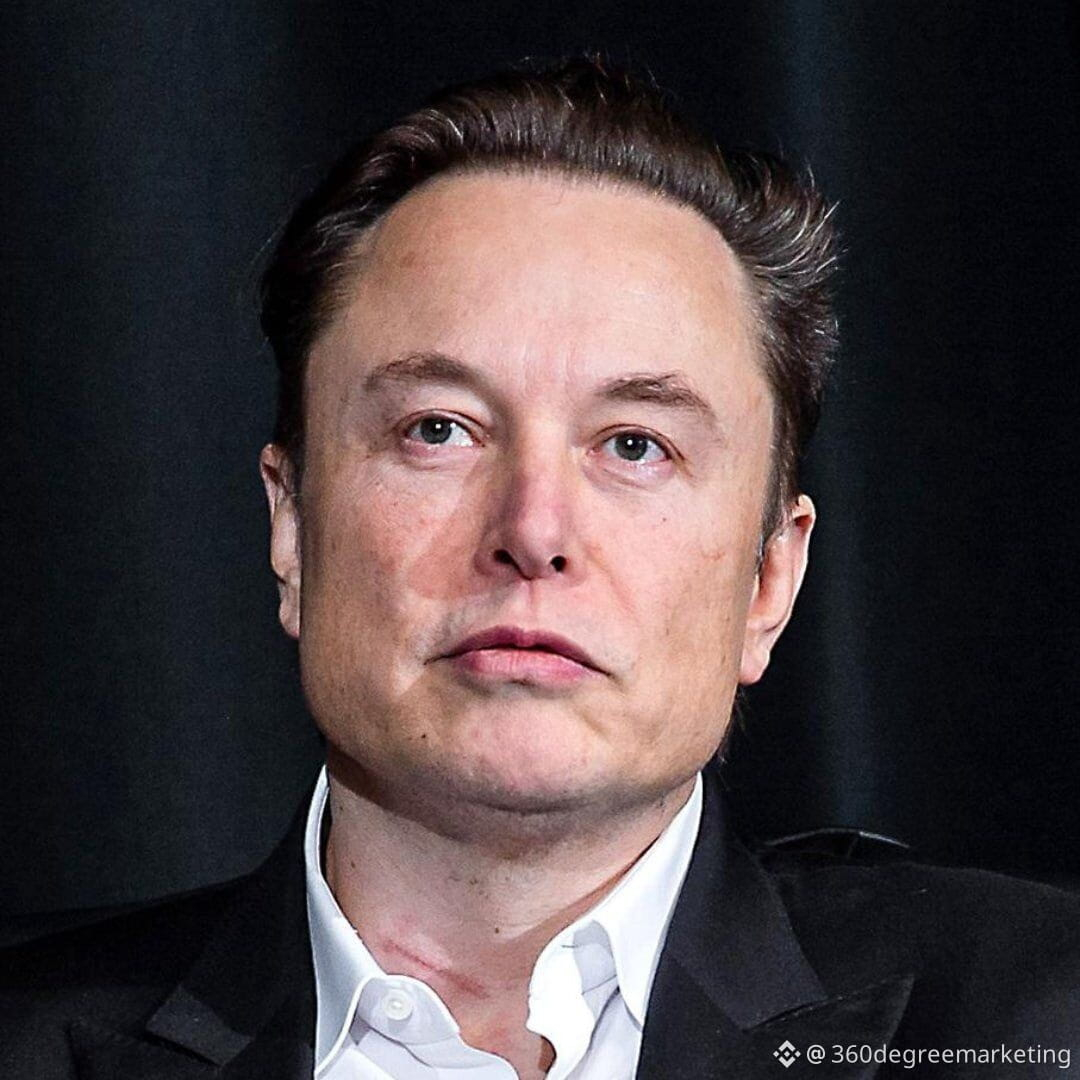
🚨 NEW: Coinbase says its AI scam defenses stopped $4.7 million from leaving customer accounts during a fake Tesla crypto giveaway that used a deepfake of Elon Musk.
#Crypto #Coinbase
🚨 NEW: Coinbase says its AI scam defenses stopped $4.7 million from leaving customer accounts during a fake Tesla crypto giveaway that used a deepfake of Elon Musk.
#Crypto #Coinbase
#Crypto #Coinbase

150



·
--
Verified
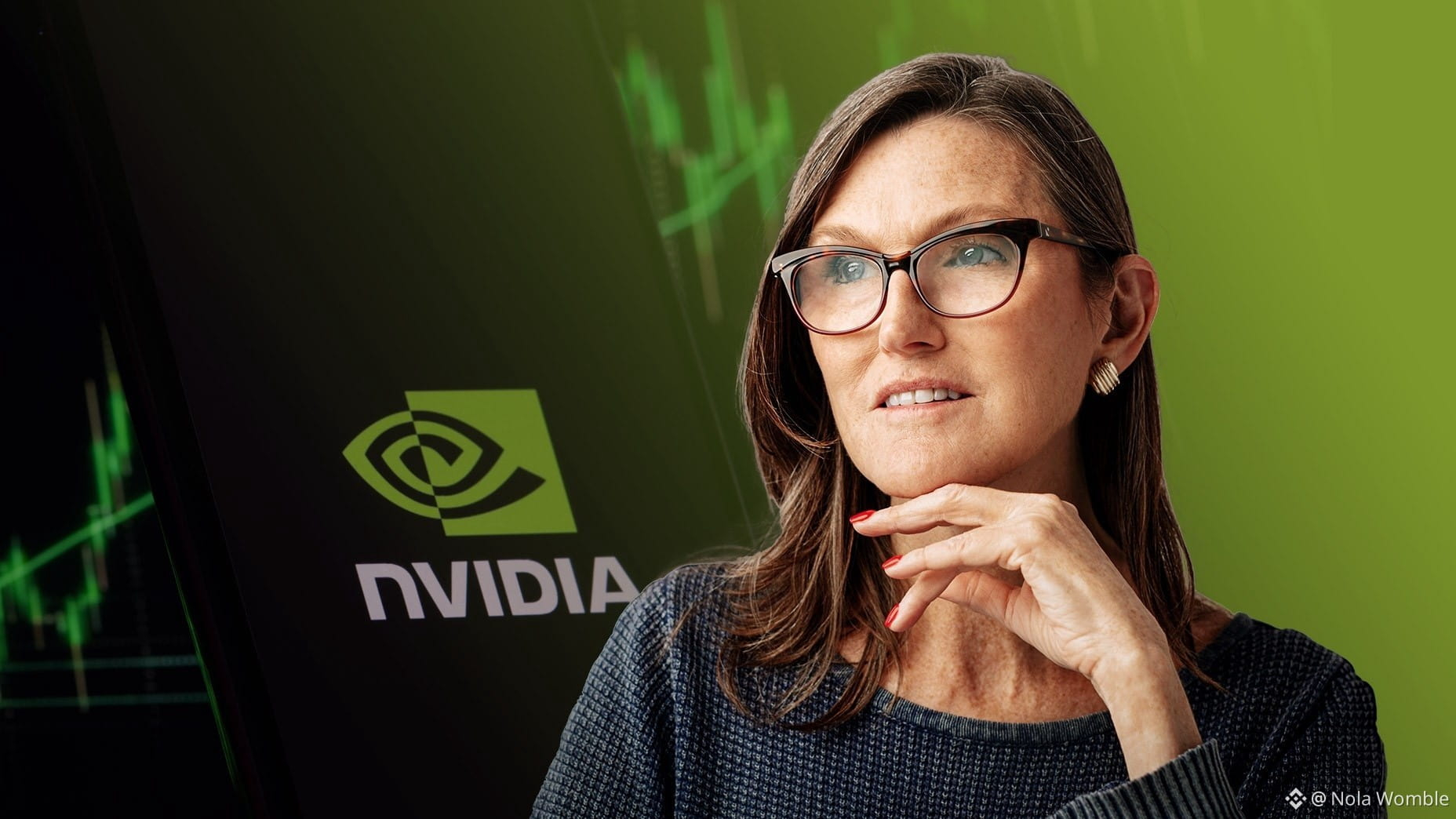
CATHIE WOOD SELLS NVIDIA AND BUYS COINBASE AND CIRCLE!
During Monday's stock market sell-off, Cathie Wood's investment firm ARK Invest executed a notable portfolio reshuffle.
The firm sold approximately 85 million USD worth of NVIDIA ( $NVDAB ) shares.
Simultaneously, ARK allocated nearly 40 million USD to purchase shares in:
Coinbase ( $COINB ) - a cryptocurrency exchange.
Circle ( $CRCLB ) - the issuer of the USDC stablecoin.
Block ( XYZ ) - a company developing payment and financial technologies.
This represents a notable capital reallocation from an AI chipmaker toward cryptocurrency infrastructure and digital payments. Cathie Wood may see greater upside potential in the crypto-finance sector.
However, this does not necessarily signify a complete exit from NVIDIA or guarantee gains for the newly acquired stocks.
In your view, which holds greater promise over the coming years - artificial intelligence or the cryptocurrency industry?
#NVIDIA #coinbase #CathieWood #CryptoNews
790
·
--
Coinbase launched a ChatGPT plugin: eligible US users can check balances and trade spot crypto, eligible stocks and dated futures inside the chat. Every new order, edit or cancel needs approval on a confirmation card. #Coinbase #AI
Coinbase launched a ChatGPT plugin: eligible US users can check balances and trade spot crypto, eligible stocks and dated futures inside the chat. Every new order, edit or cancel needs approval on a confirmation card. #Coinbase #AI
34

Coinbase bringing onchain crypto loans to New York using major assets like Bitcoin as collateral is a fascinating step for decentralized finance adoption. By integrating protocols like Morpho, we are witnessing a deeper bridge between traditional regulatory hubs and self-custodianship utility. This development highlights how crypto-backed liquidity is evolving beyond simple trading into functional financial tooling for holders. $BTC $ETH $SOL #Crypto #DeFi #Coinbase
Coinbase bringing onchain crypto loans to New York using major assets like Bitcoin as collateral is a fascinating step for decentralized finance adoption. By integrating protocols like Morpho, we are witnessing a deeper bridge between traditional regulatory hubs and self-custodianship utility. This development highlights how crypto-backed liquidity is evolving beyond simple trading into functional financial tooling for holders. $BTC $ETH $SOL #Crypto #DeFi #Coinbase
119

·
--
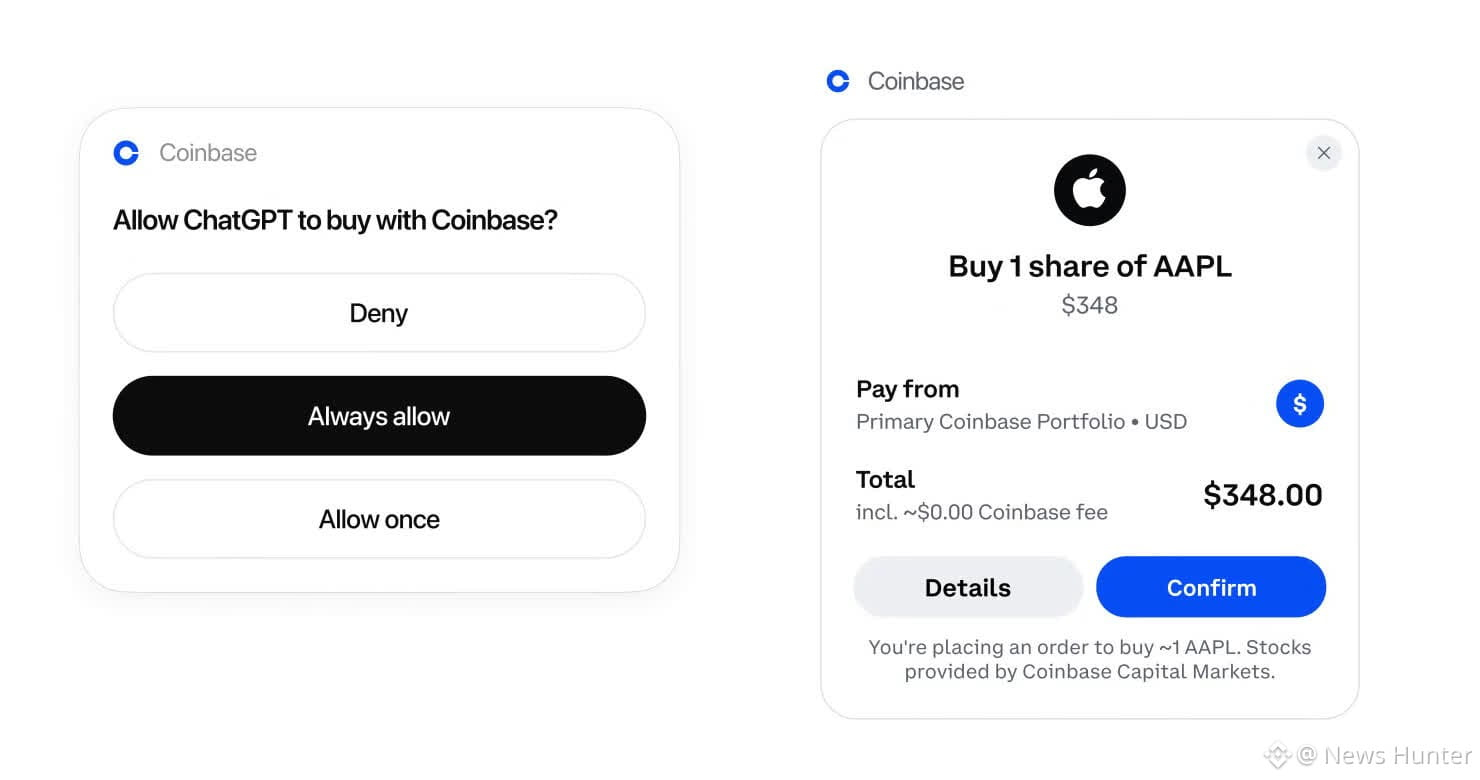
Coinbase just put a "buy" button inside ChatGPT, and I think people are underrating what that means.
As of today you can connect your Coinbase account to ChatGPT and trade stocks, crypto and derivatives right in the chat. You ask, it drafts the order, and you still have to hit Confirm on every single trade. Brian Armstrong says anyone with ChatGPT can connect starting today.
I've watched every "new on-ramp" story for decades. Online brokers, mobile apps, zero commissions. Each one looked like a gimmick at first and then quietly changed who trades and how often. This one feels similar. The distance between "what should I buy?" and actually buying it just shrank to one click.
Two things I keep coming back to.
First, distribution. Hundreds of millions of people already sit in that chat box every day. Most of them have never opened an exchange app. That is a new funnel, not a new feature.
Second, risk. An assistant that makes trading this easy will also make impulsive trading this easy. Coinbase itself suggests keeping agent trading in a separate, small portfolio. I'd take that advice seriously.
Funny part: AI-agent tokens barely reacted. $FET is flat and $VIRTUAL is down about 3% today, while the broader market is still risk-off with majors drifting lower. The real AI x crypto adoption story is happening on regulated rails, not in the tokens that sell the narrative.
Not financial advice. DYOR.
#coinbase #chatgpt #AIAgents #CryptoAdoption #FET
2
882

·
--
Coinbase CEO Armstrong made a bold prediction: within ten years, 99.999% of financial transactions will take place between AI agents.
Sounds absurd? The logic actually checks out: agents buy computing power, call APIs, and pay each other for services—thousands of transactions a second. You can't have people clicking to approve each one. Machines need to manage their own money. Automated payments are a necessity, not just a concept.
The timing is what makes it interesting. This week, the market is dumping AI assets like crazy—more than 460 S&P 500 stocks are down, and everyone is questioning whether all the money being poured into AI infrastructure can ever be made back. And Armstrong chooses this moment to make his claim. The message is clear: you all can argue; I'm already laying the tracks.
Here's another intriguing detail: CoreWeave's chief strategy officer put up $30 million of his own money to buy the company's unsecured bonds. When an executive puts real money behind their own company's debt, is it a show of confidence or a backstop? You decide.
BTC is still hovering around 60,000. Don't get your hopes up for a rally late Friday—keep some powder dry for the weekend.
The AI agent economy may sound far off, but crypto payments are its railway tracks. You don't have to believe the story yet, but keep an eye on the tracks. NFA DYOR
$COIN $CRWV $BTC
#比特币 #Coinbase #AI代理 #加密货币 #CoreWeave
231

·
--
Coinbase plans to bring its U.S. prediction market in-house, moving away from external partnerships, with 2027 as its target date, according to Crypto Briefing. The report says the reasons are to diversify revenue and reduce reliance on the more volatile crypto trading business; that is the outlet’s interpretation. Running it in-house means building things like contracts and clearing themselves, but no details on the timeline or costs were provided. $BNB #Coinbase. At most, this news is a lead; any actual move would need to be confirmed by a deal.
Coinbase plans to bring its U.S. prediction market in-house, moving away from external partnerships, with 2027 as its target date, according to Crypto Briefing. The report says the reasons are to diversify revenue and reduce reliance on the more volatile crypto trading business; that is the outlet’s interpretation. Running it in-house means building things like contracts and clearing themselves, but no details on the timeline or costs were provided. $BNB #Coinbase. At most, this news is a lead; any actual move would need to be confirmed by a deal.


·
--
Coinbase has set the launch of its own prediction market contracts for the first half of 2027. The business’s annualized net revenue has already exceeded $200 million—these are the two key figures reported by Crypto.news. The revenue figure refers to annualized net revenue, not quarterly revenue or cumulative trading volume, and shouldn’t be mistaken for profit. The plan says the company will launch its own contracts in the first half of 2027, but provides no further details on whether it will meet that timeline. $BNB #Coinbase. This news is, at most, a clue; it’s best to wait for confirmation from trading activity before making a move.
Coinbase has set the launch of its own prediction market contracts for the first half of 2027. The business’s annualized net revenue has already exceeded $200 million—these are the two key figures reported by Crypto.news. The revenue figure refers to annualized net revenue, not quarterly revenue or cumulative trading volume, and shouldn’t be mistaken for profit. The plan says the company will launch its own contracts in the first half of 2027, but provides no further details on whether it will meet that timeline. $BNB #Coinbase. This news is, at most, a clue; it’s best to wait for confirmation from trading activity before making a move.

2

·
--
VanEck to end Gemini custody for three crypto ETFs in February 2027, retain Coinbase as ETF custody landscape shifts
Crypto ETF custody is becoming increasingly concentrated among leading providers. According to Cointelegraph, VanEck plans to terminate its custody agreements with Gemini for three cryptocurrency ETFs in February 2027, while retaining Coinbase to continue providing the related custody services.
The immediate implication is that Coinbase’s position as an institutional custodian within VanEck’s ETF lineup will be strengthened, while Gemini’s share of custody at the institution will be reduced. For $COIN, predictable institutional custody contracts are an important fundamental tailwind. Taking on custody for three ETFs means ongoing fee revenue and a vote of confidence in the brand.
From a capital flows and macro perspective, the rising concentration of ETF custody is worth watching. In recent years, the industry has pursued a “multi-provider” strategy to diversify custody risk. Now, leading institutions are once again consolidating with platforms like Coinbase, which have more established track records in credibility and compliance. This reflects institutions reassessing the balance between security and scale. Greater custody concentration could, in theory, strengthen leading custodians’ pricing power and competitive moats.
It is important to note, however, that this is a decision by a single institution, VanEck, rather than an industry-wide shift. Gemini continues to operate other business lines, and this move concerns only the termination of custody for three ETFs. The actual assets involved and the scope of the impact are limited, so it should not be overinterpreted as a restructuring of the custody industry.
At the market level, this news could provide sentiment support for $COIN, but what is more important to watch is whether other large ETF issuers follow suit. If this remains an isolated case, its marginal contribution to Coinbase’s fundamentals will be limited; if it becomes a trend, it could change the competitive landscape of the institutional custody market.
A counterpoint is that custody contract renewals and changes involve negotiations among multiple parties. VanEck’s choice may not reflect market consensus, and Gemini’s valuation and business have not been materially affected as a result. From a trading perspective, it is more important to wait and see whether the market confirms the significance of this news, rather than making a judgment based solely on an announcement from a single institution.
What to watch next: whether other ETF issuers adjust their custody strategies, how Gemini’s business develops, and whether news related to $COIN translates into actual growth in institutional custody orders.
$COIN #BitcoinETF #Coinbase #StablecoinCustody
The above is a summary of information and personal analysis, and does not constitute investment advice.
Follow me for ongoing coverage of key market developments and data.
VanEck to end Gemini custody for three crypto ETFs in February 2027, retain Coinbase as ETF custody landscape shifts
Crypto ETF custody is becoming increasingly concentrated among leading providers. According to Cointelegraph, VanEck plans to terminate its custody agreements with Gemini for three cryptocurrency ETFs in February 2027, while retaining Coinbase to continue providing the related custody services.
The immediate implication is that Coinbase’s position as an institutional custodian within VanEck’s ETF lineup will be strengthened, while Gemini’s share of custody at the institution will be reduced. For $COIN , predictable institutional custody contracts are an important fundamental tailwind. Taking on custody for three ETFs means ongoing fee revenue and a vote of confidence in the brand.
From a capital flows and macro perspective, the rising concentration of ETF custody is worth watching. In recent years, the industry has pursued a “multi-provider” strategy to diversify custody risk. Now, leading institutions are once again consolidating with platforms like Coinbase, which have more established track records in credibility and compliance. This reflects institutions reassessing the balance between security and scale. Greater custody concentration could, in theory, strengthen leading custodians’ pricing power and competitive moats.
It is important to note, however, that this is a decision by a single institution, VanEck, rather than an industry-wide shift. Gemini continues to operate other business lines, and this move concerns only the termination of custody for three ETFs. The actual assets involved and the scope of the impact are limited, so it should not be overinterpreted as a restructuring of the custody industry.
At the market level, this news could provide sentiment support for $COIN , but what is more important to watch is whether other large ETF issuers follow suit. If this remains an isolated case, its marginal contribution to Coinbase’s fundamentals will be limited; if it becomes a trend, it could change the competitive landscape of the institutional custody market.
A counterpoint is that custody contract renewals and changes involve negotiations among multiple parties. VanEck’s choice may not reflect market consensus, and Gemini’s valuation and business have not been materially affected as a result. From a trading perspective, it is more important to wait and see whether the market confirms the significance of this news, rather than making a judgment based solely on an announcement from a single institution.
What to watch next: whether other ETF issuers adjust their custody strategies, how Gemini’s business develops, and whether news related to $COIN translates into actual growth in institutional custody orders.
$COIN #BitcoinETF #Coinbase #StablecoinCustody
The above is a summary of information and personal analysis, and does not constitute investment advice.
Follow me for ongoing coverage of key market developments and data.

The situation at these Indian exchanges is pretty ironic right now: people can’t withdraw their money, but the trading-volume contests are still going ahead.
First, the facts. On 11/17, Coinbase India acknowledged in a post that INR withdrawals had been unavailable for the past week because a partner bank had gone down, affecting all of that bank’s customers. It posted another update today (11/20): the bank still hasn’t fixed the issue, the withdrawal button in the app is still disabled, and payouts can only be made manually in batches. Anyone who urgently needs their money is told to contact customer support. As of today, it’s been about 11 days since 11/9.
CoinDCX posted twice last night, saying INR withdrawals were “slower than usual” because a partner bank was changing its processing procedures. Most withdrawals arrive within 4 to 6 hours, and trading is operating normally. ZebPay customer support has also been telling users that maintenance is taking longer than expected.
Now look at what these exchanges are doing at the same time. Today, CoinDCX is running the final 12 hours of its 12th-anniversary spot trading challenge while also promoting Anthropic tokenized futures. Another exchange is offering $2,500 in rewards for its trading-volume rankings. The exit is blocked, but they’re still flooring it on the way in.
My take is simple: when you use a CEX in India, your real counterparty risk isn’t the exchange—it’s the one or two banks behind it that are willing to handle crypto-related business. When a bank sneezes, the whole industry catches a cold. Several exchanges having problems in the same week shows that everyone is relying on the same few channels. “Your funds are safe” and “you can get your rupees back whenever you want” are two different things. The exchange controls the former; the bank controls the latter.
What’s still unclear: Coinbase hasn’t named the bank, and I couldn’t find official confirmation of the specific bank names circulating online, so I won’t repeat them. CoinDCX said that “the entire banking system is changing its processes,” but didn’t explain what exactly is changing.
For those of you in India, don’t leave too many rupees sitting on exchanges. If you can convert them into on-chain assets and hold them yourself, do that for now. Pushing for trading-volume rankings while withdrawals are slow feels like a risky way to make money.
#印度 #Coinbase
2
Log in to explore more content
Join global crypto users on Binance Square
⚡️ Get latest and useful information about crypto.
💬 Trusted by the world’s largest crypto exchange.
👍 Discover real insights from verified creators.
Email / Phone number
Trending Topics
1
#CanBTCReboundAfterFalling Below60K?
0 views
0 Discussing
2
#GlobalStocksFaceLongestLosingStreakSince2023
0 views
156 Discussing
3
#BTCBelow$62KAmidHikeFearsAndShiftToAnthropic
20,381 views
186 Discussing
4
#GaoTengBitcoinETFListsOnHKEX
0 views
184 Discussing
5
#TradFiForBeginners
946,825 views
5,371 Discussing
6
#NvidiaBoardReportedlySplitOverHuang’sReturn
258,674 views
2,307 Discussing
7
#TetherBurns8BillionUSDTInPast20Days
0 views
49 Discussing
8
#BitcoinWalletSignatureFlawExploitableWithinSeconds
0 views
19 Discussing
9
#CanGTA6'sLaunchLiftTTWOShares?
207,868 views
1,664 Discussing
10
#HongKongProposesSFCLicensingForFourVirtualAssetServices
404 views
32 Discussing