
#riskmanagement
riskmanagement
18.1M views
71,950 Discussing
Hot
Latest

·
--
Locking in partials on $SOL (+4.84% realized) instead of hoping for a home run.
In choppy, high-fear markets, taking green off the table early and protecting capital beats holding through every swing. Consistency is built one disciplined exit at a time — not by chasing 100% screenshots.
Are you taking quick partials on $SOL bounces or holding for bigger targets?
Not financial advice. #RiskManagement
1
4
1k

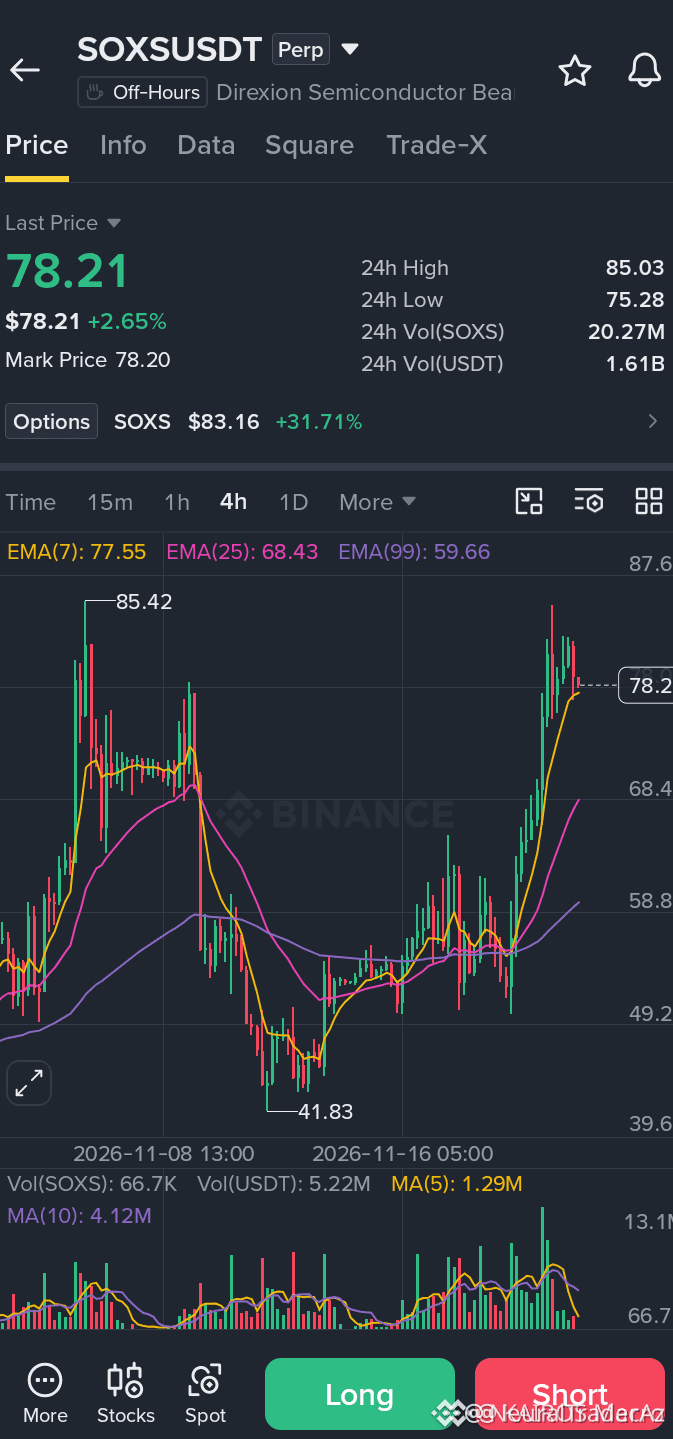
🚨 $SOXS TESTING CRITICAL LIQUIDITY THRESHOLDS AMID RETAIL FOMO 🦈
Entry: 76.80 - 78.30 ⚡
Target: 83.50 - 88.50 🚀
Stop Loss: 73.80 ⚠️
Retail sentiment is currently trapped in high-beta anxiety as volatility sweeps across the order book, testing institutional patience. Smart money capitalizes on emotional extremes by maintaining strict capital allocation rather than chasing erratic momentum swings.
📊 Price action continues to respect the structural demand block while liquidity rests cleanly above the upper distribution targets. 💡 Discipline remains the ultimate edge when the market attempts to shake out undisciplined positioning.
💬 Are you managing your risk parameters tightly on this move or waiting for a cleaner structural confirmation? 👇
⚠️ Not financial advice. Always manage your risk. 🛡️
🏷️ #SOXS #SmartMoney #RiskManagement #Crypto
🔥 💎
14

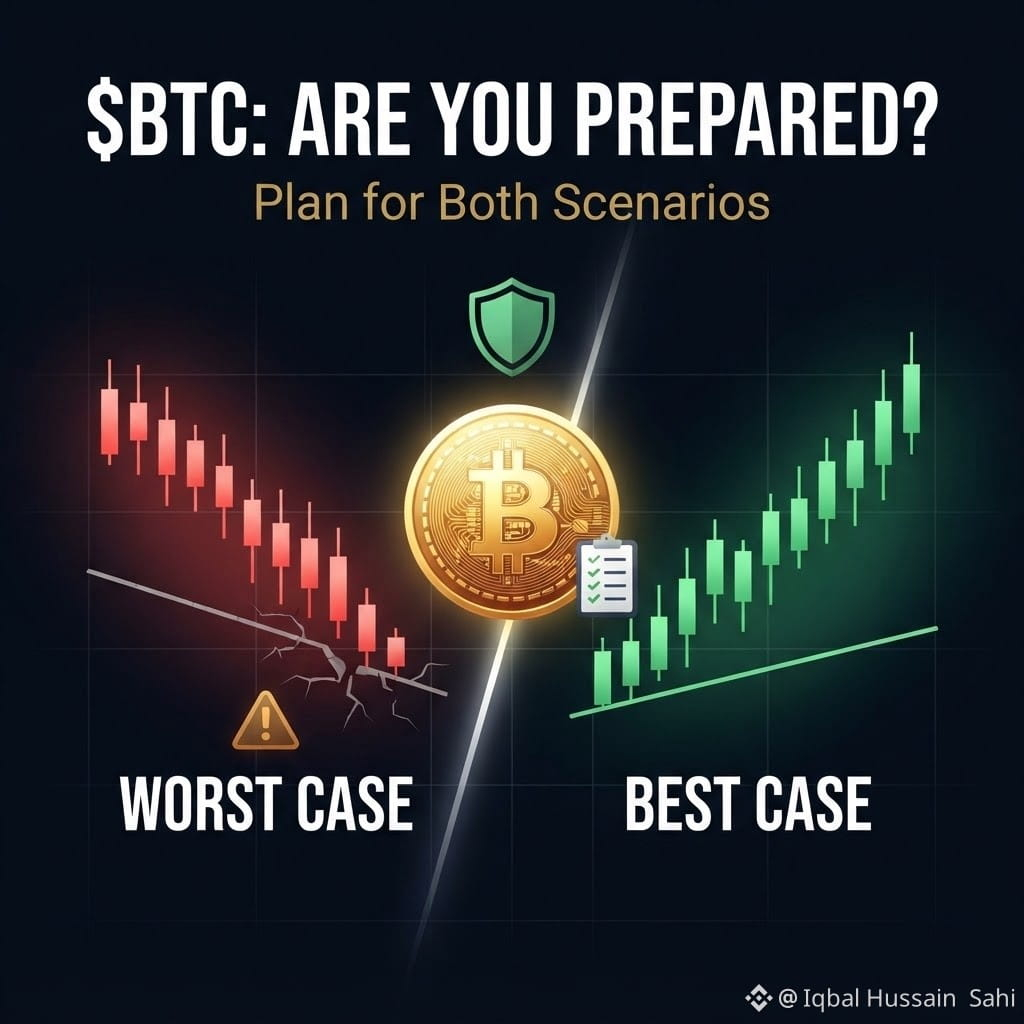
$BTC : Are You Prepared for the Worst-Case Scenario? ⚠️
Everyone loves talking about the upside, but few traders plan for the downside. In this market, nothing is impossible in either direction.
📉 Worst case: support breaks and price slides further than expected
📈 Best case: support holds and buyers step back in
🧠 Smart approach: have a plan for both before you enter
🛡️ Size your position so a bad move doesn't wipe you out
🎯 Decide your stop and exit in advance
⏳ Don't let optimism or fear make your decisions
The traders who survive are not the ones who predict perfectly, but the ones who are prepared.
Do you plan for the worst case before every trade? Tell me in the comments 👇
NFA. Crypto is high risk. Always DYOR.
#BTC #Bitcoin #Crypto #BinanceSquare #RiskManagement
{spot}(BTCUSDT)
$BTC : Are You Prepared for the Worst-Case Scenario? ⚠️
Everyone loves talking about the upside, but few traders plan for the downside. In this market, nothing is impossible in either direction.
📉 Worst case: support breaks and price slides further than expected
📈 Best case: support holds and buyers step back in
🧠 Smart approach: have a plan for both before you enter
🛡️ Size your position so a bad move doesn't wipe you out
🎯 Decide your stop and exit in advance
⏳ Don't let optimism or fear make your decisions
The traders who survive are not the ones who predict perfectly, but the ones who are prepared.
Do you plan for the worst case before every trade? Tell me in the comments 👇
NFA. Crypto is high risk. Always DYOR.
#BTC #Bitcoin #Crypto #BinanceSquare #RiskManagement
97

·
--
$XRP: The 2.4B Weekend Trap Is Echoing Through Order Books — Here Is Why Desks Are Hands-Off Before Monday
The aftermath of that 2.4 billion dollar liquidation cascade is still echoing through crypto order books this Sunday morning. If you are staring at your screen right now trying to claw back losses from yesterday, you are stepping straight into the classic weekend liquidity trap.
Thin order books make current spot prices—with XRP hovering near 0.9284—a dangerous playground for retail traders trying to force trades just to feel active. When heavy volatility hits, pushing $BTC down below 57k while $ETH tracks similar downward pressure, the impulse to revenge trade becomes the fastest way to blow up an account.
Institutional desks simply do not participate in low-volume Sunday churn. They are sitting on the sidelines, waiting for Monday to gauge how the 511 million dollar IBIT ETF bleed impacts broader market sentiment once Wall Street opens.
If you find yourself checking your phone every ten minutes, close the app. The 1 percent risk rule is not just textbook theory; it is the single protective barrier keeping your portfolio intact during aggressive market washouts. When market structure breaks down like this, standard indicators will lag or generate false signals.
That is why I spend Sundays auditing my trading journal instead of placing new orders. I evaluate how my emotional state shifted during the dump, rather than searching for a miracle reversal. With futures turnover touching 39.8 billion, over-leveraged market participants are still hunting for phantom liquidity. If you cannot explain your trade without using words like hope or feeling, stay on cash until real institutional volume returns tomorrow.
What was your biggest discipline mistake during this weekend flush, and what rules are you tweaking before Monday open?
#TradingPsychology #RiskManagement
$XRP : The 2.4B Weekend Trap Is Echoing Through Order Books — Here Is Why Desks Are Hands-Off Before Monday
The aftermath of that 2.4 billion dollar liquidation cascade is still echoing through crypto order books this Sunday morning. If you are staring at your screen right now trying to claw back losses from yesterday, you are stepping straight into the classic weekend liquidity trap.
Thin order books make current spot prices—with XRP hovering near 0.9284—a dangerous playground for retail traders trying to force trades just to feel active. When heavy volatility hits, pushing $BTC down below 57k while $ETH tracks similar downward pressure, the impulse to revenge trade becomes the fastest way to blow up an account.
Institutional desks simply do not participate in low-volume Sunday churn. They are sitting on the sidelines, waiting for Monday to gauge how the 511 million dollar IBIT ETF bleed impacts broader market sentiment once Wall Street opens.
If you find yourself checking your phone every ten minutes, close the app. The 1 percent risk rule is not just textbook theory; it is the single protective barrier keeping your portfolio intact during aggressive market washouts. When market structure breaks down like this, standard indicators will lag or generate false signals.
That is why I spend Sundays auditing my trading journal instead of placing new orders. I evaluate how my emotional state shifted during the dump, rather than searching for a miracle reversal. With futures turnover touching 39.8 billion, over-leveraged market participants are still hunting for phantom liquidity. If you cannot explain your trade without using words like hope or feeling, stay on cash until real institutional volume returns tomorrow.
What was your biggest discipline mistake during this weekend flush, and what rules are you tweaking before Monday open?
#TradingPsychology #RiskManagement
1

Everyone thinks following the number one copy trader is guaranteed passive income, but actually, it can wipe out your portfolio faster than trading on your own.
Most people turn to copy trading because they are tired of missing entries and losing money on emotional decisions. The painful reality is that handing over your trades often just automates your losses instead of protecting your capital.
Look at what just happened to the top-ranked futures copy trader by managed assets. A single closed long position on $MU perp triggered a massive loss of 407,723.36 $USDT in realized red ink. Think of copy trading like riding in the passenger seat of a sports car without a seatbelt. Even an experienced driver can lose control on a slick turn, but while the driver might have deep reserves to absorb the impact, smaller passengers get completely wiped out.
To stay safe, remember two simple lessons. First, never allocate more than a small fraction of your total $BTC or stablecoin balance to any single trader, no matter how clean their historical chart looks. Second, always configure your own personal stop-loss limits on copy settings instead of assuming the leader will cut losses before your account hits zero.
Have you ever taken a heavy hit from copy trading, or do you prefer keeping total control of your trades?
#CryptoTrading #RiskManagement #FuturesTrading

156

·
--
Picture this: you hand your portfolio to the top-ranked futures copy trader by assets under management, assuming safety in size, only to watch over four hundred thousand dollars disappear on one position.
Most people treat copy trading like automated passive income. The hard truth is that delegating execution does not remove leverage risk, and you rarely get a say before a lead trader blows through your capital reserves.
The top-ranked copy trader by AUM recently closed out a disastrous long on $MU perpetuals, realizing a net loss of -407,723.36 $USDT in a single session. Followers absorbed the entire hit as a heavily leveraged bet unraveled under adverse price action. To make matters worse, the underlying asset eventually stabilized up 1.4 percent shortly after, proving that the wipeout was not triggered by a macro collapse, but by oversized leverage that simply could not survive normal intraday volatility.
When lead traders manage massive pools of follower liquidity, their execution profile changes entirely. A position size that works on a personal book creates brutal slippage and forced exits on lower-liquidity pairs compared to majors like $BTC. A top ranking often just reflects recent aggressive volume, not institutional risk management or capital preservation.
How do you protect your portfolio from lead trader overconfidence when using automated strategies?
#CopyTrading #RiskManagement #FuturesTrading
Picture this: you hand your portfolio to the top-ranked futures copy trader by assets under management, assuming safety in size, only to watch over four hundred thousand dollars disappear on one position.
Most people treat copy trading like automated passive income. The hard truth is that delegating execution does not remove leverage risk, and you rarely get a say before a lead trader blows through your capital reserves.
The top-ranked copy trader by AUM recently closed out a disastrous long on $MU perpetuals, realizing a net loss of -407,723.36 $USDT in a single session. Followers absorbed the entire hit as a heavily leveraged bet unraveled under adverse price action. To make matters worse, the underlying asset eventually stabilized up 1.4 percent shortly after, proving that the wipeout was not triggered by a macro collapse, but by oversized leverage that simply could not survive normal intraday volatility.
When lead traders manage massive pools of follower liquidity, their execution profile changes entirely. A position size that works on a personal book creates brutal slippage and forced exits on lower-liquidity pairs compared to majors like $BTC . A top ranking often just reflects recent aggressive volume, not institutional risk management or capital preservation.
How do you protect your portfolio from lead trader overconfidence when using automated strategies?
#CopyTrading #RiskManagement #FuturesTrading

箭头箭头:
640开仓价,600零几止损,最低跌到580多,不止损岂不是亏80万刀?没有稳赚不赔的
1
183
everyone thinks the easiest way to bleed capital is getting rugged on-chain, but actually it is fronting expenses for your crew and trusting them to settle up later.
we stress over counterparty risk and smart contract exploits every day, only to run zero-collateral credit lines for people who magically forget how to sign a transaction. ngl bleeding your stack because someone ghosted an iou hurts worse than catching a wicked red candle.
the numbers on this are wild ser. a recent study showed that 76% of gen z organizers never get fully paid back when fronting costs for group plans, with the organizer usually ending up in the hole instead. saw this exact case study play out at a conference house last month. one guy booked the entire spot and told everyone to ping him the split in $USDT once they arrived.
within three days, half the house claimed their liquid funds were locked up or down bad on a fresh $SOL play, leaving the organizer four figures in debt. treating your personal wallet like an uncollateralized lending protocol is the easiest way to get drained by your own circle. if you are floating tickets, bookings, or mints in $ETH without collecting upfront, you are just running a charity.
have you ever lost a bag fronting expenses for your friends, or do you strictly demand payment before booking?
#personalfinance #riskmanagement #crypto

32
🚨 $BNB ECOSYSTEM TIGHTENS COMPLIANCE AS MAJOR CROSS-PLATFORM GATEWAYS FACE REGULATORY SCRUTINY! ⚡
Institutional risk management extends far beyond chart patterns and leverage. Recent regulatory actions from compliance authorities have forced top-tier venues to sever operational links with specific external platforms facing severe compliance investigations. 📊
Cross-platform transfers are now heavily restricted, with unverified inflows subject to rigorous audits or temporary freezes. Smart participants always account for operational and custodial counterparty risk before moving capital across disparate liquidity pools. 🔍
How are you structuring your risk protocols to navigate evolving exchange compliance policies? 💬
⚠️ Not financial advice. Always manage your risk. 🛡️
🏷️ #BNB #RiskManagement #CryptoCompliance #Trading
🔥 💎

12

🚨 WHEN INFRASTRUCTURE CRACKS: WHY WRAPPED $XMR TOKENS DEMAND EXTREME CAUTION ⚠️
A wrapped asset routing through a major derivatives venue just suffered a brutal 99.8 percent collapse, plunging from five hundred dollars to near parity in minutes. Millions of tokens flooded order books as capital rapidly evaporated, showcasing the fragile mechanics linking peripheral infrastructure to core assets. 📊
This harsh episode highlights a critical reality in decentralized finance where the strength of a primary asset does not immunize synthetic versions against compromised deployment keys or server breaches. ⚡ Always audit the bridge operators and custody layers before trusting cross-chain liquidity. 💡
How do you protect your capital from infrastructure failures when the underlying asset itself remains fundamentally sound? 🤔
⚠️ Not financial advice. Always manage your risk. 🛡️
🏷️ #XMR #DeFi #Crypto #RiskManagement
🦈 🔒

13
🚨 SYSTEMIC SHOCKS AND LIQUIDITY DRAINS ARE TESTING $BTC RISK PARAMETERS RIGHT NOW ⚠️
Institutional order flow often reacts violently to macro tailwinds and systemic vulnerability tests. When external risk vectors threaten banking infrastructure, smart money rapidly trims gross exposure rather than praying for liquidity support. 📊
Defensive positioning is a core component of execution discipline during high-volatility regime shifts across $BTC , $SOL , and $ETH . Preserving capital equity allows institutional operators to wait for structural sweep confirmations at major discount zones. 💡
Are you maintaining a defensive risk posture or deploying fresh capital into this macro turbulence? 👇
⚠️ Not financial advice. Always manage your risk. 🛡️
🏷️ #BTC #RiskManagement #Macro #Crypto
🎯 🦈
24

·
--
⚠️ TRADERS, DON’T LET MARKET VOLATILITY CATCH YOU OFF GUARD!
$BTC is under pressure, and the current market conditions demand extra caution. 👀
Sharp moves can happen in either direction, catching overleveraged traders off guard and wiping out positions in seconds.
Remember, surviving the market is more important than catching every move.
Stay patient, manage your exposure, and never let emotions drive your decisions.
A good trader knows when to enter — but a smart trader also knows when to step aside. 🧠
Protect your capital. The next opportunity will come.
#BTC #CryptoTrading #TradingPsychology #RiskManagement #BinanceSquare
{future}(BTCUSDT)
⚠️ TRADERS, DON’T LET MARKET VOLATILITY CATCH YOU OFF GUARD!
$BTC is under pressure, and the current market conditions demand extra caution. 👀
Sharp moves can happen in either direction, catching overleveraged traders off guard and wiping out positions in seconds.
Remember, surviving the market is more important than catching every move.
Stay patient, manage your exposure, and never let emotions drive your decisions.
A good trader knows when to enter — but a smart trader also knows when to step aside. 🧠
Protect your capital. The next opportunity will come.
#BTC #CryptoTrading #TradingPsychology #RiskManagement #BinanceSquare

83

Recent on-chain liquidations highlight a crucial lesson about leverage in crypto markets. When large positions rely on volatile collateral like WBTC, market dips trigger rapid cascading liquidations. Monitoring health factors on lending protocols is just as important as watching spot charts. Risk management remains the ultimate edge in volatile cycles, reminding us all why understanding debt thresholds matters deeply. $BTC #Bitcoin #DeFi #RiskManagement
Recent on-chain liquidations highlight a crucial lesson about leverage in crypto markets. When large positions rely on volatile collateral like WBTC, market dips trigger rapid cascading liquidations. Monitoring health factors on lending protocols is just as important as watching spot charts. Risk management remains the ultimate edge in volatile cycles, reminding us all why understanding debt thresholds matters deeply. $BTC #Bitcoin #DeFi #RiskManagement
42

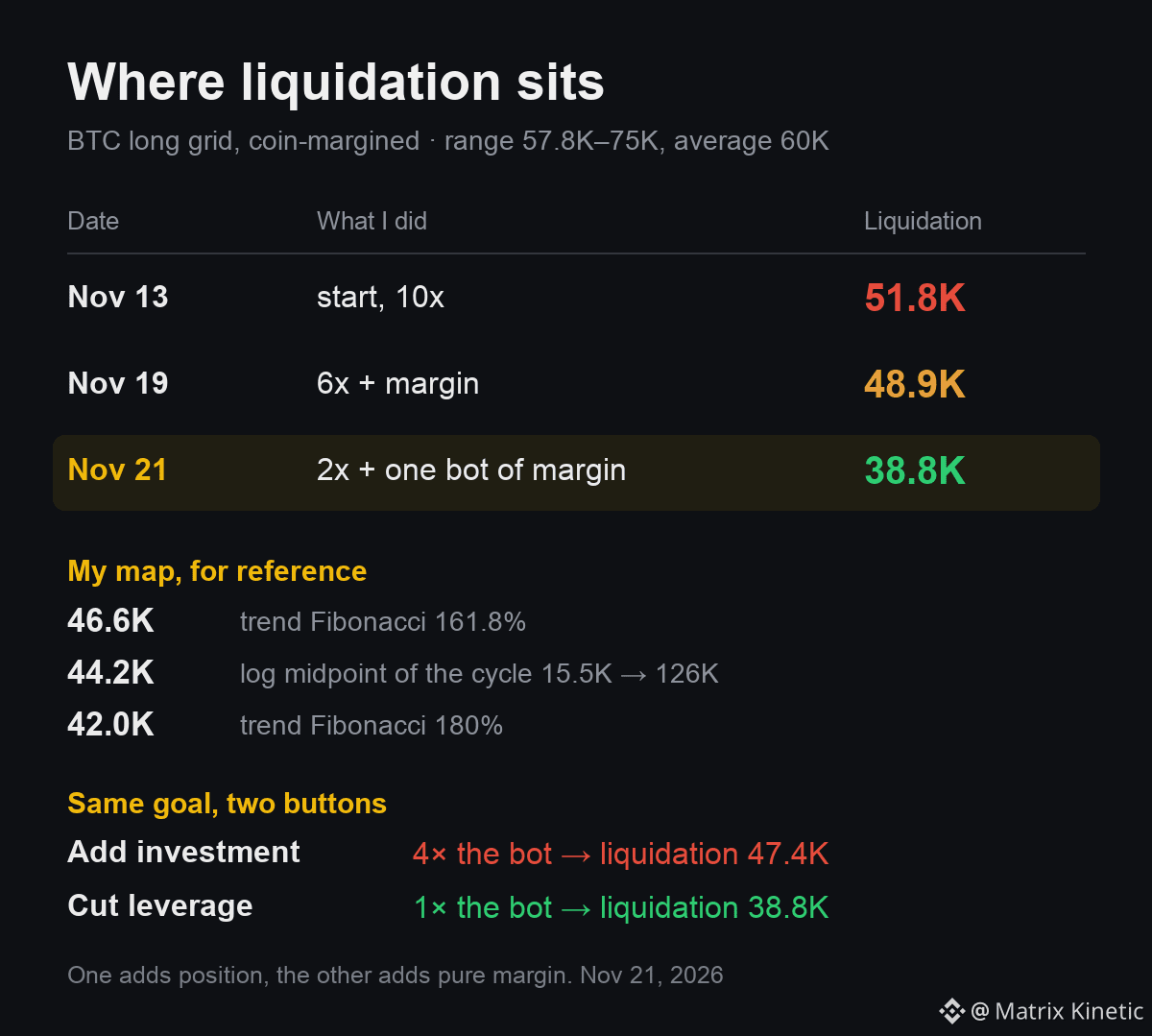
Fear 7, BTC at 57.8K. My long grid ran out of bullets: range 57.8K–75K, all 80 levels bought, average 60K, liquidation 48.9K.
My auto top-up at 55K never fired: the low stopped about 170 dollars above it. So I did it by hand.
What I did: put in about as much again as the bot held, and cut leverage from 6x to 2x. Liquidation: 48.9K → 38.8K.
Why there:
• The log midpoint of this cycle, 15.5K → 126K, is 44.2K. Last cycle bottomed 5% above its midpoint. This one hasn't been there yet.
• Trend Fibonacci: 127.2% at 55.3K, already hit. 161.8% at 46.6K, 180% at 42K. Liquidation now sits below all of them.
• The monthly closes in 9 days, likely below the 12-month average (72.6K). That would make September's break up a false one.
So I expect lower prices, and the position has to live through them. If my map is wrong, I lose more than before. That's the price of the decision.
The lesson I didn't expect: how you add money matters more than how much.
• "Add investment" on my bot buys more position. My whole balance, four times the bot, would have moved liquidation only to 47.4K.
• Cutting leverage adds pure margin. One bot's worth moved it to 38.8K.
A quarter of the money, six times the move. Before you top up a losing position, check which button you're pressing. And whether you have a map or just hope.
Tonight BTC is back at 60.1K. The bot is at −14%. Nothing is won yet.
$BTC #DCA #RiskManagement
{future}(BTCUSDT)
Fear 7, BTC at 57.8K. My long grid ran out of bullets: range 57.8K–75K, all 80 levels bought, average 60K, liquidation 48.9K.
My auto top-up at 55K never fired: the low stopped about 170 dollars above it. So I did it by hand.
What I did: put in about as much again as the bot held, and cut leverage from 6x to 2x. Liquidation: 48.9K → 38.8K.
Why there:
• The log midpoint of this cycle, 15.5K → 126K, is 44.2K. Last cycle bottomed 5% above its midpoint. This one hasn't been there yet.
• Trend Fibonacci: 127.2% at 55.3K, already hit. 161.8% at 46.6K, 180% at 42K. Liquidation now sits below all of them.
• The monthly closes in 9 days, likely below the 12-month average (72.6K). That would make September's break up a false one.
So I expect lower prices, and the position has to live through them. If my map is wrong, I lose more than before. That's the price of the decision.
The lesson I didn't expect: how you add money matters more than how much.
• "Add investment" on my bot buys more position. My whole balance, four times the bot, would have moved liquidation only to 47.4K.
• Cutting leverage adds pure margin. One bot's worth moved it to 38.8K.
A quarter of the money, six times the move. Before you top up a losing position, check which button you're pressing. And whether you have a map or just hope.
Tonight BTC is back at 60.1K. The bot is at −14%. Nothing is won yet.
$BTC #DCA #RiskManagement
Matrix Kinetic
·
--
Update, 12:10. $BTC 69.2K, the bot is at −5.44%, up from −6.69% on the poster.
What's real: +0.65% from 19 finished grid trades, already banked.
What's noise: −6.09% floating, it comes and goes with the price.
Liquidation still at 51,953.
What's real: +0.65% from 19 finished grid trades, already banked.
What's noise: −6.09% floating, it comes and goes with the price.
Liquidation still at 51,953.
1
155

Market volatility is real. Look at $BTC swinging from a low of 55,130.00 to a high of 60,996.00 today. If you are not managing risk, you are gambling.
Here are two golden rules for survival:
- Position Sizing: Never risk more than 1-2 percent of your capital on a single trade, especially when $ETH is actively fluctuating around 1,684.32.
- Stop-Loss Discipline: Always set your invalidation point before entering. Let the market take you out automatically instead of letting emotions drain your portfolio.
Protect your capital first, profits will follow.
How do you usually calculate your position size during high volatility?
#BinanceSquare #Write2Earn #RiskManagement
86

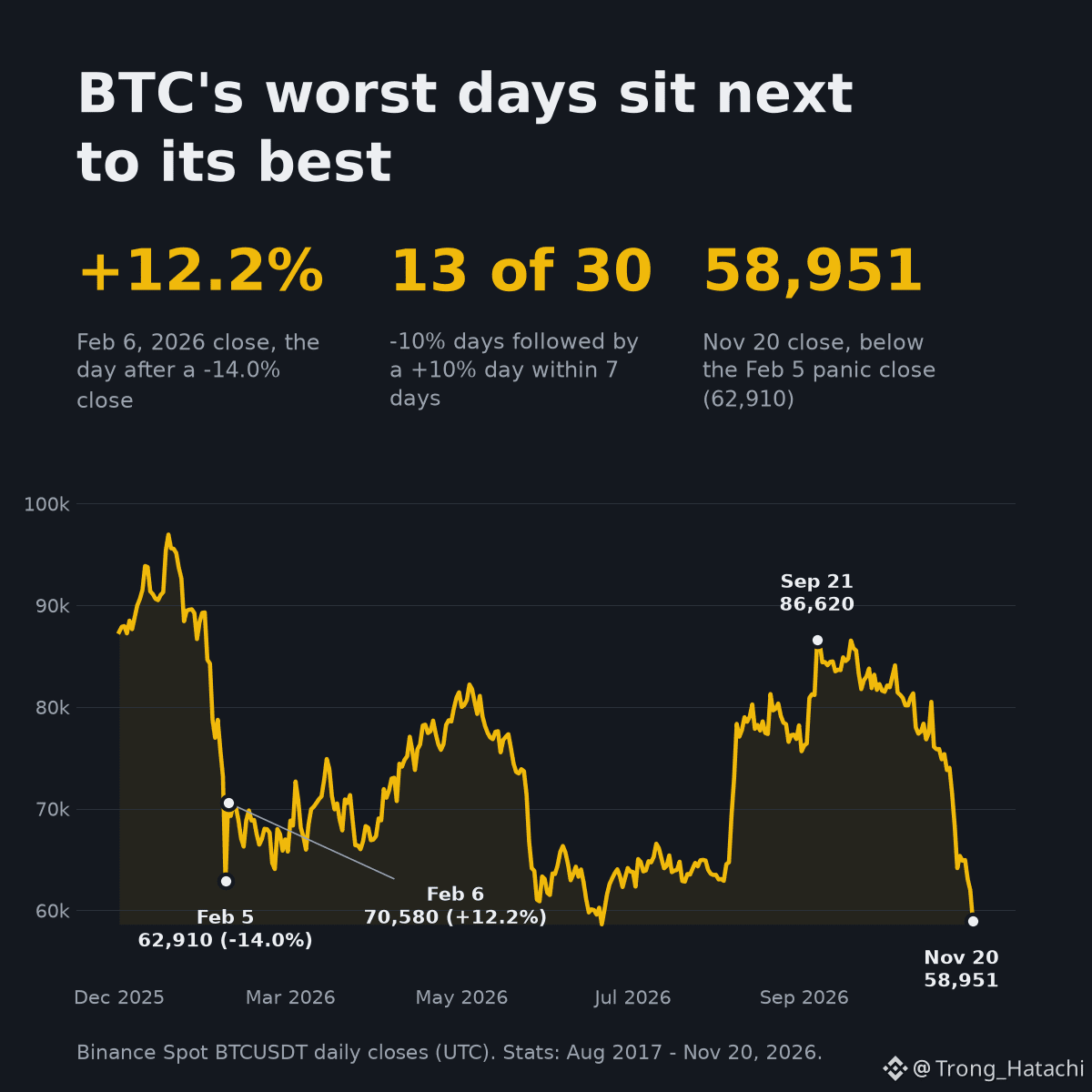
Feb 5, 2026: $BTC closed -14.0%. Feb 6: +12.2%.
Mar 12, 2020: -39.5%. The next day: +16.2%.
The days that scare you out sit next to the days that pay.
BTC daily closes, Aug 2017 to Nov 20, 2026:
• 30 days closed -10% or worse
• 13 of them had a +10% day within 7 days (vs ~8% for a random day)
• 7 of the 20 best came within 7 days after a top-20 worst
Not a "just hold" story: BTC rallied to 86,620 by Sep 21, then gave it all back. Nov 20 close: 58,951, under the Feb 5 panic close (62,910).
Crash days swing both ways. The mistake is deciding there:
1. Set exits before volatility spikes. Selling a -14% close can be right or wrong; it's just a bad moment to decide.
2. Size spot so a -15% day can't shake you out. If it would, size down.
3. Must cut on a crash day? Cut a fixed fraction (say half); the plan decides the rest.
Ever sold the close of a -10% day? YES or NO 👇
Source: Binance BTCUSDT daily closes. Not financial advice.
#TradingPsychology #PanicSelling #RiskManagement $BTC
NamWrite12:
YES — and watching the rebound right after teaches you to size smaller and plan exits early
1
4
210
·
--
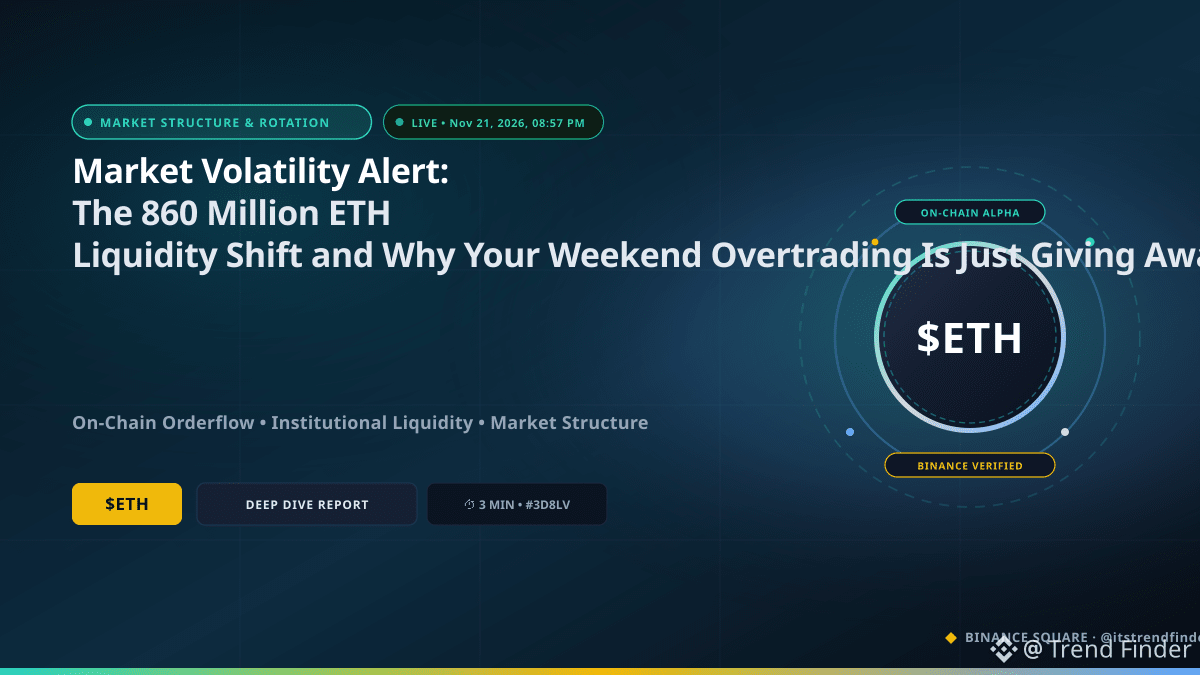
Market Volatility Alert: The 860 Million ETH Liquidity Shift and Why Your Weekend Overtrading Is Just Giving Away Alpha.
It is Saturday night, November 21, 2026, and the markets are breathing heavy after a brutal week. With news breaking that hackers are moving 860 million in Ether and Bitcoin laundering spikes surfacing on the wire, the temptation to jump into a reckless position is at an all-time high. I have been watching the orderflow all evening, and the data is screaming one thing: liquidity is paper thin.
When volume dries up on a weekend, the market makers go hunting for stop losses. If you are sitting here trading the noise, you are not a trader, you are the liquidity. I see the frustration in the community channels as people watch $BTC struggle to find footing and $ETH fluctuating around the 1683 mark. People are trying to force trades because they are bored or desperate to recover losses from the week. That is exactly how accounts get burned before the Monday open even arrives.
Look at the broader landscape. We have TradFi contracts hitting Binance and massive institutional outflows bleeding from ETFs. $XRP is testing multi-year lows, and the structural weakness across the majors is undeniable. My advice? Stop staring at the charts for a few hours. A seasoned trader knows that the most important position you can hold on a Saturday is cash or stablecoins.
If you cannot stick to a 1 percent risk rule in a low-liquidity environment, you will never survive the high-volatility regimes. Use this time to review your trade journal from the last five days. Audit your emotions. Did you revenge trade when the market moved against you? Did you chase a pump because you saw a headline on X? The market does not care about your feelings, only your execution. Prep your mind for the Monday rotation rather than donating your capital to the exchange fees during the weekend chop.
Are you sitting on your hands this weekend, or are you fighting the market?
#TradingPsychology #RiskManagement
2
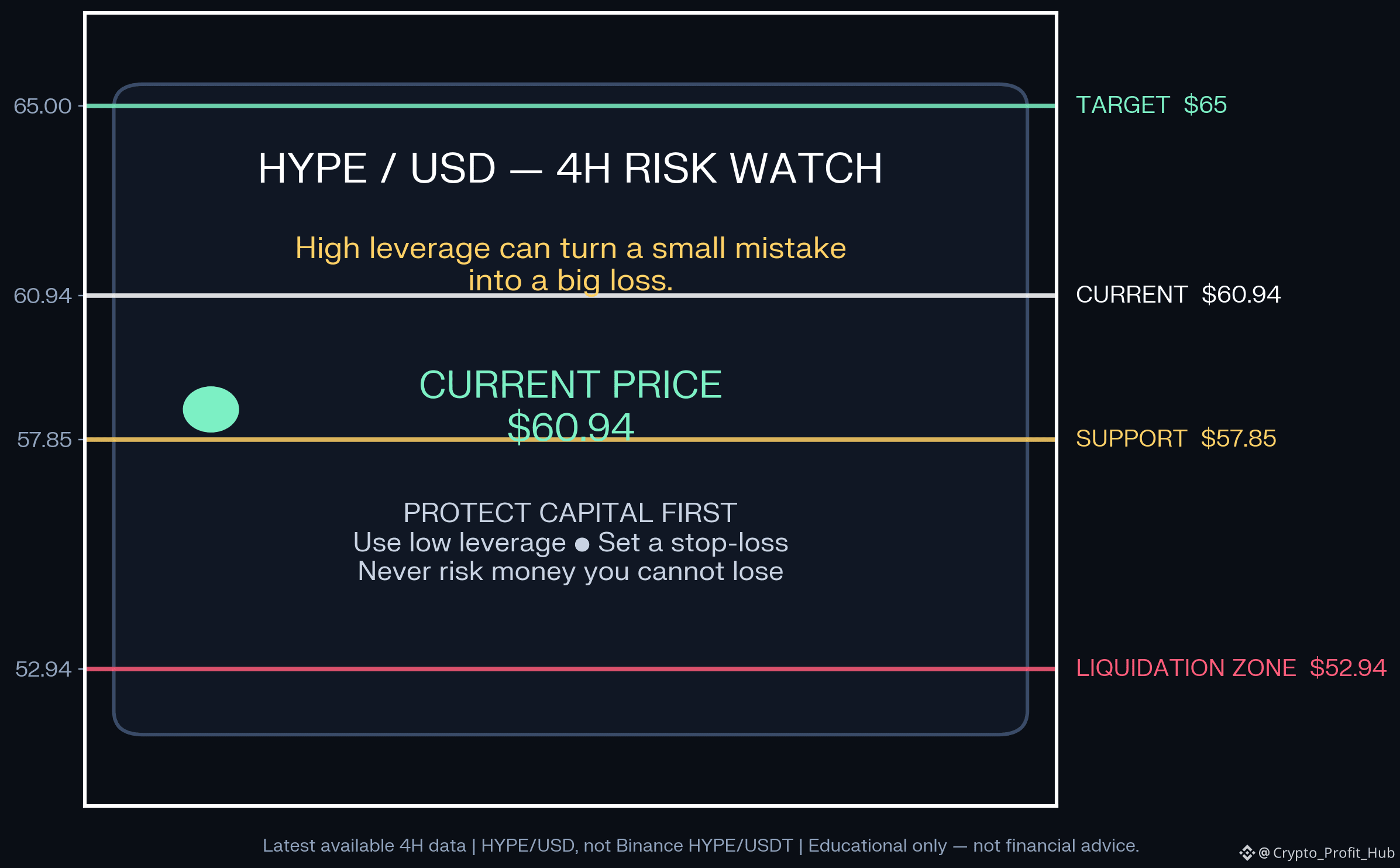
High leverage can turn a small mistake into a big loss. Follow for simple crypto education and real market levels. 🚀
A large $HYPE trader is close to liquidation after using 5x leverage. They added $7M USDC, but their profit dropped from about $68M to $17.66M.[1]
HYPE is now near $60.94. The lesson is simple: protect your capital first, then look for trades.
Use low leverage
Set a stop-loss
Never risk money you cannot lose
Question: What leverage do you use—2x, 5x, or 10x? 👇
$HYPE #cryptoeducation #RiskManagement #tradingtips
Not financial advice. DYOR.
{future}(HYPEUSDT)
High leverage can turn a small mistake into a big loss. Follow for simple crypto education and real market levels. 🚀
A large $HYPE trader is close to liquidation after using 5x leverage. They added $7M USDC, but their profit dropped from about $68M to $17.66M.[1]
HYPE is now near $60.94. The lesson is simple: protect your capital first, then look for trades.
Use low leverage
Set a stop-loss
Never risk money you cannot lose
Question: What leverage do you use—2x, 5x, or 10x? 👇
$HYPE #cryptoeducation #RiskManagement #tradingtips
Not financial advice. DYOR.
73


$RWUSD: Entry Quality Over Shallow Scanning
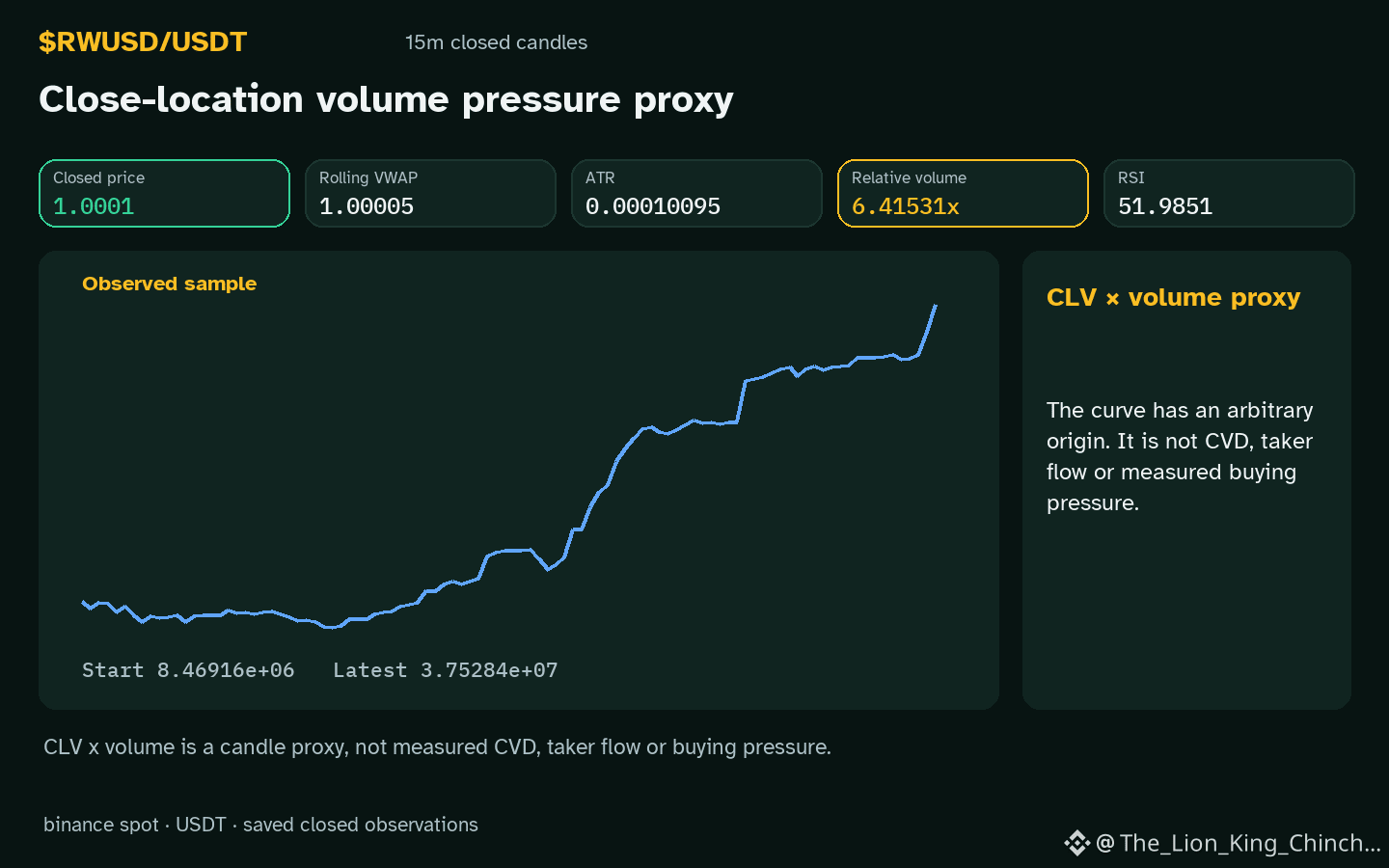
$RWUSD: Is a useful pause or a rushed conclusion? $RWUSD shows hourly direction up and volume above baseline.
The research dilemma
Shallow feed browsing scans ten surfaces. It collects RSI, volume, and change. This approach misses structural context. You see indicators but lack a rule for entry.
Deep learning focuses on one mechanism. It asks how relative volume confirms or denies the move. Here, the asset is inside the recorded range. The direction is up. The volume supports this. But does it guarantee continuation?
The trade-off
Chasing highs risks poor entry quality. Entering now means buying above the local support. A meaningful invalidation would be a close below support. Stopping further away increases risk. Waiting for a pullback might improve entry quality but could miss the move.
Consider a thought experiment. If volume spikes without price expansion, the momentum may fade. If price rises steadily with baseline volume, the move lacks conviction. Both scenarios create uncertainty.
A rule worth testing
Use a predefined reassessment condition. If the price closes below support, the interpretation weakens. If it holds above resistance, the strength increases. This is a concrete way to check the logic.
Shallow browsing reacts to noise. Deep analysis tests a single hypothesis against closed candles. The limit is that current measurements describe only the saved observation. They do not predict the next candle. A counterexample is a sudden reversal after a volume spike. This shows that correlation is not causation.
Self-check: Can you identify the exact level that breaks your assumption? If not, the setup is incomplete. Keep the focus on one trade-off, not many signals.
Probabilistic market research, not a recommendation or guaranteed return.
#RWUSD #RiskManagement #CryptoLearning
$RWUSD : Entry Quality Over Shallow Scanning
$RWUSD : Is a useful pause or a rushed conclusion? $RWUSD shows hourly direction up and volume above baseline.
The research dilemma
Shallow feed browsing scans ten surfaces. It collects RSI, volume, and change. This approach misses structural context. You see indicators but lack a rule for entry.
Deep learning focuses on one mechanism. It asks how relative volume confirms or denies the move. Here, the asset is inside the recorded range. The direction is up. The volume supports this. But does it guarantee continuation?
The trade-off
Chasing highs risks poor entry quality. Entering now means buying above the local support. A meaningful invalidation would be a close below support. Stopping further away increases risk. Waiting for a pullback might improve entry quality but could miss the move.
Consider a thought experiment. If volume spikes without price expansion, the momentum may fade. If price rises steadily with baseline volume, the move lacks conviction. Both scenarios create uncertainty.
A rule worth testing
Use a predefined reassessment condition. If the price closes below support, the interpretation weakens. If it holds above resistance, the strength increases. This is a concrete way to check the logic.
Shallow browsing reacts to noise. Deep analysis tests a single hypothesis against closed candles. The limit is that current measurements describe only the saved observation. They do not predict the next candle. A counterexample is a sudden reversal after a volume spike. This shows that correlation is not causation.
Self-check: Can you identify the exact level that breaks your assumption? If not, the setup is incomplete. Keep the focus on one trade-off, not many signals.
Probabilistic market research, not a recommendation or guaranteed return.
#RWUSD #RiskManagement #CryptoLearning
45
Everyone thinks copying the top-ranked trader is a guaranteed path to passive profits, but actually, it can be the quickest way to empty your account.
Few things hurt more than trusting your hard-earned money to a seasoned professional, only to wake up and discover they wiped out your balance overnight. You gave up control to reduce stress, yet ended up absorbing all the financial damage.
Just look at what happened on the leaderboard recently. The number one trader by total assets under management closed out a long position on MUUSDT for a massive loss of 407,723.36 $USDT. Think of high-leverage copy trading like sitting in the passenger seat of a sports car speeding in the rain. The driver might look confident, but it only takes one small slick patch on the road for the car to lose control. In this case, the underlying token $MU only dropped by 5.63 percent, yet over four hundred thousand dollars vanished simply because the position was oversized.
This breakdown highlights two key lessons every trader should remember. First, public leaderboards often showcase traders who took extreme risks during calm periods, which masks their lack of defense when the tide turns. Second, leverage magnifies routine market noise into fatal errors. If a five percent dip can wipe out half a million dollars, the strategy relies on luck rather than sound risk management, regardless of whether you trade speculative assets or major pairs like $BTC.
Where do you stand on copy trading after seeing losses like this?
#CryptoTrading #RiskManagement #FuturesTrading
Everyone thinks copying the top-ranked trader is a guaranteed path to passive profits, but actually, it can be the quickest way to empty your account.
Few things hurt more than trusting your hard-earned money to a seasoned professional, only to wake up and discover they wiped out your balance overnight. You gave up control to reduce stress, yet ended up absorbing all the financial damage.
Just look at what happened on the leaderboard recently. The number one trader by total assets under management closed out a long position on MUUSDT for a massive loss of 407,723.36 $USDT. Think of high-leverage copy trading like sitting in the passenger seat of a sports car speeding in the rain. The driver might look confident, but it only takes one small slick patch on the road for the car to lose control. In this case, the underlying token $MU only dropped by 5.63 percent, yet over four hundred thousand dollars vanished simply because the position was oversized.
This breakdown highlights two key lessons every trader should remember. First, public leaderboards often showcase traders who took extreme risks during calm periods, which masks their lack of defense when the tide turns. Second, leverage magnifies routine market noise into fatal errors. If a five percent dip can wipe out half a million dollars, the strategy relies on luck rather than sound risk management, regardless of whether you trade speculative assets or major pairs like $BTC .
Where do you stand on copy trading after seeing losses like this?
#CryptoTrading #RiskManagement #FuturesTrading

216

·
--
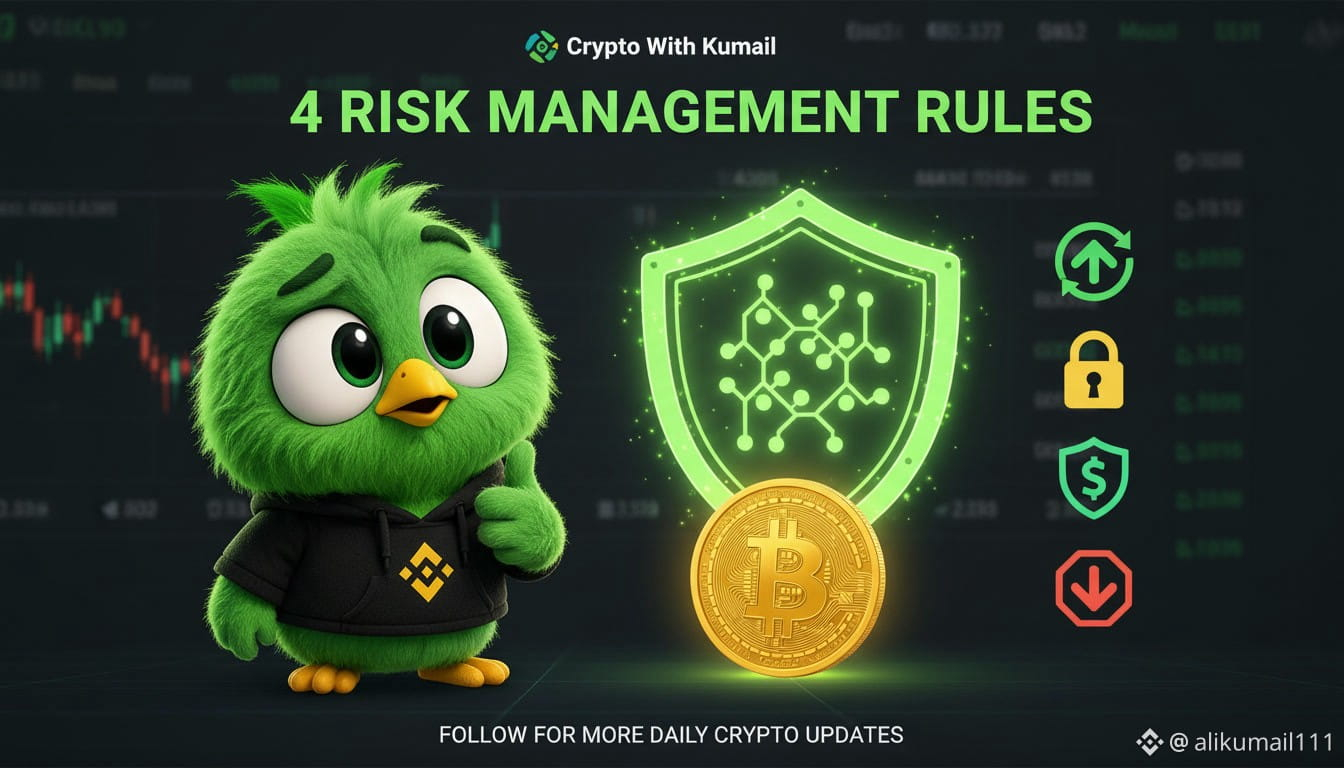
🛡️ BITCOIN MARKET VOLATILITY: 4 RISK MANAGEMENT RULES EVERY TRADER SHOULD KNOW!
When crypto markets become volatile, protecting your capital is essential.
Here are 4 important rules:
1️⃣ Avoid Excessive Leverage
High leverage can increase losses during sudden price movements.
2️⃣ Set Stop-Loss Levels
Plan your exit before entering a trade.
3️⃣ Don't Chase the Market
Avoid panic buying or selling because of sudden price changes.
4️⃣ Manage Your Position Size
Never risk money you cannot afford to lose.
💡 Remember: Successful trading is not about predicting every market move. It's about managing risk and staying disciplined.
👇 Which rule do you think traders ignore the most?
Follow Crypto With Kumail for daily crypto education and market updates.
Educational content only. Not financial advice.
#cryptotrading #bitcoin #RiskManagement #BinanceSquare
85
Log in to explore more content
Join global crypto users on Binance Square
⚡️ Get latest and useful information about crypto.
💬 Trusted by the world’s largest crypto exchange.
👍 Discover real insights from verified creators.
Email / Phone number
Trending Topics
1
#NvidiaLoses$2.7TrillionInMonthAndAHalf
26,385 views
150 Discussing
2
#CanBTCReboundAfterFallingBelow60K?
827,535 views
3,094 Discussing
3
#GlobalStocksFaceLongestLosingStreakSince2023
307,881 views
2,066 Discussing
4
#BlackRockIBITPostsRecord$541MSingleDayOutflow
38,480 views
110 Discussing
5
#AnthropicPlungesTowardIPOPriceonDay2
158,750 views
1,252 Discussing
6
#TwentyOneCapitalAdds172.25BTC
73,480 views
696 Discussing
7
#HKBillWouldExcludeTokenizedDepositsFromVirtualAssets
10,223 views
51 Discussing
8
#BNBDropsBelow540USDTWith8.46%DailyDecline
84,793 views
673 Discussing
9
#HKBillProposesHK$100KFineForUnauthorizedCryptoTitles
2,857 views
25 Discussing
10
#BitMineFaces$10.1BUnrealizedETHLoss
5,940 views
29 Discussing