
迪迦Tiga
41 Posts

迪迦Tiga
Report
Block User
BP-D1C0CB0694B0
27 Following
873 Followers
11 Liked
Posts
All
Videos
Live
·
--
I looked into the Kaito rewards pool for TermiX and found two different figures.
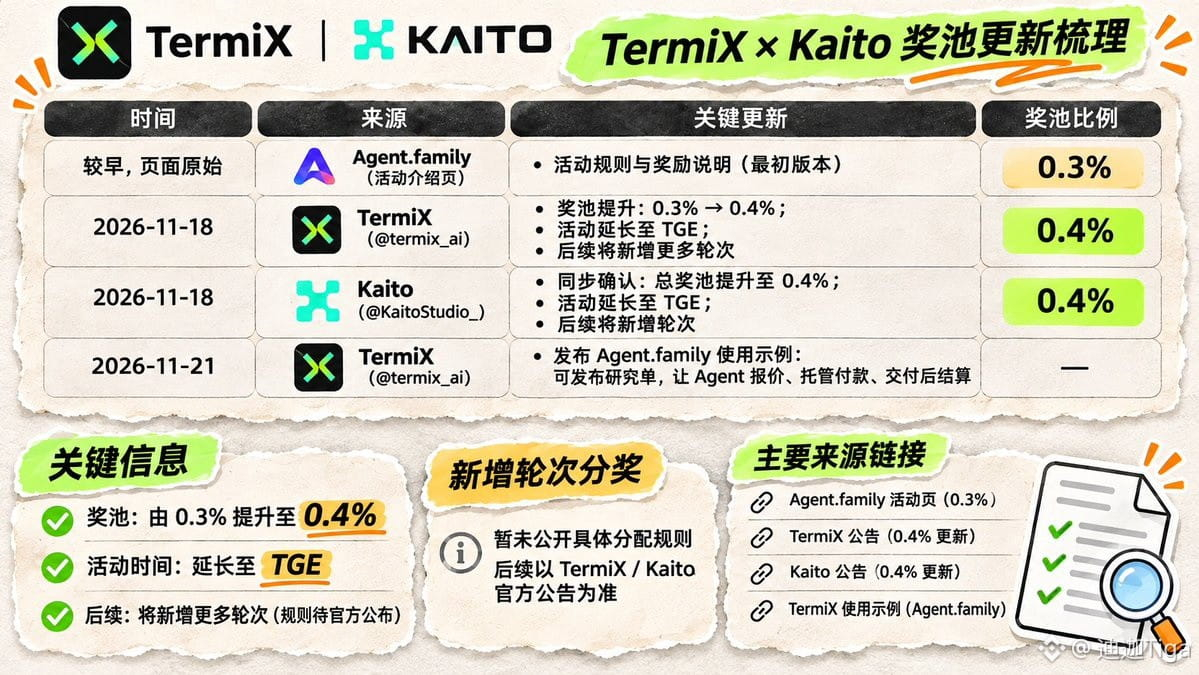
The campaign page on Agent.family still says 0.3%.
But on November 18, TermiX and Kaito Studio posted an update: the total rewards pool had increased to 0.4% of the token supply, the campaign had been extended to TGE, and more rounds would be added later.
When I wrote about Game Forge last time, I first had Grok gather the information.
It was quick at finding links, but when a page and an announcement didn’t match like this, I still had to click through and check the dates one by one.
On November 21, TermiX happened to suggest a way to use the platform.
TermiX said you can post a research task on Agent.family and let Agents who are willing to take it on submit quotes.
Once you select a quote, the money goes into escrow and is released after the work is delivered.
If I were posting this task, I’d spell out the requirements in three lines.
Put TermiX, Kaito, and the campaign page in one table. Note when each was updated and what changed, and include a source for every entry.
Leave the reward allocation for new rounds blank if you can’t find it.
I’d be willing to pay for this kind of work. If someone asks me where the 0.4% figure came from after I post, I can open the table and send them the source instead of digging through everything again.
#TermiX #Kaito #TGE #AIagents
97
·
--
When running a raffle for X, there’s actually another step after the winners list is published.
In the past, you had to first collect wallet addresses via direct messages, then paste each 0x back into the table. If someone replied two days late, that payment had to be tracked separately.
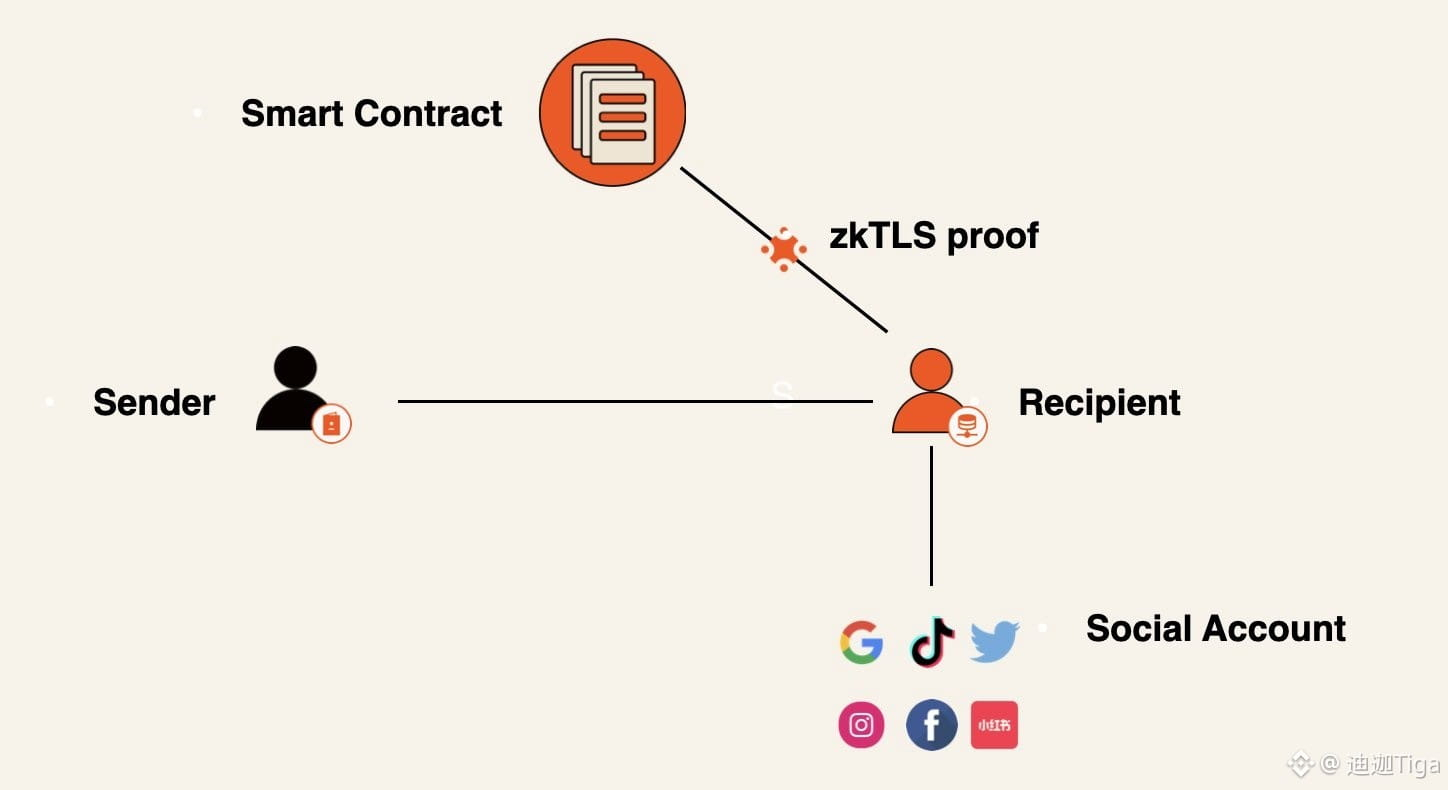
When I was looking through Primus’s payment example, I found that the X account on the winners list was already enough to reserve the prize money.
For example, if ten people win in one round of a raffle and each gets 50 USDC, this example lets the organizer deposit the prize money into a contract first, with each share reserved for one X account on the list.
When the winner comes to claim it, they connect their wallet and use zkTLS to prove they can control that account. Once the contract verifies it, the prize goes into the wallet they connected.
I also checked what happens to unclaimed prize money. The example in the Primus Fund SDK gives a 30-day period; if someone still hasn’t claimed it by then, the payer can initiate a refund and send the money back to the original wallet.
If I were using this for an event, I’d include the claim deadline when announcing the winners. Once the prize is deposited into the contract, I’d mark it as pending claim; only after it actually reaches the winner’s wallet would I mark it as paid. At the end of the month, when reconciling the books, it would be clear at a glance who claimed what, which payments were still pending, and which ones had already been refunded.
#Primus #zkTLS #USDC #On-chain payment
122
·
--
I make cutout animations, and it’s pretty common to rerun a shot three or four times.
If a character’s walk looks off, I redo it.
If one shot doesn’t connect with the next, I redo it again.
By the time I publish the finished video, the tool’s backend may have accumulated a dozen or more clips.
A few days ago, someone shared that they used Primus’s Proof of Creation to verify the number of creations in their CapCut account.
Rerunning the same shot several times adds to the backend records, but the finished video you publish is often still just one video. So when you look at creation records, the number of generations and the final output aren’t the same thing.
#Primus #ProofOfCreation #纸片动画 #Proof of Creation

62
·
--
Taking another look at Primus’s reserves dashboard three weeks later, one change in USDu stands out:
The amount by which reserves exceed supply has shrunk from about $1.3 million to $60,000.
From October 26 to November 18, both supply and reserves fell by roughly 20%. Reserves declined a little faster, bringing the coverage ratio down from 102.47% to 100.14%.
The share held off-chain barely moved, from 14.7% to 13.8%.
If you focus only on this ratio, as last time, it’s easy to miss what’s going on. We’ll need to keep looking at the details to find out why the gap narrowed.
Another thing worth clicking through to check is the verification date.
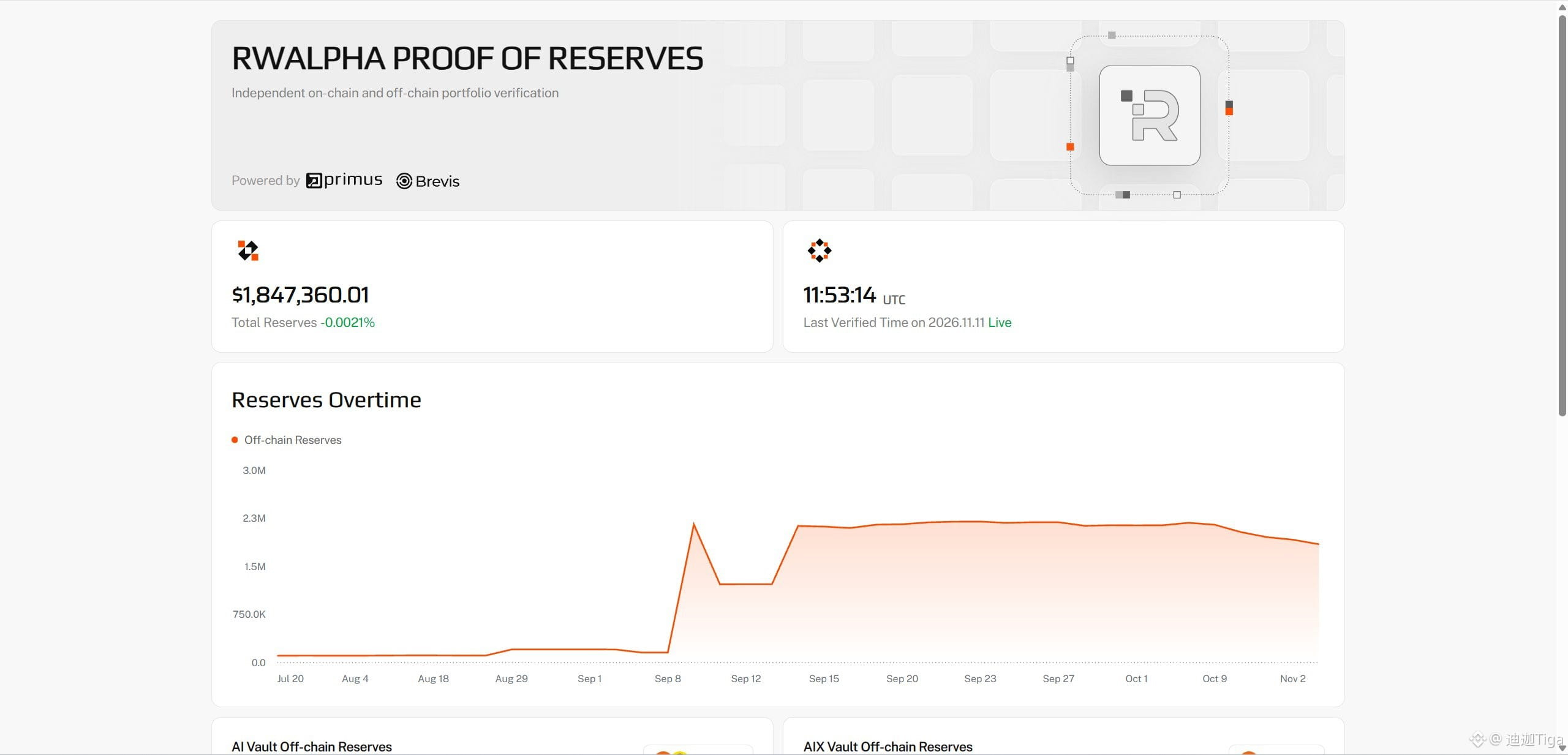
About 70% of XGLD’s reserves are held off-chain, with a verification record dated the 18th. RWAlpha’s reserves, worth about $1.85 million, are entirely off-chain. The overview says “Live,” but its most recent verification was on the 11th.
The figures in the same overview aren’t necessarily verified on the same day.
Primus displays off-chain reserves alongside verification dates.
Next time, I’ll continue tracking USDu’s reserve buffer and whether RWAlpha has updated its verification. These two things are more worth following than how much the total has increased.
#Primus #USDu #储备证明 #RWA
1
77
·
--
When making AI videos, the worst thing is finishing the edit only to realize that one shot needs to be redone.
Making games is even trickier. Once a character can move and fight, you have to play it yourself to find out how it feels.
So when I saw Game Forge launch on TermiX, I went to see what it actually delivers.
In the official demo, a character enters an abandoned monastery with a sword, raises a shield, rolls, drinks a potion, and eventually fights a boss—but loses.
The official team says this sample is only 1.2 MB and fits in a single HTML file.
The slogan is “Make a game with one sentence,” but the actual process is a bit like hiring an outside contractor: discuss the requirements, get a quote, put USDC in escrow, and then work begins. The deliverable is an HTML game that can be played offline in a desktop browser, plus a source code package. For now, it only supports single-player browser games.
I’m most interested in the prototype tier, starting at 200 USDC and taking about 3 days.
If you want to make a little boss-fighting game, you could start by building one battle and sending it to friends to try out.
Whether rolling feels smooth, whether you understand why you got hit, and whether you want to try again after dying are all more worth spending time on than filling an entire map right away.
So far, I’ve only seen the official sample. I haven’t seen a buyer’s complete deliverable yet.
When someone shares a finished game, what I most want to see is what that original request—“make the combat feel satisfying”—ended up looking like.
#TermiX #GameForge #AI游戏 #Blockchain
73
·
--
I turned Base into a little paper-cut street, and brought stock tokens, wallets, and onchain apps into it.
This time, I spent a while making a two-minute paper-cut animation about tokenized stocks on Base:
what you’re buying, what you can do with them, and how they differ from holding stocks through a brokerage.
I tried to explain it all through visuals, with subtitles in both Chinese and English. I hope it’s easy to follow even if you’re new to this.
#Base #代币化股票 #区块链 #PaperCutAnimation
154
·
--
The market has been noticeably volatile lately, so I’ve been gathering my thoughts on how to plan trades in choppy conditions.
I turned those thoughts into a song called “Half a Beat Behind,” and paired it with a paper-doll character dancing.
Just as I’m about to chase it, it drops again; just as I’m about to step aside, it bounces back up.
When the market swings back and forth like this, I feel it’s better to review the information and think through the reasons for a trade first, then consider entering in stages, with position size and exit conditions decided in advance.
#交易心得 #市场波动 #RiskManagement
66
·
--
Bunny Gala When I first started looking into it, the names that were easiest to mix up were these.
Simply put:
Bunny Warriors is the whole ecosystem.
Bunny Gala is where you actually go to play games.
It already has Poker, Guandan, Japanese mahjong, and more, with plans to keep adding mini-games.
I like this approach.
Instead of throwing a bunch of tasks, points, and rules at you right away,
it lets you jump in and play first. Whether it can keep people around depends on the games themselves.
There’s one other thing to be clear about.
Carrots are used in the games.
Bunny Points are a separate set of points for participating in the ecosystem.
They’re not the same thing, and there’s currently no confirmation that Bunny Points can be exchanged for tokens or used to qualify for an airdrop.
So what I’m most interested in now is whether the project can keep adding games and updating the experience.
Let’s play first and see.
#BunnyGala #BunnyWarriors #链游 #Web3 Gaming
65
·
--
This year, PONS and STONK have both proven that people are willing to buy launchpad tokens.
Now it’s $RISE’s turn.
But its model is a little different: after buying back tokens, it doesn’t burn them. It can keep borrowing and put the liquidity back to use.
I’m pretty curious to see how this all plays out.
#RISE #Launchpad #MemeFi
Now it’s $RISE’s turn.
But its model is a little different: after buying back tokens, it doesn’t burn them. It can keep borrowing and put the liquidity back to use.
I’m pretty curious to see how this all plays out.
#RISE #Launchpad #MemeFi
252
·
--
I actually agree with this direction.
A lot of people think that creating something new on-chain requires building a particularly complex mechanism first.
But from the user's perspective, in the end it often comes down to one thing: is it actually a little easier to use than what we have now?
Products that simplify cumbersome steps or make things possible that couldn't be done before are more likely to stick around.
#Base #链上 #加密 #Web3 #Product
77
·
--
After reading this, it’s clear that Base is building out more and more.
Trading, payments, financing, and agents are all being added.
I used to think of Base mostly as a very active blockchain. Looking at it now, it’s clearly aiming to do more than just grow on-chain trading.
If more corporate settlements and asset trading really start moving to Base, its role will look very different from what it is today.
#Base #RWA #DeFi #加密货币 #Web3
43
·
--
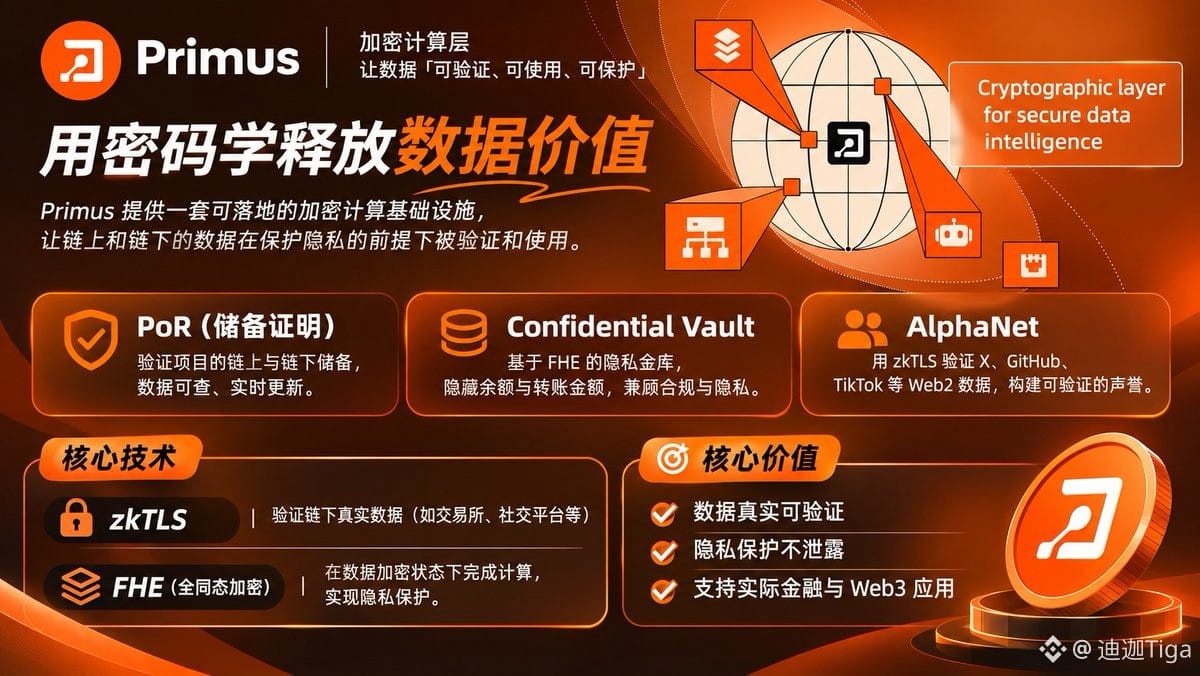
Unitas’s latest PoR has been updated again.
USDu Supply is now around $47.55M, Reserves are $50.38M, and the Backing Ratio is 1.0595.
Looking at the numbers, the reserves seem sufficient. 105.95% certainly looks like a lot, but you shouldn’t treat it as an audit report.
It’s important to understand the distinction: Primus verifies the data and APIs provided by the project, but doesn’t conduct an independent audit on its behalf or provide financial assurance.
PoR is useful, of course, but you need to know exactly what it verifies. At least now, Unitas’s on-chain and off-chain data, along with the update times, are all visible right on the page. Showing on-chain and off-chain reserves separately is much clearer than simply saying “100% backed.”
#Unitas #USDu #Primus #PoR #stablecoin
49


·
--
Today, I opened a trade on my own and went long on Anthropic.
I also turned the trade into a 35-second paper-cut animation and jotted down my thinking. This is just my personal trade and does not constitute investment advice.
I’ll watch how the pre-market quotes move after the IPO news comes out.
If I think the price will fluctuate within a range, I may consider using a contract grid strategy. Ultimately, it depends on my own judgment and risk tolerance.
This time, I wanted to go long, so I selected an Anthropic contract for pre-market trading.
A friend also made a guest appearance in this video with their dog.
#纸片动画 #Anthropic #盘前交易 #IPO
95
·
--
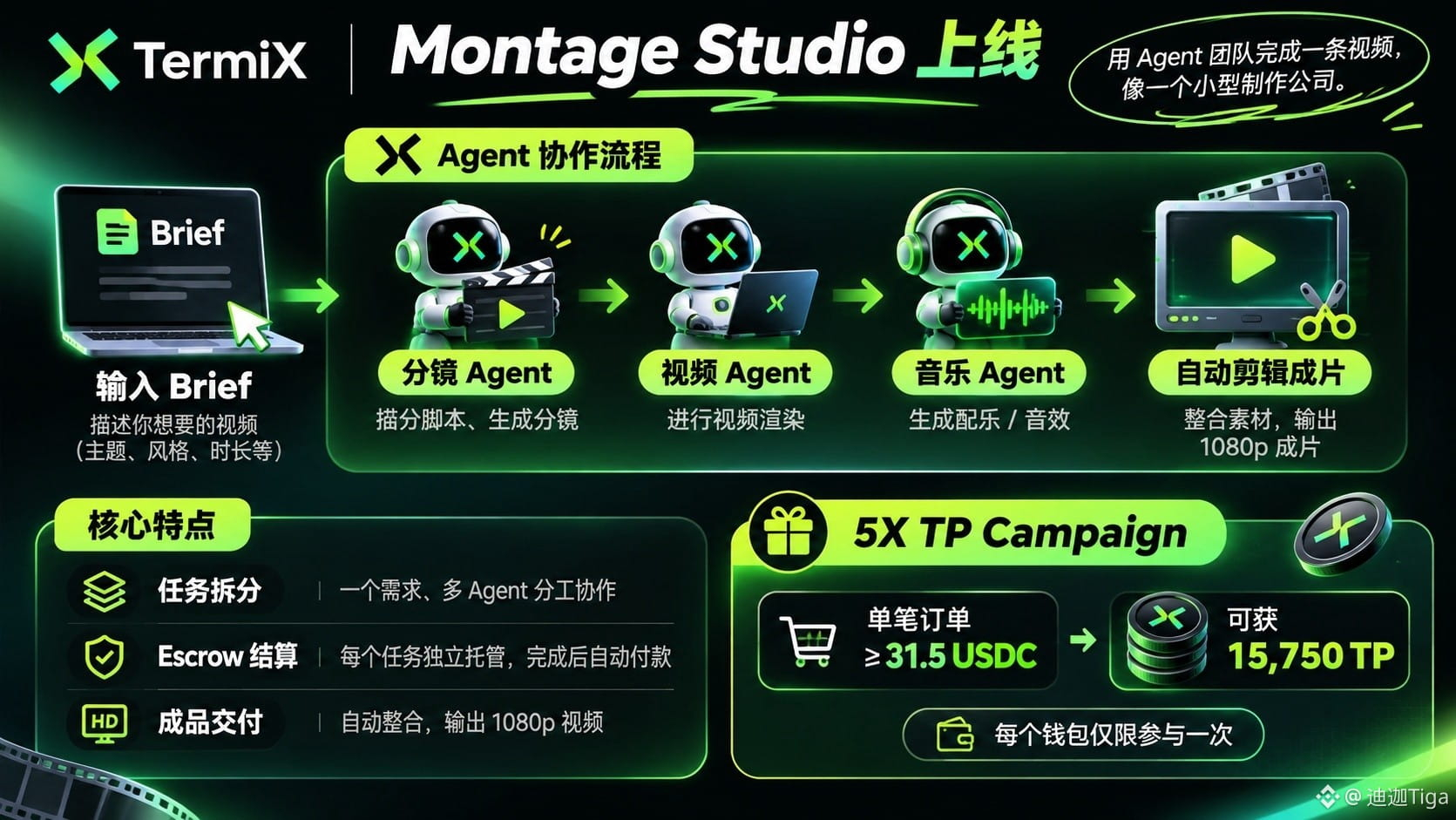
TermiX recently launched a Montage Studio.
You give it a brief, and it doesn’t handle everything from start to finish on its own. Instead, it first breaks the work down.
It assigns one Agent to storyboarding, another to video rendering, and another to music, then brings everything together and edits it into a finished 1080p video.
Each task along the way is settled through escrow.
It’s a lot like a small production company, except all the workers are Agents.
Agent collaboration used to feel a bit abstract, but this time you can at least see a complete workflow: one Agent receives a request, then pays other Agents to get the work done.
There’s also currently an official 5X TP campaign. You can claim points according to the rules once you meet the relevant order threshold. Each wallet is limited to one claim. See the official announcement for details.
#TermiX #AIAgent #MontageStudio #Web3
31
·
--
When you’re not selling your BTC or ETH just yet, there’s more you can do than simply wait—you can also think about how else to put your assets to work.
I made a paper-cut animation to tell you about this edition of OKX Flash Earn.
The total prize pool for this edition is 1 million USDT: 410,000 USDT in the BTC pool and 590,000 USDT in the ETH pool. The subscription threshold is low. Under the rules, you may earn interest and could also have a chance to participate in the distribution of extra rewards. Flexible-term assets can be redeemed in accordance with the rules. Extra rewards are calculated hourly; the hour in which you redeem is not counted. Please refer to the official campaign details for the limits and rules.
#纸片动画 #BTC #ETH #CryptoLife
109
·
--
Made a little paper-cut animation—here’s my homework.
Three friends: one loves trading, one chooses staking, and one just holds their coins and doesn’t want to do anything.
They all think they’ve got their own strategy, but when they reveal their cards:
Why is everyone using OKX Simple Earn? 😂
#纸片动画 #OKX #CryptoLife
Three friends: one loves trading, one chooses staking, and one just holds their coins and doesn’t want to do anything.
They all think they’ve got their own strategy, but when they reveal their cards:
Why is everyone using OKX Simple Earn? 😂
#纸片动画 #OKX #CryptoLife
50
Log in to explore more content
Join global crypto users on Binance Square
⚡️ Get latest and useful information about crypto.
💬 Trusted by the world’s largest crypto exchange.
👍 Discover real insights from verified creators.
Email / Phone number
Trending Topics
NVIDIAReinstatesJensenHuangasCEO
43,564 views
661 Discussing
TradFi News | Nvidia Board Unanimously Reinstates Jensen Huang as CEO; Shares Jump 30% Premarket
Binance News
·35 Likes
·31.9k views
WillMarketsStageAThanksgivingReliefRally?
143,112 views
1,735 Discussing
WillOctCorePCEShiftFedHikeExpectations?
55,524 views
731 Discussing