

PREET_X
🚀 My Crypto Journey | 🔎 Finding emerging narratives & opportunities | KITE-774433
35 Following
13 Followers
46 Liked
Posts
All
Quotes




MR_SPONDY_13
·
--
CELO: The Complete Journey -From a Mobile-First Blockchain to Ethereum Layer 2
Why was Celo created, what problem does it solve, and why did it move to Ethereum? Let's understand the technology behind this project.
Imagine a worker living in Africa who wants to receive money from Europe. Traditional international transfers can involve banks, intermediaries, conversion fees and waiting periods.
Now imagine sending digital dollars directly through a smartphone, with low transaction costs and without complicated banking infrastructure.
This is the kind of problem Celo was designed to address.
But Celo's story is much bigger than just sending cryptocurrency.
1. The Beginning: Why was Celo created?
Celo's journey began in 2017, with founders Rene Reinsberg, Marek Olszewski and Sep Kamvar.
At that time, blockchain technology was gaining attention, but everyday adoption remained difficult.
Bitcoin introduced decentralized digital money, while Ethereum introduced programmable blockchain applications. However, making these technologies accessible to ordinary smartphone users was still a challenge.
Celo wanted to approach this problem differently.
Its original vision was built around three important ideas:
1. Financial inclusion.
2. Mobile-first blockchain accessibility.
3. Affordable global payments.
The team wanted to create financial infrastructure that could work for people who might not have access to traditional banking services.
The main idea was simple: Your smartphone should be enough to access digital financial services.
2. 2020: Celo Mainnet officially launched
On April 22, 2020, Celo launched its mainnet as an independent Layer 1 blockchain.
It introduced a Proof of Stake consensus mechanism and an architecture designed for fast, affordable transactions.
But why was this important?
Because Celo was not trying to become another Bitcoin.
It wanted to make blockchain useful for everyday financial activities.
In June 2020, Celo introduced cUSD, also known as Celo Dollar.
This was a dollar-pegged stablecoin designed to reduce the price volatility associated with cryptocurrencies.
For example:
If someone wanted to transfer approximately $100 digitally, using a dollar-pegged stablecoin could be more predictable than sending a volatile asset like BTC.
This became one of the foundations of Celo's payment-focused ecosystem.
3. 2021–2022: Expansion beyond the US dollar
Celo understood that financial inclusion could not depend on a single currency.
Different countries have different financial systems and local currencies.
So its ecosystem expanded.
cEUR: A euro-pegged stablecoin introduced in 2021.
cREAL: A Brazilian real-pegged stablecoin introduced in 2022.
This was an important development because it showed that Celo was thinking beyond cryptocurrency trading.
Its objective was to support local-currency digital payments and financial applications.
The broader vision was to make digital money accessible across different economies.
4. Understanding Celo's Technology
Let's understand what makes Celo different.
A. Proof of Stake
Celo originally used Proof of Stake to secure its Layer 1 blockchain.
Instead of relying on energy-intensive mining, validators participate in securing the network through a staking-based consensus mechanism.
B. EVM Compatibility
Celo supports Ethereum Virtual Machine compatibility.
This allows developers familiar with Ethereum tools and smart contracts to build applications in the Celo ecosystem.
C. Low-cost transactions
Payment networks need transactions to be affordable.
Imagine paying $2 for a small digital service but spending another $3 on network fees.
That would make everyday payments impractical.
Celo focuses on keeping transaction costs low, making smaller payments more realistic.
D. Mobile-first architecture
Celo's original design emphasized smartphone accessibility, including user-friendly wallet experiences and easier payment interactions.
These features reflect its original mission of bringing financial services to more people.
5. 2023–2024: Why did Celo decide to become Ethereum Layer 2?
This is probably the most important chapter in Celo's history.
Initially, Celo operated as an independent Layer 1 blockchain.
However, operating an independent blockchain also meant maintaining its own infrastructure, security arrangements and developer ecosystem.
Celo recognized an opportunity to become more closely integrated with Ethereum.
In July 2023, the Layer 2 migration proposal was introduced.
In May 2024, the Celo community approved the transition.
But what exactly is Layer 2?
Think about Ethereum as a major financial infrastructure network.
When too many transactions compete for limited blockspace, fees and congestion can become challenges.
Layer 2 networks process transactions through additional infrastructure while connecting back to Ethereum for important security and settlement functions.
This can help expand transaction capacity without requiring every transaction to be processed directly on Ethereum Layer 1.
Why did Celo make this move?
- Stronger alignment with Ethereum.
- Access to a larger developer ecosystem.
- Better interoperability opportunities.
- Improved scalability.
- Continued focus on affordable payments.
It was a strategic decision to combine Celo's payment-focused vision with Ethereum's growing Layer 2 ecosystem.
6. March 26, 2025: Celo officially became Ethereum Layer 2
Celo completed its migration on March 26, 2025.
It adopted the Optimism OP Stack and integrated EigenDA for data availability.
This was not simply a new branding exercise.
It was a major technical transformation.
The migration preserved the existing network state and ecosystem while changing the underlying architecture.
The network also introduced important improvements:
- Approximately one-second block times.
- Ethereum interoperability.
- New bridging infrastructure.
- Fee abstraction.
- Support for paying network fees using supported ERC-20 assets.
One particularly interesting feature is fee abstraction.
Traditionally, blockchain users often need to hold a network's native token to pay transaction fees.
Celo's architecture allows supported stablecoins and other ERC-20 assets to be used for gas payments.
This reduces friction for ordinary users.
Important: Becoming an Ethereum Layer 2 does not mean Celo is identical to Ethereum. It has its own architecture, execution environment and ecosystem.
7. MiniPay: Connecting blockchain with real people
Now let's discuss one of the most interesting parts of the Celo ecosystem.
MiniPay is a stablecoin wallet developed by Opera and built on Celo.
It launched in 2023, initially targeting smartphone users in Africa.
Why is MiniPay important?
Because blockchain adoption does not happen simply because a network has good technology.
People need applications they can actually use.
MiniPay focuses on:
- Sending and receiving stablecoins.
- Mobile-friendly wallet access.
- Everyday digital payments.
- Access to third-party financial services.
- Easier onboarding.
A major November 19, 2026 update:
MiniPay announced an upgrade of its 20 million activated wallets to Privy wallet infrastructure, owned by Stripe.
According to the announcement, MiniPay had also processed over 600 million transactions across more than 70 countries.
These are wallet activation figures, not necessarily 20 million unique active users.
This is an important distinction when evaluating adoption.
8. 2026: Celo's next direction – AI Agent Payments
Here is where the story becomes particularly interesting.
AI agents are evolving beyond answering questions.
In the future, they may independently purchase services, access data, pay for APIs and complete digital tasks on behalf of their users.
But there is a problem.
How can an AI agent pay for a service without requiring a human to manually complete every transaction?
This is where stablecoin payment infrastructure becomes interesting.
Celo introduced its native x402 facilitator in July 2026.
The x402 payment standard enables internet services to request payments through HTTP payment flows.
For example:
Imagine an AI agent that needs access to a paid data API.
1. The agent requests the service.
2. The service requests payment.
3. The agent authorizes a stablecoin payment.
4. The payment is settled onchain.
5. The agent receives access to the service.
Celo is building infrastructure to support these types of transactions.
In September 2026, its x402 facilitator added support for local-currency agent payments, including Argentine Peso, Brazilian Real and Colombian Peso stablecoins.
In October 2026, Celo also launched the buy marketplace, where agents can purchase more than 700 services using supported stablecoins.
This means Celo is exploring two major financial markets:
Human-to-human payments and machine-to-machine payments.
That is a significant development to watch.
9. What is the actual utility of the CELO token?
Now comes the most important question for crypto investors.
If the Celo ecosystem grows, does that automatically mean the CELO token price will increase?
Not necessarily.
We must understand the difference between network adoption and token value.
CELO is the native asset of the network.
Its important roles include:
- Governance participation.
- Staking and validator economics.
- Network-level utility.
- Participation in the broader Celo ecosystem.
However, Celo also allows users to pay transaction fees using supported stablecoins.
This means network activity does not automatically translate into direct demand for CELO for every transaction.
Investors should therefore examine token supply, distribution, staking economics, governance and actual value capture rather than assuming that more transactions always mean a higher token price.
10. What could drive Celo's future growth?
I see five areas worth monitoring.
1. Stablecoin adoption
If more people use digital dollars and local-currency stablecoins for everyday payments, Celo could benefit from its payment-focused infrastructure.
2. MiniPay expansion
Wallet adoption, repeat usage, transaction activity and successful financial integrations will be important indicators.
3. Ethereum ecosystem
Its Layer 2 positioning gives Celo opportunities to connect with Ethereum developers, applications and liquidity.
4. AI Agent Economy
Automated payments could become an emerging use case. Celo's x402 and MPP infrastructure is positioning the ecosystem for this opportunity.
5. Global financial applications
Remittances, onchain foreign exchange, DeFi and local-currency payment applications could create additional demand for its infrastructure.
11. Risks investors should not ignore
Every blockchain project faces challenges.
Celo must compete with Ethereum Layer 2 networks, Solana and other payment-focused blockchain ecosystems.
Other risks include:
- Stablecoin regulatory uncertainty.
- Competition from traditional payment providers.
- Dependence on real-world user adoption.
- Liquidity and stablecoin issuer risks.
- Smart contract and bridge vulnerabilities.
- Token value capture and supply-related risks.
A growing ecosystem does not guarantee a profitable investment.
My Final Research Perspective
When I look at Celo's complete journey, I see a project that has evolved significantly.
It started with a mobile-first financial inclusion vision.
It launched an independent Layer 1 blockchain.
It expanded into stablecoins and local-currency payments.
It then transitioned into an Ethereum Layer 2.
Now it is exploring stablecoin payments, global financial applications and AI-agent transactions.
But I believe the most important question is not how many features a blockchain announces.
It is how many people actually use its infrastructure, how frequently they use it and whether that activity creates sustainable economic value.
The future of blockchain may not be determined only by speculation. It may also be determined by how useful the technology becomes in everyday life.
Let's discuss:
1. Can Celo become an important global stablecoin payment network?
2. Will MiniPay help bring millions of new users into Web3?
3. Can AI-agent payments become a meaningful source of blockchain activity?
4. Does Celo's Layer 2 transformation give it a stronger long-term position?
What is your opinion about Celo's future?
$CELO
#CELO @celo
MR_SPONDY_13
·
--
Bullish#sxt $SXT @SpaceandTime
I find Space and Time ($SXT) interesting for a reason beyond its AI narrative. It's trying to solve a fundamental problem: how can blockchain applications and AI agents know that the data they use is actually correct?
Think about a DeFi protocol calculating collateral or an AI agent making financial decisions. If the underlying data is manipulated, even perfectly written code can produce the wrong result.
This is where Proof of SQL comes in.
Developers can run complex database queries and generate cryptographic proofs that allow applications to verify the results without blindly trusting a database provider.
Its practical value extends to DeFi analytics, historical blockchain data, smart contracts and AI-powered applications.
The ecosystem includes SXT Chain, Proof of SQL, Dreamspace and Space and Time Enterprise.
One development worth watching is the November 9, 2026 Enterprise launch, which brings verifiable computation into private business data. Launch partners include Maple Finance, Indomobil, Trenez and The Data Foundation. Its wider technology ecosystem also includes Google Cloud, Microsoft and Chainlink.
For developers, the opportunity is to build applications using verifiable data rather than relying entirely on trusted intermediaries.
The SXT token supports network services and computational workloads. However, actual network usage, token demand and supply dynamics will determine whether adoption translates into long-term value.
The risk: Enterprise partnerships don't guarantee sustained usage, and decentralization, competition and token unlocks deserve attention.
My personal view is that verified data could become essential infrastructure as AI and Web3 mature. But I would watch real adoption before judging its long-term potential.
Can Space and Time become a trusted data verification layer for the next generation of AI and blockchain?
#SpaceAndTime #Web3 #altcoins
#Mr_SPONDY_13
$FOREST $HANA
Quoted content has been removed


MR_SPONDY_13
·
--
Kite: How Can AI Spend Crypto Without Losing Your Control? 🔐
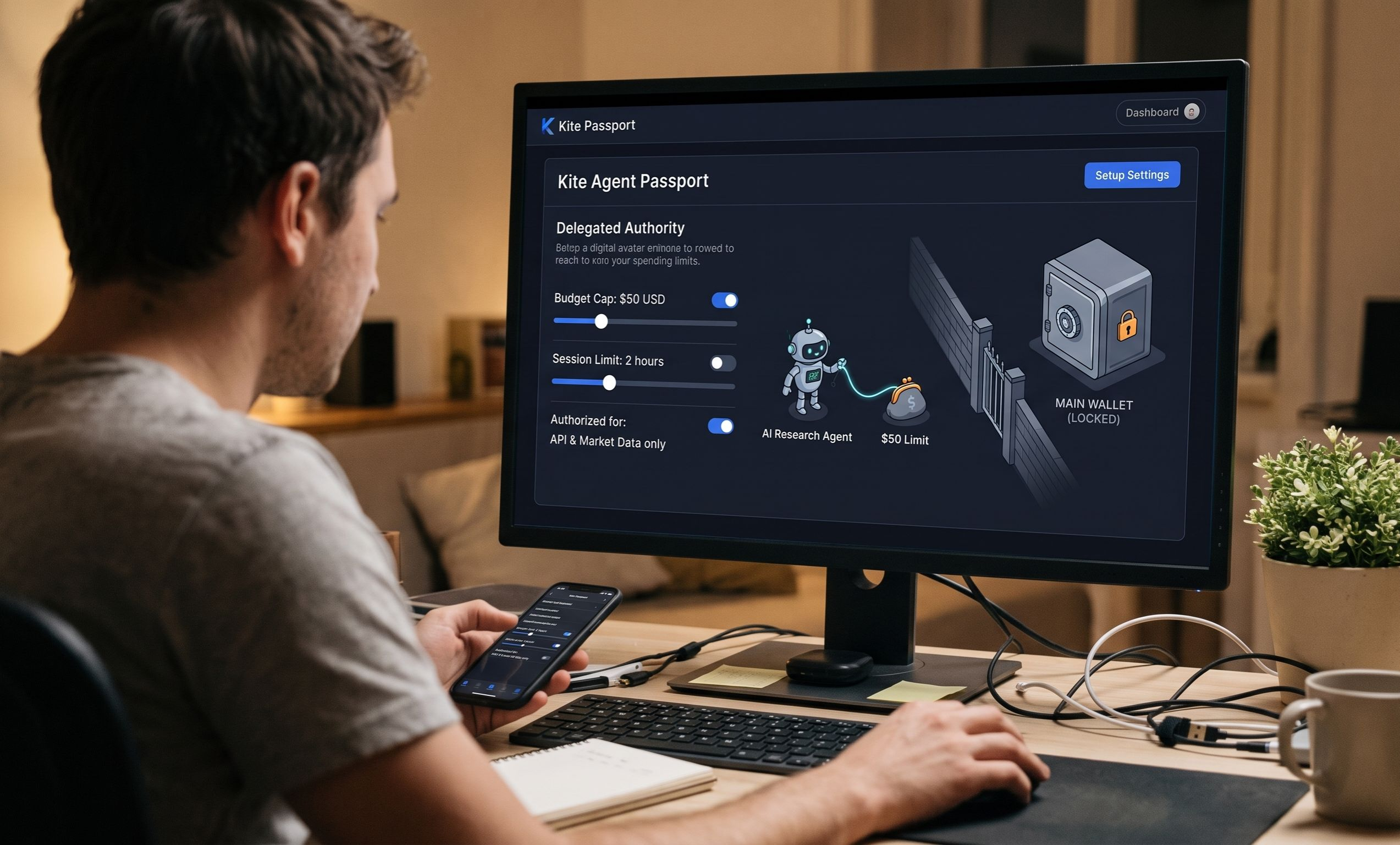
Think of an AI agent that explores crypto projects, purchases market data, and buys APIs autonomously. Sounds useful, but how can it avoid buying the wrong service?
Delegated authority in Kite Passport can solve that. You won't have to share your main wallet's private key, but only grant some limited permissions to the AI with the spending limits and time limitations. Temporary session keys will allow it to make authorized transactions without revealing your main private key.
Payment protocols like x402 and MPP will be the building blocks for the concept of payment automation, which means that AI agents will be able to communicate with paid digital services.
But wait, the agent can obey all the spending rules and still make a mistake. Limitations on spending help to manage risks, but it doesn't mean that the agent will be making good choices or determining liability.
The concept of Kite includes freedom for AI agents to do what they were designed for while being under the control of the user's financial limits.
Will you entrust your crypto to an AI agent? If the agent squanders your money without going over its limit, who should take responsibility for that?
@KITE AI 中文 $KITE
#KiteBBW

Log in to explore more content