
#bitcoinoptionsvolatilityhitsfiveyearlow
bitcoinoptionsvolatilityhitsfiveyearlow
548,967 views
2,579 Discussing
Hot
Latest

·
--
BTC falls to around $81,800 | Low-volatility buzz keeps building | I put stop-losses ahead of stories
My stance is defensive. I won't bet on a rebound just because “options volatility is low.” The exact trending hashtag on Binance Square right now is #BitcoinOptionsVolatilityHitsFiveYearLow, and the discussion count has risen from about 1,761 in the previous round to 1,867, showing that interest continues to grow. But “five-year low” is a claim made by the hashtag. I haven't independently verified it against a complete, comparable five-year data series, so I can't treat the buzz as statistical proof. In this round, I checked Deribit's public API directly: BTC's DVOL is around 37.71. Deribit explains that DVOL is an annualized implied volatility estimate for roughly the next 30 days, derived from options prices. It is not the actual spot-price range from yesterday to today, and it doesn't tell you whether prices will rise or fall tomorrow. Nor can one indicator replace position sizing and stop-losses.
The contrast worth noting is that low-volatility talk is heating up even as spot prices have weakened. At the time of writing, Kraken BTC/USD is around $81,783, with an opening price today of $83,675.6, a high of $84,250, and a low of $81,635.7. Today's decline is a pricing fact, but it can't be attributed to options traders, ETFs, or any single news item alone. Another Square trending tag, “Back above $84,000,” is still on the list, but the current price has moved away from that level. I won't describe an earlier breakout as if it were still in progress. In Farside's October 12 U.S. spot ETF table, entries for IBIT, FBTC, and others are still dashes, and the automatic total is 0.0. A dash means no figure has been reported; it does not confirm zero inflows or outflows. Strategy officially disclosed a purchase of 250 BTC that day, but a past purchase cannot guarantee against every sell order in the market now.
Mechanically, low implied volatility only means that, for a given expiry and set of options quotes, the market is pricing in less future volatility. If spot prices keep breaking through support while options quotes adjust with a lag, risk budgets can quickly become inadequate. If I use “low volatility” as a reason to tighten my stop-loss or increase leverage, I could get shaken out by noise before the market eventually moves in the direction I expected. My criteria are simple: if the area around $81,600 is decisively breached and a rebound fails to reclaim it, short-term weakness takes priority. If price gets back above $82,400 and holds, then I'll consider a recovery. If DVOL subsequently rises significantly, the final ETF figures come in, or macro news changes risk appetite, I'll reassess. I won't treat today's unreported figures as a definitive conclusion.
If I were trading this myself: I would stay out for now and only consider a small spot position to test a long. I would not sell naked options or use leverage. I would enter with no more than 0.3% of total capital only after two complete 15-minute candles close above $82,400, a retest holds between $82,100 and $82,400, and BTC trading volume and deposits and withdrawals at major exchanges are normal. I would take half off first at $83,000, then close the rest between $83,600 and $84,000. After entry, if a 15-minute candle closes back below $82,100, I would first cut half of the remaining position. I would place a hard stop below $81,500 and close the entire position if it is hit. If $81,600 breaks before the entry trigger, this plan is canceled and I stay flat; if a clear liquidity gap appears after a breakout, I would exit proactively. Without the trigger, there is no trade—and certainly no profit to claim.
#BitcoinOptionsVolatilityHitsFiveYearLow #BTC
The above is my personal market observation only and does not constitute investment advice.

105

·
--
Bullish
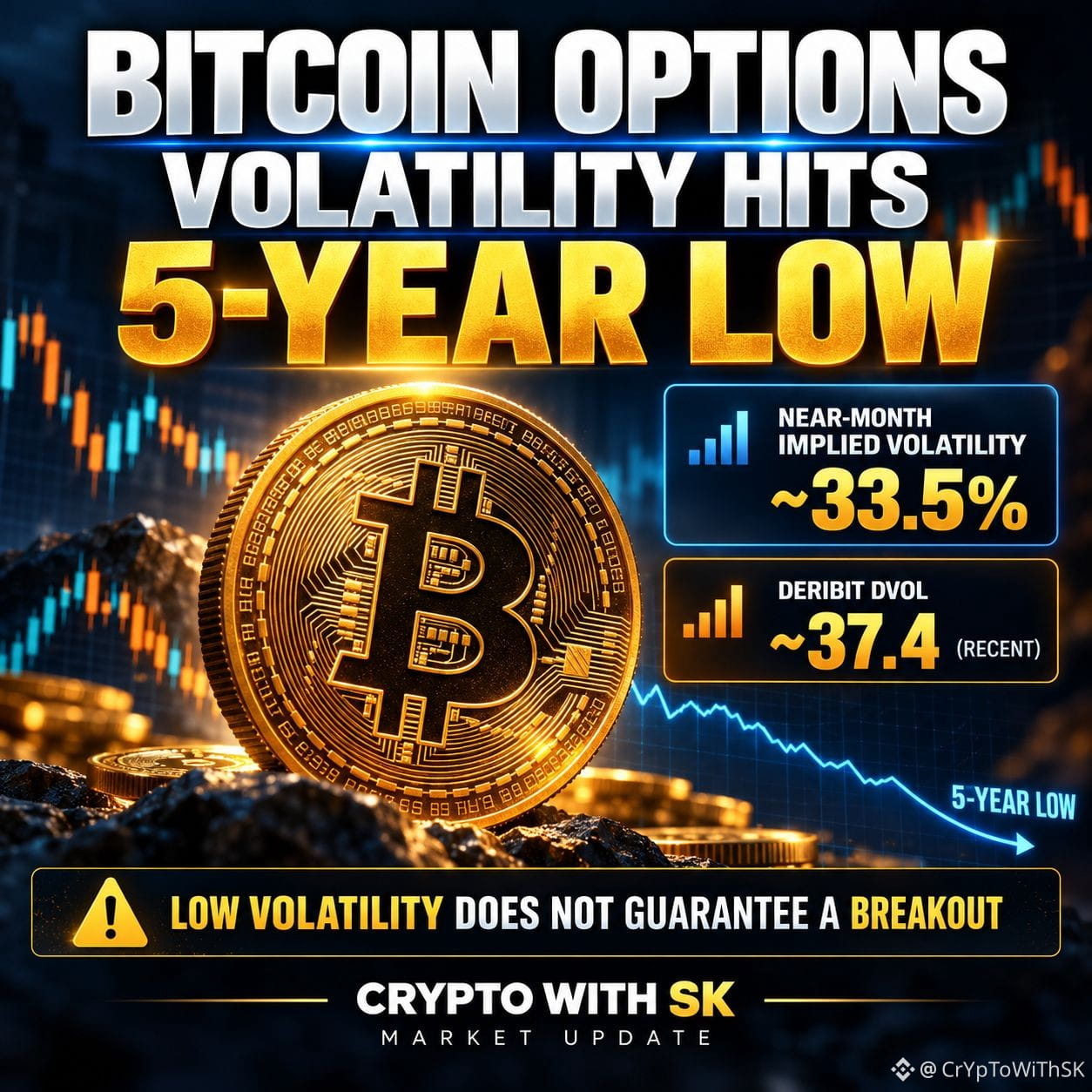
$BTC Bitcoin's options market is entering an unusually quiet phase. According to a report published on October 12, 2026, near-month Bitcoin options implied volatility has fallen to approximately 33.5%, described as a five-year low. Deribit’s DVOL index has also recently been reported around 37.4. These readings suggest that options traders are pricing in relatively modest future price swings.
#BitcoinOptionsVolatilityHitsFiveYearLow
#BitcoinOptionsVolatilityHitsFiveYearLow
1
107

#BitcoinOptionsVolatilityHitsFiveYearLow Bitcoin options volatility falling to a five-year low is an interesting development for the crypto market. It suggests that traders are expecting smaller price movements compared with periods of high volatility.
But does low volatility mean Bitcoin is ready for a major move?
Not necessarily. A quieter market can continue for some time, but it can also be followed by a sharp breakout when new buying or selling pressure enters the market.
★ What I’m watching:
* Price action: Will $BTC break out of its current range?
* Trading volume: A rise in volume could help confirm a stronger move.
* Market direction: Both bullish and bearish breakouts are possible.
My view is simple: low volatility is not automatically a buy or sell signal. I would rather wait for confirmation than predict the next move too early.
💬 What do you think? Is Bitcoin preparing for a big move, or will the market remain quiet for longer?
#Bitcoin #BTC #CryptoMarket #BitcoinOptions
{spot}(BTCUSDT)
#CryptoAnalysis
#BitcoinOptionsVolatilityHitsFiveYearLow Bitcoin options volatility falling to a five-year low is an interesting development for the crypto market. It suggests that traders are expecting smaller price movements compared with periods of high volatility.
But does low volatility mean Bitcoin is ready for a major move?
Not necessarily. A quieter market can continue for some time, but it can also be followed by a sharp breakout when new buying or selling pressure enters the market.
★ What I’m watching:
* Price action: Will $BTC break out of its current range?
* Trading volume: A rise in volume could help confirm a stronger move.
* Market direction: Both bullish and bearish breakouts are possible.
My view is simple: low volatility is not automatically a buy or sell signal. I would rather wait for confirmation than predict the next move too early.
💬 What do you think? Is Bitcoin preparing for a big move, or will the market remain quiet for longer?
#Bitcoin #BTC #CryptoMarket #BitcoinOptions
#CryptoAnalysis
1
44

·
--
Bitcoin options volatility has fallen to a five-year low. Data shows current volatility is just 8.2%, down sharply from the peak of 45% in 2022. This trend reflects growing expectations that BTC prices will remain stable. In addition, open interest in unhedged Bitcoin options (Vega) has declined by around 30%, suggesting traders are becoming more cautious. Analysts believe low volatility could persist through the end of the year, but warn that geopolitical risks could trigger market fluctuations. #BitcoinOptionsVolatilityHitsFiveYearLow
#BTC $BTC
#BTC $BTC
101

·
--
#BitcoinOptionsVolatilityHitsFiveYearLow
🟠 Bitcoin Options Volatility Hits a Five-Year Low
As of October 12, 2026, Bitcoin options volatility is reportedly near its lowest level in five years. This could be an important signal for traders, but it does not automatically mean Bitcoin is about to pump or dump. �
Binance +1
📊 What's happening?
Implied volatility (IV): Bitcoin's front-month options IV is reported at approximately 33.5%.
Deribit DVOL: The 30-day volatility index is around 37.4, described as very low relative to its five-year history.
Hedging activity: Traders have reportedly purchased substantial put options at $78,000 and $80,000 strike prices.
Market uncertainty: Options are pricing in smaller moves than Bitcoin has recently experienced. �
Binance +1
🚀 Does low volatility mean BTC will pump or dump?
167

.#BitcoinOptionsVolatilityHitsFiveYearLow
Title: Bitcoin Is Quiet… But Could a Big Move Be Coming? 👀
$BTC Bitcoin options volatility has dropped to its lowest levels in five years, according to recent market reports. BTC options are pricing in relatively smaller moves, but the market could still surprise traders.
🔹 Traders are expecting calmer price action.
🔹 Options may be relatively cheaper than recent market movements suggest.
🔹 A major economic event or sudden buying and selling pressure could trigger a sharp move.
#Bitcoin #BTC #CryptoNews #BitcoinOptions
{future}(BTCUSDT)
.#BitcoinOptionsVolatilityHitsFiveYearLow
Title: Bitcoin Is Quiet… But Could a Big Move Be Coming? 👀
$BTC Bitcoin options volatility has dropped to its lowest levels in five years, according to recent market reports. BTC options are pricing in relatively smaller moves, but the market could still surprise traders.
🔹 Traders are expecting calmer price action.
🔹 Options may be relatively cheaper than recent market movements suggest.
🔹 A major economic event or sudden buying and selling pressure could trigger a sharp move.
#Bitcoin #BTC #CryptoNews #BitcoinOptions
1
17

#bitcoinoptionsvolatilityhitsfiveyearlow
👀 Bitcoin’s Volatility Is Near a 5-Year Low — Is a Big Move Brewing? ₿
The BTC market feels unusually quiet, and that’s exactly why I’m paying attention.
When options volatility falls this low, traders are pricing in smaller moves. But quiet markets don’t always stay quiet for long. ⚡
📊 Here’s what I’m watching:
🔹 A sudden jump in implied volatility
🔹 BTC breaking out of its current range
🔹 Changes in options positioning and liquidity
🔹 Macro news that could shake up the market
⚠️ One thing to remember: low volatility doesn't guarantee an explosive move, and it certainly doesn't predict the direction.
Bitcoin could break upward, drop sharply, or remain range-bound longer than expected.
The real question is whether traders are ready when volatility returns. 🔥
Do you think BTC is preparing for a major breakout, or will this quiet phase continue?
Drop your thoughts below! 👇
#BitcoinOptionsVolatilityHitsFiveYearLow #cryptofirst21
$BTC $GTC
Educational content only. Not financial advice (NFA). Always do your own research (DYOR).
135

·
--
Bullish
Bitcoin options front-month implied volatility (IV) has collapsed to a historic 5-year low of 33.5%. In derivatives markets, this extreme compression creates a "coiled spring" effect.
While options currently price in unusually small future price swings, realized volatility is running over 4 percentage points higher (37%-38%). This massive disconnect indicates that the market is severely underpricing tail risk.
Smart money is not sitting idle, institutional traders have quietly loaded up on over $204 million in October put options (strikes at $78,000 and $80,000) purely for downside insurance while maintaining major long spot exposure. Historically, such prolonged quiet regimes act as precursors to explosive, multi-directional market expansions.
Altcoin Market Impact:
- As Bitcoin's low IV signals an impending macro move, top altcoins are exhibiting starkly localized structural behaviors. News flow and derivatives positioning are triggering rapid short-term divergences.
- Ethereum ( ETH ): Unlike BTC, ETH options display a sideways-to-bearish premium. Aggressive call-selling dominates institutional flows, and IV sits well above realized levels.
- Binance Coin ( BNB ) & Solana ( SOL ): SOL and BNB are trading on thin volume. However, their ultra-compressed correlation to BTC leaves them highly sensitive to sudden ecosystem updates, threatening swift short squeezes if the market breaks upward.
- Sui ( SUI ): High-beta ecosystem growth assets are capturing the bulk of narrative-driven speculative capital, reacting exponentially faster to retail news than legacy majors.
{future}(BTCUSDT)
{future}(SOLUSDT)
{future}(BNBUSDT)
#bitcoinoptionsvolatilityhitsfiveyearlow
Bitcoin options front-month implied volatility (IV) has collapsed to a historic 5-year low of 33.5%. In derivatives markets, this extreme compression creates a "coiled spring" effect.
While options currently price in unusually small future price swings, realized volatility is running over 4 percentage points higher (37%-38%). This massive disconnect indicates that the market is severely underpricing tail risk.
Smart money is not sitting idle, institutional traders have quietly loaded up on over $204 million in October put options (strikes at $78,000 and $80,000) purely for downside insurance while maintaining major long spot exposure. Historically, such prolonged quiet regimes act as precursors to explosive, multi-directional market expansions.
Altcoin Market Impact:
- As Bitcoin's low IV signals an impending macro move, top altcoins are exhibiting starkly localized structural behaviors. News flow and derivatives positioning are triggering rapid short-term divergences.
- Ethereum ( ETH ): Unlike BTC, ETH options display a sideways-to-bearish premium. Aggressive call-selling dominates institutional flows, and IV sits well above realized levels.
- Binance Coin ( BNB ) & Solana ( SOL ): SOL and BNB are trading on thin volume. However, their ultra-compressed correlation to BTC leaves them highly sensitive to sudden ecosystem updates, threatening swift short squeezes if the market breaks upward.
- Sui ( SUI ): High-beta ecosystem growth assets are capturing the bulk of narrative-driven speculative capital, reacting exponentially faster to retail news than legacy majors.
#bitcoinoptionsvolatilityhitsfiveyearlow
1
692


Article
🚨₿ BITCOIN IN SILENCE: OPTIONS VOLATILITY HITS A 5-YEAR LOW! WHAT COULD HAPPEN NOW?📊 Is the market expecting a big move?
Bitcoin options’ implied volatility has fallen to extremely low levels, according to recent market data and analysis. This indicates that traders are pricing in smaller short-term fluctuations.
🤔 WHAT DOES THIS MEAN?
🔹 Lower expectations for movement: the options market is pricing in a relatively calmer period.
🔹 A possible shift in the outlook: periods of low volatility can be followed by strong moves, but there’s no guarantee of when that will happen.
🚨₿ BITCOIN IN SILENCE: OPTIONS VOLATILITY HITS A 5-YEAR LOW! WHAT COULD HAPPEN NOW?
📊 Is the market expecting a big move?
Bitcoin options’ implied volatility has fallen to extremely low levels, according to recent market data and analysis. This indicates that traders are pricing in smaller short-term fluctuations.
🤔 WHAT DOES THIS MEAN?
🔹 Lower expectations for movement: the options market is pricing in a relatively calmer period.
🔹 A possible shift in the outlook: periods of low volatility can be followed by strong moves, but there’s no guarantee of when that will happen.
261

Bitcoin is quiet, but quiet doesn't mean safe 🤫
Volatility is near multi-year lows, and many traders are asking if a big move is coming. Nobody knows the direction, but low volatility often comes before expansion.
How I'm approaching it:
Wait for a breakout and a retest instead of guessing the direction
Keep position size small, since leverage hurts most when the move comes fast
Set the stop-loss before entering, not after
Boredom is when traders overtrade. Patience is a position too.
Which way do you think it breaks, up or down? 👇
$BTC $BNB #Bitcoin #Volatility #RiskManagement #BitcoinOptionsVolatilityHitsFiveYearLow $BTC
441

#BitcoinOptionsVolatilityHitsFiveYearLow
#BitcoinOptionsVolatilityHitsFiveYearLow
📉 Bitcoin Options Volatility Hits a 5-Year Low — What Comes Next?
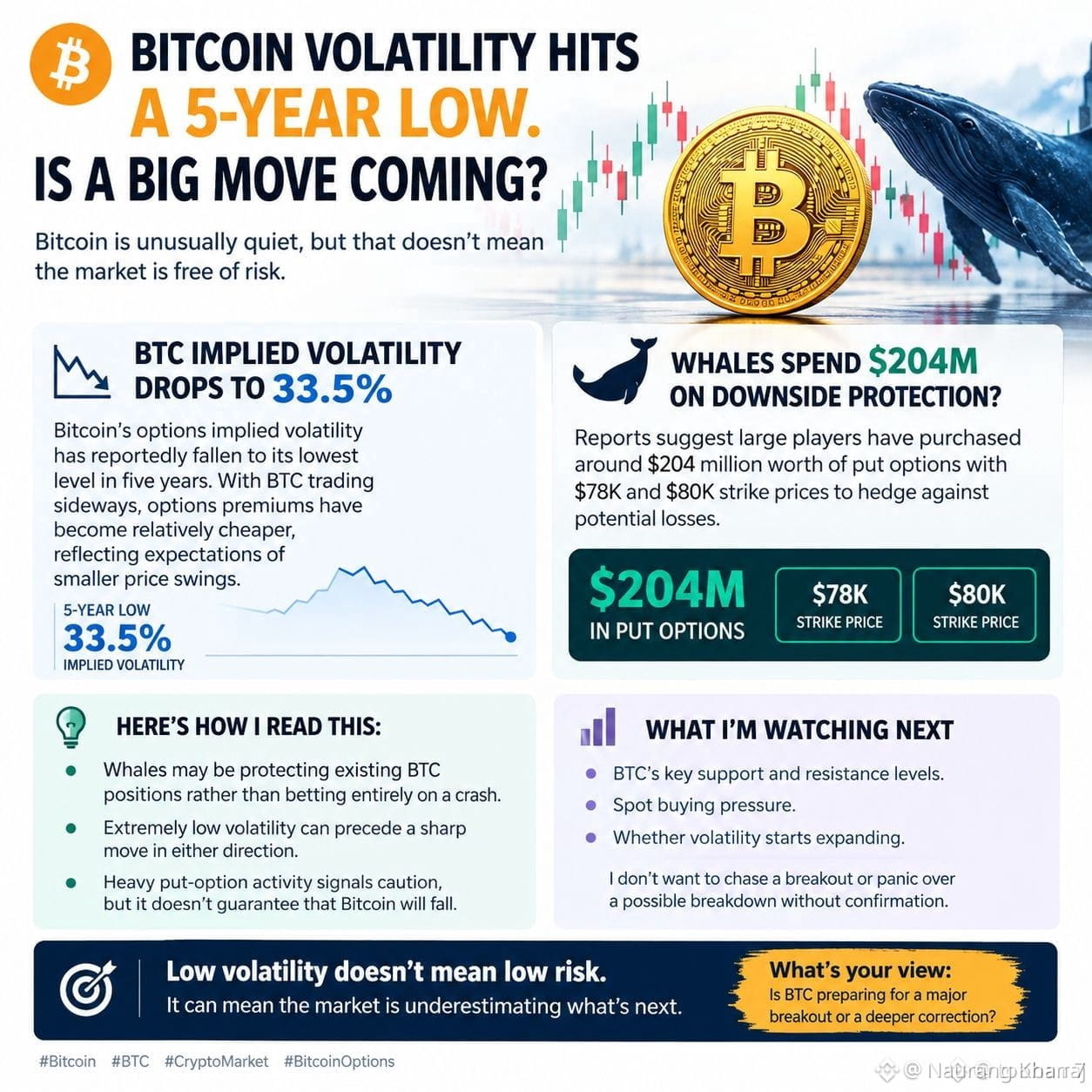
Bitcoin options volatility has dropped to an unusually low level, with implied volatility reported near 33.5%. Meanwhile, traders are buying downside protection through put options around the $78K–$80K range.
🔍 Why does this matter?
• Lower volatility can signal a quieter market.
• Traders may be preparing for potential price swings.
• A major move could follow, but its direction remains uncertain.
💡 My Take: Low volatility doesn't guarantee a breakout. Watch market volume, ETF flows, and macroeconomic news before making decisions.
What do you think — is BTC preparing for a major move? 🚀
#Bitcoin #BTC #CryptoMarket #BinanceSquareFamily
{future}(BTCUSDT)
#RBNZPausesDigitalCashDevelopment #EvernorthNasdaqDebutClosesDown1.05% #StrategyBuys250Bitcoin $NVDAB $AAPLB $MSFTB
#BitcoinOptionsVolatilityHitsFiveYearLow
#BitcoinOptionsVolatilityHitsFiveYearLow
📉 Bitcoin Options Volatility Hits a 5-Year Low — What Comes Next?
Bitcoin options volatility has dropped to an unusually low level, with implied volatility reported near 33.5%. Meanwhile, traders are buying downside protection through put options around the $78K–$80K range.
🔍 Why does this matter?
• Lower volatility can signal a quieter market.
• Traders may be preparing for potential price swings.
• A major move could follow, but its direction remains uncertain.
💡 My Take: Low volatility doesn't guarantee a breakout. Watch market volume, ETF flows, and macroeconomic news before making decisions.
What do you think — is BTC preparing for a major move? 🚀
#Bitcoin #BTC #CryptoMarket #BinanceSquareFamily
#RBNZPausesDigitalCashDevelopment #EvernorthNasdaqDebutClosesDown1.05% #StrategyBuys250Bitcoin $NVDAB $AAPLB $MSFTB
#BitcoinOptionsVolatilityHitsFiveYearLow
📉 Bitcoin Options Volatility Hits a 5-Year Low — What Comes Next?
Bitcoin options volatility has dropped to an unusually low level, with implied volatility reported near 33.5%. Meanwhile, traders are buying downside protection through put options around the $78K–$80K range.
🔍 Why does this matter?
• Lower volatility can signal a quieter market.
• Traders may be preparing for potential price swings.
• A major move could follow, but its direction remains uncertain.
💡 My Take: Low volatility doesn't guarantee a breakout. Watch market volume, ETF flows, and macroeconomic news before making decisions.
What do you think — is BTC preparing for a major move? 🚀
#Bitcoin #BTC #CryptoMarket #BinanceSquareFamily
#RBNZPausesDigitalCashDevelopment #EvernorthNasdaqDebutClosesDown1.05% #StrategyBuys250Bitcoin $NVDAB $AAPLB $MSFTB
167

·
--
#BitcoinOptionsVolatilityHitsFiveYearLow
🚨 BITCOIN OPTIONS VOLATILITY HITS A 5-YEAR LOW! ₿
What does this mean? 🤔
📉 Volatility is at its lowest level in 5 years!
In simple words, the market is showing expectations of smaller price swings compared to recent periods.
🔥 Why should traders care?
🔹 The market may be entering a quieter phase.
🔹 A major price move could catch traders off guard if volatility rises again.
🔹 Low volatility doesn't guarantee that a big pump or dump is coming.
🐂 Bulls are waiting. Bears are waiting. Everyone is watching!
The big question is: Will $BTC break out to the upside or surprise everyone with a sharp drop? 👀
💬 What's your prediction?
🚀 BIG PUMP or 📉 BIG DUMP?
#Bitcoin #BTC
114

·
--
Bullish
#bitcoinoptionsvolatilityhitsfiveyearlow $BTC
With BTC hovering around $84,000, Wall Street is nearly driving retail traders crazy! But I actually think Bitcoin is gearing up for its next rally!
Guys, the market lately has been absolutely brutal.
It goes up a little and people start calling it a bull market; it dips a little and people start calling a crash. After all that back and forth, the price is still circling around $84,000.
Even more interestingly, BTC options implied volatility has fallen to 33.5%, a five-year low!
The quieter the market gets, the more impatient everyone becomes.
But low volatility doesn't mean a breakout is necessarily imminent, and big players aren't necessarily all quietly accumulating.
I'm still leaning bullish, with my eyes on the $84,200–$84,500 breakout zone!
If BTC can hold above it decisively, the first target is $85,000. After that, I'll keep an eye on the potential short liquidation zone around $87,000!
The most frustrating thing about crypto is that when prices rise, you're afraid to chase; when they move sideways, you get bored; and when they pull back, you get scared out of your position.
Then the move finally comes, and you realize you've been out of the market all along. 😂
Just look at those dog builders who've stuck with it for 968 days. They keep posting, livestreaming, and supporting the community, no matter what the market is doing.
Real conviction isn't built by shouting about one big green candle. It accumulates little by little over time.
My view hasn't changed: I'm still bullish on BTC. I'll wait patiently for a breakout and won't use leverage to try to ride out the volatility!
$BTC $GTC
#比特币 #比特币期权波动率创五年新低 #比特币重回8.4万美元
👇 Click the link below to go straight there!
{future}(BTCUSDT)
{spot}(BTCUSDT)
#bitcoinoptionsvolatilityhitsfiveyearlow $BTC
With BTC hovering around $84,000, Wall Street is nearly driving retail traders crazy! But I actually think Bitcoin is gearing up for its next rally!
Guys, the market lately has been absolutely brutal.
It goes up a little and people start calling it a bull market; it dips a little and people start calling a crash. After all that back and forth, the price is still circling around $84,000.
Even more interestingly, BTC options implied volatility has fallen to 33.5%, a five-year low!
The quieter the market gets, the more impatient everyone becomes.
But low volatility doesn't mean a breakout is necessarily imminent, and big players aren't necessarily all quietly accumulating.
I'm still leaning bullish, with my eyes on the $84,200–$84,500 breakout zone!
If BTC can hold above it decisively, the first target is $85,000. After that, I'll keep an eye on the potential short liquidation zone around $87,000!
The most frustrating thing about crypto is that when prices rise, you're afraid to chase; when they move sideways, you get bored; and when they pull back, you get scared out of your position.
Then the move finally comes, and you realize you've been out of the market all along. 😂
Just look at those dog builders who've stuck with it for 968 days. They keep posting, livestreaming, and supporting the community, no matter what the market is doing.
Real conviction isn't built by shouting about one big green candle. It accumulates little by little over time.
My view hasn't changed: I'm still bullish on BTC. I'll wait patiently for a breakout and won't use leverage to try to ride out the volatility!
$BTC $GTC
#比特币 #比特币期权波动率创五年新低 #比特币重回8.4万美元
👇 Click the link below to go straight there!

7
13
15.9k


·
--
🚨 #bitcoinoptionsvolatilityhitsfiveyearlow 🟠
BITCOIN IS GETTING QUIET… BUT FOR HOW LONG? 👀🔥
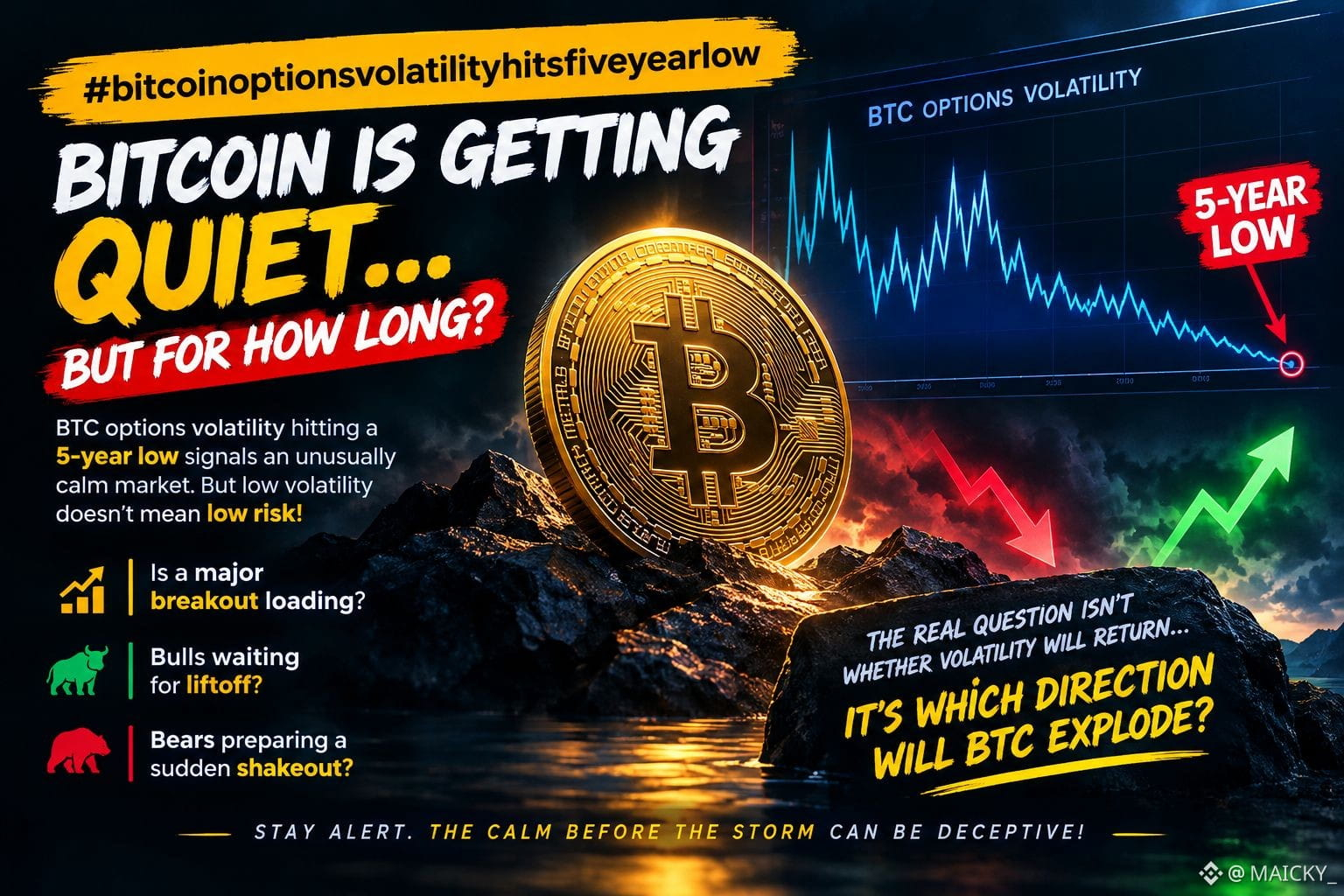
BTC options volatility hitting a 5-year low signals an unusually calm market. But low volatility doesn’t mean low risk! ⚡
💥 Is a major breakout loading?
🐂 Bulls waiting for liftoff?
🐻 Bears preparing a sudden shakeout?
The real question isn’t whether volatility will return… it’s WHICH DIRECTION WILL BTC EXPLODE? 🚀📉
Stay alert. The calm before the storm can be deceptive! 🔥
$BTC
{spot}(BTCUSDT)
🚨 #bitcoinoptionsvolatilityhitsfiveyearlow 🟠
BITCOIN IS GETTING QUIET… BUT FOR HOW LONG? 👀🔥
BTC options volatility hitting a 5-year low signals an unusually calm market. But low volatility doesn’t mean low risk! ⚡
💥 Is a major breakout loading?
🐂 Bulls waiting for liftoff?
🐻 Bears preparing a sudden shakeout?
The real question isn’t whether volatility will return… it’s WHICH DIRECTION WILL BTC EXPLODE? 🚀📉
Stay alert. The calm before the storm can be deceptive! 🔥
$BTC
6
9
13.1k

·
--
Bearish
#BitcoinOptionsVolatilityHitsFiveYearLow 📉 BITCOIN VOLATILITY IS COOLING — BUT WHAT COMES NEXT FOR BTC? 👀
$BTC
{spot}(BTCUSDT)
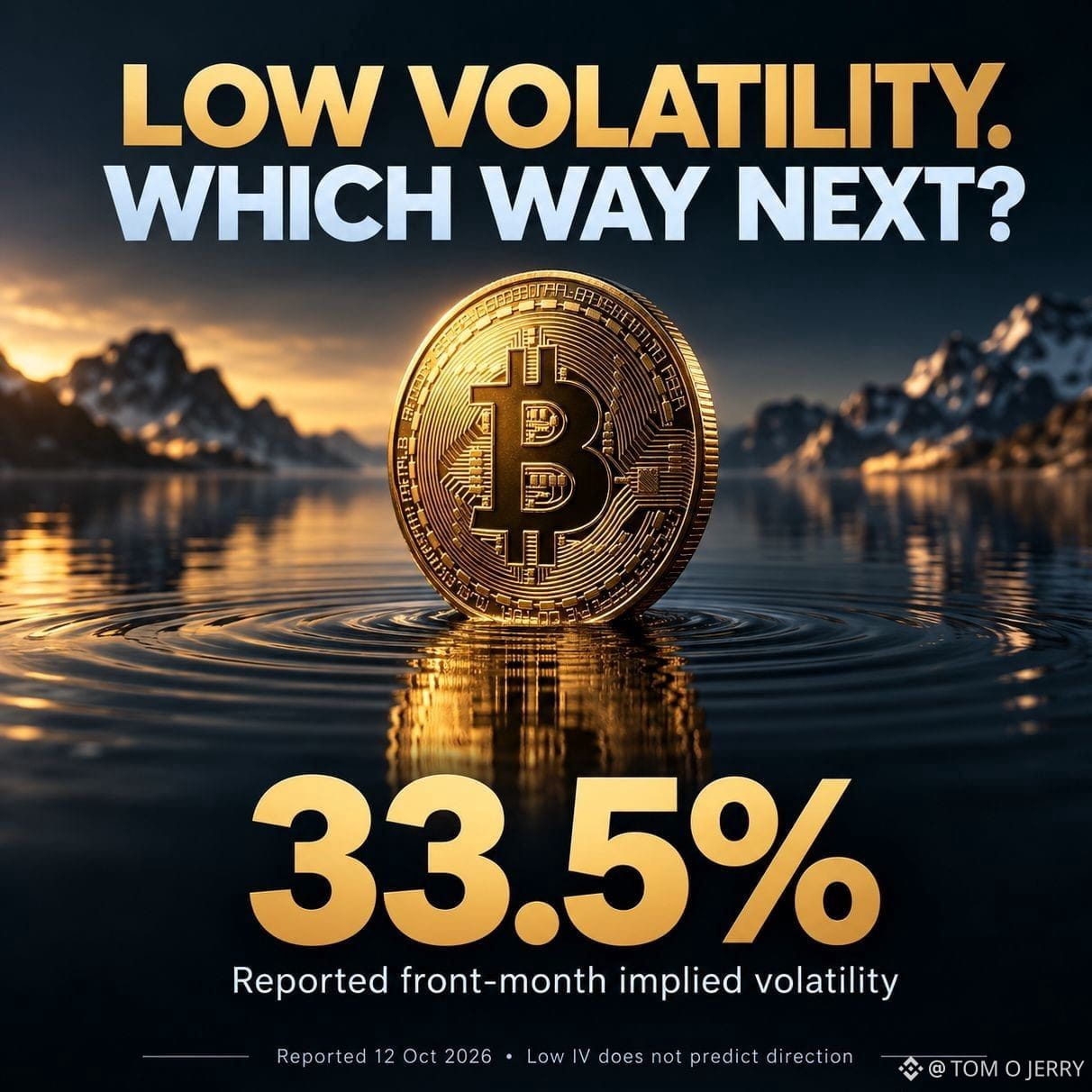
Reports citing 10x Research suggest front-month Bitcoin implied volatility has dropped to around 33.5%, its lowest level in five years.
This measures the volatility expected by options prices on an annualized basis. It does not mean BTC is expected to move 33.5% this month.
⚠️ Lower volatility doesn’t reveal whether Bitcoin will move up or down, and it doesn’t guarantee a major move is coming. The market could remain calm.
📊 BTC/USDT Market Watch:
* Current price: $82,694.17
* 24-hour change: -1.01%
* Resistance to watch: $84,352
* Support to watch: $82,311.50
🎯 My focus is on whether BTC breaks above resistance or falls below support and how price behaves when retesting these levels.
#BitcoinAnalysis #TradingStrategy
#BitcoinOptionsVolatilityHitsFiveYearLow 📉 BITCOIN VOLATILITY IS COOLING — BUT WHAT COMES NEXT FOR BTC? 👀
$BTC
Reports citing 10x Research suggest front-month Bitcoin implied volatility has dropped to around 33.5%, its lowest level in five years.
This measures the volatility expected by options prices on an annualized basis. It does not mean BTC is expected to move 33.5% this month.
⚠️ Lower volatility doesn’t reveal whether Bitcoin will move up or down, and it doesn’t guarantee a major move is coming. The market could remain calm.
📊 BTC/USDT Market Watch:
* Current price: $82,694.17
* 24-hour change: -1.01%
* Resistance to watch: $84,352
* Support to watch: $82,311.50
🎯 My focus is on whether BTC breaks above resistance or falls below support and how price behaves when retesting these levels.
#BitcoinAnalysis #TradingStrategy
2
109

·
--
#BitcoinOptionsVolatilityHitsFiveYearLow Bitcoin options volatility hits a 5-year low — but low volatility doesn’t mean low risk.
Markets may be pricing in smaller moves, but expectations can change quickly.
For $BTC , watch whether spot demand confirms the next move and whether implied volatility rises alongside a decisive breakout or breakdown.
The real signal isn’t the calm — it’s how the market reacts when conditions change.
Are you expecting a breakout or more sideways action?
#Bitcoin #BTC #CryptoMarket

1
77

#BitcoinOptionsVolatilityHitsFiveYearLow
📊 The calm before the storm? Bitcoin volatility is at its lowest level in 5 years! 📉🔥
$BTC The reason is a report showing that the implied volatility of Bitcoin options has fallen to its lowest level in five years, reaching 33.5%! 📉
What’s puzzling is the behavior of the whales: despite the price holding above $84,000 and many people being optimistic about a rise, major traders have bought downside protection (put options) at the $78K and $80K levels in large trades worth over $204 million! 💸🛡️
Analysts believe this behavior doesn’t reflect outright pessimism, but rather amounts to “portfolio insurance”: the whales are holding on to BTC, but protecting themselves against sudden volatility or an unexpected drop (tail risk).
🤔 Question for discussion:
Do you think this current calm is just accumulation before the next price explosion? Or are the whales’ purchases of protective contracts at $78K a warning sign that we should be cautious?
Share your analysis and predictions for the next move! 👇🎯
#bitcoin #BTC
{future}(BTCUSDT)
#BitcoinOptionsVolatilityHitsFiveYearLow
📊 The calm before the storm? Bitcoin volatility is at its lowest level in 5 years! 📉🔥
$BTC The reason is a report showing that the implied volatility of Bitcoin options has fallen to its lowest level in five years, reaching 33.5%! 📉
What’s puzzling is the behavior of the whales: despite the price holding above $84,000 and many people being optimistic about a rise, major traders have bought downside protection (put options) at the $78K and $80K levels in large trades worth over $204 million! 💸🛡️
Analysts believe this behavior doesn’t reflect outright pessimism, but rather amounts to “portfolio insurance”: the whales are holding on to BTC, but protecting themselves against sudden volatility or an unexpected drop (tail risk).
🤔 Question for discussion:
Do you think this current calm is just accumulation before the next price explosion? Or are the whales’ purchases of protective contracts at $78K a warning sign that we should be cautious?
Share your analysis and predictions for the next move! 👇🎯
#bitcoin #BTC

1
1
1
952
·
--
#BitcoinOptionsVolatilityHitsFiveYearLow
The cryptocurrency market is experiencing a curious moment. Implied volatility in Bitcoin options has fallen to its lowest levels in five years. For those tracking Deribit and derivatives metrics, the signal is clear: the options market is pricing in an unusually calm period for $BTC.
Many traders are taking advantage of these lower prices to build hedges by buying put options at a much lower cost. When the cost of volatility drops this much, options stop reflecting the usual retail panic and are instead used strategically by institutional players to protect their portfolios.
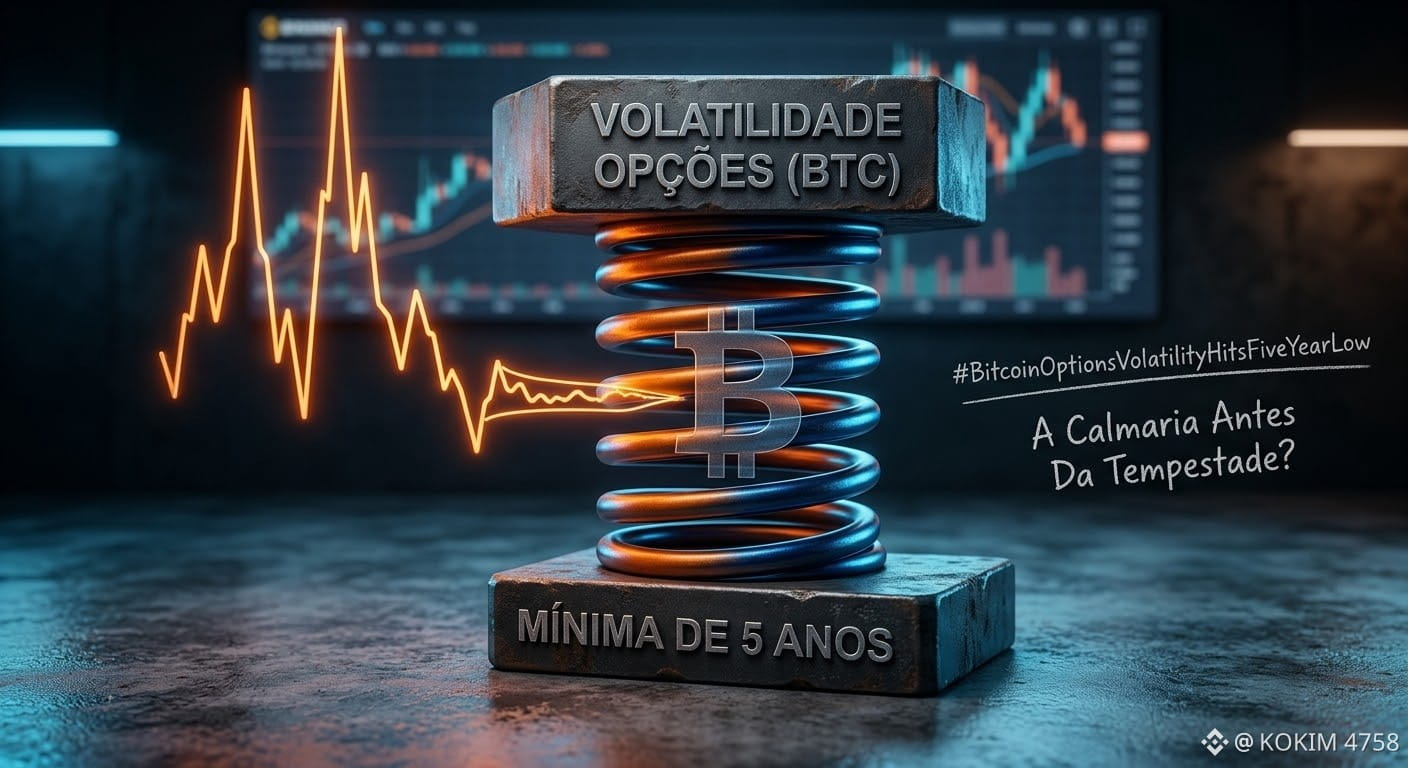
Historically, volatility compressions of this magnitude in Bitcoin don't last long. Prolonged consolidation often acts like a compressed spring: it builds energy until a significant price breakout occurs, either up or down.
My Opinion:
This calm is temporary and deceptive. Don't be fooled by the flat chart; compressed volatility in Bitcoin is often a classic warning sign of a storm ahead. Stay alert.
$BTC
#Bitcoin
#BTC
#CryptoMarket
#Options
#BitcoinOptionsVolatilityHitsFiveYearLow
The cryptocurrency market is experiencing a curious moment. Implied volatility in Bitcoin options has fallen to its lowest levels in five years. For those tracking Deribit and derivatives metrics, the signal is clear: the options market is pricing in an unusually calm period for $BTC .
Many traders are taking advantage of these lower prices to build hedges by buying put options at a much lower cost. When the cost of volatility drops this much, options stop reflecting the usual retail panic and are instead used strategically by institutional players to protect their portfolios.
Historically, volatility compressions of this magnitude in Bitcoin don't last long. Prolonged consolidation often acts like a compressed spring: it builds energy until a significant price breakout occurs, either up or down.
My Opinion:
This calm is temporary and deceptive. Don't be fooled by the flat chart; compressed volatility in Bitcoin is often a classic warning sign of a storm ahead. Stay alert.
$BTC
#Bitcoin
#BTC
#CryptoMarket
#Options
1
405

·
--
Bearish
Calm Before Storm
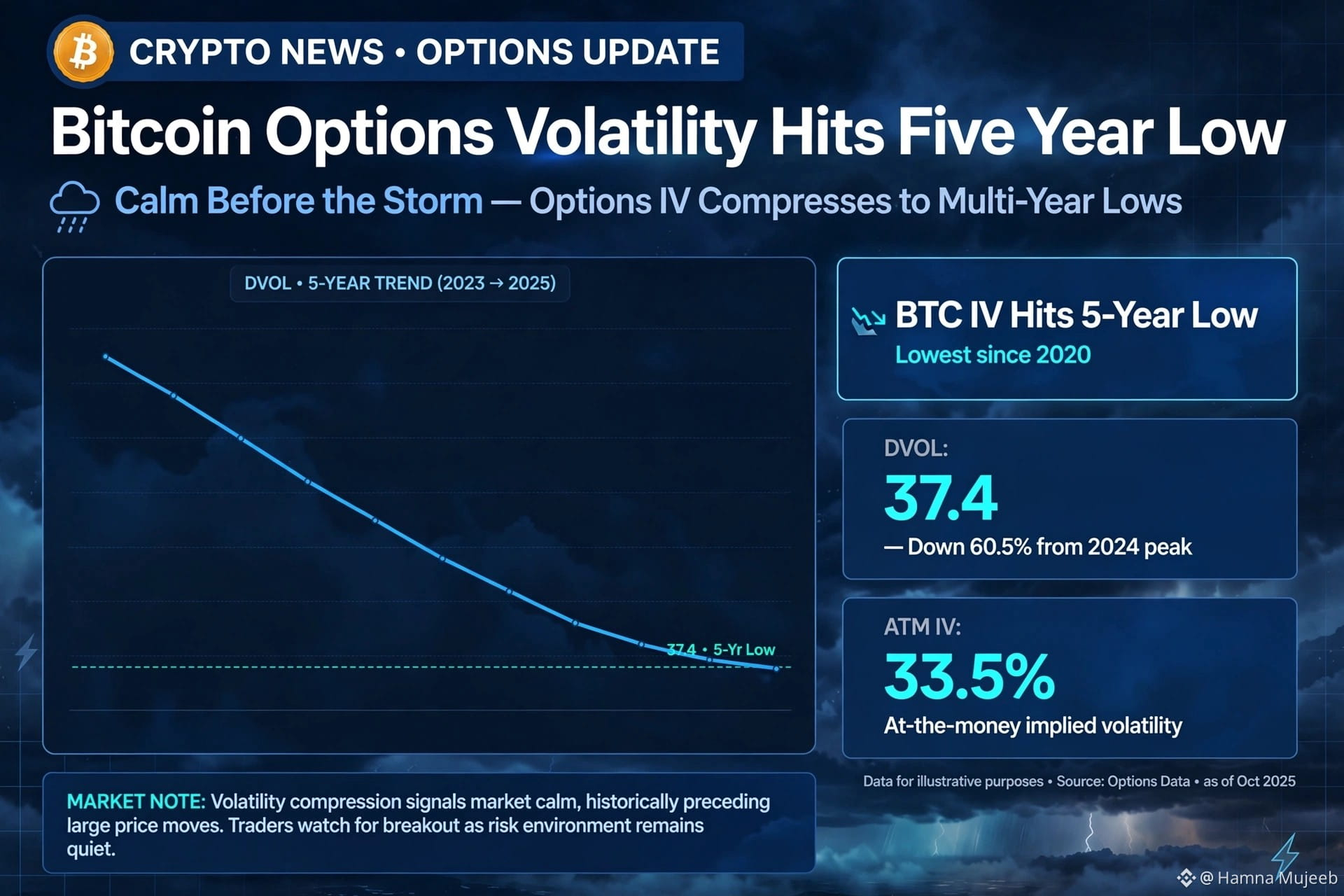
$BTC Options Volatility Hits 5-Year Low — Calm Before The Storm? 🌩️
According to 10x Research & Deribit data (Oct 12):
- DVOL (30D IV Index) = 37.4
{spot}(BTCUSDT)
→ Very Low, 5-year low
- ATM IV = 33.5% → 4pts BELOW realized vol
- 1-week ATM IV was in high 20s this summer
What it means:
Options are pricing LESS movement than Bitcoin is actually doing. Historically, this gap = volatility expansion incoming.
Why so low?
- Spot ETFs + 401k + institutional desks = maturation
- Market makers selling vol, keeping premiums suppressed
Bitcoin now less volatile than NVDA (80% IV)
But low IV makes hedging CHEAP. Smart money is buying protection.
CPI Wednesday = trigger?
$BTC #BitcoinOptionsVolatilityHitsFiveYearLow #Bitcoin #OptionsTrading #DVOL #CryptoVolatility
#BitcoinOptionsVolatilityHitsFiveYearLow
Calm Before Storm
$BTC Options Volatility Hits 5-Year Low — Calm Before The Storm? 🌩️
According to 10x Research & Deribit data (Oct 12):
- DVOL (30D IV Index) = 37.4
→ Very Low, 5-year low
- ATM IV = 33.5% → 4pts BELOW realized vol
- 1-week ATM IV was in high 20s this summer
What it means:
Options are pricing LESS movement than Bitcoin is actually doing. Historically, this gap = volatility expansion incoming.
Why so low?
- Spot ETFs + 401k + institutional desks = maturation
- Market makers selling vol, keeping premiums suppressed
Bitcoin now less volatile than NVDA (80% IV)
But low IV makes hedging CHEAP. Smart money is buying protection.
CPI Wednesday = trigger?
$BTC #BitcoinOptionsVolatilityHitsFiveYearLow #Bitcoin #OptionsTrading #DVOL #CryptoVolatility
#BitcoinOptionsVolatilityHitsFiveYearLow
2
1.5k

·
--
Bearish
#bitcoinoptionsvolatilityhitsfiveyearlow
🚨 $BTC Market volatility has fallen to a 5-year low — is this the calm before the storm?
📉 Bitcoin’s implied volatility is reportedly down to 33.5%, while whales are said to be spending **$204M on downside protection.
🐋 $78K and $80K put options are drawing traders’ attention as they prepare for a possible drop.
⚠️ But here’s the surprise:
🔹 A drop in volatility can precede a major move in either direction.
🔹 Put options may indicate hedging, not necessarily an expectation of a crash.
🔹 A spike in volatility could catch overconfident traders off guard.
🎯 The big question: Is Bitcoin gearing up for a massive breakout, or is a deeper correction on the horizon?
I’m watching Bitcoin’s key support and resistance levels, along with upcoming volatility, for confirmation.
Quiet markets don’t stay quiet forever. 👀
What’s your move — a bullish breakout 🚀 or a bearish correction 📉?
#BTC🔥🔥🔥🔥🔥 $SOL
{future}(SOLUSDT)
{future}(BTCUSDT)
$ETH
{future}(ETHUSDT)
#ETH #sol板块
#bitcoinoptionsvolatilityhitsfiveyearlow
🚨 $BTC Market volatility has fallen to a 5-year low — is this the calm before the storm?
📉 Bitcoin’s implied volatility is reportedly down to 33.5%, while whales are said to be spending **$204M on downside protection.
🐋 $78K and $80K put options are drawing traders’ attention as they prepare for a possible drop.
⚠️ But here’s the surprise:
🔹 A drop in volatility can precede a major move in either direction.
🔹 Put options may indicate hedging, not necessarily an expectation of a crash.
🔹 A spike in volatility could catch overconfident traders off guard.
🎯 The big question: Is Bitcoin gearing up for a massive breakout, or is a deeper correction on the horizon?
I’m watching Bitcoin’s key support and resistance levels, along with upcoming volatility, for confirmation.
Quiet markets don’t stay quiet forever. 👀
What’s your move — a bullish breakout 🚀 or a bearish correction 📉?
#BTC🔥🔥🔥🔥🔥 $SOL
$ETH
#ETH #sol板块

9
2
12
34.4k
Log in to explore more content
Join global crypto users on Binance Square
⚡️ Get latest and useful information about crypto.
💬 Trusted by the world’s largest crypto exchange.
👍 Discover real insights from verified creators.
Email / Phone number
Trending Topics
1
#NVIDIAReinstatesJensenHuangasCEO
12,014 views
454 Discussing
2
#WillMarketsStageAThanksgivingReliefRally?
113,315 views
1,612 Discussing
3
#WillOctCorePCEShiftFedHikeExpectations?
42,242 views
651 Discussing
4
#BitcoinEndsRecord17DayStreakOfLowerHighs
1,928 views
151 Discussing
5
#TradersPriceOut50bpDecemberFedHike
2,221 views
106 Discussing
6
#EvolveAtBinanceBlockchainWeek
96,447 views
939 Discussing
7
#TrumpBackedAmericanBitcoinRaisesHoldingsToOver8500BTC
685 views
28 Discussing
8
#MuskWarnsOfAICashCrunch
54,005 views
673 Discussing
9
#TradFiForBeginners
1.1M views
5,951 Discussing
10
#SkyPSMUSDCLiquidityReboundsTo$1.77B
409 views
9 Discussing