
#cftcmovestofoldeventcontractsintoswapsrules
cftcmovestofoldeventcontractsintoswapsrules
120,081 views
1,310 Discussing
Hot
Latest

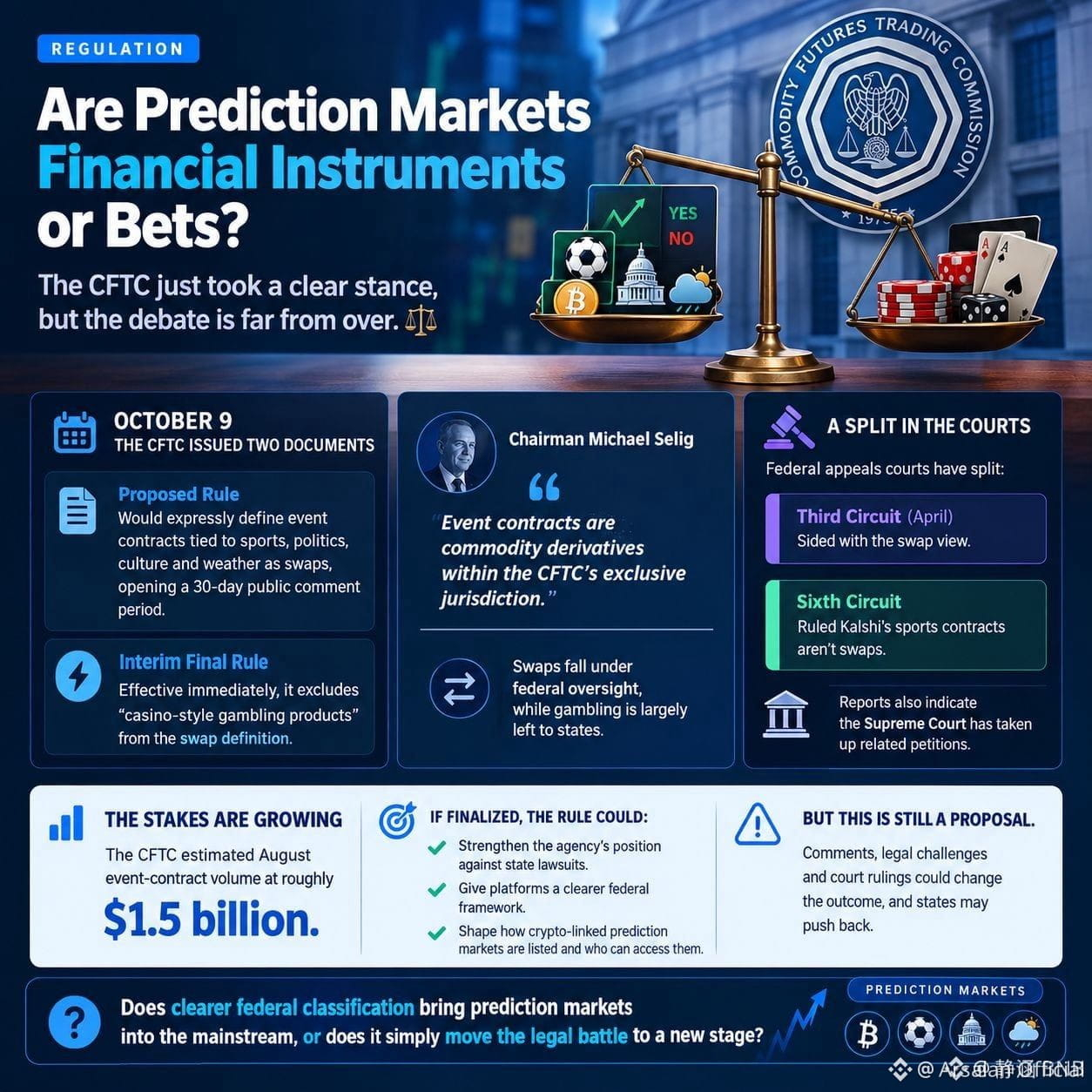
#CFTCMovesToFoldEventContractsIntoSwapsRules The U.S. CFTC is moving to classify prediction-market event contracts tied to sports, politics, culture, and weather as swaps under federal derivatives law. The proposal could strengthen federal oversight of platforms such as Polymarket and Kalshi, while intensifying legal battles with state gambling regulators. The proposal is not yet final. ⚖️📊 Commodity Futures Trading Commission
#CFTCRegulatoryShift
#PredictionMarketRules
#PolymarketRegulation
#CryptoPolicyUpdate
$BTC | $ETH | $POLYX
#CFTCRegulatoryShift
#PredictionMarketRules
#PolymarketRegulation
#CryptoPolicyUpdate
$BTC | $ETH | $POLYX
1
84

📊 PREDICTION MARKETS: A NEW REGULATORY CHAPTER?
Event contracts are attracting attention as regulators examine how they should be classified and overseen. The CFTC's move to fold them into swap rules could affect how certain products are structured and offered. 🔍 For the wider crypto industry, this is another reminder that regulation matters alongside price action. Keep monitoring official announcements instead of trading on headlines alone. 🚀 Could clearer rules support long-term market growth?
#cftcmovestofoldeventcontractsintoswapsrules
1
62

·
--
Bearish
#cftcmovestofoldeventcontractsintoswapsrules 🏛️ Regulatory Shift: CFTC Folding Event Contracts into Swaps Rules
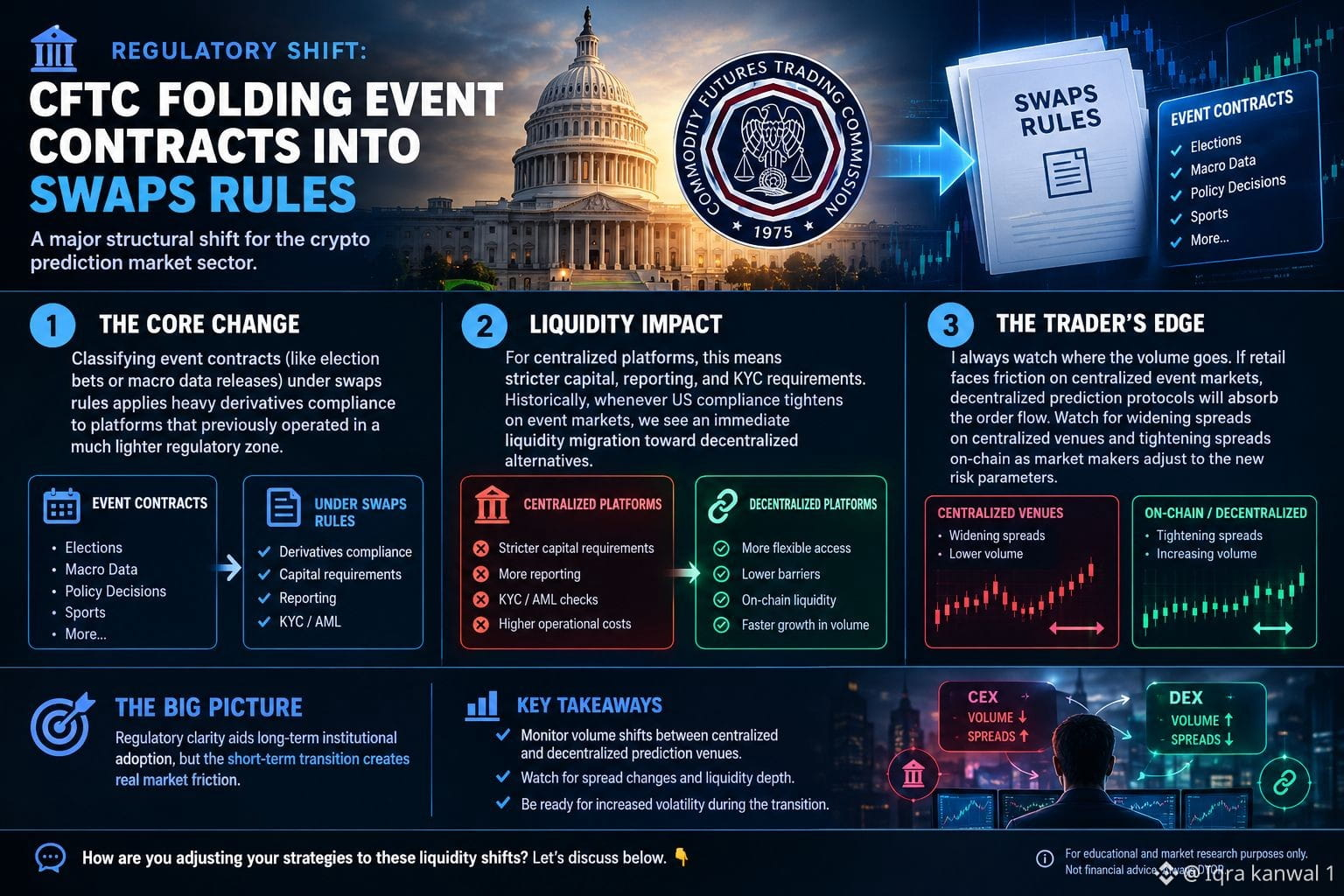
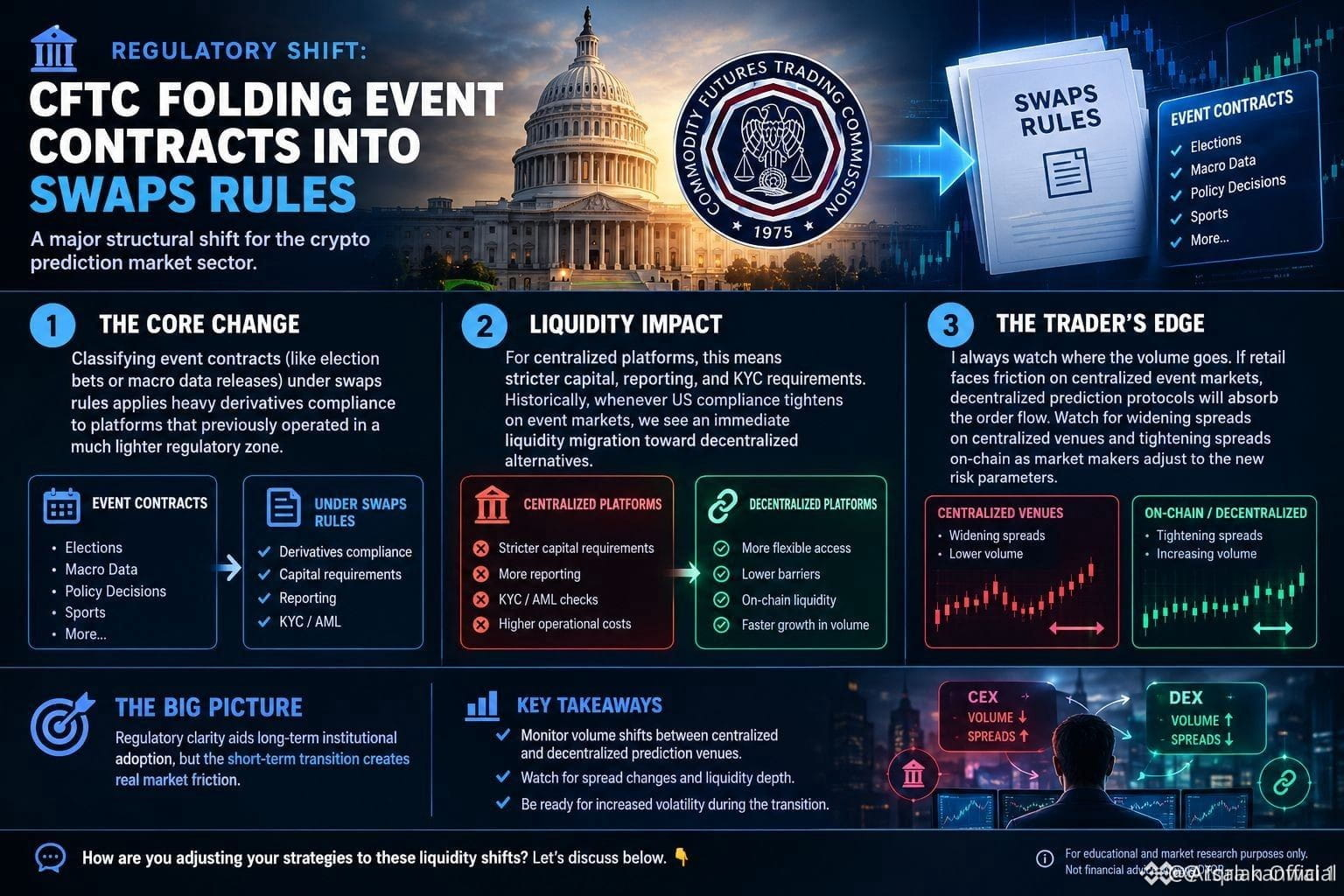
I’ve been closely tracking the CFTC’s move to fold event contracts into swaps rules, and it’s a massive structural shift for the crypto prediction market sector. Here’s my breakdown from the trading desk:
1️⃣ The Core Change: Classifying event contracts (like election bets or macro data releases) under swaps rules applies heavy derivatives compliance to platforms that previously operated in a much lighter regulatory zone.
2️⃣ Liquidity Impact: For centralized platforms, this means stricter capital, reporting, and KYC requirements. Historically, whenever US compliance tightens on event markets, we see an immediate liquidity migration toward decentralized alternatives.
3️⃣ The Trader’s Edge: I always watch where the volume goes. If retail faces friction on centralized event markets, decentralized prediction protocols will absorb the order flow. Watch for widening spreads on centralized venues and tightening spreads on-chain as market makers adjust to the new risk parameters.
Bottom line: Regulatory clarity aids long-term institutional adoption, but the short-term transition creates real market friction. Monitor volume shifts between centralized and decentralized prediction venues closely.
How are you adjusting your strategies to these liquidity shifts? Let’s discuss below. 👇
For educational and market research purposes only. Not financial advice. Always DYOR.
$OGN $PIXEL $QUICK
{spot}(QUICKUSDT)
{future}(PIXELUSDT)
{future}(OGNUSDT)
#cftcmovestofoldeventcontractsintoswapsrules 🏛️ Regulatory Shift: CFTC Folding Event Contracts into Swaps Rules
I’ve been closely tracking the CFTC’s move to fold event contracts into swaps rules, and it’s a massive structural shift for the crypto prediction market sector. Here’s my breakdown from the trading desk:
1️⃣ The Core Change: Classifying event contracts (like election bets or macro data releases) under swaps rules applies heavy derivatives compliance to platforms that previously operated in a much lighter regulatory zone.
2️⃣ Liquidity Impact: For centralized platforms, this means stricter capital, reporting, and KYC requirements. Historically, whenever US compliance tightens on event markets, we see an immediate liquidity migration toward decentralized alternatives.
3️⃣ The Trader’s Edge: I always watch where the volume goes. If retail faces friction on centralized event markets, decentralized prediction protocols will absorb the order flow. Watch for widening spreads on centralized venues and tightening spreads on-chain as market makers adjust to the new risk parameters.
Bottom line: Regulatory clarity aids long-term institutional adoption, but the short-term transition creates real market friction. Monitor volume shifts between centralized and decentralized prediction venues closely.
How are you adjusting your strategies to these liquidity shifts? Let’s discuss below. 👇
For educational and market research purposes only. Not financial advice. Always DYOR.
$OGN $PIXEL $QUICK
1
1.1k

·
--
Bullish
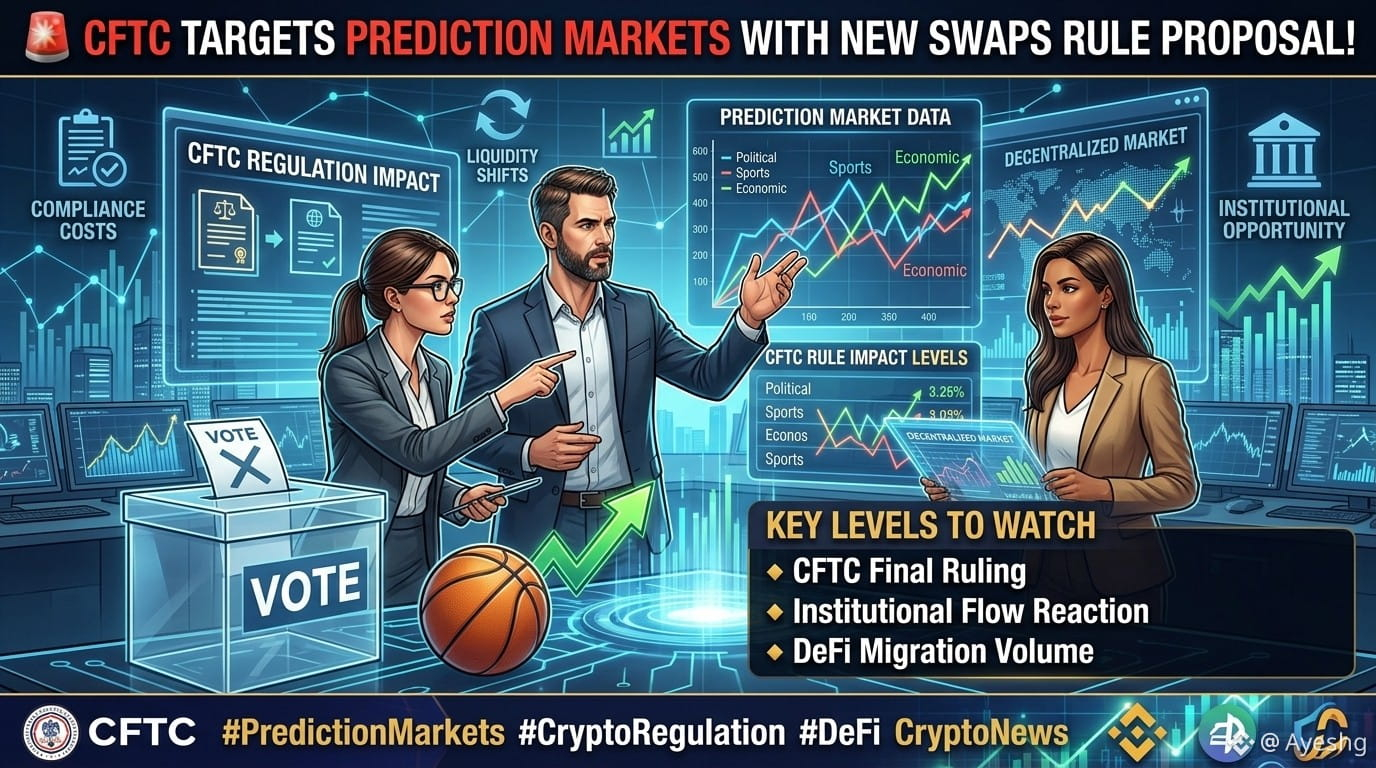
#cftcmovestofoldeventcontractsintoswapsrules 🚨 CFTC TARGETS PREDICTION MARKETS WITH A PROPOSED SWAPS-RULE EXPANSION! 📊
A new regulatory development could reshape the future of prediction markets, including platforms operating around crypto, politics, sports and economic events.
The U.S. Commodity Futures Trading Commission (CFTC) is proposing to broaden the interpretation of swaps rules to cover additional event contracts. The proposal could affect how prediction-market platforms operate, but it is not yet a finalized rule. 🏛️
🔍 WHAT COULD CHANGE?
1️⃣ Higher Compliance Demands: Platforms may need to reassess registration, reporting and other regulatory obligations depending on the contracts they offer.
2️⃣ Liquidity Shifts: Stricter requirements could increase operating costs and influence where traders access event markets. However, a migration toward decentralized platforms is not guaranteed.
3️⃣ Institutional Opportunity: Projects offering transparent operations and regulatory-compliant infrastructure could become more attractive to certain institutional participants.
4️⃣ Legal Uncertainty Remains: Event contracts may be classified differently depending on their structure. The regulatory outcome will depend on the final rules, applicable law and potential legal challenges.
⚠️ MY TAKE: Regulatory clarity could support long-term development, but compliance costs and restrictions may create short-term challenges. It is too early to declare decentralized platforms or compliance-focused tokens as guaranteed winners.
The key is to watch the final regulatory language, implementation timeline and how major platforms respond.
💬 Will tighter regulation attract institutional capital, or push more activity toward decentralized markets?
$ZKC $OP $ETH
#CFTC #PredictionMarkets #CryptoRegulation #DeFi #CryptoNews
3
2.7k

·
--
CFTC Seeks Comment on Event Contracts|Solana Hosts Tokenized Prediction Markets, but Isn’t a Regulatory Winner|Wait and See Before 110.7
My stance is cautious: this regulatory development is related to Solana, but it does not mean SOL has been approved or that prediction markets will face no further hurdles. On October 9, the U.S. CFTC issued a notice of proposed rulemaking to further clarify that event contracts involving sports, politics, culture, weather, and other areas fall within the definition of “swaps,” and invited public comment. A separate interim final rule issued the same day excludes casino-style gambling products from the definition of “swaps,” and will take effect when it is published in the Federal Register. The two documents differ in scope and procedure: the proposed rule is still open for comment, so it should not be described as fully in effect, nor should all sports-related products automatically be placed in the same category.
Why should SOL traders pay attention? Kalshi announced back in December 2025 that tokenized versions of its event contracts had entered the Solana ecosystem through Jupiter and DFlow; Solana’s official media has also covered DFlow’s interface. This suggests that greater regulatory clarity could prompt a reassessment of related front ends, settlement paths, and risk controls, potentially affecting trading activity for these applications on-chain. But the CFTC is discussing the legal classification and jurisdiction of contracts—not approving the Solana chain, Jupiter, or any token. Increased on-chain activity also may not translate directly into spot buying of SOL: many trades are denominated in stablecoins, while SOL is used mainly for transaction fees and some ecosystem needs.
The market has already offered a measured price comparison. At the time of writing, SOL/USD was around $109.46 on Kraken, below the day’s open of $109.99; the rolling 24-hour high was $110.67 and the low was $108.86. Despite increased discussion of the news, SOL has not moved above its 24-hour high. So I see 110.7 only as an upside confirmation level and around 108.8 as short-term support. I won’t force a connection between the regulatory text and current price movements. If the final rule diverges from the proposal, compliance costs for actual market access prove higher, or SOL breaks below 108.8 and fails to reclaim it on a rebound, the earlier bullish inference about usage must be reconsidered.
If I were trading this myself, I’d sit out for now and consider only a small spot long after confirmation. I’d enter with 2% of total capital only if SOL moves above 110.7, holds there for two consecutive one-hour candle closes, and holds on a retest, while subsequent CFTC documents show no signs of tighter restrictions. Otherwise, I’d stay flat. My first target would be 112.2, where I’d sell half, followed by 114; I’d proactively close the remainder if price falls back below 110.7. A hard stop at 108.5 means closing the entire position. No leverage and no averaging down. If the market has already priced in the regulatory news but the price fails to confirm, I’ll accept missing the move rather than chase a rebound.
Sources: The CFTC’s two official announcements dated October 9, public statements from Kalshi and the Solana ecosystem, and Kraken spot market data. #CFTCMovesToFoldEventContractsIntoSwapsRules #SOL
This is solely my personal market observation and does not constitute investment advice.

121

·
--
Bullish
🚨🚨🚨🚨🚨🚨🚨🚨🚨🚨🚨🚨🚨 🚨CFTC MAKES A MAJOR MOVE ON EVENT CONTRACTS — WHAT HAPPENS NEXT?
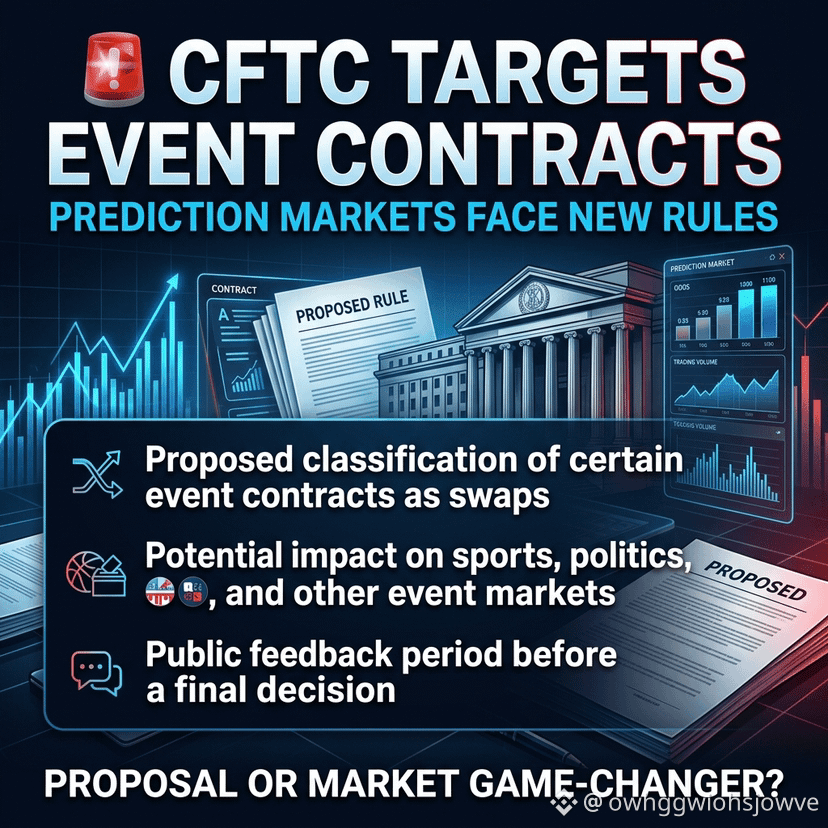
The US Commodity Futures Trading Commission (CFTC) has proposed a rule that would explicitly include certain event contracts in the definition of swaps, potentially bringing greater regulatory clarity to prediction markets.
📌 What You Need to Know:
🔹 New Proposal: The CFTC wants to formally clarify how event contracts are classified under existing derivatives rules.
🔹 Wider Scope: The proposal covers contracts linked to sports, politics, culture, and weather-related events.
🔹 Public Feedback: The agency is inviting comments for 30 days after publication in the Federal Register.
🔹 Why It Matters: The proposal could influence how event-based financial contracts are regulated in the United States.
📊 My Take: This is an important regulatory development, but it is still a proposal—not a finalized rule. Its impact will depend on the final wording and how the rules are implemented.
💬 **Do you think clearer federal rules will strengthen confidence in US financial markets? Share your thoughts below!
Trade hear 👇
$OP $ZK $MRNAB
#CFTC #CryptoRegulation #USMarkets #FinanceNews #CFTCMovesToFoldEventContractsIntoSwapsRules
{future}(OPUSDT)
{future}(ZKUSDT)
{spot}(MRNABUSDT)
🚨🚨🚨🚨🚨🚨🚨🚨🚨🚨🚨🚨🚨 🚨CFTC MAKES A MAJOR MOVE ON EVENT CONTRACTS — WHAT HAPPENS NEXT?
The US Commodity Futures Trading Commission (CFTC) has proposed a rule that would explicitly include certain event contracts in the definition of swaps, potentially bringing greater regulatory clarity to prediction markets.
📌 What You Need to Know:
🔹 New Proposal: The CFTC wants to formally clarify how event contracts are classified under existing derivatives rules.
🔹 Wider Scope: The proposal covers contracts linked to sports, politics, culture, and weather-related events.
🔹 Public Feedback: The agency is inviting comments for 30 days after publication in the Federal Register.
🔹 Why It Matters: The proposal could influence how event-based financial contracts are regulated in the United States.
📊 My Take: This is an important regulatory development, but it is still a proposal—not a finalized rule. Its impact will depend on the final wording and how the rules are implemented.
💬 **Do you think clearer federal rules will strengthen confidence in US financial markets? Share your thoughts below!
Trade hear 👇
$OP $ZK $MRNAB
#CFTC #CryptoRegulation #USMarkets #FinanceNews #CFTCMovesToFoldEventContractsIntoSwapsRules
1
332
⚖️ PREDICTION MARKETS FACE A RULEBOOK SHIFT!
The CFTC is moving to fold event contracts into swaps rules, putting regulatory oversight in focus! 🔍
Clear rules could change how platforms operate and how markets manage risk. What impact could this have on crypto sentiment? $BTC $XRP
#cftcmovestofoldeventcontractsintoswapsrules
The CFTC is moving to fold event contracts into swaps rules, putting regulatory oversight in focus! 🔍
Clear rules could change how platforms operate and how markets manage risk. What impact could this have on crypto sentiment? $BTC $XRP
#cftcmovestofoldeventcontractsintoswapsrules
235
·
--
Bullish
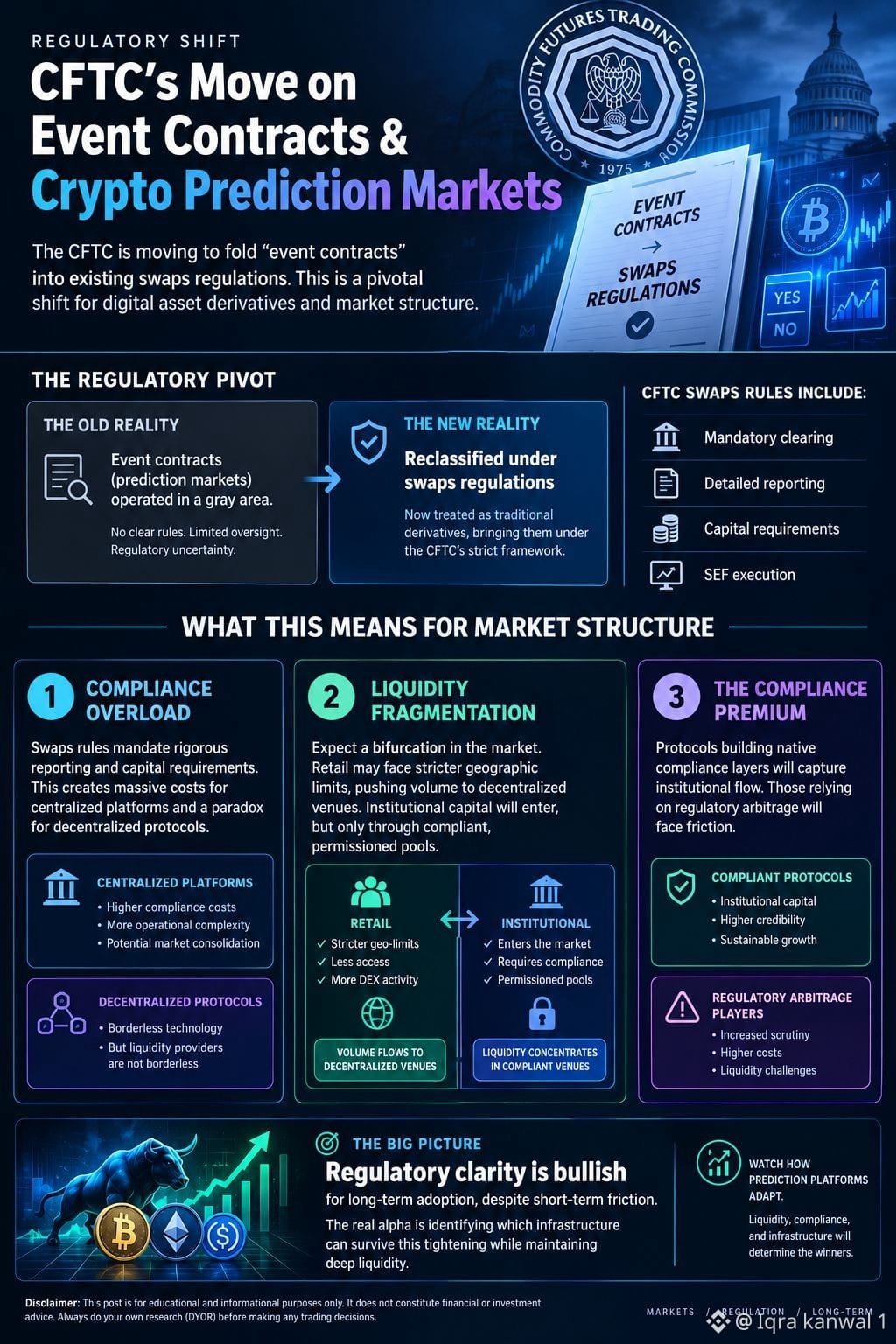
#cftcmovestofoldeventcontractsintoswapsrules The CFTC’s move to fold event contracts into swaps regulations is a structural pivot for digital asset derivatives. I’m looking past the headlines to see how this reshapes liquidity. 📊
For years, event contracts (prediction markets) operated in a gray area. Reclassifying them under swaps rules means treating them as traditional derivatives. 🏛️
What this means for market structure:
1️⃣ Compliance Overload: Swaps rules mandate rigorous reporting and capital requirements. Centralized platforms face massive costs. Decentralized protocols face a paradox: the tech is borderless, but liquidity providers are not.
2️⃣ Liquidity Fragmentation: Expect bifurcation. Retail may face stricter geographic limits, pushing volume to decentralized venues. Institutional capital will enter, but only through compliant, permissioned pools. 💧
3️⃣ The Compliance Premium: Protocols building native compliance layers will capture institutional flow. Those relying on regulatory arbitrage will face friction.
We must watch how prediction platforms adapt. The real alpha is identifying which infrastructure can survive this tightening while maintaining deep liquidity. Regulatory clarity is bullish for long-term adoption, despite short-term friction.
This post is for educational and informational purposes only. It does not constitute financial or investment advice. Always do your own research (DYOR) before making any trading decisions.
$ZK $OP $MRNAB
{spot}(MRNABUSDT)
{future}(OPUSDT)
{future}(ZKUSDT)
#cftcmovestofoldeventcontractsintoswapsrules The CFTC’s move to fold event contracts into swaps regulations is a structural pivot for digital asset derivatives. I’m looking past the headlines to see how this reshapes liquidity. 📊
For years, event contracts (prediction markets) operated in a gray area. Reclassifying them under swaps rules means treating them as traditional derivatives. 🏛️
What this means for market structure:
1️⃣ Compliance Overload: Swaps rules mandate rigorous reporting and capital requirements. Centralized platforms face massive costs. Decentralized protocols face a paradox: the tech is borderless, but liquidity providers are not.
2️⃣ Liquidity Fragmentation: Expect bifurcation. Retail may face stricter geographic limits, pushing volume to decentralized venues. Institutional capital will enter, but only through compliant, permissioned pools. 💧
3️⃣ The Compliance Premium: Protocols building native compliance layers will capture institutional flow. Those relying on regulatory arbitrage will face friction.
We must watch how prediction platforms adapt. The real alpha is identifying which infrastructure can survive this tightening while maintaining deep liquidity. Regulatory clarity is bullish for long-term adoption, despite short-term friction.
This post is for educational and informational purposes only. It does not constitute financial or investment advice. Always do your own research (DYOR) before making any trading decisions.
$ZK $OP $MRNAB
2
851

·
--
#CFTCMovesToFoldEventContractsIntoSwapsRules
CFTC Moves to Bring Event Contracts Under Swaps Rules
The US Commodity Futures Trading Commission (CFTC) proposed clarifying that certain event contracts tied to sports, politics, culture and weather fall under the legal definition of swaps.
Announced on October 9, the move could strengthen federal oversight of prediction markets such as Kalshi and Polymarket, as regulators continue to clash with states over whether these products should be treated as financial derivatives or gambling.
The CFTC also issued a separate interim rule addressing casino-style gambling products.
The proposal is not a final resolution. Its impact will depend on the rulemaking process and ongoing court battles, making the next regulatory steps worth watching.
$BTC $WLD $C98
{future}(C98USDT)
{future}(WLDUSDT)
{future}(BTCUSDT)
#CFTCMovesToFoldEventContractsIntoSwapsRules
CFTC Moves to Bring Event Contracts Under Swaps Rules
The US Commodity Futures Trading Commission (CFTC) proposed clarifying that certain event contracts tied to sports, politics, culture and weather fall under the legal definition of swaps.
Announced on October 9, the move could strengthen federal oversight of prediction markets such as Kalshi and Polymarket, as regulators continue to clash with states over whether these products should be treated as financial derivatives or gambling.
The CFTC also issued a separate interim rule addressing casino-style gambling products.
The proposal is not a final resolution. Its impact will depend on the rulemaking process and ongoing court battles, making the next regulatory steps worth watching.
$BTC $WLD $C98
2
477

·
--
#CFTCMovesToFoldEventContractsIntoSwapsRules
🚨 CFTC Moves to Bring Event Contracts Under Swaps Rules
The regulatory battle around prediction markets is entering a new phase.
The U.S. Commodity Futures Trading Commission (CFTC) is proposing to formally classify certain event contracts as swaps, potentially bringing them under a clearer set of derivatives-market rules. The move comes as platforms offering contracts tied to political, sporting, economic, and other real-world events face growing regulatory scrutiny.
Why does this matter?
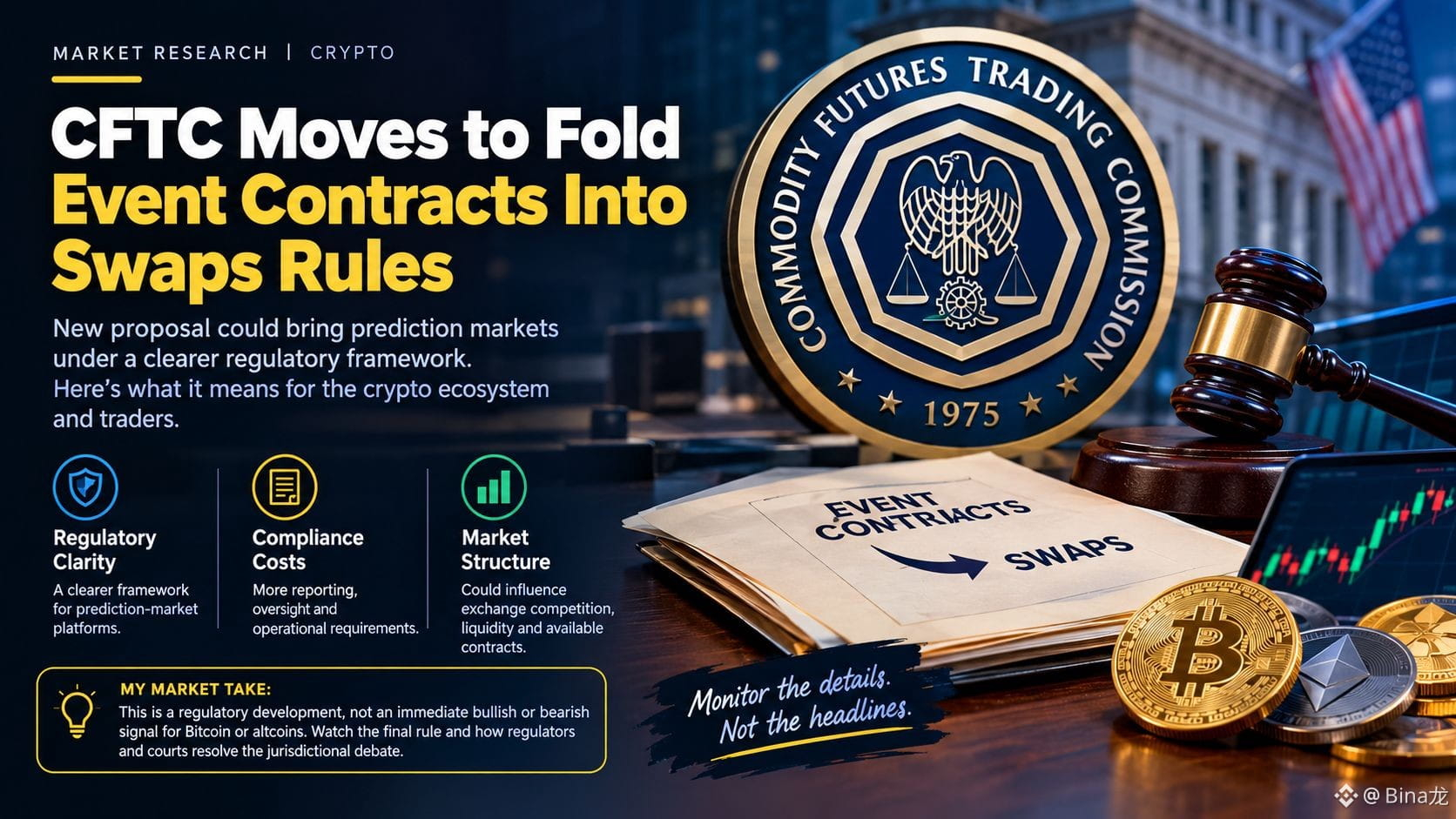
🔹 Regulatory clarity: A more defined framework could reshape how prediction-market platforms list and manage contracts.
🔹 Compliance costs: Operators may face additional reporting, oversight, and operational requirements, depending on the final rules.
🔹 Market structure: The decision could influence how exchanges compete, how liquidity develops, and which types of event contracts remain available.
My market take: This is primarily a regulatory development, not an immediate bullish or bearish signal for Bitcoin or altcoins. However, it matters to the broader digital-asset ecosystem because prediction markets and crypto increasingly overlap in trading infrastructure and market participation.
The key factor to watch is the final rule, along with how regulators and courts resolve the ongoing jurisdictional debate.
For traders, the takeaway is simple: monitor the regulatory details before pricing in any major market impact. Headlines can move sentiment, but implementation determines the longer-term consequences.
What’s your view? Will tighter oversight strengthen prediction markets through greater clarity, or limit innovation by increasing compliance burdens?
#CFTC #PredictionMarkets #Polymarket #Regulation
$MAGIC $LUMIA $ERA
{future}(ERAUSDT)
{future}(LUMIAUSDT)
{future}(MAGICUSDT)
#CFTCMovesToFoldEventContractsIntoSwapsRules
🚨 CFTC Moves to Bring Event Contracts Under Swaps Rules
The regulatory battle around prediction markets is entering a new phase.
The U.S. Commodity Futures Trading Commission (CFTC) is proposing to formally classify certain event contracts as swaps, potentially bringing them under a clearer set of derivatives-market rules. The move comes as platforms offering contracts tied to political, sporting, economic, and other real-world events face growing regulatory scrutiny.
Why does this matter?
🔹 Regulatory clarity: A more defined framework could reshape how prediction-market platforms list and manage contracts.
🔹 Compliance costs: Operators may face additional reporting, oversight, and operational requirements, depending on the final rules.
🔹 Market structure: The decision could influence how exchanges compete, how liquidity develops, and which types of event contracts remain available.
My market take: This is primarily a regulatory development, not an immediate bullish or bearish signal for Bitcoin or altcoins. However, it matters to the broader digital-asset ecosystem because prediction markets and crypto increasingly overlap in trading infrastructure and market participation.
The key factor to watch is the final rule, along with how regulators and courts resolve the ongoing jurisdictional debate.
For traders, the takeaway is simple: monitor the regulatory details before pricing in any major market impact. Headlines can move sentiment, but implementation determines the longer-term consequences.
What’s your view? Will tighter oversight strengthen prediction markets through greater clarity, or limit innovation by increasing compliance burdens?
#CFTC #PredictionMarkets #Polymarket #Regulation
$MAGIC $LUMIA $ERA
69

Why is nobody talking about how the regulatory squeeze on prediction markets is about to reshape decentralized trading?
Most traders focus purely on token charts until an unexpected policy shift nukes liquidity across their favorite decentralized venues, leaving them trapped in positions they can no longer easily exit.
The push to fold event contracts into traditional swaps rules is not just bureaucratic red tape; it is a direct challenge to decentralized prediction and derivative protocols. When regulators treat binary event markets as standard swap agreements, the burden shifts toward strict registration and centralized reporting standards. That creates immediate friction for platforms settling volume in stablecoins like $USDT and complicates the governance models that DeFi relies on.
Look at how decentralized finance infrastructure handled previous regulatory cycles. Protocols that built robust automated market maker rails, like $UNI and $RAY, survived by standardizing permissionless settlement while frontend interfaces adapted to jurisdictional limits. Event contracts will likely face the same fork in the road: comply with institutional swap definitions or migrate deeper into fully immutable smart contract layers.
Where do you think decentralized prediction markets go from here?
#CFTCMovesToFoldEventContractsIntoSwapsRules #B3PlansSecuritiesTokenizationPlatformForFirstHalfOf2027
Why is nobody talking about how the regulatory squeeze on prediction markets is about to reshape decentralized trading?
Most traders focus purely on token charts until an unexpected policy shift nukes liquidity across their favorite decentralized venues, leaving them trapped in positions they can no longer easily exit.
The push to fold event contracts into traditional swaps rules is not just bureaucratic red tape; it is a direct challenge to decentralized prediction and derivative protocols. When regulators treat binary event markets as standard swap agreements, the burden shifts toward strict registration and centralized reporting standards. That creates immediate friction for platforms settling volume in stablecoins like $USDT and complicates the governance models that DeFi relies on.
Look at how decentralized finance infrastructure handled previous regulatory cycles. Protocols that built robust automated market maker rails, like $UNI and $RAY , survived by standardizing permissionless settlement while frontend interfaces adapted to jurisdictional limits. Event contracts will likely face the same fork in the road: comply with institutional swap definitions or migrate deeper into fully immutable smart contract layers.
Where do you think decentralized prediction markets go from here?
#CFTCMovesToFoldEventContractsIntoSwapsRules #B3PlansSecuritiesTokenizationPlatformForFirstHalfOf2027

184
·
--
Bullish
#cftcmovestofoldeventcontractsintoswapsrules 🚨 CFTC Targets Prediction Markets: Event Contracts Could Fall Under Swap Rules!
The U.S. Commodity Futures Trading Commission (CFTC) has published new regulatory proposals that could reshape how prediction markets operate across the United States. 🇺🇸
📌 3 Key Developments
1️⃣ New Proposal Published
On October 9, the CFTC proposed explicitly including event contracts tied to sports, politics, culture, and weather within the federal definition of a swap. The proposal opens a 30-day public comment period and is not yet final.
2️⃣ Casino-Style Products Treated Differently
Alongside the proposal, the agency issued an interim final rule stating that casino-style products, including sportsbook wagers and casino games, are not swaps. This distinction could become central to future regulatory disputes.
3️⃣ Why Prediction Markets Matter
The classification could influence platforms such as Polymarket and other event-contract providers. Supporters of federal oversight argue these products fall under derivatives regulation, while some states maintain that certain contracts resemble gambling and should follow state laws.
⚖️ What Happens Next?
The proposal could strengthen the CFTC's argument for federal jurisdiction if adopted, but public comments, court challenges, and disagreements with state regulators may shape the final outcome.
The distinction between a regulated financial derivative and a gambling product is now a major issue for the prediction-market industry.
💬 Will the CFTC's approach provide clearer rules for prediction markets, or create another round of legal battles?
$MAGIC $LUMIA $ERA
#CFTC #PredictionMarkets #Polymarket #CryptoRegulation #EventContracts #Regulation #CryptoNews #BinanceSquare
This article summarizes the supplied report. The regulatory details have not been independently verified. The proposal is not a final rule. Not financial advice. DYOR.

6
3k

·
--
🚨 CFTC COULD CHANGE THE EVENT CONTRACTS GAME! ⚖️🔥
The CFTC is moving to fold event contracts into its swaps rules, potentially reshaping how prediction markets operate.
📊 New regulatory framework
⚖️ Greater scrutiny of event-based trading
🚨 Potential impact on prediction market platforms and traders
This could mark a major shift in how event contracts are regulated in the US.
Will this bring more clarity to prediction markets—or create new hurdles? 👇
#cftcmovestofoldeventcontractsintoswapsrules $ZEN $OP $STRK
619
#CFTCMovesToFoldEventContractsIntoSwapsRules 🇺🇸 The CFTC is moving toward treating certain event contracts under its swaps regulatory framework, potentially bringing prediction-market products closer to traditional derivatives oversight. The shift could have significant implications for crypto-based prediction platforms and U.S. market regulation.
Hashtags:
#CFTCEventContracts
#PredictionMarketRegulation
#USDerivativesRules
#CryptoRegulatoryPolicy
Tokens: $BTC · $ETH · $POLYX
Hashtags:
#CFTCEventContracts
#PredictionMarketRegulation
#USDerivativesRules
#CryptoRegulatoryPolicy
Tokens: $BTC · $ETH · $POLYX
1
214

·
--
Bearish
#cftcmovestofoldeventcontractsintoswapsrules 🚨 Regulatory Shift: CFTC Targets Event Contracts 🚨
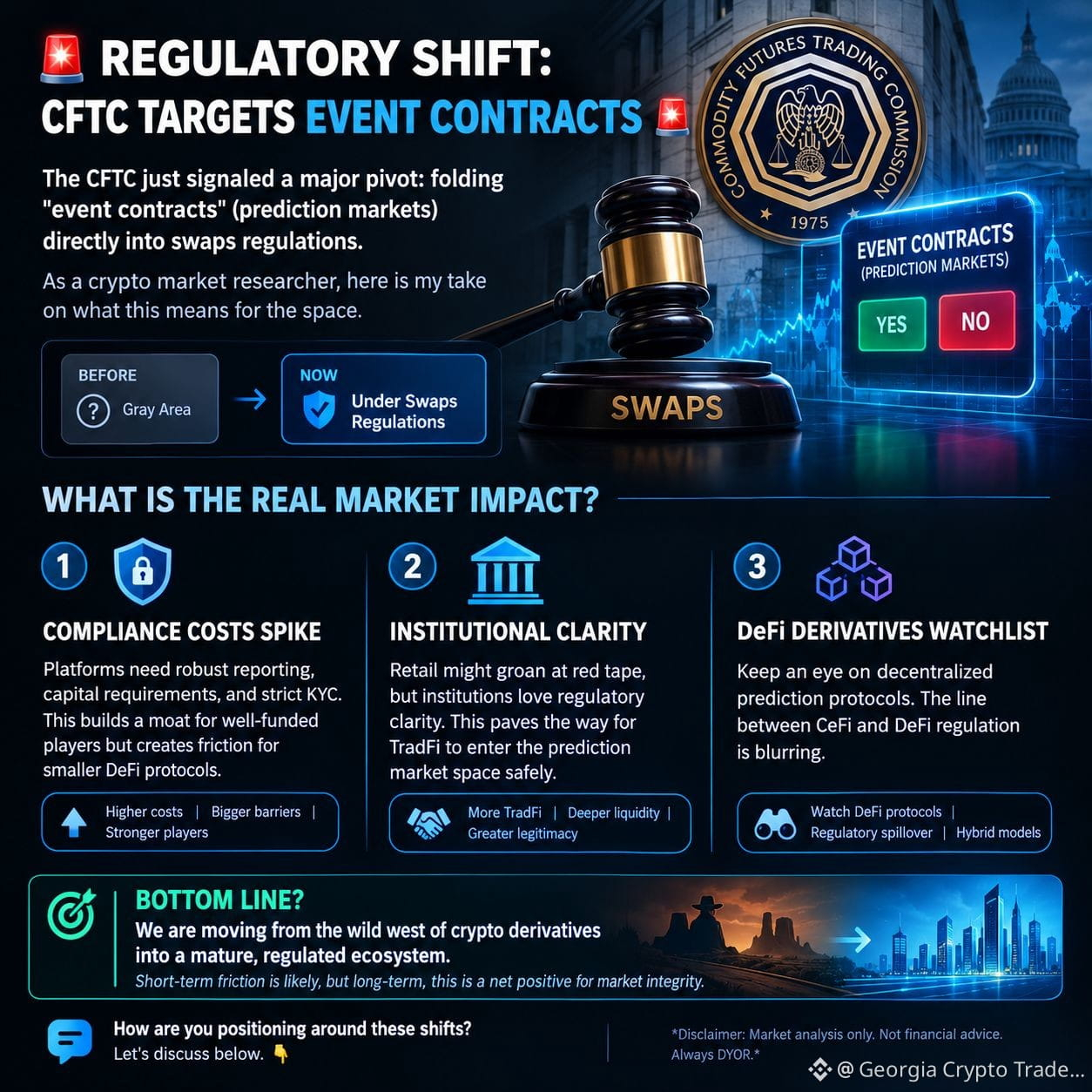
The CFTC just signaled a major pivot folding "event contracts" (prediction markets) directly into swaps regulations. As a crypto market researcher, here is my take on what this means for the space.
For years, prediction markets operated in a gray area. By classifying these as swaps the CFTC brings them under a much stricter compliance umbrella.
What is the real market impact?
1️⃣ Compliance Costs Spike: Platforms need robust reporting, capital requirements and strict KYC. This builds a moat for well funded players but creates friction for smaller DeFi protocols.
2️⃣ Institutional Clarity Retail might groan at red tape, but institutions love regulatory clarity. This paves the way for TradFi to enter the prediction market space safely.
3️⃣ DeFi Derivatives Watchlist Keep an eye on decentralized prediction protocols. The line between CeFi and DeFi regulation is blurring.
Bottom line? We are moving from the wild west of crypto derivatives into a mature regulated ecosystem. Short-term friction is likely, but long term this is a net positive for market integrity.
How are you positioning around these shifts? Let’s discuss below. 👇
Market analysis only. Not financial advice. Always DYOR.
$MUBARAK $BABY $ERA
{future}(ERAUSDT)
{future}(BABYUSDT)
{future}(MUBARAKUSDT)
#cftcmovestofoldeventcontractsintoswapsrules 🚨 Regulatory Shift: CFTC Targets Event Contracts 🚨
The CFTC just signaled a major pivot folding "event contracts" (prediction markets) directly into swaps regulations. As a crypto market researcher, here is my take on what this means for the space.
For years, prediction markets operated in a gray area. By classifying these as swaps the CFTC brings them under a much stricter compliance umbrella.
What is the real market impact?
1️⃣ Compliance Costs Spike: Platforms need robust reporting, capital requirements and strict KYC. This builds a moat for well funded players but creates friction for smaller DeFi protocols.
2️⃣ Institutional Clarity Retail might groan at red tape, but institutions love regulatory clarity. This paves the way for TradFi to enter the prediction market space safely.
3️⃣ DeFi Derivatives Watchlist Keep an eye on decentralized prediction protocols. The line between CeFi and DeFi regulation is blurring.
Bottom line? We are moving from the wild west of crypto derivatives into a mature regulated ecosystem. Short-term friction is likely, but long term this is a net positive for market integrity.
How are you positioning around these shifts? Let’s discuss below. 👇
Market analysis only. Not financial advice. Always DYOR.
$MUBARAK $BABY $ERA
2.2k

·
--
The Commodity Futures Trading Commission (CFTC) is reportedly looking into consolidating event contracts within its existing swaps regulations. This potential move could significantly alter the landscape for prediction markets and other forms of event-based trading.
This development is crucial for the crypto space, as many decentralized platforms operate on similar principles of betting on future outcomes. If the CFTC classifies these as swaps, it could lead to stricter oversight, increased compliance burdens, and potentially limit accessibility for retail traders. The market's reaction will likely hinge on the specifics of the proposed rules and how they are implemented. We'll be watching closely to see how this impacts platforms and the broader digital asset ecosystem.
This regulatory shift warrants careful consideration by all participants in the event contracts and derivatives markets.
#CFTCMovesToFoldEventContractsIntoSwapsRules

126

$BTC Closing in on $84,000 as the SEC and CFTC make crypto rules themselves instead of Congress.
The SEC just announced a five-year exemption for tokenized stocks, allowing qualifying exchanges to trade through blockchain liquidity pools while formal regulations are pending. At the same time, the CFTC is moving to bring prediction contracts under the regulatory framework for swaps.
The two agencies are acting because the Senate let the Clarity Act stall, with too few votes to pass it. Multiple sources confirm that the authority to write U.S. crypto rules has effectively shifted, for now, from Congress to these two agencies.
Crypto product builders see this as an opportunity: without strict laws, DeFi has room to work around the rules in ways centralized exchanges don't. Lawyers warn of the opposite: prolonged uncertainty is exactly what keeps large institutional investors hesitant.
Right as the news broke, BTC jumped from around $83,100 to nearly $84,000 in just one hour.
I'll be watching two things: what specific rules the SEC and CFTC issue next, and whether Congress still has a chance to save the Clarity Act before the February deadline.
Just my personal observations, not investment advice.
#CFTCMovesToFoldEventContractsIntoSwapsRules #TheoDõiFOMC #FedNews

290

·
--
U.S. prediction markets may finally be going “legit”—but only if they draw a clear line between themselves and games of pure chance.
Last Friday (October 9), the U.S. Commodity Futures Trading Commission (CFTC) dropped two rule documents at once, drawing two lines around prediction markets.
First: bring prediction markets under financial regulation. The proposed rule explicitly includes “event contracts” in the legal definition of swaps, covering contracts on sports, politics, culture, and weather—the categories with the highest trading volumes on Kalshi and Polymarket. CFTC Chair Michael Selig was unequivocal: these are commodity derivatives under the exclusive jurisdiction of the federal government, and states may not regulate them separately under state laws. The proposal is now open for public comment for 30 days before it can be finalized.
Second: exclude games of pure chance. A separate “interim final rule” takes effect immediately, explicitly excluding entertainment betting products based purely on chance from the definition of swaps—which means they do not fall under CFTC oversight. In effect, the agency is making its position clear to the courts and the public: the CFTC is focused on products with financial characteristics, not the entertainment industry.
Why act now? Over the past year, several states have sued platforms such as Kalshi, arguing that their business operates in a regulatory gray area. Federal appeals courts are sharply divided: one has sided with state governments, while two have backed federal regulation. Related cases have also reached the Supreme Court. The CFTC previously filed its own lawsuit to defend its jurisdiction; now it is putting its position in black and white through rulemaking. TD Cowen policy analysts believe the move is intended to strengthen the CFTC’s legal standing in court, but whether it works will depend on the rulings.
The impact has two sides. For operators, platforms like Kalshi and Polymarket may actually prefer uniform federal regulation—operating under one set of rules nationwide is better than dealing with local regulations state by state. But the rules are not final yet, and the court battles are ongoing, increasing uncertainty in the short term. For participants, if prediction markets are definitively classified as “derivatives,” requirements for market access, disclosures, and market surveillance will all become stricter. The era of unfettered growth may be over.
At its core, this jurisdictional battle between the federal government and the states comes down to one question: are you trading on a judgment about the future, or playing a game of chance?
#CFTCMovesToFoldEventContractsIntoSwapsRules
#CFTC #PredictionMarkets
This does not constitute investment advice. DYOR. Trading involves risk.
80

·
--
#CFTCMovesToFoldEventContractsIntoSwapsRules Prediction markets are becoming harder to ignore, and the latest CFTC move raises an important question: where does financial trading end and gambling regulation begin?
On October 9, the US Commodity Futures Trading Commission proposed explicitly including certain event contracts in the definition of swaps. The proposal covers contracts linked to sports, politics, cultural events, and weather.
One detail matters here: this is still a proposal, not a finalized rule. The CFTC is inviting public comments before moving forward.
For crypto, I think the bigger issue is regulatory clarity. Blockchain-based prediction markets can make it easier to access event-based trading, but using smart contracts or onchain settlement doesn't automatically remove legal obligations.
Clearer rules could help platforms understand their responsibilities and give users a better picture of the risks. On the other hand, compliance costs could create additional pressure for smaller operators.
There's also an ongoing jurisdictional question. The CFTC views these products as derivatives under federal commodities law, while disputes over the application of state gambling laws remain significant.
I'm curious how this proposal will shape the next phase of prediction markets. Can regulators protect users without unnecessarily limiting innovation?
$LUMIA $STRK $TIA
480

🚨 THE CFTC JUST MADE A MAJOR MOVE — PREDICTION MARKETS COULD SOON EXPLODE! 🔥
$BTC $ETH $SOL — TRADERS, KEEP YOUR EYES OPEN! 👀
The CFTC plans to bring event contracts under its existing regulatory framework for swaps.
And this could reshape the future of prediction markets!
💥 WHY THIS MATTERS:
🟢 Polymarket & Kalshi: Greater regulatory clarity could accelerate institutional adoption.
🟢 Crypto markets: Event-based trading could attract renewed interest and liquidity.
🟢 BTC & ETH: Broader adoption could support market sentiment, but the direct impact on prices remains uncertain.
⚠️ THE CATCH: Regulatory integration doesn’t mean unrestricted trading. Compliance costs and restrictions could increase.
🚀 IS WALL STREET ABOUT TO MAKE PREDICTION MARKETS ITS NEW MULTI-BILLION-DOLLAR TRADING PLAYGROUND?
BULLISH CATALYST OR REGULATORY TRAP? 👇
#cftcmovestofoldeventcontractsintoswapsrules #STRKRisesAbout20%In24Hours #TetherFreezesUSDTLinkedToLedgerTheft #LedgerPausesCryptoBilisSales #EvernorthCompletesSPACMergerWithArmadaII

2.1k
Log in to explore more content
Join global crypto users on Binance Square
⚡️ Get latest and useful information about crypto.
💬 Trusted by the world’s largest crypto exchange.
👍 Discover real insights from verified creators.
Email / Phone number
Trending Topics
1
#BTCReboundsAbove$60KAmidWhaleDipBuying
100,101 views
418 Discussing
2
#SolanaSets2027RoadmapToDoubleComputeCapacity
84,161 views
1,201 Discussing
3
#CaliforniaNvidiaProbeExaminesPotentialCriminalViolations
23,457 views
182 Discussing
4
#BlackRockLaunchesHKDollarDigitalLiquidityFund
71,875 views
876 Discussing
5
#NvidiaLoses$2.7TrillionInMonthAndAHalf
87,932 views
343 Discussing
6
#GlobalStocksFaceLongestLosingStreakSince2023
611,837 views
3,607 Discussing
7
#BlackRockIBITPostsRecord$541MSingleDayOutflow
104,483 views
188 Discussing
8
#AnthropicPlungesTowardIPOPriceonDay2
343,088 views
2,420 Discussing
9
#TwentyOneCapitalAdds172.25BTC
188,614 views
1,731 Discussing
10
#HKBillWouldExcludeTokenizedDepositsFromVirtualAssets
19,697 views
113 Discussing