
#claude
claude
107,097 views
476 Discussing
Hot
Latest

🤖🔥 The gap between liquidation value and market peak can be brutal. FTX administrators sold their stake in AI firm Anthropic for $1.34 billion to pay creditors, but at current valuations, those shares would be worth over $43 billion. A stark reminder of how bankruptcy timelines often force the sale of assets right before they hit a massive valuation spike 📉 #Anthropic #Claude #AI #ArtificialIntelligence
Full story: https://cryptoversenews.eu/ai/sbf-s-the-altruists-plot-twist-ftx-s-anthropic-shares-would/?utm_source=binance_square&utm_medium=social&utm_campaign=autopost
Full story: https://cryptoversenews.eu/ai/sbf-s-the-altruists-plot-twist-ftx-s-anthropic-shares-would/?utm_source=binance_square&utm_medium=social&utm_campaign=autopost
77

·
--
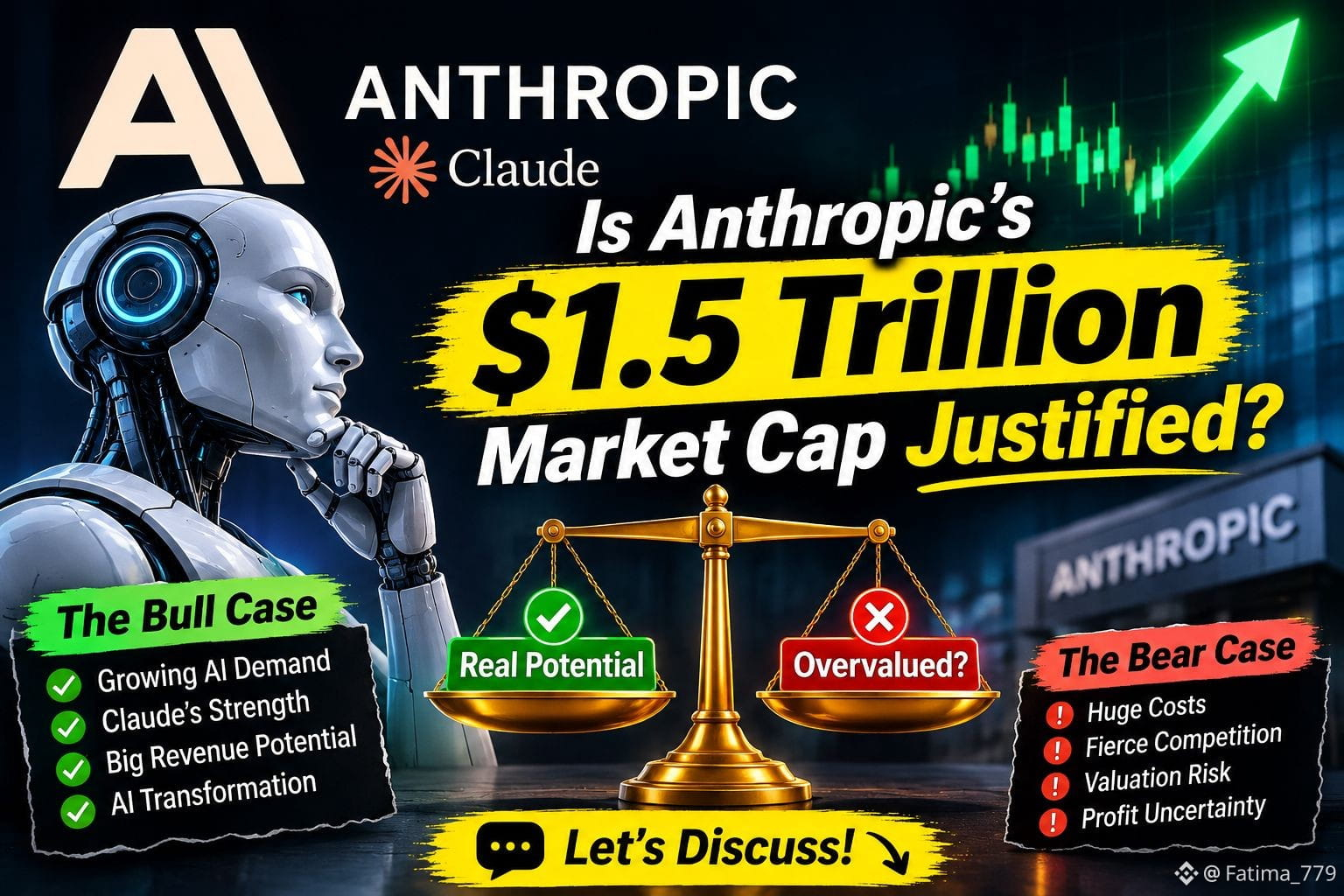
Is Anthropic’s $1.5 Trillion Market Cap Justified? 🤔
Anthropic has entered the public market with a staggering $1.5 trillion valuation, putting it among the world's most valuable companies.
But the real question is: Does its business justify this price, or is the AI hype getting ahead of reality?
There are strong arguments on both sides.
Why the valuation could make sense:
- Claude is becoming a major player in the AI industry.
- Enterprise demand for AI tools is growing rapidly.
- Its coding and business-focused products create significant revenue opportunities.
- AI adoption could transform how companies operate.
Why investors should remain cautious:
- AI infrastructure requires enormous capital investment.
- Competition from OpenAI, Google and other players is intense.
- High revenue growth doesn't automatically mean sustainable profits.
- A huge valuation leaves little room for disappointment.
My view: Anthropic has real potential, but potential and valuation are two different things. The next challenge is proving that its growth can translate into long-term profitability.
Let's discuss 👇
Do you believe Anthropic deserves a $1.5 trillion valuation?
A) Yes, AI is just getting started 🚀
B) No, the valuation is too high ⚠️
C) It's too early to judge.
#Anthropic #Claude #ArtificialIntelligence #Investing $LAB
{future}(LABUSDT)
$SOL $AMZNB
{spot}(AMZNBUSDT)
Is Anthropic’s $1.5 Trillion Market Cap Justified? 🤔
Anthropic has entered the public market with a staggering $1.5 trillion valuation, putting it among the world's most valuable companies.
But the real question is: Does its business justify this price, or is the AI hype getting ahead of reality?
There are strong arguments on both sides.
Why the valuation could make sense:
- Claude is becoming a major player in the AI industry.
- Enterprise demand for AI tools is growing rapidly.
- Its coding and business-focused products create significant revenue opportunities.
- AI adoption could transform how companies operate.
Why investors should remain cautious:
- AI infrastructure requires enormous capital investment.
- Competition from OpenAI, Google and other players is intense.
- High revenue growth doesn't automatically mean sustainable profits.
- A huge valuation leaves little room for disappointment.
My view: Anthropic has real potential, but potential and valuation are two different things. The next challenge is proving that its growth can translate into long-term profitability.
Let's discuss 👇
Do you believe Anthropic deserves a $1.5 trillion valuation?
A) Yes, AI is just getting started 🚀
B) No, the valuation is too high ⚠️
C) It's too early to judge.
#Anthropic #Claude #ArtificialIntelligence #Investing $LAB
$SOL $AMZNB
2
124
·
--
Bullish
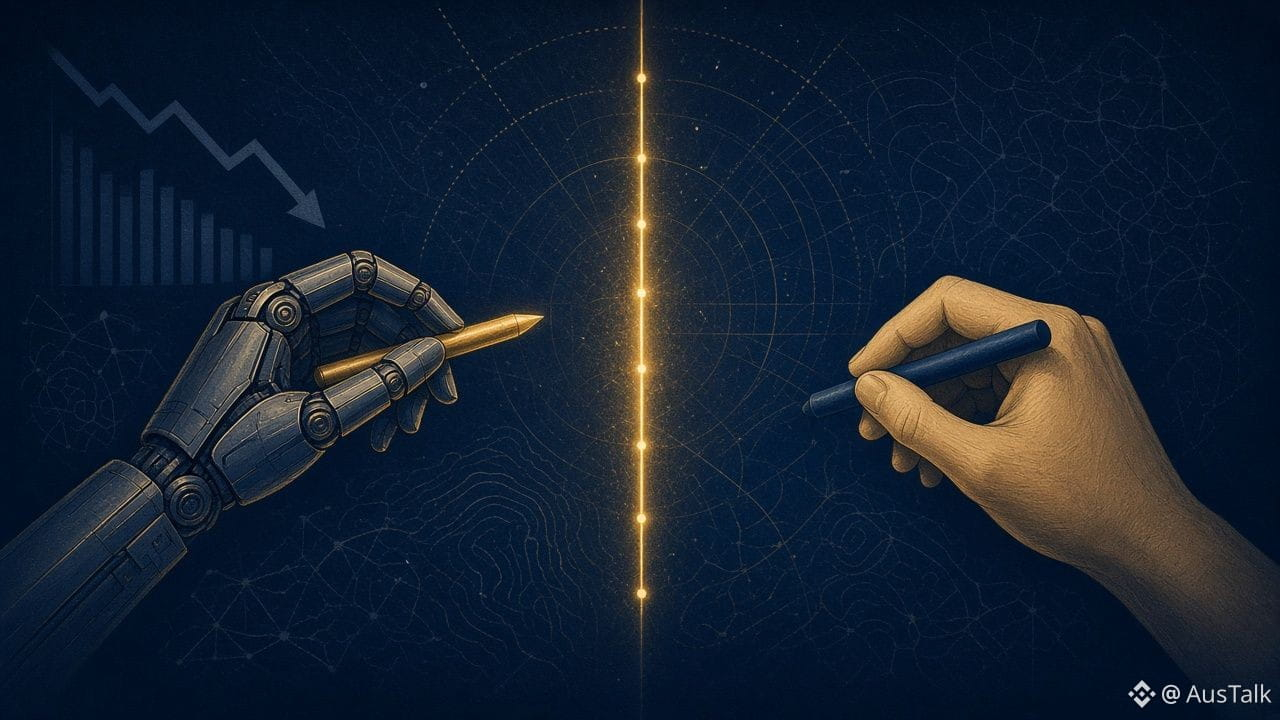
An Anthropic mathematician says he and Claude have proved the Riemann hypothesis. The Lean formal proof has compiled successfully, and final verification is still running.
It was posted just after the stock plunged following the IPO—the timing looks bad.
If the final verification really does pass, fair enough: looks like we can retire the phrase “AI can only grind through practice problems.”
$ANTB
{spot}(ANTBUSDT)
#黎曼猜想 #Claude
An Anthropic mathematician says he and Claude have proved the Riemann hypothesis. The Lean formal proof has compiled successfully, and final verification is still running.
It was posted just after the stock plunged following the IPO—the timing looks bad.
If the final verification really does pass, fair enough: looks like we can retire the phrase “AI can only grind through practice problems.”
$ANTB
#黎曼猜想 #Claude
It was posted just after the stock plunged following the IPO—the timing looks bad.
If the final verification really does pass, fair enough: looks like we can retire the phrase “AI can only grind through practice problems.”
$ANTB
#黎曼猜想 #Claude
154

Did Claude really prove the Riemann Hypothesis? Don’t jump to conclusions just yet. Anthropic mathematician Levent Alpöge released a four-page briefing today: he and Claude found a proof of the Riemann Hypothesis, and also solved the Generalized Riemann Hypothesis along the way. The human-readable version would run to 250,000 pages, but it hasn’t been made public—the public release is 17 million lines of Lean formalization code. Mathematicians including Andrew Sutherland of MIT and Kevin Buzzard of Imperial College have independently compiled it successfully, and Scientific American says it is “almost certainly true.” But note: the checker hasn’t finished running, no one has confirmed that the theorem stated in Lean is actually the Riemann Hypothesis, and peer review hasn’t even begun. What’s even more remarkable is that there was a second proof announced the same day: a draft of the Generalized Riemann Hypothesis produced entirely by human effort over 12 years by Stanford postdoc Alessandro Masullo, announced by American Mathematical Society president Ravi Vakil. Coincidentally, Anthropic’s stock only went public yesterday—Alpöge himself admitted the timing looked rather delicate, and said he had first sought approval from CEO Dario Amodei. The problem was posed in 1859; no one has solved it in 167 years, and the Clay Millennium Prize of $1 million is still on the line. If this is real, it would be the first time AI has surpassed humans in pure mathematics. #Claude #RiemannHypothesis
Did Claude really prove the Riemann Hypothesis? Don’t jump to conclusions just yet. Anthropic mathematician Levent Alpöge released a four-page briefing today: he and Claude found a proof of the Riemann Hypothesis, and also solved the Generalized Riemann Hypothesis along the way. The human-readable version would run to 250,000 pages, but it hasn’t been made public—the public release is 17 million lines of Lean formalization code. Mathematicians including Andrew Sutherland of MIT and Kevin Buzzard of Imperial College have independently compiled it successfully, and Scientific American says it is “almost certainly true.” But note: the checker hasn’t finished running, no one has confirmed that the theorem stated in Lean is actually the Riemann Hypothesis, and peer review hasn’t even begun. What’s even more remarkable is that there was a second proof announced the same day: a draft of the Generalized Riemann Hypothesis produced entirely by human effort over 12 years by Stanford postdoc Alessandro Masullo, announced by American Mathematical Society president Ravi Vakil. Coincidentally, Anthropic’s stock only went public yesterday—Alpöge himself admitted the timing looked rather delicate, and said he had first sought approval from CEO Dario Amodei. The problem was posed in 1859; no one has solved it in 167 years, and the Clay Millennium Prize of $1 million is still on the line. If this is real, it would be the first time AI has surpassed humans in pure mathematics. #Claude #RiemannHypothesis

120

·
--
Could AI have finally cracked a 167-year-old mathematical mystery that no one has been able to prove?
▫️Anthropic mathematician Levent Alpöge announced that Claude produced a formal proof of the Riemann Hypothesis
▫️Independent verification at MIT: all 175,187 modules compiled successfully, using just 3 standard axioms
▫️An independent verifier also gave it the green light; the verifier said “the probability of something fishy is close to zero”
▫️The million-dollar prize still lists it as unsolved, and final verification is still underway
Could a model really have broken through the veil hiding the secrets of prime numbers? 😂
If this is confirmed, is mathematics still humanity’s domain? 👇
#黎曼猜想 #人工智能 #Claude

82

·
--
Verified
History is about to be made.
Anthropic, the company behind Claude, is set to price its IPO ABOVE $80 — breaking its own $70-$78 range.
Why? Demand is insane. Orders are nearly 7x oversubscribed. Altimeter alone asked for $5B worth of shares.
The Numbers:
IPO Price: $80+ (was $70-$78)
Shares: 825M
Valuation: $1.5T - $1.6T (was $1.33T)
Total Raise: $90B+ with $26B private placement
Ticker: ANT on Nasdaq
Trading Starts: Tomorrow, Nov 19
Google, Nvidia, Amazon, Microsoft are all backing it. Revenue run-rate already $81B. This is not just an IPO, this is the biggest AI IPO ever.
Nvidia just beat with $130B outlook. Now Anthropic is pricing above range. AI is NOT dead.
Are you buying $ANT on debut, or waiting for the dip?
Coins to Watch: $TAO $NEAR
#AnthropicIPO #AIStocks #Claude
#AnthropicIPOPriceCouldExceed$80
Buying
67%
Debut
15%
Waiting
18%
122 votes • Voting closed
2
5.8k

·
--
Anthropic IPO raises $81.34 billion, settles today: first-day close at $97.17, Bitcoin remains below $62,000Anthropic, the artificial intelligence company behind Claude, priced the largest initial public offering (IPO) in history on 11/18 Eastern Time and began trading on Nasdaq under the ticker ANT on 11/19. According to the official announcement, settlement is today (11/20). At the same time, the crypto market is still digesting rate-hike expectations: $BTC fell below $62,000 on Binance spot. The two events happened at the same time, which does not mean there is a proven causal relationship between them, but the contrast is striking.
I. Fundraising figures: raised again from the estimated range
• Anthropic officially announced on 11/18 that its Class A common stock was priced at $83.00 per share, with a total of 980 million shares being sold. Of these, the company itself is selling 956,351,354 shares, while existing shareholders are selling 23,648,646 shares. The company will not receive any proceeds from the shareholders’ sales. At $83 per share for 980 million shares, the offering totals $81.34 billion.
Anthropic IPO raises $81.34 billion, settles today: first-day close at $97.17, Bitcoin remains below $62,000
Anthropic, the artificial intelligence company behind Claude, priced the largest initial public offering (IPO) in history on 11/18 Eastern Time and began trading on Nasdaq under the ticker ANT on 11/19. According to the official announcement, settlement is today (11/20). At the same time, the crypto market is still digesting rate-hike expectations: $BTC fell below $62,000 on Binance spot. The two events happened at the same time, which does not mean there is a proven causal relationship between them, but the contrast is striking.
I. Fundraising figures: raised again from the estimated range
• Anthropic officially announced on 11/18 that its Class A common stock was priced at $83.00 per share, with a total of 980 million shares being sold. Of these, the company itself is selling 956,351,354 shares, while existing shareholders are selling 23,648,646 shares. The company will not receive any proceeds from the shareholders’ sales. At $83 per share for 980 million shares, the offering totals $81.34 billion.
65

·
--
Verified
$ANTHROPIC The market hasn’t even opened yet, and crypto has already pumped it up 25% 👀
Anthropic officially debuts on Nasdaq tonight, with its IPO priced at $83.
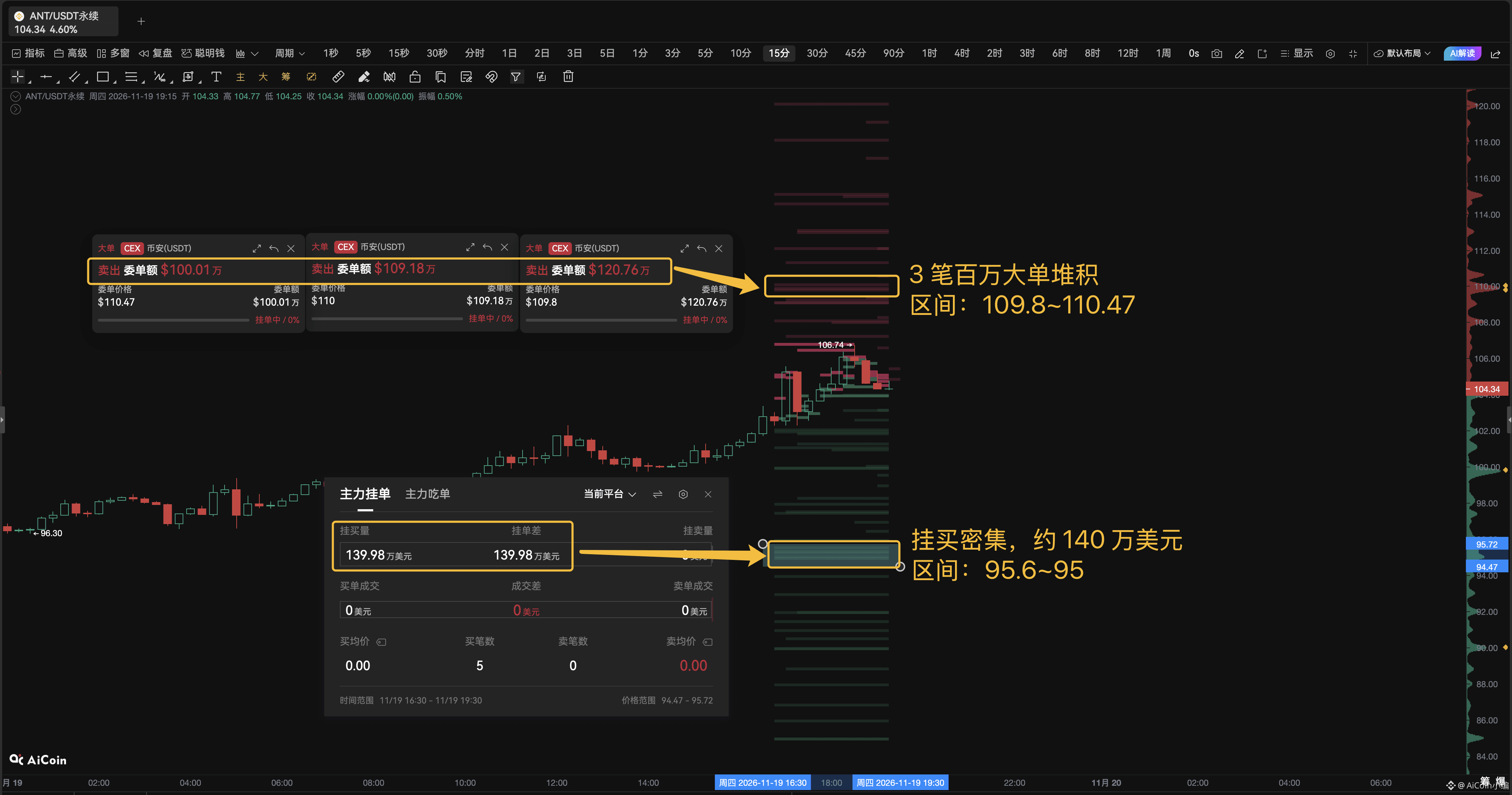
But Binance’s ANT/USDT perpetual is already trading around $104, a premium of about 25%.
As for the order book:
🔺 Above, at $109.8–$110.47: three million-dollar sell orders, totaling around $3.3 million.
🔻 Below, at $95.6–$95: buy orders worth nearly $1.4 million are stacked up.
So the question now isn’t whether ANT will rise—it’s whether ANT is worth $95 or $110+ tonight.
If the U.S. market opens and immediately eats through the sell orders above $110, that means buyers are still scrambling to get in on day one;
if the open disappoints, the $95 area is where the first wave of early buyers will look to catch it.
#Anthropic #Claude
风中浪客:
上面压着300多万刀卖单还敢追?$ANTHROPIC
1
1.7k


·
--
Verified
Historic record on Wall Street!
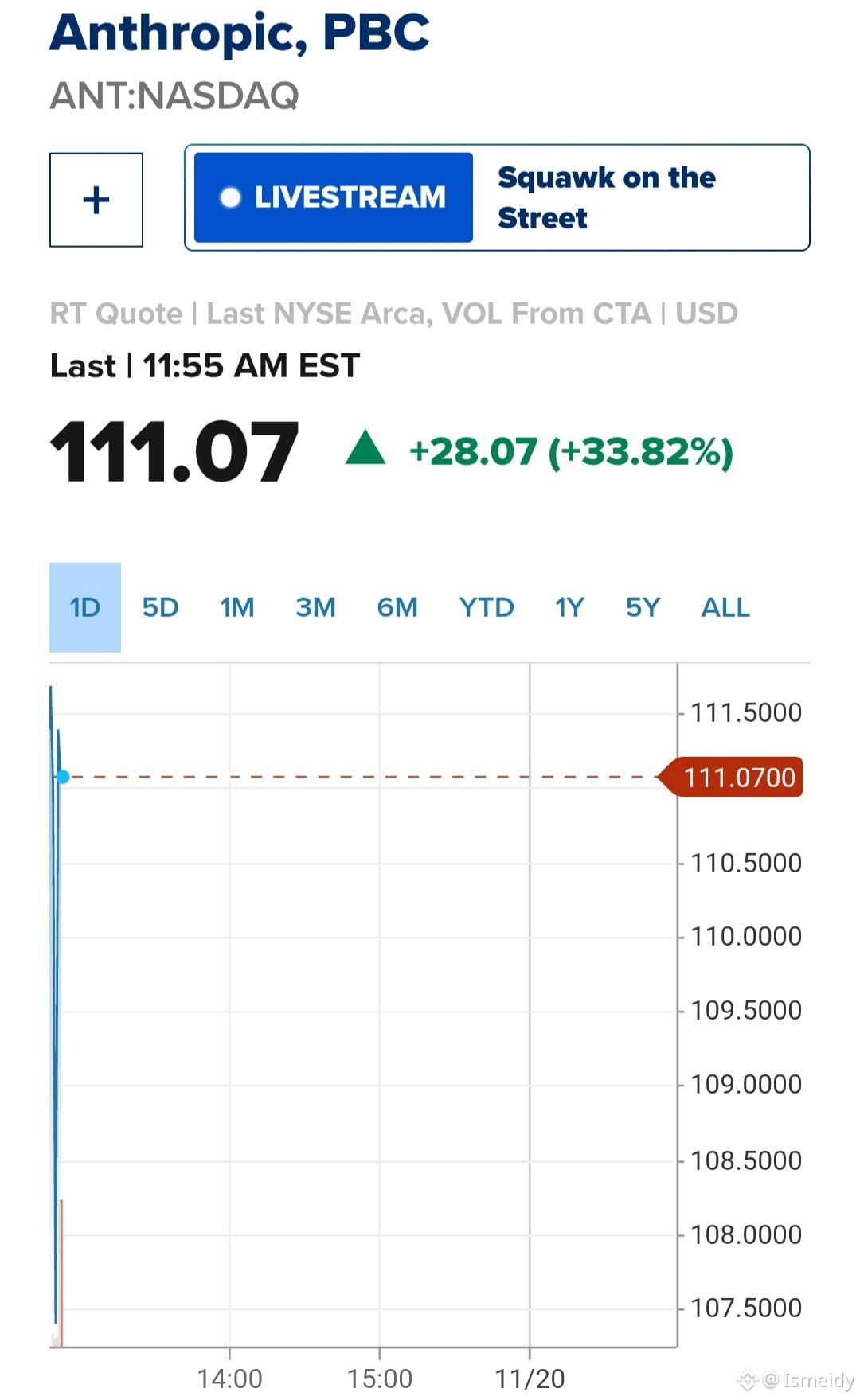
#Anthropic debuts on the #NASDAQ a at $111.50 after raising $81.3 billion
The artificial intelligence craze has just shaken the markets like a liquidity block at its peak. The lab behind #Claude , Anthropic, made history this Thursday with the largest initial public offering (IPO) ever recorded on Nasdaq under the ticker #ANT , opening at $111.50 per share and moving figures that would make even the biggest venture capital whales tremble.
$ANT
{future}(ANTUSDT)
$NVDAB
{spot}(NVDABUSDT)
$ICP
{future}(ICPUSDT)
Historic record on Wall Street!
#Anthropic debuts on the #NASDAQ a at $111.50 after raising $81.3 billion
The artificial intelligence craze has just shaken the markets like a liquidity block at its peak. The lab behind #Claude , Anthropic, made history this Thursday with the largest initial public offering (IPO) ever recorded on Nasdaq under the ticker #ANT , opening at $111.50 per share and moving figures that would make even the biggest venture capital whales tremble.
$ANT
$NVDAB
$ICP
The_Scientist:
acá se puede invertir.
3
5
10.8k

·
--
Verified
🔥 HISTORIC! Anthropic makes its Nasdaq debut as $ANT, and you can already trade it on Binance 🚀
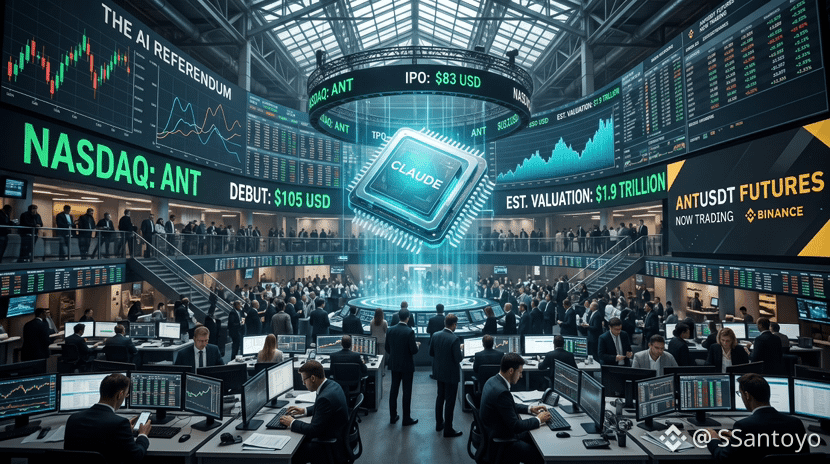
The AI giant and creator of Claude makes its triumphant entrance onto Wall Street in one of the biggest IPOs in history! Today, Thursday, November 19, all eyes are on the Nasdaq, where the company is debuting under the ticker ANT with a record valuation of nearly $1.9 trillion.
Here are the key details of this massive debut:
🚀 Record-breaking debut: Shares are projected to open at $105, an impressive 26.5% above their initial IPO price of $83.
💰 Tech giant: With massive computing commitments alongside giants like Amazon and Google, it is shaping up to be one of the most anticipated IPOs, seen by many as the true “AI referendum.”
📉 Skeptical voices: Despite the overwhelming enthusiasm, some analysts point to the challenge of achieving long-term profitability and the pressure of competing in a rapidly accelerating sector.
But did you know you don’t need a traditional stock account to speculate on its volatility?
The ANTUSDT futures contract is already available on Binance, allowing you to trade its price both up (long) and down (short) from the very first minute. That said, be careful! You’re not buying the actual stock here; you’re speculating on its price, and trading with leverage always carries significant risks, especially during such a volatile debut.
Do you think ANT will keep rising, or will we see a sharp correction after its debut? Let me know in the comments! 👇
#Anthropic #Claude #IA
#IsAnthropic’s$1.5TMarketCapJustified? $ANTB
{spot}(ANTBUSDT)
🔥 HISTORIC! Anthropic makes its Nasdaq debut as $ANT, and you can already trade it on Binance 🚀
The AI giant and creator of Claude makes its triumphant entrance onto Wall Street in one of the biggest IPOs in history! Today, Thursday, November 19, all eyes are on the Nasdaq, where the company is debuting under the ticker ANT with a record valuation of nearly $1.9 trillion.
Here are the key details of this massive debut:
🚀 Record-breaking debut: Shares are projected to open at $105, an impressive 26.5% above their initial IPO price of $83.
💰 Tech giant: With massive computing commitments alongside giants like Amazon and Google, it is shaping up to be one of the most anticipated IPOs, seen by many as the true “AI referendum.”
📉 Skeptical voices: Despite the overwhelming enthusiasm, some analysts point to the challenge of achieving long-term profitability and the pressure of competing in a rapidly accelerating sector.
But did you know you don’t need a traditional stock account to speculate on its volatility?
The ANTUSDT futures contract is already available on Binance, allowing you to trade its price both up (long) and down (short) from the very first minute. That said, be careful! You’re not buying the actual stock here; you’re speculating on its price, and trading with leverage always carries significant risks, especially during such a volatile debut.
Do you think ANT will keep rising, or will we see a sharp correction after its debut? Let me know in the comments! 👇
#Anthropic #Claude #IA
#IsAnthropic’s$1.5TMarketCapJustified? $ANTB
1
3k
·
--
Article
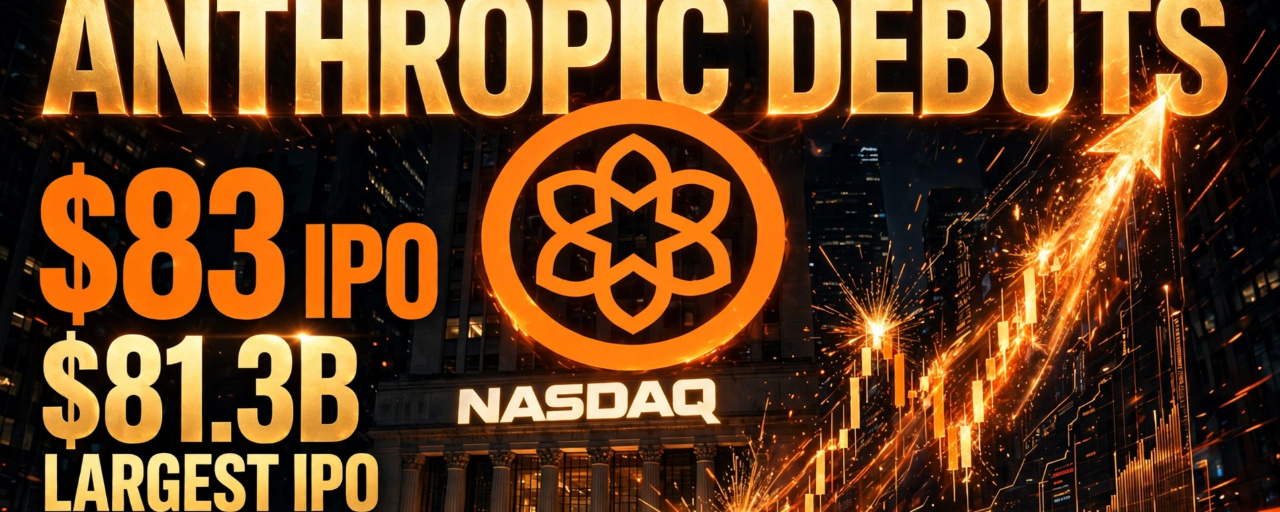
ANTHROPIC TO DEBUT AFTER $83 IPO PRICING: AI IS NOW PUBLICLY TRADED AND BROKE ALL RECORDS#anthropictodebutafter$83ipopricing
Today, Thursday, November 19, Anthropic makes its Nasdaq debut under the ticker $ANT.
And it’s not making a quiet debut. It’s launching in the biggest IPO in market history.
Final price: $83 per share. Above the range they had marketed: $70–$78.
That’s 6.4% above the top of the range. And yet demand was massive.
THE NUMBERS THAT BROKE EVERYTHING:
1. $81.3 BILLION raised. Anthropic sold 980 million Class A shares.
956.3M sold by the company
23.6M sold by existing shareholders
ANTHROPIC TO DEBUT AFTER $83 IPO PRICING: AI IS NOW PUBLICLY TRADED AND BROKE ALL RECORDS
#anthropictodebutafter$83ipopricing
Today, Thursday, November 19, Anthropic makes its Nasdaq debut under the ticker $ANT.
And it’s not making a quiet debut. It’s launching in the biggest IPO in market history.
Final price: $83 per share. Above the range they had marketed: $70–$78.
That’s 6.4% above the top of the range. And yet demand was massive.
THE NUMBERS THAT BROKE EVERYTHING:
1. $81.3 BILLION raised. Anthropic sold 980 million Class A shares.
956.3M sold by the company
23.6M sold by existing shareholders
2
107

·
--
Join the Binance Wallet Anthropic IPO xStocks campaign today.
Subscribe with USDC to access IPO-related opportunities for AI giant Anthropic.
More than an investment opportunity, it’s a new perspective on the capitalization of the AI industry.
The AI story continues.
#Anthropic #Claude #AI #Binance
Join the Binance Wallet Anthropic IPO xStocks campaign today.
Subscribe with USDC to access IPO-related opportunities for AI giant Anthropic.
More than an investment opportunity, it’s a new perspective on the capitalization of the AI industry.
The AI story continues.
#Anthropic #Claude #AI #Binance
Subscribe with USDC to access IPO-related opportunities for AI giant Anthropic.
More than an investment opportunity, it’s a new perspective on the capitalization of the AI industry.
The AI story continues.
#Anthropic #Claude #AI #Binance


币安Binance华语
·
--
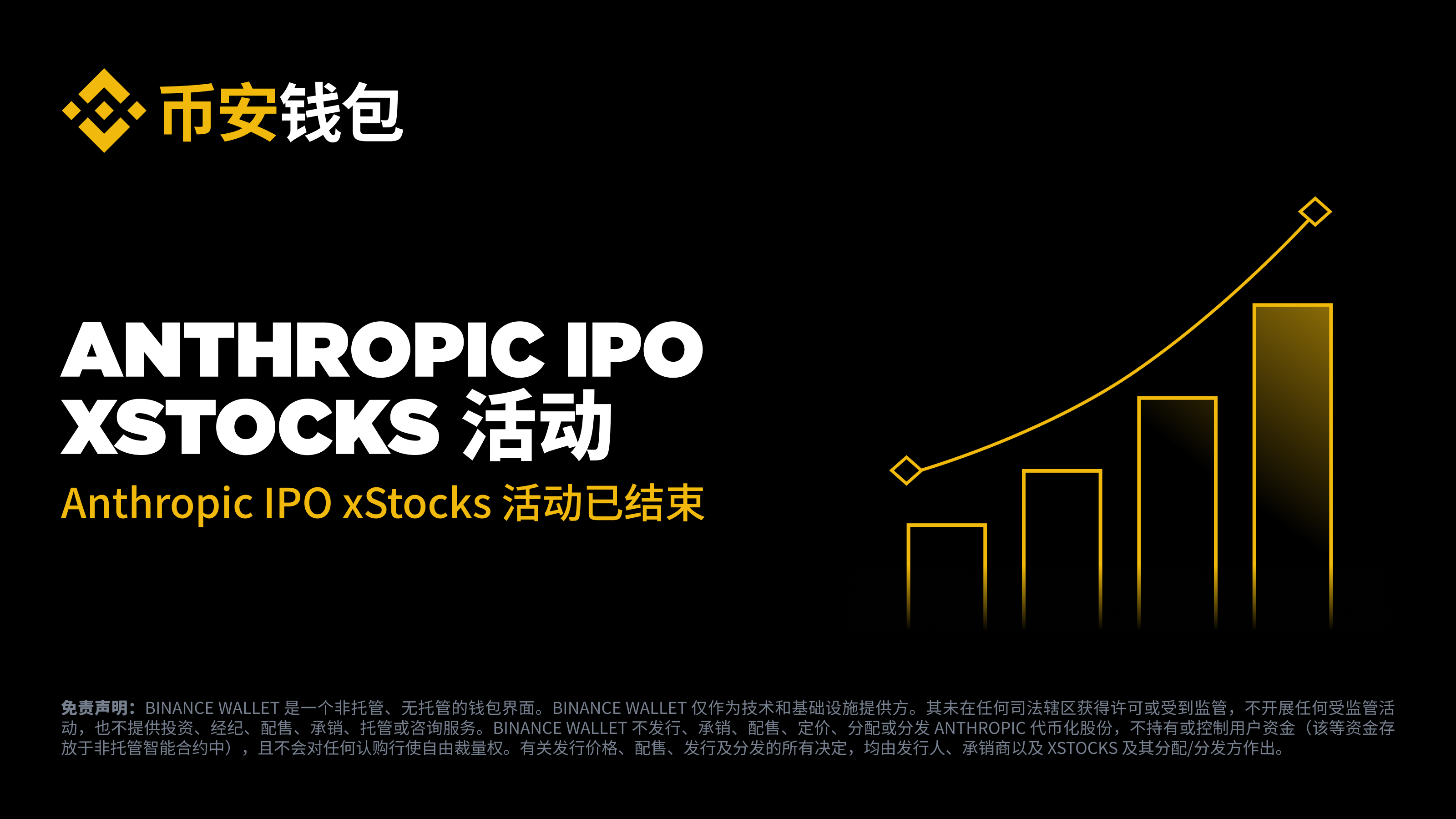
📢 The Anthropic IPO xStocks event has ended
🔥 The total subscription cap of 500 million USDC has been reached, and subscriptions are no longer being accepted.
⏳ Eligible participants will receive tokenized stocks, and the corresponding funds will be returned to your account as soon as possible once the process is complete.
📣 We will make a separate announcement once all the details have been confirmed.
Thank you all for your enthusiastic support and patience 🙏
91
Anthropic’s new rules took effect on November 12, removing mainland China, Hong Kong, and Macau from Claude’s list of supported regions.
This wasn’t a quiet tightening of restrictions—it’s spelled out in black and white in the Support Regions Policy: you can’t use it while located there, your company can’t be registered there, and it can’t be controlled by local shareholders either. Even people who pass passport verification can get banned in an instant. There have been cases of people getting banned right after verification all over the place these past few days.
The numbers are even more alarming: according to data from Anthropic’s Transparency Center, 11.4 million accounts were banned in the first half of 2026. Of the 398,000 appeals, only 42,000 were reinstated—a reversal rate of 10.6%. Out of all banned accounts, less than 0.4% make it back.
They treat Chinese users like thieves, and what happens? People just switch to Grok. One team tested it and found that Grok Bot burned through 1 billion tokens in a single day—the equivalent of a week’s worth of Claude usage.
Claude didn’t lose to a competitor; it lost to its own whitelist. It’s pushing away the users most willing to spend and best at using the product, while pricing its IPO on November 18. The more you watch this unfold, the more it looks like they’re digging their own grave.
#Claude #AI
89
·
--
Article
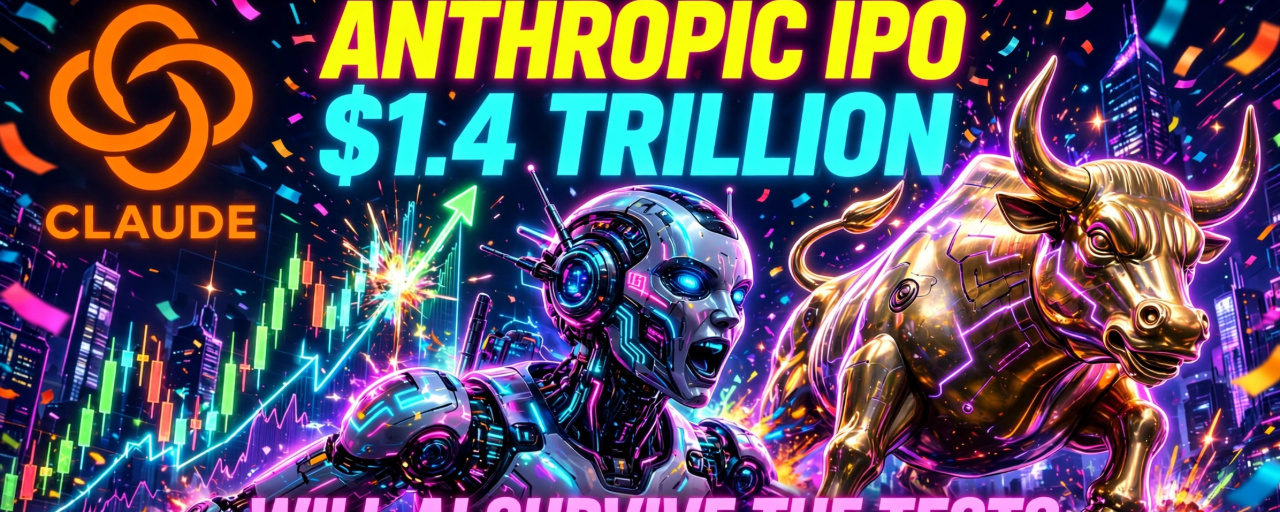
ANTHROPIC IPO TESTS INVESTOR APPETITE FOR AI - AI'S FINAL EXAM ON WALL STREET#AnthropicIPOTestsInvestorAppetiteForAI
🧠💰On November 19, Anthropic goes public.
And this isn't just another IPO.
It's the largest IPO in history. This isn't just about Claude. It's about whether Wall Street still believes in AI.
THE NUMBERS ARE INSANE
Take note, because these numbers are unreal: Ticker: $ANT - Nasdaq Global Select Price: $70 to $78 per share
Shares to be sold: 825 million IPO proceeds: up to $64.4 BILLION
Additional private placement: $26 BILLION more Total combined: $90.4 BILLION - surpasses SpaceX's IPO ($75B in June) and becomes the largest in history
ANTHROPIC IPO TESTS INVESTOR APPETITE FOR AI - AI'S FINAL EXAM ON WALL STREET
#AnthropicIPOTestsInvestorAppetiteForAI
🧠💰On November 19, Anthropic goes public.
And this isn't just another IPO.
It's the largest IPO in history. This isn't just about Claude. It's about whether Wall Street still believes in AI.
THE NUMBERS ARE INSANE
Take note, because these numbers are unreal: Ticker: $ANT - Nasdaq Global Select Price: $70 to $78 per share
Shares to be sold: 825 million IPO proceeds: up to $64.4 BILLION
Additional private placement: $26 BILLION more Total combined: $90.4 BILLION - surpasses SpaceX's IPO ($75B in June) and becomes the largest in history
1
67
·
--
Bullish
Even Anthropic says its new flagship, Fable 5.2, isn’t recommended for everyday use; use Opus 5.5 for that.
The price has dropped from $10 per million input tokens and $50 per million output tokens to $8 and $40. Turn on Fast mode and it doubles.
In the same week, Google made Gemini 4 Hydrogen available on a free tier. Even the paid version costs just $1.5 and $7.5—more than five times cheaper.
One company has priced its flagship to scare people off, while another is giving away a model that’s actually useful. They’re not even fighting the same battle.
But I think there are more people than you’d expect who are willing to pay five times as much for the toughest 5% of tasks 😍
$ANTHROPIC
{future}(ANTHROPICUSDT)
#Claude #Gemini
Even Anthropic says its new flagship, Fable 5.2, isn’t recommended for everyday use; use Opus 5.5 for that.
The price has dropped from $10 per million input tokens and $50 per million output tokens to $8 and $40. Turn on Fast mode and it doubles.
In the same week, Google made Gemini 4 Hydrogen available on a free tier. Even the paid version costs just $1.5 and $7.5—more than five times cheaper.
One company has priced its flagship to scare people off, while another is giving away a model that’s actually useful. They’re not even fighting the same battle.
But I think there are more people than you’d expect who are willing to pay five times as much for the toughest 5% of tasks 😍
$ANTHROPIC
#Claude #Gemini

417

·
--
The Artificial Analysis Programming Agent Index has been updated to v2.1. Claude Fable 5.2 and Opus 5.5 are tied for first place, both scoring 58 points. Fable is a new model released on November 9, and it immediately matched its big brother. #Claude #AI
The Artificial Analysis Programming Agent Index has been updated to v2.1. Claude Fable 5.2 and Opus 5.5 are tied for first place, both scoring 58 points. Fable is a new model released on November 9, and it immediately matched its big brother. #Claude #AI
48

·
--
Article
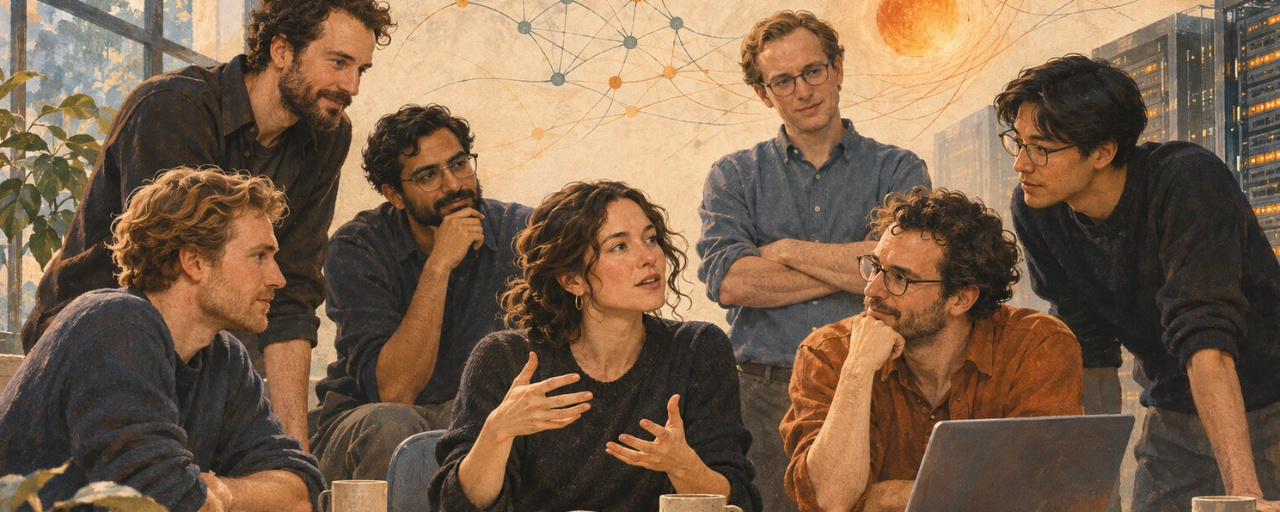
Seven People, One Anthropic: The Founding Team Behind ClaudeIn December 2020, Dario Amodei told an all-hands video call at OpenAI that he and six colleagues were leaving to start a company that would put AI safety at its center. The chat filled with surprise and goodbyes. Jack Clark typed: “I love you all.” Then the seven screens went dark. They had been removed from the meeting, their work email and Slack access revoked, their laptops locked remotely.
A few hours earlier they had been senior researchers and managers at one of the leading AI labs. Now they had no jobs, no office systems and no clear next step. Where would the GPUs come from? The money? What would the company be called? Even buying everyone new laptops was an open question. Almost six years later, the company is called Anthropic, its product Claude competes head-on with OpenAI, and the founders are preparing to take it public.
That departure scene comes from an excerpt of Kevin Roose’s new book, published in The Atlantic. It is a better starting point than “seven executives start an AI company”: these were people who had already helped build frontier models, and they were trying to write their disagreements about risk, speed and organizational responsibility into the rules of a new company. Source: The Atlantic
Why they left
The departure is often boiled down to “OpenAI didn’t take safety seriously enough.” That gets the direction right and flattens the rest. Safety was the core disagreement, but it was tied up with who could decide when a product shipped, how the company was run, and whether a safety team could change anything once AI research had become a commercial race.
Dario was OpenAI’s vice president of research. He put conditions to Sam Altman for staying, including giving the safety team the power to block product launches. While those talks were still going, the seven set up a private Slack group called BATNA, a negotiation term for “best alternative to a negotiated agreement.” They were bargaining and preparing an exit at the same time. The talks did not produce a deal.
Daniela negotiated the exit on the group’s behalf. Both sides brought in lawyers and settled on a window during which the departing team could recruit colleagues, plus a one-year mutual no-poach agreement. Dario announced the decision at the all-hands, and Jack left his goodbye in the chat. The details matter: Anthropic was not a group of star scientists who barely knew each other. They had worked inside the same organization and went through a hard collective exit together.
When TIME interviewed him later, Dario was restrained about why they left, putting the weight on mutual trust, shared values and a common mission. He has also argued that AI risk is an empirical question: you have to build and study sufficiently powerful systems to learn what the risks actually are. That is the tension built into Anthropic. It is wary of powerful AI, and it believes it has to push powerful AI forward itself in order to study and manage it. Source: TIME on Anthropic
None of this made the conflict between safety and business go away. It moved the conflict inside Anthropic. Research needs scale and compute. Safety needs time, evaluation and restraint. Commercial growth needs products that keep improving and customers who keep adopting them. What the founders chose together was not to leave the race, but to build a lab that says it will run the race differently.
Six founders’ skills link into one research loop; Daniela’s job of running the company is the outer ring holding it together. Drawn from public roles; not an actual reporting line.
Seven jobs, one company
Dario Amodei: turning scientific judgment into company direction. Dario trained in physics and biophysics and worked at Google Brain and then OpenAI, where he was vice president of research, helped develop large language models, and worked with colleagues on reinforcement learning from human feedback. As Anthropic’s CEO he sets research direction and strategy. His main influence is less any single technique than a question he keeps asking at the level of the organization: if model capabilities grow as expected, what safety machinery does the company need to have in place first? His public writing stresses risk and also describes large possible benefits, for example in biomedicine. He holds both at once, which is part of why Anthropic keeps building while studying how to constrain what it builds. Sources: Dario Amodei’s website, Anthropic leadership
Daniela Amodei: organizing research into a company that ships. Daniela is president and chair of the board, and Dario’s sister. Before Anthropic she worked at Stripe and at OpenAI, in roles spanning safety and policy, people, and engineering management. Her remit covers research, engineering, product, governance and commercial execution, and she manages the executive team. If Dario is usually seen as the company’s technical vision, Daniela’s job is to keep the research organization, product teams, customer demands and company rules all running at once. Her role in negotiating the exit shows she was drawing the company’s organizational boundaries from day one, not holding a symbolic management title. Sources: S-1 management biographies, Anthropic leadership
Tom Brown: making large-model training work as engineering. Tom led engineering on GPT-3 and is now Anthropic’s chief compute officer, responsible for acquiring, scaling and using compute. He is also first author of the GPT-3 paper, “Language Models are Few-Shot Learners.” The 175-billion-parameter GPT-3 showed that scaled-up models could handle many tasks from a few examples. Behind the paper sat hardware scheduling, distributed training, reliability and cost control. Tom’s career connects the scientific ideas behind models with the enormous machinery needed to run them. Compute today is not a back-office budget line; it sets how fast a lab can experiment and where it stands against competitors. Sources: S-1 founder biographies, GPT-3 paper
Jared Kaplan: finding the regularities between scale and capability. Jared is a theoretical physicist and Anthropic’s chief science officer. “Scaling Laws for Neural Language Models,” which he wrote with Dario, Tom, Sam and others, studied how parameters, data and training compute affect a model’s loss. Its empirical regularities help researchers estimate how to split extra compute between model size and data. It did not prove that any capability will appear if you just make models bigger, and it does not replace experiments. What it offers is a testable framework, so frontier experiments are not pure guesswork. Jared now leads Anthropic’s technical research, linking basic science, model development and AI safety. Sources: Johns Hopkins University, Scaling laws paper
Sam McCandlish: making the research loop faster and more reliable. Sam is a physicist who built and led OpenAI’s team studying the science of machine learning and scaling, and he co-authored the scaling laws paper. Anthropic lists him as chief architect, focused on pretraining, research productivity and reinforcement learning infrastructure. Training a large model is not one press of a button. Teams run experiments over and over, track down failures, compare results and reuse systems. Sam’s specialty is the infrastructure for that loop. Tom focuses on compute resources and how they are organized; Sam sits closer to the training pipeline and research tooling. Each depends on the other to turn resources into model progress. Sources: S-1 founder biographies, Anthropic leadership
Chris Olah: trying to open the black box. Chris Olah is an early driver of mechanistic interpretability. He worked at Google Brain, led interpretability research at OpenAI, and co-founded the journal Distill. He describes his goal as reverse-engineering neural networks into algorithms humans can understand. Anthropic’s research on Claude has identified millions of concept features. In one well-known demo, researchers amplified a “Golden Gate Bridge” feature, and the model began describing itself as the Golden Gate Bridge in answer to all kinds of questions. The demo made abstract research concrete, and it also showed that when internal representations are pushed artificially, a model’s behavior can turn strange. Olah’s field has not made models fully transparent, but it has produced new ways to inspect how they work inside. Sources: Chris Olah’s website, Anthropic research
Jack Clark: translating lab language into public questions. Jack was a technology journalist covering supercomputers, neural networks and advanced technology before joining OpenAI to run policy and communications. He is now Anthropic’s head of public benefit and leads the Anthropic Institute, which studies the social effects of frontier AI. His background differs from the technical founders’: while engineers talk about evaluations and training scale, Jack has to connect those ideas to policy, jobs, national security and public understanding. His reporting experience is a bridge between the company and the outside world, not a substitute for technical work. A company studying the public interest also faces a credibility test: who sets the research agenda, and can the conclusions stand apart from the company’s commercial interests? Sources: S-1 founder biographies, Anthropic leadership
Together the seven cover research direction, operations, compute, basic science, training systems, model internals and public policy. That does not mean each guards a separate patch. The research agenda sets compute needs; infrastructure sets experiment speed; explaining model behavior feeds safety evaluation; policy and governance decide how the company answers to the outside world. Anthropic’s early advantage may well come from having all these functions founded by people who had already worked together, rather than bolted on after the company grew.
From papers written at OpenAI in 2020 to the amended S-1 in November 2026. The seven announced their departure in December 2020; Anthropic was founded in 2021.
Writing safety commitments into the rules
The founders left OpenAI with a research plan and also with the intention to change the company’s legal and governance structure. Anthropic is a public benefit corporation, with “the responsible development and maintenance of advanced AI for the long-term benefit of humanity” written into its corporate purpose. It also created a Long-Term Benefit Trust, whose trustees have no financial stake in the company and which shapes the board through a special class of stock.
The amended IPO filing also has Founder LLC hold a single share of Class F stock, giving the seven founders 50.1% of the vote on matters put to shareholders generally. That is a significant founder-control arrangement. The governance picture is not “the founders decide everything,” though. The 50.1% covers general shareholder votes, including the election of directors other than Class T directors. The Long-Term Benefit Trust, through Class T stock, generally has the power to elect and remove the Class T directors, and those directors make up a majority of the board. Economic ownership, shareholder votes and board seats are allocated by different mechanisms. That separation is the system of checks Anthropic is trying to build. Source: amended S-1, November 10
Governance design can change the bar for a decision. It cannot guarantee a good outcome. TIME reported that under its Responsible Scaling Policy, Anthropic committed to holding back releases when a model crosses certain capability thresholds before matching safety measures are ready. The company argues that studying strong models is itself necessary for understanding risk and writing rules. Critics ask how firm these self-imposed limits will stay as revenue, investors and competition grow. Source: TIME on Anthropic’s structure
Left, control: the founders hold the shareholder vote, and the Trust elects most of the board. Right, money: each founder plans to sell about $250 million, roughly 1.4% of Bloomberg’s estimate of their net worth. Figures use the midpoint of the filing’s price range.
This is not an abstract governance debate. The more Claude succeeds, the more compute, talent and customers Anthropic needs. The more of those it has, the more safety research it can afford, and the more it runs into conflicts between growth speed, product launches and risk management. The problem the company was founded to solve turns into a harder one once it is operating at scale.
Wealth from the IPO, and a test
The amended filing of November 10, 2026 shows each of the seven founders planning to sell about 3.38 million shares in the IPO. At $74, the midpoint of the $70–$78 range, that comes to about $250 million each and about $1.75 billion for all seven. Bloomberg, citing the Bloomberg Billionaires Index, estimates each founder’s net worth at about $18 billion. The planned sale is a share count multiplied by an assumed price; net worth is an estimate of everything a person owns. Neither is cash already received, and the seven do not hold identical assets. Sources: amended S-1, Bloomberg
Alongside the wealth is a pledge. When they founded the company, the co-founders pledged to give 80% of their Anthropic equity to charity. The amended filing shows the company has already contributed 5% of its shares to the Anthropic Public Benefit Fund, with Jack Clark and Buddy Shah as its initial managers. In an October announcement, the company estimated that these arrangements, together with an employee equity donation program, would eventually put about 20% of its shares toward the public benefit. The filing also states that the founders’ 80% pledge is voluntary and revocable and does not create legally binding obligations. How fast the money is given and where it goes will depend on future disclosures. Sources: Anthropic Public Benefit Fund announcement, The Chronicle of Philanthropy
The scope of “seven co-founders” is also easy to misread. Anthropic’s public list and Founder LLC include Dario, Daniela, Tom, Jack, Jared, Sam and Chris. Ben Mann played an important role early on and is often called a co-founder, but the filing states that he is not a member of Founder LLC. The “seven” in the news refers to the people in this founder voting structure, not a complete ranking of early contributors. Source: S-1 founder disclosure
Told only through IPO wealth, this story quickly becomes seven new billionaires splitting the take. The better question is whether the organizational problem they left a leading lab to solve has actually been solved. When AI capability and company revenue speed up together, who has the authority to say “wait”? Can internal safety evaluations hold against a market timetable? How will the charitable equity turn into results the public can see?
The seven gave Anthropic an unusual mix: people who had trained large models by hand, people who understood the cost of compute, people who studied the regularities and internals of models, and people who ran the organization and talked to the public. The company they built has shown that a safety story can run alongside commercial competition. The next problem is showing that this is more than an early-stage ideal, and that it still holds once scale, profit and power have all grown fast.
#Anthropic #artificialintelligence #Claude
Seven People, One Anthropic: The Founding Team Behind Claude
In December 2020, Dario Amodei told an all-hands video call at OpenAI that he and six colleagues were leaving to start a company that would put AI safety at its center. The chat filled with surprise and goodbyes. Jack Clark typed: “I love you all.” Then the seven screens went dark. They had been removed from the meeting, their work email and Slack access revoked, their laptops locked remotely.
A few hours earlier they had been senior researchers and managers at one of the leading AI labs. Now they had no jobs, no office systems and no clear next step. Where would the GPUs come from? The money? What would the company be called? Even buying everyone new laptops was an open question. Almost six years later, the company is called Anthropic, its product Claude competes head-on with OpenAI, and the founders are preparing to take it public.
That departure scene comes from an excerpt of Kevin Roose’s new book, published in The Atlantic. It is a better starting point than “seven executives start an AI company”: these were people who had already helped build frontier models, and they were trying to write their disagreements about risk, speed and organizational responsibility into the rules of a new company. Source: The Atlantic
Why they left
The departure is often boiled down to “OpenAI didn’t take safety seriously enough.” That gets the direction right and flattens the rest. Safety was the core disagreement, but it was tied up with who could decide when a product shipped, how the company was run, and whether a safety team could change anything once AI research had become a commercial race.
Dario was OpenAI’s vice president of research. He put conditions to Sam Altman for staying, including giving the safety team the power to block product launches. While those talks were still going, the seven set up a private Slack group called BATNA, a negotiation term for “best alternative to a negotiated agreement.” They were bargaining and preparing an exit at the same time. The talks did not produce a deal.
Daniela negotiated the exit on the group’s behalf. Both sides brought in lawyers and settled on a window during which the departing team could recruit colleagues, plus a one-year mutual no-poach agreement. Dario announced the decision at the all-hands, and Jack left his goodbye in the chat. The details matter: Anthropic was not a group of star scientists who barely knew each other. They had worked inside the same organization and went through a hard collective exit together.
When TIME interviewed him later, Dario was restrained about why they left, putting the weight on mutual trust, shared values and a common mission. He has also argued that AI risk is an empirical question: you have to build and study sufficiently powerful systems to learn what the risks actually are. That is the tension built into Anthropic. It is wary of powerful AI, and it believes it has to push powerful AI forward itself in order to study and manage it. Source: TIME on Anthropic
None of this made the conflict between safety and business go away. It moved the conflict inside Anthropic. Research needs scale and compute. Safety needs time, evaluation and restraint. Commercial growth needs products that keep improving and customers who keep adopting them. What the founders chose together was not to leave the race, but to build a lab that says it will run the race differently.
Six founders’ skills link into one research loop; Daniela’s job of running the company is the outer ring holding it together. Drawn from public roles; not an actual reporting line.
Seven jobs, one company
Dario Amodei: turning scientific judgment into company direction. Dario trained in physics and biophysics and worked at Google Brain and then OpenAI, where he was vice president of research, helped develop large language models, and worked with colleagues on reinforcement learning from human feedback. As Anthropic’s CEO he sets research direction and strategy. His main influence is less any single technique than a question he keeps asking at the level of the organization: if model capabilities grow as expected, what safety machinery does the company need to have in place first? His public writing stresses risk and also describes large possible benefits, for example in biomedicine. He holds both at once, which is part of why Anthropic keeps building while studying how to constrain what it builds. Sources: Dario Amodei’s website, Anthropic leadership
Daniela Amodei: organizing research into a company that ships. Daniela is president and chair of the board, and Dario’s sister. Before Anthropic she worked at Stripe and at OpenAI, in roles spanning safety and policy, people, and engineering management. Her remit covers research, engineering, product, governance and commercial execution, and she manages the executive team. If Dario is usually seen as the company’s technical vision, Daniela’s job is to keep the research organization, product teams, customer demands and company rules all running at once. Her role in negotiating the exit shows she was drawing the company’s organizational boundaries from day one, not holding a symbolic management title. Sources: S-1 management biographies, Anthropic leadership
Tom Brown: making large-model training work as engineering. Tom led engineering on GPT-3 and is now Anthropic’s chief compute officer, responsible for acquiring, scaling and using compute. He is also first author of the GPT-3 paper, “Language Models are Few-Shot Learners.” The 175-billion-parameter GPT-3 showed that scaled-up models could handle many tasks from a few examples. Behind the paper sat hardware scheduling, distributed training, reliability and cost control. Tom’s career connects the scientific ideas behind models with the enormous machinery needed to run them. Compute today is not a back-office budget line; it sets how fast a lab can experiment and where it stands against competitors. Sources: S-1 founder biographies, GPT-3 paper
Jared Kaplan: finding the regularities between scale and capability. Jared is a theoretical physicist and Anthropic’s chief science officer. “Scaling Laws for Neural Language Models,” which he wrote with Dario, Tom, Sam and others, studied how parameters, data and training compute affect a model’s loss. Its empirical regularities help researchers estimate how to split extra compute between model size and data. It did not prove that any capability will appear if you just make models bigger, and it does not replace experiments. What it offers is a testable framework, so frontier experiments are not pure guesswork. Jared now leads Anthropic’s technical research, linking basic science, model development and AI safety. Sources: Johns Hopkins University, Scaling laws paper
Sam McCandlish: making the research loop faster and more reliable. Sam is a physicist who built and led OpenAI’s team studying the science of machine learning and scaling, and he co-authored the scaling laws paper. Anthropic lists him as chief architect, focused on pretraining, research productivity and reinforcement learning infrastructure. Training a large model is not one press of a button. Teams run experiments over and over, track down failures, compare results and reuse systems. Sam’s specialty is the infrastructure for that loop. Tom focuses on compute resources and how they are organized; Sam sits closer to the training pipeline and research tooling. Each depends on the other to turn resources into model progress. Sources: S-1 founder biographies, Anthropic leadership
Chris Olah: trying to open the black box. Chris Olah is an early driver of mechanistic interpretability. He worked at Google Brain, led interpretability research at OpenAI, and co-founded the journal Distill. He describes his goal as reverse-engineering neural networks into algorithms humans can understand. Anthropic’s research on Claude has identified millions of concept features. In one well-known demo, researchers amplified a “Golden Gate Bridge” feature, and the model began describing itself as the Golden Gate Bridge in answer to all kinds of questions. The demo made abstract research concrete, and it also showed that when internal representations are pushed artificially, a model’s behavior can turn strange. Olah’s field has not made models fully transparent, but it has produced new ways to inspect how they work inside. Sources: Chris Olah’s website, Anthropic research
Jack Clark: translating lab language into public questions. Jack was a technology journalist covering supercomputers, neural networks and advanced technology before joining OpenAI to run policy and communications. He is now Anthropic’s head of public benefit and leads the Anthropic Institute, which studies the social effects of frontier AI. His background differs from the technical founders’: while engineers talk about evaluations and training scale, Jack has to connect those ideas to policy, jobs, national security and public understanding. His reporting experience is a bridge between the company and the outside world, not a substitute for technical work. A company studying the public interest also faces a credibility test: who sets the research agenda, and can the conclusions stand apart from the company’s commercial interests? Sources: S-1 founder biographies, Anthropic leadership
Together the seven cover research direction, operations, compute, basic science, training systems, model internals and public policy. That does not mean each guards a separate patch. The research agenda sets compute needs; infrastructure sets experiment speed; explaining model behavior feeds safety evaluation; policy and governance decide how the company answers to the outside world. Anthropic’s early advantage may well come from having all these functions founded by people who had already worked together, rather than bolted on after the company grew.
From papers written at OpenAI in 2020 to the amended S-1 in November 2026. The seven announced their departure in December 2020; Anthropic was founded in 2021.
Writing safety commitments into the rules
The founders left OpenAI with a research plan and also with the intention to change the company’s legal and governance structure. Anthropic is a public benefit corporation, with “the responsible development and maintenance of advanced AI for the long-term benefit of humanity” written into its corporate purpose. It also created a Long-Term Benefit Trust, whose trustees have no financial stake in the company and which shapes the board through a special class of stock.
The amended IPO filing also has Founder LLC hold a single share of Class F stock, giving the seven founders 50.1% of the vote on matters put to shareholders generally. That is a significant founder-control arrangement. The governance picture is not “the founders decide everything,” though. The 50.1% covers general shareholder votes, including the election of directors other than Class T directors. The Long-Term Benefit Trust, through Class T stock, generally has the power to elect and remove the Class T directors, and those directors make up a majority of the board. Economic ownership, shareholder votes and board seats are allocated by different mechanisms. That separation is the system of checks Anthropic is trying to build. Source: amended S-1, November 10
Governance design can change the bar for a decision. It cannot guarantee a good outcome. TIME reported that under its Responsible Scaling Policy, Anthropic committed to holding back releases when a model crosses certain capability thresholds before matching safety measures are ready. The company argues that studying strong models is itself necessary for understanding risk and writing rules. Critics ask how firm these self-imposed limits will stay as revenue, investors and competition grow. Source: TIME on Anthropic’s structure
Left, control: the founders hold the shareholder vote, and the Trust elects most of the board. Right, money: each founder plans to sell about $250 million, roughly 1.4% of Bloomberg’s estimate of their net worth. Figures use the midpoint of the filing’s price range.
This is not an abstract governance debate. The more Claude succeeds, the more compute, talent and customers Anthropic needs. The more of those it has, the more safety research it can afford, and the more it runs into conflicts between growth speed, product launches and risk management. The problem the company was founded to solve turns into a harder one once it is operating at scale.
Wealth from the IPO, and a test
The amended filing of November 10, 2026 shows each of the seven founders planning to sell about 3.38 million shares in the IPO. At $74, the midpoint of the $70–$78 range, that comes to about $250 million each and about $1.75 billion for all seven. Bloomberg, citing the Bloomberg Billionaires Index, estimates each founder’s net worth at about $18 billion. The planned sale is a share count multiplied by an assumed price; net worth is an estimate of everything a person owns. Neither is cash already received, and the seven do not hold identical assets. Sources: amended S-1, Bloomberg
Alongside the wealth is a pledge. When they founded the company, the co-founders pledged to give 80% of their Anthropic equity to charity. The amended filing shows the company has already contributed 5% of its shares to the Anthropic Public Benefit Fund, with Jack Clark and Buddy Shah as its initial managers. In an October announcement, the company estimated that these arrangements, together with an employee equity donation program, would eventually put about 20% of its shares toward the public benefit. The filing also states that the founders’ 80% pledge is voluntary and revocable and does not create legally binding obligations. How fast the money is given and where it goes will depend on future disclosures. Sources: Anthropic Public Benefit Fund announcement, The Chronicle of Philanthropy
The scope of “seven co-founders” is also easy to misread. Anthropic’s public list and Founder LLC include Dario, Daniela, Tom, Jack, Jared, Sam and Chris. Ben Mann played an important role early on and is often called a co-founder, but the filing states that he is not a member of Founder LLC. The “seven” in the news refers to the people in this founder voting structure, not a complete ranking of early contributors. Source: S-1 founder disclosure
Told only through IPO wealth, this story quickly becomes seven new billionaires splitting the take. The better question is whether the organizational problem they left a leading lab to solve has actually been solved. When AI capability and company revenue speed up together, who has the authority to say “wait”? Can internal safety evaluations hold against a market timetable? How will the charitable equity turn into results the public can see?
The seven gave Anthropic an unusual mix: people who had trained large models by hand, people who understood the cost of compute, people who studied the regularities and internals of models, and people who ran the organization and talked to the public. The company they built has shown that a safety story can run alongside commercial competition. The next problem is showing that this is more than an early-stage ideal, and that it still holds once scale, profit and power have all grown fast.
#Anthropic #artificialintelligence #Claude
2
2
13
18.9k

·
--
🚀 Anthropic IPO: Could It Become One of the Biggest AI Investment Opportunities?
Artificial Intelligence is growing faster than ever, and Anthropic is becoming one of the major names in the AI industry with its Claude AI technology.
If Anthropic eventually goes public through an IPO, it could attract significant attention from investors around the world.
🔥 Why should investors watch Anthropic?
$IPO.ETF $AI
- Growing demand for AI technology.
- Claude AI competing in the global AI market.
- Increasing interest in AI infrastructure and automation.
- Potential opportunities in the future AI economy.
💡 The big question is: Will Anthropic become one of the most influential publicly traded AI companies?
Remember, an IPO is not guaranteed, and potential opportunities always come with risks. Do your own research before investing.
#AnthropicIPO #BinanceSquare #AI #Claude AI #ArtificialIntelligence #CryptoCommunity #TechInvesting
#anthropicipo
AI-2.29%
IPOETF-5.57%
2
361
🔥 BIG NEWS: Anthropic IPO!
Anthropic’s 7 co-founders are reportedly set to sell $1.75 BILLION worth of shares in the upcoming IPO, around $250M each, according to Bloomberg.
Each founder could see their net worth reach nearly $18 BILLION.
That’s a massive payday!
🚀 But here's the big question:
Would you buy $ANTHROPIC on Day One, or wait for a price correction?
Bullish or Bearish?
#AnthropicIPO #AI #Claude
354

·
--
Verified
Article
⚡️ Anthropic is going public — you can apply through Walt(English translation — in the comments)
In a week, one of the fastest-growing companies in the history of technology will go public. Anthropic has announced a price range of $70–78 per share. Trading under the ticker ANT is expected to begin on November 19.
You can apply through Walt to participate in Anthropic’s IPO (ANTx) before trading begins.
🔎 Why is Anthropic interesting to investors?
According to Morningstar analysts, no technology company has ever grown this quickly:
⚡️ Anthropic is going public — you can apply through Walt
(English translation — in the comments)
In a week, one of the fastest-growing companies in the history of technology will go public. Anthropic has announced a price range of $70–78 per share. Trading under the ticker ANT is expected to begin on November 19.
You can apply through Walt to participate in Anthropic’s IPO (ANTx) before trading begins.
🔎 Why is Anthropic interesting to investors?
According to Morningstar analysts, no technology company has ever grown this quickly:
1
783
Log in to explore more content
Join global crypto users on Binance Square
⚡️ Get latest and useful information about crypto.
💬 Trusted by the world’s largest crypto exchange.
👍 Discover real insights from verified creators.
Email / Phone number
Trending Topics
1
#NvidiaLoses$2.7TrillionInMonthAndAHalf
24,953 views
150 Discussing
2
#CanBTCReboundAfterFallingBelow60K?
807,793 views
3,059 Discussing
3
#GlobalStocksFaceLongestLosingStreakSince2023
301,793 views
2,052 Discussing
4
#BlackRockIBITPostsRecord$541MSingleDayOutflow
37,264 views
109 Discussing
5
#AnthropicPlungesTowardIPOPriceonDay2
153,300 views
1,242 Discussing
6
#TwentyOneCapitalAdds172.25BTC
71,732 views
690 Discussing
7
#HKBillWouldExcludeTokenizedDepositsFromVirtualAssets
9,847 views
51 Discussing
8
#BNBDropsBelow540USDTWith8.46%DailyDecline
82,574 views
665 Discussing
9
#HKBillProposesHK$100KFineForUnauthorizedCryptoTitles
2,792 views
22 Discussing
10
#BitMineFaces$10.1BUnrealizedETHLoss
5,805 views
28 Discussing