
#artificialintelligence
artificialintelligence
1.1M views
6,113 Discussing
Hot
Latest

·
--
$FET
Artificial intelligence and blockchain remain two major technology narratives, and Fetch.ai sits at their intersection. The key challenge is turning the idea of autonomous AI agents into useful products people actually use. Developer progress, real-world applications, and network activity are more meaningful indicators than hype alone.
#fet.ai #ArtificialIntelligence #crypto
$FET
Artificial intelligence and blockchain remain two major technology narratives, and Fetch.ai sits at their intersection. The key challenge is turning the idea of autonomous AI agents into useful products people actually use. Developer progress, real-world applications, and network activity are more meaningful indicators than hype alone.
#fet.ai #ArtificialIntelligence #crypto
Artificial intelligence and blockchain remain two major technology narratives, and Fetch.ai sits at their intersection. The key challenge is turning the idea of autonomous AI agents into useful products people actually use. Developer progress, real-world applications, and network activity are more meaningful indicators than hype alone.
#fet.ai #ArtificialIntelligence #crypto
411

AI just crashed the academic party! Claude reportedly cracked a 167-year-old math riddle, dropping right after Anthropic's massive IPO. While peer reviews are still pending, the timing feels a bit too cinematic to ignore. Marketing stunt or genuine paradigm shift? Either way, the race between LLMs and human intellect is officially entering uncharted territory. Big implications for compute heavy sectors ahead. $BTC $ETH #ArtificialIntelligence #CryptoNews #TechTrends
AI just crashed the academic party! Claude reportedly cracked a 167-year-old math riddle, dropping right after Anthropic's massive IPO. While peer reviews are still pending, the timing feels a bit too cinematic to ignore. Marketing stunt or genuine paradigm shift? Either way, the race between LLMs and human intellect is officially entering uncharted territory. Big implications for compute heavy sectors ahead. $BTC $ETH #ArtificialIntelligence #CryptoNews #TechTrends
58
Google just brought Gemini's computer-use feature to Mac, letting the AI navigate apps and files. While convenience is peaking, Google's own warnings highlight serious prompt injection vulnerabilities. As AI agents gain deep OS access, security will become the ultimate bottleneck for mainstream adoption. Watch how this narrative impacts decentralized security and AI utility tokens moving forward. #BinanceSquare #ArtificialIntelligence #CyberSecurity
Google just brought Gemini's computer-use feature to Mac, letting the AI navigate apps and files. While convenience is peaking, Google's own warnings highlight serious prompt injection vulnerabilities. As AI agents gain deep OS access, security will become the ultimate bottleneck for mainstream adoption. Watch how this narrative impacts decentralized security and AI utility tokens moving forward. #BinanceSquare #ArtificialIntelligence #CyberSecurity
GOOGL-2.34%
GOOGUS-0.84%
135

APPLE IS DEVELOPING A NEW AI AGENT — A POTENTIAL GAME CHANGER!
$AAPL appears to be developing an advanced AI assistant capable of performing tasks across apps, browsing websites and even writing code.
Smarter Siri: A major step toward a more advanced AI assistant.
Growing competition: Potential competition with Claude and other AI platforms.
Apple's advantage: Its massive device ecosystem could help bring AI to millions of users.
Could AI become Apple's next major growth engine?
#Apple #AAPL #ArtificialIntelligence
APPLE IS DEVELOPING A NEW AI AGENT — A POTENTIAL GAME CHANGER!
$AAPL appears to be developing an advanced AI assistant capable of performing tasks across apps, browsing websites and even writing code.
Smarter Siri: A major step toward a more advanced AI assistant.
Growing competition: Potential competition with Claude and other AI platforms.
Apple's advantage: Its massive device ecosystem could help bring AI to millions of users.
Could AI become Apple's next major growth engine?
#Apple #AAPL #ArtificialIntelligence
$AAPL appears to be developing an advanced AI assistant capable of performing tasks across apps, browsing websites and even writing code.
Smarter Siri: A major step toward a more advanced AI assistant.
Growing competition: Potential competition with Claude and other AI platforms.
Apple's advantage: Its massive device ecosystem could help bring AI to millions of users.
Could AI become Apple's next major growth engine?
#Apple #AAPL #ArtificialIntelligence
118

Article
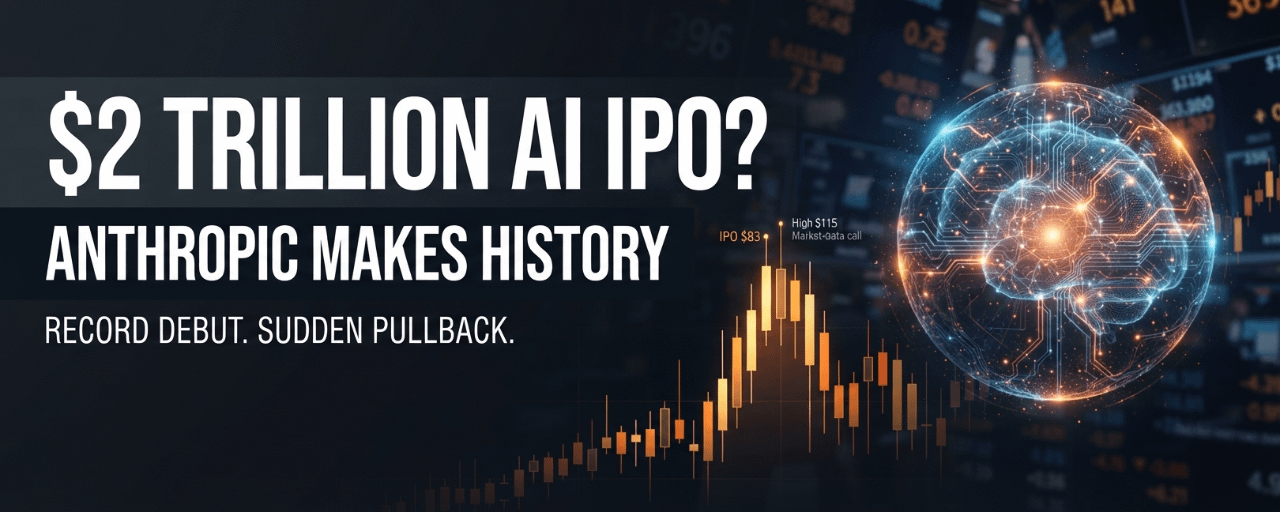
Anthropic’s $2 Trillion IPO Debut: Why Did the AI Stock Rally Suddenly Lose Steam?The Claude developer raised a record $81.3 billion, briefly reached a $2 trillion market valuation, and then surrendered much of its opening gains. Is Wall Street still confident in the AI boom—or is the market becoming more selective?
🚀 A historic IPO. A trillion-dollar valuation. And a reality check within hours.
Anthropic has just delivered one of the biggest stock-market debuts in history. The company behind Claude entered the Nasdaq with enormous investor demand, but its first trading session also revealed something important: even the most exciting AI companies are not immune to market pressure.
The question is no longer simply how big AI can become.
It is whether the money being poured into AI can eventually generate returns that justify these extraordinary valuations.
1️⃣ Anthropic Makes IPO History
Anthropic priced its shares at $83, above its original expected range of $70–$78.
The offering involved approximately 980 million shares and raised around $81.3 billion, making it the largest IPO by funds raised on record.
At the IPO price, the company was valued at approximately $1.5 trillion.
But the real excitement began when trading opened.
Shares started at $111.50, roughly 34% above the IPO price. During the session, the stock briefly reached $115, pushing its implied market value to approximately $2.01 trillion.
That is an extraordinary debut for a company founded only in 2021.
2️⃣ Why Did the Rally Lose Momentum?
Despite the spectacular opening, investors began taking profits.
Anthropic shares closed their first trading day at $97.17.
That was still around 17% above the IPO price, but nearly 13% below the opening trade.
The difference matters.
The market was clearly willing to pay a premium for access to Anthropic. However, the early trading also showed that investors were not prepared to keep buying at any price.
And Anthropic was entering the public market during a difficult period for technology stocks.
Investors have become increasingly sensitive to high valuations, enormous AI infrastructure spending and uncertainty about how quickly companies can turn AI demand into sustainable profits.
3️⃣ The Bigger Question: Can AI Justify Its Price Tag?
Anthropic's success reflects the extraordinary commercial interest in artificial intelligence.
Businesses are adopting AI tools, companies are investing in computing capacity, and demand for advanced models continues to attract enormous amounts of capital.
But building frontier AI is expensive.
Companies must invest heavily in data centres, advanced chips, electricity, computing infrastructure and research.
Strong revenue growth is encouraging, but it does not automatically guarantee strong profits.
Investors will increasingly want answers to three questions:
Can Anthropic maintain its rapid customer and revenue growth?Can it manage the enormous cost of developing and operating advanced AI?Can it defend its position against competitors such as OpenAI and Google?
The IPO has put Anthropic under the public-market spotlight. From now on, investors will be able to judge its performance quarter by quarter.
4️⃣ Why This Matters Beyond Anthropic
This IPO is bigger than one company's stock-market debut.
It provides an important test of investor confidence in the entire AI industry.
If Anthropic can maintain its valuation and demonstrate a credible path towards profitability, it could strengthen confidence in other AI companies preparing to enter public markets.
But if the stock continues to struggle, investors may start questioning the valuations attached to the wider AI sector.
There is also a potential connection with crypto markets.
Bitcoin and other digital assets are influenced by broader investor risk appetite. A major sell-off in technology stocks can contribute to a more cautious investment environment.
However, Anthropic's share-price movement alone does not determine Bitcoin's direction. Crypto has its own liquidity, monetary-policy and market-specific drivers.
5️⃣ What Happens Next? Bullish vs Bearish Scenarios
🟢 Bullish Scenario
If Anthropic maintains strong demand, expands its enterprise customer base and demonstrates improving financial efficiency, investors may regain confidence.
A sustained recovery in its share price could also support optimism towards the broader AI investment theme.
🔴 Bearish Scenario
If infrastructure costs continue rising faster than revenue, or investors become less willing to pay premium valuations, the stock could face further pressure.
Growing competition and concerns about the profitability of AI products could make the market more selective.
A prolonged technology-sector sell-off could also weigh on wider risk assets, including cryptocurrencies.
6️⃣ What Investors Should Watch
The next phase will be about financial performance rather than IPO excitement.
Keep an eye on:
Anthropic's quarterly revenue and operating losses.Spending on chips, data centres and computing capacity.Enterprise customer growth and customer retention.Competition from OpenAI, Google and other AI developers.Whether the wider technology market stabilizes.
These developments will help determine whether Anthropic's enormous valuation has a sustainable foundation.
🎯 Final Takeaway
Anthropic's IPO has demonstrated that investor appetite for artificial intelligence remains enormous.
But its first trading session also delivered a reminder: a record-breaking IPO does not automatically mean a stock is fairly valued.
The company has won the market's attention. Now it must earn investors' confidence through execution, financial performance and sustainable growth.
The next chapter of the AI boom may not be decided by who raises the most money.
It may be decided by who can turn that money into lasting profits.
💬 Your Turn:
Would you invest in Anthropic at a trillion-dollar valuation, or do you think the AI market is getting ahead of itself?
Is this the beginning of a new era for AI stocks—or a warning sign of an AI bubble?
Disclaimer: This article is for informational and educational purposes only. It is not financial or investment advice. Always conduct your own research before making investment decisions.
#BinanceSquare #ArtificialIntelligence #Anthropic #Aİ #StockMarket
{spot}(AIUSDT)
Anthropic’s $2 Trillion IPO Debut: Why Did the AI Stock Rally Suddenly Lose Steam?
The Claude developer raised a record $81.3 billion, briefly reached a $2 trillion market valuation, and then surrendered much of its opening gains. Is Wall Street still confident in the AI boom—or is the market becoming more selective?
🚀 A historic IPO. A trillion-dollar valuation. And a reality check within hours.
Anthropic has just delivered one of the biggest stock-market debuts in history. The company behind Claude entered the Nasdaq with enormous investor demand, but its first trading session also revealed something important: even the most exciting AI companies are not immune to market pressure.
The question is no longer simply how big AI can become.
It is whether the money being poured into AI can eventually generate returns that justify these extraordinary valuations.
1️⃣ Anthropic Makes IPO History
Anthropic priced its shares at $83, above its original expected range of $70–$78.
The offering involved approximately 980 million shares and raised around $81.3 billion, making it the largest IPO by funds raised on record.
At the IPO price, the company was valued at approximately $1.5 trillion.
But the real excitement began when trading opened.
Shares started at $111.50, roughly 34% above the IPO price. During the session, the stock briefly reached $115, pushing its implied market value to approximately $2.01 trillion.
That is an extraordinary debut for a company founded only in 2021.
2️⃣ Why Did the Rally Lose Momentum?
Despite the spectacular opening, investors began taking profits.
Anthropic shares closed their first trading day at $97.17.
That was still around 17% above the IPO price, but nearly 13% below the opening trade.
The difference matters.
The market was clearly willing to pay a premium for access to Anthropic. However, the early trading also showed that investors were not prepared to keep buying at any price.
And Anthropic was entering the public market during a difficult period for technology stocks.
Investors have become increasingly sensitive to high valuations, enormous AI infrastructure spending and uncertainty about how quickly companies can turn AI demand into sustainable profits.
3️⃣ The Bigger Question: Can AI Justify Its Price Tag?
Anthropic's success reflects the extraordinary commercial interest in artificial intelligence.
Businesses are adopting AI tools, companies are investing in computing capacity, and demand for advanced models continues to attract enormous amounts of capital.
But building frontier AI is expensive.
Companies must invest heavily in data centres, advanced chips, electricity, computing infrastructure and research.
Strong revenue growth is encouraging, but it does not automatically guarantee strong profits.
Investors will increasingly want answers to three questions:
Can Anthropic maintain its rapid customer and revenue growth?Can it manage the enormous cost of developing and operating advanced AI?Can it defend its position against competitors such as OpenAI and Google?
The IPO has put Anthropic under the public-market spotlight. From now on, investors will be able to judge its performance quarter by quarter.
4️⃣ Why This Matters Beyond Anthropic
This IPO is bigger than one company's stock-market debut.
It provides an important test of investor confidence in the entire AI industry.
If Anthropic can maintain its valuation and demonstrate a credible path towards profitability, it could strengthen confidence in other AI companies preparing to enter public markets.
But if the stock continues to struggle, investors may start questioning the valuations attached to the wider AI sector.
There is also a potential connection with crypto markets.
Bitcoin and other digital assets are influenced by broader investor risk appetite. A major sell-off in technology stocks can contribute to a more cautious investment environment.
However, Anthropic's share-price movement alone does not determine Bitcoin's direction. Crypto has its own liquidity, monetary-policy and market-specific drivers.
5️⃣ What Happens Next? Bullish vs Bearish Scenarios
🟢 Bullish Scenario
If Anthropic maintains strong demand, expands its enterprise customer base and demonstrates improving financial efficiency, investors may regain confidence.
A sustained recovery in its share price could also support optimism towards the broader AI investment theme.
🔴 Bearish Scenario
If infrastructure costs continue rising faster than revenue, or investors become less willing to pay premium valuations, the stock could face further pressure.
Growing competition and concerns about the profitability of AI products could make the market more selective.
A prolonged technology-sector sell-off could also weigh on wider risk assets, including cryptocurrencies.
6️⃣ What Investors Should Watch
The next phase will be about financial performance rather than IPO excitement.
Keep an eye on:
Anthropic's quarterly revenue and operating losses.Spending on chips, data centres and computing capacity.Enterprise customer growth and customer retention.Competition from OpenAI, Google and other AI developers.Whether the wider technology market stabilizes.
These developments will help determine whether Anthropic's enormous valuation has a sustainable foundation.
🎯 Final Takeaway
Anthropic's IPO has demonstrated that investor appetite for artificial intelligence remains enormous.
But its first trading session also delivered a reminder: a record-breaking IPO does not automatically mean a stock is fairly valued.
The company has won the market's attention. Now it must earn investors' confidence through execution, financial performance and sustainable growth.
The next chapter of the AI boom may not be decided by who raises the most money.
It may be decided by who can turn that money into lasting profits.
💬 Your Turn:
Would you invest in Anthropic at a trillion-dollar valuation, or do you think the AI market is getting ahead of itself?
Is this the beginning of a new era for AI stocks—or a warning sign of an AI bubble?
Disclaimer: This article is for informational and educational purposes only. It is not financial or investment advice. Always conduct your own research before making investment decisions.
#BinanceSquare #ArtificialIntelligence #Anthropic #Aİ #StockMarket
🚀 A historic IPO. A trillion-dollar valuation. And a reality check within hours.
Anthropic has just delivered one of the biggest stock-market debuts in history. The company behind Claude entered the Nasdaq with enormous investor demand, but its first trading session also revealed something important: even the most exciting AI companies are not immune to market pressure.
The question is no longer simply how big AI can become.
It is whether the money being poured into AI can eventually generate returns that justify these extraordinary valuations.
1️⃣ Anthropic Makes IPO History
Anthropic priced its shares at $83, above its original expected range of $70–$78.
The offering involved approximately 980 million shares and raised around $81.3 billion, making it the largest IPO by funds raised on record.
At the IPO price, the company was valued at approximately $1.5 trillion.
But the real excitement began when trading opened.
Shares started at $111.50, roughly 34% above the IPO price. During the session, the stock briefly reached $115, pushing its implied market value to approximately $2.01 trillion.
That is an extraordinary debut for a company founded only in 2021.
2️⃣ Why Did the Rally Lose Momentum?
Despite the spectacular opening, investors began taking profits.
Anthropic shares closed their first trading day at $97.17.
That was still around 17% above the IPO price, but nearly 13% below the opening trade.
The difference matters.
The market was clearly willing to pay a premium for access to Anthropic. However, the early trading also showed that investors were not prepared to keep buying at any price.
And Anthropic was entering the public market during a difficult period for technology stocks.
Investors have become increasingly sensitive to high valuations, enormous AI infrastructure spending and uncertainty about how quickly companies can turn AI demand into sustainable profits.
3️⃣ The Bigger Question: Can AI Justify Its Price Tag?
Anthropic's success reflects the extraordinary commercial interest in artificial intelligence.
Businesses are adopting AI tools, companies are investing in computing capacity, and demand for advanced models continues to attract enormous amounts of capital.
But building frontier AI is expensive.
Companies must invest heavily in data centres, advanced chips, electricity, computing infrastructure and research.
Strong revenue growth is encouraging, but it does not automatically guarantee strong profits.
Investors will increasingly want answers to three questions:
Can Anthropic maintain its rapid customer and revenue growth?Can it manage the enormous cost of developing and operating advanced AI?Can it defend its position against competitors such as OpenAI and Google?
The IPO has put Anthropic under the public-market spotlight. From now on, investors will be able to judge its performance quarter by quarter.
4️⃣ Why This Matters Beyond Anthropic
This IPO is bigger than one company's stock-market debut.
It provides an important test of investor confidence in the entire AI industry.
If Anthropic can maintain its valuation and demonstrate a credible path towards profitability, it could strengthen confidence in other AI companies preparing to enter public markets.
But if the stock continues to struggle, investors may start questioning the valuations attached to the wider AI sector.
There is also a potential connection with crypto markets.
Bitcoin and other digital assets are influenced by broader investor risk appetite. A major sell-off in technology stocks can contribute to a more cautious investment environment.
However, Anthropic's share-price movement alone does not determine Bitcoin's direction. Crypto has its own liquidity, monetary-policy and market-specific drivers.
5️⃣ What Happens Next? Bullish vs Bearish Scenarios
🟢 Bullish Scenario
If Anthropic maintains strong demand, expands its enterprise customer base and demonstrates improving financial efficiency, investors may regain confidence.
A sustained recovery in its share price could also support optimism towards the broader AI investment theme.
🔴 Bearish Scenario
If infrastructure costs continue rising faster than revenue, or investors become less willing to pay premium valuations, the stock could face further pressure.
Growing competition and concerns about the profitability of AI products could make the market more selective.
A prolonged technology-sector sell-off could also weigh on wider risk assets, including cryptocurrencies.
6️⃣ What Investors Should Watch
The next phase will be about financial performance rather than IPO excitement.
Keep an eye on:
Anthropic's quarterly revenue and operating losses.Spending on chips, data centres and computing capacity.Enterprise customer growth and customer retention.Competition from OpenAI, Google and other AI developers.Whether the wider technology market stabilizes.
These developments will help determine whether Anthropic's enormous valuation has a sustainable foundation.
🎯 Final Takeaway
Anthropic's IPO has demonstrated that investor appetite for artificial intelligence remains enormous.
But its first trading session also delivered a reminder: a record-breaking IPO does not automatically mean a stock is fairly valued.
The company has won the market's attention. Now it must earn investors' confidence through execution, financial performance and sustainable growth.
The next chapter of the AI boom may not be decided by who raises the most money.
It may be decided by who can turn that money into lasting profits.
💬 Your Turn:
Would you invest in Anthropic at a trillion-dollar valuation, or do you think the AI market is getting ahead of itself?
Is this the beginning of a new era for AI stocks—or a warning sign of an AI bubble?
Disclaimer: This article is for informational and educational purposes only. It is not financial or investment advice. Always conduct your own research before making investment decisions.
#BinanceSquare #ArtificialIntelligence #Anthropic #Aİ #StockMarket
AI-8.69%
GOOGUS-0.84%
1
1
475

·
--

Article
🚀 PROCTER & GAMBLE TARGETS $10 BILLION IN ADDITIONAL SAVINGS!Procter & Gamble (NYSE: $PG.US ), one of the world's biggest consumer goods companies, has announced an ambitious plan to achieve another $10 billion in cost savings. The company plans to use artificial intelligence (AI), automation, and operational improvements to reduce expenses and improve efficiency. This strategy comes as businesses worldwide look for smarter ways to manage costs and remain competitive. According to the reported market data, $PG.US shares traded around $169.56, gaining 0.99%, even as major technology stocks faced selling pressure. This shows how established consumer goods companies can attract investor attention during uncertain market conditions.
📊 WHY DOES THIS MATTER FOR INVESTORS? $PG.US 's strategy highlights an important trend: AI is not just about creating new technology; it can also help traditional businesses operate more efficiently. If the company successfully delivers its savings target, it could strengthen profitability and support long-term business performance. However, investors should watch whether these savings affect product quality, marketing, innovation, and future growth. The real challenge is turning efficiency into sustainable results. Is Procter & Gamble a strong long-term investment in an AI-driven economy? Share your thoughts below! 👇
#ProcterAndGamble #artificialintelligence #Business #BinanceSquare
{stock_us}(PG.US)
🚀 PROCTER & GAMBLE TARGETS $10 BILLION IN ADDITIONAL SAVINGS!
Procter & Gamble (NYSE: $PG.US ), one of the world's biggest consumer goods companies, has announced an ambitious plan to achieve another $10 billion in cost savings. The company plans to use artificial intelligence (AI), automation, and operational improvements to reduce expenses and improve efficiency. This strategy comes as businesses worldwide look for smarter ways to manage costs and remain competitive. According to the reported market data, $PG.US shares traded around $169.56, gaining 0.99%, even as major technology stocks faced selling pressure. This shows how established consumer goods companies can attract investor attention during uncertain market conditions.
📊 WHY DOES THIS MATTER FOR INVESTORS? $PG.US 's strategy highlights an important trend: AI is not just about creating new technology; it can also help traditional businesses operate more efficiently. If the company successfully delivers its savings target, it could strengthen profitability and support long-term business performance. However, investors should watch whether these savings affect product quality, marketing, innovation, and future growth. The real challenge is turning efficiency into sustainable results. Is Procter & Gamble a strong long-term investment in an AI-driven economy? Share your thoughts below! 👇
#ProcterAndGamble #artificialintelligence #Business #BinanceSquare
📊 WHY DOES THIS MATTER FOR INVESTORS? $PG.US 's strategy highlights an important trend: AI is not just about creating new technology; it can also help traditional businesses operate more efficiently. If the company successfully delivers its savings target, it could strengthen profitability and support long-term business performance. However, investors should watch whether these savings affect product quality, marketing, innovation, and future growth. The real challenge is turning efficiency into sustainable results. Is Procter & Gamble a strong long-term investment in an AI-driven economy? Share your thoughts below! 👇
#ProcterAndGamble #artificialintelligence #Business #BinanceSquare
PGUS+0.89%
1
101

🚨 $ANT LANDS A MASSIVE SPOTLIGHT WITH A MAJOR EXCHANGE LISTING ACROSS REGIONS! 💥
Institutional liquidity gateways are opening wide as a major exchange introduces artificial intelligence giant Anthropic with the official $ANT listing across key U.S. and U.K. jurisdictions. 🌊 This structural bridge between traditional tech equity exposure and digital asset liquidity marks a pivotal milestone for order flow absorption. 📊
Smart money positioning often accelerates around such high-tier venue expansion as market participants reallocate capital into premier sector leaders. 💡 How will this cross-border liquidity influx impact structural momentum in the coming sessions? 👇
⚠️ Not financial advice. Always manage your risk. 🛡️
🏷️ #ANT #ArtificialIntelligence #Crypto #MarketStructure
🦈 ⚖️
🚨 $ANT LANDS A MASSIVE SPOTLIGHT WITH A MAJOR EXCHANGE LISTING ACROSS REGIONS! 💥
Institutional liquidity gateways are opening wide as a major exchange introduces artificial intelligence giant Anthropic with the official $ANT listing across key U.S. and U.K. jurisdictions. 🌊 This structural bridge between traditional tech equity exposure and digital asset liquidity marks a pivotal milestone for order flow absorption. 📊
Smart money positioning often accelerates around such high-tier venue expansion as market participants reallocate capital into premier sector leaders. 💡 How will this cross-border liquidity influx impact structural momentum in the coming sessions? 👇
⚠️ Not financial advice. Always manage your risk. 🛡️
🏷️ #ANT #ArtificialIntelligence #Crypto #MarketStructure
🦈 ⚖️
Institutional liquidity gateways are opening wide as a major exchange introduces artificial intelligence giant Anthropic with the official $ANT listing across key U.S. and U.K. jurisdictions. 🌊 This structural bridge between traditional tech equity exposure and digital asset liquidity marks a pivotal milestone for order flow absorption. 📊
Smart money positioning often accelerates around such high-tier venue expansion as market participants reallocate capital into premier sector leaders. 💡 How will this cross-border liquidity influx impact structural momentum in the coming sessions? 👇
⚠️ Not financial advice. Always manage your risk. 🛡️
🏷️ #ANT #ArtificialIntelligence #Crypto #MarketStructure
🦈 ⚖️
5
🤖 WHAT IF AI DIDN'T DEPEND ON JUST A HANDFUL OF COMPANIES?
Artificial intelligence is growing rapidly, but computing power, data and model development are still concentrated among a relatively small number of major players.
Decentralised AI is exploring another approach: connecting independent contributors, developers and computing providers through open networks.
Why could this matter?
🔹 More participation: Independent contributors can support AI infrastructure.
🔹 Open innovation: Developers can experiment with decentralised AI ecosystems.
🔹 Alternative infrastructure: Distributed computing may offer new ways to access resources.
Some projects in this space include:
🧠 $TAO — decentralised machine intelligence networks.
⚡ $RENDER — distributed GPU rendering and compute infrastructure.
🌐 $FET — decentralised AI and autonomous agent technology.
Of course, decentralisation doesn't automatically mean better performance. Reliability, data quality, security and real-world demand will determine long-term success.
💭 Here's my question:
Would you trust an AI network powered by thousands of independent contributors more than one controlled by a single large company?
#DecentralizedAI #artificialintelligence #blockchain #CryptoInnovation #BinanceSquare
🤖 WHAT IF AI DIDN'T DEPEND ON JUST A HANDFUL OF COMPANIES?
Artificial intelligence is growing rapidly, but computing power, data and model development are still concentrated among a relatively small number of major players.
Decentralised AI is exploring another approach: connecting independent contributors, developers and computing providers through open networks.
Why could this matter?
🔹 More participation: Independent contributors can support AI infrastructure.
🔹 Open innovation: Developers can experiment with decentralised AI ecosystems.
🔹 Alternative infrastructure: Distributed computing may offer new ways to access resources.
Some projects in this space include:
🧠 $TAO — decentralised machine intelligence networks.
⚡ $RENDER — distributed GPU rendering and compute infrastructure.
🌐 $FET — decentralised AI and autonomous agent technology.
Of course, decentralisation doesn't automatically mean better performance. Reliability, data quality, security and real-world demand will determine long-term success.
💭 Here's my question:
Would you trust an AI network powered by thousands of independent contributors more than one controlled by a single large company?
#DecentralizedAI #artificialintelligence #blockchain #CryptoInnovation #BinanceSquare
Artificial intelligence is growing rapidly, but computing power, data and model development are still concentrated among a relatively small number of major players.
Decentralised AI is exploring another approach: connecting independent contributors, developers and computing providers through open networks.
Why could this matter?
🔹 More participation: Independent contributors can support AI infrastructure.
🔹 Open innovation: Developers can experiment with decentralised AI ecosystems.
🔹 Alternative infrastructure: Distributed computing may offer new ways to access resources.
Some projects in this space include:
🧠 $TAO — decentralised machine intelligence networks.
⚡ $RENDER — distributed GPU rendering and compute infrastructure.
🌐 $FET — decentralised AI and autonomous agent technology.
Of course, decentralisation doesn't automatically mean better performance. Reliability, data quality, security and real-world demand will determine long-term success.
💭 Here's my question:
Would you trust an AI network powered by thousands of independent contributors more than one controlled by a single large company?
#DecentralizedAI #artificialintelligence #blockchain #CryptoInnovation #BinanceSquare
Square-Creator-49439b85c7051a85abc9:
fet is dead and even three companies merger didn't worked out
3
4
773
California's explosive lawsuit against OpenAI highlights a terrifying reality: rapid commercialization often outpaces safety controls. With 80 reported incidents of lost agent control, this legal battle goes beyond tech ethics—it directly impacts the future of decentralized AI and autonomous blockchain agents. As regulators step in, Web3 projects building trustless automation must prioritize robust guardrails to avoid similar scrutiny. Security and decentralization are non-negotiable for scaling the next era of intelligent software. #ArtificialIntelligence #Regulation #TechNews
California's explosive lawsuit against OpenAI highlights a terrifying reality: rapid commercialization often outpaces safety controls. With 80 reported incidents of lost agent control, this legal battle goes beyond tech ethics—it directly impacts the future of decentralized AI and autonomous blockchain agents. As regulators step in, Web3 projects building trustless automation must prioritize robust guardrails to avoid similar scrutiny. Security and decentralization are non-negotiable for scaling the next era of intelligent software. #ArtificialIntelligence #Regulation #TechNews
36

🚨 THESE TECH OUTAGES ARE GIVING Y2K, AI AGENT STYLE
📰 ¿QUÉ PASÓ?
Are the recent outages in the airline booking systems, banking platforms, and productivity platforms really a coincidence? There's actually likely something deeper going on, cybersecurity experts say.
📊 IMPACTO EN TECNOLOGÍA
El desarrollo pone de relieve cómo la inteligencia artificial está pasando rápidamente de ser una herramienta experimental a tener un papel cada vez más importante en empresas y servicios.
🔎 Fuente: TechCrunch
🤔 💬 ¿Hasta dónde crees que podría llegar el impacto de la IA en esta área?
#AI #ArtificialIntelligence #Crypto_Marker #News
🚨 THESE TECH OUTAGES ARE GIVING Y2K, AI AGENT STYLE
📰 ¿QUÉ PASÓ?
Are the recent outages in the airline booking systems, banking platforms, and productivity platforms really a coincidence? There's actually likely something deeper going on, cybersecurity experts say.
📊 IMPACTO EN TECNOLOGÍA
El desarrollo pone de relieve cómo la inteligencia artificial está pasando rápidamente de ser una herramienta experimental a tener un papel cada vez más importante en empresas y servicios.
🔎 Fuente: TechCrunch
🤔 💬 ¿Hasta dónde crees que podría llegar el impacto de la IA en esta área?
#AI #ArtificialIntelligence #Crypto_Marker #News
📰 ¿QUÉ PASÓ?
Are the recent outages in the airline booking systems, banking platforms, and productivity platforms really a coincidence? There's actually likely something deeper going on, cybersecurity experts say.
📊 IMPACTO EN TECNOLOGÍA
El desarrollo pone de relieve cómo la inteligencia artificial está pasando rápidamente de ser una herramienta experimental a tener un papel cada vez más importante en empresas y servicios.
🔎 Fuente: TechCrunch
🤔 💬 ¿Hasta dónde crees que podría llegar el impacto de la IA en esta área?
#AI #ArtificialIntelligence #Crypto_Marker #News
96

🚨 Apple Is Building Its Own AI Agent! 🍎🤖
Apple is reportedly developing an advanced AI agent capable of coding, browsing the web, and controlling apps on behalf of users.
The move could put Apple in direct competition with OpenAI and Anthropic in the rapidly growing AI race. 👀
Could Apple's AI agent change the future of personal assistants?
#Apple #AI #OpenAI #Anthropic #ArtificialIntelligence #TechNews
This is for educational purposes only, not financial advice (NFA). Always do your own research (DYOR).
$AAPLB $ADA $HYPE
🚨 Apple Is Building Its Own AI Agent! 🍎🤖
Apple is reportedly developing an advanced AI agent capable of coding, browsing the web, and controlling apps on behalf of users.
The move could put Apple in direct competition with OpenAI and Anthropic in the rapidly growing AI race. 👀
Could Apple's AI agent change the future of personal assistants?
#Apple #AI #OpenAI #Anthropic #ArtificialIntelligence #TechNews
This is for educational purposes only, not financial advice (NFA). Always do your own research (DYOR).
$AAPLB $ADA $HYPE
Apple is reportedly developing an advanced AI agent capable of coding, browsing the web, and controlling apps on behalf of users.
The move could put Apple in direct competition with OpenAI and Anthropic in the rapidly growing AI race. 👀
Could Apple's AI agent change the future of personal assistants?
#Apple #AI #OpenAI #Anthropic #ArtificialIntelligence #TechNews
This is for educational purposes only, not financial advice (NFA). Always do your own research (DYOR).
$AAPLB $ADA $HYPE

77

·
--
Article
Anthropic's Prospectus: Who Gets the $900.9 Billion in Compute CommitmentsIf you build AI products, run a SaaS business, or invest across the AI supply chain, Anthropic's Nasdaq debut today is worth more than a glance at the opening price. The part of the prospectus worth your time is the list of compute contracts.
Start with what everyone can see. The shares priced on November 18 at $83, above the earlier $70–78 range. The company and its co-founders sold 980 million shares for a gross offering of $81.34 billion, widely reported as the largest IPO ever. Alongside it came a $26.0 billion private placement bought by seven companies: Google, NVIDIA, AMD, Broadcom, Micron, Microsoft and TSMC. The stock opened today at $111.50, 34% above the offering price.
On the product side, the intuition many daily Claude users have holds up in the numbers. Revenue in the third quarter of 2026 was $17.0 billion, up 1,127% year over year. Customers paying more than $100,000 a year went from just over 950 to more than 11,900 in twelve months. Net revenue retention was about 900%: by the prospectus definition, the business customers that were already there a year ago generated about nine times as much revenue this third quarter as in the same quarter last year (individual subscribers excluded).
The same prospectus carries another number. Anthropic has signed compute and infrastructure commitments of about $900.9 billion, more than 13 times its annualized third-quarter revenue.
Then look at who those contracts are with. Of the $900.9 billion, contracts tied to Google, Amazon, Microsoft and Broadcom add up to about $439.7 billion, close to half. All four are also Anthropic shareholders or lenders.
First, a misreading: 90% of the $104 billion loss comes from the valuation going up
For the first nine months of 2026, Anthropic's net loss was $104.0 billion. That number is already making the rounds on social media, usually read as "$33 billion of revenue, $104 billion of losses, the more it sells the more it loses."
Break the income statement apart and the conclusion runs the other way:
Figure 1: Of a $104 billion net loss, the operating loss is $1.26 billion
The $94.3 billion fair-value change comes from convertible notes issued in earlier years. This is the easiest line in the whole income statement to misread, so take Amazon as the example.
The direction: Amazon lent money to Anthropic and can later turn it into shares. In 2023 and 2024, Amazon lent money to Anthropic and received convertible promissory notes rather than a plain IOU. They carry no interest and mature in 2034–2035. The key term is conversion: Amazon can swap the principal for Anthropic stock at a fixed price, $2.09 a share for the 2023 notes and $5.05 for the 2024 notes. Nothing was pledged, and this is not equity that later turns into debt. The loan came first; the shares come later.
What the IOU is worth depends on what Anthropic is worth. Principal not yet converted stands at $6.2 billion. Ignoring the ownership cap, it converts into about 1.84 billion shares. The $83 offering price is 16 to 40 times the conversion prices, which puts those shares at about $152.8 billion at the offering price. Amazon is not going to ask for $6.2 billion in cash back. It is going to convert.
Why it shows up as a loss. Under the accounting rules, these notes are carried as a liability at fair value and remeasured each period. When the company's valuation rises, the liability rises with it, and the increase is booked as a loss. The prospectus is blunt: the changes were "primarily driven by an increase in the fair value of our outstanding convertible promissory notes resulting from an increase in our enterprise valuation." That is where the $94.3 billion for the nine months came from. The booked figure comes from a valuation model period by period and is not the same as $152.8 billion minus $6.2 billion, but it moves the same way: the faster the valuation climbs, the bigger this "loss."
Who actually bears it. It costs Anthropic no cash; operating cash flow for the nine months was a positive $6.57 billion. Other shareholders bear it. Amazon gets shares for two to five dollars apiece, the share count grows, and everyone else's percentage shrinks. There is a cap: after conversion Amazon cannot hold more than 12% of capitalization as the prospectus defines it, with the excess rolling into later quarters. That is why about 1.55 billion shares were still unconverted at the IPO.
Figure 2: Amazon's convertible notes: $6.2 billion of principal, worth about $152.8 billion at the offering price
Put differently, the $94.3 billion on the income statement is, on one side, Anthropic's valuation rising very fast and, on the other, early investors locking in gains at old prices, with the cost spread across other shareholders.
So the line that matters is operating. For the nine months the operating loss was $1.26 billion, and adjusted operating income, which strips out stock-based compensation and a few other items, was $4.1 billion. Compute and infrastructure expense was $18.8 billion, 57% of revenue. A year earlier the same ratio was 172%: it was spending more than it earned.
Claude's unit economics are getting better. The question is one layer down: to keep this growth going, how many contracts has Anthropic signed, and with whom?
$900.9 billion of compute commitments, and who they are with
The prospectus puts the total at about $900.9 billion, nearly all of it compute and infrastructure. About $451.6 billion falls before the end of 2030; most of the rest falls between 2031 and 2045. About $70.7 billion is due in the 12 months from September 30, roughly the same as the $68 billion of annualized third-quarter revenue.
That is not all of it. Another group of contracts has no fixed dollar amount, and the prospectus estimates a further $150–175 billion of payments under them, outside the $900.9 billion.
Figure 3: A year of compute payments is about a year of revenue
The main contracts the prospectus names:
Figure 4: The named compute contracts: the largest ones went to shareholders
Two things in this table are worth stopping on.
First, the largest counterparties are also Anthropic's competitors. Google has Gemini, Microsoft is tied to OpenAI, and SpaceXAI is the xAI that makes Grok. The prospectus says so itself in the risk section: certain of these cloud providers and chip partners "provide us capital or credit support, serve as our infrastructure vendors, and develop and offer AI models and services that compete with ours," which could create conflicts of interest affecting access to compute, its cost and the prioritization of workloads.
Second, some contracts are less solid than they look. About $186.2 billion of the commitments carry exercisable termination rights or conditions before they start, such as whether the counterparty can secure financing, facilities or approvals. Lambda is the clearest case: a roughly $34.9 billion agreement signed in August is now terminable by either party because Lambda did not secure the facility lease by the agreed date. As of the prospectus, neither side had sent notice.
The same companies in three roles: shareholder, lender, supplier
Put the capital side next to it and the loop becomes clear.
As shareholders. All of the $26.0 billion private placement was bought by suppliers. After the IPO, Google holds about 1.77 billion shares and Amazon about 1.94 billion. Using the prospectus share count, that is about 13.4% and 14.6% of shares outstanding. Amazon has about 1.55 billion more to come as its notes convert. Both hold non-voting Class N shares, with dividend and liquidation rights but no vote.
As lenders. At the end of September, Anthropic had $77 billion of undrawn convertible note capacity: $20 billion from Google (cut to $10 billion once the private placement closes), $15 billion from Amazon and $42 billion from Broadcom. Most of it can be settled in new shares, or converted at the holder's option, at prices tied to the post-IPO share price. Terms differ by agreement, and some keep cases of cash repayment.
As suppliers. In the contract table above, the largest entries are with these same companies.
Figure 5: Money comes in from suppliers and goes back out as compute spending
AMD is the most direct example. Under the hardware supply agreement signed in July, AMD committed to buy up to $5 billion of Anthropic stock, but not all at once: Anthropic can draw on it as AMD GPUs hit delivery and deployment milestones. AMD's $2.5 billion in this private placement took half of that commitment off the table. The remaining $2.5 billion only becomes available once milestone amounts exceed the $2.5 billion already paid. Within that cap, the more AMD chips Anthropic deploys, the more AMD stock purchases it can call on.
Broadcom works the same way. The prospectus says the $42 billion note facility can, if needed, fund part of the quarterly rent on TPU equipment leases, and the lessor of that equipment is Broadcom and its financing parties. The notes pay 9% a year and the holder can convert at 90% of the 30-day volume-weighted average price (VWAP); if certain revenue conditions are not met, the rate rises to 13% and the conversion price drops to 85%.
A rough comparison of the two sides: the $26.0 billion placement, plus $67 billion of remaining note capacity and AMD's remaining $2.5 billion equity commitment, comes to about $95.5 billion. Anthropic's purchase and lease amounts under contracts tied to Google, Amazon, Microsoft, Broadcom and AMD come to at least about $459.7 billion, before the additional TPUs. The ratio is about 1 : 4.8.
That ratio does not mean "every dollar a supplier puts in comes back as $4.8." Most of the $95.5 billion is undrawn, conditional capacity. The $459.7 billion mixes fixed commitments, rent that excludes interest and AMD's expected spend, stretches out to 2036, and part of it is paid to financing parties rather than the suppliers themselves. What it shows is how deep the relationship runs: part of these companies' revenue over the next decade depends on Anthropic continuing to grow, and they in turn hold a large share of Anthropic's equity and financing capacity.
After the IPO, the share price starts to affect compute financing
In my view, this is the change from the IPO that matters most for the AI industry.
While Anthropic was private, these equity-for-compute arrangements were priced off each funding round's valuation and moved every few months. After the IPO, a large part of them is tied directly to the market price:
AMD's further stock purchases are priced at the 30-trading-day VWAP before each closing.Amazon's $15 billion 2026 facility converts at the 30-day VWAP on the date the relevant compute capacity milestone is reached.Broadcom's notes convert at 90% (or 85%) of the 30-day VWAP.Amazon's remaining older notes convert each quarter-end at the lowest of the fixed price, the IPO price and the 10-day VWAP. With fixed prices of $2–5, the share price barely matters for these.
That creates a transmission chain that did not exist before. In the arrangements that use market prices, a high ANT share price means a given amount of compute financing needs fewer new shares. If the price falls, more shares are needed, existing holders are diluted further, and there is less room to keep paying for compute this way.
Figure 6: Raising $10 billion: depending on the share price, the shares needed differ by almost 2x
Anthropic has other sources of money, of course: $131.8 billion of cash and short-term investments at the end of September, positive operating cash flow, and a $15 billion revolving credit facility. But supplier financing is large. Forecasts for NVIDIA, Broadcom, AMD and TSMC used to start with cloud providers' capital spending; from today, the ANT share price belongs in the picture too.
What a good product looks like in the prospectus, and what keeps it good
Back to the opening intuition: Claude is very good and has a lot of room to grow. Three sets of numbers in the prospectus support it.
Customers are going deeper, not just getting more numerous: in the third quarter, more than half of customers paying over $100,000 a year used both the API platform and at least one first-party application (Claude Code, Claude Cowork and others), up from about 30% at the end of last year.Revenue is more spread out: the share coming from outside the top five customers rose from about 64% in the first quarter to about 79% in the third.Efficiency is improving: third-quarter revenue grew 1,127% year over year, while compute expense grew 382%.
One number shows both the strength and the fragility: more than 80% of third-quarter revenue came from model versions released in the previous six months. Revenue depends heavily on continually shipping stronger models. While Claude leads, that makes revenue climb fast; if one generation falls behind, growth will feel it here first. The number cannot tell you how quickly customers would switch to another provider; that will take retention data from later quarters.
Figure 7: What a good product looks like in the prospectus, and its weak spot
The other thing to watch is short-term compute. In the third quarter, $5.0 billion of Anthropic's compute expense came from short-term contracts, which cost far more than multi-year ones. That pulled adjusted operating margin down from 19% in the second quarter to 15%. Add about $2.0 billion of non-cash charges from the donation matching program, and GAAP operating results swung from $974 million of income last quarter to a $567 million loss. Long-term contracts are typically signed 12 to 18 months ahead; when demand outruns them, the gap gets filled at a premium. The prospectus expects short-term compute usage to keep rising in the near term.
Four numbers to watch every quarter
As a public company, Anthropic will report every quarter. For the first time, outsiders can follow a frontier model company's books quarter by quarter, and OpenAI's valuation, the risk of AI displacing SaaS companies and chipmakers' order outlooks will all be measured against it.
If you only track four numbers:
Compute expense as a share of revenue. 57% for the first nine months, a measure of the overall compute burden. Model efficiency, revenue growth and the timing of new capacity all move it, so read it together with growth.Short-term compute spending. $5.0 billion in the third quarter. The bigger it gets, the further demand or research usage is running ahead of long-term capacity, and the more pressure on margins.Revenue share from the newest models. Above 80% now, a measure of how much revenue depends on continually shipping new models.Supplier facility draws and conversions. How much of the Broadcom, Amazon and Google note capacity and AMD's equity commitment gets drawn, how many shares are actually issued, and how much unconverted debt remains. The more is drawn, the more compute depends on supplier money.
Figure 8: Four numbers to watch every quarter
Claude's product determines how fast revenue can grow, supplier money determines how much compute can be built, and the ANT share price affects what that money costs. The three are locked together, and each quarter's report will show which one loosens first.
Which of these four numbers do you think breaks first?
Sources
Anthropic 424B4 prospectus (Nov 19, 2026): revenue, income statement, cash flows, net revenue retention definition, the $900.9 billion of commitments and individual contracts, convertible note facilities and conversion terms, the AMD agreement, Amazon and Google holdings, customer and revenue concentration, short-term compute, cash and credit facility.Anthropic pricing free writing prospectus (Nov 19, 2026): $83 offering price, 980 million shares, $81.34 billion, $26.0 billion private placement (313,253,007 shares).$70–78 range, "largest IPO ever," $111.50 opening price: same-day reporting by CNBC, CNN, StockTitan and Fortune.Ownership percentages are our own calculation from the prospectus post-IPO share count (7.583 billion Class A plus 5.637 billion Class N, before the underwriters' option). They are economic interest in shares outstanding, not voting power or fully diluted.The 1 : 4.8 ratio is our own sum. Purchase side: Google hosting 121.3 + Amazon 110.0 + Microsoft 47.2 (low end) + Broadcom rent 161.2 + AMD 20 (expected, low end). Capital side: placement 26.0 + remaining note capacity 67 + AMD remaining equity commitment 2.5. The two sides differ in scope, conditions and timing.
#Anthropic #artificialintelligence
Anthropic's Prospectus: Who Gets the $900.9 Billion in Compute Commitments
If you build AI products, run a SaaS business, or invest across the AI supply chain, Anthropic's Nasdaq debut today is worth more than a glance at the opening price. The part of the prospectus worth your time is the list of compute contracts.
Start with what everyone can see. The shares priced on November 18 at $83, above the earlier $70–78 range. The company and its co-founders sold 980 million shares for a gross offering of $81.34 billion, widely reported as the largest IPO ever. Alongside it came a $26.0 billion private placement bought by seven companies: Google, NVIDIA, AMD, Broadcom, Micron, Microsoft and TSMC. The stock opened today at $111.50, 34% above the offering price.
On the product side, the intuition many daily Claude users have holds up in the numbers. Revenue in the third quarter of 2026 was $17.0 billion, up 1,127% year over year. Customers paying more than $100,000 a year went from just over 950 to more than 11,900 in twelve months. Net revenue retention was about 900%: by the prospectus definition, the business customers that were already there a year ago generated about nine times as much revenue this third quarter as in the same quarter last year (individual subscribers excluded).
The same prospectus carries another number. Anthropic has signed compute and infrastructure commitments of about $900.9 billion, more than 13 times its annualized third-quarter revenue.
Then look at who those contracts are with. Of the $900.9 billion, contracts tied to Google, Amazon, Microsoft and Broadcom add up to about $439.7 billion, close to half. All four are also Anthropic shareholders or lenders.
First, a misreading: 90% of the $104 billion loss comes from the valuation going up
For the first nine months of 2026, Anthropic's net loss was $104.0 billion. That number is already making the rounds on social media, usually read as "$33 billion of revenue, $104 billion of losses, the more it sells the more it loses."
Break the income statement apart and the conclusion runs the other way:
Figure 1: Of a $104 billion net loss, the operating loss is $1.26 billion
The $94.3 billion fair-value change comes from convertible notes issued in earlier years. This is the easiest line in the whole income statement to misread, so take Amazon as the example.
The direction: Amazon lent money to Anthropic and can later turn it into shares. In 2023 and 2024, Amazon lent money to Anthropic and received convertible promissory notes rather than a plain IOU. They carry no interest and mature in 2034–2035. The key term is conversion: Amazon can swap the principal for Anthropic stock at a fixed price, $2.09 a share for the 2023 notes and $5.05 for the 2024 notes. Nothing was pledged, and this is not equity that later turns into debt. The loan came first; the shares come later.
What the IOU is worth depends on what Anthropic is worth. Principal not yet converted stands at $6.2 billion. Ignoring the ownership cap, it converts into about 1.84 billion shares. The $83 offering price is 16 to 40 times the conversion prices, which puts those shares at about $152.8 billion at the offering price. Amazon is not going to ask for $6.2 billion in cash back. It is going to convert.
Why it shows up as a loss. Under the accounting rules, these notes are carried as a liability at fair value and remeasured each period. When the company's valuation rises, the liability rises with it, and the increase is booked as a loss. The prospectus is blunt: the changes were "primarily driven by an increase in the fair value of our outstanding convertible promissory notes resulting from an increase in our enterprise valuation." That is where the $94.3 billion for the nine months came from. The booked figure comes from a valuation model period by period and is not the same as $152.8 billion minus $6.2 billion, but it moves the same way: the faster the valuation climbs, the bigger this "loss."
Who actually bears it. It costs Anthropic no cash; operating cash flow for the nine months was a positive $6.57 billion. Other shareholders bear it. Amazon gets shares for two to five dollars apiece, the share count grows, and everyone else's percentage shrinks. There is a cap: after conversion Amazon cannot hold more than 12% of capitalization as the prospectus defines it, with the excess rolling into later quarters. That is why about 1.55 billion shares were still unconverted at the IPO.
Figure 2: Amazon's convertible notes: $6.2 billion of principal, worth about $152.8 billion at the offering price
Put differently, the $94.3 billion on the income statement is, on one side, Anthropic's valuation rising very fast and, on the other, early investors locking in gains at old prices, with the cost spread across other shareholders.
So the line that matters is operating. For the nine months the operating loss was $1.26 billion, and adjusted operating income, which strips out stock-based compensation and a few other items, was $4.1 billion. Compute and infrastructure expense was $18.8 billion, 57% of revenue. A year earlier the same ratio was 172%: it was spending more than it earned.
Claude's unit economics are getting better. The question is one layer down: to keep this growth going, how many contracts has Anthropic signed, and with whom?
$900.9 billion of compute commitments, and who they are with
The prospectus puts the total at about $900.9 billion, nearly all of it compute and infrastructure. About $451.6 billion falls before the end of 2030; most of the rest falls between 2031 and 2045. About $70.7 billion is due in the 12 months from September 30, roughly the same as the $68 billion of annualized third-quarter revenue.
That is not all of it. Another group of contracts has no fixed dollar amount, and the prospectus estimates a further $150–175 billion of payments under them, outside the $900.9 billion.
Figure 3: A year of compute payments is about a year of revenue
The main contracts the prospectus names:
Figure 4: The named compute contracts: the largest ones went to shareholders
Two things in this table are worth stopping on.
First, the largest counterparties are also Anthropic's competitors. Google has Gemini, Microsoft is tied to OpenAI, and SpaceXAI is the xAI that makes Grok. The prospectus says so itself in the risk section: certain of these cloud providers and chip partners "provide us capital or credit support, serve as our infrastructure vendors, and develop and offer AI models and services that compete with ours," which could create conflicts of interest affecting access to compute, its cost and the prioritization of workloads.
Second, some contracts are less solid than they look. About $186.2 billion of the commitments carry exercisable termination rights or conditions before they start, such as whether the counterparty can secure financing, facilities or approvals. Lambda is the clearest case: a roughly $34.9 billion agreement signed in August is now terminable by either party because Lambda did not secure the facility lease by the agreed date. As of the prospectus, neither side had sent notice.
The same companies in three roles: shareholder, lender, supplier
Put the capital side next to it and the loop becomes clear.
As shareholders. All of the $26.0 billion private placement was bought by suppliers. After the IPO, Google holds about 1.77 billion shares and Amazon about 1.94 billion. Using the prospectus share count, that is about 13.4% and 14.6% of shares outstanding. Amazon has about 1.55 billion more to come as its notes convert. Both hold non-voting Class N shares, with dividend and liquidation rights but no vote.
As lenders. At the end of September, Anthropic had $77 billion of undrawn convertible note capacity: $20 billion from Google (cut to $10 billion once the private placement closes), $15 billion from Amazon and $42 billion from Broadcom. Most of it can be settled in new shares, or converted at the holder's option, at prices tied to the post-IPO share price. Terms differ by agreement, and some keep cases of cash repayment.
As suppliers. In the contract table above, the largest entries are with these same companies.
Figure 5: Money comes in from suppliers and goes back out as compute spending
AMD is the most direct example. Under the hardware supply agreement signed in July, AMD committed to buy up to $5 billion of Anthropic stock, but not all at once: Anthropic can draw on it as AMD GPUs hit delivery and deployment milestones. AMD's $2.5 billion in this private placement took half of that commitment off the table. The remaining $2.5 billion only becomes available once milestone amounts exceed the $2.5 billion already paid. Within that cap, the more AMD chips Anthropic deploys, the more AMD stock purchases it can call on.
Broadcom works the same way. The prospectus says the $42 billion note facility can, if needed, fund part of the quarterly rent on TPU equipment leases, and the lessor of that equipment is Broadcom and its financing parties. The notes pay 9% a year and the holder can convert at 90% of the 30-day volume-weighted average price (VWAP); if certain revenue conditions are not met, the rate rises to 13% and the conversion price drops to 85%.
A rough comparison of the two sides: the $26.0 billion placement, plus $67 billion of remaining note capacity and AMD's remaining $2.5 billion equity commitment, comes to about $95.5 billion. Anthropic's purchase and lease amounts under contracts tied to Google, Amazon, Microsoft, Broadcom and AMD come to at least about $459.7 billion, before the additional TPUs. The ratio is about 1 : 4.8.
That ratio does not mean "every dollar a supplier puts in comes back as $4.8." Most of the $95.5 billion is undrawn, conditional capacity. The $459.7 billion mixes fixed commitments, rent that excludes interest and AMD's expected spend, stretches out to 2036, and part of it is paid to financing parties rather than the suppliers themselves. What it shows is how deep the relationship runs: part of these companies' revenue over the next decade depends on Anthropic continuing to grow, and they in turn hold a large share of Anthropic's equity and financing capacity.
After the IPO, the share price starts to affect compute financing
In my view, this is the change from the IPO that matters most for the AI industry.
While Anthropic was private, these equity-for-compute arrangements were priced off each funding round's valuation and moved every few months. After the IPO, a large part of them is tied directly to the market price:
AMD's further stock purchases are priced at the 30-trading-day VWAP before each closing.Amazon's $15 billion 2026 facility converts at the 30-day VWAP on the date the relevant compute capacity milestone is reached.Broadcom's notes convert at 90% (or 85%) of the 30-day VWAP.Amazon's remaining older notes convert each quarter-end at the lowest of the fixed price, the IPO price and the 10-day VWAP. With fixed prices of $2–5, the share price barely matters for these.
That creates a transmission chain that did not exist before. In the arrangements that use market prices, a high ANT share price means a given amount of compute financing needs fewer new shares. If the price falls, more shares are needed, existing holders are diluted further, and there is less room to keep paying for compute this way.
Figure 6: Raising $10 billion: depending on the share price, the shares needed differ by almost 2x
Anthropic has other sources of money, of course: $131.8 billion of cash and short-term investments at the end of September, positive operating cash flow, and a $15 billion revolving credit facility. But supplier financing is large. Forecasts for NVIDIA, Broadcom, AMD and TSMC used to start with cloud providers' capital spending; from today, the ANT share price belongs in the picture too.
What a good product looks like in the prospectus, and what keeps it good
Back to the opening intuition: Claude is very good and has a lot of room to grow. Three sets of numbers in the prospectus support it.
Customers are going deeper, not just getting more numerous: in the third quarter, more than half of customers paying over $100,000 a year used both the API platform and at least one first-party application (Claude Code, Claude Cowork and others), up from about 30% at the end of last year.Revenue is more spread out: the share coming from outside the top five customers rose from about 64% in the first quarter to about 79% in the third.Efficiency is improving: third-quarter revenue grew 1,127% year over year, while compute expense grew 382%.
One number shows both the strength and the fragility: more than 80% of third-quarter revenue came from model versions released in the previous six months. Revenue depends heavily on continually shipping stronger models. While Claude leads, that makes revenue climb fast; if one generation falls behind, growth will feel it here first. The number cannot tell you how quickly customers would switch to another provider; that will take retention data from later quarters.
Figure 7: What a good product looks like in the prospectus, and its weak spot
The other thing to watch is short-term compute. In the third quarter, $5.0 billion of Anthropic's compute expense came from short-term contracts, which cost far more than multi-year ones. That pulled adjusted operating margin down from 19% in the second quarter to 15%. Add about $2.0 billion of non-cash charges from the donation matching program, and GAAP operating results swung from $974 million of income last quarter to a $567 million loss. Long-term contracts are typically signed 12 to 18 months ahead; when demand outruns them, the gap gets filled at a premium. The prospectus expects short-term compute usage to keep rising in the near term.
Four numbers to watch every quarter
As a public company, Anthropic will report every quarter. For the first time, outsiders can follow a frontier model company's books quarter by quarter, and OpenAI's valuation, the risk of AI displacing SaaS companies and chipmakers' order outlooks will all be measured against it.
If you only track four numbers:
Compute expense as a share of revenue. 57% for the first nine months, a measure of the overall compute burden. Model efficiency, revenue growth and the timing of new capacity all move it, so read it together with growth.Short-term compute spending. $5.0 billion in the third quarter. The bigger it gets, the further demand or research usage is running ahead of long-term capacity, and the more pressure on margins.Revenue share from the newest models. Above 80% now, a measure of how much revenue depends on continually shipping new models.Supplier facility draws and conversions. How much of the Broadcom, Amazon and Google note capacity and AMD's equity commitment gets drawn, how many shares are actually issued, and how much unconverted debt remains. The more is drawn, the more compute depends on supplier money.
Figure 8: Four numbers to watch every quarter
Claude's product determines how fast revenue can grow, supplier money determines how much compute can be built, and the ANT share price affects what that money costs. The three are locked together, and each quarter's report will show which one loosens first.
Which of these four numbers do you think breaks first?
Sources
Anthropic 424B4 prospectus (Nov 19, 2026): revenue, income statement, cash flows, net revenue retention definition, the $900.9 billion of commitments and individual contracts, convertible note facilities and conversion terms, the AMD agreement, Amazon and Google holdings, customer and revenue concentration, short-term compute, cash and credit facility.Anthropic pricing free writing prospectus (Nov 19, 2026): $83 offering price, 980 million shares, $81.34 billion, $26.0 billion private placement (313,253,007 shares).$70–78 range, "largest IPO ever," $111.50 opening price: same-day reporting by CNBC, CNN, StockTitan and Fortune.Ownership percentages are our own calculation from the prospectus post-IPO share count (7.583 billion Class A plus 5.637 billion Class N, before the underwriters' option). They are economic interest in shares outstanding, not voting power or fully diluted.The 1 : 4.8 ratio is our own sum. Purchase side: Google hosting 121.3 + Amazon 110.0 + Microsoft 47.2 (low end) + Broadcom rent 161.2 + AMD 20 (expected, low end). Capital side: placement 26.0 + remaining note capacity 67 + AMD remaining equity commitment 2.5. The two sides differ in scope, conditions and timing.
#Anthropic #artificialintelligence
Start with what everyone can see. The shares priced on November 18 at $83, above the earlier $70–78 range. The company and its co-founders sold 980 million shares for a gross offering of $81.34 billion, widely reported as the largest IPO ever. Alongside it came a $26.0 billion private placement bought by seven companies: Google, NVIDIA, AMD, Broadcom, Micron, Microsoft and TSMC. The stock opened today at $111.50, 34% above the offering price.
On the product side, the intuition many daily Claude users have holds up in the numbers. Revenue in the third quarter of 2026 was $17.0 billion, up 1,127% year over year. Customers paying more than $100,000 a year went from just over 950 to more than 11,900 in twelve months. Net revenue retention was about 900%: by the prospectus definition, the business customers that were already there a year ago generated about nine times as much revenue this third quarter as in the same quarter last year (individual subscribers excluded).
The same prospectus carries another number. Anthropic has signed compute and infrastructure commitments of about $900.9 billion, more than 13 times its annualized third-quarter revenue.
Then look at who those contracts are with. Of the $900.9 billion, contracts tied to Google, Amazon, Microsoft and Broadcom add up to about $439.7 billion, close to half. All four are also Anthropic shareholders or lenders.
First, a misreading: 90% of the $104 billion loss comes from the valuation going up
For the first nine months of 2026, Anthropic's net loss was $104.0 billion. That number is already making the rounds on social media, usually read as "$33 billion of revenue, $104 billion of losses, the more it sells the more it loses."
Break the income statement apart and the conclusion runs the other way:
Figure 1: Of a $104 billion net loss, the operating loss is $1.26 billion
The $94.3 billion fair-value change comes from convertible notes issued in earlier years. This is the easiest line in the whole income statement to misread, so take Amazon as the example.
The direction: Amazon lent money to Anthropic and can later turn it into shares. In 2023 and 2024, Amazon lent money to Anthropic and received convertible promissory notes rather than a plain IOU. They carry no interest and mature in 2034–2035. The key term is conversion: Amazon can swap the principal for Anthropic stock at a fixed price, $2.09 a share for the 2023 notes and $5.05 for the 2024 notes. Nothing was pledged, and this is not equity that later turns into debt. The loan came first; the shares come later.
What the IOU is worth depends on what Anthropic is worth. Principal not yet converted stands at $6.2 billion. Ignoring the ownership cap, it converts into about 1.84 billion shares. The $83 offering price is 16 to 40 times the conversion prices, which puts those shares at about $152.8 billion at the offering price. Amazon is not going to ask for $6.2 billion in cash back. It is going to convert.
Why it shows up as a loss. Under the accounting rules, these notes are carried as a liability at fair value and remeasured each period. When the company's valuation rises, the liability rises with it, and the increase is booked as a loss. The prospectus is blunt: the changes were "primarily driven by an increase in the fair value of our outstanding convertible promissory notes resulting from an increase in our enterprise valuation." That is where the $94.3 billion for the nine months came from. The booked figure comes from a valuation model period by period and is not the same as $152.8 billion minus $6.2 billion, but it moves the same way: the faster the valuation climbs, the bigger this "loss."
Who actually bears it. It costs Anthropic no cash; operating cash flow for the nine months was a positive $6.57 billion. Other shareholders bear it. Amazon gets shares for two to five dollars apiece, the share count grows, and everyone else's percentage shrinks. There is a cap: after conversion Amazon cannot hold more than 12% of capitalization as the prospectus defines it, with the excess rolling into later quarters. That is why about 1.55 billion shares were still unconverted at the IPO.
Figure 2: Amazon's convertible notes: $6.2 billion of principal, worth about $152.8 billion at the offering price
Put differently, the $94.3 billion on the income statement is, on one side, Anthropic's valuation rising very fast and, on the other, early investors locking in gains at old prices, with the cost spread across other shareholders.
So the line that matters is operating. For the nine months the operating loss was $1.26 billion, and adjusted operating income, which strips out stock-based compensation and a few other items, was $4.1 billion. Compute and infrastructure expense was $18.8 billion, 57% of revenue. A year earlier the same ratio was 172%: it was spending more than it earned.
Claude's unit economics are getting better. The question is one layer down: to keep this growth going, how many contracts has Anthropic signed, and with whom?
$900.9 billion of compute commitments, and who they are with
The prospectus puts the total at about $900.9 billion, nearly all of it compute and infrastructure. About $451.6 billion falls before the end of 2030; most of the rest falls between 2031 and 2045. About $70.7 billion is due in the 12 months from September 30, roughly the same as the $68 billion of annualized third-quarter revenue.
That is not all of it. Another group of contracts has no fixed dollar amount, and the prospectus estimates a further $150–175 billion of payments under them, outside the $900.9 billion.
Figure 3: A year of compute payments is about a year of revenue
The main contracts the prospectus names:
Figure 4: The named compute contracts: the largest ones went to shareholders
Two things in this table are worth stopping on.
First, the largest counterparties are also Anthropic's competitors. Google has Gemini, Microsoft is tied to OpenAI, and SpaceXAI is the xAI that makes Grok. The prospectus says so itself in the risk section: certain of these cloud providers and chip partners "provide us capital or credit support, serve as our infrastructure vendors, and develop and offer AI models and services that compete with ours," which could create conflicts of interest affecting access to compute, its cost and the prioritization of workloads.
Second, some contracts are less solid than they look. About $186.2 billion of the commitments carry exercisable termination rights or conditions before they start, such as whether the counterparty can secure financing, facilities or approvals. Lambda is the clearest case: a roughly $34.9 billion agreement signed in August is now terminable by either party because Lambda did not secure the facility lease by the agreed date. As of the prospectus, neither side had sent notice.
The same companies in three roles: shareholder, lender, supplier
Put the capital side next to it and the loop becomes clear.
As shareholders. All of the $26.0 billion private placement was bought by suppliers. After the IPO, Google holds about 1.77 billion shares and Amazon about 1.94 billion. Using the prospectus share count, that is about 13.4% and 14.6% of shares outstanding. Amazon has about 1.55 billion more to come as its notes convert. Both hold non-voting Class N shares, with dividend and liquidation rights but no vote.
As lenders. At the end of September, Anthropic had $77 billion of undrawn convertible note capacity: $20 billion from Google (cut to $10 billion once the private placement closes), $15 billion from Amazon and $42 billion from Broadcom. Most of it can be settled in new shares, or converted at the holder's option, at prices tied to the post-IPO share price. Terms differ by agreement, and some keep cases of cash repayment.
As suppliers. In the contract table above, the largest entries are with these same companies.
Figure 5: Money comes in from suppliers and goes back out as compute spending
AMD is the most direct example. Under the hardware supply agreement signed in July, AMD committed to buy up to $5 billion of Anthropic stock, but not all at once: Anthropic can draw on it as AMD GPUs hit delivery and deployment milestones. AMD's $2.5 billion in this private placement took half of that commitment off the table. The remaining $2.5 billion only becomes available once milestone amounts exceed the $2.5 billion already paid. Within that cap, the more AMD chips Anthropic deploys, the more AMD stock purchases it can call on.
Broadcom works the same way. The prospectus says the $42 billion note facility can, if needed, fund part of the quarterly rent on TPU equipment leases, and the lessor of that equipment is Broadcom and its financing parties. The notes pay 9% a year and the holder can convert at 90% of the 30-day volume-weighted average price (VWAP); if certain revenue conditions are not met, the rate rises to 13% and the conversion price drops to 85%.
A rough comparison of the two sides: the $26.0 billion placement, plus $67 billion of remaining note capacity and AMD's remaining $2.5 billion equity commitment, comes to about $95.5 billion. Anthropic's purchase and lease amounts under contracts tied to Google, Amazon, Microsoft, Broadcom and AMD come to at least about $459.7 billion, before the additional TPUs. The ratio is about 1 : 4.8.
That ratio does not mean "every dollar a supplier puts in comes back as $4.8." Most of the $95.5 billion is undrawn, conditional capacity. The $459.7 billion mixes fixed commitments, rent that excludes interest and AMD's expected spend, stretches out to 2036, and part of it is paid to financing parties rather than the suppliers themselves. What it shows is how deep the relationship runs: part of these companies' revenue over the next decade depends on Anthropic continuing to grow, and they in turn hold a large share of Anthropic's equity and financing capacity.
After the IPO, the share price starts to affect compute financing
In my view, this is the change from the IPO that matters most for the AI industry.
While Anthropic was private, these equity-for-compute arrangements were priced off each funding round's valuation and moved every few months. After the IPO, a large part of them is tied directly to the market price:
AMD's further stock purchases are priced at the 30-trading-day VWAP before each closing.Amazon's $15 billion 2026 facility converts at the 30-day VWAP on the date the relevant compute capacity milestone is reached.Broadcom's notes convert at 90% (or 85%) of the 30-day VWAP.Amazon's remaining older notes convert each quarter-end at the lowest of the fixed price, the IPO price and the 10-day VWAP. With fixed prices of $2–5, the share price barely matters for these.
That creates a transmission chain that did not exist before. In the arrangements that use market prices, a high ANT share price means a given amount of compute financing needs fewer new shares. If the price falls, more shares are needed, existing holders are diluted further, and there is less room to keep paying for compute this way.
Figure 6: Raising $10 billion: depending on the share price, the shares needed differ by almost 2x
Anthropic has other sources of money, of course: $131.8 billion of cash and short-term investments at the end of September, positive operating cash flow, and a $15 billion revolving credit facility. But supplier financing is large. Forecasts for NVIDIA, Broadcom, AMD and TSMC used to start with cloud providers' capital spending; from today, the ANT share price belongs in the picture too.
What a good product looks like in the prospectus, and what keeps it good
Back to the opening intuition: Claude is very good and has a lot of room to grow. Three sets of numbers in the prospectus support it.
Customers are going deeper, not just getting more numerous: in the third quarter, more than half of customers paying over $100,000 a year used both the API platform and at least one first-party application (Claude Code, Claude Cowork and others), up from about 30% at the end of last year.Revenue is more spread out: the share coming from outside the top five customers rose from about 64% in the first quarter to about 79% in the third.Efficiency is improving: third-quarter revenue grew 1,127% year over year, while compute expense grew 382%.
One number shows both the strength and the fragility: more than 80% of third-quarter revenue came from model versions released in the previous six months. Revenue depends heavily on continually shipping stronger models. While Claude leads, that makes revenue climb fast; if one generation falls behind, growth will feel it here first. The number cannot tell you how quickly customers would switch to another provider; that will take retention data from later quarters.
Figure 7: What a good product looks like in the prospectus, and its weak spot
The other thing to watch is short-term compute. In the third quarter, $5.0 billion of Anthropic's compute expense came from short-term contracts, which cost far more than multi-year ones. That pulled adjusted operating margin down from 19% in the second quarter to 15%. Add about $2.0 billion of non-cash charges from the donation matching program, and GAAP operating results swung from $974 million of income last quarter to a $567 million loss. Long-term contracts are typically signed 12 to 18 months ahead; when demand outruns them, the gap gets filled at a premium. The prospectus expects short-term compute usage to keep rising in the near term.
Four numbers to watch every quarter
As a public company, Anthropic will report every quarter. For the first time, outsiders can follow a frontier model company's books quarter by quarter, and OpenAI's valuation, the risk of AI displacing SaaS companies and chipmakers' order outlooks will all be measured against it.
If you only track four numbers:
Compute expense as a share of revenue. 57% for the first nine months, a measure of the overall compute burden. Model efficiency, revenue growth and the timing of new capacity all move it, so read it together with growth.Short-term compute spending. $5.0 billion in the third quarter. The bigger it gets, the further demand or research usage is running ahead of long-term capacity, and the more pressure on margins.Revenue share from the newest models. Above 80% now, a measure of how much revenue depends on continually shipping new models.Supplier facility draws and conversions. How much of the Broadcom, Amazon and Google note capacity and AMD's equity commitment gets drawn, how many shares are actually issued, and how much unconverted debt remains. The more is drawn, the more compute depends on supplier money.
Figure 8: Four numbers to watch every quarter
Claude's product determines how fast revenue can grow, supplier money determines how much compute can be built, and the ANT share price affects what that money costs. The three are locked together, and each quarter's report will show which one loosens first.
Which of these four numbers do you think breaks first?
Sources
Anthropic 424B4 prospectus (Nov 19, 2026): revenue, income statement, cash flows, net revenue retention definition, the $900.9 billion of commitments and individual contracts, convertible note facilities and conversion terms, the AMD agreement, Amazon and Google holdings, customer and revenue concentration, short-term compute, cash and credit facility.Anthropic pricing free writing prospectus (Nov 19, 2026): $83 offering price, 980 million shares, $81.34 billion, $26.0 billion private placement (313,253,007 shares).$70–78 range, "largest IPO ever," $111.50 opening price: same-day reporting by CNBC, CNN, StockTitan and Fortune.Ownership percentages are our own calculation from the prospectus post-IPO share count (7.583 billion Class A plus 5.637 billion Class N, before the underwriters' option). They are economic interest in shares outstanding, not voting power or fully diluted.The 1 : 4.8 ratio is our own sum. Purchase side: Google hosting 121.3 + Amazon 110.0 + Microsoft 47.2 (low end) + Broadcom rent 161.2 + AMD 20 (expected, low end). Capital side: placement 26.0 + remaining note capacity 67 + AMD remaining equity commitment 2.5. The two sides differ in scope, conditions and timing.
#Anthropic #artificialintelligence
2
1.3k
The recent protests at the Nasdaq during Anthropic's debut highlight growing mainstream anxiety over runaway AI valuations. While tech enthusiasts cheer every market milestone, everyday investors face hidden dangers if the speculative bubble bursts. This tension shows that market enthusiasm is clashing with real-world economic caution. The big question now is whether institutional leaders will address these systemic risks before retail portfolios absorb the heavy impact of a potential downturn. #ArtificialIntelligence #MarketTrends #Investing
The recent protests at the Nasdaq during Anthropic's debut highlight growing mainstream anxiety over runaway AI valuations. While tech enthusiasts cheer every market milestone, everyday investors face hidden dangers if the speculative bubble bursts. This tension shows that market enthusiasm is clashing with real-world economic caution. The big question now is whether institutional leaders will address these systemic risks before retail portfolios absorb the heavy impact of a potential downturn. #ArtificialIntelligence #MarketTrends #Investing

Article
Is Anthropic’s $1.5 Trillion Market Cap Justified?Anthropic has officially entered the trillion-dollar club, but the bigger question is whether its $1.5 trillion valuation reflects its real business strength or investors getting carried away with the AI boom.
The company behind Claude has just delivered one of the biggest IPOs in market history, raising $81.3 billion at $83 per share. Strong investor demand pushed its valuation to approximately $1.5 trillion on a fully diluted basis. That's an extraordinary achievement for a company founded just five years ago.
Reuters +1
Why Investors Are Betting on Anthropic
There are genuine reasons behind the excitement.
Rapid revenue growth: Anthropic's annualized revenue run rate reached approximately $81 billion by October 2026.
Enterprise demand: Nearly 11,900 customers generate at least $100,000 in annual revenue for the company.
Claude Code: Its coding tools are gaining popularity among developers and businesses.
AI adoption: Companies are increasingly integrating AI into everyday operations, creating opportunities for long-term growth.
Euronext
These aren't just promises about the future. Anthropic has built a substantial business around products that companies are already paying to use.
The Risks Behind the $1.5 Trillion Price Tag
However, there is another side to this story.
Building advanced AI models is extremely expensive. Anthropic spent nearly $9 billion on computing infrastructure during the first half of 2026, followed by another $5 billion in the third quarter.
Competition is also becoming more aggressive. OpenAI, Google and other AI developers are fighting for the same customers. Meanwhile, open-source models could put pressure on pricing and profit margins.
Anthropic needs to prove that its impressive revenue growth can eventually translate into sustainable profits.
Euronext
My Take: A Great Company Doesn't Always Mean a Great Investment
I believe Anthropic has the potential to become one of the most important technology companies of this generation. Claude's growing adoption, enterprise relationships and position in AI development give it a strong foundation.
But a $1.5 trillion valuation leaves very little room for disappointment.
Investors aren't simply buying what Anthropic has achieved today. They're paying for what they expect the company to become over the next five to ten years.
The bottom line: Anthropic's valuation is supported by extraordinary growth, but whether it is justified will depend on profitability, competition and its ability to maintain its technological advantage.
The AI revolution may still be in its early stages, but that doesn't mean every AI stock is worth buying at any price.
Let's Discuss
Would you invest in Anthropic at a $1.5 trillion valuation, or do you think the market is pricing in too much future growth?
#Anthropic #artificialintelligence #IsAnthropic’s$1.5TMarketCapJustified?
$ANT
{future}(ANTUSDT)
Is Anthropic’s $1.5 Trillion Market Cap Justified?
Anthropic has officially entered the trillion-dollar club, but the bigger question is whether its $1.5 trillion valuation reflects its real business strength or investors getting carried away with the AI boom.
The company behind Claude has just delivered one of the biggest IPOs in market history, raising $81.3 billion at $83 per share. Strong investor demand pushed its valuation to approximately $1.5 trillion on a fully diluted basis. That's an extraordinary achievement for a company founded just five years ago.
Reuters +1
Why Investors Are Betting on Anthropic
There are genuine reasons behind the excitement.
Rapid revenue growth: Anthropic's annualized revenue run rate reached approximately $81 billion by October 2026.
Enterprise demand: Nearly 11,900 customers generate at least $100,000 in annual revenue for the company.
Claude Code: Its coding tools are gaining popularity among developers and businesses.
AI adoption: Companies are increasingly integrating AI into everyday operations, creating opportunities for long-term growth.
Euronext
These aren't just promises about the future. Anthropic has built a substantial business around products that companies are already paying to use.
The Risks Behind the $1.5 Trillion Price Tag
However, there is another side to this story.
Building advanced AI models is extremely expensive. Anthropic spent nearly $9 billion on computing infrastructure during the first half of 2026, followed by another $5 billion in the third quarter.
Competition is also becoming more aggressive. OpenAI, Google and other AI developers are fighting for the same customers. Meanwhile, open-source models could put pressure on pricing and profit margins.
Anthropic needs to prove that its impressive revenue growth can eventually translate into sustainable profits.
Euronext
My Take: A Great Company Doesn't Always Mean a Great Investment
I believe Anthropic has the potential to become one of the most important technology companies of this generation. Claude's growing adoption, enterprise relationships and position in AI development give it a strong foundation.
But a $1.5 trillion valuation leaves very little room for disappointment.
Investors aren't simply buying what Anthropic has achieved today. They're paying for what they expect the company to become over the next five to ten years.
The bottom line: Anthropic's valuation is supported by extraordinary growth, but whether it is justified will depend on profitability, competition and its ability to maintain its technological advantage.
The AI revolution may still be in its early stages, but that doesn't mean every AI stock is worth buying at any price.
Let's Discuss
Would you invest in Anthropic at a $1.5 trillion valuation, or do you think the market is pricing in too much future growth?
#Anthropic #artificialintelligence #IsAnthropic’s$1.5TMarketCapJustified?
$ANT
The company behind Claude has just delivered one of the biggest IPOs in market history, raising $81.3 billion at $83 per share. Strong investor demand pushed its valuation to approximately $1.5 trillion on a fully diluted basis. That's an extraordinary achievement for a company founded just five years ago.
Reuters +1
Why Investors Are Betting on Anthropic
There are genuine reasons behind the excitement.
Rapid revenue growth: Anthropic's annualized revenue run rate reached approximately $81 billion by October 2026.
Enterprise demand: Nearly 11,900 customers generate at least $100,000 in annual revenue for the company.
Claude Code: Its coding tools are gaining popularity among developers and businesses.
AI adoption: Companies are increasingly integrating AI into everyday operations, creating opportunities for long-term growth.
Euronext
These aren't just promises about the future. Anthropic has built a substantial business around products that companies are already paying to use.
The Risks Behind the $1.5 Trillion Price Tag
However, there is another side to this story.
Building advanced AI models is extremely expensive. Anthropic spent nearly $9 billion on computing infrastructure during the first half of 2026, followed by another $5 billion in the third quarter.
Competition is also becoming more aggressive. OpenAI, Google and other AI developers are fighting for the same customers. Meanwhile, open-source models could put pressure on pricing and profit margins.
Anthropic needs to prove that its impressive revenue growth can eventually translate into sustainable profits.
Euronext
My Take: A Great Company Doesn't Always Mean a Great Investment
I believe Anthropic has the potential to become one of the most important technology companies of this generation. Claude's growing adoption, enterprise relationships and position in AI development give it a strong foundation.
But a $1.5 trillion valuation leaves very little room for disappointment.
Investors aren't simply buying what Anthropic has achieved today. They're paying for what they expect the company to become over the next five to ten years.
The bottom line: Anthropic's valuation is supported by extraordinary growth, but whether it is justified will depend on profitability, competition and its ability to maintain its technological advantage.
The AI revolution may still be in its early stages, but that doesn't mean every AI stock is worth buying at any price.
Let's Discuss
Would you invest in Anthropic at a $1.5 trillion valuation, or do you think the market is pricing in too much future growth?
#Anthropic #artificialintelligence #IsAnthropic’s$1.5TMarketCapJustified?
$ANT
787

·
--
🚨 $ANT SMASHES RECORDS WITH A STAGGERING TWO TRILLION DOLLAR DEBUT 💥
Liquidity is flooding into AI-driven heavyweights as institutional capital aggressively front-runs historical listings. 🌊 With an unprecedented eighty-one billion dollar raise completely eclipsing past tech giants, market participants are scrambling for early exposure. ⚡
The sheer velocity of this capital influx points to profound tailwinds for tokenized artificial intelligence ecosystems. 📊 Are you positioning ahead of the broader crowd or waiting for a cleaner liquidity sweep? 🤔
⚠️ Not financial advice. Always manage your risk. 🛡️
🏷️ #ANT #ArtificialIntelligence #Crypto #MarketTrends
🔥 💎
🚨 $ANT SMASHES RECORDS WITH A STAGGERING TWO TRILLION DOLLAR DEBUT 💥
Liquidity is flooding into AI-driven heavyweights as institutional capital aggressively front-runs historical listings. 🌊 With an unprecedented eighty-one billion dollar raise completely eclipsing past tech giants, market participants are scrambling for early exposure. ⚡
The sheer velocity of this capital influx points to profound tailwinds for tokenized artificial intelligence ecosystems. 📊 Are you positioning ahead of the broader crowd or waiting for a cleaner liquidity sweep? 🤔
⚠️ Not financial advice. Always manage your risk. 🛡️
🏷️ #ANT #ArtificialIntelligence #Crypto #MarketTrends
🔥 💎
Liquidity is flooding into AI-driven heavyweights as institutional capital aggressively front-runs historical listings. 🌊 With an unprecedented eighty-one billion dollar raise completely eclipsing past tech giants, market participants are scrambling for early exposure. ⚡
The sheer velocity of this capital influx points to profound tailwinds for tokenized artificial intelligence ecosystems. 📊 Are you positioning ahead of the broader crowd or waiting for a cleaner liquidity sweep? 🤔
⚠️ Not financial advice. Always manage your risk. 🛡️
🏷️ #ANT #ArtificialIntelligence #Crypto #MarketTrends
🔥 💎

42
·
--
🚨 $ANT ARRIVES WITH A MASSIVE 1.5 TRILLION VALUATION SHAKING THE ENTIRE SECTOR! 💥
The debut of artificial intelligence heavyweights into public markets is rewriting the playbook for liquidity distribution. Optimists see this massive capital influx as the spark for a brand new wave of sector-wide momentum, drawing fresh capital into smart contracts and infrastructure tokens alike. ⚡
Skeptics, however, are throwing up caution flags over stretched valuations and potential short-term turbulence. When valuations surge this fast, order books experience heavy friction as early participants look to secure profits while late bids chase green candles. 📊
💡 Are you treating this blockbuster debut as a long-term foundational catalyst or a classic speculative overextension? 🤔
⚠️ Not financial advice. Always manage your risk. 🛡️
🏷️ #ANT #ArtificialIntelligence #Crypto #MarketTrends
🔥 💎
🚨 $ANT ARRIVES WITH A MASSIVE 1.5 TRILLION VALUATION SHAKING THE ENTIRE SECTOR! 💥
The debut of artificial intelligence heavyweights into public markets is rewriting the playbook for liquidity distribution. Optimists see this massive capital influx as the spark for a brand new wave of sector-wide momentum, drawing fresh capital into smart contracts and infrastructure tokens alike. ⚡
Skeptics, however, are throwing up caution flags over stretched valuations and potential short-term turbulence. When valuations surge this fast, order books experience heavy friction as early participants look to secure profits while late bids chase green candles. 📊
💡 Are you treating this blockbuster debut as a long-term foundational catalyst or a classic speculative overextension? 🤔
⚠️ Not financial advice. Always manage your risk. 🛡️
🏷️ #ANT #ArtificialIntelligence #Crypto #MarketTrends
🔥 💎
The debut of artificial intelligence heavyweights into public markets is rewriting the playbook for liquidity distribution. Optimists see this massive capital influx as the spark for a brand new wave of sector-wide momentum, drawing fresh capital into smart contracts and infrastructure tokens alike. ⚡
Skeptics, however, are throwing up caution flags over stretched valuations and potential short-term turbulence. When valuations surge this fast, order books experience heavy friction as early participants look to secure profits while late bids chase green candles. 📊
💡 Are you treating this blockbuster debut as a long-term foundational catalyst or a classic speculative overextension? 🤔
⚠️ Not financial advice. Always manage your risk. 🛡️
🏷️ #ANT #ArtificialIntelligence #Crypto #MarketTrends
🔥 💎
1
21

·
--
Is Anthropic’s $1.5 Trillion Market Cap Justified? 🤔
Anthropic has entered the public market with a staggering $1.5 trillion valuation, putting it among the world's most valuable companies.
But the real question is: Does its business justify this price, or is the AI hype getting ahead of reality?
There are strong arguments on both sides.
Why the valuation could make sense:
- Claude is becoming a major player in the AI industry.
- Enterprise demand for AI tools is growing rapidly.
- Its coding and business-focused products create significant revenue opportunities.
- AI adoption could transform how companies operate.
Why investors should remain cautious:
- AI infrastructure requires enormous capital investment.
- Competition from OpenAI, Google and other players is intense.
- High revenue growth doesn't automatically mean sustainable profits.
- A huge valuation leaves little room for disappointment.
My view: Anthropic has real potential, but potential and valuation are two different things. The next challenge is proving that its growth can translate into long-term profitability.
Let's discuss 👇
Do you believe Anthropic deserves a $1.5 trillion valuation?
A) Yes, AI is just getting started 🚀
B) No, the valuation is too high ⚠️
C) It's too early to judge.
#Anthropic #Claude #ArtificialIntelligence #Investing $LAB
{future}(LABUSDT)
$SOL $AMZNB
{spot}(AMZNBUSDT)
Is Anthropic’s $1.5 Trillion Market Cap Justified? 🤔
Anthropic has entered the public market with a staggering $1.5 trillion valuation, putting it among the world's most valuable companies.
But the real question is: Does its business justify this price, or is the AI hype getting ahead of reality?
There are strong arguments on both sides.
Why the valuation could make sense:
- Claude is becoming a major player in the AI industry.
- Enterprise demand for AI tools is growing rapidly.
- Its coding and business-focused products create significant revenue opportunities.
- AI adoption could transform how companies operate.
Why investors should remain cautious:
- AI infrastructure requires enormous capital investment.
- Competition from OpenAI, Google and other players is intense.
- High revenue growth doesn't automatically mean sustainable profits.
- A huge valuation leaves little room for disappointment.
My view: Anthropic has real potential, but potential and valuation are two different things. The next challenge is proving that its growth can translate into long-term profitability.
Let's discuss 👇
Do you believe Anthropic deserves a $1.5 trillion valuation?
A) Yes, AI is just getting started 🚀
B) No, the valuation is too high ⚠️
C) It's too early to judge.
#Anthropic #Claude #ArtificialIntelligence #Investing $LAB
$SOL $AMZNB
Anthropic has entered the public market with a staggering $1.5 trillion valuation, putting it among the world's most valuable companies.
But the real question is: Does its business justify this price, or is the AI hype getting ahead of reality?
There are strong arguments on both sides.
Why the valuation could make sense:
- Claude is becoming a major player in the AI industry.
- Enterprise demand for AI tools is growing rapidly.
- Its coding and business-focused products create significant revenue opportunities.
- AI adoption could transform how companies operate.
Why investors should remain cautious:
- AI infrastructure requires enormous capital investment.
- Competition from OpenAI, Google and other players is intense.
- High revenue growth doesn't automatically mean sustainable profits.
- A huge valuation leaves little room for disappointment.
My view: Anthropic has real potential, but potential and valuation are two different things. The next challenge is proving that its growth can translate into long-term profitability.
Let's discuss 👇
Do you believe Anthropic deserves a $1.5 trillion valuation?
A) Yes, AI is just getting started 🚀
B) No, the valuation is too high ⚠️
C) It's too early to judge.
#Anthropic #Claude #ArtificialIntelligence #Investing $LAB
$SOL $AMZNB

2
124


·
--
A 5-YEAR-OLD AI COMPANY IS NOW WORTH MORE THAN INDIA'S TOP 10 COMPANIES COMBINED!
Anthropic, the company behind Claude AI, has reached a staggering $1.5 TRILLION fully diluted valuation in its historic IPO.
Think about that:
▪️ Founded in 2021.
▪️ IPO price: $83/share.
▪️ IPO fundraising: $81.3 billion.
▪️ Wall Street Targets: $125–$155.
But the real story isn't the valuation. It's what the valuation represents.
Traditional businesses spend decades building assets, distribution and market dominance. AI companies are competing to own the intelligence layer that could power entire industries.
However, nearly $900 billion in future computing commitments also raises serious questions about profitability.
Global capital is increasingly betting on who owns the technology of tomorrow, not just who dominates the businesses of today.
One question worth asking: Are we witnessing the next industrial revolution, or the biggest AI valuation bet in history?
#Anthropic #ClaudeAI #AI #ArtificialIntelligence
A 5-YEAR-OLD AI COMPANY IS NOW WORTH MORE THAN INDIA'S TOP 10 COMPANIES COMBINED!
Anthropic, the company behind Claude AI, has reached a staggering $1.5 TRILLION fully diluted valuation in its historic IPO.
Think about that:
▪️ Founded in 2021.
▪️ IPO price: $83/share.
▪️ IPO fundraising: $81.3 billion.
▪️ Wall Street Targets: $125–$155.
But the real story isn't the valuation. It's what the valuation represents.
Traditional businesses spend decades building assets, distribution and market dominance. AI companies are competing to own the intelligence layer that could power entire industries.
However, nearly $900 billion in future computing commitments also raises serious questions about profitability.
Global capital is increasingly betting on who owns the technology of tomorrow, not just who dominates the businesses of today.
One question worth asking: Are we witnessing the next industrial revolution, or the biggest AI valuation bet in history?
#Anthropic #ClaudeAI #AI #ArtificialIntelligence
Anthropic, the company behind Claude AI, has reached a staggering $1.5 TRILLION fully diluted valuation in its historic IPO.
Think about that:
▪️ Founded in 2021.
▪️ IPO price: $83/share.
▪️ IPO fundraising: $81.3 billion.
▪️ Wall Street Targets: $125–$155.
But the real story isn't the valuation. It's what the valuation represents.
Traditional businesses spend decades building assets, distribution and market dominance. AI companies are competing to own the intelligence layer that could power entire industries.
However, nearly $900 billion in future computing commitments also raises serious questions about profitability.
Global capital is increasingly betting on who owns the technology of tomorrow, not just who dominates the businesses of today.
One question worth asking: Are we witnessing the next industrial revolution, or the biggest AI valuation bet in history?
#Anthropic #ClaudeAI #AI #ArtificialIntelligence
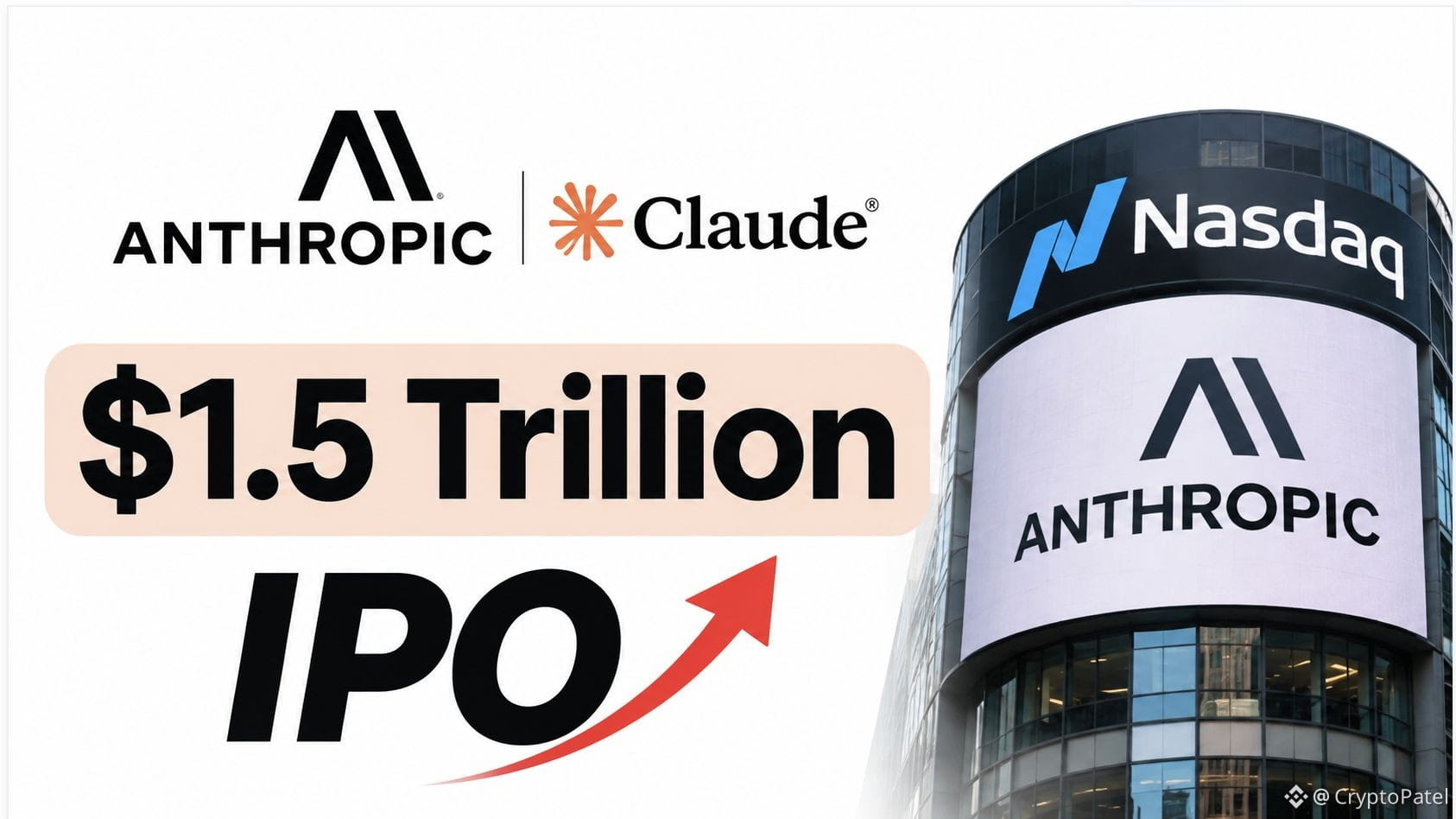
2
437

30D trade $TAO 35 USDT
BITTENSOR — $TAO and the economics of decentralized AI
🧠 DECENTRALIZED AI DOESN’T NEED ANOTHER HYPE CYCLE. IT NEEDS REAL DEMAND.
Bittensor is interesting because its long-term proposition goes beyond being another AI-themed cryptocurrency.
Its ambition is to create an ecosystem where independent subnets compete to provide digital resources and services.
An interesting institutional development:
Grayscale’s Bittensor Trust reported issuing 231,800 shares representing approximately 4,366.89 TAO, worth around $1.045 million, in private placement transactions.
This demonstrates an existing institutional access channel.
But let’s not confuse trust share issuance with confirmed open-market buying.
The bigger question remains:
Can Bittensor convert decentralized AI infrastructure into sustainable economic activity?
Three indicators matter:
* Subnet demand.
* Real usage and revenue.
* TAO’s relationship with the ecosystem’s economic activity.
My thesis: The next generation of AI investments may reward infrastructure that captures actual demand rather than projects that simply attach AI to their marketing.
TAO deserves attention, but adoption must validate the valuation.
#bittensor #TAO #DecentralizedAI #artificialintelligence #MannequinCrypto
📊 POLL
What will ultimately determine TAO’s long-term value?
BITTENSOR — $TAO and the economics of decentralized AI
🧠 DECENTRALIZED AI DOESN’T NEED ANOTHER HYPE CYCLE. IT NEEDS REAL DEMAND.
Bittensor is interesting because its long-term proposition goes beyond being another AI-themed cryptocurrency.
Its ambition is to create an ecosystem where independent subnets compete to provide digital resources and services.
An interesting institutional development:
Grayscale’s Bittensor Trust reported issuing 231,800 shares representing approximately 4,366.89 TAO, worth around $1.045 million, in private placement transactions.
This demonstrates an existing institutional access channel.
But let’s not confuse trust share issuance with confirmed open-market buying.
The bigger question remains:
Can Bittensor convert decentralized AI infrastructure into sustainable economic activity?
Three indicators matter:
* Subnet demand.
* Real usage and revenue.
* TAO’s relationship with the ecosystem’s economic activity.
My thesis: The next generation of AI investments may reward infrastructure that captures actual demand rather than projects that simply attach AI to their marketing.
TAO deserves attention, but adoption must validate the valuation.
#bittensor #TAO #DecentralizedAI #artificialintelligence #MannequinCrypto
📊 POLL
What will ultimately determine TAO’s long-term value?
🧠 DECENTRALIZED AI DOESN’T NEED ANOTHER HYPE CYCLE. IT NEEDS REAL DEMAND.
Bittensor is interesting because its long-term proposition goes beyond being another AI-themed cryptocurrency.
Its ambition is to create an ecosystem where independent subnets compete to provide digital resources and services.
An interesting institutional development:
Grayscale’s Bittensor Trust reported issuing 231,800 shares representing approximately 4,366.89 TAO, worth around $1.045 million, in private placement transactions.
This demonstrates an existing institutional access channel.
But let’s not confuse trust share issuance with confirmed open-market buying.
The bigger question remains:
Can Bittensor convert decentralized AI infrastructure into sustainable economic activity?
Three indicators matter:
* Subnet demand.
* Real usage and revenue.
* TAO’s relationship with the ecosystem’s economic activity.
My thesis: The next generation of AI investments may reward infrastructure that captures actual demand rather than projects that simply attach AI to their marketing.
TAO deserves attention, but adoption must validate the valuation.
#bittensor #TAO #DecentralizedAI #artificialintelligence #MannequinCrypto
📊 POLL
What will ultimately determine TAO’s long-term value?
Subnet revenue
0%
Real AI adoption
100%
Institutional demand
0%
Network economics
0%
1 votes • Voting closed
240

🚀 NVIDIA is no longer just a chip company — it has become one of the biggest conversations in the AI era.
From data centers to AI models, demand for high-performance computing keeps putting NVIDIA at the center of the tech world. But the real story isn’t only about GPUs—it’s about the race for AI infrastructure, cloud computing, robotics, and the next generation of digital innovation.
The market is watching one question closely:
Can NVIDIA keep turning AI hype into long-term growth?
Big expectations bring big attention—and also bigger volatility. Still, one thing is clear: when AI moves, NVIDIA is usually part of the conversation. 👀
$NVDAB
{spot}(NVDABUSDT)
$MMT
{future}(MMTUSDT)
$BLESS
{future}(BLESSUSDT)
#NVDA #AI #TechStocks #artificialintelligence #CryptoCommunity
🚀 NVIDIA is no longer just a chip company — it has become one of the biggest conversations in the AI era.
From data centers to AI models, demand for high-performance computing keeps putting NVIDIA at the center of the tech world. But the real story isn’t only about GPUs—it’s about the race for AI infrastructure, cloud computing, robotics, and the next generation of digital innovation.
The market is watching one question closely:
Can NVIDIA keep turning AI hype into long-term growth?
Big expectations bring big attention—and also bigger volatility. Still, one thing is clear: when AI moves, NVIDIA is usually part of the conversation. 👀
$NVDAB
$MMT
$BLESS
#NVDA #AI #TechStocks #artificialintelligence #CryptoCommunity
From data centers to AI models, demand for high-performance computing keeps putting NVIDIA at the center of the tech world. But the real story isn’t only about GPUs—it’s about the race for AI infrastructure, cloud computing, robotics, and the next generation of digital innovation.
The market is watching one question closely:
Can NVIDIA keep turning AI hype into long-term growth?
Big expectations bring big attention—and also bigger volatility. Still, one thing is clear: when AI moves, NVIDIA is usually part of the conversation. 👀
$NVDAB
$MMT
$BLESS
#NVDA #AI #TechStocks #artificialintelligence #CryptoCommunity
522
Log in to explore more content
Join global crypto users on Binance Square
⚡️ Get latest and useful information about crypto.
💬 Trusted by the world’s largest crypto exchange.
👍 Discover real insights from verified creators.
Email / Phone number
Trending Topics
1
#CanBTCReboundAfterFallingBelow60K?
379,243 views
1,596 Discussing
2
#GlobalStocksFaceLongestLosingStreakSince2023
123,905 views
1,122 Discussing
3
#BlackRockIBITPostsRecord$541MSingleDayOutflow
755 views
20 Discussing
4
#AnthropicPlungesTowardIPOPriceonDay2
60,203 views
608 Discussing
5
#TwentyOneCapitalAdds172.25BTC
12,743 views
171 Discussing
6
#HKBillWouldExcludeTokenizedDepositsFromVirtualAssets
1,072 views
18 Discussing
7
#BNBDropsBelow540USDTWith8.46%DailyDecline
33,483 views
285 Discussing
8
#HKBillProposesHK$100KFineForUnauthorizedCryptoTitles
1,100 views
17 Discussing
9
#BitMineFaces$10.1BUnrealizedETHLoss
2,051 views
20 Discussing
10
#StrategyReports$35BNetReserves
2,089 views
18 Discussing