
#deutschebank
deutschebank
74,083 views
241 Discussing
Hot
Latest


·
--
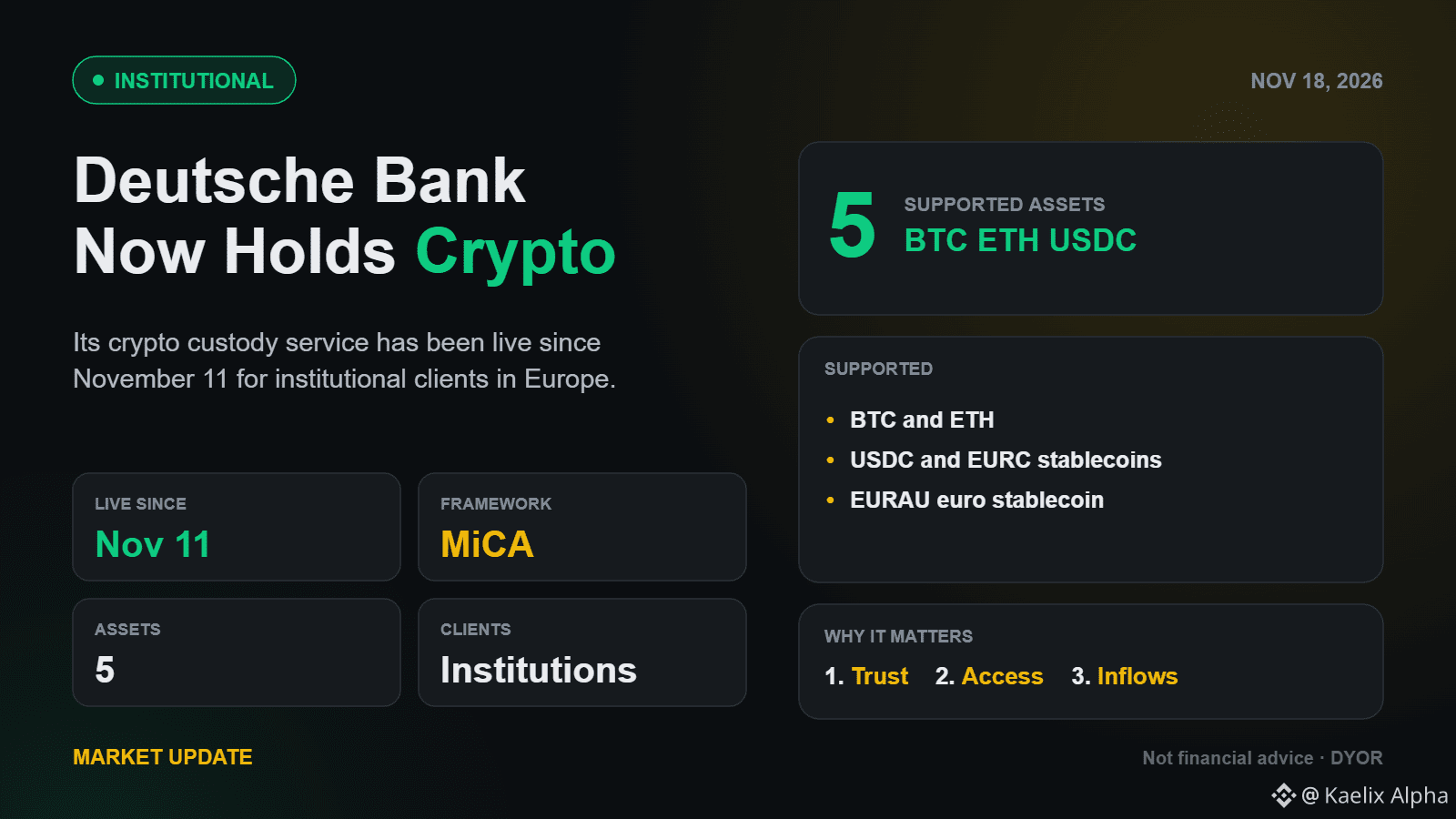
𝗗𝗲𝘂𝘁𝘀𝗰𝗵𝗲 𝗕𝗮𝗻𝗸 𝗡𝗼𝘄 𝗛𝗼𝗹𝗱𝘀 𝗖𝗿𝘆𝗽𝘁𝗼 𝗳𝗼𝗿 𝗖𝗹𝗶𝗲𝗻𝘁𝘀. 𝗪𝗵𝘆 𝗧𝗵𝗮𝘁 𝗜𝘀 𝗮 𝗕𝗶𝗴 𝗗𝗲𝗮𝗹
𝗪𝗵𝗮𝘁 𝗛𝗮𝗽𝗽𝗲𝗻𝗲𝗱
Deutsche Bank's crypto custody service has been live since November 11. Institutional clients in Europe can now hold $BTC , $ETH , USDC, EURC and EURAU with one of the largest banks on the continent.
𝗪𝗵𝘆 𝗜𝘁 𝗠𝗮𝘁𝘁𝗲𝗿𝘀
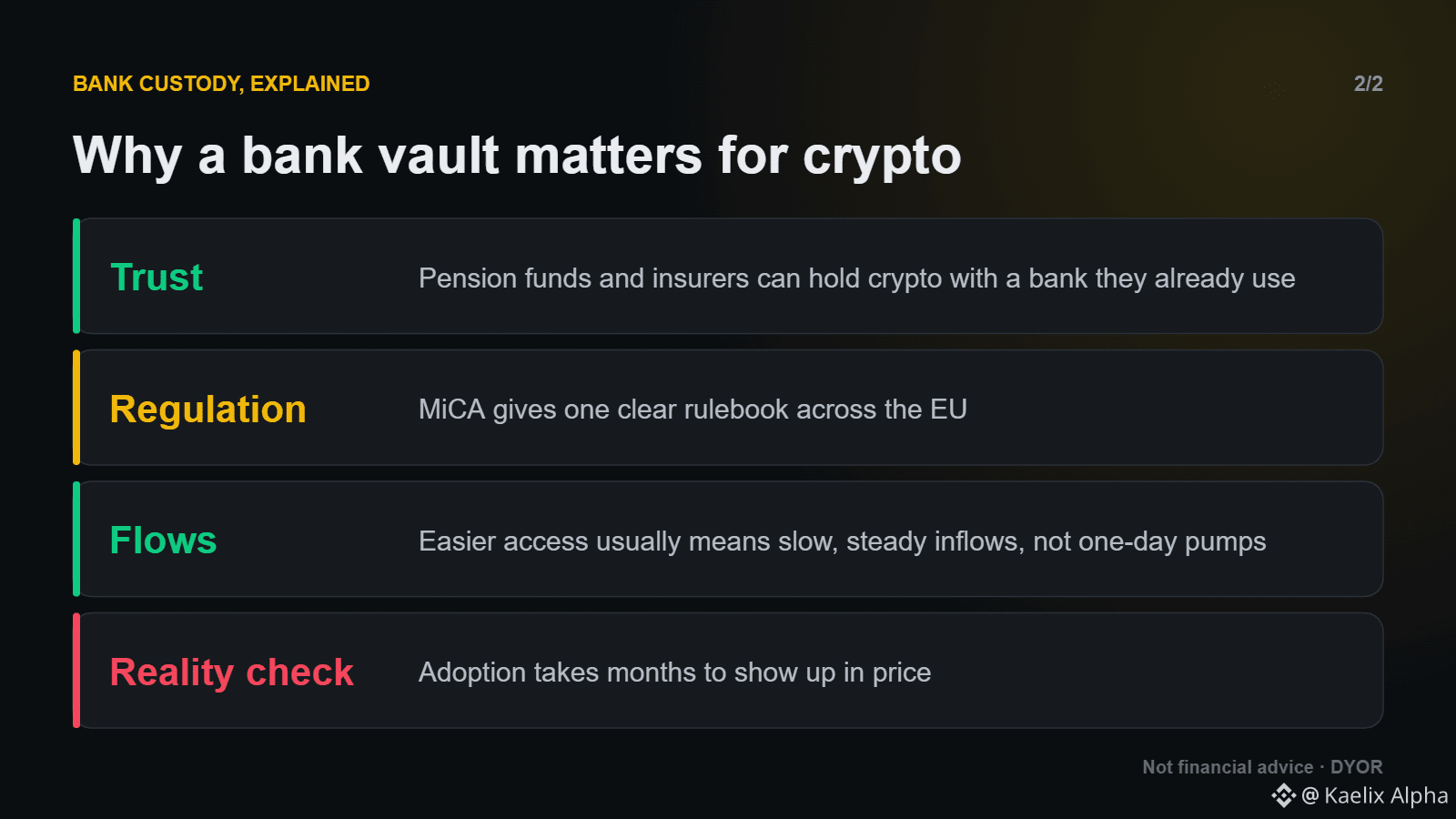
Many large funds cannot buy crypto unless a trusted, regulated custodian holds it. Pension funds and insurers want the same bank that already holds their bonds and equities. This removes one of the biggest practical blockers.
𝗧𝗵𝗲 𝗠𝗶𝗖𝗔 𝗔𝗻𝗴𝗹𝗲
Europe's MiCA rules give banks one clear framework across the EU. That clarity is exactly why traditional players are moving now instead of waiting.
𝗛𝗼𝘄 𝗜 𝗥𝗲𝗮𝗱 𝗜𝘁
This is not a price catalyst for tomorrow. Custody news builds the pipes, and money flows through them over months. In a market sitting in Extreme Fear, that kind of slow, structural progress is easy to ignore and important to notice.
Do you think European institutions will move faster than US ones this cycle?
Not financial advice. DYOR.
#Write2Earn #DeutscheBank #InstitutionalAdoption #MiCA #CryptoNews
189

·
--
Bearish
Verified
🚨 BREAKING: DEUTSCHE BANK EXPOSED IN A MASSIVE LEAK INVOLVING EPSTEIN, TRUMP AND RUSSIAN OLIGARCHS.
15 MILLION leaked internal emails and documents are raising serious questions about one of the world's biggest banks.
Here's what the files reportedly reveal:
💰 $582 MILLION in suspicious payments linked to Jeffrey Epstein.
🇺🇸 Trump's tax statements were reportedly leaked in 2017.
🇷🇺 Connections involving Russian oligarchs and alleged money laundering.
⚠️ Deutsche Bank allegedly failed to drop 28,000 high-risk clients.
And the market is already reacting.
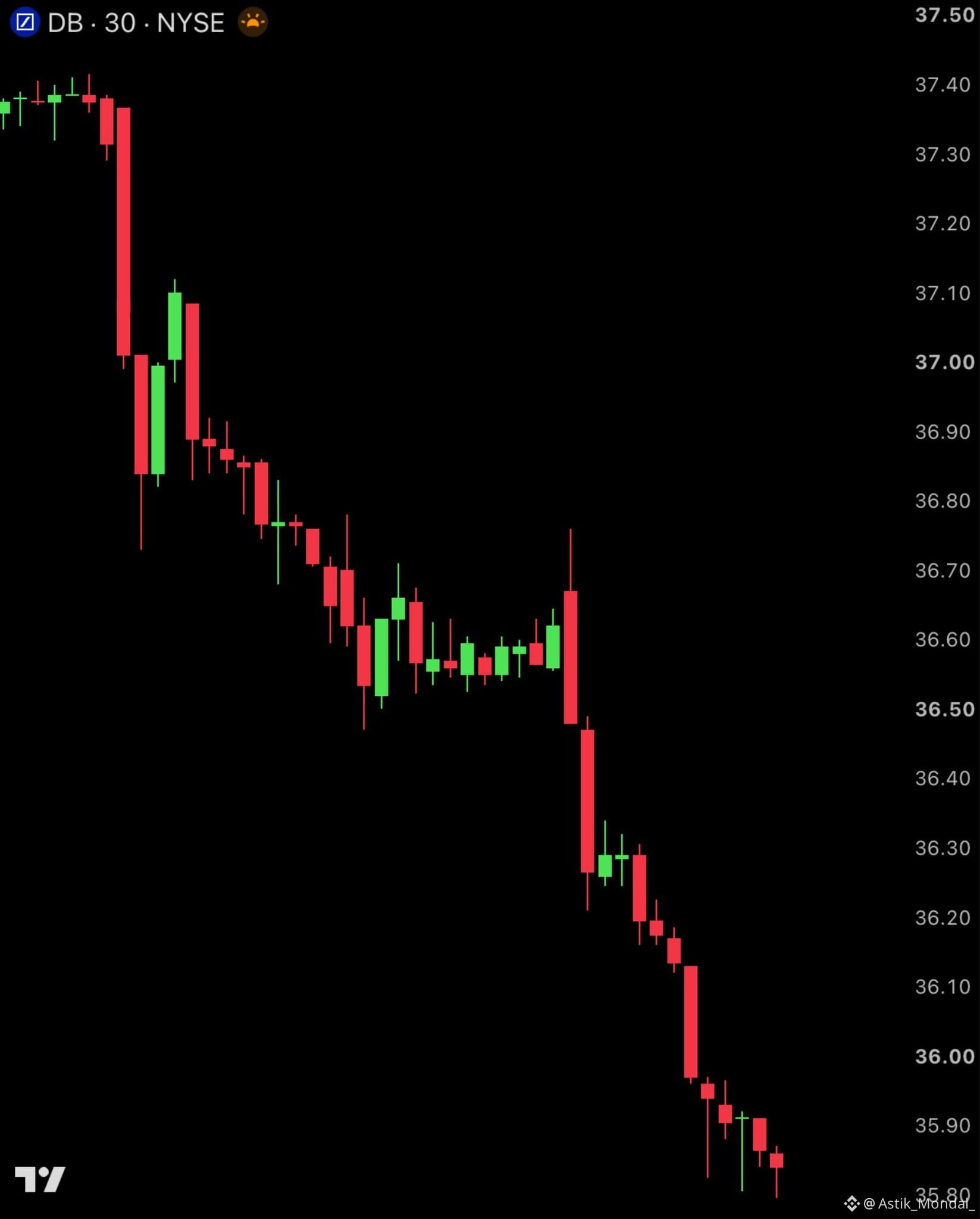
$DB shares are down more than 3% as the allegations emerge.
But the bigger question isn't just about the stock price.
How deep do these alleged connections go, and what could this mean for Deutsche Bank's legal exposure, regulatory scrutiny and reputation?
A banking scandal of this scale could have consequences far beyond a single trading session.
Wall Street is watching. Regulators may have some serious questions to answer.
#DeutscheBank #Epstein #WallStreet #BankingCrisis #StockMarket
DBUS+0.08%
2
2.1k
.🚨 JUST IN: DEUTSCHE BANK'S EPSTEIN CONNECTION REVEALED
Deutsche Bank continued doing business with Jeffrey Epstein in 2013, years after his conviction, according to leaked files.
And the revelations are massive.
Whistleblowers reportedly handed over more than 15 MILLION FILES to over 50 newsrooms, marking the largest known bank leak.
The documents expose a disturbing financial trail.
Deutsche Bank later flagged approximately $600 MILLION in suspicious transactions tied to Epstein.
Think about that.
Millions of documents. Dozens of newsrooms. Hundreds of millions of dollars in suspicious transactions.
The biggest question now:
How deep did Epstein's financial network really go, and who else knew about it?
#JeffreyEpstein #DeutscheBank #BreakingNews #Banking #Finance

DBUS+0.08%
1
220

·
--
Deutsche Bank faces pressure after leak of over 15 million documents
📉 Deutsche Bank shares fell more than 6% intraday on November 17 following investigations based on leaked internal records, renewing concerns over governance and risk controls.
📂 The files reveal weaknesses in client monitoring and the pursuit of Russian business despite internal warnings.
💵 According to the FT, the bank reported $582 million in suspicious transactions linked to Jeffrey Epstein. This does not establish that all the payments involved criminal activity.
🏦 Deutsche Bank said the matters date back many years, controls have improved and it expects no meaningful financial impact.
🔎 The selling pressure reflects uncertainty over further revelations. Regulatory responses and potential new financial liabilities will shape how long that pressure persists.
#DeutscheBank $ZEC
DBUS+0.08%
32

Germany’s largest bank, Deutsche Bank, officially launched digital asset custody on November 11—not just talk, but a real service for clients: it serves only institutional and corporate customers; retail investors can’t get in. At launch, it will custody just five assets: Bitcoin, Ethereum, and three stablecoins—USDC, EURC, and EURAU. The bank manages the private keys for you, and transfers also go through its banking channels. It’s backed by a German BaFin license and the EU’s MiCA framework: announced on September 16, added to the ESMA register on October 12, and launched on November 11—not a single step skipped. The irony is that in the same week, BTC fell below $62,000 over the weekend, the Fear & Greed Index briefly dropped to 10 (extreme fear), and ETFs saw $1.07 billion in outflows for the week—the market was panicking while the bank was opening its doors. Institutions don’t wait for confirmation that the bottom is in before entering; they lay the groundwork when nobody dares to look. #DeutscheBank #BitcoinCustody
Germany’s largest bank, Deutsche Bank, officially launched digital asset custody on November 11—not just talk, but a real service for clients: it serves only institutional and corporate customers; retail investors can’t get in. At launch, it will custody just five assets: Bitcoin, Ethereum, and three stablecoins—USDC, EURC, and EURAU. The bank manages the private keys for you, and transfers also go through its banking channels. It’s backed by a German BaFin license and the EU’s MiCA framework: announced on September 16, added to the ESMA register on October 12, and launched on November 11—not a single step skipped. The irony is that in the same week, BTC fell below $62,000 over the weekend, the Fear & Greed Index briefly dropped to 10 (extreme fear), and ETFs saw $1.07 billion in outflows for the week—the market was panicking while the bank was opening its doors. Institutions don’t wait for confirmation that the bottom is in before entering; they lay the groundwork when nobody dares to look. #DeutscheBank #BitcoinCustody

172

·
--
Verified
Article
Deutsche Bank loses US$4.2 billion as traditional banking trembles againA new earthquake is shaking European banking. Deutsche Bank, Germany’s largest private bank, opened Tuesday down nearly 6% on the Frankfurt Stock Exchange after an international consortium of journalists published an investigation based on the leak of more than 15 million of the institution’s internal documents. The plunge cost the bank around €3.8 billion in market capitalization, or about US$4.2 billion at the current exchange rate.
According to reports, the leaked material—emails, reports, presentations and even calendar notes—suggests that the bank may have prioritized its commercial revenue over warnings from its own compliance departments, particularly regarding its relationships with high-risk clients and anti-money-laundering controls. Media outlets including Der Spiegel, ZDF, The New York Times and the Financial Times took part in the investigation.
Deutsche Bank loses US$4.2 billion as traditional banking trembles again
A new earthquake is shaking European banking. Deutsche Bank, Germany’s largest private bank, opened Tuesday down nearly 6% on the Frankfurt Stock Exchange after an international consortium of journalists published an investigation based on the leak of more than 15 million of the institution’s internal documents. The plunge cost the bank around €3.8 billion in market capitalization, or about US$4.2 billion at the current exchange rate.
According to reports, the leaked material—emails, reports, presentations and even calendar notes—suggests that the bank may have prioritized its commercial revenue over warnings from its own compliance departments, particularly regarding its relationships with high-risk clients and anti-money-laundering controls. Media outlets including Der Spiegel, ZDF, The New York Times and the Financial Times took part in the investigation.
According to reports, the leaked material—emails, reports, presentations and even calendar notes—suggests that the bank may have prioritized its commercial revenue over warnings from its own compliance departments, particularly regarding its relationships with high-risk clients and anti-money-laundering controls. Media outlets including Der Spiegel, ZDF, The New York Times and the Financial Times took part in the investigation.
DBUS+0.08%
2.2k

🚨 A BANKING GIANT JUST ENTERED THE CRYPTO SPACE!
Germany's Deutsche Bank has officially launched its digital asset custody service for institutional clients.
₿ The service supports Bitcoin, Ethereum and selected stablecoins.
💡 Why it matters: Traditional banking is moving closer to digital assets.
🌍 Could this accelerate institutional crypto adoption?
#DeutscheBank #Bitcoin #Ethereum #CryptoAdoption

67

·
--
Deutsche Bank launched crypto custody on Nov 11 for institutional clients: BTC, ETH, USDC, EURC and EURAU. No trading; Germany first, EU cross-border. XRP and SOL not included yet. #DeutscheBank #Crypto
YouTube: youtube.com/@aibarfasi | TikTok: tiktok.com/@aibarfasi.vn
Deutsche Bank launched crypto custody on Nov 11 for institutional clients: BTC, ETH, USDC, EURC and EURAU. No trading; Germany first, EU cross-border. XRP and SOL not included yet. #DeutscheBank #Crypto
YouTube: youtube.com/@aibarfasi | TikTok: tiktok.com/@aibarfasi.vn
YouTube: youtube.com/@aibarfasi | TikTok: tiktok.com/@aibarfasi.vn
191

Verified
📉 BITCOIN IS FALLING, BUT WALL STREET IS MOVING IN
Bitcoin is facing renewed selling pressure, and uncertainty is spreading across the crypto market.
But something interesting is happening behind the scenes.
Deutsche Bank has launched a digital asset custody service for institutional clients, supporting assets including Bitcoin, Ethereum, and selected stablecoins.
Think about that for a moment.
While short-term investors are worried about falling prices, major financial institutions are building infrastructure to handle digital assets.
This reveals an important distinction:
Market prices reflect today's sentiment. Institutional infrastructure reflects long-term positioning.
A falling market doesn't automatically mean the industry is moving backwards.
Sometimes, the biggest developments happen while prices are falling.
#Bitcoin #Crypto #DeutscheBank
{spot}(NVDABUSDT)
$BTC #InstitutionalAdoption
📉 BITCOIN IS FALLING, BUT WALL STREET IS MOVING IN
Bitcoin is facing renewed selling pressure, and uncertainty is spreading across the crypto market.
But something interesting is happening behind the scenes.
Deutsche Bank has launched a digital asset custody service for institutional clients, supporting assets including Bitcoin, Ethereum, and selected stablecoins.
Think about that for a moment.
While short-term investors are worried about falling prices, major financial institutions are building infrastructure to handle digital assets.
This reveals an important distinction:
Market prices reflect today's sentiment. Institutional infrastructure reflects long-term positioning.
A falling market doesn't automatically mean the industry is moving backwards.
Sometimes, the biggest developments happen while prices are falling.
#Bitcoin #Crypto #DeutscheBank
$BTC #InstitutionalAdoption

8
575

·
--
Deutsche Bank is making another move into digital assets.
According to reports from The Block and Cointelegraph, its crypto custody service is now live for institutional clients in Europe.
Why does this matter?
For years, one of crypto's biggest institutional questions has been simple:
Who can securely hold the assets?
Now a major global bank is entering that conversation with its own custody offering.
This doesn't make crypto risk-free. And custody isn't the same as deposit insurance.
But it signals something important:
Crypto infrastructure is increasingly becoming part of traditional finance's business.
The next competition may not just be about which assets institutions buy.
It may be about who gets trusted to hold them.
#Crypto #Bitcoin #DeutscheBank
64

Article
Deutsche Bank integrates Bitcoin custody into institutional banking$BTC
{spot}(BTCUSDT)
Germany’s largest bank, Deutsche Bank, has officially launched a digital asset custody service for institutional clients across Europe, incorporating Bitcoin, Ether, and regulated stablecoins into its banking infrastructure. The launch, which took place on November 11, marks another significant step toward integrating cryptocurrency services into the traditional financial system (TradFi).
The launch by this TradFi giant is the culmination of years of preparation, rigorous regulatory scrutiny, and technical development. It provides corporate and institutional clients with access to the custody and transfer of digital assets, eliminating the need for them to operate their own storage infrastructure.
According to a Reuters report published on Wednesday, November 11, 2026, Deutsche Bank confirmed that its asset custody platform is now serving paying clients. This announcement follows the bank’s disclosure on September 16 regarding its plans to introduce regulated cryptocurrency custody by the end of the year.
Deutsche Bank Launches Institutional Crypto Custody Service in Compliance with MiCA
The new service supports Bitcoin (BTC) and Ether (ETH), as well as three stablecoins and e-money tokens: USDC, EURC, and EURAU. Rather than requiring institutions to secure their own digital assets, Deutsche Bank assumes responsibility for safeguarding cryptographic credentials and managing client assets within a regulated banking framework.
To protect institutional client assets, the bank utilizes specialized cryptographic hardware, ensures strict segregation of client funds, and employs multi-layered identity verification alongside customized transaction permissions. Deutsche Bank clients can choose between internet-connected accounts and offline storage solutions. The platform operates through Deutsche Bank AG in Frankfurt and is accessed via the "Autobahn" gateway and the "Corporate Bank" portal. Eligible clients include corporations, hedge funds, asset management firms, brokers, custodians, and sovereign institutions. Retail clients are not eligible for this offering.
The launch follows an application submitted by Deutsche Bank to the German financial regulator, BaFin, in June 2023. Subsequently, the institution received authorization under the European Union’s Markets in Crypto-Assets (MiCA) regulation, allowing it to provide regulated custody and transfer services.
Initially, the authorization was limited to Germany, but its scope was later extended to the entire European Economic Area through regulatory passporting arrangements. Paul Maley, Global Head of Securities Services at Deutsche Bank, outlined the institution's long-term ambitions.
Maley stated:
"In the medium term, we aim to build a fully integrated, regulated ecosystem that supports the custody, tokenization, and settlement of digital assets."
For now, tokenized securities and expanded settlement capabilities remain future objectives rather than components of the initial custody product. Deutsche Bank and Deutsche Asset Management Explore the Realm of Tokenized Finance
Alongside the launch of its custody service, Deutsche Bank also announced the signing of a Memorandum of Understanding (MOU) with Deutsche Asset Management—an investment manager formerly known as DWS. The agreement aims to "explore opportunities for comprehensive commercial and technical collaboration in the field of digital assets."
This latest announcement from Deutsche Bank comes amid an ongoing expansion of cryptocurrency-related activities among established financial institutions. On Monday, November 9, financial services giant Charles Schwab expanded its direct cryptocurrency trading offerings beyond Bitcoin and Ether, adding three additional tokens for eligible retail clients. These additions follow a broader launch by Schwab in October across all supported U.S. jurisdictions.
Although these companies target different client bases across various regions, both moves demonstrate how traditional financial institutions (TradFi) are rapidly integrating digital assets into their existing financial services. It should be noted, however, that Deutsche Bank’s custody service is not a full-fledged cryptocurrency exchange or trading platform. Furthermore, clients remain exposed to digital asset price volatility and cybersecurity threats, and the protections offered differ from those associated with traditional bank deposits.
For European institutions, the next logical step involves gaining access to cryptocurrency custody services through established banking relationships. A more important question is whether Deutsche Bank can transform this foundation into a comprehensive tokenization and settlement business. Regulated custody creates the infrastructure, but it is sustained institutional demand that will ultimately determine its commercial significance.
#GermanyNews #DeutscheBank
Deutsche Bank integrates Bitcoin custody into institutional banking
$BTC
Germany’s largest bank, Deutsche Bank, has officially launched a digital asset custody service for institutional clients across Europe, incorporating Bitcoin, Ether, and regulated stablecoins into its banking infrastructure. The launch, which took place on November 11, marks another significant step toward integrating cryptocurrency services into the traditional financial system (TradFi).
The launch by this TradFi giant is the culmination of years of preparation, rigorous regulatory scrutiny, and technical development. It provides corporate and institutional clients with access to the custody and transfer of digital assets, eliminating the need for them to operate their own storage infrastructure.
According to a Reuters report published on Wednesday, November 11, 2026, Deutsche Bank confirmed that its asset custody platform is now serving paying clients. This announcement follows the bank’s disclosure on September 16 regarding its plans to introduce regulated cryptocurrency custody by the end of the year.
Deutsche Bank Launches Institutional Crypto Custody Service in Compliance with MiCA
The new service supports Bitcoin (BTC) and Ether (ETH), as well as three stablecoins and e-money tokens: USDC, EURC, and EURAU. Rather than requiring institutions to secure their own digital assets, Deutsche Bank assumes responsibility for safeguarding cryptographic credentials and managing client assets within a regulated banking framework.
To protect institutional client assets, the bank utilizes specialized cryptographic hardware, ensures strict segregation of client funds, and employs multi-layered identity verification alongside customized transaction permissions. Deutsche Bank clients can choose between internet-connected accounts and offline storage solutions. The platform operates through Deutsche Bank AG in Frankfurt and is accessed via the "Autobahn" gateway and the "Corporate Bank" portal. Eligible clients include corporations, hedge funds, asset management firms, brokers, custodians, and sovereign institutions. Retail clients are not eligible for this offering.
The launch follows an application submitted by Deutsche Bank to the German financial regulator, BaFin, in June 2023. Subsequently, the institution received authorization under the European Union’s Markets in Crypto-Assets (MiCA) regulation, allowing it to provide regulated custody and transfer services.
Initially, the authorization was limited to Germany, but its scope was later extended to the entire European Economic Area through regulatory passporting arrangements. Paul Maley, Global Head of Securities Services at Deutsche Bank, outlined the institution's long-term ambitions.
Maley stated:
"In the medium term, we aim to build a fully integrated, regulated ecosystem that supports the custody, tokenization, and settlement of digital assets."
For now, tokenized securities and expanded settlement capabilities remain future objectives rather than components of the initial custody product. Deutsche Bank and Deutsche Asset Management Explore the Realm of Tokenized Finance
Alongside the launch of its custody service, Deutsche Bank also announced the signing of a Memorandum of Understanding (MOU) with Deutsche Asset Management—an investment manager formerly known as DWS. The agreement aims to "explore opportunities for comprehensive commercial and technical collaboration in the field of digital assets."
This latest announcement from Deutsche Bank comes amid an ongoing expansion of cryptocurrency-related activities among established financial institutions. On Monday, November 9, financial services giant Charles Schwab expanded its direct cryptocurrency trading offerings beyond Bitcoin and Ether, adding three additional tokens for eligible retail clients. These additions follow a broader launch by Schwab in October across all supported U.S. jurisdictions.
Although these companies target different client bases across various regions, both moves demonstrate how traditional financial institutions (TradFi) are rapidly integrating digital assets into their existing financial services. It should be noted, however, that Deutsche Bank’s custody service is not a full-fledged cryptocurrency exchange or trading platform. Furthermore, clients remain exposed to digital asset price volatility and cybersecurity threats, and the protections offered differ from those associated with traditional bank deposits.
For European institutions, the next logical step involves gaining access to cryptocurrency custody services through established banking relationships. A more important question is whether Deutsche Bank can transform this foundation into a comprehensive tokenization and settlement business. Regulated custody creates the infrastructure, but it is sustained institutional demand that will ultimately determine its commercial significance.
#GermanyNews #DeutscheBank
12

·
--
Deutsche Bank Launches Crypto Custody for BTC, ETH and USDC
Germany's largest bank has rolled out digital asset custody for European corporate and institutional clients, supporting Bitcoin, Ethereum and major stablecoins after years of preparation.
The launch lands as tokenized assets surge past $337B — traditional finance is moving on-chain, and one of Europe's biggest banks just joined the shift.
Not financial advice.
$BTC $ETH #DeutscheBank #Crypto #Bitcoin #Ethereum

21

Deutsche Bank has gone live with its digital asset custody service for institutional and corporate clients in Europe. The offering covers Bitcoin, Ethereum, and stablecoins including USDC, with the bank managing wallets and private keys under MiCA rules. It also signed an MoU with its asset management arm to explore tokenized products.
$BTC $ETH $USDC #CoinVahini #DeutscheBank #CryptoCustody #InstitutionalCrypto
$BTC $ETH $USDC #CoinVahini #DeutscheBank #CryptoCustody #InstitutionalCrypto
1
121


Article
Deutsche Bank Launches Institutional Crypto CustodyDeutsche Bank has completed its 5 year buildup to launch a specialized crypto custody service for its institutional and corporate client base across Europe. This move signals a significant shift as one of the largest global financial institutions moves beyond exploration into live deployment of digital asset infrastructure.
The offering currently supports Bitcoin, Ethereum, and 3 stablecoins. For institutional allocators this removes a major hurdle in the adoption of digital assets by providing the regulatory and security rigor expected of a tier 1 global bank.
This development validates the growing demand for institutional grade custody solutions and bridges the gap between traditional finance and decentralized asset markets.
#DeutscheBank #CryptoCustody
Deutsche Bank Launches Institutional Crypto Custody
Deutsche Bank has completed its 5 year buildup to launch a specialized crypto custody service for its institutional and corporate client base across Europe. This move signals a significant shift as one of the largest global financial institutions moves beyond exploration into live deployment of digital asset infrastructure.
The offering currently supports Bitcoin, Ethereum, and 3 stablecoins. For institutional allocators this removes a major hurdle in the adoption of digital assets by providing the regulatory and security rigor expected of a tier 1 global bank.
This development validates the growing demand for institutional grade custody solutions and bridges the gap between traditional finance and decentralized asset markets.
#DeutscheBank #CryptoCustody
17

·
--
Article
Crypto Hired a BankThe most “bullish” crypto headline of the week is also its quietest surrender.
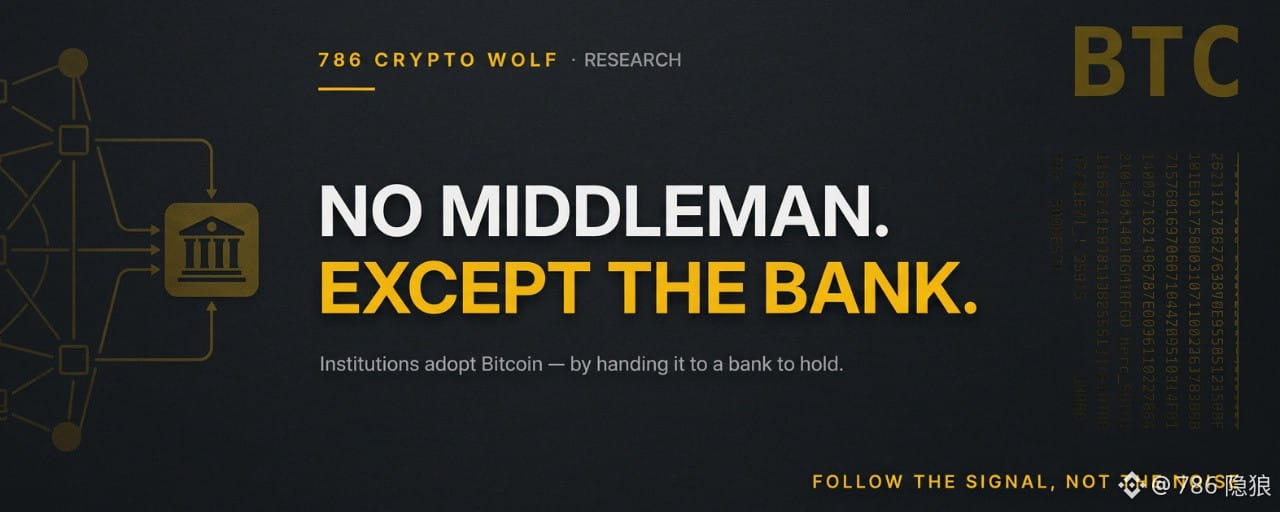
On November 11, Deutsche Bank — one of the largest banks on earth — switched on crypto custody for its institutional clients. Hedge funds, asset managers, corporations and sovereign institutions can now hand their Bitcoin, Ether and stablecoins to the bank to hold. Germany first, the rest of the EU under MiCA next, Asia in 2027.
The market read it as what it looks like: adoption. Another pillar. Institutions are in. And they’re not wrong.
But look at what “institutions are in” actually requires.
An institution will not touch Bitcoin until someone it trusts agrees to hold it. Not a promise of it — the actual keys. And the entity the financial world trusts most to hold things is the one Bitcoin was designed to make unnecessary: a bank.
So the headline everyone is cheering — “banks are custodying crypto” — is, underneath, a reversal. The asset built to remove the middleman is now held by the middleman. Self-custody was the whole point. Institutional crypto is custodial by definition.
That’s not a scandal. It’s the trade. Institutions don’t want to be their own bank; they want a bank. Deutsche Bank is simply the one that said yes first, at scale.
Here’s the part the “bullish milestone” posts skip.
When you deposit euros at Deutsche Bank, a deposit-guarantee scheme stands behind them up to a limit. If the bank fails, you’re covered. Custodied crypto is not a deposit. It’s an asset the bank holds for you — and it carries no such insurance. You get the bank’s name, its security, its reputation. You do not get the safety net that makes a bank deposit a bank deposit.
So the institution re-introduces the intermediary crypto was built to remove — and gives up the one protection that intermediary normally provides. Middleman back. Backstop gone.
Now the honest part, because it cuts two ways.
Read it one way, this is maturation: real custody, real regulation (BaFin, MiCA), real institutional money finally able to participate safely. Genuinely good for the asset class.
Read it another way, it’s crypto quietly becoming the thing it was built to replace — a system where a few trusted institutions hold everyone’s value, under rules written by regulators, with retail left out entirely (this launch skips retail).
Both are true. Adoption and decentralization are not the same direction. This week, they moved apart.
Every step toward “institutional adoption” is a step toward re-intermediation. The more crypto succeeds at being accepted, the more it resembles the banking system it set out to route around. That may not be failure — it might be inevitable. But it’s worth naming, because the people cheering “banks are in!” are cheering the exact outcome Bitcoin’s whitepaper was a rejection of.
If a bank now holds the Bitcoin, writes the rules with the regulator, and leaves retail outside — what, exactly, did Bitcoin decentralize?
🐺 786 CRYPTO WOLF · RESEARCH
Follow the signal, not the noise.
$BTC
#DeutscheBank #bitcoin #cryptocustody #AlphaWolfHQ #786CryptoWolf
Crypto Hired a Bank
The most “bullish” crypto headline of the week is also its quietest surrender.
On November 11, Deutsche Bank — one of the largest banks on earth — switched on crypto custody for its institutional clients. Hedge funds, asset managers, corporations and sovereign institutions can now hand their Bitcoin, Ether and stablecoins to the bank to hold. Germany first, the rest of the EU under MiCA next, Asia in 2027.
The market read it as what it looks like: adoption. Another pillar. Institutions are in. And they’re not wrong.
But look at what “institutions are in” actually requires.
An institution will not touch Bitcoin until someone it trusts agrees to hold it. Not a promise of it — the actual keys. And the entity the financial world trusts most to hold things is the one Bitcoin was designed to make unnecessary: a bank.
So the headline everyone is cheering — “banks are custodying crypto” — is, underneath, a reversal. The asset built to remove the middleman is now held by the middleman. Self-custody was the whole point. Institutional crypto is custodial by definition.
That’s not a scandal. It’s the trade. Institutions don’t want to be their own bank; they want a bank. Deutsche Bank is simply the one that said yes first, at scale.
Here’s the part the “bullish milestone” posts skip.
When you deposit euros at Deutsche Bank, a deposit-guarantee scheme stands behind them up to a limit. If the bank fails, you’re covered. Custodied crypto is not a deposit. It’s an asset the bank holds for you — and it carries no such insurance. You get the bank’s name, its security, its reputation. You do not get the safety net that makes a bank deposit a bank deposit.
So the institution re-introduces the intermediary crypto was built to remove — and gives up the one protection that intermediary normally provides. Middleman back. Backstop gone.
Now the honest part, because it cuts two ways.
Read it one way, this is maturation: real custody, real regulation (BaFin, MiCA), real institutional money finally able to participate safely. Genuinely good for the asset class.
Read it another way, it’s crypto quietly becoming the thing it was built to replace — a system where a few trusted institutions hold everyone’s value, under rules written by regulators, with retail left out entirely (this launch skips retail).
Both are true. Adoption and decentralization are not the same direction. This week, they moved apart.
Every step toward “institutional adoption” is a step toward re-intermediation. The more crypto succeeds at being accepted, the more it resembles the banking system it set out to route around. That may not be failure — it might be inevitable. But it’s worth naming, because the people cheering “banks are in!” are cheering the exact outcome Bitcoin’s whitepaper was a rejection of.
If a bank now holds the Bitcoin, writes the rules with the regulator, and leaves retail outside — what, exactly, did Bitcoin decentralize?
🐺 786 CRYPTO WOLF · RESEARCH
Follow the signal, not the noise.
$BTC
#DeutscheBank #bitcoin #cryptocustody #AlphaWolfHQ #786CryptoWolf
1
316

🏦 DEUTSCHE BANK OFFICIALLY CUSTODIES BITCOIN AND ETHEREUM FOR INSTITUTIONAL CLIENTS!
💬 Deutsche Bank—the largest bank in Germany—has officially launched its digital asset custody service, marking a new step by a traditional financial institution into the crypto market.
In its initial phase, the service focuses on custody of the two leading digital assets, Bitcoin (BTC) and Ethereum (ETH), for corporate and institutional clients seeking paid services.
🚀 However, Deutsche Bank’s ambitions go beyond simply storing crypto. The bank is aiming to build a more comprehensive ecosystem that includes custody, tokenization, and digital asset payments.
Notably, Deutsche Bank has also signed a memorandum of understanding with Deutsche Asset Management (formerly DWS) to explore technology and business collaboration opportunities in this area.
🌏 The bank previously disclosed plans to expand its services into the Asian market.
In my view, a major bank like Deutsche Bank beginning to offer commercial crypto custody services shows that digital assets are becoming more deeply integrated into the traditional financial system.
What stands out is not only that $BTC and $ETH are supported, but also the ambition to connect custody, tokenization, and payments within a single ecosystem.
#bitcoin #Ethereum #DeutscheBank #CryptoAdoption
{future}(ETHUSDT)
{future}(BTCUSDT)
🏦 DEUTSCHE BANK OFFICIALLY CUSTODIES BITCOIN AND ETHEREUM FOR INSTITUTIONAL CLIENTS!
💬 Deutsche Bank—the largest bank in Germany—has officially launched its digital asset custody service, marking a new step by a traditional financial institution into the crypto market.
In its initial phase, the service focuses on custody of the two leading digital assets, Bitcoin (BTC) and Ethereum (ETH), for corporate and institutional clients seeking paid services.
🚀 However, Deutsche Bank’s ambitions go beyond simply storing crypto. The bank is aiming to build a more comprehensive ecosystem that includes custody, tokenization, and digital asset payments.
Notably, Deutsche Bank has also signed a memorandum of understanding with Deutsche Asset Management (formerly DWS) to explore technology and business collaboration opportunities in this area.
🌏 The bank previously disclosed plans to expand its services into the Asian market.
In my view, a major bank like Deutsche Bank beginning to offer commercial crypto custody services shows that digital assets are becoming more deeply integrated into the traditional financial system.
What stands out is not only that $BTC and $ETH are supported, but also the ambition to connect custody, tokenization, and payments within a single ecosystem.
#bitcoin #Ethereum #DeutscheBank #CryptoAdoption
116

🏦 GERMANY’S LARGEST BANK OFFICIALLY CUSTODIES CRYPTO FOR INSTITUTIONAL CLIENTS
Deutsche Bank confirmed that its digital asset custody service went live on 11/11/2026, for fee-paying corporate and institutional clients in Europe. The bank directly manages wallets and private keys on behalf of clients, initially supporting five assets: Bitcoin, Ethereum, USDC, EURC, and EURAU.
The service is launching in Germany under the EU’s MiCA framework and was licensed by BaFin on 12/10. On the same day, the bank signed a memorandum of understanding with Deutsche Asset Management (DWS) to explore tokenized funds and stablecoins — still only an exploratory step, not a product launch.
Note: The service is for institutions only and is not available to retail customers. Crypto assets are not covered by deposit insurance like bank deposits. Deutsche Bank plans to expand into Asian financial hubs in 2027.
Meanwhile, BTC is trading around $73,900, while $XCN is the biggest gainer over the past 24 hours, up 9.30%.
Do you think major banks entering crypto will help the market mature, or does it simply show that “big money” is getting involved?
#CryptoNews #Bitcoin #DeutscheBank #MiCA

184

·
--
Update on the September plan announcement: Deutsche Bank’s official page now lists a digital asset custody service available to Corporate Bank customers in Germany, with transfers and support for BTC, ETH, USDC, EURC, and EURAU. The service is for institutions, not individuals. What do you think about banks entering the custody business? 🏦🔐🌐 $BTC $ETH #DeutscheBank
Update on the September plan announcement: Deutsche Bank’s official page now lists a digital asset custody service available to Corporate Bank customers in Germany, with transfers and support for BTC, ETH, USDC, EURC, and EURAU. The service is for institutions, not individuals. What do you think about banks entering the custody business? 🏦🔐🌐 $BTC $ETH #DeutscheBank

118

·
--
Deutsche Bank’s crypto custody service officially goes live, bringing five years of planning to fruition and opening a channel for European institutions
Deutsche Bank’s crypto custody service has officially gone live, marking the culmination of nearly five years of infrastructure development by the European financial giant. According to Decrypt, the service can now provide institutional and corporate clients with custody for Bitcoin, Ethereum, and three types of stablecoins. Clients can store and transfer assets through the bank, which also manages their wallets on their behalf.
Based on publicly available information, the assets covered by Deutsche Bank’s custody service are clearly defined: Bitcoin, Ethereum, and three types of stablecoins. According to Cointelegraph, the bank will manage client wallets and handle related operations. This means Deutsche Bank is offering institutional and corporate clients an integrated custody service covering major crypto assets and stablecoins for the first time.
Why is this worth noting? In recent years, traditional financial institutions’ crypto initiatives have largely focused on channels such as trading, financing, and ETFs. But custody is a foundational part of the infrastructure and often a prerequisite for institutions to enter the market at scale. Deutsche Bank’s launch complements recent themes such as stablecoins and ETF fund flows, and its significance as a signal may outweigh its immediate impact in terms of scale.
It is worth noting that the five-year development period shows that bringing this kind of infrastructure to market is no overnight process. Although the assets covered by the service have been specified, the actual volume held in custody is expected to be limited at launch, and it will take time to verify real inflows. Some observers see this as a continuation of an existing institutional trend, with the incremental signal potentially weaker than the market expects.
It remains unclear how the market will react. The expansion of institutional channels is a supportive factor over the long term, but prices may not respond strongly in the short term, especially before the actual custody volume becomes clear. One counterpoint is that similar “milestone” announcements have appeared repeatedly, and the market is becoming less sensitive to them. Without supporting data on actual inflows, any sentiment-driven premium may be limited.
What will be worth watching next is whether Deutsche Bank discloses the actual volume held in custody, whether it attracts more institutional clients, and whether custody volumes for these stablecoins and major cryptocurrencies can reinforce recent ETF fund flows and stablecoin-related themes. If the launch is merely symbolic and is not followed by substantial expansion, the market reaction may be muted.
#DeutscheBank #Bitcoin #CryptoAdoption
The above is a compilation of information and personal analysis, and does not constitute investment advice.
Follow me for ongoing coverage of key market developments and data.
66

·
--
Deutsche Bank’s crypto custody service goes live, opening the door to European institutions after five years of development
The channels connecting traditional finance to crypto are gradually opening up, and this time the key player is a heavyweight in European banking. According to reports by Decrypt and Cointelegraph, Deutsche Bank has officially launched a cryptocurrency custody service, offering institutional and corporate clients storage, transfers, and wallet management for Bitcoin, Ethereum, and three stablecoins.
This service did not come together overnight. According to the two sources, Deutsche Bank built its custody platform from the ground up over five years before officially bringing it to market. Launching at this point, with BTC and ETH named among the first supported assets alongside stablecoin use cases, suggests this is more than a tentative move: the bank is incorporating crypto assets into its standard service framework for institutional clients.
From a capital-flow and macro perspective, the real significance lies in the “gateway.” European institutions seeking crypto exposure have often had to use third-party custodians or exchanges, resulting in long chains and high trust costs. As a systemically important European bank, Deutsche Bank could provide a more familiar entry point for European pension funds, family offices, and corporate treasuries once its custody licensing and compliance systems are in place. BTC’s inclusion among the first supported assets reflects its status as a likely priority for this kind of conservative capital. Broadening institutional access is a positive longer-term development for Bitcoin.
However, the scale and pace should be viewed cautiously. Based on the information available, Deutsche Bank has not disclosed the actual assets under custody, so it remains uncertain how much additional capital the launch will attract initially. Five years of development has delivered infrastructure, not an immediate influx of funds. The launch means assets “can now be held” in custody—not that large sums have already been deposited—so its near-term impact on prices may be limited.
The counterarguments are also clear. First, custody is not the same as allocation. Whether clients will actually increase their holdings because the service has launched depends on the custody volumes reported going forward. Second, European institutions remain constrained by macro liquidity, interest-rate trajectories, and risk appetite. Expanding a single channel is unlikely to reverse the overall pace of capital flows.
What to watch next: The more important indicators are whether Deutsche Bank discloses its custody volumes, adds more asset classes, and whether there are observable signs of inflows from European institutions. From a trading perspective, rather than treating the custody launch as a price catalyst, it may be better to wait for confirmation from actual capital flows and the market. In the short term, BTC’s trading volume and funding rates are more worth watching than chasing a single headline.
$BTC #DeutscheBank #CryptoCustody
The above is a summary of information and personal analysis, and does not constitute investment advice.
Follow me for ongoing coverage of key market developments and data.
87
Log in to explore more content
Join global crypto users on Binance Square
⚡️ Get latest and useful information about crypto.
💬 Trusted by the world’s largest crypto exchange.
👍 Discover real insights from verified creators.
Email / Phone number
Trending Topics
1
#WillMarketsStageAThanksgivingReliefRally?
25,629 views
515 Discussing
2
#BessentSoftensStanceOnHuang’sNvidiaReturn
17,636 views
353 Discussing
3
#EvolveAtBinanceBlockchainWeek
11,012 views
189 Discussing
4
#MuskWarnsOfAICashCrunch
16,506 views
267 Discussing
5
#BitcoinETFOutflowsAccelerate
0 views
0 Discussing
6
#SouthKoreaToTightenOversightOfCryptoTransfersAbroad
1,295 views
29 Discussing
7
#RussiaAllowsExchangesToOfferCryptoTrading
7,947 views
145 Discussing
8
#UKToBarCryptoExchangesFromMakingMarketsOnTheirOwnPlatforms
476 views
20 Discussing
9
#UKTreasurySignsCryptoMarketMakingExemptionRules
3,112 views
114 Discussing
10
#BTCReboundsAbove$60KAmidWhaleDipBuying
135,072 views
444 Discussing