
#genlayer
genlayer
573 views
13 Discussing
Hot
Latest

Both sides are getting it wrong in the debate over GenLayer’s tokenomics changes. Those yelling “rug” have the wrong target, while those saying “TGE unlocks cut from 30.4% to 16%—bullish” haven’t finished doing the math.
Let’s give the team some credit where it’s due: the criticized “25% at launch + 12 months” applies to the Early Ecosystem pool of 231 million GEN, not the claiming rules for individual airdrops. The official post on 11/18 explicitly stated that the community airdrop terms hadn’t changed. There’s no evidence to support claims that they secretly changed the airdrop right before TGE.
But take “longer lockups” with a grain of salt. I went through the November tokenomics PDF: Of the 602.5 million GEN withheld at TGE, 145.76 million from the Foundation is released in months 1–2, and 173.25 million from Early Ecosystem is fully released within 12 months. Together, that’s 319 million, about 53% of the amount “additionally locked” this time around. The remaining 283.5 million is the team and advisor allocation within the Foundation, which follows the early contributor schedule, with 25% released at the month-12 cliff. By my calculations, roughly 65% of the “additionally locked” tokens are back in circulation within a year. Put simply, some of the sell pressure has just been shifted from TGE day to the first few months and the first year after TGE.
The date to really watch is month 12. The PDF itself says that’s when the cliffs for investors, early contributors, Labs, and the Foundation team allocations coincide, unlocking 795 million GEN in one go—about 18.9% of genesis supply, more than at TGE itself. Transferable supply rises from 16% at TGE to 44% by month 12, nearly tripling in a year.
One more thing that’s easy to overlook: lockups restrict transfers, not staking. Except for the DAO’s 210 million GEN, all allocations can be staked from genesis. About 361 million GEN (8.6% of genesis supply) will be issued to stakers in the first year. The only fix this time is that rewards earned on locked tokens remain locked alongside the principal. Labs and the Foundation have committed to self-staking no more than 10% of their own allocations; investors and early contributors have no such cap. The yield retail stakers receive is shared with a pile of institutional tokens that haven’t even unlocked yet.
16% circulating at launch, 44% circulating by year-end—that’s a classic low-float, high-FDV launch. It’s not a rug, but don’t treat “fewer tokens released at TGE” as bullish either. #GenLayer
The funniest thing about GenLayer’s Greyboxing promo isn’t the technology—it’s the replies.
For context: In May this year, someone hid a transfer instruction in Morse code in an X post. Grok decoded it and sent it to Bankrbot, which moved roughly $150,000–$200,000 worth of coins on Base. GenLayer used the incident to tell a story: multiple validators independently rewrite the input in secret, then reach consensus—and supposedly that makes prompt injection impossible.
Then you scroll through the replies under GenLayer’s post:
The reply from @langtusg0308 ends with this sentence, left in verbatim: "These stay short, stick to the post's points, and keep the focus on GenLayer without sounding like pure promo. Use"
They posted it without even removing the prompt they used to write the reply.
The replies from @0xBisex, @bitkeepwallet, and @Folloback99 all have English quotation marks around them, and their tone is exactly the same. It’s obvious they were copied from somewhere. Randy.base.eth’s main post got 4,289 views and 21 reposts, and claims like "Zero single points of failure" and "attacks impossible to train" are more sweeping than an audit report.
A project about preventing AI from being injected is relying on a bunch of AI-generated replies to promote itself. The irony could keep me laughing all day.
But back to the actual issue. Having multiple validators rewrite the input is essentially adding several more layers of model filtering, which increases both cost and latency. There’s no publicly available attack-and-defense data to back up claims like "impossible to break." The replies that actually got to the heart of the matter came from smaller accounts: @EMEF0815 asked whether spending limits can be enforced independently of agent instructions, and @GuruVerseX asked whether tweets will first be labeled as untrusted input. Until those two questions are clearly answered, Greyboxing is just a catchy name.
The truly reliable basics of AI wallet security are still the same three things: spending caps, whitelisted addresses, and manual confirmation for large transactions. Don’t get dazzled by "decentralized consensus prevents injection."
#AI #GenLayer
2

·
--
Day 2 of farming GenLayer Season 2 🧠
My first mission submission is in review, and Season 2 runs all the way to mainnet, so it's not too late to start.
Why I'm in: GenLayer is building Intelligent Contracts, smart contracts that can read the web and reason with AI. Early contributors get points.
How to start:
1. Connect wallet on the GenLayer portal
2. Pick a mission
3. Post, then submit your link
Who else is farming? 👇
$BNB #GenLayer #Airdrop
81

·
--
🔥 A new project in the world of AI and blockchain worth following$ !
🤖 GenLayer ($GEN)
A project aiming to integrate AI with smart contracts, enabling contracts to work with unstructured information and make decisions based on data analysis, rather than relying solely on traditional programming conditions.
📌 Project highlights:
- Using AI within smart contracts.
- Developing smarter decentralized applications.
- Building new infrastructure for Web3 applications.
🚨 The project is listed among those ahead of the token generation event (Pre-TGE), but the final trading date needs official confirmation.
Question: Will combining AI with smart contracts be one of the biggest upcoming trends in crypto?
$ #Web3 #Bloockchain #Genlayer

أطيب التمنيات!
From ERTxHema
1
13
GenLayer’s airdrop registration has been all over X these past couple of days. Everywhere you look, it’s the same post: "I registered for the GenLayer airdrop! Verify your activity and join the GenLayer community." Word for word, with a link attached—and plenty of them have single-digit view counts.
Put simply, that’s the prewritten copy on the registration page. Click once, and the project gets another free ad.
And registering doesn’t mean you’ll get tokens. The requirements are clear: at least 150 GLP points, or one of the specified Discord roles, and you have to register by October 26. Someone posts that they have 992 points and 10 contributions—and then what? Not a word about the total supply, how it’ll be distributed, or the unlock schedule. First they get you to hand over your name; the rules can come later. We’ve seen this playbook too many times.
Then there’s the project itself. The pitch is that “smart contracts” will fetch data from the internet, then a small group of randomly selected validators will use large language models to judge the results. They say it can handle messy disputes like insurance claims and contractor payments. Sounds exciting, but the problem is obvious: large language models can make things up. If the validators are running similar models, who’s accountable when they all get it wrong? The authority of a single oracle is being handed over to a few AIs. The trust problem hasn’t gone away—it’s just moved somewhere harder to audit.
Farm airdrops if you want; your time is your own. Just don’t mistake a bunch of copy-pasted registration posts for community consensus. It’s a marketing funnel.
#GenLayer #Airdrop
37

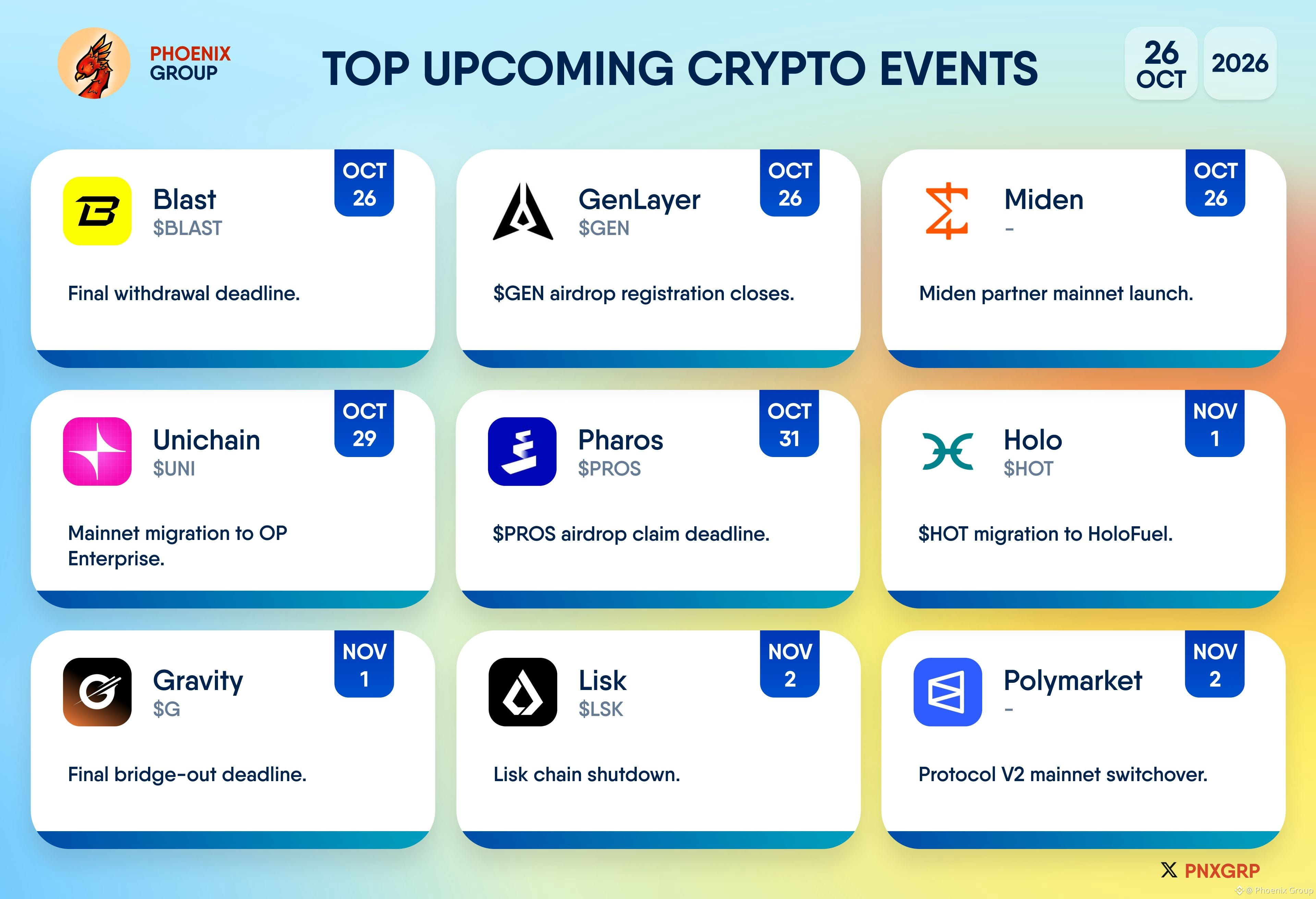
TOP UPCOMING CRYPTO EVENTS
#Blast $BLAST #GenLayer $GEN #Miden #Unichain $UNI #Pharos $PROS #Holo $HOT #Gravity $G #Lisk $LSK #Polymarket
TOP UPCOMING CRYPTO EVENTS
#Blast $BLAST #GenLayer $GEN #Miden #Unichain $UNI #Pharos $PROS #Holo $HOT #Gravity $G #Lisk $LSK #Polymarket
#Blast $BLAST #GenLayer $GEN #Miden #Unichain $UNI #Pharos $PROS #Holo $HOT #Gravity $G #Lisk $LSK #Polymarket
226

·
--
$GENIUS Most crypto projects don't fail because of tech.
They fail because nobody actually needs them.
That's why @GeniusOfficial caught my attention.
No fake AI + Web3 + future of everything” narrative.
Just a simple idea:
Make on-chain trading easier for normal users.
And honestly?
That's more valuable than 90% of hype coins right now.
The market is slowly rewarding useful projects again.
Not the loudest ones.
The useful ones.
#GenLayer @GeniusOfficial
$GENIUS
$NIL
#CapitalShiftsFromBTCEthToHYPEXRP
{future}(GENIUSUSDT)
$GENIUS Most crypto projects don't fail because of tech.
They fail because nobody actually needs them.
That's why @GeniusOfficial caught my attention.
No fake AI + Web3 + future of everything” narrative.
Just a simple idea:
Make on-chain trading easier for normal users.
And honestly?
That's more valuable than 90% of hype coins right now.
The market is slowly rewarding useful projects again.
Not the loudest ones.
The useful ones.
#GenLayer @GeniusOfficial
$GENIUS
$NIL
#CapitalShiftsFromBTCEthToHYPEXRP

2
162
Log in to explore more content
Join global crypto users on Binance Square
⚡️ Get latest and useful information about crypto.
💬 Trusted by the world’s largest crypto exchange.
👍 Discover real insights from verified creators.
Email / Phone number
Trending Topics
1
#BTCReboundsAbove$60KAmidWhaleDipBuying
95,087 views
407 Discussing
2
#SolanaSets2027RoadmapToDoubleComputeCapacity
79,255 views
1,173 Discussing
3
#CaliforniaNvidiaProbeExaminesPotentialCriminalViolations
21,820 views
170 Discussing
4
#BlackRockLaunchesHKDollarDigitalLiquidityFund
67,572 views
861 Discussing
5
#NvidiaLoses$2.7TrillionInMonthAndAHalf
85,486 views
342 Discussing
6
#GlobalStocksFaceLongestLosingStreakSince2023
603,099 views
3,592 Discussing
7
#BlackRockIBITPostsRecord$541MSingleDayOutflow
102,665 views
188 Discussing
8
#AnthropicPlungesTowardIPOPriceonDay2
337,481 views
2,412 Discussing
9
#TwentyOneCapitalAdds172.25BTC
185,070 views
1,715 Discussing
10
#HKBillWouldExcludeTokenizedDepositsFromVirtualAssets
19,428 views
110 Discussing