
#ibc
ibc
71,441 views
139 Discussing
Hot
Latest

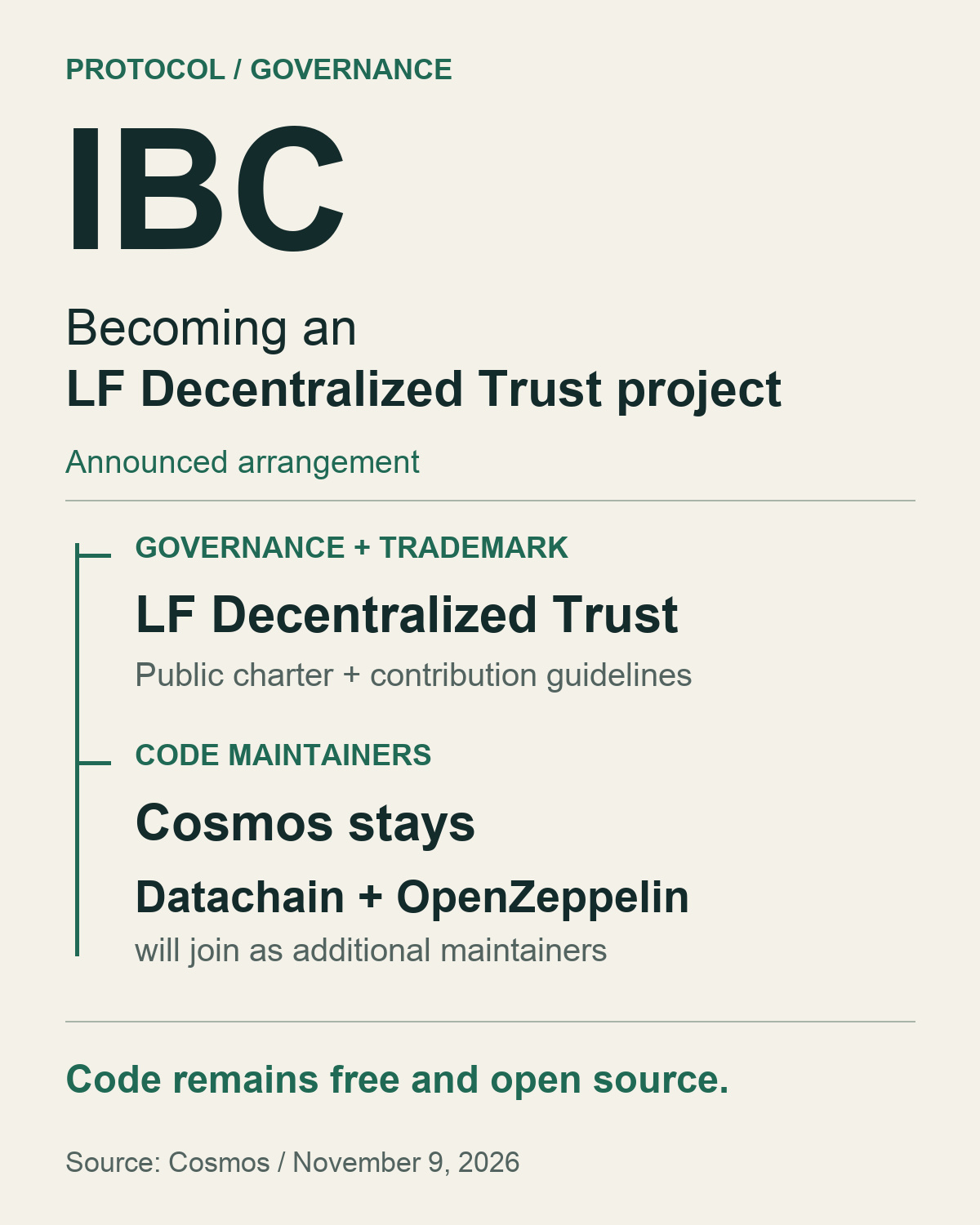
IBC is becoming an LF Decentralized Trust project, with Cosmos staying on as a maintainer and Datachain and OpenZeppelin joining as additional code maintainers.
Cosmos announced the move on November 9. IBC is the protocol that lets independent blockchains exchange assets and data.
Under the announced arrangement, LF Decentralized Trust will hold protocol governance under a public project charter and contribution guidelines, as well as the IBC trademark. The code will remain free and open source.
The change is in how IBC's development is governed and maintained. Cosmos is not walking away from the protocol it helped build.
Source: Cosmos, November 9, 2026.
https://cosmos.network/blog/ibc-joining-lf-decentralized-trust
#IBC #Cosmos
91


·
--
Cosmos has handed its cross-chain protocol IBC over to the Linux Foundation. Do cross-chain transfers in your wallet need to change too?
According to the official Cosmos blog (November 9), what’s changing is governance: IBC is becoming a project under LF Decentralized Trust. The code will remain open source, and Cosmos Labs will continue as its main maintainer. The blog doesn’t ask users to move assets or take any action. If anyone uses this news to tell you to “migrate immediately” or “re-authorize,” treat it as a scam.
The part that’s still easy to get wrong is the transfer itself. Before using IBC to transfer across chains, check three things:
1. Is the recipient address for the destination chain? Addresses for chains in the Cosmos ecosystem start differently, such as cosmos1 and osmo1.
2. Which route is the token taking? Under the IBC token transfer standard, tokens transferred across chains carry a record of their channel. In wallets, they often appear as a string starting with ibc/. Tokens with the same name but different routes may be different assets; if you want to send them back to the original chain, it’s best to return them via the same route.
3. When depositing to an exchange, follow the instructions on the deposit page for the Memo: fill it in if one is provided; don’t make one up if not. For a new address, send a small amount first.
The protocol has a new custodian, but you still need to check the address, channel, and Memo yourself.
#钱包安全 #跨链 #IBC $ATOM

1
262


·
--
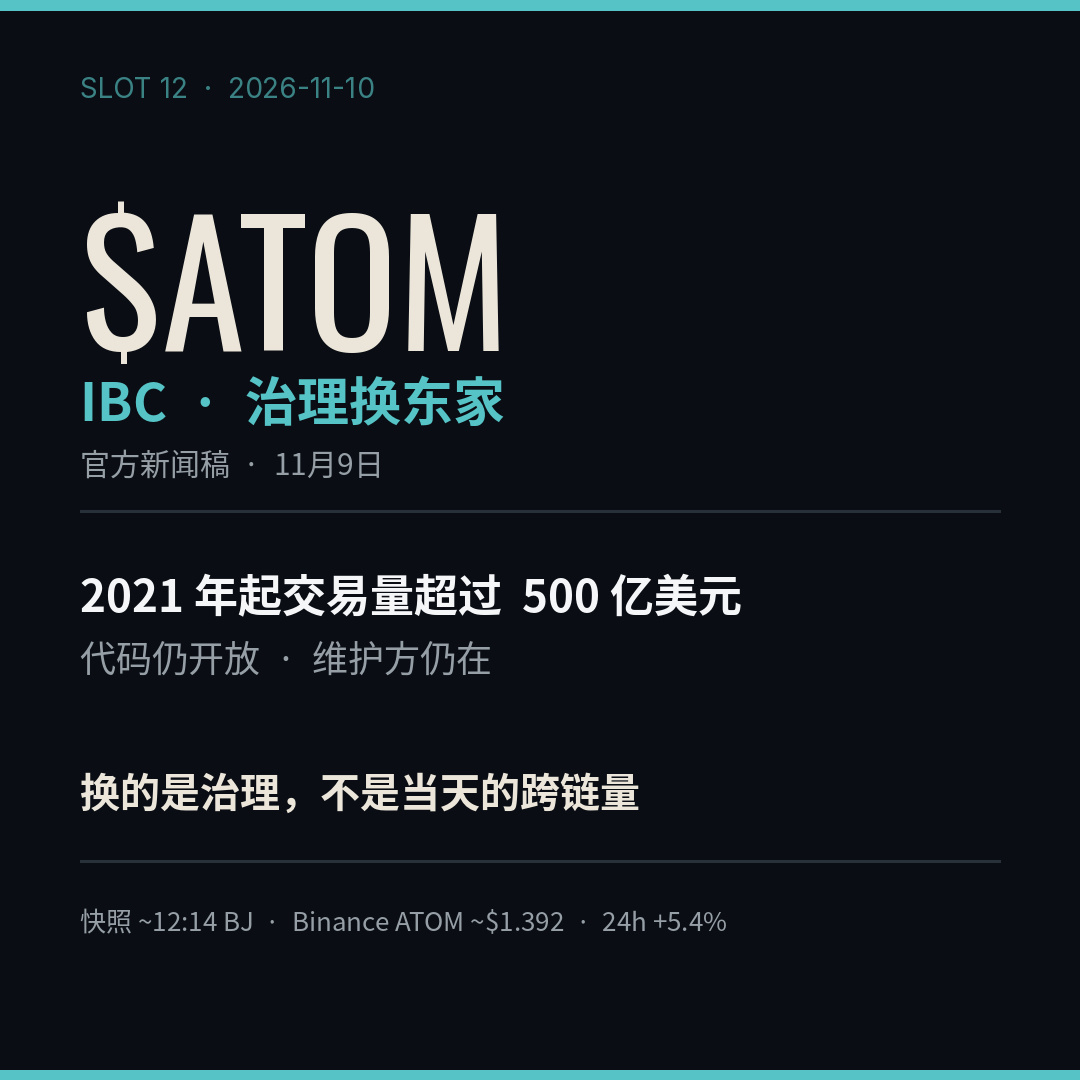
IBC changing hands in governance doesn’t mean cross-chain activity will suddenly jump. On November 9, official press releases from Cosmos and the Interchain Foundation confirmed that the Inter-Blockchain Communication protocol (IBC) has become a project of LF Decentralized Trust, part of the Linux Foundation. The code remains open, Cosmos Labs will continue as a maintainer, and the other two maintainers are Datachain and OpenZeppelin. According to the press releases, transaction volume has exceeded $50 billion since the protocol launched in 2021.
The protocol is still there; only the list of maintainers and the trademark have moved to a more neutral home. The list of sponsors includes Google Cloud and people from some financial institutions. That’s a statement of support, not additional settlement activity in production. ATOM won’t automatically gain new utility just because it has changed hands.
Let’s set the observation window through the first quarter of next year. If no new institutional projects have connected to IBC in production by then, this move will amount to no more than a governance handover. If the official bodies withdraw their contributions or the core maintenance team leaves, the claim of neutrality will no longer hold. Snapshot around 12:14 Beijing time: Binance ATOM at about $1.392, up about 5.4% over 24 hours.
$ATOM
#ATOM #Cosmos #IBC
333

·
--
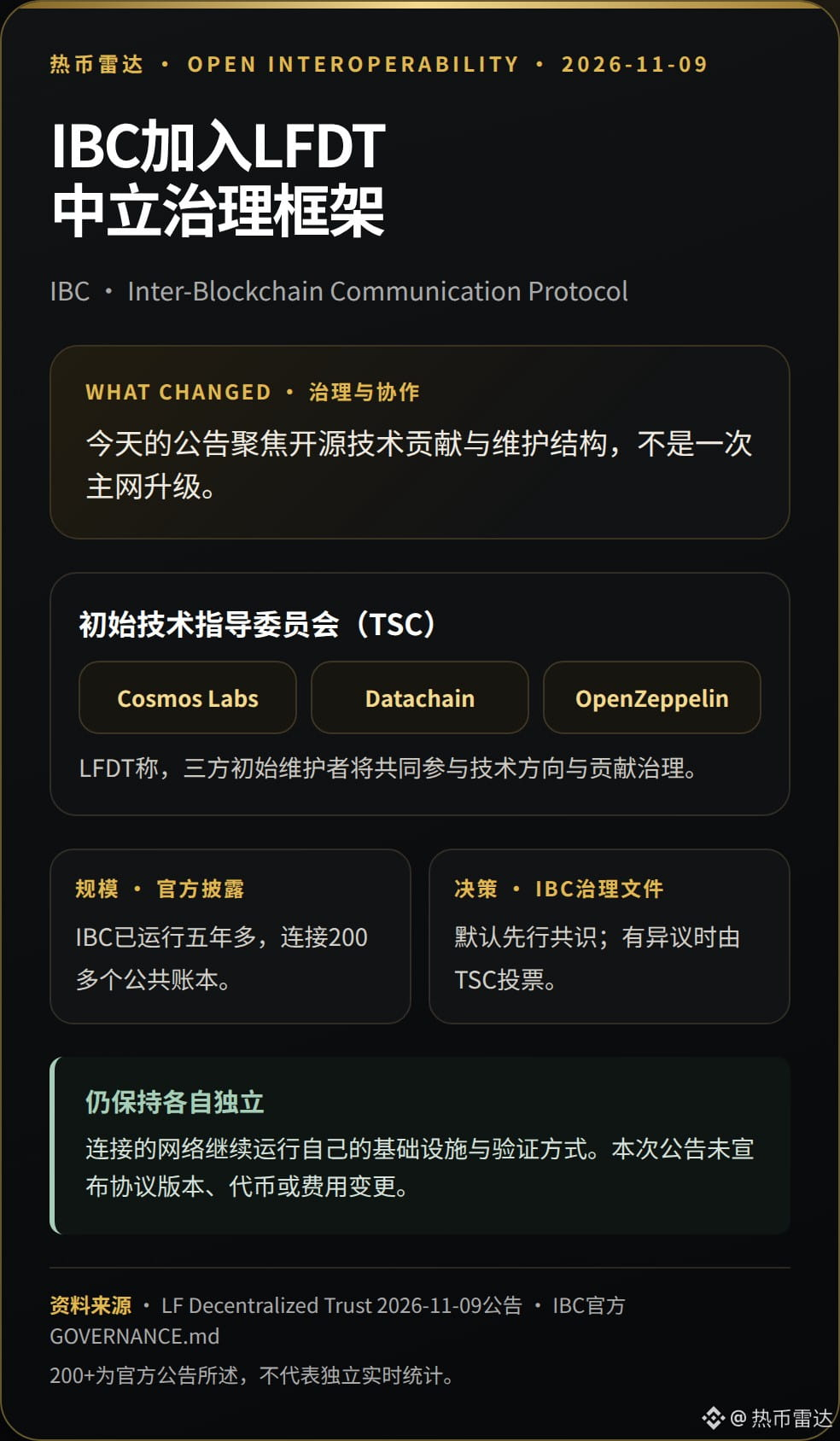
IBC joins the Linux Foundation Decentralized Trust (LFDT) neutral governance framework—the focus is open-source collaboration, not a mainnet upgrade.
LFDT says the initial Technical Steering Committee comprises maintainers from Cosmos Labs, Datachain, and OpenZeppelin. The IBC governance document states that technical decisions are made by consensus by default, with a vote held if there are dissenting views. LFDT says IBC has connected more than 200 public ledgers.
Each network retains its own infrastructure and validation methods; the announcement did not introduce a new protocol version, token, or fee changes. Which matters more to you: maintainer diversity or decision-making transparency?
Sources: [LFDT announcement](https://www.lfdecentralizedtrust.org/blog/advancing-open-interoperability-through-ibcs-contribution-to-lf-decentralized-trust)|[IBC governance document](https://github.com/cosmos/ibc/blob/main/GOVERNANCE.md)
Disclosure: This article may be eligible for Binance Square Write to Earn rewards; eligibility and rewards are subject to platform rules and actual results. Not investment advice.
#IBC

·
--
Cosmos and the Interchain Foundation today handed IBC over to the Linux Foundation’s LF Decentralized Trust.
According to the official website, the cross-chain protocol IBC has officially become an LFDT project, under neutral, open-source governance. Since launching in 2021, IBC has processed over $50 billion in transaction volume across more than 200 networks, with over 500 developers contributing code. The code will remain free and open source, and existing chains and applications can continue using it as usual. Cosmos will remain a maintainer, joined by Datachain and OpenZeppelin. Google Cloud is supporting the effort, with people from institutions such as Wells Fargo and Figure Markets also contributing.
In simple terms, this isn’t a change in technology, but in the governance framework—an effort to make cross-chain interoperability more like an industry standard such as Kubernetes. For banks and institutions connecting to multiple ledgers, a neutral standard is certainly easier to work with than a protocol owned by a single ecosystem.
#IBC #Cosmos
2

·
--
Cosmos $ATOM
Cosmos is the “Internet of Blockchains”. Instead of one chain, it’s an ecosystem of app-chains built with the Cosmos SDK + connected by IBC. Over 100 chains already use IBC to move assets without bridges.
$ATOM is the hub token. It secures the Cosmos Hub and captures fees + MEV as the network grows. “Interchain Security” lets new chains borrow ATOM’s validators instead of building their own set.
Bet: sovereign app-chains > one-size-fits-all L1s. If every dApp wants its own chain, Cosmos already built the rails.
Hub of the future or fragmented mess? #Cosmos #ATOM #IBC
112

·
--
⚛️ Cosmos ($ATOM) Interoperability & Network Security Spotlight! ⚡
As cross-chain communication protocols and modular application-specific blockchains continue to expand, Cosmos ($ATOM) remains a core architectural pillar driving the multi-chain universe.
Key highlights keeping $ATOM in focus:
* Inter-Blockchain Communication (IBC) Expansion: The IBC protocol continues to serve as the gold standard for secure, trustless cross-chain messaging, connecting dozens of independent sovereign chains with seamless interoperability.
* Resilient Network Governance & Recovery: Following rapid validator coordination and network security measures, the Cosmos ecosystem recently demonstrated robust crisis response capabilities, successfully securing funds and maintaining decentralized consensus under high-pressure scenarios.
* Enterprise & Institutional Infrastructure: Ongoing developments such as specialized tokenization suites and institutional banking partner networks are bridging traditional finance rails with high-speed decentralized applications.
Are you tracking Cosmos's IBC ecosystem growth or monitoring its latest governance upgrades? Share your thoughts below! 👇
Disclaimer: Cryptocurrency markets carry high volatility and risk. Always do your own research before trading or investing.
#ATOM #Cosmos #IBC #CryptoTrading
⚛️ Cosmos ($ATOM ) Interoperability & Network Security Spotlight! ⚡
As cross-chain communication protocols and modular application-specific blockchains continue to expand, Cosmos ($ATOM ) remains a core architectural pillar driving the multi-chain universe.
Key highlights keeping $ATOM in focus:
* Inter-Blockchain Communication (IBC) Expansion: The IBC protocol continues to serve as the gold standard for secure, trustless cross-chain messaging, connecting dozens of independent sovereign chains with seamless interoperability.
* Resilient Network Governance & Recovery: Following rapid validator coordination and network security measures, the Cosmos ecosystem recently demonstrated robust crisis response capabilities, successfully securing funds and maintaining decentralized consensus under high-pressure scenarios.
* Enterprise & Institutional Infrastructure: Ongoing developments such as specialized tokenization suites and institutional banking partner networks are bridging traditional finance rails with high-speed decentralized applications.
Are you tracking Cosmos's IBC ecosystem growth or monitoring its latest governance upgrades? Share your thoughts below! 👇
Disclaimer: Cryptocurrency markets carry high volatility and risk. Always do your own research before trading or investing.
#ATOM #Cosmos #IBC #CryptoTrading
1
299
·
--
⚛️ Cosmos ($ATOM) Interchain & Ecosystem Spotlight! ⚡
As the blockchain world expands into a massive network of independent application-specific chains, Cosmos ($ATOM) remains a foundational pioneer of true multi-chain interoperability.
Key highlights keeping $ATOM in focus:
* The Interchain Vision: Powered by the Inter-Blockchain Communication (IBC) protocol, Cosmos allows disparate blockchains to securely transfer tokens, data, and smart contract messages seamlessly without relying on centralized bridges.
* App-Chain Architecture: Through the Cosmos SDK, developers can build customized, sovereign blockchains tailored specifically to their project's needs while instantly connecting to the wider Interchain economy.
* Staking & Network Security: Cosmos Hub token holders actively participate in governance and secure the foundational relay chain through network staking, helping steer the future direction of the ecosystem.
Are you building within the Interchain ecosystem or tracking IBC-enabled networks? Let’s discuss below! 👇
#ATOM #Cosmos #IBC
⚛️ Cosmos ($ATOM ) Interchain & Ecosystem Spotlight! ⚡
As the blockchain world expands into a massive network of independent application-specific chains, Cosmos ($ATOM ) remains a foundational pioneer of true multi-chain interoperability.
Key highlights keeping $ATOM in focus:
* The Interchain Vision: Powered by the Inter-Blockchain Communication (IBC) protocol, Cosmos allows disparate blockchains to securely transfer tokens, data, and smart contract messages seamlessly without relying on centralized bridges.
* App-Chain Architecture: Through the Cosmos SDK, developers can build customized, sovereign blockchains tailored specifically to their project's needs while instantly connecting to the wider Interchain economy.
* Staking & Network Security: Cosmos Hub token holders actively participate in governance and secure the foundational relay chain through network staking, helping steer the future direction of the ecosystem.
Are you building within the Interchain ecosystem or tracking IBC-enabled networks? Let’s discuss below! 👇
#ATOM #Cosmos #IBC
3
183

🌌 $ATOM : internet of blockchains and cross-network security — goal $2.00? 🔍
📊 Overview
ATOM trades at $1.58–1.61. Cosmos remains the fundamental infrastructure for blockchain-to-blockchain interaction via the IBC protocol. Despite competition from other L1s and Layer 2s, the ecosystem continues to grow.
📈 Technically
Supports: $1.40 and $1.25. Resistances: $1.75, $2.00, and $2.50. A breakout above $1.75 opens the path to $2.00.
🔥 Key drivers
• IBC expansion: the inter-blockchain communication protocol remains the standard for cross-chain transfers.
• Zone ecosystem: dozens of specialized blockchains built on the Cosmos SDK.
• Narrative competition: ATOM competes with other scaling and cross-network solutions.
• Analyst forecasts: a range of $1.24–$1.58 in 2026, with a base target of $1.40–1.60.
🎯 Two scenarios:
🚀 Bullish: breakout and consolidation above $1.75 ➡ momentum toward $2.00, then $2.50.
📉 Bearish: loss of $1.40 ➡ correction to $1.25 for revaluation.
⚠️ DYOR — not financial advice.
#ATOM #IBC
Do you believe ATOM will return to $2.00+ this cycle?
{future}(ATOMUSDT)
🌌 $ATOM : internet of blockchains and cross-network security — goal $2.00? 🔍
📊 Overview
ATOM trades at $1.58–1.61. Cosmos remains the fundamental infrastructure for blockchain-to-blockchain interaction via the IBC protocol. Despite competition from other L1s and Layer 2s, the ecosystem continues to grow.
📈 Technically
Supports: $1.40 and $1.25. Resistances: $1.75, $2.00, and $2.50. A breakout above $1.75 opens the path to $2.00.
🔥 Key drivers
• IBC expansion: the inter-blockchain communication protocol remains the standard for cross-chain transfers.
• Zone ecosystem: dozens of specialized blockchains built on the Cosmos SDK.
• Narrative competition: ATOM competes with other scaling and cross-network solutions.
• Analyst forecasts: a range of $1.24–$1.58 in 2026, with a base target of $1.40–1.60.
🎯 Two scenarios:
🚀 Bullish: breakout and consolidation above $1.75 ➡ momentum toward $2.00, then $2.50.
📉 Bearish: loss of $1.40 ➡ correction to $1.25 for revaluation.
⚠️ DYOR — not financial advice.
#ATOM #IBC
Do you believe ATOM will return to $2.00+ this cycle?

2
532

·
--
Blockchains are often compared to separate islands because they don't always communicate easily with each other. $ATOM powers the Cosmos ecosystem, which focuses on interoperability through the Inter-Blockchain Communication (IBC) protocol. This allows compatible blockchains to transfer data and assets more efficiently. As the crypto ecosystem expands, communication between networks could become increasingly valuable. Learning how interoperability works helps explain why projects like Cosmos continue to attract developer interest.
#ATOM #Cosmos #IBC #cryptoeducation #Write2Earn
#ATOM #Cosmos #IBC #cryptoeducation #Write2Earn
187

·
--
Partly True
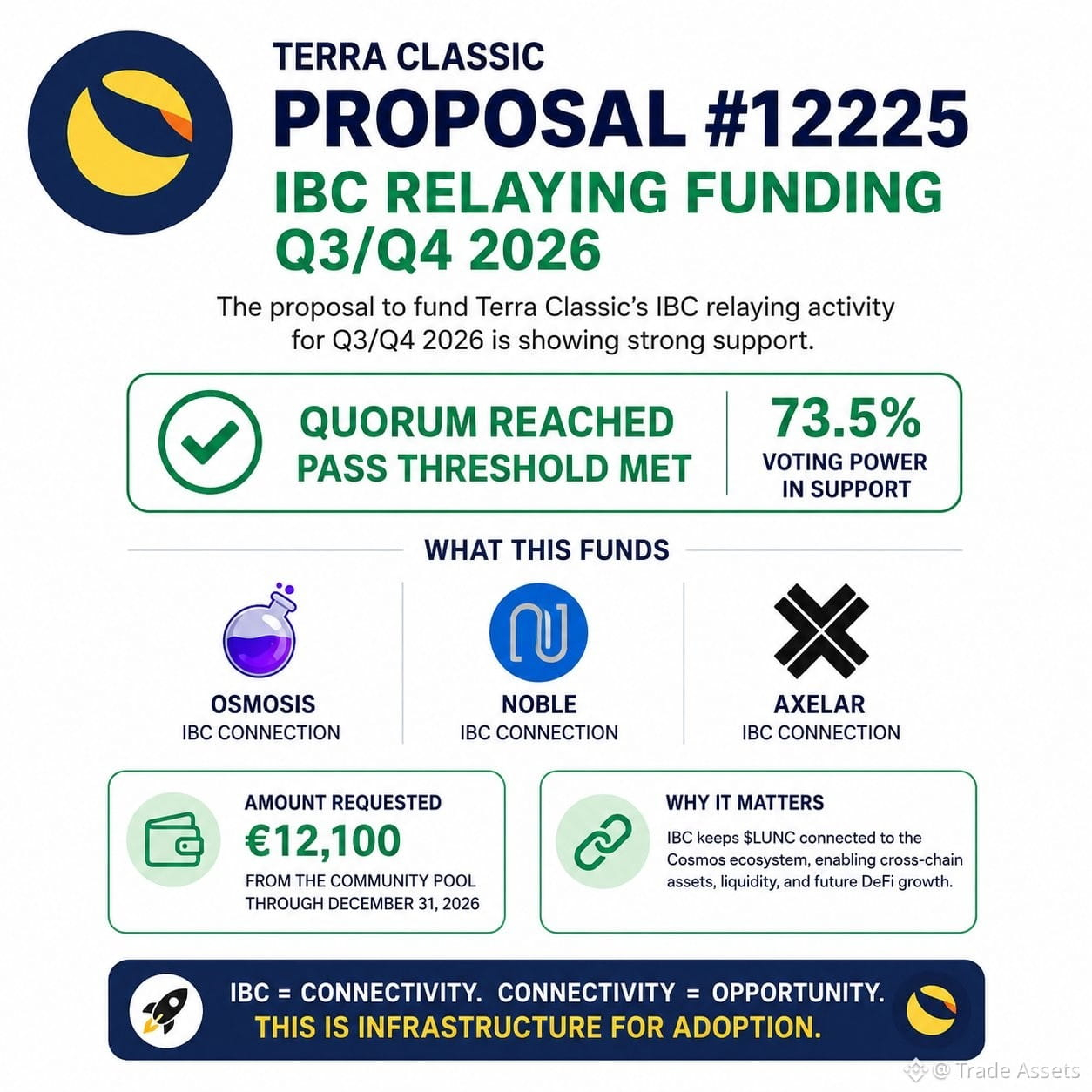
🚨 #TerraClassic Proposal #12225
Now the community has reached quorum and the proposal is above the passing threshold, with 73.5% of voting power supporting continued IBC relaying.
This is why it matters, Champs:
IBC keeps $LUNC connected to Cosmos liquidity, cross-chain assets and future DeFi opportunities.
This isn't just maintenance, but an infrastructure for massive adoption🚀🚀
#LUNC #IBC #Cosmos #Crypto
$LUNC
{spot}(LUNCUSDT)
🚨 #TerraClassic Proposal #12225
Now the community has reached quorum and the proposal is above the passing threshold, with 73.5% of voting power supporting continued IBC relaying.
This is why it matters, Champs:
IBC keeps $LUNC connected to Cosmos liquidity, cross-chain assets and future DeFi opportunities.
This isn't just maintenance, but an infrastructure for massive adoption🚀🚀
#LUNC #IBC #Cosmos #Crypto
$LUNC
3
431

·
--
IBC Protocol: The Internet of Blockchains Is Already Here
Most crypto investors focus on individual chains competing for dominance. But the more important infrastructure story is the one connecting them — the Inter-Blockchain Communication (IBC) protocol.
Originally developed within the Cosmos ecosystem, IBC has quietly become the most mature cross-chain messaging standard in crypto. Unlike bridge hacks that exploit trusted intermediaries, IBC relies on light client verification — each chain cryptographically verifies the state of the other without a centralized relayer holding funds. This is a fundamentally different security model.
Today, IBC facilitates billions in monthly transfer volume across 100+ interconnected chains. $AVAX, $DOT, and $ETH-based rollups are all exploring or integrating IBC-compatible standards. Even BNB Chain has evaluated IBC as a native interoperability layer.
The emerging picture: crypto is not winner-take-all at the chain layer. It is converging toward a modular internet of sovereign chains connected by open messaging protocols — much like how the internet unified networks that once ran incompatible stack protocols.
The analogy to TCP/IP is real, not hype. The chains that adopt open interoperability standards early will accumulate liquidity and users from the entire connected graph — not just from their native ecosystem.
Interoperability is not a feature. It is the infrastructure layer that determines which chains survive long-term.
$ETH $AVAX $DOT
#IBC #CrossChain #Interoperability #DeFi #CryptoInfrastructure
IBC Protocol: The Internet of Blockchains Is Already Here
Most crypto investors focus on individual chains competing for dominance. But the more important infrastructure story is the one connecting them — the Inter-Blockchain Communication (IBC) protocol.
Originally developed within the Cosmos ecosystem, IBC has quietly become the most mature cross-chain messaging standard in crypto. Unlike bridge hacks that exploit trusted intermediaries, IBC relies on light client verification — each chain cryptographically verifies the state of the other without a centralized relayer holding funds. This is a fundamentally different security model.
Today, IBC facilitates billions in monthly transfer volume across 100+ interconnected chains. $AVAX , $DOT , and $ETH -based rollups are all exploring or integrating IBC-compatible standards. Even BNB Chain has evaluated IBC as a native interoperability layer.
The emerging picture: crypto is not winner-take-all at the chain layer. It is converging toward a modular internet of sovereign chains connected by open messaging protocols — much like how the internet unified networks that once ran incompatible stack protocols.
The analogy to TCP/IP is real, not hype. The chains that adopt open interoperability standards early will accumulate liquidity and users from the entire connected graph — not just from their native ecosystem.
Interoperability is not a feature. It is the infrastructure layer that determines which chains survive long-term.
$ETH $AVAX $DOT
#IBC #CrossChain #Interoperability #DeFi #CryptoInfrastructure
1
203
·
--
Initia lost about $3.27 million. Was the problem with the contracts? According to the official postmortem, no—it was a leaked cloud service key.
Early this morning, Initia announced on X that on November 9, an attacker used command injection and a leaked GCP key to gain access to its infrastructure. From there, they obtained GitHub and GCP accounts and more credentials, then accessed Anvil, its rollup hosting platform, and forged IBC withdrawals for five rollups, unlocking assets in L1 escrow accounts.
About $3.27 million in assets was transferred to the attacker’s address. Around $2.16 million remains on the paused L1 and cannot be moved. The team says the attacker did not withdraw any INIT and intends to fully restore the backing of affected assets. It will announce the plan once it is finalized. The L1 was paused on November 10 at 14:18 Beijing time and is being rebuilt from scratch in an isolated environment, so recovery will take longer than a routine restart.
To be precise: even the most secure code is useless if the keys are kept in the wrong place. What ordinary users can do: rely only on announcements from Initia’s official channels, and never click links claiming to offer “compensation,” or anything similar.
#安全 #跨链 #Initia #IBC
$INIT

14

·
--
1. Background
Today's market focus is on Axelar Network's formal clarification regarding a recent security incident. The core message is very clear: it was not the Axelar Network mainnet itself that was exploited, nor was the underlying IBC protocol compromised; rather, it was a forked contract based on CW20-ICS20 that had a serious design flaw. This contract was neither developed by Axelar nor deployed and maintained by them. For the current cross-chain space, such clarifications are crucial because once security incidents are simplified and spread, they can easily be misinterpreted by the market as "protocol layer failure"⚠️.
2. Incident Analysis
From the disclosed content, the root of the problem seems less like a traditional external attack and more like consequences of intentionally modifying the security structure during the development phase. The forked version in question removed two core security checks, essentially dismantling the key barriers that were meant to constrain minting logic and validation processes, ultimately leading to an "infinite minting exploit." This indicates that the risks may not originate from the cross-chain framework itself, but rather from the access party's modifications of the open-source code.
More importantly, Axelar emphasizes that this forked version altered the original trust model and did not undergo a new security audit. This sends out two signals: first, open-source protocols can be reused, but reuse does not equal inherited security; second, the security perimeter of cross-chain assets increasingly depends on external contracts, bridging encapsulations, and deployment standards, rather than just the underlying messaging protocol. In the future, when the market assesses similar incidents, it will need to differentiate between "protocol vulnerabilities," "implementation vulnerabilities," and "fork vulnerabilities" to avoid emotional pricing.
3. Market Impact
In the short term, this clarification helps alleviate systemic concerns about Axelar and the IBC ecosystem, especially given the already sensitive market sentiment in the cross-chain sector; clarifying responsibility can reduce collateral damage. For AXL-related trading sentiment, this type of information usually first impacts risk expectations and then influences the pace of valuation recovery.
In the medium term, the incident serves as a reminder to the industry that the real vulnerabilities in the cross-chain space often do not lie in the most obvious main protocols, but in inadequately audited forked contracts, customized bridging modules, and logic altered by project teams. In the future, users, investors, and ecosystem partners will place greater emphasis on three points: whether original security checks are preserved, whether the trust model has changed, and whether independent audits have been completed🔍.
4. Conclusion
The core significance of today’s update is not about "whether another cross-chain has been attacked," but rather clarifying the chain of responsibility for the market. Axelar's statement essentially redefines the incident from a "infrastructure security crisis" to a "third-party forked contract error." This helps stabilize expectations and reinforces an industry consensus: security depends not only on protocol design but also on who modifies the code under what conditions. For market participants, the most important thing right now is not to chase emotions but to enhance their ability to assess technical attribution and risk layering.
#Axelar #IBC #crypto
181

·
--
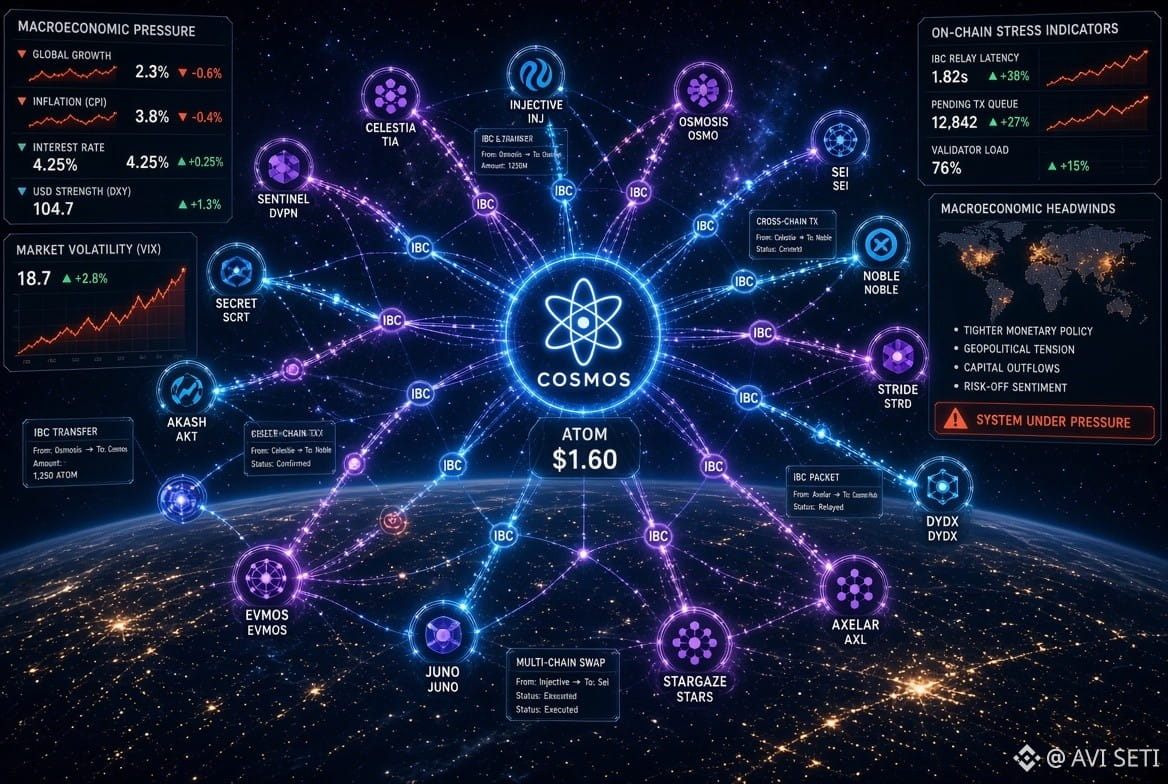
Cosmos Hub's ATOM is trading around $1.60, with roughly $50 million in 24-hour trading volume. The token has been under pressure, falling about 3.3% over the past seven days, but the broader Cosmos ecosystem continues to focus on interoperability through IBC, which connects dozens of blockchain networks.
With the market entering a major Fed-and-regulation week, ATOM is becoming a high-beta bet on whether capital rotates back toward established interoperability infrastructure after the current risk-off period.
#ATOM#Cosmos #IBC #Interoperability #CryptoMarket
With the market entering a major Fed-and-regulation week, ATOM is becoming a high-beta bet on whether capital rotates back toward established interoperability infrastructure after the current risk-off period.
#ATOM#Cosmos #IBC #Interoperability #CryptoMarket
86

·
--
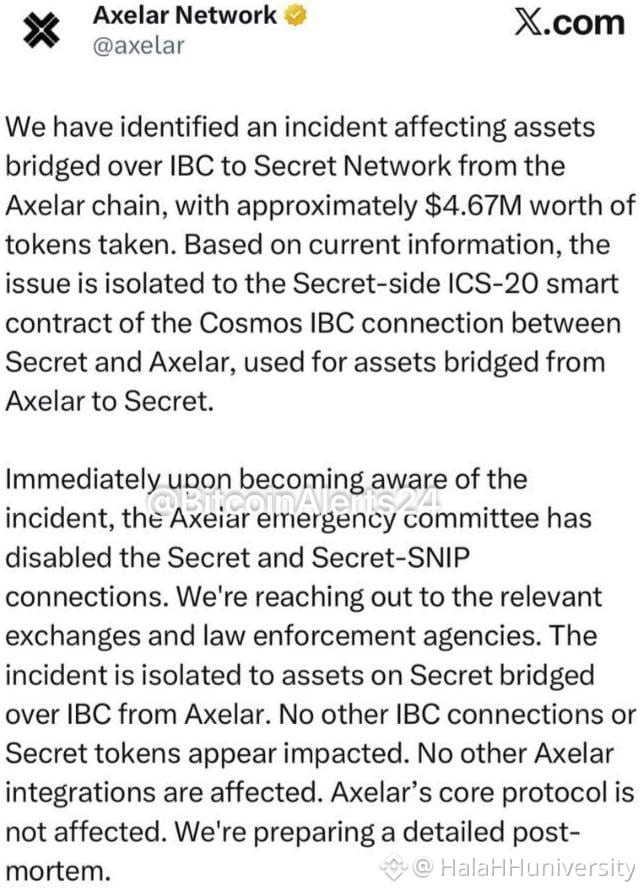
🟥 The network #AxelarNetwork announced a security incident that led to the withdrawal of approximately $4.67 million in assets transferred via the bridge (#IBC ) to the Secret Network.
🟢 According to the statement, the issue is confined to the smart contract related to ICS-20 on the Secret Network side within the Cosmos IBC connection between #Axelar and #secret , which is responsible for the assets being bridged from Axelar to Secret.
🟢 An investigation is still ongoing to determine the details of the exploit and how it was precisely leveraged.
295

·
--
🌌 $ATOM: the market is rising and this one is sinking — I’m selling into the pressure
Why am I selling ATOM when the market is in the green?
Because taker flow over the past hour is 60.3% selling: sellers aren’t waiting around.
And isn’t anyone stepping in to defend it?
Open Interest fell -9.1% ($20.13M) and volume is down -45.5% vs. yesterday: longs are quietly giving up. Price is -3.9% below its 4h EMA50 ($1.7422).
Won’t the altcoin rebound save it?
That’s the lesson: not all alts are the same. While some are waking up, ATOM is down -6.4% in 24h. The BTC network is processing 845K txs with hashrate at 1161 EH/s — the broader market is solid; the problem is ATOM.
When 60.3% of the flow is selling and longs are giving up (OI -9.1%), this zone is the ceiling the market has already set.
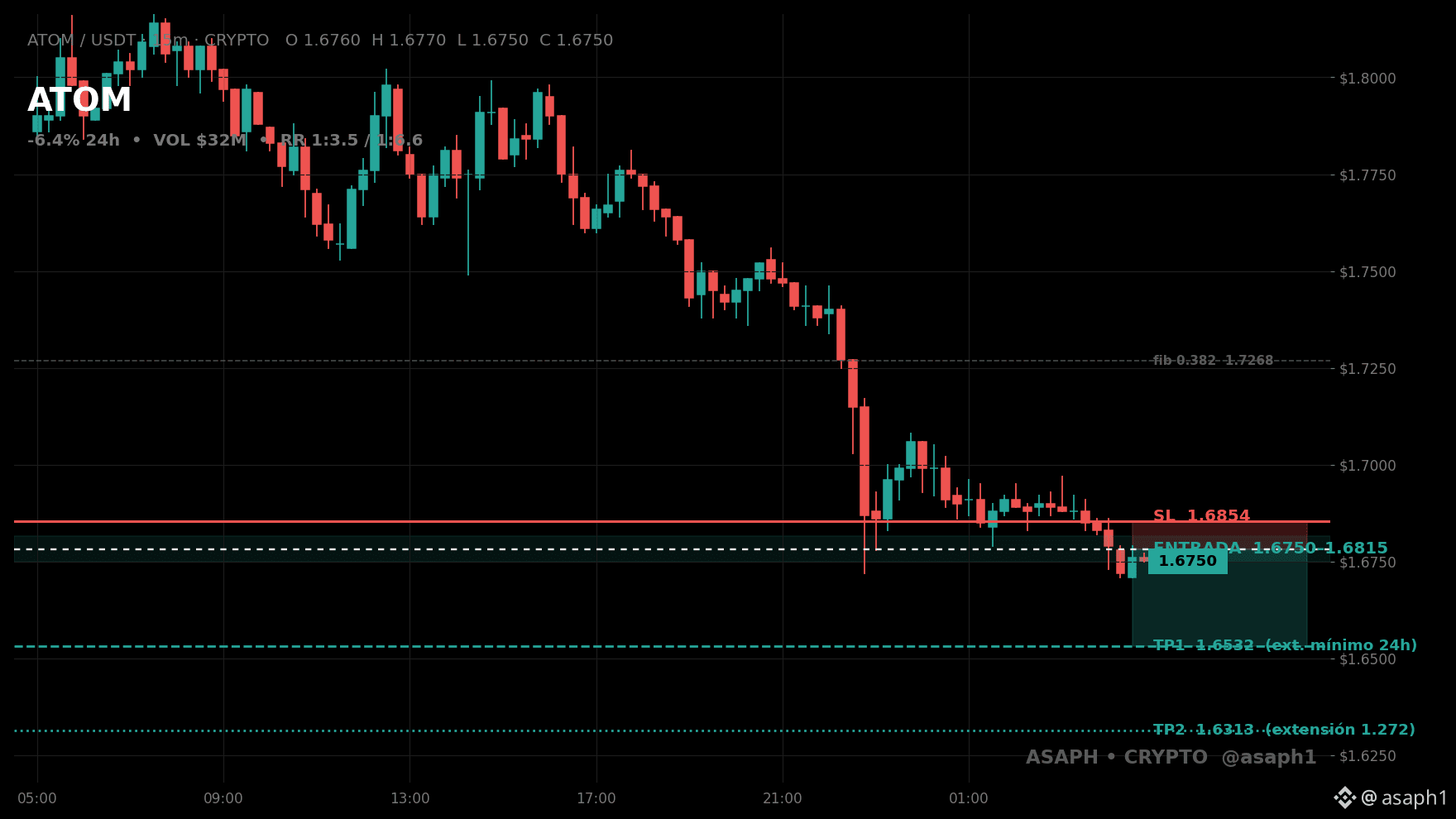
📊 SHORT ATOM signal
📍 Current price: $1.675
🎯 Zone: $1.675–$1.6815 (dist. 0.0%)
I’m going short with a limit order at $1.67825. I’ll enter with 50% in the zone and the other 50% if I get the retest.
My stop loss is at $1.6854, just +0.43% from entry, confirmed BEFORE entering.
I’m risking only 2% of my capital.
If a break of support takes it to TP1 at $1.65319, the extended 24h low, I’ll take half off and move my stop to my entry.
TP2 at $1.63129 is the 1.272 extension: the level where selling pressure runs out and I close the rest.
The R/R is 1:3.51 and 1:6.57.
Note: RSI is at 28.7, genuinely oversold — a rebound could appear, which is why the stop is tight and the expiry is short.
⏳ Valid for: the next 2h, or as long as it doesn’t exceed $1.6854.
Will ATOM lose $1.6532, or will it rebound from oversold territory here?
Live price here 👇 ATOM
ATOM #Cosmos #IBC #Trading
This is a plan, not financial advice.
🌌 $ATOM : the market is rising and this one is sinking — I’m selling into the pressure
Why am I selling ATOM when the market is in the green?
Because taker flow over the past hour is 60.3% selling: sellers aren’t waiting around.
And isn’t anyone stepping in to defend it?
Open Interest fell -9.1% ($20.13M) and volume is down -45.5% vs. yesterday: longs are quietly giving up. Price is -3.9% below its 4h EMA50 ($1.7422).
Won’t the altcoin rebound save it?
That’s the lesson: not all alts are the same. While some are waking up, ATOM is down -6.4% in 24h. The BTC network is processing 845K txs with hashrate at 1161 EH/s — the broader market is solid; the problem is ATOM.
When 60.3% of the flow is selling and longs are giving up (OI -9.1%), this zone is the ceiling the market has already set.
📊 SHORT ATOM signal
📍 Current price: $1.675
🎯 Zone: $1.675–$1.6815 (dist. 0.0%)
I’m going short with a limit order at $1.67825. I’ll enter with 50% in the zone and the other 50% if I get the retest.
My stop loss is at $1.6854, just +0.43% from entry, confirmed BEFORE entering.
I’m risking only 2% of my capital.
If a break of support takes it to TP1 at $1.65319, the extended 24h low, I’ll take half off and move my stop to my entry.
TP2 at $1.63129 is the 1.272 extension: the level where selling pressure runs out and I close the rest.
The R/R is 1:3.51 and 1:6.57.
Note: RSI is at 28.7, genuinely oversold — a rebound could appear, which is why the stop is tight and the expiry is short.
⏳ Valid for: the next 2h, or as long as it doesn’t exceed $1.6854.
Will ATOM lose $1.6532, or will it rebound from oversold territory here?
Live price here 👇 ATOM
ATOM #Cosmos #IBC #Trading
This is a plan, not financial advice.
38

·
--

Article
What Is Shentu (CTK)?Security remains a persistent challenge in blockchain and decentralized finance (DeFi). Despite large losses in the cryptocurrency industry to vulnerabilities such as smart contract exploits, protocol bugs, and unauthorized access, most security measures are reactive. These include security audits which are only conducted before launch of a product, and once a smart contract has been deployed, monitoring is often limited.
Shentu is a blockchain protocol that attempts to address this gap by making security infrastructure native on-chain. Rather than treating audits and risk assessment as off-chain services, Shentu embeds them directly into a Layer-1 network. Its Security Oracle scores contracts in real time, its ShentuShield protocol offers decentralized reimbursement for verified exploits, and its native token, CTK, powers the entire ecosystem.
This article covers what Shentu is, how its core components work, and how its native token, CTK, fits into the picture.
What Is Shentu (CTK)?
Shentu is a Layer-1 blockchain focused on blockchain security. It was originally launched in 2018 as CertiK Chain, the on-chain infrastructure arm of CertiK, a blockchain security company founded by professors from Yale and Columbia universities with backgrounds in cryptography and formal verification. In 2021, the project rebranded to Shentu Chain via an on-chain governance proposal, positioning itself as an independent public blockchain rather than a product tied to a single security firm.
Shentu is built on the Cosmos SDK and uses CometBFT consensus (formerly Tendermint), a Practical Byzantine Fault Tolerance (PBFT) mechanism that offers fast transaction finality with around six to seven seconds per block. The network is secured by a delegated proof-of-stake (DPoS) validator set, where CTK holders can delegate their tokens to validators to earn staking rewards.
Being built on Cosmos also means Shentu supports IBC (Inter-Blockchain Communication), allowing assets and data to move between Shentu and other Cosmos-compatible chains. In 2024, EVM compatibility was added, enabling developers to use familiar Ethereum tools and deploy Ethereum-compatible smart contracts on the network.
The CertiK connection
Shentu and CertiK are related but distinct. CertiK is a private security company that offers smart contract auditing, penetration testing, and vulnerability disclosure services. Shentu Chain is a public blockchain network with its own validator set, governance, and tokenomics. The two share a common origin, and CertiK continues to contribute to Shentu's development, but the chain operates independently with its own community governance.
CTK token
CTK is the native utility token of the Shentu blockchain. Its primary uses include: paying gas fees for transactions on the network; staking CTK with validators to earn rewards and secure the network; participating in on-chain governance votes to approve protocol upgrades and parameter changes; providing collateral in the ShentuShield reimbursement pool; and paying for security oracle services requested by dApp developers.
Current circulating supply of CTK stands at 160 million.Token distribution follows a combination of staking inflation rewards (allocated to validators and delegators) and allocations to the Shentu Foundation for ecosystem development and grants.
What Does Shentu Chain Do?
Shentu Chain provides a suite of security services designed to make decentralized applications safer for developers and users. Its three main components are the Security Oracle, ShentuShield, and DeepSEA.
Security oracle
The Security Oracle is Shentu's flagship feature. It is a decentralized oracle network that provides security scores for smart contracts. Certified security operators, known as certified security primitives (CSPs), analyze contracts using a combination of automated tools and manual review, then submit scores on-chain. These scores are aggregated across multiple operators to produce a composite security rating.
The key distinction between the Security Oracle and a traditional audit is timing. A standard smart contract audit is a point-in-time review: a team reviews the code before deployment, issues a report, and the engagement ends. The Security Oracle monitors contracts continuously after deployment, meaning that newly discovered vulnerabilities, changes in on-chain behavior, or interactions with other protocols can be reflected in updated scores over time.
DApp developers and protocols can query Security Oracle scores to make decisions about which contracts to integrate with, how to weight risk in their systems, or whether to pause certain operations if a score deteriorates.
ShentuShield
ShentuShield is Shentu's decentralized reimbursement mechanism. It allows CTK holders to participate as sponsors by depositing CTK into a collateral pool. Other users, referred to as members, can purchase coverage against losses from smart contract exploits by paying a fee in CTK.
If a member suffers a verified loss from a covered exploit, they can submit a claim. Claims are reviewed by the ShentuShield Council, a group of elected community representatives who assess the evidence and vote on whether to approve reimbursement. Approved claims are paid out from the collateral pool, and sponsors share in any shortfall proportionally.
ShentuShield does not function like traditional insurance. It is a community-driven, on-chain mechanism without the legal protections of regulated insurance products. Payouts are subject to council governance and the availability of collateral in the pool.
DeepSEA
DeepSEA is a high-assurance programming language developed for writing formally verifiable smart contracts. Formal verification is a mathematical technique that proves a program behaves exactly as specified, ruling out entire categories of bugs rather than testing for specific vulnerabilities.
DeepSEA complies to both the Ethereum Virtual Machine (EVM) and the CoqVM, allowing formal proofs of contract correctness to be generated alongside the deployed bytecode. While formal verification is technically demanding and not yet widely adopted across the industry, it represents one of the strongest available guarantees for mission-critical smart contract logic.
2025 network upgrades
In 2025, Shentu completed a major network upgrade (v2.14.0), which integrated a WebAssembly (WASM) module to expand smart contract support and enabled textual sign mode to improve the developer and user experience for transaction signing. The upgrade also aligned the network with the latest Cosmos SDK improvements for scalability and IBC performance. Binance temporarily paused CTK deposits and withdrawals in July 2025 during the upgrade window before resuming normal operations.
Shentu (CTK) on Binance
Binance announced Shentu (CTK) as the 6th project on Binance Launchpool on 22 October, 2020. It was made available for trading on Binance on 27 October, 2020, with the following pairs: CTK/BTC, CTK/BNB, CTK/BUSD and CTK/USDT.
FAQ
What is the difference between Shentu and CertiK?
CertiK is a private blockchain security company offering smart contract audits and penetration testing services. Shentu Chain is a public Layer-1 blockchain that CertiK originally built as its on-chain infrastructure. They share a founding team and security focus, but Shentu operates independently with its own validator set, governance, and token. The rebrand from CertiK Chain to Shentu Chain in late 2022 was intended to establish this distinction.
What is CTK used for?
CTK is the native token of the Shentu blockchain. It is used to pay transaction fees, stake with validators to earn rewards, vote on governance proposals, provide collateral in the ShentuShield pool, and pay for security oracle services.
How does the Shentu Security Oracle work?
The Security Oracle is a decentralized network of certified security operators who analyze smart contracts and submit security scores on-chain. These scores are aggregated to produce a composite rating that reflects the contract's current security status. Unlike a traditional audit, the Security Oracle provides ongoing monitoring after a contract is deployed, so scores can be updated if new vulnerabilities are discovered.
What is ShentuShield?
ShentuShield is a decentralized reimbursement protocol on the Shentu network. CTK holders can deposit tokens as collateral (sponsors) and other users can purchase coverage (members) against losses from smart contract exploits. If a member experiences a verified loss, they can submit a claim that is reviewed and voted on by the ShentuShield Council. It is not regulated insurance and payouts depend on council governance and pool availability.
Is Shentu part of the Cosmos ecosystem?
Yes. Shentu is built on the Cosmos SDK and uses CometBFT consensus. It supports IBC (Inter-Blockchain Communication), which allows assets and data to move between Shentu and other Cosmos-compatible chains. In 2024, Shentu also added EVM compatibility, extending its reach to Ethereum-compatible tools and developers.
#IBC #CTK #CTKUSDT #Shentu
$ETH
{future}(ETHUSDT)
$BONK
{spot}(BONKUSDT)
$CTK
{future}(CTKUSDT)
What Is Shentu (CTK)?
Security remains a persistent challenge in blockchain and decentralized finance (DeFi). Despite large losses in the cryptocurrency industry to vulnerabilities such as smart contract exploits, protocol bugs, and unauthorized access, most security measures are reactive. These include security audits which are only conducted before launch of a product, and once a smart contract has been deployed, monitoring is often limited.
Shentu is a blockchain protocol that attempts to address this gap by making security infrastructure native on-chain. Rather than treating audits and risk assessment as off-chain services, Shentu embeds them directly into a Layer-1 network. Its Security Oracle scores contracts in real time, its ShentuShield protocol offers decentralized reimbursement for verified exploits, and its native token, CTK, powers the entire ecosystem.
This article covers what Shentu is, how its core components work, and how its native token, CTK, fits into the picture.
What Is Shentu (CTK)?
Shentu is a Layer-1 blockchain focused on blockchain security. It was originally launched in 2018 as CertiK Chain, the on-chain infrastructure arm of CertiK, a blockchain security company founded by professors from Yale and Columbia universities with backgrounds in cryptography and formal verification. In 2021, the project rebranded to Shentu Chain via an on-chain governance proposal, positioning itself as an independent public blockchain rather than a product tied to a single security firm.
Shentu is built on the Cosmos SDK and uses CometBFT consensus (formerly Tendermint), a Practical Byzantine Fault Tolerance (PBFT) mechanism that offers fast transaction finality with around six to seven seconds per block. The network is secured by a delegated proof-of-stake (DPoS) validator set, where CTK holders can delegate their tokens to validators to earn staking rewards.
Being built on Cosmos also means Shentu supports IBC (Inter-Blockchain Communication), allowing assets and data to move between Shentu and other Cosmos-compatible chains. In 2024, EVM compatibility was added, enabling developers to use familiar Ethereum tools and deploy Ethereum-compatible smart contracts on the network.
The CertiK connection
Shentu and CertiK are related but distinct. CertiK is a private security company that offers smart contract auditing, penetration testing, and vulnerability disclosure services. Shentu Chain is a public blockchain network with its own validator set, governance, and tokenomics. The two share a common origin, and CertiK continues to contribute to Shentu's development, but the chain operates independently with its own community governance.
CTK token
CTK is the native utility token of the Shentu blockchain. Its primary uses include: paying gas fees for transactions on the network; staking CTK with validators to earn rewards and secure the network; participating in on-chain governance votes to approve protocol upgrades and parameter changes; providing collateral in the ShentuShield reimbursement pool; and paying for security oracle services requested by dApp developers.
Current circulating supply of CTK stands at 160 million.Token distribution follows a combination of staking inflation rewards (allocated to validators and delegators) and allocations to the Shentu Foundation for ecosystem development and grants.
What Does Shentu Chain Do?
Shentu Chain provides a suite of security services designed to make decentralized applications safer for developers and users. Its three main components are the Security Oracle, ShentuShield, and DeepSEA.
Security oracle
The Security Oracle is Shentu's flagship feature. It is a decentralized oracle network that provides security scores for smart contracts. Certified security operators, known as certified security primitives (CSPs), analyze contracts using a combination of automated tools and manual review, then submit scores on-chain. These scores are aggregated across multiple operators to produce a composite security rating.
The key distinction between the Security Oracle and a traditional audit is timing. A standard smart contract audit is a point-in-time review: a team reviews the code before deployment, issues a report, and the engagement ends. The Security Oracle monitors contracts continuously after deployment, meaning that newly discovered vulnerabilities, changes in on-chain behavior, or interactions with other protocols can be reflected in updated scores over time.
DApp developers and protocols can query Security Oracle scores to make decisions about which contracts to integrate with, how to weight risk in their systems, or whether to pause certain operations if a score deteriorates.
ShentuShield
ShentuShield is Shentu's decentralized reimbursement mechanism. It allows CTK holders to participate as sponsors by depositing CTK into a collateral pool. Other users, referred to as members, can purchase coverage against losses from smart contract exploits by paying a fee in CTK.
If a member suffers a verified loss from a covered exploit, they can submit a claim. Claims are reviewed by the ShentuShield Council, a group of elected community representatives who assess the evidence and vote on whether to approve reimbursement. Approved claims are paid out from the collateral pool, and sponsors share in any shortfall proportionally.
ShentuShield does not function like traditional insurance. It is a community-driven, on-chain mechanism without the legal protections of regulated insurance products. Payouts are subject to council governance and the availability of collateral in the pool.
DeepSEA
DeepSEA is a high-assurance programming language developed for writing formally verifiable smart contracts. Formal verification is a mathematical technique that proves a program behaves exactly as specified, ruling out entire categories of bugs rather than testing for specific vulnerabilities.
DeepSEA complies to both the Ethereum Virtual Machine (EVM) and the CoqVM, allowing formal proofs of contract correctness to be generated alongside the deployed bytecode. While formal verification is technically demanding and not yet widely adopted across the industry, it represents one of the strongest available guarantees for mission-critical smart contract logic.
2025 network upgrades
In 2025, Shentu completed a major network upgrade (v2.14.0), which integrated a WebAssembly (WASM) module to expand smart contract support and enabled textual sign mode to improve the developer and user experience for transaction signing. The upgrade also aligned the network with the latest Cosmos SDK improvements for scalability and IBC performance. Binance temporarily paused CTK deposits and withdrawals in July 2025 during the upgrade window before resuming normal operations.
Shentu (CTK) on Binance
Binance announced Shentu (CTK) as the 6th project on Binance Launchpool on 22 October, 2020. It was made available for trading on Binance on 27 October, 2020, with the following pairs: CTK/BTC, CTK/BNB, CTK/BUSD and CTK/USDT.
FAQ
What is the difference between Shentu and CertiK?
CertiK is a private blockchain security company offering smart contract audits and penetration testing services. Shentu Chain is a public Layer-1 blockchain that CertiK originally built as its on-chain infrastructure. They share a founding team and security focus, but Shentu operates independently with its own validator set, governance, and token. The rebrand from CertiK Chain to Shentu Chain in late 2022 was intended to establish this distinction.
What is CTK used for?
CTK is the native token of the Shentu blockchain. It is used to pay transaction fees, stake with validators to earn rewards, vote on governance proposals, provide collateral in the ShentuShield pool, and pay for security oracle services.
How does the Shentu Security Oracle work?
The Security Oracle is a decentralized network of certified security operators who analyze smart contracts and submit security scores on-chain. These scores are aggregated to produce a composite rating that reflects the contract's current security status. Unlike a traditional audit, the Security Oracle provides ongoing monitoring after a contract is deployed, so scores can be updated if new vulnerabilities are discovered.
What is ShentuShield?
ShentuShield is a decentralized reimbursement protocol on the Shentu network. CTK holders can deposit tokens as collateral (sponsors) and other users can purchase coverage (members) against losses from smart contract exploits. If a member experiences a verified loss, they can submit a claim that is reviewed and voted on by the ShentuShield Council. It is not regulated insurance and payouts depend on council governance and pool availability.
Is Shentu part of the Cosmos ecosystem?
Yes. Shentu is built on the Cosmos SDK and uses CometBFT consensus. It supports IBC (Inter-Blockchain Communication), which allows assets and data to move between Shentu and other Cosmos-compatible chains. In 2024, Shentu also added EVM compatibility, extending its reach to Ethereum-compatible tools and developers.
#IBC #CTK #CTKUSDT #Shentu
$ETH
$BONK
$CTK
1
199

·
--
#keplradvisessocialloginuserstotransferassets
🚨 SECURITY ADVISORY: CRITICAL Keplr Wallet Alert – Social Login Security Compromise (Nov 8, 2026)
This is a critical, multi-vector security alert regarding the Keplr Wallet infrastructure. Our internal monitoring systems, supported by verified data from Keplr’s November 8th Security Advisory, confirm a localized but severe private key compromise affecting users of Social Logins (specifically Google and Apple logins via Web3Auth).
A significant volume spike in unauthorized outflows (IBC transfers) from these accounts has been detected. The vulnerability exposes users to Private Key extraction and subsequent theft of on-chain assets.
WHO IS AFFECTED?
Users who access Keplr primarily via Google or Apple Social Logins.
The compromise has identified high-risk outflows across several core chains, including: $ATOM,$OSMO, $TIA,$INJ.
WHO IS NOT AFFECTED?
Users employing a Mnemonic (seed) phrase, Ledger/Hardware wallets, or private key backup methods. Your security posture remains intact.
📈 TRADING PLAN & TRADEABLE COINS
The current market environment is experiencing massive volatility due to geopolitical tensions and restrictive macro liquidity (DXY 104.1 and US 10YR Yield at 4.88%).
Bitcoin ($BTC )
Macro Bias: Strategic Dip Accumulation / Decentralized Infrastructure Hedge
Buy Zone: $72,800 – $74,500
Target 1 (T1): $79,200
Target 2 (T2): $83,500
Stop Loss (SL): $71,100
Ethereum ($ETH )
Macro Bias: Rate-Sensitive Rebound / Compute Utility
Buy Zone: $2,380 – $2,460
Target 1 (T1): $2,720
Target 2 (T2): $2,910
Stop Loss (SL): $2,290
Binance Coin ($BNB )
Macro Bias: Defensive Exchange Utility Recovery
Buy Zone: $560 – $580
Target 1 (T1): $635
Target 2 (T2): $675
Stop Loss (SL): $540
{spot}(BTCUSDT)
{spot}(ETHUSDT)
{spot}(BNBUSDT)
#SecurityAdvisory #keplr #IBC #cryptotrading
#keplradvisessocialloginuserstotransferassets
🚨 SECURITY ADVISORY: CRITICAL Keplr Wallet Alert – Social Login Security Compromise (Nov 8, 2026)
This is a critical, multi-vector security alert regarding the Keplr Wallet infrastructure. Our internal monitoring systems, supported by verified data from Keplr’s November 8th Security Advisory, confirm a localized but severe private key compromise affecting users of Social Logins (specifically Google and Apple logins via Web3Auth).
A significant volume spike in unauthorized outflows (IBC transfers) from these accounts has been detected. The vulnerability exposes users to Private Key extraction and subsequent theft of on-chain assets.
WHO IS AFFECTED?
Users who access Keplr primarily via Google or Apple Social Logins.
The compromise has identified high-risk outflows across several core chains, including: $ATOM,$OSMO, $TIA,$INJ.
WHO IS NOT AFFECTED?
Users employing a Mnemonic (seed) phrase, Ledger/Hardware wallets, or private key backup methods. Your security posture remains intact.
📈 TRADING PLAN & TRADEABLE COINS
The current market environment is experiencing massive volatility due to geopolitical tensions and restrictive macro liquidity (DXY 104.1 and US 10YR Yield at 4.88%).
Bitcoin ($BTC )
Macro Bias: Strategic Dip Accumulation / Decentralized Infrastructure Hedge
Buy Zone: $72,800 – $74,500
Target 1 (T1): $79,200
Target 2 (T2): $83,500
Stop Loss (SL): $71,100
Ethereum ($ETH )
Macro Bias: Rate-Sensitive Rebound / Compute Utility
Buy Zone: $2,380 – $2,460
Target 1 (T1): $2,720
Target 2 (T2): $2,910
Stop Loss (SL): $2,290
Binance Coin ($BNB )
Macro Bias: Defensive Exchange Utility Recovery
Buy Zone: $560 – $580
Target 1 (T1): $635
Target 2 (T2): $675
Stop Loss (SL): $540
#SecurityAdvisory #keplr #IBC #cryptotrading

828
Log in to explore more content
Join global crypto users on Binance Square
⚡️ Get latest and useful information about crypto.
💬 Trusted by the world’s largest crypto exchange.
👍 Discover real insights from verified creators.
Email / Phone number
Trending Topics
1
#IsAnthropic’s$1.5TMarketCapJustified?
12,565 views
107 Discussing
2
#BTCRemainsUnderPressureAfterHawkishFOMCMinutes
261,457 views
2,142 Discussing
3
#NvidiaBoardReportedlySplitOverHuang’sReturn
127,921 views
1,159 Discussing
4
#StrategySTRCPreferredSlips3.65%Below$100Par
8,791 views
88 Discussing
5
#MASToUpgradeSGDTestnetToSGDigitalLedger
24,996 views
283 Discussing
6
#CanGTA6'sLaunchLiftTTWOShares?
92,002 views
834 Discussing
7
#Solana2027RoadmapTargetsDoubleComputeCapacity
10,810 views
147 Discussing
8
#InjectiveTokenizedRealEstateMortgagesTop$1.5B
1,249 views
29 Discussing
9
#TetherMakesStrategicInvestmentInSCRYPT
8,043 views
114 Discussing
10
#CapitalGroupAdds1264500StrategyShares
34,197 views
247 Discussing