
#markprice
markprice
3,352 views
16 Discussing
Hot
Latest

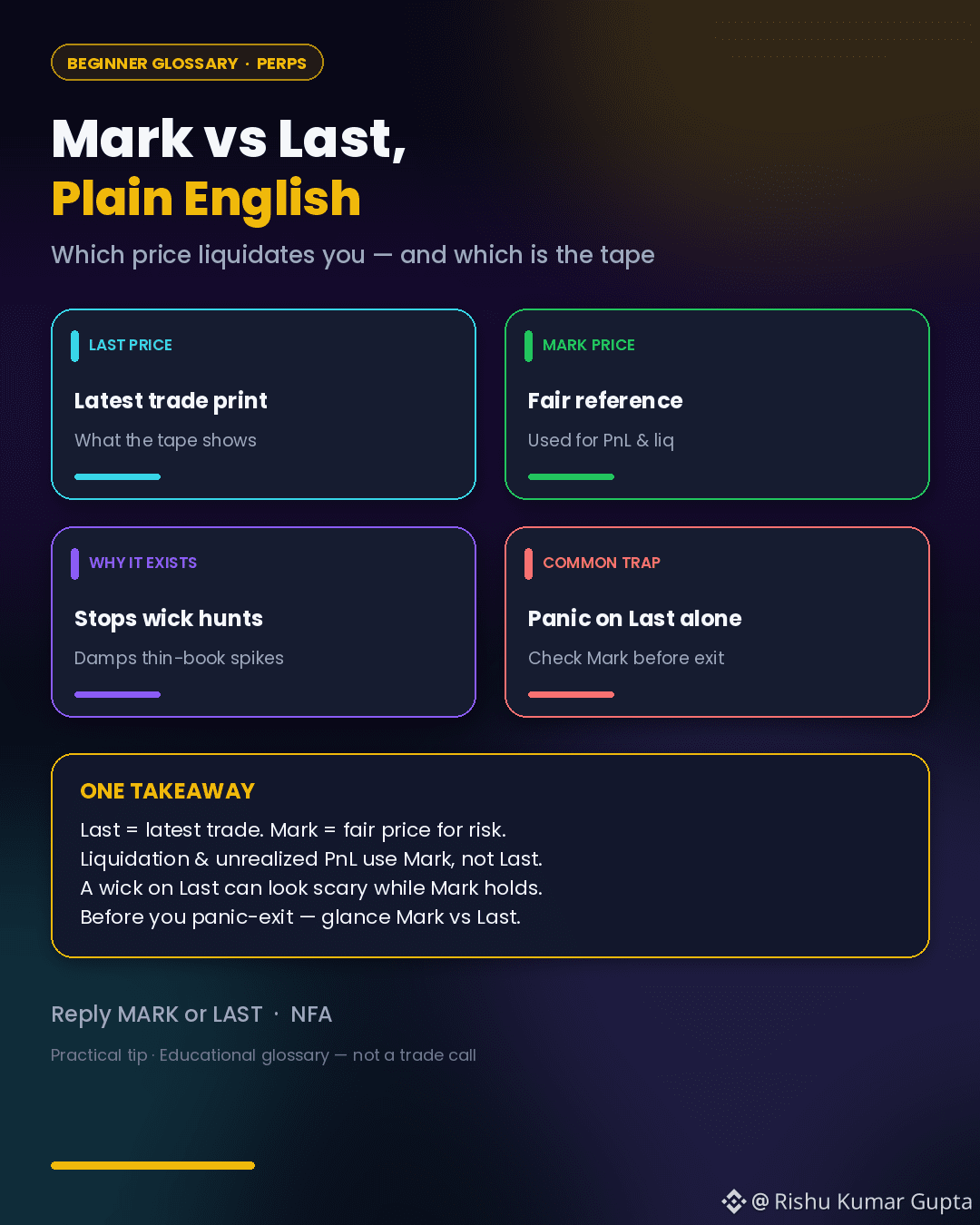
Mark Price vs Last Price — in plain English.
Last = the latest trade print (the tape).
Mark = the fair reference the exchange uses for unrealized PnL and liquidation.
Why it exists: damps thin-book spikes so a single wick is less likely to force you out.
Trap: panic-exiting on Last alone while Mark still holds. Glance both before you hit the button.
Reply MARK or LAST — which one do you check first under stress?
NFA — educational glossary, not financial advice.
$BTC $ETH
#CryptoEducation #Perps #MarkPrice
48

$SHELL Mark Price Tracks Close to the Futures Index Price
Data snapshot: October 17, 2026, 14:20 ICT (UTC+7).
Binance USDⓈ-M Futures reported a mark price of approximately $0.02243881 and an index price of $0.02243862. The two values were very close at the time of retrieval.
The mark price is used in futures risk and unrealized-profit calculations, while the index price represents a reference derived from the underlying market data. They serve different purposes even when their values are nearly identical.
These figures are a snapshot and can change with market conditions.
#MarkPrice #IndexPrice #FuturesData
38

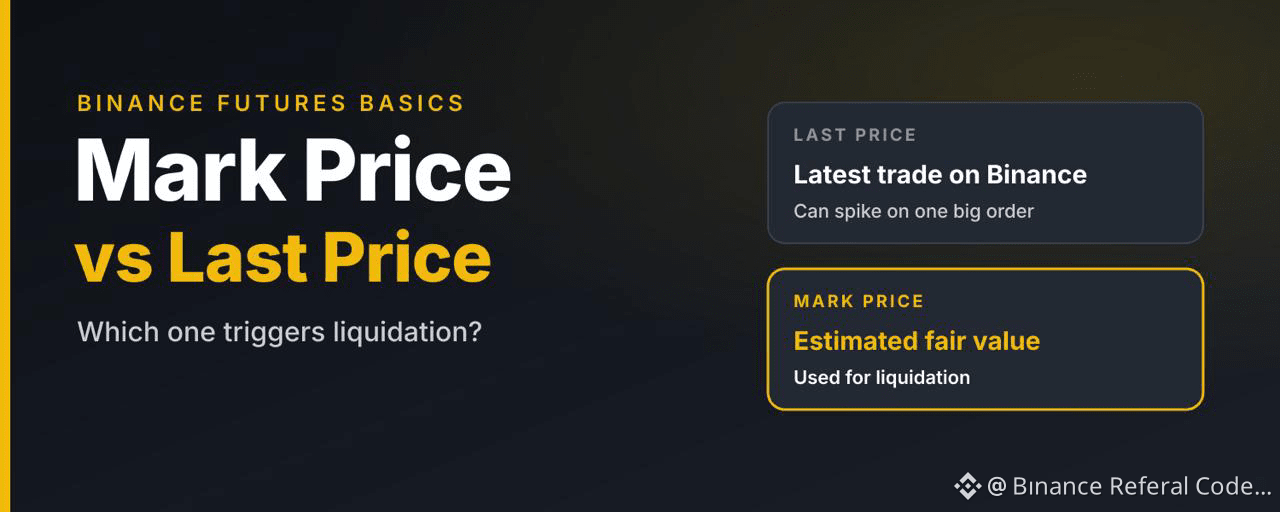
Mark Price vs Last Price on Binance Futures
Ever seen the chart touch your liquidation level, but your position was not closed? Or the opposite? The reason is that Binance Futures shows two different prices.
🔸 Last Price
The price of the most recent trade on Binance. One large market order can push it up or down for a moment.
🔸 Mark Price
Binance's estimate of the contract's fair value. It moves more smoothly and is harder to push with a single order.
⚠️ Which one matters for liquidation?
On Binance Futures, liquidation is triggered by the Mark Price, not the Last Price.
This protects traders from being liquidated by a short spike on one exchange. But it also means the chart you are looking at may not show exactly when liquidation happens.
✅ What to do
1. Check that your chart and order panel show the Mark Price
2. Watch your liquidation price in the Positions tab, not just the candles
3. For stop-losses, choose whether they trigger on Mark Price or Last Price when you set them
4. Leave room between your stop-loss and your liquidation price
Full guide to liquidation, margin ratio and cross vs isolated margin:
[https://www.binance.com/en/square/post/389195106060486](https://www.binance.com/en/square/post/389195106060486)
Which price do you use for your stop-losses? 👇
Referral code: LONG2027
Sign up: [https://www.binance.com/en/events/referral-code-2027](https://www.binance.com/en/events/referral-code-2027)
Independent educational content, not affiliated with Binance. Futures trading involves leverage and can lead to the loss of your entire margin.
#BİNANCEFUTURES #MarkPrice #liquidation #RiskManagement #CryptoTrading
Mark Price vs Last Price on Binance Futures
Ever seen the chart touch your liquidation level, but your position was not closed? Or the opposite? The reason is that Binance Futures shows two different prices.
🔸 Last Price
The price of the most recent trade on Binance. One large market order can push it up or down for a moment.
🔸 Mark Price
Binance's estimate of the contract's fair value. It moves more smoothly and is harder to push with a single order.
⚠️ Which one matters for liquidation?
On Binance Futures, liquidation is triggered by the Mark Price, not the Last Price.
This protects traders from being liquidated by a short spike on one exchange. But it also means the chart you are looking at may not show exactly when liquidation happens.
✅ What to do
1. Check that your chart and order panel show the Mark Price
2. Watch your liquidation price in the Positions tab, not just the candles
3. For stop-losses, choose whether they trigger on Mark Price or Last Price when you set them
4. Leave room between your stop-loss and your liquidation price
Full guide to liquidation, margin ratio and cross vs isolated margin:
https://www.binance.com/en/square/post/389195106060486
Which price do you use for your stop-losses? 👇
Referral code: LONG2027
Sign up: https://www.binance.com/en/events/referral-code-2027
Independent educational content, not affiliated with Binance. Futures trading involves leverage and can lead to the loss of your entire margin.
#BİNANCEFUTURES #MarkPrice #liquidation #RiskManagement #CryptoTrading
111

·
--
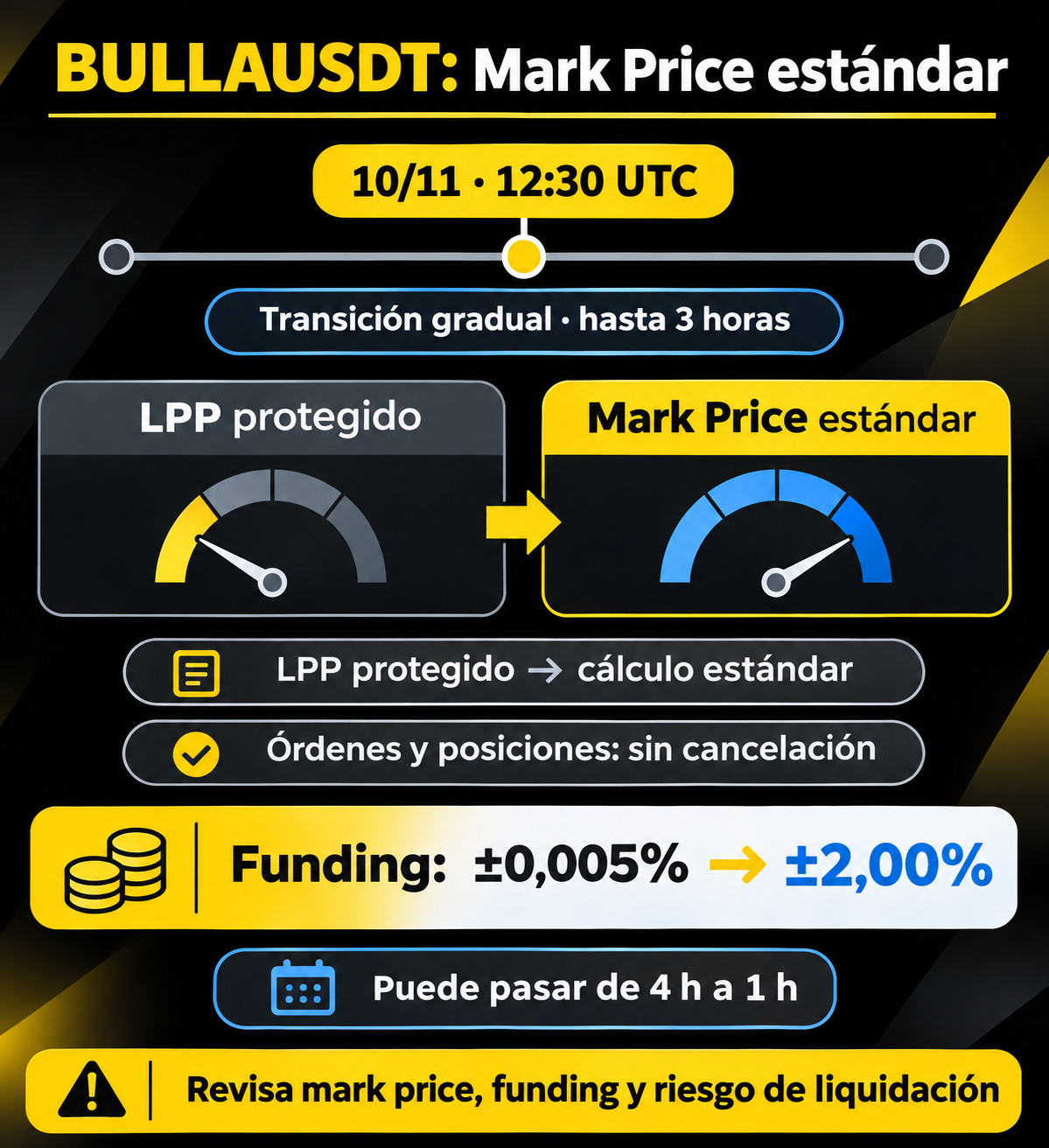
BULLA leaves protected Mark Price: transition and funding from 12:30 UTC
Reported fact: Binance published the notice on 10/11/2026 at 10:31 UTC. That same day, at 12:30 UTC, the BULLAUSDT USDⓈ-M perpetual contract begins gradually exiting the Last Price Protected (LPP) mechanism and switching to the standard Mark Price calculation. The transition may take up to three hours, depending on volatility and the availability of a stable index.
During the change, Binance will apply smoothing to reduce sharp jumps. Trading will not be interrupted, and open orders and positions will not be canceled. After the LPP period, Mark Price will be calculated as the median of Price 1, Price 2, and the contract price; the exact components depend on Binance's publicly available index and price rules.
The funding framework is also changing: the cap will increase from +0.005%/-0.005% to +2.00%/-2.00% starting at 12:30 UTC. The announcement table keeps the expanded limit in place at 16:00, 20:00, and 00:00 UTC. If the previous settlement reaches +2.00% or -2.00%, the funding interval may change from four hours to one hour. The cap is not a guaranteed rate and does not predict the next payment.
Market snapshot, not a signal: at 13:25 UTC, BULLA was trading at 0.063930 USDT (+7.681%; volume 9.29 M), with a Mark Price of 0.063910 and an index of 0.063500; BTC was at 74,221 USDT (-0.530%; 8,478.5 M) and ETH at 2,092.56 USDT (-1.181%; 5,937.2 M). These are point-in-time references; they do not prove causation or predict returns. The transition may affect liquidations, funding costs, and slippage; consider reviewing positions and settings before trading.
$BULLA $BTC $ETH
Educational Content. Not financial advice.
#BinanceFutures #MarkPrice #Funding #BULLA #EducacionCrypto
155


·
--

Article
Why the boundary between Mark Price and Price Index changes across sessionsWith TradFi Perpetuals, you can trade when the underlying market does not provide new quotes. That’s why Binance uses separate modes for Price Index and Mark Price. During a regular session, the index updates using data from multiple providers. On weekends, holidays, and during periods without external data, the Price Index remains at the last calculated value, while the Mark Price may move according to the smoothed futures price.
Why the boundary between Mark Price and Price Index changes across sessions
With TradFi Perpetuals, you can trade when the underlying market does not provide new quotes. That’s why Binance uses separate modes for Price Index and Mark Price. During a regular session, the index updates using data from multiple providers. On weekends, holidays, and during periods without external data, the Price Index remains at the last calculated value, while the Mark Price may move according to the smoothed futures price.
89

💥 Binance updates Mark Price calculation for TradFi Perpetual Contracts
Binance Futures will update the Mark Price calculation for TradFi Perpetual Contracts starting August 31 at 08:15 UTC. The change extends the moving-average basis used for Price 2 from 30 seconds to 1 minute.
The Mark Price itself will continue to be calculated as the median of Price 1, Price 2 and the Contract Price. The key difference is that Price 2 will now use a 1-minute moving average based on 60 data points, instead of a 30-second average based on 30 data points.
Binance says the change applies specifically to TradFi Perpetual Contracts; the 30-second basis for non-TradFi Perpetual Contracts remains unchanged.
#Binance #TradFiPerps #MarkPrice #BinanceFutures
#ThuyBNB
$BNB $BTC

75
·
--
Article
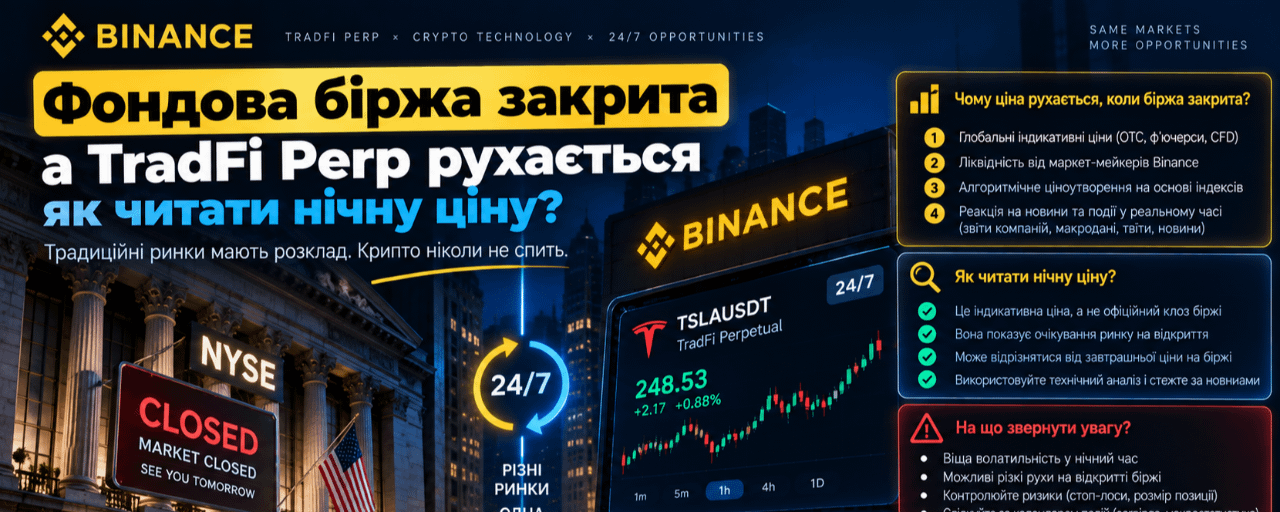
The Stock Exchange Is Closed, and the TradFi Perp Moves—How to Read the Night PriceTradFi Perpetual trades on Binance Futures 24/7, even when the underlying stock exchange is closed. Therefore, the contract’s night or weekend price is not a new official stock quotation. This is the derivatives price, formed by orders on Binance and the index and Mark Price calculation rules.
For TradFi Perps on Binance stocks starting May 16, 2026, during daily technical maintenance, weekends, and holidays, it uses an indexed mode based on the order book with EWMA smoothing, instead of the previous fixed mode. Separately, as of August 31, for one of the Mark Price components, the average is calculated on a minute-by-minute basis rather than a 30-second basis.
The Stock Exchange Is Closed, and the TradFi Perp Moves—How to Read the Night Price
TradFi Perpetual trades on Binance Futures 24/7, even when the underlying stock exchange is closed. Therefore, the contract’s night or weekend price is not a new official stock quotation. This is the derivatives price, formed by orders on Binance and the index and Mark Price calculation rules.
For TradFi Perps on Binance stocks starting May 16, 2026, during daily technical maintenance, weekends, and holidays, it uses an indexed mode based on the order book with EWMA smoothing, instead of the previous fixed mode. Separately, as of August 31, for one of the Mark Price components, the average is calculated on a minute-by-minute basis rather than a 30-second basis.
For TradFi Perps on Binance stocks starting May 16, 2026, during daily technical maintenance, weekends, and holidays, it uses an indexed mode based on the order book with EWMA smoothing, instead of the previous fixed mode. Separately, as of August 31, for one of the Mark Price components, the average is calculated on a minute-by-minute basis rather than a 30-second basis.
1
128
Log in to explore more content
Join global crypto users on Binance Square
⚡️ Get latest and useful information about crypto.
💬 Trusted by the world’s largest crypto exchange.
👍 Discover real insights from verified creators.
Email / Phone number
Trending Topics
1
#BTCReboundsAbove$60KAmidWhaleDipBuying
53,558 views
280 Discussing
2
#SolanaSets2027RoadmapToDoubleComputeCapacity
37,321 views
758 Discussing
3
#CaliforniaNvidiaProbeExaminesPotentialCriminalViolations
10,013 views
99 Discussing
4
#BlackRockLaunchesHKDollarDigitalLiquidityFund
31,193 views
598 Discussing
5
#NvidiaLoses$2.7TrillionInMonthAndAHalf
70,144 views
285 Discussing
6
#GlobalStocksFaceLongestLosingStreakSince2023
530,835 views
3,322 Discussing
7
#BlackRockIBITPostsRecord$541MSingleDayOutflow
86,884 views
176 Discussing
8
#AnthropicPlungesTowardIPOPriceonDay2
290,550 views
2,223 Discussing
9
#TwentyOneCapitalAdds172.25BTC
150,948 views
1,552 Discussing
10
#HKBillWouldExcludeTokenizedDepositsFromVirtualAssets
17,260 views
100 Discussing