
#securite
securite
17,495 views
101 Discussing
Hot
Latest

·
--
“A quantum computer could drain 35% of bitcoin in an hour.”
This phrase has been circulating since yesterday. It combines two true figures and makes up a false one.
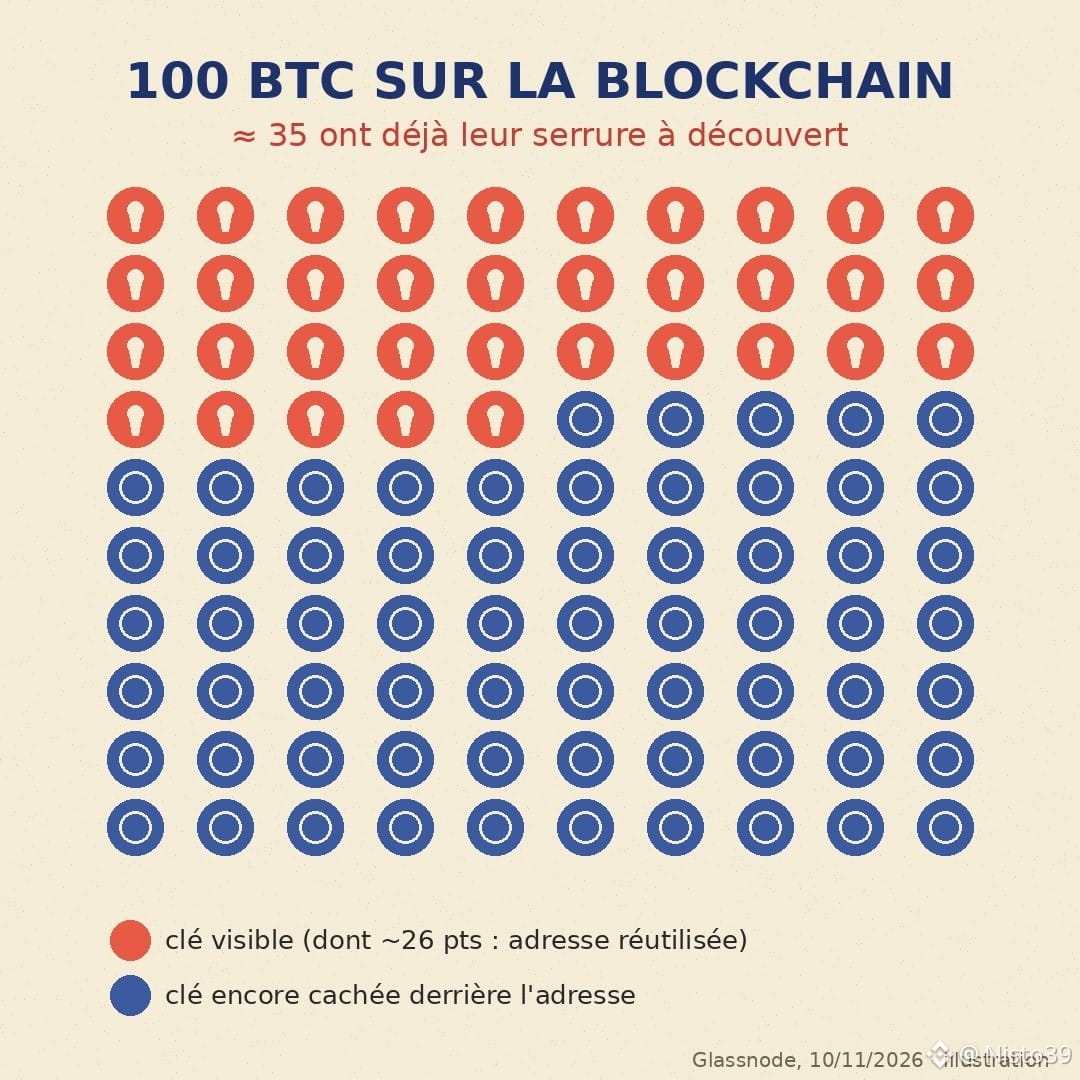
True #1: according to Glassnode (November 10), 35.4% of the $BTC supply, or around 7.12 million BTC, sits in addresses whose public key is already visible on the blockchain. A public key is like a lock that anyone can study. No computer today can work backwards from it to find the private key. A very large quantum machine theoretically could.
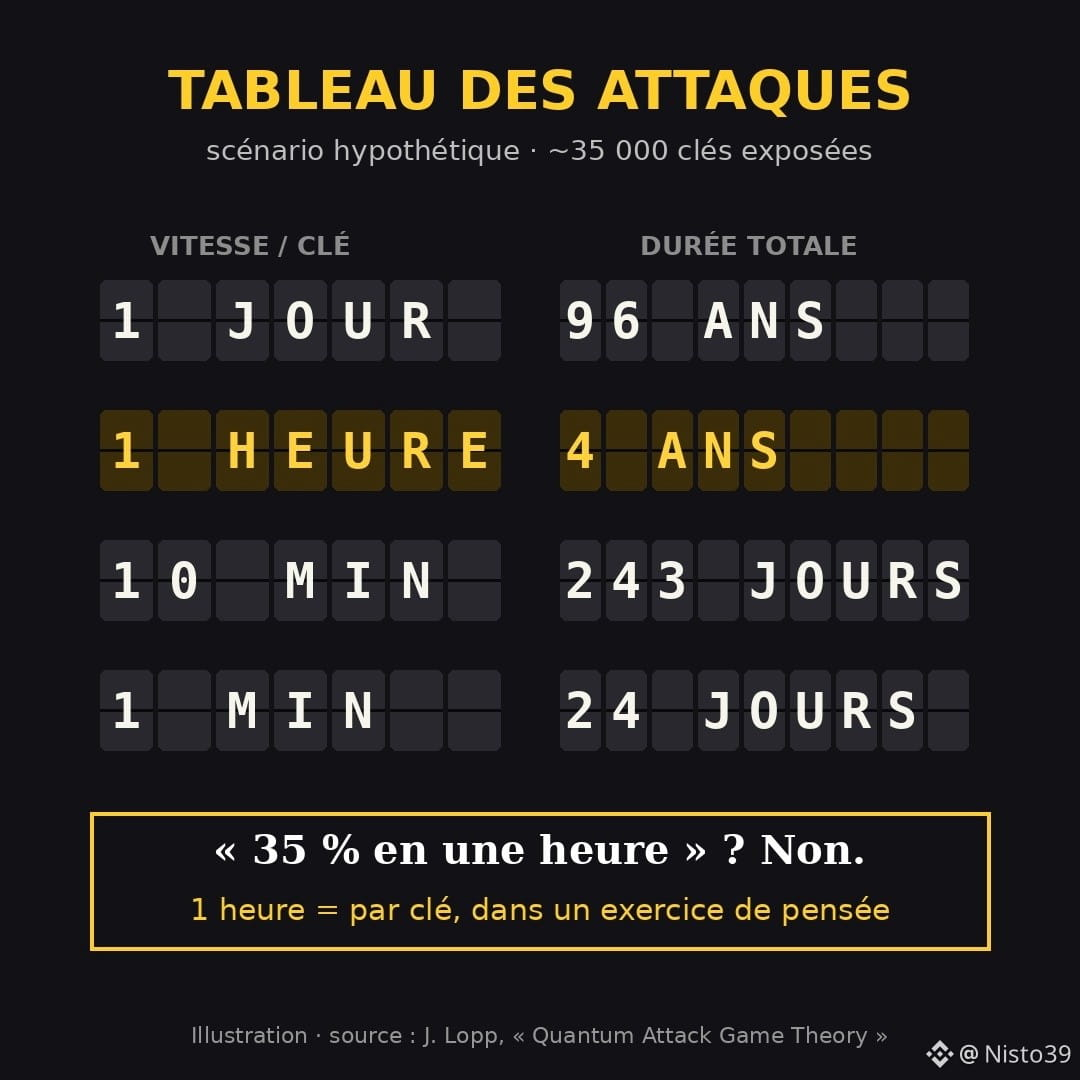
True #2: Jameson Lopp (Casa) ran the numbers as a thought experiment. Around 35,000 exposed keys, mostly belonging to coins that have been untouched for ~15 years, hold some 2.26 million BTC. At one key cracked per hour, it would take around 4 years to crack them all. At one per day: 96 years. At 10 minutes per key: 243 days.
“One hour” is therefore the time per key in a hypothetical scenario. Not the time it would take to crack a third of the network. And Lopp has already said he sees a greater than 50% chance that such a machine is more than ten years away.
My take: the real issue isn’t when, but who is exposed. According to Glassnode, 25.8% of the supply is exposed because of address reuse: you spend from an address, its public key becomes visible, and you keep receiving funds at that address. Most wallets offer a new address for each incoming payment. You just have to accept it.
The coins that can never be protected are the ones no one can move anymore. That’s where the debate will get heated, not over a well-managed wallet.
Do you still receive funds at the same address, or do you let your wallet change it?
#Bitcoin #Quantique #Securite #Glassnode
“A quantum computer could drain 35% of bitcoin in an hour.”
This phrase has been circulating since yesterday. It combines two true figures and makes up a false one.
True #1: according to Glassnode (November 10), 35.4% of the $BTC supply, or around 7.12 million BTC, sits in addresses whose public key is already visible on the blockchain. A public key is like a lock that anyone can study. No computer today can work backwards from it to find the private key. A very large quantum machine theoretically could.
True #2: Jameson Lopp (Casa) ran the numbers as a thought experiment. Around 35,000 exposed keys, mostly belonging to coins that have been untouched for ~15 years, hold some 2.26 million BTC. At one key cracked per hour, it would take around 4 years to crack them all. At one per day: 96 years. At 10 minutes per key: 243 days.
“One hour” is therefore the time per key in a hypothetical scenario. Not the time it would take to crack a third of the network. And Lopp has already said he sees a greater than 50% chance that such a machine is more than ten years away.
My take: the real issue isn’t when, but who is exposed. According to Glassnode, 25.8% of the supply is exposed because of address reuse: you spend from an address, its public key becomes visible, and you keep receiving funds at that address. Most wallets offer a new address for each incoming payment. You just have to accept it.
The coins that can never be protected are the ones no one can move anymore. That’s where the debate will get heated, not over a well-managed wallet.
Do you still receive funds at the same address, or do you let your wallet change it?
#Bitcoin #Quantique #Securite #Glassnode
This phrase has been circulating since yesterday. It combines two true figures and makes up a false one.
True #1: according to Glassnode (November 10), 35.4% of the $BTC supply, or around 7.12 million BTC, sits in addresses whose public key is already visible on the blockchain. A public key is like a lock that anyone can study. No computer today can work backwards from it to find the private key. A very large quantum machine theoretically could.
True #2: Jameson Lopp (Casa) ran the numbers as a thought experiment. Around 35,000 exposed keys, mostly belonging to coins that have been untouched for ~15 years, hold some 2.26 million BTC. At one key cracked per hour, it would take around 4 years to crack them all. At one per day: 96 years. At 10 minutes per key: 243 days.
“One hour” is therefore the time per key in a hypothetical scenario. Not the time it would take to crack a third of the network. And Lopp has already said he sees a greater than 50% chance that such a machine is more than ten years away.
My take: the real issue isn’t when, but who is exposed. According to Glassnode, 25.8% of the supply is exposed because of address reuse: you spend from an address, its public key becomes visible, and you keep receiving funds at that address. Most wallets offer a new address for each incoming payment. You just have to accept it.
The coins that can never be protected are the ones no one can move anymore. That’s where the debate will get heated, not over a well-managed wallet.
Do you still receive funds at the same address, or do you let your wallet change it?
#Bitcoin #Quantique #Securite #Glassnode
128
·
--
Article
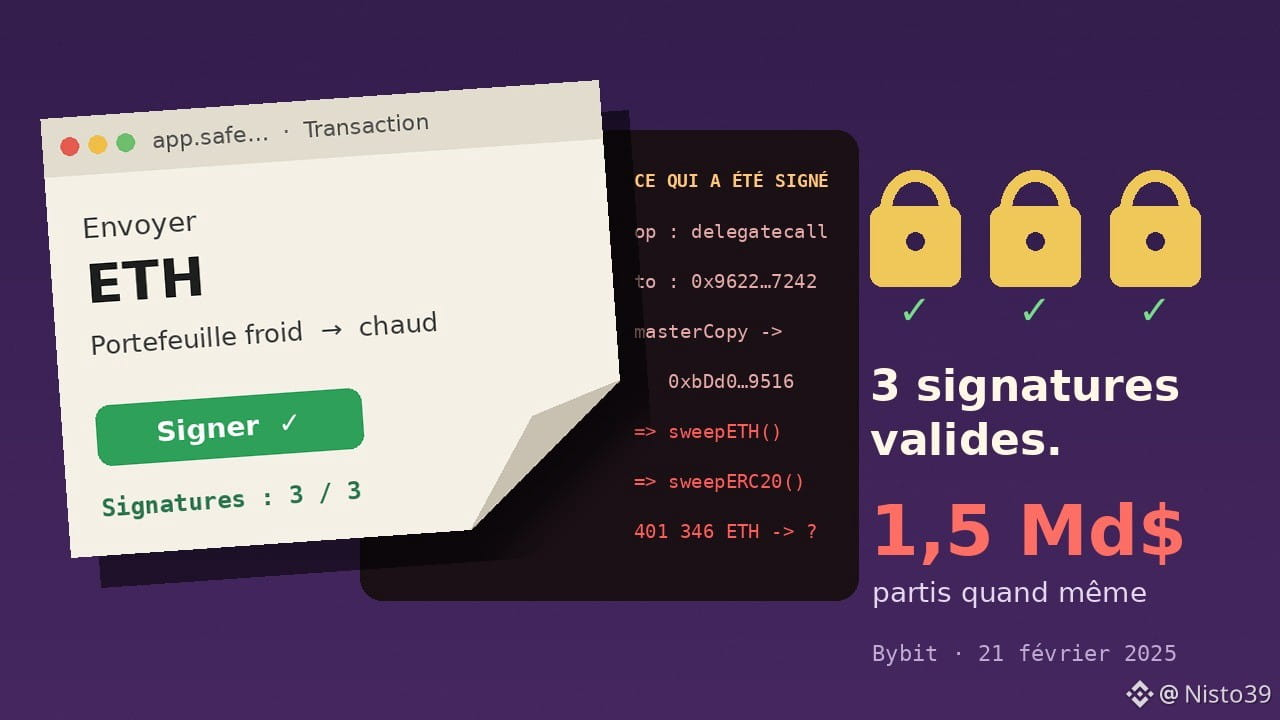
Three valid signatures, $1.5 billion gone: the Bybit vault puzzle in three cluesHere’s a puzzle I find more useful than any security tutorial.
A digital vault contains more than 400,000 ETH. To open it, three signatures are required, provided by three different people, each using their own physical signing device (a small device that keeps the private key offline). No one lost a key. No one betrayed anyone. All three signed a transaction they had verified on screen.
And yet, the vault was emptied in a matter of minutes.
Three valid signatures, $1.5 billion gone: the Bybit vault puzzle in three clues
Here’s a puzzle I find more useful than any security tutorial.
A digital vault contains more than 400,000 ETH. To open it, three signatures are required, provided by three different people, each using their own physical signing device (a small device that keeps the private key offline). No one lost a key. No one betrayed anyone. All three signed a transaction they had verified on screen.
And yet, the vault was emptied in a matter of minutes.
A digital vault contains more than 400,000 ETH. To open it, three signatures are required, provided by three different people, each using their own physical signing device (a small device that keeps the private key offline). No one lost a key. No one betrayed anyone. All three signed a transaction they had verified on screen.
And yet, the vault was emptied in a matter of minutes.
1.4k
·
--
Article
184 billion bitcoins created in a single transaction: the incident report on the 2010 bug“There will never be more than 21 million bitcoins.” The statement is true. But it isn’t magic. It holds because thousands of computers verify every block, and because people fix the code when it breaks. And yes, it has broken before.
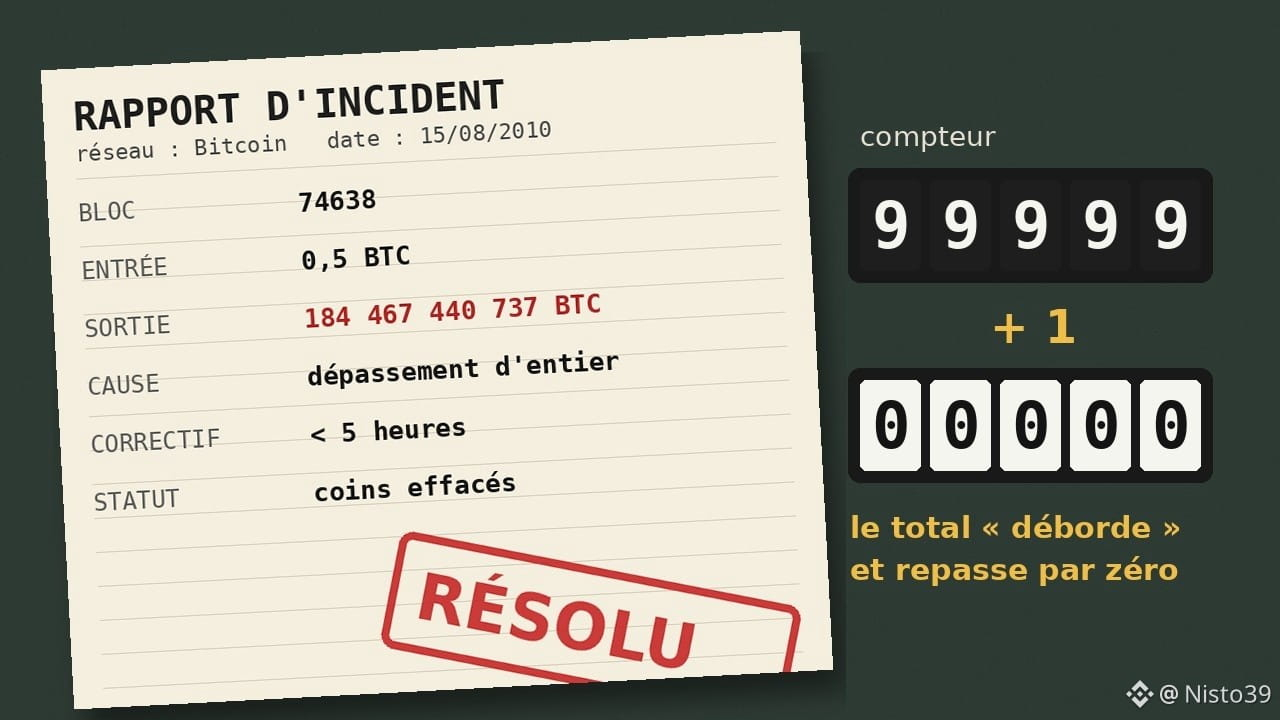
On August 15, 2010, someone created more than 184 billion bitcoins in a single transaction. Here’s the incident report, as a technical team might write it today.
SYMPTOM
Block 74638. A transaction spends 0.5 BTC and sends approximately 92.2 billion to two different addresses. Total: 184,467,440,737 BTC. The block is accepted by the network as if nothing had happened. A user spots it and starts a thread on the Bitcointalk forum: “Strange block 74638”.
184 billion bitcoins created in a single transaction: the incident report on the 2010 bug
“There will never be more than 21 million bitcoins.” The statement is true. But it isn’t magic. It holds because thousands of computers verify every block, and because people fix the code when it breaks. And yes, it has broken before.
On August 15, 2010, someone created more than 184 billion bitcoins in a single transaction. Here’s the incident report, as a technical team might write it today.
SYMPTOM
Block 74638. A transaction spends 0.5 BTC and sends approximately 92.2 billion to two different addresses. Total: 184,467,440,737 BTC. The block is accepted by the network as if nothing had happened. A user spots it and starts a thread on the Bitcointalk forum: “Strange block 74638”.
On August 15, 2010, someone created more than 184 billion bitcoins in a single transaction. Here’s the incident report, as a technical team might write it today.
SYMPTOM
Block 74638. A transaction spends 0.5 BTC and sends approximately 92.2 billion to two different addresses. Total: 184,467,440,737 BTC. The block is accepted by the network as if nothing had happened. A user spots it and starts a thread on the Bitcointalk forum: “Strange block 74638”.
1
2.4k
·
--
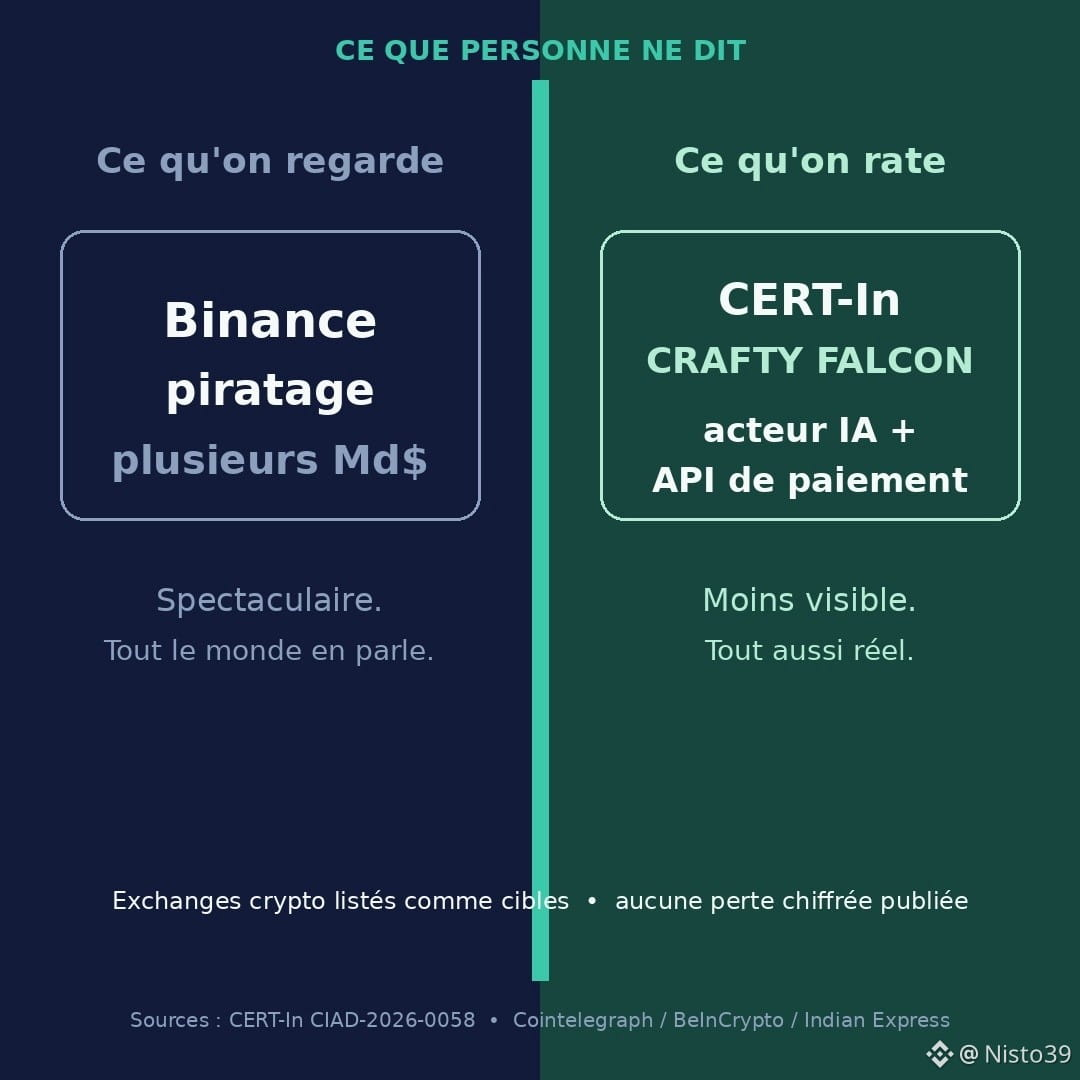
Everyone has their eyes on the Binance hack — billions frozen, report still hot off the press. Understandable. It's spectacular.
What almost no one is watching: on November 4, CERT-In published the critical advisory CIAD-2026-0058. October update. One name: CRAFTY FALCON.
Not a script kiddie. An AI-assisted financial actor that, according to CERT-In, “monitors its targets with machine intelligence, operates at machine speed, and strikes by invoking the victim’s own payment and disbursement APIs.”
Targets: NBFCs, fintechs, aggregators… and crypto exchanges / VDA providers. Wallet keys stolen. Funds drained. No exchange named. No amounts disclosed.
Modus operandi: UAT/staging environments exposed to production via shared credentials; cloud (AWS SSM/Lambda) abused; apps reverse-engineered; IP allowlists bypassed; test micro-transfers (1 rupee) before the big hits; weekend timing; AI-generated scripts.
My take: we hear a lot about $BTC and $ETH when a hot wallet gets hit. Less so when the attack comes through internal payment APIs — the invisible plumbing. CERT-In is calling for 24/7 monitoring and more staff on weekends. Not glamorous. Maybe vital.
Sources: CERT-In, Cointelegraph (Nov. 5), BeInCrypto, Indian Express, Mint. Not financial advice.
Enhanced monitoring on Sundays at your exchange: reassuring, or overkill for a regular weekend?
#CryptoNews #Securite #CERTIn #Exchange #IA
Everyone has their eyes on the Binance hack — billions frozen, report still hot off the press. Understandable. It's spectacular.
What almost no one is watching: on November 4, CERT-In published the critical advisory CIAD-2026-0058. October update. One name: CRAFTY FALCON.
Not a script kiddie. An AI-assisted financial actor that, according to CERT-In, “monitors its targets with machine intelligence, operates at machine speed, and strikes by invoking the victim’s own payment and disbursement APIs.”
Targets: NBFCs, fintechs, aggregators… and crypto exchanges / VDA providers. Wallet keys stolen. Funds drained. No exchange named. No amounts disclosed.
Modus operandi: UAT/staging environments exposed to production via shared credentials; cloud (AWS SSM/Lambda) abused; apps reverse-engineered; IP allowlists bypassed; test micro-transfers (1 rupee) before the big hits; weekend timing; AI-generated scripts.
My take: we hear a lot about $BTC and $ETH when a hot wallet gets hit. Less so when the attack comes through internal payment APIs — the invisible plumbing. CERT-In is calling for 24/7 monitoring and more staff on weekends. Not glamorous. Maybe vital.
Sources: CERT-In, Cointelegraph (Nov. 5), BeInCrypto, Indian Express, Mint. Not financial advice.
Enhanced monitoring on Sundays at your exchange: reassuring, or overkill for a regular weekend?
#CryptoNews #Securite #CERTIn #Exchange #IA
What almost no one is watching: on November 4, CERT-In published the critical advisory CIAD-2026-0058. October update. One name: CRAFTY FALCON.
Not a script kiddie. An AI-assisted financial actor that, according to CERT-In, “monitors its targets with machine intelligence, operates at machine speed, and strikes by invoking the victim’s own payment and disbursement APIs.”
Targets: NBFCs, fintechs, aggregators… and crypto exchanges / VDA providers. Wallet keys stolen. Funds drained. No exchange named. No amounts disclosed.
Modus operandi: UAT/staging environments exposed to production via shared credentials; cloud (AWS SSM/Lambda) abused; apps reverse-engineered; IP allowlists bypassed; test micro-transfers (1 rupee) before the big hits; weekend timing; AI-generated scripts.
My take: we hear a lot about $BTC and $ETH when a hot wallet gets hit. Less so when the attack comes through internal payment APIs — the invisible plumbing. CERT-In is calling for 24/7 monitoring and more staff on weekends. Not glamorous. Maybe vital.
Sources: CERT-In, Cointelegraph (Nov. 5), BeInCrypto, Indian Express, Mint. Not financial advice.
Enhanced monitoring on Sundays at your exchange: reassuring, or overkill for a regular weekend?
#CryptoNews #Securite #CERTIn #Exchange #IA

83
·
--
🔓 Coinbase: customer data leaked… without Coinbase being hacked. Here’s why it still concerns you
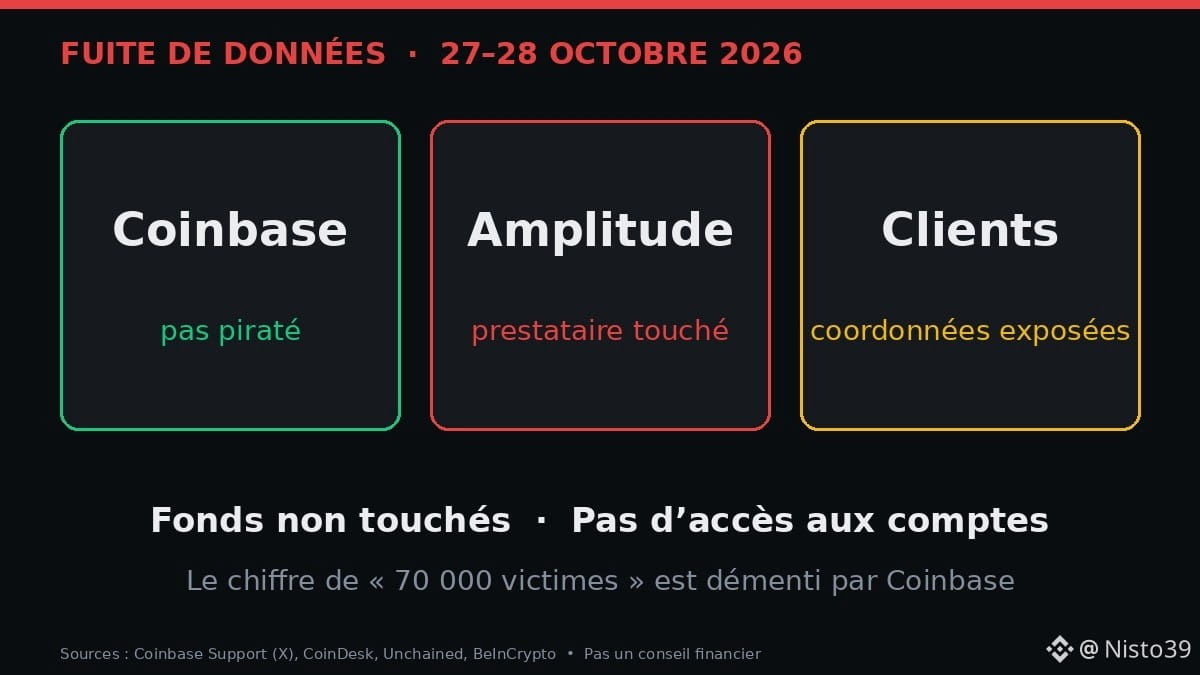
On the evening of October 27 (US time), Coinbase confirmed an incident at Amplitude, an analytics provider it uses:
• Contact details and some transaction data of a “small number” of customers exposed
• No mailing addresses or information that would allow anyone to access an account, according to Coinbase
• No evidence of access to its own systems, funds unaffected, affected customers notified
• The viral figure of “70,000 victims” is false, according to Coinbase
• In the same week in Korea: Bithumb reported a breach of an internal employee tool and the theft of personal data, with no crypto losses reported
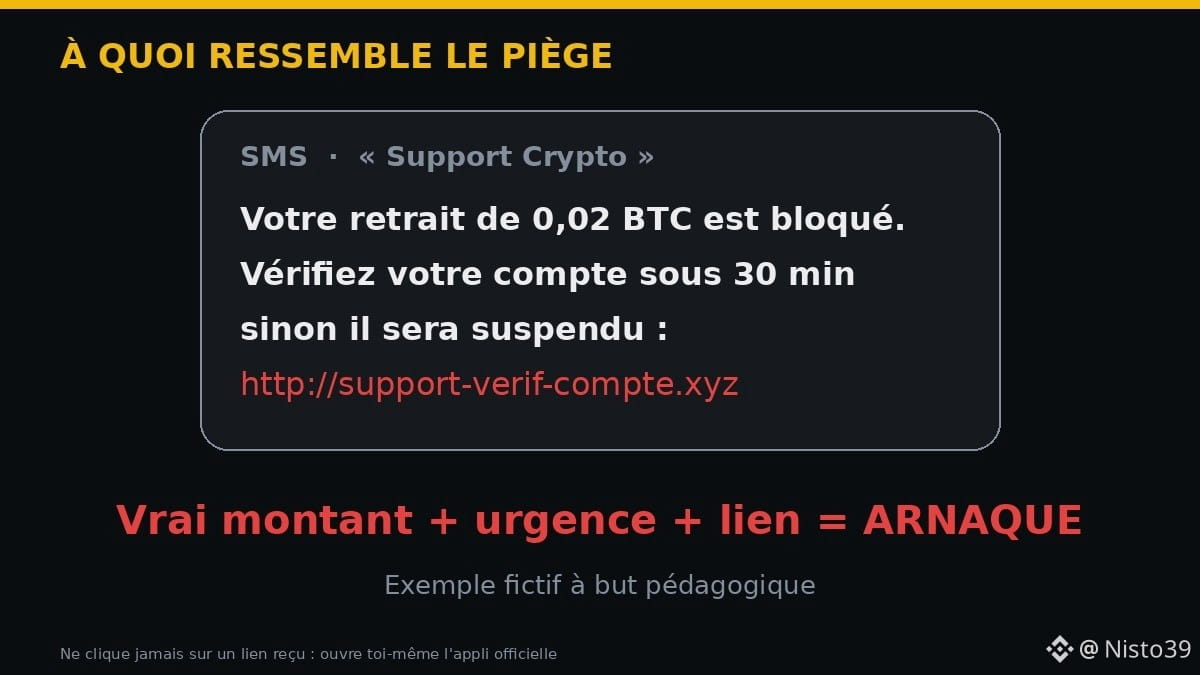
🧠 Why is this a risk? With your email, phone number, and an actual purchase amount, a scammer can craft a very convincing message: “Your 0,02 $BTC withdrawal is blocked, click here.” This is phishing.
👨🏿🔧 Example: Sékou, a mechanic in Conakry, gets a “Support” text that mentions his latest $ETH purchase. The link leads to a fake site.
➡️ He doesn’t click.
➡️ He opens the official app himself: no alerts.
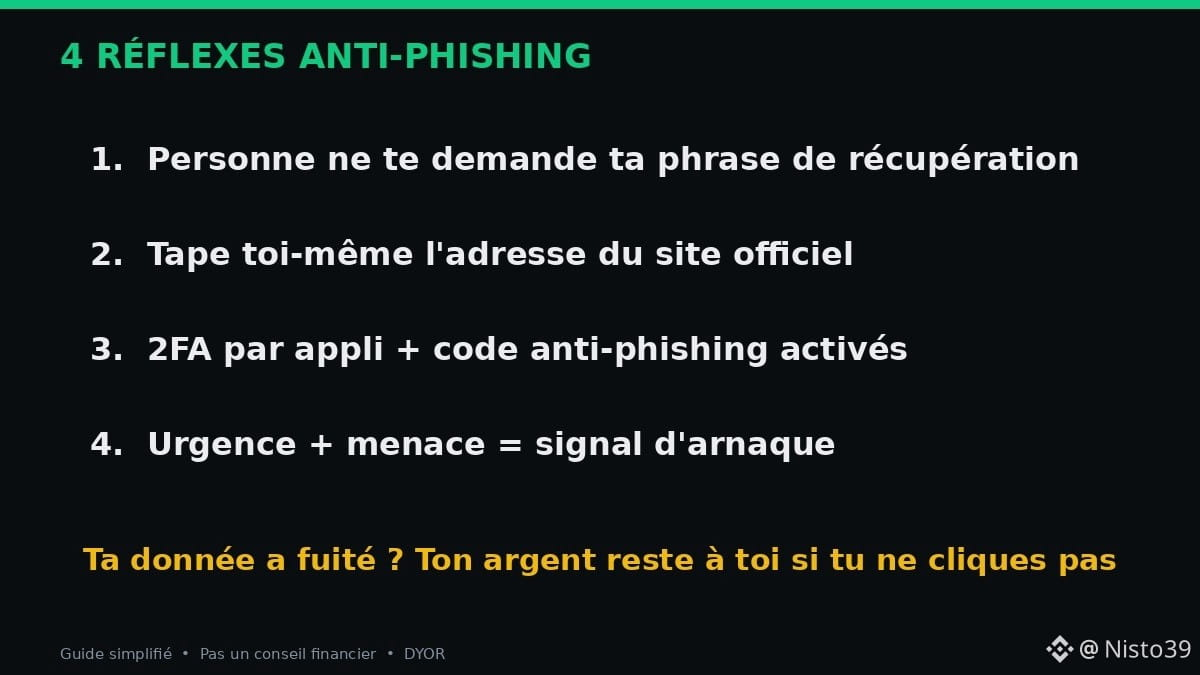
✅ Good habits:
1. No legitimate support agent will ask for your recovery phrase or 2FA code
2. Type the website address yourself; never use a link you received
3. Enable app-based 2FA (not just SMS) and an anti-phishing code
4. Urgency + threats = sign of a scam
Have you ever received a fake “crypto support” message? Tell us 👇
Sources: Coinbase Support (X), CoinDesk, Unchained, BeInCrypto. Not financial advice.
#Securite #Phishing #Coinbase #CryptoNews #Africa
🔓 Coinbase: customer data leaked… without Coinbase being hacked. Here’s why it still concerns you
On the evening of October 27 (US time), Coinbase confirmed an incident at Amplitude, an analytics provider it uses:
• Contact details and some transaction data of a “small number” of customers exposed
• No mailing addresses or information that would allow anyone to access an account, according to Coinbase
• No evidence of access to its own systems, funds unaffected, affected customers notified
• The viral figure of “70,000 victims” is false, according to Coinbase
• In the same week in Korea: Bithumb reported a breach of an internal employee tool and the theft of personal data, with no crypto losses reported
🧠 Why is this a risk? With your email, phone number, and an actual purchase amount, a scammer can craft a very convincing message: “Your 0,02 $BTC withdrawal is blocked, click here.” This is phishing.
👨🏿🔧 Example: Sékou, a mechanic in Conakry, gets a “Support” text that mentions his latest $ETH purchase. The link leads to a fake site.
➡️ He doesn’t click.
➡️ He opens the official app himself: no alerts.
✅ Good habits:
1. No legitimate support agent will ask for your recovery phrase or 2FA code
2. Type the website address yourself; never use a link you received
3. Enable app-based 2FA (not just SMS) and an anti-phishing code
4. Urgency + threats = sign of a scam
Have you ever received a fake “crypto support” message? Tell us 👇
Sources: Coinbase Support (X), CoinDesk, Unchained, BeInCrypto. Not financial advice.
#Securite #Phishing #Coinbase #CryptoNews #Africa
On the evening of October 27 (US time), Coinbase confirmed an incident at Amplitude, an analytics provider it uses:
• Contact details and some transaction data of a “small number” of customers exposed
• No mailing addresses or information that would allow anyone to access an account, according to Coinbase
• No evidence of access to its own systems, funds unaffected, affected customers notified
• The viral figure of “70,000 victims” is false, according to Coinbase
• In the same week in Korea: Bithumb reported a breach of an internal employee tool and the theft of personal data, with no crypto losses reported
🧠 Why is this a risk? With your email, phone number, and an actual purchase amount, a scammer can craft a very convincing message: “Your 0,02 $BTC withdrawal is blocked, click here.” This is phishing.
👨🏿🔧 Example: Sékou, a mechanic in Conakry, gets a “Support” text that mentions his latest $ETH purchase. The link leads to a fake site.
➡️ He doesn’t click.
➡️ He opens the official app himself: no alerts.
✅ Good habits:
1. No legitimate support agent will ask for your recovery phrase or 2FA code
2. Type the website address yourself; never use a link you received
3. Enable app-based 2FA (not just SMS) and an anti-phishing code
4. Urgency + threats = sign of a scam
Have you ever received a fake “crypto support” message? Tell us 👇
Sources: Coinbase Support (X), CoinDesk, Unchained, BeInCrypto. Not financial advice.
#Securite #Phishing #Coinbase #CryptoNews #Africa
102
·
--
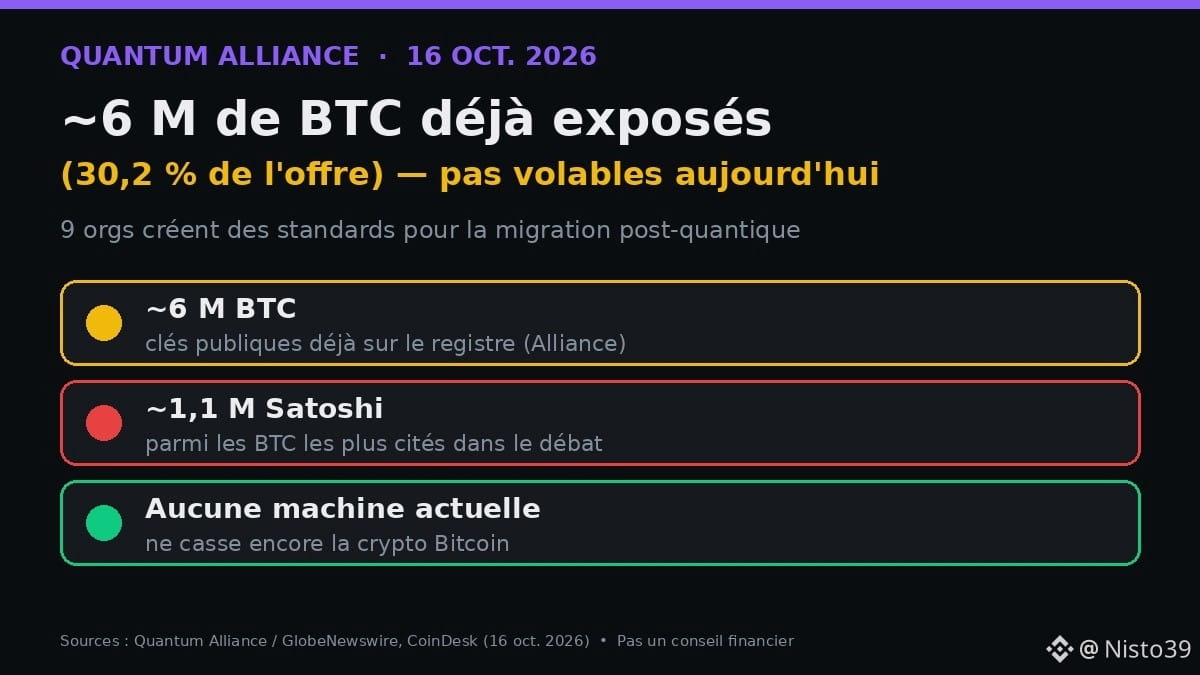
🔐 9 crypto organizations launch the Quantum Alliance: ~6 M of $BTC (30.2% of the supply) already have an exposed public key. Not stealable today — but the risk is being prepared for now.
📌 The facts (Alliance + CoinDesk, Oct. 16, 2026)
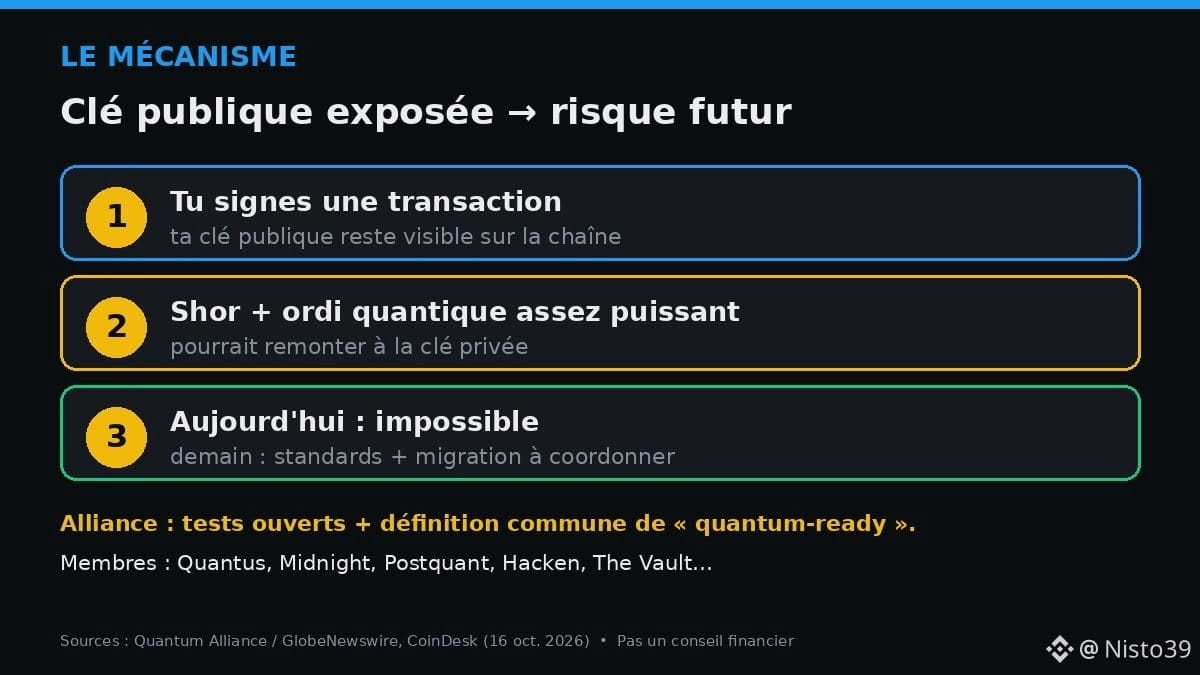
• 9 organizations (Quantus, Midnight Foundation, Postquant Labs, Hacken, The Vault…) are creating an open standards body
• Goal: define what “quantum-ready” means and how to verify it
• ~6 M BTC exposed (30.2%); ~1.1 M of those attributed to Satoshi
• No current machine can break Bitcoin cryptography; some experts cite ~2028 as a possible window
🧠 How it works
When you sign a transaction, your public key remains on the ledger. A sufficiently powerful quantum computer (using Shor’s algorithm) could derive the private key from that public key. Today: impossible. Tomorrow: migration to plan for.
⚖️ The nuance
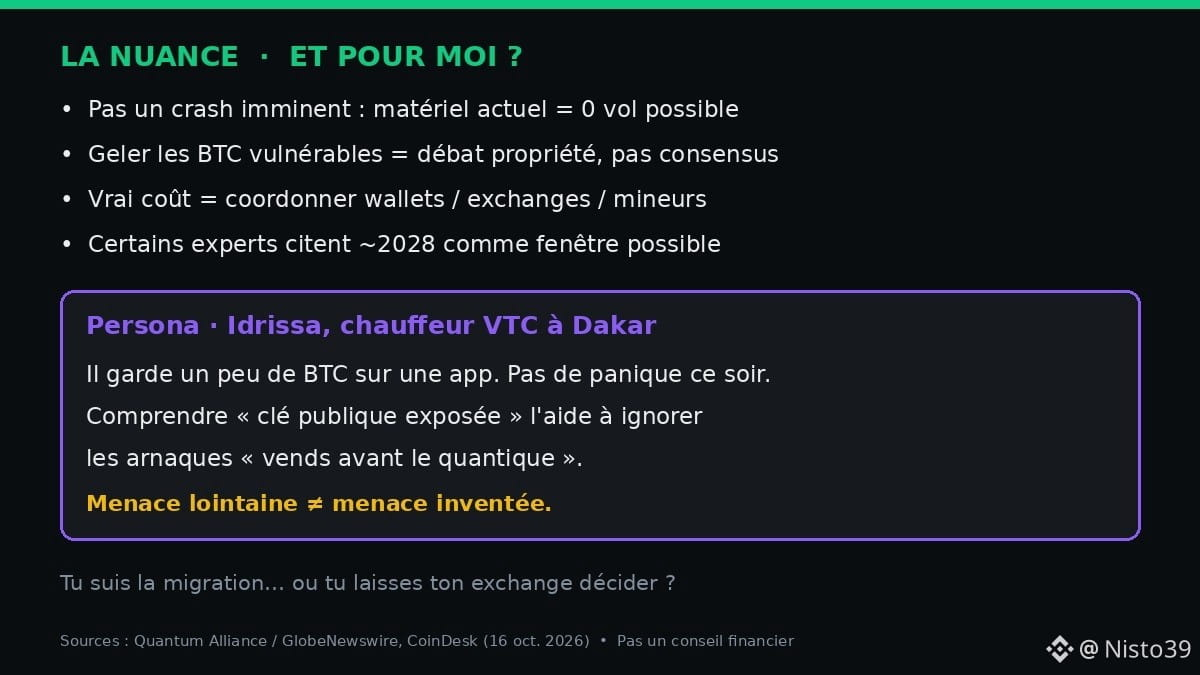
• This is NOT an imminent crash: theft isn’t possible with current hardware
• Freezing “vulnerable” BTC (an idea under debate, including Satoshi’s) = a debate about property rights, not a consensus
• The real cost = coordinating wallets, exchanges, miners — not just changing a formula
👤 Idrissa, a ride-hailing driver in Dakar, keeps a little BTC on an app. He doesn’t need to panic tonight. But understanding “exposed public key” helps him ignore scams like “sell your BTC before quantum computing arrives.”
✅ A distant threat ≠ an invented threat. Shared standards = less marketing, more evidence.
Are you already following the post-quantum migration… or waiting for your exchange to do it for you? 👇
Not financial advice. DYOR.
Sources: Quantum Alliance / GlobeNewswire, CoinDesk (Oct. 16, 2026).
#Bitcoin #Quantum #Securite #Afrique
🔐 9 crypto organizations launch the Quantum Alliance: ~6 M of $BTC (30.2% of the supply) already have an exposed public key. Not stealable today — but the risk is being prepared for now.
📌 The facts (Alliance + CoinDesk, Oct. 16, 2026)
• 9 organizations (Quantus, Midnight Foundation, Postquant Labs, Hacken, The Vault…) are creating an open standards body
• Goal: define what “quantum-ready” means and how to verify it
• ~6 M BTC exposed (30.2%); ~1.1 M of those attributed to Satoshi
• No current machine can break Bitcoin cryptography; some experts cite ~2028 as a possible window
🧠 How it works
When you sign a transaction, your public key remains on the ledger. A sufficiently powerful quantum computer (using Shor’s algorithm) could derive the private key from that public key. Today: impossible. Tomorrow: migration to plan for.
⚖️ The nuance
• This is NOT an imminent crash: theft isn’t possible with current hardware
• Freezing “vulnerable” BTC (an idea under debate, including Satoshi’s) = a debate about property rights, not a consensus
• The real cost = coordinating wallets, exchanges, miners — not just changing a formula
👤 Idrissa, a ride-hailing driver in Dakar, keeps a little BTC on an app. He doesn’t need to panic tonight. But understanding “exposed public key” helps him ignore scams like “sell your BTC before quantum computing arrives.”
✅ A distant threat ≠ an invented threat. Shared standards = less marketing, more evidence.
Are you already following the post-quantum migration… or waiting for your exchange to do it for you? 👇
Not financial advice. DYOR.
Sources: Quantum Alliance / GlobeNewswire, CoinDesk (Oct. 16, 2026).
#Bitcoin #Quantum #Securite #Afrique
📌 The facts (Alliance + CoinDesk, Oct. 16, 2026)
• 9 organizations (Quantus, Midnight Foundation, Postquant Labs, Hacken, The Vault…) are creating an open standards body
• Goal: define what “quantum-ready” means and how to verify it
• ~6 M BTC exposed (30.2%); ~1.1 M of those attributed to Satoshi
• No current machine can break Bitcoin cryptography; some experts cite ~2028 as a possible window
🧠 How it works
When you sign a transaction, your public key remains on the ledger. A sufficiently powerful quantum computer (using Shor’s algorithm) could derive the private key from that public key. Today: impossible. Tomorrow: migration to plan for.
⚖️ The nuance
• This is NOT an imminent crash: theft isn’t possible with current hardware
• Freezing “vulnerable” BTC (an idea under debate, including Satoshi’s) = a debate about property rights, not a consensus
• The real cost = coordinating wallets, exchanges, miners — not just changing a formula
👤 Idrissa, a ride-hailing driver in Dakar, keeps a little BTC on an app. He doesn’t need to panic tonight. But understanding “exposed public key” helps him ignore scams like “sell your BTC before quantum computing arrives.”
✅ A distant threat ≠ an invented threat. Shared standards = less marketing, more evidence.
Are you already following the post-quantum migration… or waiting for your exchange to do it for you? 👇
Not financial advice. DYOR.
Sources: Quantum Alliance / GlobeNewswire, CoinDesk (Oct. 16, 2026).
#Bitcoin #Quantum #Securite #Afrique
36
·
--
Article
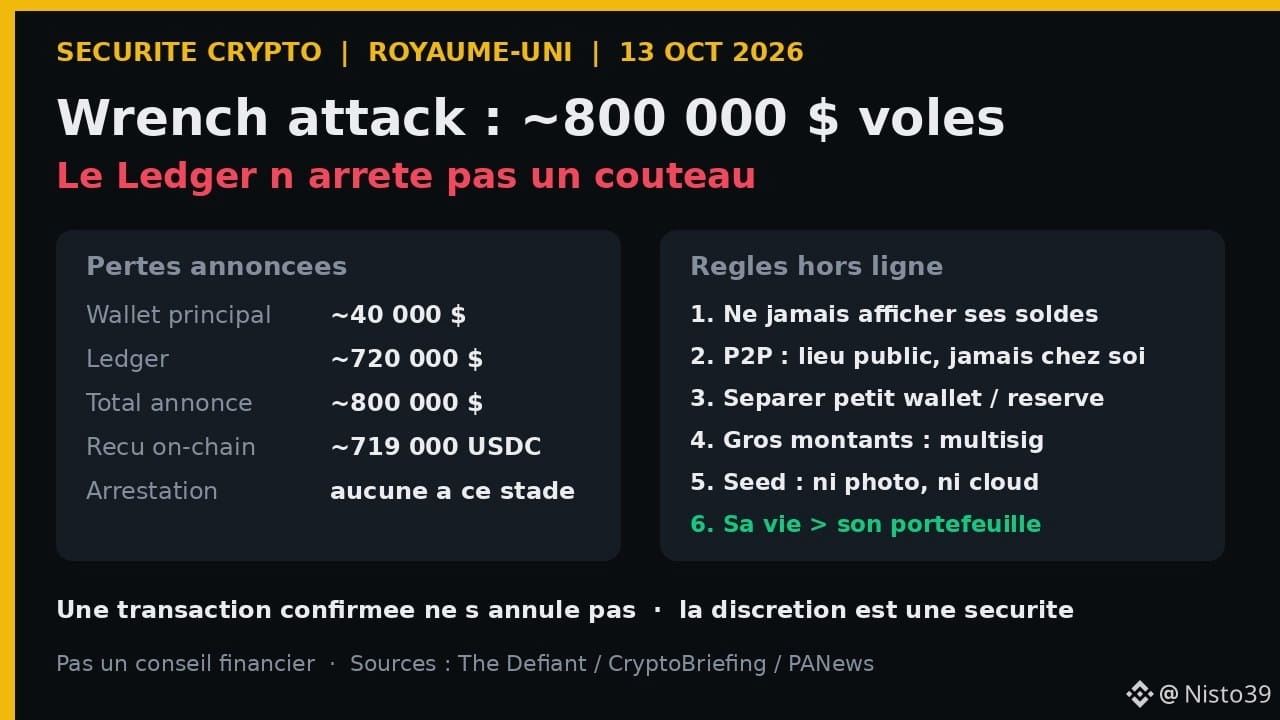
A Ledger can’t stop a knife: what the $800,000 theft in the UK teaches us allA hardware wallet protects your crypto from hackers. It doesn’t protect you from someone who breaks into your home with a knife. That’s exactly what just happened to a trader in the UK — and the lesson applies to everyone, not just “whales.”
📋 The facts (The Defiant, CryptoBriefing, PANews — Oct. 13, 2026)
• The trader known by the pseudonym “Realist” (@rrealist on X) says intruders broke into his home in the UK, tied him up and threatened him with a knife.
A Ledger can’t stop a knife: what the $800,000 theft in the UK teaches us all
A hardware wallet protects your crypto from hackers. It doesn’t protect you from someone who breaks into your home with a knife. That’s exactly what just happened to a trader in the UK — and the lesson applies to everyone, not just “whales.”
📋 The facts (The Defiant, CryptoBriefing, PANews — Oct. 13, 2026)
• The trader known by the pseudonym “Realist” (@rrealist on X) says intruders broke into his home in the UK, tied him up and threatened him with a knife.
📋 The facts (The Defiant, CryptoBriefing, PANews — Oct. 13, 2026)
• The trader known by the pseudonym “Realist” (@rrealist on X) says intruders broke into his home in the UK, tied him up and threatened him with a knife.
3
399
·
--
Article
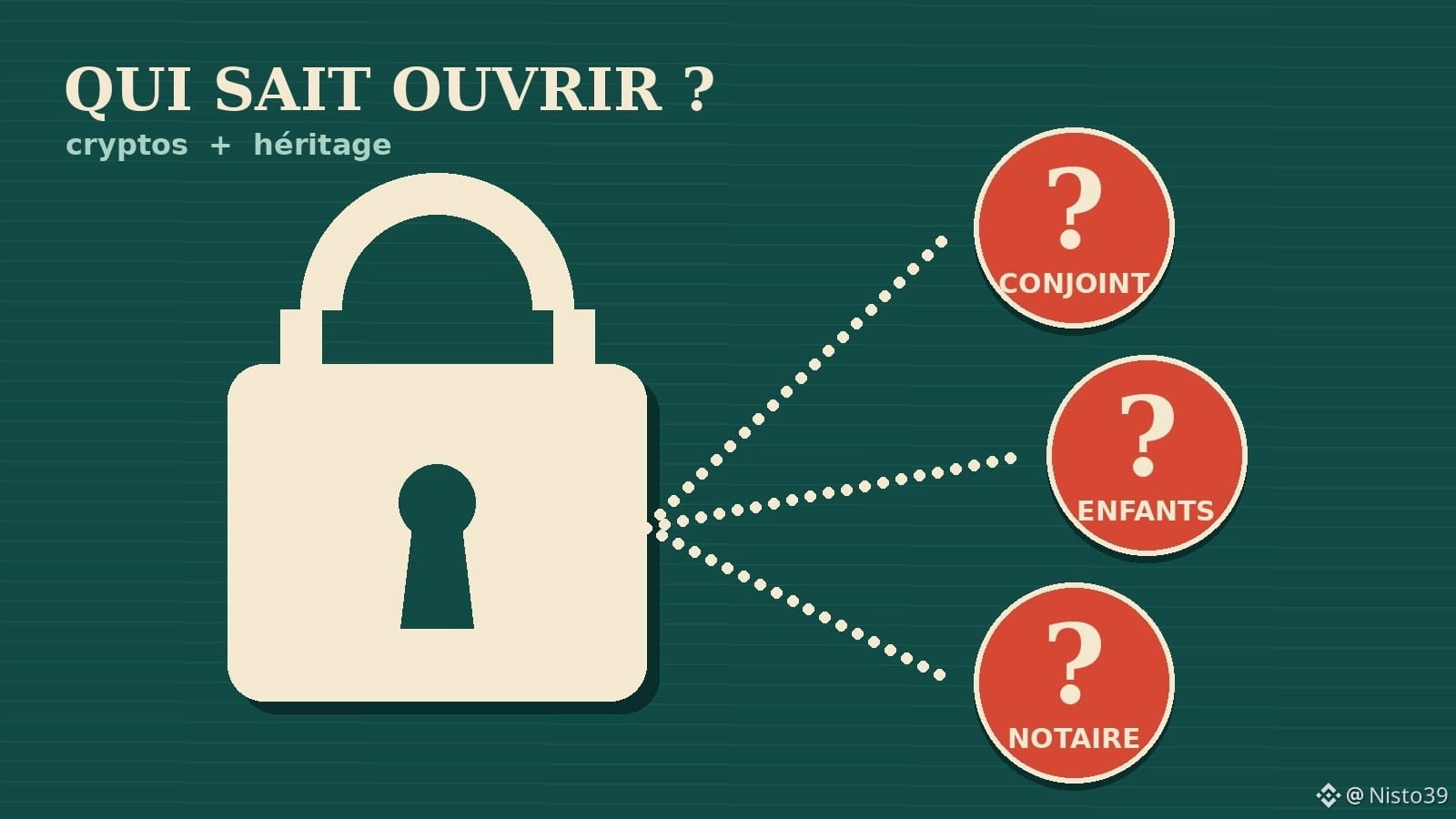
If I die tomorrow, will my family be able to recover my crypto?Awkward question, but I’d rather ask it now: if you disappeared tomorrow, who in your family would know you have crypto? And among them, who would know how to recover it?
For many of us, the honest answer is “no one.” We keep it discreet, sometimes even from our spouse. That’s understandable. But crypto without the right information is a locked door whose key went with you.
The story everyone cites in this context is QuadrigaCX, a Canadian platform. December 2018: its founder, Gerald Cotten, dies in India. The platform then explains that he alone controlled the wallets where customers’ funds were stored. For months, people told it as the tragedy of the lost keys.
If I die tomorrow, will my family be able to recover my crypto?
Awkward question, but I’d rather ask it now: if you disappeared tomorrow, who in your family would know you have crypto? And among them, who would know how to recover it?
For many of us, the honest answer is “no one.” We keep it discreet, sometimes even from our spouse. That’s understandable. But crypto without the right information is a locked door whose key went with you.
The story everyone cites in this context is QuadrigaCX, a Canadian platform. December 2018: its founder, Gerald Cotten, dies in India. The platform then explains that he alone controlled the wallets where customers’ funds were stored. For months, people told it as the tragedy of the lost keys.
For many of us, the honest answer is “no one.” We keep it discreet, sometimes even from our spouse. That’s understandable. But crypto without the right information is a locked door whose key went with you.
The story everyone cites in this context is QuadrigaCX, a Canadian platform. December 2018: its founder, Gerald Cotten, dies in India. The platform then explains that he alone controlled the wallets where customers’ funds were stored. For months, people told it as the tragedy of the lost keys.
CRYPTO AFRIQUE SN:
Une question que beaucoup d'investisseurs oublient : que deviendront leurs cryptomonnaies s'ils ne sont plus là demain ?
La sécurité ne concerne pas seulement les piratages. Elle concerne aussi la transmission et la préparation.
En crypto, protéger son capital, c'est également prévoir l'imprévisible.
2
3
814
·
--
One line of debug code. That was all it took.
Proxima, a trading app on Solana, published its post-mortem Saturday night. The account reads like an incident log:
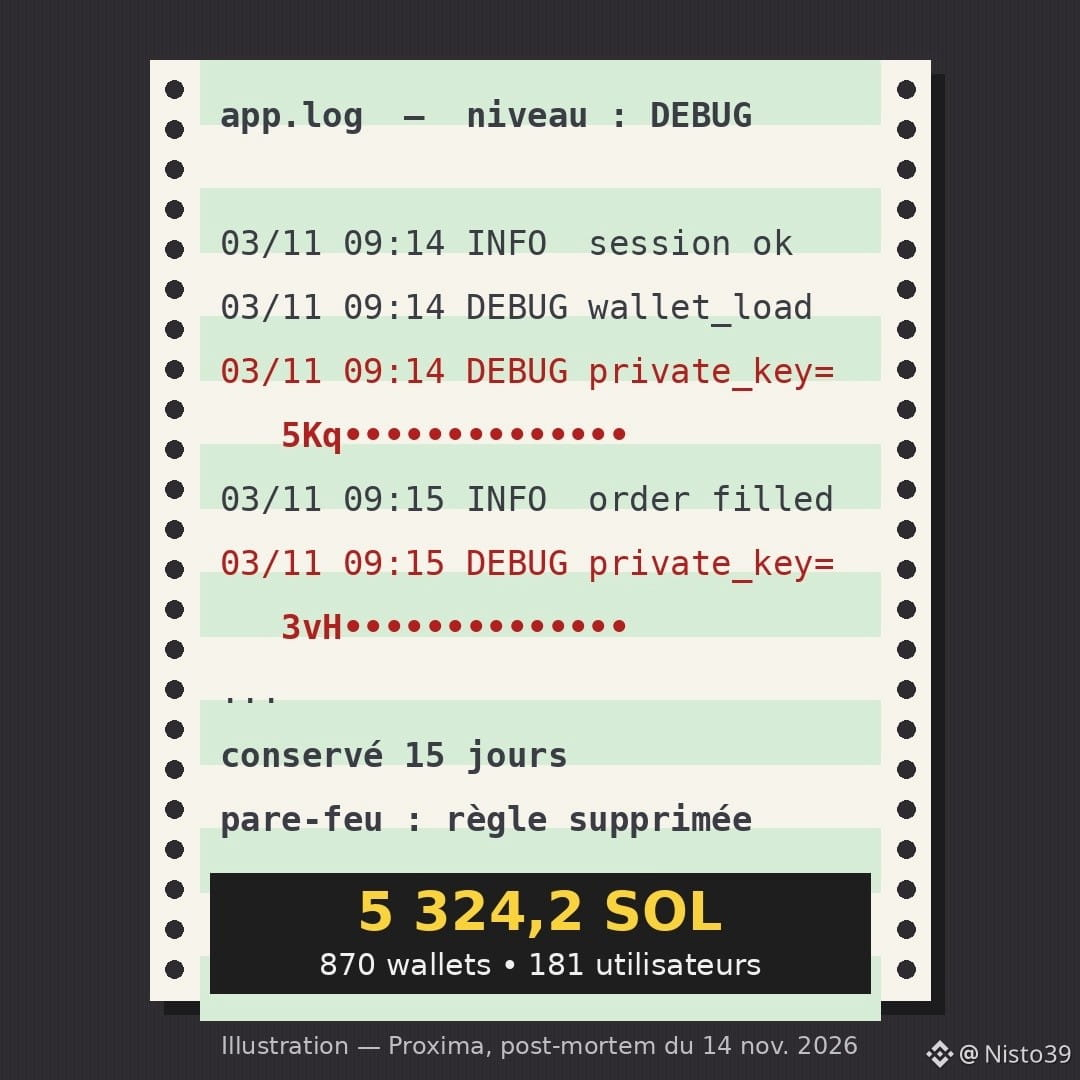
Nov. 3 — a log line intended for the beta starts writing private keys to the technical logs. It was never supposed to run in production. Someone switched the logs to “debug” mode to monitor performance.
Nov. 10 — the line is removed. Except the logs are kept for 15 days in a monitoring tool (SigNoz) whose security update had been “postponed several times.”
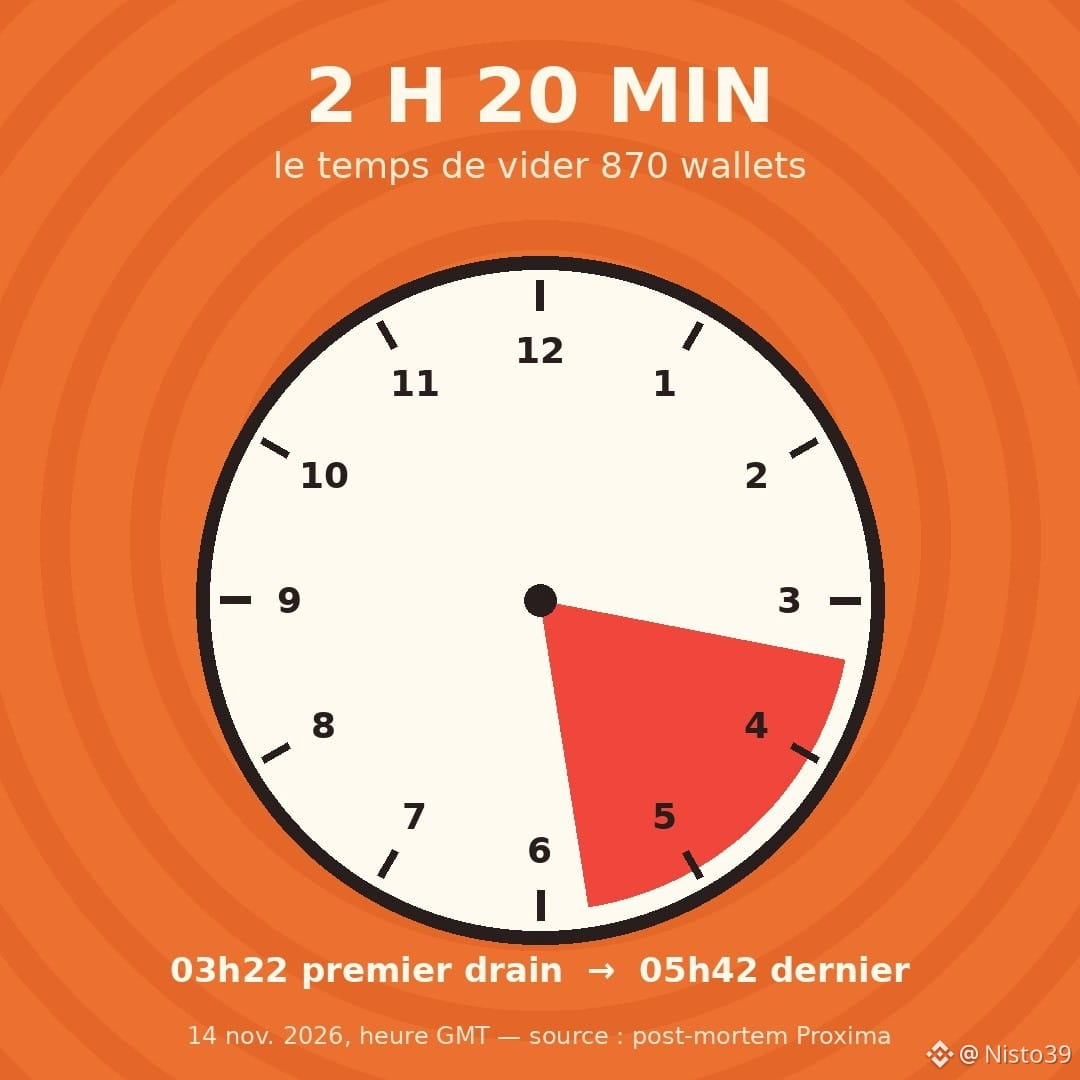
Nov. 14, 02:16 GMT — an attacker siphons off the logs. The firewall rule that was supposed to hide this tool from the internet had been “inadvertently deleted.”
03:22 — first wallet drained.
05:42 — last one.
According to Proxima: 5 324,2 $SOL taken from 870 wallets belonging to 181 users, around 0.1% of its wallets. Everyone was reimbursed from the company treasury.
One detail is troubling: the initial estimate was $200,000 to $250,000. At SOL’s price during the attack (~$75), the total is closer to $400,000 (according to Cryptowatchdesk’s calculation). The report doesn’t explain the discrepancy.
What strikes me is that none of these mistakes is particularly spectacular. A bot that buys and sells on your behalf has to keep your private key somewhere — the key is the master password that authorizes spending. Every place it passes through (a log, a server, a service provider) is one more door you can’t see.
My rule: with this kind of app, only use an amount I’m willing to lose, and never reuse elsewhere a wallet it created.
The last bot you entrusted with a wallet — could you say where it keeps your key?
#Solana #Securite #CryptoNews #TradingBot #Web3
One line of debug code. That was all it took.
Proxima, a trading app on Solana, published its post-mortem Saturday night. The account reads like an incident log:
Nov. 3 — a log line intended for the beta starts writing private keys to the technical logs. It was never supposed to run in production. Someone switched the logs to “debug” mode to monitor performance.
Nov. 10 — the line is removed. Except the logs are kept for 15 days in a monitoring tool (SigNoz) whose security update had been “postponed several times.”
Nov. 14, 02:16 GMT — an attacker siphons off the logs. The firewall rule that was supposed to hide this tool from the internet had been “inadvertently deleted.”
03:22 — first wallet drained.
05:42 — last one.
According to Proxima: 5 324,2 $SOL taken from 870 wallets belonging to 181 users, around 0.1% of its wallets. Everyone was reimbursed from the company treasury.
One detail is troubling: the initial estimate was $200,000 to $250,000. At SOL’s price during the attack (~$75), the total is closer to $400,000 (according to Cryptowatchdesk’s calculation). The report doesn’t explain the discrepancy.
What strikes me is that none of these mistakes is particularly spectacular. A bot that buys and sells on your behalf has to keep your private key somewhere — the key is the master password that authorizes spending. Every place it passes through (a log, a server, a service provider) is one more door you can’t see.
My rule: with this kind of app, only use an amount I’m willing to lose, and never reuse elsewhere a wallet it created.
The last bot you entrusted with a wallet — could you say where it keeps your key?
#Solana #Securite #CryptoNews #TradingBot #Web3
Proxima, a trading app on Solana, published its post-mortem Saturday night. The account reads like an incident log:
Nov. 3 — a log line intended for the beta starts writing private keys to the technical logs. It was never supposed to run in production. Someone switched the logs to “debug” mode to monitor performance.
Nov. 10 — the line is removed. Except the logs are kept for 15 days in a monitoring tool (SigNoz) whose security update had been “postponed several times.”
Nov. 14, 02:16 GMT — an attacker siphons off the logs. The firewall rule that was supposed to hide this tool from the internet had been “inadvertently deleted.”
03:22 — first wallet drained.
05:42 — last one.
According to Proxima: 5 324,2 $SOL taken from 870 wallets belonging to 181 users, around 0.1% of its wallets. Everyone was reimbursed from the company treasury.
One detail is troubling: the initial estimate was $200,000 to $250,000. At SOL’s price during the attack (~$75), the total is closer to $400,000 (according to Cryptowatchdesk’s calculation). The report doesn’t explain the discrepancy.
What strikes me is that none of these mistakes is particularly spectacular. A bot that buys and sells on your behalf has to keep your private key somewhere — the key is the master password that authorizes spending. Every place it passes through (a log, a server, a service provider) is one more door you can’t see.
My rule: with this kind of app, only use an amount I’m willing to lose, and never reuse elsewhere a wallet it created.
The last bot you entrusted with a wallet — could you say where it keeps your key?
#Solana #Securite #CryptoNews #TradingBot #Web3
147
·
--
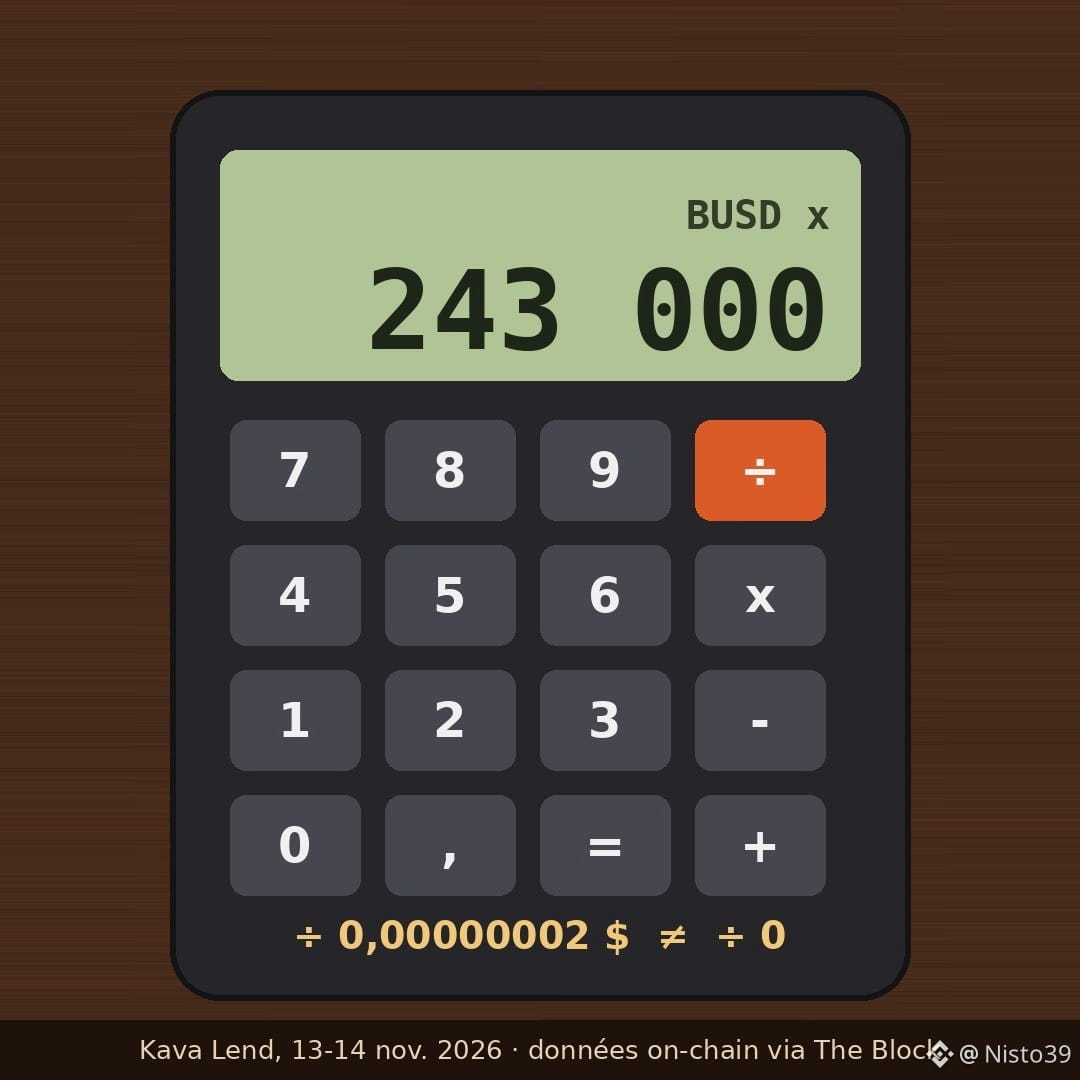
243,000.
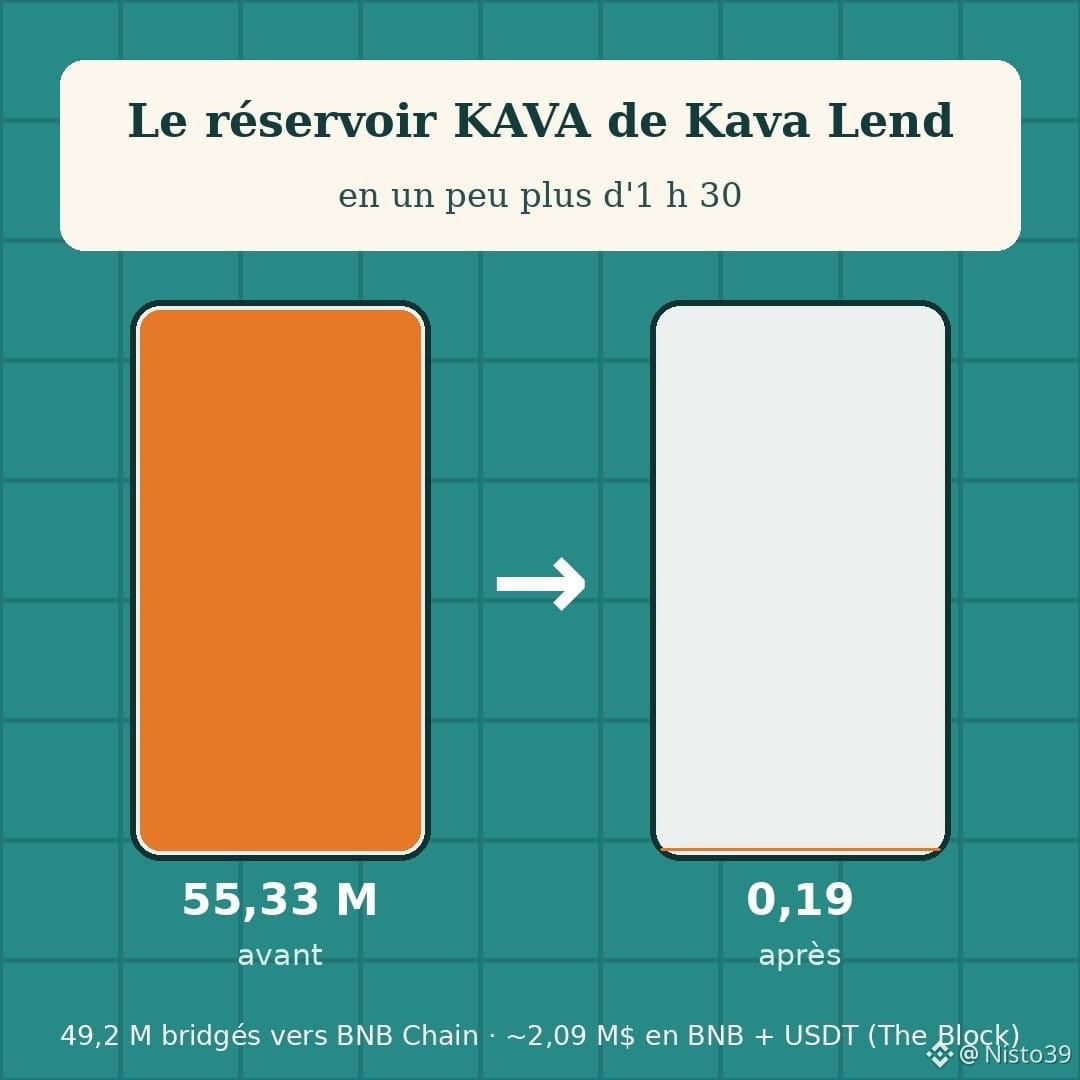
That's how many times Kava Lend multiplied the value of every BUSD deposit on Friday night, in three minutes. Nobody shouted. The code just did its math.
What happened, according to on-chain data gathered by The Block:
– Kava Lend's BUSD market was almost empty. Understandable: Paxos stopped issuing BUSD in 2023.
– The protocol calculates interest by dividing by the market's net supply. If it's exactly zero, it skips the calculation. If it's $0.00000002, it divides. And the result explodes.
– The attacker brought the supply down to that level, with their small deposit counted as ~1.25 billion BUSD in collateral, then borrowed $KAVA 127 times that amount, using a second account to get around the cap.
– The result: ~55.2 million KAVA withdrawn (≈ $3.76 million before the attack), of which 49.2 million went through LayerZero to BNB Chain and were sold for ~3 006 $BNB and 231 557 USDT.
They had been preparing the move since November 8. Kava responded publicly more than seven hours after it began. KAVA lost around 39% in 24 hours, and partner platforms suspended deposits and withdrawals.
What I take away: the vulnerability wasn't in an active market, but in the one nobody used anymore. A “dead” market still connected to the rest of the protocol is like a window left open on the ground floor of a house we think is locked. Kava calls it an isolated incident, “not an infinite mint”; the full report hasn't been published yet.
Keeping an old market open “just in case”: caution or laziness?
#Kava #DeFi #Securite #Hack #BNBChain
243,000.
That's how many times Kava Lend multiplied the value of every BUSD deposit on Friday night, in three minutes. Nobody shouted. The code just did its math.
What happened, according to on-chain data gathered by The Block:
– Kava Lend's BUSD market was almost empty. Understandable: Paxos stopped issuing BUSD in 2023.
– The protocol calculates interest by dividing by the market's net supply. If it's exactly zero, it skips the calculation. If it's $0.00000002, it divides. And the result explodes.
– The attacker brought the supply down to that level, with their small deposit counted as ~1.25 billion BUSD in collateral, then borrowed $KAVA 127 times that amount, using a second account to get around the cap.
– The result: ~55.2 million KAVA withdrawn (≈ $3.76 million before the attack), of which 49.2 million went through LayerZero to BNB Chain and were sold for ~3 006 $BNB and 231 557 USDT.
They had been preparing the move since November 8. Kava responded publicly more than seven hours after it began. KAVA lost around 39% in 24 hours, and partner platforms suspended deposits and withdrawals.
What I take away: the vulnerability wasn't in an active market, but in the one nobody used anymore. A “dead” market still connected to the rest of the protocol is like a window left open on the ground floor of a house we think is locked. Kava calls it an isolated incident, “not an infinite mint”; the full report hasn't been published yet.
Keeping an old market open “just in case”: caution or laziness?
#Kava #DeFi #Securite #Hack #BNBChain
That's how many times Kava Lend multiplied the value of every BUSD deposit on Friday night, in three minutes. Nobody shouted. The code just did its math.
What happened, according to on-chain data gathered by The Block:
– Kava Lend's BUSD market was almost empty. Understandable: Paxos stopped issuing BUSD in 2023.
– The protocol calculates interest by dividing by the market's net supply. If it's exactly zero, it skips the calculation. If it's $0.00000002, it divides. And the result explodes.
– The attacker brought the supply down to that level, with their small deposit counted as ~1.25 billion BUSD in collateral, then borrowed $KAVA 127 times that amount, using a second account to get around the cap.
– The result: ~55.2 million KAVA withdrawn (≈ $3.76 million before the attack), of which 49.2 million went through LayerZero to BNB Chain and were sold for ~3 006 $BNB and 231 557 USDT.
They had been preparing the move since November 8. Kava responded publicly more than seven hours after it began. KAVA lost around 39% in 24 hours, and partner platforms suspended deposits and withdrawals.
What I take away: the vulnerability wasn't in an active market, but in the one nobody used anymore. A “dead” market still connected to the rest of the protocol is like a window left open on the ground floor of a house we think is locked. Kava calls it an isolated incident, “not an infinite mint”; the full report hasn't been published yet.
Keeping an old market open “just in case”: caution or laziness?
#Kava #DeFi #Securite #Hack #BNBChain
148
·
--
Article
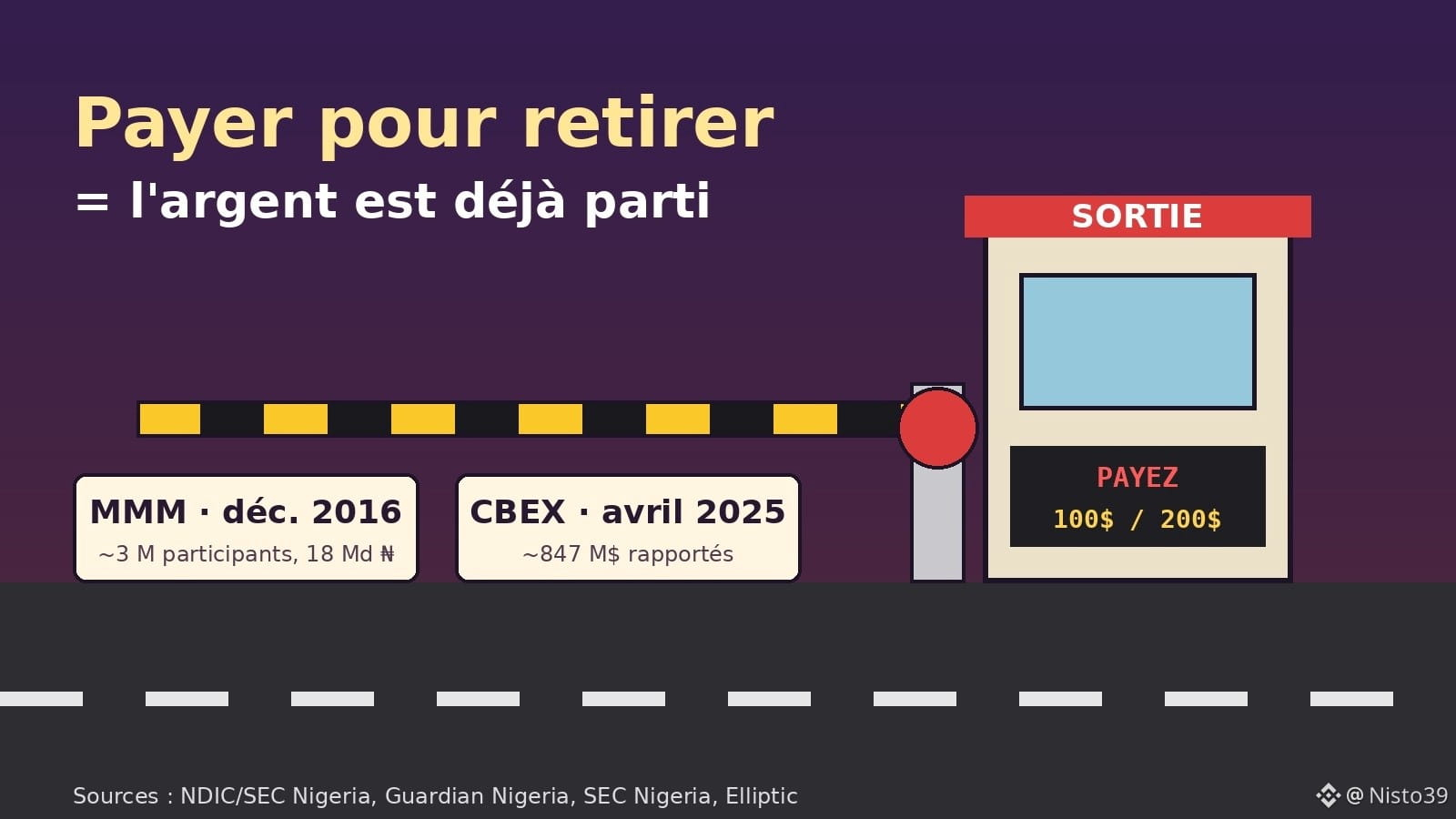
Paying to withdraw your own money: from MMM to CBEX, the telltale sign that never liesThere’s a precise moment when a scam gives itself away. It’s not when it promises too much. It’s when it asks you to pay to get your own money back.
I’ll say it plainly: if a platform demands a fee to release a withdrawal, your money is no longer there. Not “locked.” Gone. The rest is just theater.
Two Nigerian stories show this better than any lesson could.
December 2016: MMM turns off the taps
On December 13, 2016, just days before Christmas, MMM announced a one-month freeze on withdrawals, officially due to “an excessive workload on the system.” According to the NDIC, Nigeria’s deposit insurer, around 3 million participants lost nearly 18 billion naira. The freeze was never really lifted.
Paying to withdraw your own money: from MMM to CBEX, the telltale sign that never lies
There’s a precise moment when a scam gives itself away. It’s not when it promises too much. It’s when it asks you to pay to get your own money back.
I’ll say it plainly: if a platform demands a fee to release a withdrawal, your money is no longer there. Not “locked.” Gone. The rest is just theater.
Two Nigerian stories show this better than any lesson could.
December 2016: MMM turns off the taps
On December 13, 2016, just days before Christmas, MMM announced a one-month freeze on withdrawals, officially due to “an excessive workload on the system.” According to the NDIC, Nigeria’s deposit insurer, around 3 million participants lost nearly 18 billion naira. The freeze was never really lifted.
I’ll say it plainly: if a platform demands a fee to release a withdrawal, your money is no longer there. Not “locked.” Gone. The rest is just theater.
Two Nigerian stories show this better than any lesson could.
December 2016: MMM turns off the taps
On December 13, 2016, just days before Christmas, MMM announced a one-month freeze on withdrawals, officially due to “an excessive workload on the system.” According to the NDIC, Nigeria’s deposit insurer, around 3 million participants lost nearly 18 billion naira. The freeze was never really lifted.
266
·
--
Article
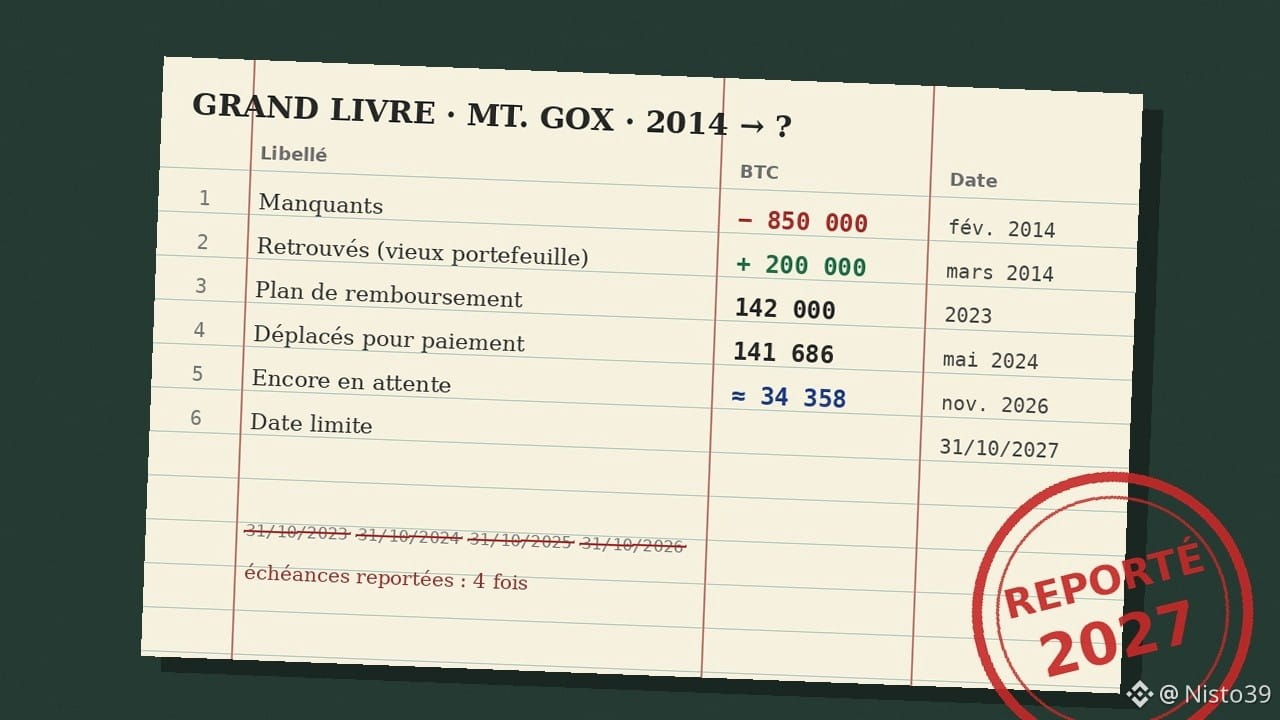
Mt. Gox, 12 years on: the account book of a bankruptcy that never endsOn October 31, 2026, a deadline passed without fanfare: the deadline for repaying Mt. Gox customers, after the platform had been closed since February 2014. Fifteen days earlier, the trustee had already secured another extension from the Tokyo court: until October 31, 2027. It is the fourth one-year extension since the original 2023 deadline.
Twelve years of proceedings over a bankruptcy. I wanted to keep track of this story like a cashbook: what came in, what went out, and what remains.
Mt. Gox, 12 years on: the account book of a bankruptcy that never ends
On October 31, 2026, a deadline passed without fanfare: the deadline for repaying Mt. Gox customers, after the platform had been closed since February 2014. Fifteen days earlier, the trustee had already secured another extension from the Tokyo court: until October 31, 2027. It is the fourth one-year extension since the original 2023 deadline.
Twelve years of proceedings over a bankruptcy. I wanted to keep track of this story like a cashbook: what came in, what went out, and what remains.
Twelve years of proceedings over a bankruptcy. I wanted to keep track of this story like a cashbook: what came in, what went out, and what remains.
589
·
--
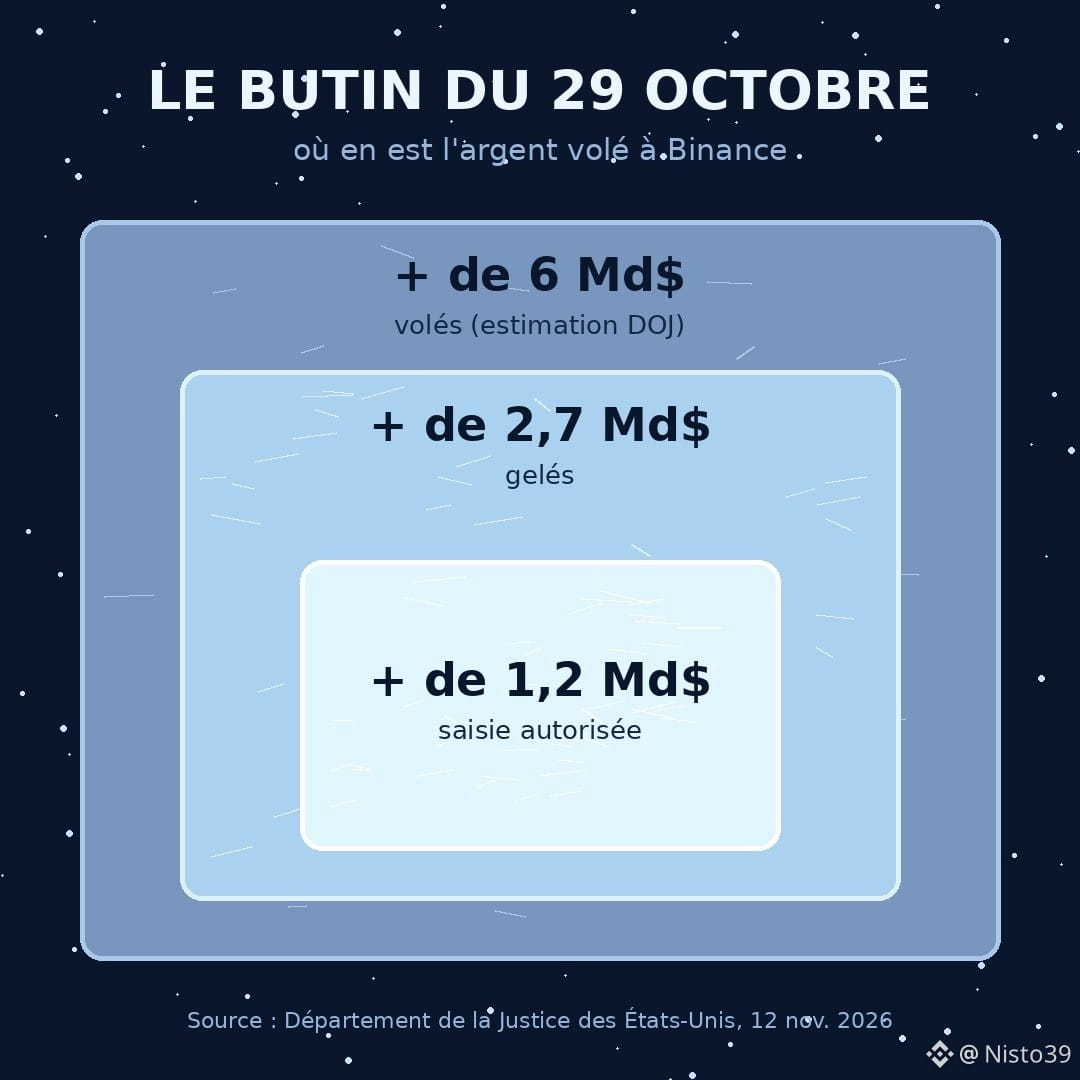
The October 29 Binance hack: more than $6 billion stolen. Yesterday, the U.S. Department of Justice announced the figures. More than $2.7 billion has been frozen, and a court has authorized the seizure of more than $1.2 billion.
Almost half the loot blocked in two weeks.
According to Bloomberg Law, a large portion was frozen by Tether and Circle, the issuers of $USDT and $USDC. A stablecoin is a token pegged to the dollar and managed by a company that can block an address with a single click.
My take, which won’t please everyone: what saved that $2.7 billion wasn’t decentralization. It was exactly the opposite. A “freeze” button controlled by a private issuer. That same button could one day mistakenly block an innocent person.
The other part of the announcement stood out to me even more. The FBI seized the servers of “FaceStealer,” a North Korean campaign: a fake contact invites you to a spoofed Zoom or Teams call using an almost identical domain name. While you wait for the meeting to start, your webcam is being recorded. More than 900 videos of victims were found, then reused to trap their own contacts. More than $400 million stolen in 18 months.
Simple rule: if a meeting link asks you to install an “update” or a plugin, close it. A real meeting never starts with a download.
The rest is still being laundered through bridges and mixers.
An issuer that can freeze stolen funds: protection or too much power? I want to read your arguments, not just a yes or no.
Sources: DOJ, CyberScoop, CoinDesk, Bloomberg Law (Nov. 12, 2026)
#Binance #Securite #CoreeDuNord #Stablecoins #CryptoNews
The October 29 Binance hack: more than $6 billion stolen. Yesterday, the U.S. Department of Justice announced the figures. More than $2.7 billion has been frozen, and a court has authorized the seizure of more than $1.2 billion.
Almost half the loot blocked in two weeks.
According to Bloomberg Law, a large portion was frozen by Tether and Circle, the issuers of $USDT and $USDC . A stablecoin is a token pegged to the dollar and managed by a company that can block an address with a single click.
My take, which won’t please everyone: what saved that $2.7 billion wasn’t decentralization. It was exactly the opposite. A “freeze” button controlled by a private issuer. That same button could one day mistakenly block an innocent person.
The other part of the announcement stood out to me even more. The FBI seized the servers of “FaceStealer,” a North Korean campaign: a fake contact invites you to a spoofed Zoom or Teams call using an almost identical domain name. While you wait for the meeting to start, your webcam is being recorded. More than 900 videos of victims were found, then reused to trap their own contacts. More than $400 million stolen in 18 months.
Simple rule: if a meeting link asks you to install an “update” or a plugin, close it. A real meeting never starts with a download.
The rest is still being laundered through bridges and mixers.
An issuer that can freeze stolen funds: protection or too much power? I want to read your arguments, not just a yes or no.
Sources: DOJ, CyberScoop, CoinDesk, Bloomberg Law (Nov. 12, 2026)
#Binance #Securite #CoreeDuNord #Stablecoins #CryptoNews
Almost half the loot blocked in two weeks.
According to Bloomberg Law, a large portion was frozen by Tether and Circle, the issuers of $USDT and $USDC . A stablecoin is a token pegged to the dollar and managed by a company that can block an address with a single click.
My take, which won’t please everyone: what saved that $2.7 billion wasn’t decentralization. It was exactly the opposite. A “freeze” button controlled by a private issuer. That same button could one day mistakenly block an innocent person.
The other part of the announcement stood out to me even more. The FBI seized the servers of “FaceStealer,” a North Korean campaign: a fake contact invites you to a spoofed Zoom or Teams call using an almost identical domain name. While you wait for the meeting to start, your webcam is being recorded. More than 900 videos of victims were found, then reused to trap their own contacts. More than $400 million stolen in 18 months.
Simple rule: if a meeting link asks you to install an “update” or a plugin, close it. A real meeting never starts with a download.
The rest is still being laundered through bridges and mixers.
An issuer that can freeze stolen funds: protection or too much power? I want to read your arguments, not just a yes or no.
Sources: DOJ, CyberScoop, CoinDesk, Bloomberg Law (Nov. 12, 2026)
#Binance #Securite #CoreeDuNord #Stablecoins #CryptoNews

284
·
--
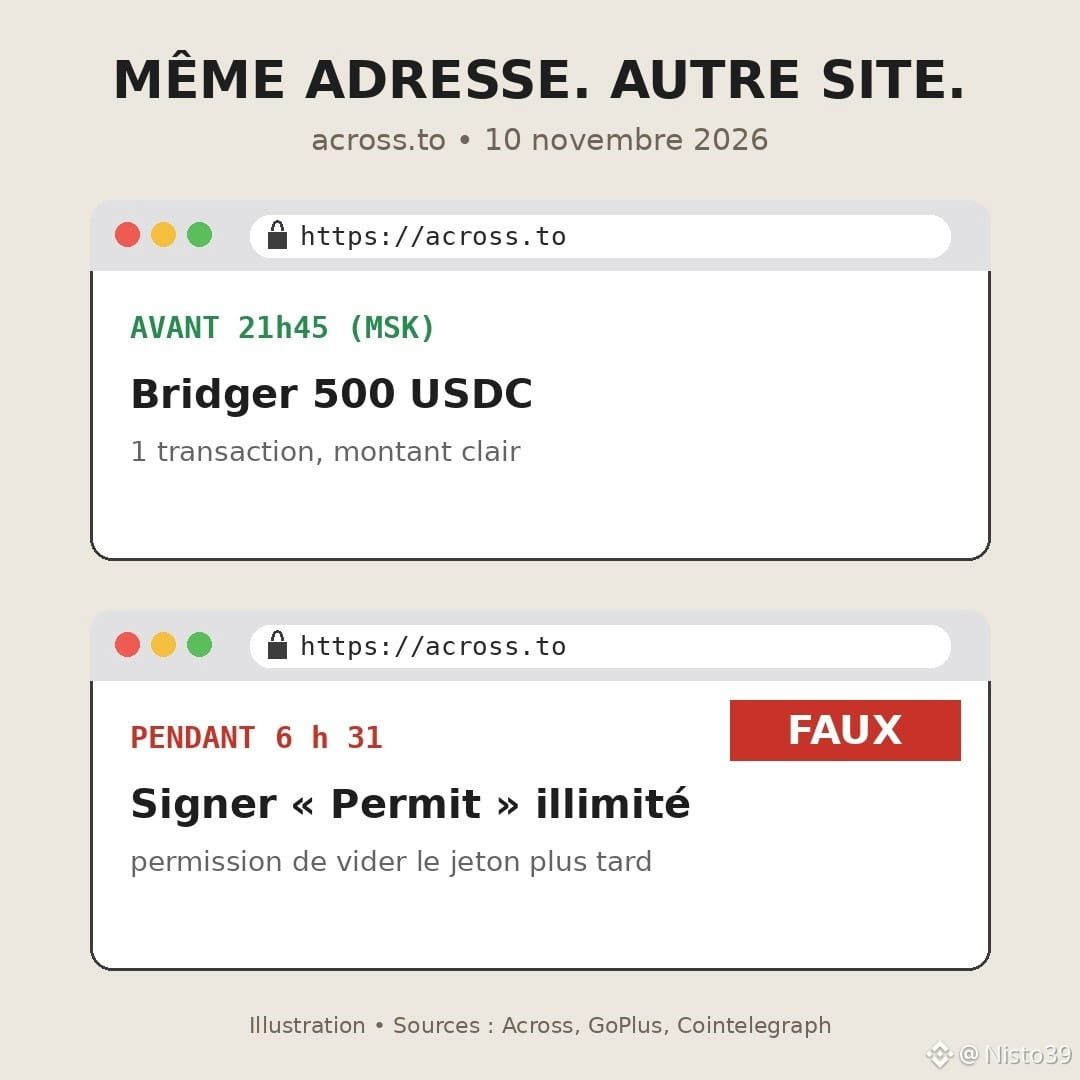
Across's code wasn't hacked. And that's exactly what should worry you.
On Tuesday, November 10, around 9:45 p.m. Moscow time, someone took control of the domain name across.to, the address of one of the most widely used bridges (around $5.9 billion transferred in 30 days, according to DefiLlama). No smart contract vulnerability. Just a bit of social engineering at Namecheap, the company that manages the domain name, according to the team.
The result: you typed in the right address, saw the right logo, and landed on a fake site. It asked you to sign “permits” and approvals. An approval is permission given to an address to move your tokens later without asking you again. One signature is enough, and your wallet is drained whenever the attacker decides.
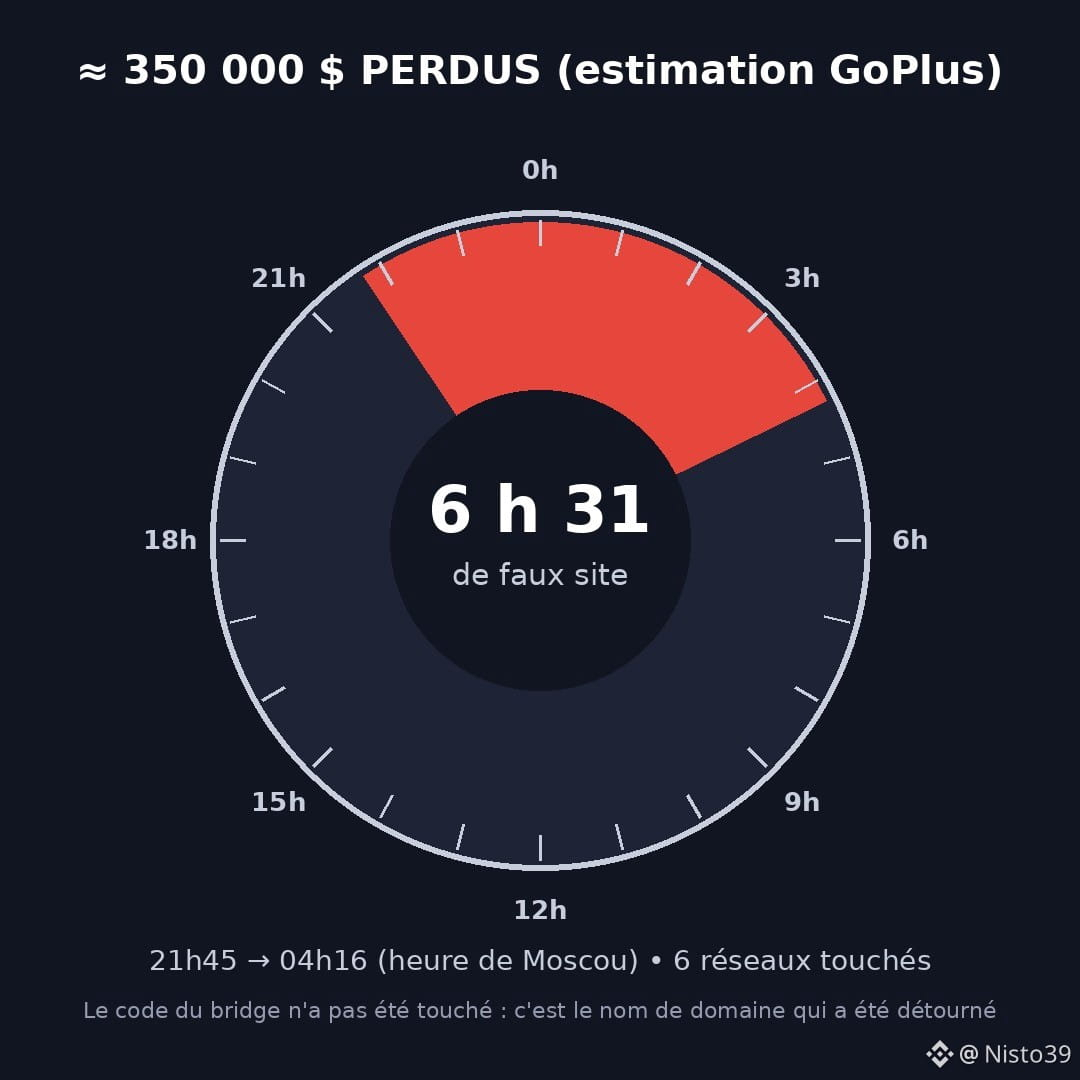
GoPlus estimates the losses at around $350,000 across Ethereum, Arbitrum, Base, BNB Chain, Ink, and Plasma. Across hasn't confirmed a total, but promises to reimburse everyone. The domain was recovered around 4:16 a.m. the next day. Six and a half hours.
My somewhat unpopular opinion: we spend months auditing the code, then entrust the shop's front door to a registrar you can reach by phone. The weak link is no longer the blockchain; it's the webpage in front of it.
What I take away from this: when a site I know by heart asks me for an unusual signature for a simple transfer of $USDC or $ETH, I stop. And I check my approvals from time to time, even when there's been no incident.
Honest question: the last time you signed an approval, did you read who you were giving permission to?
#Across #Securite #Phishing #DeFi #Crypto
Across's code wasn't hacked. And that's exactly what should worry you.
On Tuesday, November 10, around 9:45 p.m. Moscow time, someone took control of the domain name across.to, the address of one of the most widely used bridges (around $5.9 billion transferred in 30 days, according to DefiLlama). No smart contract vulnerability. Just a bit of social engineering at Namecheap, the company that manages the domain name, according to the team.
The result: you typed in the right address, saw the right logo, and landed on a fake site. It asked you to sign “permits” and approvals. An approval is permission given to an address to move your tokens later without asking you again. One signature is enough, and your wallet is drained whenever the attacker decides.
GoPlus estimates the losses at around $350,000 across Ethereum, Arbitrum, Base, BNB Chain, Ink, and Plasma. Across hasn't confirmed a total, but promises to reimburse everyone. The domain was recovered around 4:16 a.m. the next day. Six and a half hours.
My somewhat unpopular opinion: we spend months auditing the code, then entrust the shop's front door to a registrar you can reach by phone. The weak link is no longer the blockchain; it's the webpage in front of it.
What I take away from this: when a site I know by heart asks me for an unusual signature for a simple transfer of $USDC or $ETH , I stop. And I check my approvals from time to time, even when there's been no incident.
Honest question: the last time you signed an approval, did you read who you were giving permission to?
#Across #Securite #Phishing #DeFi #Crypto
On Tuesday, November 10, around 9:45 p.m. Moscow time, someone took control of the domain name across.to, the address of one of the most widely used bridges (around $5.9 billion transferred in 30 days, according to DefiLlama). No smart contract vulnerability. Just a bit of social engineering at Namecheap, the company that manages the domain name, according to the team.
The result: you typed in the right address, saw the right logo, and landed on a fake site. It asked you to sign “permits” and approvals. An approval is permission given to an address to move your tokens later without asking you again. One signature is enough, and your wallet is drained whenever the attacker decides.
GoPlus estimates the losses at around $350,000 across Ethereum, Arbitrum, Base, BNB Chain, Ink, and Plasma. Across hasn't confirmed a total, but promises to reimburse everyone. The domain was recovered around 4:16 a.m. the next day. Six and a half hours.
My somewhat unpopular opinion: we spend months auditing the code, then entrust the shop's front door to a registrar you can reach by phone. The weak link is no longer the blockchain; it's the webpage in front of it.
What I take away from this: when a site I know by heart asks me for an unusual signature for a simple transfer of $USDC or $ETH , I stop. And I check my approvals from time to time, even when there's been no incident.
Honest question: the last time you signed an approval, did you read who you were giving permission to?
#Across #Securite #Phishing #DeFi #Crypto
96
·
--
Article
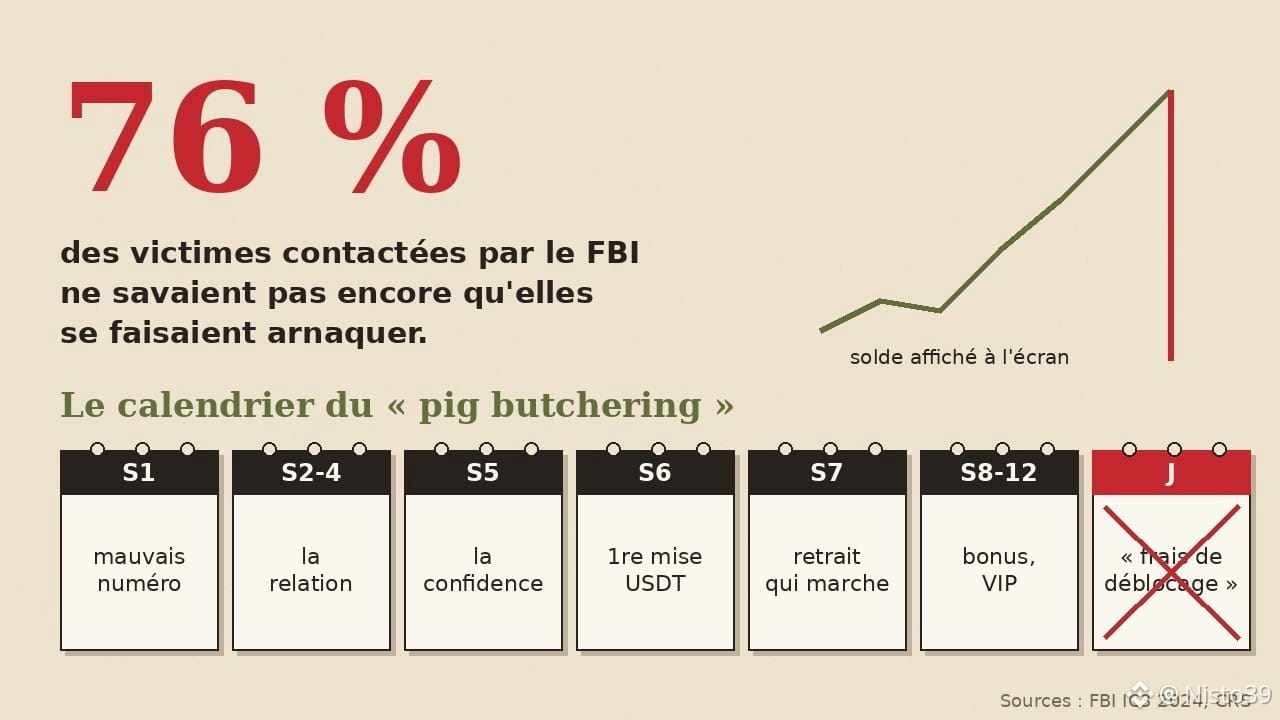
“Sorry, wrong number”: A week-by-week timeline of the scam that cost $5.8 billion76%.
That’s the share of victims the FBI contacted in 2024 as part of Operation Level Up who didn’t yet know they were being scammed. They kept sending money. They saw gains on a screen. They thought they’d found the right person and the right opportunity.
This scam has an unflattering name: “pig butchering,” a translation of the Chinese sha zhu pan, “pig slaughtering.” The victim is fattened up with trust, then bled dry. The term is shocking, and that’s exactly what the people who coined it intended—not the victims.
“Sorry, wrong number”: A week-by-week timeline of the scam that cost $5.8 billion
76%.
That’s the share of victims the FBI contacted in 2024 as part of Operation Level Up who didn’t yet know they were being scammed. They kept sending money. They saw gains on a screen. They thought they’d found the right person and the right opportunity.
This scam has an unflattering name: “pig butchering,” a translation of the Chinese sha zhu pan, “pig slaughtering.” The victim is fattened up with trust, then bled dry. The term is shocking, and that’s exactly what the people who coined it intended—not the victims.
That’s the share of victims the FBI contacted in 2024 as part of Operation Level Up who didn’t yet know they were being scammed. They kept sending money. They saw gains on a screen. They thought they’d found the right person and the right opportunity.
This scam has an unflattering name: “pig butchering,” a translation of the Chinese sha zhu pan, “pig slaughtering.” The victim is fattened up with trust, then bled dry. The term is shocking, and that’s exactly what the people who coined it intended—not the victims.
460
·
--
Article
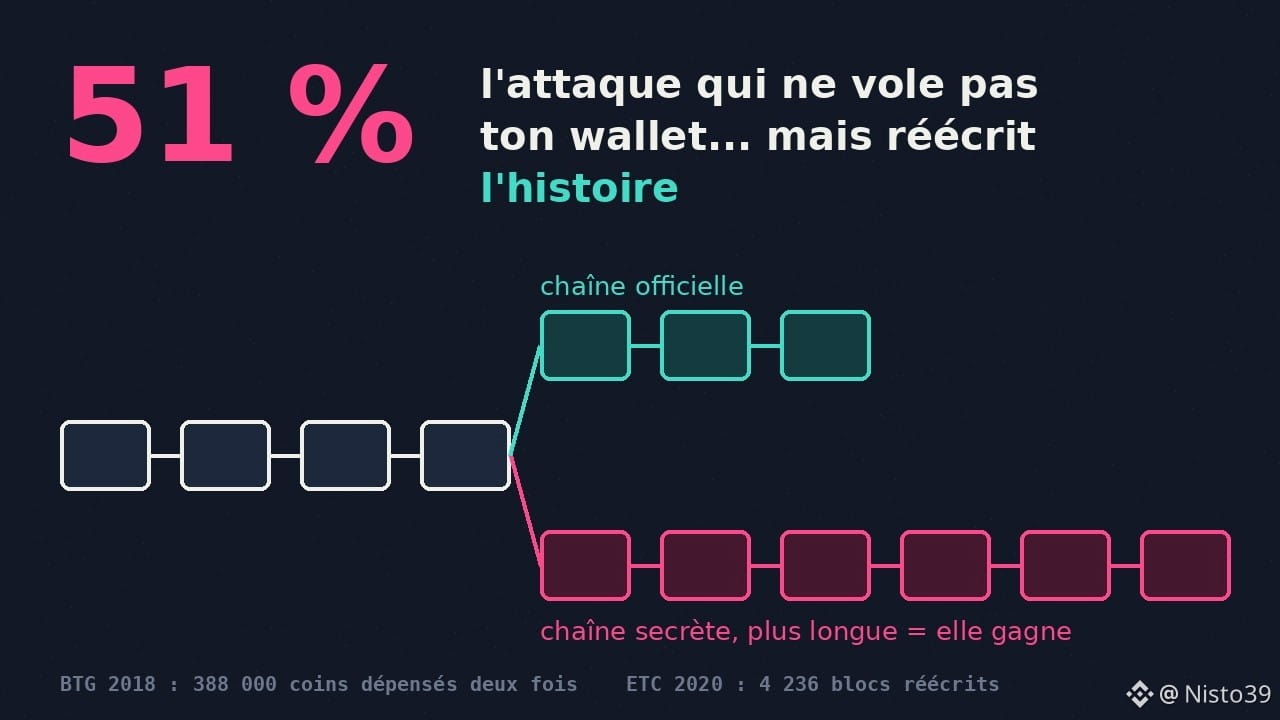
51%: The attack that doesn’t steal your wallet but has cost $18 millionThe “51% attack” is talked about like a monster capable of draining any wallet. That’s false. But it really has cost platforms millions, and it explains something very practical: why your deposit sometimes remains “awaiting confirmations.”
The principle in one sentence: on a proof-of-work blockchain, the chain that has required the most computation is the one that counts. If someone controls more than half of the mining power, they can secretly build an alternative version of the history, then publish it to replace the official version.
51%: The attack that doesn’t steal your wallet but has cost $18 million
The “51% attack” is talked about like a monster capable of draining any wallet. That’s false. But it really has cost platforms millions, and it explains something very practical: why your deposit sometimes remains “awaiting confirmations.”
The principle in one sentence: on a proof-of-work blockchain, the chain that has required the most computation is the one that counts. If someone controls more than half of the mining power, they can secretly build an alternative version of the history, then publish it to replace the official version.
The principle in one sentence: on a proof-of-work blockchain, the chain that has required the most computation is the one that counts. If someone controls more than half of the mining power, they can secretly build an alternative version of the history, then publish it to replace the official version.
1
321
·
--
Article
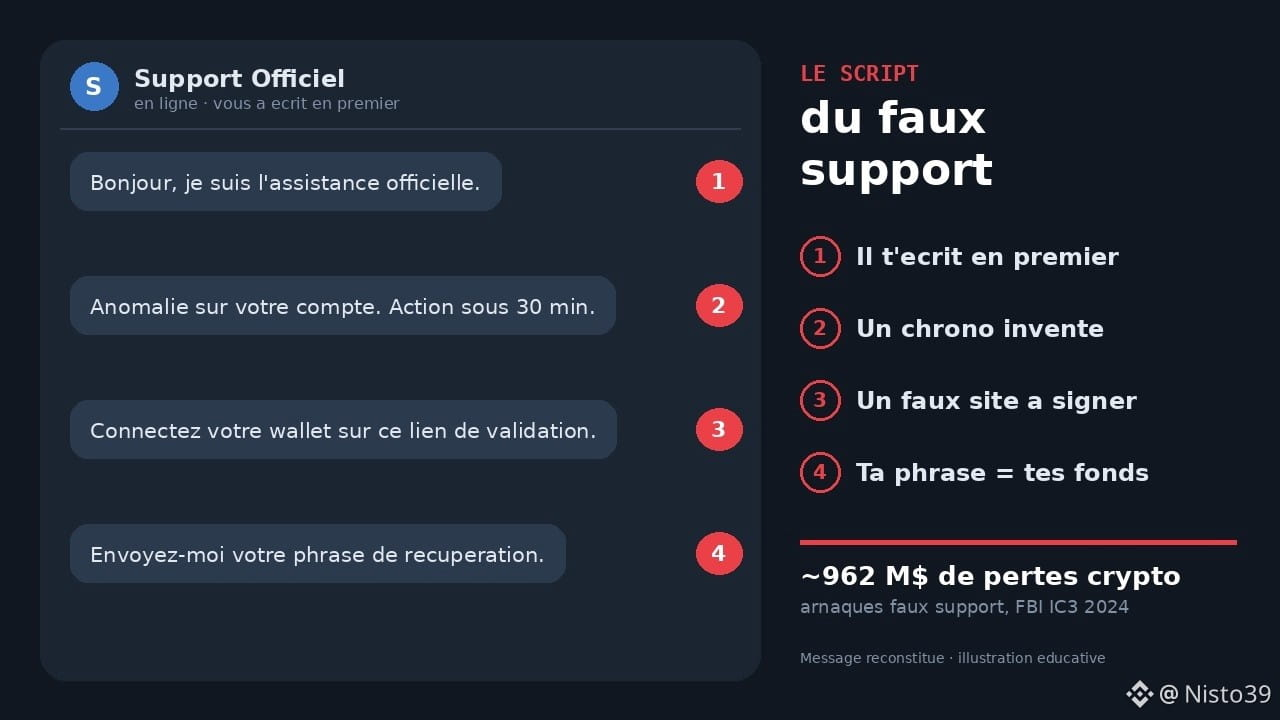
Fake support in 4 messages: the script taken apart line by lineHere's a message that circulates every day in crypto Telegram groups and Discord servers. I've reconstructed it from the most common patterns. Read it as if you were the one receiving it, then we'll take it apart line by line.
“Hello, I'm official support. We saw your message in the group.”
First trap, and it's a big one: they're the ones messaging you. You asked a question publicly, and someone replies to you privately. Real support doesn't work like that. Legitimate teams reply through the app's or website's official channels, never by reaching out to you in a private message.
Fake support in 4 messages: the script taken apart line by line
Here's a message that circulates every day in crypto Telegram groups and Discord servers. I've reconstructed it from the most common patterns. Read it as if you were the one receiving it, then we'll take it apart line by line.
“Hello, I'm official support. We saw your message in the group.”
First trap, and it's a big one: they're the ones messaging you. You asked a question publicly, and someone replies to you privately. Real support doesn't work like that. Legitimate teams reply through the app's or website's official channels, never by reaching out to you in a private message.
“Hello, I'm official support. We saw your message in the group.”
First trap, and it's a big one: they're the ones messaging you. You asked a question publicly, and someone replies to you privately. Real support doesn't work like that. Legitimate teams reply through the app's or website's official channels, never by reaching out to you in a private message.
244
·
--
Article
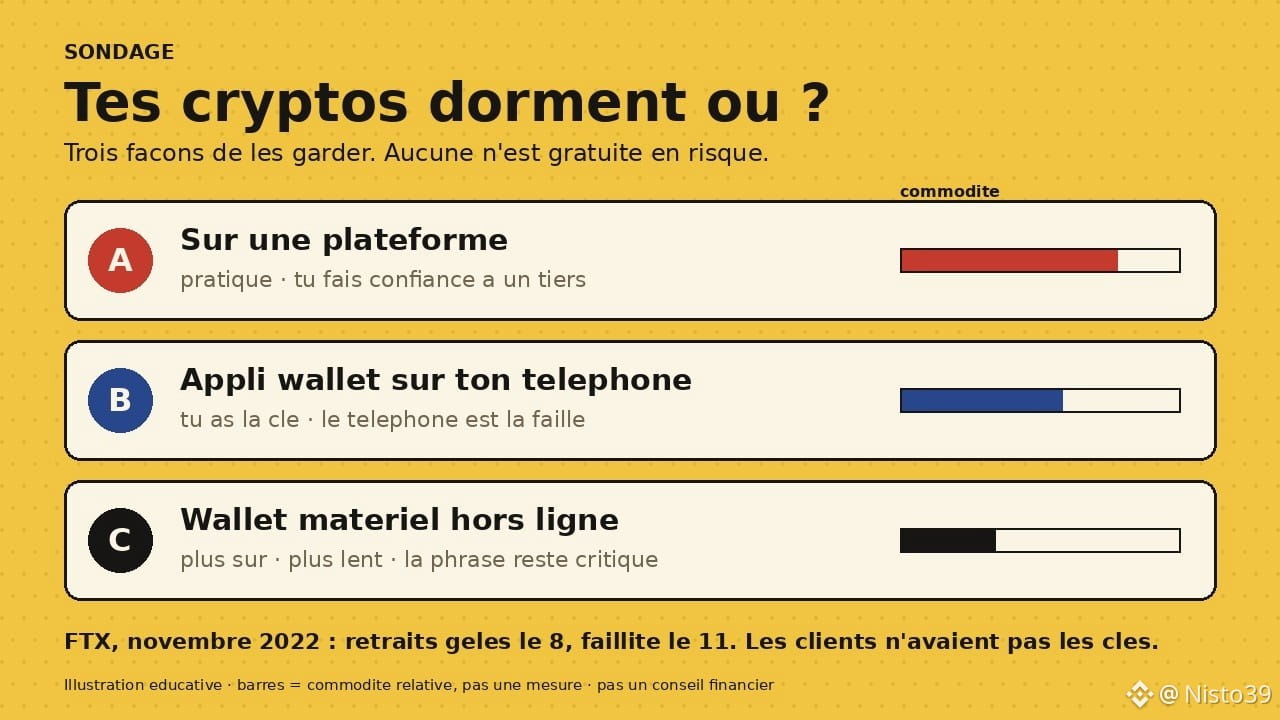
A, B, or C: where are your crypto really stored?Quick poll before we start—answer honestly in the comments: where are your crypto right now?
A) On a cryptocurrency exchange
B) In a wallet app on your phone
C) On a hardware wallet, offline
D) Honestly… I'm not really sure
If you answered D, this article is for you. And if you answered A, B, or C, it is too, because none of these three options is “the right one” in absolute terms. Each one shifts the risk elsewhere.
Four years ago this week
On November 8, 2022, FTX froze withdrawals. On the 11th, the platform filed for bankruptcy. Customers who thought they “had” crypto discovered that what they really had was an entry in a database. Eight years earlier, in February 2014, Mt. Gox had done the same, with around 850,000 BTC reported lost. Same lesson, twice: when someone else holds your keys, you depend on their solvency and honesty.
A, B, or C: where are your crypto really stored?
Quick poll before we start—answer honestly in the comments: where are your crypto right now?
A) On a cryptocurrency exchange
B) In a wallet app on your phone
C) On a hardware wallet, offline
D) Honestly… I'm not really sure
If you answered D, this article is for you. And if you answered A, B, or C, it is too, because none of these three options is “the right one” in absolute terms. Each one shifts the risk elsewhere.
Four years ago this week
On November 8, 2022, FTX froze withdrawals. On the 11th, the platform filed for bankruptcy. Customers who thought they “had” crypto discovered that what they really had was an entry in a database. Eight years earlier, in February 2014, Mt. Gox had done the same, with around 850,000 BTC reported lost. Same lesson, twice: when someone else holds your keys, you depend on their solvency and honesty.
A) On a cryptocurrency exchange
B) In a wallet app on your phone
C) On a hardware wallet, offline
D) Honestly… I'm not really sure
If you answered D, this article is for you. And if you answered A, B, or C, it is too, because none of these three options is “the right one” in absolute terms. Each one shifts the risk elsewhere.
Four years ago this week
On November 8, 2022, FTX froze withdrawals. On the 11th, the platform filed for bankruptcy. Customers who thought they “had” crypto discovered that what they really had was an entry in a database. Eight years earlier, in February 2014, Mt. Gox had done the same, with around 850,000 BTC reported lost. Same lesson, twice: when someone else holds your keys, you depend on their solvency and honesty.
125
·
--
Article
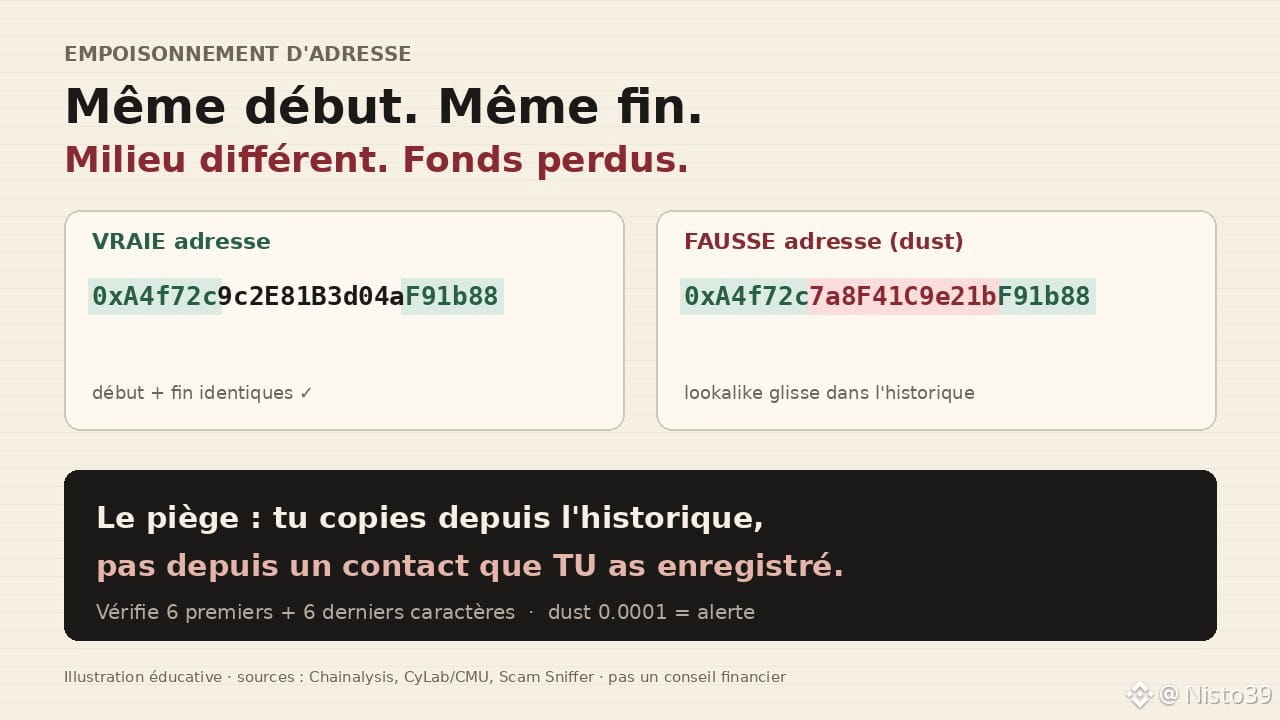
Address poisoning: the trap your history sets for youYou copy an address from your wallet history. The first few characters look right, the last few look right. You send the money. It goes… to someone else. Not a bug. Not a network hack. It’s a trap called address poisoning.
Here’s what no one tells you clearly enough: your transaction history is also a hunting ground. Scammers know it. They use it.
How it works, without unnecessary jargon
A scammer looks at the addresses you often interact with—a friend, an exchange, a contract. Then they generate a lookalike address (using a tool, sometimes bought on the dark web): the same first few characters, the same last few, but a different middle. Next, they send you a tiny amount—dust—from that fake address. Or a zero-value transaction. Your wallet logs the contact. The next time you search for “yesterday’s address,” that one is often the first to come up.
Address poisoning: the trap your history sets for you
You copy an address from your wallet history. The first few characters look right, the last few look right. You send the money. It goes… to someone else. Not a bug. Not a network hack. It’s a trap called address poisoning.
Here’s what no one tells you clearly enough: your transaction history is also a hunting ground. Scammers know it. They use it.
How it works, without unnecessary jargon
A scammer looks at the addresses you often interact with—a friend, an exchange, a contract. Then they generate a lookalike address (using a tool, sometimes bought on the dark web): the same first few characters, the same last few, but a different middle. Next, they send you a tiny amount—dust—from that fake address. Or a zero-value transaction. Your wallet logs the contact. The next time you search for “yesterday’s address,” that one is often the first to come up.
Here’s what no one tells you clearly enough: your transaction history is also a hunting ground. Scammers know it. They use it.
How it works, without unnecessary jargon
A scammer looks at the addresses you often interact with—a friend, an exchange, a contract. Then they generate a lookalike address (using a tool, sometimes bought on the dark web): the same first few characters, the same last few, but a different middle. Next, they send you a tiny amount—dust—from that fake address. Or a zero-value transaction. Your wallet logs the contact. The next time you search for “yesterday’s address,” that one is often the first to come up.
3
1.2k
·
--
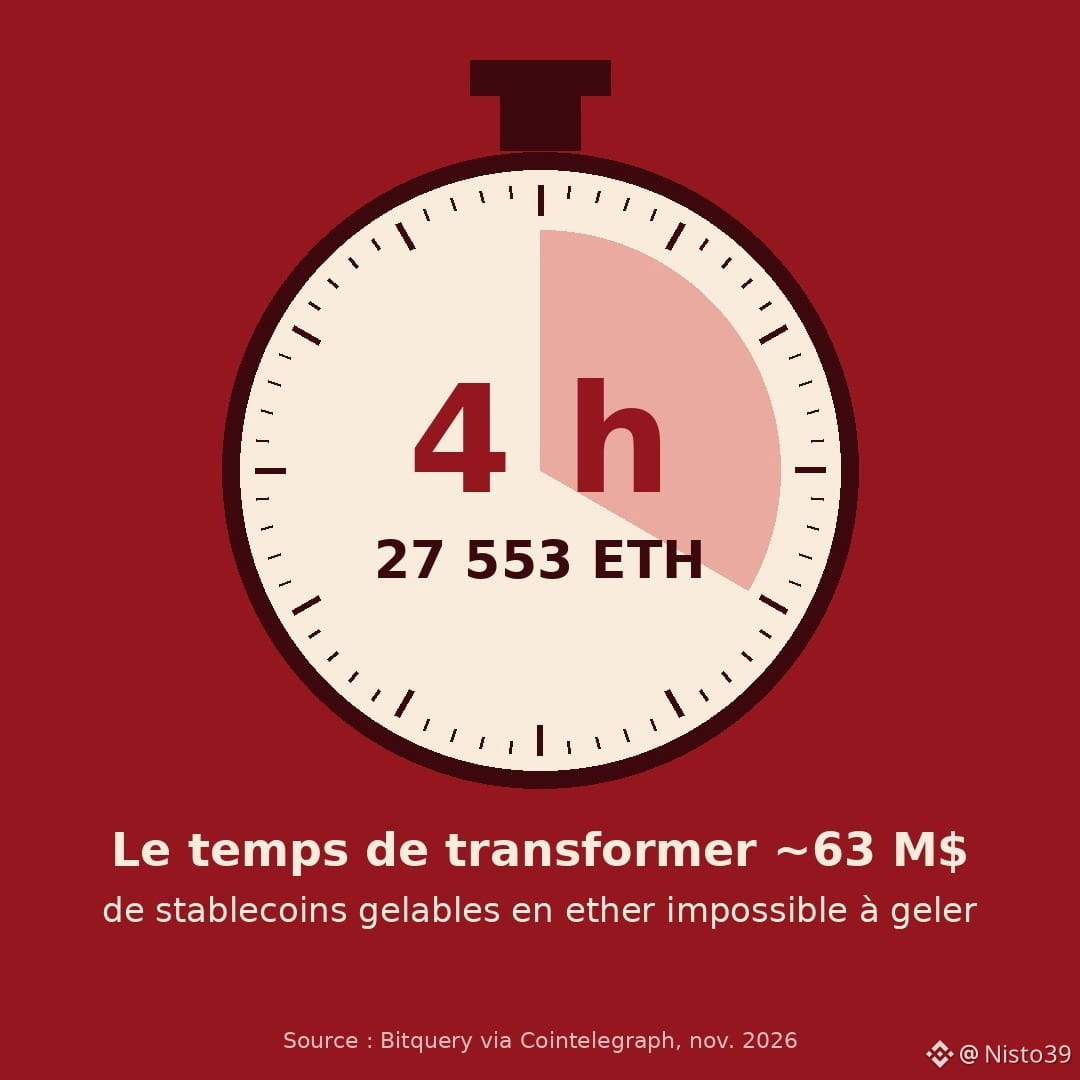
27,553 ETH in about four hours.
That’s what the perpetrator of a theft worth more than $133 million allegedly did, in a case revealed this week by investigator ZachXBT: convert nearly $63 million in stablecoins into $ETH, at breakneck speed (Bitquery, via Cointelegraph).
The named victim isn’t some obscure small exchange. According to ZachXBT, it’s Crédit Mutuel Arkéa, a French banking group. The bank confirmed to CoinDesk that an attack had enabled fraudulent transactions, said the situation was under control and its customers were protected, but did not disclose an amount. An awkward detail: in May, it had applied for a MiCA license (the European framework for crypto services).
The money trail, according to Bitquery: $108.8 million in USDC withdrawn from accounts at Kraken, Crypto.com and OKX over 21 hours on November 1 and 2, then scattered across hundreds of wallets. The three platforms say they were not hacked and that they restricted or froze the accounts involved.
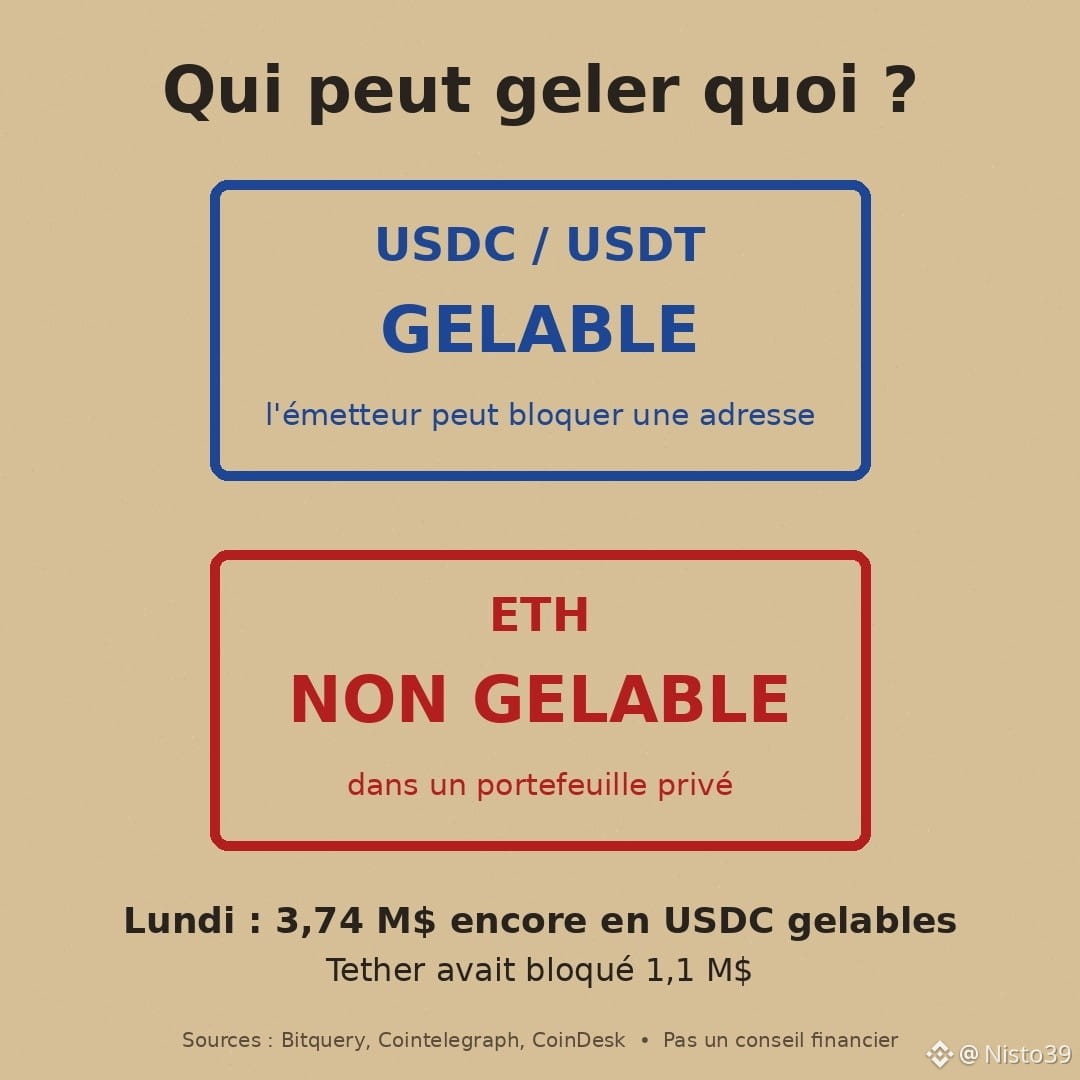
Why the rush? Because $USDC has a central issuer, Circle, which can freeze an address. Ether can’t be frozen. By Monday, only $3.74 million in freezeable USDC remained, and Tether had blocked just $1.1 million.
My takeaway: the “freeze” touted after every hack only works if you move faster than the thief. ZachXBT says some of the withdrawals took place after his first public alert. The bank hasn’t confirmed that.
Sources: CoinDesk, Cointelegraph, Bitquery. Not financial advice.
A bank gets drained before it can even launch its crypto offering: does that put you off, or would you rather it learn now?
#CryptoNews #Securite #Stablecoins #Ethereum #CryptoFrance
27,553 ETH in about four hours.
That’s what the perpetrator of a theft worth more than $133 million allegedly did, in a case revealed this week by investigator ZachXBT: convert nearly $63 million in stablecoins into $ETH , at breakneck speed (Bitquery, via Cointelegraph).
The named victim isn’t some obscure small exchange. According to ZachXBT, it’s Crédit Mutuel Arkéa, a French banking group. The bank confirmed to CoinDesk that an attack had enabled fraudulent transactions, said the situation was under control and its customers were protected, but did not disclose an amount. An awkward detail: in May, it had applied for a MiCA license (the European framework for crypto services).
The money trail, according to Bitquery: $108.8 million in USDC withdrawn from accounts at Kraken, Crypto.com and OKX over 21 hours on November 1 and 2, then scattered across hundreds of wallets. The three platforms say they were not hacked and that they restricted or froze the accounts involved.
Why the rush? Because $USDC has a central issuer, Circle, which can freeze an address. Ether can’t be frozen. By Monday, only $3.74 million in freezeable USDC remained, and Tether had blocked just $1.1 million.
My takeaway: the “freeze” touted after every hack only works if you move faster than the thief. ZachXBT says some of the withdrawals took place after his first public alert. The bank hasn’t confirmed that.
Sources: CoinDesk, Cointelegraph, Bitquery. Not financial advice.
A bank gets drained before it can even launch its crypto offering: does that put you off, or would you rather it learn now?
#CryptoNews #Securite #Stablecoins #Ethereum #CryptoFrance
That’s what the perpetrator of a theft worth more than $133 million allegedly did, in a case revealed this week by investigator ZachXBT: convert nearly $63 million in stablecoins into $ETH , at breakneck speed (Bitquery, via Cointelegraph).
The named victim isn’t some obscure small exchange. According to ZachXBT, it’s Crédit Mutuel Arkéa, a French banking group. The bank confirmed to CoinDesk that an attack had enabled fraudulent transactions, said the situation was under control and its customers were protected, but did not disclose an amount. An awkward detail: in May, it had applied for a MiCA license (the European framework for crypto services).
The money trail, according to Bitquery: $108.8 million in USDC withdrawn from accounts at Kraken, Crypto.com and OKX over 21 hours on November 1 and 2, then scattered across hundreds of wallets. The three platforms say they were not hacked and that they restricted or froze the accounts involved.
Why the rush? Because $USDC has a central issuer, Circle, which can freeze an address. Ether can’t be frozen. By Monday, only $3.74 million in freezeable USDC remained, and Tether had blocked just $1.1 million.
My takeaway: the “freeze” touted after every hack only works if you move faster than the thief. ZachXBT says some of the withdrawals took place after his first public alert. The bank hasn’t confirmed that.
Sources: CoinDesk, Cointelegraph, Bitquery. Not financial advice.
A bank gets drained before it can even launch its crypto offering: does that put you off, or would you rather it learn now?
#CryptoNews #Securite #Stablecoins #Ethereum #CryptoFrance
132
Log in to explore more content
Join global crypto users on Binance Square
⚡️ Get latest and useful information about crypto.
💬 Trusted by the world’s largest crypto exchange.
👍 Discover real insights from verified creators.
Email / Phone number
Trending Topics
1
#NvidiaLoses$2.7TrillionInMonthAndAHalf
23,982 views
147 Discussing
2
#CanBTCReboundAfterFallingBelow60K?
807,793 views
3,054 Discussing
3
#GlobalStocksFaceLongestLosingStreakSince2023
297,744 views
2,047 Discussing
4
#BlackRockIBITPostsRecord$541MSingleDayOutflow
36,576 views
107 Discussing
5
#AnthropicPlungesTowardIPOPriceonDay2
153,300 views
1,238 Discussing
6
#TwentyOneCapitalAdds172.25BTC
70,634 views
688 Discussing
7
#HKBillWouldExcludeTokenizedDepositsFromVirtualAssets
9,607 views
50 Discussing
8
#BNBDropsBelow540USDTWith8.46%DailyDecline
82,574 views
665 Discussing
9
#HKBillProposesHK$100KFineForUnauthorizedCryptoTitles
2,765 views
22 Discussing
10
#BitMineFaces$10.1BUnrealizedETHLoss
5,805 views
28 Discussing