
Malcolm_Great
17 Posts

Malcolm_Great
Report
Block User
Trader, Content creator, X: https://x.com/Malcolm_Great1 BP-CC5B3ACCEA13
Open Trade
Occasional Trader
2.3 Years
10 Following
24 Followers
25 Liked
Posts
Portfolio
All
Quotes

Article
The AI Boom Is Expanding Beyond Chips. Are Investors Looking in the Right Places?Every major technology shift creates a rush to invest in the companies building it. With artificial intelligence, that rush initially centred on semiconductor stocks.
It made sense. AI models need enormous computing power, and companies producing advanced chips, memory and networking equipment became direct beneficiaries of rising demand. As major technology firms increased their spending on AI infrastructure, semiconductor companies attracted significant investor attention.
But there's another question worth asking now: Who stands to benefit as businesses begin turning AI infrastructure into actual products, services and revenue?
That question could shape the next phase of AI investing.
The AI opportunity has several layers
Think about the AI industry as a chain of activities rather than a single market.
At the foundation are semiconductor companies supplying the chips and components needed to process AI workloads. Without this infrastructure, large-scale AI development becomes difficult.
Above that are cloud providers and data centre operators. They supply the computing capacity that businesses and developers need to train, deploy and run AI models.
Then comes the software and application layer. These are companies building AI into tools used for business operations, productivity, customer service, research and other everyday activities.
Each layer depends on the others, but their financial performance may not develop at the same pace.
A company selling essential hardware could benefit early from infrastructure spending. A software business may take longer to demonstrate how AI translates into higher revenue or stronger margins. Meanwhile, cloud providers have to show that demand for their AI services can justify the cost of expanding their infrastructure.
This creates different investment opportunities, with different risks attached.
The next question is where the money actually flows
High demand for a technology does not automatically mean every company connected to it will deliver strong investment returns.
Consider three things.
1. Infrastructure spending
Large technology companies continue to invest in computing capacity. Semiconductor businesses can benefit from this spending, particularly those with established positions in advanced chips and related components.
However, investors still need to watch valuations, production capacity and future spending plans. A strong industry outlook does not make every stock attractive at every price.
2. Commercial adoption
Businesses are increasingly exploring how AI can improve their operations. The companies that successfully turn AI capabilities into products customers are willing to pay for could become important parts of the investment story.
The challenge is identifying businesses with real demand and sustainable revenue rather than those relying mainly on market excitement.
3. The supporting infrastructure
AI development also requires electricity, cooling systems, networking equipment and data centre facilities.
These businesses may receive less attention than the companies producing popular AI chips, but their services are part of the wider infrastructure required to support the industry.
The important point is that AI investment opportunities can emerge in different parts of the value chain. Investors need to understand what is driving each company's growth.
Should investors move away from semiconductor stocks?
There's no automatic reason to do so.
Semiconductors remain central to AI development, and companies with strong technology, established customers and competitive advantages may continue benefiting from infrastructure demand.
However, concentrating an entire AI investment strategy in one segment creates exposure to the risks affecting that segment.
A slowdown in capital expenditure, changing chip requirements or valuation pressure could affect semiconductor stocks even while AI adoption continues elsewhere.
Looking at other parts of the ecosystem can provide a broader perspective. It also helps investors distinguish between companies benefiting from the construction of AI infrastructure and those attempting to generate revenue from its use.
That distinction matters because the two groups may respond differently to changes in the market.
A practical way to approach AI-related stocks
Before adding another AI stock to a portfolio, I would consider a few questions:
- What specific role does the company play in the AI ecosystem?
- Is its growth supported by actual demand or mainly investor expectations?
- How much of its future performance is already reflected in its share price?
- Does it have a clear path to generating sustainable revenue?
- How exposed is the business to changes in technology spending?
These questions help put the excitement around AI into perspective.
Investors should also remember that companies within the same industry can have very different financial positions, valuations and growth prospects. Being associated with AI alone is not enough to make a stock a suitable investment.
Access matters when your investment view changes
As the AI market develops, investors may want to review their exposure across different companies and sectors. That requires access to the markets where those companies are listed.
BiyaPay provides access to selected U.S. stocks, allowing eligible users to fund their accounts with USDT and trade supported equities. The platform also offers access to Hong Kong stocks, futures and cryptocurrency markets.
BiyaPay advertises zero-commission trading on U.S. equities. Other applicable charges and trading conditions should still be reviewed before placing an order.
For someone following the AI industry, this provides another way to access listed companies across different parts of the technology ecosystem while managing digital assets and traditional market investments through one platform.
The AI investment story is still developing. Semiconductor companies remain important, but the wider opportunity deserves attention too.
The next phase could reward investors who look beyond the most visible names and pay closer attention to where real business value is being created.
This article is for educational purposes only and does not constitute financial or investment advice. Stocks and other financial instruments carry risks, and investors should conduct their own research before making investment decisions.
#BiyaPay #Crypto #AI
The AI Boom Is Expanding Beyond Chips. Are Investors Looking in the Right Places?
Every major technology shift creates a rush to invest in the companies building it. With artificial intelligence, that rush initially centred on semiconductor stocks.
It made sense. AI models need enormous computing power, and companies producing advanced chips, memory and networking equipment became direct beneficiaries of rising demand. As major technology firms increased their spending on AI infrastructure, semiconductor companies attracted significant investor attention.
But there's another question worth asking now: Who stands to benefit as businesses begin turning AI infrastructure into actual products, services and revenue?
That question could shape the next phase of AI investing.
The AI opportunity has several layers
Think about the AI industry as a chain of activities rather than a single market.
At the foundation are semiconductor companies supplying the chips and components needed to process AI workloads. Without this infrastructure, large-scale AI development becomes difficult.
Above that are cloud providers and data centre operators. They supply the computing capacity that businesses and developers need to train, deploy and run AI models.
Then comes the software and application layer. These are companies building AI into tools used for business operations, productivity, customer service, research and other everyday activities.
Each layer depends on the others, but their financial performance may not develop at the same pace.
A company selling essential hardware could benefit early from infrastructure spending. A software business may take longer to demonstrate how AI translates into higher revenue or stronger margins. Meanwhile, cloud providers have to show that demand for their AI services can justify the cost of expanding their infrastructure.
This creates different investment opportunities, with different risks attached.
The next question is where the money actually flows
High demand for a technology does not automatically mean every company connected to it will deliver strong investment returns.
Consider three things.
1. Infrastructure spending
Large technology companies continue to invest in computing capacity. Semiconductor businesses can benefit from this spending, particularly those with established positions in advanced chips and related components.
However, investors still need to watch valuations, production capacity and future spending plans. A strong industry outlook does not make every stock attractive at every price.
2. Commercial adoption
Businesses are increasingly exploring how AI can improve their operations. The companies that successfully turn AI capabilities into products customers are willing to pay for could become important parts of the investment story.
The challenge is identifying businesses with real demand and sustainable revenue rather than those relying mainly on market excitement.
3. The supporting infrastructure
AI development also requires electricity, cooling systems, networking equipment and data centre facilities.
These businesses may receive less attention than the companies producing popular AI chips, but their services are part of the wider infrastructure required to support the industry.
The important point is that AI investment opportunities can emerge in different parts of the value chain. Investors need to understand what is driving each company's growth.
Should investors move away from semiconductor stocks?
There's no automatic reason to do so.
Semiconductors remain central to AI development, and companies with strong technology, established customers and competitive advantages may continue benefiting from infrastructure demand.
However, concentrating an entire AI investment strategy in one segment creates exposure to the risks affecting that segment.
A slowdown in capital expenditure, changing chip requirements or valuation pressure could affect semiconductor stocks even while AI adoption continues elsewhere.
Looking at other parts of the ecosystem can provide a broader perspective. It also helps investors distinguish between companies benefiting from the construction of AI infrastructure and those attempting to generate revenue from its use.
That distinction matters because the two groups may respond differently to changes in the market.
A practical way to approach AI-related stocks
Before adding another AI stock to a portfolio, I would consider a few questions:
- What specific role does the company play in the AI ecosystem?
- Is its growth supported by actual demand or mainly investor expectations?
- How much of its future performance is already reflected in its share price?
- Does it have a clear path to generating sustainable revenue?
- How exposed is the business to changes in technology spending?
These questions help put the excitement around AI into perspective.
Investors should also remember that companies within the same industry can have very different financial positions, valuations and growth prospects. Being associated with AI alone is not enough to make a stock a suitable investment.
Access matters when your investment view changes
As the AI market develops, investors may want to review their exposure across different companies and sectors. That requires access to the markets where those companies are listed.
BiyaPay provides access to selected U.S. stocks, allowing eligible users to fund their accounts with USDT and trade supported equities. The platform also offers access to Hong Kong stocks, futures and cryptocurrency markets.
BiyaPay advertises zero-commission trading on U.S. equities. Other applicable charges and trading conditions should still be reviewed before placing an order.
For someone following the AI industry, this provides another way to access listed companies across different parts of the technology ecosystem while managing digital assets and traditional market investments through one platform.
The AI investment story is still developing. Semiconductor companies remain important, but the wider opportunity deserves attention too.
The next phase could reward investors who look beyond the most visible names and pay closer attention to where real business value is being created.
This article is for educational purposes only and does not constitute financial or investment advice. Stocks and other financial instruments carry risks, and investors should conduct their own research before making investment decisions.
#BiyaPay #Crypto #AI
66
Article
The Price on Your Screen Isn't Always the Price You Get: Understanding Trade ExecutionYou spot a stock trading at $150. You decide it's a good entry point, open your trading app and place an order. A moment later, the execution confirmation shows $150.18.
That difference may look insignificant. But if it happens repeatedly, especially when trading larger amounts or entering and exiting positions frequently, it can affect your overall results.
This is one part of trading that deserves more attention: execution price.
Many traders spend hours studying charts, identifying support and resistance, and deciding when to enter a position. Yet they sometimes overlook what happens between pressing the buy or sell button and the order actually being completed.
The displayed price is only part of the picture
A market price displayed on a trading screen usually reflects recent market activity or a current quote. It doesn't necessarily mean every order can be executed at that exact price.
There are several reasons for this.
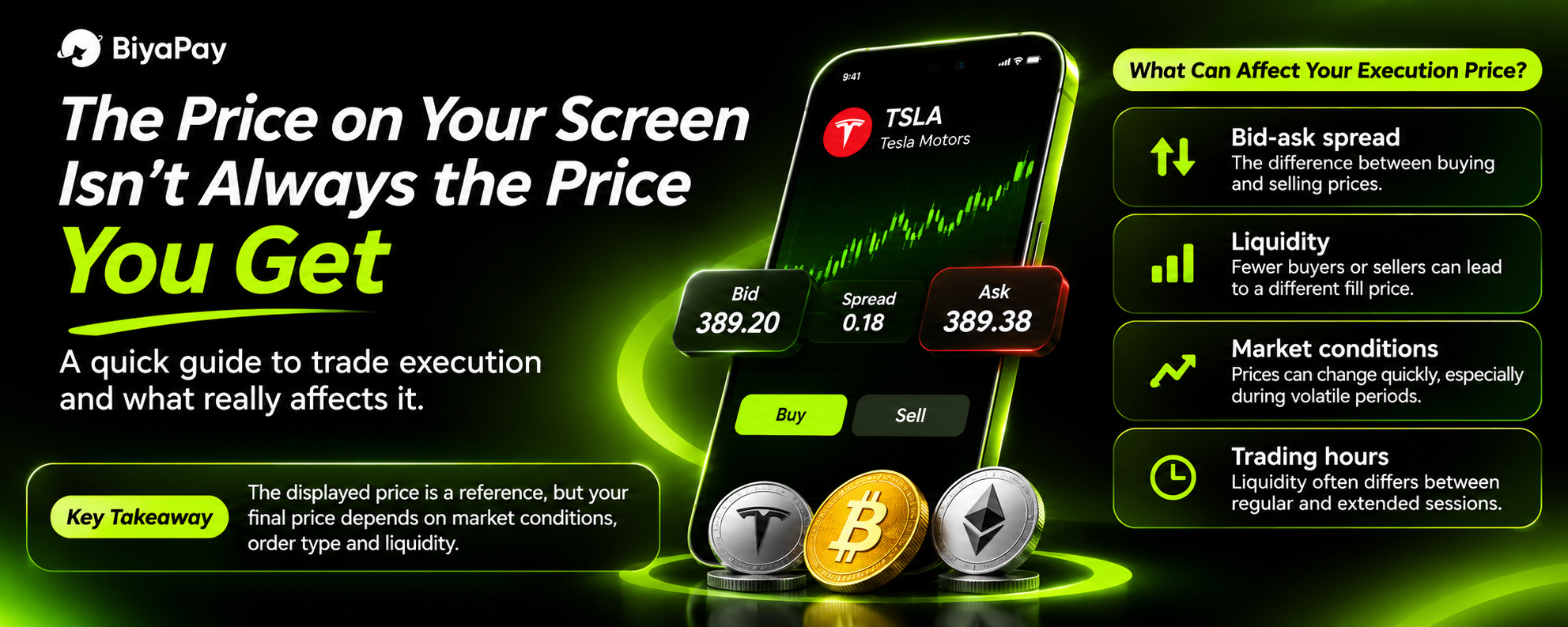
The buying and selling prices are different. The gap between them is called the bid-ask spread. When the spread is wider, the cost of entering and exiting a position can become more noticeable.
Liquidity also matters. A highly traded asset generally has more buyers and sellers available. In a less liquid market, a large order may need to match with several available prices, producing a different average execution price.
Market conditions can change quickly, too. A stock reacting to earnings or a cryptocurrency experiencing a sudden price movement may move before an order is completed.
Two orders can produce different outcomes
Consider two common order types.
Market order: This prioritises executing the trade at the best available prices. It can be useful when execution speed matters, but the final price isn't guaranteed.
Limit order: This allows you to specify the maximum price you're willing to pay when buying or the minimum price you're willing to accept when selling. The trade may remain unfilled if the market doesn't reach your chosen price.
Neither option is perfect for every situation. A market order can execute at a less favourable price during volatile conditions, while a limit order can miss an opportunity entirely.
Understanding that difference is part of managing a trade properly.
Why trading hours can change the experience
Liquidity isn't constant throughout the day.
For U.S. stocks, regular trading hours generally attract substantial market participation, while pre-market and after-hours sessions can have lower liquidity and wider spreads.
This matters to international investors who may monitor U.S. markets from different time zones. A price movement outside regular hours may look attractive, but the available buyers and sellers can be limited.
The same general principle applies to cryptocurrency markets during periods of sudden volatility. Being able to trade around the clock doesn't mean liquidity and execution conditions remain identical at every moment.
Looking beyond the chart
This is particularly relevant when using a platform that provides access to different financial markets.
BiyaPay brings U.S. stocks, Hong Kong stocks and cryptocurrency trading together, alongside other supported financial products. That means users can follow different markets within the same platform, but each market still has its own trading conditions.
For example, buying a U.S. stock and trading a BTC/USDT pair involve different instruments, market structures and risks. The execution conditions of one should not be assumed to apply to the other.
BiyaPay also lists zero commission for U.S. stock trading. However, commission is only one part of the overall trading cost. Platform fees, external charges, spreads, currency conversion and other applicable costs can still affect the final amount.
That's why looking at the order details and actual execution record matters more than relying on a headline fee alone.
A better habit before placing an order
Before entering a position, I would pay attention to the following:
Compare the displayed bid and ask prices instead of looking only at the last traded price.Check whether the market is operating during regular hours or an extended session.
Consider the liquidity of the asset and the size of your order.Understand how your chosen order type works.Review the estimated costs and confirm the final execution details.
These checks won't eliminate slippage or guarantee a better entry. They can, however, help you understand what you're paying and why your executed price may differ from the one you initially saw.
The point many traders overlook
A trading strategy can identify a good opportunity and still produce a disappointing result if execution costs are ignored.
The difference between the price you expect and the price you receive is part of the trading decision itself. It's worth paying attention to before entering a position, not only after reviewing your trade history.
As markets become more accessible across digital and traditional financial platforms, understanding execution becomes an increasingly useful skill.
Disclaimer: This article is for educational purposes only and does not constitute investment or financial advice. Trading involves risk, and prices can change rapidly. Order execution, spreads, liquidity, fees and product availability vary by market and account eligibility. Always review the relevant trading conditions before placing an order.
#BiyaPay #Trading #TradeExecution #StockMarket #crypt
The Price on Your Screen Isn't Always the Price You Get: Understanding Trade Execution
You spot a stock trading at $150. You decide it's a good entry point, open your trading app and place an order. A moment later, the execution confirmation shows $150.18.
That difference may look insignificant. But if it happens repeatedly, especially when trading larger amounts or entering and exiting positions frequently, it can affect your overall results.
This is one part of trading that deserves more attention: execution price.
Many traders spend hours studying charts, identifying support and resistance, and deciding when to enter a position. Yet they sometimes overlook what happens between pressing the buy or sell button and the order actually being completed.
The displayed price is only part of the picture
A market price displayed on a trading screen usually reflects recent market activity or a current quote. It doesn't necessarily mean every order can be executed at that exact price.
There are several reasons for this.
The buying and selling prices are different. The gap between them is called the bid-ask spread. When the spread is wider, the cost of entering and exiting a position can become more noticeable.
Liquidity also matters. A highly traded asset generally has more buyers and sellers available. In a less liquid market, a large order may need to match with several available prices, producing a different average execution price.
Market conditions can change quickly, too. A stock reacting to earnings or a cryptocurrency experiencing a sudden price movement may move before an order is completed.
Two orders can produce different outcomes
Consider two common order types.
Market order: This prioritises executing the trade at the best available prices. It can be useful when execution speed matters, but the final price isn't guaranteed.
Limit order: This allows you to specify the maximum price you're willing to pay when buying or the minimum price you're willing to accept when selling. The trade may remain unfilled if the market doesn't reach your chosen price.
Neither option is perfect for every situation. A market order can execute at a less favourable price during volatile conditions, while a limit order can miss an opportunity entirely.
Understanding that difference is part of managing a trade properly.
Why trading hours can change the experience
Liquidity isn't constant throughout the day.
For U.S. stocks, regular trading hours generally attract substantial market participation, while pre-market and after-hours sessions can have lower liquidity and wider spreads.
This matters to international investors who may monitor U.S. markets from different time zones. A price movement outside regular hours may look attractive, but the available buyers and sellers can be limited.
The same general principle applies to cryptocurrency markets during periods of sudden volatility. Being able to trade around the clock doesn't mean liquidity and execution conditions remain identical at every moment.
Looking beyond the chart
This is particularly relevant when using a platform that provides access to different financial markets.
BiyaPay brings U.S. stocks, Hong Kong stocks and cryptocurrency trading together, alongside other supported financial products. That means users can follow different markets within the same platform, but each market still has its own trading conditions.
For example, buying a U.S. stock and trading a BTC/USDT pair involve different instruments, market structures and risks. The execution conditions of one should not be assumed to apply to the other.
BiyaPay also lists zero commission for U.S. stock trading. However, commission is only one part of the overall trading cost. Platform fees, external charges, spreads, currency conversion and other applicable costs can still affect the final amount.
That's why looking at the order details and actual execution record matters more than relying on a headline fee alone.
A better habit before placing an order
Before entering a position, I would pay attention to the following:
Compare the displayed bid and ask prices instead of looking only at the last traded price.Check whether the market is operating during regular hours or an extended session.
Consider the liquidity of the asset and the size of your order.Understand how your chosen order type works.Review the estimated costs and confirm the final execution details.
These checks won't eliminate slippage or guarantee a better entry. They can, however, help you understand what you're paying and why your executed price may differ from the one you initially saw.
The point many traders overlook
A trading strategy can identify a good opportunity and still produce a disappointing result if execution costs are ignored.
The difference between the price you expect and the price you receive is part of the trading decision itself. It's worth paying attention to before entering a position, not only after reviewing your trade history.
As markets become more accessible across digital and traditional financial platforms, understanding execution becomes an increasingly useful skill.
Disclaimer: This article is for educational purposes only and does not constitute investment or financial advice. Trading involves risk, and prices can change rapidly. Order execution, spreads, liquidity, fees and product availability vary by market and account eligibility. Always review the relevant trading conditions before placing an order.
#BiyaPay #Trading #TradeExecution #StockMarket #crypt
73
Article
Market Volatility vs. Trading Risk: What Should Investors Understand Before Opening a Position?A market can move sharply without every trader experiencing the same level of loss. The difference often comes down to how much capital they commit, the size of their position and whether they use leverage.
This is an important distinction for anyone trading cryptocurrencies or following traditional financial markets.
Many people spend time trying to predict whether Bitcoin, a stock or another asset will rise or fall. Yet understanding the possible direction of a market is only one part of trading. Managing the amount of risk attached to a position is equally important.
Volatility and risk are two different things
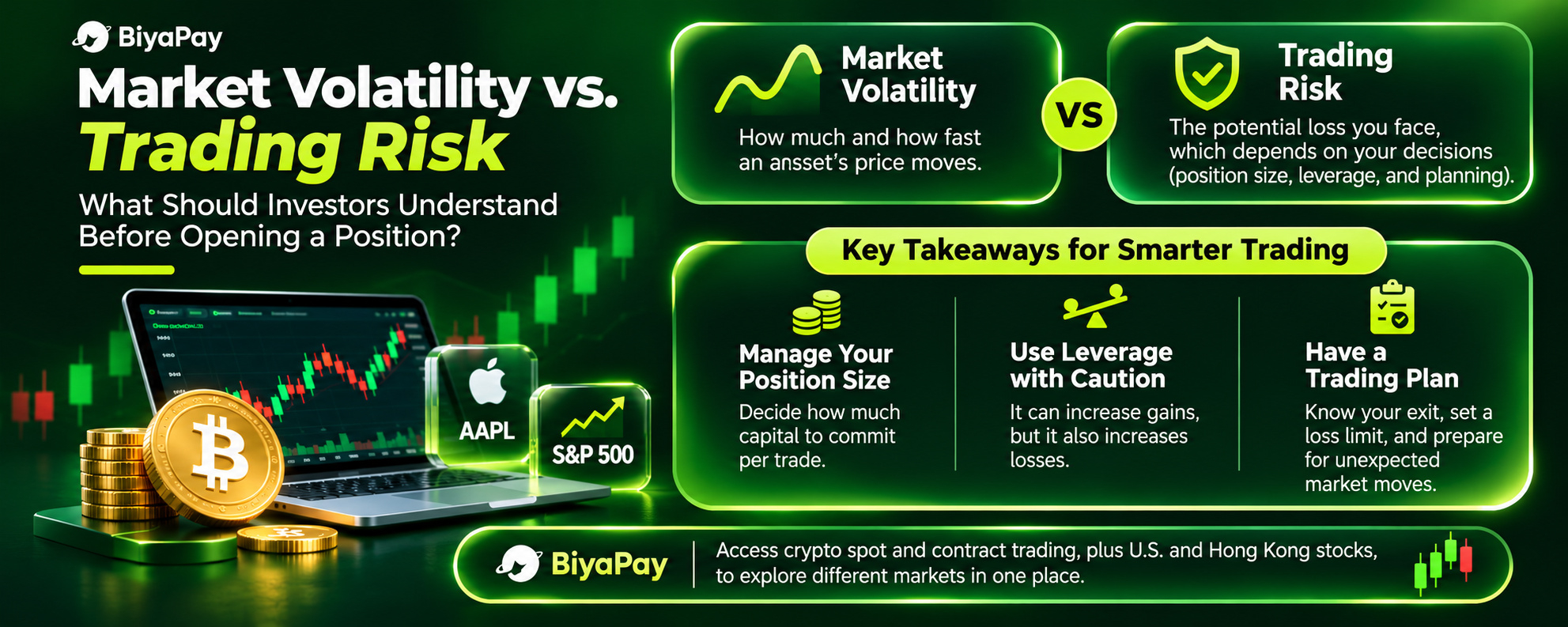
Volatility describes how much an asset's price fluctuates over a period of time.
An asset that experiences frequent and significant price changes is generally considered more volatile than one with smaller price movements.
Trading risk, however, also depends on the decisions made by the person entering the market.
Consider two traders buying the same cryptocurrency at the same price. One commits a small portion of their available capital, while the other commits almost everything they have allocated for trading.
If the price falls, both face a loss, but the financial impact on each trader can be very different.
The market movement is the same. Their exposure is not.
This is why looking at price charts alone doesn't provide a complete picture of trading risk.
Position size can change the outcome
Position sizing refers to how much capital a trader allocates to a particular trade.
It's one of the practical decisions that should be made before entering a position.
For example, imagine having $500 allocated for trading. You decide to open a position worth $50 rather than committing the entire amount.
A 10% decline in that position would represent a $5 loss before applicable fees and other costs.
If you had exposed the entire $500 to the same 10% decline, the loss would be $50.
This simple comparison shows why the amount committed matters.
A trader should consider their available capital, acceptable loss and the possibility that the market may move against their expectations.
Why leverage deserves extra attention
Leverage allows traders to control a position larger than the capital they provide as margin.
It can increase potential gains, but it also increases potential losses.
For instance, with 5x leverage, a trader can open a position worth $500 using $100 in initial margin, subject to the platform's requirements.
A 2% adverse price movement represents a $10 change in the position's value, equivalent to 10% of the initial $100 margin, before fees and funding costs.
The actual liquidation price depends on several factors, including maintenance margin, fees and the platform's liquidation rules.
This is why leverage should never be selected simply because a platform makes higher multiples available.
Understanding margin requirements and liquidation conditions is essential before opening a leveraged position.
Build a trading plan before the market moves
One mistake traders make is deciding what to do after a price movement has already started.
A better approach is to establish the important conditions before entering a trade.
I would consider three questions:
What would invalidate my market idea?
Every trade begins with an expectation about price direction. Decide what market movement would show that your original reasoning may be wrong.
How much can I afford to lose?
Determine the amount of capital you're willing to put at risk. Avoid using money needed for essential expenses.
What will I do if the market moves unexpectedly?
A trading plan should account for sudden price movements, changing market conditions and the possibility of execution differences.
These questions won't eliminate losses, but they can help prevent emotional decisions from controlling every trade.
How different markets fit into the picture
Risk management also matters when moving between different financial markets.
Cryptocurrency markets can experience significant price changes at any time, while traditional stock markets operate within scheduled trading sessions.
A strategy suitable for one asset may not work for another. A trader researching Bitcoin should consider different market factors from someone analysing a company's earnings or stock valuation.
BiyaPay provides access to cryptocurrency spot and contract trading, alongside traditional markets such as U.S. and Hong Kong stocks.
This allows users to explore different financial markets through one platform. However, each product has its own trading conditions, costs and risks. Understanding those differences remains the trader's responsibility.
The real advantage is knowing your exposure
There's always uncertainty in financial markets. Even a well-researched trade can move in an unexpected direction.
What traders can control is how much exposure they take, whether they understand the product they're using and how they respond when their expectations are challenged.
A useful trading habit is to assess the possible loss before focusing on the potential profit.
Because a good market prediction can still become a bad trade if the position is poorly managed.
The next time you consider opening a position, ask yourself one question:
If the market moves against me, have I already decided how much I'm willing to lose?
That answer deserves as much attention as your price target.
Disclaimer: This article is for educational purposes only and does not constitute financial or investment advice. Cryptocurrency and derivatives trading involve substantial risk. Leverage can amplify losses, including the possibility of losing your entire margin. Always understand the product and its trading conditions before participating.
#BiyaPay #CryptoTrading #RiskManagement #TradingEducation #DigitalAssets
Market Volatility vs. Trading Risk: What Should Investors Understand Before Opening a Position?
A market can move sharply without every trader experiencing the same level of loss. The difference often comes down to how much capital they commit, the size of their position and whether they use leverage.
This is an important distinction for anyone trading cryptocurrencies or following traditional financial markets.
Many people spend time trying to predict whether Bitcoin, a stock or another asset will rise or fall. Yet understanding the possible direction of a market is only one part of trading. Managing the amount of risk attached to a position is equally important.
Volatility and risk are two different things
Volatility describes how much an asset's price fluctuates over a period of time.
An asset that experiences frequent and significant price changes is generally considered more volatile than one with smaller price movements.
Trading risk, however, also depends on the decisions made by the person entering the market.
Consider two traders buying the same cryptocurrency at the same price. One commits a small portion of their available capital, while the other commits almost everything they have allocated for trading.
If the price falls, both face a loss, but the financial impact on each trader can be very different.
The market movement is the same. Their exposure is not.
This is why looking at price charts alone doesn't provide a complete picture of trading risk.
Position size can change the outcome
Position sizing refers to how much capital a trader allocates to a particular trade.
It's one of the practical decisions that should be made before entering a position.
For example, imagine having $500 allocated for trading. You decide to open a position worth $50 rather than committing the entire amount.
A 10% decline in that position would represent a $5 loss before applicable fees and other costs.
If you had exposed the entire $500 to the same 10% decline, the loss would be $50.
This simple comparison shows why the amount committed matters.
A trader should consider their available capital, acceptable loss and the possibility that the market may move against their expectations.
Why leverage deserves extra attention
Leverage allows traders to control a position larger than the capital they provide as margin.
It can increase potential gains, but it also increases potential losses.
For instance, with 5x leverage, a trader can open a position worth $500 using $100 in initial margin, subject to the platform's requirements.
A 2% adverse price movement represents a $10 change in the position's value, equivalent to 10% of the initial $100 margin, before fees and funding costs.
The actual liquidation price depends on several factors, including maintenance margin, fees and the platform's liquidation rules.
This is why leverage should never be selected simply because a platform makes higher multiples available.
Understanding margin requirements and liquidation conditions is essential before opening a leveraged position.
Build a trading plan before the market moves
One mistake traders make is deciding what to do after a price movement has already started.
A better approach is to establish the important conditions before entering a trade.
I would consider three questions:
What would invalidate my market idea?
Every trade begins with an expectation about price direction. Decide what market movement would show that your original reasoning may be wrong.
How much can I afford to lose?
Determine the amount of capital you're willing to put at risk. Avoid using money needed for essential expenses.
What will I do if the market moves unexpectedly?
A trading plan should account for sudden price movements, changing market conditions and the possibility of execution differences.
These questions won't eliminate losses, but they can help prevent emotional decisions from controlling every trade.
How different markets fit into the picture
Risk management also matters when moving between different financial markets.
Cryptocurrency markets can experience significant price changes at any time, while traditional stock markets operate within scheduled trading sessions.
A strategy suitable for one asset may not work for another. A trader researching Bitcoin should consider different market factors from someone analysing a company's earnings or stock valuation.
BiyaPay provides access to cryptocurrency spot and contract trading, alongside traditional markets such as U.S. and Hong Kong stocks.
This allows users to explore different financial markets through one platform. However, each product has its own trading conditions, costs and risks. Understanding those differences remains the trader's responsibility.
The real advantage is knowing your exposure
There's always uncertainty in financial markets. Even a well-researched trade can move in an unexpected direction.
What traders can control is how much exposure they take, whether they understand the product they're using and how they respond when their expectations are challenged.
A useful trading habit is to assess the possible loss before focusing on the potential profit.
Because a good market prediction can still become a bad trade if the position is poorly managed.
The next time you consider opening a position, ask yourself one question:
If the market moves against me, have I already decided how much I'm willing to lose?
That answer deserves as much attention as your price target.
Disclaimer: This article is for educational purposes only and does not constitute financial or investment advice. Cryptocurrency and derivatives trading involve substantial risk. Leverage can amplify losses, including the possibility of losing your entire margin. Always understand the product and its trading conditions before participating.
#BiyaPay #CryptoTrading #RiskManagement #TradingEducation #DigitalAssets
122
Article
Your Money Lives in Different Currencies. Does Your Financial Strategy Reflect That?Think about how money moves through an ordinary person's life.
You might earn in one currency, pay for subscriptions in another, support family in a different country, and invest in assets priced in U.S. dollars.
Your financial life can become international long before you consider yourself a global investor.
This creates an interesting challenge: managing money across different currencies while trying to keep your financial decisions organised.
And it's a challenge worth paying attention to.
The currency mismatch most people overlook
Imagine someone who earns in Nigerian naira but follows opportunities in the U.S. stock market.
Their everyday expenses are in naira. Their preferred digital assets may be held in USDT. Meanwhile, the stocks they want to research and potentially invest in are priced in dollars.
These are three different financial environments.
Moving between them involves more than simply changing numbers on a screen. Exchange rates, conversion costs, transaction fees and the availability of financial services all influence how much money eventually reaches its destination.
This is where people can lose sight of the bigger picture.
Someone may focus heavily on the price of an investment while paying very little attention to the cost of moving funds into the account. Another person may hold digital assets without having a clear plan for converting them when they need traditional currency.
Over time, these small decisions can affect how efficiently money is managed.
Money movement deserves as much attention as investment decisions
Most financial conversations focus on what to buy.
Should you hold Bitcoin? Are U.S. technology stocks worth researching? Is the Hong Kong market offering opportunities? Should you keep some funds in cash?
These questions matter, but there's another question worth asking:
How easily can you move your money between the different financial activities that matter to you?
Consider three situations.
1. Accessing traditional financial markets
Someone holding USDT may want exposure to eligible U.S. or Hong Kong stocks. That requires a financial service that connects digital asset funding with the relevant investment market.
2. Managing international payment.
A person supporting family abroad may need to convert digital assets into a supported fiat currency and transfer the funds through an available remittance route.
3. Following different asset markets
An investor interested in equities and cryptocurrencies may want to monitor both markets without treating them as completely unrelated parts of their financial life.
Each situation involves a different objective, but they share one thing: the need to manage funds across financial systems.
The case for a more connected financial setup
This is one reason platforms combining different financial services are becoming more relevant.
BiyaPay is built around this idea of connecting digital assets, traditional financial markets and cross-border money movement.
Its services cover U.S. and Hong Kong stock trading, cryptocurrency spot and contract trading, currency conversion, and international remittance. This gives users access to several financial activities within one platform rather than treating every activity as an entirely separate process.
For example, USDT can be converted into supported fiat currencies, including USD and HKD. Users can also access eligible U.S. and Hong Kong stock markets through the platform.
The interesting part is how these services relate to one another.
A person holding digital assets may also have international payment needs. Someone interested in global equities may already be managing funds in different currencies. Having these activities connected can make the overall financial setup easier to organise.
Of course, access to multiple services does not automatically make every financial decision a good one. Users still need to understand the products they're using, their costs, eligibility requirements and associated risks.
Convenience should never replace financial discipline
Having access to multiple markets can create more choices, but more choices also require better decision-making.
Before moving money, understand the exchange rate and the amount you'll receive after applicable charges.
Before investing, research the asset, understand its volatility and decide how much risk you're comfortable taking.
Before making an international transfer, check the supported destination, recipient details, limits and expected processing conditions.
And when using digital assets, pay attention to the network and wallet address. A mistake in an on-chain transfer can be difficult or impossible to reverse.
These checks matter regardless of which platform you use.
There's also a difference between having access to a market and having a reason to participate in it. Just because an asset is available doesn't mean it belongs in your portfolio.
A connected financial platform should make managing money more convenient. It should never become a reason to abandon a financial plan.
A better way to think about global finance
I think the next stage of personal finance will involve more people managing money across currencies and asset classes as part of their everyday lives.
Someone may use digital assets for one purpose, traditional currencies for another, and global investments for long-term financial goals.
The important thing is understanding how these pieces fit together.
BiyaPay is an example of a platform bringing several of these activities into one financial environment. Its combination of currency conversion, remittance, digital asset services and access to U.S. and Hong Kong markets reflects a growing demand for more connected financial tools.
For anyone managing money across borders, the real question is worth considering:
Is your financial setup keeping up with the way you actually earn, spend, transfer and invest money?
That may be a more useful place to start than simply looking for the next asset to buy.
Disclaimer: This article is for educational and informational purposes only. It is not financial or investment advice. Digital assets and financial markets involve risks, and product availability, fees and eligibility conditions may vary.
#BiyaPay #GlobalFinance #DigitalAssets #CrossBorderPayments #GlobalInvesting
Your Money Lives in Different Currencies. Does Your Financial Strategy Reflect That?
Think about how money moves through an ordinary person's life.
You might earn in one currency, pay for subscriptions in another, support family in a different country, and invest in assets priced in U.S. dollars.
Your financial life can become international long before you consider yourself a global investor.
This creates an interesting challenge: managing money across different currencies while trying to keep your financial decisions organised.
And it's a challenge worth paying attention to.
The currency mismatch most people overlook
Imagine someone who earns in Nigerian naira but follows opportunities in the U.S. stock market.
Their everyday expenses are in naira. Their preferred digital assets may be held in USDT. Meanwhile, the stocks they want to research and potentially invest in are priced in dollars.
These are three different financial environments.
Moving between them involves more than simply changing numbers on a screen. Exchange rates, conversion costs, transaction fees and the availability of financial services all influence how much money eventually reaches its destination.
This is where people can lose sight of the bigger picture.
Someone may focus heavily on the price of an investment while paying very little attention to the cost of moving funds into the account. Another person may hold digital assets without having a clear plan for converting them when they need traditional currency.
Over time, these small decisions can affect how efficiently money is managed.
Money movement deserves as much attention as investment decisions
Most financial conversations focus on what to buy.
Should you hold Bitcoin? Are U.S. technology stocks worth researching? Is the Hong Kong market offering opportunities? Should you keep some funds in cash?
These questions matter, but there's another question worth asking:
How easily can you move your money between the different financial activities that matter to you?
Consider three situations.
1. Accessing traditional financial markets
Someone holding USDT may want exposure to eligible U.S. or Hong Kong stocks. That requires a financial service that connects digital asset funding with the relevant investment market.
2. Managing international payment.
A person supporting family abroad may need to convert digital assets into a supported fiat currency and transfer the funds through an available remittance route.
3. Following different asset markets
An investor interested in equities and cryptocurrencies may want to monitor both markets without treating them as completely unrelated parts of their financial life.
Each situation involves a different objective, but they share one thing: the need to manage funds across financial systems.
The case for a more connected financial setup
This is one reason platforms combining different financial services are becoming more relevant.
BiyaPay is built around this idea of connecting digital assets, traditional financial markets and cross-border money movement.
Its services cover U.S. and Hong Kong stock trading, cryptocurrency spot and contract trading, currency conversion, and international remittance. This gives users access to several financial activities within one platform rather than treating every activity as an entirely separate process.
For example, USDT can be converted into supported fiat currencies, including USD and HKD. Users can also access eligible U.S. and Hong Kong stock markets through the platform.
The interesting part is how these services relate to one another.
A person holding digital assets may also have international payment needs. Someone interested in global equities may already be managing funds in different currencies. Having these activities connected can make the overall financial setup easier to organise.
Of course, access to multiple services does not automatically make every financial decision a good one. Users still need to understand the products they're using, their costs, eligibility requirements and associated risks.
Convenience should never replace financial discipline
Having access to multiple markets can create more choices, but more choices also require better decision-making.
Before moving money, understand the exchange rate and the amount you'll receive after applicable charges.
Before investing, research the asset, understand its volatility and decide how much risk you're comfortable taking.
Before making an international transfer, check the supported destination, recipient details, limits and expected processing conditions.
And when using digital assets, pay attention to the network and wallet address. A mistake in an on-chain transfer can be difficult or impossible to reverse.
These checks matter regardless of which platform you use.
There's also a difference between having access to a market and having a reason to participate in it. Just because an asset is available doesn't mean it belongs in your portfolio.
A connected financial platform should make managing money more convenient. It should never become a reason to abandon a financial plan.
A better way to think about global finance
I think the next stage of personal finance will involve more people managing money across currencies and asset classes as part of their everyday lives.
Someone may use digital assets for one purpose, traditional currencies for another, and global investments for long-term financial goals.
The important thing is understanding how these pieces fit together.
BiyaPay is an example of a platform bringing several of these activities into one financial environment. Its combination of currency conversion, remittance, digital asset services and access to U.S. and Hong Kong markets reflects a growing demand for more connected financial tools.
For anyone managing money across borders, the real question is worth considering:
Is your financial setup keeping up with the way you actually earn, spend, transfer and invest money?
That may be a more useful place to start than simply looking for the next asset to buy.
Disclaimer: This article is for educational and informational purposes only. It is not financial or investment advice. Digital assets and financial markets involve risks, and product availability, fees and eligibility conditions may vary.
#BiyaPay #GlobalFinance #DigitalAssets #CrossBorderPayments #GlobalInvesting
106
Article
One Market Screen, Different Opportunities: Why Watching Multiple Asset Classes Matters.A stock can be rising while Bitcoin is gaining momentum. At the same time, another market could be experiencing a sharp decline.
This is why I think investors should pay attention to more than one corner of the financial market.
Looking at a single asset can give you only part of the picture. Sometimes, understanding what's happening elsewhere can help you put a market move into better context.
That's one thing I noticed while exploring BiyaPay's market interface.
Instead of focusing on just cryptocurrency, the platform brings different market categories into view, including stocks, crypto, TradFi and futures.
And there's an interesting lesson in that arrangement.
Different markets tell different stories
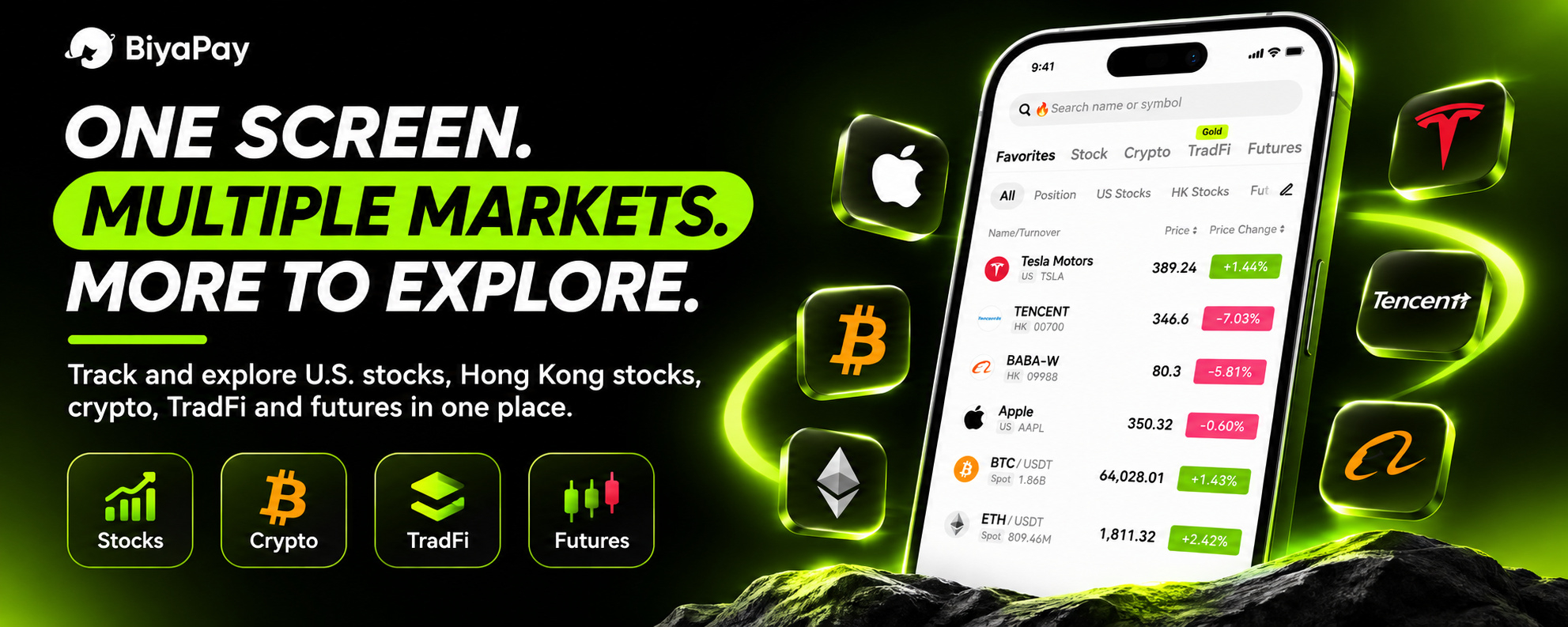
Take the stocks displayed in the screenshot.
Tesla and Apple represent major U.S. technology companies, while Tencent and Alibaba provide exposure to major Hong Kong-listed businesses
Their prices don't necessarily move in the same direction or respond to the same factors.
A technology stock may react to earnings expectations, company announcements or developments in its industry. A Hong Kong-listed company may respond to different regional economic conditions and market sentiment.
Cryptocurrency introduces another layer.
The screenshot also displays BTC/USDT and ETH/USDT in the spot market, alongside their perpetual contract pairs.
These instruments provide different ways to follow crypto market activity. Spot trading involves buying or selling the underlying asset, while perpetual contracts allow traders to speculate on price movements using derivatives.
The distinction matters, especially because perpetual contracts involve leverage and liquidation risks.
Why looking across markets can be useful
Imagine you're monitoring Bitcoin and notice that its price is moving sharply.
You might naturally want to understand whether the movement is isolated to crypto or part of a broader change in market sentiment.
Looking at stocks, commodities-related instruments and other markets can provide additional context.
It doesn't mean these assets will move together. In fact, their differences are exactly why observing multiple markets can be useful.
A diversified watchlist also helps investors avoid becoming too focused on one asset simply because it's receiving the most attention.
A Closer Look at Different Market Categories
BiyaPay provides access to different market categories within one interface, making it easier to keep an eye on various financial markets.
These include:
Stock: Access to listed stock markets, including U.S. and Hong Kong stocks.
Crypto: Spot trading pairs such as BTC/USDT and ETH/USDT.
TradFi: Traditional financial market instruments.
Futures: Contracts that allow traders to follow and trade supported futures markets.
The favorites section also displays different instruments in one view.
For someone monitoring several markets, having this overview can make it easier to check prices and observe how different assets are performing without constantly moving between separate market screens.
The screenshot shows Tesla at 389.24, Tencent at 346.6, Apple at 350.32, BTC/USDT at 64,028.01 and ETH/USDT at 1,811.32, alongside other instruments.
These figures are simply the prices displayed in the captured interface, not live quotes or current market recommendations.
A watchlist is useful, but interpretation matters more
Seeing several markets together doesn't automatically make someone a better investor or trader.
The real value comes from knowing what to look for.
Before acting on a price movement, consider:
The reason behind the move: Is there a company announcement, economic development or market event?
The time frame: Is the movement short-term or part of a longer trend?
The instrument: Are you looking at a stock, spot asset or leveraged derivative?
The risk: How much capital could you lose if the market moves against your position?
The cost: Understand trading fees, spreads, funding charges and other applicable costs.
A watchlist should help you observe the market, not pressure you into trading every opportunity you see.
My takeaway
Financial markets are connected in some ways, but each asset class has its own drivers, risks and opportunities.
Being able to monitor different markets from one interface can make the research process more convenient. That's the practical value I see in BiyaPay's multi-market approach.
You can explore the platform and its available markets through BiyaPay's official resources.
Disclaimer: This article is for educational purposes only and does not constitute investment, financial, legal or tax advice. Market prices change constantly. Trading involves risk, and futures or perpetual contracts can result in significant losses, including liquidation. Product availability, fees and eligibility vary by jurisdiction. Always review the latest product terms before trading.
#BiyaPay #Crypto #StockMarket #Trading #DigitalAssets #FinancialMarkets
One Market Screen, Different Opportunities: Why Watching Multiple Asset Classes Matters.
A stock can be rising while Bitcoin is gaining momentum. At the same time, another market could be experiencing a sharp decline.
This is why I think investors should pay attention to more than one corner of the financial market.
Looking at a single asset can give you only part of the picture. Sometimes, understanding what's happening elsewhere can help you put a market move into better context.
That's one thing I noticed while exploring BiyaPay's market interface.
Instead of focusing on just cryptocurrency, the platform brings different market categories into view, including stocks, crypto, TradFi and futures.
And there's an interesting lesson in that arrangement.
Different markets tell different stories
Take the stocks displayed in the screenshot.
Tesla and Apple represent major U.S. technology companies, while Tencent and Alibaba provide exposure to major Hong Kong-listed businesses
Their prices don't necessarily move in the same direction or respond to the same factors.
A technology stock may react to earnings expectations, company announcements or developments in its industry. A Hong Kong-listed company may respond to different regional economic conditions and market sentiment.
Cryptocurrency introduces another layer.
The screenshot also displays BTC/USDT and ETH/USDT in the spot market, alongside their perpetual contract pairs.
These instruments provide different ways to follow crypto market activity. Spot trading involves buying or selling the underlying asset, while perpetual contracts allow traders to speculate on price movements using derivatives.
The distinction matters, especially because perpetual contracts involve leverage and liquidation risks.
Why looking across markets can be useful
Imagine you're monitoring Bitcoin and notice that its price is moving sharply.
You might naturally want to understand whether the movement is isolated to crypto or part of a broader change in market sentiment.
Looking at stocks, commodities-related instruments and other markets can provide additional context.
It doesn't mean these assets will move together. In fact, their differences are exactly why observing multiple markets can be useful.
A diversified watchlist also helps investors avoid becoming too focused on one asset simply because it's receiving the most attention.
A Closer Look at Different Market Categories
BiyaPay provides access to different market categories within one interface, making it easier to keep an eye on various financial markets.
These include:
Stock: Access to listed stock markets, including U.S. and Hong Kong stocks.
Crypto: Spot trading pairs such as BTC/USDT and ETH/USDT.
TradFi: Traditional financial market instruments.
Futures: Contracts that allow traders to follow and trade supported futures markets.
The favorites section also displays different instruments in one view.
For someone monitoring several markets, having this overview can make it easier to check prices and observe how different assets are performing without constantly moving between separate market screens.
The screenshot shows Tesla at 389.24, Tencent at 346.6, Apple at 350.32, BTC/USDT at 64,028.01 and ETH/USDT at 1,811.32, alongside other instruments.
These figures are simply the prices displayed in the captured interface, not live quotes or current market recommendations.
A watchlist is useful, but interpretation matters more
Seeing several markets together doesn't automatically make someone a better investor or trader.
The real value comes from knowing what to look for.
Before acting on a price movement, consider:
The reason behind the move: Is there a company announcement, economic development or market event?
The time frame: Is the movement short-term or part of a longer trend?
The instrument: Are you looking at a stock, spot asset or leveraged derivative?
The risk: How much capital could you lose if the market moves against your position?
The cost: Understand trading fees, spreads, funding charges and other applicable costs.
A watchlist should help you observe the market, not pressure you into trading every opportunity you see.
My takeaway
Financial markets are connected in some ways, but each asset class has its own drivers, risks and opportunities.
Being able to monitor different markets from one interface can make the research process more convenient. That's the practical value I see in BiyaPay's multi-market approach.
You can explore the platform and its available markets through BiyaPay's official resources.
Disclaimer: This article is for educational purposes only and does not constitute investment, financial, legal or tax advice. Market prices change constantly. Trading involves risk, and futures or perpetual contracts can result in significant losses, including liquidation. Product availability, fees and eligibility vary by jurisdiction. Always review the latest product terms before trading.
#BiyaPay #Crypto #StockMarket #Trading #DigitalAssets #FinancialMarkets
1
145
Article
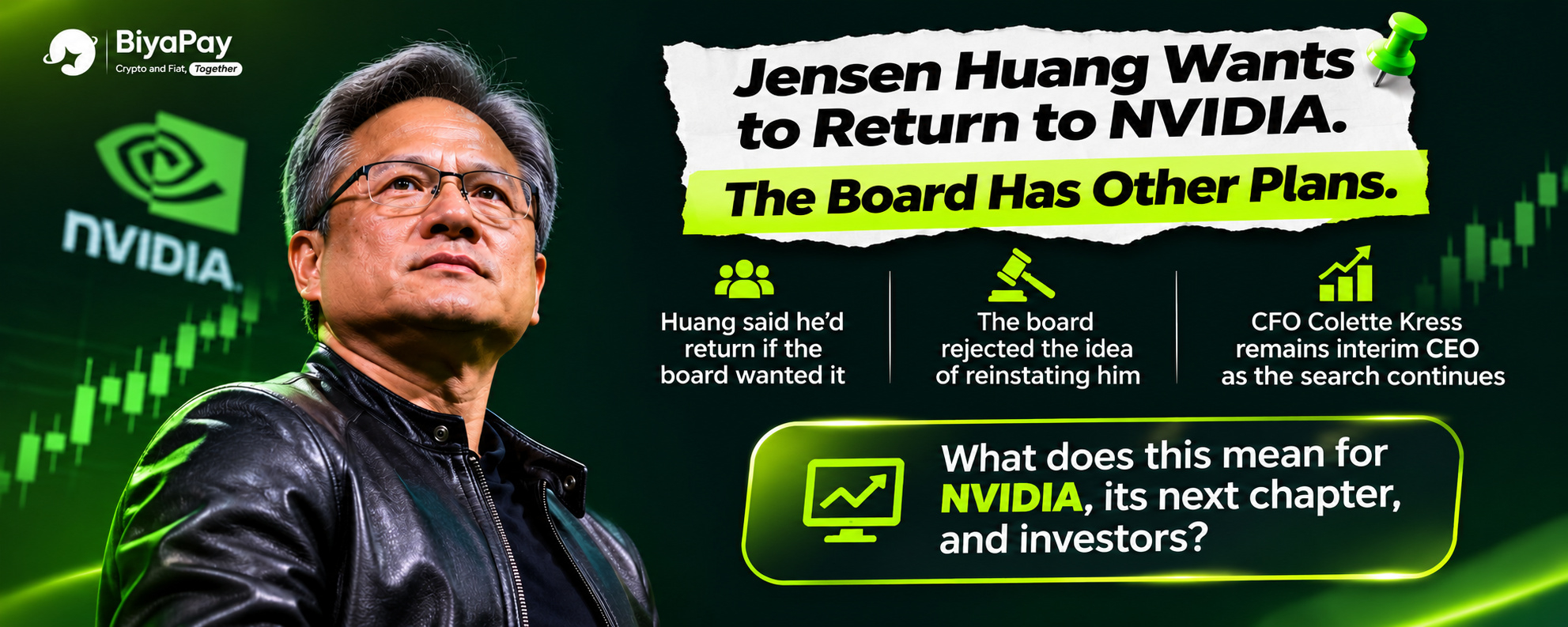
Jensen Huang Wants to Return to NVIDIA. The Board Has Other Plans.NVIDIA has entered an unusual moment in its history.
After Jensen Huang stepped down as CEO, many investors, employees and industry figures began calling for his return. Huang eventually addressed the calls, saying he would be honoured to return if the board believed it was in the company's best interest.
That statement immediately brought a new question into the conversation: Could NVIDIA bring back the leader who helped build it into one of the most influential companies in the AI industry?
For now, the answer from the board is no.
On November 17, NVIDIA chairman Harvey C. Jones confirmed that the board had unanimously accepted Huang's resignation and did not intend to reinstate him as CEO. CFO Colette Kress remains interim CEO while the company searches for a permanent replacement.
That changes the conversation around NVIDIA.
Why are people calling for his return?
Huang has been closely associated with NVIDIA's growth for decades. Under his leadership, the company moved beyond its traditional graphics business and became a major force in accelerated computing and artificial intelligence.
His leadership, technical vision and relationships across the technology industry have made him a central figure in NVIDIA's identity.
For some investors and employees, his departure raises concerns about continuity. They want to know whether the company's next leader can maintain the same direction, execute its long-term strategy and manage relationships across an increasingly competitive AI market.
However, a company's future cannot be judged by one person's presence alone.
What should investors pay attention to now?
The leadership story is important, but NVIDIA's business performance deserves equal attention.
The company reported third-quarter fiscal 2027 revenue of approximately $115.8 billion, according to its latest earnings announcement. It also issued a strong revenue outlook for the following quarter.
These figures suggest that demand for NVIDIA's products and AI infrastructure remains a major part of the investment story.
Still, strong revenue does not remove every risk.
Investors should pay attention to whether the company can sustain demand, maintain its competitive position, deliver on its product roadmap and manage challenges around international trade restrictions and advanced-chip exports.
The next CEO will also matter. The board must find someone capable of maintaining operational momentum while providing confidence to employees, customers, partners and shareholders.
Does Huang's possible return change the investment outlook?
His willingness to return may have encouraged supporters, but the board's response makes a comeback unlikely under the current position.
For investors, this creates two separate issues to evaluate.
The first is leadership uncertainty. A permanent CEO search can create questions about strategy, decision-making and the company's long-term direction.
The second is business fundamentals. NVIDIA's revenue, margins, customer demand, competition, product development and future guidance remain important indicators of its performance.
It's worth keeping these two issues separate. A change in leadership can influence market sentiment, but it does not automatically mean the company's underlying business is getting weaker or stronger.
The same applies to a strong earnings report. Good financial results do not make leadership and governance questions disappear.
A practical approach to investing in U.S. stocks
This situation is a useful reminder that investing requires more than reacting to breaking headlines.
Before buying a stock, consider why you want to own it. Are you interested in the company's long-term business prospects, or are you responding to a short-term market reaction?
Also consider your entry price, investment horizon, risk tolerance and how much of your portfolio you are willing to expose to one company.
For people exploring access to U.S. stocks with digital assets, BiyaPay is one platform worth researching. Its services include USDT funding and access to eligible U.S. stock investments, subject to account verification, supported regions and platform terms. Users should review the conversion process, applicable costs and stock-trading conditions before making a decision.
The important thing is to understand the process and the risks before committing funds.
My takeaway
Jensen Huang's willingness to return shows how much confidence some people still place in his leadership. But NVIDIA's board has made its current position clear: it does not intend to reinstate him.
Now the focus shifts to the company's next chapter.
Can NVIDIA maintain its momentum under new leadership? Can its financial performance continue to support investor confidence? And who will eventually take over the role?
Those are the questions worth watching.
A headline can move sentiment quickly. Long-term investment decisions deserve a closer look at the facts.
Disclaimer: This article is for informational and educational purposes only. It is not financial advice or a recommendation to buy or sell NVIDIA shares or any other asset. Stock prices can rise or fall, and investors should conduct their own research and assess their risk tolerance before investing.
#NVIDIA #JensenHuang #Aİ #StockMarke t #USstock #TechNews #ArtificialIntelligence #Investing #MarketNews #BiyaPay
Jensen Huang Wants to Return to NVIDIA. The Board Has Other Plans.
NVIDIA has entered an unusual moment in its history.
After Jensen Huang stepped down as CEO, many investors, employees and industry figures began calling for his return. Huang eventually addressed the calls, saying he would be honoured to return if the board believed it was in the company's best interest.
That statement immediately brought a new question into the conversation: Could NVIDIA bring back the leader who helped build it into one of the most influential companies in the AI industry?
For now, the answer from the board is no.
On November 17, NVIDIA chairman Harvey C. Jones confirmed that the board had unanimously accepted Huang's resignation and did not intend to reinstate him as CEO. CFO Colette Kress remains interim CEO while the company searches for a permanent replacement.
That changes the conversation around NVIDIA.
Why are people calling for his return?
Huang has been closely associated with NVIDIA's growth for decades. Under his leadership, the company moved beyond its traditional graphics business and became a major force in accelerated computing and artificial intelligence.
His leadership, technical vision and relationships across the technology industry have made him a central figure in NVIDIA's identity.
For some investors and employees, his departure raises concerns about continuity. They want to know whether the company's next leader can maintain the same direction, execute its long-term strategy and manage relationships across an increasingly competitive AI market.
However, a company's future cannot be judged by one person's presence alone.
What should investors pay attention to now?
The leadership story is important, but NVIDIA's business performance deserves equal attention.
The company reported third-quarter fiscal 2027 revenue of approximately $115.8 billion, according to its latest earnings announcement. It also issued a strong revenue outlook for the following quarter.
These figures suggest that demand for NVIDIA's products and AI infrastructure remains a major part of the investment story.
Still, strong revenue does not remove every risk.
Investors should pay attention to whether the company can sustain demand, maintain its competitive position, deliver on its product roadmap and manage challenges around international trade restrictions and advanced-chip exports.
The next CEO will also matter. The board must find someone capable of maintaining operational momentum while providing confidence to employees, customers, partners and shareholders.
Does Huang's possible return change the investment outlook?
His willingness to return may have encouraged supporters, but the board's response makes a comeback unlikely under the current position.
For investors, this creates two separate issues to evaluate.
The first is leadership uncertainty. A permanent CEO search can create questions about strategy, decision-making and the company's long-term direction.
The second is business fundamentals. NVIDIA's revenue, margins, customer demand, competition, product development and future guidance remain important indicators of its performance.
It's worth keeping these two issues separate. A change in leadership can influence market sentiment, but it does not automatically mean the company's underlying business is getting weaker or stronger.
The same applies to a strong earnings report. Good financial results do not make leadership and governance questions disappear.
A practical approach to investing in U.S. stocks
This situation is a useful reminder that investing requires more than reacting to breaking headlines.
Before buying a stock, consider why you want to own it. Are you interested in the company's long-term business prospects, or are you responding to a short-term market reaction?
Also consider your entry price, investment horizon, risk tolerance and how much of your portfolio you are willing to expose to one company.
For people exploring access to U.S. stocks with digital assets, BiyaPay is one platform worth researching. Its services include USDT funding and access to eligible U.S. stock investments, subject to account verification, supported regions and platform terms. Users should review the conversion process, applicable costs and stock-trading conditions before making a decision.
The important thing is to understand the process and the risks before committing funds.
My takeaway
Jensen Huang's willingness to return shows how much confidence some people still place in his leadership. But NVIDIA's board has made its current position clear: it does not intend to reinstate him.
Now the focus shifts to the company's next chapter.
Can NVIDIA maintain its momentum under new leadership? Can its financial performance continue to support investor confidence? And who will eventually take over the role?
Those are the questions worth watching.
A headline can move sentiment quickly. Long-term investment decisions deserve a closer look at the facts.
Disclaimer: This article is for informational and educational purposes only. It is not financial advice or a recommendation to buy or sell NVIDIA shares or any other asset. Stock prices can rise or fall, and investors should conduct their own research and assess their risk tolerance before investing.
#NVIDIA #JensenHuang #Aİ #StockMarke t #USstock #TechNews #ArtificialIntelligence #Investing #MarketNews #BiyaPay
1
89
Article
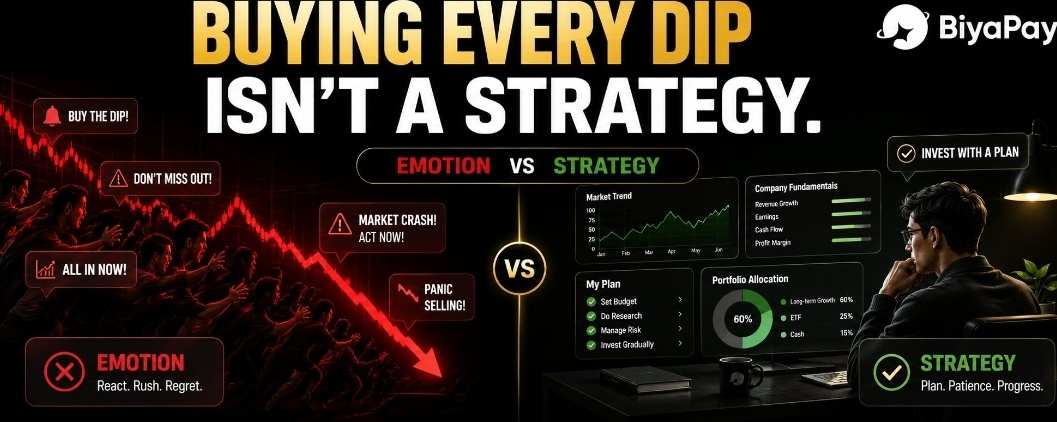
Buying the Dip: A Smarter Approach to Fractional Shares.Every time the stock market experiences a significant pullback, the same conversation starts again.
Investors begin looking for opportunities. Social media fills with predictions about which stocks will recover first, while others encourage people to buy before prices move higher.
But there's one question I think deserves more attention:
Do you actually have a plan for buying the dip, or are you simply reacting to falling prices?
A declining stock price can create an opportunity, but it can also signal deeper problems with a company. Understanding that difference is an important part of investing.
And sometimes, the biggest challenge isn't identifying a good company. It's deciding how much of your money to commit to it.
Why Buying Every Dip Can Become a Problem
Imagine you've been following NVIDIA or Apple for months. You believe in the company's long-term prospects, but its share price suddenly drops.
Your first reaction might be to buy more.
Then the price drops again.
You buy again, hoping you've found the bottom. A few days later, the market moves lower.
This is where an investment plan can easily turn into an emotional decision.
The problem is that falling prices alone don't tell you whether a stock is undervalued.
A company might experience a temporary decline because of broader market sentiment. Another might be facing weaker earnings, increased competition or changing business conditions.
These situations require different levels of consideration.
Before buying a dip, it's worth asking:
- What caused the price decline?
- Has anything changed about the company's fundamentals?
- Does the stock still fit my investment objectives?
- Can I afford to take additional exposure if the price falls further?
Having answers to these questions can help you avoid making decisions simply because everyone else is buying.
The Often-Overlooked Part of Investing: Position Sizing
Many conversations about investing focus on which stock to buy and when to enter.
Position sizing receives much less attention.
Yet, it can have a significant influence on how an investor manages risk.
Position sizing refers to deciding how much capital to allocate to a particular investment.
For example, imagine you want exposure to three technology companies. Instead of putting most of your available capital into one stock, you could determine how much you're comfortable allocating to each position.
This approach helps you think about your overall exposure rather than focusing entirely on the potential return of one investment.
It also gives you room to adjust your strategy as market conditions change.
There's no universally correct allocation. Your financial goals, risk tolerance, available capital and investment timeframe should guide that decision.
Fractional Shares: Starting Without Buying a Full Share
Here's where fractional shares become interesting.
Some well-known U.S. companies have share prices that can make purchasing a full share difficult for investors working with smaller budgets.
Think about companies like Apple, NVIDIA, Microsoft and Amazon.
An investor may want exposure to these businesses but may not want to commit enough capital to purchase a whole share.
Fractional shares provide another option.
They allow eligible investors to purchase a portion of a share rather than having to buy a complete unit.
This can make it easier to:
- Start investing with a smaller amount.
- Build a position gradually.
- Allocate capital across different companies.
- Adjust investment amounts according to a personal budget.
For example, instead of waiting until you have enough money to purchase a full share of a company, you may be able to start with a smaller position, subject to the platform's minimum investment requirements and stock eligibility.
However, fractional shares don't eliminate market risk. If the underlying stock loses value, your fractional investment can also decline.
The benefit is flexibility in how you build your position.
Accessing U.S. Stocks with Smaller Investments
For investors interested in U.S. stocks, having access to the market and understanding how to fund investments are important considerations.
BiyaPay provides eligible users with access to supported U.S. stock investments, including fractional shares.
With fractional shares, investors can explore owning a portion of a stock without having to purchase a full share. This can make it easier to start with smaller investment amounts, depending on the available stocks and platform requirements.
For people who already hold digital assets, BiyaPay also provides supported funding options, including a USDT-to-USD conversion process for accessing eligible stock investment services.
The general process involves:
1. Creating and completing verification on a BiyaPay account.
2. Depositing USDT through a supported network.
3. Converting the USDT into USD.
4. Transferring available USD into the relevant stock trading account.
5. Selecting an eligible stock and placing an order.
BiyaPay also advertises zero commission on eligible U.S. stock trades. Investors should still review applicable conversion, transfer and other charges before funding their accounts.
The interesting part is how this creates another funding route for people who already participate in digital asset markets but are also interested in traditional investments.
Of course, access to a stock doesn't automatically make it a good investment. Research and risk management remain important.
A Better Way to Think About Market Pullbacks
I don't think investors need to predict every market bottom to build a meaningful portfolio.
Trying to get the perfect entry can sometimes create unnecessary pressure.
A more practical approach is to establish an investment plan, decide how much capital you're comfortable allocating and understand the companies you're investing in.
Fractional shares can support that process by giving eligible investors more flexibility over position sizes.
And when the market becomes volatile, having a plan can make it easier to avoid impulsive decisions.
Final Thoughts
The next time you see a stock falling, take a moment before joining the conversation about buying the dip.
Look beyond the price movement. Understand what's happening with the company, review your available capital and decide whether the investment still fits your strategy.
You don't have to buy everything at once, and you don't have to own a full share to begin building exposure where fractional investing is supported.
For those exploring U.S. stocks, BiyaPay offers fractional-share access for eligible users alongside funding options that connect digital assets with traditional investing.
Sometimes, better investing starts with making smaller, more deliberate decisions.
Explore BiyaPay: https://www.biyapay.com/
Disclaimer: This article is for educational and informational purposes only and does not constitute financial, investment, legal or tax advice. Investing in stocks involves risks, including the possible loss of capital. Fractional-share availability, eligible securities, fees and account access may vary by jurisdiction. Always conduct your own research and consider your financial circumstances before investing.
#crypto #Web3 #CryptoCommunity #Web3 #Blockchain #DeFi
Buying the Dip: A Smarter Approach to Fractional Shares.
Every time the stock market experiences a significant pullback, the same conversation starts again.
Investors begin looking for opportunities. Social media fills with predictions about which stocks will recover first, while others encourage people to buy before prices move higher.
But there's one question I think deserves more attention:
Do you actually have a plan for buying the dip, or are you simply reacting to falling prices?
A declining stock price can create an opportunity, but it can also signal deeper problems with a company. Understanding that difference is an important part of investing.
And sometimes, the biggest challenge isn't identifying a good company. It's deciding how much of your money to commit to it.
Why Buying Every Dip Can Become a Problem
Imagine you've been following NVIDIA or Apple for months. You believe in the company's long-term prospects, but its share price suddenly drops.
Your first reaction might be to buy more.
Then the price drops again.
You buy again, hoping you've found the bottom. A few days later, the market moves lower.
This is where an investment plan can easily turn into an emotional decision.
The problem is that falling prices alone don't tell you whether a stock is undervalued.
A company might experience a temporary decline because of broader market sentiment. Another might be facing weaker earnings, increased competition or changing business conditions.
These situations require different levels of consideration.
Before buying a dip, it's worth asking:
- What caused the price decline?
- Has anything changed about the company's fundamentals?
- Does the stock still fit my investment objectives?
- Can I afford to take additional exposure if the price falls further?
Having answers to these questions can help you avoid making decisions simply because everyone else is buying.
The Often-Overlooked Part of Investing: Position Sizing
Many conversations about investing focus on which stock to buy and when to enter.
Position sizing receives much less attention.
Yet, it can have a significant influence on how an investor manages risk.
Position sizing refers to deciding how much capital to allocate to a particular investment.
For example, imagine you want exposure to three technology companies. Instead of putting most of your available capital into one stock, you could determine how much you're comfortable allocating to each position.
This approach helps you think about your overall exposure rather than focusing entirely on the potential return of one investment.
It also gives you room to adjust your strategy as market conditions change.
There's no universally correct allocation. Your financial goals, risk tolerance, available capital and investment timeframe should guide that decision.
Fractional Shares: Starting Without Buying a Full Share
Here's where fractional shares become interesting.
Some well-known U.S. companies have share prices that can make purchasing a full share difficult for investors working with smaller budgets.
Think about companies like Apple, NVIDIA, Microsoft and Amazon.
An investor may want exposure to these businesses but may not want to commit enough capital to purchase a whole share.
Fractional shares provide another option.
They allow eligible investors to purchase a portion of a share rather than having to buy a complete unit.
This can make it easier to:
- Start investing with a smaller amount.
- Build a position gradually.
- Allocate capital across different companies.
- Adjust investment amounts according to a personal budget.
For example, instead of waiting until you have enough money to purchase a full share of a company, you may be able to start with a smaller position, subject to the platform's minimum investment requirements and stock eligibility.
However, fractional shares don't eliminate market risk. If the underlying stock loses value, your fractional investment can also decline.
The benefit is flexibility in how you build your position.
Accessing U.S. Stocks with Smaller Investments
For investors interested in U.S. stocks, having access to the market and understanding how to fund investments are important considerations.
BiyaPay provides eligible users with access to supported U.S. stock investments, including fractional shares.
With fractional shares, investors can explore owning a portion of a stock without having to purchase a full share. This can make it easier to start with smaller investment amounts, depending on the available stocks and platform requirements.
For people who already hold digital assets, BiyaPay also provides supported funding options, including a USDT-to-USD conversion process for accessing eligible stock investment services.
The general process involves:
1. Creating and completing verification on a BiyaPay account.
2. Depositing USDT through a supported network.
3. Converting the USDT into USD.
4. Transferring available USD into the relevant stock trading account.
5. Selecting an eligible stock and placing an order.
BiyaPay also advertises zero commission on eligible U.S. stock trades. Investors should still review applicable conversion, transfer and other charges before funding their accounts.
The interesting part is how this creates another funding route for people who already participate in digital asset markets but are also interested in traditional investments.
Of course, access to a stock doesn't automatically make it a good investment. Research and risk management remain important.
A Better Way to Think About Market Pullbacks
I don't think investors need to predict every market bottom to build a meaningful portfolio.
Trying to get the perfect entry can sometimes create unnecessary pressure.
A more practical approach is to establish an investment plan, decide how much capital you're comfortable allocating and understand the companies you're investing in.
Fractional shares can support that process by giving eligible investors more flexibility over position sizes.
And when the market becomes volatile, having a plan can make it easier to avoid impulsive decisions.
Final Thoughts
The next time you see a stock falling, take a moment before joining the conversation about buying the dip.
Look beyond the price movement. Understand what's happening with the company, review your available capital and decide whether the investment still fits your strategy.
You don't have to buy everything at once, and you don't have to own a full share to begin building exposure where fractional investing is supported.
For those exploring U.S. stocks, BiyaPay offers fractional-share access for eligible users alongside funding options that connect digital assets with traditional investing.
Sometimes, better investing starts with making smaller, more deliberate decisions.
Explore BiyaPay: https://www.biyapay.com/
Disclaimer: This article is for educational and informational purposes only and does not constitute financial, investment, legal or tax advice. Investing in stocks involves risks, including the possible loss of capital. Fractional-share availability, eligible securities, fees and account access may vary by jurisdiction. Always conduct your own research and consider your financial circumstances before investing.
#crypto #Web3 #CryptoCommunity #Web3 #Blockchain #DeFi
1
274
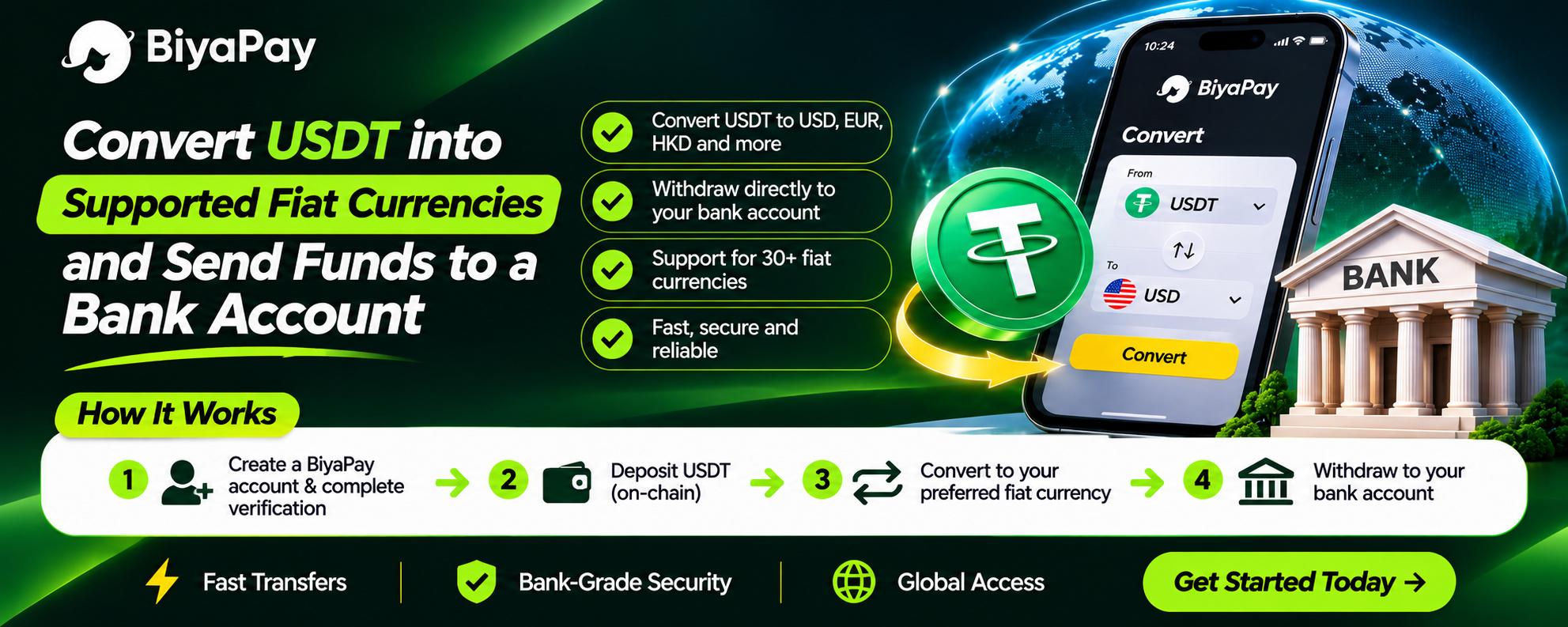
Article
How to Convert USDT into Fiat Currency and Withdraw Money to Your Bank AccountHolding USDT can be useful when you're working with digital assets, but there are times when you need money in a regular bank account.
Maybe you're paying for school fees, supporting family, covering everyday expenses, or moving funds for a personal transaction. In those situations, keeping your money in a crypto wallet may not be enough. You need a way to convert your digital assets into a supported fiat currency and send the funds to a bank account.
This is where crypto-to-fiat conversion and international remittance services become useful.
BiyaPay offers a process that connects USDT deposits, fiat conversion and bank withdrawals within one platform. Here's how the process works and what you should check before making a transfer.
Why convert USDT into fiat currency?
USDT is a stablecoin designed to track the value of the US dollar. People use it to hold digital value, move funds between platforms and manage crypto transactions.
However, most everyday expenses are still paid through traditional banking systems. A landlord, school, supplier or family member may need to receive money in a local or bank-supported currency rather than USDT.
Converting USDT into fiat gives you another way to access your funds.
For someone handling international payments, the ability to convert into currencies such as USD, EUR, HKD and other supported currencies can also make cross-border transactions more practical.
The important thing is to confirm that the currency and receiving bank account are supported for your particular transfer.
How BiyaPay handles USDT-to-fiat transfers
BiyaPay brings digital asset deposits and fiat remittance together. Its website currently advertises support for more than 30 fiat currencies, while the available transfer routes and receiving options depend on the destination.
The general process involves completing identity verification, depositing USDT, converting the funds and withdrawing the fiat balance to an approved bank account.
Step-by-step: Convert USDT and withdraw to a bank account
1. Create an account and complete identity verification
Start by registering on BiyaPay and completing the required identity verification.
You may need to provide personal information and documents to confirm your identity. The platform also requires an eligible bank account to be linked and approved before making a bank withdrawal.
Make sure the bank account details are accurate and that the account belongs to you. BiyaPay's terms require users to use bank accounts they legally own or control.
2. Link your bank account
Open your profile or the remittance section and follow the instructions to add your bank account.
Check the supported countries, bank details and available payment methods. Different destinations may have different requirements, so don't assume that a bank account can receive every currency or transfer type.
3. Deposit USDT
From the app's home screen, select Deposit, then choose On-chain Deposit.
Select USDT and follow the instructions to obtain the deposit address.
Before sending anything, check the wallet address and blockchain network carefully. The network selected for the withdrawal from your external wallet must match the network supported by the deposit address.
A wrong address or network can result in lost funds. If you're using the service for the first time, consider starting with a small test transaction.
4. Convert USDT into fiat currency
Once your USDT deposit is credited, open the conversion feature.
BiyaPay's describes converting USDT into USD through the Convert section. Its wider remittance service also advertises support for additional fiat currencies.
Check the available currency options and the exchange quote before confirming. The amount you receive can depend on the conversion rate, applicable charges and the selected transfer route.
Don't rely on an old exchange-rate screenshot or assume that every currency has the same conversion conditions.
5. Withdraw the fiat balance to your bank account
After conversion, proceed to the withdrawal or remittance section and select your linked, approved bank account.
Review the recipient details, currency, transfer amount, fees and estimated arrival time. If everything is correct, complete the required confirmation or security verification.
Keep the transaction reference or confirmation details so you can follow up if the receiving bank takes longer than expected.
The final cost may also depend on the payment route and any charges applied by third-party financial institutions.
Processing time can vary too. BiyaPay says some eligible transfers may arrive on the same working day, while other routes can take longer. The destination country, currency, payment method, bank operating hours, weekends, public holidays and receiving-bank reviews can all affect the timing.
So, before confirming a transfer, focus on the amount the recipient is expected to receive, the total fee and the estimated arrival window.
A few things to check before sending
- Confirm that your country, destination and receiving bank are supported.
- Make sure your identity verification is complete.
- Use a bank account you own or are authorised to operate.
- Double-check the USDT deposit address and blockchain network.
- Review the conversion quote and withdrawal fee.
- Check the estimated arrival time and any bank-side charges.
- Keep your transaction confirmation for reference.
Final thoughts
Converting USDT into fiat can make digital assets more useful for everyday financial needs, especially when you need to move money into a traditional bank account.
BiyaPay provides a route for users to deposit USDT, convert it into supported fiat currencies and withdraw funds through eligible bank transfer options. The process is worth exploring if you're looking for a way to connect your crypto balance with traditional payments.
Still, take a moment to check the available currency, bank support, exchange quote, fees and processing time before confirming. Those details matter just as much as the conversion itself.
Disclaimer: This article is for informational and promotional purposes only and does not constitute financial, investment, tax or legal advice. Digital asset deposits, currency conversions and bank transfers involve risks. Supported currencies, countries, banks, fees, exchange rates and processing times may change or vary by transaction. Transfers may be delayed, rejected or subject to additional checks by financial institutions. Always review BiyaPay's current terms and transaction details, and comply with the laws and requirements applicable in your location.
#BiyaPay #USDT #CryptoToFiat #CryptoPayments #CrossBorderPayments #Stablecoins #DigitalAssets
How to Convert USDT into Fiat Currency and Withdraw Money to Your Bank Account
Holding USDT can be useful when you're working with digital assets, but there are times when you need money in a regular bank account.
Maybe you're paying for school fees, supporting family, covering everyday expenses, or moving funds for a personal transaction. In those situations, keeping your money in a crypto wallet may not be enough. You need a way to convert your digital assets into a supported fiat currency and send the funds to a bank account.
This is where crypto-to-fiat conversion and international remittance services become useful.
BiyaPay offers a process that connects USDT deposits, fiat conversion and bank withdrawals within one platform. Here's how the process works and what you should check before making a transfer.
Why convert USDT into fiat currency?
USDT is a stablecoin designed to track the value of the US dollar. People use it to hold digital value, move funds between platforms and manage crypto transactions.
However, most everyday expenses are still paid through traditional banking systems. A landlord, school, supplier or family member may need to receive money in a local or bank-supported currency rather than USDT.
Converting USDT into fiat gives you another way to access your funds.
For someone handling international payments, the ability to convert into currencies such as USD, EUR, HKD and other supported currencies can also make cross-border transactions more practical.
The important thing is to confirm that the currency and receiving bank account are supported for your particular transfer.
How BiyaPay handles USDT-to-fiat transfers
BiyaPay brings digital asset deposits and fiat remittance together. Its website currently advertises support for more than 30 fiat currencies, while the available transfer routes and receiving options depend on the destination.
The general process involves completing identity verification, depositing USDT, converting the funds and withdrawing the fiat balance to an approved bank account.
Step-by-step: Convert USDT and withdraw to a bank account
1. Create an account and complete identity verification
Start by registering on BiyaPay and completing the required identity verification.
You may need to provide personal information and documents to confirm your identity. The platform also requires an eligible bank account to be linked and approved before making a bank withdrawal.
Make sure the bank account details are accurate and that the account belongs to you. BiyaPay's terms require users to use bank accounts they legally own or control.
2. Link your bank account
Open your profile or the remittance section and follow the instructions to add your bank account.
Check the supported countries, bank details and available payment methods. Different destinations may have different requirements, so don't assume that a bank account can receive every currency or transfer type.
3. Deposit USDT
From the app's home screen, select Deposit, then choose On-chain Deposit.
Select USDT and follow the instructions to obtain the deposit address.
Before sending anything, check the wallet address and blockchain network carefully. The network selected for the withdrawal from your external wallet must match the network supported by the deposit address.
A wrong address or network can result in lost funds. If you're using the service for the first time, consider starting with a small test transaction.
4. Convert USDT into fiat currency
Once your USDT deposit is credited, open the conversion feature.
BiyaPay's describes converting USDT into USD through the Convert section. Its wider remittance service also advertises support for additional fiat currencies.
Check the available currency options and the exchange quote before confirming. The amount you receive can depend on the conversion rate, applicable charges and the selected transfer route.
Don't rely on an old exchange-rate screenshot or assume that every currency has the same conversion conditions.
5. Withdraw the fiat balance to your bank account
After conversion, proceed to the withdrawal or remittance section and select your linked, approved bank account.
Review the recipient details, currency, transfer amount, fees and estimated arrival time. If everything is correct, complete the required confirmation or security verification.
Keep the transaction reference or confirmation details so you can follow up if the receiving bank takes longer than expected.
The final cost may also depend on the payment route and any charges applied by third-party financial institutions.
Processing time can vary too. BiyaPay says some eligible transfers may arrive on the same working day, while other routes can take longer. The destination country, currency, payment method, bank operating hours, weekends, public holidays and receiving-bank reviews can all affect the timing.
So, before confirming a transfer, focus on the amount the recipient is expected to receive, the total fee and the estimated arrival window.
A few things to check before sending
- Confirm that your country, destination and receiving bank are supported.
- Make sure your identity verification is complete.
- Use a bank account you own or are authorised to operate.
- Double-check the USDT deposit address and blockchain network.
- Review the conversion quote and withdrawal fee.
- Check the estimated arrival time and any bank-side charges.
- Keep your transaction confirmation for reference.
Final thoughts
Converting USDT into fiat can make digital assets more useful for everyday financial needs, especially when you need to move money into a traditional bank account.
BiyaPay provides a route for users to deposit USDT, convert it into supported fiat currencies and withdraw funds through eligible bank transfer options. The process is worth exploring if you're looking for a way to connect your crypto balance with traditional payments.
Still, take a moment to check the available currency, bank support, exchange quote, fees and processing time before confirming. Those details matter just as much as the conversion itself.
Disclaimer: This article is for informational and promotional purposes only and does not constitute financial, investment, tax or legal advice. Digital asset deposits, currency conversions and bank transfers involve risks. Supported currencies, countries, banks, fees, exchange rates and processing times may change or vary by transaction. Transfers may be delayed, rejected or subject to additional checks by financial institutions. Always review BiyaPay's current terms and transaction details, and comply with the laws and requirements applicable in your location.
#BiyaPay #USDT #CryptoToFiat #CryptoPayments #CrossBorderPayments #Stablecoins #DigitalAssets
1
141
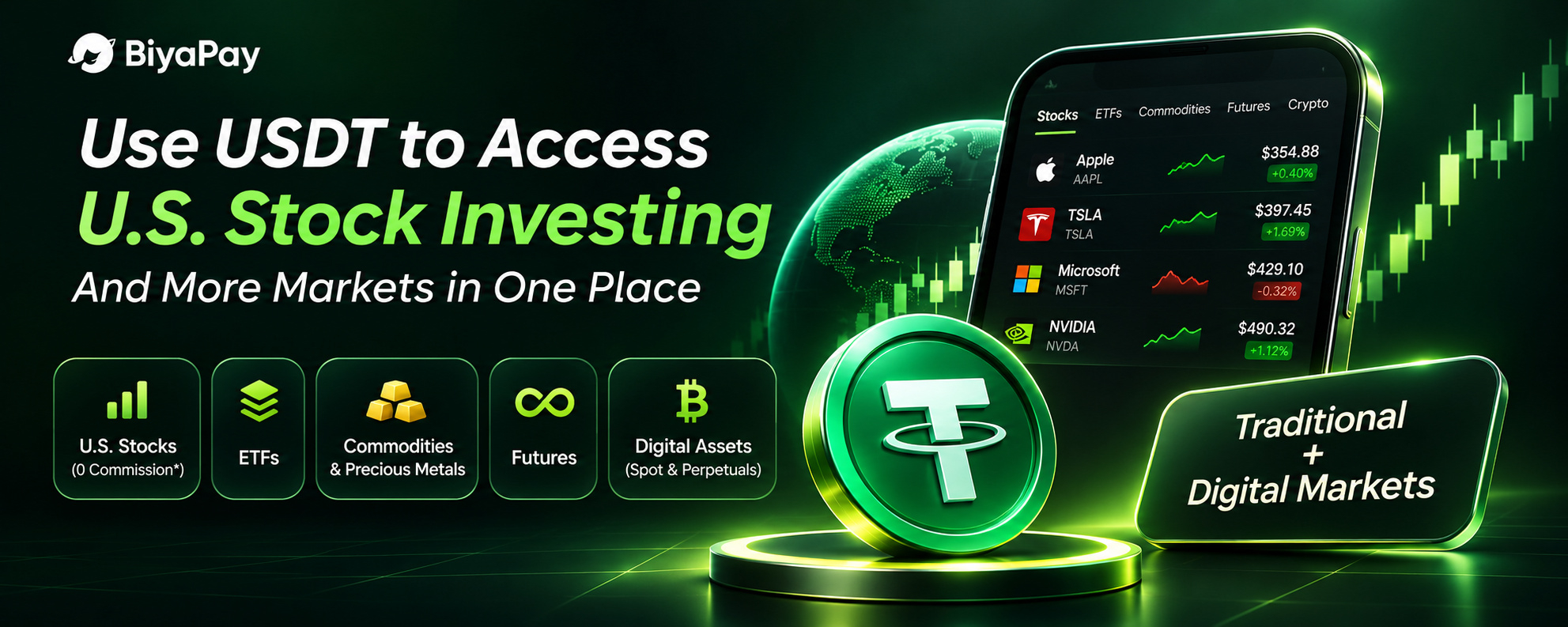
Article
Holding USDT? Here's How One Platform Connects U.S. Stocks, ETFs and Digital Asset Trading.A person holding USDT may have more than one financial goal.
They might want exposure to established U.S. companies, explore ETFs, follow commodity markets or trade digital assets. The challenge is finding a practical way to access these different markets without constantly moving between separate platforms and funding systems.
This raises an interesting question: can someone use their existing USDT balance to access traditional financial markets while still having access to cryptocurrency trading?
BiyaPay is one platform exploring this combination. Its services bring together U.S. and Hong Kong stocks, ETFs, commodities, forex and digital asset markets.
But before looking at the features, it's worth understanding what this combination actually means for someone managing their money.
The problem with managing different markets separately
Traditional investing and digital asset trading often operate through different financial systems.
Someone interested in U.S. stocks may need a brokerage account, an accepted funding method and a way to convert their money into the required currency.
Meanwhile, someone trading cryptocurrencies may already have USDT in a digital asset account.
Moving between these systems can introduce extra steps. There may be currency conversion costs, transfer charges, account requirements and different settlement arrangements.
This becomes particularly relevant for people outside the United States who want to explore U.S. markets while holding digital assets.
Having USDT available doesn't automatically give someone access to every traditional investment product. The funding route, account eligibility and supported instruments still matter.
Using USDT to access U.S. stocks
One of the features advertised by BiyaPay is the ability to fund its investment services using digital assets.
According to its official stock service information, the general process involves:
1. Registering for an account.
2. Completing identity verification.
3. Depositing fiat currency or supported digital assets.
4. Converting USDT into USD or HKD where required.
5. Transferring funds into the relevant investment account and trading.
The platform advertises zero commission for U.S. stock trading and describes its stock service as providing access to real stocks, ownership and dividends.
This can be relevant to investors who already hold USDT and want another funding route for accessing U.S. equities.
However, zero commission should be understood as a specific fee category. Other charges may still apply, including platform fees, external institution fees, regulatory charges, currency conversion costs or transfer fees.
The actual costs should be checked against the current fee schedule and order confirmation before trading.
Traditional markets extend beyond individual stocks
Another interesting part of the platform is the range of traditional market categories displayed on its investment interface.
These include:
ETFs: Exchange-traded funds provide exposure to baskets of securities or specific market segments. Depending on the fund, this could include broad market indexes, fixed income or particular sectors.
Commodities: Commodity-linked markets provide exposure to assets such as gold, silver and crude oil. These instruments can behave differently from individual company shares.
Precious metals: Gold and silver are commonly followed by investors interested in commodity markets and alternative asset exposure. Before trading, it's important to understand whether the product represents a fund, a commodity-linked instrument or another type of contract.
Futures: Futures markets allow traders to take positions based on the expected future price of an underlying asset. They involve additional risks and may require margin.
The availability of these categories gives users a wider range of markets to explore. However, the specific instruments, trading conditions and access requirements should always be checked inside the platform.
Digital asset trading remains part of the picture
Traditional financial products are only one side of this combination.
BiyaPay also displays cryptocurrency spot and perpetual markets.
Spot trading involves buying or selling an asset at the prevailing market price, with the transaction settled according to the platform's rules.
Perpetual contracts are different. They allow traders to speculate on price movements without holding the underlying asset in the same way as a spot purchase. They can also involve leverage and funding payments.
The distinction matters because the risks are not the same.
BiyaPay's published spot fee information currently lists a zero maker fee and a 0.08% taker fee. Some individual perpetual contract pages advertise zero maker fees. These figures should not be treated as a universal zero-fee guarantee across every trading pair or product. Check the applicable fee schedule before placing an order.
Leveraged perpetual trading can lead to rapid losses, including liquidation of a position. It requires a clear understanding of margin, funding rates and position risk.
What about regulation and settlement?
This is an area where investors should take their time.
A platform offering access to financial products does not automatically mean every product is covered by the same regulatory framework.
The same disclosure describes the U.S. Broker-Dealer licence application as being pursued. That wording should not be confused with confirmation that the entity already holds a Broker-Dealer licence.
Investors should verify the legal entity providing the service, its current regulatory status, the applicable custody arrangements and the protections available for the specific product they intend to use.
Settlement also deserves attention. A platform may advertise fast or instant settlement, but the actual process depends on the instrument, order execution, market arrangements and any third-party institutions involved.
A zero-commission headline or a fast-settlement description should never replace a review of the actual trading and transfer terms.
Why this combination matters
The interesting development here is the possibility of managing exposure to traditional financial markets and digital assets through a connected platform.
For someone holding USDT, that could mean having a route to explore eligible U.S. stocks and ETFs while also accessing supported cryptocurrency markets.
BiyaPay is positioning its platform around this combination of traditional finance and digital asset trading.
Still, having multiple markets available does not mean every product is suitable for every investor. Stocks, ETFs, commodities, futures and perpetual contracts have different structures, costs and risk profiles.
The sensible approach is to understand the instrument first, confirm that it's available to your account, review its fees and check how deposits, withdrawals and settlement work.
Final thoughts
The relationship between traditional finance and digital assets continues to evolve.
For people who already hold USDT, platforms connecting these markets offer another route to explore. BiyaPay is one example, bringing together access to U.S. and Hong Kong stocks, ETFs, commodities, forex and cryptocurrency trading.
The real value of this kind of setup depends on the products available to you, the total cost of using them and the protections attached to each service.
Before moving funds, read the relevant terms and verify the details for the specific market you plan to access.
Disclaimer: This article is for educational purposes only and does not constitute investment, legal or financial advice. It is not a recommendation to buy, sell or hold any asset. All financial products involve risk, including the possible loss of capital. Futures and leveraged perpetual contracts carry additional risks. Product availability, fees, regulatory status and settlement arrangements may vary. Verify current information through official sources before making any financial decision.
#BiyaPay #USDT #USStocks #TradFi #DeFi #ETFInvesting #CommodityTrading #PreciousMetals #CryptoTrading #DigitalAssets #PerpetualTrading #BinanceSquare
Holding USDT? Here's How One Platform Connects U.S. Stocks, ETFs and Digital Asset Trading.
A person holding USDT may have more than one financial goal.
They might want exposure to established U.S. companies, explore ETFs, follow commodity markets or trade digital assets. The challenge is finding a practical way to access these different markets without constantly moving between separate platforms and funding systems.
This raises an interesting question: can someone use their existing USDT balance to access traditional financial markets while still having access to cryptocurrency trading?
BiyaPay is one platform exploring this combination. Its services bring together U.S. and Hong Kong stocks, ETFs, commodities, forex and digital asset markets.
But before looking at the features, it's worth understanding what this combination actually means for someone managing their money.
The problem with managing different markets separately
Traditional investing and digital asset trading often operate through different financial systems.
Someone interested in U.S. stocks may need a brokerage account, an accepted funding method and a way to convert their money into the required currency.
Meanwhile, someone trading cryptocurrencies may already have USDT in a digital asset account.
Moving between these systems can introduce extra steps. There may be currency conversion costs, transfer charges, account requirements and different settlement arrangements.
This becomes particularly relevant for people outside the United States who want to explore U.S. markets while holding digital assets.
Having USDT available doesn't automatically give someone access to every traditional investment product. The funding route, account eligibility and supported instruments still matter.
Using USDT to access U.S. stocks
One of the features advertised by BiyaPay is the ability to fund its investment services using digital assets.
According to its official stock service information, the general process involves:
1. Registering for an account.
2. Completing identity verification.
3. Depositing fiat currency or supported digital assets.
4. Converting USDT into USD or HKD where required.
5. Transferring funds into the relevant investment account and trading.
The platform advertises zero commission for U.S. stock trading and describes its stock service as providing access to real stocks, ownership and dividends.
This can be relevant to investors who already hold USDT and want another funding route for accessing U.S. equities.
However, zero commission should be understood as a specific fee category. Other charges may still apply, including platform fees, external institution fees, regulatory charges, currency conversion costs or transfer fees.
The actual costs should be checked against the current fee schedule and order confirmation before trading.
Traditional markets extend beyond individual stocks
Another interesting part of the platform is the range of traditional market categories displayed on its investment interface.
These include:
ETFs: Exchange-traded funds provide exposure to baskets of securities or specific market segments. Depending on the fund, this could include broad market indexes, fixed income or particular sectors.
Commodities: Commodity-linked markets provide exposure to assets such as gold, silver and crude oil. These instruments can behave differently from individual company shares.
Precious metals: Gold and silver are commonly followed by investors interested in commodity markets and alternative asset exposure. Before trading, it's important to understand whether the product represents a fund, a commodity-linked instrument or another type of contract.
Futures: Futures markets allow traders to take positions based on the expected future price of an underlying asset. They involve additional risks and may require margin.
The availability of these categories gives users a wider range of markets to explore. However, the specific instruments, trading conditions and access requirements should always be checked inside the platform.
Digital asset trading remains part of the picture
Traditional financial products are only one side of this combination.
BiyaPay also displays cryptocurrency spot and perpetual markets.
Spot trading involves buying or selling an asset at the prevailing market price, with the transaction settled according to the platform's rules.
Perpetual contracts are different. They allow traders to speculate on price movements without holding the underlying asset in the same way as a spot purchase. They can also involve leverage and funding payments.
The distinction matters because the risks are not the same.
BiyaPay's published spot fee information currently lists a zero maker fee and a 0.08% taker fee. Some individual perpetual contract pages advertise zero maker fees. These figures should not be treated as a universal zero-fee guarantee across every trading pair or product. Check the applicable fee schedule before placing an order.
Leveraged perpetual trading can lead to rapid losses, including liquidation of a position. It requires a clear understanding of margin, funding rates and position risk.
What about regulation and settlement?
This is an area where investors should take their time.
A platform offering access to financial products does not automatically mean every product is covered by the same regulatory framework.
The same disclosure describes the U.S. Broker-Dealer licence application as being pursued. That wording should not be confused with confirmation that the entity already holds a Broker-Dealer licence.
Investors should verify the legal entity providing the service, its current regulatory status, the applicable custody arrangements and the protections available for the specific product they intend to use.
Settlement also deserves attention. A platform may advertise fast or instant settlement, but the actual process depends on the instrument, order execution, market arrangements and any third-party institutions involved.
A zero-commission headline or a fast-settlement description should never replace a review of the actual trading and transfer terms.
Why this combination matters
The interesting development here is the possibility of managing exposure to traditional financial markets and digital assets through a connected platform.
For someone holding USDT, that could mean having a route to explore eligible U.S. stocks and ETFs while also accessing supported cryptocurrency markets.
BiyaPay is positioning its platform around this combination of traditional finance and digital asset trading.
Still, having multiple markets available does not mean every product is suitable for every investor. Stocks, ETFs, commodities, futures and perpetual contracts have different structures, costs and risk profiles.
The sensible approach is to understand the instrument first, confirm that it's available to your account, review its fees and check how deposits, withdrawals and settlement work.
Final thoughts
The relationship between traditional finance and digital assets continues to evolve.
For people who already hold USDT, platforms connecting these markets offer another route to explore. BiyaPay is one example, bringing together access to U.S. and Hong Kong stocks, ETFs, commodities, forex and cryptocurrency trading.
The real value of this kind of setup depends on the products available to you, the total cost of using them and the protections attached to each service.
Before moving funds, read the relevant terms and verify the details for the specific market you plan to access.
Disclaimer: This article is for educational purposes only and does not constitute investment, legal or financial advice. It is not a recommendation to buy, sell or hold any asset. All financial products involve risk, including the possible loss of capital. Futures and leveraged perpetual contracts carry additional risks. Product availability, fees, regulatory status and settlement arrangements may vary. Verify current information through official sources before making any financial decision.
#BiyaPay #USDT #USStocks #TradFi #DeFi #ETFInvesting #CommodityTrading #PreciousMetals #CryptoTrading #DigitalAssets #PerpetualTrading #BinanceSquare
1
202
Article
Have USDT and an Online Subscription to Pay For? Here’s What to Check Before Using a Virtual CardPaying for an online subscription can become frustrating when the service requires an international payment card.
Maybe you need a tool for work, an AI subscription for content creation, cloud storage for your files, or a streaming service you use every month. You have USDT available, but the payment page asks for card details.
That leaves you with a practical question: how can you use the digital assets you already hold to pay for an online service?
Virtual payment cards are one option worth understanding. However, before funding one, there are a few things you should check. A card that works for one online purchase may not necessarily work for every subscription.
Start with the actual payment problem
Online subscriptions often require more than having enough money in your account.
The merchant may check the card type, billing country, currency, payment address and other details before approving a transaction. Some services also have restrictions on which cards they accept.
This can create a problem for people who hold USDT but don't have a conventional card that works with the subscription they want.
Using a virtual card funded through a digital asset platform may offer another payment route. But it's important to understand how the card works before relying on it for recurring payments.
Understand how a USDT-funded virtual card works
A virtual payment card provides card details that can be entered on websites and supported online payment platforms. It doesn't require a physical card to make an online payment.
With a USDT-funded card, the general idea is that you use your digital asset balance to fund the card or its associated payment balance. The platform handles the conversion into the currency used for spending, according to its current payment process.
Paying for Everyday Online Services with Digital Assets
Online payments have become part of everyday life, from streaming subscriptions and software tools to international shopping and gaming services. For people who hold USDT, finding practical ways to use their digital assets for these payments can be an important consideration.
BiyaPay's EasyCard offers a virtual payment option that supports converting digital currencies, including USDT, into fiat currency for payments.
This opens up potential uses across subscription services, online shopping and game payments. It can be particularly useful for people who want to connect their digital asset holdings with everyday online spending.
However, payment acceptance can vary between merchants and services, so it's worth checking whether a particular platform supports the card before relying on it for a payment..
What should you check before applying?
This is where I would slow down and pay attention. Before moving any USDT, consider the following.
1. Check whether the card is available to you
Don't assume that a payment card is available in every country simply because the provider describes it as a global payment product.
Check the application page and the current card terms for your country or region. Confirm that you can complete the required identity verification and that the card range currently offered to your account is available for use.
For users in Nigeria, this is particularly important. Check the current eligibility information in your own account and make sure your intended use complies with applicable local requirements.
If the application page does not clearly confirm your eligibility, contact the provider before funding anything.
2. Confirm that your subscription accepts the card
Make a distinction between a platform being listed as a supported use case and your particular subscription payment being approved.
For example, a virtual card may be intended for online software or AI subscriptions, but the merchant can still apply its own payment rules.
Check the payment methods accepted by the subscription provider. Pay attention to its billing-country requirements, currency and any restrictions on prepaid or virtual cards.
If you're unsure, ask the merchant or card provider for clarification before relying on the card for an important subscription.
3. Understand all the fees
The amount you spend on a subscription may not be the only cost involved.
Depending on the provider's current terms, you may need to account for card issuance, funding, currency conversion or transaction charges.
For example, imagine a subscription costs $20 per month. You should check how much USDT is required to fund the card with enough USD to cover that payment, including any applicable charges.
Don't calculate the cost using an assumed one-to-one USDT-to-USD conversion. Review the actual conversion quote and fee information displayed before confirming.
Also check whether a failed payment or refund could involve additional charges.
4. Check the card's current status and terms
Card availability and card number ranges can change when a provider's upstream payment arrangements change.
This is worth checking rather than relying on old tutorials, screenshots or recommendations from other users.
BiyaPay published an announcement on October 23, 2026, stating that EasyCards beginning with 400, 436 and 472 had been discontinued following upstream bank adjustments. The announcement said affected balances and corresponding top-up fees had been refunded to users' Funding Accounts.
This is a useful reminder to check the current card options displayed in your account before applying. An older card tutorial may no longer describe the available options.
5. Plan for automatic subscription renewals
Subscriptions often renew automatically.
If your card balance is insufficient when the next billing date arrives, the payment may fail. Depending on the merchant's policy, your subscription could be interrupted or you may need to update your payment method.
Keep track of renewal dates and maintain enough available balance for the upcoming charge, including any applicable fees.
If you no longer need a subscription, review the merchant's cancellation process. Removing a card from a payment page may not automatically cancel the subscription itself.
6. Protect your card details
A virtual card still contains sensitive payment information.
Avoid sharing your full card number, expiry date, security code or account credentials in public posts, screenshots or private messages with strangers.
Only access the provider through its verified official website or application. Be cautious of people offering to activate cards, process payments or solve account problems in exchange for your login details.
If you notice an unfamiliar transaction, contact the provider through its official support channels.
Using USDT for Everyday Online Payments
For people who already hold USDT, finding practical ways to use their digital assets for online purchases and subscriptions can be useful.
BiyaPay EasyCard provides a virtual payment option that allows users to convert supported digital currencies, including USDT, into fiat currency for online payments.
This gives users another way to put their digital assets to use when paying for eligible online services, depending on merchant acceptance and applicable card requirements.
Its official materials mention subscription-related use cases, including services in streaming, software and AI tools.
The important part is to check the current application instructions, available card range, fees and merchant compatibility before making a decision.
My take
If you already hold USDT and regularly pay for online subscriptions, understanding how a virtual card works could help you assess another way to manage those payments.
But I wouldn't move a large amount of USDT into any card before checking the details.
Start by confirming eligibility, reviewing the full cost, checking whether your intended merchant accepts the card and understanding how recurring payments work. If everything checks out, you can decide whether the option makes sense for your needs.
The goal is to make an informed payment decision and avoid unexpected charges or interrupted subscriptions.
Disclaimer: This article is for educational and informational purposes only. It is not financial, legal or payment advice. Card availability, eligibility, supported merchants, fees and payment conditions may change. A listed merchant or use case does not guarantee successful payment. Always review the provider's current terms, confirm local eligibility and check the subscription merchant's payment requirements before funding a card.
#BiyaPay #EasyCard #USDT #VirtualCard #OnlineSubscriptions #CryptoPayments #DigitalPayments #CryptoEducation
Have USDT and an Online Subscription to Pay For? Here’s What to Check Before Using a Virtual Card
Paying for an online subscription can become frustrating when the service requires an international payment card.
Maybe you need a tool for work, an AI subscription for content creation, cloud storage for your files, or a streaming service you use every month. You have USDT available, but the payment page asks for card details.
That leaves you with a practical question: how can you use the digital assets you already hold to pay for an online service?
Virtual payment cards are one option worth understanding. However, before funding one, there are a few things you should check. A card that works for one online purchase may not necessarily work for every subscription.
Start with the actual payment problem
Online subscriptions often require more than having enough money in your account.
The merchant may check the card type, billing country, currency, payment address and other details before approving a transaction. Some services also have restrictions on which cards they accept.
This can create a problem for people who hold USDT but don't have a conventional card that works with the subscription they want.
Using a virtual card funded through a digital asset platform may offer another payment route. But it's important to understand how the card works before relying on it for recurring payments.
Understand how a USDT-funded virtual card works
A virtual payment card provides card details that can be entered on websites and supported online payment platforms. It doesn't require a physical card to make an online payment.
With a USDT-funded card, the general idea is that you use your digital asset balance to fund the card or its associated payment balance. The platform handles the conversion into the currency used for spending, according to its current payment process.
Paying for Everyday Online Services with Digital Assets
Online payments have become part of everyday life, from streaming subscriptions and software tools to international shopping and gaming services. For people who hold USDT, finding practical ways to use their digital assets for these payments can be an important consideration.
BiyaPay's EasyCard offers a virtual payment option that supports converting digital currencies, including USDT, into fiat currency for payments.
This opens up potential uses across subscription services, online shopping and game payments. It can be particularly useful for people who want to connect their digital asset holdings with everyday online spending.
However, payment acceptance can vary between merchants and services, so it's worth checking whether a particular platform supports the card before relying on it for a payment..
What should you check before applying?
This is where I would slow down and pay attention. Before moving any USDT, consider the following.
1. Check whether the card is available to you
Don't assume that a payment card is available in every country simply because the provider describes it as a global payment product.
Check the application page and the current card terms for your country or region. Confirm that you can complete the required identity verification and that the card range currently offered to your account is available for use.
For users in Nigeria, this is particularly important. Check the current eligibility information in your own account and make sure your intended use complies with applicable local requirements.
If the application page does not clearly confirm your eligibility, contact the provider before funding anything.
2. Confirm that your subscription accepts the card
Make a distinction between a platform being listed as a supported use case and your particular subscription payment being approved.
For example, a virtual card may be intended for online software or AI subscriptions, but the merchant can still apply its own payment rules.
Check the payment methods accepted by the subscription provider. Pay attention to its billing-country requirements, currency and any restrictions on prepaid or virtual cards.
If you're unsure, ask the merchant or card provider for clarification before relying on the card for an important subscription.
3. Understand all the fees
The amount you spend on a subscription may not be the only cost involved.
Depending on the provider's current terms, you may need to account for card issuance, funding, currency conversion or transaction charges.
For example, imagine a subscription costs $20 per month. You should check how much USDT is required to fund the card with enough USD to cover that payment, including any applicable charges.
Don't calculate the cost using an assumed one-to-one USDT-to-USD conversion. Review the actual conversion quote and fee information displayed before confirming.
Also check whether a failed payment or refund could involve additional charges.
4. Check the card's current status and terms
Card availability and card number ranges can change when a provider's upstream payment arrangements change.
This is worth checking rather than relying on old tutorials, screenshots or recommendations from other users.
BiyaPay published an announcement on October 23, 2026, stating that EasyCards beginning with 400, 436 and 472 had been discontinued following upstream bank adjustments. The announcement said affected balances and corresponding top-up fees had been refunded to users' Funding Accounts.
This is a useful reminder to check the current card options displayed in your account before applying. An older card tutorial may no longer describe the available options.
5. Plan for automatic subscription renewals
Subscriptions often renew automatically.
If your card balance is insufficient when the next billing date arrives, the payment may fail. Depending on the merchant's policy, your subscription could be interrupted or you may need to update your payment method.
Keep track of renewal dates and maintain enough available balance for the upcoming charge, including any applicable fees.
If you no longer need a subscription, review the merchant's cancellation process. Removing a card from a payment page may not automatically cancel the subscription itself.
6. Protect your card details
A virtual card still contains sensitive payment information.
Avoid sharing your full card number, expiry date, security code or account credentials in public posts, screenshots or private messages with strangers.
Only access the provider through its verified official website or application. Be cautious of people offering to activate cards, process payments or solve account problems in exchange for your login details.
If you notice an unfamiliar transaction, contact the provider through its official support channels.
Using USDT for Everyday Online Payments
For people who already hold USDT, finding practical ways to use their digital assets for online purchases and subscriptions can be useful.
BiyaPay EasyCard provides a virtual payment option that allows users to convert supported digital currencies, including USDT, into fiat currency for online payments.
This gives users another way to put their digital assets to use when paying for eligible online services, depending on merchant acceptance and applicable card requirements.
Its official materials mention subscription-related use cases, including services in streaming, software and AI tools.
The important part is to check the current application instructions, available card range, fees and merchant compatibility before making a decision.
My take
If you already hold USDT and regularly pay for online subscriptions, understanding how a virtual card works could help you assess another way to manage those payments.
But I wouldn't move a large amount of USDT into any card before checking the details.
Start by confirming eligibility, reviewing the full cost, checking whether your intended merchant accepts the card and understanding how recurring payments work. If everything checks out, you can decide whether the option makes sense for your needs.
The goal is to make an informed payment decision and avoid unexpected charges or interrupted subscriptions.
Disclaimer: This article is for educational and informational purposes only. It is not financial, legal or payment advice. Card availability, eligibility, supported merchants, fees and payment conditions may change. A listed merchant or use case does not guarantee successful payment. Always review the provider's current terms, confirm local eligibility and check the subscription merchant's payment requirements before funding a card.
#BiyaPay #EasyCard #USDT #VirtualCard #OnlineSubscriptions #CryptoPayments #DigitalPayments #CryptoEducation
1
85
Article
From Digital Dollars to Wall Street: A Different Way to Approach U.S. StocksThe U.S. stock market attracts investors interested in companies like Apple, Microsoft, Amazon and Nvidia.
For crypto holders, exploring these companies can raise an interesting possibility: using digital assets to access traditional stock markets.
But before placing a stock order, there's one important question to consider: how can USDT be used to fund a U.S. stock investment?
This is where understanding the funding process becomes important.
With BiyaPay, the process involves moving through different account stages. Your USDT first enters your Funding Account. It is then converted into USD, and the resulting dollar balance is transferred to your Stock Account.
Each stage has a separate purpose. Here's how the process works.
1. Start by setting up your BiyaPay account
Before funding anything, you'll need to register on BiyaPay and complete the required identity verification.
This is an important first step because depositing digital assets and accessing stock trading are separate activities. Having a funded account does not automatically mean every investment service or market is available to you.
Make sure your account has completed the required verification and that you can access the stock services relevant to your location and account status.
It's also worth checking the current requirements before sending funds, especially if this is your first time using the platform.
2. Deposit USDT into your Funding Account
Once your account is ready, the next step is to deposit USDT.
Your Funding Account is where the assets you deposit are received and held before you use them for another purpose on the platform.
When making an on-chain deposit, pay attention to the deposit instructions displayed in your account.
Check the following before confirming the transaction:
- The receiving address.
- The supported blockchain network.
- The asset selected is USDT.
- Any minimum deposit requirement or additional instruction shown.
For example, USDT sent through one network should not be assumed to be compatible with a deposit address configured for another network.
Always match the network selected on the sending platform with the network supported by BiyaPay's deposit instructions. Sending funds to an incorrect address or through an unsupported network can result in delays or loss of access to those funds.
After submitting the transfer, wait for the deposit to be credited to your Funding Account. Check the balance and transaction status before moving to the next stage.
3. Convert USDT into USD
This is where the funding process changes from digital assets to fiat currency.
USDT and USD are different assets, even though USDT is designed to maintain a value close to one U.S. dollar.
To use the funds for the stock account transfer described by BiyaPay, the deposited USDT needs to be converted into USD first.
In simple terms, you're exchanging the USDT balance in your Funding Account for a USD balance.
Before confirming the conversion, review the exchange quote and the amount of USD you are expected to receive. Also check any applicable fees or deductions displayed during the transaction.
For example, if you deposit 1,000 USDT, don't automatically assume that the amount available after conversion will be exactly 1,000 USD. The actual result should be based on the quote and applicable charges shown to you at the time.
Once the conversion is completed, check that the USD has appeared in your Funding Account.
4. Transfer the USD into your Stock Account
This is the step that connects the converted funds to your stock trading balance.
BiyaPay's Help Center explains that when users deposit cryptocurrency, they first need to convert it into fiat currency such as USD or HKD. The fiat balance can then be transferred from the Funding Account to the U.S. or Hong Kong stock account.
The process is straightforward:
Open the Assets section, go to the Stock page and select the transfer option. From there, follow the instructions to move the USD balance from your Funding Account into your Stock Account.
Before confirming, carefully review the transfer direction, currency and amount.
Why does this matter?
Because having USD in your Funding Account is not the same as having USD available in your Stock Account.
The Funding Account holds the money before the transfer. The Stock Account is where the funds are placed for eligible stock trading.
After completing the transfer, check the Stock Account balance and confirm that the funds have arrived and are available for the intended transaction.
5. Check your available balance before placing a stock order
Once the USD reaches your Stock Account, you can move on to the trading stage, subject to your account permissions and the platform's requirements.
You can research the stocks available on the platform, review their prices and decide whether a particular investment fits your plans.
However, don't rush straight into an order just because the balance is showing.
Check the available cash, the stock's current price, the estimated order value and any applicable trading charges. Also review the order type and market conditions before confirming.
Remember that stock prices move. The price you see while researching may differ from the final execution price. And if you're buying shares for the first time, take time to understand the product you're purchasing, including the rights attached to it and any relevant trading or custody conditions..
Why the Funding Process Has Separate Stages
It may seem like several steps for one transaction, but each stage serves a different purpose.
Your USDT deposit brings digital assets into the platform. Conversion changes those assets into USD. The internal transfer then moves the dollar balance into the account used for stock trading.
Keeping these stages separate makes it easier to understand where your money is at any point in the process.
It also helps when checking a balance or investigating a delayed transaction. If the USDT has arrived but the USD conversion hasn't been completed, the issue is at the conversion stage. If the USD is already in your Funding Account but hasn't reached your Stock Account, you need to check the internal transfer.
That distinction can save a lot of confusion.
A Few Things to Check Before Funding
Before starting, take a moment to confirm:
- Your account has completed the required identity verification.
- USDT and your selected deposit network are supported by the current deposit instructions.
- You have reviewed the conversion quote and applicable charges.
- You understand how to transfer USD from the Funding Account to the Stock Account.
- Your account is eligible to access the stock service and the market you intend to trade.
- You have checked the stock's price, order requirements and associated risks.
Availability, account permissions, processing conditions and fees can vary. Always rely on the information displayed in your own account and the current platform terms rather than assuming every user will have identical options.
Final Thoughts
Holding USDT can give you another starting point for accessing U.S. stocks, provided you use a supported funding route.
With BiyaPay, the process described in its Help Center follows a clear sequence: deposit USDT into your Funding Account, convert it into USD, transfer the USD into your Stock Account, and then check your available balance before trading.
Understanding these steps before sending funds helps you know what to expect and where to check if something doesn't go as planned.
If you're considering using USDT to fund stock trading, take the time to review the instructions and costs at every stage. A little preparation can make the process easier to follow.
Disclaimer: This article is for educational and informational purposes only. It does not constitute financial or investment advice or a recommendation to buy or sell any security. Investing in stocks involves risk, including the possible loss of capital. Product availability, account eligibility, fees and processing conditions may vary. Always verify the latest information through BiyaPay's official platform and conduct your own research before making financial decisions.
#BiyaPay #USDT #USStocks #StockTrading #CryptoToFiat #BinanceSquare #InvestingBasics #CryptoEducation
From Digital Dollars to Wall Street: A Different Way to Approach U.S. Stocks
The U.S. stock market attracts investors interested in companies like Apple, Microsoft, Amazon and Nvidia.
For crypto holders, exploring these companies can raise an interesting possibility: using digital assets to access traditional stock markets.
But before placing a stock order, there's one important question to consider: how can USDT be used to fund a U.S. stock investment?
This is where understanding the funding process becomes important.
With BiyaPay, the process involves moving through different account stages. Your USDT first enters your Funding Account. It is then converted into USD, and the resulting dollar balance is transferred to your Stock Account.
Each stage has a separate purpose. Here's how the process works.
1. Start by setting up your BiyaPay account
Before funding anything, you'll need to register on BiyaPay and complete the required identity verification.
This is an important first step because depositing digital assets and accessing stock trading are separate activities. Having a funded account does not automatically mean every investment service or market is available to you.
Make sure your account has completed the required verification and that you can access the stock services relevant to your location and account status.
It's also worth checking the current requirements before sending funds, especially if this is your first time using the platform.
2. Deposit USDT into your Funding Account
Once your account is ready, the next step is to deposit USDT.
Your Funding Account is where the assets you deposit are received and held before you use them for another purpose on the platform.
When making an on-chain deposit, pay attention to the deposit instructions displayed in your account.
Check the following before confirming the transaction:
- The receiving address.
- The supported blockchain network.
- The asset selected is USDT.
- Any minimum deposit requirement or additional instruction shown.
For example, USDT sent through one network should not be assumed to be compatible with a deposit address configured for another network.
Always match the network selected on the sending platform with the network supported by BiyaPay's deposit instructions. Sending funds to an incorrect address or through an unsupported network can result in delays or loss of access to those funds.
After submitting the transfer, wait for the deposit to be credited to your Funding Account. Check the balance and transaction status before moving to the next stage.
3. Convert USDT into USD
This is where the funding process changes from digital assets to fiat currency.
USDT and USD are different assets, even though USDT is designed to maintain a value close to one U.S. dollar.
To use the funds for the stock account transfer described by BiyaPay, the deposited USDT needs to be converted into USD first.
In simple terms, you're exchanging the USDT balance in your Funding Account for a USD balance.
Before confirming the conversion, review the exchange quote and the amount of USD you are expected to receive. Also check any applicable fees or deductions displayed during the transaction.
For example, if you deposit 1,000 USDT, don't automatically assume that the amount available after conversion will be exactly 1,000 USD. The actual result should be based on the quote and applicable charges shown to you at the time.
Once the conversion is completed, check that the USD has appeared in your Funding Account.
4. Transfer the USD into your Stock Account
This is the step that connects the converted funds to your stock trading balance.
BiyaPay's Help Center explains that when users deposit cryptocurrency, they first need to convert it into fiat currency such as USD or HKD. The fiat balance can then be transferred from the Funding Account to the U.S. or Hong Kong stock account.
The process is straightforward:
Open the Assets section, go to the Stock page and select the transfer option. From there, follow the instructions to move the USD balance from your Funding Account into your Stock Account.
Before confirming, carefully review the transfer direction, currency and amount.
Why does this matter?
Because having USD in your Funding Account is not the same as having USD available in your Stock Account.
The Funding Account holds the money before the transfer. The Stock Account is where the funds are placed for eligible stock trading.
After completing the transfer, check the Stock Account balance and confirm that the funds have arrived and are available for the intended transaction.
5. Check your available balance before placing a stock order
Once the USD reaches your Stock Account, you can move on to the trading stage, subject to your account permissions and the platform's requirements.
You can research the stocks available on the platform, review their prices and decide whether a particular investment fits your plans.
However, don't rush straight into an order just because the balance is showing.
Check the available cash, the stock's current price, the estimated order value and any applicable trading charges. Also review the order type and market conditions before confirming.
Remember that stock prices move. The price you see while researching may differ from the final execution price. And if you're buying shares for the first time, take time to understand the product you're purchasing, including the rights attached to it and any relevant trading or custody conditions..
Why the Funding Process Has Separate Stages
It may seem like several steps for one transaction, but each stage serves a different purpose.
Your USDT deposit brings digital assets into the platform. Conversion changes those assets into USD. The internal transfer then moves the dollar balance into the account used for stock trading.
Keeping these stages separate makes it easier to understand where your money is at any point in the process.
It also helps when checking a balance or investigating a delayed transaction. If the USDT has arrived but the USD conversion hasn't been completed, the issue is at the conversion stage. If the USD is already in your Funding Account but hasn't reached your Stock Account, you need to check the internal transfer.
That distinction can save a lot of confusion.
A Few Things to Check Before Funding
Before starting, take a moment to confirm:
- Your account has completed the required identity verification.
- USDT and your selected deposit network are supported by the current deposit instructions.
- You have reviewed the conversion quote and applicable charges.
- You understand how to transfer USD from the Funding Account to the Stock Account.
- Your account is eligible to access the stock service and the market you intend to trade.
- You have checked the stock's price, order requirements and associated risks.
Availability, account permissions, processing conditions and fees can vary. Always rely on the information displayed in your own account and the current platform terms rather than assuming every user will have identical options.
Final Thoughts
Holding USDT can give you another starting point for accessing U.S. stocks, provided you use a supported funding route.
With BiyaPay, the process described in its Help Center follows a clear sequence: deposit USDT into your Funding Account, convert it into USD, transfer the USD into your Stock Account, and then check your available balance before trading.
Understanding these steps before sending funds helps you know what to expect and where to check if something doesn't go as planned.
If you're considering using USDT to fund stock trading, take the time to review the instructions and costs at every stage. A little preparation can make the process easier to follow.
Disclaimer: This article is for educational and informational purposes only. It does not constitute financial or investment advice or a recommendation to buy or sell any security. Investing in stocks involves risk, including the possible loss of capital. Product availability, account eligibility, fees and processing conditions may vary. Always verify the latest information through BiyaPay's official platform and conduct your own research before making financial decisions.
#BiyaPay #USDT #USStocks #StockTrading #CryptoToFiat #BinanceSquare #InvestingBasics #CryptoEducation
1
148
Article
A Portfolio Can Hold Many Assets and Still Lack Diversification: What Global Investors Should UndersA portfolio can contain ten different assets and still depend heavily on the same market forces.
Think about someone holding several technology stocks, a technology-focused ETF and a cryptocurrency whose price often reacts to broader risk sentiment. The portfolio may look diversified on the surface, but a major shift in market sentiment could affect several positions at once.
This is one of the easiest mistakes to make when investing across different asset classes: counting the number of investments instead of understanding what drives them.
As access to global markets becomes more convenient, investors need to pay closer attention to how their holdings interact.
Different assets don't always mean different risks
Diversification is often explained as spreading money across different investments. That's a useful starting point, but the relationship between those investments matters just as much.
For example, holding Apple, Microsoft and an ETF with significant exposure to large technology companies may give an investor three different investment positions. However, their performance can still be influenced by similar factors, including technology-sector sentiment, interest-rate expectations and corporate earnings.
The same issue can appear across asset classes.
Cryptocurrencies, equities and commodities have different market structures and price drivers. Yet during periods of heightened uncertainty, several markets can experience pressure at the same time.
This is why simply adding more assets doesn't automatically reduce portfolio risk.
A better question is: what economic or market conditions could affect several of my holdings simultaneously?
Look beyond the asset name
When reviewing a portfolio, I think it's useful to examine the factors behind each investment.
Consider these examples:
Interest rates: Changes in interest-rate expectations can influence equity valuations, currency movements and demand for certain assets.
Economic growth: Slower economic activity can affect company earnings, commodity demand and investor confidence.
Market sentiment: During periods of uncertainty, investors may reduce exposure to assets they consider risky. This can create pressure across different markets.
Currency movements: International investors also need to consider the currency in which an asset is priced and the currency they use to measure their overall portfolio.
These relationships don't mean different assets will always move together. They simply show why understanding the underlying exposure is more useful than looking at an asset list alone.
A practical way to review your market exposure
You don't need a complicated financial model to start asking better questions about your investments.
Begin by grouping your holdings according to what influences them.
For instance, an investor following U.S. stocks, Hong Kong stocks and cryptocurrencies could review:
- Which positions are concentrated in the same industry?
- How much exposure depends on technology-sector performance?
- Which assets are sensitive to interest-rate changes?
- How much of the portfolio is exposed to cryptocurrency volatility?
- Are currency movements likely to affect the value of the holdings?
The purpose is to identify possible overlaps before they become obvious during a market downturn.
It also helps to distinguish between long-term investments and short-term trading positions. A stock held because of a company's long-term prospects carries a different investment rationale from a leveraged perpetual contract opened to benefit from a short-term price movement.
Both may appear on the same platform, but they shouldn't be evaluated in the same way.
Why access to different markets matters
Investors who follow global markets often work with several types of financial instruments.
Someone interested in U.S. equities may also monitor Hong Kong-listed companies, cryptocurrency markets or other financial products. Each category offers a different way to participate in market activity, with its own trading arrangements and risks.
BiyaPay brings several of these categories together. Its platform provides access to U.S. stocks, Hong Kong stocks, cryptocurrency spot and contract products, alongside other supported markets.
It also supports USDT-based access to selected stock markets, subject to product availability and account eligibility.
This gives users a platform where they can explore different market categories without having to treat every asset as part of the same investment strategy.
For example, an investor researching a U.S. technology company can also monitor cryptocurrency markets and selected Hong Kong stocks within the BiyaPay market environment. Having access to these categories can make it easier to observe different markets, although it doesn't remove the need for separate research and risk assessment.
The important distinction is that access and diversification are two different things. A platform can make multiple markets available, but the investor still has to decide how much exposure to take and whether those positions make sense together.
Don't overlook the risks of derivatives
Another important consideration is the difference between owning an asset and trading a contract linked to its price.
A spot stock position, a cryptocurrency holding and a perpetual futures contract do not carry identical risks.
With leveraged contracts, relatively small price movements can have a significant effect on account equity. Adverse movements may trigger liquidation, depending on the contract's margin requirements and platform rules.
BiyaPay also provides cryptocurrency contract products, including perpetual trading. These instruments may appeal to experienced traders who understand derivatives, but leverage can increase losses as well as potential gains.
Before entering any contract, users should understand the underlying asset, leverage, margin requirements, funding arrangements and liquidation conditions.
A broader range of available products should never be mistaken for a reason to trade more frequently or take on additional risk.
The real value of a portfolio review
A portfolio review should go beyond asking which asset performed best this month.
It should examine whether the original reason for holding each position remains valid, whether exposure has become too concentrated and whether market conditions have changed.
An asset that performed well can gradually become a larger part of a portfolio than intended. Several investments that appeared unrelated can also become more exposed to the same economic factor over time.
Regular reviews help investors notice these changes instead of relying entirely on past performance.
Final thoughts
Global investing gives people access to a wider range of opportunities, but a wider selection of assets also creates more decisions to manage.
For me, the most useful measure of diversification is not how many tickers appear in a portfolio. It's how well I understand the risks behind each position and how those risks may interact.
Platforms such as BiyaPay make it possible to explore different financial markets within one environment. The responsibility of building a sensible portfolio, however, still comes down to research, allocation and understanding the products being traded.
More market access can expand your choices. Understanding your exposure helps you use those choices more carefully.
Disclaimer: This article is for educational purposes only and does not constitute investment, financial, legal or tax advice. Stocks, cryptocurrencies and derivatives involve risk, including the possible loss of capital. Product availability, fees and eligibility may vary by jurisdiction. Always review the applicable product terms and conduct your own research before making investment decisions.
#BiyaPay #PortfolioDiversification #GlobalInvesting #CryptoMarkets #RiskManagement
A Portfolio Can Hold Many Assets and Still Lack Diversification: What Global Investors Should Unders
A portfolio can contain ten different assets and still depend heavily on the same market forces.
Think about someone holding several technology stocks, a technology-focused ETF and a cryptocurrency whose price often reacts to broader risk sentiment. The portfolio may look diversified on the surface, but a major shift in market sentiment could affect several positions at once.
This is one of the easiest mistakes to make when investing across different asset classes: counting the number of investments instead of understanding what drives them.
As access to global markets becomes more convenient, investors need to pay closer attention to how their holdings interact.
Different assets don't always mean different risks
Diversification is often explained as spreading money across different investments. That's a useful starting point, but the relationship between those investments matters just as much.
For example, holding Apple, Microsoft and an ETF with significant exposure to large technology companies may give an investor three different investment positions. However, their performance can still be influenced by similar factors, including technology-sector sentiment, interest-rate expectations and corporate earnings.
The same issue can appear across asset classes.
Cryptocurrencies, equities and commodities have different market structures and price drivers. Yet during periods of heightened uncertainty, several markets can experience pressure at the same time.
This is why simply adding more assets doesn't automatically reduce portfolio risk.
A better question is: what economic or market conditions could affect several of my holdings simultaneously?
Look beyond the asset name
When reviewing a portfolio, I think it's useful to examine the factors behind each investment.
Consider these examples:
Interest rates: Changes in interest-rate expectations can influence equity valuations, currency movements and demand for certain assets.
Economic growth: Slower economic activity can affect company earnings, commodity demand and investor confidence.
Market sentiment: During periods of uncertainty, investors may reduce exposure to assets they consider risky. This can create pressure across different markets.
Currency movements: International investors also need to consider the currency in which an asset is priced and the currency they use to measure their overall portfolio.
These relationships don't mean different assets will always move together. They simply show why understanding the underlying exposure is more useful than looking at an asset list alone.
A practical way to review your market exposure
You don't need a complicated financial model to start asking better questions about your investments.
Begin by grouping your holdings according to what influences them.
For instance, an investor following U.S. stocks, Hong Kong stocks and cryptocurrencies could review:
- Which positions are concentrated in the same industry?
- How much exposure depends on technology-sector performance?
- Which assets are sensitive to interest-rate changes?
- How much of the portfolio is exposed to cryptocurrency volatility?
- Are currency movements likely to affect the value of the holdings?
The purpose is to identify possible overlaps before they become obvious during a market downturn.
It also helps to distinguish between long-term investments and short-term trading positions. A stock held because of a company's long-term prospects carries a different investment rationale from a leveraged perpetual contract opened to benefit from a short-term price movement.
Both may appear on the same platform, but they shouldn't be evaluated in the same way.
Why access to different markets matters
Investors who follow global markets often work with several types of financial instruments.
Someone interested in U.S. equities may also monitor Hong Kong-listed companies, cryptocurrency markets or other financial products. Each category offers a different way to participate in market activity, with its own trading arrangements and risks.
BiyaPay brings several of these categories together. Its platform provides access to U.S. stocks, Hong Kong stocks, cryptocurrency spot and contract products, alongside other supported markets.
It also supports USDT-based access to selected stock markets, subject to product availability and account eligibility.
This gives users a platform where they can explore different market categories without having to treat every asset as part of the same investment strategy.
For example, an investor researching a U.S. technology company can also monitor cryptocurrency markets and selected Hong Kong stocks within the BiyaPay market environment. Having access to these categories can make it easier to observe different markets, although it doesn't remove the need for separate research and risk assessment.
The important distinction is that access and diversification are two different things. A platform can make multiple markets available, but the investor still has to decide how much exposure to take and whether those positions make sense together.
Don't overlook the risks of derivatives
Another important consideration is the difference between owning an asset and trading a contract linked to its price.
A spot stock position, a cryptocurrency holding and a perpetual futures contract do not carry identical risks.
With leveraged contracts, relatively small price movements can have a significant effect on account equity. Adverse movements may trigger liquidation, depending on the contract's margin requirements and platform rules.
BiyaPay also provides cryptocurrency contract products, including perpetual trading. These instruments may appeal to experienced traders who understand derivatives, but leverage can increase losses as well as potential gains.
Before entering any contract, users should understand the underlying asset, leverage, margin requirements, funding arrangements and liquidation conditions.
A broader range of available products should never be mistaken for a reason to trade more frequently or take on additional risk.
The real value of a portfolio review
A portfolio review should go beyond asking which asset performed best this month.
It should examine whether the original reason for holding each position remains valid, whether exposure has become too concentrated and whether market conditions have changed.
An asset that performed well can gradually become a larger part of a portfolio than intended. Several investments that appeared unrelated can also become more exposed to the same economic factor over time.
Regular reviews help investors notice these changes instead of relying entirely on past performance.
Final thoughts
Global investing gives people access to a wider range of opportunities, but a wider selection of assets also creates more decisions to manage.
For me, the most useful measure of diversification is not how many tickers appear in a portfolio. It's how well I understand the risks behind each position and how those risks may interact.
Platforms such as BiyaPay make it possible to explore different financial markets within one environment. The responsibility of building a sensible portfolio, however, still comes down to research, allocation and understanding the products being traded.
More market access can expand your choices. Understanding your exposure helps you use those choices more carefully.
Disclaimer: This article is for educational purposes only and does not constitute investment, financial, legal or tax advice. Stocks, cryptocurrencies and derivatives involve risk, including the possible loss of capital. Product availability, fees and eligibility may vary by jurisdiction. Always review the applicable product terms and conduct your own research before making investment decisions.
#BiyaPay #PortfolioDiversification #GlobalInvesting #CryptoMarkets #RiskManagement
1
271
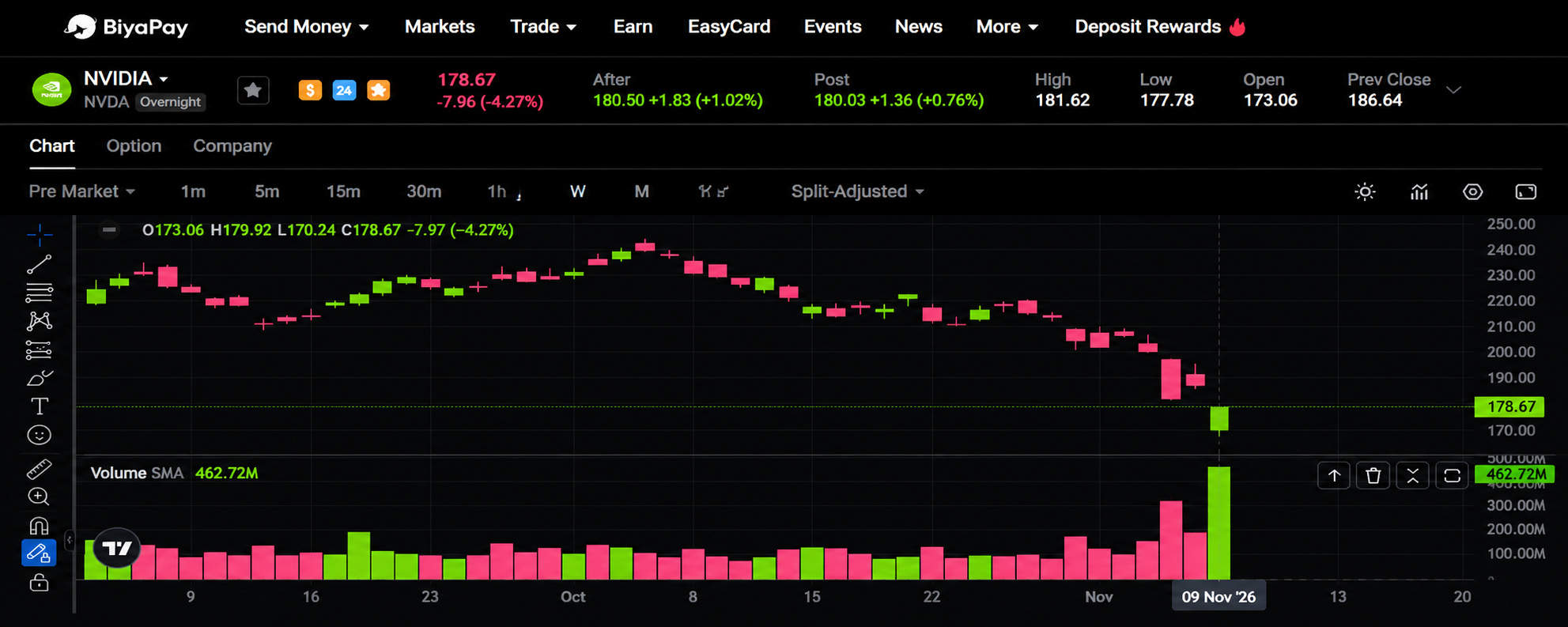
Article
Nvidia's Jensen Huang Controversy: Should Investors Be Worried About NVDA Stock or Focus on Its FundNvidia has become one of the most important companies in the artificial intelligence industry. Its chips power data centres, support AI development and sit at the centre of a global technology race.
But recently, the company found itself facing an unusual challenge.
Its founder and CEO, Jensen Huang, acknowledged having an affair in a message to employees dated November 8, 2026. He apologised to his family and colleagues and accepted responsibility for his actions.
Around the same time, Nvidia's board announced an independent investigation following reports that Huang had been targeted by a foreign intelligence effort. The board said it had no reason to believe that national security or Nvidia's confidential information had been compromised, but confirmed that it would examine the available information.
These developments have put Nvidia under a different kind of spotlight, and investors are asking an important question:
Does this controversy change the investment case for Nvidia, or is the market reacting to uncertainty surrounding its leadership?
What Happened and Why Does It Matter?
There are two separate issues investors need to understand.
First, Huang publicly acknowledged his personal conduct and apologised. This is a confirmed statement from the CEO himself.
Second, reports raised concerns about whether he had been targeted by a foreign intelligence operation. Nvidia's board responded by establishing an independent investigation led by independent directors with assistance from outside legal counsel.
The underlying intelligence allegations remain subject to investigation. They should not be presented as established facts.
Why does this matter to investors?
Nvidia is a company with significant exposure to the global semiconductor industry, where business relationships, technology security and international trade policies carry considerable importance.
Any development that raises questions about leadership, corporate governance or national security can influence how investors assess the company's risks.
However, the existence of an investigation does not automatically mean that Nvidia's business operations have been compromised.
Is Nvidia's Business Actually Changing?
This is where I think investors need to look beyond the headlines.
Nvidia's investment case has largely been built around demand for AI computing infrastructure.
Companies are investing heavily in data centres, advanced processors and the computing resources needed to develop and operate AI systems.
Nvidia has positioned itself as a major supplier in this market through its GPUs, networking technology and software ecosystem.
The important question is whether the recent controversy changes these business fundamentals.
For now, the public information does not establish that Nvidia's AI-chip demand has weakened because of Huang's personal controversy.
Investors should continue monitoring the factors that directly influence the company's financial performance:
AI infrastructure demand: Are cloud providers and other major customers continuing to invest in Nvidia's computing products?
Revenue and earnings: Is Nvidia maintaining its growth trajectory, and are its margins holding up?
Export restrictions: Could additional restrictions affect the company's ability to sell advanced chips into important international markets?
Customer confidence: Are major business partners maintaining their relationships and purchasing commitments?
These factors provide a more useful picture of Nvidia's long-term prospects than headlines alone.
Why NVDA Investors Are Watching Leadership Risk
Although business fundamentals remain important, leadership cannot be ignored.
Jensen Huang has been closely associated with Nvidia's growth and strategic direction. His public presence and leadership have played a major role in shaping the company's identity.
That creates a question about leadership continuity.
If the investigation produces findings that affect Huang's position, investors may have to consider how a leadership transition would influence the company.
There are several possible developments worth watching:
- The findings and recommendations of the independent investigation.
- Whether Huang continues leading the company without changes to his responsibilities.
- Whether Nvidia's board strengthens its governance and oversight arrangements.
- Whether the situation creates additional regulatory or national security scrutiny.
At this stage, there is no confirmed announcement that Huang is stepping down.
Investors should avoid pricing in a leadership departure as though it has already happened.
What Does the Market Reaction Tell Us?
The market's initial response showed that investors were paying attention.
At 5:15 a.m. ET on November 9, 2026, NVDA was reported down 4.4% in premarket trading.
That figure represents a specific premarket observation, not Nvidia's closing performance for the day.
The decline suggests that uncertainty surrounding the CEO and the investigation had become an immediate concern for market participants.
However, a short-term stock decline does not establish that the company's long-term earnings outlook has deteriorated.
There is an important difference between a change in a company's financial prospects and a change in the price investors are willing to pay for those prospects.
For example, if Nvidia continues reporting strong revenue growth but investors become less comfortable with its leadership risk, its valuation could come under pressure even without an immediate deterioration in earnings.
That distinction is worth remembering when evaluating NVDA.
Exploring Nvidia Stock Exposure Through BiyaPay
For investors following Nvidia (NVDA), understanding its stock performance is one part of staying informed. Access to the stock market is another consideration, especially for those looking to add individual companies to their investment portfolios.
BiyaPay provides access to supported U.S. and Hong Kong stocks, including Nvidia. Its stock-trading service advertises real stock ownership, dividend access and zero stock-trading commission.
This gives eligible users another avenue to access Nvidia shares through the platform, subject to the applicable trading requirements.
For those interested in derivatives, BiyaPay also lists NVDAUSDT perpetual futures, which provide a different way to gain exposure to Nvidia's price movements. Unlike owning shares, perpetual futures involve leveraged trading risks and do not represent ownership of the underlying stock..
These are different financial products, and investors should understand the distinction before choosing between them.
Buying NVDA shares: This provides exposure to the actual stock, with the associated ownership rights applicable to the shares purchased.
Trading NVDAUSDT perpetuals: This provides derivative exposure to Nvidia's price movements using USDT as the settlement asset. It does not give the trader ownership of Nvidia shares or shareholder voting rights.
BiyaPay's NVDAUSDT product page displays up to 10x leverage and a zero-fee trading offer. Users should check the live contract specifications, funding arrangements, margin requirements and applicable promotional conditions before opening a position.
Zero trading commission also does not mean that every possible trading cost is eliminated.
For someone following Nvidia's developments, these products offer different ways to approach the stock depending on their investment objectives and understanding of the risks.
So, Should You Hold, Reduce or Wait?
I wouldn't make that decision based on the controversy alone.
An existing NVDA shareholder may reasonably choose to hold while monitoring the investigation and the company's financial performance.
Another investor may decide to reduce exposure because the additional governance and geopolitical uncertainty no longer fits their risk tolerance.
Someone considering an initial investment may prefer to wait for more information before committing capital.
All three approaches can be reasonable depending on individual circumstances.
Personally, I would pay closer attention to Nvidia's next earnings results, customer demand, export-related developments and the findings of the independent investigation.
Those developments will provide a clearer basis for evaluating whether the controversy has lasting consequences for the company.
Final Thoughts
Nvidia's current situation is a reminder that investing in a company involves looking beyond its products and market position.
Leadership, corporate governance and geopolitical exposure can all influence how investors value a business.
But separating confirmed information from speculation is equally important.
Jensen Huang has acknowledged his personal conduct. Nvidia's board has confirmed an independent investigation into reported foreign intelligence concerns. What the investigation will ultimately establish remains to be seen.
For now, Nvidia's AI business and financial performance deserve the same attention as the headlines surrounding its CEO.
If you hold NVDA today, would you maintain your position, reduce your exposure or wait until the investigation produces clearer answers?
Disclaimer: 𝗧𝗵𝗶𝘀 𝗮𝗿𝘁𝗶𝗰𝗹𝗲 𝗶𝘀 𝗳𝗼𝗿 𝗶𝗻𝗳𝗼𝗿𝗺𝗮𝘁𝗶𝗼𝗻𝗮𝗹 𝗮𝗻𝗱 𝗲𝗱𝘂𝗰𝗮𝘁𝗶𝗼𝗻𝗮𝗹 𝗽𝘂𝗿𝗽𝗼𝘀𝗲𝘀 𝗼𝗻𝗹𝘆 𝗮𝗻𝗱 𝘀𝗵𝗼𝘂𝗹𝗱 𝗻𝗼𝘁 𝗯𝗲 𝗰𝗼𝗻𝘀𝗶𝗱𝗲𝗿𝗲𝗱 𝗳𝗶𝗻𝗮𝗻𝗰𝗶𝗮𝗹 𝗼𝗿 𝗶𝗻𝘃𝗲𝘀𝘁𝗺𝗲𝗻𝘁 𝗮𝗱𝘃𝗶𝗰𝗲. 𝗦𝘁𝗼𝗰𝗸 𝗽𝗿𝗶𝗰𝗲𝘀 𝗮𝗻𝗱 𝗺𝗮𝗿𝗸𝗲𝘁 𝗰𝗼𝗻𝗱𝗶𝘁𝗶𝗼𝗻𝘀 𝗰𝗮𝗻 𝗰𝗵𝗮𝗻𝗴𝗲 𝗿𝗮𝗽𝗶𝗱𝗹𝘆. 𝗜𝗻𝘃𝗲𝘀𝘁𝗶𝗻𝗴 𝗶𝗻 𝗡𝗩𝗗𝗔 𝗮𝗻𝗱 𝘁𝗿𝗮𝗱𝗶𝗻𝗴 𝗡𝗩𝗗𝗔𝗨𝗦𝗗𝗧 𝗽𝗲𝗿𝗽𝗲𝘁𝘂𝗮𝗹 𝗰𝗼𝗻𝘁𝗿𝗮𝗰𝘁𝘀 𝗶𝗻𝘃𝗼𝗹𝘃𝗲 𝗿𝗶𝘀𝗸𝘀, 𝗶𝗻𝗰𝗹𝘂𝗱𝗶𝗻𝗴 𝗽𝗼𝘁𝗲𝗻𝘁𝗶𝗮𝗹 𝗹𝗼𝘀𝘀 𝗼𝗳 𝗰𝗮𝗽𝗶𝘁𝗮𝗹. 𝗟𝗲𝘃𝗲𝗿𝗮𝗴𝗲𝗱 𝘁𝗿𝗮𝗱𝗶𝗻𝗴 𝗰𝗮𝗿𝗿𝗶𝗲𝘀 𝗮𝗱𝗱𝗶𝘁𝗶𝗼𝗻𝗮𝗹 𝗿𝗶𝘀𝗸𝘀. 𝗔𝗹𝘄𝗮𝘆𝘀 𝗰𝗼𝗻𝗱𝘂𝗰𝘁 𝘆𝗼𝘂𝗿 𝗼𝘄𝗻 𝗿𝗲𝘀𝗲𝗮𝗿𝗰𝗵 𝗮𝗻𝗱 𝗮𝘀𝘀𝗲𝘀𝘀 𝘆𝗼𝘂𝗿 𝗿𝗶𝘀𝗸 𝘁𝗼𝗹𝗲𝗿𝗮𝗻𝗰𝗲 𝗯𝗲𝗳𝗼𝗿𝗲 𝗺𝗮𝗸𝗶𝗻𝗴 𝗳𝗶𝗻𝗮𝗻𝗰𝗶𝗮𝗹 𝗱𝗲𝗰𝗶𝘀𝗶𝗼𝗻𝘀. 𝗩𝗲𝗿𝗶𝗳𝘆 𝗕𝗶𝘆𝗮𝗣𝗮𝘆'𝘀 𝗹𝗮𝘁𝗲𝘀𝘁 𝘁𝗿𝗮𝗱𝗶𝗻𝗴 𝗳𝗲𝗲𝘀, 𝗽𝗿𝗼𝗱𝘂𝗰𝘁 𝗮𝘃𝗮𝗶𝗹𝗮𝗯𝗶𝗹𝗶𝘁𝘆 𝗮𝗻𝗱 𝘁𝗲𝗿𝗺𝘀 𝗯𝗲𝗳𝗼𝗿𝗲 𝘂𝘀𝗶𝗻𝗴 𝗶𝘁𝘀 𝘀𝗲𝗿𝘃𝗶𝗰𝗲𝘀.
#BiyaPay #NVIDIA #NVDA #StockMarket #AIInvesting
Nvidia's Jensen Huang Controversy: Should Investors Be Worried About NVDA Stock or Focus on Its Fund
Nvidia has become one of the most important companies in the artificial intelligence industry. Its chips power data centres, support AI development and sit at the centre of a global technology race.
But recently, the company found itself facing an unusual challenge.
Its founder and CEO, Jensen Huang, acknowledged having an affair in a message to employees dated November 8, 2026. He apologised to his family and colleagues and accepted responsibility for his actions.
Around the same time, Nvidia's board announced an independent investigation following reports that Huang had been targeted by a foreign intelligence effort. The board said it had no reason to believe that national security or Nvidia's confidential information had been compromised, but confirmed that it would examine the available information.
These developments have put Nvidia under a different kind of spotlight, and investors are asking an important question:
Does this controversy change the investment case for Nvidia, or is the market reacting to uncertainty surrounding its leadership?
What Happened and Why Does It Matter?
There are two separate issues investors need to understand.
First, Huang publicly acknowledged his personal conduct and apologised. This is a confirmed statement from the CEO himself.
Second, reports raised concerns about whether he had been targeted by a foreign intelligence operation. Nvidia's board responded by establishing an independent investigation led by independent directors with assistance from outside legal counsel.
The underlying intelligence allegations remain subject to investigation. They should not be presented as established facts.
Why does this matter to investors?
Nvidia is a company with significant exposure to the global semiconductor industry, where business relationships, technology security and international trade policies carry considerable importance.
Any development that raises questions about leadership, corporate governance or national security can influence how investors assess the company's risks.
However, the existence of an investigation does not automatically mean that Nvidia's business operations have been compromised.
Is Nvidia's Business Actually Changing?
This is where I think investors need to look beyond the headlines.
Nvidia's investment case has largely been built around demand for AI computing infrastructure.
Companies are investing heavily in data centres, advanced processors and the computing resources needed to develop and operate AI systems.
Nvidia has positioned itself as a major supplier in this market through its GPUs, networking technology and software ecosystem.
The important question is whether the recent controversy changes these business fundamentals.
For now, the public information does not establish that Nvidia's AI-chip demand has weakened because of Huang's personal controversy.
Investors should continue monitoring the factors that directly influence the company's financial performance:
AI infrastructure demand: Are cloud providers and other major customers continuing to invest in Nvidia's computing products?
Revenue and earnings: Is Nvidia maintaining its growth trajectory, and are its margins holding up?
Export restrictions: Could additional restrictions affect the company's ability to sell advanced chips into important international markets?
Customer confidence: Are major business partners maintaining their relationships and purchasing commitments?
These factors provide a more useful picture of Nvidia's long-term prospects than headlines alone.
Why NVDA Investors Are Watching Leadership Risk
Although business fundamentals remain important, leadership cannot be ignored.
Jensen Huang has been closely associated with Nvidia's growth and strategic direction. His public presence and leadership have played a major role in shaping the company's identity.
That creates a question about leadership continuity.
If the investigation produces findings that affect Huang's position, investors may have to consider how a leadership transition would influence the company.
There are several possible developments worth watching:
- The findings and recommendations of the independent investigation.
- Whether Huang continues leading the company without changes to his responsibilities.
- Whether Nvidia's board strengthens its governance and oversight arrangements.
- Whether the situation creates additional regulatory or national security scrutiny.
At this stage, there is no confirmed announcement that Huang is stepping down.
Investors should avoid pricing in a leadership departure as though it has already happened.
What Does the Market Reaction Tell Us?
The market's initial response showed that investors were paying attention.
At 5:15 a.m. ET on November 9, 2026, NVDA was reported down 4.4% in premarket trading.
That figure represents a specific premarket observation, not Nvidia's closing performance for the day.
The decline suggests that uncertainty surrounding the CEO and the investigation had become an immediate concern for market participants.
However, a short-term stock decline does not establish that the company's long-term earnings outlook has deteriorated.
There is an important difference between a change in a company's financial prospects and a change in the price investors are willing to pay for those prospects.
For example, if Nvidia continues reporting strong revenue growth but investors become less comfortable with its leadership risk, its valuation could come under pressure even without an immediate deterioration in earnings.
That distinction is worth remembering when evaluating NVDA.
Exploring Nvidia Stock Exposure Through BiyaPay
For investors following Nvidia (NVDA), understanding its stock performance is one part of staying informed. Access to the stock market is another consideration, especially for those looking to add individual companies to their investment portfolios.
BiyaPay provides access to supported U.S. and Hong Kong stocks, including Nvidia. Its stock-trading service advertises real stock ownership, dividend access and zero stock-trading commission.
This gives eligible users another avenue to access Nvidia shares through the platform, subject to the applicable trading requirements.
For those interested in derivatives, BiyaPay also lists NVDAUSDT perpetual futures, which provide a different way to gain exposure to Nvidia's price movements. Unlike owning shares, perpetual futures involve leveraged trading risks and do not represent ownership of the underlying stock..
These are different financial products, and investors should understand the distinction before choosing between them.
Buying NVDA shares: This provides exposure to the actual stock, with the associated ownership rights applicable to the shares purchased.
Trading NVDAUSDT perpetuals: This provides derivative exposure to Nvidia's price movements using USDT as the settlement asset. It does not give the trader ownership of Nvidia shares or shareholder voting rights.
BiyaPay's NVDAUSDT product page displays up to 10x leverage and a zero-fee trading offer. Users should check the live contract specifications, funding arrangements, margin requirements and applicable promotional conditions before opening a position.
Zero trading commission also does not mean that every possible trading cost is eliminated.
For someone following Nvidia's developments, these products offer different ways to approach the stock depending on their investment objectives and understanding of the risks.
So, Should You Hold, Reduce or Wait?
I wouldn't make that decision based on the controversy alone.
An existing NVDA shareholder may reasonably choose to hold while monitoring the investigation and the company's financial performance.
Another investor may decide to reduce exposure because the additional governance and geopolitical uncertainty no longer fits their risk tolerance.
Someone considering an initial investment may prefer to wait for more information before committing capital.
All three approaches can be reasonable depending on individual circumstances.
Personally, I would pay closer attention to Nvidia's next earnings results, customer demand, export-related developments and the findings of the independent investigation.
Those developments will provide a clearer basis for evaluating whether the controversy has lasting consequences for the company.
Final Thoughts
Nvidia's current situation is a reminder that investing in a company involves looking beyond its products and market position.
Leadership, corporate governance and geopolitical exposure can all influence how investors value a business.
But separating confirmed information from speculation is equally important.
Jensen Huang has acknowledged his personal conduct. Nvidia's board has confirmed an independent investigation into reported foreign intelligence concerns. What the investigation will ultimately establish remains to be seen.
For now, Nvidia's AI business and financial performance deserve the same attention as the headlines surrounding its CEO.
If you hold NVDA today, would you maintain your position, reduce your exposure or wait until the investigation produces clearer answers?
Disclaimer: 𝗧𝗵𝗶𝘀 𝗮𝗿𝘁𝗶𝗰𝗹𝗲 𝗶𝘀 𝗳𝗼𝗿 𝗶𝗻𝗳𝗼𝗿𝗺𝗮𝘁𝗶𝗼𝗻𝗮𝗹 𝗮𝗻𝗱 𝗲𝗱𝘂𝗰𝗮𝘁𝗶𝗼𝗻𝗮𝗹 𝗽𝘂𝗿𝗽𝗼𝘀𝗲𝘀 𝗼𝗻𝗹𝘆 𝗮𝗻𝗱 𝘀𝗵𝗼𝘂𝗹𝗱 𝗻𝗼𝘁 𝗯𝗲 𝗰𝗼𝗻𝘀𝗶𝗱𝗲𝗿𝗲𝗱 𝗳𝗶𝗻𝗮𝗻𝗰𝗶𝗮𝗹 𝗼𝗿 𝗶𝗻𝘃𝗲𝘀𝘁𝗺𝗲𝗻𝘁 𝗮𝗱𝘃𝗶𝗰𝗲. 𝗦𝘁𝗼𝗰𝗸 𝗽𝗿𝗶𝗰𝗲𝘀 𝗮𝗻𝗱 𝗺𝗮𝗿𝗸𝗲𝘁 𝗰𝗼𝗻𝗱𝗶𝘁𝗶𝗼𝗻𝘀 𝗰𝗮𝗻 𝗰𝗵𝗮𝗻𝗴𝗲 𝗿𝗮𝗽𝗶𝗱𝗹𝘆. 𝗜𝗻𝘃𝗲𝘀𝘁𝗶𝗻𝗴 𝗶𝗻 𝗡𝗩𝗗𝗔 𝗮𝗻𝗱 𝘁𝗿𝗮𝗱𝗶𝗻𝗴 𝗡𝗩𝗗𝗔𝗨𝗦𝗗𝗧 𝗽𝗲𝗿𝗽𝗲𝘁𝘂𝗮𝗹 𝗰𝗼𝗻𝘁𝗿𝗮𝗰𝘁𝘀 𝗶𝗻𝘃𝗼𝗹𝘃𝗲 𝗿𝗶𝘀𝗸𝘀, 𝗶𝗻𝗰𝗹𝘂𝗱𝗶𝗻𝗴 𝗽𝗼𝘁𝗲𝗻𝘁𝗶𝗮𝗹 𝗹𝗼𝘀𝘀 𝗼𝗳 𝗰𝗮𝗽𝗶𝘁𝗮𝗹. 𝗟𝗲𝘃𝗲𝗿𝗮𝗴𝗲𝗱 𝘁𝗿𝗮𝗱𝗶𝗻𝗴 𝗰𝗮𝗿𝗿𝗶𝗲𝘀 𝗮𝗱𝗱𝗶𝘁𝗶𝗼𝗻𝗮𝗹 𝗿𝗶𝘀𝗸𝘀. 𝗔𝗹𝘄𝗮𝘆𝘀 𝗰𝗼𝗻𝗱𝘂𝗰𝘁 𝘆𝗼𝘂𝗿 𝗼𝘄𝗻 𝗿𝗲𝘀𝗲𝗮𝗿𝗰𝗵 𝗮𝗻𝗱 𝗮𝘀𝘀𝗲𝘀𝘀 𝘆𝗼𝘂𝗿 𝗿𝗶𝘀𝗸 𝘁𝗼𝗹𝗲𝗿𝗮𝗻𝗰𝗲 𝗯𝗲𝗳𝗼𝗿𝗲 𝗺𝗮𝗸𝗶𝗻𝗴 𝗳𝗶𝗻𝗮𝗻𝗰𝗶𝗮𝗹 𝗱𝗲𝗰𝗶𝘀𝗶𝗼𝗻𝘀. 𝗩𝗲𝗿𝗶𝗳𝘆 𝗕𝗶𝘆𝗮𝗣𝗮𝘆'𝘀 𝗹𝗮𝘁𝗲𝘀𝘁 𝘁𝗿𝗮𝗱𝗶𝗻𝗴 𝗳𝗲𝗲𝘀, 𝗽𝗿𝗼𝗱𝘂𝗰𝘁 𝗮𝘃𝗮𝗶𝗹𝗮𝗯𝗶𝗹𝗶𝘁𝘆 𝗮𝗻𝗱 𝘁𝗲𝗿𝗺𝘀 𝗯𝗲𝗳𝗼𝗿𝗲 𝘂𝘀𝗶𝗻𝗴 𝗶𝘁𝘀 𝘀𝗲𝗿𝘃𝗶𝗰𝗲𝘀.
#BiyaPay #NVIDIA #NVDA #StockMarket #AIInvesting
1
200
Article
Cross-Border Payments: How Crypto Is Changing the Way People Send Money Internationally.Sending money to another country should be a straightforward financial activity. Yet, for many people, international payments can become a frustrating experience.
Imagine you're a freelancer receiving payments from an overseas client, a business owner paying an international supplier, or someone supporting family members living in another country.
You need to move money, but the process can involve several steps before the recipient gets what they're expecting.
There may be bank processing times, currency conversion costs, transfer restrictions and additional verification requirements. Depending on the countries and financial institutions involved, even a simple transaction can take longer than expected.
This raises an important question: Can digital assets make international money transfers more accessible?
Platforms combining cryptocurrency and traditional financial services are exploring ways to address this problem. One example is BiyaPay.
📍Why International Money Transfers Can Be Complicated
Traditional international transfers usually involve multiple financial institutions.
When money moves between countries, the transaction may pass through intermediary banks before reaching the recipient's account. Each institution can have its own processing procedures, requirements and charges.
Currency conversion adds another consideration.
For example, someone sending US dollars to a recipient who needs euros will have to consider the applicable exchange rate and any conversion charges.
Other challenges include:
- Processing delays: Some international bank transfers take several business days, depending on the destination and payment route.
- Transfer fees: Charges can come from the sending bank, intermediary institutions or receiving bank.
- Currency conversion: Exchange rate differences can affect the final amount received.
- Verification requirements: Financial institutions may request additional documents or transaction information.
- Transfer restrictions: Available payment methods and sending limits can differ between countries.
These challenges can be particularly inconvenient for people who regularly deal with international payments.
Connecting Digital Assets with Everyday Financial Needs
Managing digital assets and handling traditional financial transactions can involve different services.
BiyaPay brings these financial activities together through services such as cryptocurrency deposits, fiat currency conversion and international remittances, alongside other financial products.
For users who deal with both digital currencies and traditional payments, having access to these services within one platform can offer a more convenient way to manage different financial needs.
One feature worth examining is its support for USDT.
USDT is a stablecoin designed to maintain a value close to the US dollar. People who already hold USDT can use supported BiyaPay services to convert their digital assets into fiat currencies for eligible international transfers.
This creates another way to manage funds across borders without relying entirely on conventional currency deposit methods.
BiyaPay also supports the conversion of more than 30 fiat currencies, with international transfer coverage advertised across more than 100 countries and regions.
However, supported currencies, deposit methods and transfer routes depend on the particular transaction and destination.
𝗛𝗼𝘄 𝘁𝗼 𝗦𝗲𝗻𝗱 𝗠𝗼𝗻𝗲𝘆 𝗨𝘀𝗶𝗻𝗴 𝗨𝗦𝗗𝗧 𝗼𝗻 𝗕𝗶𝘆𝗮𝗣𝗮𝘆
For someone who already holds USDT, the process involves a few important stages.
1. Create an account and complete verification
Start by registering a BiyaPay account.
Complete the required identity verification before accessing the relevant financial services. Depending on the transaction, you may also need to provide additional personal or banking information.
2. Deposit your USDT
Open the deposit section and select the on-chain deposit option.
Choose USDT and the supported blockchain network. Carefully confirm that the network selected matches the network used by your sending wallet.
Sending assets through an unsupported network or to an incorrect address can result in lost funds.
3. Convert your assets
After the deposit is credited, use the conversion feature to exchange your available assets into the required fiat currency.
BiyaPay supports cryptocurrency-to-fiat and fiat-to-fiat conversion, although available currency pairs may vary.
4. Set up the recipient's details
Add the recipient's bank account or select an existing recipient where supported.
Make sure the banking information is correct before proceeding.
5. Review and confirm the transfer
Check the exchange rate, applicable fees, recipient details and estimated arrival time.
If everything is correct, complete the required security verification and submit the transaction.
The transfer can then be processed through the available payment route.
Understanding BiyaPay's Transfer Fees
Fees are an important part of international payments, and this is something users should examine before confirming a transaction.
BiyaPay publishes different remittance fee tiers for certain USD withdrawals.
For example, its published USD remittance schedule includes:
Transaction amount| Published withdrawal fee
$200–below $2,000| $20
$2,000–below $50,000| 1%
$50,000–below $100,000| 0.90%
$100,000–below $500,000| 0.80%
$500,000–below $1 million| 0.70%
$1 million–below $2 million| 0.60%
$2 million and above| 0.50%
These figures come from BiyaPay's published fee information for USD remittances and withdrawals. They should not be treated as a universal fee schedule for every currency or destination.
The platform also indicates that users can check the applicable remittance fee when linking their bank account on the remittance page.
What Should You Know Before Using It?
While combining crypto and fiat services can offer more flexibility, there are still some things worth considering.
First, identity verification is required. Users should expect to provide the necessary information before accessing relevant services.
Second, USDT deposits are not necessarily available for every sending and receiving route. For example, BiyaPay's published Philippines-to-US transfer information indicates that USDT deposits are not supported for that particular route.
Third, transfer times depend on the destination, payment channel and transaction requirements. Although BiyaPay advertises eligible transfers arriving in as little as five minutes, that should not be interpreted as a guarantee that every transaction will settle within that period.
Finally, users should check the applicable fees, exchange rates, withdrawal requirements and recipient eligibility before sending funds.
Understanding these details can help prevent unnecessary complications.
Is This a Useful Development for Global Payments?
I think the interesting part of this development is the additional flexibility it gives people who already interact with both cryptocurrency and traditional financial systems.
Freelancers can explore alternative ways of managing international earnings. Businesses can examine digital asset conversion for eligible cross-border payments. Individuals can also explore supported routes for sending money to family members abroad.
Of course, the best payment option still depends on the country, amount, fees and the recipient's banking arrangements.
BiyaPay is one platform working in this space by bringing crypto deposits, currency conversion and international remittance services into a single financial application.
The bigger conversation is about making international money movement easier to understand and manage.
As financial services continue to evolve, having more payment options gives people greater flexibility in how they handle their money.
For anyone interested in exploring crypto-supported international transfers, BiyaPay is worth researching. Just make sure you understand the available services and transaction costs before committing your funds.
Disclaimer: This article is for educational and informational purposes only and does not constitute financial or investment advice. Stock investments and perpetual contracts involve risk. Zero trading commission does not mean all transaction costs are eliminated. Always review platform fees, funding charges, leverage and liquidation conditions before trading.
#BiyaPay #CryptoPayments #CrossBorderPayments #USDT #DigitalFinance
Cross-Border Payments: How Crypto Is Changing the Way People Send Money Internationally.
Sending money to another country should be a straightforward financial activity. Yet, for many people, international payments can become a frustrating experience.
Imagine you're a freelancer receiving payments from an overseas client, a business owner paying an international supplier, or someone supporting family members living in another country.
You need to move money, but the process can involve several steps before the recipient gets what they're expecting.
There may be bank processing times, currency conversion costs, transfer restrictions and additional verification requirements. Depending on the countries and financial institutions involved, even a simple transaction can take longer than expected.
This raises an important question: Can digital assets make international money transfers more accessible?
Platforms combining cryptocurrency and traditional financial services are exploring ways to address this problem. One example is BiyaPay.
📍Why International Money Transfers Can Be Complicated
Traditional international transfers usually involve multiple financial institutions.
When money moves between countries, the transaction may pass through intermediary banks before reaching the recipient's account. Each institution can have its own processing procedures, requirements and charges.
Currency conversion adds another consideration.
For example, someone sending US dollars to a recipient who needs euros will have to consider the applicable exchange rate and any conversion charges.
Other challenges include:
- Processing delays: Some international bank transfers take several business days, depending on the destination and payment route.
- Transfer fees: Charges can come from the sending bank, intermediary institutions or receiving bank.
- Currency conversion: Exchange rate differences can affect the final amount received.
- Verification requirements: Financial institutions may request additional documents or transaction information.
- Transfer restrictions: Available payment methods and sending limits can differ between countries.
These challenges can be particularly inconvenient for people who regularly deal with international payments.
Connecting Digital Assets with Everyday Financial Needs
Managing digital assets and handling traditional financial transactions can involve different services.
BiyaPay brings these financial activities together through services such as cryptocurrency deposits, fiat currency conversion and international remittances, alongside other financial products.
For users who deal with both digital currencies and traditional payments, having access to these services within one platform can offer a more convenient way to manage different financial needs.
One feature worth examining is its support for USDT.
USDT is a stablecoin designed to maintain a value close to the US dollar. People who already hold USDT can use supported BiyaPay services to convert their digital assets into fiat currencies for eligible international transfers.
This creates another way to manage funds across borders without relying entirely on conventional currency deposit methods.
BiyaPay also supports the conversion of more than 30 fiat currencies, with international transfer coverage advertised across more than 100 countries and regions.
However, supported currencies, deposit methods and transfer routes depend on the particular transaction and destination.
𝗛𝗼𝘄 𝘁𝗼 𝗦𝗲𝗻𝗱 𝗠𝗼𝗻𝗲𝘆 𝗨𝘀𝗶𝗻𝗴 𝗨𝗦𝗗𝗧 𝗼𝗻 𝗕𝗶𝘆𝗮𝗣𝗮𝘆
For someone who already holds USDT, the process involves a few important stages.
1. Create an account and complete verification
Start by registering a BiyaPay account.
Complete the required identity verification before accessing the relevant financial services. Depending on the transaction, you may also need to provide additional personal or banking information.
2. Deposit your USDT
Open the deposit section and select the on-chain deposit option.
Choose USDT and the supported blockchain network. Carefully confirm that the network selected matches the network used by your sending wallet.
Sending assets through an unsupported network or to an incorrect address can result in lost funds.
3. Convert your assets
After the deposit is credited, use the conversion feature to exchange your available assets into the required fiat currency.
BiyaPay supports cryptocurrency-to-fiat and fiat-to-fiat conversion, although available currency pairs may vary.
4. Set up the recipient's details
Add the recipient's bank account or select an existing recipient where supported.
Make sure the banking information is correct before proceeding.
5. Review and confirm the transfer
Check the exchange rate, applicable fees, recipient details and estimated arrival time.
If everything is correct, complete the required security verification and submit the transaction.
The transfer can then be processed through the available payment route.
Understanding BiyaPay's Transfer Fees
Fees are an important part of international payments, and this is something users should examine before confirming a transaction.
BiyaPay publishes different remittance fee tiers for certain USD withdrawals.
For example, its published USD remittance schedule includes:
Transaction amount| Published withdrawal fee
$200–below $2,000| $20
$2,000–below $50,000| 1%
$50,000–below $100,000| 0.90%
$100,000–below $500,000| 0.80%
$500,000–below $1 million| 0.70%
$1 million–below $2 million| 0.60%
$2 million and above| 0.50%
These figures come from BiyaPay's published fee information for USD remittances and withdrawals. They should not be treated as a universal fee schedule for every currency or destination.
The platform also indicates that users can check the applicable remittance fee when linking their bank account on the remittance page.
What Should You Know Before Using It?
While combining crypto and fiat services can offer more flexibility, there are still some things worth considering.
First, identity verification is required. Users should expect to provide the necessary information before accessing relevant services.
Second, USDT deposits are not necessarily available for every sending and receiving route. For example, BiyaPay's published Philippines-to-US transfer information indicates that USDT deposits are not supported for that particular route.
Third, transfer times depend on the destination, payment channel and transaction requirements. Although BiyaPay advertises eligible transfers arriving in as little as five minutes, that should not be interpreted as a guarantee that every transaction will settle within that period.
Finally, users should check the applicable fees, exchange rates, withdrawal requirements and recipient eligibility before sending funds.
Understanding these details can help prevent unnecessary complications.
Is This a Useful Development for Global Payments?
I think the interesting part of this development is the additional flexibility it gives people who already interact with both cryptocurrency and traditional financial systems.
Freelancers can explore alternative ways of managing international earnings. Businesses can examine digital asset conversion for eligible cross-border payments. Individuals can also explore supported routes for sending money to family members abroad.
Of course, the best payment option still depends on the country, amount, fees and the recipient's banking arrangements.
BiyaPay is one platform working in this space by bringing crypto deposits, currency conversion and international remittance services into a single financial application.
The bigger conversation is about making international money movement easier to understand and manage.
As financial services continue to evolve, having more payment options gives people greater flexibility in how they handle their money.
For anyone interested in exploring crypto-supported international transfers, BiyaPay is worth researching. Just make sure you understand the available services and transaction costs before committing your funds.
Disclaimer: This article is for educational and informational purposes only and does not constitute financial or investment advice. Stock investments and perpetual contracts involve risk. Zero trading commission does not mean all transaction costs are eliminated. Always review platform fees, funding charges, leverage and liquidation conditions before trading.
#BiyaPay #CryptoPayments #CrossBorderPayments #USDT #DigitalFinance
101
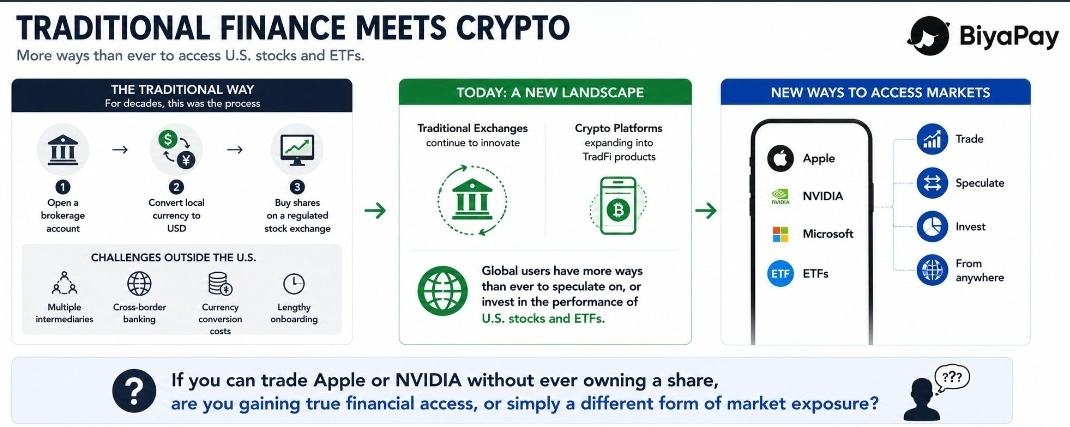
Article
The line between traditional finance (TradFi) and crypto is becoming increasingly blurred.For decades, gaining exposure to companies like 𝗔𝗽𝗽𝗹𝗲, 𝗡𝗩𝗜𝗗𝗜𝗔, 𝗠𝗶𝗰𝗿𝗼𝘀𝗼𝗳𝘁, 𝗼𝗿 𝗽𝗼𝗽𝘂𝗹𝗮𝗿 𝗘𝗧𝗙𝘀 usually meant:
☞ Opening a brokerage account
☞ Converting your local currency into U.S. dollars
☞ Purchasing shares through a regulated stock exchange.
For many people outside the United States, that process could involve:
☞ multiple intermediaries
☞ cross-border banking requirements
☞ currency conversion costs
☞ lengthy onboarding.
Today, the landscape looks very different.
Traditional exchanges continue to innovate, while crypto platforms are expanding beyond digital assets into products linked to traditional financial markets. As a result, global users now have more ways than ever to speculate 𝗼𝗻, 𝗼𝗿 𝗶𝗻𝘃𝗲𝘀𝘁 𝗶𝗻 𝘁𝗵𝗲 𝗽𝗲𝗿𝗳𝗼𝗿𝗺𝗮𝗻𝗰𝗲 𝗼𝗳 𝗨.𝗦. 𝘀𝘁𝗼𝗰𝗸𝘀 𝗮𝗻𝗱 𝗲𝘅𝗰𝗵𝗮𝗻𝗴𝗲-𝘁𝗿𝗮𝗱𝗲𝗱 𝗳𝘂𝗻𝗱𝘀.
But this shift raises an important question:
𝗜𝗳 𝘆𝗼𝘂 𝗰𝗮𝗻 𝘁𝗿𝗮𝗱𝗲 𝗔𝗽𝗽𝗹𝗲 𝗼𝗿 𝗡𝗩𝗜𝗗𝗜𝗔 𝘄𝗶𝘁𝗵𝗼𝘂𝘁 𝗲𝘃𝗲𝗿 𝗼𝘄𝗻𝗶𝗻𝗴 𝗮 𝘀𝗵𝗮𝗿𝗲, 𝗮𝗿𝗲 𝘆𝗼𝘂 𝗴𝗮𝗶𝗻𝗶𝗻𝗴 𝘁𝗿𝘂𝗲 𝗳𝗶𝗻𝗮𝗻𝗰𝗶𝗮𝗹 𝗮𝗰𝗰𝗲𝘀𝘀, 𝗼𝗿 𝘀𝗶𝗺𝗽𝗹𝘆 𝗮 𝗱𝗶𝗳𝗳𝗲𝗿𝗲𝗻𝘁 𝗳𝗼𝗿𝗺 𝗼𝗳 𝗺𝗮𝗿𝗸𝗲𝘁 𝗲𝘅𝗽𝗼𝘀𝘂𝗿𝗲?
📍The answer depends entirely on which financial instrument you're using.
Although several products may appear to track the same company, they can represent very different legal rights, risks, and trading experiences.
For example, buying one share of Apple stock is fundamentally different from trading a stock future, a perpetual contract, or another derivative whose value is linked to Apple's price. At first glance, all four may move in a similar direction, but they are not economically or legally equivalent.
Understanding this distinction has become increasingly important as financial markets continue to evolve.
🗣️𝗪𝗵𝘆 𝗧𝗵𝗶𝘀 𝗠𝗮𝘁𝘁𝗲𝗿𝘀 𝗳𝗼𝗿 𝗚𝗹𝗼𝗯𝗮𝗹 𝗜𝗻𝘃𝗲𝘀𝘁𝗼𝗿𝘀
Outside the United States, millions of investors face practical barriers when trying to access U.S. financial markets.
𝗦𝗼𝗺𝗲 𝗲𝗻𝗰𝗼𝘂𝗻𝘁𝗲𝗿:
◽ Limited brokerage availability.
◽Others deal with expensive ◽International bank transfers
◽Foreign exchange fees
◽ Local regulations that make investing abroad more complicated than buying domestic assets.
Meanwhile, many crypto users already hold digital assets such as USDT and are looking for ways to diversify beyond cryptocurrencies without moving funds across multiple platforms.
This convergence has created a growing ecosystem where users can move between digital assets and traditional market exposure more seamlessly than before.
𝗛𝗼𝘄𝗲𝘃𝗲𝗿, 𝗲𝗮𝘀𝗶𝗲𝗿 𝗮𝗰𝗰𝗲𝘀𝘀 𝗮𝗹𝘀𝗼 𝗰𝗿𝗲𝗮𝘁𝗲𝘀 𝗮 𝗻𝗲𝘄 𝗰𝗵𝗮𝗹𝗹𝗲𝗻𝗴𝗲:
Many people mistakenly assume 🤔 that every product tracking a stock offers the same rights and protections.
That assumption can lead to misunderstandings about ownership, leverage, settlement, voting rights, dividends, and risk.
𝗕𝗲𝗳𝗼𝗿𝗲 𝗰𝗵𝗼𝗼𝘀𝗶𝗻𝗴 𝗮𝗻𝘆 𝗽𝗿𝗼𝗱𝘂𝗰𝘁, 𝗶𝗻𝘃𝗲𝘀𝘁𝗼𝗿𝘀 𝘀𝗵𝗼𝘂𝗹𝗱 𝘂𝗻𝗱𝗲𝗿𝘀𝘁𝗮𝗻𝗱 𝗲𝘅𝗮𝗰𝘁𝗹𝘆 𝘄𝗵𝗮𝘁 𝘁𝗵𝗲𝘆 𝗮𝗿𝗲 𝗯𝘂𝘆𝗶𝗻𝗴 𝗼𝗿 𝗻𝗼𝘁 𝗯𝘂𝘆𝗶𝗻𝗴.
🗣️ 𝗢𝘄𝗻𝗲𝗿𝘀𝗵𝗶𝗽 𝘃𝘀. 𝗘𝘅𝗽𝗼𝘀𝘂𝗿𝗲
One of the biggest misconceptions in modern markets is believing that following a stock's price is the same as owning the stock itself.
It isn't.
Think of it this way:
𝗢𝘄𝗻𝗶𝗻𝗴 𝗮 𝗵𝗼𝘂𝘀𝗲 𝗴𝗶𝘃𝗲𝘀 𝘆𝗼𝘂 𝗹𝗲𝗴𝗮𝗹 𝗼𝘄𝗻𝗲𝗿𝘀𝗵𝗶𝗽 𝗼𝗳 𝘁𝗵𝗲 𝗽𝗿𝗼𝗽𝗲𝗿𝘁𝘆.
𝗕𝘂𝘆𝗶𝗻𝗴 𝗶𝗻𝘀𝘂𝗿𝗮𝗻𝗰𝗲 𝗼𝗻 𝘁𝗵𝗮𝘁 𝗵𝗼𝘂𝘀𝗲 𝗴𝗶𝘃𝗲𝘀 𝘆𝗼𝘂 𝗲𝘅𝗽𝗼𝘀𝘂𝗿𝗲 𝘁𝗼 𝗰𝗲𝗿𝘁𝗮𝗶𝗻 𝗳𝗶𝗻𝗮𝗻𝗰𝗶𝗮𝗹 𝗼𝘂𝘁𝗰𝗼𝗺𝗲𝘀, 𝗯𝘂𝘁 𝘆𝗼𝘂 𝘀𝘁𝗶𝗹𝗹 𝗱𝗼𝗻'𝘁 𝗼𝘄𝗻 𝘁𝗵𝗲 𝗵𝗼𝘂𝘀𝗲.
▫️Financial markets operate similarly.
▫️Some products give you ownership.
▫️Others simply provide exposure to price movements.
Recognizing that difference is essential before comparing:
✅ Convenience
✅ Leverage
✅ Costs
✅ Accessibility.
At first glance, many financial products appear to do the same thing, they rise when a stock rises and fall when it falls. But beneath the surface, they are built on very different structures.
Some products make you an investor. Others make you a trader. Some give you ownership, while others only mirror price movements.
Knowing the difference can help you choose an instrument that aligns with your objective rather than simply following what's most popular.
𝟭. 𝗥𝗲𝗮𝗹 𝗦𝘁𝗼𝗰𝗸𝘀: 𝗔𝗰𝘁𝘂𝗮𝗹 𝗢𝘄𝗻𝗲𝗿𝘀𝗵𝗶𝗽
Buying a real stock means purchasing an ownership interest in a publicly listed company.
If you buy shares of 𝗔𝗽𝗽𝗹𝗲 𝗼𝗿 𝗡𝗩𝗜𝗗𝗜𝗔 through a supported brokerage, you become a shareholder. Depending on the company's policies and the number of shares you hold, you may be entitled to benefits such as dividends, voting rights, and participation in certain corporate actions.
The value of your investment will still fluctuate with the market, but your position represents actual ownership rather than a contract tied to price movement.
For investors building long-term wealth, real stocks are often viewed as the foundation of a diversified portfolio because they provide direct exposure to a company's long-term performance.
That doesn't eliminate risk. Share prices can decline, companies can underperform, and investors can lose money. However, the investment is tied to an underlying asset rather than a leveraged trading contract.
𝟮. 𝗘𝗧𝗙𝘀: 𝗗𝗶𝘃𝗲𝗿𝘀𝗶𝗳𝗶𝗰𝗮𝘁𝗶𝗼𝗻 𝗶𝗻 𝗮 𝗦𝗶𝗻𝗴𝗹𝗲 𝗜𝗻𝘃𝗲𝘀𝘁𝗺𝗲𝗻𝘁
Exchange-Traded Funds (𝗘𝗧𝗙𝘀) bundle multiple assets into one investment.
Instead of purchasing shares in a single company, an 𝗘𝗧𝗙 may track an index, sector, industry, or investment theme.
For example, one 𝗘𝗧𝗙 might track the S&P 500, while another focuses on semiconductor companies or technology firms.
This allows investors to spread risk across many holdings instead of relying on the performance of a single stock.
Like individual stocks, 𝗘𝗧𝗙𝘀 are traded on exchanges during market hours, and investors own shares of the ETF itself.
𝟯. 𝗦𝘁𝗼𝗰𝗸 𝗙𝘂𝘁𝘂𝗿𝗲𝘀: 𝗧𝗿𝗮𝗱𝗶𝗻𝗴 𝗮 𝗙𝘂𝘁𝘂𝗿𝗲 𝗣𝗿𝗶𝗰𝗲
Stock futures are derivative contracts.
Rather than purchasing the underlying stock, traders agree to exchange the value of a stock at a specified future date according to the contract's terms.
The key distinction is that the contract, not the company share, is being traded.
These products are commonly used for hedging, institutional portfolio management, and short-term speculation.
Because futures often involve leverage, relatively small price movements can produce larger gains or losses compared to investing directly in stocks.
𝟰. 𝗣𝗲𝗿𝗽𝗲𝘁𝘂𝗮𝗹 𝗖𝗼𝗻𝘁𝗿𝗮𝗰𝘁𝘀: 𝗣𝗿𝗶𝗰𝗲 𝗘𝘅𝗽𝗼𝘀𝘂𝗿𝗲 𝗪𝗶𝘁𝗵𝗼𝘂𝘁 𝗘𝘅𝗽𝗶𝗿𝗮𝘁𝗶𝗼𝗻
Perpetual contracts, commonly called perpetuals, have become one of crypto's most popular trading instruments.
Unlike traditional futures, perpetual contracts generally do not have a fixed expiration date. Instead, they use mechanisms such as funding payments to help keep contract prices close to the underlying market.
When trading a USDT-margined perpetual linked to a stock or ETF, you're not purchasing shares in that company.
You're entering a derivative contract designed to reflect its price movement.
This means you may benefit if the price moves in your favor, or incur losses if it moves against you.
Because perpetuals frequently allow leverage, they are generally considered higher-risk instruments than buying stocks outright.
𝟱. 𝗧𝗼𝗸𝗲𝗻𝗶𝘇𝗲𝗱 𝗦𝘁𝗼𝗰𝗸𝘀
Tokenized stocks are digital tokens designed to represent exposure to a stock or, depending on the issuer's structure, an interest linked to underlying shares.
However, not every tokenized stock operates the same way.
☞ Some are backed by real shares held by a custodian.
☞ Others use entirely different legal or financial structures.
The rights attached to these products, including redemption, dividends, voting rights, or ownership claims, depend on how each issuer has designed the token.
For that reason, investors should always read the issuer's documentation rather than assuming all tokenized stocks function identically.
🗣️ 𝗪𝗵𝘆 𝘁𝗵𝗲 𝗗𝗶𝘀𝘁𝗶𝗻𝗰𝘁𝗶𝗼𝗻 𝗠𝗮𝘁𝘁𝗲𝗿𝘀
A common mistake is comparing these products solely by how closely they follow a stock's price.
Price movement tells only part of the story.
Before choosing any instrument, it's worth asking a few questions:
◽𝗔𝗺 𝗜 𝘁𝗿𝘆𝗶𝗻𝗴 𝘁𝗼 𝗼𝘄𝗻 𝗮𝗻 𝗮𝘀𝘀𝗲𝘁 𝗼𝗿 𝘀𝗶𝗺𝗽𝗹𝘆 𝘁𝗿𝗮𝗱𝗲 𝗶𝘁𝘀 𝗽𝗿𝗶𝗰𝗲?
◽ 𝗔𝗺 𝗜 𝗶𝗻𝘃𝗲𝘀𝘁𝗶𝗻𝗴 𝗳𝗼𝗿 𝘆𝗲𝗮𝗿𝘀 𝗼𝗿 𝘁𝗿𝗮𝗱𝗶𝗻𝗴 𝗼𝘃𝗲𝗿 𝗵𝗼𝘂𝗿𝘀 𝗼𝗿 𝗱𝗮𝘆𝘀?
◽𝗗𝗼 𝗜 𝗻𝗲𝗲𝗱 𝗹𝗲𝘃𝗲𝗿𝗮𝗴𝗲, 𝗼𝗿 𝗮𝗺 𝗜 𝗰𝗼𝗺𝗳𝗼𝗿𝘁𝗮𝗯𝗹𝗲 𝗶𝗻𝘃𝗲𝘀𝘁𝗶𝗻𝗴 𝘄𝗶𝘁𝗵𝗼𝘂𝘁 𝗶𝘁?
◽ 𝗗𝗼 𝗜 𝘂𝗻𝗱𝗲𝗿𝘀𝘁𝗮𝗻𝗱 𝘁𝗵𝗲 𝗿𝗶𝘀𝗸𝘀 𝗮𝘀𝘀𝗼𝗰𝗶𝗮𝘁𝗲𝗱 𝘄𝗶𝘁𝗵 𝗱𝗲𝗿𝗶𝘃𝗮𝘁𝗶𝘃𝗲𝘀, 𝗶𝗻𝗰𝗹𝘂𝗱𝗶𝗻𝗴 𝗹𝗶𝗾𝘂𝗶𝗱𝗮𝘁𝗶𝗼𝗻 𝗮𝗻𝗱 𝗳𝘂𝗻𝗱𝗶𝗻𝗴 𝗰𝗼𝘀𝘁𝘀?
◽𝗜𝗳 𝗜'𝗺 𝗯𝘂𝘆𝗶𝗻𝗴 𝗮 𝘁𝗼𝗸𝗲𝗻𝗶𝘇𝗲𝗱 𝗽𝗿𝗼𝗱𝘂𝗰𝘁, 𝘄𝗵𝗮𝘁 𝗹𝗲𝗴𝗮𝗹 𝗿𝗶𝗴𝗵𝘁𝘀 𝗱𝗼𝗲𝘀 𝘁𝗵𝗮𝘁 𝘁𝗼𝗸𝗲𝗻 𝗮𝗰𝘁𝘂𝗮𝗹𝗹𝘆 𝗽𝗿𝗼𝘃𝗶𝗱𝗲?
The answers will vary from one investor to another.
There is no universally "best" instrument. Each serves a different purpose, and understanding those differences is far more valuable than assuming they are interchangeable.
That distinction becomes especially relevant as some platforms now allow users to access multiple types of financial instruments from a single ecosystem. Instead of forcing users to choose between crypto and traditional finance, these platforms bring both worlds together, while still requiring users to understand which product they are actually trading.
𝗔 𝗖𝗮𝘀𝗲 𝗦𝘁𝘂𝗱𝘆 𝗶𝗻 𝗖𝗿𝘆𝗽𝘁𝗼–𝗧𝗿𝗮𝗱𝗙𝗶 𝗖𝗼𝗻𝘃𝗲𝗿𝗴𝗲𝗻𝗰𝗲: 𝗨𝗻𝗱𝗲𝗿𝘀𝘁𝗮𝗻𝗱𝗶𝗻𝗴 𝗕𝗶𝘆𝗮𝗣𝗮𝘆'𝘀 𝗠𝘂𝗹𝘁𝗶-𝗔𝘀𝘀𝗲𝘁 𝗔𝗽𝗽𝗿𝗼𝗮𝗰𝗵
The convergence of crypto and traditional finance is no longer just a concept, it's increasingly reflected in how financial platforms are designed.
Rather than limiting users to either cryptocurrencies or traditional investments, some platforms now provide access to multiple asset classes within a single ecosystem. This approach aims to simplify the user experience, particularly for individuals who already hold digital assets but also want exposure to traditional financial markets.
🗣️ @BiyaPay is one example of this evolving model.
Instead of treating crypto and traditional finance as separate worlds, the platform allows eligible users to begin with digital assets such as USDT and then choose different paths depending on their financial objective.
That distinction is important because starting with the same funding asset does not mean every investment product works the same way.
🤔 Imagine a user already holds USDT and wants exposure to U.S. markets.
Within the same ecosystem, there are two fundamentally different routes.
𝗥𝗼𝘂𝘁𝗲 𝟭: 𝗨𝗦𝗗𝗧 → 𝗨𝗦𝗗 → 𝗥𝗲𝗮𝗹 𝗨.𝗦. 𝗦𝘁𝗼𝗰𝗸𝘀 𝗼𝗿 𝗘𝗧𝗙𝘀
One option is to convert supported digital assets into U.S. dollars and purchase supported U.S. stocks or ETFs through the platform's stock trading account.
In this scenario, the objective is investment rather than leveraged speculation.
Depending on the specific security purchased, the investor gains exposure through actual listed securities rather than a derivative contract.
BiyaPay provides access to U.S. stocks and ETFs, with fractional shares available on eligible securities. Its stock-trading service also connects orders to traditional market liquidity.
The platform advertises zero commission on U.S. stock trades. However, investors should still check the latest fee schedule to understand whether any platform, regulatory or third-party charges apply before trading.
For someone building a long-term portfolio, this route may align more closely with the goal of participating in the performance of listed companies over time.
𝗥𝗼𝘂𝘁𝗲 𝟮: 𝗨𝗦𝗗𝗧 → 𝗧𝗿𝗮𝗱𝗙𝗶 𝗣𝗲𝗿𝗽𝗲𝘁𝘂𝗮𝗹 𝗖𝗼𝗻𝘁𝗿𝗮𝗰𝘁𝘀
The second route is entirely different.
Instead of purchasing shares, users can trade selected USDT-margined TradFi perpetual contracts whose prices are linked to traditional financial assets.
Here, the objective shifts from ownership to trading price movements.
Perpetual contracts are derivative instruments. They are designed for market exposure rather than acquiring ownership of the underlying asset.
Depending on market conditions and platform features, traders may use leverage, open both long and short positions, and respond to short-term price movements.
However, leverage increases both potential gains and potential losses.
Unlike buying shares for a long-term portfolio, perpetual contracts often require more active risk management and a clear understanding of concepts such as liquidation, margin requirements, and funding payments.
The key takeaway is simple:
𝗧𝗵𝗲 𝗳𝘂𝗻𝗱𝗶𝗻𝗴 𝗮𝘀𝘀𝗲𝘁 𝗺𝗮𝘆 𝗯𝗲 𝗨𝗦𝗗𝗧 𝗶𝗻 𝗯𝗼𝘁𝗵 𝗰𝗮𝘀𝗲𝘀, 𝗯𝘂𝘁 𝘁𝗵𝗲 𝗳𝗶𝗻𝗮𝗻𝗰𝗶𝗮𝗹 𝗶𝗻𝘀𝘁𝗿𝘂𝗺𝗲𝗻𝘁, 𝗮𝗻𝗱 𝘁𝗵𝗲 𝗿𝗶𝘀𝗸𝘀 𝗶𝗻𝘃𝗼𝗹𝘃𝗲𝗱, 𝗮𝗿𝗲 𝗰𝗼𝗺𝗽𝗹𝗲𝘁𝗲𝗹𝘆 𝗱𝗶𝗳𝗳𝗲𝗿𝗲𝗻𝘁.
As financial ecosystems become more integrated, it's easy to assume that everything offered on one platform serves the same purpose.
That's rarely the case.
Using @BiyaPay as an example illustrates an important principle:
A single platform can provide access to multiple asset classes while each product retains its own characteristics, risks, and intended use.
🔺𝗥𝗲𝗮𝗹 𝘀𝘁𝗼𝗰𝗸𝘀 𝗿𝗲𝗺𝗮𝗶𝗻 𝗼𝘄𝗻𝗲𝗿𝘀𝗵𝗶𝗽 𝗶𝗻𝘀𝘁𝗿𝘂𝗺𝗲𝗻𝘁𝘀.
🔺𝗘𝗧𝗙𝘀 𝗽𝗿𝗼𝘃𝗶𝗱𝗲 𝗱𝗶𝘃𝗲𝗿𝘀𝗶𝗳𝗶𝗲𝗱 𝗶𝗻𝘃𝗲𝘀𝘁𝗺𝗲𝗻𝘁 𝗲𝘅𝗽𝗼𝘀𝘂𝗿𝗲.
🔺𝗣𝗲𝗿𝗽𝗲𝘁𝘂𝗮𝗹 𝗰𝗼𝗻𝘁𝗿𝗮𝗰𝘁𝘀 𝗮𝗿𝗲 𝗱𝗲𝗿𝗶𝘃𝗮𝘁𝗶𝘃𝗲 𝗽𝗿𝗼𝗱𝘂𝗰𝘁𝘀 𝗱𝗲𝘀𝗶𝗴𝗻𝗲𝗱 𝗽𝗿𝗶𝗺𝗮𝗿𝗶𝗹𝘆 𝗳𝗼𝗿 𝘁𝗿𝗮𝗱𝗶𝗻𝗴.
Understanding these distinctions is more valuable than simply focusing on convenience.
@BiyaPay combines several features within a single ecosystem, including:
▫️Support for eligible U.S. stocks and ETFs alongside other listed products.
▫️Funding through supported fiat currencies and digital assets.
▫️Fractional share investing on eligible securities.
▫️Order routing to traditional market liquidity.
▫️Zero commission on U.S. stock trading, subject to the platform's current fee schedule and applicable charges.
▫️Extended-hours trading settings where available.
▫️Multi-asset access from one account ecosystem.
▫️USDT-margined TradFi perpetual contracts for eligible markets.
Taken together, these features demonstrate how crypto infrastructure is increasingly being used as a gateway to broader financial markets.
However, convenience should never replace understanding.
𝗪𝗵𝗲𝘁𝗵𝗲𝗿 𝘀𝗼𝗺𝗲𝗼𝗻𝗲 𝗰𝗵𝗼𝗼𝘀𝗲𝘀 𝘁𝗼 𝗼𝘄𝗻 𝘀𝗵𝗮𝗿𝗲𝘀, 𝗶𝗻𝘃𝗲𝘀𝘁 𝗶𝗻 𝗘𝗧𝗙𝘀, 𝗼𝗿 𝘁𝗿𝗮𝗱𝗲 𝗱𝗲𝗿𝗶𝘃𝗮𝘁𝗶𝘃𝗲 𝗰𝗼𝗻𝘁𝗿𝗮𝗰𝘁𝘀, 𝘁𝗵𝗲 𝗱𝗲𝗰𝗶𝘀𝗶𝗼𝗻 𝘀𝗵𝗼𝘂𝗹𝗱 𝗯𝗲 𝗯𝗮𝘀𝗲𝗱 𝗼𝗻 𝗵𝗼𝘄 𝗲𝗮𝗰𝗵 𝗶𝗻𝘀𝘁𝗿𝘂𝗺𝗲𝗻𝘁 𝘄𝗼𝗿𝗸𝘀, 𝗻𝗼𝘁 𝘀𝗶𝗺𝗽𝗹𝘆 𝗼𝗻 𝘁𝗵𝗲 𝗳𝗮𝗰𝘁 𝘁𝗵𝗮𝘁 𝘁𝗵𝗲𝘆 𝗮𝗿𝗲 𝗮𝗰𝗰𝗲𝘀𝘀𝗶𝗯𝗹𝗲 𝘁𝗵𝗿𝗼𝘂𝗴𝗵 𝘁𝗵𝗲 𝘀𝗮𝗺𝗲 𝗽𝗹𝗮𝘁𝗳𝗼𝗿𝗺.
As access to global markets continues to improve, financial literacy becomes just as important as financial technology.
🗣️ 𝗨𝗻𝗱𝗲𝗿𝘀𝘁𝗮𝗻𝗱𝗶𝗻𝗴 𝘁𝗵𝗲 𝗥𝗶𝘀𝗸𝘀 𝗕𝗲𝗳𝗼𝗿𝗲 𝗖𝗵𝗼𝗼𝘀𝗶𝗻𝗴 𝗔𝗻𝘆 𝗜𝗻𝘀𝘁𝗿𝘂𝗺𝗲𝗻𝘁
Greater access to financial markets is a positive development for many investors. However, easier access should not be mistaken for lower risk.
Whether you're buying a real stock, investing in an ETF, trading a futures contract, or opening a perpetual position, every financial instrument comes with its own set of trade-offs. Understanding those differences is one of the most important steps before committing capital.
🗣️ 𝗠𝗮𝗿𝗸𝗲𝘁 𝗥𝗶𝘀𝗸
Every instrument discussed in this article is exposed to market risk.
A company's earnings, changes in interest rates, geopolitical events, economic data, or shifts in investor sentiment can all influence prices. Even high-quality companies can experience significant price declines during periods of market volatility.
No financial product is immune to market fluctuations.
🗣️ 𝗟𝗲𝘃𝗲𝗿𝗮𝗴𝗲 𝗥𝗶𝘀𝗸
Leverage is one of the defining features of many derivative products, including perpetual contracts and certain futures.
While leverage can amplify gains, it can also magnify losses. A relatively small market movement may have a much larger impact on a leveraged position than it would on an investment in the underlying stock.
For traders, effective risk management—including appropriate position sizing and an understanding of margin requirements, is essential.
🗣️ 𝗟𝗶𝗾𝘂𝗶𝗱𝗶𝘁𝘆 𝗥𝗶𝘀𝗸
Not all markets have the same level of liquidity.
During periods of heightened volatility or reduced trading activity, it may become more difficult to enter or exit positions at expected prices. Wider bid-ask spreads and increased slippage can affect trading outcomes, particularly for less liquid products.
🗣️ 𝗣𝗿𝗶𝗰𝗲 𝗗𝗲𝘃𝗶𝗮𝘁𝗶𝗼𝗻
Derivative products are designed to track an underlying asset, but they may not always match its price perfectly.
Factors such as funding mechanisms, market demand, and trading activity can cause temporary differences between a derivative's price and the price of the underlying asset.
Understanding how a specific product tracks its reference market can help set realistic expectations.
🗣️ 𝗜𝗻𝘁𝗲𝗿𝗺𝗲𝗱𝗶𝗮𝗿𝘆 𝗮𝗻𝗱 𝗢𝗽𝗲𝗿𝗮𝘁𝗶𝗼𝗻𝗮𝗹 𝗥𝗶𝘀𝗸
Different products rely on different intermediaries, custodians, exchanges, and settlement mechanisms.
For example, holding a real stock, trading a derivative contract, or using a tokenized representation of an asset may involve different operational processes and legal structures.
Before using any platform, investors should review the applicable terms, fee schedules, supported jurisdictions, and product documentation to understand how each service operates.
🗣️ 𝗙𝗶𝗻𝗮𝗹 𝗧𝗵𝗼𝘂𝗴𝗵𝘁𝘀
The question isn't whether one financial product is universally better than another.
The better question is:
📍𝗪𝗵𝗮𝘁 𝗮𝗿𝗲 𝘆𝗼𝘂 𝘁𝗿𝘆𝗶𝗻𝗴 𝘁𝗼 𝗮𝗰𝗵𝗶𝗲𝘃𝗲?
If your goal is long-term investment and ownership, real stocks or ETFs may align with that objective.
If your goal is short-term price exposure, derivatives such as futures or perpetual contracts may offer different tools, but they also introduce additional risks that should be fully understood before trading.
Platforms such as @BiyaPay illustrate how these different worlds are increasingly being brought together. By allowing eligible users to fund accounts with supported digital assets while offering access to both traditional securities and selected TradFi-linked perpetual contracts, the platform serves as an example of how crypto and traditional finance continue to converge.
However, the platform itself does not eliminate the differences between these instruments.
The responsibility remains with each investor or trader to understand exactly what they are buying, how it works, and whether it matches their financial objectives and risk tolerance.
As global financial markets continue to evolve, one principle remains unchanged:
U𝗻𝗱𝗲𝗿𝘀𝘁𝗮𝗻𝗱𝗶𝗻𝗴 𝘁𝗵𝗲 𝗶𝗻𝘀𝘁𝗿𝘂𝗺𝗲𝗻𝘁 𝗶𝘀 𝗷𝘂𝘀𝘁 𝗮𝘀 𝗶𝗺𝗽𝗼𝗿𝘁𝗮𝗻𝘁 𝗮𝘀 𝗮𝗰𝗰𝗲𝘀𝘀𝗶𝗻𝗴 𝘁𝗵𝗲 𝗺𝗮𝗿𝗸𝗲𝘁.
📍𝗟𝗲𝗮𝗿𝗻 𝗠𝗼𝗿𝗲
If you'd like to explore how platforms are combining digital assets with access to traditional financial markets, review the available products, fee schedules, supported jurisdiction.
Disclaimer: This article is for educational and informational purposes only and does not constitute financial or investment advice. Stock investments and perpetual contracts involve risk. Zero trading commission does not mean all transaction costs are eliminated. Always review platform fees, funding charges, leverage and liquidation conditions before trading.
#BiyaPay #Crypto #TradFi #DeFi #StockMarket #ETFs #TokenizedStock #PerpetualTrading #FinancialMarkets #CryptoTrading
The line between traditional finance (TradFi) and crypto is becoming increasingly blurred.
For decades, gaining exposure to companies like 𝗔𝗽𝗽𝗹𝗲, 𝗡𝗩𝗜𝗗𝗜𝗔, 𝗠𝗶𝗰𝗿𝗼𝘀𝗼𝗳𝘁, 𝗼𝗿 𝗽𝗼𝗽𝘂𝗹𝗮𝗿 𝗘𝗧𝗙𝘀 usually meant:
☞ Opening a brokerage account
☞ Converting your local currency into U.S. dollars
☞ Purchasing shares through a regulated stock exchange.
For many people outside the United States, that process could involve:
☞ multiple intermediaries
☞ cross-border banking requirements
☞ currency conversion costs
☞ lengthy onboarding.
Today, the landscape looks very different.
Traditional exchanges continue to innovate, while crypto platforms are expanding beyond digital assets into products linked to traditional financial markets. As a result, global users now have more ways than ever to speculate 𝗼𝗻, 𝗼𝗿 𝗶𝗻𝘃𝗲𝘀𝘁 𝗶𝗻 𝘁𝗵𝗲 𝗽𝗲𝗿𝗳𝗼𝗿𝗺𝗮𝗻𝗰𝗲 𝗼𝗳 𝗨.𝗦. 𝘀𝘁𝗼𝗰𝗸𝘀 𝗮𝗻𝗱 𝗲𝘅𝗰𝗵𝗮𝗻𝗴𝗲-𝘁𝗿𝗮𝗱𝗲𝗱 𝗳𝘂𝗻𝗱𝘀.
But this shift raises an important question:
𝗜𝗳 𝘆𝗼𝘂 𝗰𝗮𝗻 𝘁𝗿𝗮𝗱𝗲 𝗔𝗽𝗽𝗹𝗲 𝗼𝗿 𝗡𝗩𝗜𝗗𝗜𝗔 𝘄𝗶𝘁𝗵𝗼𝘂𝘁 𝗲𝘃𝗲𝗿 𝗼𝘄𝗻𝗶𝗻𝗴 𝗮 𝘀𝗵𝗮𝗿𝗲, 𝗮𝗿𝗲 𝘆𝗼𝘂 𝗴𝗮𝗶𝗻𝗶𝗻𝗴 𝘁𝗿𝘂𝗲 𝗳𝗶𝗻𝗮𝗻𝗰𝗶𝗮𝗹 𝗮𝗰𝗰𝗲𝘀𝘀, 𝗼𝗿 𝘀𝗶𝗺𝗽𝗹𝘆 𝗮 𝗱𝗶𝗳𝗳𝗲𝗿𝗲𝗻𝘁 𝗳𝗼𝗿𝗺 𝗼𝗳 𝗺𝗮𝗿𝗸𝗲𝘁 𝗲𝘅𝗽𝗼𝘀𝘂𝗿𝗲?
📍The answer depends entirely on which financial instrument you're using.
Although several products may appear to track the same company, they can represent very different legal rights, risks, and trading experiences.
For example, buying one share of Apple stock is fundamentally different from trading a stock future, a perpetual contract, or another derivative whose value is linked to Apple's price. At first glance, all four may move in a similar direction, but they are not economically or legally equivalent.
Understanding this distinction has become increasingly important as financial markets continue to evolve.
🗣️𝗪𝗵𝘆 𝗧𝗵𝗶𝘀 𝗠𝗮𝘁𝘁𝗲𝗿𝘀 𝗳𝗼𝗿 𝗚𝗹𝗼𝗯𝗮𝗹 𝗜𝗻𝘃𝗲𝘀𝘁𝗼𝗿𝘀
Outside the United States, millions of investors face practical barriers when trying to access U.S. financial markets.
𝗦𝗼𝗺𝗲 𝗲𝗻𝗰𝗼𝘂𝗻𝘁𝗲𝗿:
◽ Limited brokerage availability.
◽Others deal with expensive ◽International bank transfers
◽Foreign exchange fees
◽ Local regulations that make investing abroad more complicated than buying domestic assets.
Meanwhile, many crypto users already hold digital assets such as USDT and are looking for ways to diversify beyond cryptocurrencies without moving funds across multiple platforms.
This convergence has created a growing ecosystem where users can move between digital assets and traditional market exposure more seamlessly than before.
𝗛𝗼𝘄𝗲𝘃𝗲𝗿, 𝗲𝗮𝘀𝗶𝗲𝗿 𝗮𝗰𝗰𝗲𝘀𝘀 𝗮𝗹𝘀𝗼 𝗰𝗿𝗲𝗮𝘁𝗲𝘀 𝗮 𝗻𝗲𝘄 𝗰𝗵𝗮𝗹𝗹𝗲𝗻𝗴𝗲:
Many people mistakenly assume 🤔 that every product tracking a stock offers the same rights and protections.
That assumption can lead to misunderstandings about ownership, leverage, settlement, voting rights, dividends, and risk.
𝗕𝗲𝗳𝗼𝗿𝗲 𝗰𝗵𝗼𝗼𝘀𝗶𝗻𝗴 𝗮𝗻𝘆 𝗽𝗿𝗼𝗱𝘂𝗰𝘁, 𝗶𝗻𝘃𝗲𝘀𝘁𝗼𝗿𝘀 𝘀𝗵𝗼𝘂𝗹𝗱 𝘂𝗻𝗱𝗲𝗿𝘀𝘁𝗮𝗻𝗱 𝗲𝘅𝗮𝗰𝘁𝗹𝘆 𝘄𝗵𝗮𝘁 𝘁𝗵𝗲𝘆 𝗮𝗿𝗲 𝗯𝘂𝘆𝗶𝗻𝗴 𝗼𝗿 𝗻𝗼𝘁 𝗯𝘂𝘆𝗶𝗻𝗴.
🗣️ 𝗢𝘄𝗻𝗲𝗿𝘀𝗵𝗶𝗽 𝘃𝘀. 𝗘𝘅𝗽𝗼𝘀𝘂𝗿𝗲
One of the biggest misconceptions in modern markets is believing that following a stock's price is the same as owning the stock itself.
It isn't.
Think of it this way:
𝗢𝘄𝗻𝗶𝗻𝗴 𝗮 𝗵𝗼𝘂𝘀𝗲 𝗴𝗶𝘃𝗲𝘀 𝘆𝗼𝘂 𝗹𝗲𝗴𝗮𝗹 𝗼𝘄𝗻𝗲𝗿𝘀𝗵𝗶𝗽 𝗼𝗳 𝘁𝗵𝗲 𝗽𝗿𝗼𝗽𝗲𝗿𝘁𝘆.
𝗕𝘂𝘆𝗶𝗻𝗴 𝗶𝗻𝘀𝘂𝗿𝗮𝗻𝗰𝗲 𝗼𝗻 𝘁𝗵𝗮𝘁 𝗵𝗼𝘂𝘀𝗲 𝗴𝗶𝘃𝗲𝘀 𝘆𝗼𝘂 𝗲𝘅𝗽𝗼𝘀𝘂𝗿𝗲 𝘁𝗼 𝗰𝗲𝗿𝘁𝗮𝗶𝗻 𝗳𝗶𝗻𝗮𝗻𝗰𝗶𝗮𝗹 𝗼𝘂𝘁𝗰𝗼𝗺𝗲𝘀, 𝗯𝘂𝘁 𝘆𝗼𝘂 𝘀𝘁𝗶𝗹𝗹 𝗱𝗼𝗻'𝘁 𝗼𝘄𝗻 𝘁𝗵𝗲 𝗵𝗼𝘂𝘀𝗲.
▫️Financial markets operate similarly.
▫️Some products give you ownership.
▫️Others simply provide exposure to price movements.
Recognizing that difference is essential before comparing:
✅ Convenience
✅ Leverage
✅ Costs
✅ Accessibility.
At first glance, many financial products appear to do the same thing, they rise when a stock rises and fall when it falls. But beneath the surface, they are built on very different structures.
Some products make you an investor. Others make you a trader. Some give you ownership, while others only mirror price movements.
Knowing the difference can help you choose an instrument that aligns with your objective rather than simply following what's most popular.
𝟭. 𝗥𝗲𝗮𝗹 𝗦𝘁𝗼𝗰𝗸𝘀: 𝗔𝗰𝘁𝘂𝗮𝗹 𝗢𝘄𝗻𝗲𝗿𝘀𝗵𝗶𝗽
Buying a real stock means purchasing an ownership interest in a publicly listed company.
If you buy shares of 𝗔𝗽𝗽𝗹𝗲 𝗼𝗿 𝗡𝗩𝗜𝗗𝗜𝗔 through a supported brokerage, you become a shareholder. Depending on the company's policies and the number of shares you hold, you may be entitled to benefits such as dividends, voting rights, and participation in certain corporate actions.
The value of your investment will still fluctuate with the market, but your position represents actual ownership rather than a contract tied to price movement.
For investors building long-term wealth, real stocks are often viewed as the foundation of a diversified portfolio because they provide direct exposure to a company's long-term performance.
That doesn't eliminate risk. Share prices can decline, companies can underperform, and investors can lose money. However, the investment is tied to an underlying asset rather than a leveraged trading contract.
𝟮. 𝗘𝗧𝗙𝘀: 𝗗𝗶𝘃𝗲𝗿𝘀𝗶𝗳𝗶𝗰𝗮𝘁𝗶𝗼𝗻 𝗶𝗻 𝗮 𝗦𝗶𝗻𝗴𝗹𝗲 𝗜𝗻𝘃𝗲𝘀𝘁𝗺𝗲𝗻𝘁
Exchange-Traded Funds (𝗘𝗧𝗙𝘀) bundle multiple assets into one investment.
Instead of purchasing shares in a single company, an 𝗘𝗧𝗙 may track an index, sector, industry, or investment theme.
For example, one 𝗘𝗧𝗙 might track the S&P 500, while another focuses on semiconductor companies or technology firms.
This allows investors to spread risk across many holdings instead of relying on the performance of a single stock.
Like individual stocks, 𝗘𝗧𝗙𝘀 are traded on exchanges during market hours, and investors own shares of the ETF itself.
𝟯. 𝗦𝘁𝗼𝗰𝗸 𝗙𝘂𝘁𝘂𝗿𝗲𝘀: 𝗧𝗿𝗮𝗱𝗶𝗻𝗴 𝗮 𝗙𝘂𝘁𝘂𝗿𝗲 𝗣𝗿𝗶𝗰𝗲
Stock futures are derivative contracts.
Rather than purchasing the underlying stock, traders agree to exchange the value of a stock at a specified future date according to the contract's terms.
The key distinction is that the contract, not the company share, is being traded.
These products are commonly used for hedging, institutional portfolio management, and short-term speculation.
Because futures often involve leverage, relatively small price movements can produce larger gains or losses compared to investing directly in stocks.
𝟰. 𝗣𝗲𝗿𝗽𝗲𝘁𝘂𝗮𝗹 𝗖𝗼𝗻𝘁𝗿𝗮𝗰𝘁𝘀: 𝗣𝗿𝗶𝗰𝗲 𝗘𝘅𝗽𝗼𝘀𝘂𝗿𝗲 𝗪𝗶𝘁𝗵𝗼𝘂𝘁 𝗘𝘅𝗽𝗶𝗿𝗮𝘁𝗶𝗼𝗻
Perpetual contracts, commonly called perpetuals, have become one of crypto's most popular trading instruments.
Unlike traditional futures, perpetual contracts generally do not have a fixed expiration date. Instead, they use mechanisms such as funding payments to help keep contract prices close to the underlying market.
When trading a USDT-margined perpetual linked to a stock or ETF, you're not purchasing shares in that company.
You're entering a derivative contract designed to reflect its price movement.
This means you may benefit if the price moves in your favor, or incur losses if it moves against you.
Because perpetuals frequently allow leverage, they are generally considered higher-risk instruments than buying stocks outright.
𝟱. 𝗧𝗼𝗸𝗲𝗻𝗶𝘇𝗲𝗱 𝗦𝘁𝗼𝗰𝗸𝘀
Tokenized stocks are digital tokens designed to represent exposure to a stock or, depending on the issuer's structure, an interest linked to underlying shares.
However, not every tokenized stock operates the same way.
☞ Some are backed by real shares held by a custodian.
☞ Others use entirely different legal or financial structures.
The rights attached to these products, including redemption, dividends, voting rights, or ownership claims, depend on how each issuer has designed the token.
For that reason, investors should always read the issuer's documentation rather than assuming all tokenized stocks function identically.
🗣️ 𝗪𝗵𝘆 𝘁𝗵𝗲 𝗗𝗶𝘀𝘁𝗶𝗻𝗰𝘁𝗶𝗼𝗻 𝗠𝗮𝘁𝘁𝗲𝗿𝘀
A common mistake is comparing these products solely by how closely they follow a stock's price.
Price movement tells only part of the story.
Before choosing any instrument, it's worth asking a few questions:
◽𝗔𝗺 𝗜 𝘁𝗿𝘆𝗶𝗻𝗴 𝘁𝗼 𝗼𝘄𝗻 𝗮𝗻 𝗮𝘀𝘀𝗲𝘁 𝗼𝗿 𝘀𝗶𝗺𝗽𝗹𝘆 𝘁𝗿𝗮𝗱𝗲 𝗶𝘁𝘀 𝗽𝗿𝗶𝗰𝗲?
◽ 𝗔𝗺 𝗜 𝗶𝗻𝘃𝗲𝘀𝘁𝗶𝗻𝗴 𝗳𝗼𝗿 𝘆𝗲𝗮𝗿𝘀 𝗼𝗿 𝘁𝗿𝗮𝗱𝗶𝗻𝗴 𝗼𝘃𝗲𝗿 𝗵𝗼𝘂𝗿𝘀 𝗼𝗿 𝗱𝗮𝘆𝘀?
◽𝗗𝗼 𝗜 𝗻𝗲𝗲𝗱 𝗹𝗲𝘃𝗲𝗿𝗮𝗴𝗲, 𝗼𝗿 𝗮𝗺 𝗜 𝗰𝗼𝗺𝗳𝗼𝗿𝘁𝗮𝗯𝗹𝗲 𝗶𝗻𝘃𝗲𝘀𝘁𝗶𝗻𝗴 𝘄𝗶𝘁𝗵𝗼𝘂𝘁 𝗶𝘁?
◽ 𝗗𝗼 𝗜 𝘂𝗻𝗱𝗲𝗿𝘀𝘁𝗮𝗻𝗱 𝘁𝗵𝗲 𝗿𝗶𝘀𝗸𝘀 𝗮𝘀𝘀𝗼𝗰𝗶𝗮𝘁𝗲𝗱 𝘄𝗶𝘁𝗵 𝗱𝗲𝗿𝗶𝘃𝗮𝘁𝗶𝘃𝗲𝘀, 𝗶𝗻𝗰𝗹𝘂𝗱𝗶𝗻𝗴 𝗹𝗶𝗾𝘂𝗶𝗱𝗮𝘁𝗶𝗼𝗻 𝗮𝗻𝗱 𝗳𝘂𝗻𝗱𝗶𝗻𝗴 𝗰𝗼𝘀𝘁𝘀?
◽𝗜𝗳 𝗜'𝗺 𝗯𝘂𝘆𝗶𝗻𝗴 𝗮 𝘁𝗼𝗸𝗲𝗻𝗶𝘇𝗲𝗱 𝗽𝗿𝗼𝗱𝘂𝗰𝘁, 𝘄𝗵𝗮𝘁 𝗹𝗲𝗴𝗮𝗹 𝗿𝗶𝗴𝗵𝘁𝘀 𝗱𝗼𝗲𝘀 𝘁𝗵𝗮𝘁 𝘁𝗼𝗸𝗲𝗻 𝗮𝗰𝘁𝘂𝗮𝗹𝗹𝘆 𝗽𝗿𝗼𝘃𝗶𝗱𝗲?
The answers will vary from one investor to another.
There is no universally "best" instrument. Each serves a different purpose, and understanding those differences is far more valuable than assuming they are interchangeable.
That distinction becomes especially relevant as some platforms now allow users to access multiple types of financial instruments from a single ecosystem. Instead of forcing users to choose between crypto and traditional finance, these platforms bring both worlds together, while still requiring users to understand which product they are actually trading.
𝗔 𝗖𝗮𝘀𝗲 𝗦𝘁𝘂𝗱𝘆 𝗶𝗻 𝗖𝗿𝘆𝗽𝘁𝗼–𝗧𝗿𝗮𝗱𝗙𝗶 𝗖𝗼𝗻𝘃𝗲𝗿𝗴𝗲𝗻𝗰𝗲: 𝗨𝗻𝗱𝗲𝗿𝘀𝘁𝗮𝗻𝗱𝗶𝗻𝗴 𝗕𝗶𝘆𝗮𝗣𝗮𝘆'𝘀 𝗠𝘂𝗹𝘁𝗶-𝗔𝘀𝘀𝗲𝘁 𝗔𝗽𝗽𝗿𝗼𝗮𝗰𝗵
The convergence of crypto and traditional finance is no longer just a concept, it's increasingly reflected in how financial platforms are designed.
Rather than limiting users to either cryptocurrencies or traditional investments, some platforms now provide access to multiple asset classes within a single ecosystem. This approach aims to simplify the user experience, particularly for individuals who already hold digital assets but also want exposure to traditional financial markets.
🗣️ @BiyaPay is one example of this evolving model.
Instead of treating crypto and traditional finance as separate worlds, the platform allows eligible users to begin with digital assets such as USDT and then choose different paths depending on their financial objective.
That distinction is important because starting with the same funding asset does not mean every investment product works the same way.
🤔 Imagine a user already holds USDT and wants exposure to U.S. markets.
Within the same ecosystem, there are two fundamentally different routes.
𝗥𝗼𝘂𝘁𝗲 𝟭: 𝗨𝗦𝗗𝗧 → 𝗨𝗦𝗗 → 𝗥𝗲𝗮𝗹 𝗨.𝗦. 𝗦𝘁𝗼𝗰𝗸𝘀 𝗼𝗿 𝗘𝗧𝗙𝘀
One option is to convert supported digital assets into U.S. dollars and purchase supported U.S. stocks or ETFs through the platform's stock trading account.
In this scenario, the objective is investment rather than leveraged speculation.
Depending on the specific security purchased, the investor gains exposure through actual listed securities rather than a derivative contract.
BiyaPay provides access to U.S. stocks and ETFs, with fractional shares available on eligible securities. Its stock-trading service also connects orders to traditional market liquidity.
The platform advertises zero commission on U.S. stock trades. However, investors should still check the latest fee schedule to understand whether any platform, regulatory or third-party charges apply before trading.
For someone building a long-term portfolio, this route may align more closely with the goal of participating in the performance of listed companies over time.
𝗥𝗼𝘂𝘁𝗲 𝟮: 𝗨𝗦𝗗𝗧 → 𝗧𝗿𝗮𝗱𝗙𝗶 𝗣𝗲𝗿𝗽𝗲𝘁𝘂𝗮𝗹 𝗖𝗼𝗻𝘁𝗿𝗮𝗰𝘁𝘀
The second route is entirely different.
Instead of purchasing shares, users can trade selected USDT-margined TradFi perpetual contracts whose prices are linked to traditional financial assets.
Here, the objective shifts from ownership to trading price movements.
Perpetual contracts are derivative instruments. They are designed for market exposure rather than acquiring ownership of the underlying asset.
Depending on market conditions and platform features, traders may use leverage, open both long and short positions, and respond to short-term price movements.
However, leverage increases both potential gains and potential losses.
Unlike buying shares for a long-term portfolio, perpetual contracts often require more active risk management and a clear understanding of concepts such as liquidation, margin requirements, and funding payments.
The key takeaway is simple:
𝗧𝗵𝗲 𝗳𝘂𝗻𝗱𝗶𝗻𝗴 𝗮𝘀𝘀𝗲𝘁 𝗺𝗮𝘆 𝗯𝗲 𝗨𝗦𝗗𝗧 𝗶𝗻 𝗯𝗼𝘁𝗵 𝗰𝗮𝘀𝗲𝘀, 𝗯𝘂𝘁 𝘁𝗵𝗲 𝗳𝗶𝗻𝗮𝗻𝗰𝗶𝗮𝗹 𝗶𝗻𝘀𝘁𝗿𝘂𝗺𝗲𝗻𝘁, 𝗮𝗻𝗱 𝘁𝗵𝗲 𝗿𝗶𝘀𝗸𝘀 𝗶𝗻𝘃𝗼𝗹𝘃𝗲𝗱, 𝗮𝗿𝗲 𝗰𝗼𝗺𝗽𝗹𝗲𝘁𝗲𝗹𝘆 𝗱𝗶𝗳𝗳𝗲𝗿𝗲𝗻𝘁.
As financial ecosystems become more integrated, it's easy to assume that everything offered on one platform serves the same purpose.
That's rarely the case.
Using @BiyaPay as an example illustrates an important principle:
A single platform can provide access to multiple asset classes while each product retains its own characteristics, risks, and intended use.
🔺𝗥𝗲𝗮𝗹 𝘀𝘁𝗼𝗰𝗸𝘀 𝗿𝗲𝗺𝗮𝗶𝗻 𝗼𝘄𝗻𝗲𝗿𝘀𝗵𝗶𝗽 𝗶𝗻𝘀𝘁𝗿𝘂𝗺𝗲𝗻𝘁𝘀.
🔺𝗘𝗧𝗙𝘀 𝗽𝗿𝗼𝘃𝗶𝗱𝗲 𝗱𝗶𝘃𝗲𝗿𝘀𝗶𝗳𝗶𝗲𝗱 𝗶𝗻𝘃𝗲𝘀𝘁𝗺𝗲𝗻𝘁 𝗲𝘅𝗽𝗼𝘀𝘂𝗿𝗲.
🔺𝗣𝗲𝗿𝗽𝗲𝘁𝘂𝗮𝗹 𝗰𝗼𝗻𝘁𝗿𝗮𝗰𝘁𝘀 𝗮𝗿𝗲 𝗱𝗲𝗿𝗶𝘃𝗮𝘁𝗶𝘃𝗲 𝗽𝗿𝗼𝗱𝘂𝗰𝘁𝘀 𝗱𝗲𝘀𝗶𝗴𝗻𝗲𝗱 𝗽𝗿𝗶𝗺𝗮𝗿𝗶𝗹𝘆 𝗳𝗼𝗿 𝘁𝗿𝗮𝗱𝗶𝗻𝗴.
Understanding these distinctions is more valuable than simply focusing on convenience.
@BiyaPay combines several features within a single ecosystem, including:
▫️Support for eligible U.S. stocks and ETFs alongside other listed products.
▫️Funding through supported fiat currencies and digital assets.
▫️Fractional share investing on eligible securities.
▫️Order routing to traditional market liquidity.
▫️Zero commission on U.S. stock trading, subject to the platform's current fee schedule and applicable charges.
▫️Extended-hours trading settings where available.
▫️Multi-asset access from one account ecosystem.
▫️USDT-margined TradFi perpetual contracts for eligible markets.
Taken together, these features demonstrate how crypto infrastructure is increasingly being used as a gateway to broader financial markets.
However, convenience should never replace understanding.
𝗪𝗵𝗲𝘁𝗵𝗲𝗿 𝘀𝗼𝗺𝗲𝗼𝗻𝗲 𝗰𝗵𝗼𝗼𝘀𝗲𝘀 𝘁𝗼 𝗼𝘄𝗻 𝘀𝗵𝗮𝗿𝗲𝘀, 𝗶𝗻𝘃𝗲𝘀𝘁 𝗶𝗻 𝗘𝗧𝗙𝘀, 𝗼𝗿 𝘁𝗿𝗮𝗱𝗲 𝗱𝗲𝗿𝗶𝘃𝗮𝘁𝗶𝘃𝗲 𝗰𝗼𝗻𝘁𝗿𝗮𝗰𝘁𝘀, 𝘁𝗵𝗲 𝗱𝗲𝗰𝗶𝘀𝗶𝗼𝗻 𝘀𝗵𝗼𝘂𝗹𝗱 𝗯𝗲 𝗯𝗮𝘀𝗲𝗱 𝗼𝗻 𝗵𝗼𝘄 𝗲𝗮𝗰𝗵 𝗶𝗻𝘀𝘁𝗿𝘂𝗺𝗲𝗻𝘁 𝘄𝗼𝗿𝗸𝘀, 𝗻𝗼𝘁 𝘀𝗶𝗺𝗽𝗹𝘆 𝗼𝗻 𝘁𝗵𝗲 𝗳𝗮𝗰𝘁 𝘁𝗵𝗮𝘁 𝘁𝗵𝗲𝘆 𝗮𝗿𝗲 𝗮𝗰𝗰𝗲𝘀𝘀𝗶𝗯𝗹𝗲 𝘁𝗵𝗿𝗼𝘂𝗴𝗵 𝘁𝗵𝗲 𝘀𝗮𝗺𝗲 𝗽𝗹𝗮𝘁𝗳𝗼𝗿𝗺.
As access to global markets continues to improve, financial literacy becomes just as important as financial technology.
🗣️ 𝗨𝗻𝗱𝗲𝗿𝘀𝘁𝗮𝗻𝗱𝗶𝗻𝗴 𝘁𝗵𝗲 𝗥𝗶𝘀𝗸𝘀 𝗕𝗲𝗳𝗼𝗿𝗲 𝗖𝗵𝗼𝗼𝘀𝗶𝗻𝗴 𝗔𝗻𝘆 𝗜𝗻𝘀𝘁𝗿𝘂𝗺𝗲𝗻𝘁
Greater access to financial markets is a positive development for many investors. However, easier access should not be mistaken for lower risk.
Whether you're buying a real stock, investing in an ETF, trading a futures contract, or opening a perpetual position, every financial instrument comes with its own set of trade-offs. Understanding those differences is one of the most important steps before committing capital.
🗣️ 𝗠𝗮𝗿𝗸𝗲𝘁 𝗥𝗶𝘀𝗸
Every instrument discussed in this article is exposed to market risk.
A company's earnings, changes in interest rates, geopolitical events, economic data, or shifts in investor sentiment can all influence prices. Even high-quality companies can experience significant price declines during periods of market volatility.
No financial product is immune to market fluctuations.
🗣️ 𝗟𝗲𝘃𝗲𝗿𝗮𝗴𝗲 𝗥𝗶𝘀𝗸
Leverage is one of the defining features of many derivative products, including perpetual contracts and certain futures.
While leverage can amplify gains, it can also magnify losses. A relatively small market movement may have a much larger impact on a leveraged position than it would on an investment in the underlying stock.
For traders, effective risk management—including appropriate position sizing and an understanding of margin requirements, is essential.
🗣️ 𝗟𝗶𝗾𝘂𝗶𝗱𝗶𝘁𝘆 𝗥𝗶𝘀𝗸
Not all markets have the same level of liquidity.
During periods of heightened volatility or reduced trading activity, it may become more difficult to enter or exit positions at expected prices. Wider bid-ask spreads and increased slippage can affect trading outcomes, particularly for less liquid products.
🗣️ 𝗣𝗿𝗶𝗰𝗲 𝗗𝗲𝘃𝗶𝗮𝘁𝗶𝗼𝗻
Derivative products are designed to track an underlying asset, but they may not always match its price perfectly.
Factors such as funding mechanisms, market demand, and trading activity can cause temporary differences between a derivative's price and the price of the underlying asset.
Understanding how a specific product tracks its reference market can help set realistic expectations.
🗣️ 𝗜𝗻𝘁𝗲𝗿𝗺𝗲𝗱𝗶𝗮𝗿𝘆 𝗮𝗻𝗱 𝗢𝗽𝗲𝗿𝗮𝘁𝗶𝗼𝗻𝗮𝗹 𝗥𝗶𝘀𝗸
Different products rely on different intermediaries, custodians, exchanges, and settlement mechanisms.
For example, holding a real stock, trading a derivative contract, or using a tokenized representation of an asset may involve different operational processes and legal structures.
Before using any platform, investors should review the applicable terms, fee schedules, supported jurisdictions, and product documentation to understand how each service operates.
🗣️ 𝗙𝗶𝗻𝗮𝗹 𝗧𝗵𝗼𝘂𝗴𝗵𝘁𝘀
The question isn't whether one financial product is universally better than another.
The better question is:
📍𝗪𝗵𝗮𝘁 𝗮𝗿𝗲 𝘆𝗼𝘂 𝘁𝗿𝘆𝗶𝗻𝗴 𝘁𝗼 𝗮𝗰𝗵𝗶𝗲𝘃𝗲?
If your goal is long-term investment and ownership, real stocks or ETFs may align with that objective.
If your goal is short-term price exposure, derivatives such as futures or perpetual contracts may offer different tools, but they also introduce additional risks that should be fully understood before trading.
Platforms such as @BiyaPay illustrate how these different worlds are increasingly being brought together. By allowing eligible users to fund accounts with supported digital assets while offering access to both traditional securities and selected TradFi-linked perpetual contracts, the platform serves as an example of how crypto and traditional finance continue to converge.
However, the platform itself does not eliminate the differences between these instruments.
The responsibility remains with each investor or trader to understand exactly what they are buying, how it works, and whether it matches their financial objectives and risk tolerance.
As global financial markets continue to evolve, one principle remains unchanged:
U𝗻𝗱𝗲𝗿𝘀𝘁𝗮𝗻𝗱𝗶𝗻𝗴 𝘁𝗵𝗲 𝗶𝗻𝘀𝘁𝗿𝘂𝗺𝗲𝗻𝘁 𝗶𝘀 𝗷𝘂𝘀𝘁 𝗮𝘀 𝗶𝗺𝗽𝗼𝗿𝘁𝗮𝗻𝘁 𝗮𝘀 𝗮𝗰𝗰𝗲𝘀𝘀𝗶𝗻𝗴 𝘁𝗵𝗲 𝗺𝗮𝗿𝗸𝗲𝘁.
📍𝗟𝗲𝗮𝗿𝗻 𝗠𝗼𝗿𝗲
If you'd like to explore how platforms are combining digital assets with access to traditional financial markets, review the available products, fee schedules, supported jurisdiction.
Disclaimer: This article is for educational and informational purposes only and does not constitute financial or investment advice. Stock investments and perpetual contracts involve risk. Zero trading commission does not mean all transaction costs are eliminated. Always review platform fees, funding charges, leverage and liquidation conditions before trading.
#BiyaPay #Crypto #TradFi #DeFi #StockMarket #ETFs #TokenizedStock #PerpetualTrading #FinancialMarkets #CryptoTrading
135
While other tokens are fighting to pop up on Dexscreener to be noticed, take the advantage of Orbitt BNB Volume Bot.
orbitt is very easy to use on BNB. Use it straight through Telegram without the need for spreadsheets or complex setup.
1. Open https: https://t.me/OrbittMM_1_bot?start=CGRKC9
2. Tap Volume Booster.
3. Select Boost Volume.
4. Pick your strategy, Quick Boost or Custom Setup.
5. Pay
6. Enter your contract address.
7. Sit back and watch your chart come alive.
The Orbitt BNB Volume Bot is designed for quick, effortless operation.
#BNB_Market_Update #SOLANA $BNB
12
12
Orbitt is flipping the script.
Orbitt is flipping the script.

Laurel Dan
·
--
BullishWhile others fake volume, Orbitt exist to make it look natural, even the bots deserve stealth mode.” 😎
Then casually switched to biweekly Spaces like, “Yeah, we’re too fast for monthly now.”
BNB’s on fire, staking’s about to spin again, and I’m just here refreshing charts like a proud parent.
I'm actually preparing for the Orbitt space on October 21, maybe another big news is about to land.
We must win in this BNB season!
4
4
Log in to explore more content
Join global crypto users on Binance Square
⚡️ Get latest and useful information about crypto.
💬 Trusted by the world’s largest crypto exchange.
👍 Discover real insights from verified creators.
Email / Phone number
Trending Topics
NVIDIAReinstatesJensenHuangasCEO
33,112 views
622 Discussing
TradFi News | Nvidia Board Unanimously Reinstates Jensen Huang as CEO; Shares Jump 30% Premarket
Binance News
·33 Likes
·29.5k views
WillMarketsStageAThanksgivingReliefRally?
135,171 views
1,707 Discussing
WillOctCorePCEShiftFedHikeExpectations?
51,426 views
717 Discussing