
#alphabet
alphabet
100,559 views
429 Discussing
Hot
Latest

·
--
### ASMA DOLL PREMIUM SIGNAL
SHORT SETUP – BEARISH REVERSAL WATCH
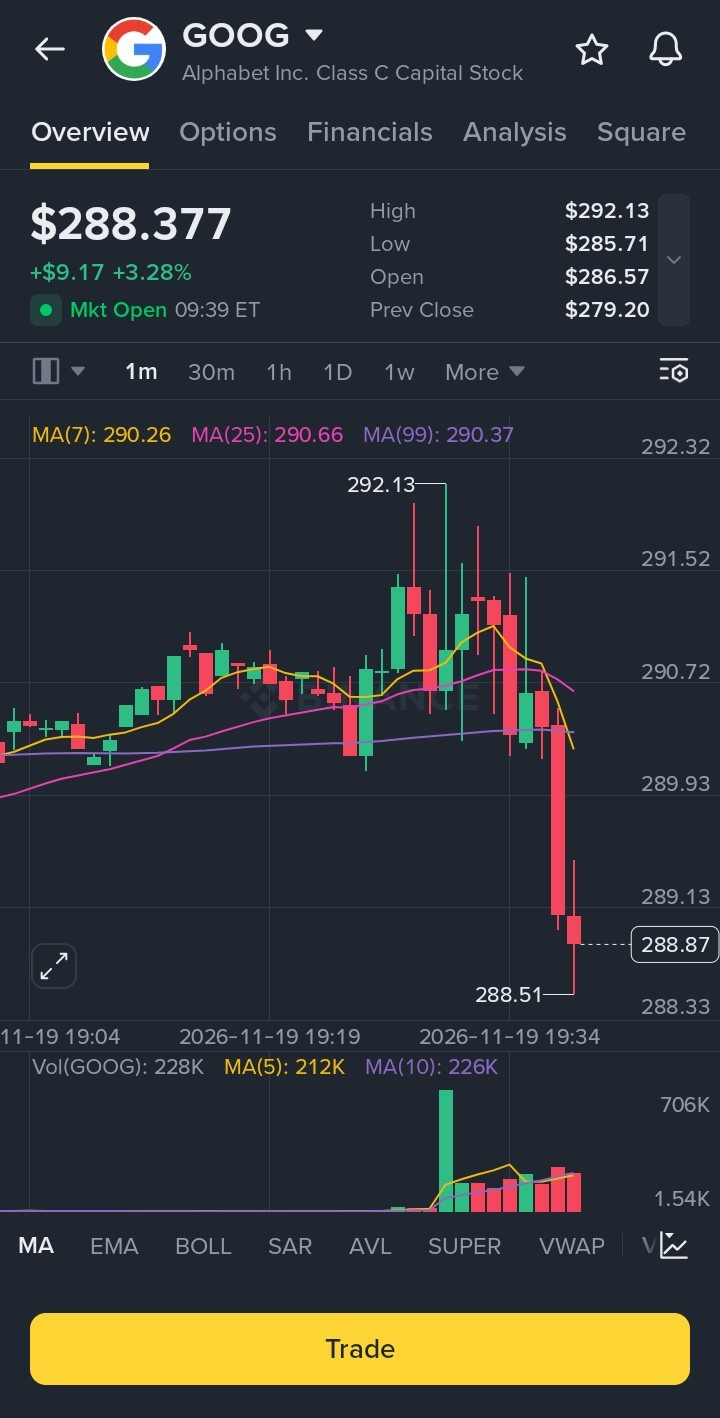
$GOOG.US /USDT (Alphabet Inc. Class C)
Based on your supplied 1H/30m market snapshot
### $288.377
+3.28% | Intraday bullish momentum
### Trade Plan – SHORT
| Parameter | Price |
| ---------- | ----------------- |
| Entry Zone | $290.00 – $292.00 |
| Stop Loss | $294.50 |
| TP1 | $286.00 |
| TP2 | $282.00 |
| TP3 | $278.00 |
Trade here $GOOG.US
### Market Analysis
* Strong resistance: Price is approaching the $290–$292 resistance zone.
* Moving averages: MA(7) at 290.26, MA(25) at 290.66 and MA(99) at 290.37 indicate a nearby resistance cluster.
* Buyer strength: GOOG is up 3.28%, showing strong intraday buying pressure.
* Rejection possibility: Failure to hold above $292 could trigger short-term profit-taking.
* Bearish scenario: A confirmed rejection followed by a break below $288 could open downside toward $286 and $282.
### Confirmation
Wait for a clear bearish rejection around $290–$292 and confirmation below $288 before entering short.
Invalidation: Sustained breakout above $294.50 weakens this short setup.
### Risk Management
Do not chase the short at current price. The stock is showing bullish momentum, so wait for confirmation.
#GOOG #Alphabet #StockTrading #ShortSignal #ASMA_DOLL
GOOGUS-0.84%
Al asbahi:
شكرا لك على المتابعة اختي الكريمة
5
4
45

·
--
Alphabet surged as much as 3.8% to $293.23 in early trading Thursday, as Anthropic’s IPO lit a spark and the market thought Google’s spring had arrived. At the close, though, it was at $272.66, down 3.46%. It had fallen as low as $270.10 intraday, and closed just $0.55 above its 52-week low of $272.11. It has fallen about a third from its record high of just under $409 on May 18, dropping 18.55% in a month.
Anthropic priced its IPO at $83. Alphabet holds about 1.8 billion shares, or roughly 13.7%, following the IPO. At the offering price, that stake is worth about $150 billion. Barron’s said it could generate paper gains in the hundreds of billions of dollars. But the market isn’t buying it: gains in the value of a stake are paper wealth; making money from the core business is what counts.
Valuation has returned to levels near the bottom of 2025, at about 15 times estimated 2026 earnings. Chart analyst Larry Williams says two signals have appeared at once: the stock is undervalued, and big money has been actively accumulating shares over the past four weeks. Historically, when this combination has appeared, the stock has often bottomed before rebounding.
But a rebound needs a catalyst: either a revaluation of Anthropic translates into real cash, or February’s earnings report proves the cloud business is still doubling. Nasdaq 100 futures fell another 1.11% in premarket trading Friday, and the macro headwinds haven’t passed. If the stock probes lower again at the close and breaks below its 52-week-low level, the technical picture will take another step down.
#Alphabet #Anthropic $GOOGL $AMZN $QQQ
214

·
--
Google Search fell below half of Alphabet’s revenue for the first time. Third-quarter Search revenue was $63.35 billion, just $79 million more than in the second quarter, accounting for 49.7% of total revenue, down from 55.3% a year ago. Search growth has slowed each quarter: 19% in the first quarter, 17% in the second, and 12% in the third. Google’s own AI features are diverting traffic from Search.
On the other hand, Google Cloud revenue was $30.7 billion, more than double year over year, up 103%. Total revenue was $127.6 billion, up 25% year over year. As Cloud grows faster and Search slows, Alphabet is transforming from a search company into a cloud and AI infrastructure company.
The cost of the transformation is written in the books: third-quarter earnings per share were $2.12, about 30% below the market’s expectation of $3.02. The stock fell 12.6% the day after the earnings report, its worst single-day drop since going public in 2004. Capital expenditure guidance for 2026 is $195 billion to $205 billion, with a substantial increase expected again in 2027. Long-term debt ballooned from $10.9 billion at the end of 2024 to $125.1 billion this September. There were no buybacks in the first nine months; instead, the company issued new shares to raise $61.9 billion. Free cash flow fell 73% year over year. Free cash flow is the money left to spend freely after subtracting capital expenditures—such as building data centers and buying chips—from operating cash flow.
The market’s valuation logic has already changed: it used to value Alphabet as a search cash machine; now it values it as an AI infrastructure company burning cash. Search’s share falling below half is a watershed moment. Cloud must keep doubling to fill the gap left by slowing Search and rising capital expenditure. Watch Cloud growth and free cash flow in next February’s earnings report. If Cloud growth drops below double digits, the story will have to be rewritten.
#Alphabet #谷歌云 $GOOGL $MSFT $QQQ
214

·
--
Bullish
🚀 $GOOGL — The Uptrend Isn't Dead Yet!
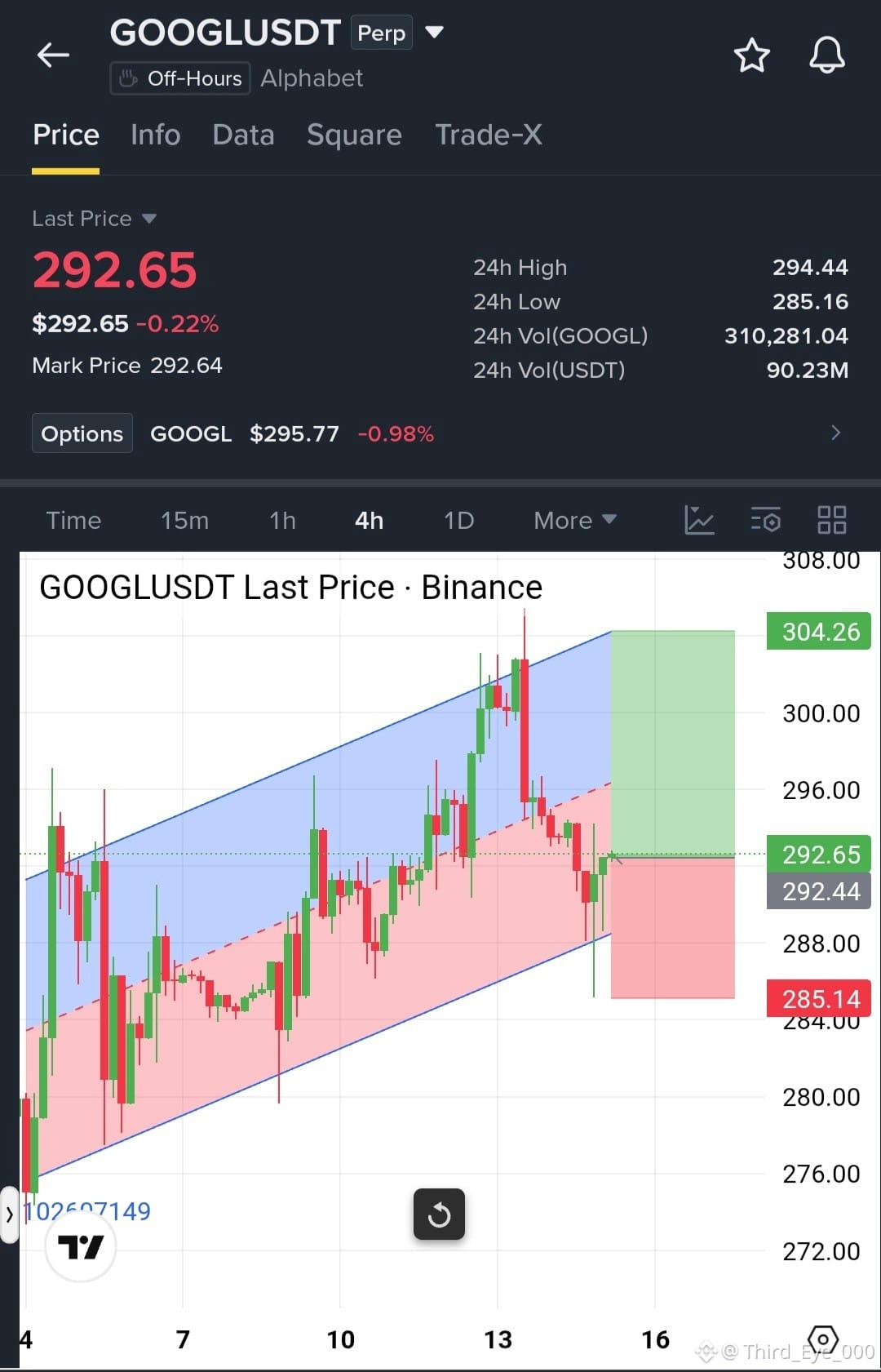
#Alphabet is still moving inside a rising channel on the 4H chart.
After getting rejected near $304, price pulled back and is now showing signs of recovery around $292.
I'm watching this level closely. If bulls regain momentum, another attempt toward the channel resistance could be coming. 👀
🎯 LONG SETUP
E.P: $292
S.L: $285
T.P: $305
The idea is simple: ride the channel, respect the stop-loss, and let the chart do the talking.
No emotions, just execution. 👁️
1
2
623
·
--
Alphabet had a busier week than earnings week.
Shares closed Friday at $295.77, down 0.98%. They briefly surged to $304.97 intraday before being pushed back down, but still gained about 4.7% for the week. The stock is 27.6% below its 52-week high of $408.61, with the 200-day moving average at $338.45 hanging overhead. Its relative strength index is 40.58, still languishing in weak territory.
First, let’s get the numbers straight. Third-quarter results were released on October 28: revenue of $127.6 billion, up 25% year over year; Google Cloud revenue of $30.7 billion, more than double; operating income of $40.6 billion; and an operating margin of 31.8%. The numbers looked great on paper. But buried in the same earnings report were two figures: quarterly capital expenditures of $51.4 billion and free cash flow of negative $9.1 billion, versus expectations of just negative $2.7 billion. The market voted with its feet the next day: the stock fell about 12.6% in a single session, closing at $283.82. More than $500 billion in market value evaporated in one day, taking the company from $3.97 trillion to $3.46 trillion—its worst day since going public. Revenue growth of 25% couldn’t save the day; the real reason investors sold was the negative cash flow.
Three developments this week brought those numbers back into focus.
First, on November 12, four nonprofit organizations sued the AI divisions of Google, OpenAI, Anthropic, Meta, and SpaceX in San Francisco Superior Court. They asked the court to order a freeze on frontier model development, barring the release of any model more capable than those available on November 12, citing California’s unfair competition law. The 63-page complaint seeks only this one form of relief, not damages. In practical terms, the case is unlikely to have much immediate impact: none of the five defendants has publicly responded so far, no hearing date has been set, and U.S. courts have never issued an injunction prohibiting the development of more capable models. But it puts one question on the table: as models become more expensive to build, who pays for the race to build them faster?
Second, on the same day, Google went ahead with its usual product launch: Gemini 4 Hydrogen went live, integrating with Google Search, the Gemini app, Google AI Studio, and enterprise products. The lawsuit is one thing; product launches are another. The rollout continued without missing a beat.
Third, and most tangible of all, Google agreed to invest $10 billion in about 135 million newly issued Anthropic shares, buying at the offering price. The investment is part of Anthropic’s $26 billion private placement, with pricing set for November 18 and the listing on November 19. Google is both Anthropic’s cloud service provider and now one of its shareholders—a presence across the entire value chain.
There’s really just one link in the chain of events: after Nvidia CEO Jensen Huang resigned on November 12, Wall Street started taking a serious look at the numbers for a second provider of AI computing power. Morgan Stanley estimates that direct sales of Google’s Tensor Processing Units (TPUs, its in-house AI chips) could reach $84 billion next year, compared with about $8 billion this year—a tenfold jump. If that plays out, Google Cloud won’t be a “cash-burning side business” but a second growth engine, giving the company’s full-year capital expenditure forecast of $195 billion to $205 billion a clear rationale. On the other hand, if TPUs don’t sell, negative free cash flow won’t be a one-quarter problem.
There are two risk factors, too. A trust belonging to co-founder Larry Page reported a sale of about $148 million in shares on November 12: 253,800 Class A shares and 253,800 Class C shares. The sales follow a monthly plan put in place back in 2020, don’t affect control, and aren’t in themselves a bearish signal. But the timing coincides with the period of negative free cash flow, making it easy for the market to read “the founder is selling on schedule” as “insiders are also waiting for a better price.” The other risk is the valuation anchor: the 52-week low of $272.11 is only about 8.7% below the current price. If the stock falls through the $300 mark again, the next level to watch is $272, followed by the trading range from late last year.
Three levels to watch: whether the stock can reclaim the $300 mark; the 200-day moving average at $338.45, which is the dividing line between bulls and bears in the medium term; and Anthropic’s pricing and listing on November 18–19, the nearest upcoming catalyst.
Google’s story has shifted from “search company” to “computing-power company.” Whether the stock recovers depends on whether the TPU story can move from research reports into the earnings report.
#Alphabet #MagnificentSeven
$GOOGL $NVDA $QQQ
161
·
--
Alphabet had a busier week than on earnings day.
It closed Friday at $295.77, down 0.98%. It briefly surged to $304.97 intraday before being pushed back, but still gained about 4.7% for the week. It remains 27.6% below its 52-week high of $408.61, with the 200-day moving average at $338.45 hanging overhead. Its relative strength index is 40.58, still languishing in weak territory.
First, let’s do the math. Third-quarter results were announced on October 28: revenue of $127.6 billion, up 25% year over year; Google Cloud revenue of $30.7 billion, more than doubling year over year; operating income of $40.6 billion; and an operating margin of 31.8%. The figures looked great on paper. But buried in the same report were two figures: quarterly capital expenditures of $51.4 billion and free cash flow of negative $9.1 billion, compared with expectations of just negative $2.7 billion. The next day, the market voted with its feet: the stock fell about 12.6% in a single day to close at $283.82, wiping out more than $500 billion in market value as it plunged from $3.97 trillion to $3.46 trillion—its worst day since going public. Revenue growth of 25% couldn’t save the day; the real reason for the selloff was negative cash flow.
Three developments this week brought those numbers back into focus.
First, on November 12, four nonprofits sued the AI divisions of Google, OpenAI, Anthropic, Meta, and SpaceX in San Francisco Superior Court. They asked the court to order a freeze on frontier-model development, barring the release of any model more powerful than those available on November 12, citing California’s Unfair Competition Law. The 63-page complaint seeks only this one form of relief, with no damages. Realistically, the case is unlikely to have an immediate impact: none of the five defendants has publicly responded, no hearing date has been set, and U.S. courts have never issued an injunction prohibiting the development of more powerful models. But it put a question on the table: as models get more expensive to build, who will pay for the race to build them faster?
Second, on the same day, Google went ahead with its usual product launch: Gemini 4 Hydrogen went live across Google Search, the Gemini app, Google AI Studio, and enterprise products. The lawsuit is the lawsuit; product launches continue, with the pace completely undisturbed.
Third, and most substantial, Google agreed to invest $10 billion in about 135 million newly issued Anthropic shares at the offering price. It’s part of Anthropic’s $26 billion private financing, priced on November 18, with trading starting on November 19. Google is both Anthropic’s cloud provider and now one of its shareholders—a presence across the supply chain.
The chain of events is really quite simple: after NVIDIA CEO Jensen Huang resigned on November 12, Wall Street began seriously calculating the potential of a second provider of AI computing power. Morgan Stanley estimates that direct sales of Google’s Tensor Processing Units (TPUs, its in-house AI chips) could reach $84 billion next year, compared with about $8 billion this year—a tenfold jump. If that plays out, Google Cloud would no longer be a “cash-burning side business” but a second growth engine, giving the company’s full-year capital expenditure of $195 billion to $205 billion a clear rationale. On the other hand, if TPUs don’t sell, negative free cash flow won’t be a one-quarter issue.
There are two risk factors, too. A trust belonging to founder Larry Page reported selling about $148 million worth of shares on November 12: 253,800 each of Class A and Class C shares, under a monthly sale plan established back in 2020. It doesn’t affect control and, taken on its own, isn’t a bearish signal. But it coincides with the period of negative free cash flow, making it easy for the market to read “the founder is selling according to plan” as “insiders are also waiting for a better price.” The other concern is the valuation anchor: the 52-week low of $272.11 is only about 8.7% below the current price. If the stock breaks below the $300 psychological level again, the next support is around $272, followed by the base formed late last year.
Three levels to watch: whether the stock can reclaim the $300 psychological level; the 200-day moving average at $338.45 as the medium-term bull-bear divide; and Anthropic’s pricing and listing on November 18–19 as the nearest catalyst.
Google’s story has shifted from “search company” to “computing power company.” Whether the stock recovers depends on whether the TPU numbers make it from research reports into earnings.
#Alphabet #MagnificentSevenStocks
$GOOGL $NVDA $QQQ
200

·
--
$GOOGL
{future}(GOOGLUSDT)
Perp | Intraday Plan (Nov 14) 📉
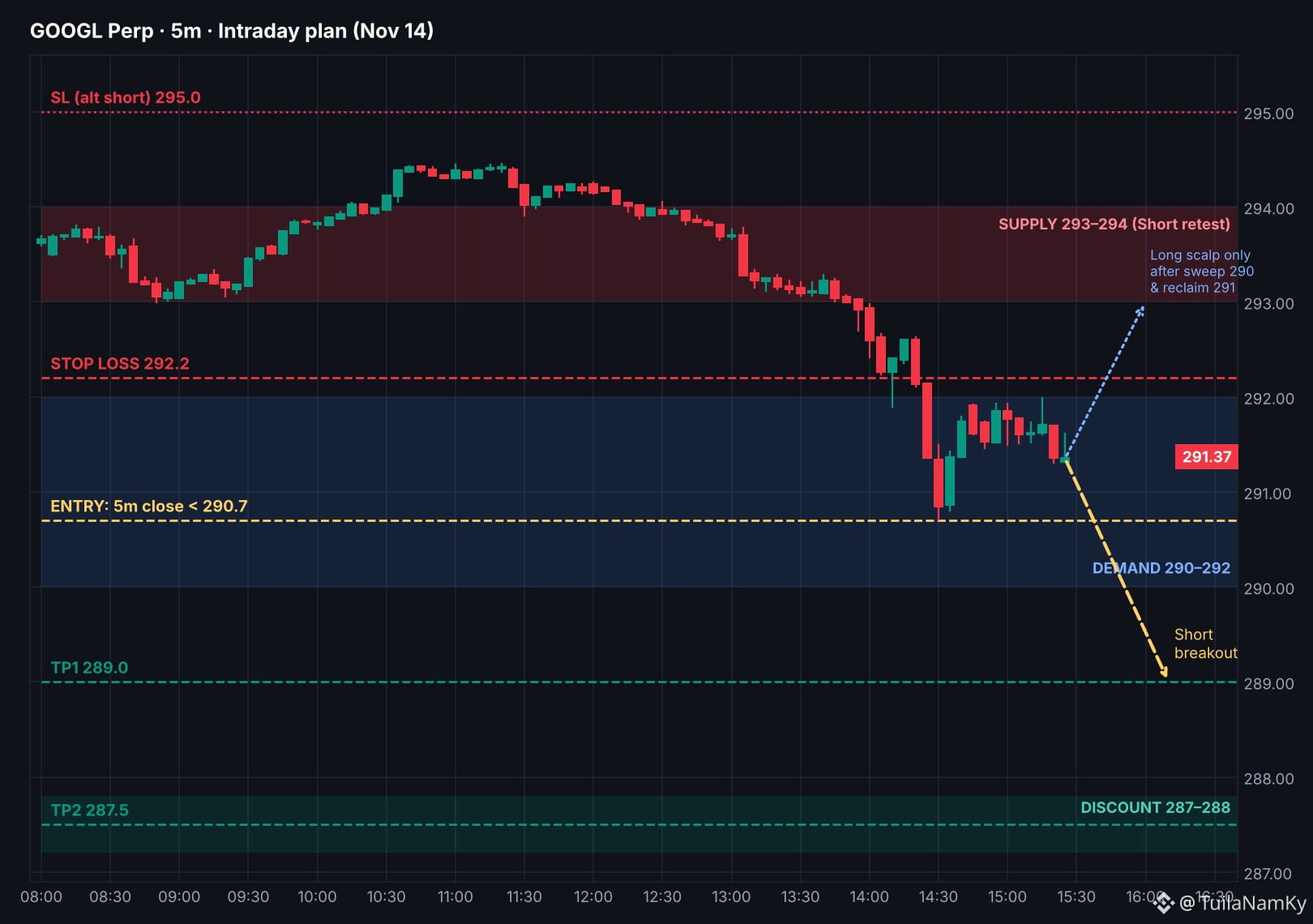
Alphabet is still digesting the Q3 earnings miss (negative FCF, 2027 capex guided above $300B). Daily structure remains bearish after the BOS, with price bouncing from the 275–282 discount zone and rejected near 302. On the 1H, price lost the equilibrium zone and is sitting on the 290–292 demand block.
🔻 Short setup:
Entry: 5m close below 290.7
SL: 292.2
TP1: 289.0
TP2: 287.5
🔻 Alt short (retest): 293–294, SL 295.
🔼 Long only if price sweeps 290 and reclaims 291 → quick scalp to 293.
⚠️ Weekend = thin liquidity, fake breakouts are common. Risk ≤1% per trade.
Not financial advice. DYOR.
#GOOGL #Alphabet #TradFi
$GOOGL
Perp | Intraday Plan (Nov 14) 📉
Alphabet is still digesting the Q3 earnings miss (negative FCF, 2027 capex guided above $300B). Daily structure remains bearish after the BOS, with price bouncing from the 275–282 discount zone and rejected near 302. On the 1H, price lost the equilibrium zone and is sitting on the 290–292 demand block.
🔻 Short setup:
Entry: 5m close below 290.7
SL: 292.2
TP1: 289.0
TP2: 287.5
🔻 Alt short (retest): 293–294, SL 295.
🔼 Long only if price sweeps 290 and reclaims 291 → quick scalp to 293.
⚠️ Weekend = thin liquidity, fake breakouts are common. Risk ≤1% per trade.
Not financial advice. DYOR.
#GOOGL #Alphabet #TradFi
249
·
--
Alphabet has become a point of contention on Wall Street: faced with the same third-quarter results, HSBC set a $360 price target, implying roughly 20% upside from the current price, betting the stock can rebound, while JPMorgan removed it from its Analysts’ Focus List.
First, the bullish case. Google Cloud brought in $30.7 billion in third-quarter revenue, more than doubling year over year, and $11.1 billion in operating profit, more than tripling. Its operating margin rose from 23.7% a year ago to 36.2%, and it still has $561 billion in backlog. The cloud engine is finally humming.
Now for the part that’s causing a stir. Capital spending hit $51.4 billion in a single quarter, more than double the $23.95 billion spent in the same period last year. Free cash flow plunged to negative $9.1 billion—the company spent more than it earned. Management set full-year 2026 investment at $195 billion to $205 billion, with even more spending planned for next year. Search ads also disappointed: revenue of $63.35 billion, up 12%, fell short of the market’s $64.99 billion forecast. Earnings per share came in at $2.12, also below market expectations of just over $3.
In plain English: the cloud business is genuinely profitable, but data centers are being built faster than the money is coming in. Profits on paper are turning into steel and concrete at construction sites. HSBC is betting that backlog will eventually turn into cash; JPMorgan is worried that AI-powered search will take too long to monetize, and that spending will burn through the valuation first. One thing to note: JPMorgan hasn’t changed its Overweight rating. It only removed Alphabet from its most favored list. Despite the disagreement, no one is willing to come out outright bearish.
Watch three things: whether the market accepts the cost of financing at the $3.8 billion bond settlement on November 19; whether Google Cloud can keep converting backlog into revenue next quarter; and whether users actually take to Gemini 4 Hydrogen, launched just yesterday, once it’s built into Google Search. The stock closed Friday at $295.77, down 27.6% from its 52-week high of $408.61, while the average price target from 55 Wall Street firms still stands at $412.51. The wider the disagreement, the more important it is to watch when real cash flow turns positive.
#Alphabet #谷歌云
$GOOGL $QQQ $SPY
329

$GOOGLB Analysis 🚀
Market Update • Nov 11, 2026
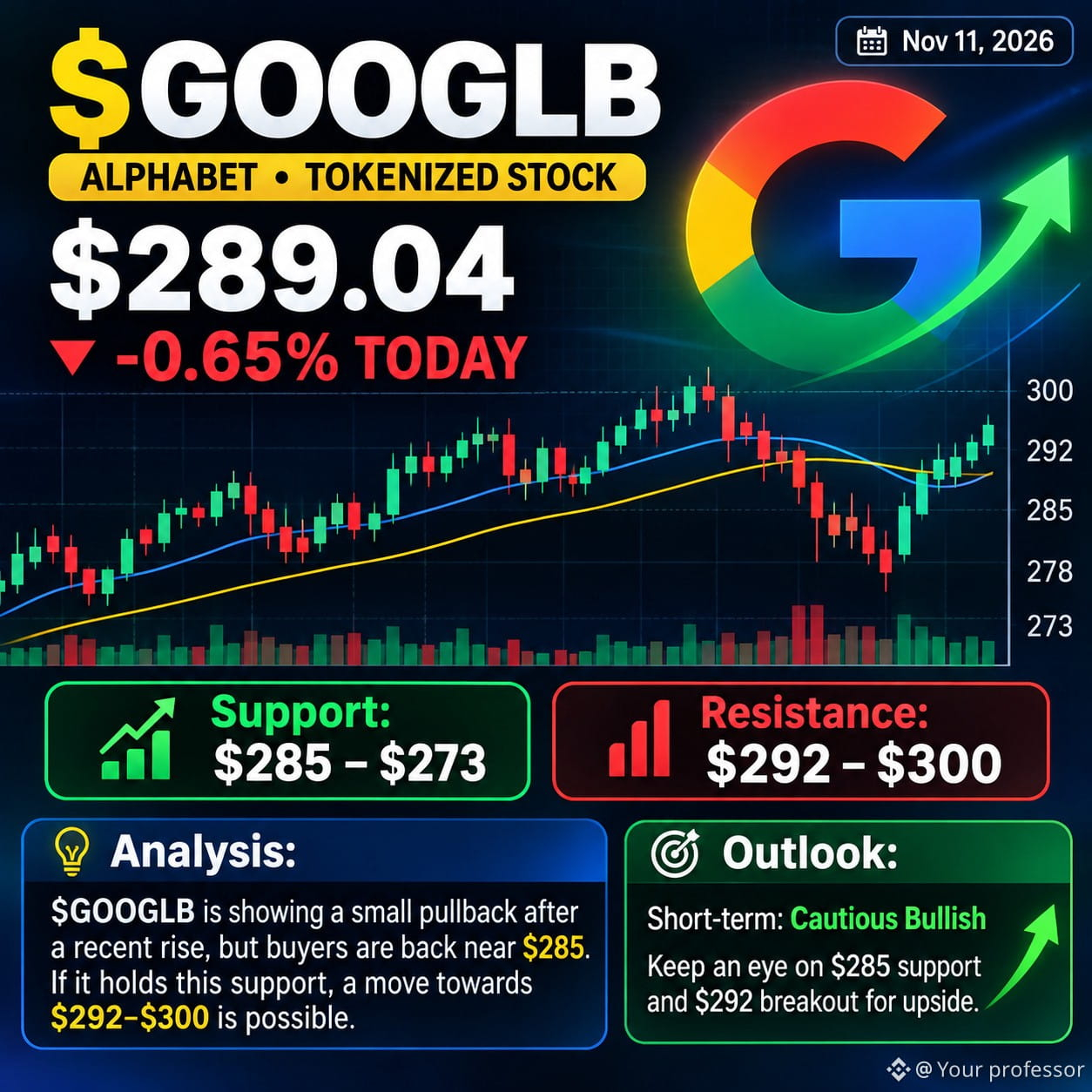
$GOOGLB (Alphabet Tokenized Stock) is trading around $289.04, showing a minor 0.65% pullback.
Support: $285 – $273
Resistance: $292 – $300
Bullish Target: $300+
Outlook: Cautiously bullish 📈
Holding above $285 could create an opportunity for an upward move. A breakout above $292 may strengthen bullish momentum.
Trade smart & manage your risk! 🔥
#GOOGLB #Alphabet #Google #crypto #AnthropicRejectsIPODelayValuationinQuestion $GOOGLB
{spot}(GOOGLBUSDT)
$GOOGLB Analysis 🚀
Market Update • Nov 11, 2026
$GOOGLB (Alphabet Tokenized Stock) is trading around $289.04, showing a minor 0.65% pullback.
Support: $285 – $273
Resistance: $292 – $300
Bullish Target: $300+
Outlook: Cautiously bullish 📈
Holding above $285 could create an opportunity for an upward move. A breakout above $292 may strengthen bullish momentum.
Trade smart & manage your risk! 🔥
#GOOGLB #Alphabet #Google #crypto #AnthropicRejectsIPODelayValuationinQuestion $GOOGLB
1
1
54

·
--
Bullish
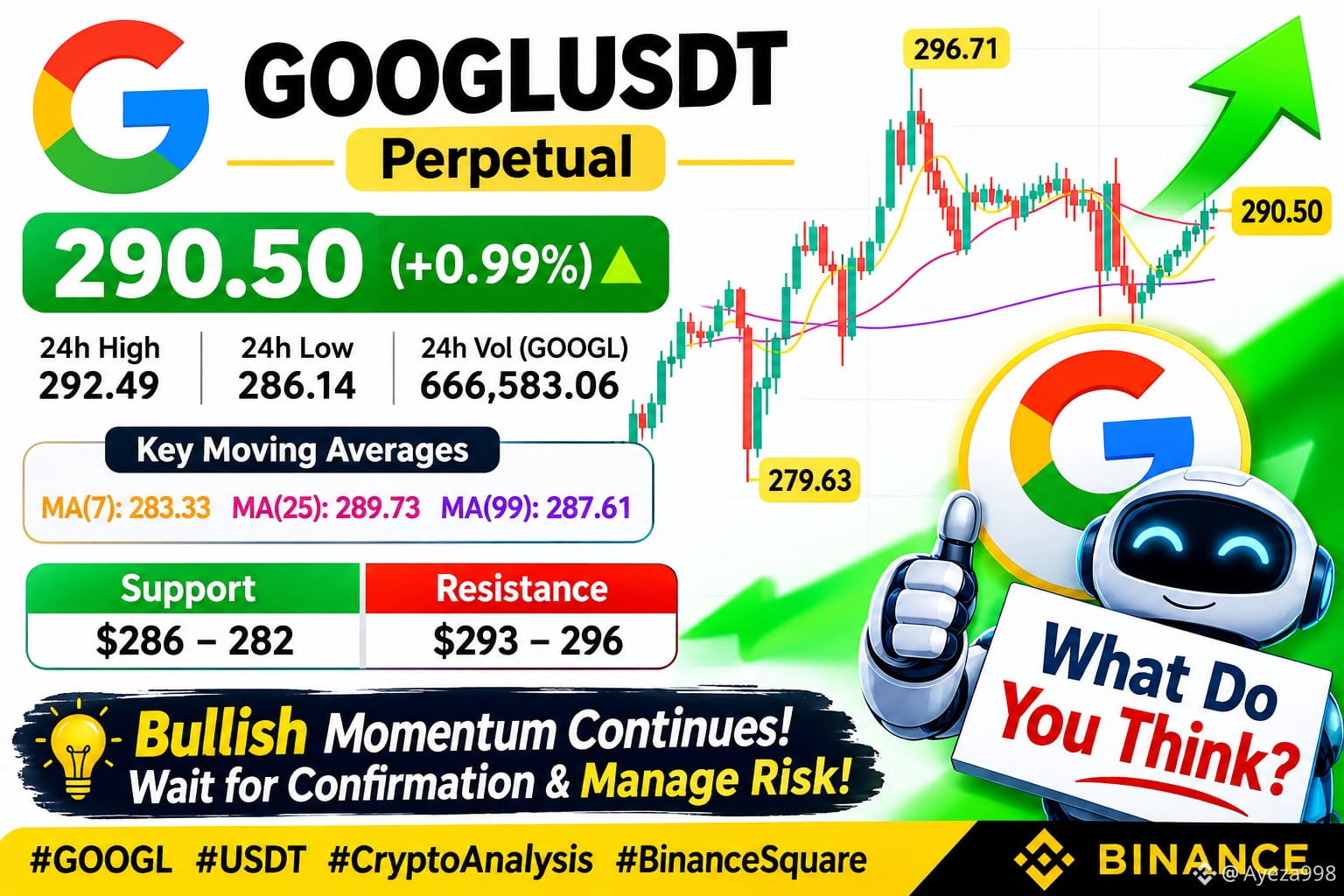
🚀 GOOG/USDT: Bulls Are Trying to Take Control! 📈
Alphabet's tokenized stock is showing signs of recovery after bouncing from recent support!
📊 Market Overview:
Current Price: $290.50
24h High: $292.49
24h Low: $286.14
24h Volume: 192.80M USDT
MA(7): $289.33
MA(25): $289.73
MA(99): $287.61
Key Levels to Watch: 🟢 Resistance: $292.49 – $296.71 🟢 Support: $289.00 – $286.14
The price is trading above all three moving averages, suggesting improving short-term momentum. However, a strong breakout above $292.49 with volume confirmation is needed to strengthen the bullish outlook.
💬 Can GOOG break above $296.71 next?
Trade carefully, avoid FOMO, and always manage your risk. DYOR!
#GOOG #Alphabet #CryptoTrading #BinanceSquare
GOOGUS-0.84%
7
139

·
--
Google Parent Adds to SpaceX Stake in Third Quarter, but Its Value Falls by $10.4 Billion$TSLA $GOOGL $SPCX #加密監管 #谷歌 #Alphabet
Google parent company Alphabet bought more SpaceX shares in the third quarter, yet the market value of its stake fell by more than $10 billion. Alphabet’s third-quarter Form 13F filing with the U.S. Securities and Exchange Commission (SEC), submitted on November 6, shows that as of September 30, the company held 555,043,560 shares of SpaceX Class A stock, worth approximately $83.73 billion.
At the end of the second quarter, Alphabet held 551,189,500 shares, worth approximately $94.18 billion. That means it added about 3.85 million shares in the third quarter, worth approximately $580 million based on the price at the end of September. However, the value per share fell from about $171 to about $151, bringing the total market value of its stake down by approximately $10.4 billion.
Google Parent Adds to SpaceX Stake in Third Quarter, but Its Value Falls by $10.4 Billion
$TSLA $GOOGL $SPCX #加密監管 #谷歌 #Alphabet
Google parent company Alphabet bought more SpaceX shares in the third quarter, yet the market value of its stake fell by more than $10 billion. Alphabet’s third-quarter Form 13F filing with the U.S. Securities and Exchange Commission (SEC), submitted on November 6, shows that as of September 30, the company held 555,043,560 shares of SpaceX Class A stock, worth approximately $83.73 billion.
At the end of the second quarter, Alphabet held 551,189,500 shares, worth approximately $94.18 billion. That means it added about 3.85 million shares in the third quarter, worth approximately $580 million based on the price at the end of September. However, the value per share fell from about $171 to about $151, bringing the total market value of its stake down by approximately $10.4 billion.
1
526


·
--
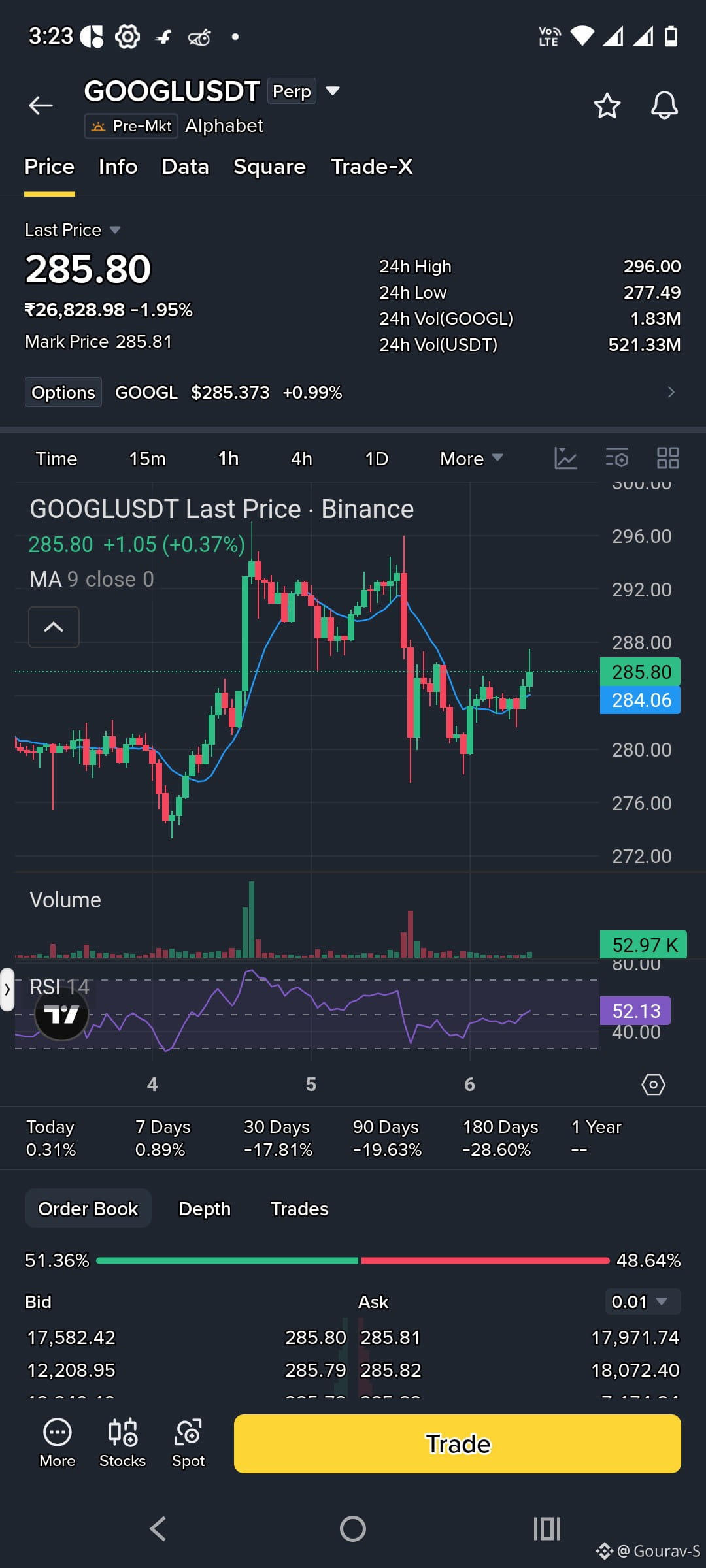
$GOOGL - Long Setup
GOOGL is holding higher lows above its 9-period MA after bouncing from 277.5, trading in a 277–296 range. I'm waiting for a pullback into support after the US open instead of buying mid-range in pre-market.
Entry: 282.0 – 284.0
Stop-loss: 278.5
- TP1: 289.0
- TP2: 292.0
- TP3: 296.0
Reason: Higher lows since 277.5, price above the 9-period MA, and 296 is the clear range top. A 1H close above 296.5 opens 300+. A 1H close below 278.5 invalidates the setup.
📰 News: The Nasdaq fell over 5% in an AI-stock rout, with Nvidia down over 9%, Micron over 17% and SanDisk over 22%. The US jobs report is due at 8:30 AM New York time today. Expect a gap and sharp volatility around the US open.
⚠️ Small size, low leverage.
Personal view, not financial advice. DYOR.
#GOOGL #Alphabet #Binance #futures
{future}(GOOGLUSDT)
$GOOGL - Long Setup
GOOGL is holding higher lows above its 9-period MA after bouncing from 277.5, trading in a 277–296 range. I'm waiting for a pullback into support after the US open instead of buying mid-range in pre-market.
Entry: 282.0 – 284.0
Stop-loss: 278.5
- TP1: 289.0
- TP2: 292.0
- TP3: 296.0
Reason: Higher lows since 277.5, price above the 9-period MA, and 296 is the clear range top. A 1H close above 296.5 opens 300+. A 1H close below 278.5 invalidates the setup.
📰 News: The Nasdaq fell over 5% in an AI-stock rout, with Nvidia down over 9%, Micron over 17% and SanDisk over 22%. The US jobs report is due at 8:30 AM New York time today. Expect a gap and sharp volatility around the US open.
⚠️ Small size, low leverage.
Personal view, not financial advice. DYOR.
#GOOGL #Alphabet #Binance #futures
2
80

·
--
Verified
Article
Alphabet just lost $500B in a day. Here’s what actually happenedAlphabet ($GOOGL) just had one of its ugliest days ever. More than $500 billion in market cap gone, and the big indexes went down with it.
The earnings were the trigger. Revenue grew 25% to $127.6 billion, which is strong, but EPS missed consensus by a lot. A miss like that on the bottom line usually means institutions sell now and read the call later.
Search is what people are actually nervous about. Growth in core Search came in slower than expected, and the fear is that AI answers are cannibalizing ad revenue. Search also dropped below 50% of total revenue for the first time. Cloud growing fast explains some of that, but the market read it as lost ground anyway.
Then there’s the spending. Capex was $51.4 billion in Q3 alone, mostly AI infrastructure and Google’s own TPUs, and free cash flow went to -$9.1 billion. Investors will put up with a lot of AI spending, just not forever without margins to show for it.
There is a bright spot. Cloud revenue more than doubled to $30.7 billion, so businesses clearly want AI. Some analysts think being less dependent on search ads is healthy anyway. Others aren’t convinced.
Follow for my next post, as I will give an analysis on what to possibly do next. There is always an opportunity in every situation.
Stay Safe fam.
$GOOGLB #Alphabet #Google
Alphabet just lost $500B in a day. Here’s what actually happened
Alphabet ($GOOGL) just had one of its ugliest days ever. More than $500 billion in market cap gone, and the big indexes went down with it.
The earnings were the trigger. Revenue grew 25% to $127.6 billion, which is strong, but EPS missed consensus by a lot. A miss like that on the bottom line usually means institutions sell now and read the call later.
Search is what people are actually nervous about. Growth in core Search came in slower than expected, and the fear is that AI answers are cannibalizing ad revenue. Search also dropped below 50% of total revenue for the first time. Cloud growing fast explains some of that, but the market read it as lost ground anyway.
Then there’s the spending. Capex was $51.4 billion in Q3 alone, mostly AI infrastructure and Google’s own TPUs, and free cash flow went to -$9.1 billion. Investors will put up with a lot of AI spending, just not forever without margins to show for it.
There is a bright spot. Cloud revenue more than doubled to $30.7 billion, so businesses clearly want AI. Some analysts think being less dependent on search ads is healthy anyway. Others aren’t convinced.
Follow for my next post, as I will give an analysis on what to possibly do next. There is always an opportunity in every situation.
Stay Safe fam.
$GOOGLB #Alphabet #Google
GOOGUS-0.84%
3
1.7k

Verified

Article
Alphabet: AI Fear or Buying Opportunity?#Alphabet ($GOOGL.US /$GOOGLB / $GOOGL ) plunged over 12% after Q3 2026 results disappointed investors. Revenue reached $127.6B while ai driven spending, weaker than expected advertising and negative free cash flow intensified concerns. As such we found a rapid sale off!!
The sell off may offer a discounted entry for long term investors but falling price alone does not mean under valuation. Watch out ad monetization, AI spending and cash flow before buying.
More data will help you shape your decision. Always #dyor and make smart move.
#stock
#TradingSignals
{future}(GOOGLUSDT)
Alphabet: AI Fear or Buying Opportunity?
#Alphabet ($GOOGL.US /$GOOGLB / $GOOGL ) plunged over 12% after Q3 2026 results disappointed investors. Revenue reached $127.6B while ai driven spending, weaker than expected advertising and negative free cash flow intensified concerns. As such we found a rapid sale off!!
The sell off may offer a discounted entry for long term investors but falling price alone does not mean under valuation. Watch out ad monetization, AI spending and cash flow before buying.
More data will help you shape your decision. Always #dyor and make smart move.
#stock
#TradingSignals
The sell off may offer a discounted entry for long term investors but falling price alone does not mean under valuation. Watch out ad monetization, AI spending and cash flow before buying.
More data will help you shape your decision. Always #dyor and make smart move.
#stock
#TradingSignals
GOOGLUS-0.84%
3
1
882

·
--
🚨 GOOGLE JUST LOST NEARLY $500 BILLION IN MARKET VALUE!
Alphabet (Google’s parent company) suffered a massive sell-off, wiping out approximately $475–500 billion in market capitalization.
What's behind the crash?
🔻 Heavy AI infrastructure spending
🔻 Slower Google Search revenue growth
🔻 Earnings falling short of expectations
🔻 Growing concerns about AI profitability
But here's the twist: Google Cloud revenue surged 103%, showing that AI demand remains strong.
The bigger question is: Are investors losing confidence in the AI boom, or is this just a temporary market correction?
$GOOGL $LSK
{future}(GOOGLUSDT)
#Google #Alphabet #AI #TechStocks
🚨 GOOGLE JUST LOST NEARLY $500 BILLION IN MARKET VALUE!
Alphabet (Google’s parent company) suffered a massive sell-off, wiping out approximately $475–500 billion in market capitalization.
What's behind the crash?
🔻 Heavy AI infrastructure spending
🔻 Slower Google Search revenue growth
🔻 Earnings falling short of expectations
🔻 Growing concerns about AI profitability
But here's the twist: Google Cloud revenue surged 103%, showing that AI demand remains strong.
The bigger question is: Are investors losing confidence in the AI boom, or is this just a temporary market correction?
$GOOGL $LSK
#Google #Alphabet #AI #TechStocks

2
221

Article
Alphabet Loses $482 Billion in One Day: Its Worst Ever, and the Second-Largest Wipeout in HistoryShares fell nearly 13% after earnings as AI spending fears hit. Here's the correct record, why it happened, and what it could mean for crypto and risk assets.
📉 Alphabet just had the worst trading day in its history, and the headline you've probably seen isn't quite right.
On Thursday, October 29, Alphabet closed at $283.82, down 12.64%, after its Q3 earnings. Yahoo Finance calculates about $482 billion in market value erased, and the Wall Street Journal puts it near $500 billion. It's Alphabet's biggest single-day drop since it went public in 2004.
🏷️ The record check.
It wasn't the largest wipeout ever. It's the second-largest one-day market-value loss for a US-listed company. Nvidia still holds the top spot with a loss of about $589 billion to $593 billion on January 27, 2025, the day DeepSeek rattled AI investors. Alphabet did pass SpaceX's $400 billion loss on June 22 and its own earlier record of about $275 billion on July 23.
🧠 Why a growing company fell 13%.
The business numbers were strong in places. Revenue rose 25% to $127.6 billion, Google Cloud more than doubled to about $31 billion, and the Gemini app passed 1 billion users. The problems were elsewhere. Adjusted EPS of $2.67 missed the $3.02 expected, Search grew 12% to about $63 billion against roughly $65 billion expected, and free cash flow swung to a loss of about $9 billion as AI spending climbed.
💸 The real message from investors.
Growth wasn't enough. The market wants proof that heavy AI spending turns into profit, and one quarter of negative cash flow shook that confidence. Alphabet has now lost about $1.4 trillion in value since its May record. It's also part of a pattern: US-listed stocks had 18 sessions this year with $200 billion-plus losses through Wednesday, more than in any year before 2022.
🔗 Why crypto traders care.
Crypto has been trading with tech and AI sentiment lately, so a loss of confidence in AI spending is a risk-appetite signal. That's a link through mood, not a direct cause. This drop doesn't tell you where Bitcoin goes next.
✅ What this means for you
If you trade $BTC, watch whether tech weakness keeps spreading through the Nasdaq. It's one more reason to keep position size modest around big data days.
If you're on the sidelines, the lesson is about headlines. "Biggest crash ever" sounds scarier than "second-largest single-stock loss," and only the second one is true.
If you hold long term, one earnings reaction doesn't change a thesis. It does show how quickly sentiment on AI spending can turn.
🟢 Bullish scenario
Other tech names report better cash flow, confidence in AI returns recovers, and risk assets steady.
🔴 Risk scenario
More companies show rising spending without matching profit, tech sells off further, and risk appetite stays weak.
👀 Three things to watch
1️⃣ Other big-tech cash flow: do more companies show negative free cash flow?
2️⃣ The Nasdaq: does the selloff spread, or does it stay with Alphabet?
3️⃣ AI-linked assets: do AI tokens and tech-linked crypto stocks follow?
💡 The key takeaway
Alphabet lost about $482 billion in a day, its worst ever and the second-largest on record. The cause wasn't weak growth. It was doubt about what AI spending will pay back.
The real question isn't how big the number is. It's whether investors will keep funding AI before the profits show up.
That is the part worth watching.
This post is for informational and educational purposes only and is not financial advice. Crypto markets are volatile. Always conduct your own research before making financial decisions.
#BinanceSquare #Alphabet #Google #EarningsSeason #Aİ
{spot}(BTCUSDT)
{spot}(NVDABUSDT)
{spot}(GOOGLBUSDT)
Alphabet Loses $482 Billion in One Day: Its Worst Ever, and the Second-Largest Wipeout in History
Shares fell nearly 13% after earnings as AI spending fears hit. Here's the correct record, why it happened, and what it could mean for crypto and risk assets.
📉 Alphabet just had the worst trading day in its history, and the headline you've probably seen isn't quite right.
On Thursday, October 29, Alphabet closed at $283.82, down 12.64%, after its Q3 earnings. Yahoo Finance calculates about $482 billion in market value erased, and the Wall Street Journal puts it near $500 billion. It's Alphabet's biggest single-day drop since it went public in 2004.
🏷️ The record check.
It wasn't the largest wipeout ever. It's the second-largest one-day market-value loss for a US-listed company. Nvidia still holds the top spot with a loss of about $589 billion to $593 billion on January 27, 2025, the day DeepSeek rattled AI investors. Alphabet did pass SpaceX's $400 billion loss on June 22 and its own earlier record of about $275 billion on July 23.
🧠 Why a growing company fell 13%.
The business numbers were strong in places. Revenue rose 25% to $127.6 billion, Google Cloud more than doubled to about $31 billion, and the Gemini app passed 1 billion users. The problems were elsewhere. Adjusted EPS of $2.67 missed the $3.02 expected, Search grew 12% to about $63 billion against roughly $65 billion expected, and free cash flow swung to a loss of about $9 billion as AI spending climbed.
💸 The real message from investors.
Growth wasn't enough. The market wants proof that heavy AI spending turns into profit, and one quarter of negative cash flow shook that confidence. Alphabet has now lost about $1.4 trillion in value since its May record. It's also part of a pattern: US-listed stocks had 18 sessions this year with $200 billion-plus losses through Wednesday, more than in any year before 2022.
🔗 Why crypto traders care.
Crypto has been trading with tech and AI sentiment lately, so a loss of confidence in AI spending is a risk-appetite signal. That's a link through mood, not a direct cause. This drop doesn't tell you where Bitcoin goes next.
✅ What this means for you
If you trade $BTC, watch whether tech weakness keeps spreading through the Nasdaq. It's one more reason to keep position size modest around big data days.
If you're on the sidelines, the lesson is about headlines. "Biggest crash ever" sounds scarier than "second-largest single-stock loss," and only the second one is true.
If you hold long term, one earnings reaction doesn't change a thesis. It does show how quickly sentiment on AI spending can turn.
🟢 Bullish scenario
Other tech names report better cash flow, confidence in AI returns recovers, and risk assets steady.
🔴 Risk scenario
More companies show rising spending without matching profit, tech sells off further, and risk appetite stays weak.
👀 Three things to watch
1️⃣ Other big-tech cash flow: do more companies show negative free cash flow?
2️⃣ The Nasdaq: does the selloff spread, or does it stay with Alphabet?
3️⃣ AI-linked assets: do AI tokens and tech-linked crypto stocks follow?
💡 The key takeaway
Alphabet lost about $482 billion in a day, its worst ever and the second-largest on record. The cause wasn't weak growth. It was doubt about what AI spending will pay back.
The real question isn't how big the number is. It's whether investors will keep funding AI before the profits show up.
That is the part worth watching.
This post is for informational and educational purposes only and is not financial advice. Crypto markets are volatile. Always conduct your own research before making financial decisions.
#BinanceSquare #Alphabet #Google #EarningsSeason #Aİ
1
1
221

Alphabet experienced its worst single-day drop since its 2004 IPO, wiping out $482 billion in market value following a 12% stock plunge. Heavy AI infrastructure spending of $50 billion drove quarterly free cash flow to negative $9.1 billion, sparking investor debate around monetization timelines versus Search margin preservation.
{spot}(GOOGLBUSDT)
$GOOGLB $GOOG.US $GOOGL
#CoinVahini #Alphabet #AISpending #MarketCorrection
Alphabet experienced its worst single-day drop since its 2004 IPO, wiping out $482 billion in market value following a 12% stock plunge. Heavy AI infrastructure spending of $50 billion drove quarterly free cash flow to negative $9.1 billion, sparking investor debate around monetization timelines versus Search margin preservation.
$GOOGLB $GOOG.US $GOOGL
#CoinVahini #Alphabet #AISpending #MarketCorrection
$GOOGLB $GOOG.US $GOOGL
#CoinVahini #Alphabet #AISpending #MarketCorrection
GOOGUS-0.84%
GOOGLB-0.38%
24

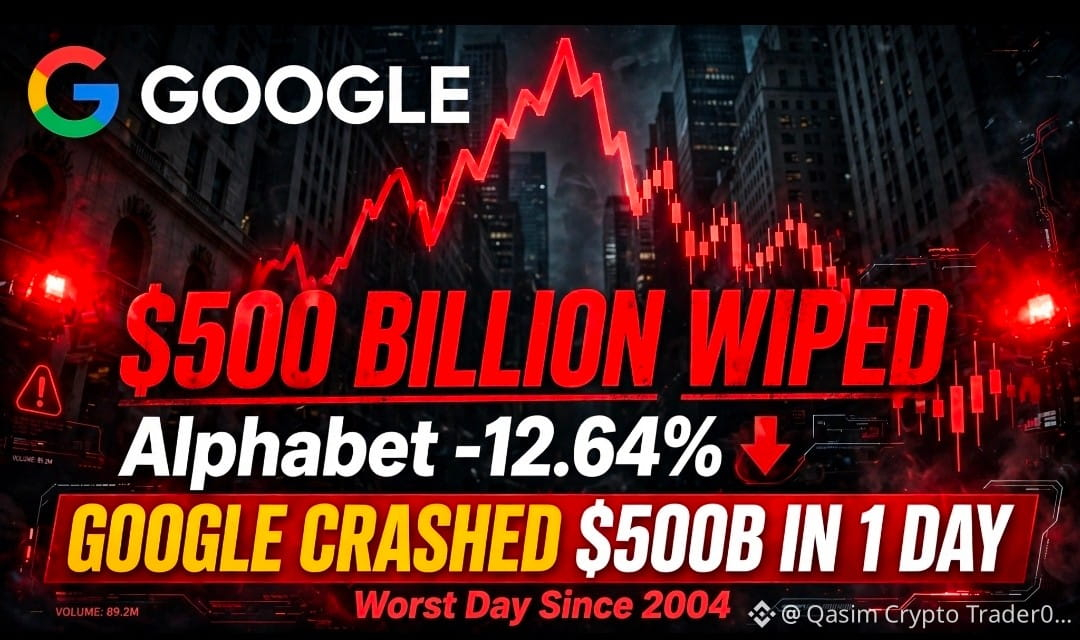
Google loses $500 billion in 1 day! 😱
Alphabet (Google) shares crash -12.64% — $500B wiped out! Its worst day since 2004.
Reason: $51.4B spent on AI and slowing ad growth.
Tech crash + Binance $6.3B hack = crypto market in the red 🔴
Is this a buy-the-dip opportunity? Comment below 👇
#Google #Alphabet #StockMarket #Binance #cryptocrash
Alphabet (Google) shares crash -12.64% — $500B wiped out! Its worst day since 2004.
Reason: $51.4B spent on AI and slowing ad growth.
Tech crash + Binance $6.3B hack = crypto market in the red 🔴
Is this a buy-the-dip opportunity? Comment below 👇
#Google #Alphabet #StockMarket #Binance #cryptocrash
GOOGUS-0.84%
GOOGLB-0.38%
4
10
2.9k

·
--
Verified
Google lost $500 billion in a day—the worst single-day plunge in history
▫️ Alphabet closed down more than 12%, wiping out around $500 billion in market value
▫️ Its worst single day since going public, and the second-largest single-day loss in U.S. stock market history
▫️ Free cash flow turned negative by about $9.1 billion, as slowing ad growth weighed on results
▫️ Cloud revenue doubled to around $30.7 billion, but still couldn’t quell fears over AI spending
AI burned through hundreds of billions, and the market burned you first 😂
Is this a bubble warning, or a chance to get in? 👇 (Not investment advice)
#谷歌 #Alphabet #AI

GOOGUS-0.84%
615

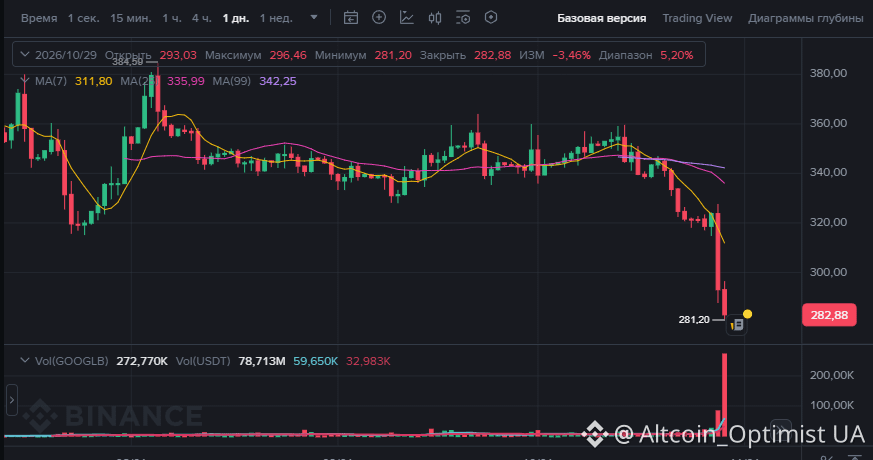
$GOOGLB : Is a Local Bottom Forming After the Sharp Sell-Off? 📉
$GOOGLB has dropped approximately 12.7%, and I'm starting to look for a potential LONG setup. But is this sell-off enough to form a local bottom?
📉 What's Behind the Drop?
The main catalyst is Alphabet's quarterly earnings report released on October 28. Google Cloud delivered strong growth, but the company's earnings and revenue fell short of market expectations. Investors were also concerned about massive AI spending and negative free cash flow.
This means the current decline has a fundamental catalyst rather than being just a technical correction.
📊 What Does the Chart Show?
Price is trading below the MA(7), MA(25), and MA(99). Selling volume has surged, while the latest visible local low stands at 281.20 USDT.
A previous support zone has turned into potential resistance. However, after such a sharp sell-off, a short-term rebound remains possible if selling pressure starts to fade.
🎯 My Trading Plan
I'm considering buying $GOOGLB at 280 USDT.
• Entry: 280 USDT
• Take Profit: 310 USDT
• Stop Loss: 270 USDT
• Potential upside: +10.71%
• Potential downside: −3.57%
• Risk/Reward: 3:1
My idea is to enter slightly below the recent local low amid strong bearish sentiment and look for a rebound.
However, I understand the risk: if the 280 zone fails to hold, the decline could continue. For now, this is a countertrend setup, not a confirmed reversal.
🔎 Which Scenarios Am I Watching?
🔴 Bearish — 51%: Sellers remain in control, and price breaks below the local low.
🟢 Bullish — 49%: Selling pressure fades, price stabilizes, and a recovery toward 290–300 USDT opens the way to 310.
These are my subjective market-scenario estimates, not statistically validated forecasts.
What do you think: Is approaching a local bottom, or could the market push even lower after these earnings?
#GOOGLB #Alphabet #Trading #TechnicalAnalysis
264
Log in to explore more content
Join global crypto users on Binance Square
⚡️ Get latest and useful information about crypto.
💬 Trusted by the world’s largest crypto exchange.
👍 Discover real insights from verified creators.
Email / Phone number
Trending Topics
1
#NvidiaLoses$2.7TrillionInMonthAndAHalf
5,208 views
71 Discussing
2
#CanBTCReboundAfterFallingBelow60K?
611,302 views
2,637 Discussing
3
#GlobalStocksFaceLongestLosingStreakSince2023
214,271 views
1,812 Discussing
4
#BlackRockIBITPostsRecord$541MSingleDayOutflow
20,803 views
63 Discussing
5
#AnthropicPlungesTowardIPOPriceonDay2
106,425 views
1,073 Discussing
6
#TwentyOneCapitalAdds172.25BTC
44,955 views
554 Discussing
7
#HKBillWouldExcludeTokenizedDepositsFromVirtualAssets
5,006 views
48 Discussing
8
#BNBDropsBelow540USDTWith8.46%DailyDecline
60,939 views
566 Discussing
9
#HKBillProposesHK$100KFineForUnauthorizedCryptoTitles
2,033 views
20 Discussing
10
#BitMineFaces$10.1BUnrealizedETHLoss
4,291 views
25 Discussing