
#impliedvolatility
impliedvolatility
432 views
15 Discussing
Hot
Latest

Volatility Metrics: The Impact of IV (Implied Volatility)
Title: Implied Volatility: The Secret Indicator of Options Traders 🌊📊
Content:
Implied Volatility (IV) reflects expectations of market nervousness or the magnitude of the upcoming price movement.
📌 The impact on your positions:
IV Crush: A sudden drop in volatility after a major event (such as a rate decision or a Halving) deflates the value of premiums, even if the price doesn’t move.
Buy low volatility: Buying options when IV is at its lowest provides a more favorable risk/reward ratio.
Never trade options without checking the IV level!
#ImpliedVolatility #IVCrush #CryptoAnalytics #BinanceAcademy
Volatility Metrics: The Impact of IV (Implied Volatility)
Title: Implied Volatility: The Secret Indicator of Options Traders 🌊📊
Content:
Implied Volatility (IV) reflects expectations of market nervousness or the magnitude of the upcoming price movement.
📌 The impact on your positions:
IV Crush: A sudden drop in volatility after a major event (such as a rate decision or a Halving) deflates the value of premiums, even if the price doesn’t move.
Buy low volatility: Buying options when IV is at its lowest provides a more favorable risk/reward ratio.
Never trade options without checking the IV level!
#ImpliedVolatility #IVCrush #CryptoAnalytics #BinanceAcademy
Title: Implied Volatility: The Secret Indicator of Options Traders 🌊📊
Content:
Implied Volatility (IV) reflects expectations of market nervousness or the magnitude of the upcoming price movement.
📌 The impact on your positions:
IV Crush: A sudden drop in volatility after a major event (such as a rate decision or a Halving) deflates the value of premiums, even if the price doesn’t move.
Buy low volatility: Buying options when IV is at its lowest provides a more favorable risk/reward ratio.
Never trade options without checking the IV level!
#ImpliedVolatility #IVCrush #CryptoAnalytics #BinanceAcademy
72

·
--

Article
BTC Rises to $66,000 as Greeks.live Analyst Says Doom IV Doubles to 30%According to macro researcher Adam from Greeks.live, Bitcoin (BTC) has risen to a price of $66,000, marking a notable move in recent trading activity. On X, Adam also reported that the implied volatility (IV) for Doom IV, an indicator used to gauge market sentiment and risk, has doubled to an extreme level of 30%.
Adam’s analysis suggests that while Bitcoin has gained ground, the market remains highly uncertain, as reflected by the surge in Doom IV. The doubling of this measure to 30% indicates increased fear or anticipation of significant market swings, highlighting a more cautious or volatile investor outlook.
Despite the spike in Doom IV, Adam noted that all-term implied volatility has decreased slightly by 0.5% compared to the previous week. This suggests that while short-term fears are intensifying, longer-term market expectations remain relatively stable, possibly reflecting a mix of short-term volatility and longer-term confidence.
These developments showcase the complex dynamics at play in the crypto market, where rising prices coexist with heightened market anxiety. Traders and investors will likely keep a close watch on how these volatility measures evolve in the coming days, as they can serve as indicators of future price movements and market sentiment. #Bitcoin #ImpliedVolatility #MarketSentiment
BTC Rises to $66,000 as Greeks.live Analyst Says Doom IV Doubles to 30%
According to macro researcher Adam from Greeks.live, Bitcoin (BTC) has risen to a price of $66,000, marking a notable move in recent trading activity. On X, Adam also reported that the implied volatility (IV) for Doom IV, an indicator used to gauge market sentiment and risk, has doubled to an extreme level of 30%.
Adam’s analysis suggests that while Bitcoin has gained ground, the market remains highly uncertain, as reflected by the surge in Doom IV. The doubling of this measure to 30% indicates increased fear or anticipation of significant market swings, highlighting a more cautious or volatile investor outlook.
Despite the spike in Doom IV, Adam noted that all-term implied volatility has decreased slightly by 0.5% compared to the previous week. This suggests that while short-term fears are intensifying, longer-term market expectations remain relatively stable, possibly reflecting a mix of short-term volatility and longer-term confidence.
These developments showcase the complex dynamics at play in the crypto market, where rising prices coexist with heightened market anxiety. Traders and investors will likely keep a close watch on how these volatility measures evolve in the coming days, as they can serve as indicators of future price movements and market sentiment. #Bitcoin #ImpliedVolatility #MarketSentiment
Adam’s analysis suggests that while Bitcoin has gained ground, the market remains highly uncertain, as reflected by the surge in Doom IV. The doubling of this measure to 30% indicates increased fear or anticipation of significant market swings, highlighting a more cautious or volatile investor outlook.
Despite the spike in Doom IV, Adam noted that all-term implied volatility has decreased slightly by 0.5% compared to the previous week. This suggests that while short-term fears are intensifying, longer-term market expectations remain relatively stable, possibly reflecting a mix of short-term volatility and longer-term confidence.
These developments showcase the complex dynamics at play in the crypto market, where rising prices coexist with heightened market anxiety. Traders and investors will likely keep a close watch on how these volatility measures evolve in the coming days, as they can serve as indicators of future price movements and market sentiment. #Bitcoin #ImpliedVolatility #MarketSentiment
69

·
--
$BTC | Bitcoin options volatility is compressing toward multi-year lows. Vol is cheap. In the SatoshiMacro Model, the Deribit 30-day implied vol signal reads a 3.4 percentile rank today, the lowest tier score in the 48-signal panel, with raw DVOL at 37.7. On the desk we treated a vol crush like this as reload, not relax: one headline can reprice the curve fast. SMM's calibrated score is still 38.1, Neutral, since this input is 20% of one tier, not the whole model. My read: a quiet options market is not safety here. ASIC's 2:1 retail CFD cap on crypto derivatives is the real constraint, not conviction. It is a percentile rank, not a forecast.
https://satoshimacro.com/tools/crypto/satoshimacro-model/?utm_source=binance_square&utm_medium=social&utm_campaign=autopilot_trend
#SatoshiMacro #BitcoinOptionsVolatilityHitsFiveYearLow #ImpliedVolatility #Bitcoin
$BTC | Bitcoin options volatility is compressing toward multi-year lows. Vol is cheap. In the SatoshiMacro Model, the Deribit 30-day implied vol signal reads a 3.4 percentile rank today, the lowest tier score in the 48-signal panel, with raw DVOL at 37.7. On the desk we treated a vol crush like this as reload, not relax: one headline can reprice the curve fast. SMM's calibrated score is still 38.1, Neutral, since this input is 20% of one tier, not the whole model. My read: a quiet options market is not safety here. ASIC's 2:1 retail CFD cap on crypto derivatives is the real constraint, not conviction. It is a percentile rank, not a forecast.
https://satoshimacro.com/tools/crypto/satoshimacro-model/?utm_source=binance_square&utm_medium=social&utm_campaign=autopilot_trend
#SatoshiMacro #BitcoinOptionsVolatilityHitsFiveYearLow #ImpliedVolatility #Bitcoin
https://satoshimacro.com/tools/crypto/satoshimacro-model/?utm_source=binance_square&utm_medium=social&utm_campaign=autopilot_trend
#SatoshiMacro #BitcoinOptionsVolatilityHitsFiveYearLow #ImpliedVolatility #Bitcoin
340

·
--
As $BTC continues to deepen its decline, options markets (#options ) are repricing the risks, volatility, and the probabilities investors assign to the upcoming major move.
Here’s what Bitcoin options data reveals about investor positioning, volatility, and market sentiment. 👇
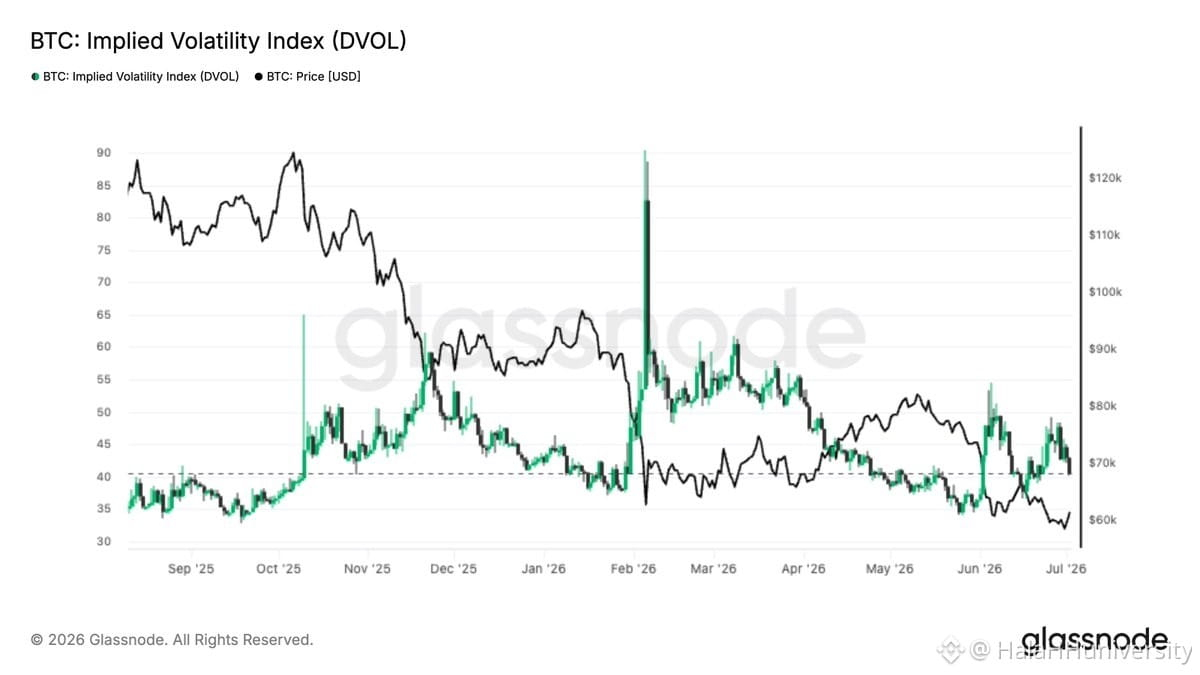
The #DVOL index rises as the BTC sell-off wave continues, indicating a gradual repricing of future volatility. This move reflects increasing uncertainty, but implied volatility (#ImpliedVolatility ) remains far below the peak levels the market saw during major periods of turmoil.
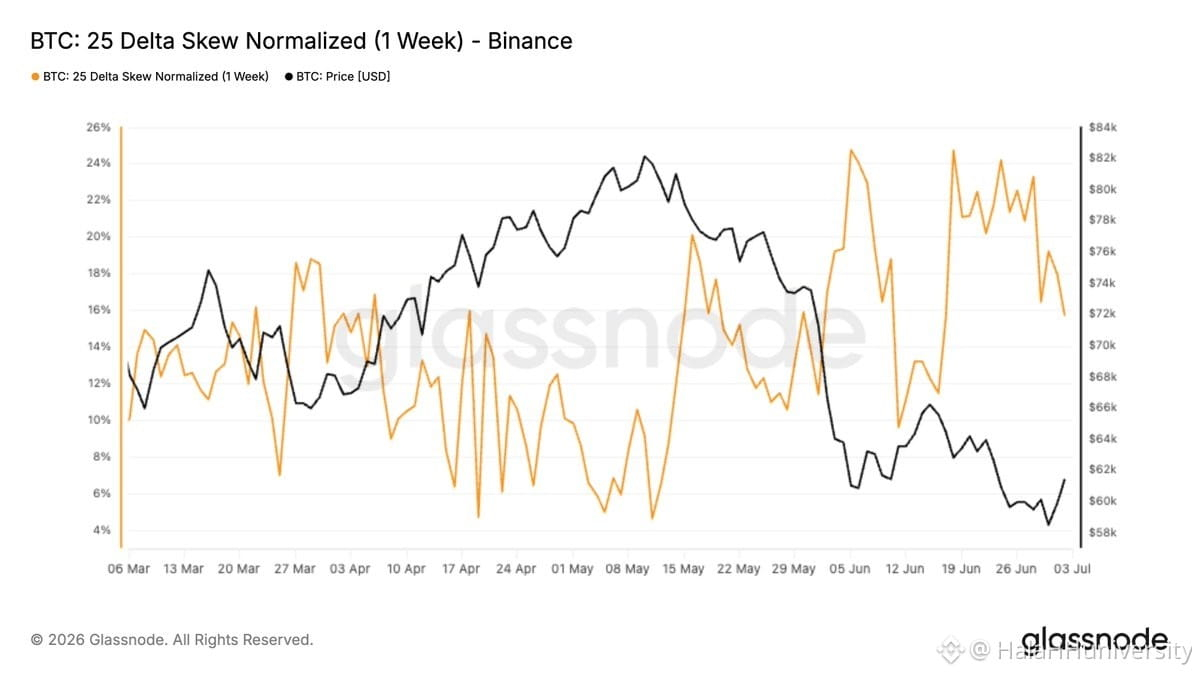
Despite Bitcoin recovering from the $58,000 level, Skew is still clearly positive, meaning put contracts (Puts) continue to trade at a higher premium than call contracts (Calls). Demand for downside hedging instruments persists, and although it has fallen from the elevated levels recorded in June, it suggests that defensive positioning has begun to ease gradually.
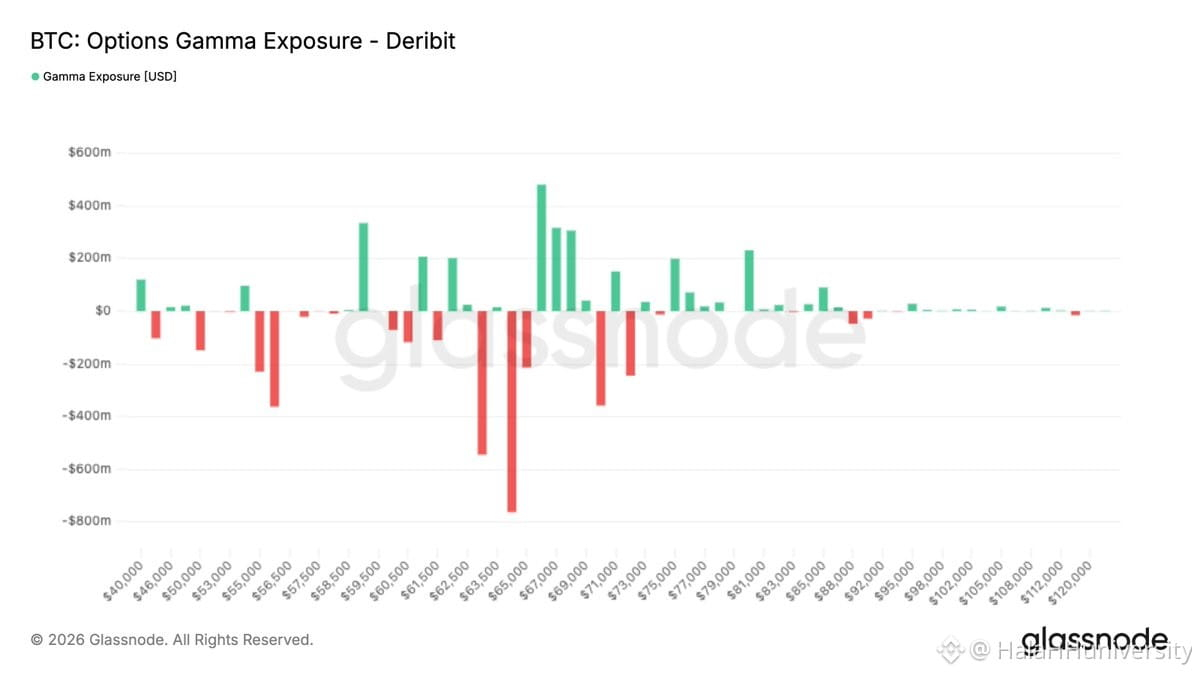
With BTC continuing to trade within the negative gamma zone (#NegativeGamma ), the market makers’ hedging activities have continued to amplify price movements. Combined with the rise in implied volatility and ongoing demand for put options, the options market continues to adopt a cautious defensive stance.
As $BTC continues to deepen its decline, options markets (#options ) are repricing the risks, volatility, and the probabilities investors assign to the upcoming major move.
Here’s what Bitcoin options data reveals about investor positioning, volatility, and market sentiment. 👇
The #DVOL index rises as the BTC sell-off wave continues, indicating a gradual repricing of future volatility. This move reflects increasing uncertainty, but implied volatility (#ImpliedVolatility ) remains far below the peak levels the market saw during major periods of turmoil.
Despite Bitcoin recovering from the $58,000 level, Skew is still clearly positive, meaning put contracts (Puts) continue to trade at a higher premium than call contracts (Calls). Demand for downside hedging instruments persists, and although it has fallen from the elevated levels recorded in June, it suggests that defensive positioning has begun to ease gradually.
With BTC continuing to trade within the negative gamma zone (#NegativeGamma ), the market makers’ hedging activities have continued to amplify price movements. Combined with the rise in implied volatility and ongoing demand for put options, the options market continues to adopt a cautious defensive stance.
Here’s what Bitcoin options data reveals about investor positioning, volatility, and market sentiment. 👇
The #DVOL index rises as the BTC sell-off wave continues, indicating a gradual repricing of future volatility. This move reflects increasing uncertainty, but implied volatility (#ImpliedVolatility ) remains far below the peak levels the market saw during major periods of turmoil.
Despite Bitcoin recovering from the $58,000 level, Skew is still clearly positive, meaning put contracts (Puts) continue to trade at a higher premium than call contracts (Calls). Demand for downside hedging instruments persists, and although it has fallen from the elevated levels recorded in June, it suggests that defensive positioning has begun to ease gradually.
With BTC continuing to trade within the negative gamma zone (#NegativeGamma ), the market makers’ hedging activities have continued to amplify price movements. Combined with the rise in implied volatility and ongoing demand for put options, the options market continues to adopt a cautious defensive stance.
67
Volatility: The Key to Options Pricing
Title: Implied Volatility (IV): The Engine Behind Option Value 🌊📊
Content :
Implied Volatility (IV) reflects the market’s expectations regarding future movements in the price of the underlying asset.
📌 Why is Implied Volatility important?
High IV: Option premiums become more expensive because the expected amplitude of the move is greater
Low IV: Option premiums are less costly.
Knowing how to spot periods of volatility expansion or contraction helps optimize the timing of buying your contracts.
#ImpliedVolatility #CryptoVolatility #OptionsMarket #BinanceTools #MarketAnalysis @Dashpay
Volatility: The Key to Options Pricing
Title: Implied Volatility (IV): The Engine Behind Option Value 🌊📊
Content :
Implied Volatility (IV) reflects the market’s expectations regarding future movements in the price of the underlying asset.
📌 Why is Implied Volatility important?
High IV: Option premiums become more expensive because the expected amplitude of the move is greater
Low IV: Option premiums are less costly.
Knowing how to spot periods of volatility expansion or contraction helps optimize the timing of buying your contracts.
#ImpliedVolatility #CryptoVolatility #OptionsMarket #BinanceTools #MarketAnalysis @Dash
Title: Implied Volatility (IV): The Engine Behind Option Value 🌊📊
Content :
Implied Volatility (IV) reflects the market’s expectations regarding future movements in the price of the underlying asset.
📌 Why is Implied Volatility important?
High IV: Option premiums become more expensive because the expected amplitude of the move is greater
Low IV: Option premiums are less costly.
Knowing how to spot periods of volatility expansion or contraction helps optimize the timing of buying your contracts.
#ImpliedVolatility #CryptoVolatility #OptionsMarket #BinanceTools #MarketAnalysis @Dash
131

Article
OPTIONS RADAR 07. BITCOIN OPTIONS: IS THE FEAR PREMIUM BEGINNING TO NORMALIZE?November 16, 2026 | Deribit Options Intelligence
Bitcoin options reveal something that spot prices alone cannot show: how much investors are willing to pay for protection against further downside.
The latest data points to elevated downside hedging demand, an inverted volatility term structure and an important distinction between declining fear and a confirmed market recovery.
THE VOLATILITY SNAPSHOT
BTC at-the-money implied volatility:
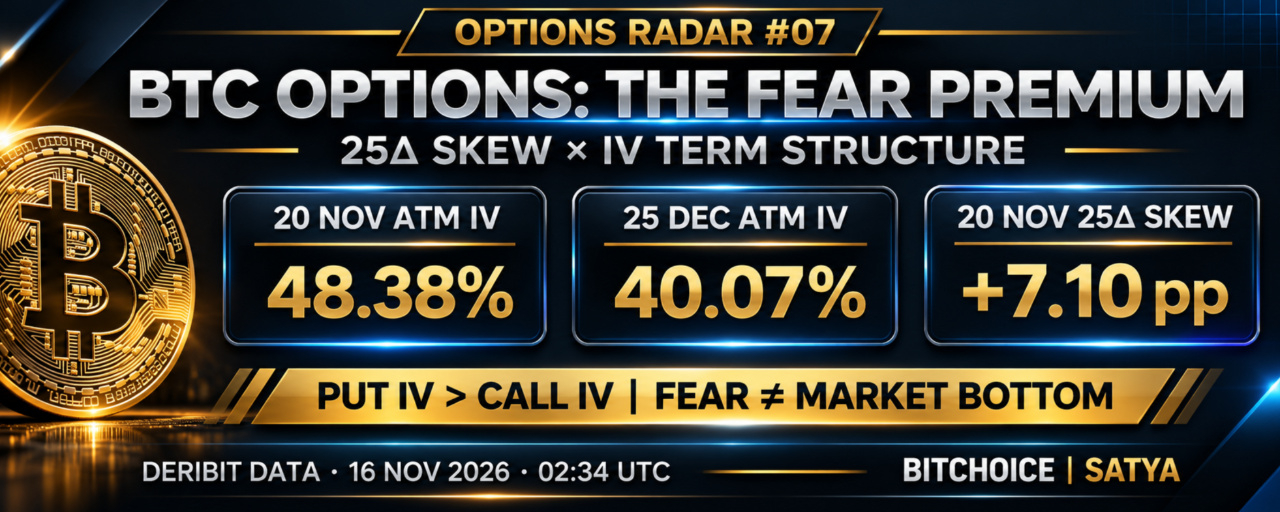
• November 20: 48.38%
• November 27: 43.21%
• December 25: 40.07%
The near-term November 20 expiration carries an 8.31 percentage-point annualized IV premium over December 25.
This indicates that greater volatility is being priced into the near-term options than into longer-dated contracts.
But volatility expectations are not price-direction forecasts.
SIGNAL 1: THE 25-DELTA SKEW
The 25-delta skew compares similarly delta-weighted out-of-the-money puts and calls.
Using Put IV minus Call IV:
• November 20: +7.10 percentage points
• November 27: +7.74 percentage points
• December 25: +5.83 percentage points
A positive reading means downside puts carry higher implied volatility than comparable upside calls.
This is consistent with a premium for downside protection.
The November 20 skew also declined from 17.79 points in the preceding 24-hour comparison window to 7.10 points in the selected snapshot.
That is meaningful normalization of relative option pricing.
However, normalization is not proof that Bitcoin has reached its bottom.
SIGNAL 2: THE INVERTED IV CURVE
Normally, volatility across maturities reflects differing expectations about uncertainty, events and risk premiums.
An elevated front end indicates particularly expensive annualized near-term volatility.
Possible explanations include:
• Immediate downside hedging demand
• Short-term event uncertainty
• Rapid changes in positioning
• Demand for protection after forced liquidations
The curve tells us where uncertainty is concentrated, not where Bitcoin must trade next.
SIGNAL 3: WHY OPEN INTEREST CAN MISLEAD
Put/Call Open Interest is often treated as a simple bullish or bearish indicator.
But options can be bought or sold, hedged, or combined into multi-leg positions.
A large call open interest does not necessarily represent aggressive bullish buying.
Likewise, elevated put demand may reflect portfolio insurance rather than outright bearish speculation.
The most useful interpretation combines skew, term structure, open interest and spot-market liquidity.
STRATEGY ANALYTICS: DIAGONAL CALL SPREADS
An inverted IV curve makes diagonal spreads worth studying.
A typical diagonal call spread combines:
• A purchased longer-dated call
• A written shorter-dated call at a different strike
It can create exposure to differences in time decay, volatility and market direction.
But lower upfront debit does not automatically mean lower overall risk.
The outcome depends on both option prices, spot movements, volatility changes, contract settlement and short-leg management.
Rolling the short leg may require additional capital.
Without a complete option chain and scenario-based P&L, no strategy can be judged attractive from IV differences alone.
WHAT TO WATCH NEXT
Whether 25Δ skew continues to normalizeWhether the near-term IV premium narrowsWhether spot-market depth improvesWhether derivatives leverage rebuilds too quicklyWhether BTC and ETH show consistent changes in risk pricing
MY ASSESSMENT
The options market is showing signs that extreme near-term protection demand may be easing.
But the critical distinction is between a normalization in option premiums and a sustainable return of underlying capital demand.
The first can happen without the second.
THE TAKEAWAY
A decline in the price of fear is an important market development.
It is not a reliable standalone signal to buy Bitcoin.
The stronger evidence of stabilization would come from reduced hedging pressure combined with recovering spot liquidity and healthier positioning.
Source: Pandabull / Deribit, November 16, 2026, 02:34 UTC. Historical options snapshot.
#OptionsRadar #BitcoinOptions #ImpliedVolatility #CryptoMarkets #RiskManagement $BTC
$ETH
{spot}(ETHUSDT)
OPTIONS RADAR 07. BITCOIN OPTIONS: IS THE FEAR PREMIUM BEGINNING TO NORMALIZE?
November 16, 2026 | Deribit Options Intelligence
Bitcoin options reveal something that spot prices alone cannot show: how much investors are willing to pay for protection against further downside.
The latest data points to elevated downside hedging demand, an inverted volatility term structure and an important distinction between declining fear and a confirmed market recovery.
THE VOLATILITY SNAPSHOT
BTC at-the-money implied volatility:
• November 20: 48.38%
• November 27: 43.21%
• December 25: 40.07%
The near-term November 20 expiration carries an 8.31 percentage-point annualized IV premium over December 25.
This indicates that greater volatility is being priced into the near-term options than into longer-dated contracts.
But volatility expectations are not price-direction forecasts.
SIGNAL 1: THE 25-DELTA SKEW
The 25-delta skew compares similarly delta-weighted out-of-the-money puts and calls.
Using Put IV minus Call IV:
• November 20: +7.10 percentage points
• November 27: +7.74 percentage points
• December 25: +5.83 percentage points
A positive reading means downside puts carry higher implied volatility than comparable upside calls.
This is consistent with a premium for downside protection.
The November 20 skew also declined from 17.79 points in the preceding 24-hour comparison window to 7.10 points in the selected snapshot.
That is meaningful normalization of relative option pricing.
However, normalization is not proof that Bitcoin has reached its bottom.
SIGNAL 2: THE INVERTED IV CURVE
Normally, volatility across maturities reflects differing expectations about uncertainty, events and risk premiums.
An elevated front end indicates particularly expensive annualized near-term volatility.
Possible explanations include:
• Immediate downside hedging demand
• Short-term event uncertainty
• Rapid changes in positioning
• Demand for protection after forced liquidations
The curve tells us where uncertainty is concentrated, not where Bitcoin must trade next.
SIGNAL 3: WHY OPEN INTEREST CAN MISLEAD
Put/Call Open Interest is often treated as a simple bullish or bearish indicator.
But options can be bought or sold, hedged, or combined into multi-leg positions.
A large call open interest does not necessarily represent aggressive bullish buying.
Likewise, elevated put demand may reflect portfolio insurance rather than outright bearish speculation.
The most useful interpretation combines skew, term structure, open interest and spot-market liquidity.
STRATEGY ANALYTICS: DIAGONAL CALL SPREADS
An inverted IV curve makes diagonal spreads worth studying.
A typical diagonal call spread combines:
• A purchased longer-dated call
• A written shorter-dated call at a different strike
It can create exposure to differences in time decay, volatility and market direction.
But lower upfront debit does not automatically mean lower overall risk.
The outcome depends on both option prices, spot movements, volatility changes, contract settlement and short-leg management.
Rolling the short leg may require additional capital.
Without a complete option chain and scenario-based P&L, no strategy can be judged attractive from IV differences alone.
WHAT TO WATCH NEXT
Whether 25Δ skew continues to normalizeWhether the near-term IV premium narrowsWhether spot-market depth improvesWhether derivatives leverage rebuilds too quicklyWhether BTC and ETH show consistent changes in risk pricing
MY ASSESSMENT
The options market is showing signs that extreme near-term protection demand may be easing.
But the critical distinction is between a normalization in option premiums and a sustainable return of underlying capital demand.
The first can happen without the second.
THE TAKEAWAY
A decline in the price of fear is an important market development.
It is not a reliable standalone signal to buy Bitcoin.
The stronger evidence of stabilization would come from reduced hedging pressure combined with recovering spot liquidity and healthier positioning.
Source: Pandabull / Deribit, November 16, 2026, 02:34 UTC. Historical options snapshot.
#OptionsRadar #BitcoinOptions #ImpliedVolatility #CryptoMarkets #RiskManagement $BTC
$ETH
Bitcoin options reveal something that spot prices alone cannot show: how much investors are willing to pay for protection against further downside.
The latest data points to elevated downside hedging demand, an inverted volatility term structure and an important distinction between declining fear and a confirmed market recovery.
THE VOLATILITY SNAPSHOT
BTC at-the-money implied volatility:
• November 20: 48.38%
• November 27: 43.21%
• December 25: 40.07%
The near-term November 20 expiration carries an 8.31 percentage-point annualized IV premium over December 25.
This indicates that greater volatility is being priced into the near-term options than into longer-dated contracts.
But volatility expectations are not price-direction forecasts.
SIGNAL 1: THE 25-DELTA SKEW
The 25-delta skew compares similarly delta-weighted out-of-the-money puts and calls.
Using Put IV minus Call IV:
• November 20: +7.10 percentage points
• November 27: +7.74 percentage points
• December 25: +5.83 percentage points
A positive reading means downside puts carry higher implied volatility than comparable upside calls.
This is consistent with a premium for downside protection.
The November 20 skew also declined from 17.79 points in the preceding 24-hour comparison window to 7.10 points in the selected snapshot.
That is meaningful normalization of relative option pricing.
However, normalization is not proof that Bitcoin has reached its bottom.
SIGNAL 2: THE INVERTED IV CURVE
Normally, volatility across maturities reflects differing expectations about uncertainty, events and risk premiums.
An elevated front end indicates particularly expensive annualized near-term volatility.
Possible explanations include:
• Immediate downside hedging demand
• Short-term event uncertainty
• Rapid changes in positioning
• Demand for protection after forced liquidations
The curve tells us where uncertainty is concentrated, not where Bitcoin must trade next.
SIGNAL 3: WHY OPEN INTEREST CAN MISLEAD
Put/Call Open Interest is often treated as a simple bullish or bearish indicator.
But options can be bought or sold, hedged, or combined into multi-leg positions.
A large call open interest does not necessarily represent aggressive bullish buying.
Likewise, elevated put demand may reflect portfolio insurance rather than outright bearish speculation.
The most useful interpretation combines skew, term structure, open interest and spot-market liquidity.
STRATEGY ANALYTICS: DIAGONAL CALL SPREADS
An inverted IV curve makes diagonal spreads worth studying.
A typical diagonal call spread combines:
• A purchased longer-dated call
• A written shorter-dated call at a different strike
It can create exposure to differences in time decay, volatility and market direction.
But lower upfront debit does not automatically mean lower overall risk.
The outcome depends on both option prices, spot movements, volatility changes, contract settlement and short-leg management.
Rolling the short leg may require additional capital.
Without a complete option chain and scenario-based P&L, no strategy can be judged attractive from IV differences alone.
WHAT TO WATCH NEXT
Whether 25Δ skew continues to normalizeWhether the near-term IV premium narrowsWhether spot-market depth improvesWhether derivatives leverage rebuilds too quicklyWhether BTC and ETH show consistent changes in risk pricing
MY ASSESSMENT
The options market is showing signs that extreme near-term protection demand may be easing.
But the critical distinction is between a normalization in option premiums and a sustainable return of underlying capital demand.
The first can happen without the second.
THE TAKEAWAY
A decline in the price of fear is an important market development.
It is not a reliable standalone signal to buy Bitcoin.
The stronger evidence of stabilization would come from reduced hedging pressure combined with recovering spot liquidity and healthier positioning.
Source: Pandabull / Deribit, November 16, 2026, 02:34 UTC. Historical options snapshot.
#OptionsRadar #BitcoinOptions #ImpliedVolatility #CryptoMarkets #RiskManagement $BTC
$ETH
123
Log in to explore more content
Join global crypto users on Binance Square
⚡️ Get latest and useful information about crypto.
💬 Trusted by the world’s largest crypto exchange.
👍 Discover real insights from verified creators.
Email / Phone number
Trending Topics
1
#BitcoinCorePatchesAIDiscoveredVulnerability
7 views
21 Discussing
2
#CanBTCReboundAfterFallingBelow60K?
448,740 views
1,921 Discussing
3
#GlobalStocksFaceLongestLosingStreakSince2023
152,117 views
1,336 Discussing
4
#BlackRockIBITPostsRecord$541MSingleDayOutflow
5,295 views
42 Discussing
5
#AnthropicPlungesTowardIPOPriceonDay2
73,269 views
752 Discussing
6
#TwentyOneCapitalAdds172.25BTC
23,984 views
285 Discussing
7
#HKBillWouldExcludeTokenizedDepositsFromVirtualAssets
2,671 views
31 Discussing
8
#BNBDropsBelow540USDTWith8.46%DailyDecline
42,673 views
370 Discussing
9
#HKBillProposesHK$100KFineForUnauthorizedCryptoTitles
1,500 views
20 Discussing
10
#BitMineFaces$10.1BUnrealizedETHLoss
2,750 views
25 Discussing