
#regulasi
regulasi
1,085 views
19 Discussing
Hot
Latest

·
--
SEC commissioner nominee: stock tokenization rules should be developed through a formal process, not through an exemption.
Facts: At the Senate Banking Committee confirmation hearing on Nov. 19, Kristin Johnson — the Democratic SEC commissioner nominee and former CFTC commissioner — answered Senator Angela Alsobrooks’ questions about the SEC’s tokenization policy. Johnson said she welcomed the opportunity to bring issues surrounding the innovation exemption into a formal rulemaking process with public consultation. The nuance matters: she did NOT call for the exemption to be revoked or suspended — this is about process, not cancellation. Republican nominee Steven Levine said the exemption is time-limited and narrow. SEC Chair Paul Atkins has already outlined his plan: test it through an exemption first, then establish formal rules.
My take: This is a signal about direction, not a decision. All three — the Democratic nominee, the Republican nominee, and the SEC chair — are pointing toward formal rulemaking for stock tokenization. That’s good news for legal certainty: rules developed through public consultation are more robust than exemptions that could be challenged. But don’t misread this: nothing has changed today, and a formal process takes time. Meanwhile, BTC is still around $62,900 this morning, and the market remains defensive.
What I’m watching: the committee vote to advance both nominations to the Senate — an earlier report targeted Nov. 20, but no official schedule has been confirmed — and whether a formal rulemaking timeline starts to emerge. The CLARITY market structure bill itself remains stalled in the Senate.
Do you think rules for tokenization developed through a formal process will speed up adoption, or slow it down because the process takes so long?
This is my analysis, not financial advice — always DYOR.
#Tokenisasi #Regulation
·
--
Germany has just given its customs authorities a new key: crypto worth more than 100,000 euros can be frozen for 30 days — without a prior criminal case.
The facts: The Bundestag passed the Zollfinanzgerechtigkeitsgesetz on 12 Nov 2026 (CDU/CSU, SPD and AfD voted in favor; The Left opposed it; the Greens abstained). Customs can freeze assets worth more than 100,000 euros if there are concrete indications that their origin is illegal — crypto is covered under the MiCA definition. Financial courts can extend the freeze, and permanent confiscation still requires a court ruling. The law takes effect on 1 Jan 2027, pending approval by the Bundesrat.
My opinion: this is not a ban on holding crypto — but it shifts the burden of proof from prosecutors to customs’ administrative procedures. A large balance alone is not enough to justify a freeze; there must be indications of an illicit origin. Those most affected: large holders with messy records of where their funds came from. BTC itself is around 64,972 this afternoon — so far, the market hasn’t reacted to the news.
What I’m watching next: the Bundesrat session — the 20 Nov agenda doesn’t include this bill — and whether other EU countries follow the same approach.
What do you think: do rules like this protect the market, or do they push large holders to move to other jurisdictions?
This is my analysis, not financial advice — always DYOR.
#Jerman #Regulasi $BTC
12
·
--
The claim “SEC officially classifies XRP, BTC, and SOL as commodities” is circulating again today — and it’s FALSE. #FactCheck
The claim: The SEC supposedly officially classified XRP, Bitcoin, and SOL as commodities under the Nasdaq Texas Commodity Trusts framework.
The facts: The document being cited is SEC Order No. 34-106268, dated September 3, 2026 — more than two months ago, not breaking news. And it doesn’t establish a federal classification: the order approved changes to the listing standards of ONE exchange, Nasdaq Texas (Rule 5711(d)), including a 15% buffer for assets that don’t meet the requirements.
The four coins — BTC, ETH, SOL, XRP — appear only in a hypothetical calculation example in the order: a trust worth 95 million dollars. The phrase “eligible commodities” there has a narrow meaning: coins that meet that exchange’s listing test (at least 6 months of futures trading on an ISG market + an ETF with at least 40% exposure). That’s a market surveillance standard, not a determination of federal legal status.
The order’s definition of “digital commodity” also refers to SEC-CFTC joint guidance from March 2026 and is temporary until there’s legislation. What’s actually new this week is something else: the SEC approved Nasdaq ISE’s listing of options on digital commodity ETPs (Nov. 10) — that, too, is an exchange rule, not a federal classification.
My conclusion: FALSE. There is no new federal commodity classification for XRP, SOL, or BTC today. This “the SEC has recognized them” narrative has made the rounds twice since September.
XRP is still below 1 dollar this afternoon, at around 0.99 — this claim hasn’t moved the price either.
Why do you think claims like this go viral so easily, even though the original documents are easy to check?
Not financial advice — always DYOR.
#CekFakta #Regulasi #Kripto $XRP $SOL $BTC
2
·
--
Thailand wants to limit stablecoins: 5 million baht per day per customer.
Facts: Thailand’s SEC proposed a daily limit of 5 million baht (around US$148,000) each for stablecoin deposits and withdrawals per customer at each regulated crypto operator, announced Thursday, Nov 12, 2026. Deposit and withdrawal limits apply separately, transfers to and from third-party wallets are prohibited, and operators must verify wallet ownership. The goal is to curb money laundering, cybercrime, and attempts to bypass cross-border transfer rules. This is a draft follow-up rule stemming from September’s consultation, and the SEC has not set an effective date.
My opinion: this isn’t a stablecoin ban, but the guardrails are getting tighter. The biggest impact is the ban on third-party wallets — for retail users in Thailand, stablecoins are becoming more tied to regulated channels, and for operators, compliance costs are rising. I see this as part of a global trend this year: regulators in Asia and Europe are both tightening stablecoin rules, not loosening them. The immediate impact on market prices is small, but the regulatory direction is clear.
What I’m watching next: whether this draft passes without changes, and whether other Asian regulators follow suit with the 5 million baht limit.
What do you think? Do daily limits like this protect users — or do they push them toward unregulated channels?
This is my analysis, not financial advice — always DYOR.
#Stablecoin #Regulasi $USDT
3
·
--
Coinbase officially becomes a federal custodian bank — but not the kind of bank you might imagine.
The facts: The US banking regulator (OCC) granted final approval to Coinbase National Trust Company, effective Nov. 6, 2026, and announced Nov. 9. This marks the end of a process lasting over a year: application filed in Oct. 2025, conditional approval on Apr. 2, 2026. Coinbase’s institutional custody of digital assets like BTC and ETH is now under direct federal oversight. The limits are clear: it’s not a retail bank, and it cannot take retail deposits, make loans, issue stablecoins, or offer FDIC insurance. Minimum Tier 1 capital is US$60 million; migration from its New York entity is planned over three years.
My take: This is a major legitimacy boost for US crypto custody — the third big name this year after Circle (July) and Ripple (Oct. 26). But don’t read it as a catalyst for prices tomorrow morning: this is about custody, not new money flowing in, and the ICBA lawsuit over the OCC’s charter policy is still ongoing.
What I’m watching next: US CPI tomorrow at 20:30 WIB as a price-direction indicator.
What do you think: Is a federal charter like this more important for institutional adoption, or just a formal stamp of approval?
Not financial advice — always DYOR.
#Regulasi #Coinbase $BTC $ETH
27
·
--
Arkansas has become the seventh state to sue Kalshi — and this lawsuit goes straight to the heart of the prediction market business model.
The facts: Arkansas Attorney General Tim Griffin sued KalshiEX LLC and Kalshi Inc. on Nov. 4, 2026, alleging that the platform operated unlicensed sports gambling in the state, was open to users aged 18 and older, and violated the Arkansas Deceptive Trade Practices Act. The 57-page lawsuit seeks restitution, civil penalties, back taxes, and a court order. The case is listed in the Circuit Court of Independence County under case number 32CV-26-717. Kalshi has argued that its contracts are financial derivatives regulated by the CFTC, not gambling. There has been no court ruling on Arkansas’s allegations.
My take: this is no longer a lawsuit from just one state — it’s a pattern. Utah has filed 14 criminal charges against Kalshi and its founders, and now seven states have taken action. The real fight is over jurisdiction: states see an online bookmaker, while the CFTC sees a federal futures exchange. Until the Supreme Court or Congress answers that question, every new lawsuit adds legal risk for the entire prediction market sector — including crypto contracts traded on similar platforms. BTC itself was steady around $80,300 as the news circulated, so the market hasn’t priced this in as a shock — but the regulatory headwinds are clear.
What I’m watching next: Kalshi’s response to this lawsuit, the CFTC’s Nov. 6 response deadline in a separate case involving stock perps, and whether other states file similar lawsuits.
What do you think: are event contracts on Kalshi financial products or gambling — and who should regulate them?
This is my analysis, not financial advice — always DYOR.
#Kalshi #PredictionMarket #Regulasi
15

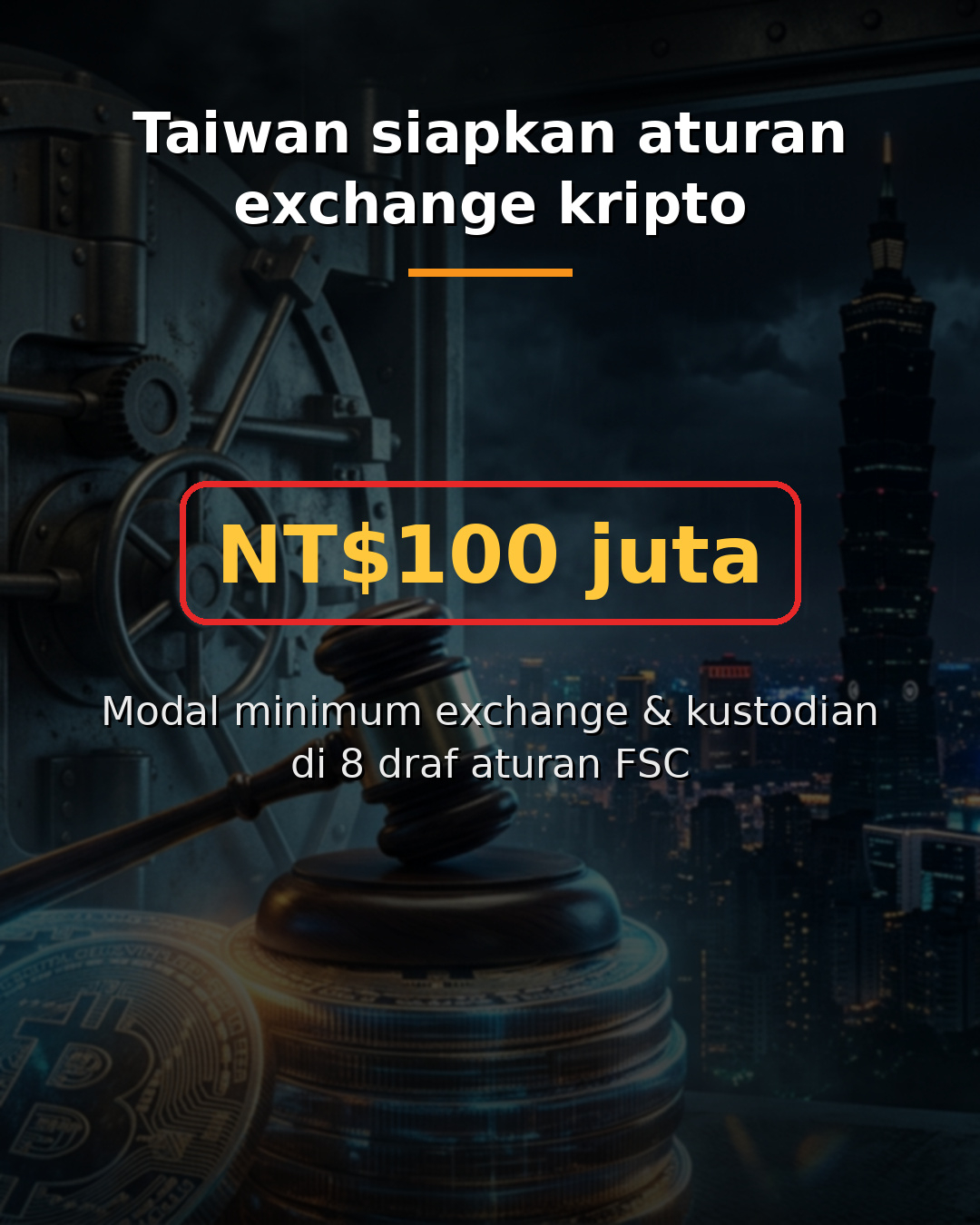
Taiwan prepares rules for crypto exchanges—how strict are the requirements?
Minimum capital for exchanges & custodians: NT$100 million | 8 draft FSC rules (Nov. 3, 2026)
Taiwan’s Financial Supervisory Commission (FSC) has released 8 draft regulations for crypto service providers. Key points:
1. Tiered paid-in capital requirements — Exchanges and custodians must have at least NT$100 million. Crypto lending platforms must have NT$200 million. Crypto asset exchange, transfer, or underwriting businesses must each have NT$50 million. If a company offers multiple services, the requirements are added together.
2. Security deposits — Exchanges and custodians must deposit NT$30 million, while lenders must deposit NT$50 million. The amounts are added together if a company offers more than one service.
3. Banks can participate — Banks that already provide crypto custody can apply for licenses to offer exchange, transfer, custody, and underwriting services, but exchange and transfer services will be limited to corporate clients.
The Virtual Asset Service Act was promulgated on July 22 but has not yet taken effect. The public has 40 days to submit comments. The technical rules and the Act are planned to take effect on the same day.
#Regulasi #Taiwan #Kripto #Exchange #BinanceSquare
74
·
--
Of the 150–200 companies expected to take part, only around 40 registered — Brazil has just cut its crypto industry down to a handful of players.
The facts: The Central Bank of Brazil’s October 30 deadline for virtual asset service providers (VASPs) wishing to continue operating has passed. Around 40 institutions applied for authorization — including Binance, Itaú, and the B3 stock exchange. Those that didn’t apply must orderly exit the Brazilian market within 30 days, and starting November 6, banks and payment institutions will be prohibited from serving unauthorized VASPs. The new rules also require daily custody reports for each client and monthly proof of reserves. (Source: PANews, CryptoNews, TradingView/Bloomingbit — Nov 2, 2026.)
My take: this is regulatory consolidation, not just a crackdown. The pattern is the same as MiCA in Europe: compliance costs become a barrier to entry, and big markets eventually end up in the hands of players able to meet them. The date that really matters is November 6 — when banks cut off fiat access, unauthorized VASPs will effectively no longer be able to serve Brazilian customers.
What I’m watching next: whether enforcement on November 6 goes smoothly or includes a transition period, and whether stablecoins and real-world asset tokenization become the next phase of regulation.
What do you think — does this kind of consolidation make the market safer, or does it just stifle competition?
This is my analysis, not financial advice — always DYOR.
#Regulasi #Brasil #Crypto $BNB
12
·
--
Crypto never sleeps — and US derivatives regulators are now discussing whether futures markets should stay up all night too.
The facts: On Oct. 28, the CFTC announced it will hold an industry roundtable on Dec. 15 at its Washington headquarters (livestreamed) to discuss the feasibility of 24/7 derivatives trading. This follows last summer’s Request for Comment. Topics include overnight trading, tokenization, infrastructure, staffing, and operational readiness. Chair Selig stressed that the approach would not be one-size-fits-all across asset classes. The agenda, speakers, and registration details will be announced later; the public may suggest speakers.
My take: this isn’t just about opening hours, but the machinery behind them — overnight margin, surveillance, and systems that must never go down. Crypto markets have been 24/7 for a long time, while US futures still have trading sessions; if regulators find a workable formula, the line between the two will grow thinner. Important to note: this is only a discussion, not approval to launch.
What I’m watching: the agenda and participant list when they’re released, and whether the discussion touches on the US-regulated crypto perpetuals that launched this week. BTC is around $79,972 this morning — the market itself is testing $80,000 from below.
What do you think: are markets that never close progress, or a new risk we’re not yet ready to manage?
This is my analysis, not financial advice — always DYOR.
#Regulasi #Derivatif $BTC
67
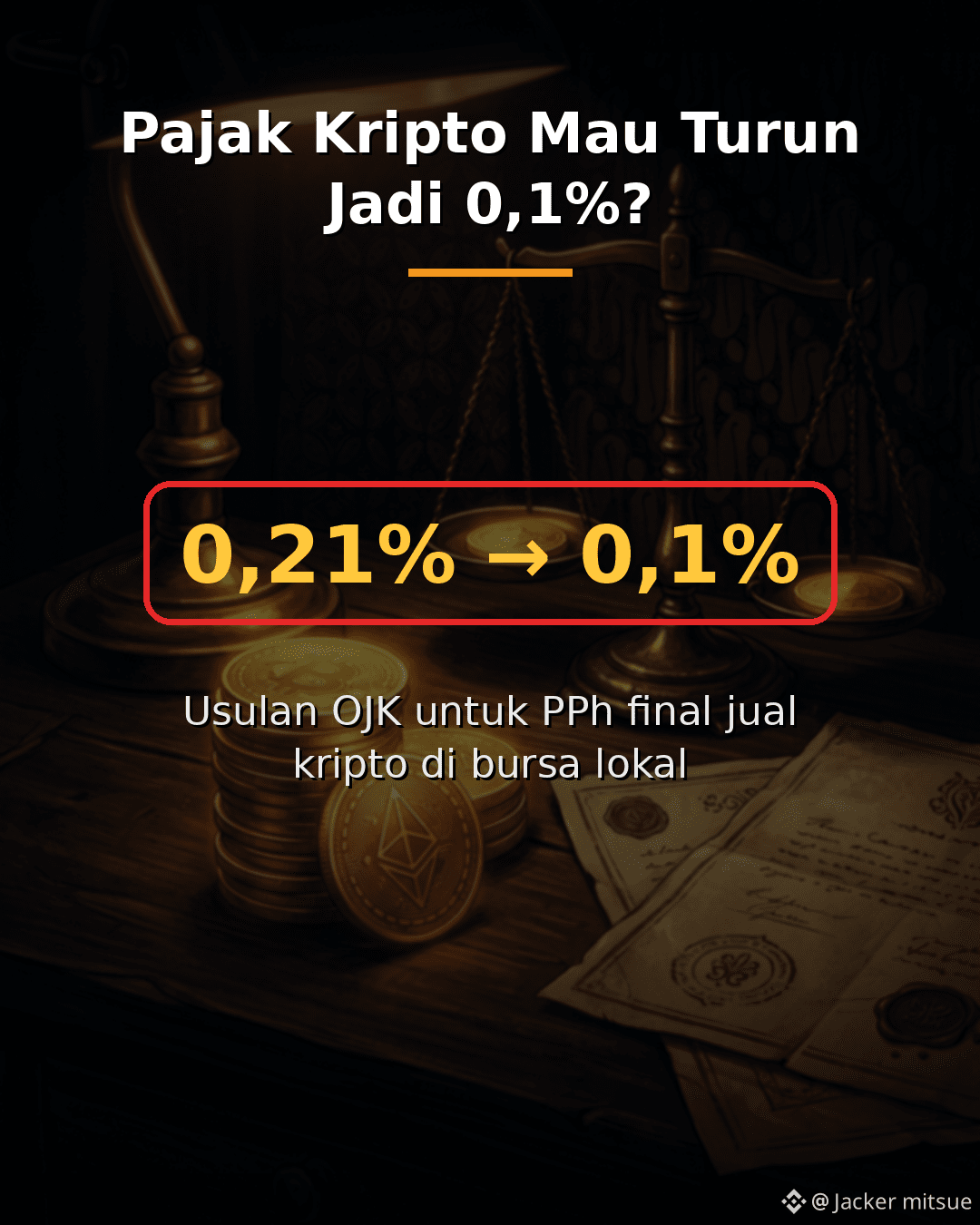
Will crypto tax in Indonesia drop to 0.1%?
Currently 0.21% (local exchanges) | 1% (foreign platforms) | Proposed: 0.1%
1. Current regulations — Since August 1, 2025, under PMK 50/2025, crypto sales are subject to a final Article 22 income tax of 0.21% of the transaction value when made through a domestic exchange, and 1% when made through a foreign platform. Buying crypto? It is no longer subject to VAT because crypto is treated as a security.
2. OJK proposal — Adi Budiarso of OJK said the industry is pushing for the final income tax rate to be reduced from 0.21% to 0.1%, matching the tax on stock sales on the stock exchange (at a seminar on Oct. 16, 2026, as reported by DDTCNews). It is still a proposal; no new PMK has been issued.
3. What this means for you — Tax is calculated on the sale value, not the profit. For example: sell Rp10 million worth of crypto on a local exchange, and the income tax is Rp21,000; if the proposal is approved, it would be Rp10,000. Keep an eye out for official announcements from the Ministry of Finance/DJP.
#PajakKripto #OJK #KriptoIndonesia #Regulasi #BinanceSquare
76
Log in to explore more content
Join global crypto users on Binance Square
⚡️ Get latest and useful information about crypto.
💬 Trusted by the world’s largest crypto exchange.
👍 Discover real insights from verified creators.
Email / Phone number
Trending Topics
1
#CanBTCReboundAfterFallingBelow60K?
106,207 views
494 Discussing
2
#GlobalStocksFaceLongestLosingStreakSince2023
48,293 views
492 Discussing
3
#AnthropicPlungesTowardIPOPriceonDay2
15,582 views
196 Discussing
4
#GaoTengBitcoinETFListsOnHKEX
35,946 views
386 Discussing
5
#TradFiForBeginners
1M views
5,808 Discussing
6
#NvidiaBoardReportedlySplitOverHuang’sReturn
395,190 views
2,577 Discussing
7
#TetherBurns8BillionUSDTInPast20Days
41,465 views
156 Discussing
8
#BitcoinWalletSignatureFlawExploitableWithinSeconds
11,789 views
74 Discussing
9
#CanGTA6'sLaunchLiftTTWOShares?
331,964 views
1,803 Discussing
10
#HongKongProposesSFCLicensingForFourVirtualAssetServices
2,100 views
36 Discussing