
#travelrule
travelrule
4,745 views
93 Discussing
Hot
Latest

·
--
Coins.ph has stopped supporting self-custody wallets. Since Nov 19, Philippine users can only send crypto to or receive it from other regulated platforms, and every external transfer needs Travel Rule details whatever the amount, to meet Bangko Sentral ng Pilipinas rules. A big test for self-custody in Southeast Asia. #Crypto #Philippines #TravelRule
Coins.ph has stopped supporting self-custody wallets. Since Nov 19, Philippine users can only send crypto to or receive it from other regulated platforms, and every external transfer needs Travel Rule details whatever the amount, to meet Bangko Sentral ng Pilipinas rules. A big test for self-custody in Southeast Asia. #Crypto #Philippines #TravelRule


·
--
🇵🇭 Coins.ph cuts off self-custody wallet transfers
Philippine exchange Coins.ph now only lets users send and receive crypto with accounts at other regulated exchanges, saying self-custody wallets are no longer supported as of Nov. 19.
Every external deposit or withdrawal, of any size, now requires names, wallet addresses, the counterparty platform and the purpose of the transfer, and funds move only after the details are verified. The exchange cites the Travel Rule set by the Bangko Sentral ng Pilipinas (BSP).
⭐ One of Asia's strictest takes on the Travel Rule, it cuts users off from moving coins to personal wallets or DeFi and could set a precedent for other regional platforms.
#Philippines #TravelRule #SelfCustody #CryptoRegulation

67

·
--
I just saw a notice in the official Coins.ph Help Center, the Philippine exchange. The page was updated on November 21: as of November 19, they no longer support transfers to or from self-custody wallets.
The notice says crypto assets can only be transferred to accounts at other regulated exchanges, and can only be received from those accounts. This is to comply with the BSP’s Travel Rule. For every transfer to or from another platform, regardless of the amount, you must provide information about the other party. The transfer will only be processed after verification.
If you only use Coins.ph and don’t transfer assets off the platform, this change won’t affect you.
#TravelRule
12

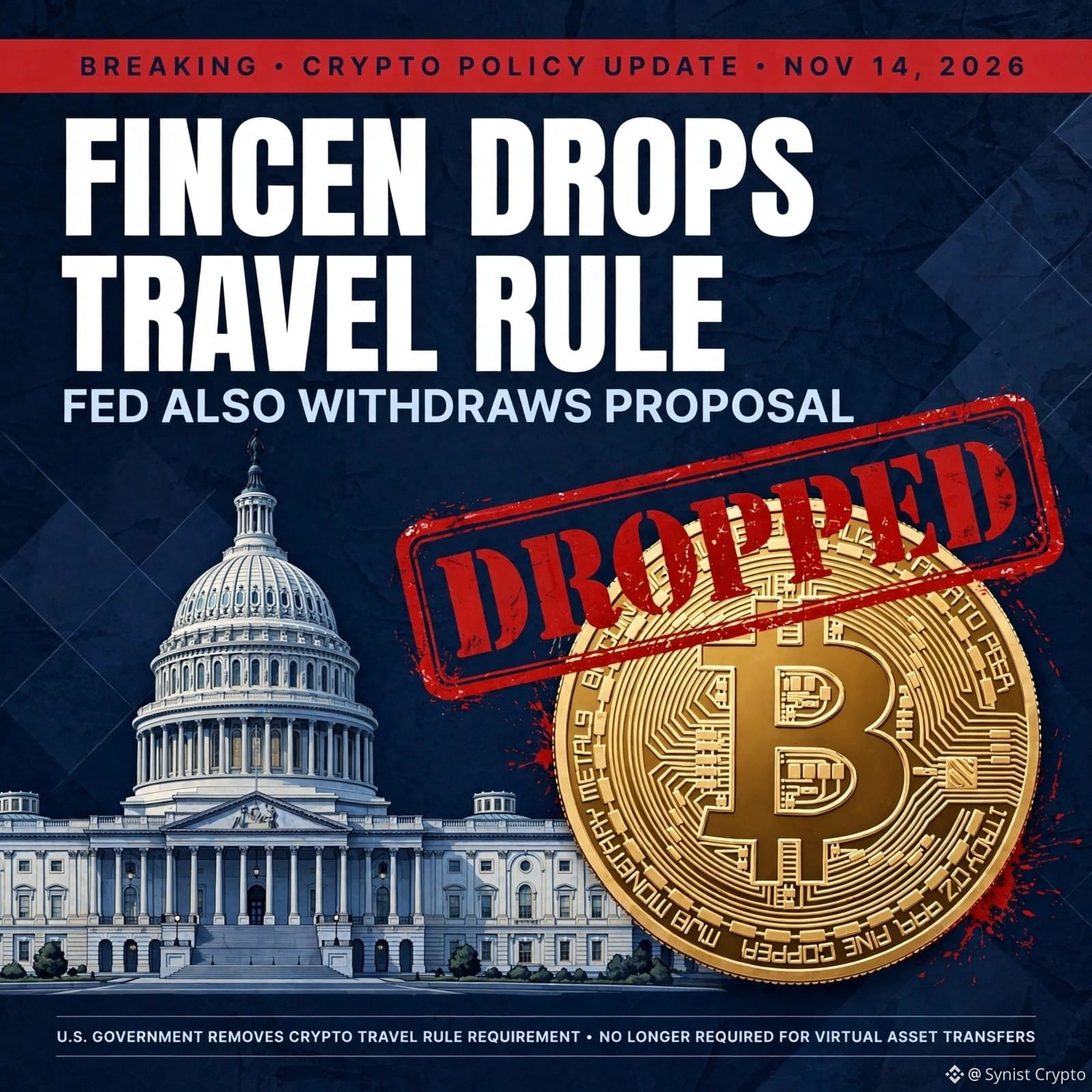
US JUST DROPPED A BIG CRYPTO RULE WHILE BTC IS BLEEDING
FinCEN and Fed just withdraw proposed crypto Travel Rule expansion That rule would have forced more info sharing on crypto transfers.
BTC still near $66,800 after it fell to $66,400 lowest since August ETFs saw 7th straight day of outflows $185.4M on Friday alone.
Do you think dropping this rule will help crypto bounce or is price still going down?
#cryptonewstoday #Bitcoin #FinCENAndFedToWithdrawCrossBorderThresholdProposal #TravelRule
137

·
--
The IMF has proposed a specific measure to Kenya: requiring crypto companies to share customer identity and wallet information under the Travel Rule.
Crypto.news reported that the IMF’s request comes as Kenya strengthens its anti-money laundering controls. The information to be shared includes customer IDs and wallet details. The report did not specify the form in which the request was made, or whether Kenya has responded.
· What can currently be confirmed is that the IMF made the request and specified two data items: customer IDs and wallet details. No corresponding information is available on approval or implementation.
· If implemented, the requirement would apply between crypto companies, not to public disclosures.
Has a timeline been set for implementing the Travel Rule?
#反洗钱 #TravelRule

29

·
--
【U.S. Crypto Regulation】$250 Threshold Proposal Formally Withdrawn—Travel Rule Not Repealed
On November 9, the Federal Register published document 2026-22809, announcing that FinCEN and the Federal Reserve were withdrawing their 2020 joint proposal, effective that day. FinCEN had issued an advance notice on November 6; today’s development is the formal publication and the withdrawal taking effect.
The original proposal would have lowered the recordkeeping threshold for certain funds transfers beginning or ending outside the United States from $3,000 to $250, adjusted the accompanying requirements for transfer information, and clarified the scope of covered transactions, including transactions involving convertible virtual currency.
Key distinction: What was withdrawn is a proposed amendment that had not taken effect—not the existing Travel Rule. Nor does this mean that crypto transactions are exempt from anti-money laundering obligations. Regulators said that if similar amendments are proposed in the future, the public will again have an opportunity to comment.
Why it matters: This removes the uncertainty that a final rule might be issued directly under the old proposal, but it does not mean “a broad easing of regulation” or guarantee rising crypto prices.
Which matters more to you: transfer privacy, or harmonized compliance standards across platforms?
#CryptoRegulation #FinCEN #TravelRule
Original sources:
https://www.federalregister.gov/d/2026-22809
https://www.fincen.gov/news/news-releases/fincen-announces-withdrawal-proposed-rule-related-recordkeeping-and-travel-rule
55

·
--
Quiet headline, real impact: US regulators just dropped the $250 crypto Travel Rule.
On Friday, FinCEN and the Federal Reserve withdrew the 2020 proposal that would have cut the cross-border reporting threshold for crypto transfers from $3,000 to $250. The $3,000 line stays. That means exchanges won't have to build new data pipelines for every small remittance, and everyday users keep sending modest amounts without extra paperwork.
What stands out to me is the pattern. This is the third Bank Secrecy Act crypto rollback in about a month, after Treasury pulled the unhosted wallet and mixing rules in October.
Price barely reacted. $ETH sits near $2,244 and $SOL around $90 while the market waits on macro. But less compliance friction is the kind of slow tailwind that matters more for adoption than for one day's candle.
Are you watching regulation, or just the chart?
#CryptoRegulation #TravelRule #CryptoNews #Write2Earn
Not financial advice.
114

Washington just quietly closed the book on one of crypto's oldest surveillance fights — I think most people missed it.
On Friday, the Treasury's FinCEN and the Federal Reserve withdrew their 2020 proposal to cut the "travel rule" threshold for international transfers from $3,000 to $250. It would have forced banks and money transmitters to collect and share sender details on far smaller payments, including convertible virtual currency. The agencies said five years had passed and the industry had changed. It follows last month's withdrawal of the unhosted-wallet and mixer proposals.
That's three such proposals shelved in about a month, and the $3,000 threshold stays. But don't read this as a free pass — the agencies left the door open to a revised proposal, and current reporting duties stand. $BTC sat flat near $75,860.
Lighter-touch era, or just Washington clearing stale paperwork before writing new rules? DYOR.
#Bitcoin #Regulation #TravelRule #CryptoMarkets
6
·
--
Saw this on Wu Blockchain: FinCEN and the Federal Reserve have withdrawn the 2020 proposal to revise the Travel Rule, lowering the threshold for cross-border transfers from $3,000 to $250.
The original proposal also planned to bring convertible virtual currencies and digital assets with legal-tender status under the rule—meaning identity information would have to be collected even for small cross-border crypto transfers. Nearly 3,000 public comments came in, most of them citing excessive compliance costs and privacy risks.
The official position: the industry and regulatory framework have changed, and feedback has been received, so the proposal is being withdrawn for now. Any future changes would require a new round of public comment. The current $3,000 threshold remains in place, and the Travel Rule itself has not been scrapped. The withdrawal is expected to take effect on November 9.
The threshold hasn’t been lowered, and exchanges can skip another round of heavy compliance prep.
#FinCEN #TravelRule #Regulation
12

US Treasury Withdraws Crypto Oversight Details
- The US Treasury Department has withdrawn its controversial 'travel rule' proposal concerning requirements for cryptocurrency transactions
- The proposal aimed to expand regulations for crypto transactions
- News related to macro regulations affecting the crypto market
#BinanceSquare #CryptoNews #TravelRule #US Treasury #Regulation
$btc $eth
vlikevn Titanbot
Source: The Block
183

Don’t get swept up in the “U.S. scraps crypto surveillance” narrative.
What FinCEN and the Federal Reserve withdrew on November 6 was a 2020 proposal that would have lowered the threshold for cross-border travel rule requirements from $3,000 to $250. The Federal Register is expected to publish it on November 9. The current $3,000 threshold hasn’t changed, and exchanges still have to collect the required information.
The official explanation: the proposal had been pending for five years, the industry had changed (they even cited the GENIUS stablecoin law), and they need to seek public comment again. In plain English: this isn’t about giving you privacy; the old test is scrapped and you’ll be tested on a new one.
The EU has been recording transactions from the very first euro. The U.S. still has its $3,000 threshold. Accounts shouting “privacy victory” don’t mention the rules already in place—they’re just selling outrage. The ones who really benefit are compliance teams at small and midsize banks, which will have fewer reports to file on $250 transactions.
#TravelRule #Regulation
99

·
--
⚖️ THE U.S. HAS REFUSED TO LOWER THE TRAVEL RULE THRESHOLD TO $250
On November 6, FinCEN and the U.S. Federal Reserve announced the withdrawal of a 2020 proposal. It would have lowered the threshold from $3,000 to $250, above which financial institutions must collect and transmit information about certain international transfers. The proposal also clarified how the rules apply to convertible virtual currencies.
Important: It is the proposal—not the current Travel Rule—that has been withdrawn. The $3,000 threshold and existing obligations for financial institutions remain in effect. Notice of the withdrawal is scheduled to be published in the Federal Register on November 9.
Sources: FinCEN, Federal Register.
#Крипторегулирование #TravelRule
168

·
--
Treasury & the Fed officially withdrew an old plan that could have tracked crypto transfers as small as $250 — the $3,000 threshold remains in place.
Facts: FinCEN (the U.S. Treasury Department) and the Federal Reserve Board jointly filed a notice of withdrawal on Nov. 6, 2026. It is scheduled to be published in the Federal Register on Nov. 9 and take effect immediately. What was withdrawn: the 2020 proposal to lower the recordkeeping/Travel Rule threshold for cross-border transfers from $3,000 to $250, while also clarifying that the rule applied to crypto. The current $3,000 threshold remains in effect, and both agencies said they would take no further action — any new final rule would first have to go through public comment.
My take: this isn’t just one proposal being scrapped — it’s the third piece in a series of U.S. regulatory rollbacks. FinCEN had already withdrawn its 2020 proposal on unhosted wallets and its 2023 proposal on crypto mixing reports. The pattern is consistent: Washington is easing, not tightening, oversight of crypto transfers. For the market, this removes one cloud of uncertainty — but don’t overstate it: the status quo is being preserved, not new freedoms granted. BTC is still moving sideways at around $75,844 after Thursday’s crash, so this news hasn’t become a price catalyst yet.
What I’m watching next: the official publication in the Federal Register on Nov. 9, then whether a replacement proposal with a different threshold emerges — plus U.S. CPI on Nov. 10 as the next major catalyst.
Do you think this series of rule withdrawals signals a more crypto-friendly direction for U.S. regulation, or is it just a pause before stricter new rules?
#RegulasiKripto #TravelRule $BTC
38

·
--
The U.S. just pulled the plug on a regulatory landmine that had been looming for six years
FinCEN and the Federal Reserve jointly issued a withdrawal notice on November 6.
The 2020 proposal would have lowered the Travel Rule threshold for cross-border transfers from $3,000 to $250.
If it had gone through, even a $250 transfer of $BTC would have required your identity information to be attached.
That’s no longer happening. The threshold stays at $3,000, and the withdrawal takes effect when it’s officially published on November 9.
Put simply, regulators have taken a step back.
FinCEN had already withdrawn its proposal on self-hosted wallets and its 2023 proposal on mixers.
This time, they’ve shelved the last remaining one, too.
Their reasoning is pretty practical: the proposal is more than five years old, the industry has changed, and the GENIUS Act has now been passed.
There’s no direct impact on ordinary users like us.
Compliance requirements still apply, and the $3,000 threshold remains in place.
But small transfers won’t be scrutinized quite so heavily, which is a good thing.
With regulation, one less round of upheaval means one less market shake-up.
Just my personal opinion—not investment advice.
#TravelRule
12

📜 Regulation 101: Understanding the Travel Rule
On June 30, 2026, Australia's Travel Rule takes effect July 1, joining 40+ countries implementing FATF Recommendation 16. The Travel Rule requires crypto exchanges to share sender and recipient information for transactions above a threshold — similar to traditional banking requirements.
For everyday users, this means exchanges may require additional verification for certain transfers. The goal is to prevent money laundering and illicit finance. Privacy-focused alternatives like decentralized exchanges and privacy coins may become more relevant as Travel Rule adoption grows.
📌 Key Takeaway:
The Travel Rule brings crypto closer to traditional banking compliance — a step toward mainstream adoption that also raises important privacy considerations.
#FATF #TravelRule #CryptoRegulation
#BinanceAlphaAlert
81

South Korea has officially “closed the loopholes” in how shark-vibe wallets like to split transactions. Could this be the reason behind $BTC turning around near the 63.914,2 USD mark?
South Korea has scrapped the 1 million won threshold for the Travel Rule, meaning all upcoming crypto transactions will be monitored. From a money-flow perspective, this tightening causes large capital to either pull back or go idle while it waits and watches. The immediate reaction showed when, at the time of writing, both $BTC (-2.00%) and $ETH (-2.76%) were in the red.
In my view, this cautious mindset right now can easily create those annoying liquidity-sweeping moves. Sharks may use the news to push prices even deeper, in order to scoop up cheap inventory. During this period, you guys should place orders with smaller volume, and watch for strong support instead of rushing to catch the bottom. We still can’t be sure whether the price has already formed a bottom. Good risk management is what will keep us in the game.
In this zone, would you choose LONG or SHORT for $BTC? Hit $BTC below and let’s review the chart together! 👇
#Bitcoin #TravelRule #Phaply #Crypto
South Korea has officially “closed the loopholes” in how shark-vibe wallets like to split transactions. Could this be the reason behind $BTC turning around near the 63.914,2 USD mark?
South Korea has scrapped the 1 million won threshold for the Travel Rule, meaning all upcoming crypto transactions will be monitored. From a money-flow perspective, this tightening causes large capital to either pull back or go idle while it waits and watches. The immediate reaction showed when, at the time of writing, both $BTC (-2.00%) and $ETH (-2.76%) were in the red.
In my view, this cautious mindset right now can easily create those annoying liquidity-sweeping moves. Sharks may use the news to push prices even deeper, in order to scoop up cheap inventory. During this period, you guys should place orders with smaller volume, and watch for strong support instead of rushing to catch the bottom. We still can’t be sure whether the price has already formed a bottom. Good risk management is what will keep us in the game.
In this zone, would you choose LONG or SHORT for $BTC ? Hit $BTC below and let’s review the chart together! 👇
#Bitcoin #TravelRule #Phaply #Crypto
54
South Korea removes the 1 million won threshold, applying the Travel Rule to all crypto transfers
- South Korea eliminates the 1 million won threshold for the Travel Rule
- Requires sharing information applicable to all transfers between registered crypto service providers
- Goal: enhance transparency, prevent money laundering
- Impact: costs, procedures for crypto transactions
- #TravelRule #CryptoRegulation #SouthKorea
$btc $eth
#vlikevn #Titanbot
Source: CoinTelegraph
52

🚨 Cryptocurrency Travel Rule Guidelines 🧠
📊 | $BTC | $ETH | $BNB |
- Please follow, like, and comment on this post 📈
- Transactions between cryptocurrency exchanges may share personal identity information
- The Travel Rule is a banking standard from decades ago, and it is now reshaping the crypto market
- The rule requires exchanges to share user information when the transaction amount exceeds a certain threshold
- Implementation of this rule may have far-reaching effects on the cryptocurrency market 🔥
- The market may face downward pressure and panic-driven volatility due to the implementation of the Travel Rule
- Whales may respond to market changes by allocating funds or accumulating positions
- Large volatility is expected in the cryptocurrency market in the short term
- Or new market trends and investment opportunities may emerge
- Readers, how do you view the impact of the Travel Rule on the cryptocurrency market?
- Please continue to follow and comment on this post—let’s discuss the future of the cryptocurrency market
#Bitcoin #Crypto #TravelRule #Blockchain #Trading
149

·
--
🔍 What Is the Crypto Travel Rule?
The Travel Rule is reshaping crypto compliance by requiring exchanges to share customer information for certain transactions.
📖 Read more:
https://cointopsecret.com/
#TravelRule #Crypto #AML #KYC #CryptoNews
🔍 What Is the Crypto Travel Rule?
The Travel Rule is reshaping crypto compliance by requiring exchanges to share customer information for certain transactions.
📖 Read more:
https://cointopsecret.com/
#TravelRule #Crypto #AML #KYC #CryptoNews
The Travel Rule is reshaping crypto compliance by requiring exchanges to share customer information for certain transactions.
📖 Read more:
https://cointopsecret.com/
#TravelRule #Crypto #AML #KYC #CryptoNews

26
📜 Compliance Corner: Australian Exchanges Gear Up for Travel Rule
On June 30, 2026, Australian crypto exchanges are implementing systems to comply with the Travel Rule taking effect July 1. The rule requires collecting beneficiary information for transfers, a significant operational change for platforms accustomed to pseudonymous transactions.
The cost of compliance will likely accelerate consolidation among smaller exchanges that lack resources. Larger, compliant platforms will benefit from the 'flight to quality' as users migrate to regulated venues.
📌 Key Takeaway:
Australia's Travel Rule will accelerate exchange consolidation, benefiting compliant platforms while raising the barrier to entry for smaller players.
#Australia #TravelRule #CryptoExchanges
#BinanceAlphaAlert
44
Log in to explore more content
Join global crypto users on Binance Square
⚡️ Get latest and useful information about crypto.
💬 Trusted by the world’s largest crypto exchange.
👍 Discover real insights from verified creators.
Email / Phone number
Trending Topics
1
#NvidiaLoses$2.7TrillionInMonthAndAHalf
30,956 views
167 Discussing
2
#CanBTCReboundAfterFallingBelow60K?
877,010 views
3,252 Discussing
3
#GlobalStocksFaceLongestLosingStreakSince2023
334,416 views
2,180 Discussing
4
#BlackRockIBITPostsRecord$541MSingleDayOutflow
43,170 views
121 Discussing
5
#AnthropicPlungesTowardIPOPriceonDay2
172,904 views
1,335 Discussing
6
#TwentyOneCapitalAdds172.25BTC
79,970 views
773 Discussing
7
#HKBillWouldExcludeTokenizedDepositsFromVirtualAssets
11,662 views
56 Discussing
8
#BNBDropsBelow540USDTWith8.46%DailyDecline
90,483 views
725 Discussing
9
#HKBillProposesHK$100KFineForUnauthorizedCryptoTitles
3,150 views
29 Discussing
10
#BitMineFaces$10.1BUnrealizedETHLoss
6,324 views
32 Discussing