
#nvidia
nvidia
4.3M views
8,953 Discussing
Hot
Latest

·
--
Verified
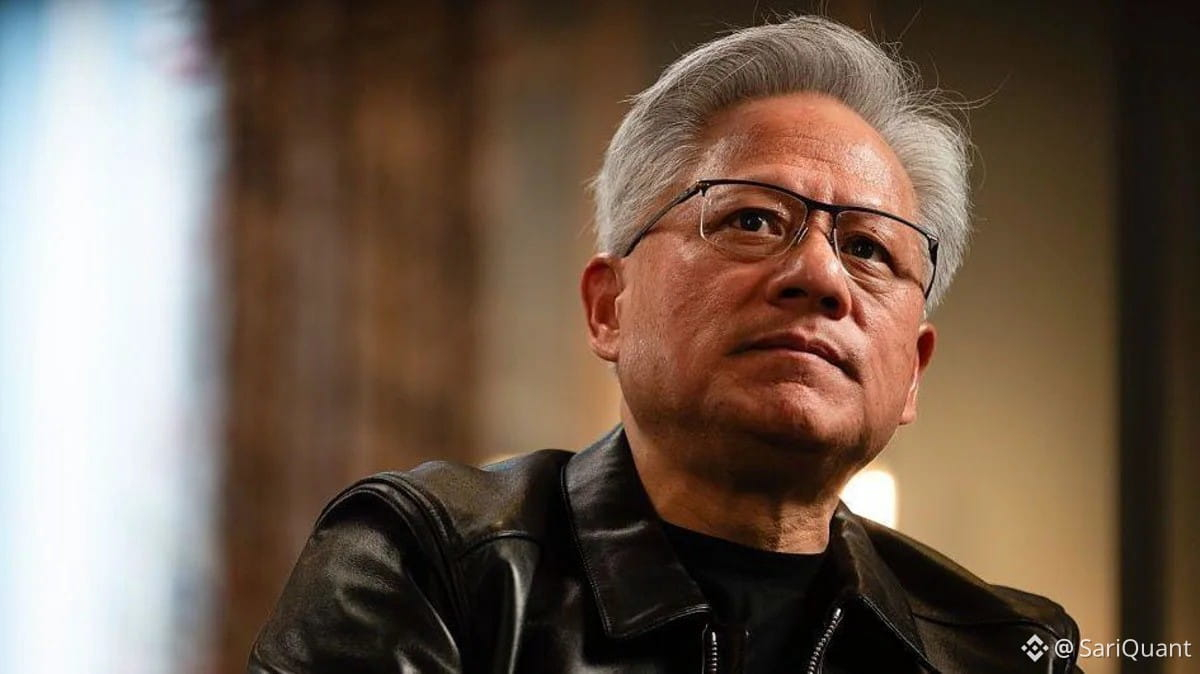
Huang, WIFE TRANSFER 59 MILLION NVIDIA SHARES WORTH $10.7 bn TO FAMILY TRUST
Nvidia co-founder Jensen Huang and his wife, Lori Huang, transferred nearly 59 million shares of the chipmaker, valued at approximately $10.7 billion, to a family trust in March 2026
The transfer involved 58,962,602 Nvidia shares and took place after two grantor-retained annuity trusts (GRATs), established by the couple in 2016, reached the end of their 10-year terms. The shares were transferred to the Huang Irrevocable Remainder Trust, of which Jensen Huang is a trustee.
The transaction was recorded as a gift without consideration, meaning the shares were not sold in the open market. The transfer was part of a decade-long estate-planning arrangement and preceded Huang's reported departure as Nvidia's chief executive in November 2026.
#NvidiaBoardReportedlySplitOverHuang’sReturn
#NVIDIA #JensenHuang
Huang, WIFE TRANSFER 59 MILLION NVIDIA SHARES WORTH $10.7 bn TO FAMILY TRUST
Nvidia co-founder Jensen Huang and his wife, Lori Huang, transferred nearly 59 million shares of the chipmaker, valued at approximately $10.7 billion, to a family trust in March 2026
The transfer involved 58,962,602 Nvidia shares and took place after two grantor-retained annuity trusts (GRATs), established by the couple in 2016, reached the end of their 10-year terms. The shares were transferred to the Huang Irrevocable Remainder Trust, of which Jensen Huang is a trustee.
The transaction was recorded as a gift without consideration, meaning the shares were not sold in the open market. The transfer was part of a decade-long estate-planning arrangement and preceded Huang's reported departure as Nvidia's chief executive in November 2026.
#NvidiaBoardReportedlySplitOverHuang’sReturn
#NVIDIA #JensenHuang
Nvidia co-founder Jensen Huang and his wife, Lori Huang, transferred nearly 59 million shares of the chipmaker, valued at approximately $10.7 billion, to a family trust in March 2026
The transfer involved 58,962,602 Nvidia shares and took place after two grantor-retained annuity trusts (GRATs), established by the couple in 2016, reached the end of their 10-year terms. The shares were transferred to the Huang Irrevocable Remainder Trust, of which Jensen Huang is a trustee.
The transaction was recorded as a gift without consideration, meaning the shares were not sold in the open market. The transfer was part of a decade-long estate-planning arrangement and preceded Huang's reported departure as Nvidia's chief executive in November 2026.
#NvidiaBoardReportedlySplitOverHuang’sReturn
#NVIDIA #JensenHuang
9
2k

·
--
Partly True
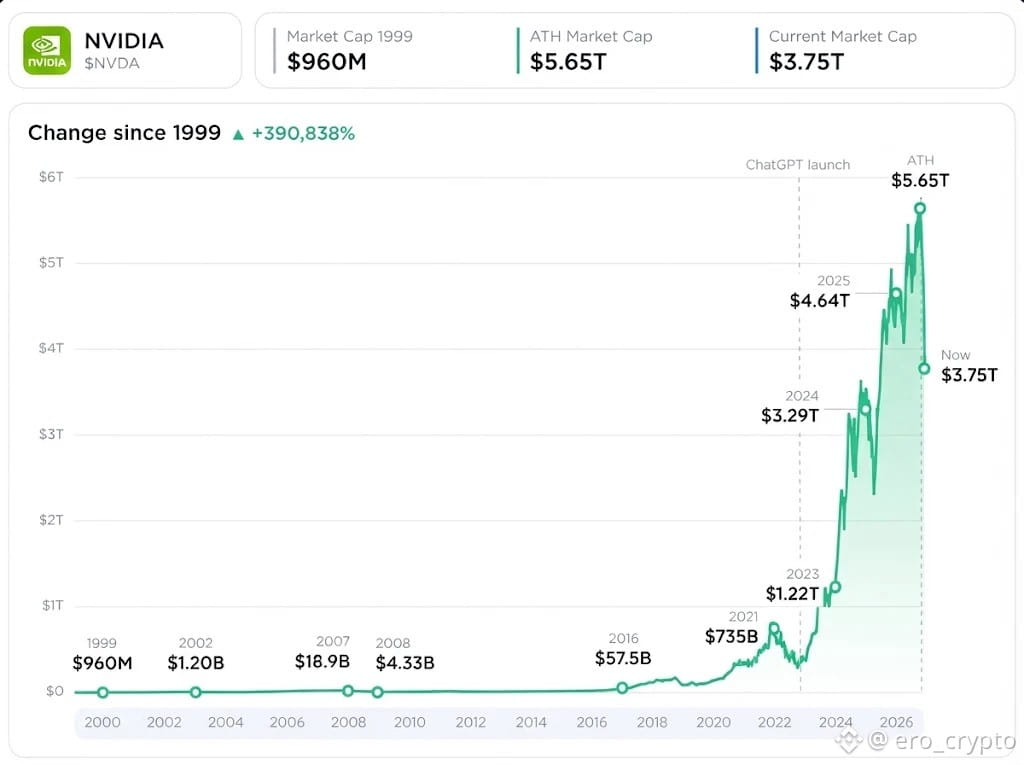
#NVIDIA Market Cap Since 1999
From $960M at the end of 1999 to $3.75T today, NVIDIA grew 3,909x. The road was not smooth: −81% in 2002, −77% in 2008 and −50% in 2022.
The AI era did most of the work. In the week ChatGPT launched, NVIDIA was worth $421B; by the October peak it was 13.4x bigger. 2023 (+236%) was its best year ever, ahead of the GPU boom of 2016 (+224%), and 2024 added another +169%.
Since the ATH, $1.90T is gone in about six weeks (−34%), and the market cap is down 19% in 2026.
#NVIDIA Market Cap Since 1999
From $960M at the end of 1999 to $3.75T today, NVIDIA grew 3,909x. The road was not smooth: −81% in 2002, −77% in 2008 and −50% in 2022.
The AI era did most of the work. In the week ChatGPT launched, NVIDIA was worth $421B; by the October peak it was 13.4x bigger. 2023 (+236%) was its best year ever, ahead of the GPU boom of 2016 (+224%), and 2024 added another +169%.
Since the ATH, $1.90T is gone in about six weeks (−34%), and the market cap is down 19% in 2026.
From $960M at the end of 1999 to $3.75T today, NVIDIA grew 3,909x. The road was not smooth: −81% in 2002, −77% in 2008 and −50% in 2022.
The AI era did most of the work. In the week ChatGPT launched, NVIDIA was worth $421B; by the October peak it was 13.4x bigger. 2023 (+236%) was its best year ever, ahead of the GPU boom of 2016 (+224%), and 2024 added another +169%.
Since the ATH, $1.90T is gone in about six weeks (−34%), and the market cap is down 19% in 2026.
2
887

Verified
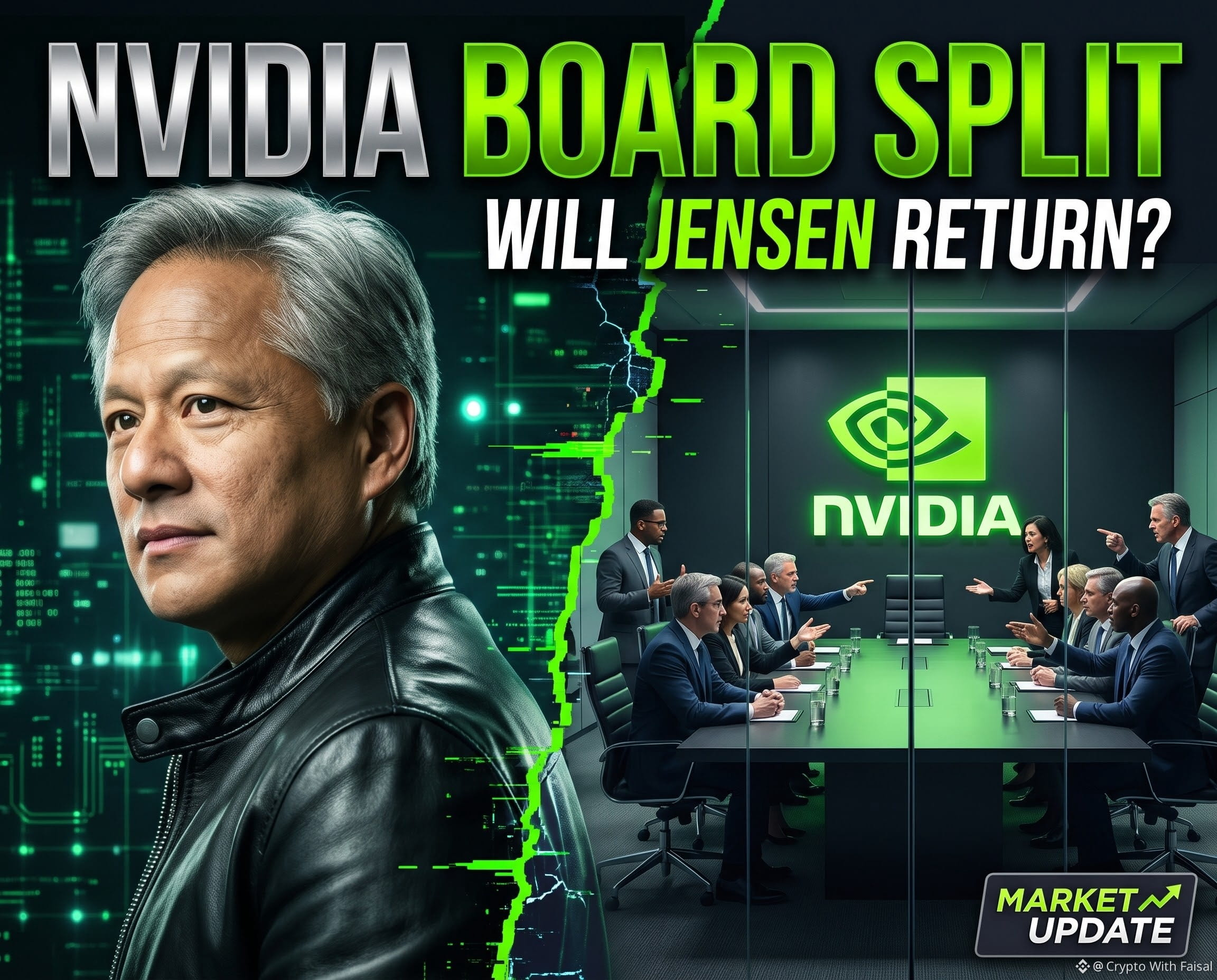
Nvidia’s boardroom drama just took a sharp turn—and AI traders are watching closely. 👀
Publicly, Board Chair Harvey Jones insists Nvidia has "no intention" of reinstating Jensen Huang after his resignation, even as Q3 revenue surged 103% YoY to $115.8B with $130B Q4 guidance.
Behind closed doors? A different story. According to Semafor, three directors are reportedly pushing to bring Huang back after he stated he would be "honored" to return.
Why this matters for the market:
• Leadership uncertainty is slowing the CEO search as external names like Arm’s Rene Haas and Marvell’s Matt Murphy circulate.
• Huang’s Dec 1 Congressional testimony keeps export-control and regulatory risk in focus.
• Core fundamentals remain massive, keeping AI compute demand—and AI crypto narratives—on high alert.
Volatility loves a power struggle. Do you think Nvidia’s board caves and brings Jensen back, or moves on? 👇
$NVDA $IRYS $MMT
{future}(MMTUSDT)
{future}(IRYSUSDT)
{future}(NVDAUSDT)
#nvidiaboardreportedlysplitoverhuang’sreturn #NVIDIA #AICrypto #MarketUpdate
Nvidia’s boardroom drama just took a sharp turn—and AI traders are watching closely. 👀
Publicly, Board Chair Harvey Jones insists Nvidia has "no intention" of reinstating Jensen Huang after his resignation, even as Q3 revenue surged 103% YoY to $115.8B with $130B Q4 guidance.
Behind closed doors? A different story. According to Semafor, three directors are reportedly pushing to bring Huang back after he stated he would be "honored" to return.
Why this matters for the market:
• Leadership uncertainty is slowing the CEO search as external names like Arm’s Rene Haas and Marvell’s Matt Murphy circulate.
• Huang’s Dec 1 Congressional testimony keeps export-control and regulatory risk in focus.
• Core fundamentals remain massive, keeping AI compute demand—and AI crypto narratives—on high alert.
Volatility loves a power struggle. Do you think Nvidia’s board caves and brings Jensen back, or moves on? 👇
$NVDA $IRYS $MMT
#nvidiaboardreportedlysplitoverhuang’sreturn #NVIDIA #AICrypto #MarketUpdate
Publicly, Board Chair Harvey Jones insists Nvidia has "no intention" of reinstating Jensen Huang after his resignation, even as Q3 revenue surged 103% YoY to $115.8B with $130B Q4 guidance.
Behind closed doors? A different story. According to Semafor, three directors are reportedly pushing to bring Huang back after he stated he would be "honored" to return.
Why this matters for the market:
• Leadership uncertainty is slowing the CEO search as external names like Arm’s Rene Haas and Marvell’s Matt Murphy circulate.
• Huang’s Dec 1 Congressional testimony keeps export-control and regulatory risk in focus.
• Core fundamentals remain massive, keeping AI compute demand—and AI crypto narratives—on high alert.
Volatility loves a power struggle. Do you think Nvidia’s board caves and brings Jensen back, or moves on? 👇
$NVDA $IRYS $MMT
#nvidiaboardreportedlysplitoverhuang’sreturn #NVIDIA #AICrypto #MarketUpdate
cryptokishehzadi:
Amazing sharing! Beginners ke liye aisi informative posts bohat helpful hoti hain. Keep growing ❤️
8
3
16
29.4k

·
--
Bullish
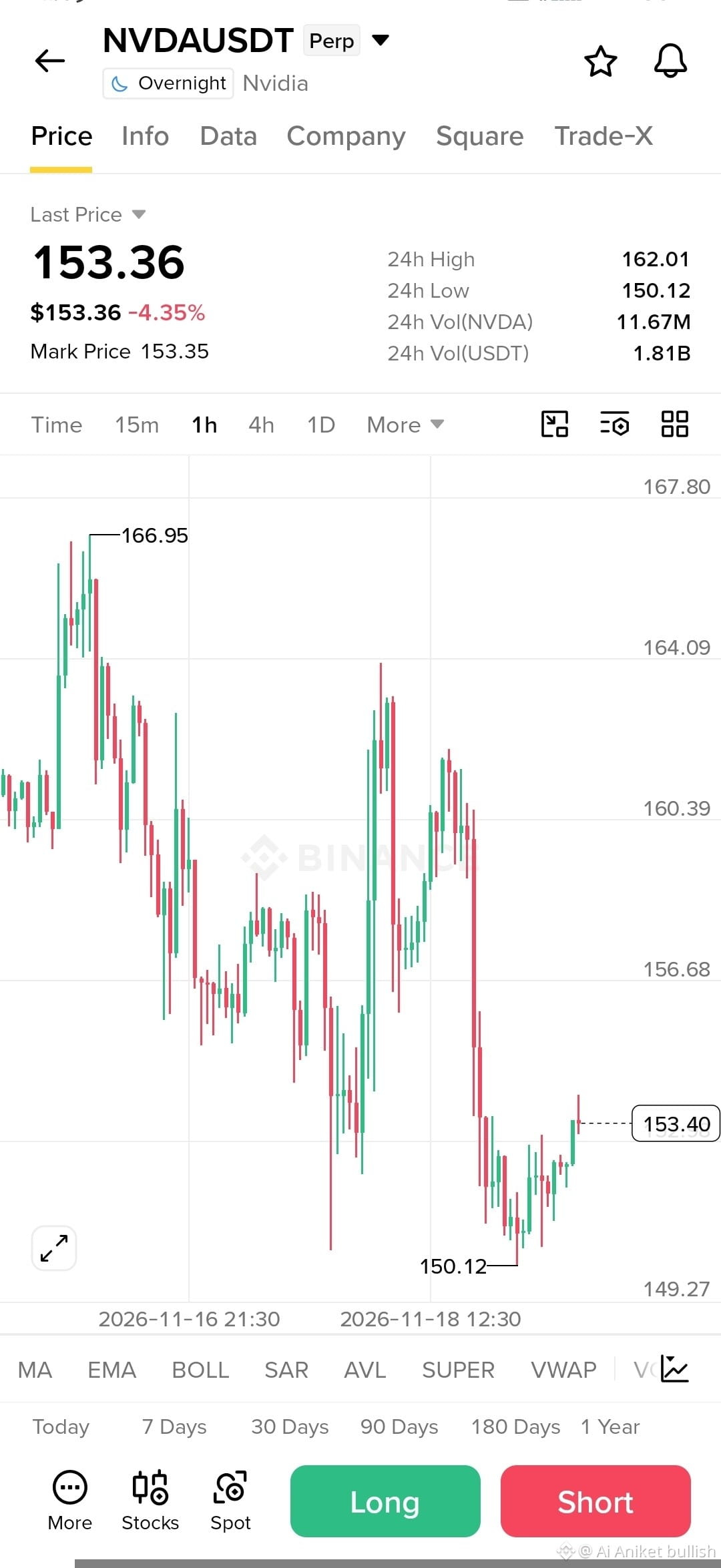
NVDA: Is This the Bounce Bulls Have Been Waiting For? 👀
$NVDA is showing a small recovery after dropping sharply toward the $150 area.
My view is cautiously bullish here. The $150 zone is an important support area, and buyers are trying to defend it.
If NVDA holds above $150 and reclaims $156–$160, the recovery could gain strength. But losing $150 would weaken the bullish outlook.
I'm watching this bounce closely. Can NVIDIA turn this dip into a real recovery? 🚀
{future}(NVDAUSDT)
#NVIDIA #stocks #trading #NVDIA
NVDA: Is This the Bounce Bulls Have Been Waiting For? 👀
$NVDA is showing a small recovery after dropping sharply toward the $150 area.
My view is cautiously bullish here. The $150 zone is an important support area, and buyers are trying to defend it.
If NVDA holds above $150 and reclaims $156–$160, the recovery could gain strength. But losing $150 would weaken the bullish outlook.
I'm watching this bounce closely. Can NVIDIA turn this dip into a real recovery? 🚀
#NVIDIA #stocks #trading #NVDIA
$NVDA is showing a small recovery after dropping sharply toward the $150 area.
My view is cautiously bullish here. The $150 zone is an important support area, and buyers are trying to defend it.
If NVDA holds above $150 and reclaims $156–$160, the recovery could gain strength. But losing $150 would weaken the bullish outlook.
I'm watching this bounce closely. Can NVIDIA turn this dip into a real recovery? 🚀
#NVIDIA #stocks #trading #NVDIA
1
1
253
·
--
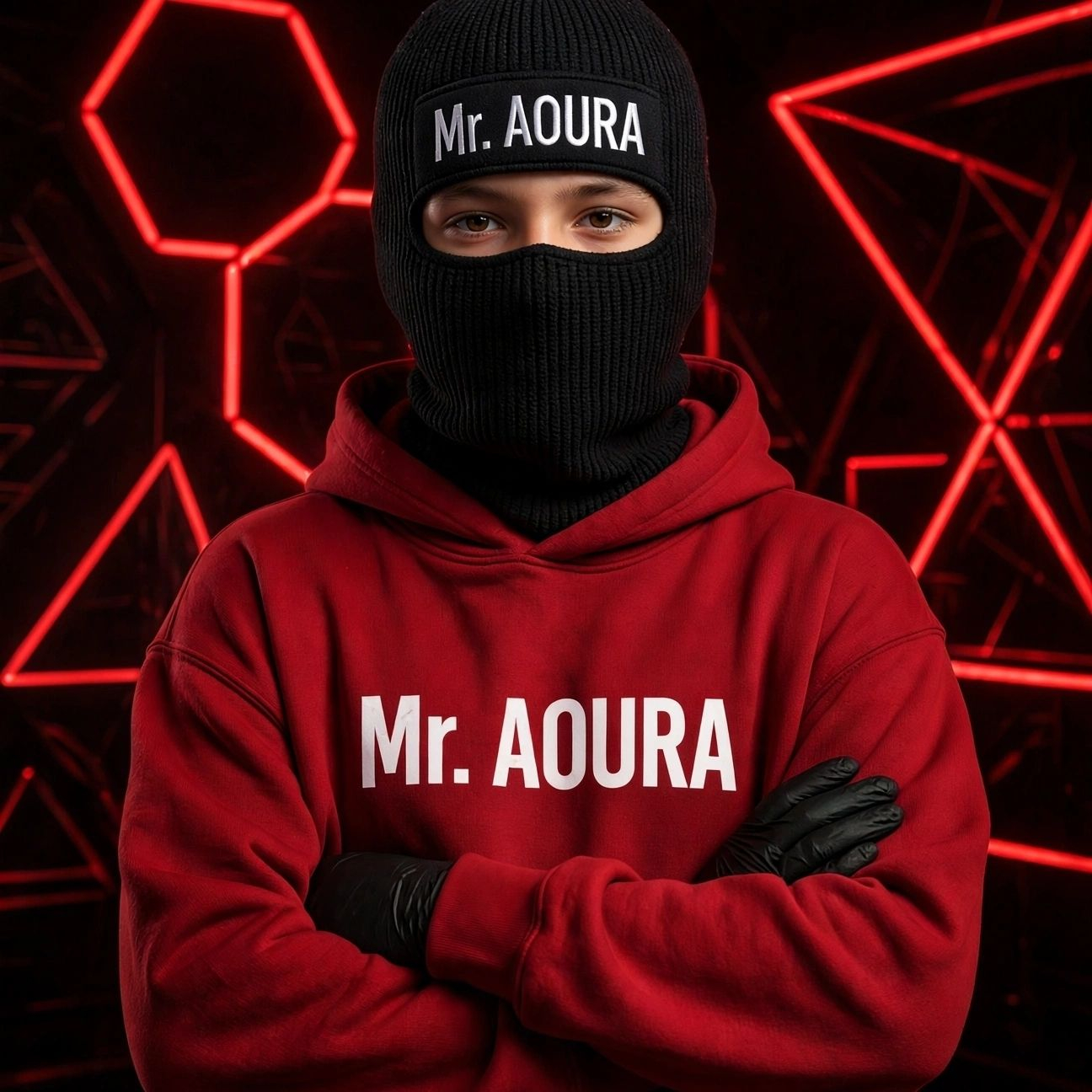
🚨 NVIDIA'S EARNINGS POP IS ALREADY GONE!
$BTC $ETH
Nvidia beat everything yesterday — $115.8 billion in revenue, up 103%. But the stock closed at $150.96, down 2.89% — its 5th straight down day. The whole earnings jump is gone.
The stock is now just above its 52-week low of $148.80, down 13% since November 11 and down more than 30% in a month. Even UBS cut its price target to $220 — the second cut in 3 days.
Money is rotating out: AMD jumped 5.3% the same day, and CoreWeave hit an all-time low. The market's second read was a small footnote — big cloud customers cut their spending commitments from $36 billion to $32 billion.
Is the AI trade finally cooling off? 👇
#Nvidia #AI #Crypto
(Info only, not financial advice)
{spot}(BTCUSDT)
{spot}(ETHUSDT)
🚨 NVIDIA'S EARNINGS POP IS ALREADY GONE!
$BTC $ETH
Nvidia beat everything yesterday — $115.8 billion in revenue, up 103%. But the stock closed at $150.96, down 2.89% — its 5th straight down day. The whole earnings jump is gone.
The stock is now just above its 52-week low of $148.80, down 13% since November 11 and down more than 30% in a month. Even UBS cut its price target to $220 — the second cut in 3 days.
Money is rotating out: AMD jumped 5.3% the same day, and CoreWeave hit an all-time low. The market's second read was a small footnote — big cloud customers cut their spending commitments from $36 billion to $32 billion.
Is the AI trade finally cooling off? 👇
#Nvidia #AI #Crypto
(Info only, not financial advice)
$BTC $ETH
Nvidia beat everything yesterday — $115.8 billion in revenue, up 103%. But the stock closed at $150.96, down 2.89% — its 5th straight down day. The whole earnings jump is gone.
The stock is now just above its 52-week low of $148.80, down 13% since November 11 and down more than 30% in a month. Even UBS cut its price target to $220 — the second cut in 3 days.
Money is rotating out: AMD jumped 5.3% the same day, and CoreWeave hit an all-time low. The market's second read was a small footnote — big cloud customers cut their spending commitments from $36 billion to $32 billion.
Is the AI trade finally cooling off? 👇
#Nvidia #AI #Crypto
(Info only, not financial advice)
343

·
--
Bearish
Verified
⚡ $NVDA 'S BOARDROOM IS DIVIDED — AND THE CEO QUESTION ISN'T OVER
NVIDIA's leadership drama is getting more complicated
According to a Semafor report, some board members are pushing for Jensen Huang's return, while a three-member faction strongly opposes it
{future}(NVDAUSDT)
But there's a major contradiction — Chairman Harvey Jones publicly said the board unanimously accepted Huang's resignation and was not considering reinstating him
Huang himself has said he would be honored to return if the board believes it is in the company's best interest
📊 Meanwhile, NVIDIA reported $115.8B in Q3 FY2027 revenue, up 103% year over year, with Data Center revenue reaching $107.6B
The business remains powerful, but leadership uncertainty introduces a different kind of risk
$ANT
{future}(ANTUSDT)
🔎 The real question is whether NVIDIA can maintain its execution, customer confidence and strategic direction without the founder who shaped its AI dominance
Strong earnings can support a business — but they cannot automatically resolve a governance crisis
#NVIDIA #NVDA #Aİ
⚡ $NVDA 'S BOARDROOM IS DIVIDED — AND THE CEO QUESTION ISN'T OVER
NVIDIA's leadership drama is getting more complicated
According to a Semafor report, some board members are pushing for Jensen Huang's return, while a three-member faction strongly opposes it
But there's a major contradiction — Chairman Harvey Jones publicly said the board unanimously accepted Huang's resignation and was not considering reinstating him
Huang himself has said he would be honored to return if the board believes it is in the company's best interest
📊 Meanwhile, NVIDIA reported $115.8B in Q3 FY2027 revenue, up 103% year over year, with Data Center revenue reaching $107.6B
The business remains powerful, but leadership uncertainty introduces a different kind of risk
$ANT
🔎 The real question is whether NVIDIA can maintain its execution, customer confidence and strategic direction without the founder who shaped its AI dominance
Strong earnings can support a business — but they cannot automatically resolve a governance crisis
#NVIDIA #NVDA #Aİ
NVIDIA's leadership drama is getting more complicated
According to a Semafor report, some board members are pushing for Jensen Huang's return, while a three-member faction strongly opposes it
But there's a major contradiction — Chairman Harvey Jones publicly said the board unanimously accepted Huang's resignation and was not considering reinstating him
Huang himself has said he would be honored to return if the board believes it is in the company's best interest
📊 Meanwhile, NVIDIA reported $115.8B in Q3 FY2027 revenue, up 103% year over year, with Data Center revenue reaching $107.6B
The business remains powerful, but leadership uncertainty introduces a different kind of risk
$ANT
🔎 The real question is whether NVIDIA can maintain its execution, customer confidence and strategic direction without the founder who shaped its AI dominance
Strong earnings can support a business — but they cannot automatically resolve a governance crisis
#NVIDIA #NVDA #Aİ
1.4k

·
--
Nvidia says no. But behind closed doors, the board is split.
Three board members are reportedly pushing to bring Jensen Huang back, even as interim CEO Colette Kress and Chair Harvey Jones ruled it out. Jones said the board unanimously accepted Huang resignation and does not intend to reinstate him.
So why is this a story. Because Huang wants back. He said he would be honoured to return if it served shareholders, employees, the company and America. He said employees, investors, partners and customers are urging him to return.
Pressure is building outside too. More than 180,000 people signed a petition for his return. Elon Musk backed him. President Trump said he would not mind seeing him back. Huang owns about 3.5 percent of Nvidia, enough to nominate two directors.
Meanwhile the board is looking elsewhere. Arm CEO Rene Haas and Marvell CEO Matt Murphy are in the frame. A new national security committee is in place.
The split is real. One side wants stability. The other side wants the founder who built a $3.8 trillion empire.
Which side wins?
Comment below
$NVDA $ARM $MRVL
#NVIDIA #JensenHuang #NVDA
#NvidiaBoardReportedlySplitOverHuang’sReturn
Nvidia says no. But behind closed doors, the board is split.
Three board members are reportedly pushing to bring Jensen Huang back, even as interim CEO Colette Kress and Chair Harvey Jones ruled it out. Jones said the board unanimously accepted Huang resignation and does not intend to reinstate him.
So why is this a story. Because Huang wants back. He said he would be honoured to return if it served shareholders, employees, the company and America. He said employees, investors, partners and customers are urging him to return.
Pressure is building outside too. More than 180,000 people signed a petition for his return. Elon Musk backed him. President Trump said he would not mind seeing him back. Huang owns about 3.5 percent of Nvidia, enough to nominate two directors.
Meanwhile the board is looking elsewhere. Arm CEO Rene Haas and Marvell CEO Matt Murphy are in the frame. A new national security committee is in place.
The split is real. One side wants stability. The other side wants the founder who built a $3.8 trillion empire.
Which side wins?
Comment below
$NVDA $ARM $MRVL
#NVIDIA #JensenHuang #NVDA
#NvidiaBoardReportedlySplitOverHuang’sReturn
Three board members are reportedly pushing to bring Jensen Huang back, even as interim CEO Colette Kress and Chair Harvey Jones ruled it out. Jones said the board unanimously accepted Huang resignation and does not intend to reinstate him.
So why is this a story. Because Huang wants back. He said he would be honoured to return if it served shareholders, employees, the company and America. He said employees, investors, partners and customers are urging him to return.
Pressure is building outside too. More than 180,000 people signed a petition for his return. Elon Musk backed him. President Trump said he would not mind seeing him back. Huang owns about 3.5 percent of Nvidia, enough to nominate two directors.
Meanwhile the board is looking elsewhere. Arm CEO Rene Haas and Marvell CEO Matt Murphy are in the frame. A new national security committee is in place.
The split is real. One side wants stability. The other side wants the founder who built a $3.8 trillion empire.
Which side wins?
Comment below
$NVDA $ARM $MRVL
#NVIDIA #JensenHuang #NVDA
#NvidiaBoardReportedlySplitOverHuang’sReturn
1
263

Article
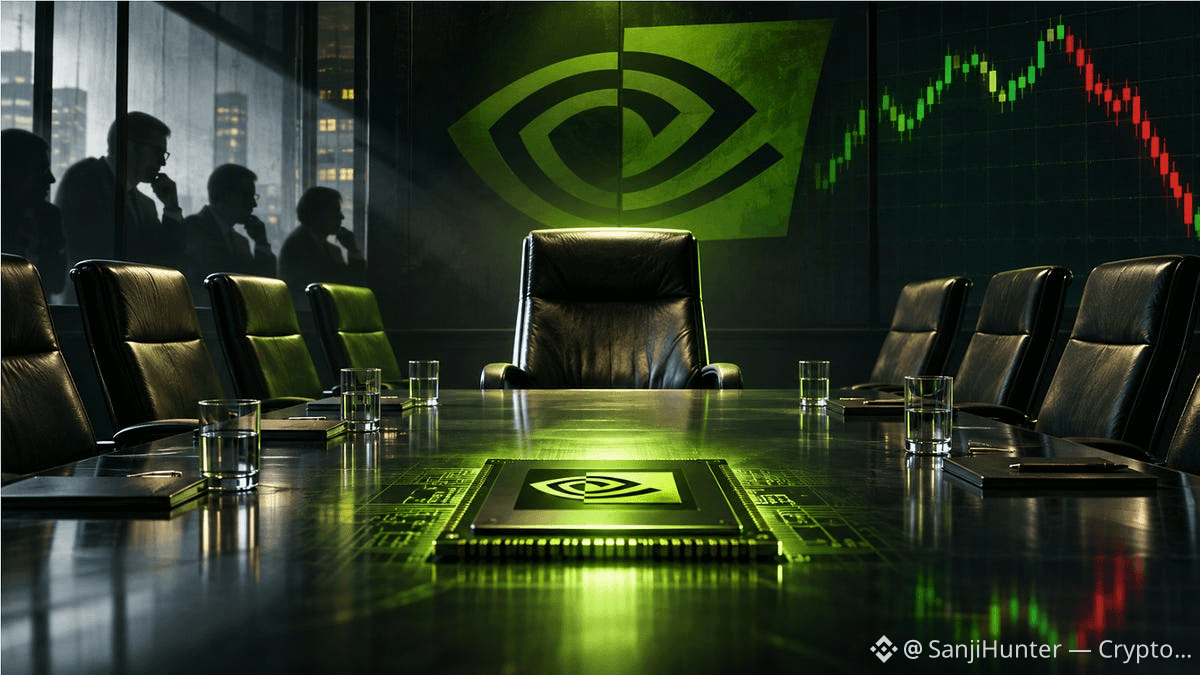
AI × CAPITAL MARKETS INTELLIGENCE 04NVIDIA DELIVERS $115.8 BILLION — WHY WALL STREET STILL SOLD THE STOCK
Can a company double its revenue and still disappoint investors?
NVIDIA has just demonstrated why extraordinary business performance does not always translate into higher share prices.
On November 17, 2026, NVIDIA reported its third-quarter fiscal 2027 results.
Revenue reached $115.8 billion, an increase of 103% year over year.
Data Center revenue climbed to $107.6 billion, up 110%.
Yet NVDA shares closed approximately 2.9% lower on November 18.
The contradiction deserves a closer look.
THE NUMBERS
Q3 FY2027:
• Total revenue: $115.8B
• Revenue growth: +103% YoY
• Data Center revenue: $107.6B
• Data Center growth: +110% YoY
• GAAP gross margin: 74.8%
• GAAP net income: $65.3B
• Diluted GAAP EPS: $2.70
Guidance for Q4 FY2027:
• Revenue: approximately $130B, plus or minus 3%
• Expected gross margin: 71–72%
NVIDIA is not reporting a collapse in AI demand.
Its financial results point to an extraordinary expansion of computing infrastructure.
So why did investors sell?
GROWTH IS NOT THE SAME AS EXPECTATIONS
Stock prices reflect expectations about future performance, not simply the strength of the most recent quarter.
When investors already anticipate exceptional growth, even excellent earnings may fail to trigger a rally.
The relevant questions become more demanding.
How much future revenue growth is already reflected in the share price?
Can profitability remain exceptional?
How long can customers sustain enormous AI capital expenditures?
These questions matter more as market valuations incorporate increasingly optimistic scenarios.
THE MARGIN SIGNAL
NVIDIA reported a GAAP gross margin of 74.8%.
Its guidance points to 71–72% in the following quarter.
That is a projected decline, not a realized result.
It also does not establish that NVIDIA's underlying business is deteriorating.
Product transitions, revenue mix and infrastructure costs may influence margins.
However, investors must evaluate whether revenue growth can compensate for changes in profitability.
A larger business does not automatically produce a proportionally larger valuation.
THE AI SPENDING QUESTION
NVIDIA's customers are investing heavily in data centers, GPUs, networking and accelerated computing infrastructure.
That creates enormous demand for NVIDIA products.
But there are two different financial stories.
For NVIDIA, AI infrastructure purchases generate revenue.
For customers, those purchases represent investments that must eventually produce sufficient returns.
The long-term sustainability of the cycle depends partly on whether customers can monetize their AI capacity through profitable products and services.
AI adoption can grow rapidly while some infrastructure investors experience disappointing returns.
That distinction is central to the next phase of the market.
LEADERSHIP AND STRATEGIC UNCERTAINTY
The market reaction also occurred amid significant uncertainty following Jensen Huang's departure from the CEO role.
Interim CEO Colette Kress now faces questions about strategic continuity, investment discipline and future competitive positioning.
Strong quarterly results do not automatically remove concerns about leadership transitions.
It would therefore be misleading to attribute the entire stock decline to one margin forecast.
WHAT TO WATCH NEXT
Data Center revenue growth and customer concentrationActual gross margins versus Q4 guidanceCustomer spending and AI monetizationProduct transitions and competitionManagement execution and strategic stability
OUR ASSESSMENT
NVIDIA's earnings confirm the extraordinary scale of the AI infrastructure expansion.
But the market is beginning to distinguish between three separate things:
AI adoption.
Corporate spending on AI.
Sustainable investment returns from AI.
These are connected, but they are not interchangeable.
The next stage of the AI boom will be measured not only by how much computing capacity companies purchase, but by how much lasting economic value they generate from it.
Would you prioritize NVIDIA's revenue growth, gross margins or the returns earned by its largest customers?
BITCHOICE | SATYA
AI × Capital Markets Intelligence 04
Research: NVIDIA Q3 FY2027 earnings, November 17, 2026; post-earnings market reaction, November 18.
#NVIDIA #Aİ #Earnings #CapitalMarkets #Semiconductors $NVDA $QQQ
{future}(QQQUSDT)
{future}(NVDAUSDT)
AI × CAPITAL MARKETS INTELLIGENCE 04
NVIDIA DELIVERS $115.8 BILLION — WHY WALL STREET STILL SOLD THE STOCK
Can a company double its revenue and still disappoint investors?
NVIDIA has just demonstrated why extraordinary business performance does not always translate into higher share prices.
On November 17, 2026, NVIDIA reported its third-quarter fiscal 2027 results.
Revenue reached $115.8 billion, an increase of 103% year over year.
Data Center revenue climbed to $107.6 billion, up 110%.
Yet NVDA shares closed approximately 2.9% lower on November 18.
The contradiction deserves a closer look.
THE NUMBERS
Q3 FY2027:
• Total revenue: $115.8B
• Revenue growth: +103% YoY
• Data Center revenue: $107.6B
• Data Center growth: +110% YoY
• GAAP gross margin: 74.8%
• GAAP net income: $65.3B
• Diluted GAAP EPS: $2.70
Guidance for Q4 FY2027:
• Revenue: approximately $130B, plus or minus 3%
• Expected gross margin: 71–72%
NVIDIA is not reporting a collapse in AI demand.
Its financial results point to an extraordinary expansion of computing infrastructure.
So why did investors sell?
GROWTH IS NOT THE SAME AS EXPECTATIONS
Stock prices reflect expectations about future performance, not simply the strength of the most recent quarter.
When investors already anticipate exceptional growth, even excellent earnings may fail to trigger a rally.
The relevant questions become more demanding.
How much future revenue growth is already reflected in the share price?
Can profitability remain exceptional?
How long can customers sustain enormous AI capital expenditures?
These questions matter more as market valuations incorporate increasingly optimistic scenarios.
THE MARGIN SIGNAL
NVIDIA reported a GAAP gross margin of 74.8%.
Its guidance points to 71–72% in the following quarter.
That is a projected decline, not a realized result.
It also does not establish that NVIDIA's underlying business is deteriorating.
Product transitions, revenue mix and infrastructure costs may influence margins.
However, investors must evaluate whether revenue growth can compensate for changes in profitability.
A larger business does not automatically produce a proportionally larger valuation.
THE AI SPENDING QUESTION
NVIDIA's customers are investing heavily in data centers, GPUs, networking and accelerated computing infrastructure.
That creates enormous demand for NVIDIA products.
But there are two different financial stories.
For NVIDIA, AI infrastructure purchases generate revenue.
For customers, those purchases represent investments that must eventually produce sufficient returns.
The long-term sustainability of the cycle depends partly on whether customers can monetize their AI capacity through profitable products and services.
AI adoption can grow rapidly while some infrastructure investors experience disappointing returns.
That distinction is central to the next phase of the market.
LEADERSHIP AND STRATEGIC UNCERTAINTY
The market reaction also occurred amid significant uncertainty following Jensen Huang's departure from the CEO role.
Interim CEO Colette Kress now faces questions about strategic continuity, investment discipline and future competitive positioning.
Strong quarterly results do not automatically remove concerns about leadership transitions.
It would therefore be misleading to attribute the entire stock decline to one margin forecast.
WHAT TO WATCH NEXT
Data Center revenue growth and customer concentrationActual gross margins versus Q4 guidanceCustomer spending and AI monetizationProduct transitions and competitionManagement execution and strategic stability
OUR ASSESSMENT
NVIDIA's earnings confirm the extraordinary scale of the AI infrastructure expansion.
But the market is beginning to distinguish between three separate things:
AI adoption.
Corporate spending on AI.
Sustainable investment returns from AI.
These are connected, but they are not interchangeable.
The next stage of the AI boom will be measured not only by how much computing capacity companies purchase, but by how much lasting economic value they generate from it.
Would you prioritize NVIDIA's revenue growth, gross margins or the returns earned by its largest customers?
BITCHOICE | SATYA
AI × Capital Markets Intelligence 04
Research: NVIDIA Q3 FY2027 earnings, November 17, 2026; post-earnings market reaction, November 18.
#NVIDIA #Aİ #Earnings #CapitalMarkets #Semiconductors $NVDA $QQQ
Can a company double its revenue and still disappoint investors?
NVIDIA has just demonstrated why extraordinary business performance does not always translate into higher share prices.
On November 17, 2026, NVIDIA reported its third-quarter fiscal 2027 results.
Revenue reached $115.8 billion, an increase of 103% year over year.
Data Center revenue climbed to $107.6 billion, up 110%.
Yet NVDA shares closed approximately 2.9% lower on November 18.
The contradiction deserves a closer look.
THE NUMBERS
Q3 FY2027:
• Total revenue: $115.8B
• Revenue growth: +103% YoY
• Data Center revenue: $107.6B
• Data Center growth: +110% YoY
• GAAP gross margin: 74.8%
• GAAP net income: $65.3B
• Diluted GAAP EPS: $2.70
Guidance for Q4 FY2027:
• Revenue: approximately $130B, plus or minus 3%
• Expected gross margin: 71–72%
NVIDIA is not reporting a collapse in AI demand.
Its financial results point to an extraordinary expansion of computing infrastructure.
So why did investors sell?
GROWTH IS NOT THE SAME AS EXPECTATIONS
Stock prices reflect expectations about future performance, not simply the strength of the most recent quarter.
When investors already anticipate exceptional growth, even excellent earnings may fail to trigger a rally.
The relevant questions become more demanding.
How much future revenue growth is already reflected in the share price?
Can profitability remain exceptional?
How long can customers sustain enormous AI capital expenditures?
These questions matter more as market valuations incorporate increasingly optimistic scenarios.
THE MARGIN SIGNAL
NVIDIA reported a GAAP gross margin of 74.8%.
Its guidance points to 71–72% in the following quarter.
That is a projected decline, not a realized result.
It also does not establish that NVIDIA's underlying business is deteriorating.
Product transitions, revenue mix and infrastructure costs may influence margins.
However, investors must evaluate whether revenue growth can compensate for changes in profitability.
A larger business does not automatically produce a proportionally larger valuation.
THE AI SPENDING QUESTION
NVIDIA's customers are investing heavily in data centers, GPUs, networking and accelerated computing infrastructure.
That creates enormous demand for NVIDIA products.
But there are two different financial stories.
For NVIDIA, AI infrastructure purchases generate revenue.
For customers, those purchases represent investments that must eventually produce sufficient returns.
The long-term sustainability of the cycle depends partly on whether customers can monetize their AI capacity through profitable products and services.
AI adoption can grow rapidly while some infrastructure investors experience disappointing returns.
That distinction is central to the next phase of the market.
LEADERSHIP AND STRATEGIC UNCERTAINTY
The market reaction also occurred amid significant uncertainty following Jensen Huang's departure from the CEO role.
Interim CEO Colette Kress now faces questions about strategic continuity, investment discipline and future competitive positioning.
Strong quarterly results do not automatically remove concerns about leadership transitions.
It would therefore be misleading to attribute the entire stock decline to one margin forecast.
WHAT TO WATCH NEXT
Data Center revenue growth and customer concentrationActual gross margins versus Q4 guidanceCustomer spending and AI monetizationProduct transitions and competitionManagement execution and strategic stability
OUR ASSESSMENT
NVIDIA's earnings confirm the extraordinary scale of the AI infrastructure expansion.
But the market is beginning to distinguish between three separate things:
AI adoption.
Corporate spending on AI.
Sustainable investment returns from AI.
These are connected, but they are not interchangeable.
The next stage of the AI boom will be measured not only by how much computing capacity companies purchase, but by how much lasting economic value they generate from it.
Would you prioritize NVIDIA's revenue growth, gross margins or the returns earned by its largest customers?
BITCHOICE | SATYA
AI × Capital Markets Intelligence 04
Research: NVIDIA Q3 FY2027 earnings, November 17, 2026; post-earnings market reaction, November 18.
#NVIDIA #Aİ #Earnings #CapitalMarkets #Semiconductors $NVDA $QQQ
260

·
--
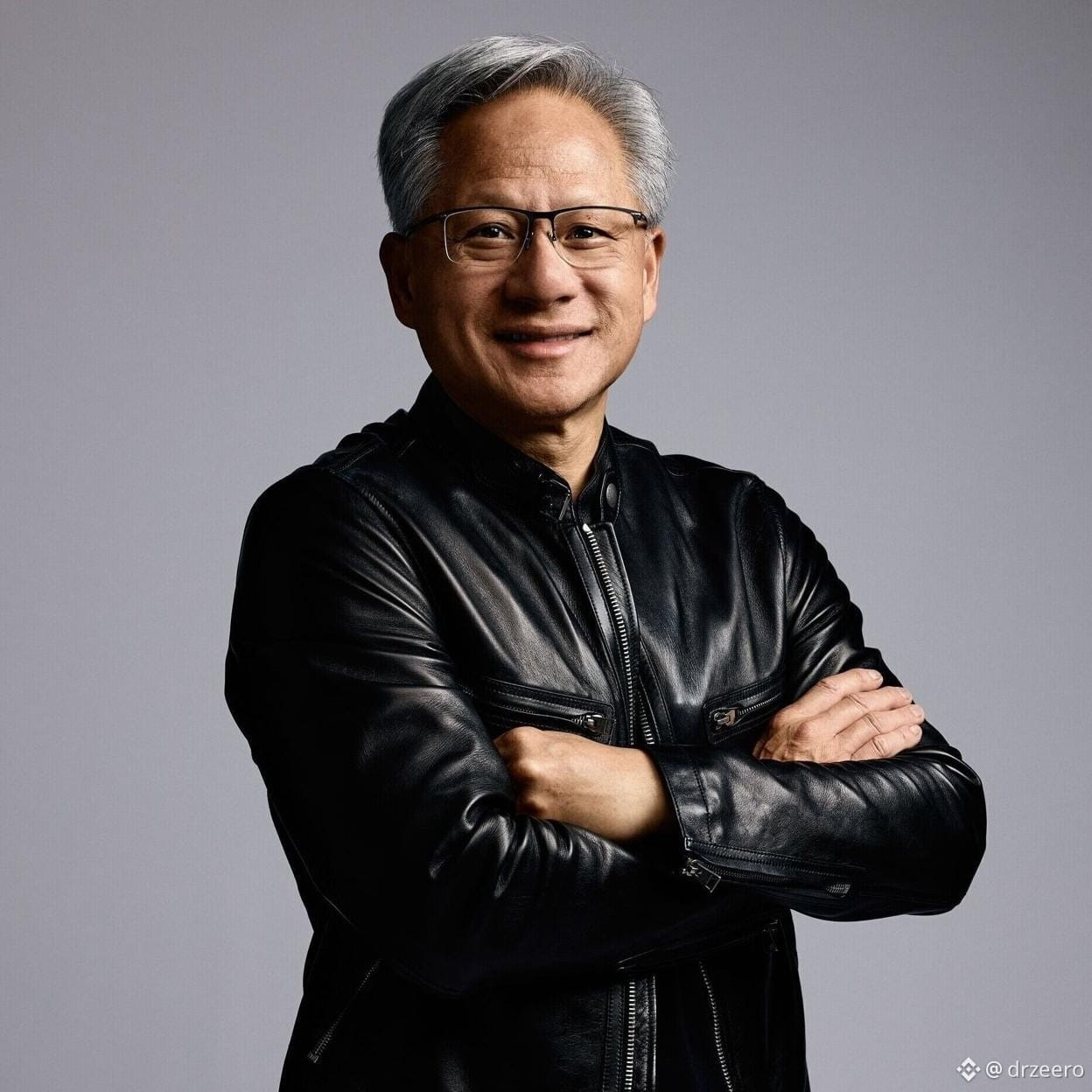
🚨 ELON MUSK: “NO ONE CAN REALLY REPLACE JENSEN HUANG.”
Elon Musk has come out strongly in defense of NVIDIA's former CEO Jensen Huang.
Speaking at the DealBook Summit, Musk compared Jensen's importance to a team to Michael Jordan at his peak. 🏀
He highlighted Jensen's deep technology knowledge, decades-long supplier relationships and the loyalty he has built within NVIDIA.
But there's a major twist...
NVIDIA's board has reportedly ruled out bringing Jensen back.
Can NVIDIA maintain its dominance in the AI industry without the man who built it?
What do you think? 👀
#NVIDIA #NVDIA #ElonMusk #JensenHuang #AI
🚨 ELON MUSK: “NO ONE CAN REALLY REPLACE JENSEN HUANG.”
Elon Musk has come out strongly in defense of NVIDIA's former CEO Jensen Huang.
Speaking at the DealBook Summit, Musk compared Jensen's importance to a team to Michael Jordan at his peak. 🏀
He highlighted Jensen's deep technology knowledge, decades-long supplier relationships and the loyalty he has built within NVIDIA.
But there's a major twist...
NVIDIA's board has reportedly ruled out bringing Jensen back.
Can NVIDIA maintain its dominance in the AI industry without the man who built it?
What do you think? 👀
#NVIDIA #NVDIA #ElonMusk #JensenHuang #AI
Elon Musk has come out strongly in defense of NVIDIA's former CEO Jensen Huang.
Speaking at the DealBook Summit, Musk compared Jensen's importance to a team to Michael Jordan at his peak. 🏀
He highlighted Jensen's deep technology knowledge, decades-long supplier relationships and the loyalty he has built within NVIDIA.
But there's a major twist...
NVIDIA's board has reportedly ruled out bringing Jensen back.
Can NVIDIA maintain its dominance in the AI industry without the man who built it?
What do you think? 👀
#NVIDIA #NVDIA #ElonMusk #JensenHuang #AI

1
429
·
--
$NVDA posted another record, but the stock still fell.
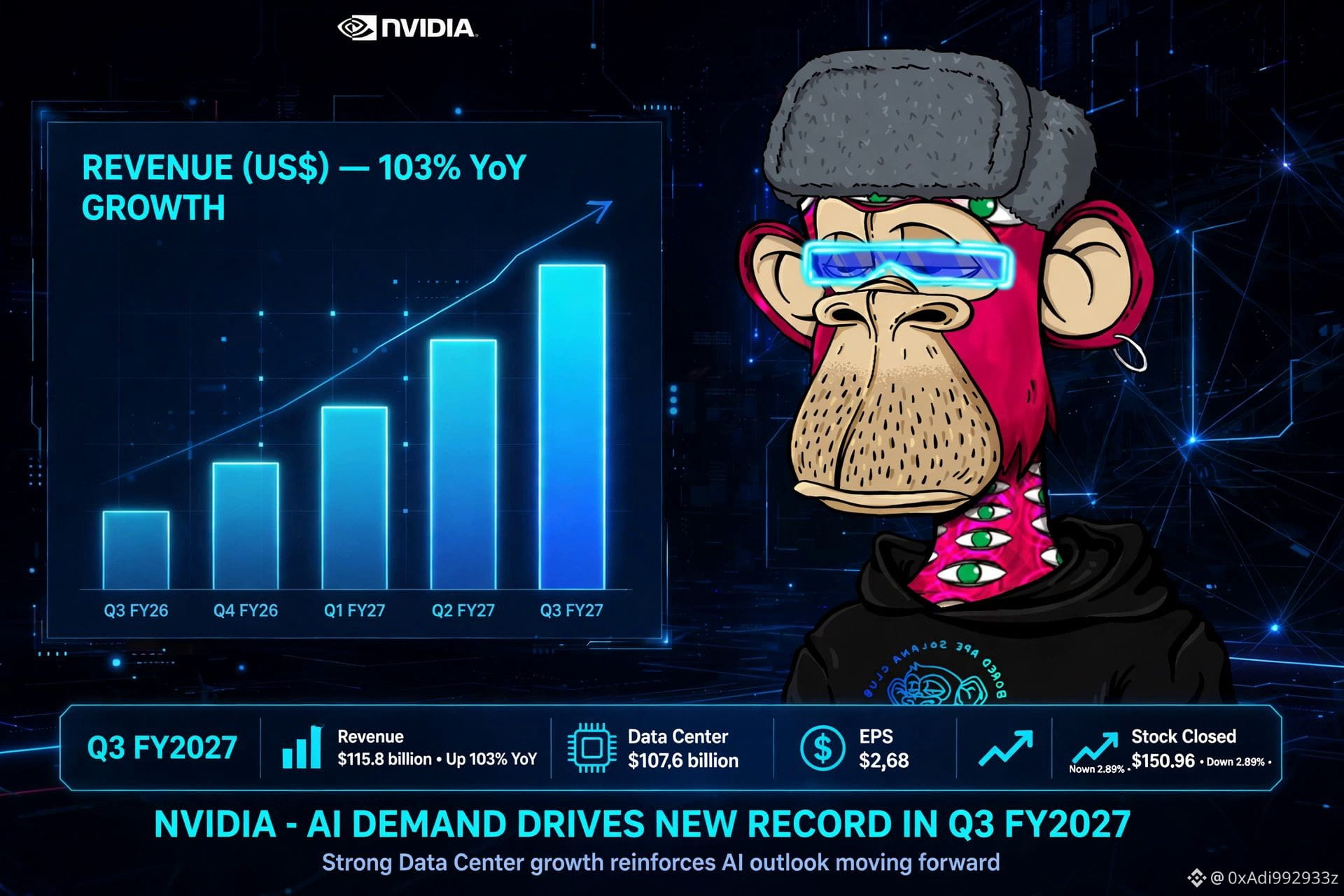
Nvidia reported Q3 FY2027: revenue $115.8 billion (+103% YoY), data center $107.6 billion (+110% YoY), adjusted EPS $2.68, all above Wall Street expectations. Q4 guidance is $130 billion, also above consensus.
This was the first report under interim CEO Colette Kress after Jensen Huang resigned on Nov 12. The board has unanimously rejected reinstating Huang as CEO, and the company is tightening its review of circular financing for neoclouds.
Shares jumped more than 3% after hours on the beat, then reversed: $NVDA closed Nov 18 at $150.96, down 2.89% on the day. Nvidia also raised its CY27 sales growth outlook to +75% from +70%.
Record fundamentals, fearful sentiment — are you buying the fear, or waiting?
#NVIDIA #NVDA #AI #Earnings #BinanceSquare
$NVDA posted another record, but the stock still fell.
Nvidia reported Q3 FY2027: revenue $115.8 billion (+103% YoY), data center $107.6 billion (+110% YoY), adjusted EPS $2.68, all above Wall Street expectations. Q4 guidance is $130 billion, also above consensus.
This was the first report under interim CEO Colette Kress after Jensen Huang resigned on Nov 12. The board has unanimously rejected reinstating Huang as CEO, and the company is tightening its review of circular financing for neoclouds.
Shares jumped more than 3% after hours on the beat, then reversed: $NVDA closed Nov 18 at $150.96, down 2.89% on the day. Nvidia also raised its CY27 sales growth outlook to +75% from +70%.
Record fundamentals, fearful sentiment — are you buying the fear, or waiting?
#NVIDIA #NVDA #AI #Earnings #BinanceSquare
Nvidia reported Q3 FY2027: revenue $115.8 billion (+103% YoY), data center $107.6 billion (+110% YoY), adjusted EPS $2.68, all above Wall Street expectations. Q4 guidance is $130 billion, also above consensus.
This was the first report under interim CEO Colette Kress after Jensen Huang resigned on Nov 12. The board has unanimously rejected reinstating Huang as CEO, and the company is tightening its review of circular financing for neoclouds.
Shares jumped more than 3% after hours on the beat, then reversed: $NVDA closed Nov 18 at $150.96, down 2.89% on the day. Nvidia also raised its CY27 sales growth outlook to +75% from +70%.
Record fundamentals, fearful sentiment — are you buying the fear, or waiting?
#NVIDIA #NVDA #AI #Earnings #BinanceSquare
1
236

🚨 $NVDA BULLS HIT BY A $71.2K LIQUIDATION! SELLING PRESSURE RETURNS! 🔴📉
NVIDIA traders just received a painful reminder that leveraged positions can disappear quickly. A $71,200 LONG position was liquidated at $148.12, putting bullish momentum under pressure.
📊 NVDA LIQUIDATION BREAKDOWN
- Asset: $NVDA
- Liquidation Side: LONG
- Wiped-Out Value: $71,200
- Liquidation Price: $148.12
⚠️ WHAT DOES THIS SIGNAL?
This liquidation indicates that leveraged buyers were caught during a downside move. Forced long closures can add further selling pressure, especially when buyers struggle to defend important price levels.
🎯 NVDA — THE NEXT MOVE
🔴 Bearish Continuation
If NVDA remains below $148.12, sellers could maintain control and push for another downside test. Watch for rising selling volume.
🟢 Bullish Recovery
If buyers reclaim $148.12 and successfully hold above it, a relief bounce could develop. Strong volume would be needed to confirm the recovery.
📍 TRADE SETUP
- $148.12 — Key liquidation reference.
- Above $148.12 — Potential recovery trigger.
- Below $148.12 — Downside pressure remains.
- Confirmation — Look for a successful retest before considering an entry.
💎 MY PROFESSIONAL SIGNAL VIEW
My immediate bias is CAUTIOUSLY BEARISH until NVDA demonstrates that buyers are returning. I would avoid aggressive LONG entries during continued weakness. A confirmed reclaim could change the outlook.
🔥 $71.2K in bullish positions erased! Will NVIDIA buyers defend the next level, or will sellers push for another liquidity sweep?
⚠️ Risk Disclaimer: Liquidation data does not guarantee further downside. Monitor broader market conditions, manage position size, and always define your stop-loss.
#NVDA #NVIDIA
#MASToUpgradeSGDTestnetToSGDigitalLedger #Solana2027RoadmapTargetsDoubleComputeCapacity
{stock_us}(NVDA.US)
🚨 $NVDA BULLS HIT BY A $71.2K LIQUIDATION! SELLING PRESSURE RETURNS! 🔴📉
NVIDIA traders just received a painful reminder that leveraged positions can disappear quickly. A $71,200 LONG position was liquidated at $148.12, putting bullish momentum under pressure.
📊 NVDA LIQUIDATION BREAKDOWN
- Asset: $NVDA
- Liquidation Side: LONG
- Wiped-Out Value: $71,200
- Liquidation Price: $148.12
⚠️ WHAT DOES THIS SIGNAL?
This liquidation indicates that leveraged buyers were caught during a downside move. Forced long closures can add further selling pressure, especially when buyers struggle to defend important price levels.
🎯 NVDA — THE NEXT MOVE
🔴 Bearish Continuation
If NVDA remains below $148.12, sellers could maintain control and push for another downside test. Watch for rising selling volume.
🟢 Bullish Recovery
If buyers reclaim $148.12 and successfully hold above it, a relief bounce could develop. Strong volume would be needed to confirm the recovery.
📍 TRADE SETUP
- $148.12 — Key liquidation reference.
- Above $148.12 — Potential recovery trigger.
- Below $148.12 — Downside pressure remains.
- Confirmation — Look for a successful retest before considering an entry.
💎 MY PROFESSIONAL SIGNAL VIEW
My immediate bias is CAUTIOUSLY BEARISH until NVDA demonstrates that buyers are returning. I would avoid aggressive LONG entries during continued weakness. A confirmed reclaim could change the outlook.
🔥 $71.2K in bullish positions erased! Will NVIDIA buyers defend the next level, or will sellers push for another liquidity sweep?
⚠️ Risk Disclaimer: Liquidation data does not guarantee further downside. Monitor broader market conditions, manage position size, and always define your stop-loss.
#NVDA #NVIDIA
#MASToUpgradeSGDTestnetToSGDigitalLedger #Solana2027RoadmapTargetsDoubleComputeCapacity
NVIDIA traders just received a painful reminder that leveraged positions can disappear quickly. A $71,200 LONG position was liquidated at $148.12, putting bullish momentum under pressure.
📊 NVDA LIQUIDATION BREAKDOWN
- Asset: $NVDA
- Liquidation Side: LONG
- Wiped-Out Value: $71,200
- Liquidation Price: $148.12
⚠️ WHAT DOES THIS SIGNAL?
This liquidation indicates that leveraged buyers were caught during a downside move. Forced long closures can add further selling pressure, especially when buyers struggle to defend important price levels.
🎯 NVDA — THE NEXT MOVE
🔴 Bearish Continuation
If NVDA remains below $148.12, sellers could maintain control and push for another downside test. Watch for rising selling volume.
🟢 Bullish Recovery
If buyers reclaim $148.12 and successfully hold above it, a relief bounce could develop. Strong volume would be needed to confirm the recovery.
📍 TRADE SETUP
- $148.12 — Key liquidation reference.
- Above $148.12 — Potential recovery trigger.
- Below $148.12 — Downside pressure remains.
- Confirmation — Look for a successful retest before considering an entry.
💎 MY PROFESSIONAL SIGNAL VIEW
My immediate bias is CAUTIOUSLY BEARISH until NVDA demonstrates that buyers are returning. I would avoid aggressive LONG entries during continued weakness. A confirmed reclaim could change the outlook.
🔥 $71.2K in bullish positions erased! Will NVIDIA buyers defend the next level, or will sellers push for another liquidity sweep?
⚠️ Risk Disclaimer: Liquidation data does not guarantee further downside. Monitor broader market conditions, manage position size, and always define your stop-loss.
#NVDA #NVIDIA
#MASToUpgradeSGDTestnetToSGDigitalLedger #Solana2027RoadmapTargetsDoubleComputeCapacity
NVDA-2.62%
NVDAUS-2.35%
30

·
--
Verified
#nvidiaboardreportedlysplitoverhuang’sreturn
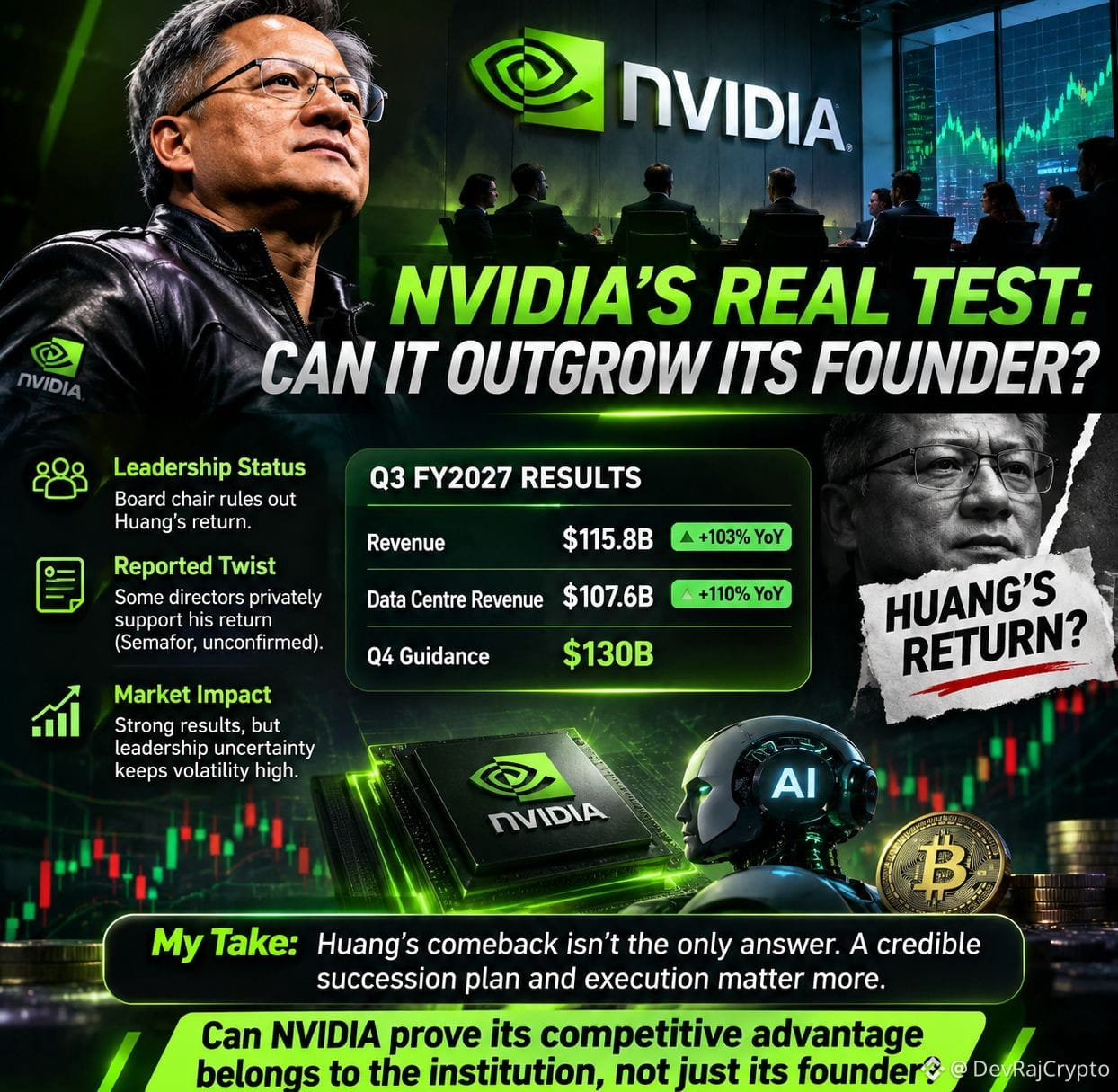
NVIDIA’s biggest test may not be AI competition. It may be proving that its success can outlast its founder.
The leadership story remains contested. Chairman Harvey Jones publicly ruled out reinstating Jensen Huang, while Semafor reported that some directors privately support his return. That reported disagreement remains unconfirmed.
Meanwhile, NVIDIA’s Q3 numbers are extraordinary:
• Revenue: $115.8B, up 103% year on year.
• Data Centre revenue: $107.6B, up 110%.
• Q4 revenue guidance: $130B.
Yet strong fundamentals haven't eliminated leadership uncertainty.
Following AI developments and their influence on crypto narratives, one lesson stands out: market sentiment can move faster than business fundamentals. NVIDIA's leadership uncertainty may influence AI-token sentiment, but it doesn't automatically change individual projects' value.
My view: Huang's return isn't necessarily the answer. A credible succession plan and uninterrupted execution matter more.
Can NVIDIA prove its competitive advantage belongs to the institution, not just its founder?
$NVDA $BTC $ETH
#NVIDIA #Aİ #CryptoMarket
#nvidiaboardreportedlysplitoverhuang’sreturn
NVIDIA’s biggest test may not be AI competition. It may be proving that its success can outlast its founder.
The leadership story remains contested. Chairman Harvey Jones publicly ruled out reinstating Jensen Huang, while Semafor reported that some directors privately support his return. That reported disagreement remains unconfirmed.
Meanwhile, NVIDIA’s Q3 numbers are extraordinary:
• Revenue: $115.8B, up 103% year on year.
• Data Centre revenue: $107.6B, up 110%.
• Q4 revenue guidance: $130B.
Yet strong fundamentals haven't eliminated leadership uncertainty.
Following AI developments and their influence on crypto narratives, one lesson stands out: market sentiment can move faster than business fundamentals. NVIDIA's leadership uncertainty may influence AI-token sentiment, but it doesn't automatically change individual projects' value.
My view: Huang's return isn't necessarily the answer. A credible succession plan and uninterrupted execution matter more.
Can NVIDIA prove its competitive advantage belongs to the institution, not just its founder?
$NVDA $BTC $ETH
#NVIDIA #Aİ #CryptoMarket
NVIDIA’s biggest test may not be AI competition. It may be proving that its success can outlast its founder.
The leadership story remains contested. Chairman Harvey Jones publicly ruled out reinstating Jensen Huang, while Semafor reported that some directors privately support his return. That reported disagreement remains unconfirmed.
Meanwhile, NVIDIA’s Q3 numbers are extraordinary:
• Revenue: $115.8B, up 103% year on year.
• Data Centre revenue: $107.6B, up 110%.
• Q4 revenue guidance: $130B.
Yet strong fundamentals haven't eliminated leadership uncertainty.
Following AI developments and their influence on crypto narratives, one lesson stands out: market sentiment can move faster than business fundamentals. NVIDIA's leadership uncertainty may influence AI-token sentiment, but it doesn't automatically change individual projects' value.
My view: Huang's return isn't necessarily the answer. A credible succession plan and uninterrupted execution matter more.
Can NVIDIA prove its competitive advantage belongs to the institution, not just its founder?
$NVDA $BTC $ETH
#NVIDIA #Aİ #CryptoMarket
1
1.8k

🚨 $NVDA BOARDROOM BATTLE COLLIDES WITH RECORD REVENUE WHILE SMART MONEY WATCHES CLOSELY ⚡
Corporate governance friction is testing the resilience of $NVDA as factions clash over leadership while the machine prints astronomical numbers. 📊 Q3 revenue punched through at one hundred fifteen billion with data centers carrying the heavy load, proving underlying demand remains an absolute juggernaut. ⚡
Yet, structural uncertainty at the top introduces a completely different breed of risk that order flow algorithms cannot easily quantify. 🔍 Can execution and raw cash flow outweigh boardroom friction when momentum shifts? 👇
⚠️ Not financial advice. Always manage your risk. 🛡️
🏷️ #NVDA #NVIDIA #Trading #Markets
🔥 💎
🚨 $NVDA BOARDROOM BATTLE COLLIDES WITH RECORD REVENUE WHILE SMART MONEY WATCHES CLOSELY ⚡
Corporate governance friction is testing the resilience of $NVDA as factions clash over leadership while the machine prints astronomical numbers. 📊 Q3 revenue punched through at one hundred fifteen billion with data centers carrying the heavy load, proving underlying demand remains an absolute juggernaut. ⚡
Yet, structural uncertainty at the top introduces a completely different breed of risk that order flow algorithms cannot easily quantify. 🔍 Can execution and raw cash flow outweigh boardroom friction when momentum shifts? 👇
⚠️ Not financial advice. Always manage your risk. 🛡️
🏷️ #NVDA #NVIDIA #Trading #Markets
🔥 💎
Corporate governance friction is testing the resilience of $NVDA as factions clash over leadership while the machine prints astronomical numbers. 📊 Q3 revenue punched through at one hundred fifteen billion with data centers carrying the heavy load, proving underlying demand remains an absolute juggernaut. ⚡
Yet, structural uncertainty at the top introduces a completely different breed of risk that order flow algorithms cannot easily quantify. 🔍 Can execution and raw cash flow outweigh boardroom friction when momentum shifts? 👇
⚠️ Not financial advice. Always manage your risk. 🛡️
🏷️ #NVDA #NVIDIA #Trading #Markets
🔥 💎
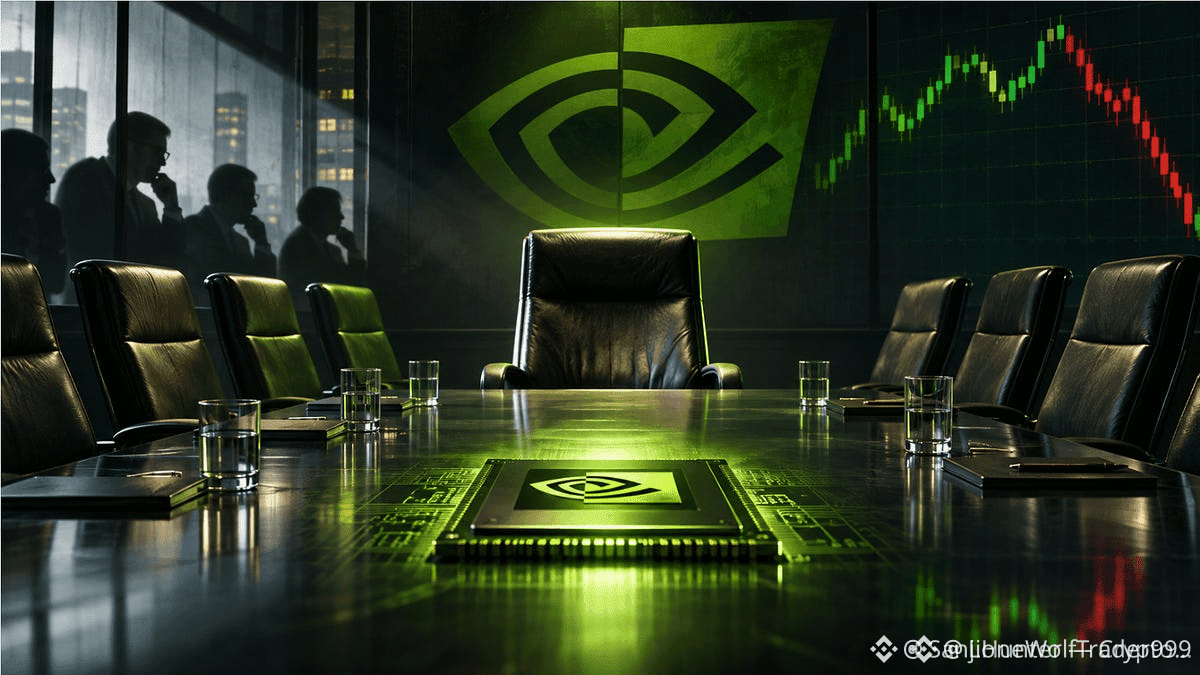
12

Partly True
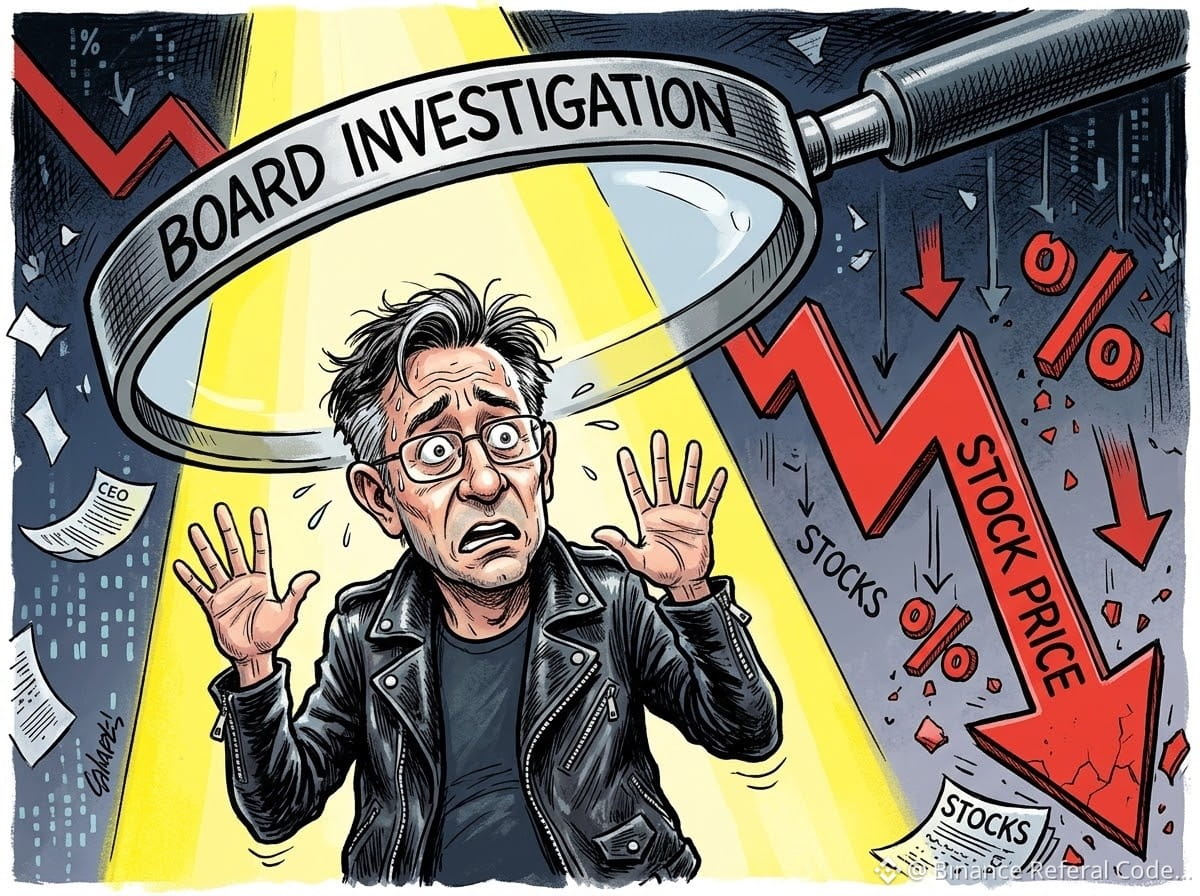
⚠️ $NVDA Slides Pre-Market as Board Opens Probe Into CEO Jensen Huang
Nvidia shares were down roughly 4.5%–4.9% in Monday's pre-market trading after the board launched an independent investigation into whether CEO Jensen Huang was the target of a foreign intelligence effort. Nvidia said it has no reason to believe U.S. national security or company secrets were compromised. Huang told employees he takes "full responsibility" for his personal conduct.
#NvidiaBoardReportedlySplitOverHuang’sReturn
The broader tape is firmer: as of 3:00 a.m. ET, Dow futures were +1.06% and S&P 500 futures +0.63%, while Nasdaq futures lagged at +0.43%. Last week the Philadelphia Semiconductor Index posted its biggest weekly loss since March 2025.
Why it matters:
• Leadership risk at the AI bellwether, just over a week before earnings
• A slip in $NVDA weighs on Nasdaq and AI-linked names like $AMD
• It comes on top of last week's sharp chip sell-off
What to watch next:
• US open: today 09:30 ET
• October CPI: Tue Nov 10, 08:30 ET
• Nvidia Q3 earnings call: Tue Nov 17, 17:00 ET
Not financial advice.
#Nvidia #NVDA #StockMarket
⚠️ $NVDA Slides Pre-Market as Board Opens Probe Into CEO Jensen Huang
Nvidia shares were down roughly 4.5%–4.9% in Monday's pre-market trading after the board launched an independent investigation into whether CEO Jensen Huang was the target of a foreign intelligence effort. Nvidia said it has no reason to believe U.S. national security or company secrets were compromised. Huang told employees he takes "full responsibility" for his personal conduct.
#NvidiaBoardReportedlySplitOverHuang’sReturn
The broader tape is firmer: as of 3:00 a.m. ET, Dow futures were +1.06% and S&P 500 futures +0.63%, while Nasdaq futures lagged at +0.43%. Last week the Philadelphia Semiconductor Index posted its biggest weekly loss since March 2025.
Why it matters:
• Leadership risk at the AI bellwether, just over a week before earnings
• A slip in $NVDA weighs on Nasdaq and AI-linked names like $AMD
• It comes on top of last week's sharp chip sell-off
What to watch next:
• US open: today 09:30 ET
• October CPI: Tue Nov 10, 08:30 ET
• Nvidia Q3 earnings call: Tue Nov 17, 17:00 ET
Not financial advice.
#Nvidia #NVDA #StockMarket
Nvidia shares were down roughly 4.5%–4.9% in Monday's pre-market trading after the board launched an independent investigation into whether CEO Jensen Huang was the target of a foreign intelligence effort. Nvidia said it has no reason to believe U.S. national security or company secrets were compromised. Huang told employees he takes "full responsibility" for his personal conduct.
#NvidiaBoardReportedlySplitOverHuang’sReturn
The broader tape is firmer: as of 3:00 a.m. ET, Dow futures were +1.06% and S&P 500 futures +0.63%, while Nasdaq futures lagged at +0.43%. Last week the Philadelphia Semiconductor Index posted its biggest weekly loss since March 2025.
Why it matters:
• Leadership risk at the AI bellwether, just over a week before earnings
• A slip in $NVDA weighs on Nasdaq and AI-linked names like $AMD
• It comes on top of last week's sharp chip sell-off
What to watch next:
• US open: today 09:30 ET
• October CPI: Tue Nov 10, 08:30 ET
• Nvidia Q3 earnings call: Tue Nov 17, 17:00 ET
Not financial advice.
#Nvidia #NVDA #StockMarket
1
8
977

·
--
Verified
WHY I’M BUYING #NVIDIA : STRONG FUNDAMENTALS, LONG-TERM AI POTENTIAL
#NVIDIA remains one of the biggest players in the AI infrastructure market. Despite recent pressure on its share price, its latest financial results show that business growth is still strong.
Q3 FY2027 Financial Results
Financial Metric| Result
Revenue| $115.8B
YoY Revenue Growth| 103%
Data Center Revenue| $107.6B
Non-GAAP EPS| $2.68
Gross Margin| 74.8%
Why Is NVIDIA’s Stock Under Pressure?
I’m watching three major concerns weighing on investor sentiment:
1. Leadership uncertainty: Jensen Huang’s resignation has raised questions about NVIDIA’s future direction and leadership.
2. AI valuation concerns: Investors are questioning whether the massive spending on AI infrastructure can remain sustainable.
3. Regulatory risks: Export restrictions and regulatory scrutiny are adding further uncertainty.
My Long-Term View
Despite these risks, I believe NVIDIA remains an attractive AI infrastructure business. Its long-term potential is strong, but execution, leadership, valuation, and market conditions still matter.
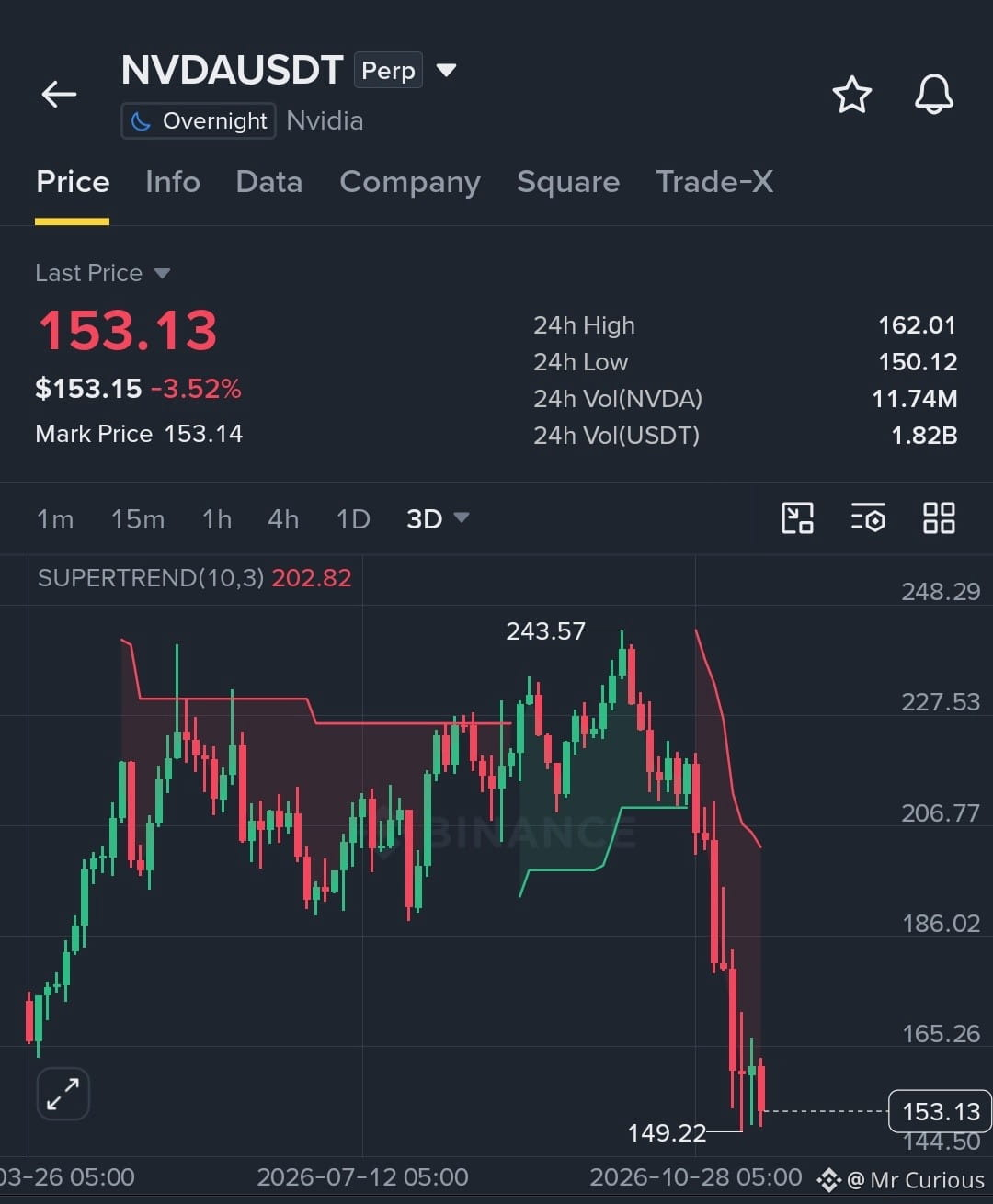
I see $150 as a potential accumulation level for long-term investors, but I wouldn’t invest the entire amount at once.
My Gradual Accumulation Plan
Entry Price| Allocation
$150| 30%
$145| 25%
$140| 25%
$130| 20%
Total| 100%
The idea is simple: divide the investment into four parts and build the position gradually instead of committing everything at one price.
Trade with proper risk management.
$NVDA
{future}(NVDAUSDT)
$NVDAB
{spot}(NVDABUSDT)
$NVDA.US
{stock_us}(NVDA.US)
#NvidiaBoardReportedlySplitOverHuang’sReturn
WHY I’M BUYING #NVIDIA : STRONG FUNDAMENTALS, LONG-TERM AI POTENTIAL
#NVIDIA remains one of the biggest players in the AI infrastructure market. Despite recent pressure on its share price, its latest financial results show that business growth is still strong.
Q3 FY2027 Financial Results
Financial Metric| Result
Revenue| $115.8B
YoY Revenue Growth| 103%
Data Center Revenue| $107.6B
Non-GAAP EPS| $2.68
Gross Margin| 74.8%
Why Is NVIDIA’s Stock Under Pressure?
I’m watching three major concerns weighing on investor sentiment:
1. Leadership uncertainty: Jensen Huang’s resignation has raised questions about NVIDIA’s future direction and leadership.
2. AI valuation concerns: Investors are questioning whether the massive spending on AI infrastructure can remain sustainable.
3. Regulatory risks: Export restrictions and regulatory scrutiny are adding further uncertainty.
My Long-Term View
Despite these risks, I believe NVIDIA remains an attractive AI infrastructure business. Its long-term potential is strong, but execution, leadership, valuation, and market conditions still matter.
I see $150 as a potential accumulation level for long-term investors, but I wouldn’t invest the entire amount at once.
My Gradual Accumulation Plan
Entry Price| Allocation
$150| 30%
$145| 25%
$140| 25%
$130| 20%
Total| 100%
The idea is simple: divide the investment into four parts and build the position gradually instead of committing everything at one price.
Trade with proper risk management.
$NVDA
$NVDAB
$NVDA.US
#NvidiaBoardReportedlySplitOverHuang’sReturn
#NVIDIA remains one of the biggest players in the AI infrastructure market. Despite recent pressure on its share price, its latest financial results show that business growth is still strong.
Q3 FY2027 Financial Results
Financial Metric| Result
Revenue| $115.8B
YoY Revenue Growth| 103%
Data Center Revenue| $107.6B
Non-GAAP EPS| $2.68
Gross Margin| 74.8%
Why Is NVIDIA’s Stock Under Pressure?
I’m watching three major concerns weighing on investor sentiment:
1. Leadership uncertainty: Jensen Huang’s resignation has raised questions about NVIDIA’s future direction and leadership.
2. AI valuation concerns: Investors are questioning whether the massive spending on AI infrastructure can remain sustainable.
3. Regulatory risks: Export restrictions and regulatory scrutiny are adding further uncertainty.
My Long-Term View
Despite these risks, I believe NVIDIA remains an attractive AI infrastructure business. Its long-term potential is strong, but execution, leadership, valuation, and market conditions still matter.
I see $150 as a potential accumulation level for long-term investors, but I wouldn’t invest the entire amount at once.
My Gradual Accumulation Plan
Entry Price| Allocation
$150| 30%
$145| 25%
$140| 25%
$130| 20%
Total| 100%
The idea is simple: divide the investment into four parts and build the position gradually instead of committing everything at one price.
Trade with proper risk management.
$NVDA
$NVDAB
$NVDA.US
#NvidiaBoardReportedlySplitOverHuang’sReturn
NVDAB-2.55%
NVDAUS-2.35%
Handy38:
I think anthropic IPO will raise appetite and retain trust in this sector many analysis refer to gaining strong buying habits for semi conductors, software, ai asset
1
3
457


·
--
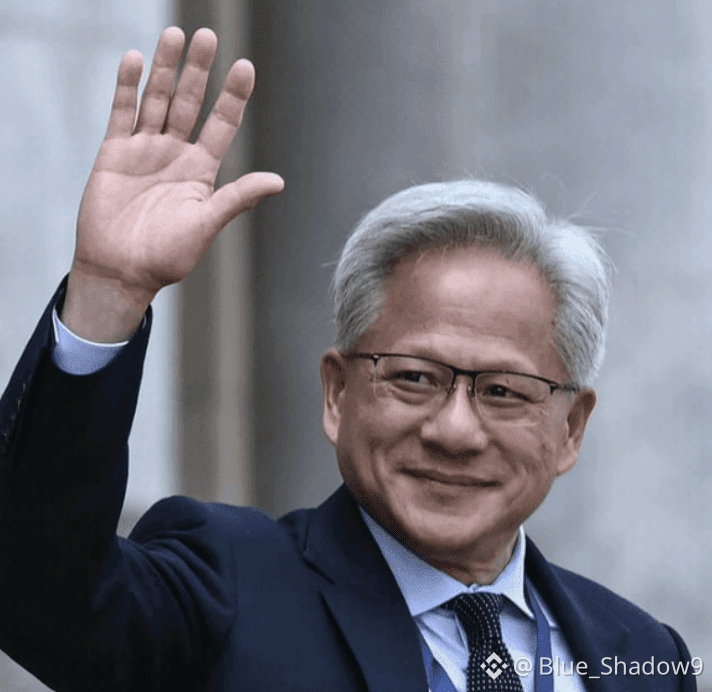
🚨 BREAKING: Jensen Huang Open to Returning as NVIDIA CEO!
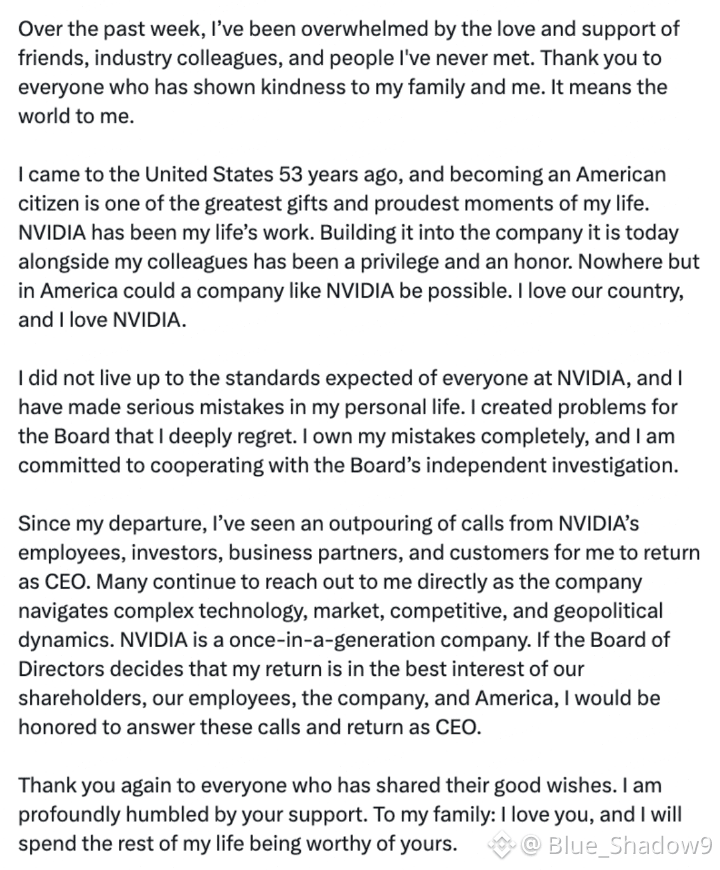
Jensen Huang has publicly addressed the situation for the first time since leaving NVIDIA, saying he is willing to return as CEO.
In his statement, he acknowledged falling short of NVIDIA’s standards and making serious mistakes in his personal life. He apologized to the board for the difficulties caused and promised to take full responsibility while cooperating fully with the independent investigation.
Huang also revealed that employees, investors, business partners, and customers have called for his return.
Describing NVIDIA as his life’s work, he said he would be honored to return if the board believes it is in the best interests of shareholders, employees, the company, and the United States.
He ended his statement with an emotional message to his family:
“I will spend the rest of my life trying to prove I deserve your love.”
A developing story that could have major implications for NVIDIA’s future.
#NVIDIA #JensenHuang
🚨 BREAKING: Jensen Huang Open to Returning as NVIDIA CEO!
Jensen Huang has publicly addressed the situation for the first time since leaving NVIDIA, saying he is willing to return as CEO.
In his statement, he acknowledged falling short of NVIDIA’s standards and making serious mistakes in his personal life. He apologized to the board for the difficulties caused and promised to take full responsibility while cooperating fully with the independent investigation.
Huang also revealed that employees, investors, business partners, and customers have called for his return.
Describing NVIDIA as his life’s work, he said he would be honored to return if the board believes it is in the best interests of shareholders, employees, the company, and the United States.
He ended his statement with an emotional message to his family:
“I will spend the rest of my life trying to prove I deserve your love.”
A developing story that could have major implications for NVIDIA’s future.
#NVIDIA #JensenHuang
Jensen Huang has publicly addressed the situation for the first time since leaving NVIDIA, saying he is willing to return as CEO.
In his statement, he acknowledged falling short of NVIDIA’s standards and making serious mistakes in his personal life. He apologized to the board for the difficulties caused and promised to take full responsibility while cooperating fully with the independent investigation.
Huang also revealed that employees, investors, business partners, and customers have called for his return.
Describing NVIDIA as his life’s work, he said he would be honored to return if the board believes it is in the best interests of shareholders, employees, the company, and the United States.
He ended his statement with an emotional message to his family:
“I will spend the rest of my life trying to prove I deserve your love.”
A developing story that could have major implications for NVIDIA’s future.
#NVIDIA #JensenHuang
eyes of 火:
The board must consider what is best for the company, its employees, and shareholders.
5
2
9
292

🚨 NVIDIA'S BIG LEADERSHIP DRAMA!
NVIDIA's future is making headlines! 👀
The board chair reportedly says Jensen Huang will not return, but according to reports, three directors want him back.
Why does this matter?
- Leadership uncertainty could affect investor confidence.
- AI demand remains extremely strong.
- Export rules and regulations could impact future growth.
Now the big question: Should NVIDIA bring Jensen Huang back, or choose a new leader?
@Square-Creator-01b95538a978 @Square-Creator-34bcd0ba65d89 @Square-Creator-5f6522ade8ad9 @Square-Creator-a10482322 @Square-Creator-8b5674750
👇 What's your opinion?
🟢 YES – Bring Jensen back!
🔴 NO – Choose a new CEO!
$NVDA $IRYS $MMT
#NVIDIA #JensenHuang #CryptoNews #StockMarket #BinanceSquare
{future}(NVDAUSDT)
{spot}(MMTUSDT)
{future}(IRYSUSDT)
🚨 NVIDIA'S BIG LEADERSHIP DRAMA!
NVIDIA's future is making headlines! 👀
The board chair reportedly says Jensen Huang will not return, but according to reports, three directors want him back.
Why does this matter?
- Leadership uncertainty could affect investor confidence.
- AI demand remains extremely strong.
- Export rules and regulations could impact future growth.
Now the big question: Should NVIDIA bring Jensen Huang back, or choose a new leader?
@HH-- @D-T- @g g tu tu @U Y @H_J_
👇 What's your opinion?
🟢 YES – Bring Jensen back!
🔴 NO – Choose a new CEO!
$NVDA $IRYS $MMT
#NVIDIA #JensenHuang #CryptoNews #StockMarket #BinanceSquare
NVIDIA's future is making headlines! 👀
The board chair reportedly says Jensen Huang will not return, but according to reports, three directors want him back.
Why does this matter?
- Leadership uncertainty could affect investor confidence.
- AI demand remains extremely strong.
- Export rules and regulations could impact future growth.
Now the big question: Should NVIDIA bring Jensen Huang back, or choose a new leader?
@HH-- @D-T- @g g tu tu @U Y @H_J_
👇 What's your opinion?
🟢 YES – Bring Jensen back!
🔴 NO – Choose a new CEO!
$NVDA $IRYS $MMT
#NVIDIA #JensenHuang #CryptoNews #StockMarket #BinanceSquare
🟢YES!
🔴NO!
1 day(s) left
51

Article
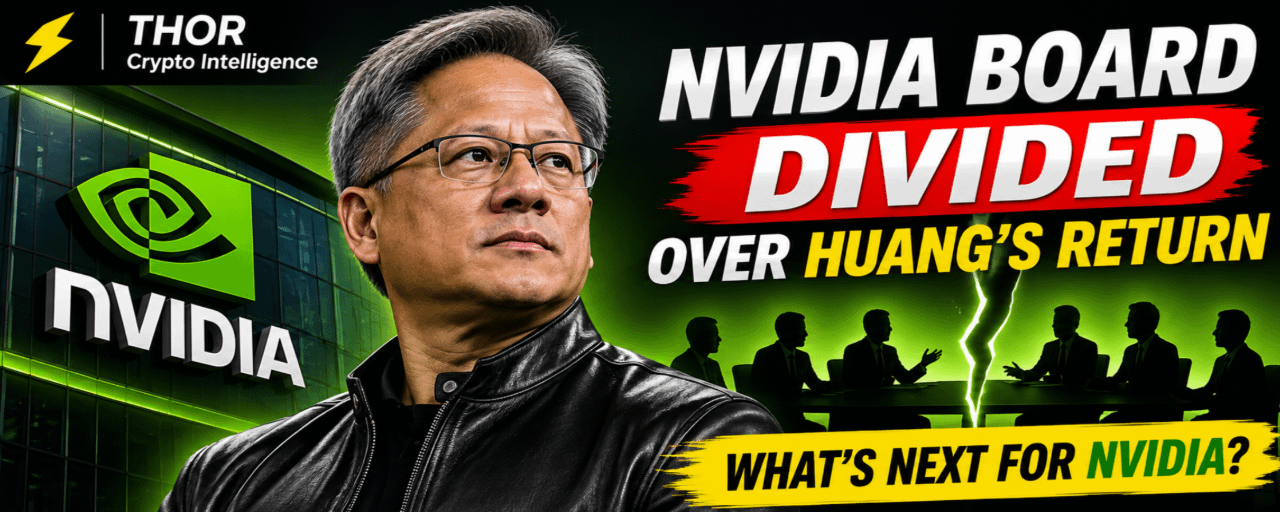
NVIDIA BOARD DIVIDED — HUANG'S COMEBACK SPARKS INTERNAL RIFT!NVIDIA's succession battle is intensifying as some directors reportedly push for Jensen Huang's return, while others oppose bringing him back.
⚡ THOR Update
🟢 Some board members reportedly support Huang's reinstatement.🔴 At least three directors reportedly oppose his return.👤 Huang has expressed willingness to return if the board approves.🏛️ Chairman Harvey Jones says the board is not considering reinstatement.🔍 The search for a permanent CEO continues.
🧠 THOR Edge: This is now a governance battle, not just a leadership transition. Conflicting positions could create uncertainty around NVIDIA's succession strategy and investor confidence.
⚖️ THOR Verdict: Huang's return remains uncertain. The board's public position is still against reinstatement.
⚡ THOR Signal: Watch the board's next decision and permanent CEO search.
👇 Should NVIDIA bring Jensen back?
🟢 Bring Huang back
🟡 Appoint new leadership
🔴 Let the investigation decide
#NVIDIA #JensenHuan #NVDA #NvidiaBoardReportedlySplitOverHuang’sReturn #BTCRemainsUnderPressureAfterHawkishFOMCMinutes
$EVAA
{future}(EVAAUSDT)
$ICNT
{future}(ICNTUSDT)
$MMT
{future}(MMTUSDT)
NVIDIA BOARD DIVIDED — HUANG'S COMEBACK SPARKS INTERNAL RIFT!
NVIDIA's succession battle is intensifying as some directors reportedly push for Jensen Huang's return, while others oppose bringing him back.
⚡ THOR Update
🟢 Some board members reportedly support Huang's reinstatement.🔴 At least three directors reportedly oppose his return.👤 Huang has expressed willingness to return if the board approves.🏛️ Chairman Harvey Jones says the board is not considering reinstatement.🔍 The search for a permanent CEO continues.
🧠 THOR Edge: This is now a governance battle, not just a leadership transition. Conflicting positions could create uncertainty around NVIDIA's succession strategy and investor confidence.
⚖️ THOR Verdict: Huang's return remains uncertain. The board's public position is still against reinstatement.
⚡ THOR Signal: Watch the board's next decision and permanent CEO search.
👇 Should NVIDIA bring Jensen back?
🟢 Bring Huang back
🟡 Appoint new leadership
🔴 Let the investigation decide
#NVIDIA #JensenHuan #NVDA #NvidiaBoardReportedlySplitOverHuang’sReturn #BTCRemainsUnderPressureAfterHawkishFOMCMinutes
$EVAA
$ICNT
$MMT
⚡ THOR Update
🟢 Some board members reportedly support Huang's reinstatement.🔴 At least three directors reportedly oppose his return.👤 Huang has expressed willingness to return if the board approves.🏛️ Chairman Harvey Jones says the board is not considering reinstatement.🔍 The search for a permanent CEO continues.
🧠 THOR Edge: This is now a governance battle, not just a leadership transition. Conflicting positions could create uncertainty around NVIDIA's succession strategy and investor confidence.
⚖️ THOR Verdict: Huang's return remains uncertain. The board's public position is still against reinstatement.
⚡ THOR Signal: Watch the board's next decision and permanent CEO search.
👇 Should NVIDIA bring Jensen back?
🟢 Bring Huang back
🟡 Appoint new leadership
🔴 Let the investigation decide
#NVIDIA #JensenHuan #NVDA #NvidiaBoardReportedlySplitOverHuang’sReturn #BTCRemainsUnderPressureAfterHawkishFOMCMinutes
$EVAA
$ICNT
$MMT
643

·
--
Bullish
$NVDAB Overview
Nvidia delivered a quarterly beat and strong guidance in its first earnings report since Jensen Huang's ouster as CEO. Colette Kress, the finance chief, took the lead as interim CEO and sat down with CNBC's Jim Cramer afterward to discuss demand, buybacks and China. The company also revised its cloud industry backlog higher, according to CNBC's Investing Club. Shares nonetheless ended Wednesday down roughly 3.15% at $150.56 on Yahoo Finance's trending data.
Market Impact
The reaction shows how nervous the AI trade has become. Barron's said the earnings were not enough to shift Wall Street's AI narrative. The Investing Club said the stock looks historically cheap on earnings but kept its advice to trim positions. Yahoo Finance reported that the stock had just logged its longest weekly losing streak since October 2012. The S&P 500 technology sector is down 20% since October 6 and the Philadelphia Semiconductor index is down 30%. MarketWatch said demand is hard to ignore, but CEO succession, the AI ecosystem, export controls and China loom over the stock. A WSJ opinion piece added that up to a third of China's compute may come from smuggled chips.
What's Next
A permanent CEO announcement is the most obvious catalyst, along with any change in China export rules. Thursday's Anthropic debut is another test of appetite for AI shares. CNBC also reported that ETFs targeting credit default swaps on AI issuers are coming, which shows how much investor worry about AI balance sheets has grown. Fed minutes showing officials expect more rate hikes add pressure to high-multiple tech shares#NVIDIA
$NVDAB Overview
Nvidia delivered a quarterly beat and strong guidance in its first earnings report since Jensen Huang's ouster as CEO. Colette Kress, the finance chief, took the lead as interim CEO and sat down with CNBC's Jim Cramer afterward to discuss demand, buybacks and China. The company also revised its cloud industry backlog higher, according to CNBC's Investing Club. Shares nonetheless ended Wednesday down roughly 3.15% at $150.56 on Yahoo Finance's trending data.
Market Impact
The reaction shows how nervous the AI trade has become. Barron's said the earnings were not enough to shift Wall Street's AI narrative. The Investing Club said the stock looks historically cheap on earnings but kept its advice to trim positions. Yahoo Finance reported that the stock had just logged its longest weekly losing streak since October 2012. The S&P 500 technology sector is down 20% since October 6 and the Philadelphia Semiconductor index is down 30%. MarketWatch said demand is hard to ignore, but CEO succession, the AI ecosystem, export controls and China loom over the stock. A WSJ opinion piece added that up to a third of China's compute may come from smuggled chips.
What's Next
A permanent CEO announcement is the most obvious catalyst, along with any change in China export rules. Thursday's Anthropic debut is another test of appetite for AI shares. CNBC also reported that ETFs targeting credit default swaps on AI issuers are coming, which shows how much investor worry about AI balance sheets has grown. Fed minutes showing officials expect more rate hikes add pressure to high-multiple tech shares#NVIDIA
Nvidia delivered a quarterly beat and strong guidance in its first earnings report since Jensen Huang's ouster as CEO. Colette Kress, the finance chief, took the lead as interim CEO and sat down with CNBC's Jim Cramer afterward to discuss demand, buybacks and China. The company also revised its cloud industry backlog higher, according to CNBC's Investing Club. Shares nonetheless ended Wednesday down roughly 3.15% at $150.56 on Yahoo Finance's trending data.
Market Impact
The reaction shows how nervous the AI trade has become. Barron's said the earnings were not enough to shift Wall Street's AI narrative. The Investing Club said the stock looks historically cheap on earnings but kept its advice to trim positions. Yahoo Finance reported that the stock had just logged its longest weekly losing streak since October 2012. The S&P 500 technology sector is down 20% since October 6 and the Philadelphia Semiconductor index is down 30%. MarketWatch said demand is hard to ignore, but CEO succession, the AI ecosystem, export controls and China loom over the stock. A WSJ opinion piece added that up to a third of China's compute may come from smuggled chips.
What's Next
A permanent CEO announcement is the most obvious catalyst, along with any change in China export rules. Thursday's Anthropic debut is another test of appetite for AI shares. CNBC also reported that ETFs targeting credit default swaps on AI issuers are coming, which shows how much investor worry about AI balance sheets has grown. Fed minutes showing officials expect more rate hikes add pressure to high-multiple tech shares#NVIDIA
200

·
--
Verified
#NvidiaBeatsEstimatesWith$130BQ4Outlook
🚨 BREAKING: NVIDIA Delivers a Massive Earnings Report!
$NVIDIA has reported impressive Q3 FY2027 results:
📊 Revenue: $115.8 Billion (+103% YoY)
🔥 Data Center Revenue: $107.6 Billion (+110% YoY)
🚀 Q4 Revenue Outlook: $130 Billion (±3%)
AI demand continues to drive NVIDIA's growth!
Is this another major milestone for the AI industry?
#NVIDIA #NVDA #AI #TechNews #BinanceSquare
#NvidiaBeatsEstimatesWith$130BQ4Outlook
🚨 BREAKING: NVIDIA Delivers a Massive Earnings Report!
$NVIDIA has reported impressive Q3 FY2027 results:
📊 Revenue: $115.8 Billion (+103% YoY)
🔥 Data Center Revenue: $107.6 Billion (+110% YoY)
🚀 Q4 Revenue Outlook: $130 Billion (±3%)
AI demand continues to drive NVIDIA's growth!
Is this another major milestone for the AI industry?
#NVIDIA #NVDA #AI #TechNews #BinanceSquare
🚨 BREAKING: NVIDIA Delivers a Massive Earnings Report!
$NVIDIA has reported impressive Q3 FY2027 results:
📊 Revenue: $115.8 Billion (+103% YoY)
🔥 Data Center Revenue: $107.6 Billion (+110% YoY)
🚀 Q4 Revenue Outlook: $130 Billion (±3%)
AI demand continues to drive NVIDIA's growth!
Is this another major milestone for the AI industry?
#NVIDIA #NVDA #AI #TechNews #BinanceSquare
12
317
Log in to explore more content
Join global crypto users on Binance Square
⚡️ Get latest and useful information about crypto.
💬 Trusted by the world’s largest crypto exchange.
👍 Discover real insights from verified creators.
Email / Phone number
Trending Topics
1
#IsAnthropic’s$1.5TMarketCapJustified?
7,224 views
64 Discussing
2
#BTCRemainsUnderPressureAfterHawkishFOMCMinutes
205,547 views
1,972 Discussing
3
#NvidiaBoardReportedlySplitOverHuang’sReturn
100,001 views
1,058 Discussing
4
#StrategySTRCPreferredSlips3.65%Below$100Par
5,485 views
63 Discussing
5
#MASToUpgradeSGDTestnetToSGDigitalLedger
15,689 views
218 Discussing
6
#CanGTA6'sLaunchLiftTTWOShares?
70,967 views
777 Discussing
7
#Solana2027RoadmapTargetsDoubleComputeCapacity
5,770 views
117 Discussing
8
#InjectiveTokenizedRealEstateMortgagesTop$1.5B
969 views
27 Discussing
9
#TetherMakesStrategicInvestmentInSCRYPT
4,828 views
93 Discussing
10
#CapitalGroupAdds1264500StrategyShares
22,743 views
221 Discussing