
#quantumcomputing
quantumcomputing
285,249 views
1,648 Discussing
Hot
Latest

·
--
⚠️ COULD QUANTUM COMPUTERS CHANGE THE FUTURE OF CRYPTO?
A new warning from global regulators has raised an important question.
Here's why:
🔹 Quantum computers could eventually threaten today's encryption.
🔹 Quantum-resistant security may make blockchain transactions slower.
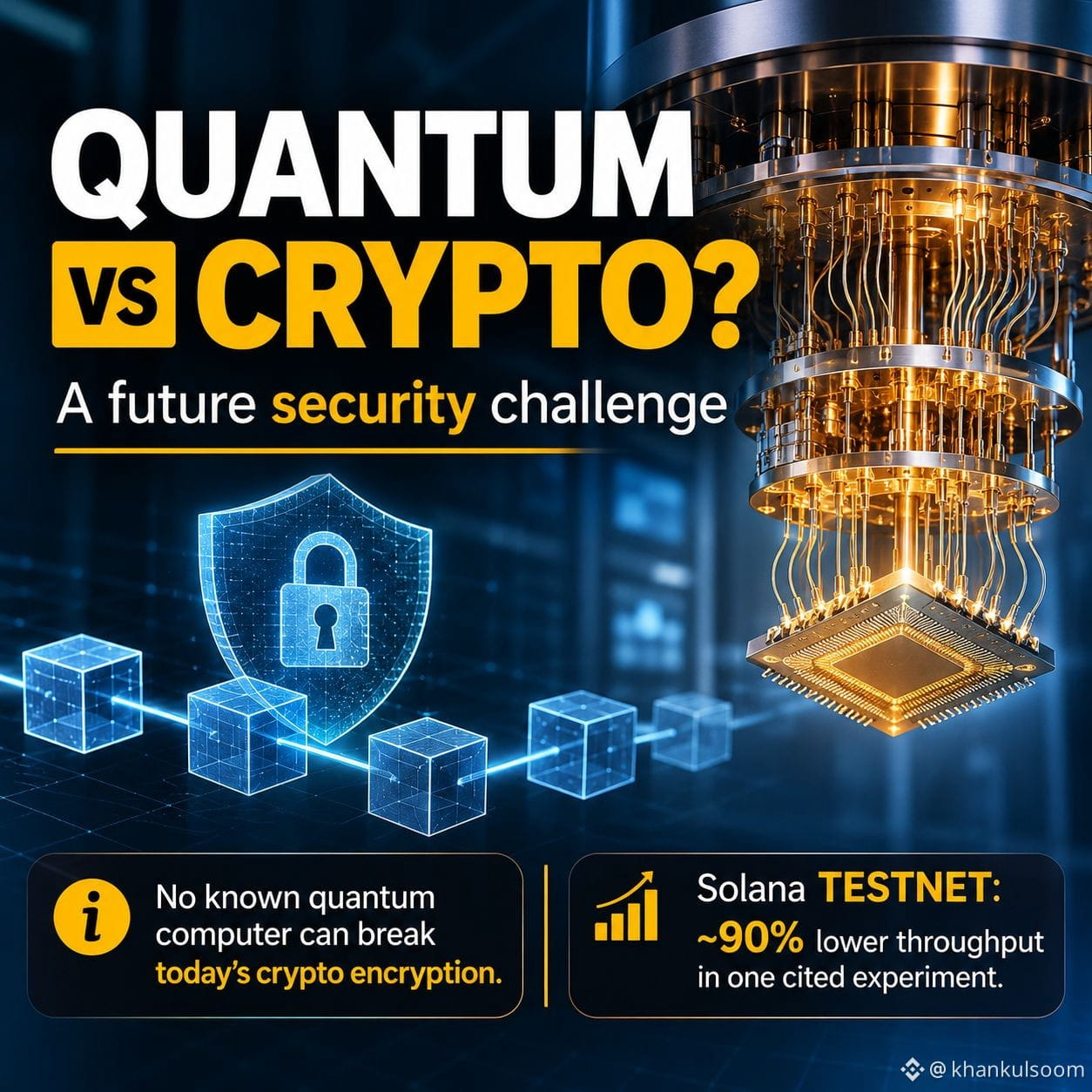
🔹 One Solana testnet experiment showed approximately 90% lower throughput.
But don't panic: no known quantum computer can currently break crypto's encryption.
💬 ONE QUESTION:
What matters more for crypto's future?
1️⃣ Maximum SPEED ⚡
2️⃣ Stronger SECURITY 🔐
Comment 1 or 2! 👇
$SOL
{spot}(SOLUSDT)
#solana #sol #blockchain #IsAnthropic’s$1.5TMarketCapJustified? #quantumcomputing
⚠️ COULD QUANTUM COMPUTERS CHANGE THE FUTURE OF CRYPTO?
A new warning from global regulators has raised an important question.
Here's why:
🔹 Quantum computers could eventually threaten today's encryption.
🔹 Quantum-resistant security may make blockchain transactions slower.
🔹 One Solana testnet experiment showed approximately 90% lower throughput.
But don't panic: no known quantum computer can currently break crypto's encryption.
💬 ONE QUESTION:
What matters more for crypto's future?
1️⃣ Maximum SPEED ⚡
2️⃣ Stronger SECURITY 🔐
Comment 1 or 2! 👇
$SOL
#solana #sol #blockchain #IsAnthropic’s$1.5TMarketCapJustified? #quantumcomputing
57

·
--
⚠️ QUANTUM COMPUTING COULD BECOME BLOCKCHAIN'S NEXT BIG SECURITY CHALLENGE!
Bitcoin and Ethereum rely on cryptography to protect transactions and prove ownership of digital assets.
But a new warning from the International Organization of Securities Commissions (IOSCO), published on November 19, deserves attention from the entire crypto industry.
Here's why.
⚛️ 1. The quantum computing challenge
Powerful quantum computers could eventually break some of the cryptographic systems currently used to secure digital transactions.
This could create risks for:
Bitcoin wallet security.
Ethereum digital signatures.
Blockchain authentication systems.
Cryptocurrency custody infrastructure.
🔐 2. Is crypto already vulnerable?
Not in the way some headlines suggest.
No known quantum computer can currently break widely used cryptographic systems.
However, IOSCO warns that sufficiently capable systems could emerge within the next five years, according to some industry assessments.
The transition to quantum-resistant cryptography could take several years.
🌐 3. Why blockchain faces a bigger challenge
Traditional financial institutions can coordinate security upgrades through centralized systems.
Public blockchains are different.
Thousands of independent validators, developers, node operators and wallet users may need to coordinate changes.
Upgrading cryptographic signatures could also affect transaction sizes, network capacity and fees.
💬 What do you think? Should Bitcoin and Ethereum developers prioritize quantum-resistant security now, even if it makes future upgrades more complicated?
$ETH $BTC
{spot}(BTCUSDT)
{spot}(ETHUSDT)
#Bitcoin #Ethereum #QuantumComputing
⚠️ QUANTUM COMPUTING COULD BECOME BLOCKCHAIN'S NEXT BIG SECURITY CHALLENGE!
Bitcoin and Ethereum rely on cryptography to protect transactions and prove ownership of digital assets.
But a new warning from the International Organization of Securities Commissions (IOSCO), published on November 19, deserves attention from the entire crypto industry.
Here's why.
⚛️ 1. The quantum computing challenge
Powerful quantum computers could eventually break some of the cryptographic systems currently used to secure digital transactions.
This could create risks for:
Bitcoin wallet security.
Ethereum digital signatures.
Blockchain authentication systems.
Cryptocurrency custody infrastructure.
🔐 2. Is crypto already vulnerable?
Not in the way some headlines suggest.
No known quantum computer can currently break widely used cryptographic systems.
However, IOSCO warns that sufficiently capable systems could emerge within the next five years, according to some industry assessments.
The transition to quantum-resistant cryptography could take several years.
🌐 3. Why blockchain faces a bigger challenge
Traditional financial institutions can coordinate security upgrades through centralized systems.
Public blockchains are different.
Thousands of independent validators, developers, node operators and wallet users may need to coordinate changes.
Upgrading cryptographic signatures could also affect transaction sizes, network capacity and fees.
💬 What do you think? Should Bitcoin and Ethereum developers prioritize quantum-resistant security now, even if it makes future upgrades more complicated?
$ETH $BTC
#Bitcoin #Ethereum #QuantumComputing

71

As quantum computing advances, the conversation around network longevity is shifting beyond basic scaling. Proposals like SHRINCS highlight how developers are proactively looking at cryptographic resilience. Securing the base layer against future threats without sacrificing current performance is a massive engineering puzzle. It reminds us that protocol evolution is continuous, and staying ahead of technological horizons remains vital for decentralized infrastructure over the long haul. $BTC #Bitcoin #QuantumComputing #CryptoSecurity
As quantum computing advances, the conversation around network longevity is shifting beyond basic scaling. Proposals like SHRINCS highlight how developers are proactively looking at cryptographic resilience. Securing the base layer against future threats without sacrificing current performance is a massive engineering puzzle. It reminds us that protocol evolution is continuous, and staying ahead of technological horizons remains vital for decentralized infrastructure over the long haul. $BTC #Bitcoin #QuantumComputing #CryptoSecurity
53

·
--
🚨🛡️ GLOBAL TECH ALERT: IOSCO Warns Quantum Computing Threatens Crypto Encryption & Network Throughput! 💻⚠️
🏛️ In a newly released 63-page report today, the International Organization of Securities Commissions (IOSCO) warned that advancing quantum computers could break the public-key cryptography securing blockchains like Bitcoin and Ethereum within 5 to 10 years.
📊 Hard Data & Technical Bottlenecks:
⚡ 90% Throughput Drop:
Citing a Solana benchmark test, switching to post-quantum signatures cut transaction throughput by up to 90%.
📦 40x Larger Signatures: Quantum-resistant cryptographic signatures are 35x–40x heavier, requiring complex upgrades and potential hard forks.
🔐 6 Million $BTC Exposed:
Roughly 6M Bitcoin sitting in legacy or exposed public-key addresses face "at-rest" vulnerability, prompting new industry security coalitions.
💡 Trader Reality Check:
No quantum computer can crack $ BTC or $ ETH today—this is a medium-to-long-term infrastructure warning, not an immediate market crash trigger. Beware of "Quantum Washing" hype from projects claiming instant immunity. 🧠
#IOSCO #quantumcomputing #CryptoSecurity #bitcoin #Ethereum #BlockchainTech #CryptoNews
$BTC
$ETH
{spot}(ETHUSDT)
$SOL
{spot}(SOLUSDT)
$QRL
$ALGO
{spot}(ALGOUSDT)
🚨🛡️ GLOBAL TECH ALERT: IOSCO Warns Quantum Computing Threatens Crypto Encryption & Network Throughput! 💻⚠️
🏛️ In a newly released 63-page report today, the International Organization of Securities Commissions (IOSCO) warned that advancing quantum computers could break the public-key cryptography securing blockchains like Bitcoin and Ethereum within 5 to 10 years.
📊 Hard Data & Technical Bottlenecks:
⚡ 90% Throughput Drop:
Citing a Solana benchmark test, switching to post-quantum signatures cut transaction throughput by up to 90%.
📦 40x Larger Signatures: Quantum-resistant cryptographic signatures are 35x–40x heavier, requiring complex upgrades and potential hard forks.
🔐 6 Million $BTC Exposed:
Roughly 6M Bitcoin sitting in legacy or exposed public-key addresses face "at-rest" vulnerability, prompting new industry security coalitions.
💡 Trader Reality Check:
No quantum computer can crack $ BTC or $ ETH today—this is a medium-to-long-term infrastructure warning, not an immediate market crash trigger. Beware of "Quantum Washing" hype from projects claiming instant immunity. 🧠
#IOSCO #quantumcomputing #CryptoSecurity #bitcoin #Ethereum #BlockchainTech #CryptoNews
$BTC
$ETH
$SOL
$QRL
$ALGO


ETH 4U 🍀
From OnionSam
4
132

CoinDesk says securities watchdog warns banks and blockchains lag on quantum defense facing yearslong encryption security overhauls many barely began
⚠️ #QuantumComputing #CryptoSecurity #Blockchain
$BTC
CoinDesk says securities watchdog warns banks and blockchains lag on quantum defense facing yearslong encryption security overhauls many barely began
⚠️ #QuantumComputing #CryptoSecurity #Blockchain
$BTC
⚠️ #QuantumComputing #CryptoSecurity #Blockchain
$BTC

17

IOSCO warns that transitioning to quantum resistant signatures could cause massive performance degradation. Solana testnets showed a 90% reduction in speed when implementing these security protocols.
#BlockchainSecurity #QuantumComputing
IOSCO warns that transitioning to quantum resistant signatures could cause massive performance degradation. Solana testnets showed a 90% reduction in speed when implementing these security protocols.
#BlockchainSecurity #QuantumComputing
#BlockchainSecurity #QuantumComputing
1
IOSCO warns quantum-resistant upgrades may slow blockchains 90% per Solana tests, leaving older-key wallets vulnerable to security gaps, Cointelegraph reports.
🔐 #QuantumComputing #BlockchainSecurity #IOSCO
$SOL
IOSCO warns quantum-resistant upgrades may slow blockchains 90% per Solana tests, leaving older-key wallets vulnerable to security gaps, Cointelegraph reports.
🔐 #QuantumComputing #BlockchainSecurity #IOSCO
$SOL
🔐 #QuantumComputing #BlockchainSecurity #IOSCO
$SOL

10

·
--
IOSCO warns that quantum computing could instantly crack existing encryption systems, while institutions may still wait years before seriously addressing post-quantum cryptography. Only starting work in 2027? That’s so slow it’s practically advertising quantum computing power. Haven’t PQC concepts taken off yet? Get on board now—don’t wait until physicists take down Binance.
#PQC #QuantumComputing #Crypto
#PQC #QuantumComputing #Crypto

10

·
--
IOSCO warns for the first time that quantum upgrades could slow blockchains, putting institutional confidence in long-term holdings to the test
The International Organization of Securities Commissions (IOSCO), the global securities regulator, has issued a rare, systematic warning: advances in quantum computing could pose “particularly thorny” challenges for blockchains, and the market should not wait until quantum computers actually arrive. This is the first comprehensive assessment of the quantum threat by an authoritative regulatory body, and it could set an example for how institutional investors view the long-term security of public blockchains.
According to Decrypt, IOSCO noted that blockchains will need to contend with issues such as larger signatures in a quantum environment. According to Cointelegraph, official tests found that enabling quantum signatures on the Solana testnet made it about 90% slower, while wallets still using old keys could leave security gaps. This means that as quantum computing advances, existing public blockchains could come under simultaneous pressure on signature security and network performance.
Why this matters to investors: Institutions’ long-term holdings of public blockchains are fundamentally based on trust in the networks’ long-term security. IOSCO’s authoritative position on global securities regulation brings the “quantum threat” from a tech-sector issue into the view of regulators and institutions. If the security premium is repriced, it could affect how investors assess the long-term value of public blockchains.
From a fundamentals perspective, this remains a long-term technology issue, not an immediate catalyst. Quantum computing is still far from posing a practical threat, so its short-term impact on prices is expected to be limited. The test results showing a slowdown of about 90% came from a testnet and reflect the trade-off between migration costs and performance, rather than an existing crisis.
How the market might react: The issue could fuel discussion about public blockchain security, but attention is more likely to be structural and gradual than to trigger major short-term capital flows. The key thing to watch is whether institutions raise the security premium they require for on-chain assets as a result.
One counterpoint is that this is a “wolf at the door” risk: repeated warnings that fail to materialize could lead to reader fatigue. Migration plans and key-upgrade paths are also still being developed, so there is no certain near-term shock.
What to watch next: For investors following public blockchains, the more important things to monitor are the actual progress of quantum migration and whether the security premium is repriced—not to treat this warning as a short-term signal.
#QuantumComputing #Bitcoin #Blockchain
The above is a compilation of information and personal analysis, and does not constitute investment advice.
I will continue to track key data and technological developments.
80

·
--
⚠️ QUANTUM CRYPTO HACK IN 5 YEARS?
On November 19, the International Organization of Securities Commissions (IOSCO) warned that quantum computers capable of breaking widely used financial cryptography could emerge within five years. This is an assessment of a potential risk, not a report of a hack that has already occurred.
A 63-page report published by the organization says that banks and blockchain projects are not yet sufficiently prepared to transition to quantum-resistant algorithms. This upgrade could take years.
The risks affect digital signatures in Bitcoin and Ethereum: in the future, powerful quantum computers could theoretically extract private keys from exposed public keys. No quantum computers with this capability are known to exist today.
Source: CoinDesk, IOSCO report. November 19, 2026.
#CryptoSecurity #QuantumComputing
25

·
--
ETHEREUM ($ETH ) — Preparing for the Quantum Future? ⚡
Ethereum co-founder Vitalik Buterin has supported research into leanPCS, a potential approach to making future quantum-resistant cryptography more practical.
This is long-term research, not an activated Ethereum upgrade.
Could quantum-resistant security become Ethereum's next major milestone?
#Ethereum #ETH #quantumcomputing

25


·
--
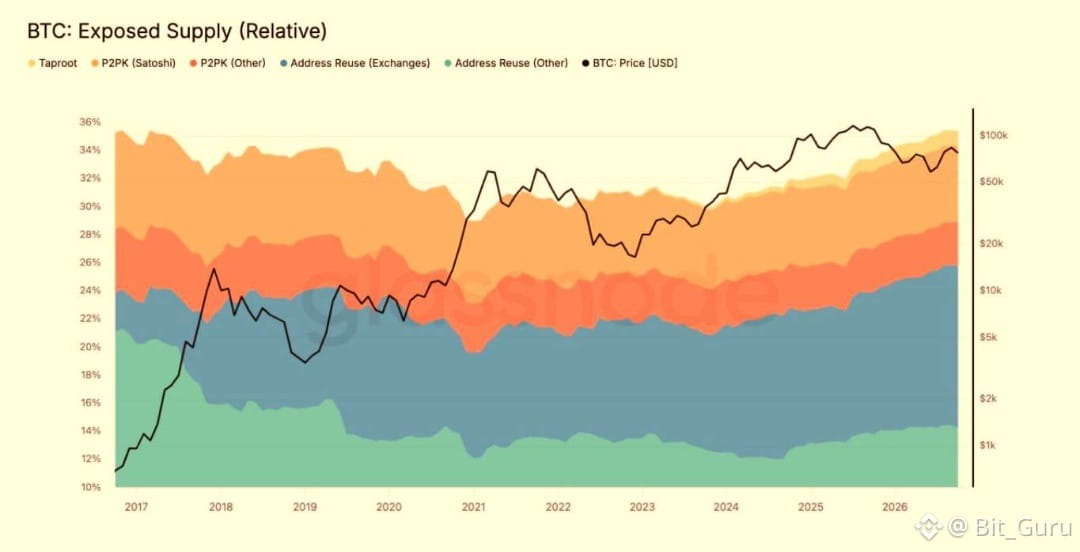
🚨 BITCOIN QUANTUM WARNING! 35.4% OF BTC SUPPLY COULD FACE FUTURE SECURITY RISKS! 👀
According to reported figures, around 7.12 million BTC may have publicly exposed keys, potentially creating vulnerabilities to future quantum attacks.
🔸 25.8% linked to address reuse. 🔸 11.6% held on centralized exchanges.
⚠️ There is no immediate threat. Today's quantum computers cannot break Bitcoin's cryptography.
However, the growing power of quantum technology makes long-term security upgrades increasingly important.
🔥 Bitcoin's next big challenge may be preparing for the quantum era!
#Bitcoin #BTC #QuantumComputing #CryptoNews
$BTC
{spot}(BTCUSDT)
🚨 BITCOIN QUANTUM WARNING! 35.4% OF BTC SUPPLY COULD FACE FUTURE SECURITY RISKS! 👀
According to reported figures, around 7.12 million BTC may have publicly exposed keys, potentially creating vulnerabilities to future quantum attacks.
🔸 25.8% linked to address reuse. 🔸 11.6% held on centralized exchanges.
⚠️ There is no immediate threat. Today's quantum computers cannot break Bitcoin's cryptography.
However, the growing power of quantum technology makes long-term security upgrades increasingly important.
🔥 Bitcoin's next big challenge may be preparing for the quantum era!
#Bitcoin #BTC #QuantumComputing #CryptoNews
$BTC
1
433

·
--
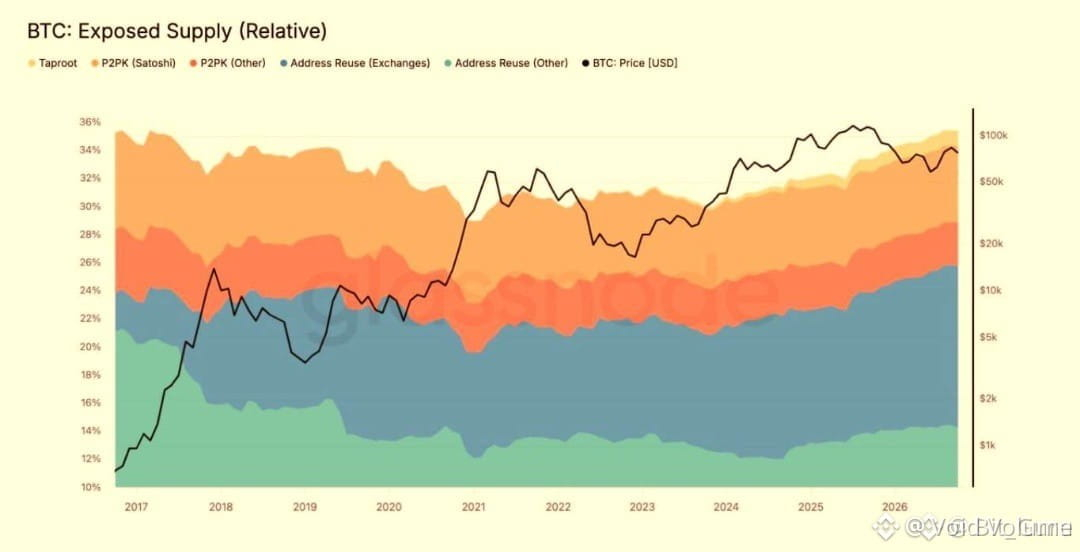
🦈 $BTC CRYPTOGRAPHIC HORIZON: 35% OF SUPPLY EXPOSED TO LONG-TERM QUANTUM RISKS! ⚡
Institutional risk models are looking far beyond the immediate order book to evaluate the structural integrity of $BTC . Reports indicate that over seven million coins carry exposed keys stemming from address reuse and legacy storage across centralized exchanges, highlighting a critical architectural bottleneck for the next decade.
While current quantum capabilities pose zero immediate threat to cryptographic foundations, long-term protocol evolution and consensus-layer upgrades remain non-negotiable. Smart money accumulation tracks both liquidity and network resilience equally. 📊
💬 How will protocol developers handle a seamless migration path for dormant coins before quantum advancement accelerates? 👇
⚠️ Not financial advice. Always manage your risk. 🛡️
🏷️ #BTC #QuantumComputing #CryptoNews #MarketStructure
🦈 ⚖️

·
--
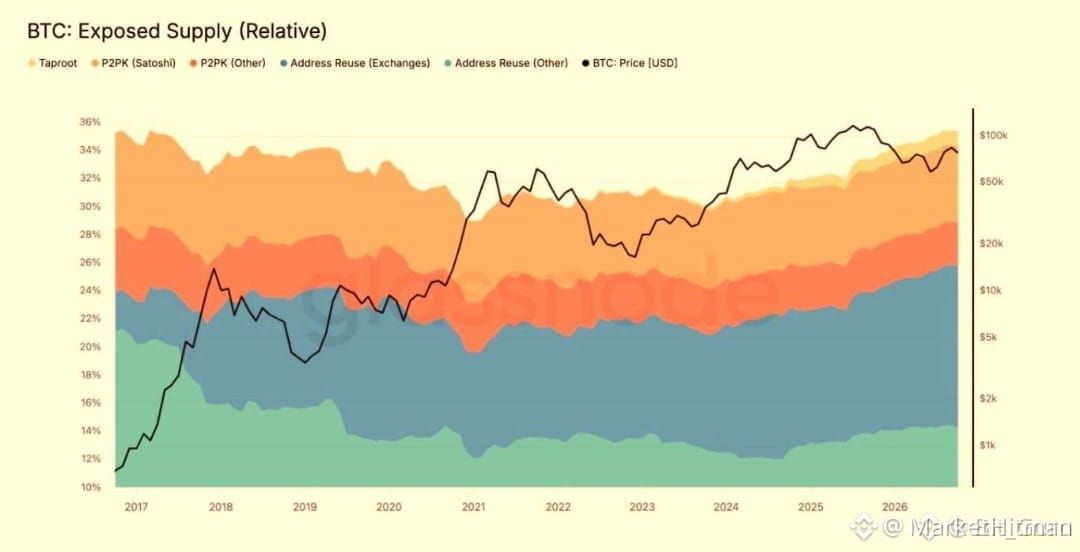
🚨 THE QUANTUM CLOCK IS TICKING FOR A MASSIVE CHUNK OF $BTC SUPPLY! ⏳
Over a third of all circulating coins carry structural vulnerabilities from address reuse and exchange custody habits. While today hardware cannot touch cryptographic encryption, tomorrow architecture demands a serious protocol evolution before computing power outpaces our defenses. 📊
Smart money looks decades ahead, not just at the next weekly candle. 💡 Long-term survival depends entirely on how smoothly the network upgrades its cryptographic armor when the next technological era arrives. ⚡
Are you factoring structural network milestones into your multi-year horizon, or staying hyper-focused on intraday price action? 🤔
⚠️ Not financial advice. Always manage your risk. 🛡️
🏷️ #BTC #QuantumComputing #CryptoNews #LongTerm
🔥 💎
3
·
--
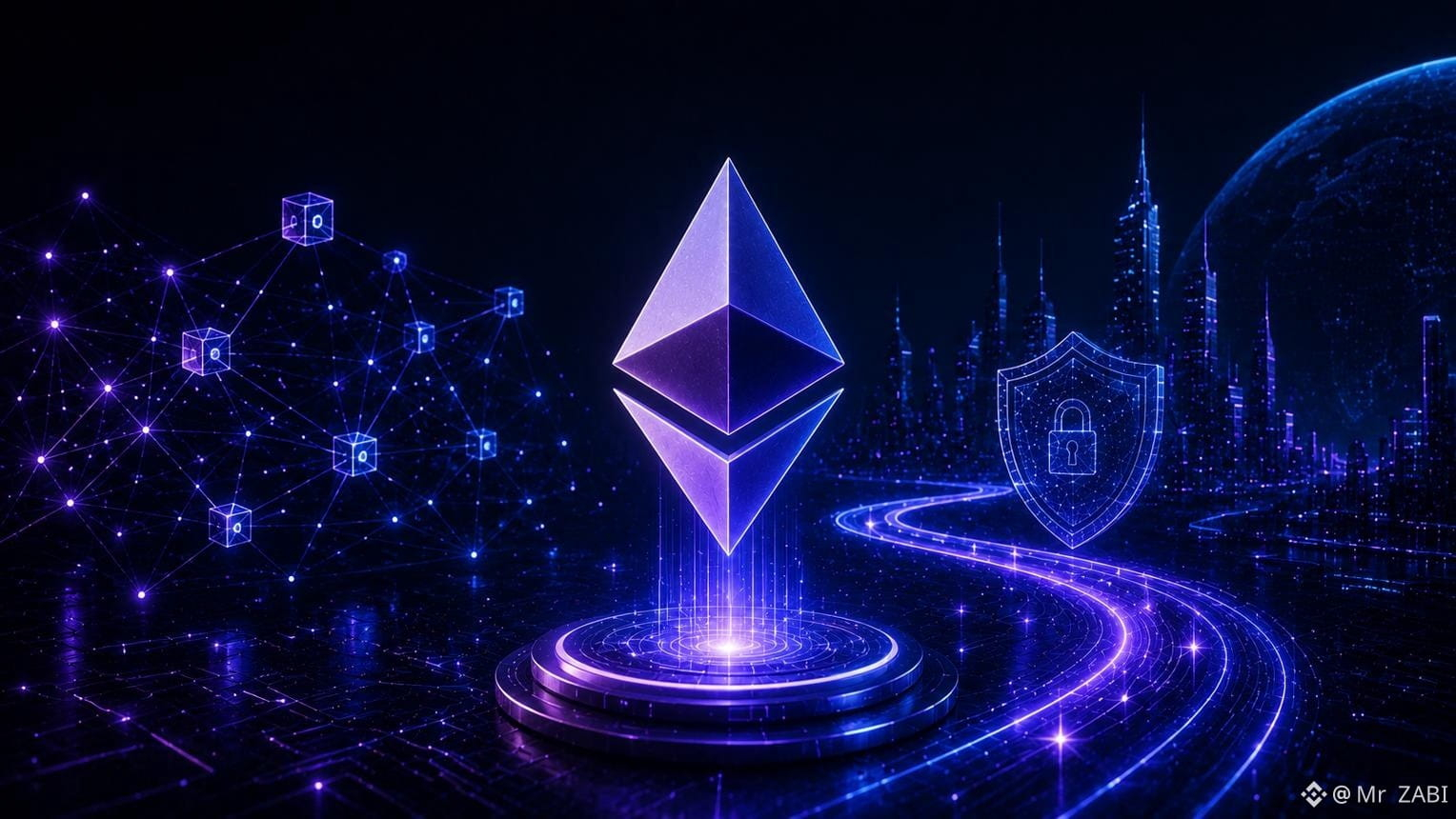
ETHEREUM — Preparing for the Quantum Era ⚡
$ETH
researchers are exploring ways to protect the network against future quantum-computing threats. Long-term security is becoming an important blockchain discussion.
Is quantum resistance the next big challenge for crypto?
#Ethereum #quantumcomputing #crypto
$ETH
researchers are exploring ways to protect the network against future quantum-computing threats. Long-term security is becoming an important blockchain discussion.
Is quantum resistance the next big challenge for crypto?
#Ethereum #quantumcomputing #crypto
1
107

⚛️ COULD QUANTUM COMPUTING CHANGE CRYPTO SECURITY?
The XRP Ledger Foundation has proposed exploring quantum-resistant security upgrades.
Why is this important?
Future quantum computers could challenge some cryptographic systems used today.
The proposed direction includes:
* New signing-key options.
* Stronger long-term security.
* Preparing blockchain infrastructure for future technology.
This is a developing area of research, not evidence that current XRP accounts have been compromised.
#XRP #QuantumComputing #CryptoSecurity #Technology

123

·
--
Quantum Risk Is a Long-Term Upgrade Challenge—not a Wallet Panic
Quantum computers are not cracking crypto wallets today—but preparation has a long lead time.
Google Research’s March 31, 2026 paper estimates that a future cryptographically relevant quantum computer could run Shor’s algorithm against 256-bit elliptic-curve cryptography with fewer than 1,200 logical qubits in one circuit. These are error-corrected logical qubits, not a working machine available today. The result is a resource estimate, not evidence that current wallets are compromised. Google recommends that blockchains plan for post-quantum cryptography before such hardware exists. What migration steps should networks prioritize first?
Source: Google Research: https://research.google/blog/safeguarding-cryptocurrency-by-disclosing-quantum-vulnerabilities-responsibly/
Market watch:
#CryptoEducation #QuantumComputing #BlockchainSecurity
3

·
--
Verified
Article
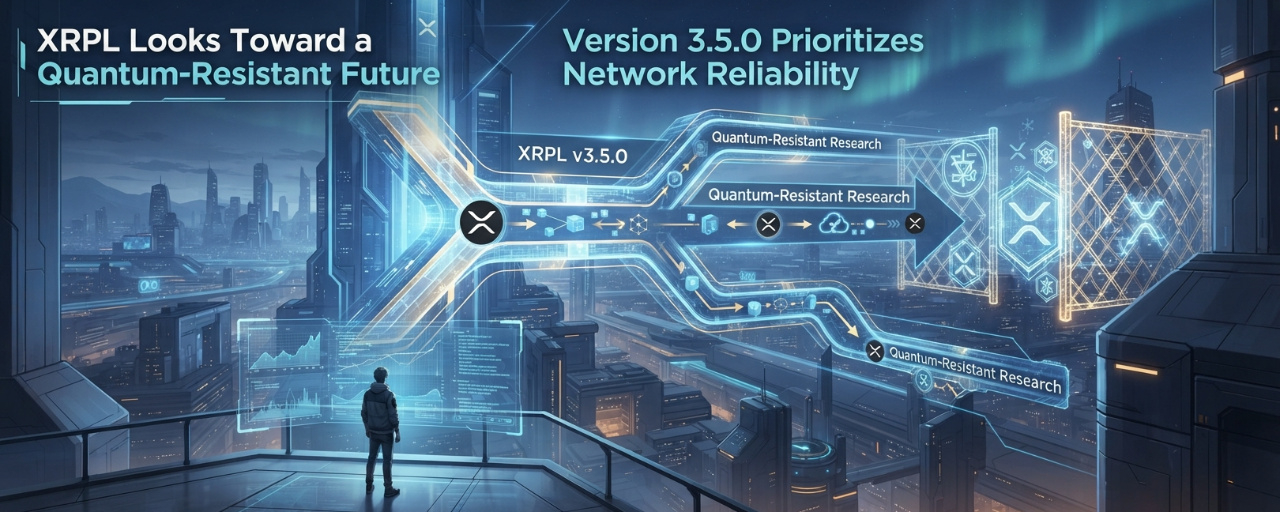
XRPL Looks Toward a Quantum-Resistant Future as Version 3.5.0 Prioritizes Network ReliabilityThe XRP Ledger (XRPL) is looking ahead to the potential risks posed by quantum computing, as developers consider how the network could strengthen its long-term cryptographic security. However, quantum-resistant protection remains a research and planning topic rather than an upcoming confirmed feature. The next documented update, version 3.5.0, is focused on improving network performance and reliability, particularly by addressing occasional ledger-closing delays. $XRP
{spot}(XRPUSDT)
Quantum computers could eventually threaten the elliptic-curve cryptography used by XRPL, Bitcoin, Ethereum, and other major blockchain networks. In theory, sufficiently powerful quantum machines could derive private keys from public keys. However, current quantum technology is still far from being capable of carrying out such attacks in practice. Preparing early is therefore important, especially because migrating wallets, validators, exchanges, and custodians to new cryptographic standards could take years.
{future}(XRPUSDT)
A potential quantum-resistant upgrade could introduce new address formats and post-quantum digital signatures instead of replacing the entire system at once. Such a transition would require extensive testing, broad validator approval, and clear migration guidance. Developers would also need to evaluate possible trade-offs, including larger transactions, higher fees, and changes to network capacity.
For now, XRPL's confirmed priority is improving operational stability through version 3.5.0. The key developments to watch are formal technical proposals, migration plans for users and institutions, and performance tests for post-quantum cryptography. For XRP holders, the practical details of any future transition will matter more than headlines suggesting that quantum protection is arriving immediately.
#xrp #XRPL #quantumcomputing
XRPL Looks Toward a Quantum-Resistant Future as Version 3.5.0 Prioritizes Network Reliability
The XRP Ledger (XRPL) is looking ahead to the potential risks posed by quantum computing, as developers consider how the network could strengthen its long-term cryptographic security. However, quantum-resistant protection remains a research and planning topic rather than an upcoming confirmed feature. The next documented update, version 3.5.0, is focused on improving network performance and reliability, particularly by addressing occasional ledger-closing delays. $XRP
Quantum computers could eventually threaten the elliptic-curve cryptography used by XRPL, Bitcoin, Ethereum, and other major blockchain networks. In theory, sufficiently powerful quantum machines could derive private keys from public keys. However, current quantum technology is still far from being capable of carrying out such attacks in practice. Preparing early is therefore important, especially because migrating wallets, validators, exchanges, and custodians to new cryptographic standards could take years.
A potential quantum-resistant upgrade could introduce new address formats and post-quantum digital signatures instead of replacing the entire system at once. Such a transition would require extensive testing, broad validator approval, and clear migration guidance. Developers would also need to evaluate possible trade-offs, including larger transactions, higher fees, and changes to network capacity.
For now, XRPL's confirmed priority is improving operational stability through version 3.5.0. The key developments to watch are formal technical proposals, migration plans for users and institutions, and performance tests for post-quantum cryptography. For XRP holders, the practical details of any future transition will matter more than headlines suggesting that quantum protection is arriving immediately.
#xrp #XRPL #quantumcomputing
Natalie-7:
👌! Thanks 🤝
1
14
2k

⚡ XRP LEDGER IS PREPARING FOR THE QUANTUM ERA!
The XRP Ledger Foundation has outlined a roadmap for quantum-resistant accounts.
Why this matters:
🔹 New quantum-resistant signing keys.
🔹 ML-DSA-44 cryptographic technology.
🔹 Existing vulnerable keys can be disabled.
🔹 No additional base transaction fees proposed.
The roadmap targets a full quantum transition by 2028.
However, development and network testing are still ongoing.
Is quantum-resistant security becoming the next major blockchain competition?
What's your take on $XRP ? 👀
#XRP #XRPL #QuantumComputing #Blockchain #CryptoMatrix $XRP
{spot}(XRPUSDT)
⚡ XRP LEDGER IS PREPARING FOR THE QUANTUM ERA!
The XRP Ledger Foundation has outlined a roadmap for quantum-resistant accounts.
Why this matters:
🔹 New quantum-resistant signing keys.
🔹 ML-DSA-44 cryptographic technology.
🔹 Existing vulnerable keys can be disabled.
🔹 No additional base transaction fees proposed.
The roadmap targets a full quantum transition by 2028.
However, development and network testing are still ongoing.
Is quantum-resistant security becoming the next major blockchain competition?
What's your take on $XRP ? 👀
#XRP #XRPL #QuantumComputing #Blockchain #CryptoMatrix $XRP
1
193

·
--
Bearish
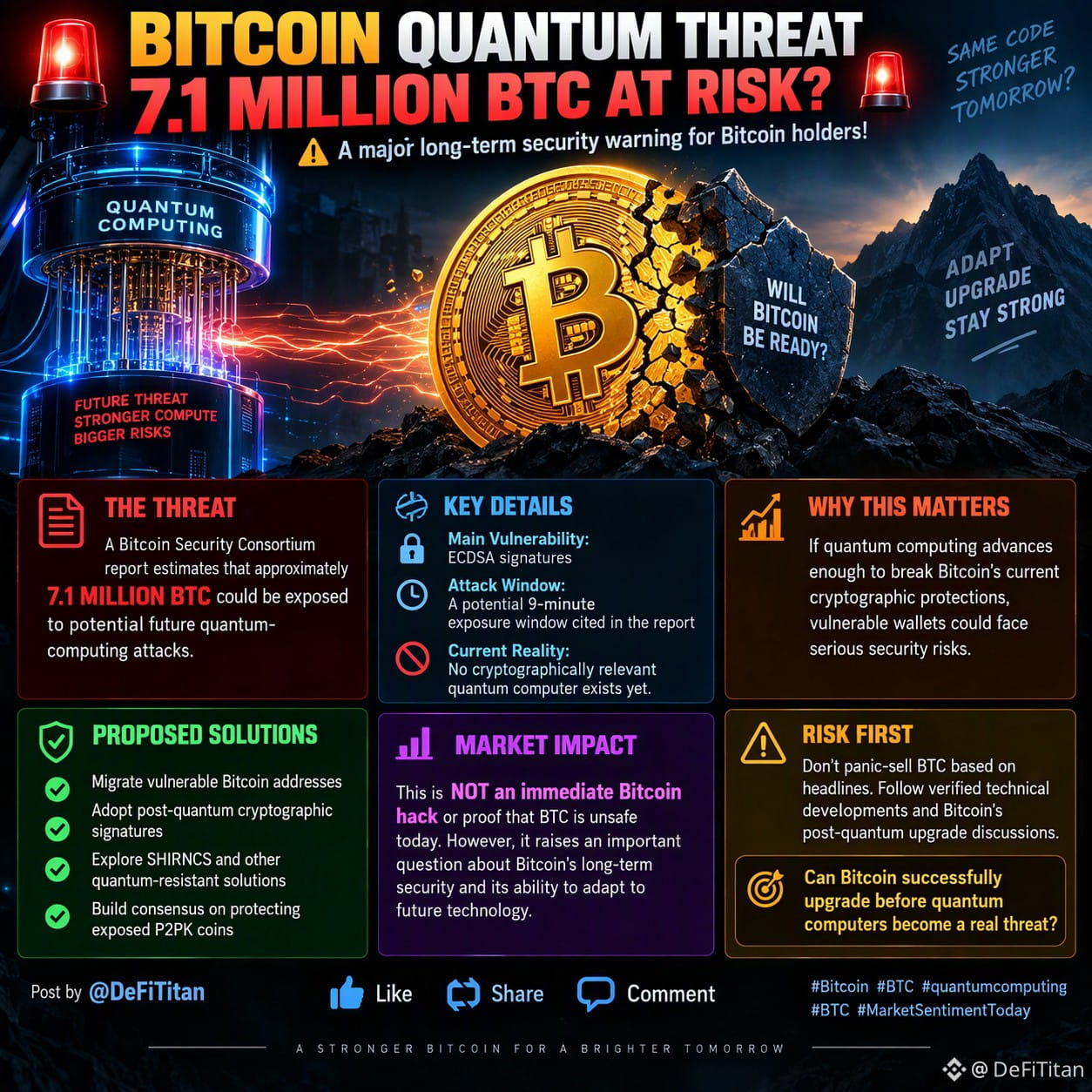
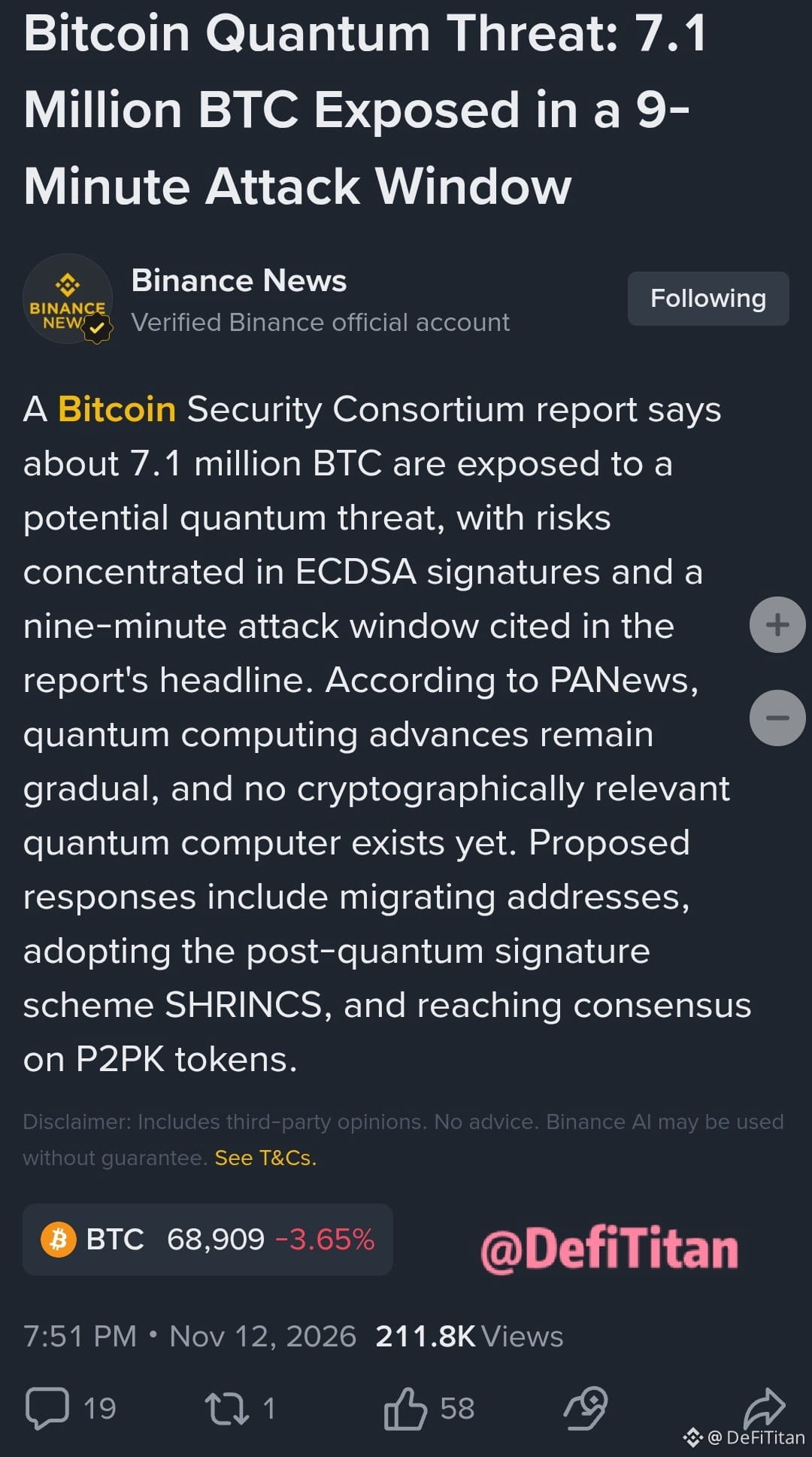
🚨 BITCOIN QUANTUM THREAT – 7.1 MILLION BTC AT RISK? 🚨
⚠️ **A major long-term security warning for Bitcoin holders!**
📍 **The Threat:**
A Bitcoin Security Consortium report estimates that approximately **7.1 million BTC** could be exposed to potential future quantum-computing attacks.
🔹 **Main Vulnerability:** ECDSA signatures
🔹 **Attack Window:** A potential 9-minute exposure window cited in the report
🔹 **Current Reality:** No cryptographically relevant quantum computer exists yet.
📉 **Why This Matters:**
If quantum computing advances enough to break Bitcoin's current cryptographic protections, vulnerable wallets could face serious security risks.
🔐 **Proposed Solutions:**
• Migrate vulnerable Bitcoin addresses
• Adopt post-quantum cryptographic signatures
• Explore SHIRNCS and other quantum-resistant solutions
• Build consensus on protecting exposed P2PK coins
⚠️ **Market Impact:**
This is NOT an immediate Bitcoin hack or proof that BTC is unsafe today. However, it raises an important question about Bitcoin's long-term security and its ability to adapt to future technology.
📌 **Risk First:**
Don't panic-sell BTC based on headlines. Follow verified technical developments and Bitcoin's post-quantum upgrade discussions.
**Can Bitcoin successfully upgrade before quantum computers become a real threat?**
📢 Post by @DeFiTitan
👍 Like 🔁 Share 💬 Comment
#Bitcoin #BTC #quantumcomputing #BTC #MarketSentimentToday
{future}(BTCUSDT)
{future}(SOLUSDT)
{future}(ETHUSDT)
$BTC $ETH $BNB
🚨 BITCOIN QUANTUM THREAT – 7.1 MILLION BTC AT RISK? 🚨
⚠️ **A major long-term security warning for Bitcoin holders!**
📍 **The Threat:**
A Bitcoin Security Consortium report estimates that approximately **7.1 million BTC** could be exposed to potential future quantum-computing attacks.
🔹 **Main Vulnerability:** ECDSA signatures
🔹 **Attack Window:** A potential 9-minute exposure window cited in the report
🔹 **Current Reality:** No cryptographically relevant quantum computer exists yet.
📉 **Why This Matters:**
If quantum computing advances enough to break Bitcoin's current cryptographic protections, vulnerable wallets could face serious security risks.
🔐 **Proposed Solutions:**
• Migrate vulnerable Bitcoin addresses
• Adopt post-quantum cryptographic signatures
• Explore SHIRNCS and other quantum-resistant solutions
• Build consensus on protecting exposed P2PK coins
⚠️ **Market Impact:**
This is NOT an immediate Bitcoin hack or proof that BTC is unsafe today. However, it raises an important question about Bitcoin's long-term security and its ability to adapt to future technology.
📌 **Risk First:**
Don't panic-sell BTC based on headlines. Follow verified technical developments and Bitcoin's post-quantum upgrade discussions.
**Can Bitcoin successfully upgrade before quantum computers become a real threat?**
📢 Post by @DeFiTitan
👍 Like 🔁 Share 💬 Comment
#Bitcoin #BTC #quantumcomputing #BTC #MarketSentimentToday
$BTC $ETH $BNB
97
Log in to explore more content
Join global crypto users on Binance Square
⚡️ Get latest and useful information about crypto.
💬 Trusted by the world’s largest crypto exchange.
👍 Discover real insights from verified creators.
Email / Phone number
Trending Topics
1
#GlobalStocksFaceLongestLosingStreakSince2023
0 views
66 Discussing
2
#BTCBelow$62KAmidHikeFearsAndShiftToAnthropic
20,381 views
164 Discussing
3
#GaoTengBitcoinETFListsOnHKEX
0 views
112 Discussing
4
#TradFiForBeginners
946,825 views
5,255 Discussing
5
#NvidiaBoardReportedlySplitOverHuang’sReturn
258,674 views
2,239 Discussing
6
#TetherBurns8BillionUSDTInPast20Days
0 views
6 Discussing
7
#CanGTA6'sLaunchLiftTTWOShares?
207,868 views
1,623 Discussing
8
#HongKongProposesSFCLicensingForFourVirtualAssetServices
404 views
28 Discussing
9
#BlackRockBitcoinETFRecordsLargestDailyOutflow
17,904 views
310 Discussing
10
#LedgerProbesTamperedWalletsInBerlinAndDubai
26,327 views
423 Discussing