
#tradfiforbeginners
tradfiforbeginners
1M views
5,873 Discussing
Hot
Latest


Article
TradFi 101: How to Buy Your First Stock$Bought crypto before? You're one step away from owning your first share.
1. What's TradFi? You Use It Every Day
TradFi = Traditional Finance
If you’ve ever put money in a savings account or just downloaded a brokerage app, that already makes you a TradFi user.
If you trade crypto, you've already accessed the three core mechanisms of stock trading:
Asset ownership — What am I actually holding?Price discovery — What does the market think this stock is worth?Placing orders — How do I buy and sell?
2. What's a Stock? Become an "Owner"
A stock (also called a share) is a small piece of ownership in a company.
Think of the chips that run many AI models today: they’re likely from Nvidia (NVDA).
Nvidia is divided into more than 24 billion shares.
With owning each share comes a fraction of Nvidia's earnings and its future, and you stand to gain three things:
📈 Capital gains: If the company’s value grows, your shares can be worth more than what you paid.
🗳️ Shareholder rights: Shareholders can vote on some company decisions.
💵 Dividends: Some companies pay part of their profit out to shareholders.
3. Buying Stocks on Binance: Two Routes, Your Pick
Don’t confuse Binance Stocks and bStocks! Here’s a quick look at how they’re different:
What you get
Binance Stocks: Beneficial ownership of real sharesbStocks: A 1:1-backed tokenized stock
When you can trade
Binance Stocks: Regular market sessionsbStocks: 24/7
Where to trade
Binance Stocks: Binance Stocks platformbStocks: Binance Spot
🔸 Route A: Binance Stocks
You can get started in 3 steps:
Account: You’ll need a Binance accountFunds: At least 5 USD, held in your Funding or Spot AccountOrder: Pay mainly with USDC. BNB, USDT, U and USD1 also work
After you tap “Buy”, your order is matched with a seller and the exchange fills it accordingly.
🔸 Route B: bStocks
bStocks are issued by BTech Holdings Limited, a Binance group affiliate.
Note: bStocks do not give you direct ownership of shares in the underlying company.
They give you exposure to the stock's price performance and economic benefits, such as dividend reinvestment.
4. What Does Stock Trading Cost?
There are two main costs:
🔸 Commission fees: paid to the brokerage firm.
🔸 The bid-ask spread: also known as the buy-sell gap.
Say Nvidia is quoted at $180.05 to buy from a seller and $180.00 to sell to a buyer.
This 5-cent gap is the spread.
Note: Stock prices can be volatile. Only invest what you can afford to lose.
Want to learn more before you decide?
Learn about how exchanges and brokers work, using diversification to manage risk, and more.
👉 It's all in the Binance Academy course [Understanding Stocks: From Shares to Markets](https://www.binance.com/en/academy/track/understanding-stocks).
TradFi 101: How to Buy Your First Stock
$Bought crypto before? You're one step away from owning your first share.
1. What's TradFi? You Use It Every Day
TradFi = Traditional Finance
If you’ve ever put money in a savings account or just downloaded a brokerage app, that already makes you a TradFi user.
If you trade crypto, you've already accessed the three core mechanisms of stock trading:
Asset ownership — What am I actually holding?Price discovery — What does the market think this stock is worth?Placing orders — How do I buy and sell?
2. What's a Stock? Become an "Owner"
A stock (also called a share) is a small piece of ownership in a company.
Think of the chips that run many AI models today: they’re likely from Nvidia (NVDA).
Nvidia is divided into more than 24 billion shares.
With owning each share comes a fraction of Nvidia's earnings and its future, and you stand to gain three things:
📈 Capital gains: If the company’s value grows, your shares can be worth more than what you paid.
🗳️ Shareholder rights: Shareholders can vote on some company decisions.
💵 Dividends: Some companies pay part of their profit out to shareholders.
3. Buying Stocks on Binance: Two Routes, Your Pick
Don’t confuse Binance Stocks and bStocks! Here’s a quick look at how they’re different:
What you get
Binance Stocks: Beneficial ownership of real sharesbStocks: A 1:1-backed tokenized stock
When you can trade
Binance Stocks: Regular market sessionsbStocks: 24/7
Where to trade
Binance Stocks: Binance Stocks platformbStocks: Binance Spot
🔸 Route A: Binance Stocks
You can get started in 3 steps:
Account: You’ll need a Binance accountFunds: At least 5 USD, held in your Funding or Spot AccountOrder: Pay mainly with USDC. BNB, USDT, U and USD1 also work
After you tap “Buy”, your order is matched with a seller and the exchange fills it accordingly.
🔸 Route B: bStocks
bStocks are issued by BTech Holdings Limited, a Binance group affiliate.
Note: bStocks do not give you direct ownership of shares in the underlying company.
They give you exposure to the stock's price performance and economic benefits, such as dividend reinvestment.
4. What Does Stock Trading Cost?
There are two main costs:
🔸 Commission fees: paid to the brokerage firm.
🔸 The bid-ask spread: also known as the buy-sell gap.
Say Nvidia is quoted at $180.05 to buy from a seller and $180.00 to sell to a buyer.
This 5-cent gap is the spread.
Note: Stock prices can be volatile. Only invest what you can afford to lose.
Want to learn more before you decide?
Learn about how exchanges and brokers work, using diversification to manage risk, and more.
👉 It's all in the Binance Academy course Understanding Stocks: From Shares to Markets.
Alex Khvoinitskii:
用加密交易者已经熟悉的三件事来讲股票:资产所有权、价格发现、下单,切入点很好。但有一个差别值得补充:股票有交易时段和结算周期,而加密是全天候的,所以休市期间的风险只能靠仓位管理来吸收。理解这一点,比记住术语更能避免新手踩坑。
5
2
25
51.2k

·
--
Bearish
Partly True
#TradFiForBeginners
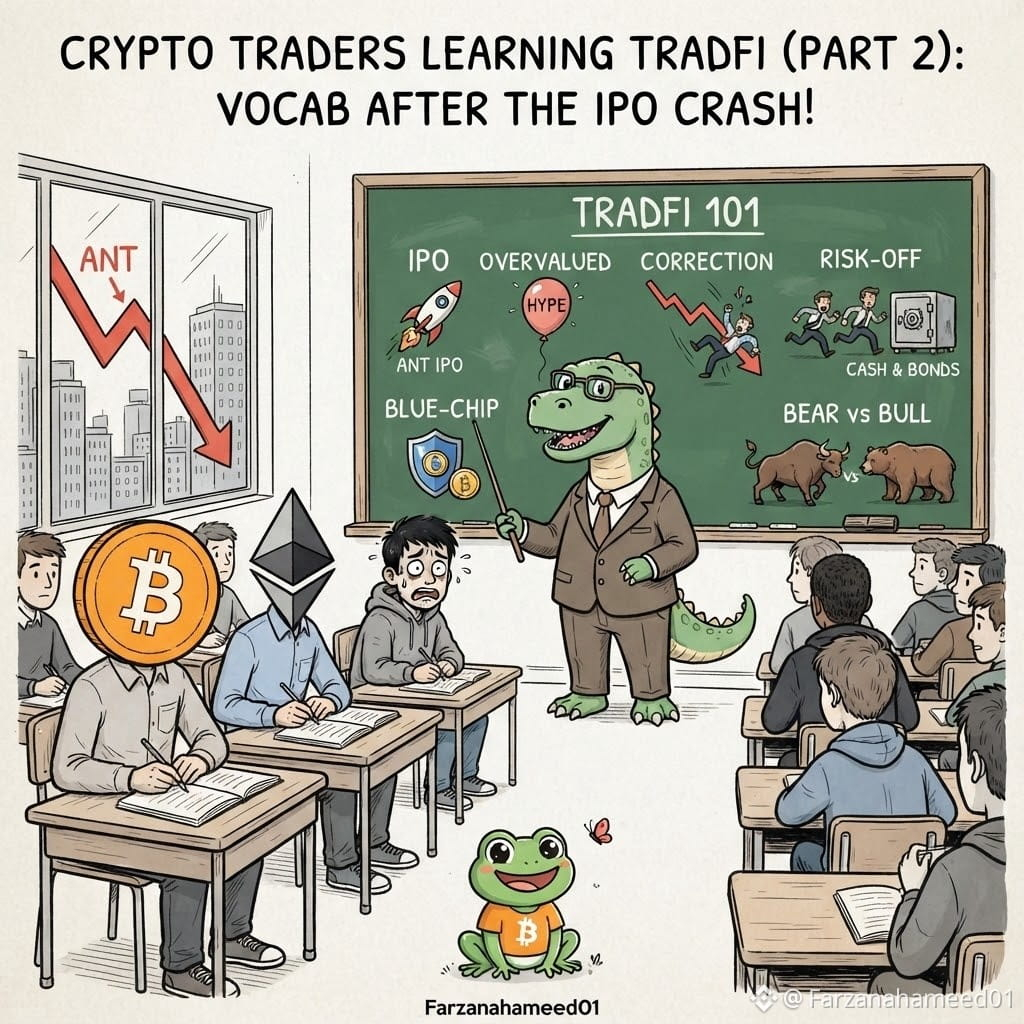
🦖 CRYPTO FOLKS LEARNING TRADFI BY OSMOSIS (PART 2): ANTIQUE VOCABULARY AFTER THE IPO CRASH! 📉
Following up on Part 1, today we're upgrading our vocabulary and diving straight into the latest drama: Anthropic's (ticker: ANT) IPO price-pumping scandal, which sent both Wall Street and Crypto markets tumbling around the world!
Let me explain in very simple words what is happening:
🔸 IPO: The first time a company lists on the stock market (the original version of an ICO/IEO).
🔸 Overvalued: Priced sky-high compared to its actual value, just like ANT's price surge that left the market gasping for air.
🔸 Correction: A "flood of selling" that cools prices when a bubble has been inflated too much.
🔸 Risk-off: When the whales pull money out of risky assets (like tech stocks and Crypto) and pile into cash or bonds.
🔸 Blue-chip: Reputable, leading stocks (like BTC and ETH on our side).
🔸 Bear/Bull Market: Bear and bull markets — the original Wall Street terms that coin folks borrow and use all the time.
💡 So what should we do?
In my opinion, learn this vocabulary by heart so you won't be "clueless" when you hear U.S. news at 9:30 p.m. every night, and know how to dodge the storm when the whales switch to Risk-off mode!
⚠️ This is not financial advice. This is for learning and sharing only. I do not trade.
Which one of these words confused you the most before today? 🤔
$GOOGL - This is a strong coin in this story, Wall Street fear dragged it down too, so please watch it near support.
$NVDA - This is also a strong coin in this story, it fell with tech sell-off, so please do not chase it with FOMO.
$ANT - This is the main coin in this story, its IPO scandal started this whole crash, so please be careful with it.
#WallStreet #MarketCorrection #TradFi #CryptoLearning #StockMarket #BinanceSquare
✨𝐅𝐀𝐑𝐙𝐀𝐍𝐀 𝐇𝐀𝐌𝐄𝐄𝐃 𝐎𝐅𝐅𝐈𝐂𝐈𝐀𝐋 • 🦋
{future}(GOOGLUSDT)
{future}(NVDAUSDT)
{future}(ANTUSDT)
#TradFiForBeginners
🦖 CRYPTO FOLKS LEARNING TRADFI BY OSMOSIS (PART 2): ANTIQUE VOCABULARY AFTER THE IPO CRASH! 📉
Following up on Part 1, today we're upgrading our vocabulary and diving straight into the latest drama: Anthropic's (ticker: ANT) IPO price-pumping scandal, which sent both Wall Street and Crypto markets tumbling around the world!
Let me explain in very simple words what is happening:
🔸 IPO: The first time a company lists on the stock market (the original version of an ICO/IEO).
🔸 Overvalued: Priced sky-high compared to its actual value, just like ANT's price surge that left the market gasping for air.
🔸 Correction: A "flood of selling" that cools prices when a bubble has been inflated too much.
🔸 Risk-off: When the whales pull money out of risky assets (like tech stocks and Crypto) and pile into cash or bonds.
🔸 Blue-chip: Reputable, leading stocks (like BTC and ETH on our side).
🔸 Bear/Bull Market: Bear and bull markets — the original Wall Street terms that coin folks borrow and use all the time.
💡 So what should we do?
In my opinion, learn this vocabulary by heart so you won't be "clueless" when you hear U.S. news at 9:30 p.m. every night, and know how to dodge the storm when the whales switch to Risk-off mode!
⚠️ This is not financial advice. This is for learning and sharing only. I do not trade.
Which one of these words confused you the most before today? 🤔
$GOOGL - This is a strong coin in this story, Wall Street fear dragged it down too, so please watch it near support.
$NVDA - This is also a strong coin in this story, it fell with tech sell-off, so please do not chase it with FOMO.
$ANT - This is the main coin in this story, its IPO scandal started this whole crash, so please be careful with it.
#WallStreet #MarketCorrection #TradFi #CryptoLearning #StockMarket #BinanceSquare
✨𝐅𝐀𝐑𝐙𝐀𝐍𝐀 𝐇𝐀𝐌𝐄𝐄𝐃 𝐎𝐅𝐅𝐈𝐂𝐈𝐀𝐋 • 🦋
alikumail111:
You're most welcome! 😊 Keep sharing these educational breakdowns — they make complex market topics easier for everyone to understand. Looking forward to Part 3! 📚👏
3
10
1.4k

·
--
Article
TRADFI FOR BEGINNERS: WHAT DOES IT MEAN?#TradFiForBeginners Ever heard the term TradFi in crypto discussions? Here's what you need to know!
💡 What Is TradFi?
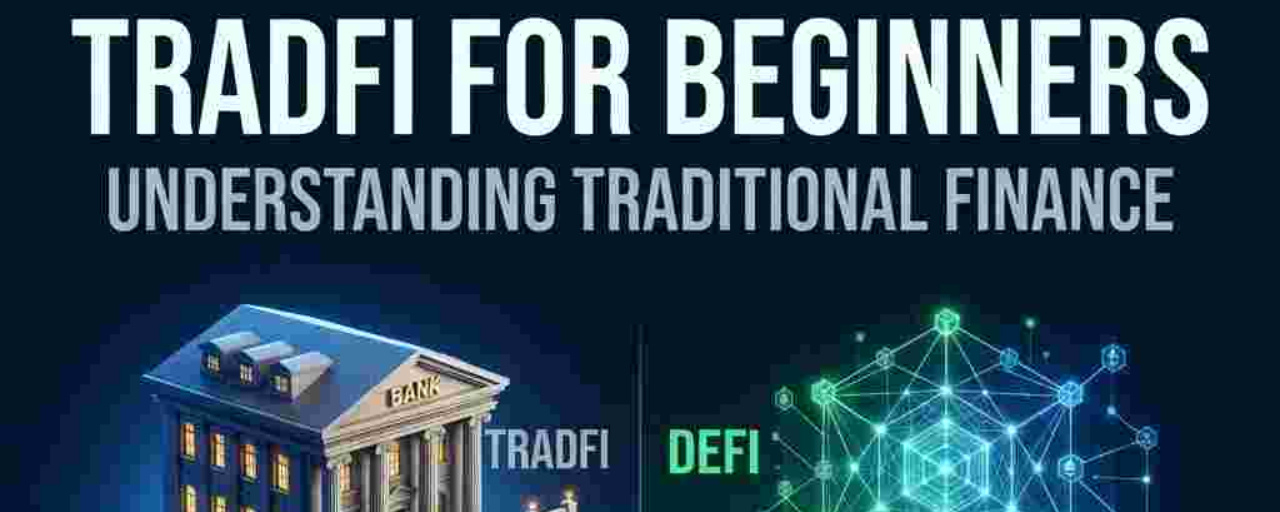
TradFi stands for Traditional Finance. It refers to the established financial system we use every day.
🏦 Examples of TradFi:
Commercial banksStock marketsGovernment bondsTraditional investment fundsInsurance companiesCentral banks
🔗 TradFi vs DeFi: What's the Difference?
TradFi:
Controlled by financial institutions.Often requires intermediaries.Operates under established regulations.
DeFi:
Uses blockchain technology.Enables peer-to-peer financial transactions.Often operates through smart contracts.
🚀 Why Does TradFi Matter to Crypto?
Traditional financial institutions are increasingly exploring Bitcoin ETFs, tokenized assets, and blockchain-based payments.
The future could bring traditional finance and decentralized finance closer together.
💬 Question: Do you believe TradFi and DeFi will eventually work together or compete?
#DeFi #Bitcoin #CryptoEducation
TRADFI FOR BEGINNERS: WHAT DOES IT MEAN?
#TradFiForBeginners Ever heard the term TradFi in crypto discussions? Here's what you need to know!
💡 What Is TradFi?
TradFi stands for Traditional Finance. It refers to the established financial system we use every day.
🏦 Examples of TradFi:
Commercial banksStock marketsGovernment bondsTraditional investment fundsInsurance companiesCentral banks
🔗 TradFi vs DeFi: What's the Difference?
TradFi:
Controlled by financial institutions.Often requires intermediaries.Operates under established regulations.
DeFi:
Uses blockchain technology.Enables peer-to-peer financial transactions.Often operates through smart contracts.
🚀 Why Does TradFi Matter to Crypto?
Traditional financial institutions are increasingly exploring Bitcoin ETFs, tokenized assets, and blockchain-based payments.
The future could bring traditional finance and decentralized finance closer together.
💬 Question: Do you believe TradFi and DeFi will eventually work together or compete?
#DeFi #Bitcoin #CryptoEducation
52

·
--
Traditional Finance (TradFi) is a common entry point for many into the broader financial world. For those new to crypto, understanding the parallels and differences between TradFi and Decentralized Finance (DeFi) can be crucial. Many concepts like investing, lending, and borrowing exist in both systems, but the mechanisms and accessibility differ significantly.
For beginners transitioning into crypto, grasping these fundamental TradFi concepts can provide a solid foundation. It helps in understanding the value proposition of DeFi, its potential for innovation, and the associated risks. Recognizing how markets operate, the role of intermediaries, and risk management in TradFi offers valuable context when exploring the decentralized landscape. This foundational knowledge can demystify crypto and enable more informed decision-making.
This is not investment advice. Please refer to Binance's terms and conditions.
#TradFiForBeginners
117

New to trading and investing? You've probably heard terms like stocks, forex, bonds, commodities, and financial markets.
But what do they actually mean?
Welcome to TradFi (Traditional Finance) — the established financial system that connects investors, companies, banks, governments, and financial institutions.
1. WHAT IS TRADFI?
TradFi stands for Traditional Finance.
It refers to the conventional financial system operating through regulated institutions, intermediaries, and established financial markets.
Examples include:
> Commercial banks.
> Stock exchanges.
> Investment companies.
> Insurance institutions.
> Brokerage firms.
> Central banks.
Unlike decentralized finance (DeFi), traditional finance generally relies on regulated institutions and intermediaries to facilitate transactions and manage financial services.
2. THE FIVE MAJOR TRADFI MARKETS
Understanding these markets is essential for every beginner.
🔹 STOCK MARKET
Investors buy and sell shares representing ownership in publicly traded companies.
Examples: Apple, Microsoft, NVIDIA and Tesla.
You can potentially benefit from share-price appreciation and dividends, although stock prices can also fall.
🔹 FOREX MARKET
Forex is the global market for exchanging currencies.
Popular currency pairs include:
> EUR/USD
> GBP/USD
> USD/JPY
Forex prices move based on interest rates, economic data, inflation, and geopolitical developments.
🔹 BOND MARKET
Bonds are debt instruments issued by governments and corporations.
Investors lend money to the issuer in exchange for interest payments and repayment according to the bond's terms.
Examples include U.S. Treasury bonds and corporate bonds.
🔹 COMMODITIES MARKET
This market involves trading raw materials and natural resources.
Popular commodities include:
> Gold
> Silver
> Crude oil
> Natural gas
> Copper
Commodity prices can respond to supply, demand, inflation, and global economic conditions.
$ETH
{spot}(ETHUSDT)
#tradfiforbeginners
New to trading and investing? You've probably heard terms like stocks, forex, bonds, commodities, and financial markets.
But what do they actually mean?
Welcome to TradFi (Traditional Finance) — the established financial system that connects investors, companies, banks, governments, and financial institutions.
1. WHAT IS TRADFI?
TradFi stands for Traditional Finance.
It refers to the conventional financial system operating through regulated institutions, intermediaries, and established financial markets.
Examples include:
> Commercial banks.
> Stock exchanges.
> Investment companies.
> Insurance institutions.
> Brokerage firms.
> Central banks.
Unlike decentralized finance (DeFi), traditional finance generally relies on regulated institutions and intermediaries to facilitate transactions and manage financial services.
2. THE FIVE MAJOR TRADFI MARKETS
Understanding these markets is essential for every beginner.
🔹 STOCK MARKET
Investors buy and sell shares representing ownership in publicly traded companies.
Examples: Apple, Microsoft, NVIDIA and Tesla.
You can potentially benefit from share-price appreciation and dividends, although stock prices can also fall.
🔹 FOREX MARKET
Forex is the global market for exchanging currencies.
Popular currency pairs include:
> EUR/USD
> GBP/USD
> USD/JPY
Forex prices move based on interest rates, economic data, inflation, and geopolitical developments.
🔹 BOND MARKET
Bonds are debt instruments issued by governments and corporations.
Investors lend money to the issuer in exchange for interest payments and repayment according to the bond's terms.
Examples include U.S. Treasury bonds and corporate bonds.
🔹 COMMODITIES MARKET
This market involves trading raw materials and natural resources.
Popular commodities include:
> Gold
> Silver
> Crude oil
> Natural gas
> Copper
Commodity prices can respond to supply, demand, inflation, and global economic conditions.
$ETH
#tradfiforbeginners

336

·
--
🚨 BANKS CONTROL YOUR MONEY. BLOCKCHAIN GIVES YOU MORE CONTROL. BUT WHICH ONE IS ACTUALLY SAFER?! 🏦⚔️₿
TRADFI VS DEFI — EXPLAINED IN 30 SECONDS!
🏦 TRADFI:
Banks and brokers act as intermediaries.
Regulated financial institutions.
Identity verification is usually required.
Consumer protections depend on the product and jurisdiction.
⛓️ DEFI:
Smart contracts execute financial transactions.
Many protocols allow direct wallet access.
Markets can operate 24/7.
Users face smart-contract, wallet and liquidation risks.
🔥 HERE'S WHAT MOST BEGINNERS MISS:
MORE CONTROL DOESN'T AUTOMATICALLY MEAN MORE SAFETY.
TradFi has institutional risks.
DeFi has technological and self-custody risks.
And neither guarantees profits.
👀 IF YOU HAD $10,000 TO INVEST, WOULD YOU TRUST A BANK, AN ETF OR A DEFI PROTOCOL?
$BTC $ETH $AAVE $LINK
#tradfiforbeginners #CanBTCReboundAfterFallingBelow60K? #GlobalStocksFaceLongestLosingStreakSince2023 #NvidiaBoardReportedlySplitOverHuang’sReturn #TetherBurns8BillionUSDTInPast20Days
105

·
--
#TradFiForBeginners
New to crypto and keep seeing the term TradFi thrown around? Let's break it down without the jargon. 🧠👇
TradFi stands for Traditional Finance.
Think of it as the classic financial system you already use every day—your local bank, the stock market, credit cards, and government-backed currencies (like the US Dollar, Euro, or Rupee).
Here is how TradFi compares to DeFi (Decentralized Finance) in simple terms:
🏦 Who is in control?
• TradFi: Centralized institutions like banks, brokers, and governments manage your money and approve transactions.
• DeFi: Code (smart contracts) and blockchain networks run the show—no middlemen required.
⏰ When can you use it?
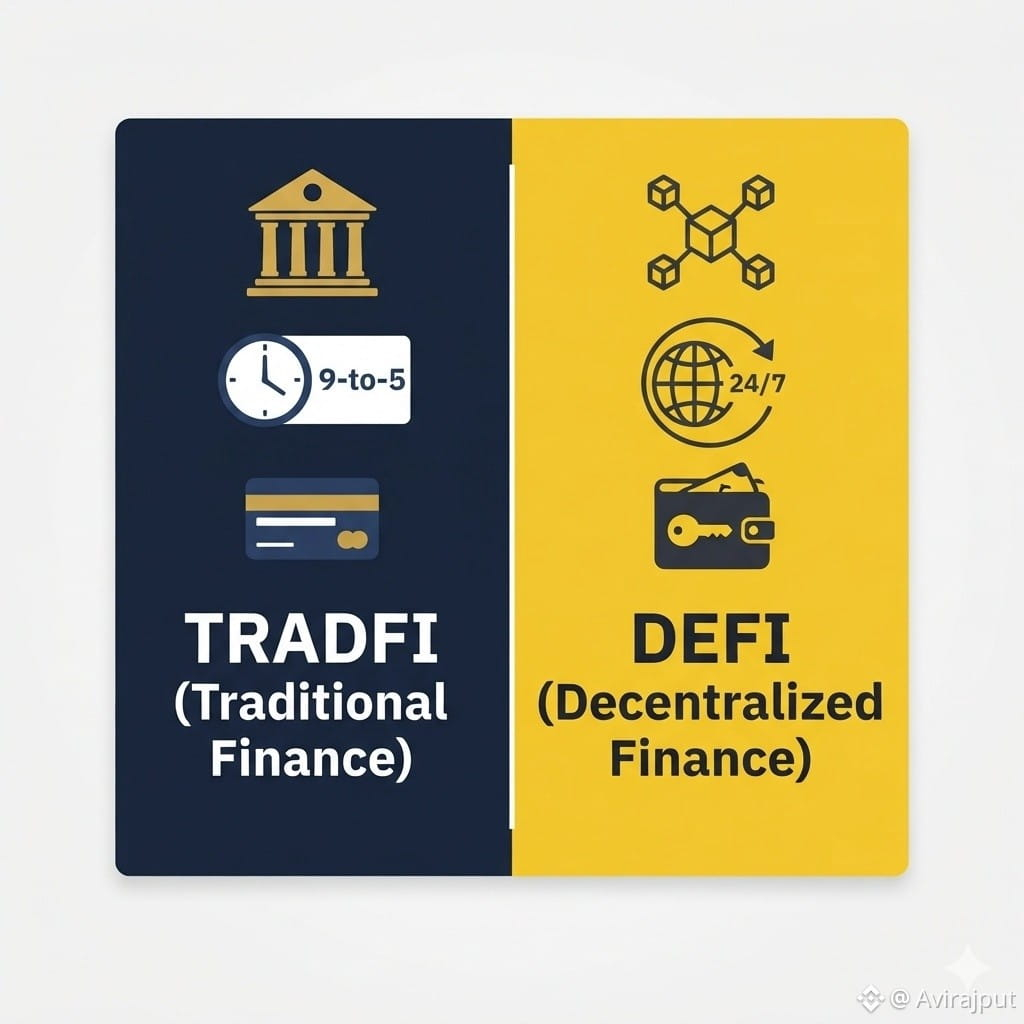
• TradFi: Operates on "bankers' hours" (usually Monday–Friday, 9 AM to 5 PM). Wire transfers can take days.
• DeFi: Open 24/7/365. Send value across the globe in seconds, even on a Sunday night.
🔑 Who holds the keys?
• TradFi: Your bank holds your funds for you. If you forget your password, customer support can reset it.
• DeFi: You are your own bank. You hold your private keys, meaning total control—and total responsibility.
Why does TradFi matter in crypto?
Today, the two worlds are merging! From $BTC ETFs on Wall Street to tokenized real-world assets (RWAs) like gold and real estate on the blockchain, TradFi and crypto are building the future of money together. 🤝
Which side do you prefer right now—the safety net of TradFi or the 24/7 freedom of DeFi? Drop your thoughts in the comments! 👇💬
#TradFiForBeginners #CryptoBasics #Web3Education
{spot}(BTCUSDT)
{spot}(ANTBUSDT)
{spot}(XAUTUSDT)
#TradFiForBeginners
New to crypto and keep seeing the term TradFi thrown around? Let's break it down without the jargon. 🧠👇
TradFi stands for Traditional Finance.
Think of it as the classic financial system you already use every day—your local bank, the stock market, credit cards, and government-backed currencies (like the US Dollar, Euro, or Rupee).
Here is how TradFi compares to DeFi (Decentralized Finance) in simple terms:
🏦 Who is in control?
• TradFi: Centralized institutions like banks, brokers, and governments manage your money and approve transactions.
• DeFi: Code (smart contracts) and blockchain networks run the show—no middlemen required.
⏰ When can you use it?
• TradFi: Operates on "bankers' hours" (usually Monday–Friday, 9 AM to 5 PM). Wire transfers can take days.
• DeFi: Open 24/7/365. Send value across the globe in seconds, even on a Sunday night.
🔑 Who holds the keys?
• TradFi: Your bank holds your funds for you. If you forget your password, customer support can reset it.
• DeFi: You are your own bank. You hold your private keys, meaning total control—and total responsibility.
Why does TradFi matter in crypto?
Today, the two worlds are merging! From $BTC ETFs on Wall Street to tokenized real-world assets (RWAs) like gold and real estate on the blockchain, TradFi and crypto are building the future of money together. 🤝
Which side do you prefer right now—the safety net of TradFi or the 24/7 freedom of DeFi? Drop your thoughts in the comments! 👇💬
#TradFiForBeginners #CryptoBasics #Web3Education
1
166

·
--
Bullish
#TradFiForBeginners
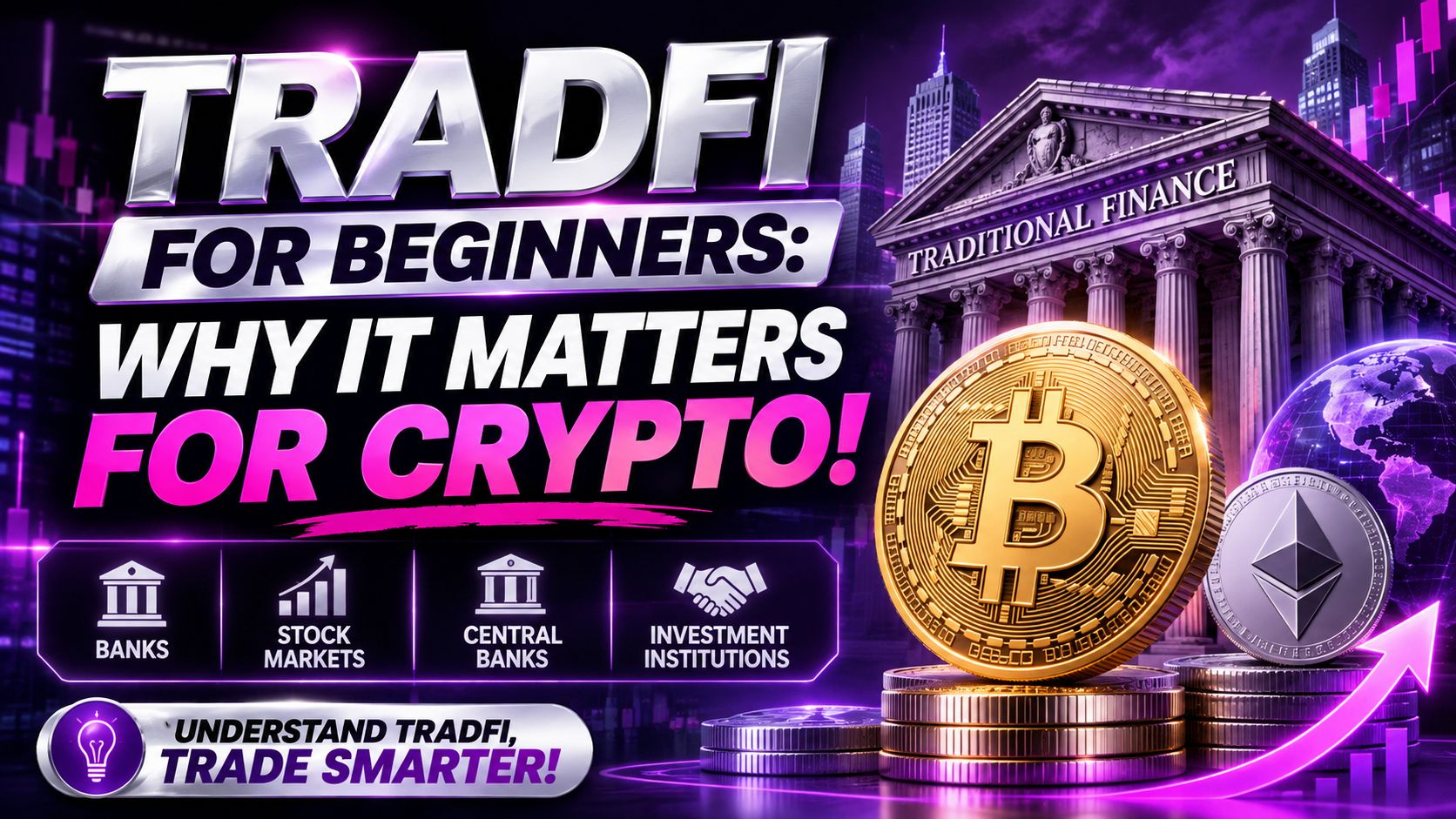
🚨 TRADFI FOR BEGINNERS: WHY IT MATTERS FOR CRYPTO!
Traditional Finance (TradFi) includes banks, stock markets, central banks, and investment institutions.
💡 Why Should Crypto Traders Care?
- Interest rate decisions can influence Bitcoin and crypto prices.
- Institutional investments can impact market liquidity.
- Inflation and dollar strength affect investor sentiment.
- Tokenization is connecting traditional assets with blockchain technology.
📊 Market Insight:
Crypto doesn't move independently. Global economic conditions and traditional financial markets can influence crypto trends.
The Bottom Line: Understanding TradFi helps crypto investors see the bigger picture instead of focusing only on Bitcoin price movements.
💬 Will TradFi and DeFi eventually become one financial ecosystem?
#TradFiForBeginners #Bitcoin #CryptoEducation
$BTC
{future}(BTCUSDT)
$KERNEL
{future}(KERNELUSDT)
$BLESS
{future}(BLESSUSDT)
#TradFiForBeginners
🚨 TRADFI FOR BEGINNERS: WHY IT MATTERS FOR CRYPTO!
Traditional Finance (TradFi) includes banks, stock markets, central banks, and investment institutions.
💡 Why Should Crypto Traders Care?
- Interest rate decisions can influence Bitcoin and crypto prices.
- Institutional investments can impact market liquidity.
- Inflation and dollar strength affect investor sentiment.
- Tokenization is connecting traditional assets with blockchain technology.
📊 Market Insight:
Crypto doesn't move independently. Global economic conditions and traditional financial markets can influence crypto trends.
The Bottom Line: Understanding TradFi helps crypto investors see the bigger picture instead of focusing only on Bitcoin price movements.
💬 Will TradFi and DeFi eventually become one financial ecosystem?
#TradFiForBeginners #Bitcoin #CryptoEducation
$BTC
$KERNEL
$BLESS
416
·
--
🚨 YOU'RE TRADING $BTC BUT DON'T UNDERSTAND HOW MONEY WORKS?! 💀💰
THIS IS WHY BEGINNERS NEED TO LEARN TRADFI FIRST!
Before crypto, there was Traditional Finance — the system behind banks, stocks, bonds and global capital markets.
🔥 HERE ARE 5 THINGS EVERY TRADER SHOULD KNOW:
🏦 Banks: Manage deposits, payments and lending.
📈 Stocks: Represent ownership in companies.
💵 Bonds: Let governments and businesses borrow money from investors.
🏛️ Central Banks: Influence interest rates and financial conditions.
📊 ETFs: Offer exposure to a basket of assets through a single fund.
HERE'S THE REALITY:
You can memorize 100 candlestick patterns and still lose money if you don't understand liquidity, interest rates and risk.
💥 LEARN THE SYSTEM BEFORE TRYING TO BEAT IT.
👀 BE HONEST — DID YOU LEARN TRADFI BEFORE CRYPTO, OR DID YOU JUMP STRAIGHT INTO MEMECOINS? 😂
$BTC $ETH $BNB
#tradfiforbeginners #CanBTCReboundAfterFallingBelow60K? #GlobalStocksFaceLongestLosingStreakSince2023 #NvidiaBoardReportedlySplitOverHuang’sReturn #TetherBurns8BillionUSDTInPast20Days
1
108
·
--
#tradfiforbeginners 🦖 CRYPTO TRADERS, TIME TO LEARN WALL STREET LANGUAGE! (PART 2) 📉
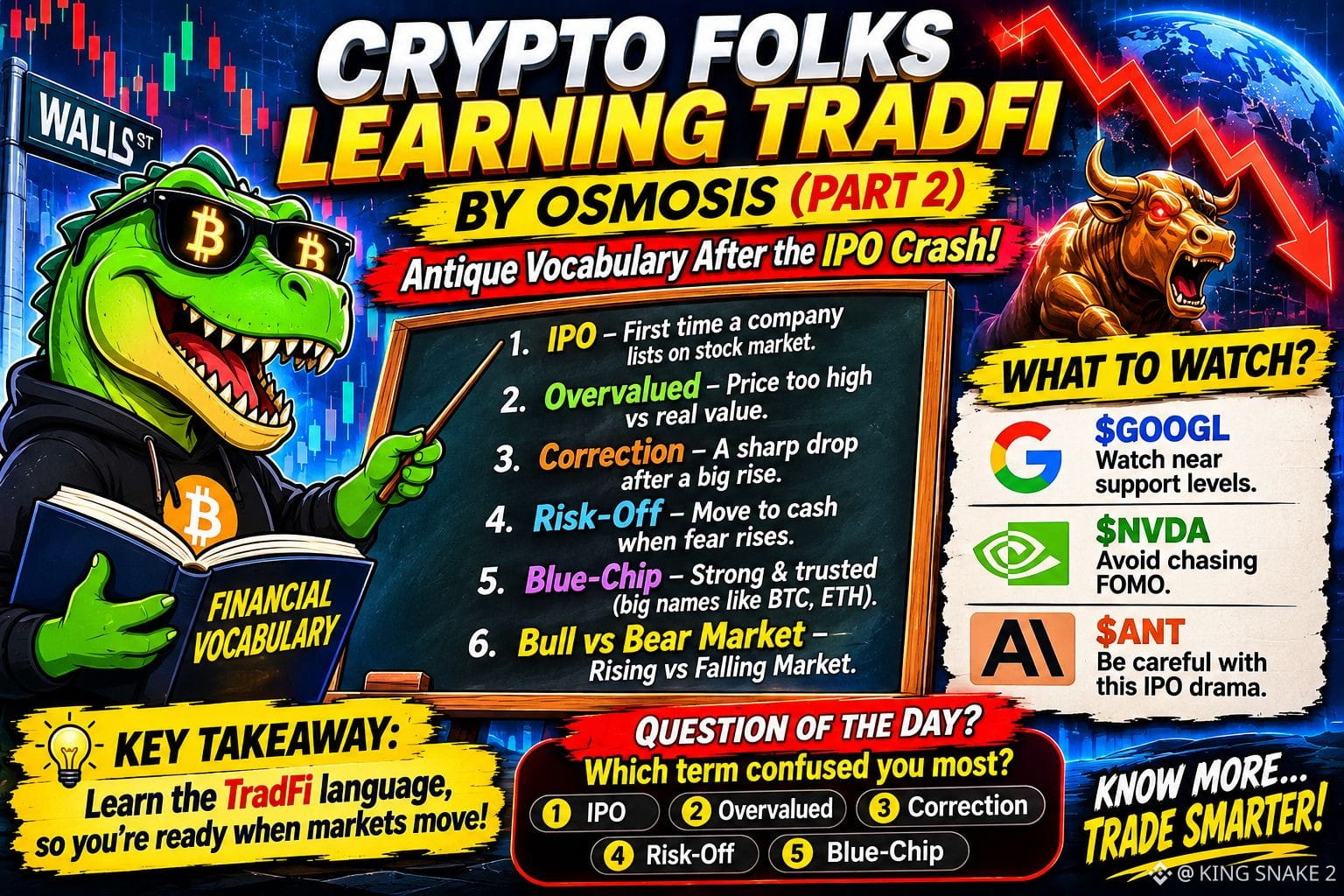
Crypto and traditional finance are more connected than ever. If you understand Wall Street terminology, you'll have a better idea of what's happening when global markets turn red.
Let's break down 6 important financial terms in simple language:
📚 1. IPO (Initial Public Offering)
The first time a private company offers its shares to the public on a stock exchange.
📚 2. Overvalued
When an asset is trading at a price much higher than its underlying fundamentals may justify.
📚 3. Market Correction
A significant price decline after an asset or market rises too quickly.
📚 4. Risk-Off
When investors become nervous and move money away from risky assets like tech stocks and crypto into safer investments such as cash and government bonds.
📚 5. Blue-Chip
A term for established, financially strong companies with a reputation for stability. In crypto, BTC and ETH are sometimes informally called blue-chip assets.
📚 6. Bull vs. Bear Market
🐂 Bull Market = Prices are generally rising.
🐻 Bear Market = Prices are generally falling.
💡 WHAT SHOULD CRYPTO TRADERS LEARN FROM THIS?
When Wall Street experiences fear, crypto markets can also face selling pressure.
Keep an eye on:
🔹 $GOOGL: Watch how it reacts around important support levels.
🔹 $NVDA: Monitor tech-sector sentiment and avoid chasing sudden price moves.
🔹 Anthropic: Follow verified company and IPO developments rather than relying on market rumors.
⚠️ MY MESSAGE:
Don't just watch Bitcoin's price. Understand the global financial system behind it.
The more you learn, the better prepared you can be when market conditions change.
🤔 QUESTION OF THE DAY:
Which financial term was the most confusing for you before this post?
1️⃣ IPO
2️⃣ Overvalued
3️⃣ Correction
4️⃣ Risk-Off
5️⃣ Blue-Chip
Drop your answer below! 👇
#CryptoEducation #Bitcoin #BTC #Ethereum
CLICK TO BELOW TARDE👇
$GOOGL $NVDA $ANT
{future}(ANTUSDT)
{future}(NVDAUSDT)
{future}(GOOGLUSDT)
#tradfiforbeginners 🦖 CRYPTO TRADERS, TIME TO LEARN WALL STREET LANGUAGE! (PART 2) 📉
Crypto and traditional finance are more connected than ever. If you understand Wall Street terminology, you'll have a better idea of what's happening when global markets turn red.
Let's break down 6 important financial terms in simple language:
📚 1. IPO (Initial Public Offering)
The first time a private company offers its shares to the public on a stock exchange.
📚 2. Overvalued
When an asset is trading at a price much higher than its underlying fundamentals may justify.
📚 3. Market Correction
A significant price decline after an asset or market rises too quickly.
📚 4. Risk-Off
When investors become nervous and move money away from risky assets like tech stocks and crypto into safer investments such as cash and government bonds.
📚 5. Blue-Chip
A term for established, financially strong companies with a reputation for stability. In crypto, BTC and ETH are sometimes informally called blue-chip assets.
📚 6. Bull vs. Bear Market
🐂 Bull Market = Prices are generally rising.
🐻 Bear Market = Prices are generally falling.
💡 WHAT SHOULD CRYPTO TRADERS LEARN FROM THIS?
When Wall Street experiences fear, crypto markets can also face selling pressure.
Keep an eye on:
🔹 $GOOGL : Watch how it reacts around important support levels.
🔹 $NVDA : Monitor tech-sector sentiment and avoid chasing sudden price moves.
🔹 Anthropic: Follow verified company and IPO developments rather than relying on market rumors.
⚠️ MY MESSAGE:
Don't just watch Bitcoin's price. Understand the global financial system behind it.
The more you learn, the better prepared you can be when market conditions change.
🤔 QUESTION OF THE DAY:
Which financial term was the most confusing for you before this post?
1️⃣ IPO
2️⃣ Overvalued
3️⃣ Correction
4️⃣ Risk-Off
5️⃣ Blue-Chip
Drop your answer below! 👇
#CryptoEducation #Bitcoin #BTC #Ethereum
CLICK TO BELOW TARDE👇
$GOOGL $NVDA $ANT
666

·
--
#TradFiForBeginners
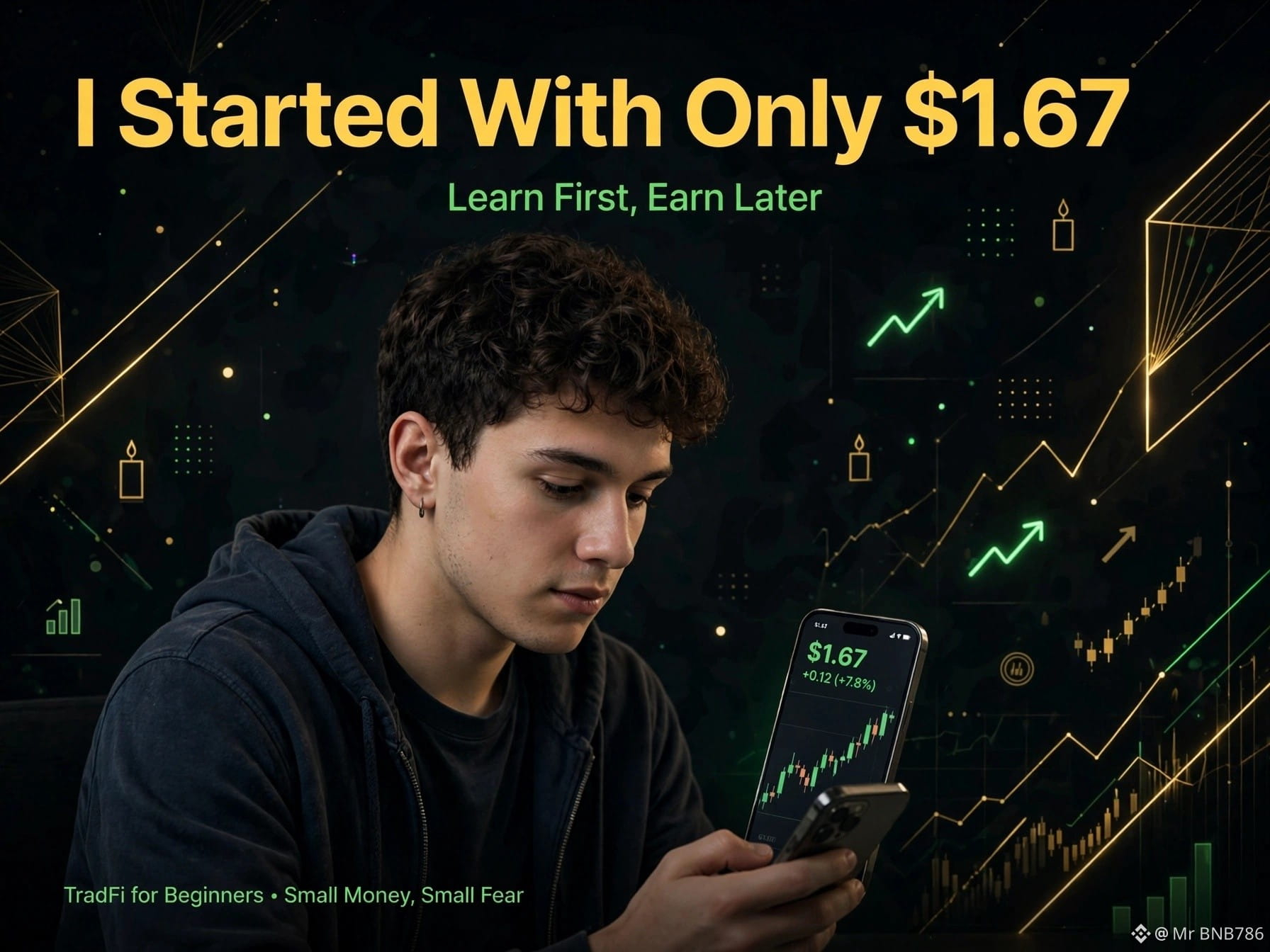
I Started With Only $1.67 - Here's What TradFi Taught Me*
I didn't start trading with $1000.
I started with just $1.67.
Most people think you need big money to learn trading.
You don't. You need patience.
TradFi taught me 3 simple lessons:
*1. Don't chase profit, chase learning*
My first goal was not to earn. It was to understand how market moves.
*2. Small money = Small fear*
When you trade with $1, you learn without panic. When you trade with $1000 without learning, you lose with panic.
*3. Earn is better than gambling*
Instead of doing risky Futures, I learned to keep my small money in Flexible Earn. Slow profit is better than fast loss.
If you are a beginner, don't ask "How much will I earn?"
Ask "How much will I learn?"
Money will follow learning.
Are you a beginner too? How much did you start with?
#TradFiForBeginners #BinanceSquare #CryptoForBeginners #LearnAndEarn
114

·
--
Bullish
#TradFiForBeginners
📚 TradFi for Beginners: Understanding Traditional Finance! 💰
New to finance? Let's start with the basics!
🌍 What is TradFi?
TradFi stands for Traditional Finance. It refers to the conventional financial system that includes banks, stock markets, insurance companies, and other financial institutions.
🔑 5 Key Parts of TradFi:
1️⃣ Banks: Store money, provide loans, and facilitate payments.
2️⃣ Stock Markets: Allow investors to buy and sell company shares.
3️⃣ Bonds: Ways for governments and companies to borrow money from investors.
4️⃣ Forex: The global market for exchanging currencies.
5️⃣ Commodities: Trading assets like gold, silver, oil, and natural gas.
⚡ TradFi vs DeFi
🏦 TradFi: Usually operates through centralized institutions and intermediaries.
🔗 DeFi: Uses blockchain and smart contracts to provide financial services without traditional intermediaries.
💡 Why should crypto beginners understand TradFi?
Because traditional financial markets influence liquidity, interest rates, investor sentiment, and sometimes cryptocurrency prices.
🎯 Remember: Understanding TradFi is one step towards becoming a smarter investor.
👇 What would you like to learn next: Stocks, Bonds, Forex, or DeFi?
#TradFiForBeginners #TradFi #DeFi!
1
26
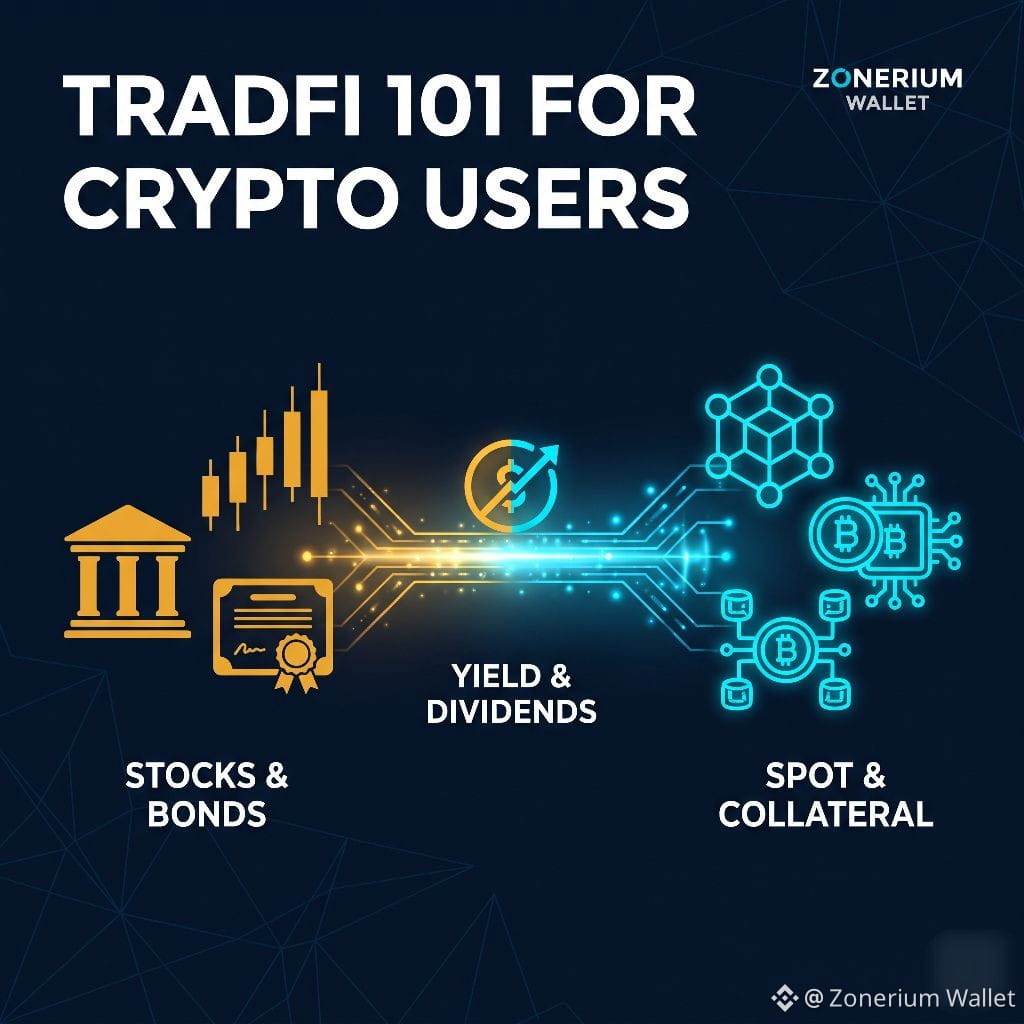
TradFi 101: The Wall Street Playbook Every Crypto User Should Know 🏦🔗
Long before the first crypto block was mined, Traditional Finance (TradFi) built the core concepts that power today’s markets. Understanding both worlds makes you a sharper investor:
🔸 Dividends: Company profits paid out to shareholders—similar to holding rewards in crypto.
🔸 Yield: The return generated on your capital over time, the traditional cousin of staking.
🔸 Collateral: Pledging an asset as security to borrow funds, just like margin and DeFi lending.
🔸 Spread: The gap between the highest buy price (bid) and lowest sell price (ask).
🔸 Spot Price: The live market price for buying or selling an asset right now.
🔸 Stocks & Bonds: Stocks give you equity ownership in a company, while bonds represent debt instruments that pay regular interest (coupons).
#TradFiForBeginners #NvidiaBoardReportedlySplitOverHuang’sReturn
61

·
--
Bullish
#tradfiforbeginners
📘 TradeFi for Beginners: Start With Risk Management, Not Hype
For beginners entering crypto, TradeFi is best approached as a learning framework rather than a shortcut to profits.
The key concepts are understanding market structure, liquidity, volatility, position sizing, and risk management before focusing on potential returns. Traders who enter without a defined plan can easily make emotional decisions during sharp market moves.
A practical approach is to start small, study how different assets react to market conditions, and keep leverage limited or avoid it entirely while learning.
From a trader’s perspective, the biggest advantage for a beginner is not predicting every move — it is protecting capital and developing consistency.
Bottom line: Learn the market first, manage risk second, and only then think about increasing exposure.
#TradeFi #CryptoTrading #TradingForBeginners #RiskManagement $EVAA $UVXY $ICNT
{future}(ICNTUSDT)
{future}(UVXYUSDT)
{future}(EVAAUSDT)
#tradfiforbeginners
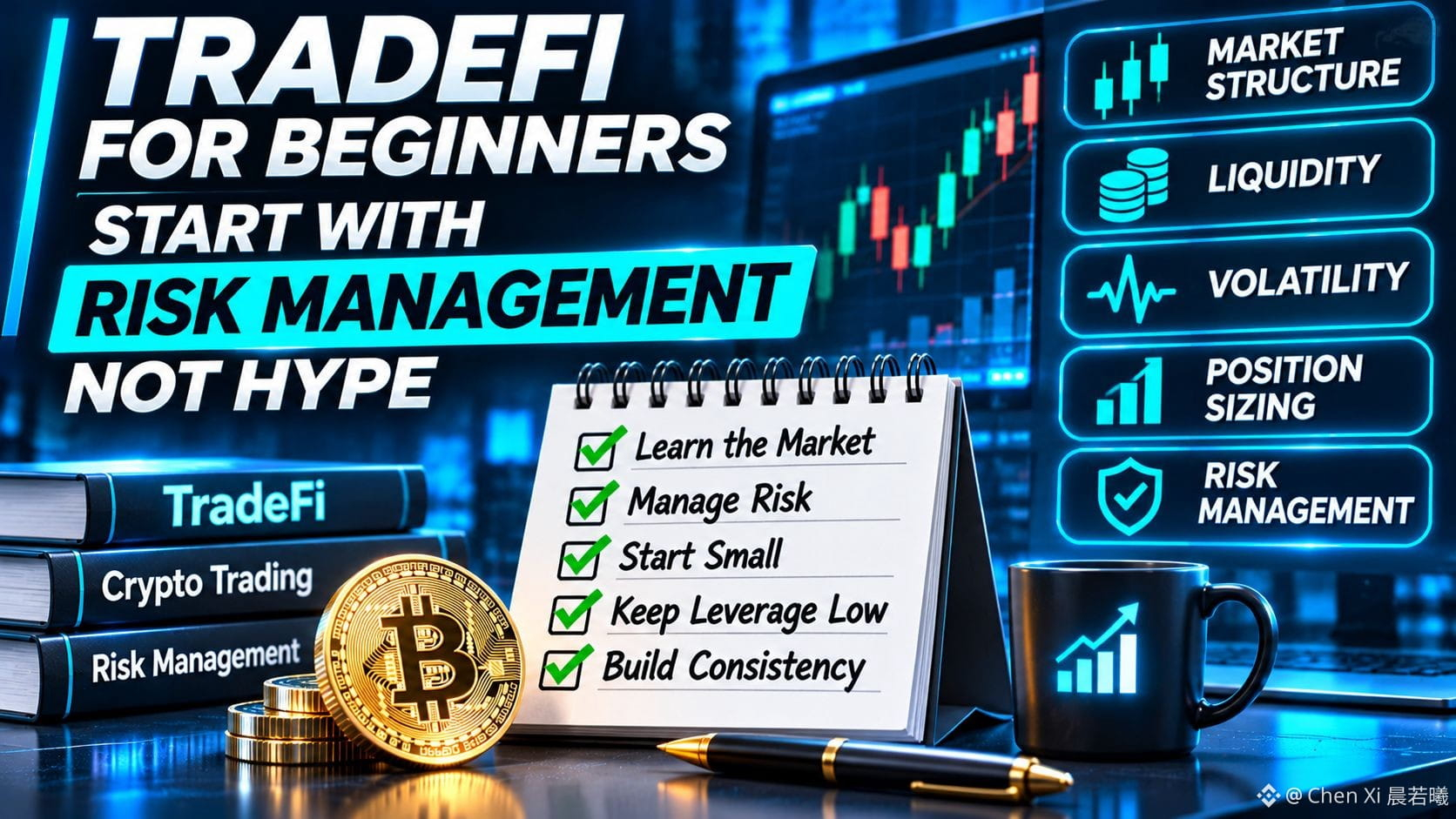
📘 TradeFi for Beginners: Start With Risk Management, Not Hype
For beginners entering crypto, TradeFi is best approached as a learning framework rather than a shortcut to profits.
The key concepts are understanding market structure, liquidity, volatility, position sizing, and risk management before focusing on potential returns. Traders who enter without a defined plan can easily make emotional decisions during sharp market moves.
A practical approach is to start small, study how different assets react to market conditions, and keep leverage limited or avoid it entirely while learning.
From a trader’s perspective, the biggest advantage for a beginner is not predicting every move — it is protecting capital and developing consistency.
Bottom line: Learn the market first, manage risk second, and only then think about increasing exposure.
#TradeFi #CryptoTrading #TradingForBeginners #RiskManagement $EVAA $UVXY $ICNT
1
63

·
--
Bullish
Verified
#tradfiforbeginners 🦖 CRYPTO INVESTORS LEARNING TRADFI (PART 2): WALL STREET VOCABULARY EVERY TRADER SHOULD KNOW! 📉
The connection between traditional financial markets and cryptocurrency is becoming increasingly important. Recent market movements following Anthropic's historic IPO have reminded investors that Wall Street sentiment can influence the entire financial ecosystem.
Anthropic, the company behind Claude AI, made its Nasdaq debut under ticker $ANT on November 19, 2026. The company priced its shares at $83, opened at $111.50 and closed its first trading session at $97.17.
However, the broader US stock market struggled. The S&P 500 recorded its sixth consecutive losing session, while technology stocks remained under pressure.
Let's understand some important financial terms in simple language:
📚 6 TRADFI TERMS EVERY CRYPTO TRADER SHOULD UNDERSTAND
🔸 1. IPO (Initial Public Offering)
An IPO happens when a private company offers its shares to public investors for the first time through a stock exchange. Think of it as a company's entry into the public stock market.
🔸 2. Overvalued
A company is considered overvalued when its market price appears higher than what its financial performance and future prospects reasonably justify. A rising price doesn't always mean a good investment.
🔥 3 MARKET ASSETS TO WATCH
📌 $ANTB — Anthropic's newly listed stock. Investors are watching its valuation, profitability and ability to sustain AI growth.
📌 $NVDAB — Nvidia remains a major player in AI chips and data-centre infrastructure. Watch earnings, demand and valuation.
📌 $GOOGLB — Alphabet is a major technology and AI company. Its
Education only. DYOR. Not financial advice.
#TradFi #CryptoLearning #WallStreet #MarketCorrection #Bitcoin #Anthropic #StockMarket #BinanceSquare

404

Article
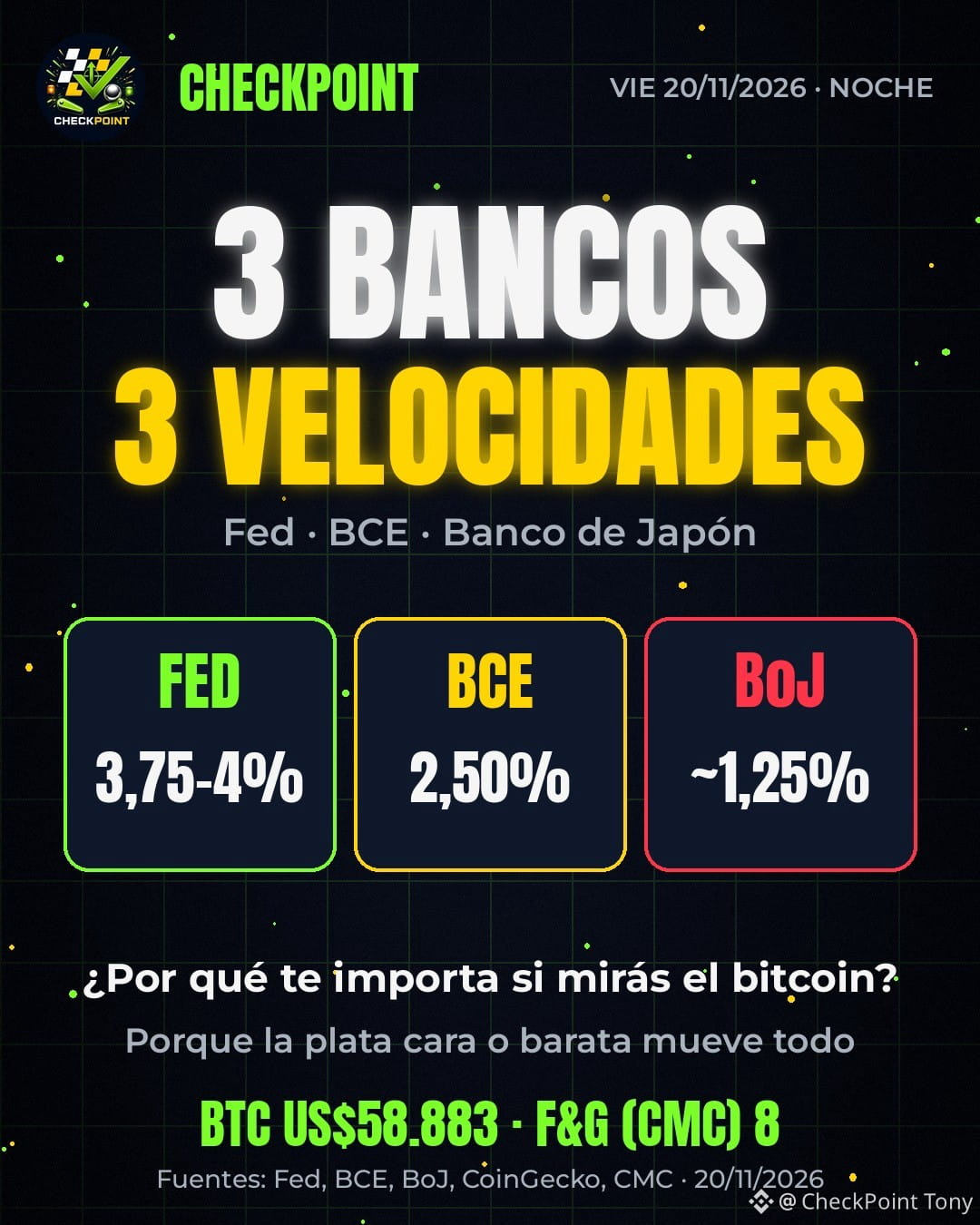
Three banks, three speeds: what almost no one is watching as bitcoin fallsThree banks, three speeds: the world doesn’t have a single interest rate, and that changes where it makes sense to put your money.
Today, Friday 11/20/2026, Bitcoin is hovering around US$58,900 (−4.8% in 24 hours, CoinGecko), and the CMC/Binance Fear & Greed Index reads 8: extreme fear. While everyone watches the price, almost no one is looking at what really moves the needle: what central banks charge to lend money.
THE NUMBERS (official sources)
• Fed (U.S.): range of 3.75%–4%. At its 10/28 meeting, it held rates steady, but the vote was 10 to 2: the two dissenters wanted to RAISE rates by 0.25 percentage points. The minutes, published on 11/18, say it was “a very close decision” and that almost everyone thinks rates will need to rise further down the road. Next meeting: December 8 and 9.
Three banks, three speeds: what almost no one is watching as bitcoin falls
Three banks, three speeds: the world doesn’t have a single interest rate, and that changes where it makes sense to put your money.
Today, Friday 11/20/2026, Bitcoin is hovering around US$58,900 (−4.8% in 24 hours, CoinGecko), and the CMC/Binance Fear & Greed Index reads 8: extreme fear. While everyone watches the price, almost no one is looking at what really moves the needle: what central banks charge to lend money.
THE NUMBERS (official sources)
• Fed (U.S.): range of 3.75%–4%. At its 10/28 meeting, it held rates steady, but the vote was 10 to 2: the two dissenters wanted to RAISE rates by 0.25 percentage points. The minutes, published on 11/18, say it was “a very close decision” and that almost everyone thinks rates will need to rise further down the road. Next meeting: December 8 and 9.
38
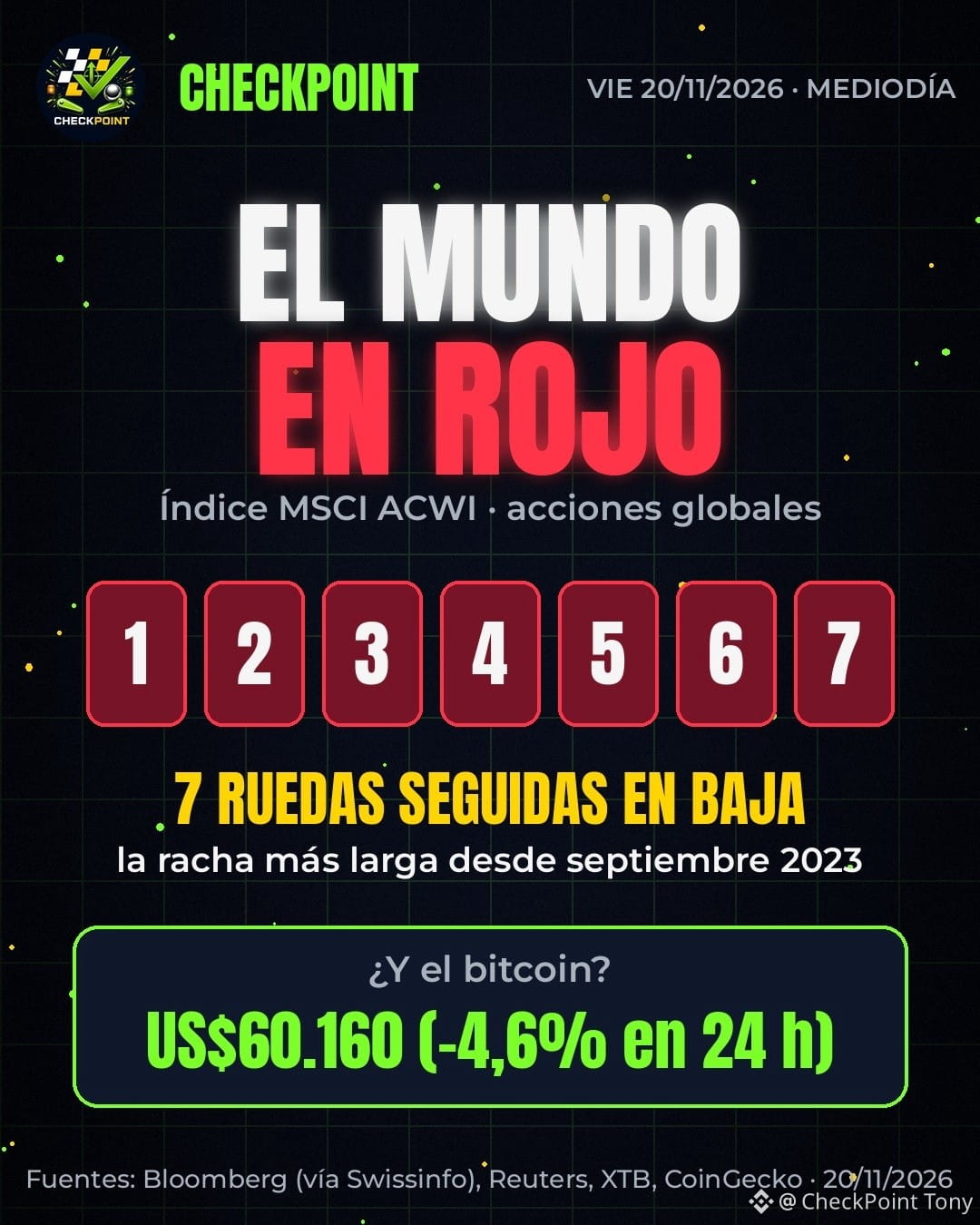
🌍 Seven days straight in the red. The entire world. This hasn’t happened since September 2023.
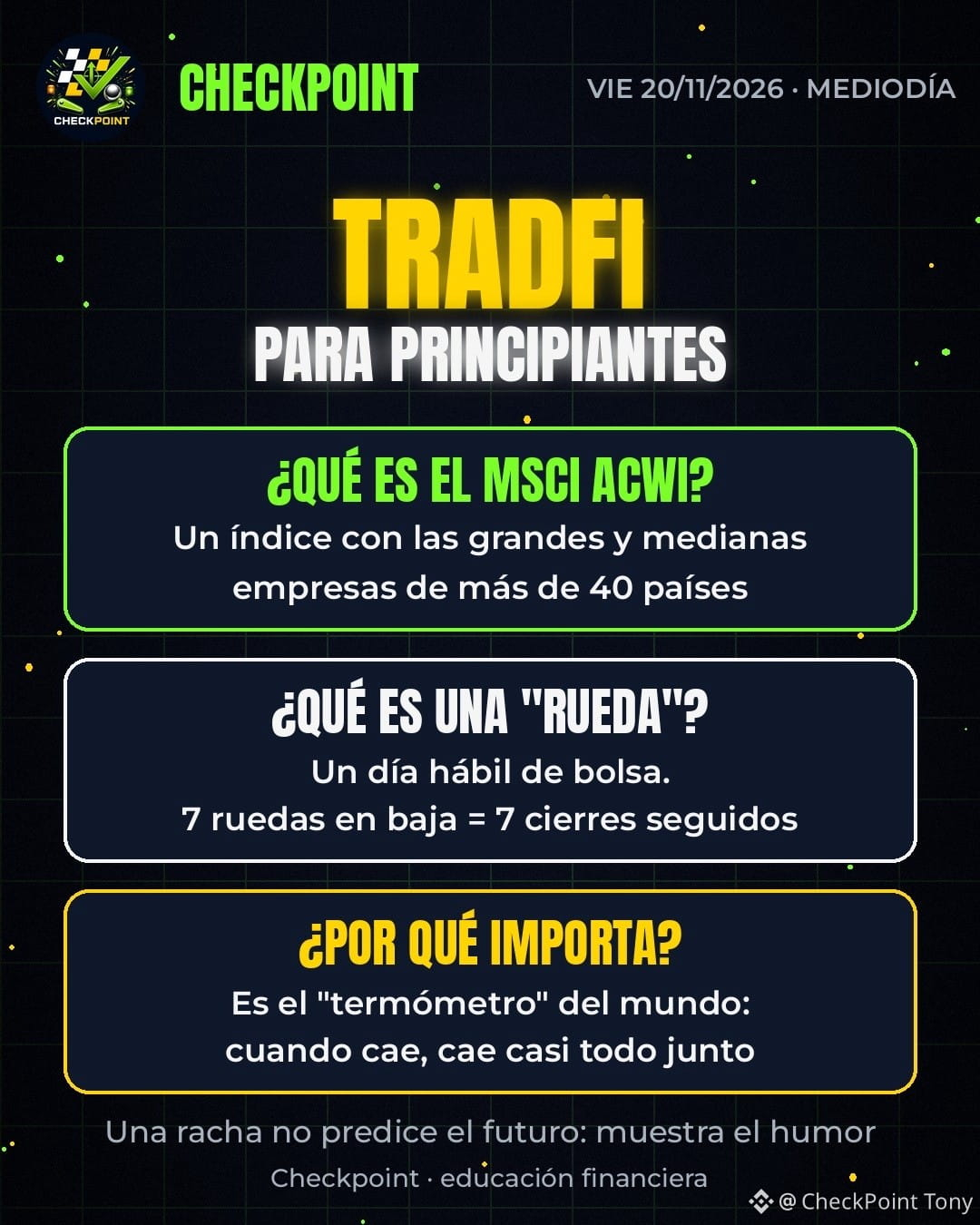
If you’re new to TradFi, here’s the no-nonsense version 👇
📊 What fell? The MSCI ACWI, an index that tracks large and mid-sized companies across more than 40 countries. It’s the global stock market’s thermometer: when it falls, almost everything falls at once.
📅 What’s a 7-session losing streak? A “session” is a trading day. Seven consecutive closes lower. It’s not a one-day crash: it’s a slow decline, the kind that wears you down.
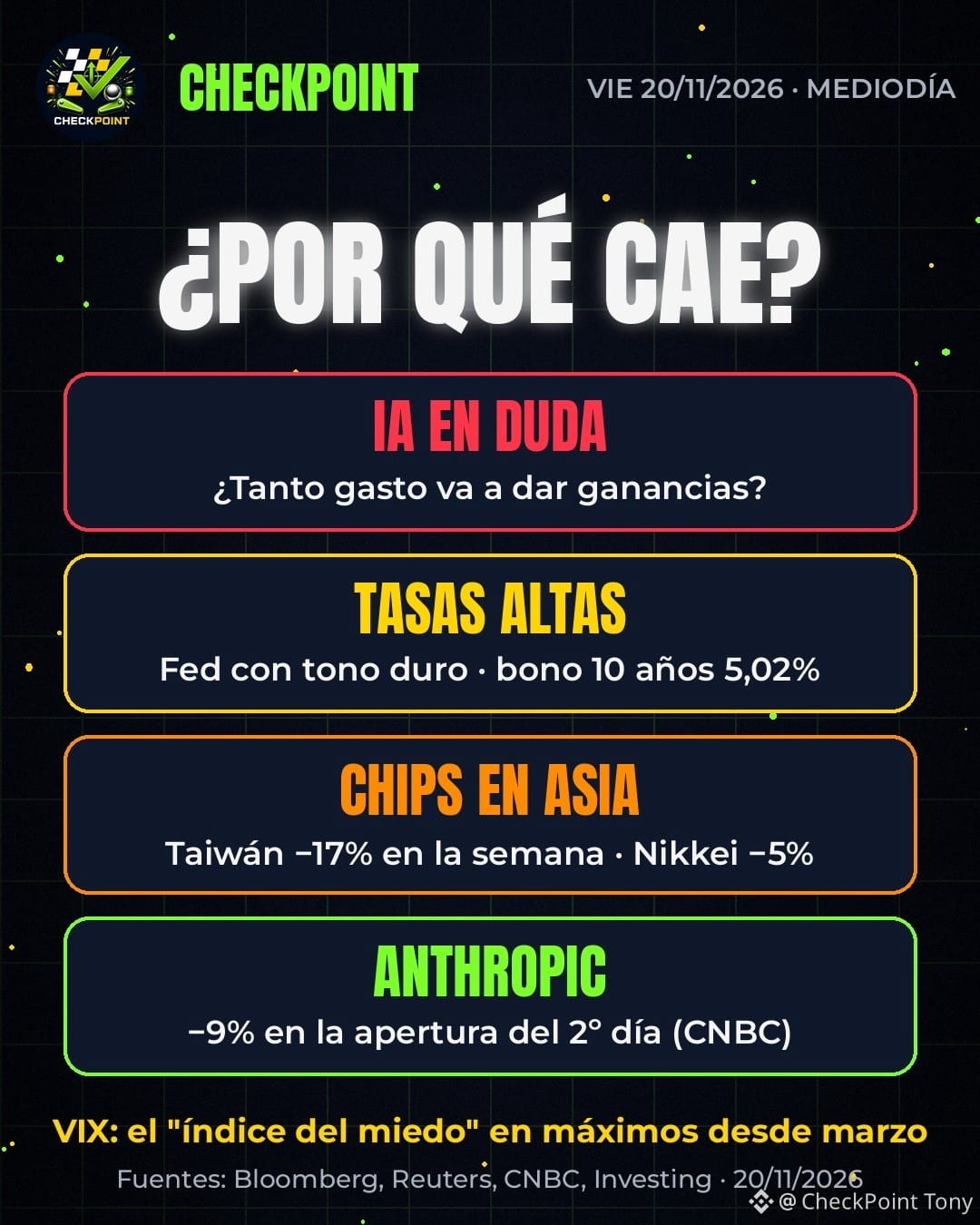
🔥 Why is it falling?
• AI doubts: the market is no longer asking whether there’s demand; it’s asking whether all that spending will generate profits.
• Interest rates: Fed officials are taking a hawkish tone, and the 10-year Treasury yield is at 5.02%. Expensive money = growth stocks take a hit.
• Chips: Asia is in panic mode. Nikkei down 5% today and Taiwan down 17% for the week, its worst performance since 1990 (Reuters).
• Anthropic: after yesterday’s record-breaking debut, it opened down 9% today (CNBC). The biggest IPO in history wasn’t enough to change the mood.
😨 The VIX, Wall Street’s “fear index,” hit its highest level since March. Money is rushing into bonds.
₿ And crypto? Far from a safe haven: $BTC is at US$60,160, down 4.6% in 24 hours (CoinGecko).
🧠 The lesson for beginners: a losing streak doesn’t tell you when it will end. It tells you how people are feeling. And today, the mood is fear. Those who bought indexes with a 10-year horizon have lived through worse streaks... but those who invested money they needed the following week didn’t have a good time.
What will hit bottom first: stocks or bitcoin? Let me know in the comments 👇
Follow Checkpoint to understand the market without the jargon.
#GlobalStocksFaceLongestLosingStreakSince2023 #TradFiForBeginners
Sources: Bloomberg (via Swissinfo), Reuters, CNBC, XTB, CoinGecko · 20/11/2026.
This is not financial advice.
1
244

·
--
#tradfiforbeginners 📚 TradFi for Beginners: What Is It and Why Does It Matter?
“TradFi” stands for Traditional Finance and includes banks, stock exchanges, bonds, investment funds, and financial systems that have existed for decades. 🏦📈
Many investors see cryptocurrencies as the future, but understanding TradFi helps explain how institutional money moves and why news about interest rates, ETFs, or central banks affects Bitcoin.
💡 Crypto and TradFi markets are more connected than ever.
👇 Do you think Crypto will replace TradFi, or will both coexist?
✅ Crypto will dominate
✅ They will coexist
✅ TradFi will continue to lead
#TradFi #Crypto #Bitcoin #BTC #BinanceSquare #Investments #Blockchain 🚀📊
43

#tradfiforbeginners
🏦 TradFi for beginners: what Wall Street really controls 🏛️
💳 Imagine paying with your debit card at a café at 2 a.m. Your screen says “approved,” but behind the scenes, the actual money remains locked until Monday morning.
🏛️ This invisible machinery is TradFi, short for “traditional finance.” It encompasses the familiar banks, stock exchanges, insurance giants, and central banks that manage global capital.
🔐 Unlike cryptocurrencies, where you hold your own keys, TradFi relies on trusted intermediaries to verify transactions, hold assets, and enforce strict government regulations.
📊 For decades, this centralized model has supported global economic growth through predictable credit and ample liquidity. Yet slow settlement times, high fees for cross-border payments, and weekend closures remain persistent bottlenecks.
⚖️ Today, the gap between traditional finance and digital assets is narrowing rapidly. Major banks now hold digital assets and tokenize real-world bonds, seeking to benefit from blockchain’s speed while meeting institutional compliance requirements.
💡 TradFi nevertheless involves counterparty risk. When a centralized institution blocks withdrawals or mismanages its reserves, ordinary users are left waiting in line.
🧭 Understanding how traditional financial infrastructure works helps you spot where capital will flow next, especially when macroeconomic interest rates shift market liquidity.
🚀 TradFi built the modern financial world, but blockchain is teaching it how to operate.
#TradFiForBeginners
$HUMA $EVAA $MMT

35

·
--
Bearish
Verified
CRYPTO FOLKS LEARNING TRADFI BY OSMOSIS (PART 2): ANTIQUE VOCABULARY AFTER THE IPO CRASH! 🦖📉
Following up on Part 1, today we're upgrading our vocabulary #tradfiforbeginners and diving straight into the latest drama: Anthropic's (ticker: ANT) IPO price-pumping scandal, which sent both Wall Street and Crypto markets tumbling around the world!
What's the deal?
🔸 IPO: The first time a company lists on the stock market (the original version of an ICO/IEO).
🔸 Overvalued: Priced sky-high compared to its actual value, just like ANT's price surge that left the market gasping for air.
🔸 Correction: A “flood of selling” that cools prices when a bubble has been inflated too much.
🔸 Risk-off: When the whales pull money out of risky assets (like tech stocks and Crypto) and pile into cash or bonds.
🔸 Blue-chip: Reputable, leading stocks (like BTC and ETH on our side).
🔸 Bear/Bull Market: Bear and bull markets—the original Wall Street terms that coin folks borrow and use all the time.
What should traders do? Learn this vocabulary by heart so you won't be “clueless” when you hear U.S. news at 9:30 p.m. every night, and know how to dodge the storm when the whales switch to Risk-off mode!
This is not financial advice.
#WallStreet #MarketCorrection #VINHTOCDO #IsAnthropic’s$1.5TMarketCapJustified?
Click Trade below to support me: $GOOGL
{future}(GOOGLUSDT)
$NVDA
{future}(NVDAUSDT)
$ANT
{future}(ANTUSDT)
CRYPTO FOLKS LEARNING TRADFI BY OSMOSIS (PART 2): ANTIQUE VOCABULARY AFTER THE IPO CRASH! 🦖📉
Following up on Part 1, today we're upgrading our vocabulary #tradfiforbeginners and diving straight into the latest drama: Anthropic's (ticker: ANT) IPO price-pumping scandal, which sent both Wall Street and Crypto markets tumbling around the world!
What's the deal?
🔸 IPO: The first time a company lists on the stock market (the original version of an ICO/IEO).
🔸 Overvalued: Priced sky-high compared to its actual value, just like ANT's price surge that left the market gasping for air.
🔸 Correction: A “flood of selling” that cools prices when a bubble has been inflated too much.
🔸 Risk-off: When the whales pull money out of risky assets (like tech stocks and Crypto) and pile into cash or bonds.
🔸 Blue-chip: Reputable, leading stocks (like BTC and ETH on our side).
🔸 Bear/Bull Market: Bear and bull markets—the original Wall Street terms that coin folks borrow and use all the time.
What should traders do? Learn this vocabulary by heart so you won't be “clueless” when you hear U.S. news at 9:30 p.m. every night, and know how to dodge the storm when the whales switch to Risk-off mode!
This is not financial advice.
#WallStreet #MarketCorrection #VINHTOCDO #IsAnthropic’s$1.5TMarketCapJustified?
Click Trade below to support me: $GOOGL
$NVDA
$ANT

8
425

🔴 Lesson 93: Very Important 👇
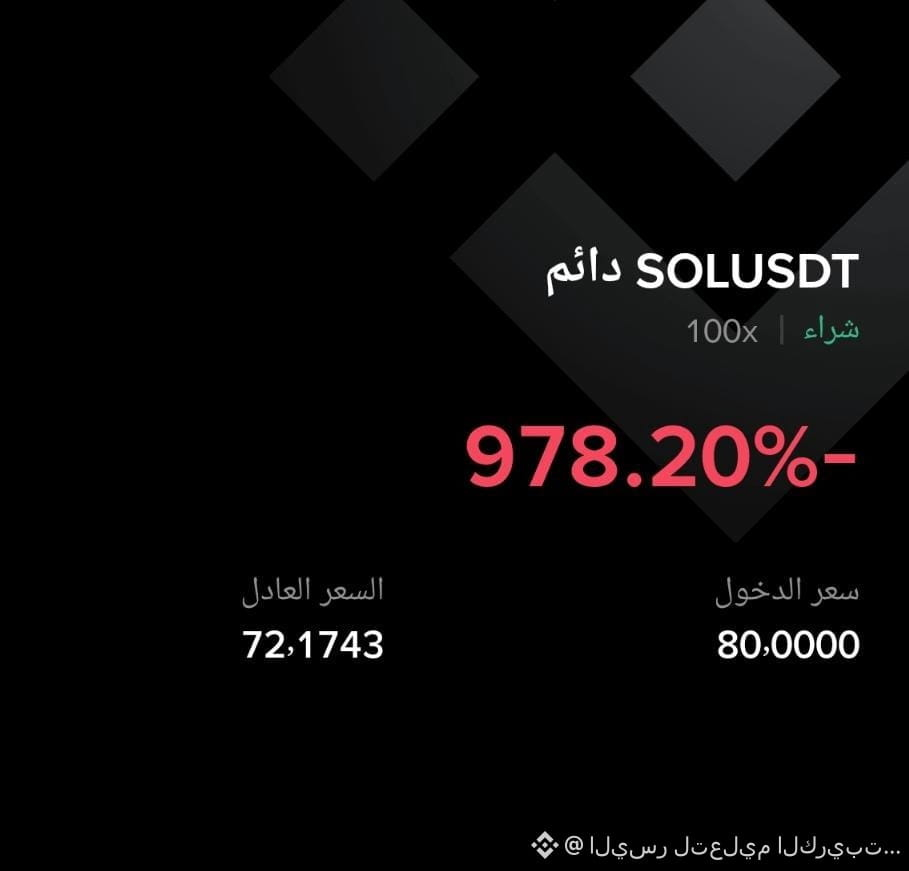
How can a 10% market drop turn into a -978% loss in your portfolio?! 😱📉
Hello, Al-Yusr Crypto Education family 👋
Today I saw a real trade by a trader who went long on a coin that had dropped by just 10%, but their loss reached -978%! 💸
Why? It’s the 100x leverage trap in futures trading! 💡 Compare for yourself:
1️⃣ Spot trading: A 10% drop means you still hold your coins and can wait for a rebound; your account can never be liquidated. 🛡
2️⃣ Futures (100x): A 1% move against you wipes out all your capital and forcibly closes your account! 🚨
💡 Al-Yusr rule: The safety and peace of mind of spot trading are worth more than the illusion of quick profits!
💬 Which camp are you in:
The safety of spot trading or the risk of futures?
Share your opinion in the comments! 👇
⚠️ Disclaimer: This content is for educational purposes and to raise awareness of risks. It is not financial advice (DYOR).
$BTC $BNB $SOL
#BinanceSquare
#TradFiForBeginners
#اليسر_لتعليم_الكريبتو
#إدارة_المخاطر
#تداول_فوري
{spot}(SOLUSDT)
🔴 Lesson 93: Very Important 👇
How can a 10% market drop turn into a -978% loss in your portfolio?! 😱📉
Hello, Al-Yusr Crypto Education family 👋
Today I saw a real trade by a trader who went long on a coin that had dropped by just 10%, but their loss reached -978%! 💸
Why? It’s the 100x leverage trap in futures trading! 💡 Compare for yourself:
1️⃣ Spot trading: A 10% drop means you still hold your coins and can wait for a rebound; your account can never be liquidated. 🛡
2️⃣ Futures (100x): A 1% move against you wipes out all your capital and forcibly closes your account! 🚨
💡 Al-Yusr rule: The safety and peace of mind of spot trading are worth more than the illusion of quick profits!
💬 Which camp are you in:
The safety of spot trading or the risk of futures?
Share your opinion in the comments! 👇
⚠️ Disclaimer: This content is for educational purposes and to raise awareness of risks. It is not financial advice (DYOR).
$BTC $BNB $SOL
#BinanceSquare
#TradFiForBeginners
#اليسر_لتعليم_الكريبتو
#إدارة_المخاطر
#تداول_فوري
OpheliaTrade:
yes I think 10x or 20x is enough if you have money in your wallet
10
3
169
Log in to explore more content
Join global crypto users on Binance Square
⚡️ Get latest and useful information about crypto.
💬 Trusted by the world’s largest crypto exchange.
👍 Discover real insights from verified creators.
Email / Phone number
Trending Topics
1
#CanBTCReboundAfterFallingBelow60K?
346,215 views
1,455 Discussing
2
#GlobalStocksFaceLongestLosingStreakSince2023
113,883 views
1,039 Discussing
3
#BlackRockIBITPostsRecord$541MSingleDayOutflow
503 views
14 Discussing
4
#AnthropicPlungesTowardIPOPriceonDay2
55,260 views
556 Discussing
5
#TwentyOneCapitalAdds172.25BTC
8,054 views
129 Discussing
6
#HKBillWouldExcludeTokenizedDepositsFromVirtualAssets
721 views
13 Discussing
7
#BNBDropsBelow540USDTWith8.46%DailyDecline
29,042 views
240 Discussing
8
#HKBillProposesHK$100KFineForUnauthorizedCryptoTitles
957 views
14 Discussing
9
#BitMineFaces$10.1BUnrealizedETHLoss
1,922 views
18 Discussing
10
#StrategyReports$35BNetReserves
1,763 views
17 Discussing